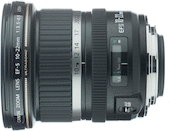
![]() Canon’s ultra-wide zoom for crop frame cameras (T3i, 7D, 60D etc…) only. On these cameras the range is very similar to the Canon 16-35 on a full frame camera. The lens is very sharp. It has amazingly little distortion and is surprisingly resistant to lens flare for such a wide zoom. Only Works With: Crop sensor cameras (T3i, 7D, 60D etc…) Roger’s Take: Comparing the ultra-wide, crop sensor camera lenses is an extremely difficult task, so I’ll put the summary first: they all deliver excellent image quality and you can’t go wrong with any of them. To my ‘just taking pictures’ assessment they are all excellent. There are some differences though, so I’ll try to point those out so you have a better chance at choosing the one that’s best for you. The Sigma 8-16 f/4.5-5.6 is the widest (and remember, 8mm is 20% wider than 10mm, so it’s a very real difference). Not quite as sharp in the corners as the others, and lower maximum aperture, but it’s really pretty good, especially considering it’s the widest of the wide. The Canon 10-22 f/3.5-4.5 is arguably the most flare resistant, the smallest and lightest when that’s important, and has low distortion. It’s also the most expensive and vignettes a bit. I like it a lot, though, and often find myself preferring it because of its small size. The Sigma 10-20 f/3.5 has a bit more distortion than the others but delivers very nice images and is also built much better than the Canon 10-22. It does everything well. The Tokina 11-16 f/2.8 gives you the widest aperture if you’ll be working in low light (with ultra wides, depth of field is rarely an important point), but it’s a bit soft at f/2.8, so the aperture advantage isn’t huge (I usually shoot it at f/3.5 if I can to get it sharper). It has very little vignetting and distortion, probably the least of the group. Unfortunately, it does show quite a bit of chromatic aberration at times. Overall it may be the best image quality of the group. The Tokina 12-24 f/4 PRO DX II is built like a sturdy tank (and therefore a bit heavier). It does tend to give low contrast images when shot into the sun but is quite sharp otherwise. This is the one I’d take if conditions were rough: I pity the rock this bad boy falls on. Poor rock. But like I said above: they’re all excellent. We hardly ever get anything but happy comments about any of them. Note: We have removed the “high risk lens” designation for the Canon 10-22 EF-S. Failure rates have dropped dramatically in the last 6 months. Does Not Include: lens hood Please note: Use of standard (non Ultra Thin) Circular Polarizing filters will result in a slight bit of vignetting with this lens. Specs:
Links:MTF Chart:
Thick lines: 10 lines/mm; thin lines: 30 lines/mm. The darker black lines represent the MTF characteristics at maximum aperture; the blue lines at f/8. The solid lines trace the radical S (sagittal) curve, while the broken lines trace the tangential M (meridional) curve. If you are bored and don’t understand MTF charts, you can read about them HERE Lens Diagram:
PricingLensRentals.com offers rentals of every length between 4 and 90 days. Some common selections are:
The shopping cart will automatically update the quoted price as you adjust the length of your rental. LensRentals also offers an optional damage waiver on this product, limiting your expense should it get damaged while in your possession.
ShippingLensRentals.com ships via UPS 2-day service, unless your rental requires faster shipping. Return shipping is included in the shipping price, and we include a prepaid return label with your order—all you need to do is bring it to a UPS drop-off location when your rental is complete. The shopping cart can automatically quote shipping, even for multi-item and oversize orders. Shipping multiple items together offers significant savings over shipping them individually. |