7-day rental
+$29 shipping

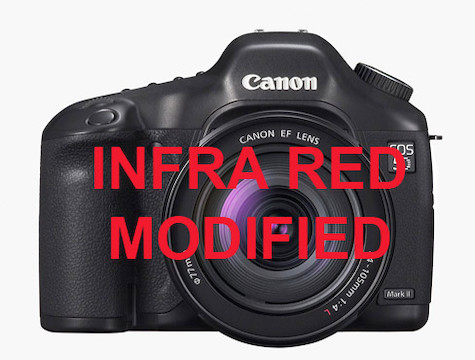
Canon 5D Mark II IR Modified (715nm)

In Stock

Canon 5D Mark II IR Modified (715nm)

Please note: we carry two types of IR modified 5D Mark IIs. This is the 715nm conversion.

We have had this 5D mark II modified for IR photography by MaxMax. They removed the low-pass filter, and replaced it with an internal 715nm infrared filter. Instead of capturing three different colors of visible light, the camera now sees three different wavelengths in the near-infrared spectrum.

Unlike IR filters, you can use an IR-modified camera just as you would a normal SLR: autofocus works, live view works, and in-camera metering works. Exposure times are as short as you would have shooting the camera normally—often even a little shorter, since current sensor designs seem to be more sensitive to IR light.

For those of you who are not familiar with IR photography, the look is very different: you’ll want to read up on shooting in IR and the post-processing required for the images.

Please note, the modification disables the automatic sensor cleaning function so the camera may report to an error when powering up if you set it to clean the sensor when starting up. Ignore this, it will work just fine.

What’s the difference between 715nm and 830nm conversions?

Truth is not a whole lot. The 715 conversion lets in red visible light, the 830nm conversion doesn’t so there are some noticeable differences:

  • Exposure time on an 830nm conversion will be longer, 2 to 3 times longer than the 715 conversion (both cameras autoexpose accurately, though). This can be the difference between ‘need a tripod’ and ’don’t need a tripod’.
  • The 830nm conversion uses all three channels (R, G, B) fairly equally, while the 715nm uses mostly the red channel. In theory this should make the 830 images a bit sharper. In practice, maybe, maybe not.
  • The 830nm conversion has a “more IR” look: skies are darker, clouds whiter.
  • You can get images with a 730nm in artificial light, but indoors (especially with fluorescent light) there’s not enough IR floating around to really get a picture.

Truth is, unless you are waaayyyyy into this, it doesn’t make a lot of difference — unless for some weird reason you’re shooting IR under fluorescent light, then avoid the 830nm. I can’t imagine why anyone would do that, but I know for certain if I don’t mention it somebody will.

You can find more information and a few thumbnails comparing shots from the two versions HERE

In case you need them.

Lens List

Lenses behave differently when used for IR. Some great visible light lenses aren’t great in IR; Canon neither tests nor optimizes for IR functionality. Here’s a list we’ve been able to assemble, although it’s incomplete.

Good for IR Photography

  • Canon EF 17-40mm f/4L
  • Canon EF-S 17-85mm f/4-5.6 IS
  • Nikon 18-200 VR
  • Canon EF 24-70mm f/2.8L
  • Canon EF 24-105mm f/4L IS
  • Canon EF 28-135mm/3.5-5.6 IS
  • Canon EF 28mm f/2.8
  • Nikon 35mm f/2.0
  • Canon EF 50mm f/1.8
  • Canon EF 70-200mm f/4L
  • Canon EF 70-300mm f/4-5.6 IS USM
  • Canon EF 75-300mm f/4-5.6 IS
  • Nikon 85mm f1.8
  • Canon EF 135mm f/2L
  • Canon EF 100-400mm f/4-5.6L IS
  • Canon EF 100mm f/2.8 Macro
  • Canon TS-E 24mm f/3.5 L
  • Tamron 28-300mm XR
  • Sigma 105mm f/2.8 EX DG Macro
  • Canon 400 f5.6

Not Recommended

  • Canon EF-S 10-22mm f/3.5-4.5
  • Canon EF 85mm f/1.8
  • Canon EF 200mm f/2.8L
  • Canon EF 15mm f/2.8 Fisheye
  • Canon EF 16-35mm f/2.8L (I or II)
  • Canon EF-S 18-55mm f/3.5-5.6
  • Canon EF 20mm f/2.8
  • Canon EF 20-35mm f/3.5-4.5 USM
  • Canon EF 24mm f/2.8
  • Canon EF 24-85mm f/3.5-4.5
  • Canon EF 28-70mm f/2.8L
  • Canon EF 28-105mm f/3.5-4.5
  • Canon EF 35mm f/2
  • Canon EF 35-80mm f/4-5.6
  • Canon EF 50mm f/1.4
  • Canon EF 50mm f/2.5 Macro
  • Canon EF 70-200mm f/2.8L IS
  • Canon EF 70-300mm f/4.5-5.6 DO IS
  • Nikon 70-300mm VR
  • Canon EF 85mm f/1.8
  • Sigma 10-20mm f/4.0-5.6 EX DC HSM
  • Sigma 17-70mm f/2.8-4.5
  • Sigma 18-50mm f/2.8 EX
  • Sigma 30mm f/1.4
  • Sigma 70-200mm f/2.8
  • Tamron 18-200mm f/3.5-6.3 AF XR (IF) Di-II
  • Tamron 70-300mm Macro
  • Tokina 12-24mm f/4

Pricing

LensRentals.com offers rentals of every length between 4 and 90 days. Some common selections are:

Rental Period Price Day Rate
4 days $146.25 ~$36.57 per day
7 days $195.00 ~$27.86 per day
10 days $263.25 ~$26.33 per day
14 days $341.25 ~$24.38 per day
21 days $458.25 ~$21.83 per day
30 days $575.25 ~$19.18 per day
45 days $750.75 ~$16.69 per day
60 days $877.50 ~$14.63 per day
90 days $1,131.00 ~$12.57 per day

The shopping cart will automatically update the quoted price as you adjust the length of your rental.

LensRentals also offers an optional damage waiver on this product, limiting your expense should it get damaged while in your possession.

Rental Period Waiver Price Total Price Day Rate
4 days +$24.75 $171.00 $42.75 per day
7 days +$33.00 $228.00 ~$32.58 per day
10 days +$44.50 $307.75 ~$30.78 per day
14 days +$57.75 $399.00 $28.50 per day
21 days +$77.50 $535.75 ~$25.52 per day
30 days +$97.25 $672.50 ~$22.42 per day
45 days +$127.00 $877.75 ~$19.51 per day
60 days +$148.50 $1,026.00 $17.10 per day
90 days +$191.50 $1,322.50 ~$14.70 per day

Shipping

LensRentals.com ships via UPS 2-day service, unless your rental requires faster shipping. Return shipping is included in the shipping price, and we include a prepaid return label with your order—all you need to do is bring it to a UPS drop-off location when your rental is complete.

The shopping cart can automatically quote shipping, even for multi-item and oversize orders. Shipping multiple items together offers significant savings over shipping them individually.