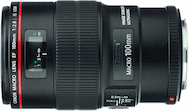
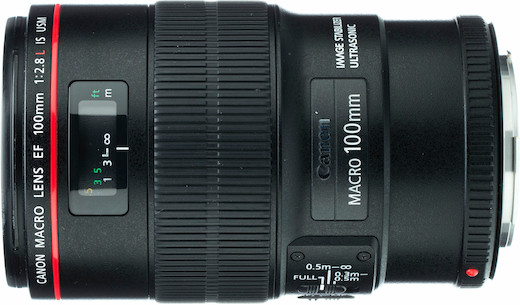
![]() A major upgrade to the venerable 100mm f/2.8 Macro, this lens now receives L series designation, weather sealing, and Canon’s new 4 stop ‘hybrid’ Image stabilization system. The hybrid image stabilization system compensates for linear and rotational shake, making image stabilization more effective at close distances. With 15 elements in 13 groups, an improved ultrasonic motor, and a nine-blade aperture ring for smooth out-of-focus highlights, this lens represents a major improvement over the excellent 100mm f/2.8 Macro it replaces. Roger’s Take: When this was first announced, I thought it was a triumph of technology over common sense. Didn’t Canon have something better to do than improve one of their best lenses? The 100 Macro was sharp as a tack, easy to use, and reasonably priced. I couldn’t see why they’d change it. After shooting with this lens, I can see why. First of all, some things are just different—not necessarily better. It’s a thicker, larger lens than the original 100 Macro, and it has a plastic body (well-made, heavy plastic but still plastic). Some things are less attractive (the price is much higher but not unreasonable). Some things are a bit better- its textured plastic hood is much nicer than the standard “shiny until something touches it and leaves a mark” hoods on most Canon lenses. It’s also a bit sharper with perhaps better bokeh than the first version. But 4 stop Image Stabilization, now that, my friends is worthwhile. It allows me to use this tripod-free for a lot of work, even with it stopped down if the light is reasonable. Handholding for 1/10 of a second in portrait mode is reasonable. One thing I would mention though in case you don’t read the Canon manual: when shooting Macro shots up close the IS is not as effective. About 2 stops is all you can depend on in Macro mode. Now, if I were doing Macro work with a tripod and focusing rail, would I pay the difference for this lens? No, I’d use the original version; it was a superb lens. For hand-held work, however, there’s no comparison. This one is miles better. Specs:
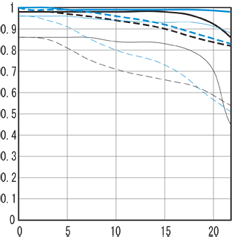
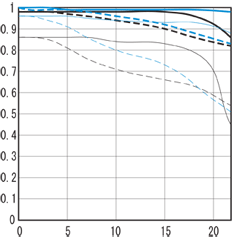
Links:MTF Chart:
Thick lines: 10 lines/mm; thin lines: 30 lines/mm. The darker black lines represent the MTF characteristics at maximum aperture; the blue lines at f/8. The solid lines trace the radical S (sagittal) curve, while the broken lines trace the tangential M (meridional) curve. If you are bored and don’t understand MTF charts, you can read about them HERE Lens Diagram
PricingLensRentals.com offers rentals of every length between 4 and 90 days. Some common selections are:
The shopping cart will automatically update the quoted price as you adjust the length of your rental. LensRentals also offers an optional damage waiver on this product, limiting your expense should it get damaged while in your possession.
ShippingLensRentals.com ships via UPS 2-day service, unless your rental requires faster shipping. Return shipping is included in the shipping price, and we include a prepaid return label with your order—all you need to do is bring it to a UPS drop-off location when your rental is complete. The shopping cart can automatically quote shipping, even for multi-item and oversize orders. Shipping multiple items together offers significant savings over shipping them individually. |