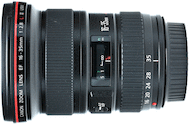
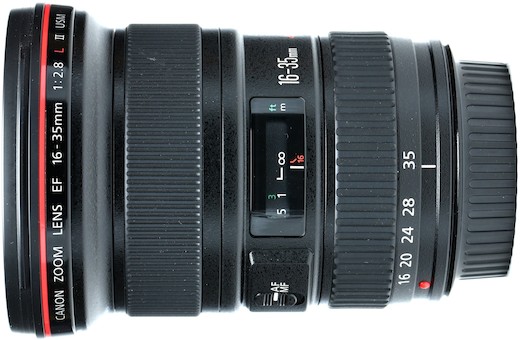
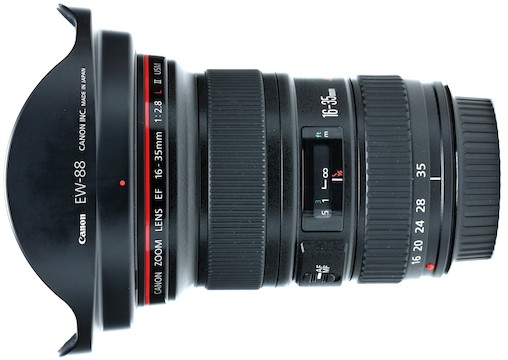
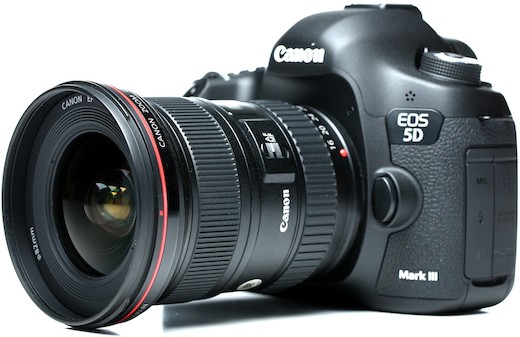
![]() The Mark II is a significant improvement over the original 16-35—but only if you’re on a full-frame camera. The lens is markedly sharper at the edges and corners and more flare resistant. There’s not a big difference in center frame sharpness (which wasn’t a problem with the original version). For this reason, we don’t think those of you shooting T3i or 7D cameras are going to find this a worthwhile upgrade from the original. For 5DMkII and 1DsMkIII shooters, this lens addresses those issues that had some of us using manual-focus, exotic wide-angle lenses to get good edge and corner sharpness. There is still a little distortion at extreme wide angle shots, but nothing that isn’t easily corrected in post processing. Summary: this is the best wide angle zoom Canon has ever made. The others aren’t even close. Roger’s Take: This is a very good wide angle zoom and better than the Mark I in the edges and corners. It’s the wide zoom of choice for f/2.8 on a full frame camera. My hesitation with this lens has nothing to do with quality, it is very good. But if you’re doing landscape work and shooting at f/5.6 or higher the Canon 17-40 will provide every bit as good an image at a lower cost. If you’re shooting on a crop sensor camera (T3i, 7D), the 17-55 f/2.8 IS offers nearly as good an image quality plus the added benefit of image stabilization. If you need to go as wide as you can get, the 14 f/2.8 is wider and at least as good in image quality with probably less distortion. If you’re shooting wide in dim conditions, the 24mm or 35mm f/1.4 lenses are more than twice the aperture. All of this isn’t meant to sound negative. The 16-35 MkII travels with me everywhere because I need the convenience of a zoom, and sometimes I need f/2.8 on my full-frame. In my mind, the 16-35 II is to the wide end what the 100-400 IS is to the long end: a very good do-it-all lens. There are specific lenses better for specific tasks, but the 16-35 is good at everything. PLEASE NOTE: This lens requires 82mm front filters. Specs:Filter Size:= 82mm (nonrotating front element)
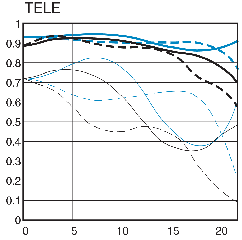
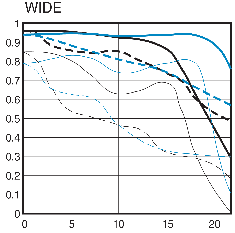
Links:MTF Chart:
Thick lines: 10 lines/mm; thin lines: 30 lines/mm. The darker black lines represent the MTF characteristics at maximum aperture; the blue lines at f/8. The solid lines trace the radical S (sagittal) curve, while the broken lines trace the tangential M (meridional) curve. If you are bored and don’t understand MTF charts, you can read about them HERE Lens Diagram:
PricingLensRentals.com offers rentals of every length between 4 and 90 days. Some common selections are:
The shopping cart will automatically update the quoted price as you adjust the length of your rental. LensRentals also offers an optional damage waiver on this product, limiting your expense should it get damaged while in your possession.
ShippingLensRentals.com ships via UPS 2-day service, unless your rental requires faster shipping. Return shipping is included in the shipping price, and we include a prepaid return label with your order—all you need to do is bring it to a UPS drop-off location when your rental is complete. The shopping cart can automatically quote shipping, even for multi-item and oversize orders. Shipping multiple items together offers significant savings over shipping them individually. |