
The Sky is Falling and the Light is Leaking: the A7r Anti-Massacree
Anti-Massacree – A humorous anti-war movement from the 1960s, suggested in the Arlo Guthrie song Alice’s Restaurant. The song, like many of my posts, was criticized for being overly long.
Believe it or not, I’m mostly a lurker in online forums. I read the hysteria of the day mostly for my own amusement. Sometimes I type a response but I almost always delete it. Interjecting facts into one of the daily hysterical rants would be about as welcome as a cat at a dog show. Usually I don’t even go that far. I just think there’s a lot of people online without much to do and go back to work.
That was my initial response when people started talking about light leaks in Sony A7r cameras. Let me think this through. If you shoot a 30 second exposure at ISO 25,000 into the sun or with a studio strobe aimed at the camera, you get a light leak. I do that … let me think … never. And this isn’t my first rodeo. I’ve noticed there are light leaks in lots of cameras if you look for them, and most of them were apparent without jumping through all the hoops it took to produce them on the A7r.
Judging from the various forums, however, at least a million people do that all the time and therefore this presented a huge problem to their style of photography. The amount of hysteria over leaking sunlight made me think I’d stumbled into the vampire.com forums. I wasn’t getting involved in that for love or money.
But Dave Etchells and the crew at Imaging Resource have shown in a series of articles that there probably are some real-world implications for some photographers. When Dave asked us to take a look and see if we could find causes and workarounds, we did just that.
Testing Setup
The light leak has already been documented quite well by Imaging Resource, Ferrell McCollough, and others. We tried a couple of simple methods to determine where the light leak occurred and found something that seemed pretty accurate. We took the fiberoptic light sources from our microscopes and shined them at various points around the camera mount with either lens caps or lenses mounted.

We found at ISO 25,000 and 6 second exposures we could reproduce the leaks quite readily. More importantly, we could see the leaks varied depending upon which quadrant of the mount we shined the light on, with no leak from certain areas and spectacular leaks from others.


Here’s what we found:
- We tested several A7rs and several A7s and all were the same, so it’s simply a design issue, not a batch of defective cameras.
- The light leak occurs with the body cap in place, but is more severe with a 35 f/2.8 Sony lens mounted instead of the body cap.
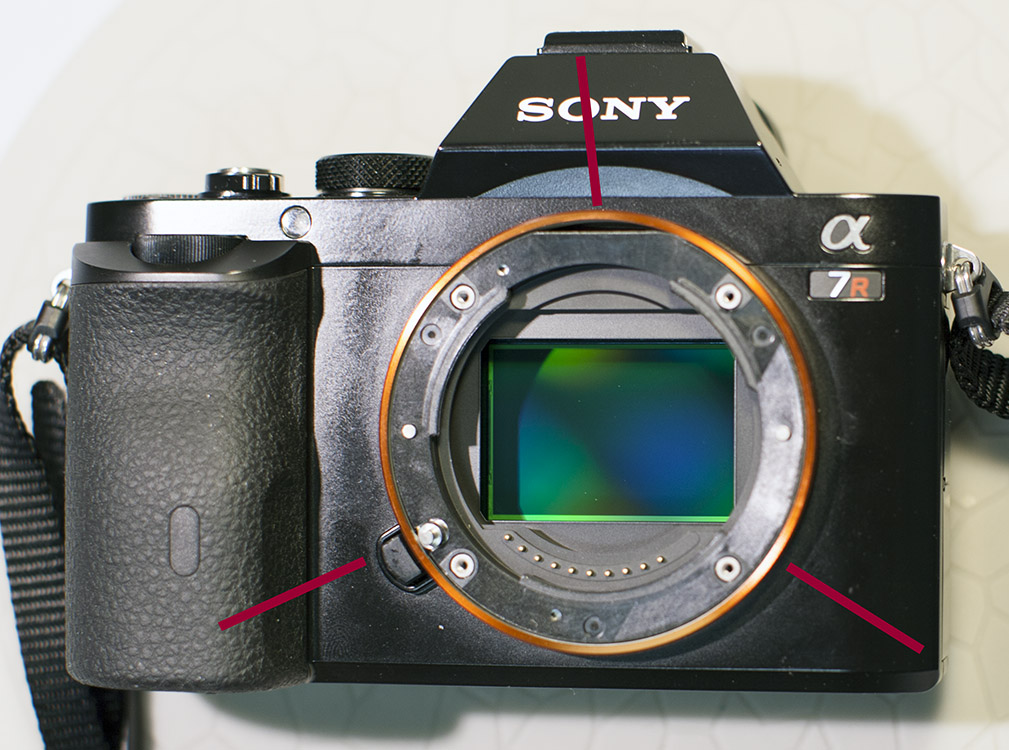
- The leak is worst when the light is shined onto the lens-release button area. It is also bad when the light shines onto the lower left quadrant of the lens mount, and directly above the lens mount. Other areas either didn’t leak or showed only a thin line that was far less pronounced than these areas.
- Wrapping something around the lens mount stopped the left side leaks, but not the leaks around the lens-release button.
Taking the metal mount off of the lens gives us a bit more information. The red lines show the areas of greatest light leak. Obviously one is around the lens release button. There’s a gap under the mount at the top that may explain why that area has more of a leak. The lower left area doesn’t show any obvious explanation as to why it might be worse, though.
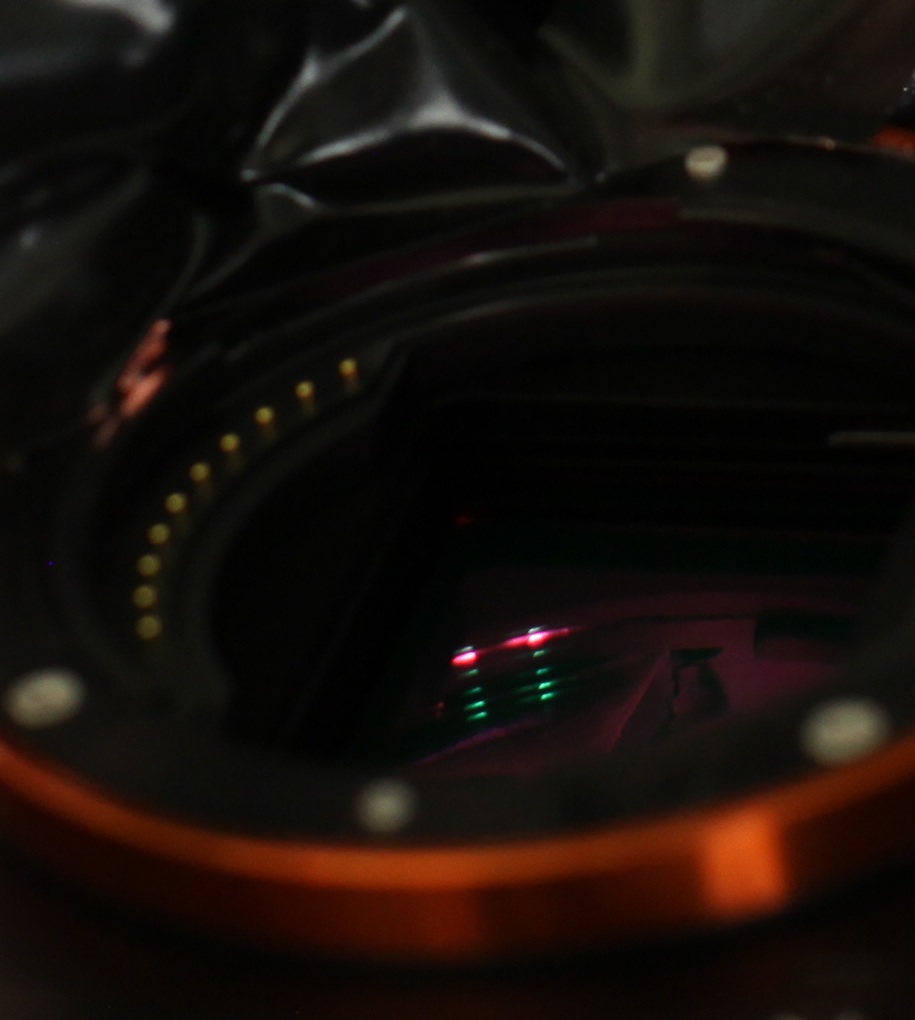
We went back to our test lights and placed the fiberoptic lights over the lens-release button and screened them from the rest of the camera to see if we could actually see the light leak in this area. We were a bit surprised to find there was almost a direct reflection down onto the sensor. This image isn’t the greatest, but you can clearly see the light that was shined onto the button (it’s behind the black mask at the top of the picture) is reflecting back off of the sensor assembly (violet and green bars).
Quick Fixes
Obviously putting a scrunchy around the lens mount, as Ferrell McCollough has suggested, helps a great deal. My thought, after looking at the front with the mount removed was that putting some optical black on the back of the mount might reduce reflections from the aluminum, so we tried that. Epic fail – it made no difference at all.
We assumed a weather-sealed lens, with a rubber gasket, would work well, too. But we don’t have any weather sealed FE lenses available. So Aaron decided to make a bit of weather sealing around the lens mount, using some single-side adhesive rubber material (electrical tape) we keep in our high-tech lab. A bit of time working under a magnifying loupe with a scalpel and forceps and he had made a nice weather seal.

Once it was placed back on the camera, lenses mounted nicely and the light leak from the top and left sides was almost totally gone. It didn’t do doodly squat about the light leak around the lens-release button, as we expected.
Here we were faced with a conundrum. We could completely disassemble the camera to get to the lens release mechanism and hope some obvious solution became apparent (this was Aaron’s initial vote). But about this time Officer Obie wandered into the repair area and made some ‘suggestions’ about us actually fixing some stuff that was awaiting repair. We told him, in two-part harmony, that we had been tasked with a Holy Quest and explained the ISO 25,000, shooting into the sun, 30-second exposures, fiberoptic light testing, and the special rubber lens-mount weather seal we’d made. He just said, “Kids, get back to work.”
So, instead of completely disassembling the camera, Aaron invented the ‘lens release button light seal’, again using some special flexible lightproof plasticized sealant patches (electrical tape) we had.

I wouldn’t call it elegant, but it worked just fine. There were absolutely no light leaks now and once we trimmed the tape back off of the lens, the release button worked fine through the tape.
Practically speaking, I don’t recommend making your own weather seal around the lens mount. It takes a while and you have to take off the front mounting plate so your warranty is voided, etc. A scrunchy or such will work just fine for those times when you just have to shoot at ISO 25,000 for 30 seconds, take long exposures facing the sun, etc. If the thing you use doesn’t cover the lens-release button, then a bit of electrical tape will handle that just fine, too.
And for you Fanboys who just can’t wait to Sony bash over this odd little issue, let he whose camera is without light leak cast the first stone. Because, so far the same problem has been found with Canon, Nikon, and Fuji cameras. I assume a similar solution will work just fine for those, too.
Roger Cicala and Aaron Closz, the boys from the Group W bench
Lensrentals.com
March, 2014
Meaningless Aside: Guthrie’s suggestion was that draftees, during the psychiatric evaluation part of induction, simply walk in, say, “You can get anything you want, at Alice’s Restaurant,” and walk out. I view a lot of forum threads the way he viewed the draft evaluation. If you’ve never heard “Alice’s Restaurant Massacree” and have 18 minutes to spare, it’s pretty funny even today.
53 Comments
Speed ·
Injecting reason. Will the internet survive?
Paul B ·
Great article, Roger. Thanks for posting.
CarVac ·
I wanna see blood and gore and [camera] guts and wires in my teeth. Eat dead bricked [A7] bodies. I mean kill.
MikeO ·
Wonderful, balanced, thoughtful AND useful article. Your long-form technical writing is very good, and I love it – and would like to see more. I wrote a column, nominally on computer protocols, every month for twelve years, and I know what it is like to be funny on deadline. As this is a blog, you don’t have that pressure, but there are damn few people who can write humorously about highly technical stuff, and I prize your ability.
Roger Cicala ·
Thank you, Mike. My pressure isn’t that bad. I’d freeze up if I knew I had to have it done by xxxxx. I used to ghostwrite for textbook publishers and the stress about killed me. Then again, my insistence on slipping something amusing in here and there about killed them.
Roger
Siegfried ·
Roger,
I read it twice but still don’t get it: how come this is about sensitivity? I mean we’re talking about non-transparent parts made of metal and plastic several millimeters thick and it requires a hack of nuke to make them transparent. If there’s a hole, then light comes in and shines at whatever ISO setting currently set.
Or it’s about indirect reflection (geeky speaking: n-th derivative reflection) which Sony engineers 99,32% suppressed and one has to push the pedal to the metal to get the remaining 0,68% part?
Thanks,
Zig
Roger Cicala ·
Zig, I’m not sure I understood the first paragraph, but the second paragraph is a perfect summation of things 🙂
Aaron ·
Well, I could see how this could affect a few people who shoot in broad daylight with a 10-stop ND filter. On the other hand…I don’t know how many people shoot with that getup. Probably not many.
Ken Sky ·
So let’s be practical: I take my tripod-mounted A7r into a noon-day sun to photograph a landscape. Can I expect to see a light leak on my files? Oh, BTW, the last time I used ISO 25,000 with 30 sec. exposure was……never! Is there any practical importance to this finding? If so when? I’ve stollen a scrunch from my wife drawer and stuck it in my bag but could return it before she finds out;)
Roger Cicala ·
Ken, you and I have the same point of view. And since I have no hair, I really don’t have an excuse for carrying a scrunchy. Not that I can ever imagine needing one for this issue – I don’t do that kind of long exposure. Not enough patience.
Sam ·
Dust and moisture resistance
Carefree shooting in tough environments is yours thanks to comprehensive dust and moisture resistance measures that enhance reliability by helping to prevent water and dust from entering the body. These measures include sealing around the buttons and dials, as well as a protective double-layered structure that tightly interlocks panels and components.
Yet light shines through…
Roger Knight ·
Roger, As usual, great work and enjoyable reading. Is this problem possibly due to slight deformation, between the lugs, of the lens/body mount when a lens or cap is mounted. I imagine the light leak would be horrendous without a lens or cap mounted, even at ISO 100. Aloha.
Roger Cicala ·
Roger, I couldn’t say but since it affected all 6 we looked at I think it’s a design issue, not an assembly issue. I guess it could be a batch of bad parts since the mounts are the same in both cameras.
Todd Bannor ·
Great article Roger. It probably would have been clearer with 27 8×10 glossy pictures with circles and arrows and a paragraph on the back of each one though.
Roger Cicala ·
Todd, I was going to do that with at least one of the photos. But the internet has a seeing eye dog.
RawheaD ·
I hate seeing this “ISO25,600, 30 sec, broad daylight” meme being beaten to death. I originally came up with the test so that people can quickly check where the source of the light leak may be, indoors, with nothing but a flashlight. It’s a dead horse. Please stop.
My A7R leaked light doing daytime LE with a 76 sec. exposure at ISO50.
I would actually like someone to show me a pro-level camera that consistently leaks light from the flange area under those conditions. Because I’ve been doing LE for years, and I’ve never had that problem with any of my previous cameras (K20D, K7, 5D, 5Dmk2), even at longer exposures (up to 10-20 minutes).
Roger Cicala ·
Rawhea, Imaging Resource found D800, 5D Mk III, and Fuji XT all did I believe.
L.P.O. ·
So, you’re suggesting that, just in case we ever encounter a useless and/or fanboyish camera argument on the Internet (not that I think it would ever happen in real life because they are so rare), then we’d just need to say: “You can get anything you want at Roger’s restaurant” and run the hell away?
(Yes, I listened to the whole song. And no, though I knew Arlo Guthrie from Woodstock, I didn’t know this particular song.)
Roger Cicala ·
L.P.O – if 50 people a day do that, it should end all Fanboism!
Iggy ·
My experience is that it happens on lower iso like iso 1600 as well. At least my A7 does.
Most e-mount parts are xcross manufactured and used on other models. What about the Nex7, Nex6, and the newer ones like the a5000, a6000. The issue will be less obvious due to the sensor size. Have you any clue???
Roger Cicala ·
Iggy, I haven’t checked them. I suspect Imaging Resource will be doing that in their Part III article.
Brian ·
You can get anything, except Alice and 30 second exposures at ISO 25,600 shot in daylight.
There was also a full-length movie starring Arlo Guthrie released in 1969.
Well, it’s not as bad as a Kiev.
Chr K ·
“The lower left area doesn’t show any obvious explanation as to why it might be worse, though.”
Well, certainly the mount has 3 lugs and 3 “spaces” in between (just like most camera bayonet mounts). And you found 3 sensitive areas. – Do you really think this could be a coincidence without significance? 😉
From the pictures shown at a Korean forum it seems like the silvery metal ring is a tiny bit thinner on the A7/A7r mount than on the NEX 7. But the underlying black plastic ring seems to be identical. I suspect Sony somehow forgot to use a new revised and matching black plastic “sealer” ring when they assembled the A7/A/r.
Roger Cicala ·
Thanks Chr K. That makes sense – saw it this am.
Christer Almqvist ·
I had already put black electrical tape around the mount because I cannot stand the colour of that orange red ring, so I am fine. More or less.
Peter Kelly ·
When these diehard ‘find-a-fault-at-all-costs’ individuals come to take their strange pictures, why is it they are happy to arrange all manner of ND filters, adjust their cameras on heavy tripods to eliminate camera shake, but can’t be bothered to cover up with a black cloth?
The solution was used since the beginning of photography, but now they have to rant about nothing?
Bizarre!!!
Paul Tawerll ·
Thanks for these tests.
This means that the Great Leica debate of the late 50’s has been resolved. Screw mount (SM) lenses are better than bayonet mount(M). SM will have no light leaks. This debate occurred during the M3 and lllg period.
jseliger ·
The song, like many of my posts, was criticized for being overly long.
As I said on Reddit, I find your posts to be too short. Like The Lord of the Rings, I always wish them to be longer than they are!
Right now, my comment is the top-rated on Reddit, which indicates that I’m not the only one who feels this way.
You’re already quite good about putting an abstract / summary / findings section at the top of most posts; just keep doing that and those who don’t revel in detail and knowledge can stop there, while the rest of us keep going.
Robert ·
Roger, I’ve read about these, and I believe (have not thoroughly tested, yet) that I actually have a real-world issue with this light leak.
I do astrophotography; taking 2-5min (or even longer) exposures at 400-1600 ISO, with my camera mounted to the back of a telescope or other camera lens. I ran into a problem where I was seeing strange rainbow arcs in my image, but as I was trying out a new piece of gear which dropped a prism into the imaging area, I figured I may be getting stray reflections off it or something. After seeing this, however, it looks very much the same.
I’ll see if I can reproduce this with a standard mounting and no little fiddly bits potentially interfering with the light. I’m not sure, as it’s usually relatively dark around the telescope, but I’m also taking very high contrast images with a normally black background, for very long exposures.
I appreciate the potential solutions, as it’s likely I’ll need them. This and the supposed RAW lossy compression have me worried about using my A-7R for astrophotography. And the fact that getting a bulb mode intervalometer for this camera is more difficult/expensive than it should be.
RawheaD ·
Roger; Imaging Resources found they all had leaks at those extreme numbers (ISO25,600, 30sec, broad daylight). They have not tested much more reasonable, “real-world” numbers. Like I said, I’m seeing the leak at 76s, ISO50.
Graham Clark has images up that were ISO50 @ 30sec. Those are very very modest numbers, and yet the leak is there. Are you really going to suggest that (1) that is not an issue, and (2) all other cameras are going to fare the same?
http://www.grahamclarkphoto.com/sony-a7r-field-notes-with-canon-ef-lenses/
Roger Cicala ·
Rawhea,
I’m not saying it’s not an issue, but heck there have been light leaks through Nikon lenses, light leaks from the LCD on 5D III cameras during with no ambient light, all kinds of things. They certainly affect some people, I’m not trying to say they don’t. I don’t think they affect quite as many people as seem to be complaining about it. Sure, if I was a landscape photog doing 30 and 60 second exposures (sounds like you are) I’d be upset. But I read somewhere that 95% of SLR owners don’t own a tripod, so I’m assuming we’re already down to 5% of owners, at most, really affected.
Mel Snyder ·
Thanks, Roger. It would be interesting to know if there’s a commonality about where Nikons and Canons leak – around the mount or the lens release button, or…?
I would bet that, with enough light blasted against any aperture near the lens mount, SOMETHING might get to the sensor.
I own an A7 I bought chiefly to use my 3 M-mount lenses from my M4P era in the early 1980s. But I bought the kit lens, and used it for my test. After covering the capped lens with a lightproof lens bag to within an inch of the mount, I set the camera for 20 seconds at ISO 25,600. I then took the camera out in the bright sunshine over my snow-covered yard, and rocked the lens in the mount in all four axes.
Nothing.
Not even when opening the file in Photoshop and boosting the brightness all the way to the right.
I think we can assure the henhouse that Chicken Little was wrong. One wonders what these worry-warts will seize on next…
Max Berlin ·
Let’s tally the A7r list of f’ups (so far).
Shutter blur – check.
Light leaks – check.
Alias and posterization – check.
14 bit fantasy output (outright fraud) – check.
Soft sensor prone to scratching – check.
Rush job camera, manual and packaging to meet the XMAS season – check.
Made to look like a jackass for buying the camera as an early adopter now that it’s selling for as little as $1437 new ? – check.
Lousy set of lens choices (other than the FE55) so far – check.
And now a possibly vastly improved AF system in a camera that costs 1/3rd the price of the A7r. – check.
They sued Nikon over a lil’ol oil on the sensor issue. Lawyers would have a field day with Sony shortcomings and considering the number of cameras (especially the 14 bit fraud) it could be a massive payday for a class action lawsuit.
RawheaD ·
Roger,
And neither am I claiming how prevalent this is, or how many people should be getting upset about it.
Do you know what percentage of SLR users own an external flash? Now, imagine if your flash sync port was defective, in a detrimental way that would only affect serious amateurs and pros. Should these people suck it up when a review site tells them “It only affects 1% of the customers”?
All I’ve asked for since the beginning is that Sony recognizes this as a serious issue, and provide a fix for those who pursue it.
I don’t want to blow it out of proportion, but neither do I want people telling me that it’s a “non-issue”, that “all cameras have it”, that “there’s a workaround”, that I should “shut up and take pictures”.
Roger Cicala ·
Rawhea,
I certainly wasn’t saying anything like that. As I said, I know it can be an issue for some photographers. I don’t think it’s ‘affecting millions’ as has been stated on some silly forums.
My usual point of view with new cameras is ‘it’s never quite as great as everyone says it is’ and ‘it’s never quite as bad as everyone says it is’.
With the A7r, I think we’re following “Roger’s Law of New Product Introduction” pretty predictably. Should it be fixed? Sure it should be. Is it pretty predictable that a brand new type of camera has flaws? Yep, they usually do. I’ve been doing this a long time, and have been through 1DMk III focus issues, 5DIII light leak from the LCDs, D800 focus issues, D600 oil/dust issues, etc. Sometimes the manufacturers man up, acknowledge the problem, and offer a fix. Some don’t. We don’t know what Sony will do, but from conversations I’ve had with Sony people (not reps, reps know little) I suspect they’ll acknowledge it and offer a fix.
Mel Snyder ·
Hey Max Berlin…
Max, if I was as unhappy as you are about the A7r, I’d sell it and move on. While Sony might solve some of your issues over time, it’s unlikely they’ll fix all that’s bugging you.
Then, buy an A7. My A7 has no shutter shock. My A7 has no light leaks. I have a whole shelf full of lenses that work spectacularly well with my A7. I have no idea if my sensor or cover glass are soft because I routinely blast it with a Rocket blower.
I happily paid B&H full price for my A7, kit lens (got a GREAT one!) and a 2-year extended warranty. Got it with a 30-day price-match with my Aadvantage Citicard.
I wouldn’t place too much hope on mounting a class action lawsuit. Even the 800-BAD-DRUG firms won’t take them unless tens of thousands of people are so medically and financially damaged that the firm can see many millions of dollars in the contingency settlement. Taking on a company like Sony with armies of attorneys to deal with intellectual property and rights issues, you’d not see a dime after your lawyers took their cut of even a wildly successful, uncontested decision 4-5 years from now.
Good luck, Max – try the A7!
Mel
Mel Snyder ·
Robert – do you do astrophotography in sunlight? I always thought that was done in near darkness, at night. The light leak tests, translated to ISO 400, are equivalent to a 2 hour exposure with a bright light shining against the leaky areas. I guess I don’t understand the circumstances when you would shoot the night sky with a high-powered light clamped against the lens release button for 2 hours.
Richard Crack ·
Hey Roger, like you too, I lurk around in many forums, and I find as do you that many of them are silly and specious.
However, even a blind squirrel finds an acorn now and again.
Your ridicule of an issue which you, yourself admit is a long-standing issue found in several manufacturers’ equipment lines, is simply indefensible.
It IS a real design failure, “a design issue” to quote your article. And it does affect more moderate photographic endeavours whether or not the outcome is readily apparent—e.g.lowered contrast, semi-concealed artifacts, etc, etc.
I was at first inclined, like yourself, to simply shrug it off as one of another anomalies that affect all complex machines, which in due course would be fixed, allowing all of us to dive back into our ponds of personal prejudice and self-absorption.
And so, my INITIAL reasoning, in regards to the latest light leak issue with the Fujifilm X-T1, in light (no pun intended—ya, right) of my three decades of experience shooting film and engaging in darkroom work before digital arrived on the scene (sarcasm alert—obviously digital was sent from on high to punish us for our many analog sins), was that this issue was simply an oversight by a new crop of designers who had not been raised to respect the ‘perniciousness’ of light.
In terms of Fujifilm, the X-T1 development team seems to consist of a group of young, smart, talented and committed individuals. But with the exception of one or two older ‘consultants’ from the company’s film side, perhaps none of them have been in a position to have absorbed the ethos (with their mothers’ ‘dektol’, so to paraphrase) of ‘light control’ that extends beyond the darkroom and even into the realm of ‘change film in the shadow of your own body’ awareness. In other words, for some of the younger designers, this is a consideration which has been lost in the background haze of new challenges such as solid-state design, computer programming, UI design, etc.
I have a great deal of confidence in the professionalism of the Fujifilm group and the approach of Fujifilm themselves to working with photographers. I’m pretty sure they will see this issue as an opportunity to grow. In other words, they’ll fix it and we can all move on to experience our various digital ‘delights’.
Therefore, my order of Fujifilm X-T1 equipment still stands and I am very much looking forward to receiving it.
However, I’m now thinking that this is a more serious issue of neglect and carelessness being adopted or ignored by a desperate industry whose sales are tanking.
You may recall that there was a time, (its ok, I’m now old enough to be a certified OF {Old Fart}) when a top-of-the-line camera was 10 years in its development cycle. Now a certain manufacturer brags about a 4-year development span. But I wonder if the pace is not really accelerated in reality to the point of 10-12 MONTHS, to the obvious detriment of good, careful, and considered design.
Whatever, the bottom line is that the light leak issue IS REAL and, in my opinion indefensible. Especially for products which are priced at around $2-3,000, or even more.
At its most basic level a camera is simply a box intended to exclude ALL light except that which is controlled by the LENS. Surely we who purchase these boxes, no matter how complex, have a right to assume that certain levels of competence will apply in their design and construction.
I feel very strongly that we should NOT reward, excuse or ignore incompetence.
Roger Cicala ·
Richard,
I don’t disagree with you in general. I simply think there’s been an overreaction online. Sony wasn’t the best camera company ever when they released a full-frame mirrorless cammera. They aren’t the worst company ever because they screwed some things up in that camera. Every camera company I know of has had their miscues. I think that’s inevitable. How they handle it interests me more. We haven’t given them time to see how they’ll handle it yet.
Roger
RawheaD ·
Roger,
OK, thanks for clarifying that. Because I have to say, starting with the Imaging Resource article, that is the vibe I’ve been getting, both from the bloggers as well as many of the commenters.
You don’t know this, but I have a personal investment in this debate, because, for better or for worse, I’m probably the person who started it all, when I reported on light leaks on the Facebook Sony Alpha group back in December. That’s when I came up with the quick & dirty test “set ISO to 12,8 or 25,6, lens cap on, 30s exposure (just so you have enough time to point a flashlight at various parts of the mount)” which has not spread across the Internet and at some point, lost in translation, it became “ISO25,600, 30s in broad daylight”. I never intended those numbers to be a baseline benchmark, and yet, now we have several sites and droves of commenters dismissing the issue as some ramblings of a madman photographer.
But, like you say, the leak shows up in much, much more modest settings, and I would still maintain, at levels where few, if any, other pro-level DSLR/ILC would, and I believe it can and should be fixed. Yes, other cameras have other issues, some even similar (like the Fuji light leak, 5Dmk3 LED light leak, etc.). I think they should be recognized and fixed as well.
I don’t know about other people, but I’m not here to bash Sony. I have no allegiance to any maker. I sold my 5Dmk2 to purchase an A7R, because I was confident that for what I do, it’s the best thing that money can buy. That’s why I didn’t go mk3. I want Sony to succeed. I want the A7 line / FE mount to succeed. And knowing many long exposure photographers out there, fixing this, I believe, is not a trivial matter in terms of achieving these things.
Thanks again.
Str8_Shot ·
What!!???!! And let Sony escape the Group W Bench!! Kid! We don’t like your Kind!
Roger, Thanks for a well written article, and pointing out how simple a short term fix can be. Well, at least until Sony announces they have a fix. Once this is settled, I might even buy one.
Str8_Shot (Sometimes known and the photographer formerly known as PaulB. But not the Paul B posting above).
PS. Thanks for using humor and one of my all time favorite songs to do it with. My apologies to Arlo Guthere.
Thorbard ·
Its nice to see that I’m not the only person that considers replying to rants and arguments before giving up and doing something else!
Also interesting to see your methods of investigation.
St. Louis ·
RawheaD / Can I see the pic you mentioned as ‘ 76s, ISO50’?? We are arguing about design issue which might affecting picture quality but all we saw in real life picture was only couple of them.
Chuck Jones ·
Great story Roger. I picked it up as our first cross-post.
I could not agree with you more. Is it a problem? Yes, for some. Is it a problem that Sony should fix? Yes, certainly and I expect that they will. Is it a show stopper that somehow horribly cripples the A7R to an extent that makes it unusable? Sorry, but nope. Not for me nor for 99% of the users anyway. For that 1% though, yea may want to add some tape until Sony figures out a permanent fix.
Besides, what is so bad about light leaks in the first place? Would anyone ever want a Holga WITHOUT light leaks?
RawheaD ·
St. Louis
Here it is: https://dl.dropboxusercontent.com/u/131577/forums/FB%20Samples/DSC02717-Edit.jpg
But you can always go to Graham Clark’s website to see examples of the leak @ 30s, ISO50:
http://www.grahamclarkphoto.com/sony-a7r-field-notes-with-canon-ef-lenses/
Ilya Zakharevich ·
@RawheaD:
Please do not call the references you post “real world samples”. (If you would call them “real world samples with 13EV black filters”, I would not object.)
There is enough confusion in this thread. It is very important to have claims labeled unambiguously. Gradation filters ARE used in real world. But the readers should have SOME hints at HOW rare this bug in design has a chance to strike them.
Ilkka ·
Okay. So the practical lesson is that if you are shooting something at night in no light at all using highest ISO and long exposure, do not use a flashlight (torch) to check the settings of the camera or lens or at least avoid pointing the flashlight to the three places you mentioned. Probably applies to just about any camera out there, though the weather sealed ones may have an advantage. This is during the exposure. Before or after exposure it does not matter at all, unlike with film cameras. And why would anybody care if this happens with the body cap on?
NormSchulttze ·
” And the 8×10 color glossy photographs with the circles and arrows and the writing on the back….”
Dr Croubie ·
I just think that it’s somewhere between ‘funny’ and ‘ironic’ that bleeding-edge digital shooters are facing the same problems that have plagued photographers for the best part of a century or more.
Pinholes in your Bellows!
ps, next time Officer Obie makes suggestions about how to spend your time, just explain that it’s a new business venture. If you can fix this light-leak and turn the fix into a “standard-servicing”, you have the potential to get literally millions of customers, and can point to the forums posts to back up the numbers as “market research”.
Randy ·
I think it’s obvious the A7r is pretty cool. But I wonder why some folks will stand in line, to pay top dollar, to be the first to discover an obscure problem that will surely be corrected, along with other improvements in the next model.
john ·
I agree with Roger, in real usage there will be no different but I believe CANON lens will gives more consistent autofocus therefore more sharp pictures than Sigma. Besides that, Canon 24-105mm IS is bullet proof lens, hard to kill lens and magnesium body. With the street price of around $650-$700, Sigma should sell it below $500 to get enough buyers.
John Clark ·
Simpler solution …. for the 3 times in the life of the camera you are going to do this, use Blu tack
Scott ·
I agree with Roger, Alice’s Restaurant Massacree is still pretty funny. We listen each year on Thanksgiving. N