

A few days ago I learned about the Metabones Speed Booster. For both of you who haven’t heard yet, this is an adapter containing optical elements and electronic controls that allows you to mount Canon EF lenses to Sony NEX cameras (other versions are planned for other lenses and cameras). The quick summary is the adapter is the opposite of a teleconverter.
A teleconverter spreads out the light leaving the lens so that only the center portion reaches the sensor. The result is the focal length of the lens seems longer (the image is magnified), but at the cost of reducing the amount of light (effective aperture) of the lens. The Speed Booster compresses the light leaving the lens onto a smaller image circle. This makes the focal length seem shorter and actually increases the amount of light reaching the sensor.

The EF to NEX Speed Booster, for example, changes the effective focal length x 0.71, and increases the maximum aperture by 1 stop. A Canon 50mm f/1.2 lens effectively becomes a 35.5mm f/0.9 NEX lens, for example. Videographers all over the internet were singing Hosannah and laying palm leaves along the path of it’s introduction.
I went into my office, shut the door, and sobbed quietly for a while. Why, you ask? I’ll tell you why. About once a day, we get an email saying somthing like, “I just rented a Canon 5D Mk III and shot video of my daughter’s high-school graduation. My footage doesn’t look anything like Vincent LaForet’s. Obviously the camera was defective and I want my money back.”
This adapter was, I thought, going to result in another 50 emails saying, “I just shot video using a generic 50mm f/2.0 lens I bought on eBay with the Speed Booster adapter and Sony NEX VG20 I rented from you. The footage doesn’t look anything like the footage shot with a Zeiss 35mm T1.5 Super Speed shot on a RED Epic. Obviously the equipment is defective and I want my money back.” I know, like I know the sun is going to rise in the east tomorrow, that you don’t put some more glass between a camera and a lens and get a better image.
But marketing hype will be marketing hype and people who want to believe in magic will believe it – and be disappointed when the magic doesn’t happen.
But Then, There Came a Ray of Hope
Then I flipped over to Metabones’ white paper on the Speed Booster and spit coffee. The primary designer of the adapter is Brian Caldwell. If anyone could make optics do magic, he could. He designed, for example, the Coastal Optics UV-VIS-IR Macro lens, an amazing thing that is the gold standard for forensic macro photography. So I read the white paper carefully and it made perfect sense. The White Paper explained how:
- The Speed Booster introduces zero (none, nada) spherical aberration, even with an f/0.9 output. That’s amazing. The very complete graphics in the White Paper do show it adds a bit of astigmatism and distortion, though.
- Where teleconverters magnify lens aberration, a focal reducer would reduce aberations basically because it would shrink them.
- The adapter is physically smaller than a standard, non-optical EF to NEX adapter.
- Corner illumination is improved.
After reading the white paper, I became convinced that these things were true. And these are all good things.
There was an additional claim made in the white paper, that MTF (modulation transfer function – acutance and resolution) was also improved. This one I struggled with. To be blunt, I found this section to be, shall we say, selective, in the comparisons made. I was left with the feeling that it might be using some very specific examples to suggest a general conclusion. The section was a bit more carefully worded than other parts of the white paper, and some information in the graphs, that didn’t quite agree with the claim, was downplayed in the text of the section.
I was willing, however, to be convinced that an FX lens mounted to the Speed Booster would have better corner resolution mounted to a Micro 4/3 than the same lens mounted to a full-frame camera – after all, those Micro 4/3 corners are a lot closer to the center of the image. And that it may, or may not, have better corner resolution mounted to an NEX camera compared to a full-frame camera.
So after my research, my impression was this will be, at least a very useful tool. It may be nearly as good as people hope it will be. In other words, it will, like all other imaging gear ever made, follow Roger’s Law of New Product Introduction (pathway A).
Let’s Do Some Testing Boys and Girls!
OK, first and foremost, this is not going to be a bunch of video samples. That’s not what I do. I’m a testing geek that writes words and makes graphs. But for those who have bravely come this far without a picture to ease the heavy burden of reading, let’s have a look at the Metabones Speed Booster.


It’s a nice looking bit of kit – solidly made and well put together. There’s a solid mount for tripods or shoulder mounts underneath. It mounts with a most satisfying thunk and clamps tightly to camera and lens. The optics are close to the surface, though, and some care in handling will be necessary to make sure they don’t scratch.
Let’s Shoot a Few Test Charts
There are a lot of ways to compare lenses with the Speed Booster and not a lot of time, so I tried to choose things that seemed practical. Or cool. Or both.
Starting with cool, I mounted a Canon 14mm f/2.8 II lens, which with the adapter should give us the equivalent of a 10mm f/2.0 NEX lens. That sounds cool to me. Plus I thought we should look at things as extreme as people are likely to get.
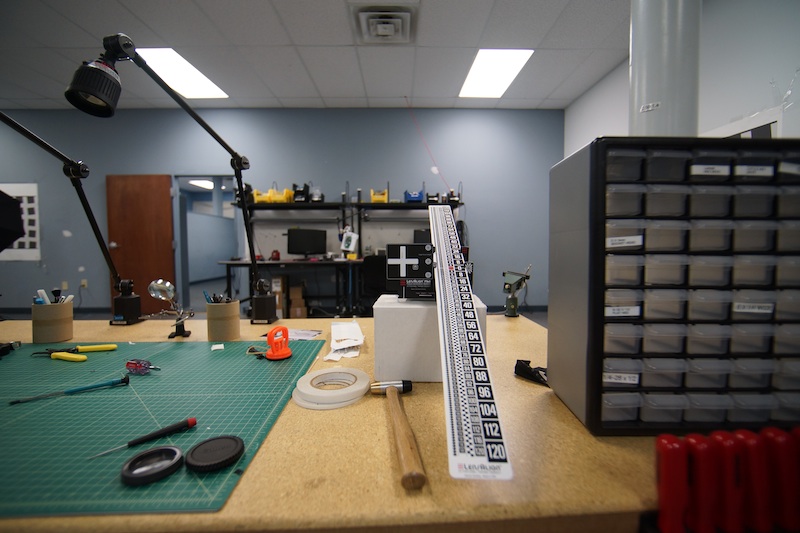
We’ll start by comparing simple shots of an ISO1223 chart shot with the lens on a plain adapter and on the Speed Booster. To even things up I moved my position so that the chart filled the image each time, so that we could compare resolution directly. First an overall picture of the chart, followed by center and near corner crops with each adapter.
Canon 14mm f/2.8
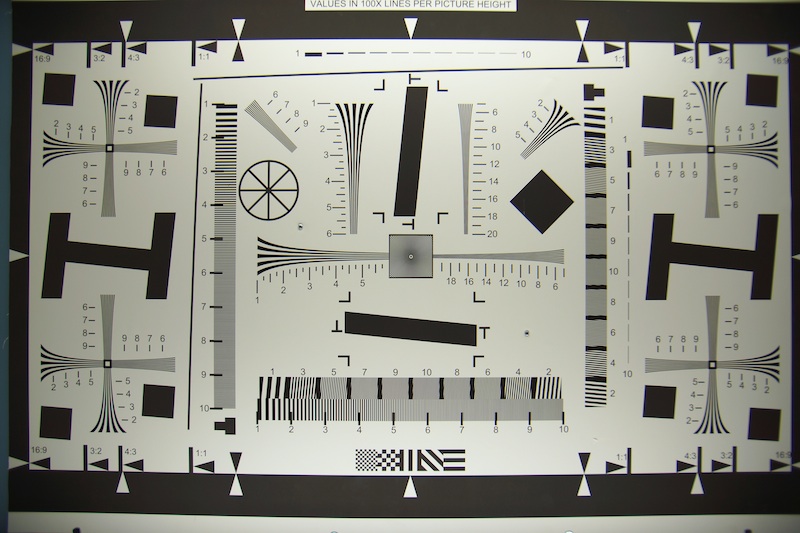
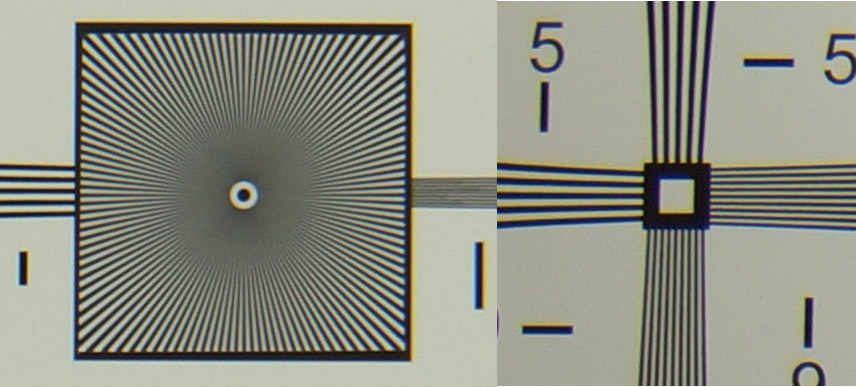
Again, the images were from different distances so that the chart filled the image with both shots. It’s not an optically critical test, but I’d call it a complete success for the Speed Booster. Even spotting the original image 1 stop of light, there’s no significant difference in resolution to my eye.
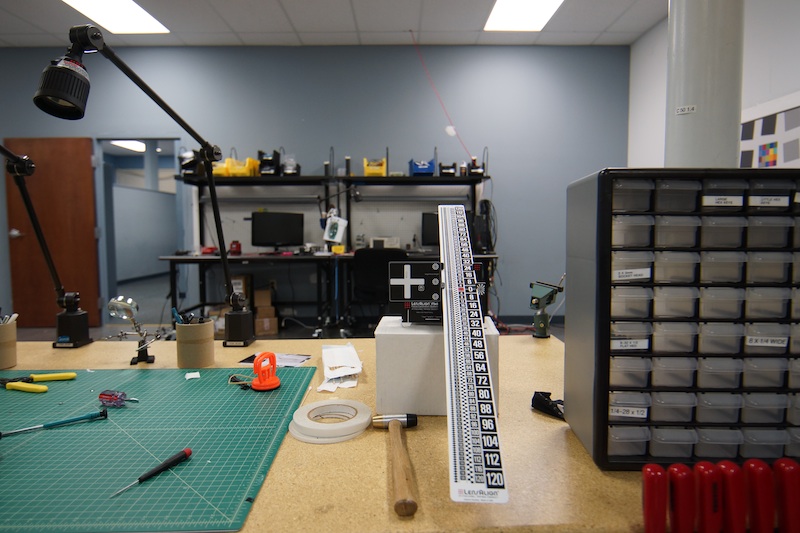
The change in perspective is impressive. These are shot from the same location with the Canon 14mm f/2.8 mounted to a straightforward adapter first and the Speed Booster second.
Canon 50mm f/1.2
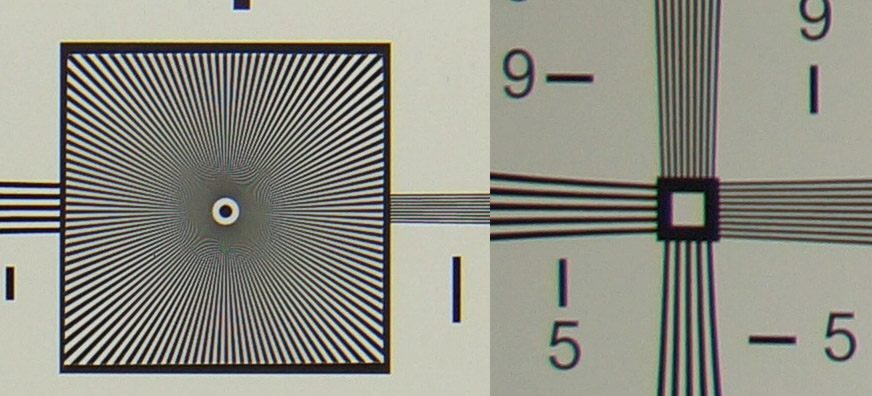
That was pretty impressive, now lets stress things a little bit more. The Canon 50mm f/1.2 lens brings a few aberrations to the table and with the adapter will be an f/0.9 equivalent. I can’t think of anything that would stress an adapter more than f/0.9. Again, I’ll reposition myself so both shots fill the frame with the chart. We’ll compare the 50mm f/1.2 on top to the Speedboosted 35.5mm f/0.9 below.

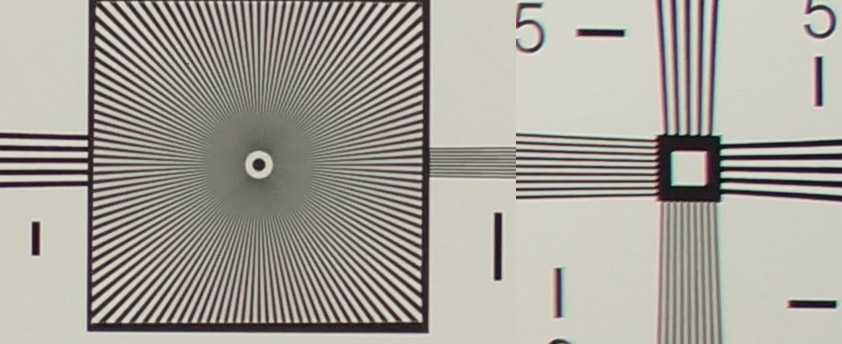
Again, these are not critical tests, but are carefully lined up, best focus of several shots. And again, the Speed Booster comes out very well. It may be the illumination boost but the acutance in the center, at least seems a little better with the Speed Booster. I would draw your attention, though, to the difference between vertical and horizontal lines in the corner crop of the Speed Booster image. That’s not an artifact of the shot or alignment. With this lens and camera, at least, the astigmatism seems to be showing up a bit. I also note that the image looks oversharpened, but it’s an unsharpened JPEG and this appearance was consistent on multiple shots.
Canon 135 f/2.0
I wanted to try the other extreme, and made the assumption that this would be about the longest focal length people would want to use the Speed Booster with. I may be wrong about that, but was running out of time today.
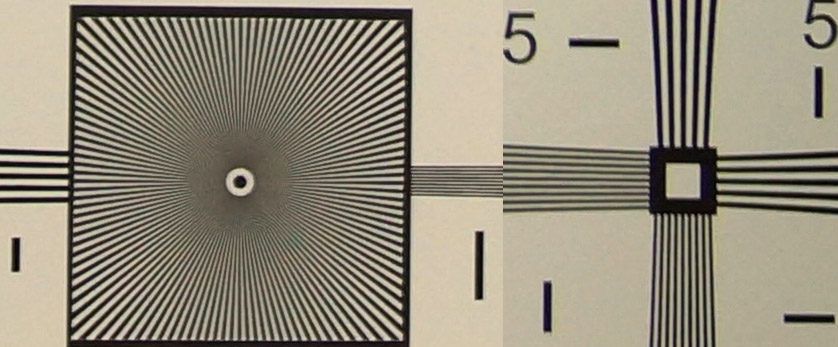

Again, if there’s any deterioration in image quality with the Speed Booster, even though it’s a stop of aperture wider, I’m having difficulty seeing it. I also don’t notice the astigmatism with this combination.
But let’s test the resolution a bit more critically.
Imatest results
We don’t have multiple copies of the Speed Booster yet, so this is what we did. We took a Canon 50mm f/1.2 lens and tested it on a Canon 5D Mk II camera. Then we tested that same copy on an NEX-7 using a standard adapter. Finally, we tested those same copies (camera and lens) with our Speed Booster.
Usually when talking about Imatest results I’m sampling dozens of copies and give you the average (mean) resolution in the center and a weighted average of all the test points on the lens. But usually we NEVER test lenses on adapters if we can avoid it. Why? Because even the very best adapter still introduces and extra variation in tilt and centering between the lens and the camera.
Let me word this more carefully because it’s important. When the imaging sensor is placed in the camera, it is carefully lined up to be completely parallel to, and centered with, the lens mount of the front of the camera. A tilt of 20 microns may be visible on a very wide angle lens. A tilt of 40 microns almost certainly will be visible. From repair manuals we know that the sensor can be made parallel to the lens mount within a few microns so that’s taken care of.
But when the big, heavy lens mount rotates into the big, heavy camera mount, chances are it’s not accurate within a few microns. Let’s assume it’s getting close to the 20 micron limit, because we know with high-quality, wide angle lenses we can often see some side-to-side variation. Sometimes obvious with some pixel peeping, sometimes not at all, but frequently enough that I’ve assumed we’re getting close to tolerance.
This is one of those sources of lens-camera variation I talk about so often. Lens 12345 looks great on camera 54321 but not so great on camera 112233. It may tilt a bit more on that second camera mount.
When we add an adapter we’re adding another heavy duty mount and making it more likely there’s a bit of tilt. It’s rarely apparent (with a high quality adapter) at standard or telephoto ranges, but often can be detected with high resolution wide-angle lenses. It may cause no harm at all. It may create too much tilt. I mention all of this because it’s going to explain some of our test results.
Canon 50mm f/1.2 on a Canon 5D Mk II
On a Canon 5D Mk II and our lens shot at f/1.4, the MTF50 was 590 line pairs / image height in the center; 460 lp / ih averaged over the entire lens, and 265 lp / ih in its worst corner with a barrel distortion of 1.2%.
Canon 50mm f/1.2 on a Sony NEX-7
On the NEX-7 with a standard adapter shot at f/1.4, it resolved 625 lp / ih in the center, 485 averaged over the entire lens, and 210 in its worst corner with a barrel distortion of 0.825% (smaller sensor). The difference in the center and overall isn’t surprising – the NEX has a higher pixel density and is using the ‘sweet spot’ from the center of the lens. The fact that the lowest corner is worse is a bit surprising until you see the overall graph of results:

Notice the upper left corner is worse and the upper right better, and that the right side of the image resolves better than the left. The lens, which behaved very nicely on a Canon camera, is tilted when shot on this particular NEX-7 with this particular adapter. So, of course, we went and got another adapter. It tilted the other way. And we were out of time. From experience I can say the center resolution number is going to be accurate, the actual weighted average should be a few points higher and the worst corner about 275 or so rather than 210 (275 is the resolution on the less affected corner).
So it is with adapters. And before you scream that the adapter was bad, it wasn’t. The guys put those adapters on other cameras and lenses later and they were either dead even or tilted another way. It is what it is. Also remember we’re churning MTF 50 numbers. You need a big difference to be able to actually see the difference in a photograph, and an even bigger difference for it to affect video.
Canon 50mm f/1.2 on NEX-7 with Speed Booster
On the NEX-7 with Speed Booster adapter and shot at f/0.9, it resolved 720 lp / ih in the center, 410 averaged over the entire lens and 230 in the worst corner. Stopped down to f/1.3 the MTF 50 increased to 800 center, 510 weighted average, and 300 for the worst corner. As advertised, the MTF 50 increased compared to the same lens on no adapter.
However, barrel distortion increased to 1.9%. Remember, however, this is in effect now a 35mm lens, so that number isn’t as big a jump as you would think at first glance. Just to note, there was no sign of tilt with this adapter on this camera.
One thing to note – there was definitely a bit of astigmatism, with horizontal and vertical resolution quite different along the edges of the lens. One other interesting note – we measured primarily MTF 50 as this is the number we work with most frequently. We also checked the MTF 20 numbers and for these combinations the Speed Booster had a similar effect: slightly improved but with greater astigmatism.
A reminder for everyone again – we had one copy of the adapter to play with and limited time. But I’ll have to admit that it seems the folks at Metabones pulled off what they claimed: with the adapter a lens is wider, faster, and even a bit sharper.
A Few Images
There’s not a lot of photogenic material around the Lensrentals Lab, but how often do I get to shoot with a 35mm f/0.9 lens? I’ve included some 100% crop areas in the corners of the scaled down shots.


Now, to get completely subjective, there’s something about the images as far as photography that I don’t like, but it’s hard for me to put a finger on it. But if you look at the crops there’s a bit of a glow around highlight areas, both in-focus (in Sarah’s shirt) and out of focus (the rubber bands).
My first thought was perhaps shooting on an NEX -7 could be the issue, since we know that camera has had some problems with adapted retrofocus lenses. Shooting with a Canon 50mm f/1.2 may also be the culprit – that lens is, well, different. But we repeated the rubber band shot with an NEX-6 and then with both cameras and a Canon 85 f/1.2 and the Speed Booster. To my eye (and remember I’m a techie, so I don’t do subjective all that well), there’s a real tendency for highlights, in and out of focus, to bloom a bit at the widest apertures. It seems to go away by f/2.0 affective aperture.

I’d also add, for those who plan on using it, that the autofocus worked well as far as accuracy. Eventually. You won’t be catching any moving targets unless they are turtles, though. I doubt this is of great import to many people, though.
Conclusions
I think it was pretty obvious that I came armed for battle, ready to slam this product as some marketing overhype. I was wrong less correct than I might have been. The Speed Booster does what they claimed it would do, much to my shock and surprise. It creates a wider-angle, greater aperture lens while retaining resolution and acutance.
It does increase astigmatism a bit, although I doubt this will cause anyone problems unless someone is trying to shoot landscape photography with it. It also seems to create some highlight blooming at very wide apertures. Again, nothing that can’t be worked around and probably not something that will be noticeable with anything but the widest aperture lenses.
It is going to take a while and a lot of people experimenting before we find out what combinations of lenses and cameras are awesome with it, which are fairly good, and which fairly bad. They won’t all be the same. But I suspect most of them are going to be pretty good. And this is going to be a very useful tool.
Most of the little foibles I’ve seen (including the part about adapter tilt) really only apply to photographers trying to tweek every drop of resolution out of their high-resolution sensor. Video, even 5k video, is more forgiving of a slightly weak corner or a bit of astigmatism.
Roger Cicala
Lensrentals.com
January, 2013
80 Comments
Polo ·
Thanks for the test, impressive.
Andre ·
Thanks for the test Roger! If you recall from the white paper, it seems they added a bit of SA to sweeten up the bokeh. Perhaps that explains the blooming? (Top of page 5.)
Roger Cicala ·
Andre – that makes perfect sense. A bit of SA might be exactly what it was that ‘I can’t quite put my finger on’. Thank you for reminding me.
CarVac ·
Now I’m trying to imagine a 200/1.8 on the adapter…
Adam ·
Very cool.
Obligatory obnoxious question that only Roger is likely to have the ability or the inclination to answer: In the white paper, it says that the maximum input aperture is f/1.26. So, what happens if you put a Canon 50mm f/1.0 on and shoot wide-open? Severe vignetting?
Roger Cicala ·
Adam, you just had to ask, didn’t you? 🙂 OK, I’ll go find a 50 1.0, because I have no idea.
OK, I was hoping it would suck the sun in through the lens and cause an eclipse, but all that happens is it automatically stopped it down to f/1.2. Smart adapter.
Michal ·
Pretty cool and impressive.
What if you put it on Canon 8-15 mm Fisheye? Just vignetting or even wider angle?
Samuel H ·
THANK YOU THANK YOU THANK YOU THANK YOU THANK YOU THANK YOU
Amarger ·
Thank you for this useful test.
what is SA ? (maybe obvious to you but my english is not my primary language)
I like highlight blooming for children and women portraits; High resolution + highlight blooming = old leica lenses glow. They will sell gazillions of this stuff. Where do I buy Metabones shares ?
Roger Cicala ·
Spherical Aberration 🙂
Sorry, I should have put that in originally – half of those whose primary language is English probably didn’t realize what I meant either 🙂
Chris Rorden ·
Roger-
Thanks for the terrific review and insight. I am not an expert, but it does sound to me that at best (if optically perfect) it mimics the same lens on a full frame camera. In other words, a 50mm F=1.2 lens on a FF will appear to the APS as a 35mm F=0.9 lens, and so will have an equivalent of a 50mm lens with F=1.2. In other words, I think people get excited about F=0.9, but they forget that depth of field/bokeh depend on both the F-ratio and the sensor size. Since the APS sensor is smaller than the FF, at the same F-stop the APS has a deeper depth of field. In other words, this seems like a terrific tool for APS sensors using FF lenses, but not magic. From first principles, it seems that if you have the same resolution on FF and APS, the APS sensors are smaller and therefore at some point this approach is diffraction limited. This is revolutionary until there is a FF mirror less, after that it may simply be an affordable alternative.
obican ·
All this for 600$?
Since I already have a NEX-7, should I sell my EOS 5D and get one of this? I’m thinking positive.
butch ·
might be worth looking for a minolta 17-35 2.8-3.5 or the 17-35G and the wide converter
butch ·
that is if they ever offer it in A mount to Emount
Kevindar ·
Roger, thanks, not only for the wonderful tests, but the detailed technical specifications.
for me the biggest deal breaker with this is autofocus. the white papers state autofocus does not work with 3rd party lenses, and works very slowly with canon lenses.
To make matters worse, they got rid of DMF. can you comment on autofocus and ease of manual focusing? thanks.
Art D ·
Wow Roger, my head is spinning with this review of yours.
Now, let me think this through…this thing gives you a focal length multiplier of 0.71. So, let’s say I took one of these Speed Boosters, put it on my NEX, and attached my 17mm TS-E. I now have a 12mm f/3.0 tilt-shift lens!? I mean, that sounds impossible. Am I missing something here?
Art D ·
I am thinking through my own bafflement a bit more in regards to my previous comment…a 17mm lens would be effectively 12mm on the NEX, but but 1.5x crop factor would still be in play, correct? So the effective focal length compared to a full frame sensor would end up actually being 18mm….is that right?
Nalahm ·
Hi Roger
Jan 2012 test ? Ha ha ha
never mine Thanks for the test
Roger Cicala ·
Ooops – I do this every year. OK, I’ve entered 2013 now. Thanks for the head’s up.
Kholi ·
Hey Guys,
The “haze” you’re looking at is called Coma, and I suspected that the Speed Booster would actually exaggerate that a bit. I agree with you, I’m not a fan of it but by 2.0 it looks pretty good.
So we need a lot more glass to be tested, preferably the newest digital lenses, so we really know what the most plausible aperture is.
Looking forward to the MFT mount version the most! Although I am concerned that the coma will be even more exaggerated due to the smaller sensor sizes.
Kholi ·
I might also add that there may be great value found in turning your sharp-wide-open 2.8’s into sharp wide open 2.0’s.
Tai ·
Roger, could you please comment on whether this adapter can adjust infinity focus? some other reviews say it can but am not sure what adjustment they meant. The reason i ask is because 2 highly regarded legacy lenses, Canon fd and Minolta lenses, cannot reach infinity focus on Canon ef mount 🙁
Roger Cicala ·
Tai,
It has infinity focus tuning, but I assume this is simply enough range to make up for the adapter-to-adapter variation that might occur. I’d be surprised if it has enough adjustability to make up for a lens that isn’t infinity focuasable to begin with – but it might. I’m sure someone will check soon.
Mal ·
Roger, we really needed this review. There have been so many comments on the forums from users that don’t understand why the MTF can be improved. Thanks for clearing things up with real results.
Personally I think this is a win(aperture), win(MTF), win(size!) for everyone and an outstanding product. I have been wishing for a 0.5x converter to use my OM lenses on m43, but this is a great start.
sam ·
Awesome review! So does the canon 50 f1.4 become a 35 f1.0 ?
And this then means on a nex6 35x 1.5 means it ends up as a real terms 52.5 f1.0
Please confirm as this combo for this price (rather than the super expensive canon 50 1.2) is looking very appealing!
Roger Cicala ·
Sam, that is correct if my math is working this morning.
anon ·
Roger, thanks for the review! would you know if the m43 version will give a fullframe image as well?
Feng Chun ·
This is really like magic..
By adapting FX lens to Nex still lose a little bit of FOV compare to mount on FF camera.
But adapting a DX lens to M4/3 can gain a little bit FOV according to the white paper. Although I didn’t find the product on sale from their homepage..
DKW ·
Thanks for the excellent review.
How are the AF speed and accuracy for these EF lenses compared to the EOS-M + adaptor?
Roger Cicala ·
DKW – it is slower than the EOS-M, no question, although not twice as long to focus. I’m sure there will be some variation with different lenses but I didn’t test that qualitatively.
David Tayler ·
Can you bolt a medium format lens on with duct tape if need be and see if we get 3-4 stops extra, or is that just too silly…..
Tim Cooper ·
Two immediate thoughts: One, finally there’s another body I can usefully put my 17mm TS-E on, so I’m not totally locked into Canon forever if they never overcome their sensor technology deficit.
Two, they should be able to build a medium-format to 35mm-full-frame version, which could be quite nice.
Samuel H ·
@ Art D:
Your overexcitement is messing your math…
This adapter turns your 17mm f/4L TS-E into a 12mm f/2.8. But then it only works with crop sensors.
With the one on a NEX-7 (1.52x crop factor), you’ll get the FoV and DoF that you’d get on a full frame camera with a 18mm f/4.3. But FoV and light gathering will be like what you’d get on a full frame camera with a 18mm f/2.8.
Except: I’m not sure it will play well with tilt-shift lenses. I’d wait until someone super-nice such as Roger tests that out.
Walter ·
Olympus shooters have known this sort of thing was possible for a while, since one of the best Four Thirds lenses has just this sort of adapter built in.
The Zuiko 35-100 f/2 is known as one of the sharpest lenses around. But it’s a huge beastie, seemingly way too big for its specs. Some folks who know what they’re looking at looked at the element diagram, and found that it’s essentially the design of a standard FX-frame 70-200 with an added 0.5x converter at the back.
Perhaps this was a lazy way for Olympus to make a lens, but the results are certainly fantastic.
Michael Steinbach ·
Now if I stacked three of these on top of one another….. :,)
Martin Kellermann ·
Dear Roger, thanks for the intersting semi-test. The technology has been around for quite a while. On the site of Marco Cavina you can find a very nice article (unfortunately in Italian) on the the Zeiss 50mm/f0,7 used by NASA for moon images, and its predecessors. The diagrams also show quite nicely how these types of lenses work.
Martin Kellermann ·
Forgot to put mention Marco Cavina’s website: http://www.marcocavina.com/omaggio_a_kubrick.htm
Art D ·
@Samuel H:
Yeah, I had that same realization above, that when we’re talking about a change in “effective” focal length it’s still in relation to actually focal length on full frame, not “effectively” a wider lens than what it is on FF because the crop factor on the NEX still applies.
As to the question on if this thing will work well with TS-E lenses…that I am quite curious about. On a TS-E even if fully shifted on a crop sensor, it wouldn’t be at the extreme edges of the imaging circle, so if this Speedbooster thing can work well with TS-Es (and if the distortion introduced isn’t too severe) then this could be quite useful. Pretty please Roger, can you let us know about this combo? 🙂
Roger Cicala ·
Art, I would, but we’ve only been able to get a couple and both have gone out now. When we get some more in, I’ll grab some TS-Es.
Ric Ettinger ·
I’m somewhat confused about your focal length calculation. You’re saying a 50mm lens with this adapter is a 35.something mm equivalent on a NEX7. wouldn’t it be 52.5?
Roger Cicala ·
Ric, it’s going to be equivalent to, for example, the Sony 35mm NEX lens, which is equivalent to 52.5 on a full frame as far as field of view.
Don’t even ask about depth of field 🙂
john ·
MB SB adapter on a fs700:
70-200 lens = 50-140ish at 2.0?
24-70 lens = 18-52ish? at 2.0?
john ·
MB SB adapter on a fs700:
70-200 lens = 50-140ish at 2.0?
24-70 lens = 18-52ish? at 2.0?
Kevin Purcell ·
For those trying to do the math for “effective crop factor” to get the the “effective focal length”
The 0.71x Speedbooster with a 1.5x crop factor sensor (Nikon APS-C) is 0.71 x 1.5 = 1.065x.
The 0.71x Speedbooster with a 2.0x crop factor sensor (micro FourThirds) is 0.71 x 2.0 = 1.42x
Matt ·
With a 50mm f/1.0, can you tape the contacts or otherwise force it to work at f/1.0?
Rasmus ·
Am I the only one thinking that this could be a way to finally get a decent birding lens on Micro 4/3? A device like the Bigma would become a 355/4.5 and a 400/5.6 would be 284/4.0 (and of course, SigZilla would zoom to 355/2.0, who said overkill was a bad thing?), with effective focal lengths of 710 mm and 568mm, respectively, and both lenses would be faster than anything that’s currently available for Micro 4/3.
Does unbalanced do a lot of difference for lenses most people use with mono- or tripods anyway?
Greg Smily ·
It’s no wonder why this focal reducer was so ingeniously named Speed Booster. I would honestly call it “Crop Factor Reducer” cause this is what it does. Just imagine that we do not attach SB to any given lens getting all this fantastic F/0.9 etc . Instead, let’s attach it to the camera like NEX-7. This optical device being mounted on the NEX-7 is in fact a (really very high-end quality) 1.41x loupe through which any lens sees the sensor. So we got a “new camera” – NEX-77 🙂 with resulting crop-factor 1.53 / 1.408 = 1.085. Now we have no boost – It’s just a reduced crop factor.
For example, EF50mm F/1.2 on the NEX-77 became equivalent to 54.3 F/1.3 mounted on FF . Assuming of course more or less equal quality sensors on FF and NEX-7, eg – 5DM3.
And the balance is: gain in weight (350 g) and in total length (5-6 mm ?) comparing to 5DM3, but slight loss in FOV, DOF, AF and handling. Moreover, to my taste , tiny NEX with a good E-lens like Sigma 30/2.8 or 19/2.8 is almost pocket-sized, light wheighted all-around camera, but imaging it with, say, 35/1.4L with no AF …
So I see no sense in getting the SB (though I was very much impressed when I read first info) if one already has a FF camera like 5DM3 (not to mention N800, N800E) with good FF optics. BTW, I do have both systems 🙂
Feng Chun ·
I believe it’s not possible Matt
It is the optical part limits it as stated by the white paper
Lydia Bridges ·
Thanks for sharing this information. Nice lenses you got there.
Digital_analog ·
Roger, as an engineer I love ur work here on this site, a bunch of numbers in the “I think” sea.
Well, this adapter intrigues me, if I shoot for ex a 50mm 1.8 in a full frame, and in a nex with this adapter, will I get the same DOF? I guess yes right?
Why when we use a 50 1.8 full frame in a 1.5x crop we say that the it is equivalent to a 75mm 1.8, but if I use in a 1.5x teleconverter in a full frame it becomes a 75 2.4? The DOF it isnt the same?
John Arthur ·
Looking at the first diagrams in the article it shows the FX circle matching with the DX sensor but this is obviously still covering a larger area than the m43 sensor, so presumably you would not be getting a FX filed of view on m43. What would be the mag factor for m43? If I used a 50mm on m43 would this be 0.71 x 2 = 70mm equivalent? Instead of 100mm equivalent?
Samuel H ·
@Digital_Analog and others trying to work out the math:
These 3 combinations will give you roughly the same FoV, DoF, and exposure:
* 50mm f/2.8 on 5D2 at ISO 400
* 35mm f/2.0 on NEX7 at ISO 200
* 50mm f/2.8 on NEX7 with speedbooster, at ISO 200
So:
* With a standard adapter on a 1.4x crop camera:
– multiply focal length by 1.4x to get “FoV equivalent”
– multiply aperture by 1.4x to get “DoF equivalent”
– just read aperture to get “light gathering equivalent”
* With a speedbooster on a 1.4x crop camera:
– just read focal length to get “FoV equivalent”
– just read aperture to get “DoF equivalent”
– divide aperture by 1.4x to get “light gathering equivalent”
Also: the difference between this and a 2x teleconverter is that with the latter you’re keeping the same sensor, with the former you’re using a crop sensor. Big impact on DoF!
KyleSTL ·
Roger, since you’ve tested the aperture extreme at 50mm (the EF 50mm f/1.0 USM), I have a few other extremes that would be perfect for this new accessory and a NEX-7 or Fuji X-Pro1 (in ascending order of rediculousness):
Canon EF 600mm f/4 IS II USM (600mm f/2.8 equ)
Canon EF 400mm f/2.8 IS II USM (400mm f/2.0 equ)
Canon EF 200mm f/2.0 IS USM (200mm f/1.4 equ)
Siglauncher 200-500mm f/2.8 (200-500mm f/2.0 equ)
Pat ·
Roger,
How feasible would it be for Metabones to create an EF lens to EF-S mount speed booster?
Wouldn’t such an adapter essentially turn a 24-70 f2.8 lens into a 15-44 f1.4 lens for Canon Rebels?
Honestly, if they came out with that adapter I would sell my 6D and get a T4i, then use the extra money to buy a 24-70!
Chris ·
@Pat – such an adapter would be a far greater challenge. Because it would move the adapted lens further forward of the sensor plane, it would need to correct for infinity focus as well as perform the reduction.
Chris ·
“Why when we use a 50 1.8 full frame in a 1.5x crop we say that the it is equivalent to a 75mm 1.8, but if I use in a 1.5x teleconverter in a full frame it becomes a 75 2.4? The DOF it isnt the same?”
We don’t. A 50 f/1.8 on a DX crop camera behaves, in terms of DOF, framing, and perspective, like a 75mm f/2.5 – it’s just often overlooked that on a smaller sensor, you need even wider apertures to maintain the same depth of field.
(This is why there’s nothing amazing about the m43 f/2.0 zooms – in DOF terms, it will produce an image that looks like it was shot at f/4 on full frame. Still, you get 2 more stops of brightness, right? Well, sort of – you do, which means you can drop ISO 2 stops compared to shooting an f/4 lens on full frame in the same light. The catch is that the noise performance of m43 is about 2 stops worse than the best full frames, so that extra 2 stops of brightness isn’t a free lunch, it just gets you back to a level playing field. You can’t beat physics!)
Robert Spanjaard ·
Roger, there’s something missing here. You seem to have noticed some quality loss in the corners, and if I read correctly, you attribute this loss to the adapter completely.
But I remember that, when APS-C DSLRs just arrived, everybody was saying that optical quality would _increase_ because, on an APS-C camera, you only use the ‘sweet spot’ of a 35mm-lens.
Now, Metabones claims the exact opposite: quality will increase because the image (and defects) that the lens projects onto the sensor is shrunk to fit APS-C. And I don’t see anyone complaining about that claim, even though numerous tests done bij slrgear.com clearly show that most 35mm-format lenses perform better on APS-C than they do on 35mm, especially in the corners.
Why? Why is it that you don’t mention this, even when your own testshots do show some quality loss in the corners?
Roger Cicala ·
Robert,
I’m not sure I follow, but I was overall rather pleasantly surprised by the corners. However, I had trouble making any clear conclusions because the standard adapters I had available duruing this test all caused some tilt with our NEX camera – lens combination. So I’m not certain if the Speed Booster is about the same, a little worse, or a lot worse: I don’t have the baseline to make a strong conclusion. And unfortunately (testing is not my full-time job) didn’t have time to change out adapaters and cameras again.
Kevin Purcell ·
@Digital_analog
Because when you use a crop body you don’t change the focal length (you change the angle of view by reducing the part of the image circle you use). So the aperture ratio (f number) is the same.
If you add a teleconverter or “focal length reducer” you are changing the focal length of the lens to be the focal length of the lens + convertor. So you are changing the aperture ratio (f number) because you really changed the focal length.
Samuel H ·
@Robert
The reason is that, when APS-C came out and people said that pictures would be sharper because you’re only using the sweet spot of the lens, they were wrong. It turns out that the magnification that you apply at the same time has a bigger effect on sharpness.
I know this for a fact now, but didn’t just a couple of weeks ago: I’m pondering the FF move right now, so I borrowed a 5D2 and compared it against a T2i:
http://www.similaar.com/foto/lenstestsff/lenstestsff.html
It seems like the speedbooster brings APS-C a lot closer to FF by eliminating most of this difference (I’m buying one, thanks this review by Roger, and to the bokeh tests Philip Bloom posted).
Robert Spanjaard ·
@Samuel H
No, they were right. Just check this example of the recent Canon 24-70 L II. On the 5D MkIII, there is less sharpness, more distortion, and more vignetting than on the 7D.
http://slrgear.com/reviews/showproduct.php/product/1494/cat/11
It’s the same for the 70-200 L II:
http://slrgear.com/reviews/showproduct.php/product/1316/cat/11
And the 14/2.8 II Roger used:
http://slrgear.com/reviews/showproduct.php/product/1115/cat/10
And it’s not just Canon. Check The Nikon 70-200 F/4, another recent high-quality lens:
http://slrgear.com/reviews/showproduct.php/product/1570/cat/13
Or a 50mm prime from Nikon:
http://slrgear.com/reviews/showproduct.php/product/1231/cat/12
I could go on and on, but I think I’ve made my point. Metabones’ claims about the Speed Booster are debatable _at best_.
The only thing that might improve is CA, which seems to vary from lens to lens. On some it improves because you ‘shrink’ the effect, but on others it gets worse because lenses exhibit CA mostly at the edge of their image circle.
And distortion shouldn’t be underestimated here. Most RAW-converters handle distortion quite well with their built-in lens profiles, but these profiles don’t work with the Speed Booster attached.
Samuel H ·
That’s weird. My bet is that those numbers are relative to the best spot for each lens. Every lens you posted gets a “perfect” spot at one aperture or another. Even the ultra-soft Tamron 17-50 f/2.8 VC gets a perfect center score (and wide open, no less):
http://slrgear.com/reviews/showproduct.php/product/1297
That is not what you’ll find in real life:
http://www.the-digital-picture.com/Reviews/ISO-12233-Sample-Crops.aspx?Lens=679&Camera=474&Sample=0&FLI=0&API=0&LensComp=709&CameraComp=453&SampleComp=0&FLIComp=0&APIComp=4
http://wordpress.lensrentals.com/2011/01/stuff-i-wish-id-never-bought
If those numbers are relative, it means that all you know about those lenses you mentioned is that the difference between the center and the corners is bigger in full frame. But the center is probably a lot sharper on full frame.
Did you check my link?
http://www.similaar.com/foto/lenstestsff/lenstestsff.html
Robert Spanjaard ·
No, those numbers are not relative. The Tamron got a maximum sharpness of around 1 to 1.5 blur units. That’s not a “perfect score”. And the TDP-link you provide clearly shows that it’s far from “ultra-soft”. The lensrentals blog shows that the VC-version is softer than the old non-VC version, which is exactly what the slrgear.com-results will show you.
In your comparison, you focus at the corners separately to test the sharpness.
Sggs ·
It seems that the metabones optical construction is similar to that used in the “legendary” zeiss 50 0.7 planar used by Kubrick in Barry Lyndon. See http://www.marcocavina.com/omaggio_a_kubrick.htm and http://en.wikipedia.org/wiki/Carl_Zeiss_Planar_50mm_f/0.7 and http://www.google.com.br/url?sa=t&rct=j&q=zeiss+50+0.7&source=web&cd=6&ved=0CEYQFjAF&url=http%3A%2F%2Fwww.visual-memory.co.uk%2Fsk%2Fac%2Flen%2Fpage1.htm&ei=VaoFUbiFHo-C8QSpuIDAAw&usg=AFQjCNFUtWOkMw0pxgjd8NK2SPX5E-McSQ&sig2=pG8SPfpAOMJSvLJX84DHaw
Samuel H ·
I looked at both center and corner sharpness, they’re all in the link.
In any case, I know what’s true for my lenses, and obviously don’t know if that can be applied to all other lenses, so, let’s leave it there. Have a nice day!
Lisandra ·
So, I cant stop thinking, a .50 reducer that covers the 4/3s sensor is very very possible based on the diagrams, what do you think?. With a 2 stop light gathering boost too
oops, I drooled a bit on the keyboard…
Lisandra ·
Chris, theres no way, in holy hell, that my 5D mk2 is 2 stops better than my OMD in noise performance. Id say less than a stop even. Three years ago my answer would have been different but now? Yes you can break the laws of physics with good ol fashion engineering. Im not even gonna bother upgrading to the mk3.
Anywho, no flame wars here, this adapter is right up my alley, im curious about the m4/3s version
Samuel H ·
@Lisandra
OM-D is a lot newer tech than a 5D2!
A D600 would be a better point of comparison in terms of same-age tech
Which basically misses the point, because, even if it was 2 stops cleaner (it’a actually around 1.5 stops, see link below), it’s still a lot bigger and more expensive. If you can get the same IQ (or nearly the same) on a much smaller and cheaper body-lens combo…
http://www.dxomark.com/index.php/Cameras/Compare-Camera-Sensors/Compare-cameras-side-by-side/(appareil1)/793%7C0/(brand)/Olympus/(appareil2)/792%7C0/(brand2)/Nikon/(appareil3)/483%7C0/(brand3)/Canon#toggleBookmarks
Aaron ·
Just saw DPReview’s review of this, but I’m interested in the fact that at exceptionally wide apertures (f/1.0 equivalent) they are actually seeing some loss of light, and point to a DxO article (http://www.dxomark.com/index.php/Publications/DxOMark-Insights/F-stop-blues) which basically says that as you get to the extreme wide apertures, more and more of the light is coming in from the sides at oblique angles, and so many sensors, especially with smaller photosites, are unable to take advantage of that more light and actually capture less light. I could see that, but given the article is from 2010, with more modern sensors with micro-lenses and such, is that as big a factor? I know I’m occasionally obsessed with finding the widest lens I can, even if I rarely would shoot with it completely wide open.
Voodoo Fox ·
soounds like this magic ring can also make a m3/4 camera into an equivalent full frame camera if Metabones offers a booster for m3/4 body. grear work indeed. thanks to Metabones.
Timmi ·
The poor results with the 50mm 1.2 are being downplayed a bit too much, imho. the vertical lines in the bottom right are downright blurred.
Timmi ·
Also, you said that there is no CA… and there is a _significant_ amount that can be seen in that same 50mm+SB shot.
Samuel H ·
I got the speedbooster so that my 24mm could be a real wide angle, but then my question was: if I have to take a portrait, should I go for the 90mm f/2.8 on the speedbooster, or for the 50mm f/1.4 on a standard adapter?
So I put the speedbooster against my one dollar resolution chart:
http://www.similaar.com/foto/lenstestsff/lenstests_speedbooster.html
My conclusion: the SpeedBooster delivers a small sharpness increase. Plus, the DoF and brightness advantages make it a winner. But it’s not as big an improvement as actually going Full Frame.
My 90mm Elmarit with the SpeedBooster is slightly sharper than both the 50mm or the 90mm on APS-C without SpeedBooster. But it is not as sharp as the 90mm on an actual Full Frame. If all I have is the NEX-5N and I have to take a portrait, 90mm+SB is slightly better (sharper in the center, about the same in the corners) than 50mm with the standard adapter. But 90mm on FullFrame would be a lot better.
But the DoF and brightness advantages make the SB even better. I can take that portrait with the following settings:
* APS-C with standard adapter, 50mm lens set at f/2
* APS-C with SpeedBooster, 90mm lens set at f/2.8
With the same ISO and shutter speed, I’ll get the same FoV, DoF and exposure in both cases. Now, looking at the tests, it’s easy to see which option has the lead: because I can close the lens a bit, the one with the SpeedBooster is sharper both in the center and in the corners! Not as good as actually going Full Frame, but an improvement for sure, with no downsides whatsoever (because I’ve also checked that bokeh is basically not affected: http://www.similaar.com/foto/lenstests/bokehtests.html)
Flavio Egoavil ·
The Metabones’ Speed Booster is what is usually called a “focal reducer”, something that has existed for decades. As correctly mentioned, the Zeiss f0.7 lens used on Barry Lyndon was basically a normal, smaller-aperture planar design with a focal reducer behind.
Now, what we are we doing is basically optical ‘impedance matching’: Reduce the circle of coverage of the lens to better match the sensor size. In this page, a Canon 50/1.2 is compared used directly on the NEX sensor versus using it through the Speed Booster. I’m afraid this is not a meaningful test. It is already known that to use just a small section of the lens’ coverage circle (i.e. putting a FX lens on a DX camera) would bring suboptimal resolving power (than using a lens tailored for the DX image circle but with the same angle-of-view). This happens for the very same reason than large format (4×5″) cameras give overall greater definition — the smaller the sensor size, the more absolute lines-per-mm demanded from the lens.
So, a more fair test would be to compare said Canon EF 50/1.2 on a full frame camera whose sensor is of equal resolving power as the NEX’s sensor, and to compare the 50/1.2 lens on the full frame camera versus the 50/1.2 lens on the NEX using the Speed Booster. On both, we’re using the full image circle produced by the lens. But in the second case, this image circle has went through a further process: the Speed Booster. Thus, there will be some image degradation — unless the device is made of unobtainium glass.
Samuel H is totally right. FX lens on FX sensor will win anytime over a smaller sensor + speed booster, assuming both sensors are of similar technology and resolution.
Fabiano Silva ·
Roger, do you have any clue why this technology first appear to the Nex and not to the Canon Crop cameras that I think are more widespread? I know that EF-s have a smaller circle but I have 3 Crop bodies with 2 EF lenses. Would love to convert them to wider field of view! Regards
Nick Seth-Smith ·
Hi Roger
Thanks for the detailed review – most enlightening and helpful. I appreciate your objectivity and detail on the adapter’s performance.
I do have one question. You (and everyone else) comment that the autofocus is slow and “You won’t be catching any moving targets …”. Can you put some numbers to that please? (Approximate time to focus on a subject from Infinity or min focus distance – comparison to Canon EOS 5D MK II for instance). I realize that performance will vary widely with image composition, lighting conditions, current position of the lens etc.; however some ballpark numbers would help (e.g. 2x slower, 10x slower, 3 weeks on a good day …)
Many thanks
Nick
John Gaylord ·
Actual high res still photo samples of real world scenes would be more useful than a flat test chart IMO. I wonder whether field curvature of an extreme UWA lens combined with “tilt” as measured here, and combined with narrower DOF at the better apertures might necessitate the use of a smaller aperture; and both would noticeably degrade IQ. This, in addition to a likely increase in barrel distortion and CA at the edges.
Jan Steinman ·
Thank you for this review, but it is now five years old.
Have you had a chance to try the newer Ultra version?
ney frota ·
I have a speed booster dumb question. (Please correct me if i am wrong)
“Why i cannot have a ef-to-ef speed booster in my canon sl2?”
Let me break this. all this speed buster talk include 2 aspects
– mechanical: to adapt X lens to Y camera (as in your example. canon ef lens to sony camera. Or ef to ef-m as we see lot m-50 youtube videos)
– optical: to get a full frame light cone and compress to smaller then full frame sensor (asp-c, anyone. Pick yours)
But i cannot find (or understand why not) a speed booster without lens adapter.
More specific, in a real life scenario, a ef-to-ef speed booster to use in canon dslr with asp-c sensor (sl2).
In my naive pov, this can reduce my “full frame lens” to “asp-c sensor” crop and i can be a happy monkey.
A blue bird told me we have space limitation to accommodate speedbooster optics …
but i love to see your “text and graphics” myth buster explanation
Peace : )
Ney Frota ·
I have a speed booster dumb question. (Please correct me if i am wrong)
“Why i cannot have a ef-to-ef speed booster in my canon sl2?”
Let me break this. all this speed buster talk include 2 aspects
– mechanical: to adapt X lens to Y camera (as in your example. canon ef lens to sony camera. Or ef to ef-m as we see lot m-50 youtube videos)
– optical: to get a full frame light cone and compress to smaller than full frame sensor (aps-c, anyone. Pick yours)
But i cannot find (or understand why not) a speed booster without lens adapter.
More specific, in a real life scenario, a ef-to-ef speed booster to use in canon dslr with aps-c sensor (sl2).
In my naive pov, this can reduce my “full frame lens” to “smaller sensor” crop and i can be a happy monkey.
A blue bird told me we have space limitation to accommodate speedbooster optics …
… but i love to see your “text and graphics” myth buster explanation
Peace : )