

What is Decentering and What Does it Do?
Strictly speaking, decentering would involve one or more of the lens elements being off of the central axis of the lens. This would prevent the curved surfaces of the lens from bending the light properly. In severe cases it could result in halos or ghosting. In most cases it causes softness, especially away from the center of the lens. A decentered lens may be normally sharp in the center, but very soft in the corners. Or it may just be soft and blurry everywhere. Most lenses have one or more elements that are adjusted to correct centering. Which element that is varies depending on the lens type and design. The front element is often a centering element, with the rear element being the second most common centering element.
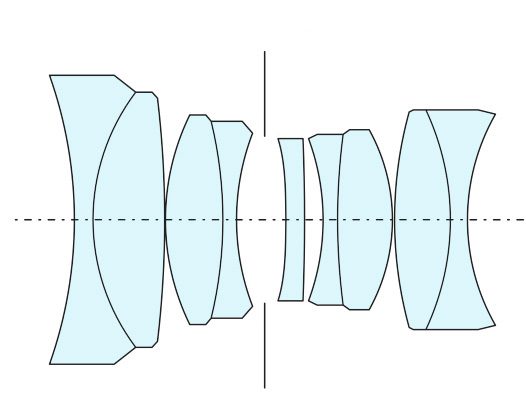
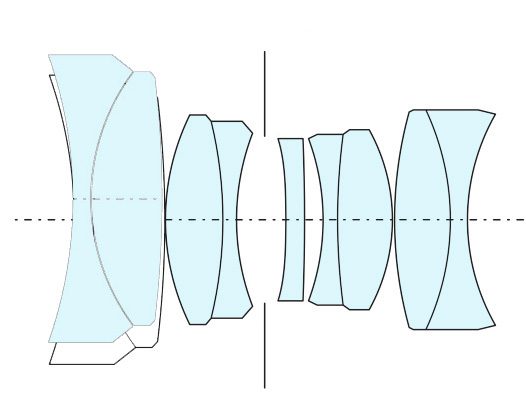
An element can also be tilted to one side or another. Strictly speaking this is not decentering, but it can have similar effects, so people often say a lens is decentered when in fact it’s tilted. In this case one axis may remain sharp, but the other will be out of sorts. If the tilt is side-to-side, the top and bottom of the image might be fine, but both sides soft. If it is corner-to-corner the top right and lower left corners might be fine, while the top left and lower right are soft. High quality lenses usually have one or more elements on which the tilt can be adjusted by two or three elliptical collars.
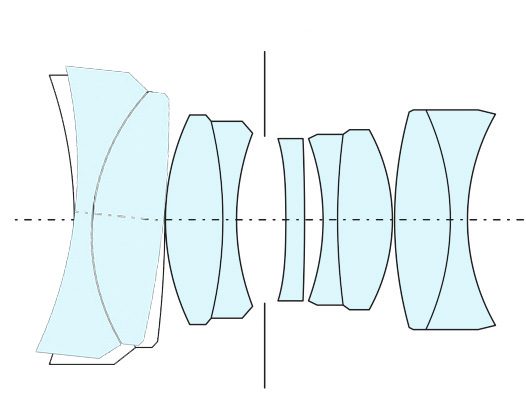
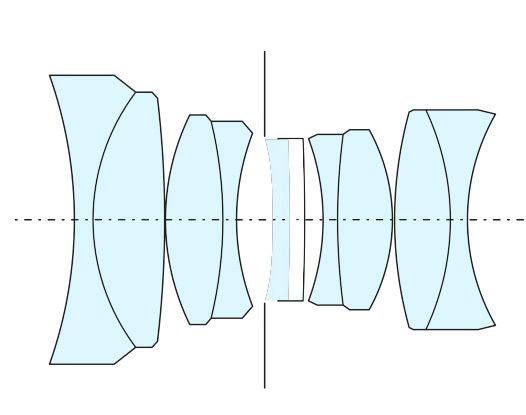
The third problem that can occur with lens elements is spacing. If elements aren’t the proper distance apart the lens may not focus the image sharply, or might not focus all the way to infinity. But the lens is not decentered and the tests we’re describing would be normal. There are usually a couple of elements that have ‘critical spacing’ within the lens. Theses are adjusted when the lens is assembled either by removable shims or by installing an element on a ‘ramp’ so that rotating the element moves it forward or backward.
Some Generalizations
It would be nice if we could say “a decentered lens looks like this” and “a tilted lens causes that”. Unfortunately lenses are too complex for that. But one common issue people ask me about is a lens that seems OK in the center but is very soft in the corners. Sometimes that’s just how the lens is designed. But if the lens doesn’t have a reputation for soft corners, it may well be that the copy in question is decentered.
The Way It Used to Be
Back in the days of film and manual focus lenses, most repair shops had a centering collimator. It shined a star chart or a chart of concentric circles through the lens. If an element was decentered the chart would flare or be distorted in one direction. The technician would then adjust those elements that could be adjusted until the lens was properly centered. Obviously in film days you didn’t take a test shot, send it off to be developed, make an adjustment, take another shot … . it was all done off camera.
When lenses became more automated, so did testing: Lenses are mounted to the manufacturer’s electronic test system and most of the adjustments made electronically – or the computer report suggests which lens elements need be adjusted. The equipment is breathtakingly expensive and only the factory and some (not all) factory authorized centers have access to it. Standard centering collimators became a thing of the past, except for some specialty shops. (You can find them on eBay every so often if you want one to keep around the house.)
A Simple Test for Decentering
If you want to correct a decentered lens you need an optical bench, a computerized MTF program, or at the very least a lens projector and a lot of knowledge about which elements can be adjusted to correct an abnormality. But if you just want to check and see if your lens is centered properly (at least for most lenses) you don’t need much equipment at all. Now that we have live-view focusing and the ability to look at images in real-time, we nearly have the same thing as a centering collimator built into our camera and lens. You need just a couple of accessories: a tripod to give your camera a stable platform and a simple chart.
The screening test I’m going to describe is not perfect: a few lenses (particularly ultra-wide and 10x zooms) will give false-positive results; and this test won’t detect other causes of softness like problems with spacing of elements. But it’s at least 95% accurate for detecting decentering in our experience (which is for several thousand lenses tested over-and-over).
We use a the Zeiss modified Siemens Star Chart. Star Charts are often used as focusing aids, which is one of the reasons we put them on the resolution charts we use for Imatest and our other testing setups. You determine the lens is properly focused as the rays of the stars get closer and closer to the center. The Zeiss version adds a small white circle around a small black dot in the middle of the star chart. You can buy them for about $30.
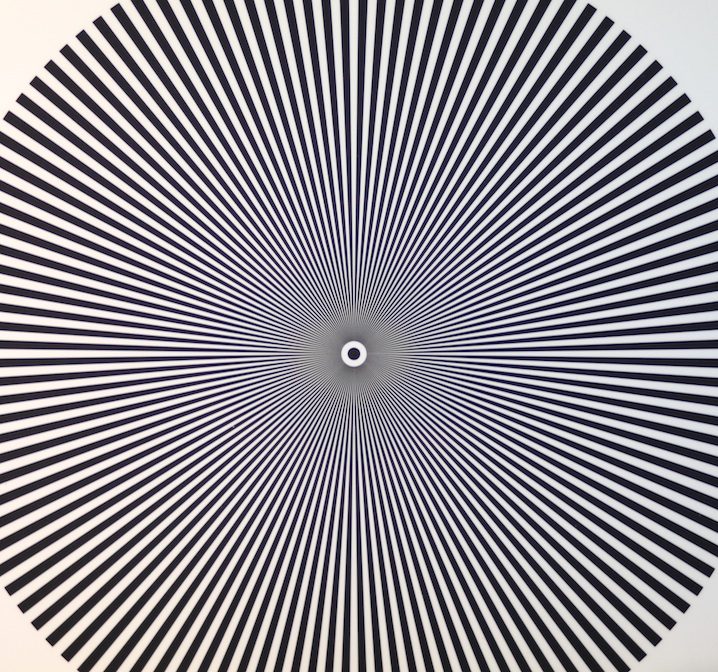
If you manually defocus the lens just a bit, the star rays and the white and black circles in the center blur, of course. If the lens is in proper alignment and pointed directly (lineup isn’t critical, you can eyeball it) at the star, the white and black circles remain circular as they blur. But if the lens is decentered or significantly tilted the center blur will ‘flare’ out in one direction or another as you defocus.
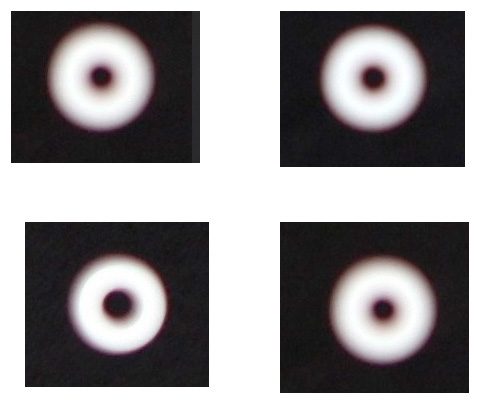
For example here are star charts shot just out of focus using four Canon 24-70mm f/2.8 L lenses at 70mm.
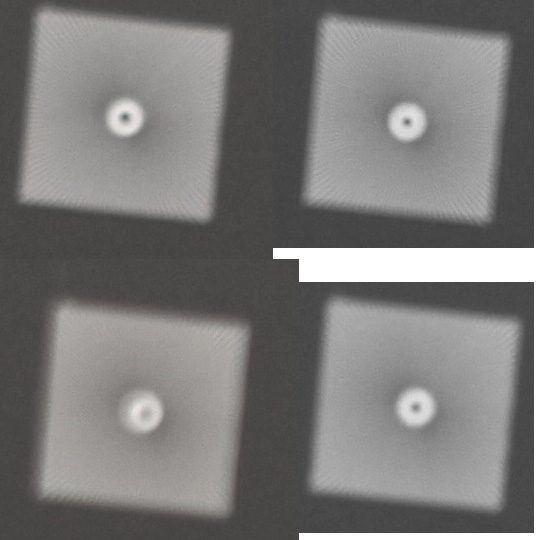
Even at the low resolution of blog-post graphics you should be able to tell that one of these things is not like the other: the lens in the lower left has a blur which is flared out toward 9 o’clock while the other three lenses have nice round blurs. The nice thing about this test is it’s not very set-up critical. The chart doesn’t have to be exactly in the center of the lens, you don’t have to line the lens up at exactly right angles to the chart, it doesn’t even matter which way you go out of focus (near or far) or exactly how far you go.
Let’s look at the resolution tests we did on the same 4 lenses using our Imatest lab – keeping the graphs in the same positions as the star patterns were above. Yellow areas are the highest resolution, blue are worst.
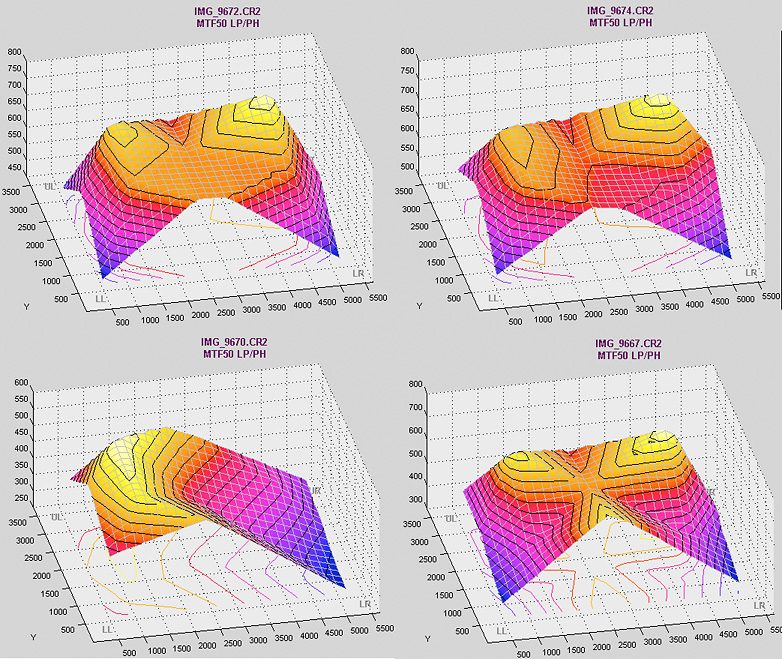
You probably notice that our lower left lens (the one with the flared star chart) has a pattern much softer on the right side. Also note the vertical axis (which shows the peak resolution) is different for this lens (the program automates the axis). The other three lenses peak near 800 line pairs, while the lower left lens peaks at about 600. It’s significantly worse than the other lenses.
Our star-chart flare did a nice job of identifying this decentered lens. The other thing that’s nice is the expensive Imatest lab shows me exactly how much the lens is affected, but it doesn’t show WHY it’s affected. The star chart made it pretty obvious the lens had a centering problem. We recentered the front element (the most common place for decentering on this particular lens) and the lens returned to perfect resolution.
If you don’t have $30 to spend on a Zeiss Star Chart, you can make a reasonable substitute yourself: just stick some white rings (like notebook paper reinforcing rings) on some black posterboard.
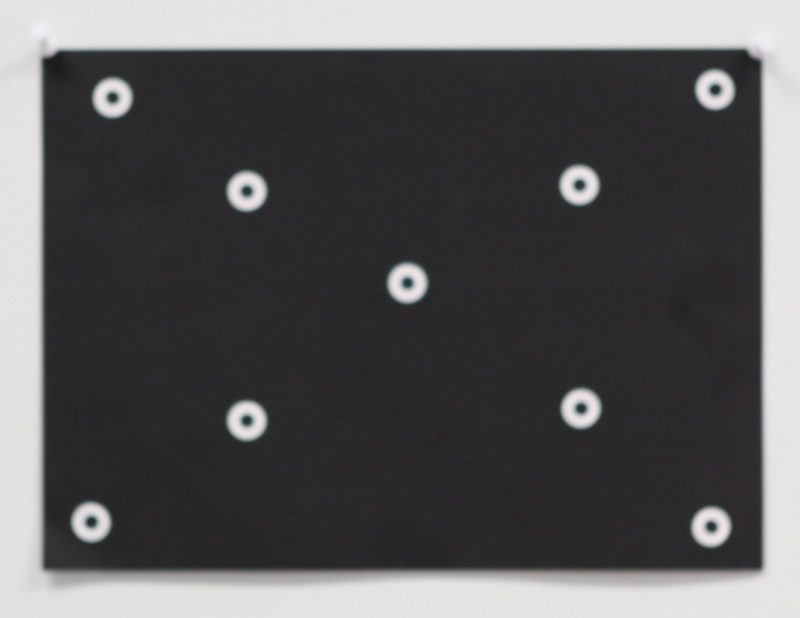
The flare isn’t as easy to spot as with the star chart, but it’s still noticeable. Here are the same four lenses that were used for the example above. Look particularly at the black center and see how it bleeds out onto the white circle at 5 o,clock — the opposite direction from the white flare noticed above. There is still some white flare noticeable: compare the outside of the white circle at the lower right and upper left areas. It’s not as easy to spot as the Star Chart flare, but it’s there (and this chart is free).
Uses and Limitations
Using the Star Chart as a poor-man’s centering collimator is a nice screening tool. It’s not perfect by any means. Some consumer grade zooms (particularly superzooms), some retrofocus lenses, and a few others show a pattern like this even when they are perfectly aligned, but those are the exception. For the majority of lenses, seeing a decentering pattern when the lens seems soft provides you some confirmation that the lens has a problem and may need a trip back to the factory. It can often answer the ‘is it me, or is it the lens?’ question. It may provide some further data when you’re trying to decide if the corners on your new lens are supposed to be sharper than they seem.
Because I know some people are going to ask, I don’t recommend trying to adjust lens elements at home using this method. Centering the lens element to remove the flare can be a good starting place and we do it here. But it’s just a starting place and you need a LOT of other equipment to fine tune the resolution (especially in a zoom). There are some lenses that don’t have any elements that allow tilt or centering — a factory rebuild is the only option when it gets out of sorts. With others, nearly complete disassembly is required to make such adjustments. And, of course, opening up your lens voids any warranty.
Roger Cicala
Lensrentals.com
May 2012
65 Comments
Samuel Hurtado ·
Very cool tip.
I’ve solved a few badly assembled vintage lenses, but only of the “poor spacing” type. This issue seems to be very common on vintage lenses: I’ve had to correct it on 2 out of the 5 vintage Leitz primes that I own.
The most obvious issue that this causes is “no infinity focus”, but it also affects corner sharpness, and even bokeh.
Vintage primes can be cheap and awesome, but they’re also kind of a lottery…
http://www.similaar.com/foto/lenstests/lenstestsc.html
CarVac ·
My Contax Zeiss 50/1.4 is actually somewhat decentered. I can see it in the bokeh: the ring around the very edge is considerably fainter on one side.
Mashuri ·
Wow! This was tremendously helpful. Even using the star pattern image on my computer monitor worked well enough for testing. I had just picked up a Tokina 16-28/2.8 and was worried about centering issues, since it seems to be a problem reported by a few testing sites. Can I assume, since everything blurred nice and even in the center (different story in the corners, but I think that’s a trait of UW lenses, since my Sigma 12-24 behaved the same way) that the elements are properly centered?
Roger Cicala ·
Mashuri,
You can assume there’s no decentering – we’ve tested that lens here enough to know it does exhibit that pattern when decentered.
zajcev ·
I know it could be hard to judge but maybe you could help me. My 35L behaves strange. When focusing with center af point it’s ok. When using side left AF sensor it is ok, but using side right AF sensor the lens frontfocuses. Checked on other bodies and the lens beheve similar, so I assume it is not the camera problem. What defect could it be?
Roger Cicala ·
It could definitely be a decenter, or tilted element causing the phase to not be equal on both sides. Have you checked it carefully to see if one side is softer than the other, or focusing at a different distance?
zajcev ·
I don’t find any of the side softer when fousing with center AF sensor. Image of a text taken a 1.4 at close distance gives a pretty straight dof. Only when focusing with right af points there is a frontfocus. And the text is out of dof.
Roger Cicala ·
zajcev, that leaves me totally puzzled. I’ve no idea what it might be.
sergejv ·
zajcev, the same problem is with all my five nikkor 24-70/2.8 lenses on D300s body.
Left and center AF sensors is OK, but outer right has back-focus. Tested on 50 and 70mm.
Roger, can check your af-s 24-70/2.8 lenses for this issue?
Roger Cicala ·
sergejv, I don’t think that can be a lens issue = on 1 or even 2 lenses, perhaps, but not 5. But to answer the question we haven’t seen any problems with 24-70s and lateral autofocus. Excepting, of course, a couple of copies that were decentered.
Vlad ·
Should there be decentered flaring on the circles other then the one in the center of the lens?
I’m asking because I have a Sigma 50mm 1.4 which suffers from erratic AF an I tested using the black background and white circles. When slightly OOF I can see that the center is ok but the rest whould be decentered going worse to the edges.
Thanks
Roger Cicala ·
Vlad, worse towards the edges, if it’s symetrical, is pretty normal. All the various abberations can make that happen away from center.
Raul ·
I’m trying to determine if a Sony SELP 16-50 is defective (kit lens on NEX-6). In the middle of the zoom range, the left side of the image is significantly softer than the right. It affects about 15 % of the width, an does not improve much when stopping down. This is my second copy of the lens. The first one had this problem at the wider end of the zoom range. Am I unlucky, or this lens has poor manufacturing tolerances? Roger, have you tested any of these lenses?
Pro ·
Hallo, a couple of years ago I bought a D700 with a Nikon 24-70 2.8. The left side of the frame was out of focus but not always so I suspected that an element must been loose. I sent it to Nikon service and after 15 day the said that they calibrate the af of the lens and everything was ok. I find that answer idiot. Since the lens was new I demanded a replacement and after a month a new lens arrived. Better copy but same problem.One shot perfect , 9 shots average .The body was wonderful providing nice pictures at 2500 ISO but the lens…So I sold all the Nikon gear and continued with my reliable 17-55 on my 30D!( yes I bought the D700 instead of the 5DmkII because of the better ISO performance)
Bradley ·
I just picked up a Zeiss Siemens Star Test Chart to check for lens focus and decentering. Well, I just ordered it. I’m assuming that it is just a piece of paper or thin cardboard, right? If so, can it be laminated in plastic without any effect on it’s quality or use?
Roger Cicala ·
Bradley, I wouldn’t laminate it unless you can get a low-glare covering and even then I’d be hesitant. It’s made to be the first surface and adding a diffraction layer might cause an issue. It might not, too, but for critical testing I think it best not to add another variable.
Kate ·
I am testing a Sigma 24-70mm because lately when I am shooting it seems that the center of my image is sharp, and the focus gets softer on the left side. When doing your test with the circles, the corners seem to only show slight change in the center dot. Is this normal? Should the center target be the only one showing misalignment??
Roger Cicala ·
Kate, only the center target is pertinent with this test. Coma and other aberrations will affect the off center dots in a normal lens.
Norbe ·
I just sent my Sigma 70-200 f2.8 HSM II back to Sigma in NY for the decentered problem. Center is shape, but left and right are blurry. They emailed back saying the lens is being sent to Japan for repair. So, it seems that they do not have the equipment in the US to make the adjustment. Just reserved one on rental to fill the gap.
Fabrizio Giudici ·
Many thanks for all the info. I’ve just ordered the Zeiss Siemes star chart, but in the meantime I’ve run a quick test with the image above on the monitor. I’ve just received a brand new SEL-1018 and it looks as it’s decentered (confirmed also by the quick test described at photozone.de). Do you have any experience with this lens?
Jon ·
For the purpose of testing would it suffice to print the start chart on A3 size paper using a laser printer?
Chris Kennedy ·
Hi there,
I just bought a Samyang 24mm f1.4 lens for astro photography. In the top left corner of the photos I am noticing some distortion, stars that look out of focus and appear to be starting to trail, yet other stars in the photo or sharp. I am using a Canon 5D (Classic) and I think I get the same issue with the 24-105mm Canon L lens it came with (f4). Is this issue likely to be the camera or purely a lens issue? I can supply pics if this helps?
Any help would be appreciated.
Kind regards, Chris
Roger Cicala ·
HI Kris, it could be either one, but no way to tell without carefully testing each. But most Samyangs have a soft corner and they can’t be adjusted.
Tom ·
Hi Roger, i´m “proud” of a EF16-35 II lens which has been two times given away for centering… First of all: middle part sharp; edges blurred with less ca´s. Adjusted, got it back… better sharpness but lots of ca in the edges. And now.. only useable at f8.
Is it so difficult to adjust this lens? I know there are a lot of possibilities to make it more worse. Or is it normal to have massive ca´s in all edges (my tree is now green-brown-red; magnification 100x).
Or should it find a way to the trash.. and sell a new f4 type? Thanks Tom
Roger Cicala ·
Tom, it’s probably the most difficult to adjust lens we know of. We send about 40% back to Canon for readjustment after the first go around.
Frank Nachtman ·
Hi Roger – What about the 16-35mm f/4L IS? Easier to adjust? Sent back less often?
John McKay ·
I know this is an old post but hopefully you guys get this message. Do you test all of your lenses for decentering? I’ve got two 24mm Rokinons on reserve from you guys for a project in August. I have three Canon 5DMII’s and a 24mm Rokinon myself and plan on using them for a three camera pano setup. Hoping they all three match.
Roger Cicala ·
John, we do test every lens for decentering. But that has to be done within the capabilities of the lens. For example, there is no Rokinon 24mm we’ve ever had that isn’t slightly decentered, and they cannot be adjusted. If you do a three camera set up, the Rokinon would not be my first choice unless you are stopping down a bit. At f/4 they’d probably be fine. But it’s the nature of the beast. You can’t make a perfect 24 f/1.4 at the price they make those at. They are excellent, sharp, contrasty lenses. But if you want 3 exactly alike it’s going to depend on what your definition of “alike” is. Each of the three will have a slightly soft corner, as will the other 2 dozen we have in stock and as did all the dozens that came before. It’s minor, and depending on the subject being shot probably not noticeable, but if I have them in the lab, it will be detectable. Rokinon 24mm distortion also varies just a bit, so one may have 2.2% another 2.1% and the other 2.3%. Probably not noticeable at all, but if your pano is that critical it could result in more work splicing or could be a tiny bit noticeable.
All that being said, I’m going by the lab results. Photography and videography results are less critical and what I see in the lab may not be noticeable in the field. But it may. I own the Rokinon lens you speak of myself, it’s a great, awesome bargain. But I’d be hesitant to use 3 of them in a pano. It might work. It might not.
Lowry ·
Any chance you guys can test a lens for decentering if I drop it by your Cordova office? I’ve got a Fuji 18-55 that isn’t sharp. I sent it to Fuji and they say nothing is wrong with it but there is a definite issue.
Roger Cicala ·
Lowry, sorry, we can’t test Fuji mount except with the older, time consuming techniques.
Lynn Ross ·
I have the Rokinon 14mm it’s way out of focus so to say … but the thing is that you have to get so darn close to the test shot that anything could be out of focus …. does it work with the 14mm? or I’m I just wasting my time… I believe that it’s got a de-focus issue ..
But anyway thanks for your idea and I want to try it on a different lens now … but will hopefully send this lens back for a replacement…
Lynn
Brian ·
I would assume the best way to do this test is with a lens wide open (f/1.4, f/2.8, etc.) vs say F/22. Correct?
How far away should you be from the chart? I have a 25mm and 85mm prime.
Thanks.
-Brian
Chik Sum ·
May I ask is there any case where decentering occurred but didn’t show up in the star test?
Roger Cicala ·
Chik Sum,
I can’t think of any – there are false positives (star chart looks decentered but lens is good) especially with zooms. But I’ve never seen a decentered lens with a good star chart.
BUT – I’m using the term decentered here in an optical sense (a lens element is not lined up along the center of the lens). In online forums people say ‘decentered’ and mean ‘something wrong with the lens’. If there is a spacing error (elements too far apart or close together) or a tilt (element properly centered but not quite horizontal) you could get a normal star chart but have a bad lens. Online, people are often talking about tilt when they have a bad lens and this test may, or may not, detect a tilt. However, normal chart shooting usually detects tilt just fine.
Roger
Wedding-Photographer ·
Hello Roger.
Thank you for this article !
Little question : if the lens have a spacing error (and all elements are correctly aligned) , how can you notice that ? Is there any special test to do ?
Kenny ·
I have 3 different lenses with 28mm focus distance. I tested them on a tripod pointing towards the same spot. Two of them centered at the same spot while the other one is a little bit shifted to the left bottom. Yet, when I tested the off-centered one using the Zeiss chart, it appeared totally normal (no flare). So is this lens de-centered or not?
Roger Cicala ·
Kenny, when we set up a camara focused on a test target and then change lens after lens to test them, we always see the ‘center’ of the image change location a bit with some of the lenses. This seems to be more a thing about how the optics are centered in the mount than anything about whether the lens is decentered or not. So what you said about the image shift is to me, just normal variation and nothing of importance if I’m understanding the question correctly.
And as always, a reminder that this test is for optical decentering. It’s not going to detect tilt or spacing errors that could also affect sharpness. On the forums people often say ‘decentered’ when they mean any of those three things.
Roger
Lynn Allan ·
Hope this question on an older blog article comes to your (RC’s) attention.
Do you feel that this de-centering testing is sufficient to identify a large or maybe even great majority of lenses that are out of spec? Especially from Sony/Zony?
Or is there still “insufficient data”?
There is also what appears to be an even simpler de-centering test that just involves an out-of-focus LED. Your thoughts greatly appreciate on that.
I would greatly welcome being able to get away from what I consider odious, tiresome, and error-prone brick wall testing … if one or the other de-centering tests was sufficient for perhaps 90% or [fill-in-the-blank]% of LUTs (Lens Under Test).
There is a Y.A.T. (yet another thread) on DPR where a proposal has been made by YACPW (yet another clueless post.writer .. that would be me) to perhaps have a multi-step approach to “good copy vs bad copy” testing:
Thread:
http://www.dpreview.com/forums/post/58013972
Post … sorry fo tl;dr :
http://www.dpreview.com/forums/post/58027091 (proposal below)
My speculation is that perhaps valid “best practice” for “good copy vs bad copy” might be done in multiple stages:
* relatively simple de-centering test (OOF LED or LR approach)
* if passes and concerns still exist about the LUT (Lens under Test), more involved far-horizon testing at a tilt (if adequate scene and climate easily available without driving)
* if passes and concerns still exist about the LUT, more involved with something like a brick-wall
* if passes and concerns still exist about the LUT or real MtfMapper numbers justified, more involved with silhouetted razor blade, perhaps with motorized, computer-controlled focus rail
l_d_allan ·
I was wondering about using this de-centering test with a zoom lens: is it sufficient to test just one focal length? Would the wide FL or the narrow FL be more sensitive to showing de-centering? About the same?
Roger Cicala ·
Zooms can decenter anywhere throughout the range. We test at both ends and in the middle of the range. BUT most zooms are going to be slightly decentered at some point. It’s really quite rare to find one that isn’t at all.
Mauro Schramm ·
Hi Roger, nice article, as usual.
One question: in the alternative method (white rings over black background) which portion of the frame is used in the comparison (in the last picture)?
Roger Cicala ·
That’s the center of the image, Mauro.
Mauro Schramm ·
Thanks, Roger.
Mcroberg ·
I have a question, I am testing my Sony emount version utilizing the alternate version. Am I to use f2.8? When doing so the center ring is perfectly circular however the edge rings lose their center definition and turn into a glob, defective or normal? I am planning to use it for astrophotographery.
Roger Cicala ·
Mcroberg, widest aperture is what we suggest.
Mcroberg ·
I shot a couple pictures slightly out of focused at the widest f2.8(Rokinon 14mm), there’s a slight shift in the center but doesn’t bleed out like the pictures you posted above. Do you think it’s acceptable for astrophotographery where you need to shoot wide open or something I should return?
radu ·
Dear Roger,
I applied your recommended method to a Tamron 15-30, Nikon mount, and everything appeared to be fine. However, in practical tests the lens is constantly weaker in the left margin. would it be possible that your test give false-positive result for the lens mentioned above?
Thank tou,
Radu
Roger Cicala ·
Radu, it sounds like your lens may have a field tilt rather than a decentering. Field tilt makes the sides very different even though the lens is well centered.
Remember, we’re talking about OPTICAL decentering. The internet uses ‘decentering’ to mean ‘any lens that is optically maladjusted’. A lens can have tilt or spacing errors yet appear well centered, even though it, as we say scientifically, sucks.
Sally Shears ·
Roger, thanks for this simple test.
Two Q’s:
1. I’m taking photos and examining the images, rather than the live-view. Sound OK?
2. Noting that this is all at close focus. Could decentering show up differently at close vs. far focus?
Again, thanks.
FWIW, Google “Zeiss Siemens Star Test Chart” images to find a high res file that seems to work pretty well.
Roger Cicala ·
It is possible to have a problem at different focusing distances, and if you do that pretty much guarantees it is in the focusing cams/helicoid.
Matt M ·
I second Sally shears in does this work at close focus as I have a UW that I did it on?
Roger Cicala ·
It does work, although with close focus it may give false positives if you’re getting near the minimal focusing distance.
One other thing find is some wide angles will use a slight decentering to counteract a field tilt, so just seeing a little bit doesn’t mean a lens is bad.
appliance5000 ·
I use a newspaper taped to the wall – am I a bad person?
Hunter45 ·
We don’t know if you are or not. Would you like to provide more info? (grin)
appliance5000 ·
Seeing kittens cry makes me happy. I will burn in hell.
Hunter45 ·
Yep.
Laurens van Herpen ·
Hi Roger,
Interesting article. I know you recommend against trying to calibrate zooms, but I’m one of those foolhardy people who want to try. I repair Canon lenses as a hobby and have recently bought a 70-200mm 2.8 IS USM II that has been taken apart by the previous owner, with complete disregard for the factory calibration. There are at least 4 lens groups that can be adjusted for tilt, so I’m struggling to get a good image. At this moment, 200mm is tack sharp in the center and soft in the corners, 70mm looks awful.
I have a perfectly fine 70-200mm 2.8 IS USM to compare it to and use tethered live view, zoomed in as far as I can get, while adjusting any of the calibration rings. Every time the center or one of the corners looks good, another corner is soft or flaring. Long story short: I don’t know what a good approach is to get closer to a useable lens.
Could you recommend an approach that will help me? Such as which lens groups to calibrate first and which last, or if I should read up on the Imatest program you use.
I have not contacted Canon yet about the price to get it done by them.
Thanks,
Laurens
gadgetaddict ·
I have a Tamrom lens with a very soft lower left corner. Aiming at this Siemens Zeiss charted my computer screen shows no decentered flare on my life view. So at least im my case this test is useless.
Tord55 ·
Dear Roger,
Thanks for sharing two simple and elegant solution to problematic lenses, but as yet my Sigma seems to work well, so I haven’t had a need to try these tests. Not even the AF fine-adjustment, as yet.
As usual, had I known these tests when I was a Pentax guy I would probably had a lot of help from them!
Five years ago, to be precise!
Thanks again,
Tord
sneamia ·
@roger_cicala:disqus this is super helpful for lenses. Do you have any recommendations for testing whether a camera sensor is tilted?
Sebastian G ·
I have a lens that passes this test without any issue, but completely fails the Gletscherbruch test. I am pretty confident the lens has significant field curvature. Could this explain the difference? I can post pictures if that helps. Interestingly the lens is not a poor performer, but the opposite. It has extreme center sharpness even wide open and it’s a f/0.95 lens.
TinusVerdino ·
If my front element rotates but the decentering is always on the same side no matter the focal distance, is it then safe to say the front element is not the problem?
Brad Herman ·
@roger_cicala:disqus
Happy New Year!
I was curious about what the optimal distance should be for testing with the Siemens Star Chart with a 50mm lens?
Thanks!
-Brad
Brad Herman ·
Hi @roger_cicala:disqus;
I have a questions regarding the use of the Siemens Star Chart. I can see how to check the center of the lens by, well, centering the dot in the chart in the middle of the frame, but how do I go about testing the corners of the lens without compromising my testing parameters (distance, tripod movement, etc?) Do I simply keep the tripod where it is and move the center dot to the top right, bottom left of the frame?
Thanks
Tempat Sewa Proyektor ·
Wah, artikel tentang testing for a decentered lens ini keren banget! Teknik lama yang diperbarui itu sangat berguna, apalagi untuk fotografer yang Ingin menjaga kualitas lensa tetap optimal.