
Lensrentals Repair Data: January – July 2012
What Is This?
We have a unique opportunity: We own a very large number of lenses subjected to rather harsh conditions. They get tossed around during shipping, and sometimes the user isn’t as careful with them as you would be with your own lenses. Basically, we have a laboratory set up to stress test camera equipment and we share those results with you.
Our numbers reflect heavy and hard use. Your personal lenses shouldn’t fail nearly as often; they aren’t subjected to rental conditions. But since all of our lenses are subject to roughly the same number of rentals per year, it does provide some comparison about how fragile various lenses are compared to other lenses.
It’s not completely scientific, but it’s a bit more useful than 10 posts on a forum going back and forth between “never had a problem with it” and “mine sucked.”
This list is not a comment about how good a lens is. It’s simply data about how often it breaks under harsh conditions. Some of my favorite lenses are on this list.
What’s New This Year?
A lot, actually. First of all I’m doing a mid-year report. We’ve got twice as many items as we did last year, so half a year’s data is equal to all of the 2011 data we collected.
In the past we’ve looked at our data as repairs per number of copies stocked over time. With better data now, we’re going to present it as the number of rental weeks per failure. That should level the playing field a bit more since nothing stops working while it’s sitting on a shelf. It also may be more appropriate since these items are used so heavily.
For example, if we have 10 copies of a lens, each copy has been rented for 10 weeks, and we’ve had one repair, that lens averages 100 rental weeks per failure.
Lens age is a bit of a variable. Our average item is less than a year old, and none are two years old. But if an item has been released in the last 8 or 9 months, all the copies are new and repairs may seem falsely low. (If it shows up when all are new, well, that’s bad.) When an item is discontinued we still stock it for a year, so all of the copies are older. (This year the Canon 24-70 is the one example.)
Additionally, we now have a 3-person repair department and do about 50% of our repairs in-house. That gives us better information on what’s going wrong. It’s much better than the “internal parts replaced and calibrated” report that we get from some service centers. For some of the lenses we can show you what the weak point actually is.
We’ve also computerized tracking for all of the repairs we’ve sent in to various service centers. This lets us track things like cost, turnaround time, repairs requiring return trips to the service center, etc. There are major differences between brands in how they approach repairs and service. I think that’s important enough to write about.
Equipment Failure Rates
What do the numbers mean?
It is an annualized repair rate of the period from January 1 through July 1, 2012. A physically damaged lens (by our observation or customer report) does not count as a failure for this list. If it’s obviously been dropped, soaked, or otherwise damaged we don’t consider it a failure. For example, if a filter ring is dented, a front element scratched, or a distance window cracked it is not a failure.

It is probable that some lenses included in these numbers actually were damaged, but there was no overt evidence that it was so. We do not accept the factory service center’s word that the failure was “secondary to shock damage,” because a number of brand new, fresh-out-of-the-box lenses that we’ve sent back for repair came back with “shock damage” as the problem.
We make no comment at all on lenses that we have less than 9 copies of (we don’t think that’s particularly useful, it’s too small of a number) or that have been in stock less than 3 months unless something spectacular is going on (there are a couple of those this time).
Limitations and Disclaimers
Now, for those of you who want to reach conclusions from the data, please note the following: the average rental weeks per failure for all lenses and cameras is just over 300 . Everything fails eventually, but that means most items takes a long time to do it.
To determine failure rates with actual statistical significance we’d need at least 400 copies of each lens. We don’t have that many (although we’re getting close on some of them) so take this data for what it is meant to be: something better than a thread telling you about 6 individuals’ lenses; but not, by any means, an infallible fact. Still, it’s better than anything else currently available that I know of.
Depending upon the lens in question we have 10 to 200+ copies. It’s obviously more meaningful when we see 20 failures in a lens we have 200 copies, than when 2 of our 20 copies failed on another lens.
I want you to get an idea of the sample size we’re dealing with, but I can’t put an exact number of copies we because it varies over time. As an example, we had 69 copies of one lens in February but 128 copies of the same lens in June. What I’ll do is use the following descriptions of the sample size: Very large – always over 150 copies in stock; Large – always over 90 copies; Moderate – always over 40 copies; Small – always between 10 and 39 copies. If we see a strong tendency in a very large sample size, it’s very likely to be a real finding. In a small sample size it could very well be random variation.
We’ll look a little further into those by telling you what it was that went wrong. If 4 different things go wrong in 4 different lenses out of 50 in stock, it’s likely to be random. If all 4 have exactly the same problem, it’s more likely there is a weakness in the lens.
The following lenses or cameras we carry were NOT evaluated because we have less than 10 copies or they were in stock less than 3 months.
- Canon: 180 f/3.5 L; 24mm f/2.8; 24mm f/2.8 IS; 28mm f/2.8 IS; 40mm f/2.8; MPE-65 Macro
- Nikon: 14mm f/2.8; 16-85mm VR; 17-35 f/2.8; 20mm f/2.8; 35 f/2D; 85mm f/3.5DX; 105 f/2 DC; 55-200 Dx
- Sony: all Alpha prime lenses; NEX 18-200 OSS; 55-210;
- Tamron: 90mm f/2.8 Di, 180 f/3.5
- Sigma: 20 f/1.8; 70mm f/2.8 Macro; 105mm macro; 180 f/2.8 OS; 300-80mm
- Rokinon: 8mm fisheye
- Panasonic: All cameras except GH2, 45-175mm lens, 100-300 lens
- Olympus m4/3: 75mm f/1.8; 14-42 II
- All Leica, Voigtlander, Pentax, Fuji, and Schneider lenses
If we carry the lens and it isn’t listed above or below, then it’s weeks per failure was greater than 155 weeks (97.5% of the items we carry had a time until failure of greater than 155 weeks).
Finally, the usual ‘don’t read this and lose your mind‘ call goes out: These are heavily used, frequently shipped lenses. A given lens would have a far lower repair rate owned by someone who uses it on weekends, takes good care of it, and doesn’t ship it around the country.
Lenses with High Failure Rates
| Lens | Avg. Weeks Per Failure | Sample Size | Common Problems |
|---|---|---|---|
| Sigma 120-300 f/2.8 OS | 13 | Small | Cam rails (4), focusing barrel, OS |
| Sigma 50-500 OS | 43 | Moderate | HSM Motor (4), OS unit (3) |
| Nikon 70-200 f/2.8 VR II | 53 | Large | Tripod foot bent (8); AF adjustment (5), resolution (5) |
| Nikon D800 | 55 | Large | Battery door (6), electronics (3) |
| Tokina 16-28 f/2.8 | 57 | Small | AF/MF clutch (3 of 3) |
| Nikon 16-35 f/4 VR | 58 | Small | Resolution (3 of 3) |
| Canon 24-70 f/2.8 | 65 | Very Large | Resolution (26); Helicoid collar (19) |
| Sony 70-200 f/2.8 G SSM | 71 | Small | USM motor (3 of 3) |
| Canon 70-200 f/2.8 IS II | 83 | Very Large | IS assembly (11), Optical adjustment (10); Zoom jam (10); Barrel assembly (7) |
| Nikon D700 | 109 | Moderate | Bent CF pins (4); Grip peeling (4); PCB (2) |
| Canon 35mm f/1.4 | 110 | Large | Resolution (18); USM motor (3) |
| Nikon 105 VR f2.8 Micro | 118 | Small | VR (2), AF encoder (1), diaphragm (1) |
| Canon 100-400 IS L | 126 | Large | MF ring (10). IS (5), AF motor (4) |
| Tokina 11-16 f/.28 | 147 | Large | focus jam (6); AF/MF clutch (6); loose screw (3) |
| Canon 5D Mk III | 155 | Large | CF pins (8), electronics (3) |
A Few Observations
Several lenses on the list are ones that we have relatively few copies of: the Sony 70-200 f/2.8; Tokina 16-28 f/2.8; Nikon 16-35 f/4 VR; and Nikon 105 f/2.8 VR. Obviously, just one repair less and they would have ranked much lower or been off the list altogether.
I still believe the Sony 70-200 f/2.8 really does have a high failure rate for a couple of reasons. First, it was also on last year’s list. Also, two other Sony zooms were all just one repair away from making the list this year (24-70 f/2.8 and 70-400) and did make it last year. Plus all of the Sony 70-200 f/2.8 repairs were for the same issue: USM motors.
All of the Tokina 16-28 f/2.8 lenses had the same problem (AF/MF clutch), which is also a chronic problem on the similarly designed Tokina 11-16 f/2.8. Because they’re all failing for the same reason, we think it’s probably a real thing.
The Nikon 105 VR, though, seems to be more of a random event. It’s never been a problem lens and the repairs were for different things.
I think the other trend that’s very obvious is that large, f/2.8 zoom lenses are likely to have issues. Sony, Canon, and Nikon 70-200 f/2.8 lenses all made the list. The Canon 100-400 is there, too, while the Nikon 80-400 and Canon 28-300 barely missed (and usually make the list). The Sigma 50-500 OS and 120-300 OS are on it, too, with the Sigma 70-200 f/2.8 OS barely missing (in a small sample size of 20 copies).
Each seems to have its own issues. The Canon 70-200 IS II has problems with the nylon reverse gears in the zoom ring and its IS unit. The 100-400 with its outer focusing barrel and notorious smooth-tighten ring. The Sigmas have HSM motor problems, OS issues, and barrel/cam issues. The plate for Nikon’s tripod foot is too thin and bends frequently, and the AF system is a bit finicky. The takeaway message is these are among the most complex lenses made today and the complexity shows in higher repair rates.
If you noticed, Sigma released a new version of the 120-300 f/2.8 OS just over a year after the original version. The optical diagram is exactly the same but I suspect we’ll see some more robust internal components in the new version. They’ve also announced new quality control measures at their manufacturing plant. Given the improvements Sigma has made in their repair service, I suspect they’re serious about improving quality.
Confirmation is Always Good
I’m always happier when I can find a logical explanation for the numbers. The Tokina lenses are a good example. They seem to have trouble with the AF-MF clutch system (if you haven’t shot with one, instead of an electrical switch or full-time manual focus, you move the focus ring forward or backward to engage manual focus). If we pull the rubber off of the focus ring, it becomes apparent the clutch is really two barrels held together by tape.
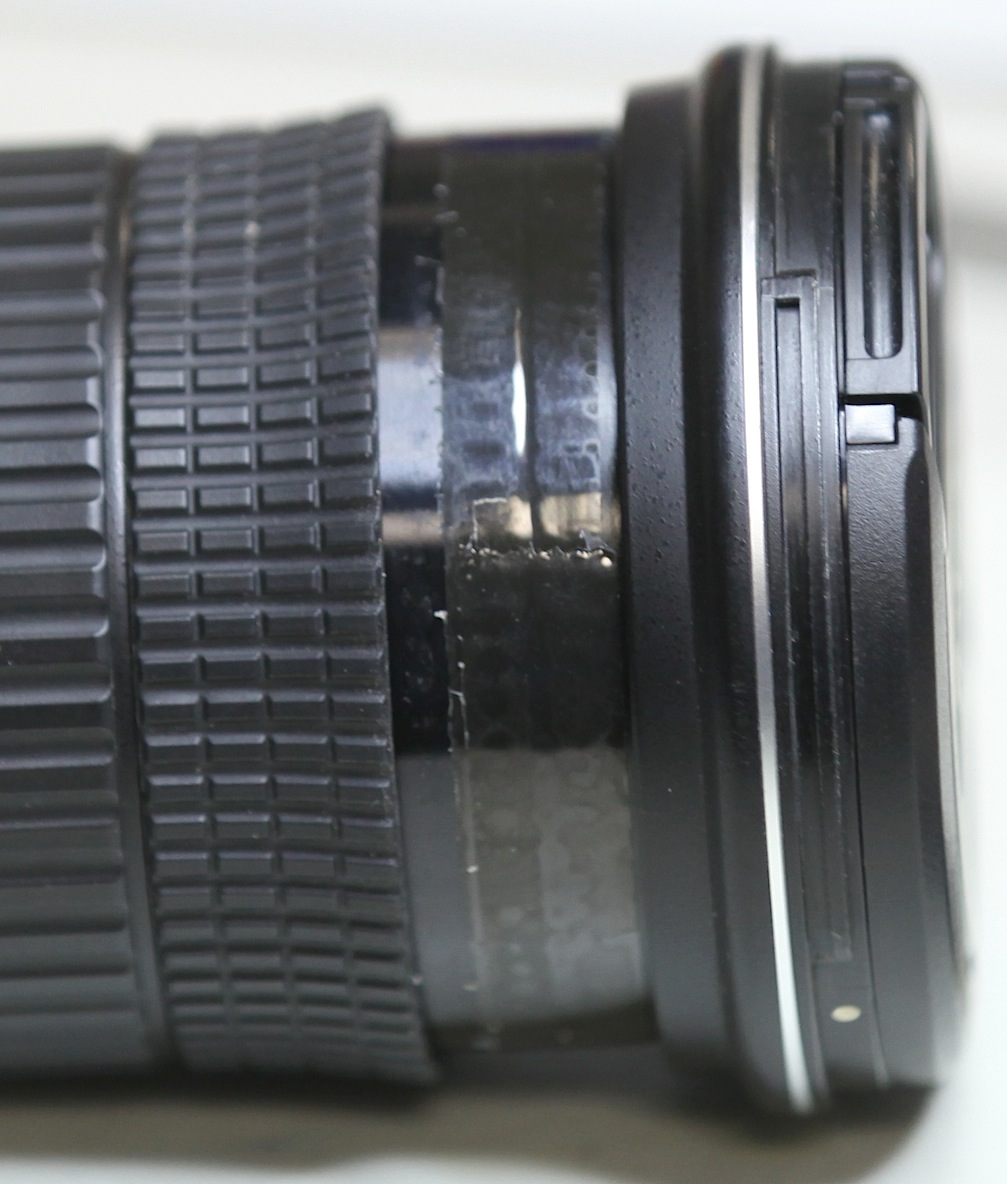
The lower (mount side) barrel pulls drops down once the tape is removed, showing the mechanical clutch. The teeth on the upper side engage the small collared screws in the internal focusing ring to manually focus when the clutch is pulled back to manually focus, disengage when it’s pushed forward.
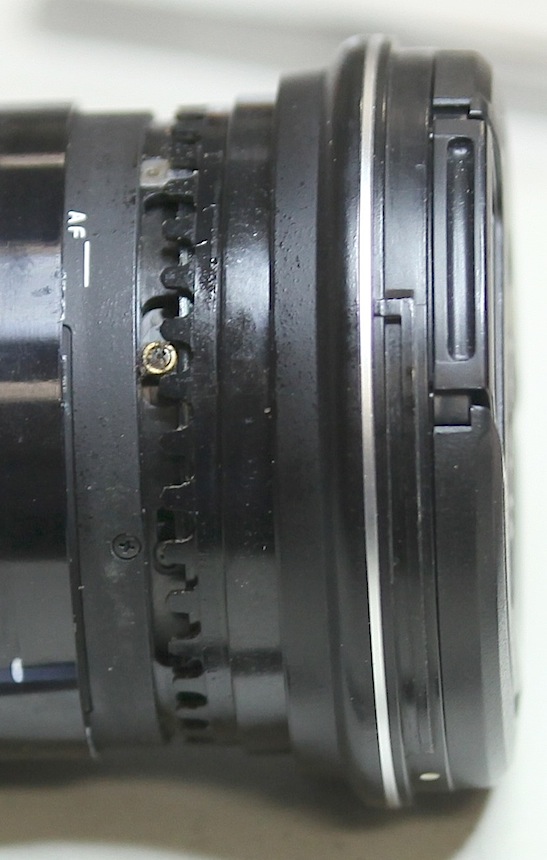
A lot of grit and dirt gets in there (probably from inside the lens) and sticks because there is lubricant on the teeth. The brass collars and screws break. So it makes sense that a heavily used lens, like a rental lens, might develop problems from wear-and-tear around the clutch.
I’ve written a couple of entire posts on why the original Canon 24-70 f/2.8 tends to have problems, and as I mentioned earlier, our fleet has gotten older since we haven’t been able to buy new copies since Spring.
With the Nikon 70-200 VRII, the tripod foot bends so often that the 8 we listed are probably lower than reality. Back when Nikon sold parts we kept spares and any tech would replace it, all you have to do is remove 4 screws and put the new plate in. Now, unfortunately, it takes a trip back to Nikon.
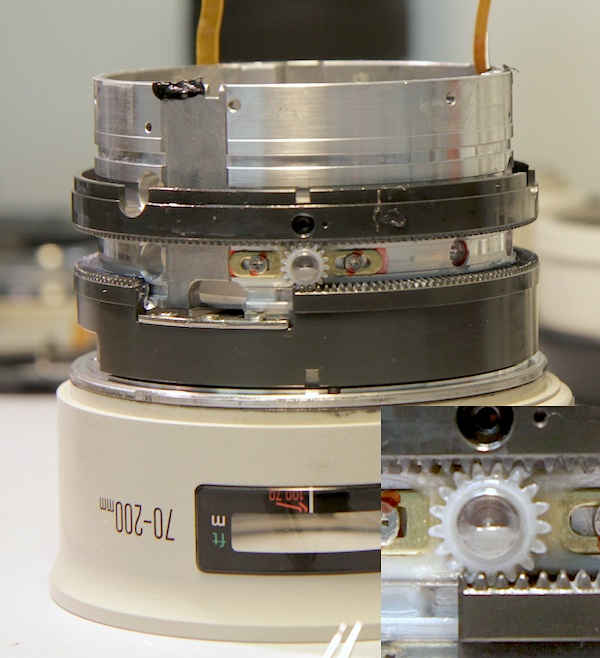
Similarly the Canon 70-200 fails for a couple of different reasons, but jammed zoom rings are common and caused by a tooth breaking on the nylon ‘reversing’ gear under the zoom ring. this is a good system – it was used in the Non IS and IS Mk I lenses – but it seems to have some problems with the Mk II. Whether that’s a bad batch of gears or that there’s more resistance in turning the new lens I have no clue. Either way I expect it will be fixed soon.
A Word About Cameras
This go around, the Nikon D700 is the only camera to really make the list. That was simply because of peeling grip problems, similar to what the Canon 60D had last year. But almost every camera body from every manufacturer barely missed — all had repair rates of right around 10%.
More notable, to me at least, is that we’ve already had almost 10% of our Canon 5D III and Nikon D800s repaired, despite having them in stock only a few months. I said we usually don’t put things on the list that we’ve had less than 6 months, but this is so noticeable it deserves mention. Once again, early adopters seem to be doing some beta testing.
I should mention, these aren’t ‘small number flukes’; we have a lot of these cameras. I should also mention that I’m not including ‘left side AF issues’ in the D800s required repair — we don’t have hard numbers on that yet. These were all for other things. Mostly a battery door that seems to break off if you look at it hard. I suspect either weak plastic or too thin of a pin on the door design are the likely culprits. That wouldn’t have been a big deal if you could buy replacement doors, but with Nikon’s new policy you have to send the camera in for factory service.
With 5D Mk IIIs, CF pins are bending at an amazing rate. With the latter, I suspect the combination of a CF slot and and SD slot (rather than 2 CF slots) allows CF cards to wiggle a bit more during insertion, so the card slots might not line up with the pins properly. I don’t know that there will be an easy fix for this, but be gentle putting those CF cards in your 5D III.

Factory Service Center, Uhm, Service
I care about this a more than most of you, probably. I send things in for repair every single day while many of you have never sent anything in for repair. But someday you will, trust me on that.
Depending upon which brand you buy, your repair experience, should you ever need it, could be great or awful. I’m personally convinced certain manufacturers are going to some lengths to make repairs a positive customer service experience, other companies are certain that internet fanboy noise will drown out the individual complaints about their horrible service.
First, let me emphasize this is USA only data; things are very different in different countries (particularly for Nikon). Second, other than a corporate account with Canon (in exchange for a large annual fee, we get to pay our bill once a month and get a 30% discount on repair prices) we send everything in just like you. When figuring repair prices for comparison purposes I’ve removed the discount and used Canon’s list prices, so all of the prices and turnaround times are the same as they would be for you. Actually, if you have NPS or CPS you get a bit faster service and lower cost than we do.
The table below shows the average (mean) turnaround time in days and average cost of repairs for each factory service center. Days are the # of days it was at the repair center; shipping does not count. Average cost is a rather blunt tool, but since most service centers use a three or four step, flat-rate repair fee schedule, it has some meaning.
| Brand | Days | Cost |
|---|---|---|
| Canon | 6 | $305 |
| Nikon | 26 | $376 |
| Sigma | 11 | $186 |
| Sony | 31 | $285 |
| Zeiss | 29 | $286 |
| Olympus | 9 | $281 |
| Tamron | 3 | xx |
| Voigtlander | > 60 | xx |
| Rokinon | > 60 | xx |
We have no cost figures for Voigtlander or Rokinon because we haven’t managed to get anything back from repair; nor from Tamron because they did not charge us for the few repairs we sent.
For the Nikon fanboys who tell me regularly ‘it’s just because they’re overwhelmed with the D800 problem.’ That’s true, but the number above is the average for the whole year. Repair turnaround was slow last year (18 days or so), got slower before the D800 was even released (25 days), and has crept up steadily since then. It’s been well over 30 days mean turnaround time for the last couple of months. So the number shown in the table is better than current reality.
Also I should point out that current Nikon repair costs are higher than the table suggests. First, I dropped an $1,800 D800 sensor replacement and $1,300 D3x sensor replacement because they were such outliers. I also used prices from the entire year — Nikon raised prices significantly in early April, just after they announced they weren’t selling parts to third-party repair centers anymore (color me paranoid if you like). In the last 3 months Nikon repair prices were significantly higher than the table shows.
Just for curiosity, I compared same-item repair costs for Nikon and Canon 24-70s. All Canon 24-70 repairs were either $268 or $370 (non-discounted price) during the entire 6-month period. All Nikon repairs were $539 or $602 from April 1 onwards; they were $310 before April (although there were only two during that period). I don’t have room to list all the replaced items, but they were similar: barrels, collars, helicoid rings.
Nikon, I love the cameras. I love the prices on the cameras. But Nikon USA’s repair and service sucks and is getting worse. And yes, Fanboy, I know they fixed your item for free in 5 days. We had one come back in 5 days, too (although not this year). I also know they have a great 5-year warranty. But how much does that help when you drop it?
Would I change brands or something over it? Of course not. That’s silly. Nikon makes excellent, reliable equipment and most people need a repair maybe once every couple of years. But I certainly am advising newcomers in a different direction, and I’d be a bit hesitant about picking up used Nikon equipment.
Finally, let me give a good word for a couple of the third-party manufacturers. Five years ago I thought Sigma’s factory service was awful and we used only independent service centers for Sigma equipment. Since then they have made clear improvements, with an easy-to-use website and polite, knowledgeable customer service on the phone. We started using them again this year and their turnaround time and prices were excellent.
While we don’t use them often, Tamron even goes a step better: they guarantee they’ll have an item fixed 3 days after they receive it (I’ve confirmed this with Pat Simonetti, Director of Tamron Customer Service). If they can’t fix it in a timely fashion, they supply a refurbished or new replacement. I should also mention that when we’ve reported a problem to Tamron or Zeiss, both make inquiries about it, getting all the information they can and passing it on to manufacturing. It’s a pleasant change from “there is no problem, we never have problems.”
Tokina is absent from the table because we stopped sending anything in to them years ago. If we can’t fix it ourselves, we use an independent service center. They may be much better now, but I have no information either way.
Roger Cicala
Lensrentals.com
September, 2012
83 Comments
Derek ·
Hi Roger,
Thanks for publishing these, they’re always interesting reading. Are you planning on publishing the best performers too? In some ways that’s just as useful.
Roger Cicala ·
Derek,
That’s an excellent idea and I should do that. I’ll get some numbers together this week and do an addendum. I can tell you off-hand the following:
Zeiss Primes are among the most reliable. Very occasional centering issue is all. Makes sense: no electric motor, no IS unit.
Among the Canon zooms, the 24-105 L is one we just think of as bulletproof. Never fails. The Canon 17-55 IS used to have lots of IS failures but obviously got fixed a couple of years ago. Another lens that rarely fails.
The Nikon 14-24, when it first came out had barrel issues, but it’s certainly fixed. Another lens with no troubles. None of the Nikon primes have problems either.
The Sigma ‘short zooms’ are trouble-free in general, as are their primes other than focus issues.
Anyway, thank you for the idea and I’ll get some better numbers together over the weekend.
Roger
J. DeYoung ·
I own a lot of Nikon Gear, and it has been my unfortunate experience that service from Nikon USA sucks! You can’t even buy simple repair parts anymore. Does a broken battery door really need to go into the factory for replacement? Seriously!?
Couple that with Nikon’s standard 1 month turn around time, even for simple things and I shudder to think what will happen the next time I need something fixed.
Nikon USA Service = Fail!
Fred ·
Does the 70-200f4L IS have the same problem as the 2.8II?
Roger Cicala ·
Fred,
No zoom lock-up issues with the f/4 version, occasional IS issues, but every lens with IS has that.
Roger
CarVac ·
The 50/1.0 is incredibly sad…..
James Bong ·
Yeah, I almost cried when I saw the 50mm f/1.0. 🙁
Jim Thomson ·
Roger,
Is there ever any problem with SD cards/card slots?
I noticed that bent pins for CF cards happens on both Nikon and Canon.
I also see lots of fanboys saying that pro camera’s should have two CF card slots. Personally I use both (on different cameras) and don’t see much advantage to either format. Although I guess you can get bigger and faster CF cards.
Roger Cicala ·
Jim,
Once in a great while we’ll see the little lever-latch in the SD slot break or get stuck, but it’s rare. We fix pins in CF slots, well not every day, but certainly several times a week.
5DIIIs are more frequent, clearly, but I’ve had to do it on every camera with CF slots.
Roger
George ·
The Nikon service issues make me feel a bit nervous, I switched from Canon to Nikon for the D800. My D800 is on the way back to me, I sent it in for the left focus issue (was wayyyyy off, unbearable!) It’s on its way back after about a week and a half–ended up being in the shop for about 5 days total, I’d say. This is with El Segundo. I’m hoping it’s fixed–I think the time was reasonable. Nikon seems to like to claim “shock damage” on everyone, from what people say on the forums.
The one time I had to send a lens (15-85) to Canon, they had it back within a week, it was amazing.
I agree that Tamron has good service. Girlfriend sent in a 70-300 that was dropped and wouldn’t zoom all the way anymore. They got to it right away, charge $160 (real reasonable, I felt), and answered the phone within 5 minutes.
Maybe with all the publicity, Nikon will be shamed into improving.
Roger Cicala ·
George,
Glad to hear about your turnaround time. Maybe they are addressing it. I’ve also been told they had parts backlogs on D800s that have finally gotten covered.
Pieter ·
Interesting that you say the Canon 24-105 is bulletproof – mine’s currently in for repairs for a broken aperture assembly! It seems to be an uncommon (but not unknown) issue with some older 24-105’s – since your stock is regularly replaced I guess you might not have seen that. And also, one lens doesn’t make for conclusive results.
Roger Cicala ·
Hi Peter,
I think the ‘newer copy’ thing does make some difference. A few years ago 17-55 f/2.8 Canon lenses were always on the list for IS problems, then they just stopped. 24-105s have never been high repair rate lenses, even at first, but the last 2 years we just never see them come through repair – and we have well over 100 of them.
n/a ·
it’s established already – nikon usa service is … (hope ones there in europa are in better state). a business suggestion (to make them behave) – ask yours suppliers (or start doing it yourself) to import gray market spare parts, at least the ones for mechanical wear and tear
David ·
Greats stuff as always, Roger. Your blog is the often the sole ray of data in what are otherwise terribly opaque areas of photography. Thanks for that.
One issue I’m paranoid about is centering quality. I’ve become more and more reluctant to deal with used lenses for this reason. It would be interesting to see graphs similar to the one you did for the 24-70 to learn just how much performance variance there is for a given model, but I imagine the workload for that test was substantial.
Brian Tao ·
“First, let me emphasize this is USA only data; things are very different in different countries (particularly for Nikon).”
Wow, no kidding. I’m an NPS member in Canada, and they provide 3-day turnaround on repairs (subject to parts availability), and a 20% discount on your repair bill. Those policies were instituted earlier this year. In the 3.5 years I’ve been shooting Nikon before then, I’ve had to send in my two D700s in at least twice each because of the hot shoe problem. It required parts each time, but it never took longer than a week to complete, even during the aftermath of the tsunami disaster in Japan. My SB-900 was also fixed in just a few days (blown tube). I’ve had a couple of lenses go in because of loose rubber rings. Both were fixed on the spot. So far, I have not had to pay for any repairs, thanks to the 2- and 5-year warranty length in Canada.
I’m always astonished when I read about people’s experiences with Nikon USA. I can understand regional differences, but why does Nikon Canada seem so much better on the service depot side of things? I would have thought the US operation would benefit from economies of scale.
Andrew ·
Roger, perhaps you could comment on my recent experience with a repair on a Canon 24-105mm L lens.
The IS mechanism had become unreliable, sometimes it worked, but lots of times it just “fluttered” around. I took it to a reputable repair shop in Seattle, and they did a good job of repairing the lens. But it cost more than they estimated, because Canon would not supply them with the IS assembly for the repair, stating it was “discontinued”. The shop had to acquire the IS assembly from a firm on the East Coast that stocks hard-to-get parts (hence the extra cost). By the way, they showed me the paperwork from Canon stating the IS assembly is discontinued, so I have no reason to doubt their veracity.
This event left me scratching my head, as the 24-105mm is a current, and very popular, lens. Do you have any opinion about what is going here?
Roger Cicala ·
Hi Andrew,
That sounds very, very weird to me. We can order 24-105 IS units from Canon parts with no problem. I wonder if possibly they’ve changed IS units in the distant past. Did you have an older copy? I do remember way back in the day having IS trouble with them, but not for years.
Kuan ·
Roger, may I ask what does you mean by Sigma 120-300 OS’s cam rails problem?
Roger Cicala ·
Kuan,
The rails slide in grooves within the helicoid when the various elements move during focusing and zooming. If they break, bend, or get jammed things don’t move properly.
Ron ·
That’s really interesting about the Canon 70-200 f/2.8 IS II zoom’s collar. I borrowed one from Canon for a few days and the only thing I didn’t like about it (other than the size) is that the zoom action had way too much resistance compared to my f/4 IS version and now sold f/2.8 IS I lens. I did a day-long shoot with it and by the end of the day my ‘zoom’ fingers were quite sore. I thought it might have been a one-off anomaly because it was a loaner/demo lens, but maybe not…
I agree some companies need to learn a few things about customer service. One example I think is interesting is Leica AG. They typically have a 2-3 week turnaround, but if you live in the EU, you can request either express (2 day) or fast (5 day) service for either 170 or 80 Euro, respectively. I think this is a good alternative to a CPS/NPS type membership as it allows one to decide on a case by case basis how quickly one needs the equipment back.
Some of the smaller market share brands are releasing interesting ‘pro caliber’ products and really need to consider that ‘pro’ users value fast repair service. It’s one of the things that makes me nervous about possibly investing in systems from traditional electronics brands such as Sony and Panasonic.
Christian ·
Hi Roger,
Thank you for this article.
Is there going to be some sort of permanent link to your repair database or will we have to sarch your blog ebery time?
And can we have a look into the complete database, not just the top-15? did not find it…
Roger Cicala ·
Hi Christian,
I’m going to put out another list of the most bullet proof items. A list of 900 different repair rates for all the stuff we carry just isn’t practical.
Roger
Nuno ·
How I wish you guys would operate in Europe! 🙂 Great job!
Leon ·
“All Nikon repairs were $539 or $602 from April 1 onwards”
This was a Fool’s Day business decision :- )))
…. but seriously, the same can be said about Nikon Canada-Missassauga. It sucks. This is a corporate culture. I’m not an NPS member.
I heard that Sony repairs are also very expensive.
How is Olympus M5 and lenses doing and what about their service quality?
Thanks for a great article and valuable information.
Peter ·
Hi Roger,
Interesting info, thanks for sharing.
I ditto Pieter’s 24-105L experience, it seems to be a not uncommon occurrence (N.B. all still working ok at f/4), apparently a flexible cable develops a crack and gives a faulty contact, solved by Canon replacing the whole aperture assembly, 296€ repair in France. My lens purchased in 2008.
Alan B ·
I have a 5D mk 3… once while working quickly, I accidentally crammed an SD card into the empty CF slot, and since it went in diagonally it was long enough to touch the pins. I fished it out and fortunately nothing was damaged. But that might be the origin of at least some of the 5D3 bent pins. I certainly never did that with the 30D or 5D mk 1.
Michael M ·
Thanks so much Roger, this is fantastic!
It is so rare that people have good data. Rarer still is someone who actually uses it to help make decisions, and uses it to make the correct decision.
I have a Black Belt in 6 Sigma process improvement. The core of the discipline, under all the complexity of the methodology, is this:
“Data driven decisions.” Plus, “Systems thinking, and continous improvement.”
We could solve so many problems in every field if people only knew how to collect and use data.
Instead they act on anecdotal information, a “gut feel”, or their own bias, whether they recognize it or not. (Ehxibit A: Teh Internetz.) ;>)
Cheers! Great stuff!
Michael M.
Adam Schallau ·
You mention having to frequently send the Nikon 70-200mm f/2.8 VR II lenses back to Nikon to have the plate for the tripod foot replaced due to the part being bent. Why don’t you opt for the Really Right Stuff LCF-10P replacement part? Here’s the link: http://reallyrightstuff.com/ProductDesc.aspx?code=LCF-10P&type=0
Best,
Adam Schallau
Andrew ·
Roger, thanks for the response about the IS repair on my Canon 24-105mm.
According to the date code stamped on the back, my lens was made in March of 2006. Since the lens was introduced in October 2005, I suppose that mine qualifies as an “older copy”. Perhaps there was a change to the IS assembly sometime since.
Ron Hartman ·
I noticed there is no mention of Panasonic. Have they been that reliable?
I once sent them a lens for repair of the OIS. For weeks, the repair tracking just showed they had received it. Finally, after almost 2 months, I got a phone call and it showed up at my door, repaired.
Roger Cicala ·
Hi Ron,
we just don’t have enough Panasonic repairs to comment.
Roger
Jason Greene ·
Roger – Thank you. This is excellent information and, aside from the manufacturers themselves, you are in a unique position to provide it. We also had to send our month-old 5D Mark III in for repair due to a bent CF pin. I wondered if it was a widespread problem. Now I know.
Benjy ·
Regarding the Nikon 105s, were they made in China or Japan? They switched production a few years ago and I wonder if that’s related.
Roger Cicala ·
Hi Benjy,
I don’t have origin information on the 105s handy, but basically all of the copies we have were purchased in the last 18 months if that helps. The random nature of the failures makes me think it’s just one of those blips that occur every once in a while, not a real issue. If they had all failed for the same reason I’d be more inclined to think it was a real issue.
robert cook ·
I switched from cannot focus issues to Nikon. The canon service was so sad, with the mk4 up to spec exposure errors, 7d hot shoe made to small that a strobe can not fit,, (but must be my fault of course),and the just toooooo many visits to irvine, that I just was forced to switch. Nikon’s do focus VERY well and the exposure is on the money. But Nikon service sucks hard too. Just a shame. My only real complain with Nikon is in the Body design. The front of the camera near the mount area, allowing for the sliding old lens Ai tab, is a place where water and sand and dust can KILL your camera. The camera’s are sealed like a submarine with just one screen door design. My D 700 has Died twice from this feature. For the first time ever,, I am taking a good look at SONY !! I really am bummed every time I search out info on the D800E I find another Night Mare on elm street horror story, on some ones wonderful new camera , and the problems he had when he spent 3 Grand on something that should just work new out of the box. Thank you Roger ,, for the great Info .. Why is Nikon’s service so poor ?? WHY??? ??? ???
Mike Fergusson ·
I have to say, I’ve had both positive and negative experiences with repair at Nikon Canada. Most recently last week, when they said my D800 was irrepairable due to a bent body cast from a 1ft drop that didn’t even bend the mount on the lens. Needless to say I’m shocked, considering they’ve had the camera for almost a month and had already quoted over $600 to just replace the f-mount. My old D700 had a 10 day turnaround back in feb, while my 70-200mm was in for over a month this summer. Nikon is all over the map.
Chris P ·
Hi Roger, perhaps you should send your data about the Nikon USA service situation directly to their top management in Japan. It appears that Nikon USA is quasi independent and if its actions are affecting Nikon’s reputation and sales they will not be popular with a Japanese management, my experience of which is more akin to that which you have seen at Sigma.
Carl Thomas ·
Thanks for taking what must be a considerable amount of time to compile and post this information online.
I hope that you dont mind answering a couple of questions.
What do you do with your lenses once they are EOL?
Typically how long after a manufacturer stops selling a lens do they stop selling spare parts? Are some manufacturers better than others?
Roger Cicala ·
Hi Carl,
I think most manufacturer’s keep parts for about 5 years, but they have a finite stock and could run out sooner or later. Nikon seems to keep legacy parts much longer than anyone else.
If an item has done it’s two years with us and is in good shape we sell it. Many things don’t make two years, or they aren’t in good enough shape to sell. Generally we ‘part out’ those items that aren’t good enough to sell.
Jerry L ·
Mind if I ask you who you use for your Tokina service? I sent them a lens a couple years back and I was unimpressed- not only did they take 1+ month to get it back to me, there was almost no communication to me whatsoever about what was going on (including if they had even charged my CC), and it took days to finally reach someone on the phone who knew anything at all. If I ever get the lens repaired again, it might be nice to have another option.
Roger Cicala ·
Jerry,
We’re currently using CRIS.
matt ·
I’m a Nikon fanboy but not a Nikon service fanboy. My Nikon 70-200 vr2 was damaged last year and it took well over a month to get back from service. In Aug of this year I damaged it again. It has been on parts hold since 8/13/12! Around the same time I applied for NPS. I had hoped to take advantage of expedited repairs and a loaner but it has been 6-8 weeks since I got my app submitted and still nothing back on that either.
Rob ·
[[ ‘don’t read this and loose your mind‘ ]]
Just as a reminder: Loose rhymes with goose. As in “don’t read this and goose your coworker” which someone might do if they lose their mind.
Roger Cicala ·
Thank you Rob!
Ian ·
RRS make a replacement foot for the Nikon 70-200mm lens foot – much stronger. Could be worth your looking into it, especially in cases where you are replacing the Nikon version because it failed.
William Kazak ·
Thank you so much for this information. The forum buzz is one thing but this information is different. How helpful this information can be to the users of certain systems remains to be seen. Any suggestions?
AJ ·
Dear Roger,
I really appreciate the Blogs you start. Very insightful and backed up with ‘real world’ data.
Thank you 🙂
It might be interesting to post stats on the actual modes of failure of lenses too. e.g. IS failures, in-lens motor failures etc.
It would seem that ‘added complexity’ of lenses like IS, lens drives, result in higher failure rates – but this is not backed by any stats.
BTW, I have a Tokina wide zoom – same failure (after 8 days) – MF/AF focus ring.
Jepomat ·
Dear Roger,
Many thanks for providing this window into your experience. Most interesting (I have Nikon equipment and thus keep my fingers crossed – even if I live on the wrong side of the Pond i.e. in Europe). Any data or impressions you could share on Nikon’s 17-35 f/2.8 ?
Again, fantastic data well presented. Congratulations !
Jim ·
I had a problem with CF cards some time back. I hadn’t (yet) damaged the cameras pins but the source of the problem was the CF card reader that I was using (and perhaps also operator error – don’t force it in).
patrick murphy-racey ·
I just switched about a year ago to Nikon from Canon and while I don’t miss paying $$ for CPS repair service, I sure miss Canon’s repair turnaround times. It took me 34 days to get a 300mm f/2.8 AF II back. Very disappointing. I kept calling and asking, “are you sure it’s marked NPS????” They would assure me it was and then nothing… thanks for posting the information– hopefully Nikon will take a look at how they fared and do something about it. Last, maybe Sigma would be willing to fix Nikon’s lenses????? They sound great! 😉
Brian Church ·
Roger,
I just wanted to take a moment to say thank you for this post and all the other great ‘myth busting’ articles, data sets, and humor pieces you’ve posted in the past. It’s great to know that there is somebody in the photography business who wants the same kind of data I’d love to have access to when making purchasing decisions, and has the resources to actually do the data mining and share it with the world.
This, the quality of service your company provides, and your obviously sick (like mine) sense of humor are the reasons that I exclusively buy used equipment and rent only from LR.com.
Be proud of the good work you’ve achieved and keep it up!
Thanks.
Dave Steinberg ·
Nikon USA warranties their cameras for only 1 year. I did a poll on Dpreview.com and found almost all other countries offer 2 year Nikon warranties.
Esa Tuunanen ·
“Nikon raised prices significantly in early April, just after they announced they weren’t selling parts to third-party repair centers anymore (color me paranoid if you like).”
You’re just properly paranoid, Roger.
But why did I get this feeling of some considering that inapproriate?
Funny thing how some people always speak state owned/run monopolies as some ultimate bad but then entirely skip usual results of private monopoly. Like this primus of the class example provided by Nikon.
Let’s hope their disease isn’t contagious. You guys have no doubt enough sources of grey hairs without further “improvements” in servicing, as this kind changes are officially called.
Stephen Praibin ·
I just want to make a comment about warranties. Nikon USA con US consumers into thinking that their gear is somehow special because they have a Nikon USA sticker. Nikon USA supposedly refuse to carry out warranty repair on gear purchased overseas. And yes, in the USA, its only 12 months.
Just about everywhere else in the world, Nikon insert a copy of the Nikon International Warranty and in many countries, Australia and NZ for instance, a manufacturer must support dual sourcing. The grey market is now quite black. I wonder when Nikon USA will learn that there is an other world outside USA borders.
I am in Singapore and I purchased a new D700 from Adorama, and the shutter failed. I did not have to send it back to Adorama. Nikon Singapore fixed it under, yes, the two year warranty that applies in Asia and Oceania.
Ralph Nader, where are you???
Todd P ·
Hi Roger
Thanks for posting this data. I have to say that my experience with canon service was completely different. My 1ds mkiii went in for a broken shutter. It took 3 trips back and forth and over a month and half before it was finally fixed. The last time it went back to them was because one of the rear seals was lying across the cf card slot. I can see an internal problem not diagnosed properly but, a gasket completely out of place and actually rendering the cf slot useless, that just shows absolutely no quality control. I would hope they replaced the gasket after pinching the hell out it, but I couldn’t be sure.
Steven ·
Thanks for all this data. I know that they’re not on the list above but would love data on the canon 70-200 f4 is and 70-300
L lenses. These Are not f2.8 obviously, so do they fare a bit better or loads better than the f2.8 IS?
RS ·
I dropped my Nikon 24-70 on a concrete floor and the repair for a new front element and whatever was jammed in the focusing and zoom mechanism was $690; the repair took 30 days door to door. I will say, however, the lens came back performing much better than before I dropped it. It focuses instantly and is dead accurate without any need for adjustment in the camera. But it does seem like Nikon just doesn’t like their US customers very much. It’s kind of puzzling.
Hatef ·
Awesome post! Thank you so much for sharing this information with the whole community.
Robert Panick ·
Good information Roger, and I appreciate that Lens Rentals publishes these articles, and I enjoy your writing style. You have to wonder why Canon and Nikon don’t treat you special given your volume with them and the visibility you have with other photographers. Doesn’t sound to bright on their part.
Cal Smith ·
Thank you for publishing this data and taking the time to do so repeatedly. It is a unique resource in the community and is a very valuable public service. Much luck and continued success to you; next time I need a rental, I’m heading to LensRentals.com!
Lori ·
Roger,
Thank you for the great post. I have been contemplating an upgrade to the D800. Of course, for me, it’s a bit of money so I’m debating how I want to move forward and what is the best bang for the buck. I currently have a D200. I’ve never had an issue with it and I’m grateful. However, it’s very disconcerning to hear how Nikon service is going down the toilet. Even more so are the repair reports on the D800. Combine that with the AF problem and it seems better sit patiently. In the meantime I know I can rent one from you guys. That has been working out great. I really appreciate all the effort, time, and support Roger. I will certainly continue to use you guys. Thanks! Lori
William Kazak ·
Thanks for the report.
Signed,
Fearful Nikon User
Bob Ohlemann ·
I would like to see some figures for failure after being repaired. Just curious if the companies realize that they need to beef up certain failure-prone components and implement it in the repairs or just re-install the same sketchy parts.
Bryan Stone ·
Thanks very much for this report. I suppose I had better buy am extended warranty on my D800!
Jamie ·
Not surprised to see the sigma 50-500 high on that list. I had my Sigma 50-500mm AF repaired single every year for 5 years running and never ever had it repaired in less than 6 weeks. Once it was 10 weeks and it failed the first day back. I’ve had my Sony 70-400mm for over 6 years before it developed a problem..Anything I have ever sent to Sony has been back in my hands in less than 10 days. I’m surprised your experience has been different on the lenghth of time for Sony repairs.
But thanks for the info. This is very intersting.
Roger Golub ·
Thanks for the info. Most useful (and sad, come on Nikon). But I’m surprised you still leave factory tripod collars on Nikon teles. In the 10 years I’ve been collecting Nikon telephoto lenses, I’ve not found a single one with a well designed tripod collar. Mine have Kirk or RRS collars.
Nikon is one weird company. Great cameras, insular service and support, unable to make or market tripod collars and software.
Fin ·
Aaaaah how I love these articles. Empiricism is so deliciously refreshing amongst all the subjective forum trolling out there.
Thank you Roger, for the level and logical head you keep.
Angel ·
Hello, I’ve got a Tokina 116 Pro DX II. One day, I tooked of the camara from my backpack, turned it on, tryied to focus and the lens did a noise like the gear wasn’t where it had to be. Happened the same to the Tokina you’re showing? I’ve try to find any info in the internet, but couldn’t find anything. Thanks.
Roger Cicala ·
Angel, we’ve had a couple that had the focusing clutch get a tooth broken off. Will the lens still focus properly?
Angel ·
I’ve send the lens to the guy who sold it to me. Here in Argentina we don’t have official retailers. I asked him to turnet it back to me so if I can figure out if I can fix it. The lens isn’ autofocusing and the clutch doesn’t sit properly in the lens.
Henry ·
For what it’s worth, you’re quite correct about the problem with Nikon being a USA issue and not global.
While living in the US, here’s how long Nikon USA took. These are calendar days, and exclude shipping on either end.
26 days (parts order only, when they were doing that)
31 days (70-200 VRII)
35 days (70-200 VRII)
51 days (D4)
I recently moved and have been able to use Nikon South Africa outside Johannesburg. The difference is pretty dramatic:
5 days (24-70)
2 days (14-24)
Prices are hard to compare since the repairs were different but they seem to be roughly similar. Now all I need to do is quit dropping lenses.
Tim Ashton ·
It beggars belief that a company that relies to such an extent on it’s photographic equipment for itss financial survival just isnt getting the message. I shoot a D7k Nikon with the 17-55 (Second hand from the FM buy and sell)and had all sorts of probs but the major Nikon service centre for all of Aus is only a 20 minute drive away and they were fantastic although I hear from dealers the total opposite.
Hey Nikon. wake up or you wont be around to wake up
Tim
Miranda ·
I am curious about the numbers for the second half of 2012… and also interested in the numbers for 1Q+2Q on 2013…. Very informative article, this is. Thanks for posting.
Miranda
Roger Cicala ·
Miranda,
I’ll be crunching July 12 – July 13 numbers soon. There’s a LOT more data this time, so I expect it to take until August before I get all the numbers crunched and the post written.
Roger
bhaishahab ·
Roger thanks for the much appreciated data which you crunch,its awesome! I can understand your data crunching and puzzle solving habbit(good one) as you were in medical field,isnt it the same stuff we do in hospitals diagnosis and data crunching all the time.Human body is much more complicated and interesting but camera are superb that they dont sue for malpractice .I wish you all the best and literally waiting for 2013 report.and my whole floor including nurses are waiting , so please step up doc!
Roger Cicala ·
Jay, it’s exactly the same as when I was practicing — simply checking for outcomes and effectiveness as we always do. I can’t imagine not doing it. That being said I’m crunching the 2012-2013 numbers now. There are a lot more of them (over 2,000 repairs) so it’s taking me a while but should be ready the first week of August.
Frank Kolwicz ·
Repair turn-around time and cost are important, but how about the quality of the repair?
I broke an EF600/4 L IS (first version) and have had it into Canon Irvine 4 times since April. This lens was quite satisfactory when I bought it used, but, now images simply are not critically sharp under the best of conditions. The optics were not damaged, but the focus mechanism was jammed when it came off my tripod quick-mount due to an imperfectly engaged dovetail and landed on asphalt.
It seems to me that it should be repairable: neither the housing nor the optics were destroyed, but is it possible that it can’t be restored to it’s previous performance level? Is there some other repair shop that is more reliable for restoring critical sharpness?
Roger Cicala ·
Frank, optical adjustments are the most likely thing to not get done properly – not just Canon, but all of them. One thing I’ve learned is if you send it in simply saying “not sharp” it will never get fixed. That just gets it tested and adjusted for back and front focus it seems. Be very, very specific. For example, I might send a lens in with something like this: “Not back or front focusing, but resolution in upper left part of image is much lower than remainder of image, and worse when focusing in the near to 20 foot range, not so bad at infinity.” That gives them a fighting chance to figure out which of the 18 elements is at fault.
Roger
Frank Kolwicz ·
Thanks, Roger,
If Canon were really trying to practice Customer *Service*, I’d expect them to have asked me about my specific problems instead of just sending the lens back 5 times, but they never have and the problem still exists and I’m still really pissed at them. I was actually considering completely switching to Nikon until I read about their “Customer Service”; maybe I should just move to another country.
Frank Kolwicz ·
I didn’t realize that I hadn’t posted a follow-up on this thread with further details, so here’s a summary.
I contacted Roger N. Clark (http://www.clarkvision.com) a now-retired NASA head of optical imaging for space missions. He had me do some specific imaging of Polaris and analyzed the photos. His conclusion was that one of the optical elements as “wedged” or de-centered. I sent his analysis and the photos to Canon and they flat refused to accept the data or make any optical correction of the lens, saying, as usual, “lens meets specs”.
Canon was perfectly willing to fix mechanical parts and did, in fact, repair/replace some of the AF and IS parts that were not of concern to me. But, having “perfect” AF and no sharp focus is of no use.
Floyd Ma ·
Dear Roger Cicala,
Would you tell me what kind of the SWM motor is used in NIKON AF-s 16-35/4 VR please? A Micro Ultrasonic motor or a ring motor.
Roger Cicala ·
Floyd I believe that one is a ring motor.