

NOTE: This is a Geek Post. If you aren’t into geeky photo measurements, or into adapting lenses from one brand of camera to another, you’ll not be interested.
A year or two ago, I wrote a blog post where I basically showed lenses shot on adapters on other cameras aren’t acceptable for testing. If you run them through Imatest the results aren’t accurate. I suggested that reviewers shouldn’t test lenses on adapters, although obviously adapters are a great way to use interesting lenses to take pictures.
More recently, in online discussions about why certain lenses weren’t working well on certain cameras, I brought up the fact that sensor stacks, the various layers of glass in front of the sensor containing AA filters, IR filters, etc. would be contributing to this problem; that there was more to it than just adapter irregularities. Most people thought that really wasn’t having an effect, though, so I forgot about it.
Yesterday I got a dramatic rude awakening that made me return to this train of thought and do some investigation. The way it happened was simple enough. Dr. Brian Caldwell, the guy who designed the Coastal Optics 60mm Macro, the Metabones Speedboosters focal reducers, and a lot of other cool lenses came to visit. I’ve had the pleasure of knowing Brian for some time, but I will have to admit his visits (like those of several others) have become just a bit more frequent since we got our MTF bench up and running.
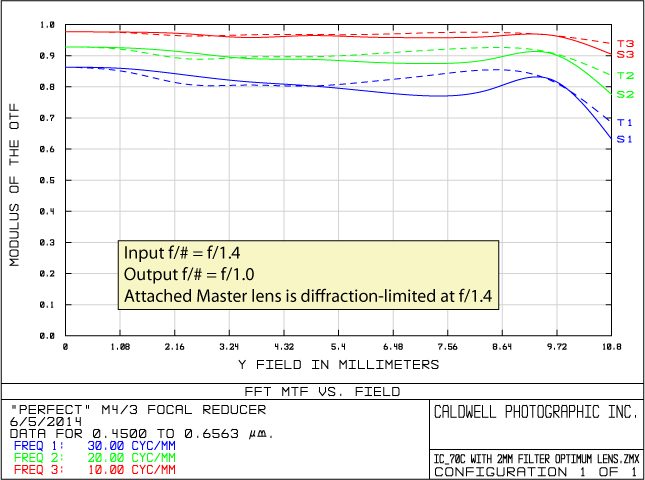
Brian had brought a prototype of his latest focal reducer. He told me it was so good that it clearly improved the MTF of full-frame lenses while increasing their aperture when mounting them to m4/3 cameras. He also brought the computer generated MTF graphs showing what it should do, which was pretty spectacular.
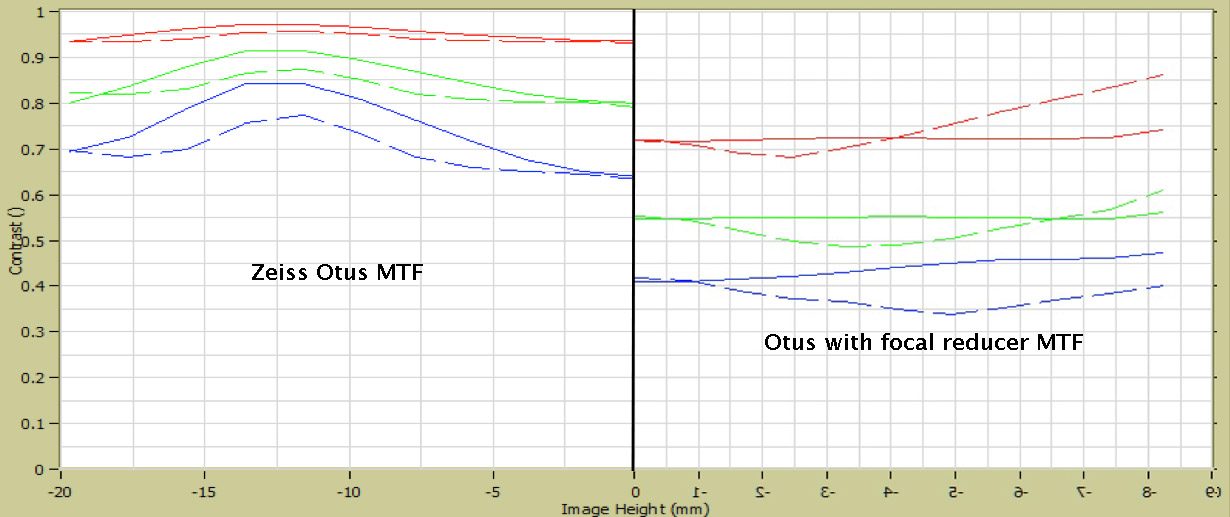
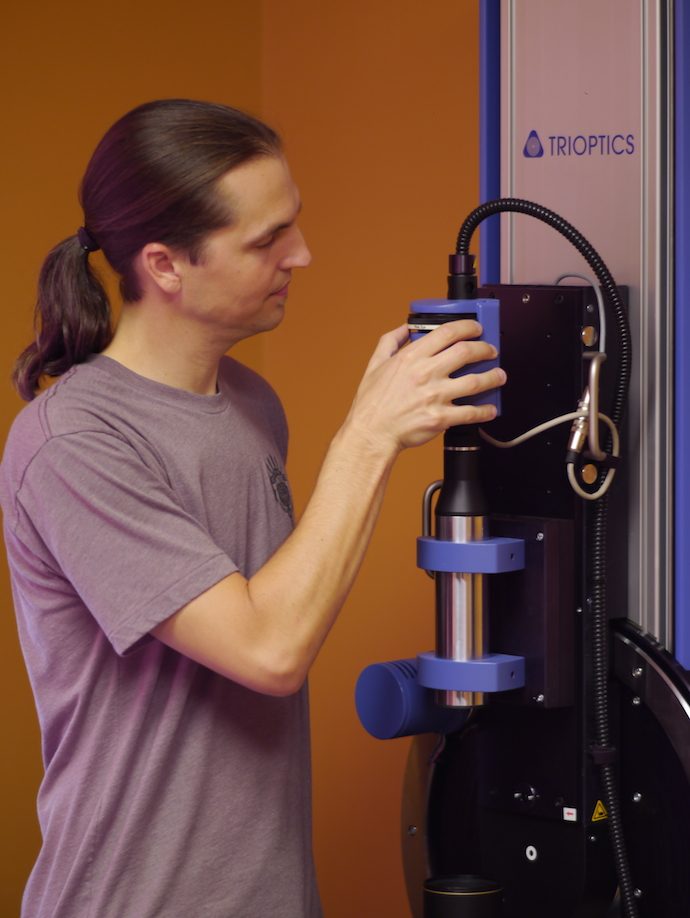
Well, we really couldn’t wait to play around with that, so we all gathered by the cheerful glow of the Imagemaster MTF bench and mounted a Zeiss Otus 55mm f/1.4 on it for a test run. As expected, the Otus generated very nice MTF curves.
Then we mounted the focal reducer on the Otus, adjusted the MTF bench for the narrower depth of field and greater aperture, and tested the combination. The results were absolutely awful. We rechecked all our settings and ran it again. Awful. We tweaked some settings. Awful. Here’s an example, of the same side of the same lens with and without the focal reducer straight out of the MTF bench. (I’ve flipped the MTF chart of the lens-with-reducer to make it easy to compare, which is why the numbers are backwards.) We repeated this with several lenses and it’s about the same every time.
The room became really quiet. Then Brian jumped up and said, “Filter stack – the machine doesn’t have a filter stack.” What he meant was that every digital camera has several pieces of glass in front of the sensor. The light leaving the rear of the lens has to pass through this glass before arriving at the sensor. Brian’s design (like that of most lenses) has an optical formula that plans on light rays leaving the lens passing through such a stack before reaching the sensor. Since this adapter is designed for micro 4/3 systems, which have a thick optically stack, the fact that there was no glass in the light path of the optical bench might be causing a problem.
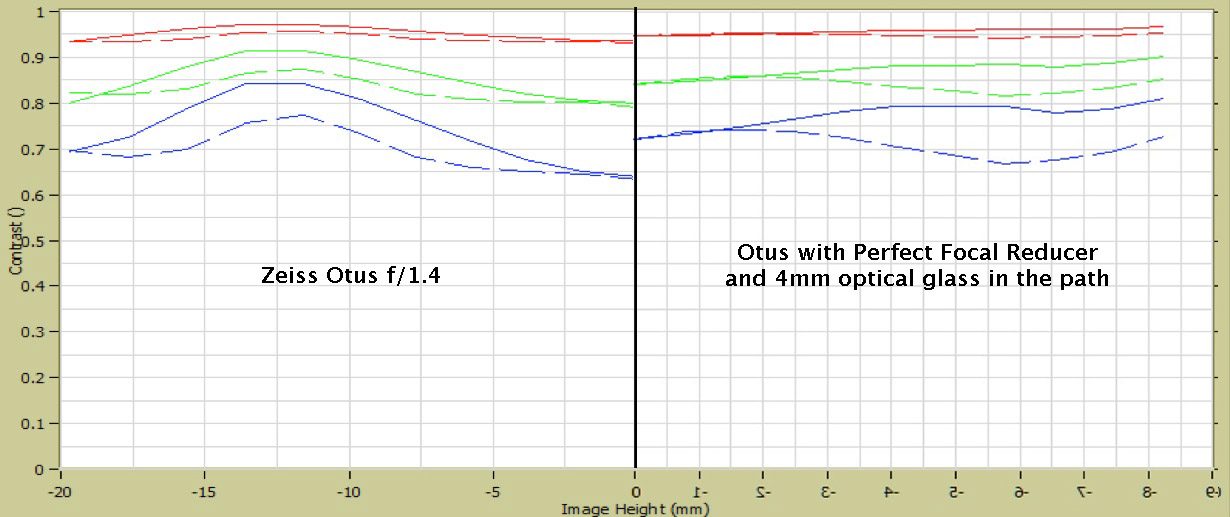
So we found a couple of 2mm pieces of optical glass, mounted them between the lens rear element and the MTF sensor, and ran the tests again. Suddenly the Otus-focal reducer combination was amazingly good. As Brian had promised and predicted, it was a bit better at f/1.0 than the Otus was at f/1.4 (over a smaller angle of view, of course).
OK, But What About Regular Lenses?
The MTF results with Brian’s Perfect focal reducer were ridiculously dramatic, and to be honest I didn’t believe the glass could make that much difference. Brian often speaks to me in English because it’s a common language we both understand. But when he gets excited he lapses into his native Theoretical Optical Physics, which I can barely follow.
Luckily, he had brought along his colleague Wilfried Bittner, who speaks both Theoretical Optical Physics and English (although his native language is German). With Wilfried’s aid as translator, I’m pretty sure I understand that at effective apertures under f/1.4, glass in the optical pathway have a huge effect on spherical aberrations, which are apparent even in the center of the lens’ field. So the fact that we were testing what was, in effect, and f/1.0 lens made the results very dramatic.
But I still wanted to see if this had an effect on normal lenses. We put another copy of the Zeiss 55mm f/1.4 on the Imagemaster and tested it. Then we put our 4mm optical glass in the pathway. The image below shows the MTF comparison for the Otus when tested with no glass in the optical pathway compared to same lens with 4mm of optical glass in the pathway. Red, green, and blue lines are for 10, 20, and 30 line pairs/mm.
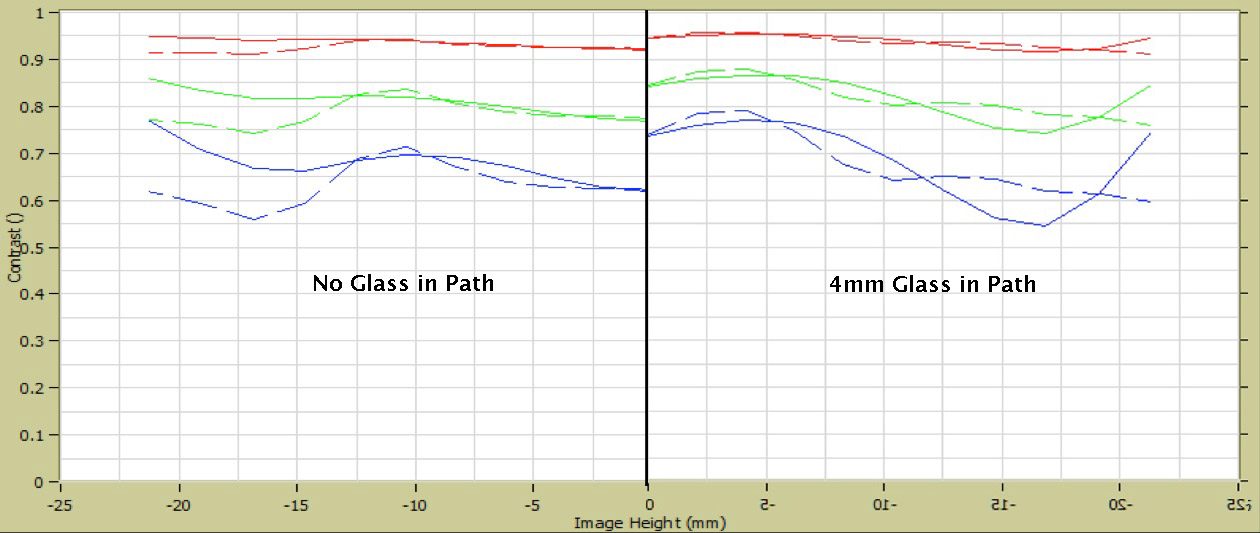
The MTF is better now higher in the center, but there is more astigmatism off-axis. (I was surprised at the on-axis effect, but Brian tells me that the amount of glass in the path creates on-axis spherical aberration that could affect center MTF on wide-aperture lenses. At least that’s what I think he said. Any errors of interpretation are mine.)
But then we realized this is a Canon lens, not an m4/3 lens. Canon cameras, as best we know, have about a 2mm filter stack. So we reduced the glass in the path to 2mm and ran the test again.
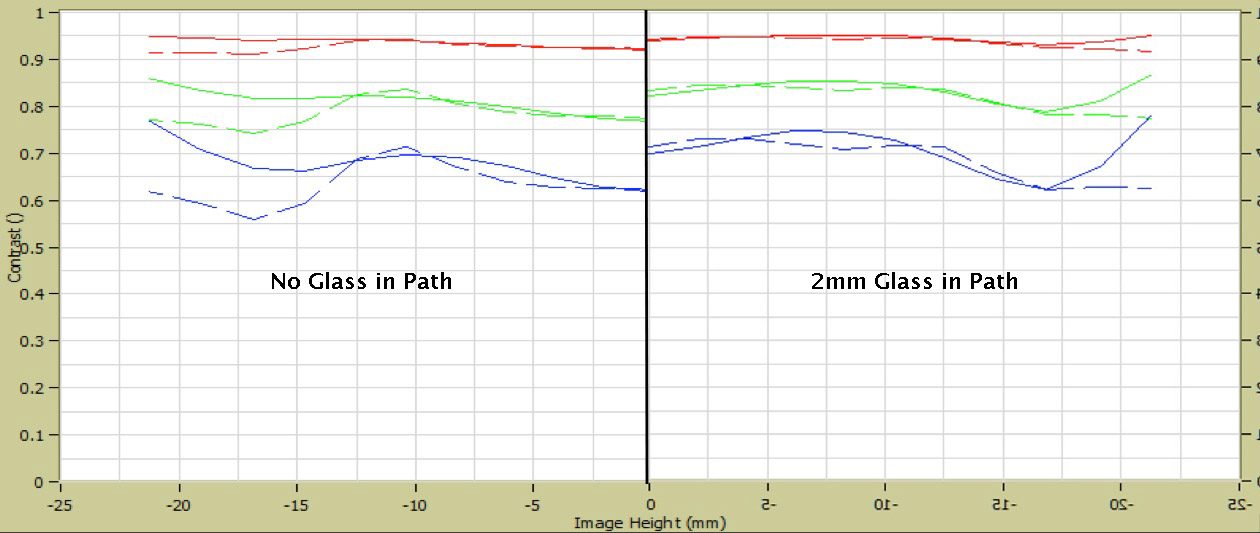
The 2mm result does seem a bit better over all, compared to the 4mm. The graph below compares the 2mm and 4mm results to hopefully make them easier to compare.
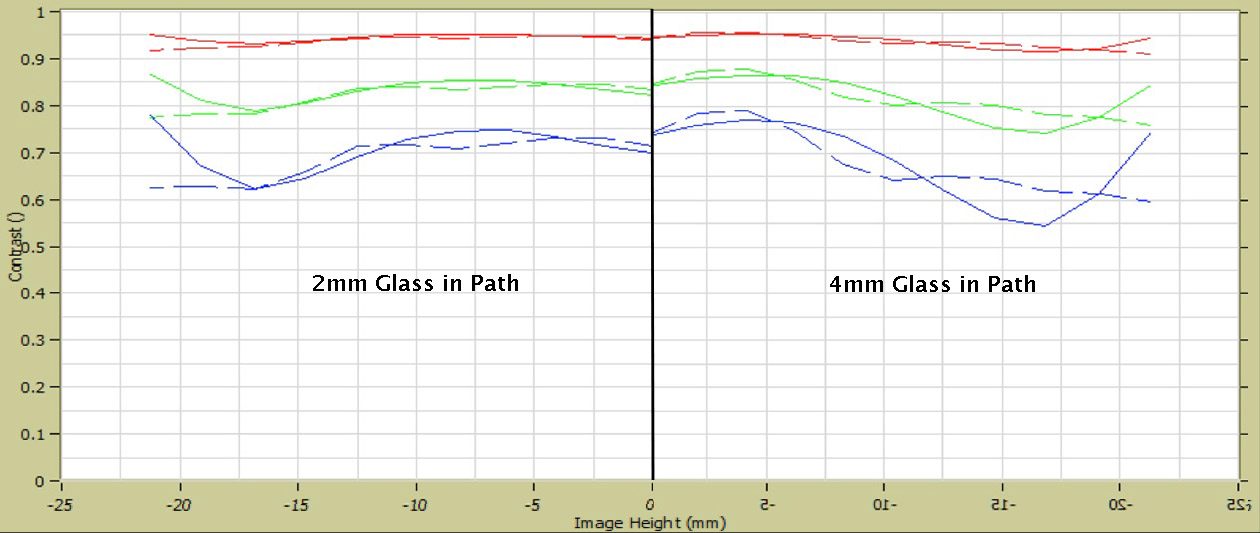
We repeated this for a couple of other Canon wide aperture lenses and found similar results. The MTF bench results are better when there is a 2mm piece of optical glass in the path between the rear of the lens and the bench’s sensor.
So This Should Work the Other Way, Right?
OK, so if micro 4/3 lenses are expected to have a thick sensor stack and m4/3 lenses have to be designed for them seem much better with a thick piece of optical glass in front of the sensor. Canon lenses supposedly have a medium-thickness sensor stack, and lenses designed for them seem best when we put a thinner piece of glass in their optical path.
What about lenses designed for little or no sensor stack? Actually, it’s already been shown they don’t do well on camera with significant sensor stacks. Panavision has made premium lenses for their film cameras for many years. Recently they’ve released their Primo V series of lenses, which are their Primo lenses modified, according to their website to ” eliminate coma, astigmatism, and other aberrations caused by the extra layers of glass in digital cameras.” U. S. Patent application 14/024,578 describes adding additional optics to the existing lenses to correct for the glass in the imaging pathway, that is between the rear of the lens and the camera sensor.
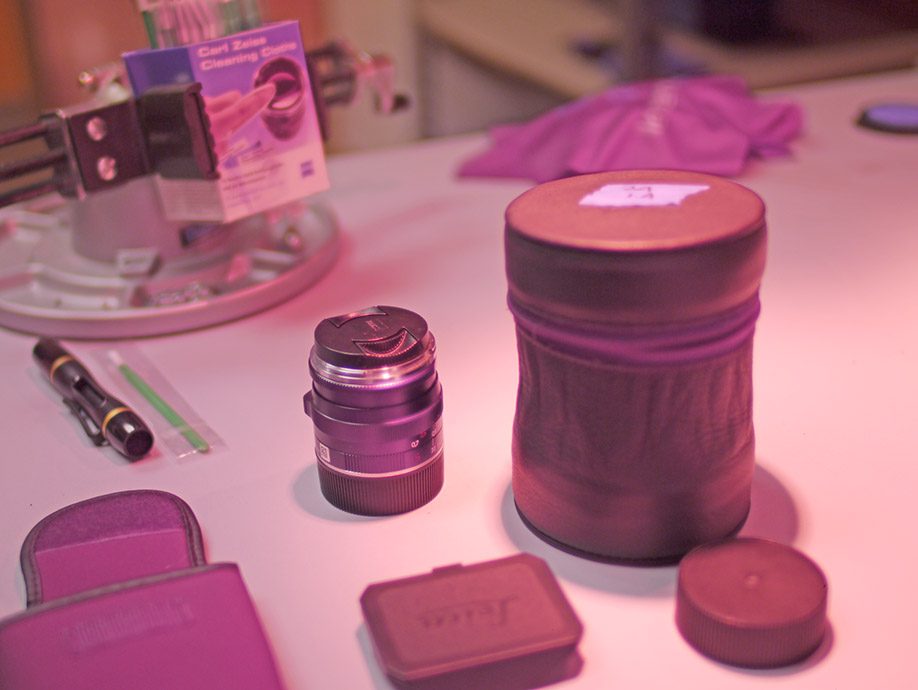
But we like to see for ourselves, so we grabbed a Leica 35mm ASPH Summicron and tried the same tests. Leica is known to use much thinner filter stacks (1mm or so) than the other camera manufacturers. So putting optical glass in the imaging pathway of an older Leica lens should make it worse.
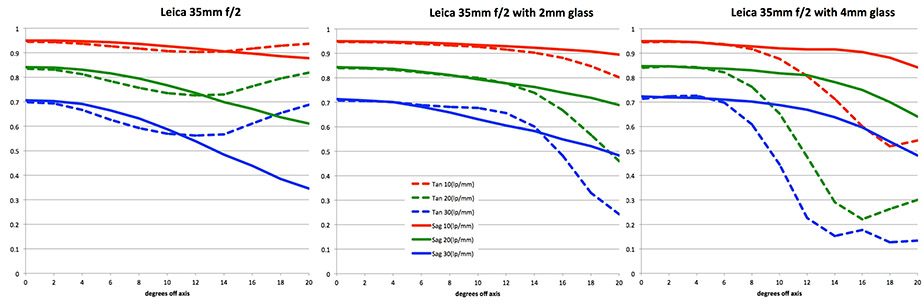
The Leica 35mm ASPH had an odd reversal of astigmatism with sagittal lines improving a bit, but tangential lines getting much worse. Overall I’d say it wasn’t better or worse, just different. With 4mm of glass in the optical pathway, though, the Leica clearly gets worse. I would have liked to repeat the test with 1mm of optical glass in the pathway, but we didn’t have any 1mm optical flats.
Conclusions
The things I’ve brought up today aren’t unknown, although they aren’t widely talked about. Bruno Massett had an excellent discussion about the theoretical implications almost a year ago in Mike Johnston’s The Online Photographer. Lens designers plan for the thickness of the sensor stack, and others have made corrective lenses to allow very expensive lenses developed for film to be used on digital cinema cameras.
Obviously this isn’t an exhaustive test using a large series of different lenses. The main purpose of this post is to serve as a demonstration of just how much of an effect the sensor stack has. I figured if I was surprised, then some of you would be, too.
Real-World Implications
People in the real world often shoot a lens designed for one size of sensor stack on a camera with a different size. It seems logical that this kind of issue will affect certain combinations. We don’t know which lenses on which cameras will be most affected, but it would seem logical that lenses designed for film cameras and cameras with very thin sensor stacks won’t do well on cameras with thick sensor stacks.
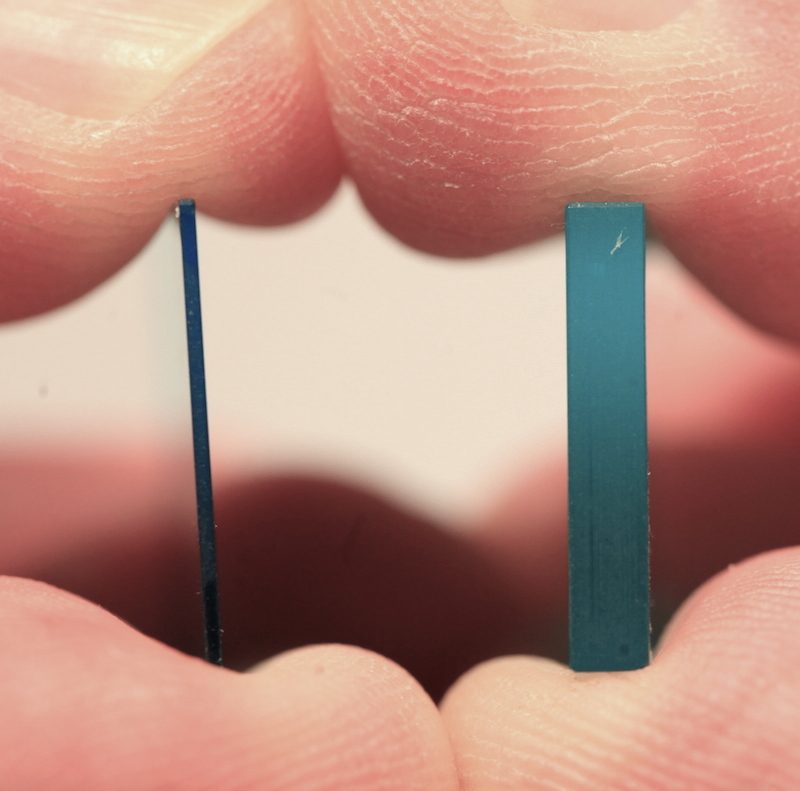
In order to start making some generalizations, a good database of sensor thickness needs to be made public. I’ve only been able to find references to a few. We know Leica is thinnest and I was told micro 4/3 was the thickest at 4mm. I didn’t believe that, so we took a GX1 apart. As you can see from the first picture, it is, indeed very thick and I can confirm it’s a bit over 4mm.
The extra good news is we now have a micro 4/3 camera with absolutely no glass in front of the sensor at all and a really nice piece of 3mm thick cyan glass for a conversation piece. The camera no longer focuses to infinity, of course, but it takes nice pictures in UV/IR/Visible light spectrum, at least up close. (I know what you’re thinking: but no, we didn’t start this article just so we could make a glass-free GX1.)
I hope to have at least a moderately complete database of sensor thicknesses done and published by early next week. We’re doing some disassembly here to measure sensor glass and have sent some cameras off so the glass can be measured optically. Optical thickness may be somewhat different from measured thickness since different types of glass might be used. (If you have some knowledge in this area, I’d appreciate an email or comment post. You might save a camera.)
Testing Implications
We may need to make corrections on our optical bench when testing lenses designed to have a certain thickness of glass between their rear element and the sensor. Obviously, we’ll be going back to doing more testing there, too. I suspect, for example, that the numbers I posted in last week’s 50mm article might actually be a tiny bit lower than reality for the Sigma Art and Zeiss Otus lenses.
Or perhaps not. This is a new area and we’ll have to run lots of copies on the bench, and correlate them with Imatest or other complete-systems measurements before we know for sure.
Of course, it’s possible that sensor stack thickness might end up being no big deal. But hey, if it’s important enough for Panavision, it’s important enough for me.
Roger Cicala and Aaron Closz, with the assistance of Brian Caldwell and Wilfried Bittner
Lensrentals.com
June, 2014
102 Comments
Joel M ·
Wow, that was quite the eye-opener – no wonder adapted lenses never reach optimum sharpness, even when binning for the perfect lens combination.
I wonder what implications this has for Sigma’s mount conversion service – Perhaps in addition to replacing the mount and focusing electronics, they will also need to swap an element to change the level of correction for a different manufacturer’s stack thickness.
By the way Roger, you could probably put your “NOTE: This is a Geek Post” warning at the top of all posts, but replace “Post” with “Blog”. Just sayin’
Roger Cicala ·
Joel, sometimes I write stuff that’s not geeky. I think. Well, yeah, maybe you’re right. . . .
Mike ·
Makes you kind of wonder about what we’re loosing when adapting film lenses…
Vincent ·
Roger, you really must stop publishing such useful and factual information. Photographers like to debate with each other using anecdotal “facts” and are not ready to deal with real data. You run the risk of ending pointless Internet debates which will result in decreased traffic and ad revenues for photography websites.
SoulNibbler ·
Ya know… since you are getting good at it, next time you get a scratched A7(r) you can see if the M wide angle issue is really the result of the IR filter stack. With adapted lenses it should even be possible make a thinner adapter.
Siegfried ·
Roger,
I wonder about glass thickness differences on the same sensor but in different DSLR bodies. E.g. we all know that Sony sensors have made their way into their own cameras, as well as Nikon and Pentax rivals. And fwiw I know the last brand isn’t that popular in your blog (and there must be reasons for that, obviously), but I look forward to seeing it to be included into your sensor glass thickness database.
And by the way, are you sure that sensor filter thickness is a constant for a given camera system, I mean to say that they don’t change it when they release a new model? I wouldn’t be much surprised to see Pentax changed that parameter when they moved back to Sony sensor from Samsung. Maybe the other makes also adjust it from model to model. Or maybe not.
Thanks,
Zig
Roger Cicala ·
Hey, Zig, I own a Pentax myself! But I don’t write about them as much, that’s true.
I have only limited data for sensor stacks, but I know there have been some changes within brands. For example of the 3 Canon’s I’ve gotten data on, there’a a range from 1.8 to 2.45mm. Hopefully I’ll have more data soon.
Walter ·
I wonder at what point the camera manufacturers switched from assuming no glass (i.e. film) to whatever thickness they use on their sensors? This won’t just impact adapted lenses; it’ll impact all the late-film-era Canon and Nikon lenses that can be used natively on their DSLR’s.
I recall that when Four Thirds initially came out, the Olympus lens+body combinations tested as incredibly sharp; perhaps this is because they were uniquely for their time designed from the ground up for the thickness of glass used in the 4/3 cameras rather than being designed for film?
Chia-Ming Yang ·
I’m quite curious about which setting do the 3rd party lenses makers(Sigma, Zeiss, etc.) design for?
Roger Cicala ·
Chia-Ming, I am too. I think Canon and Nikon stacks are similar in depth, so perhaps it hasn’t been a problem, although I wonder what they are doing now that they make lenses for many brands.
David ·
Early dEOS bodies had a filter stack of around 2mm. Of course this is a sandwich of various layers: IR reflection, IR absorption, horizontal and vertical AA filters, etc.
Starting with the the 400D this was split into two pieces of <1mm each. One close to the sensor which stays still (this includes the IR absorption layer) and one over a mm above it which vibrates when shaking off dust (this includes the IR-reflective coating).
I'm starting to get a bit out of my depth, but have to wonder how the thickness and position of each of these pieces changes the behaviour compared to a single 2mm piece.
Mike ·
So…when will this leave the prototype stage…?
CarVac ·
Siegfried:
I doubt that they’d change that parameter; I’m sure that the sensor silicon and the filtration in front of it are not a ‘package deal’.
n/a ·
Roger – do compare thickness of Olympus m43 filter stack vs Panasonic m43 filter – they might be different
n/a ·
PS: I found filter stack from Olympus EPM2 m43 camera that I disassembled – it is ~2.7mm thick
Joe Kashi ·
Hi, Roger
I suspect that you’ll find some exceptions.
For example, about 1 or 2 years ago, some guy who rents lenses suggested that a film-era Leica 135mm Tele-Elmar would work well as a sharp long prime lens on an Olympus OM-D E-M5. Sadly, there’s still no such compact, long prime lens native to M4/3
I took that advice, bought a late 1990s 135/4 Tele-Elmar, seated the adapter faces as parallel as possible without a micrometer, then set everything “in stone” with Loc-Tite.
That adapted Leica 135/4 lens on an E-M5 seems to resolve essentially to the limits of the M4/3 sensor, even to the edges.
That fella in TN published some pretty good advice. Perhaps longer lenses are less susceptible to induced aberrations because the exiting rays are more or less parallel and perpendicular to the sensor?
Roger Cicala ·
Joe, the more telecentric a lens, if I understand correctly, the less effect the filter stack might have. I haven’t had a chance to check any longer lenses yet. I suspect I’ve opened a can of worms here that we’ll be checking for months.
Jn- ·
What implications does this have for using a digital era designed lens on an old film camera?
For example, using the Canon 24-85mm film era lens on a Canon Eos 3 film camera may be no problem? but a Canon 24-105mm f4.0 might have?
Also, are there implications for using film era designed lens on a digital camera?
Roger Cicala ·
Jn, good questions. I hope to know the answers someday. I assume we’d have the same problems in reverse to some degree, but I don’t know for certain.
Malte ·
Hi Roger,
Reading your blog for a while now and really enjoy your writing as well as the knowledge that comes with it. This article remembered me about an old 135mm primes I tried on my K-30. No matter what I did, pics had such a low contrast like they were taken in the fog. Thats when I learned about internal reflections. Which was not a big issue in the film era, where this lens was designed. Other film lenses I tried were not that much affected.
Brian Caldwell ·
Jn: The Canon 24-105mm f/4 is relatively slow (aperture-wise), and has a fairly long exit pupil distance of slightly greater than 100mm throughout its zoom range. As a result, I think it will function almost identically on both film and digital cameras. The lenses that should have the most sensitivity to filter stack thickness are those that are either really fast, or have a short exit pupil distance, or both.
Brian Caldwell ·
Walter: I suspect the switchover from film (zero glass) to digital (with glass) lens design began in the late 1990’s. The Nikon 17-35/2.8, released in 1999 is probably a good example. This lens has a relatively long exit pupil distance compared to earlier lenses like the 25-50/4.0, and so it should work well with both film and digital cameras. Also, in 1999 I did a small consulting job for now extinct Silicon Film to analyze the effect of adding filter glass behind various high-speed film lenses available at that time.
Scott McMorrow ·
Well, that explains why Nikon took the approach they did on the D800/D800E with the AA-filter. The optical path length remains the same in both cameras.
Also, remember that in measuring sensor glass stacks, it’s not just the thickness but also the index of refraction that determines the optical thickness.
Thickness x index of refraction = equivalent optical length in air.
Jn- ·
Thanks Roger, superb article, as usual.
Dave Lively ·
The thicker filter stack also has an effect on how visible dust is. The thicker the stack they more you can stop down before it becomes visible. Olympus has a reputation for having a really good dust removal system. After seeing how much thicker the filter stack is it is no wonder dust is less of a problem on m43 cameras.
Taylor C ·
I think what is even more exciting then this article is that this is the first ‘unofficial’ new about the EOS to MTF speedbooster! Hopefully it is as close as it seems.
Gert F Hansen ·
There is a company calld LDP LLC (www.maxmax.com) that converts cameras to IR/UV and also does so called hot-rod conversions where the lo-pass filter is replaced with optical glass of suitable thickness. Might be worth it to give them a call.
Thanks for the good edutainmaint as allways!
NancyP ·
This is very interesting, Roger, I love it when you provide the geeky goodness.
The sensor glass issue also affects users of old film lenses on digital sensors – zero thickness vs probable ~2mm thickness, in my Canon 6D case. I still enjoy using the old lenses, and don’t expect that they will rise to the glorious heights of Otus.
The full-spectrum and astrophotography crowds get sensor conversions – if the OEM companies or the companies performing conversion aren’t willing to give out sensor thickness, you might try experienced users. Bjorn Roslett or Enrico Savazzi might be good full-spectrum users to contact. http://www.naturfotograf.com/index2.html (Roslett); http://www.savazzi.net/photography/default.htm (Savazzi) Fun reading, even if you contact them and they don’t have info.
NancyP ·
To add to the comments on telecentric lenses, my 5 year old Canon 400mm f/5.6L is a great lens on digital, although the lens design is from 1991 or 1992, pre-digital. It is possible that Canon made unannounced changes in the lens design to optimize for digital, but it seems likely that they didn’t need to do this.
ken ·
Wait… Do you know when the new metabones adapter with the perfect glass will be available?
Roger Cicala ·
Ken, not for a bit – it’s still in Prototype phase. But it’s pretty awesome.
Brian Drinkwater ·
I bet the likes of Canikon full well know this which is perhaps why the D800e (for example) is a more convoluted path than than just removing the blur filter.
Will be interesting to confirm the glass thickness on the newer DX and FX cameras.
Brian
Brian Drinkwater ·
I also wonder if the IR converters understand this.
Joe ·
Too much fun, if you weren’t already popular with all the camera toys. These new optical benches seem to draw in a whole new level of camera geek. How, how does the thickness of the sensor glass play into it’s durability or ease of getting scratched? I wonder if you were to pull off the glass off a m4/3 sensor, what would the image comparison look like with other system lenses.
Roger Cicala ·
Joe, those two pictures at the bottom are with a G1x with the entire sensor stack removed. It won’t focus to infinity anymore, and lets in both IR and UV light now, but otherwise works fine. We’ll probably shoot some lenses on adapaters with it to see how they do.
Seth ·
Roger, what does this mean about the data you’ve already compiled for lenses not accounting for sensor stacks? You mention going back to the 50mm article, but are there other measurements you’ve made that need to be corrected or do you check everything through Imatest after the optical bench when taking measurements? I imagine your MTFs would be way off just as you describe above?
Roger Cicala ·
Seth, the only thing we’ve done entirely on the optical bench has been the 50mm test you mentioned. All the other tests are on Imatest which are shot on a camera so the sensor stack is already in place.
Sggs ·
I wonder how will behave the lens that are made in many different mounts as the samyang 12 f2. They seem to have the same glass for the canons, fujis and m43, regardless the sensor glass variations. DXO tests lens in different bodies what may be wise. Olaf lost its superpowers…
Rob ·
Gary Honis has a good site on astronomic conversion and includes a bit of calculation for replacing the OEM stack to maintain focus calibration.
http://dslrmodifications.com/rebelmod450d6a.html
Max ·
Great post! Any idea how thick the sensor stack is on the Sony A7r?
Roger Cicala ·
Max, trying to measure the A7r now. It’s difficult because the various pieces are really glued together (not sure if there are air gaps in the stack or not) so we’ve sent one off to be refractively measured.
Marc ·
Very interesting article. Since I didn’t even know that Theoretical Optical Physics is a language, I may have a stupid question: it’s currently quite fashionable for manufacturers to remove the Optical Low Pass or Anti Aliasing filter. Does this influence the total thickness of the stack discussed here, or does it stay the same because they just replace it with a plain layer of optical glass?
I vaguely recall when the D800E was introduced Nikon publishing graphics explaining how an extra ‘filter’ was added to neutralize the effect of the OLPF instead of just completely removing it. From other manufactures I haven’t seen such information. So what happens when they decide to remove the OLPF/AA filter?
Roger Cicala ·
Marc, I think the reason Nikon rotated their OLPA plates rather than removing them in the D800e was to keep the stack the same height. I know there were some changes made early in Digital SLR history, but I assume most manufacturer’s keep the stack a similar thickness for all their cameras now. But that’s an assumption right now, so who knows?
Max ·
By the way, looking at first picture it’s hard to believe left glass is 2 mm assuming right is 4. It’s more like 0.8-1.0 mm. Does it mean left one is not a full canon’s stack?
Roger Cicala ·
Max, that’s not a full Canon stack, just the center of the three pieces of glass. The m4/3 is just the center piece, too, it’s about 3mm by itself.
Tilman ·
Couldn’t the camera manufacturer compensate the effect of whatever stack he’s applying by placing the sensor a littel deeper in the body? I wonder if this isn’t done. So you could have *all* your lenses with the same focus on sensor-side set to a virtual sensor-plane (where a film would be). The glass-stack on the sensor then refracts this virtual plane to the real sensor position…
Richard Gray ·
Is there a rational behind the various manufacturers choice of filter stack thickness and in particular why did M4/3 choose such a thick stack?
Tony ·
Roger, you made me wonder if Nikon and Canon have different stack thicknesses, and if so, do Sigma, Zeiss, etc. take that into account in the designs of their 3rd party lenses?
And if you’re ready for yet another can of worms, the spacing between the lens and the glass might be a significant variable.
Mike ·
What impact then, do uv or clear filters on the front of the lens have? Might be interesting to find and measure the thickness of some different brands then see what they do to mtf. Old minolta tele lenses almost all had a clear/uv filter at the back of the lens and it was supposed to be kept in the lens when no other filter was being used as it was part of the optical design.
Mike
Roger Cicala ·
Mike, none of this kind of impact. Filters, unless they’re cheap ones with imperfect glass or poor coatings, don’t have much effect and nothing like this.
Nqina Dlamini ·
Greatly enjoyable articles. Yes there will be talk of this for months to come. I learned something new.
Samuel H ·
Very interesting, can’t thank you enough for all these posts. Good that Karma is rewarding you by letting you hang out with the cool kids 🙂
This may explain why I felt my 50mm f/1.4 summilux had a “random performance” problem, where it would sometimes be super nice and sometimes unexpectedly soft.
I have the a7s on preorder, and my lens set is mainly vintage Leica-R designed for no-glass-stack-whatsoever, so I’d be happy to buy a Metabones E-to-R adapter with glass stack correction. Unless it’s only a problem at very wide apertures: I usually shoot at f/2.8-f/4, and it would seem that this kind of problem would be much smaller away from the f/1.0 of that lovely contraption you tested (it’s already much less of a problem at f/1.4, without the speedbooster).
Wally ·
I always thought of the sensor cover glasses as being pretty thin sheets of glass, but it looks like I was wrong. Nice report on yet another item for endless internet discussions.
You can use ultrasonic sensors to measure thickness but you may not have enough information for it to work well. You send a pulse through the glass and measure the time for the pulse to return. With luck you could get the thickness of all the sublayers. You would need to know the wave velocity in the glass and I think the density to get accurate values, but it has been many years since I did that kind of measurement so YMMV.
Andrew Z ·
I suspect there is a difference in longitudal chromatic abberation as well which is why people complain about purple fringing more now than the film days. I recently converted an old samsung nx100 to full spectrum and noticed an improvement there. I’ll measure the filters for your database (not that I expect you care about samsung lenses). I know the IR was 1mm but I’ll have to check the cyan one.
Roger Cicala ·
Andrew, we want to know about any of them! Please send your data along.
hugh crawford ·
Re: Testing with different sensor stacks, obviously the lenses designed for the sensor stacks should be retested and perhaps the testing for repair protocol should include the sensor stacks, but I’d be particularly interested in how differently film era lenses test with and without the stack.
Anu ·
It would be interesting to know if the Sony A7 and A7r have the same optical stack thickness (ie. if A7r uses D800e-style AA-cancellation) or not.
Wiebe ·
A question that comes up with me is about the position of the filter stack. Does it matter if the filter is right at the sensor, or somewhere else in the optical path behind the lens?
I work a lot with IR converted cameras with removed filters, but add filters back in like the astronomik clip filters or just the original in my nex6 with a piece of scotch tape…
Roger Cicala ·
Wiebe, I’ve been told by people who know that it doesn’t matter much where the position is. I don’t have the math to vouch for that myself, but they all agree.
Brian Caldwell ·
Wiebe:
In terms of aberrations and MTF, only the thickness and refactive index of the rear filters matters, and not the axial position.
Michael ·
Wonder why if this is what causes the sometimes extreme chromatic aberration I get using an old Leitz 560mm R-Mount on Panasonic GH2? Lens designed for very thin stack used on system with extra thick stacks? It doesn’t always occur.
Thanks for another interesting article!
JerryR ·
Thanks for the great information and all the work involved! I don’t know if this is the reason some of my older Zuiko lenses don’t resolve very well on my Fujis but I’ll sleep better having something to blame it on.
I don’t always agree with what you present in your blog but I seem hard-pressed to find actual facts to refute any of it. You would make my job easier if you presented more conjecture and less data-supported factual information. 😉
Ramon Santiago ·
If I read this correctly, it means that any new Canon lens I would buy for a Canon 5dm3 would produce inferior results on a film camera such as a Canon EV-1, a film camera. Because the film camera would not have the 2mm thick piece of glass.
Is that correct Roger?
Roger Cicala ·
Ramon, in theory that would be true, but film might be more forgiving that sensors since film actually has some depth. But I don’t know for sure.
Wiebe ·
Thanks!
I just read you may be compiling some data on the cover glass thicknesses over the next week. The converters among us would be very happy with that and even more happy if you could include the other dimensions as well!
Roger Cicala ·
Weibe, I just posted that tonight.
Phil ·
Thanks for a great article.
I use a speedbooster with my fuji bodies and contax Zeiss cy lenses. I love the results. A question for Dr Caldwell… Does it compensate for the stack or is it just the increased telecentricity that helps keep the problems under control? Thx again.
Brian Caldwell ·
Phil: All of the Metabones Speed Boosters compensate for the filter stack.
Ivan Muller ·
In other lens test websites I have always noticed that micro 4/3 lenses are worse towards the corners. The Canon lenses for EOS M on the other hand are much better in the corners…perhaps because in order to accommodate EF lenses it had to have the same thickness glass in front of the sensor as the EOS bodies. I wonder exactly why the 4/3 cameras have such a thick glass design?
Helder ·
Roger,removing the optical stack, which made the lens l its infinity focus, it is equivalent of changing flange distance right?
So we would go from 19.25mm to something like 23.25mm… interesting
If you say I’m thinking in changing flange distance from an old EOS rebel to accept FD lenses, it right what I’m thinking.
And it might work if the optical stack from EOS cameras is 2mm thick.
Could this be done? How thick from the optical stack in EOS cameras?
J.Thomsen ·
@Brian Caldwell:
You said all metabones Speed Boosers compansate for the filter stack.
But Rodgher said, he found m43 cameras (which) with no or very thin stack, and was told (?!) that there are m43 Cameras with very thick stacks.
How is it possible for Metabones to compensate that?!?
I Think, it couldn’t be compensate then….
Regards
Jörg
J.Thomsen ·
okay, I finaly got it. Roger ripped it of from an G1x. So it can be compensated.
John Leslie ·
So am I to understand from you using a Canon version of the Zeiss and a m43 mount speed-booster that there will be an EF-m43 SpeedBooster along sometime in the not too dim and distant? With electronic control too? Cool…
Lynn Allan ·
Roger: I posted the links to these two articles to DPR’s sub-forum.
http://www.dpreview.com/forums/post/53848087
It might be interesting for some of the optical engineers and/or scientists to provide feedback.
CanonRumors.com has already posted … hope it generates some traffic / revenue for your company.
Nicholas T ·
Very interesting articles and research. Does this mean that it would theoretically be possible to get better performance in the corners when using Leica wide angle lenses on the Sony A7R by replacing the sensor glass with a thinner equivalent? Has anyone tried this ?
JasonT ·
Thanks for your article.
Fascinating. Makes me wish I finished high school etc.
But since I didn’t….
what – if any – is the implication for third party lenses?
E.g. Tamron or Sigma.
I’ve always assumed they use basically the same design for a given model change the base and load it with appropriate firmware. Sigma’s relatively new convert your mount service had re-inforced this idea in my head.
But now this.
Presumably there is an adjustable group to tune each design for the different mounts in 3rd party lenses?
Or are they more customised than that?
Roger Cicala ·
Jason, I can’t say specifically whether there is a lens difference, but Canon and Nikon filter stacks are similar thickness so it’s doubtful any change is necessary.
Roger
Mad Hungarian ·
The amateur astrophotographer types often use Canon DSLR’s, and when they do they usually remove that IR filter from the sensor stack, because it also cuts off much of the red end of the visual spectrum (i guess CCD’s are overly sensitive to red or something). Red is where a lot of the interesting things with nebulas happen, so you don’t want to cut it off. Causes problems with daylight photography now, but you either use a separate IR filter or buy another DSLR.
Danny Chau ·
I wondered there is any correlation between pixel density, angle of micro lenses on the sensor in combination with thickness of sensor stack? For example I found the Sony A7s do not show the same purple fringing as the A7R, and maybe because of the lower pixel count in the A7s which maximises the original design of wide angle M mount lenses such as Voigtlander/Zeiss 15mm and 12mm lenses?
Danny Chau ·
One more thing come to mind is the DXO actually test the lenses on the relevant camera body before they give out the figures, surly this is the best way to test out the combine lens to body/sensor effect than just purely reading from the MTF rig?
Roger Cicala ·
Danny, so do all Imatest based sites. It has certain advantages and certain disadvantages. Chief among the disadvantages are the short distances at which the tests are performed (2-3 feet for wide angle lenses). The other disadvantage are you add the variable of the camera if you are interested in the lens. For example, a test of a Sigma lens on a Canon camera can be very different than the test of a Sigma lens on a Nikon camera.
roberto ·
A few months ago I took apart my old Panasonic Lumix G1 and swapped the low-pass filter glass (again, 4 mm thick) with some regular, see-through glass. I know it is far from perfect, but it emulates the original one good enough so that my Olympus 12-50 Zooom lens works perfectly and focuses to infinity throughout the whole range. I did it for the reason of having an infrared camera of course, and with the addition of screw-on IR filters (680 upwards) I can make pretty pictures now with 1/200 or even better.
So yes, the thickness (and layer-ness?) of these pressed or single glass elements in front of the sensor do make a difference. Ask Sony – they even sell their RX cameras as special Mark II or III editions with removed (or swapped like mine?) low-pass filters.
Jeff Livacich ·
This gets me thinking about cameras like the Nikon D800E, with its extra AA filter to recombine the diffusion of the first, and the Pentax K3, which just doesn’t have an AA filter at all.
Jeff Allen ·
The AA / OPLF is not just some piece of optically flat glass it is prescriptive to the sensor / optical design of the camera and specialist companies make these. Badly designed OPLF filters rob resolution and in themselves can add to abbérations or induce flares or color casts particularly at high ISOs and point light sources coming straight down the lens.
Regarding film you can adjust the focal depth into the layers of the film in motion picture we did this sometimes for various reasons plus grain depending on emulsion played a part. Film is more forgiving than digital regarding sharpness.
The other aspect of sensors that could also play a part are the micro lenses on the photo sites especially out to the corners of the frame that is why telecentric lens designs are preferable.
Then their is nyquist and matching pixel size the list goes on.
Max Rockbin ·
Is the Canon APS-C sensor stack the same thickness as the full frame?
If not – that’d have consequences for using EF lenses on the smaller sensor bodies. You’d expect EF-S lenses to do better…
Eric Hiss ·
Anyone know what the sensor stack thickness, optical thickness of MFDB’s are?
Eric Hiss ·
Ps. from my crude measurements based on a Leaf AFi to graflok film adapter that the optical distance must be about 2.7mm on the 80mp Dalsa chips
Rishi ·
Hi, Thanks for the article, a curious question as a next step. if we remove the stack and the Bayer filter for shoot B&W, I presume the camera would still run its algorythm to fill the missing colors. Is there a way by which we could get the actual (without algorythm run) B&W picture? or Since there is no Bayer filter the end result of algorythim would be the same as that without algorythm?
Roger Cicala ·
Rishi, I don’t think so, but I’m not sure.
Paul Weissman ·
Cover plate thickness has an effect on lens performance. As a lend designer for over 35 years cover plates are included in the design of a lens. The effects the plate are a function of the plate thickness and the f# (or the field angle departure from telecentricity). This makes the addition of a cover plate a poor idea for fast lenses or for wide angle lenses (rangefinder WA lenses are worst). When thinking about pixel pitches that are small 5-10mu I would forget about using fast or WA lenses designed for film on cameras with cover plates. If the lens is close to telecentric and the f:8 is used you may do altight.
mike brassey ·
Hi
Just read this informative and interesting article and thought i might lend some of my thoughts from a background of optometrist/ophthalmic optician and some experience in ophthalmic lens design and manufacture.
Firstly formulas are certainly more easily understood by computers when designing lenses but simple ray tracing is more easily understood by the semitechies among us.We have all seen the cutaway lens photos showing all the individual component lenses.
Now for the techie bit …one formula covers 90% of optics…..snells law:
n sine i = n’ sine i’ n=refractive index of the medium you travelling from( air is conveniently 1)
n’=refractive index of the medium you are travelling into (glass ranges from 1.5 to1.9)
i is the angle the ray hits the surface
i’ is the angle the ray leaves the surface of the different mediums
Now you have survived that bit lets apply this to any optical system
Trace out those lens elements in the cut away drawing on a large sheet of paper keeping all the lens curves and dimensions exact.
Now trace ANY ray coming into the lens following the above formula at each medium interface and you can physically measure where it ends up.
Couple of things to consider.1/ refractive index from memory is measured for yellowish light at 550nanometers so light at the far ends of the spectrum refract at different angles ie prism or rainbow.2/ remember to swop round refractive indices when travelling from glass to air.
So from this imagine a ray leaving the exit pupil of the lens and heading towards a point focus on the sensor.Draw this on your piece of paper and notice where it hits the sensor, then insert an imaginary 2mm plano piece of glass into your diagram (parallel to the sensor)and retrace the ray . Now insert a plano 4mm piece of glass into your diagram and again retrace the ray.
If you have chosen any ray (except the optical axis ray) you can easily see that the thickness of glass affects the final position of that ray on the sensor.It can also be easily deduced that the closer to 0°(ie straight on) the ray hits the plano glass ie closer to telecentric with an exit pupil a long way from the sensor ,the less impact the plano glass makes.
Surprised Dr Caldwell didnt cotton on quicker as he had spent many hours considering this very question when designing his extremely well made adapters ,one of which I own.I hope the reason was not that any admission might undermine the “one size fits almost all” policy This was one of the points i briefly considered before buying the metabones but never quite realised the vast varying plate thicknesses.
Off to bed to think about refraction through film gelatin layers!!
Do hope at least somebody ploughed this lengthy reply.
Keep up the good work on the database and please make sure of its continued free availability.
mike
Thinkinginpictures ·
Wow
mike brassey ·
Hi Rishi
A monochrome camera I think is the only answer.I would imagine the problem would be getting hold of the algorithms and then reprogramming as I think the” bayer filter”software uses complicated algorithms to give true colour reproduction. Anyway one large photosite measuring only tonality and taking in all available light is far superior to 4 small photosites, giving higher native iso much less noise and less computing requirements.
mike
ps blimey leica monchrome costs 7k bucks and it hasnt even got colour !! Think ill keep to the old lightroom trick of pressing the b&w button.
Steve ·
Thanks…this is really, really interesting. I had no idea!
Morlun ·
For god sake this article is 2 yr old! How can I be the first to compliment to the autor and his team for the AMAZING job? This was brillant. Thank you.
Michael Clark ·
When they transferred the blog to Disqus a few months ago all of the older comments were lost.
gLOW-x ·
Very nice article !
And others related to filter stacks too 😉
I was searching WHY even my good Canon FDn f1.4 was giving so much troubles on Olympus M43 sensor…now i know 😉
Some ppl reported focal reducers (even no-name China ones) where giving a LOT more better result than dumb tube on M43 sensors. And not only related to the usual focal reducer effect (sharpness…) BUT related to focal reducers “telecentric effect” on filter stack.
M43 lenses/filter stack where created with telecentric orientation (there is a nice article on Olympus papers about that).
And related to sensor shift, of course, to get a bigger image circle with clean border, to be able to move the sensor near border.
So they used a thick filter stack with no troubles…with native “telecentric” lenses only 😉
I now have TWO options : buy an M43 focal reducer…or another body 😀
Gary Markosyan ·
Hello. I think you are missing some point here. The issue in not in filter stack thickness only! Say Nikon D800 and Nikon D3300 have different thicknesses of filter combos. Almost two times thinner on Nikon D3300. We do convert cameras for UV, Infrared and Full Spectrum applications (at Image-Laboratory) so this was a first thing to check.
1. From basic optics we know if you introduce optical medium with refractive index different that of refractive index of air on the ray path you will change the the ray path as long as it does not go strictly perpendicular to introduced media surface.
What does this mean? Thicker glass stack will “bring” focus plane “closer” tho the lens.
I did measure actual distance from lens mount flange to the bare sensor surface for pairs of D800 and D3300 as well as Sony Nex7, A6000 and A7. They are different and change according to the filter stack thickness!
It could not be any other way as say Sony APS-C cameras have different thickness of filter stack. But they all focus similarly. Same thing with Canon and Nikon.
So rather to introduce glass plate between lens and sensor for measurements you could move lens closer. Just what manufacturer does with different actual distance between flange plane and sensor surface.
This difference will get more dramatic as wider your lens will be. Say with 14mm lens without filter thickness correction you will get more aberrations then in same situation with say 300mm lens.
You can visualize this should you load lens simulation in ZeMax (or any software that allow ray tracing) and shift focus plane.
I know what I am talking about as I make AF lenses for UV photography for Canon cameras.
Michael Clark ·
Even though the actual thickness is different for different Nikon cameras, isn’t it quite likely that the different refractive indexes of the different materials mean they have the same optical effect?
Gary Markosyan ·
Hi Michael. Refractive index alone can not compensate for difference of over 1.5mm in filter assembly. Well not for normal commonly known optical materials. What was the case is that actual distance measured from lens mount till sensor surface (not filter surface) is different for D3300 and D800. D3300 is closer to the lens mount.
Over years I took apart every fiter stack from every major camera model. Then measured refractive index of pieces. None of them had RE over 1.62. this totally insufficient to compensate for thickness.
Now I am playing with Sigma SD quatro. And saw interesting effect. On wide NON sigma lenses you see not just CA on the frame periferia but clear separation on channels! It looks like native Sigma SA lenses are telecentric compared to say Nikon lenses. I machinned lens mount on two nikon lenses to fit them on Sigma.
My point is that despite same (corrected) flange distance one will not be able to get good photos with lenses that are not specifically designed for particular sensor assembly.
Mere difference in microlens shapes will degrade image quality on the sensor periferia.
Marc Gabor ·
How come vintage Nikon lenses designed for film work so well on modern nikon digital cameras? Vintage Leica 35mm summicrons, voigtlander and Zeiss ZM lenses designed to work on film cameras work great on new digital Leicas. What about the film industry – they regularly use vintage glass on Arri digital cameras and get a really clean rendering. I have seen adapted SLR lenses look terrible on mirrorless cameras but I suspect it has to do with the adapters and the flange distance more than the thickness of the sensor stack.
Michael Clark ·
Anyone using an Arri digital camera is almost certainly paying a specialist tech to adjust the back focus distance of each specific lens they use to the specific camera to which it is mated. This issue is one of several reasons why this is necessary.