
Canon 100-400mm IS L Mk II Teardown: Best Built Lens Ever?
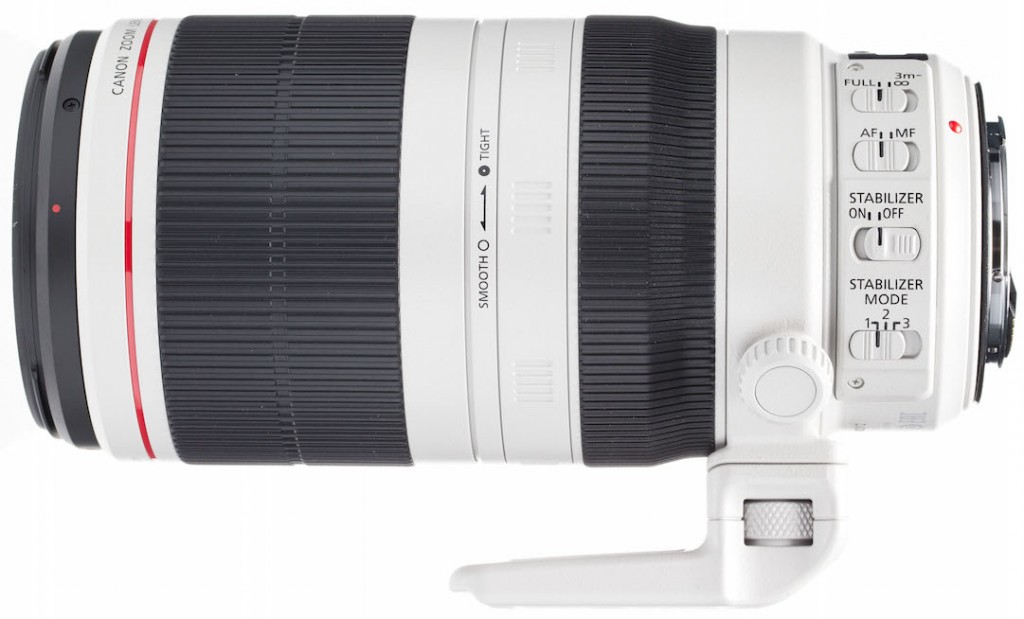
You know Aaron and I love doing teardowns of almost anything. The two types we look forward to most, though, are Sony cameras and Canon lenses, because those tend to be on the cutting edge of engineering elegance. For a couple of weeks now, we’ve been wanting to sink our screwdrivers into the new Canon 100-400mm IS Mk II lens, and yesterday we finally got a few free hours to do it.
For those two or three of you who don’t like a little lens strip-tease I’ll give you the quick summary: the build quality on this thing is amazing. I usually laugh when people describe a lens as “built like a tank” because what I know is the lens they are describing has a thick, heavy outer metal shell filled with tiny delicate pieces that break and wear out with great frequency. But this lens is built like a tank inside and out.
The New Tripod Mount
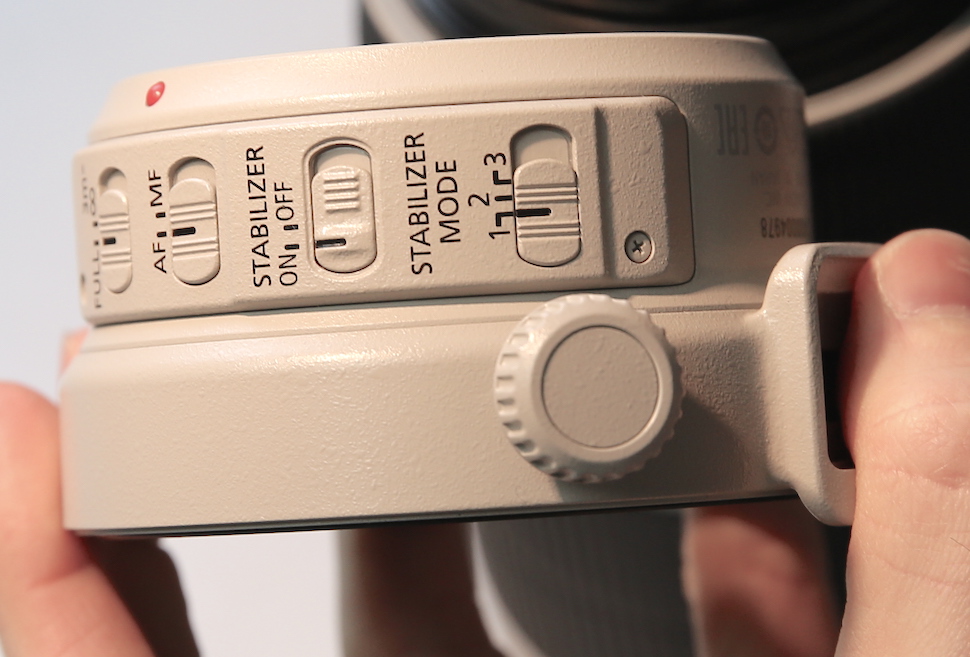
Yeah, I know, taking off the tripod mount isn’t part of the teardown. But this mount is entirely new and different, plus it kind of gives notice of the build quality to come. The actual foot removes, of course, via the little thumbwheel.
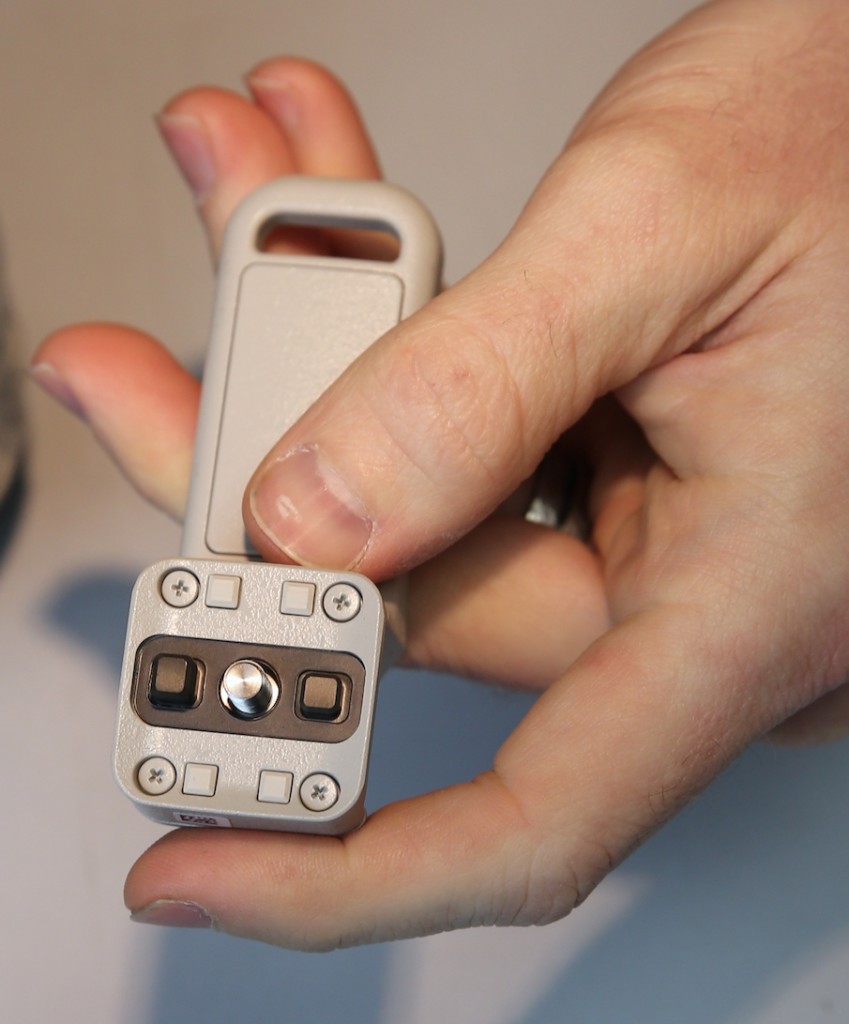
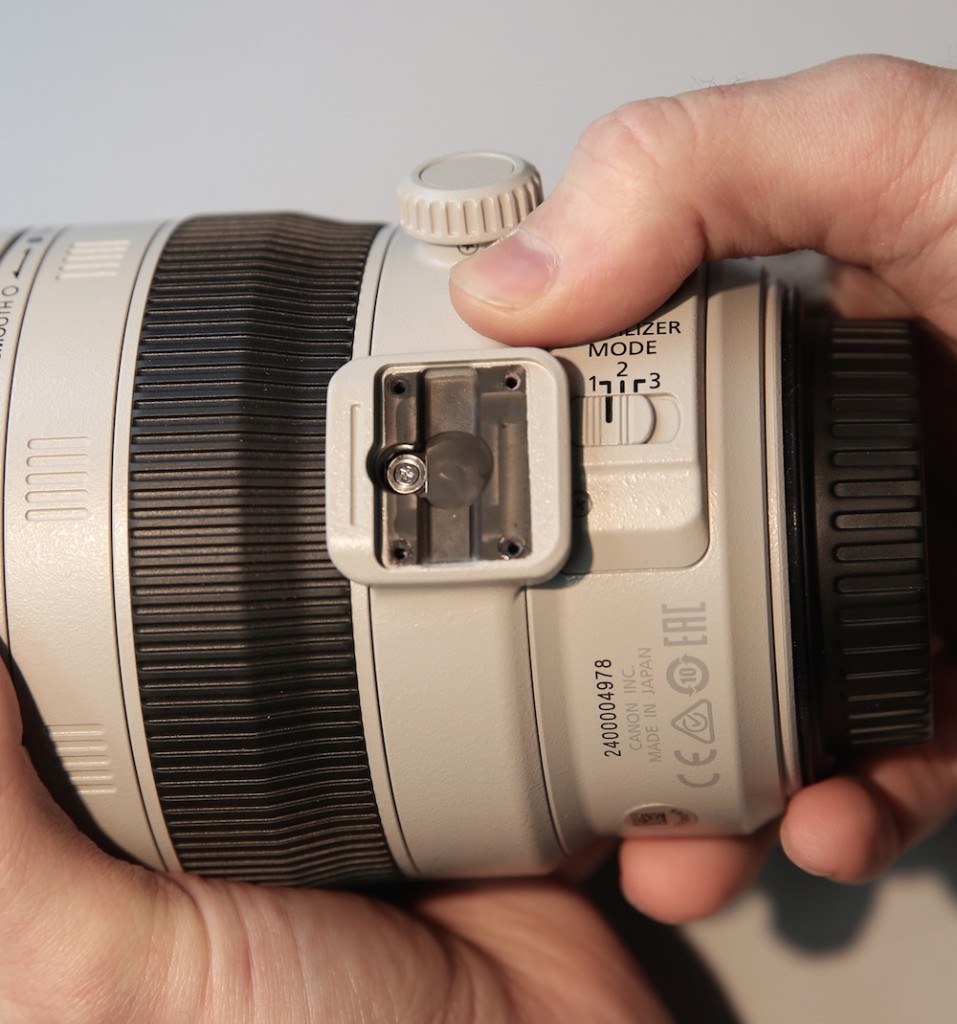
It’s just a foot, but note that there are two large and four small locking posts to keep it from slipping. It also can’t be mounted in reverse fashion, but I’m sure not too many people will want to do that anyway. It’s also nice that where the foot mounts to the ring is a replaceable locking plate, meaning that if you are strong enough to strip out the female threads, just the plate can be replaced, not the entire ring. That’s the difference between a $10 part and a $150 (my guess on costs, but probably accurate) part replacement.

With the plate removed you can loosen the ring and slide it around to reveal the large screws that mount the ring to the barrel. I’ll note here that you can’t remove the ring without partial disassembly of the barrel, so no need to try taking them out at home. Again, I’ll point out those are big screws with washers around them, double the size of the screws we usually see assigned to this kind of task.
Taking the Back Off
The lens mount comes off in the usual fashion so I won’t take up bandwidth with pictures of that. Once it’s off, though, we saw one thing we’d never seen before. The shim (red arrow) that is used to space the mount properly for infinity focus has screws (green arrows) holding it in place. I have no idea why, the mount screws pass through the shim and would hold it just fine, but there must be some purpose.
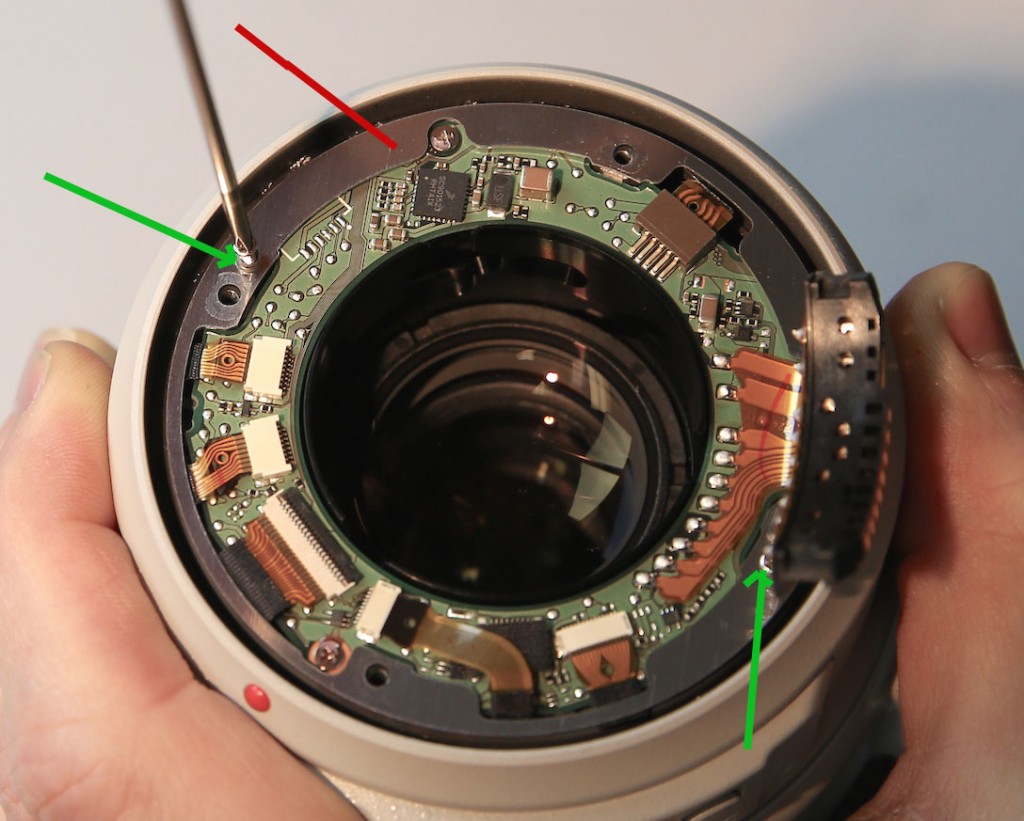
With the shim removed, a normal Canon main circuit board is revealed.
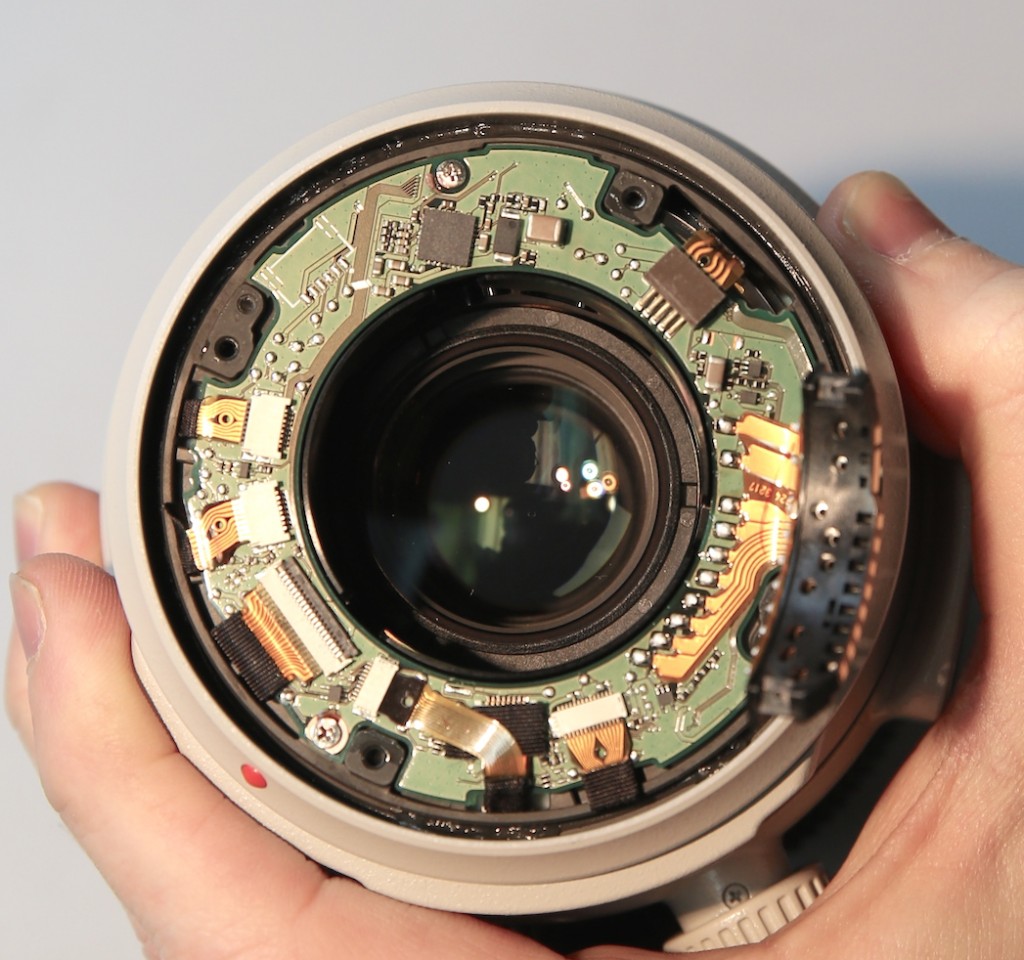
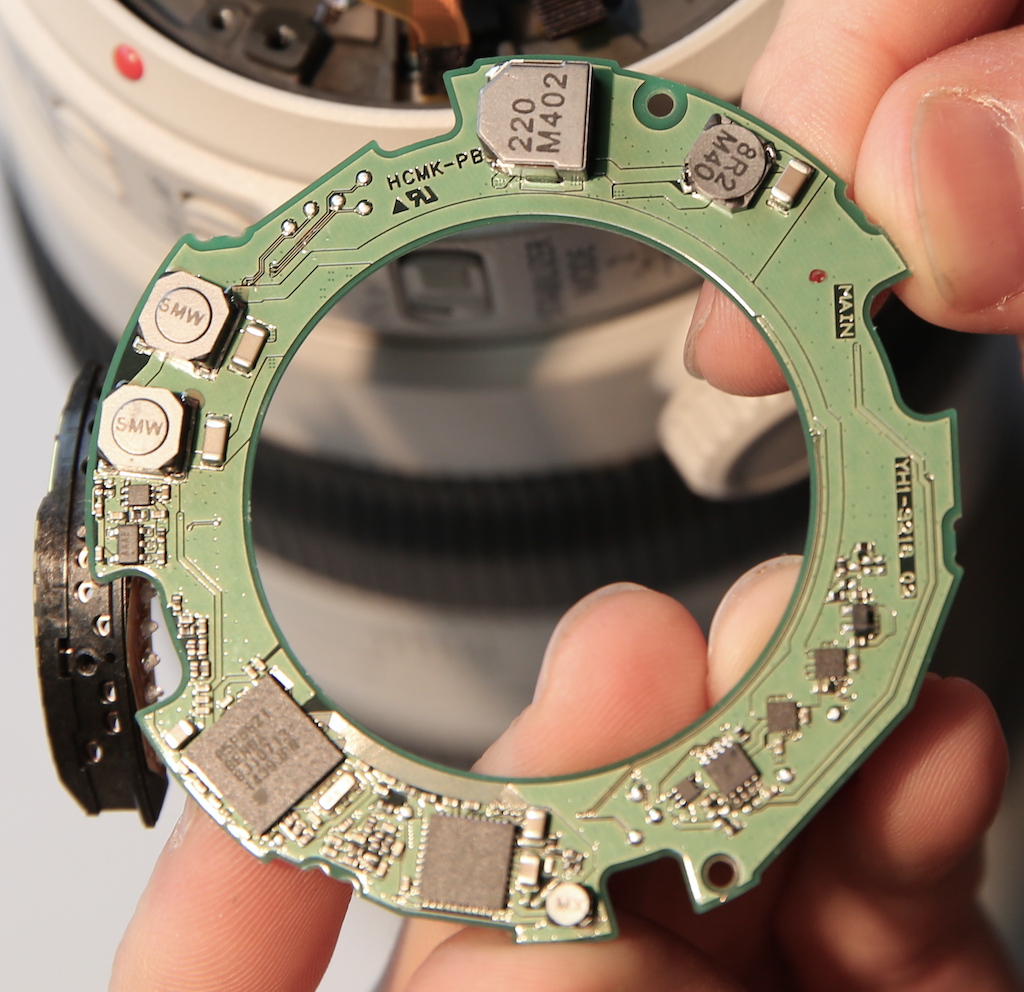
Removing the board gives access to the eight large screws (four to six is what we would have expected) holding the rear barrel in place.
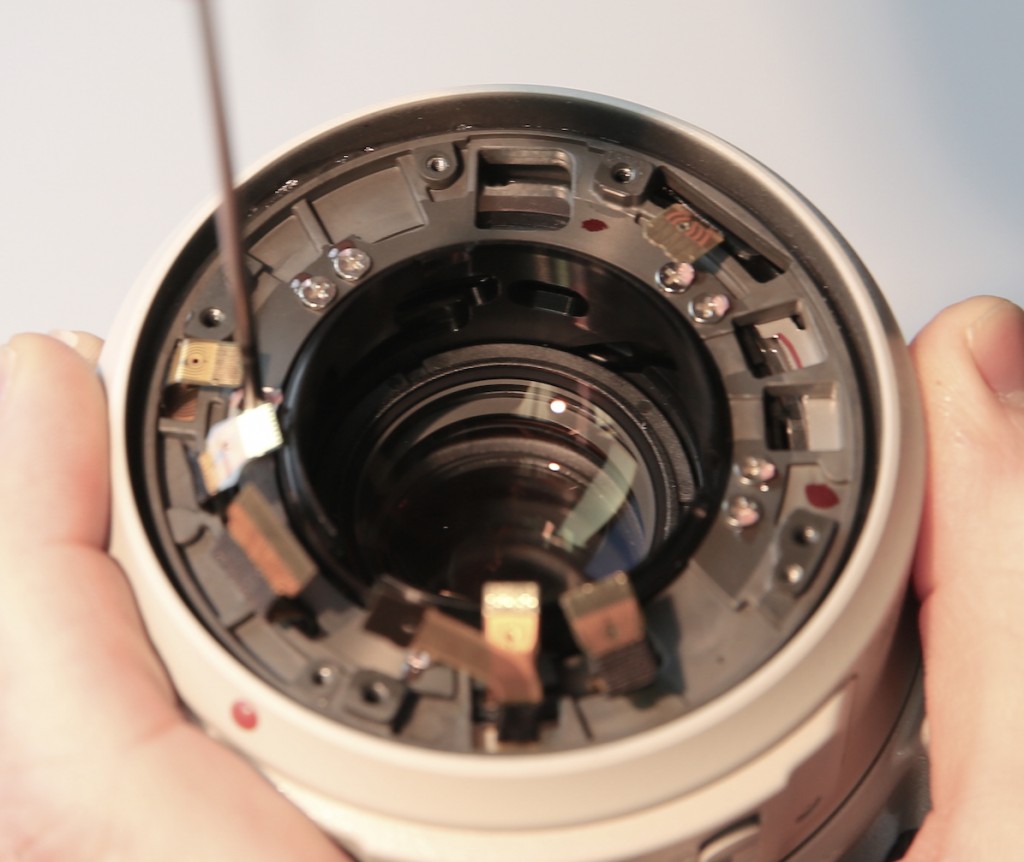
Removing these lets the rear barrel slide right off.
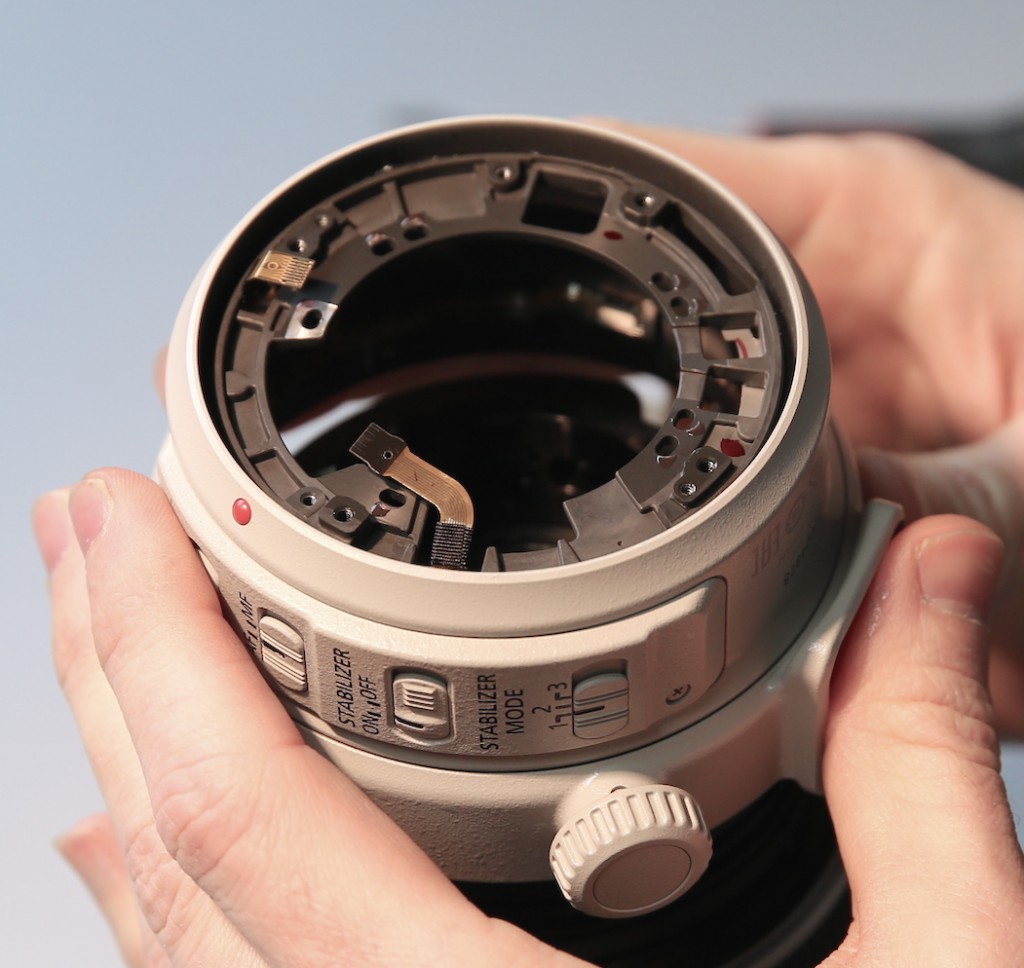
The design here, like most Canon designs, is nice and modular. The rear barrel assembly includes the tripod ring (which could now be removed if we wished) and all of the switches, meaning the flexes and connections are all contained in this replaceable assembly.
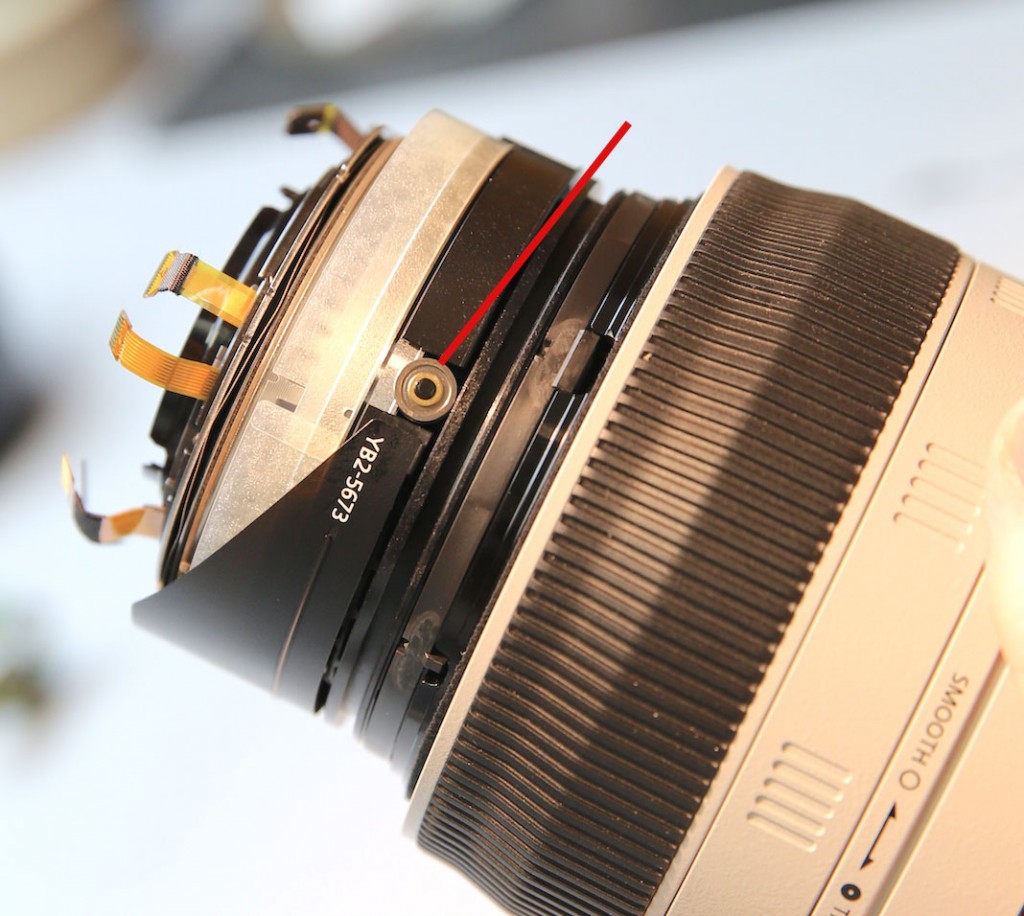
Taking the rear barrel off lets us see one of the first examples of the robustness engineered into the new 100-400 Mk II. The rollers (red arrow) that the focusing assembly rotates on are huge metal bearings, about twice the size of what we see in most telephoto zooms. These are more the size we’d expect in big super telephoto prime.
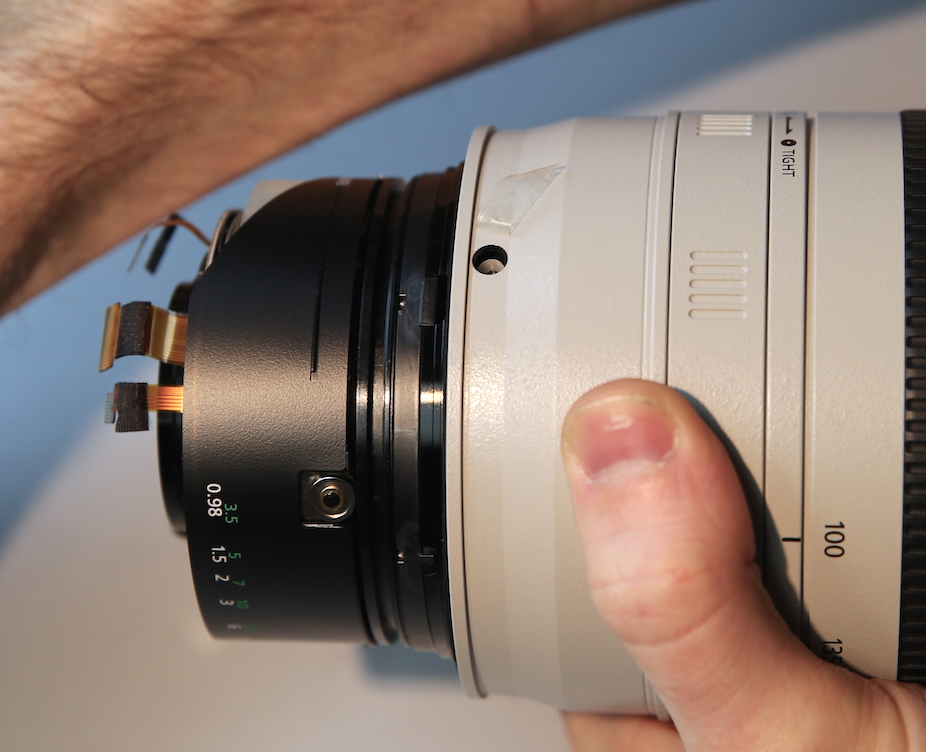
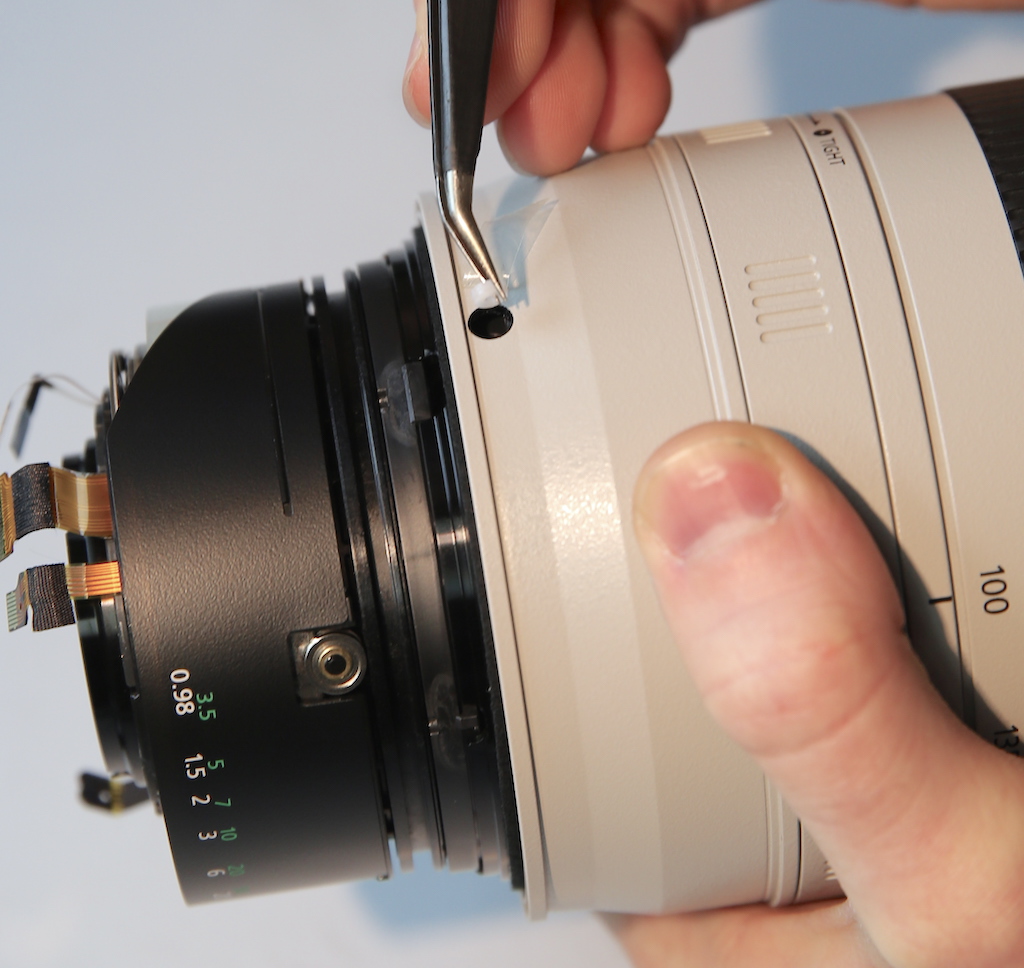
Back to disassembling now. Removing the focus rubber gives access to small openings that let us remove the collars under the focusing ring.
With those out of the way the USM motor assembly lifts right off in one modular piece.
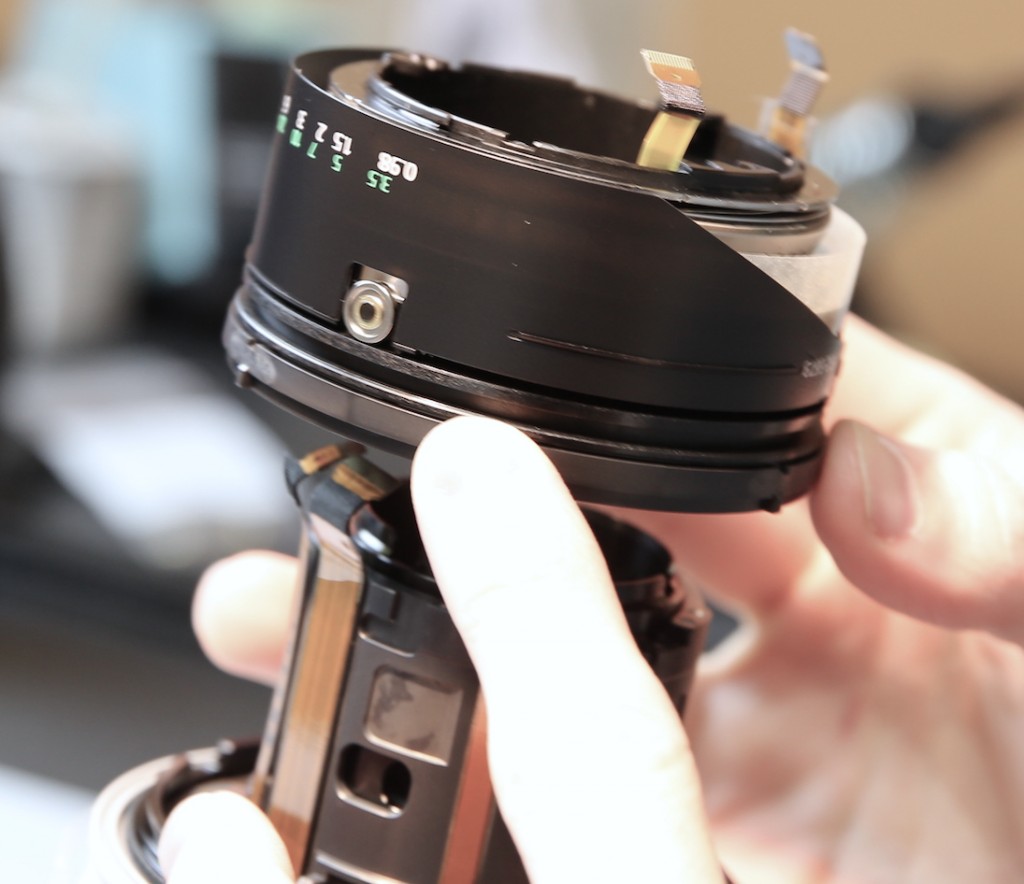
After which the focus ring can be taken off.
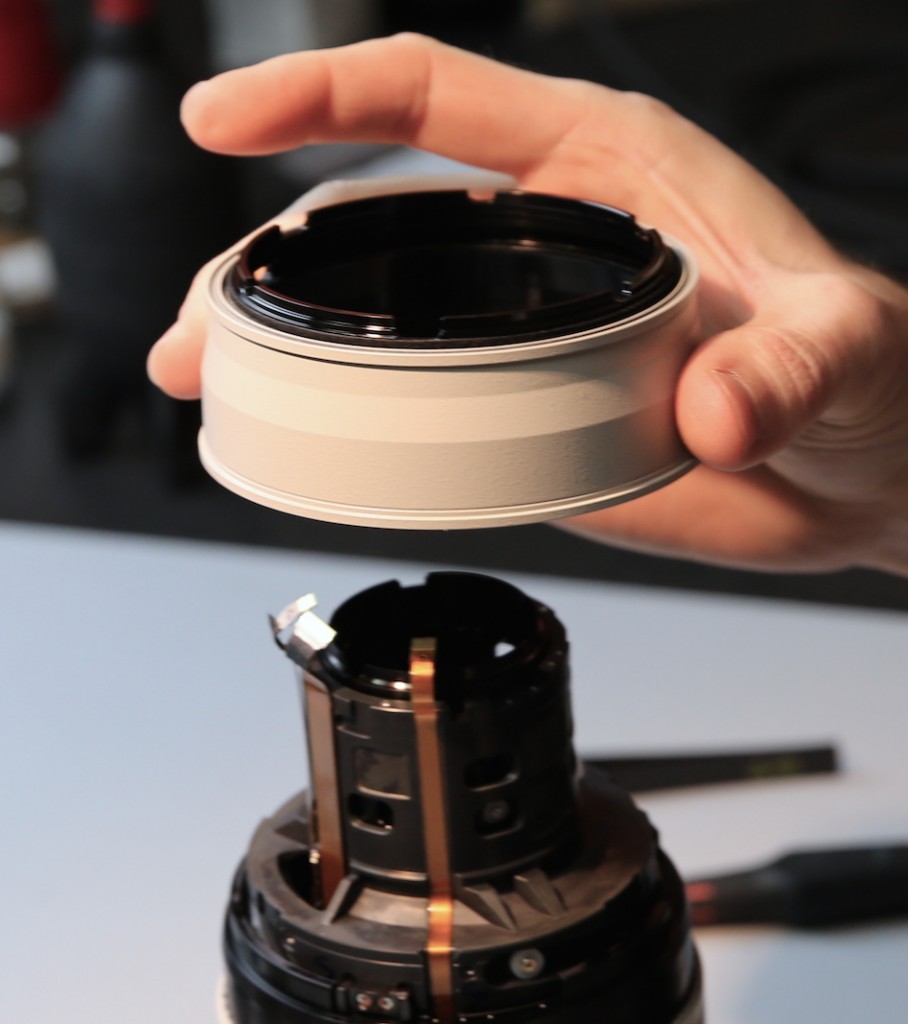
With all of the back assemblies off, the bulk of the lens looks like this. You can start to notice how large the various collars and rollers are. And everything we’ve removed up until now has been an electrical or mechanical assembly. All of the glass and optics are still intact.
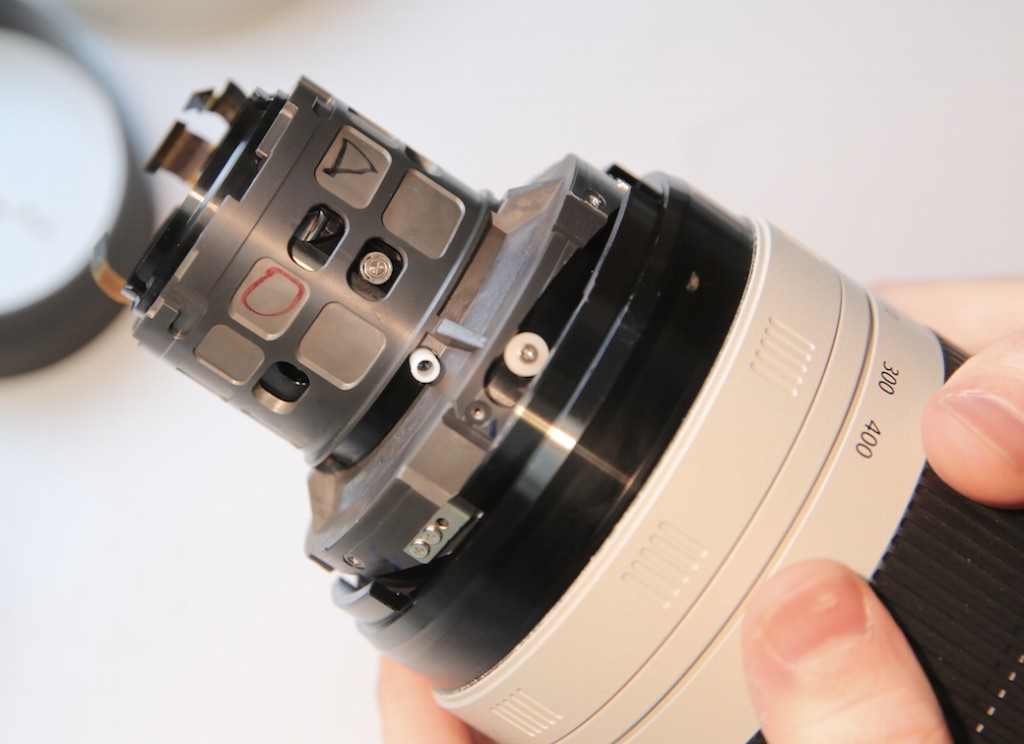
Smooth-Tighten Ring
Normally I wouldn’t spend so much time on this assembly, but in the original 100-400 IS L, the smooth-tighten ring was a part destined to fail eventually, using about 1,000 tiny ball bearings to move friction pads around. The new lens has a very different and much more durable (at least in appearance) mechanism, which is entirely different.
Looking up into the smooth-tighten ring from below you can see the spring clips that hold it in place at the stop.
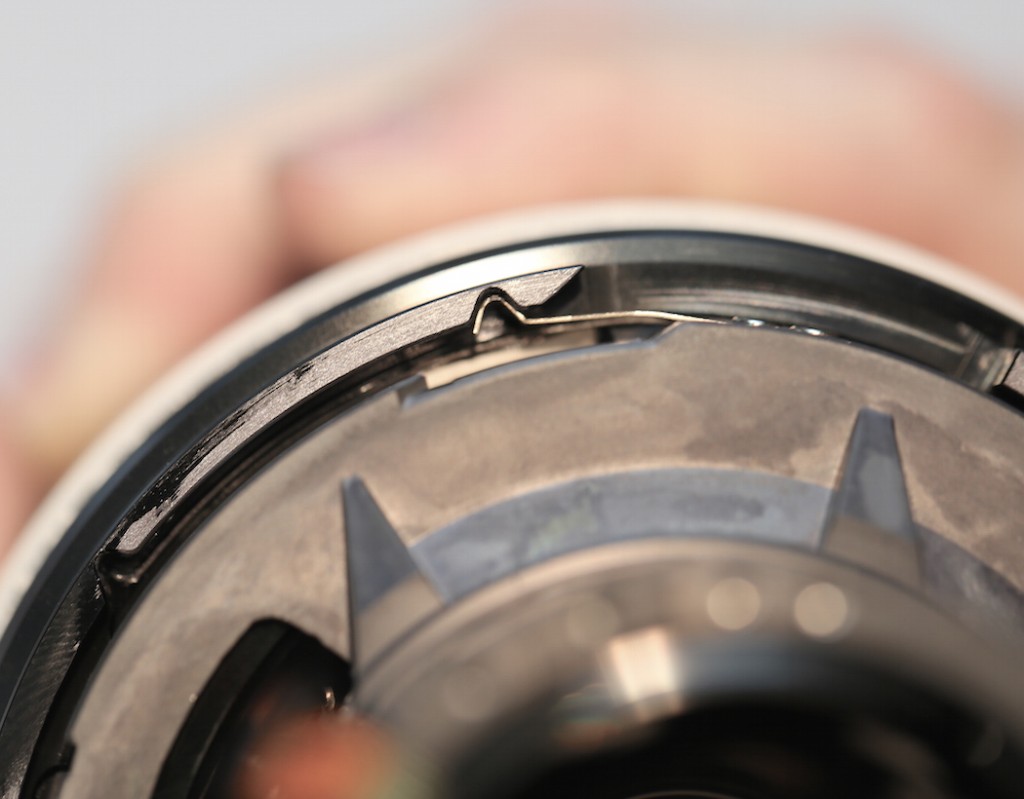
Removing a plastic stop lets us rotate the assembly and remove it from the lens.
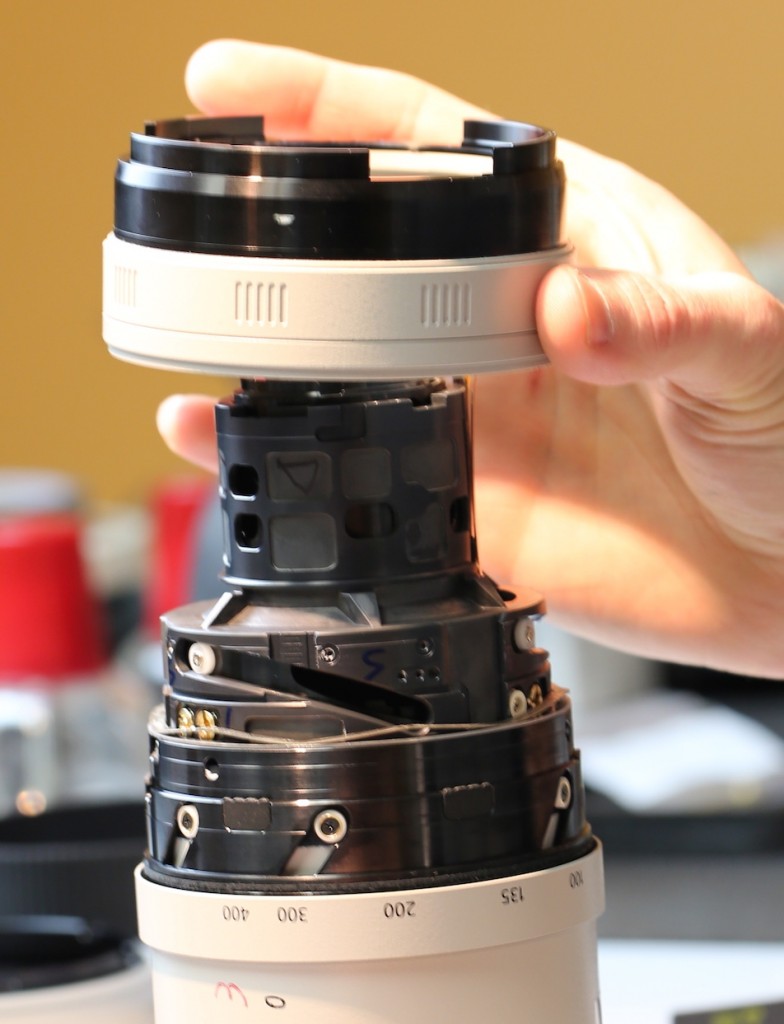
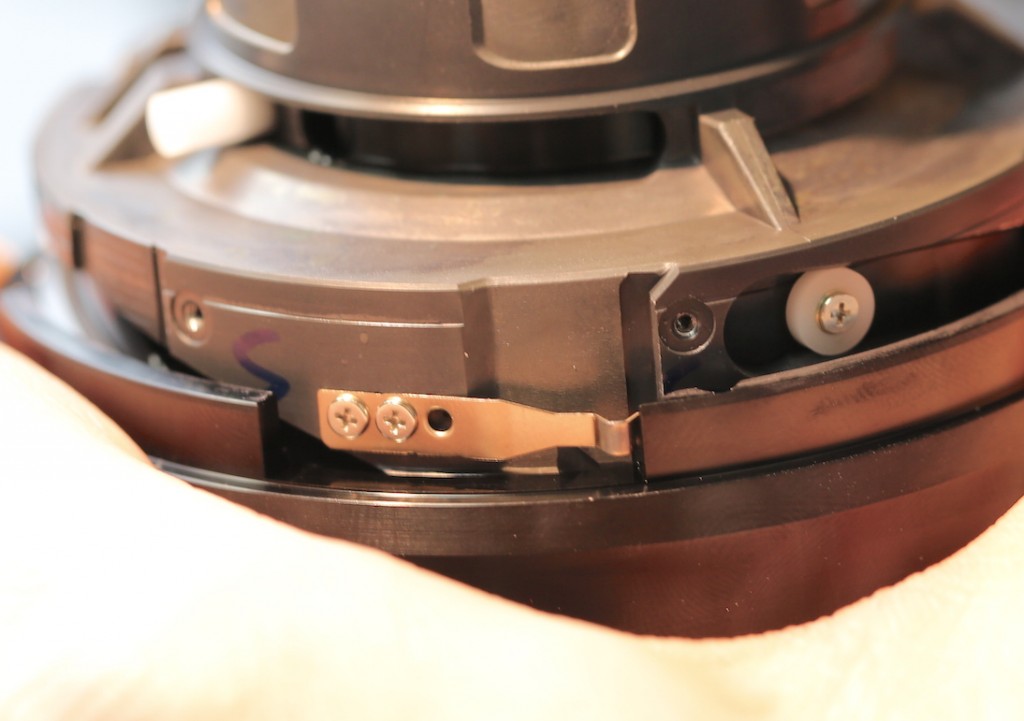
Back on the lens barrel, you can see how thick and firmly attached the spring clips are – and those are just so you feel when the ring moves into certain positions, they don’t have a tightening function.
The smooth-tighten ring itself separates into two parts.
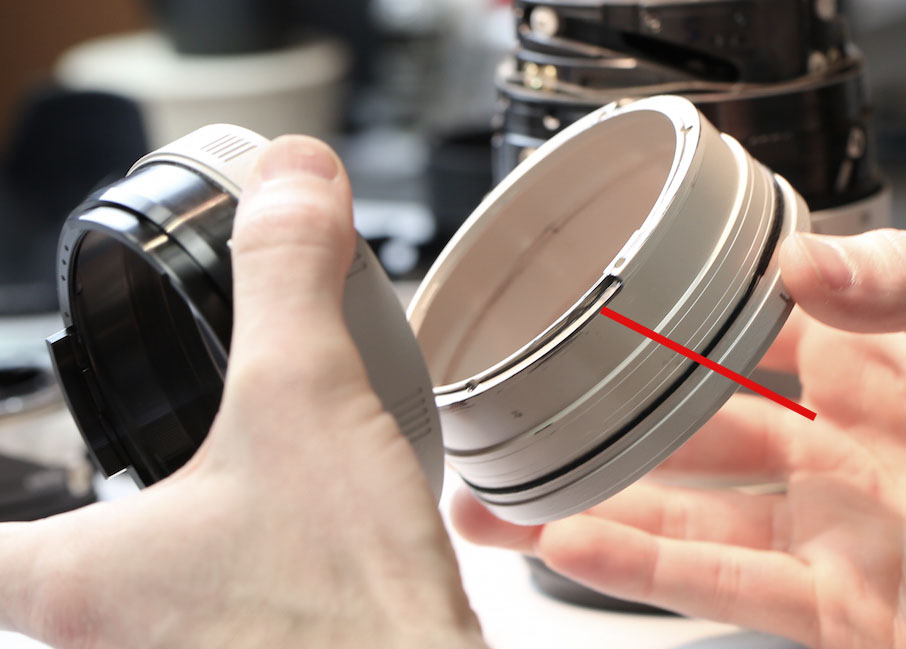
Which lets us see how friction is generated by two thick ramps (one on each piece) – sliding the ring increases tension. No ball bearings to fail. I guess the metal ramps could wear over time, but that shouldn’t have a great effect; you just slide them a bit further.
The Optical Assembly
This is where things get fun. Before we do anything else, let’s just take a look at the back of the lens, where the various barrels, helicoids, and helicoid collars are largely visible. First, look at the helicoid collars for the focusing and zoom groups (I believe) identified by the red arrows. Those are huge and robust things; I’ll show you a comparison in a second. Additionally, look at the lower helicoids – there are six channels, of which two are visible (one marked with the lower red arrow). Most lenses have three channels and collars. That’s a huge amount of increased stability when the barrel extends away from the lens.
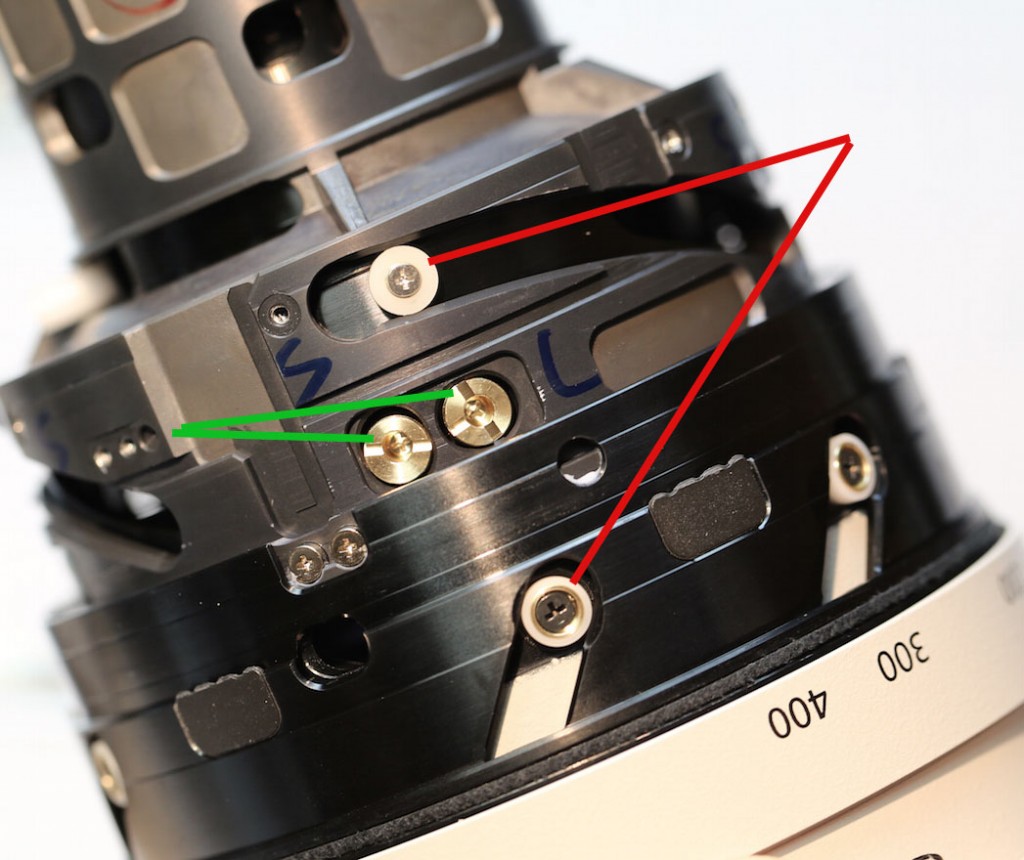
Next look at the eccentric optical adjustment screws identified by the green arrows. Those are much larger than usual, which allows for much finer adjustments. They’re also separated into tilting and centering screws at each of three locations around the lens. This should allow not only more accurate adjustments, but adjustments that are less likely to slip over time. I’m extremely impressed.
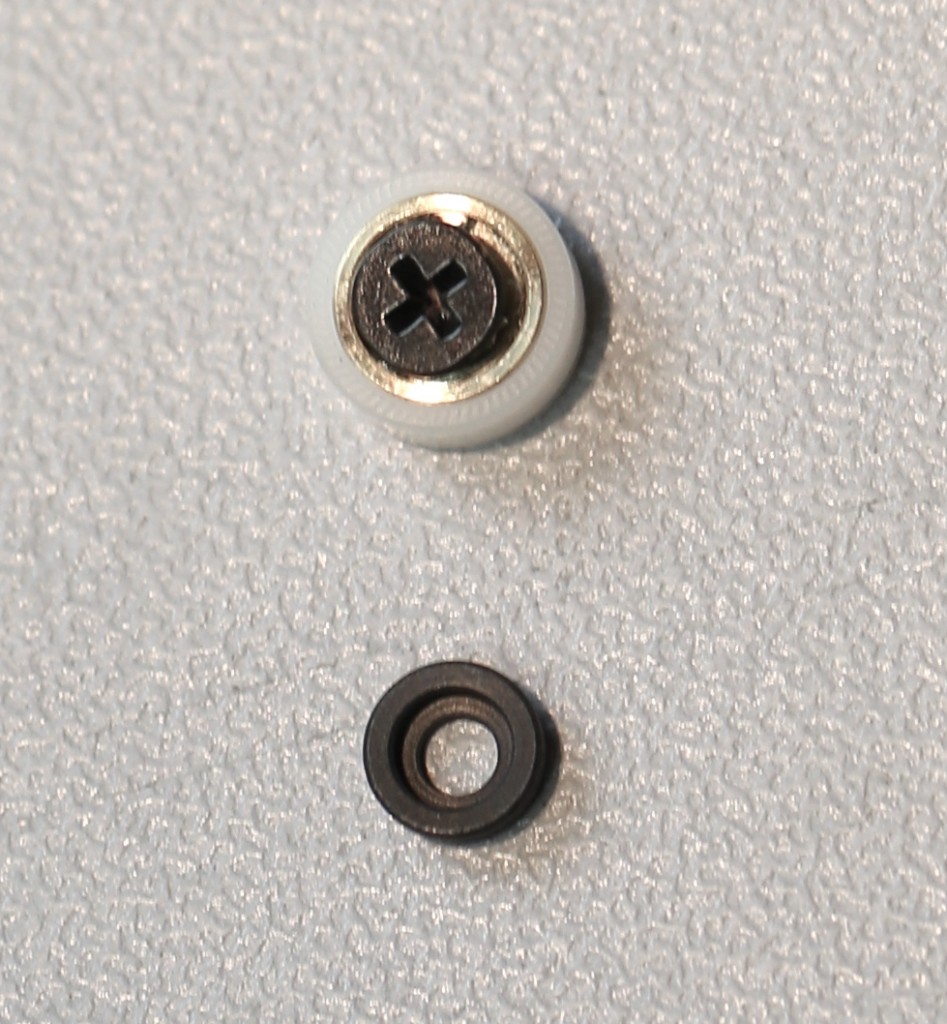
Below is a size comparison from one of the smaller 100-400 Mk II collars and the largest collar in the original Canon 24-70 f/2.8 lens, which until now I would have called a fairly large collar. Notice the 100-400 collar (the white one) is not only larger and thicker, it’s made of a very tough nylon and has a brass center, compared to the simple composite of the 24-70 collar.
OK, back to our regularly scheduled disassembly. Removing the front makeup rings and a stop key lets us slide the last outer barrel (zoom ring) off of the lens.
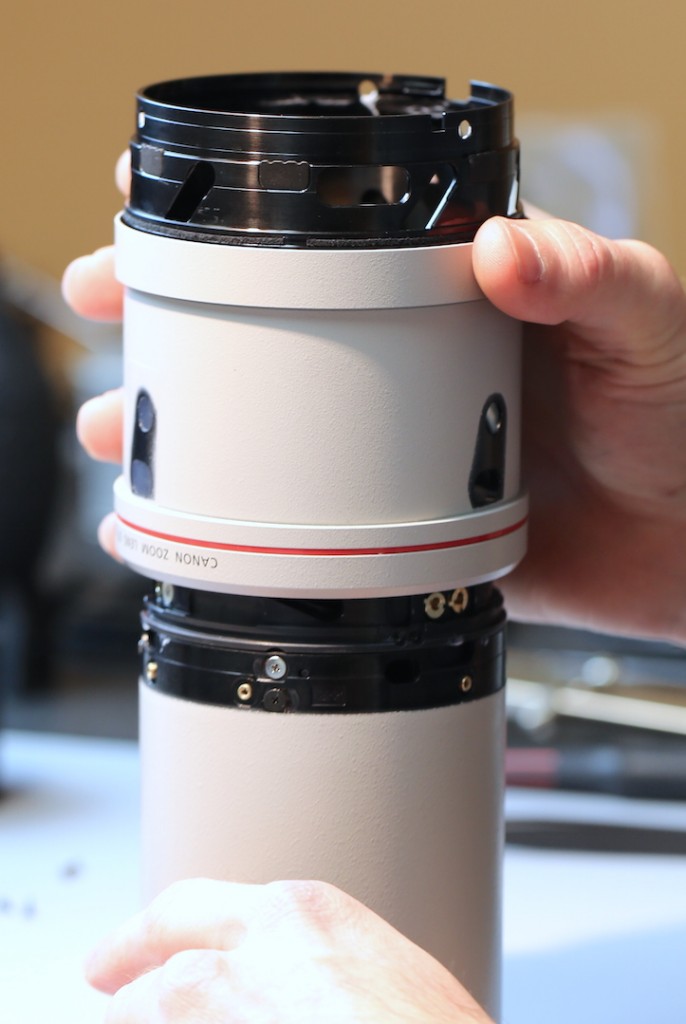
Which now looks like this with the barrel fully extended.
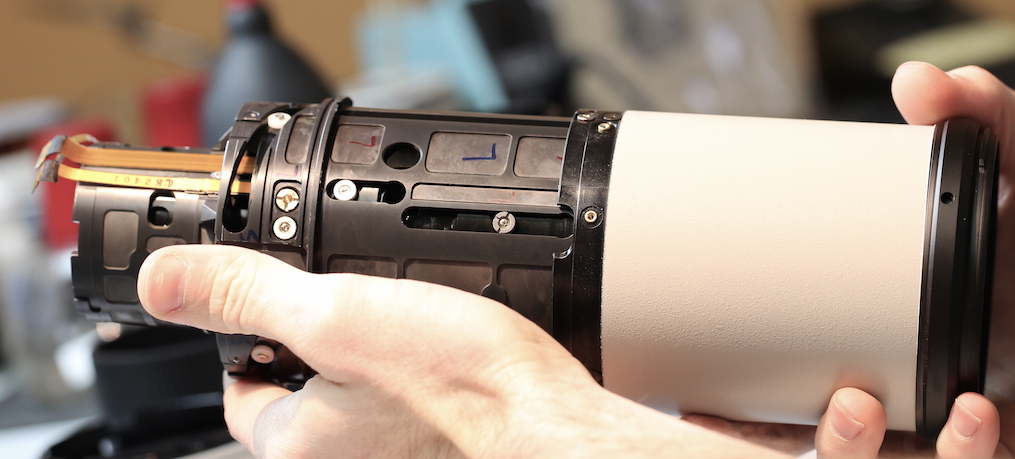
We have to remove the zoom locator brush, and then a series of screws and sliders (the black screw below the brush Aaron is removing in this picture is one of them) to remove the front barrel.
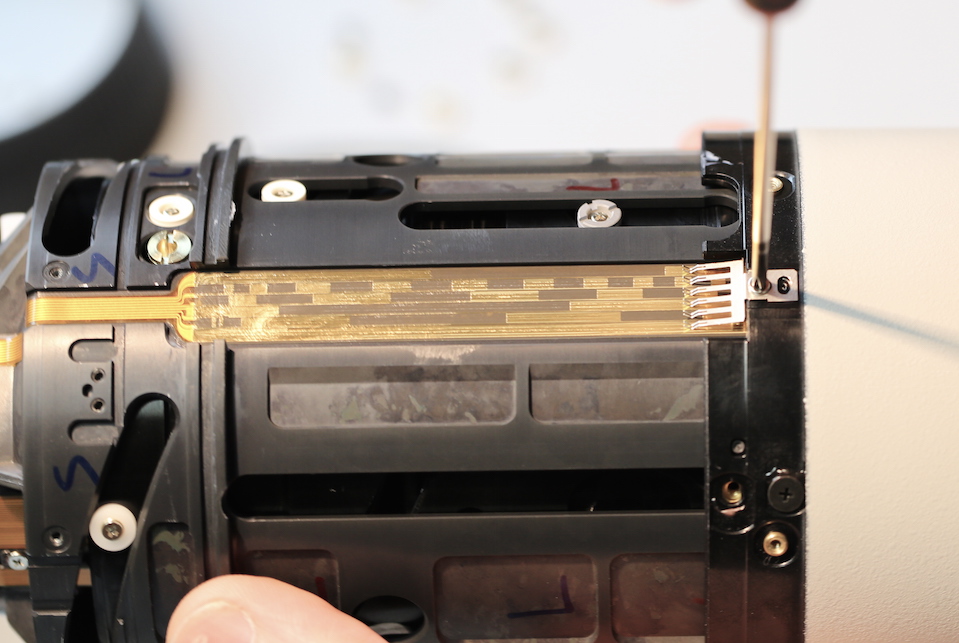
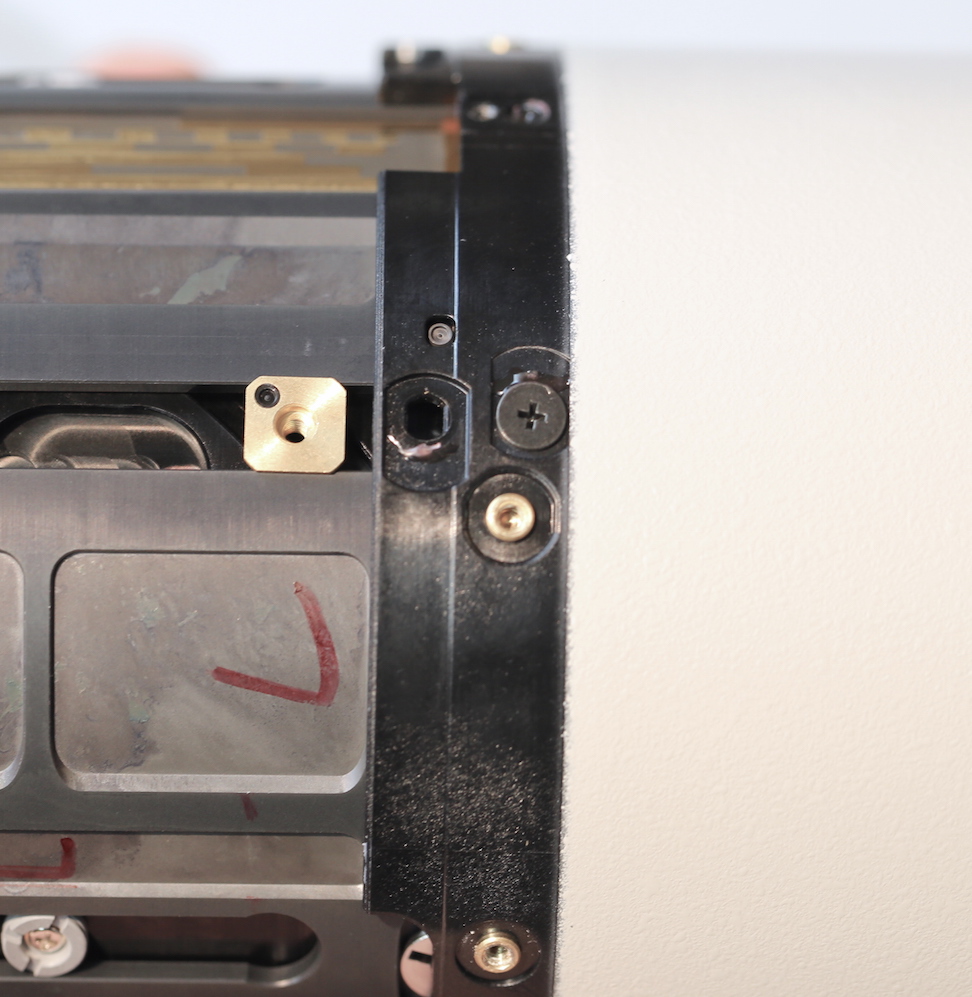
Here is a close-up of the thick brass sliders that are under the screws. They keep the barrel straight when it zooms, which is critical for keeping the optics in line. Most zoom lenses just have plastic guides, not brass, and not nearly this robust.
That’s got everything disassembled down to the individual lens elements. The front element is still in the extending barrel in Aaron’s right hand. The front element in this lens is not adjustable other than a distance slider, the optical adjustments are in the other elements.
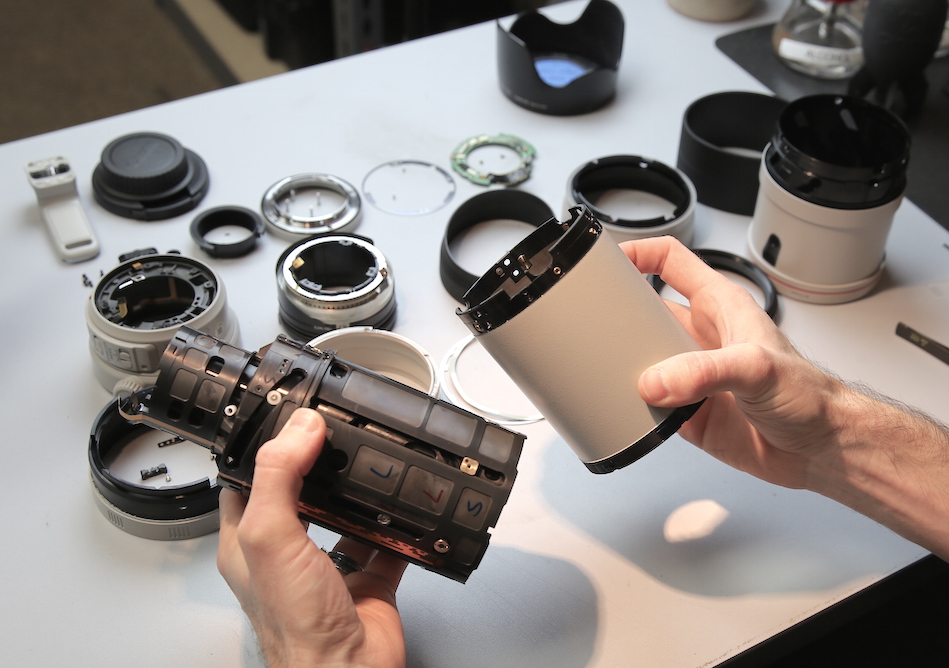
All of the other elements and all of the adjustable collars are in the main optical assembly in Aaron’s left hand.
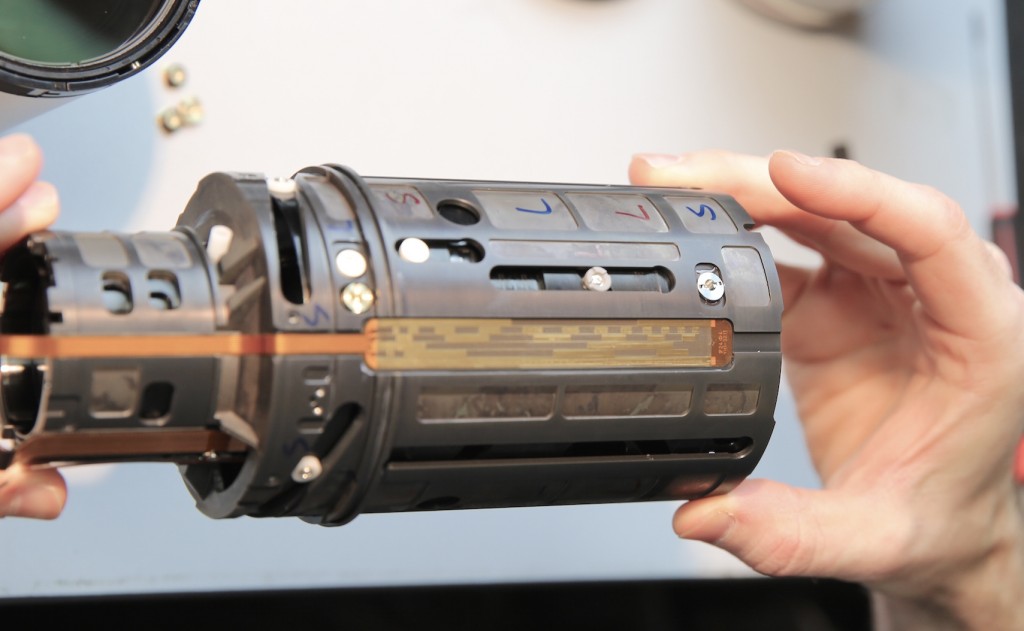
You can’t see all of them in one view, but there are a number of different optical adjustment locations. It will take us a while to figure out which control what types of issues. The IS unit, by the way, is the top group in the optical assembly, the second group overall from the front.
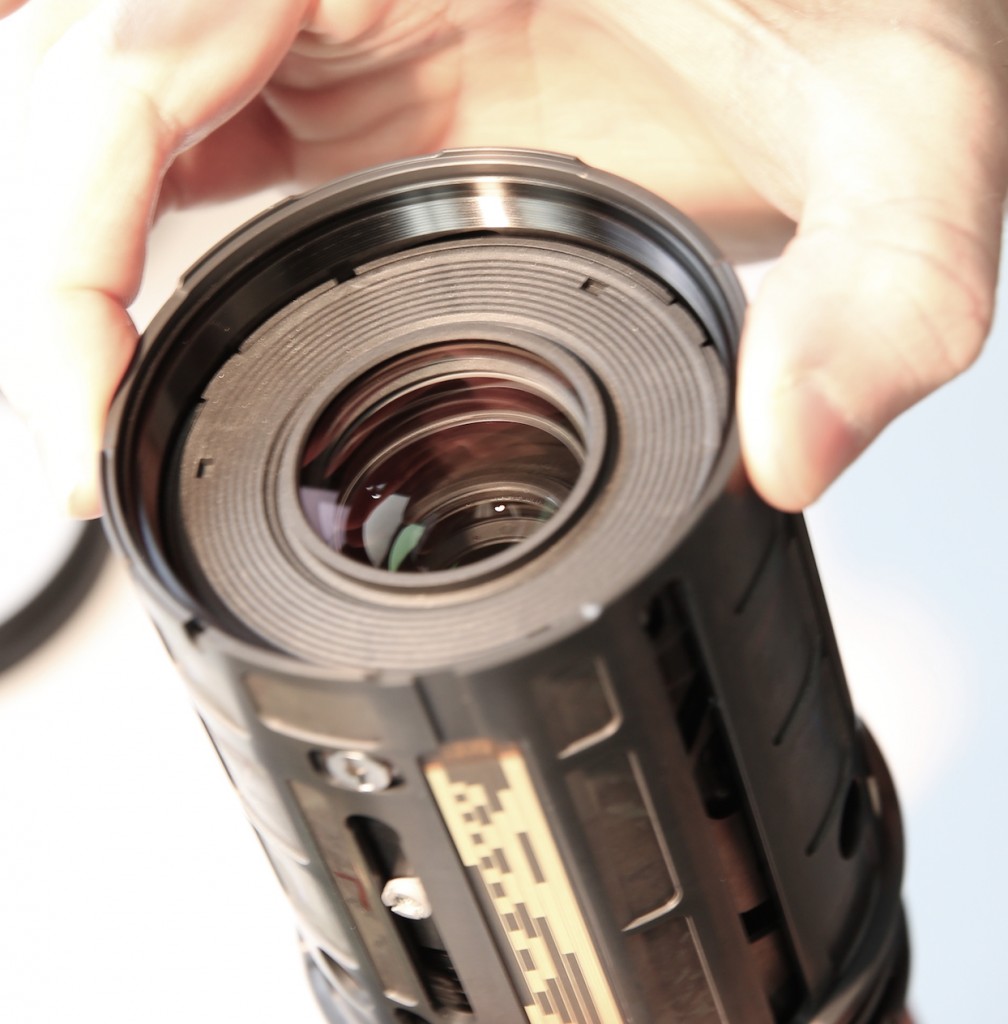
I know I can’t really, without showing you dozens of other lenses, do a good job of impressing you with just how robustly engineered this lens is. I will say that the insides look more like what we’d expect to see in a 500mm f/4 or 600mm f/4 lens, rather than a telezoom. It’s by far the most heavily engineered zoom lens Aaron and I have ever seen; and we’ve seen the insides of dozens of lenses in this range.
Well done, Canon engineers, well done!
Roger Cicala and Aaron Closz
Lensrentals.com
February, 2015
73 Comments
Lasse Beyer ·
That zoom locator resolves 49 different focal lengths, right? Tapering looks nicely non-linear, just like the changes in focal length probably are. Gray code is mandatory 🙂
Thomas Alicoate ·
The lens handles nicely too. Though you are right about it being built like a tank. Handholding it for a day of Eagle watching and musical event photography adds up to some serious soreness the next day. Maybe in a year or two you will have a few up on your(lens authority) black Friday sale, and I will have saved up the money for it. Looks like it will still be in good shape, being engineered so well. Thanks for the tear down!
Matteo ·
Hi Roger, will you or some users please explain to me exactly what the circle symbol with the “10” inside visible in the third photo from the upper part of the topic means? Thank you a lot
George Kash ·
Gosh, great job to all designers 😉
And of course to Roger for bringing it to us !
Jean-Paul Landry ·
Too bad you can’t convert it to push-pull.
Mark Olwick ·
Great info. I’m curious, what happens to these teardown units? Do they get thrown back into the rotation or are the sacrificed for parts? Or sold on Lens Authority?
Roger Cicala ·
Mark, they go right back into stock after they get reassembled and retested. Remember we have to disassemble lenses to repair them all day every day, it’s what we do. We have 4 full-time repair technicians and during a typical work day we’ll disassemble a couple of dozen lenses and cameras to repair or optically adjust them.
Matt ·
Matteo, I believe that is the “environmentally friendly use period” (EFUP), 10 years.
Roger, thanks to you and Aaron for all the great info. Your articles are a pleasure to read.
Thanks,
Matt
Ray ·
I’m really curious. Have you ever disassembled one of the 4/3 SHG lenses like the 90-250mm f2.8? I’ve had one for years now from new and it’s not had an easy life, yet seems as good as the day I bought it.
Eugene Mitchell (aka "Houndog") ·
Fantastic. I recently bought one. It has superbly done everything I have asked it to do. Quick focusing on my 70D. A bit heavy, but I quickly got used to that. Got good BIF shots of wild ducks on my first outing. Can’t wait for warmer weather in the mid-Atlantic States (more birds).
Renaud ·
Thank you for this teardown. Some say that the 4-5.6/70-300 LIS is also build like a tank. You probably have repaired some of them, is it your opinion too?
obican ·
Question: Can you partially assemble the lens so that it is still possible to reach all the adjustment locations while having the lens mounted to a camera?
Roger Cicala ·
Obican, yes, we looked at that as we reassembled.
Tim ·
It’s always great to see your lens teardowns. Thanks!
Bradford Griswold ·
Roger – I’m curious to hear your thoughts on the Mark II vs the Mark I. Is it that big an improvement where a real photo nerd should consider upgrading? Heading off to Africa in October to do some game spotting – I remember the last time I was there I almost never took off the 100-400…makes me wonder about upgrading…
EJ Morales ·
Jean-Paul Landry: Set the slip ring to the loosest setting, grab a hold of the hood, and push-pull all you want.
I’ve seen several former Version 1 owners doing this and being OK with it given the vast IQ improvements they gained by giving up the old one.
For me, I prefer the ring-zoom since I never liked or owned Version 1….. This one, however, is a keeper…. Sharpest lens I’ve seen in this range. I’m even thinking about selling my 400 5.6L which I’ve had for 20 years.
NancyP ·
Thank you. Most of us have no idea how complex the designs can get.
CyberDyneSystems ·
Awesome Roger.
Loving this lens, it is more than everything we hoped for in a replacement for the old standard.
I am eying your tear down intensely and looking to see what sort of machining it would require to convert to “One touch” zoom.
thanks for your insightful post!
Doctor Ed ·
Jean-Paul, the lens also zooms by push-pull if you wish to operate it that way. You just grasp the base of the lens hood and push or pull. (You really need to have the lens hood on for this.) To me push-pull is awkward with this lens because you have to reach a bit, so I twist to zoom.
Fábio Bernardino ·
The only bad thing i have read about this lens is the softness of the tripod collar.
DOC ·
Roger, How ’bout stirrin’ the pot a little. Please think about stripping down a new Nikon 80-400 and compare it to the Canon. This new Canon lens which has a magnesium barrel is a few hundred less than Nikon’s new 80-400, which is all engineering plastic. Can the cost be that dramatic between alloy and plastic? Yes, we all know construction materials do not affect the optical quality, it’s just that all the new Nikon glass keeps getting more cheaply made with every new release. I wonder if their execs would like plastic wood dashboard panels and body panels on their Lexus cars!(Just guessing) For my hard-earned money, I really do expect more from Nikon. Their legacy is lenses, and they should be ashamed of themselves. BTW, how about as Zeiss Otus 85mm teardown? Thanks, Doc
Frank S. ·
Excellent work, both on you and Canon.
I can’t wait to see what your I impressions are when you finally get your hands on Pentax’s new DFA* 70-200 and the DFA 150-450.
SteveNobody ·
Fabio: Yes…the tripod foot itself is a tad flexy. If you *really* tighten the foot down it will minimize it, but it ain’t the collar on the 70-200 f/2.8.
I also don’t care for the window in the hood. You can’t turn the filter that much at a time and it gets knocked open by accident a lot. I may try to find a way to hold mine shut forever.
But other than that the lens is AMAZING…easily one of my favorites now.
Jeet ·
Hi Roger,
What is your take on the weather-sealing of the lens? Dust/moisture resistance etc.?
Roger Cicala ·
Jeet, it has all of the usual rubber seals and taped over holes. So it’s like most L Canon lenses.
Henrik Sandstrom ·
Always interesting to see the inside. How about the 70-300L? Have you done a teardown of that too and if does the inside look sturdy enough? I was stupid enough to buy one that has a dent (hard to see but big enough to prohibit filters) close to the front lens from being dropped on the floor. The pictures seemes sharp but i have not looked really close.
Eric Tung ·
Also interesting in teardown of canon 70-300L. I know Roger is not a fan of this lens. But before 100-400L II came out, this lens was a lot people’s choice since the old 100-400L has not weather sealing and only 2 stops for its image stabilization.
Pieter kers ·
Impressive ! to see what comes around to make such a lens… ( and that you all @LR can make it work again!)
This is what i have always liked about photography ; that so many skills come together.
(The chemical part however has been lost…but the electronics part has come to take its place)
KeithB ·
Pieter:
As someone who has worked closely to a wafer fab, there are *plenty* of chemicals involved in electronics.
mrc4nl ·
this being a blog about the technical side of photography:Why are there so many pictures blurry, or plain shaken (taken at a too slow shutter speed)
how hard can it be?
Roger Cicala ·
mrc4ni, I invite you to take apart a lens under halogen spotlights, doing it as quickly as you can because it needs to be back in stock as soon as possible, and take great product shots over the shoulder of the person doing the disassembly. It can be damn hard. We have a superb product photo section with plenty of diffuse, reflected light, tripods, acrylic stands, etc. The repair area ain’t it.
Roger
Anthony Botelho ·
Thank you for taking the time to post your findings on this new lens. As a photographer who knows how to use a lens, but not how to repair one, I found it very interesting to see one taken apart. As for the person who commented on blurry pictures I have to say. Come on? I feel like they missed the point of this post, plus I disagree. The photos are fine. Job well done, thanks again!
Kenny ·
@mrc4nl, bad form.
mrc4nl ·
i just find it odd there are also some great shots with excellent sharpness and (micro)contrast.
If they were taken in the same lighting conditions, why is the “ringoff” picture so blurry and the “backoff” picture as sharp as it can be? they look similar in light.
i dont expect fantastic product shots under diffuse light ,but ample light to make the pictures not so blurry would be nice. (maybe provide extra lights on the repair department ceiling? )
Roger Cicala ·
mrc4ni some of it is contortions – trying to work around Aaron’s body to get the shot can be difficult. A lot of it is exposing to get black on black parts to show up. Most of it is priorities: we’re doing this to learn the lens for future work, and usually with lenses that are ‘hot’ and in great demand so time is of the essence. Taking shots during the teardown is fine and I write them up after work. It’s not the priority.
Goran ·
Well done! I recently stumbled on your site and I am already a big fan of your lens teardowns, including your first-class humor. 🙂
As a Canon user I am very pleased to see the splendid engineering they’ve put into a number of lenses. I recently bought this lens and my first impressions of holding it was: Massive but silent when shaken. Reading your thoughts about the construction is like pouring hot cloud-berry jam on top of vanilla ice cream. I love this lens, it’s simply amazing to work with.
bdbender4 ·
@mr4cnl
I think you are missing the point: more teardowns with adequate photos vs. fewer teardowns with studio-standard photos, given the amount of time Roger has. I vote for more teardowns, every time!
Every time Roger does a lens test, some people pile on asking “why didn’t you do this or that” or “could you please test these other lenses”. These folks are missing the point, too, in a different context. Roger has politely explained about his time limitations quite a few times.
mrc4nl ·
@Roger Cicala, now i understand the conditions a little better, and the lack of time to do them properly. i was just giving ideas to do them better
I guess nobody does the teardown in their free time, otherwise somebody could do blogposts about the less popular lenses (with sharp pictures) 😉
Berneice Demorrett ·
Its superb as your other articles : D, appreciate it for posting .
Daniel ·
Great teardown. Business suggestion: LR for Lens Rentals, and LR II for Lens Repair. Your company has total credibility, and sending a lens in to be adjusted for service and optical centering would definitely be something your company would find willing clients. D.
Roland ·
Thanks so much for the teardown Roger!
Can you let us know what the inner barrel (i.e. the one that extends when you zoom to 400mm) is made of?
Plastic or metal?
Ruprecht ·
How does this lens compare to the older but slightly more versatile zoom range Sony 70-400 G2? Are there a couple valid pros and cons about each you could name quickly and concisely?
Laurence ·
Hi
A great insight into the construction and quality of the product 🙂
I have the MkI version and must admit I was puzzled by the new tripod mounting point assembly? I currently use a Black Rapid strap as you likely know this holds the lens (and Canon body) inverted I also mount the combo onto a Wimberley Sidemount Gimbal so the strain is either a “pull” in the case of the BR strap or lateral with the Gimbal. So with the MkI as it is a single casting the load is spread across the whole ring with no obvious weak points.
However, the MkII as shown in the teardown has the tripod screw going into a plate that is held with four much smaller screws………….so my concern is just how strong is this multi layered (so to speak) connection when used in the situations I mount such a lens?
Clearly in when mounted in an upright position all the parts are in compression and little actual load is on the various screws and connections but just how good is the strength and durability or lifespan of the weakest ‘link’ in the chain?
I ask because I am looking to upgrade my MkI to this newest MkII but as there is no published data (as far as I can find out) I suppose I am looking for the reassurance that the mechanical failure of this mounting is as unlikely as winning the Lotto in my lifetime 😆
TIA for the insight & feedback 🙂
Christer Almqvist ·
Sorry, I posted that in the wrong forum, should have been in the 200 mm comparison.
Chris ·
Hi,
As this lens uses a shim as the mount spacer, does this mean that the lens uses one set size & thickness mount/bayonet? The previous model had something like 10 different thickness mounts in 0.1mm increments.
Cheers!
Photonius ·
As follow-up to Laurence. I’d also be interested in the foot. A strip-down of the foot (at a post in dpreview) did show these tiny four M2 screws. It would indeed be interesting to know how much these screws would hold when the lens is carried on tripod, or is attached at the tripod mount to a shoulder strap and swinging around.
Leigh ·
I, like Photonius, have concern of relying 0n four tiny screws to support the lens, & whatever is attached to it.
I was contemplating rotating the foot up, and toting it with a “Sling”-Strap; but in view of the above, I’m having second thoughts.
Balb0wa ·
Hello
ive had my 100-400mk2 a month now, i have a lot of dust under the front element.
How easy is it to get to it? can you take it apart from the front?
Thanks
Roger Cicala ·
It seems to be a pretty common problem with the front element dust, but it’s not nearly as easy to get out as the older version. I wouldn’t tackle it unless you’re really comfortable with disassembling lenses.
chrisnosleep ·
I too have the question about the front element. Is it possible to take out the front element by removing the front lens retaining ring with a spanner wrench. If not, what is the easiest/safest way to get into the front chamber for dust issues? I have read your other articles (which were excellent) about how much dust/particles it takes to affect the image. However I’m not having issues with the IQ, my issues are with focusing.
I completely understand the risks involved here, but paying Canon $200-300 twice a month for cleaning isn’t something that’s feasible for me. And there are no camera shops anywhere even remotely close to my location.
Thank you!
Roger Cicala ·
Chris,
It’s a bit more difficult than that. The front element has to be taken out by removing the front ring, then taking out the side mount collars. If you’re handy and used to working with lenses it’s not awfully difficult, but it’s not one I would consider an easy dusting.
That being said, I haven’t really experienced dust affecting AF accuracy.
chrisnosleep ·
Can you tell us what the pink adhesive is that is on most of the screws? It seems it has a rubber cement elasticity to it. Is it some kind of Loctite? Thank you.
Roger Cicala ·
Chris, it’s just pink lactate.
abo ·
Could you do a test comparison with Nikon AF-s 80-400?
E A H K ·
Interesting article! Thank you for taking the time to write and picture it. One question here, what would be this part number? CY3-2359-000-260 Sleeve Mount, can you please point it in one of your pictures?
AaronClosz ·
The mount sleeve is a sized ring that the lens mount fits into (the rubber weather seal would be in between these two parts). The final three digits in this particular part number give you the thickness of the sleeve. Sleeves at the mount are used in place of shims to achieve accurate flange distance.
E A H K ·
Thank you Aaron! I’d tell you later why the question. Have a good day 😉
E A H K ·
Thank you Aaron! I'd tell you later why the question. Have a good day ;)
Mike Hamra ·
Fantastic teardown and great to learn. But, for gods sake, please stop down your lens, turn up the lights, and get everything in focus.
Irene Vejar ·
Having done this can you give me any idea why my tripod collar will not rotate? I’ve removed the foot, put a little silicone around the edges and tried to just physically loosen it up a bit. It will not budge!
Roger Cicala ·
Irene, there’s probably a bent or backed out screw and collar on the barrel inside the tripod collar. Unfortunately, that requires lens disassembly to repair so is best sent in to Canon.
Irene Vejar ·
Having done this can you give me any idea why my tripod collar will not rotate? I've removed the foot, put a little silicone around the edges and tried to just physically loosen it up a bit. It will not budge!
Roger Cicala ·
Irene, there's probably a bent or backed out screw and collar on the barrel inside the tripod collar. Unfortunately, that requires lens disassembly to repair so is best sent in to Canon.
Ralph Hill ·
Is it possible to remove the extending barrel without removing everything from the camera end first? After a recent trip to the desert I have dust inside my lens and am hoping for an easy way to blow it out. I doubt that I am the only person with this problem.
Notna ·
I already wanted this lens, now I’m mad with desire! Canon aren’t the most innovative camera maker, but I’ll be damned if anyone can best their lens design skills.
Notna ·
I already wanted this lens, now I'm mad with desire! Canon aren't the most innovative camera maker, but I'll be damned if anyone can best their lens design skills.
Wayne Young ·
What a way to ‘undress’ a lens! 🙂
Very impressive.
May we see the optics layout next, please?
Wayne Young ·
What a way to 'undress' a lens! :)
Very impressive.
May we see the optics layout next, please?
Shane Castle ·
I know, this is an old post now, but I just recently acquired this lens and I found two annoyances that I’d like to rant about. One, the foot had to be replaced right away with an Arca-Swiss compatible foot; the only one that still allows me to use the supplied pouch seems to be the Kirk foot. If Canon had supplied an A-S compatible foot this would not have been necessary. Two, the lens collar has no markings or detents for 90° rotation, a real annoyance when using it on a tripod with the foot and wanting to change between portrait and landscape. Building in detents on the collar would have been a really nice touch. Maybe there was no room left underneath? Other than those, so far I have no regrets.
Shane Castle ·
I know, this is an old post now, but I just recently acquired this lens and I found two annoyances that I'd like to rant about. One, the foot had to be replaced right away with an Arca-Swiss compatible foot; the only one that still allows me to use the supplied pouch seems to be the Kirk foot. If Canon had supplied an A-S compatible foot this would not have been necessary. Two, the lens collar has no markings or detents for 90° rotation, a real annoyance when using it on a tripod with the foot and wanting to change between portrait and landscape. Building in detents on the collar would have been a really nice touch. Maybe there was no room left underneath? Other than those, so far I have no regrets.
Carlos Refried ·
Sweet article. I remember reading this back in the day and was amazed. Now I was able to get one of these second-hand. Question, Roger, (if you still read these) — My copy of this lens is sweet, except, it has a few dust specks behind the front element. From what I've read and gather, there does not seem to be any optical adjustments or shims on the front element. In theory, one should be able to (carefully) remove the front element (it's just a few screws, a couple under tape) clean the elements, and reassemble without worry? Of course mark the position of the front element and return it 100% to the same position) — perhaps use blue threadlock on the screws on reassembly? Hopefully i'm not worrying too much.
Carlos Refried ·
Update: I cleaned the front element by removing it and put it back together. optics are still perfect. everything is sharp everywhere.
Carlos Refried ·
Sweet article. I remember reading this back in the day and was amazed. Now I was able to get one of these second-hand. Question, Roger, (if you still read these) -- My copy of this lens is sweet, except, it has a few dust specks behind the front element. From what I've read and gather, there does not seem to be any optical adjustments or shims on the front element. In theory, one should be able to (carefully) remove the front element (it's just a few screws, a couple under tape) clean the elements, and reassemble without worry? Of course mark the position of the front element and return it 100% to the same position) -- perhaps use blue threadlock on the screws on reassembly? Hopefully i'm not worrying too much.