
Canon 11-24 f/4 L MTF Tests
I’ll be honest. I’m pretty excited about the Canon 11-24mm f/4 L lens. I love shooting ultra-wide and the chance to shoot this wide with a rectilinear lens on a full-frame camera has me pretty excited. But I’m also very aware of how near-impossibly difficult designing a lens this wide would be, so my expectations were tempered a bit. There’s a reason I’ll often stitch together a couple of 24mm shots for a landscape rather than take one 16mm shot. Okay, there are several reasons, but image quality is high among them.
So I couldn’t wait to get the new lens on the optical bench to see if it was even close to acceptable at the wide end. But there is a bit of a problem there. We’ve never had the opportunity to test anything at 11mm focal length before. So what do we compare it to? I decided we’d compare the 11-24 to itself. We’d get an idea of how well it did at the long end compared to other 24mm options, and then compare those results to the wide end. The wide end can’t possibly be as good as the long end, of course, but we can see how close it is.
This is not a detailed lens review, of course, just a nice quick assessment of resolution with the new lens.
This Sucker is Heavy, BTW
Looking at a comparison of the wide f/4 zooms most of us are familiar with, the new Canon 11-24mm is a little shorter and wider than the Canon and Nikon 16-35 f/4 lenses.
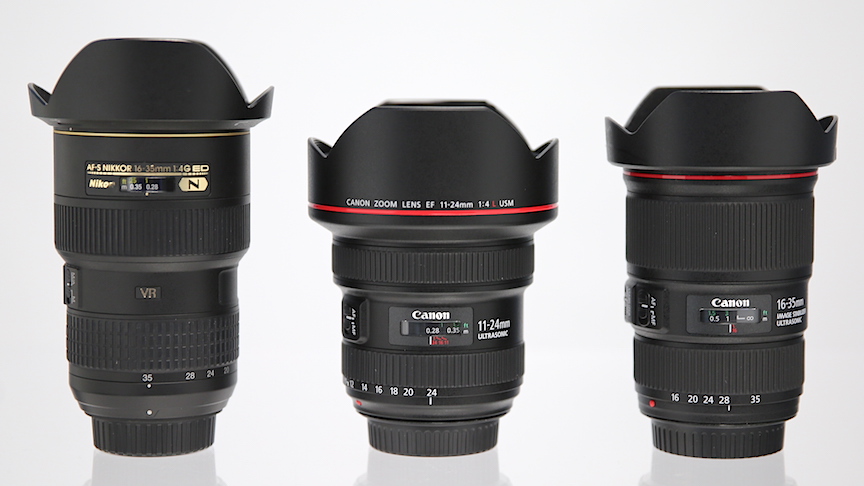
The new Canon lens actually most resembles the Nikon 14-24 f/2.8 lens, not just in size and shape but also in the very protruding front element.
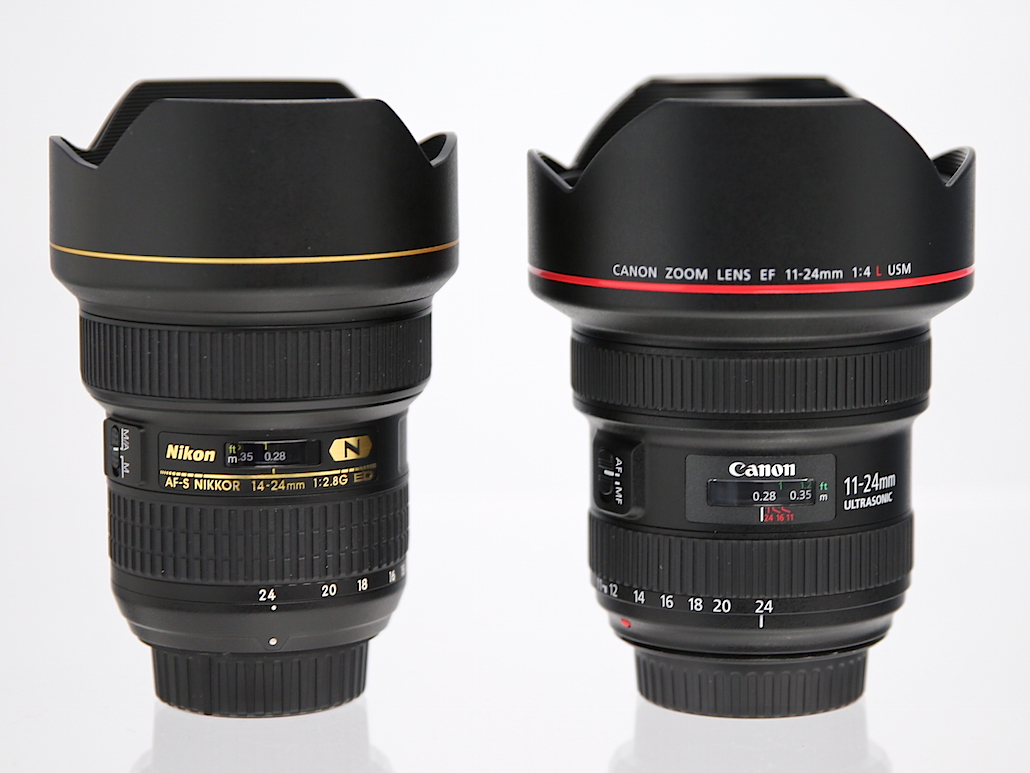
What the pictures don’t show is the weight. The new Canon weighs in at 2.6 pounds, which is twice the weight of the 16-35 f/4 IS lens, and half a pound heavier than the Nikon 14-24 f/2.8.
24mm Comparison
I decided to start by setting the bar ridiculously high. The best zoom lens we’ve ever tested at 24mm, and it’s not very close, is the Canon 24-70mm f/2.8 Mk II. To even the playing field totally, we tested both lenses at f/4. (We had three copies of the 11-24mm f/4 L to test. The MTF chart shows the average of the three, each tested at four rotations, as is our standard.)
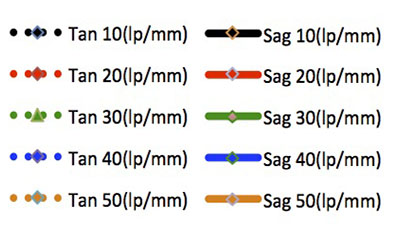
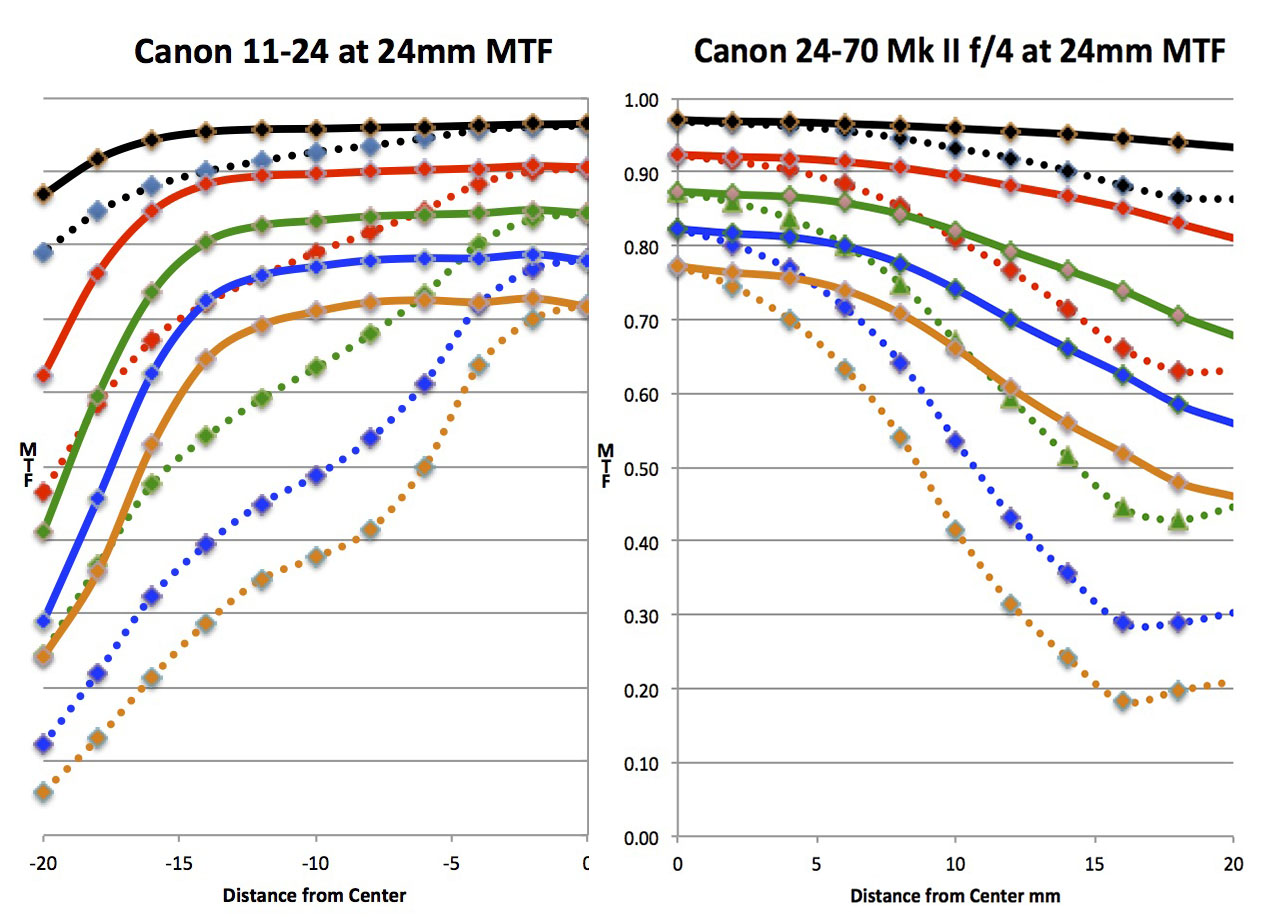
You can choose whether your glass is half-empty or half-full. No, the new lens doesn’t resolve as well as the Canon 24-70 f/2.8 at f/4 and 24mm. Nothing does, really. But it’s decently close to it, and this is actually a good performance.
Let’s try a more reasonable comparison; the 11-24 and the Canon 16-35 f/4 IS L both shot at 24mm. The 16-35 is a very good lens. 24mm isn’t its strongest spot, but it’s still very good there.
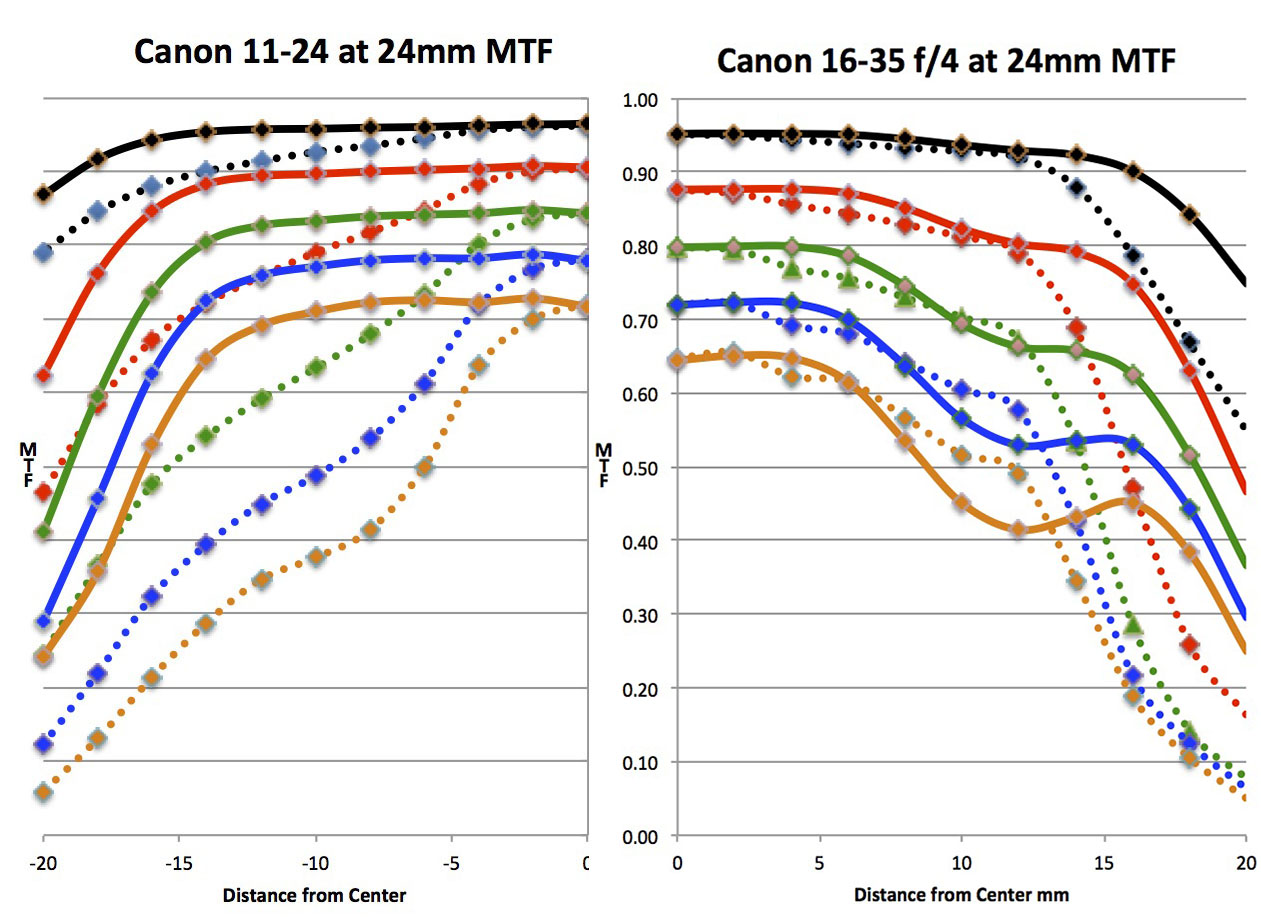
I think we all have to agree the glass is pretty full this time. The new Canon 11-24 at 24mm is really good. Other than having more astigmatism in the middle of the field, the area from 5 to 15mm distance from center, it’s a bit better than the Canon 16-35 f/4 IS. I think we can all agree, it’s a really good lens at 24mm. Let’s see how much it deteriorates at the wide end.
Wide Angle Comparisons
For completeness let me point out that I had to modify the inputs at 11mm just a bit. At certain angles, the fixed hood would prevent MTF measurements at 20mm distance from center (it’s supposed to do that). That means that while each lens was measured at four rotations from the center to 18mm, there were only two measurements at 20mm. It doesn’t matter for anything other than variance measurements, which I’m not going to get into today, but I just want to mention it.
Okay, so let’s compare the 24mm end to the 11mm end.
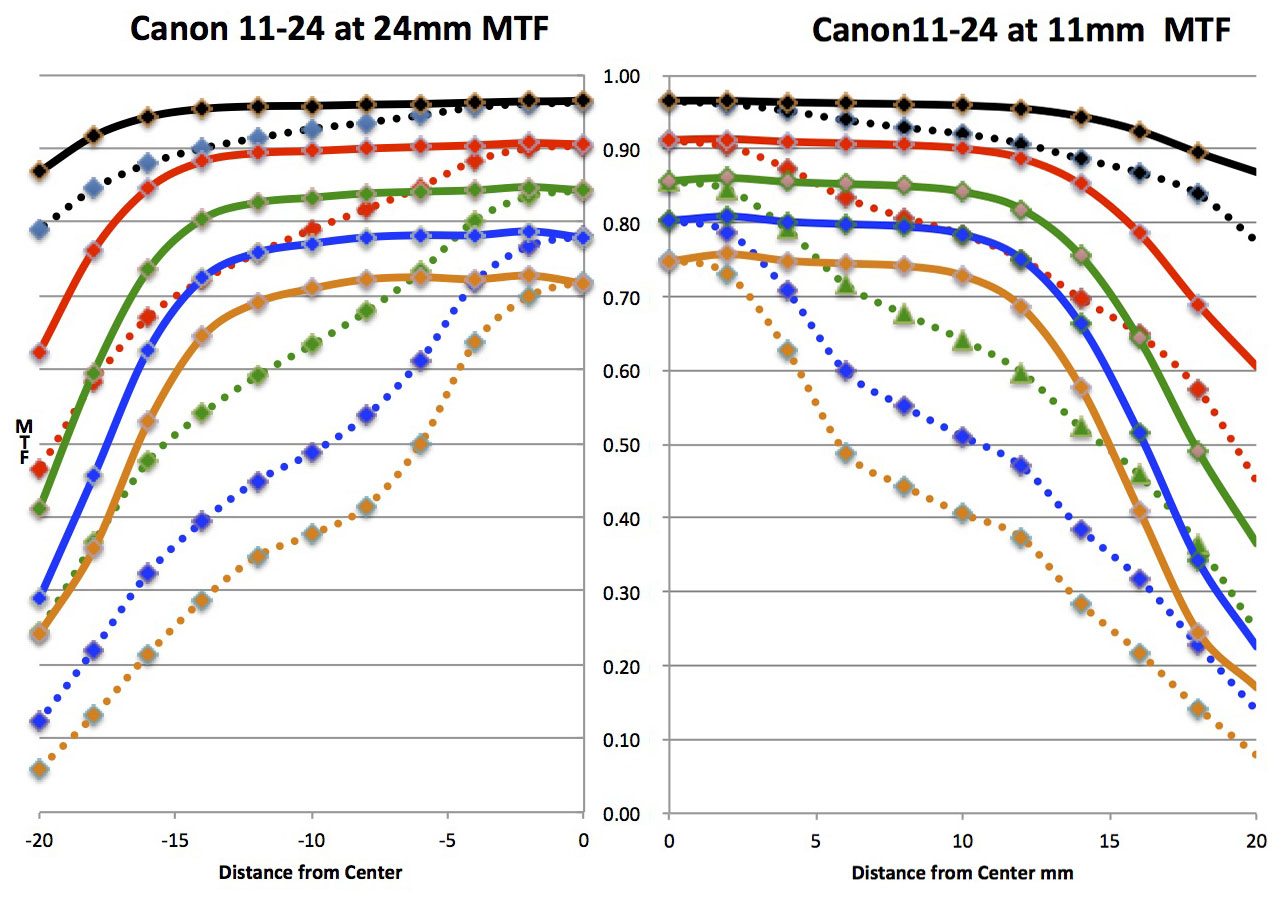
If you’re like me, you had to look twice to see that there are some definite differences. The lens is actually a tiny bit sharper in the center at 11mm. The outer 1/3 of the image has a tiny bit lower resolution at 11mm compared to 24mm. But the differences are pretty minor and I doubt any amount of pixel peeping could show them to you.
The truth is the two ends are so similar that I redid testing just to make absolutely certain we hadn’t messed up. You rarely see a wide zoom where both ends have such similar image quality. I was totally shocked that the lens would have this kind of performance at 11mm.
For completeness we also tested the lens in the middle of the zoom range (about 16mm).
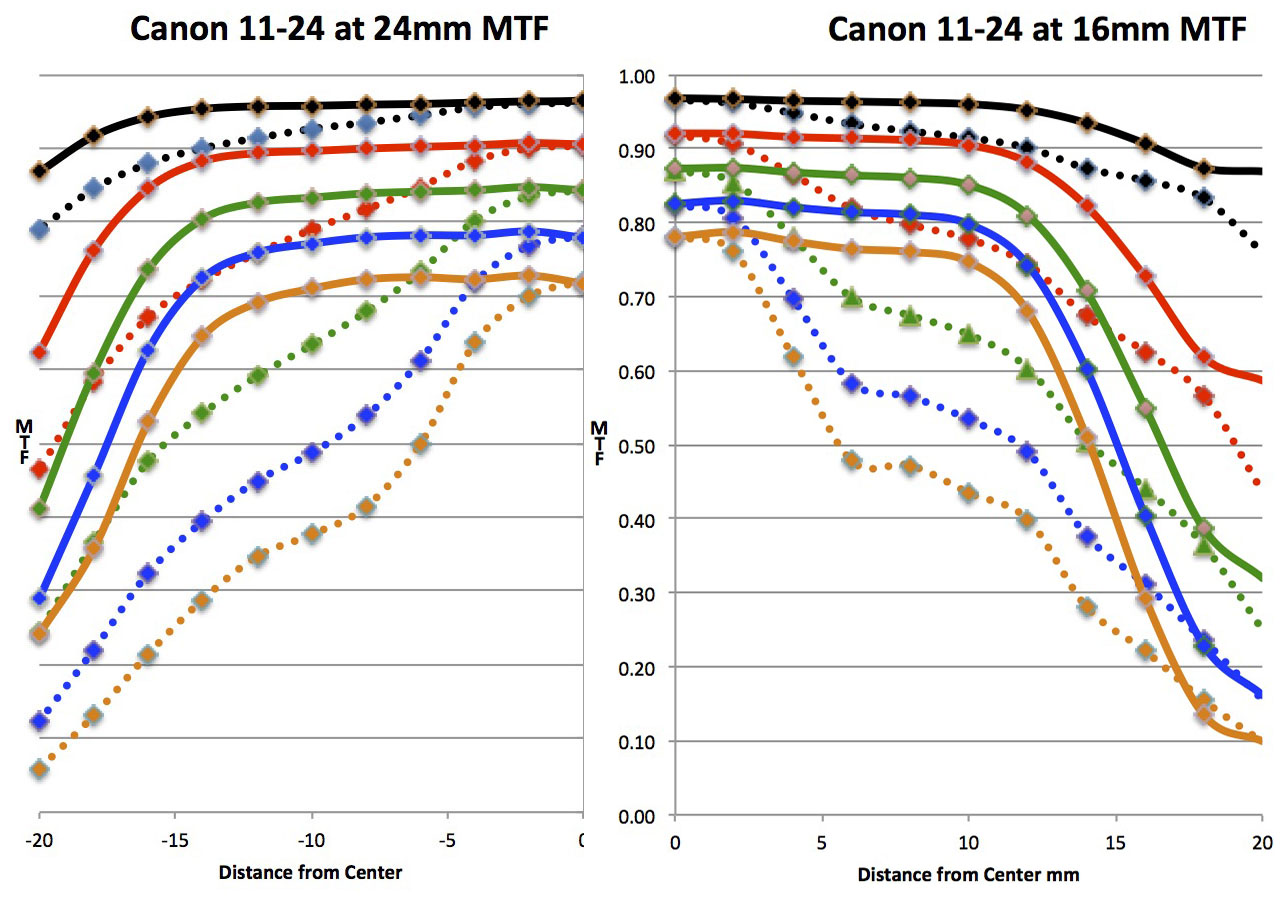
As you can see, the center at 16mm has an even higher resolution than the two extreme ends, although the edges are just a bit weaker.
But all of that is hair-splitting; this is a remarkable lens. Canon made the widest full-frame rectilinear lens available, and made it with superb image quality throughout the zoom range. Once again, hats off to Canon’s lens designers.
Roger Cicala and Aaron Closz
Lensrentals.com
February, 2015
40 Comments
Charlie ·
Nice.
Canon lens line is lookin’ pretty complete right now.
Daniel ·
Great lens, great article!
NancyP ·
Wow. I really want to see what 11mm FOV FF images look like.
Erick Moreno ·
As always, great article! Thanks for your work in this blog, Roger.
Why you didn’t compared this lens with the nikon 14-24, both at f4? I think that this would be a really interesting and useful test, since some canon users adapt the nikon 14-24 to their bodies.
Roger Cicala ·
Erick and others, I may do the Nikon tests, but I generally HATE testing across bodies more than necessary, it always incites Fanboy riots. But that would be a worthwhile thing to look at, I know a lot of Canon shooters do use that lens on adapters. It will have to wait until after WPPI, though, I’ll be there all next week.
prateeck ·
16mm Corners look pretty bad in the 11-24mm lens. I bet 16mm corners are much better in case of 16-35mm f/4
Rupert ·
It would be interesting to see it compared to the Nikon 14-24 across the shared zoom range at f4. With the sensitivity available these days who needs f2.8 on a wide? Personally, I’d happily exchange f2.8 for the extra width.
B Taylor ·
It’s a great lens minus the 3k price tag.
Richard Fisher ·
Thanks for this quick test. Like Rupert I would be interested in seeing the comparison to Nikon 14-24.
George Kash ·
Finally 😉
Waited to see this from the day this lens was introduced.
Thank you guys
Omesh ·
Will you also be sharing field curvature tests for this 11-24mm?
Roger Cicala ·
Omesh, I will. I’ve already done them, but I’m on my way out of town for WPPI, so they may have to wait a bit unless I can get them added tomorrow morning.
Hussain ·
2.8 on a UWA is very important for astro work, you can cut the ISO by half with that extra stop. You can get a shot with ISO 6400, you can get a better shot with ISO 3200 🙂
grubernd ·
you might pull all the fanboys hate onto you, but then there are a lot of pros and thinkalikes who dont give a rodents posterior about what brand they shoot and just need the best specialty tool for specialty cases. for me shooting that wide would be such case. and for some things – let’s say sports – stitching is not an option. so knowing how different options behave is a very valuable thing. after all, somewhere close to you is a well respected rental house for those special occassions. =)
Peter Bruggemans ·
I think the optics people at Canon are stresing themselves because the 50mp camera’s need lenses like this.
bob ·
It would be nice to see the 11-24 and 16-35 both at 16mm
Andre Y ·
Roger, thanks for doing the tests. It’s really impressive how tightly grouped the MTF curves are. I can’t wait to see the photos that this lens produces — the microcontrast should be insanely good!
Jeff Hanson ·
Any idea how te resolution compares to the Canon 14mm 2.8 and the 24mm tilt shift?
Gus Weckesser ·
I´d like to read a side by side comparison to Nikon´s 11-24
Gus Weckesser ·
I ment Nikon´s 14-24
Carl ·
Roger, once again I commend your efforts to test a new lens like this. Looks to me like it is ready for the 5DS.
I agree this needs to be compared to the Nikon, but I’ll suggest another one…the Zeiss 21mm Distagon. From what I have seen it is sharper than the 15mm Zeiss (and possibly also the Nikon)…It seems to be the sharpest wide angle lens around that focal length (mustache distortion and all). Also this Zeiss costs 1/3 less than this new Canon, and the Nikon…so that would be a very interesting comparison to me.
KimH ·
Roger Aaron, again – thanks!
This is what i was hoping for while I try (read tried) to control my GAS – Lens is ordered…
But i have a blond moment which is not about you, it’s about MTF from Canon – maybe it’s more of a statement than a question.
One thing with the Canon publicised MTF charts was that both f4 and f8 Bold – 10 lpm – Sagital was near 1, clearly above 0.9 & ALL THE WAY TO THE EDGE. Which I thought was VERY impressive. Yours seem to drop a little deeper and faster.
The 30 lpm Wide stays close to 0.8 to 18mm on Canons and on yours drop fast and deeper after 12mm
Understood the charts you show are multi sample, measured for real and clearly also impressive – but not nearly as much.
Does this mean that the MTF of vendors are really (!) theoretical and marketing hype, and with a „prove me wrong“ attitude? Or do I need to be re-threaded…?
Navyo Eller ·
Really lately Canon makes even more impressive lenses, bought 2 recently and hat’s off! Excellent lenses. This one seems to be the next one…
Jore Puusa ·
Great lenses, all of them. But! Most of pictures areseen in the internet nowadays. People watch them at screens which all are a bit different. Some are bad, some good screens, most are mediocre. Big prints are rare. So most of pictures look technically the same, one may use 100 € lens and 1000€ lens and pictures are still the same technically when John Smith sees them at his homescreen. The only important thing in photography is how visually fresh pictures are. Most of amateurs who buy these expensive lenses do not know anything about visuals – they have cameras and lenses as a hobby – not for making pictures. The pictures are mostly plagiates. Somebody finds a way to alter reality and millions of wannabe photographers copy the idea and picture.
100 years from the start of photography all the great pictures were already made. Those photographers used cameras which were merely boxes with some kind of shutter. Yet old pictures were astonishing. With all these fine lenses and unbelievable bodies millions of modern photographers have not reached the greatness of oldtime photographers.
Gadgets are more and more astonishing but photography as a profession and as a work of art is dying.
What is annoying is the fact that all attempts to raise a discussion about photography – are faced with anger and hate, more and more so. Photography used to be humanism. Now it is a war zone.
—
Sorry for my bad english, it´s my third foreign language.
–
Jore Puusa
Photojournalist, teacher of photojournalism / retired.
Helsinki, Finland.
Jore Puusa ·
Great lenses, all of them. But! Most of pictures areseen in the internet nowadays. People watch them at screens which all are a bit different. Some are bad, some good screens, most are mediocre. Big prints are rare. So most of pictures look technically the same, one may use 100 € lens and 1000€ lens and pictures are still the same technically when John Smith sees them at his homescreen. The only important thing in photography is how visually fresh pictures are. Most of amateurs who buy these expensive lenses do not know anything about visuals – they have cameras and lenses as a hobby – not for making pictures. The pictures are mostly plagiates. Somebody finds a way to alter reality and millions of wannabe photographers copy the idea and picture.
100 years from the start of photography all the great pictures were already made. Those photographers used cameras which were merely boxes with some kind of shutter. Yet old pictures were astonishing. With all these fine lenses and unbelievable bodies millions of modern photographers have not reached the greatness of oldtime photographers.
Gadgets are more and more astonishing but photography as a profession and as a work of art is dying.
What is annoying is the fact that all attempts to raise a discussion about photography – are faced with anger and hate, more and more so. Photography used to be humanism. Now it is a war zone.
—
Sorry for my bad english, it´s my third foreign language.
–
Jore Puusa
Photojournalist, teacher of photojournalism / retired.
Helsinki, Finland.
abhi ·
Thank you for the tests. Would be interesting to compare the ZE 21 Distagon at f/4 and at f5.6
rgds,
abhi
Ilya Zakharevich ·
Roger, do you really think that the FORMAT of your MTF charts is the best possible? When you say “X is a tiny bit better than Y”, usually I get exactly the opposite from just squinting at your diagrams. I think lens-X and lens-Y diagrams SHOULD be combined (shown on the same coordinate plane).
Thinking about this more: does anyone NEED to know ALL 5(10)—20—30—40-50 lp/mm curves? Obviously, 5 (or 10) is important (essentially, the transparency and vignetting of the lens). And, the highest of N lp/mm which does not go below 10% is also important (with good lenses of today it would be at least 50 lp/mm). But the stuff in between just clutters the diagrams, does not it?
Combining these remarks: calculate N (as above) for both lenses; choose the highest one. Show only 4 (S/T-pairs of) curves on the graph: 5 lp/mm for both lenses, and N lp/mm for both lenses. One gets 4 solid lines, and 4 dashed lines (less than you show now!), and one would be able to see the differences immediately.
Yet better: show the graphs in-the-format-of-today on mouse-over (mouse-over on left half for lens-X, on the right half for lens-Y).
hjalmar ·
Roger, excellent work.
It’s impressive to see that this super UWA outperforms in some aspects the 16-35mm f4L IS that I consider and excellent lens.
Steven ·
Roger,
I know you only have three copies of the 11-24mm, but how does the copy variation and centering quality look on those you did get?
BigEater ·
Jore,
Do not despair my friend. Many people still talk about the art of photography and many people are still out there pushing the boundaries. But the boundary-pushers are too busy shooting to be posting on the internet. Like all the arts, photography is being reinvented in ways that we can’t imagine by people all over the world; how that reinvention will play out, only time will tell.
But for the time being, let us give thanks to Roger who has provided a way for the visionaries among us to get the equipment they need at a reasonable price so that they can pursue their artistic destiny, wherever it leads.
Georg ·
Some real life pictures I could take in the last two days:
http://www.photographie.wien/albums/2955edca2a04577f4e6d96adf897c557/
rg
Georg
stanis riccadonna zolczynski ·
What about Voightlander 12/5.6? Any good?
bdbender4 ·
Well, geez, Roger! What about this and that and the other thing? Hop to it!
It seems these woulda/coulda/shoulda comments follow every test you do. Sometimes I am tempted to tell folks to rent the d*mn lense(es) themselves – bodies are easily available too, if one wants to compare across systems – and do their own real-world tests by shooting some actual images.
But that would just confirm that I have become the grouchy old geezer I never wanted to be. So I will refrain.
Mike Earussi ·
“Good” is a matte of definition. From your tests it looks really “good” on an APS-C sensor, but has very soft edges on a FF one. The key is how does it compare to the Nikon 14-24 and the new Tamron 15-30?
Paul R ·
It would be helpful to see curves at the apertures we’re likely to use. I use my Nikor 14-24 for urban / industrial landscape work, and have probably never once used it wide open. f2.8 is nice for the bright viewfinder image, but realistically, the lens gets used between 5.6 and 11. Almost always!
The wide-open MTF curves don’t mean anything to me.
Baden Kudrenecky ·
Hi Roger:
I am a big fan of your most informative and entertaining articles. This is a two bit comment from the peanut gallery that might help your presentation.
The graphs, as most graphs and line art, are best saved as GIF or PNG in a non lossy format. Saving the images in JPEG blurs lines and text, which is very noticeable on graphs and charts.
thanks,
Baden
Arun ·
A good friend of mine who shoots Nikon commented when Canon’s announcement came out that Canon had not made any improvements in sensor technology. I mentioned at the time that, based on the MTF curves they’d published, I considered the 11-24mm to be the more exciting product than the two 50 MP cameras. Nice to know that your testing validates my optimism about its performance. Can’t wait to shoot with it!
NancyP ·
Very interesting. Next up for specialized photography: Hartblei could make a tilt-shift adapter for this lens that fits the Sony A series mirrorless cameras (A7r). They have done this for the Nikon 14-24mm. Are the senor stack thicknesses similar between Sony A series and CaNikon?
Renaud Saada ·
I bought this lens 10 months ago, sold new at half it’s full price. It’s absolutely surprising, not only by the pictures you can get but also by the quality of what you get.
I also own the 16-35 LIS and yes, the 11-24 seems better at 16 mm.
Renaud Saada ·
I bought this lens 10 months ago, sold new at half it's full price. It's absolutely surprising, not only by the pictures you can get but also by the quality of what you get.
I also own the 16-35 LIS and yes, the 11-24 seems better at 16 mm.