
Tearing Down the Sony 24-70 f/4 ZA OSS Vario Tessar
Those of you who read our teardowns know that we commonly are tearing down Canon or Nikon mount lenses. The reasons are pretty simple and it basically comes down to the fact that we have a lot more of those lenses. If we have a lot more it’s less of a problem to take a couple out of stock for a teardown. Plus, we’re more likely to be doing repairs on them in-house so we need to know the layout. Not to mention, since we spend most of our day inside those lenses, we know our way around them pretty well and don’t look to stupid when we do a teardown.
But people who shoot Sony, or Pentax, or micro 4/3 ask us to rip apart their lenses, too. We’ve avoided doing that because of the above reasons and because we rarely try to repair them. But in the last few months, we’ve gotten motivated to look inside Sony E mount lenses. Partly it’s because we’re carrying a lot more of them. Partly it’s because repair costs on Sony lenses have become — well I like Sony, so let’s just say “fully valued.”
A few days ago, we sent a Sony 24-70 f/4 ZA OSS to repair because it made a grinding noise and wouldn’t autofocus properly. That kind of thing happens all the time and the repair cost at most manufacturers is $200 to $300. When the service center told this would be an $800 repair, we decided to have them send it back and take a look inside ourselves.
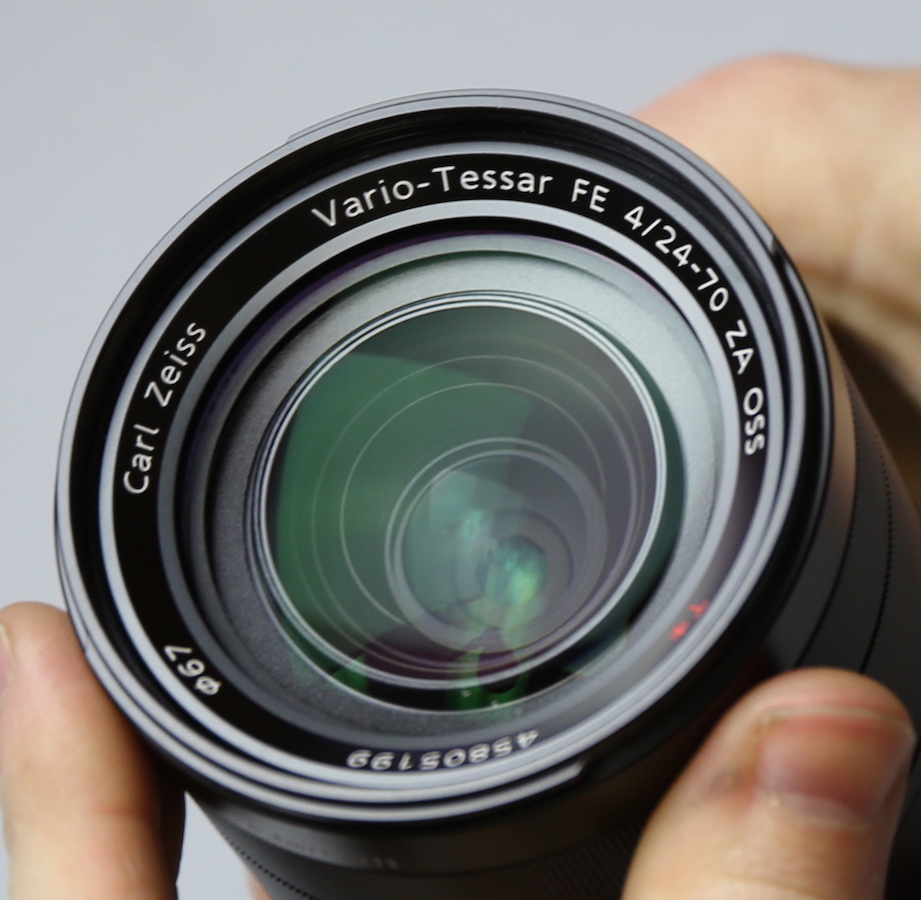
One thing I like to mention before we start an article is what my expectations were on the front end. We know the 24-70 f/4, like most of the new Sony E mount lenses, has electromagnetic, rather than helicoid, autofocus. We also know that there’s a bit more optical variability in these lenses (making me think optical adjustments are somewhat limited). So I rather expected we would find the internal optics/electromechanical parts of the lens might be completely sealed; not repairable, only replaceable. That would go along with high repair costs, too.
I also need to mention that we do NOT know how to repair Sony lenses. We don’t have access to repair manuals, etc. This is not intended as a how-to-repair-your-lens article. We just thought you might enjoy watching us mess around with it and see what’s inside of it. Oh, and the usual disclaimers — if you do this yourself, it’s on your nickel. Also, I can’t respond to emails asking how to do this or that: you are many; I am one, and I really am supposed to be working much of the day.
By the way, if you feel the need to comment that we don’t take beautifully lit product shots during a teardown, save it for someone who cares. We’re tearing down a lens, trying to figure out how to fix it, and remembering how to put it all back together. We take a few hand-held shots while we do it, under the very harsh tungsten lighting we need to peer into the various nooks and crannies of the lens, so we can show it to you. If you want to look at beautiful pictures, go to Peter Lik’s gallery or something.
So Let’s Go Break Things!
The bayonet mount comes off in the usual fashion: remove the four screws. With Sony lenses it’s usually simpler to disconnect the electrode flex from circuit board than to remove the electrodes from the bayonet.
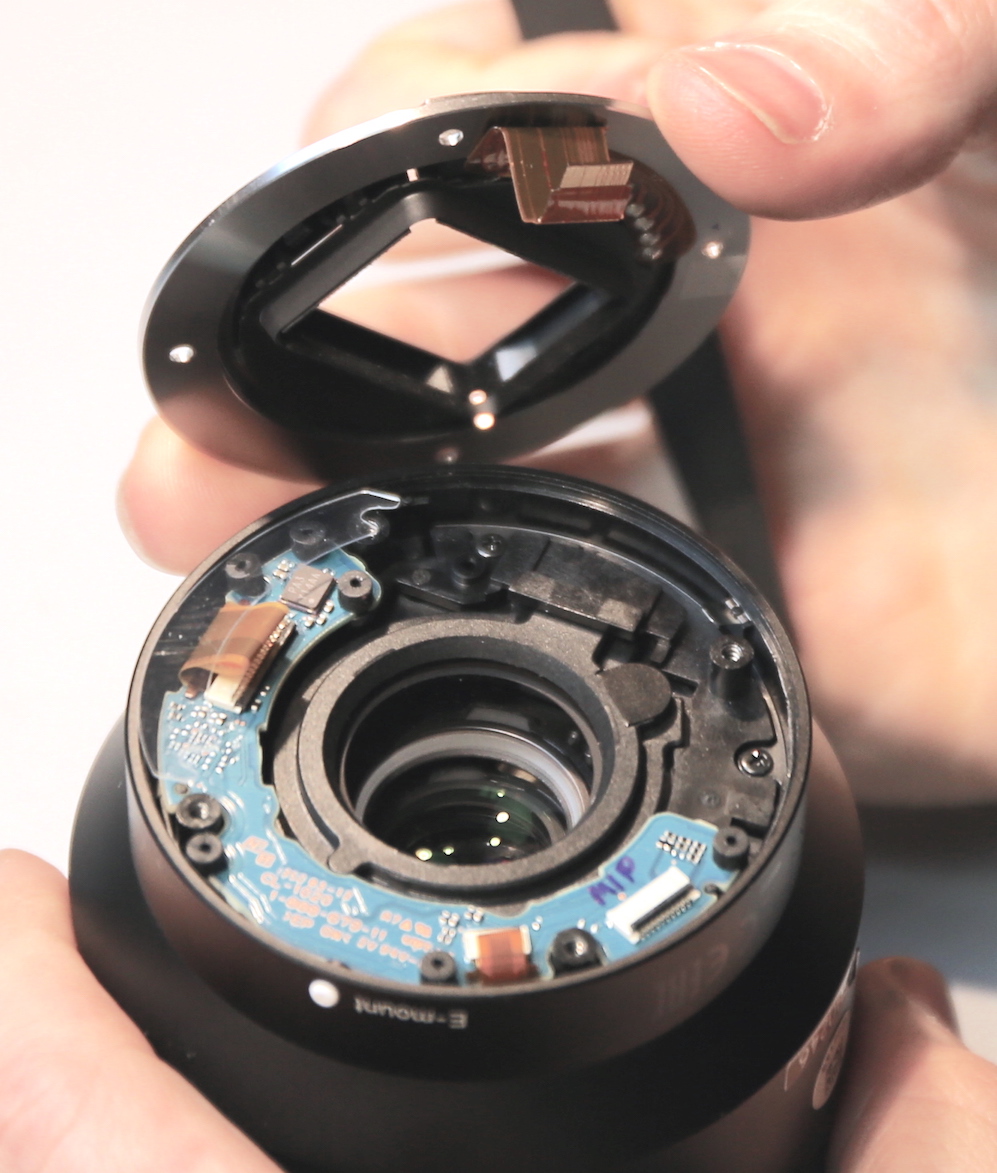
Sony doesn’t hold their PCBs in with screws like most manufacturers, they use adhesive rubber bumpers. I don’t have the slightest idea if it’s an advantage or disadvantage, it’s just different.
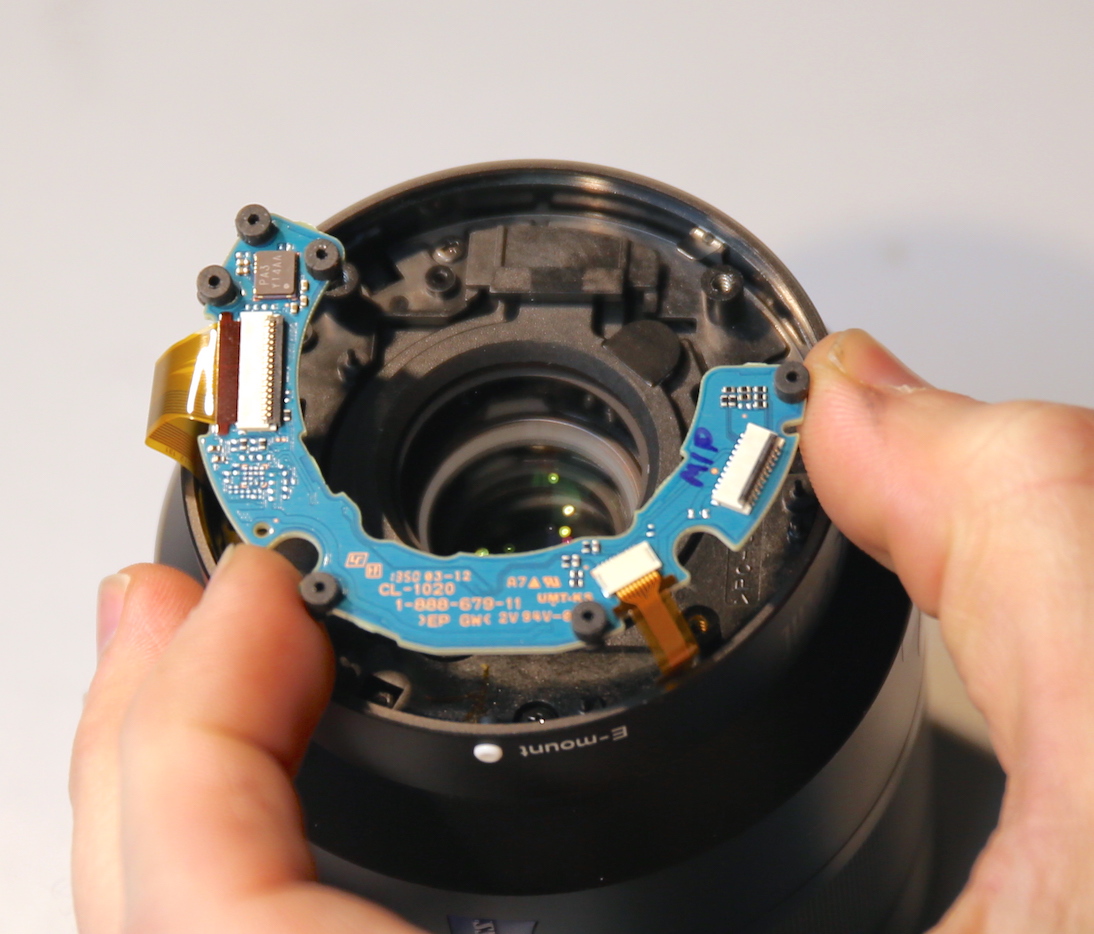
With the PCB removed we get access to the four screws holding the rear barrel in place and can remove it.
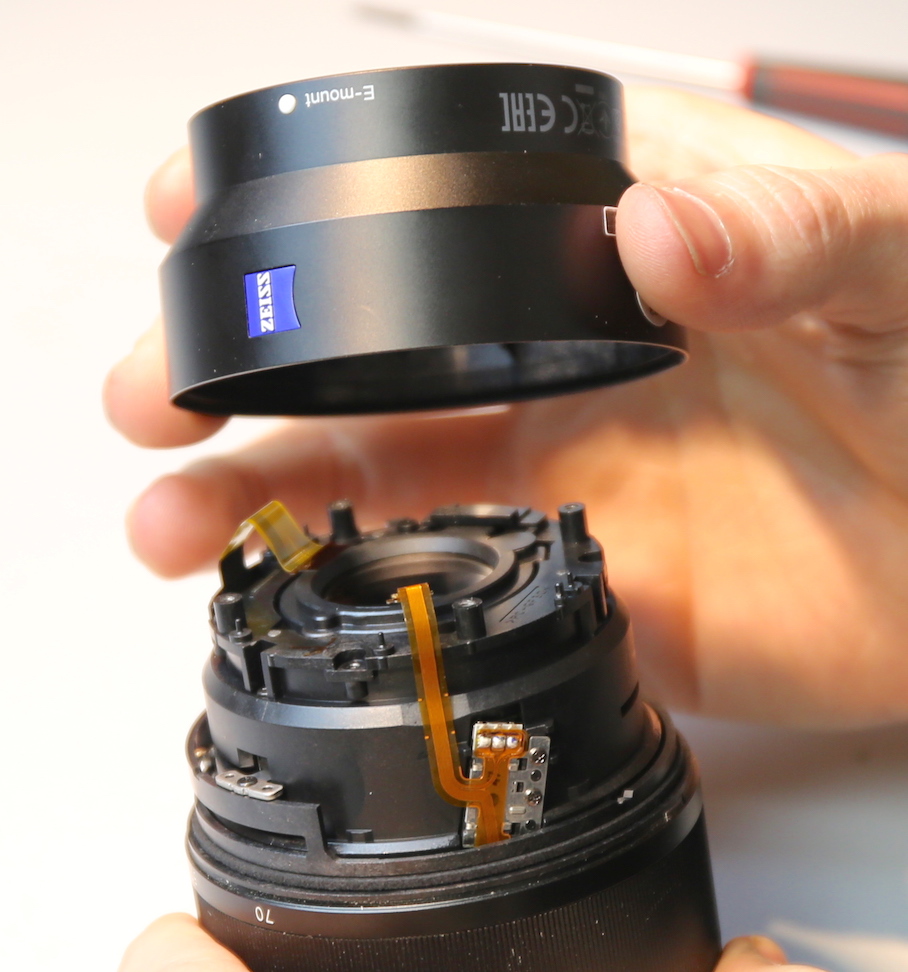
That exposes the zoom keys, one on either side, that have to be removed to let us take the zoom ring off.
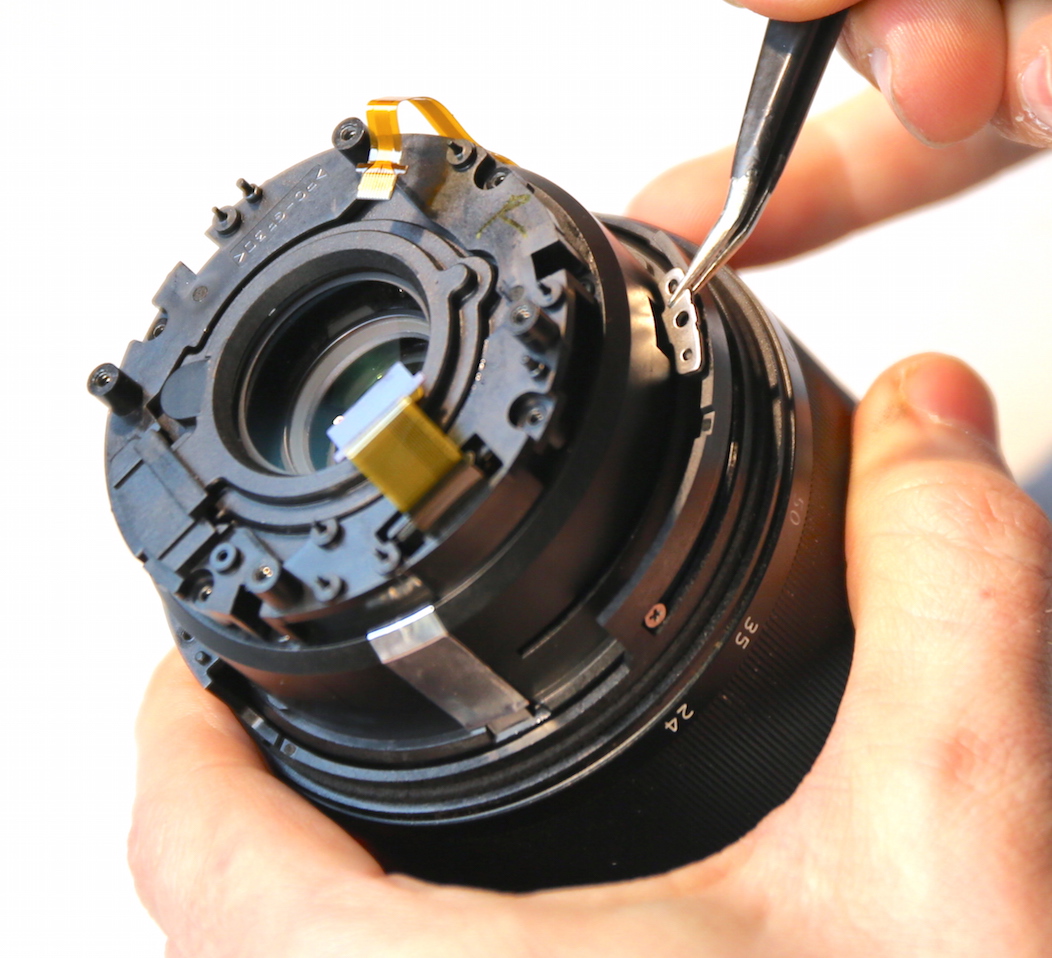
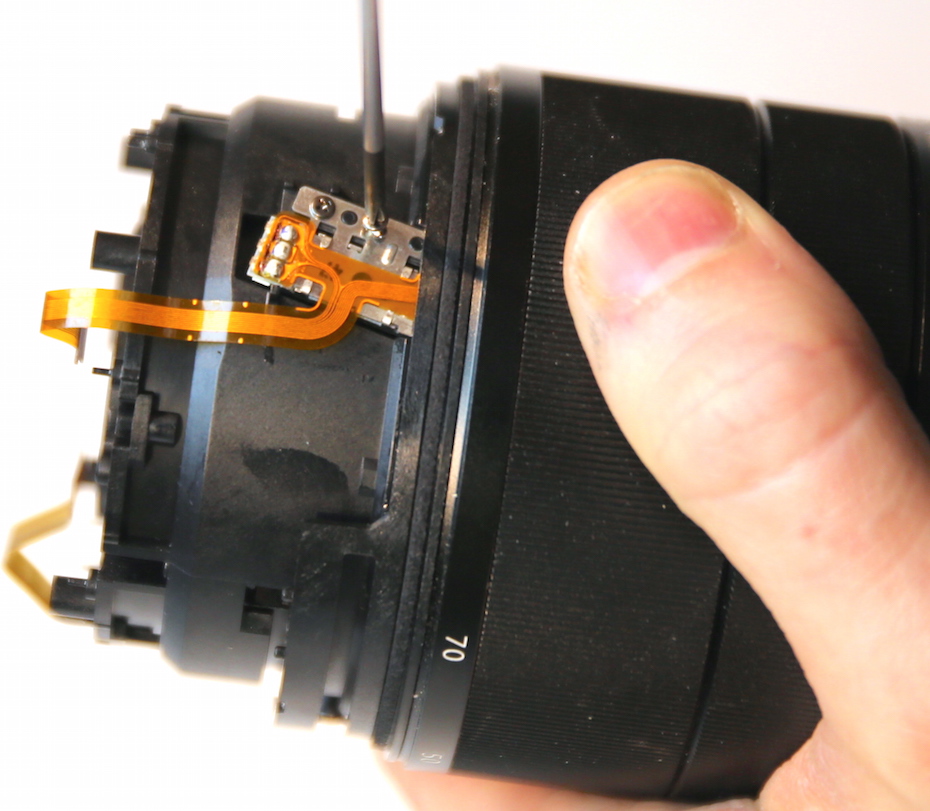
Since we weren’t sure how the connections ran, we removed the screws holding the zoom position sensor before removing the zoom ring; part of the sensor was under the zoom ring.
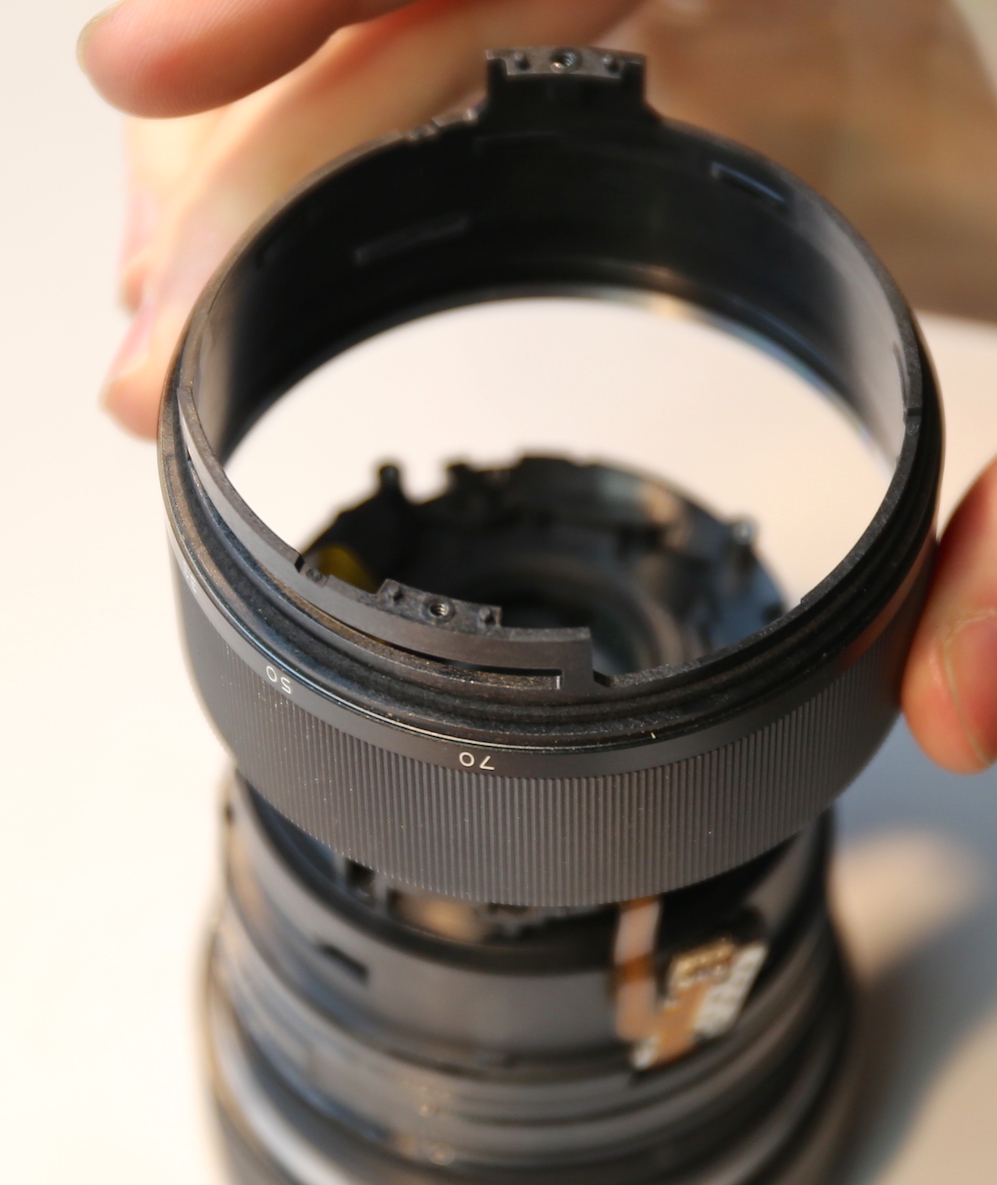
The zoom ring slides right off once the keys are removed and it’s rotated to the right position.
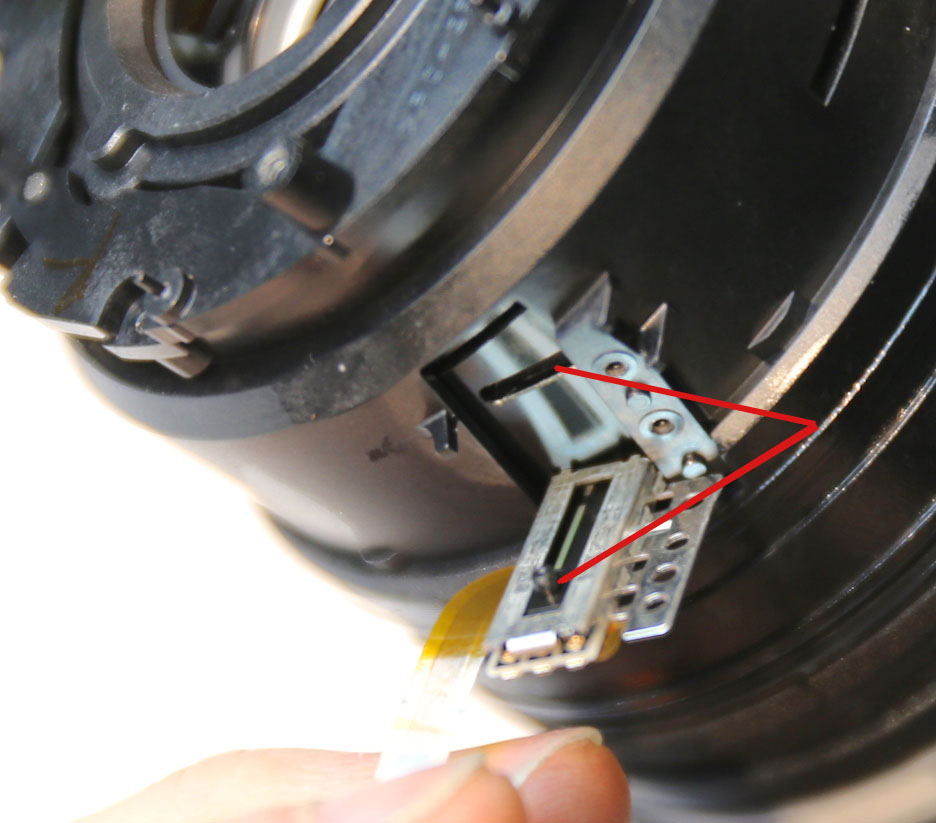
Now we can look at the working side of the zoom position sensor. It’s a simple slide inserted into a rotating helicoid (red arrows). That’s different than the electrical brushes and positions sensors that most lenses use, but certainly cleaner and simpler. I like it. Sure, the plastic tab could snap off, but the very thin metal brushes bend too, so I would think this is at least as reliable as a brush system.
Moving right along, taking out another set of screws lets us remove the inner barrel.
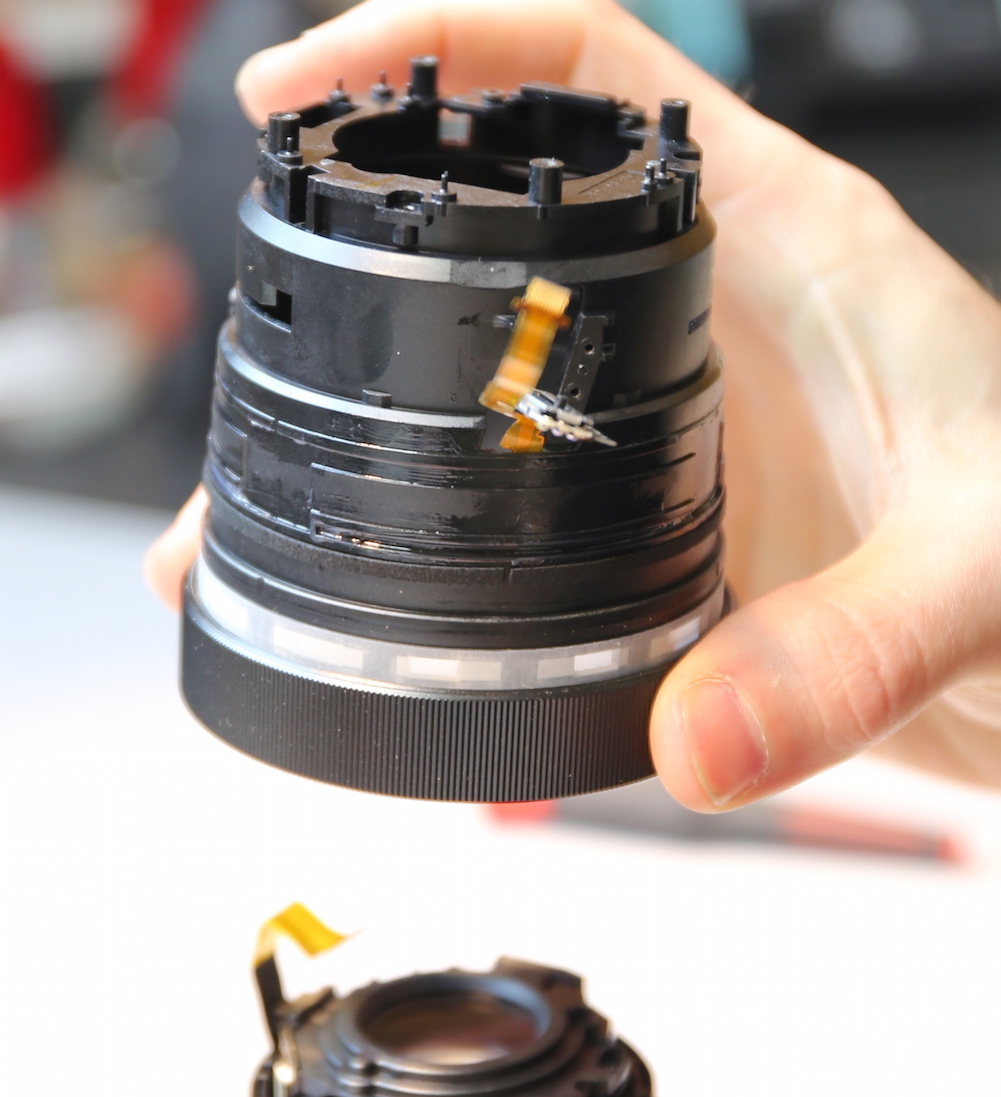
With the inner barrel removed we can see another nice touch that I wish all the other manufacturers would do. Sony places some cushioning strips between the extending barrel and the rest of the lens. This makes things move more smoothly and also prevents the plastic-on-plastic catches that sometimes develop with extending barrels.
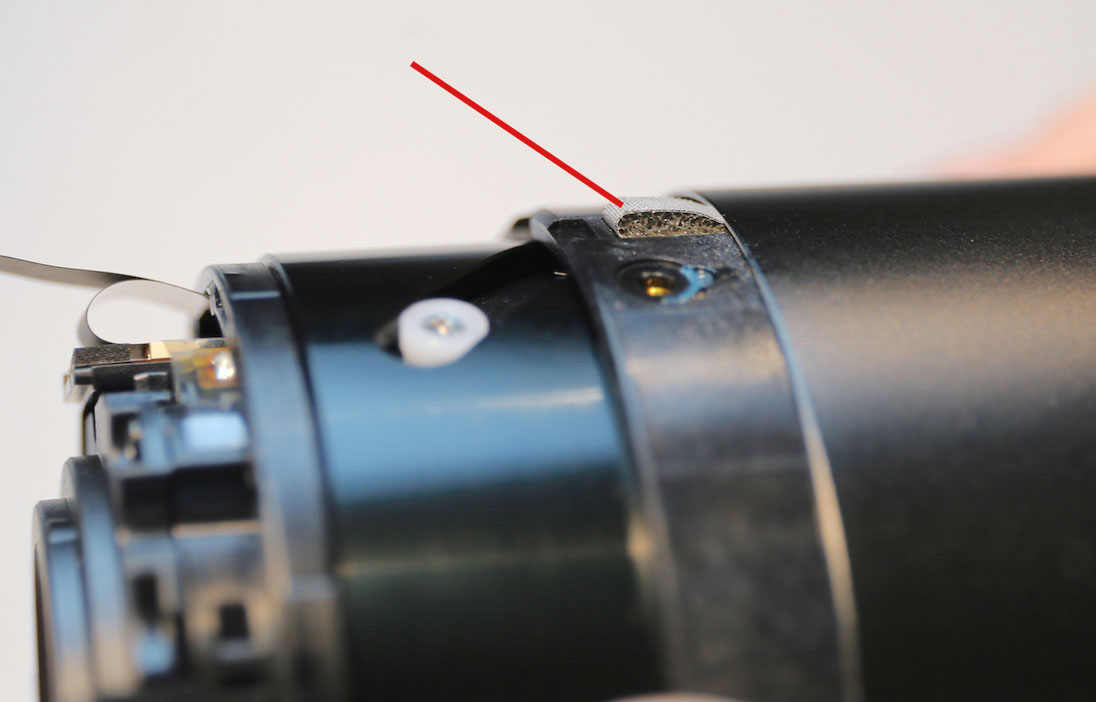
The front barrel is held on with three screws inserted into large brass inserts, just like most lenses use. Removing these lets us remove the extending barrel.
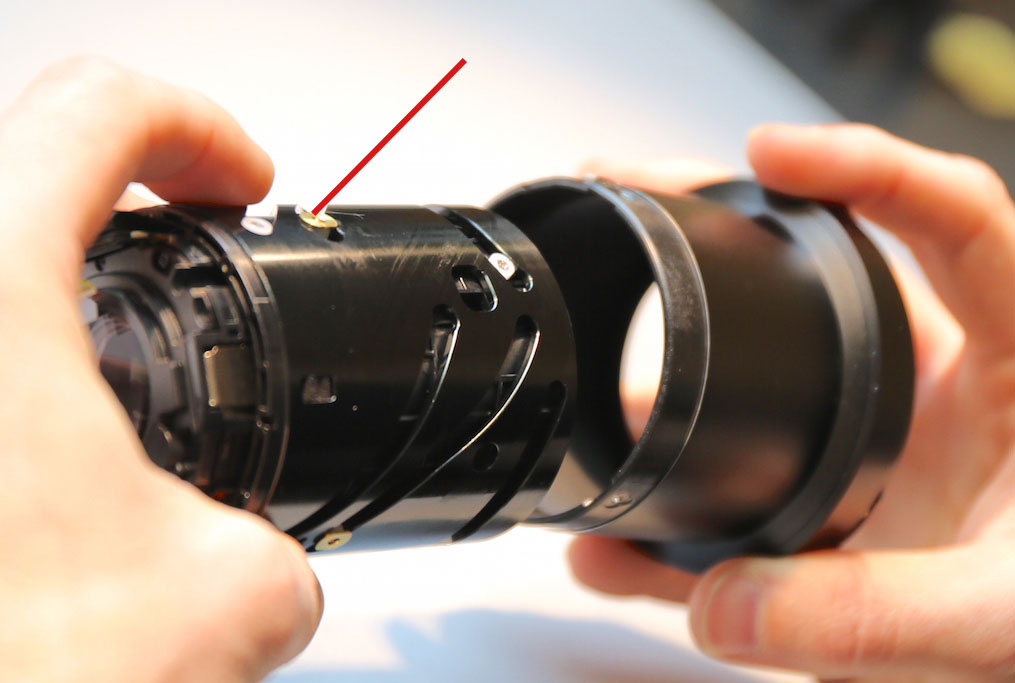
It’s probably worth noting that with all the disassembly we’ve done, this is the first time we’ve removed any of the lens elements. The front element is removed with the extending barrel. Everything else we’ve removed has simply been structural or mechanical.
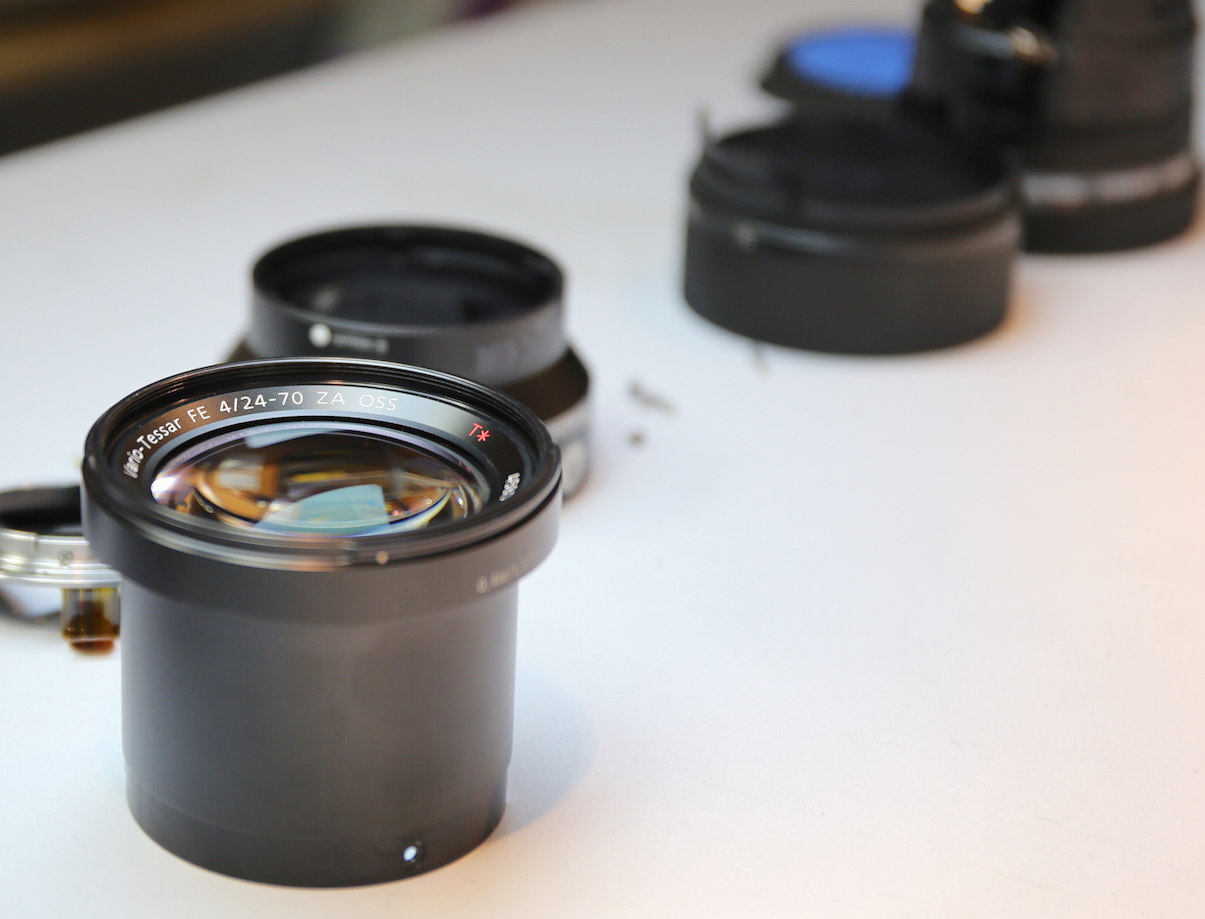
What we’re left with is the central core of the lens. This contains all of the glass (except the front element), the OSS unit, aperture, focusing motor, etc.
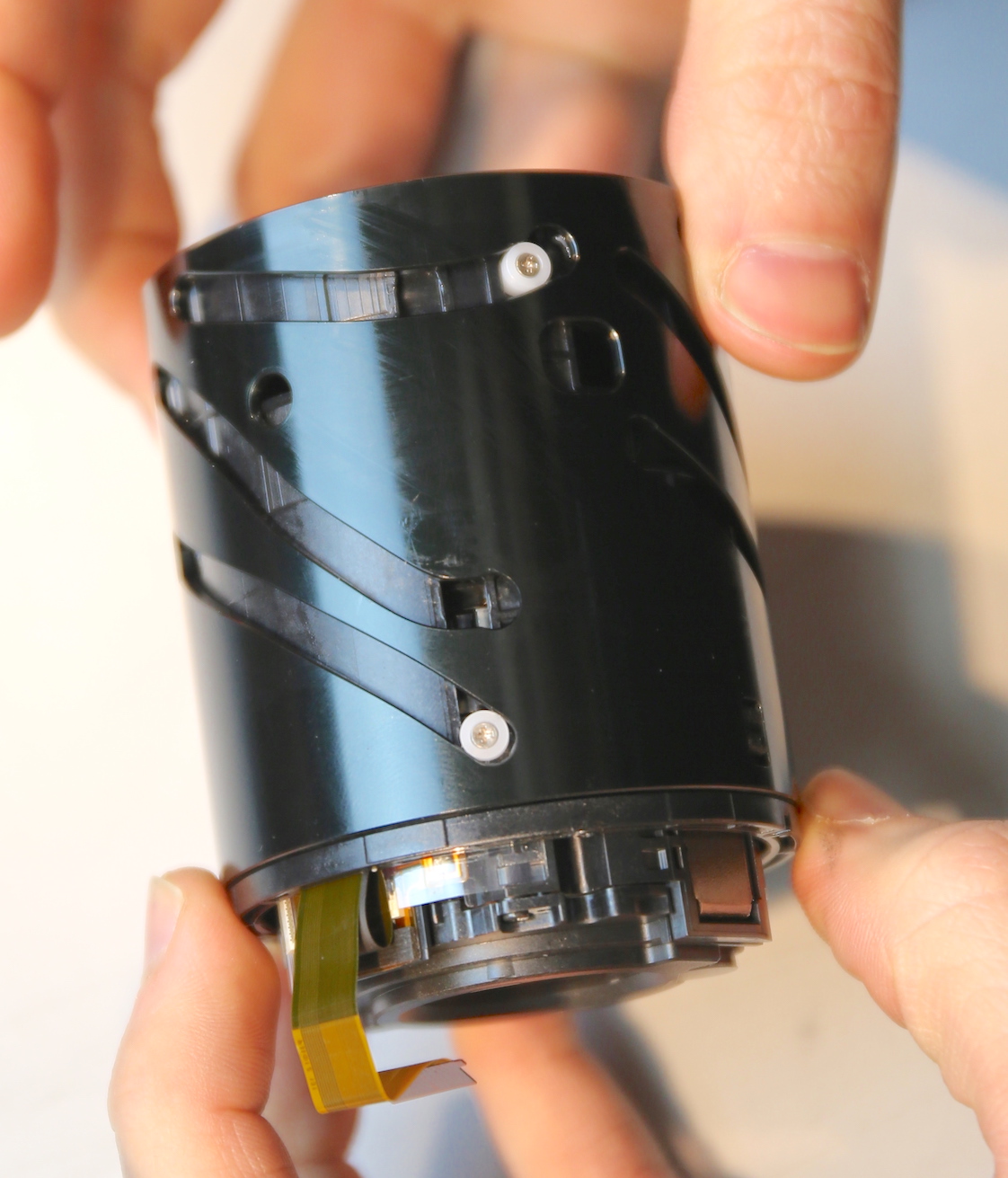
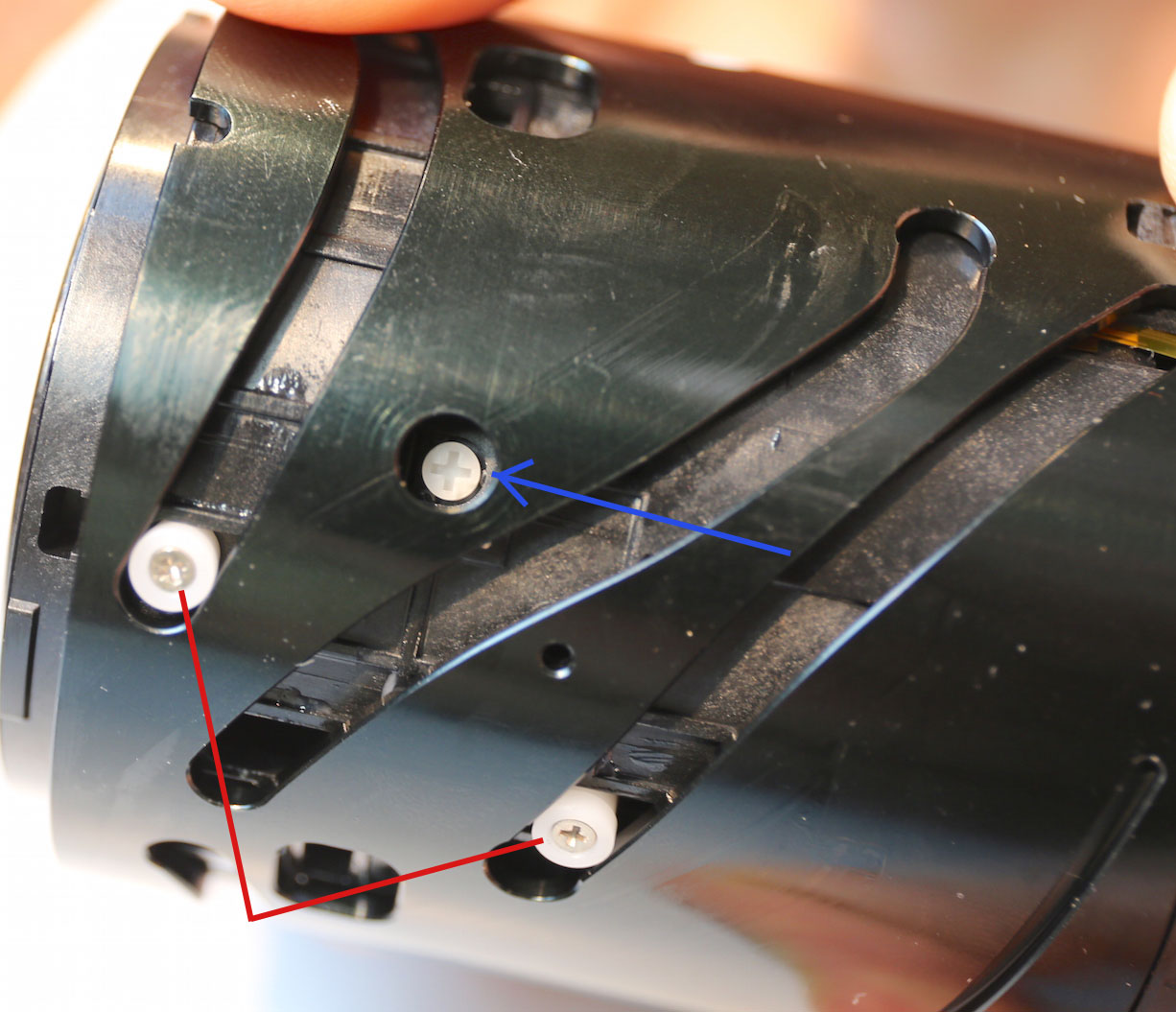
We examined it pretty carefully, looking for optically adjustable elements. There were the usual helicoid sliding collars (red lines) and one set of elements that had what appeared to be eccentric adjustable collars on them (blue arrow), but closer examination showed those collars seemed to be holding the OS element so it’s unlikely they have any optical adjusting capability.
At any rate, removing the mount-side set of collars lets us remove the helicoid barrel.
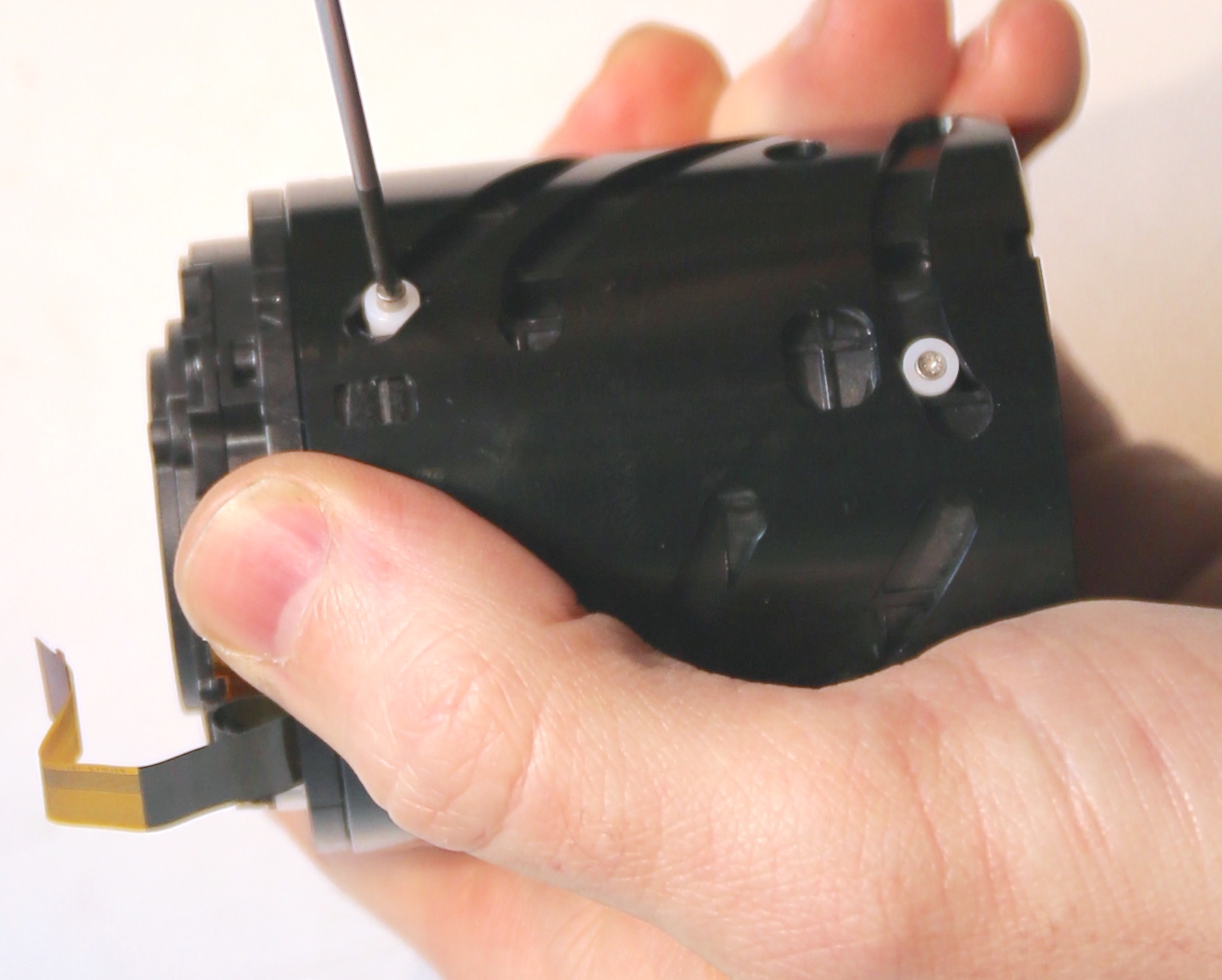
I should mention that these are thick, robust collars that look like they should hold up well.
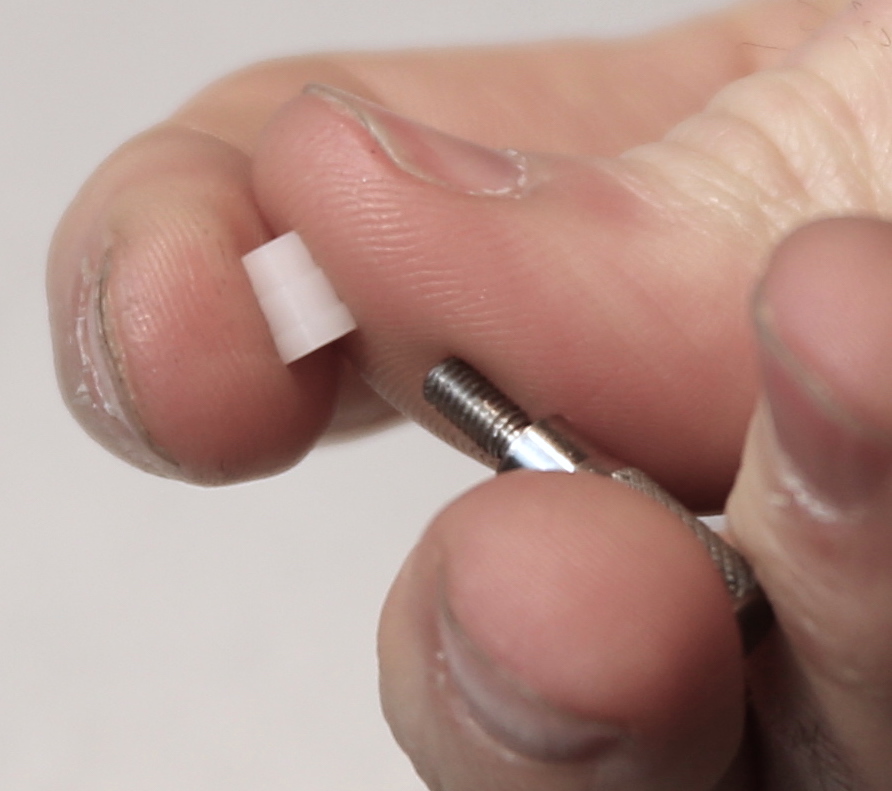
With those collars removed, the helicoid barrel slides right off.
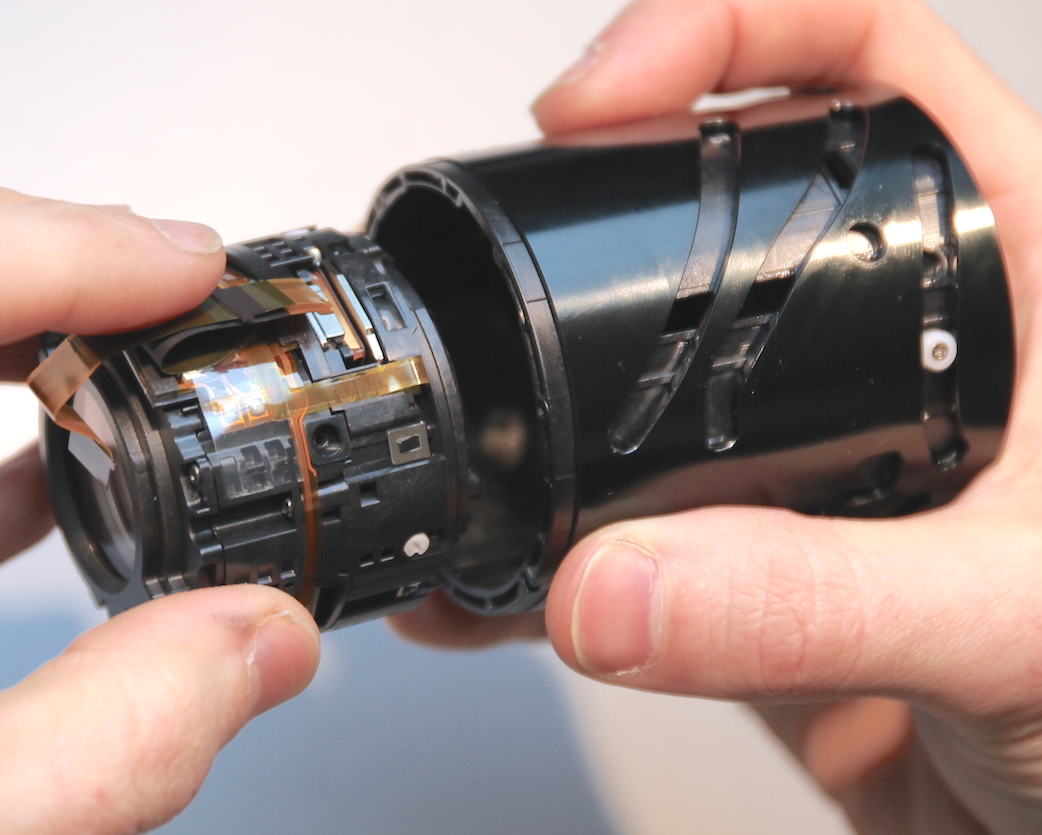
This barrel contains the second lens element, so now we have those two large elements removed and sitting in their barrels on the back bench.
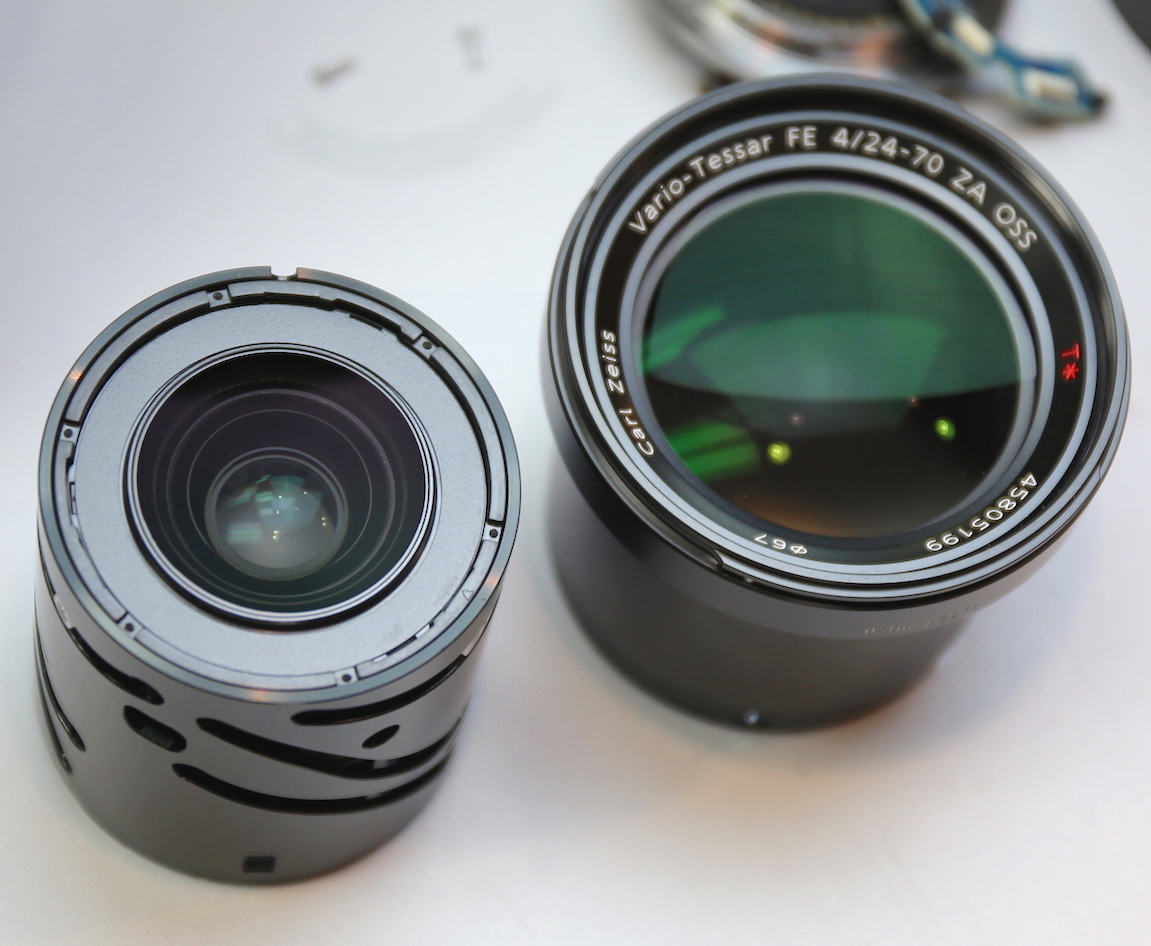
And what we are left working on is the small inner core of the lens, which contains all the other glass elements, the OS unit, autofocus unit, aperture assembly (you can see that on the top), etc. This is where I expected we’d find, like many micro 4/3 lenses, this entire unit would be sealed and could only be replaced, not repaired.
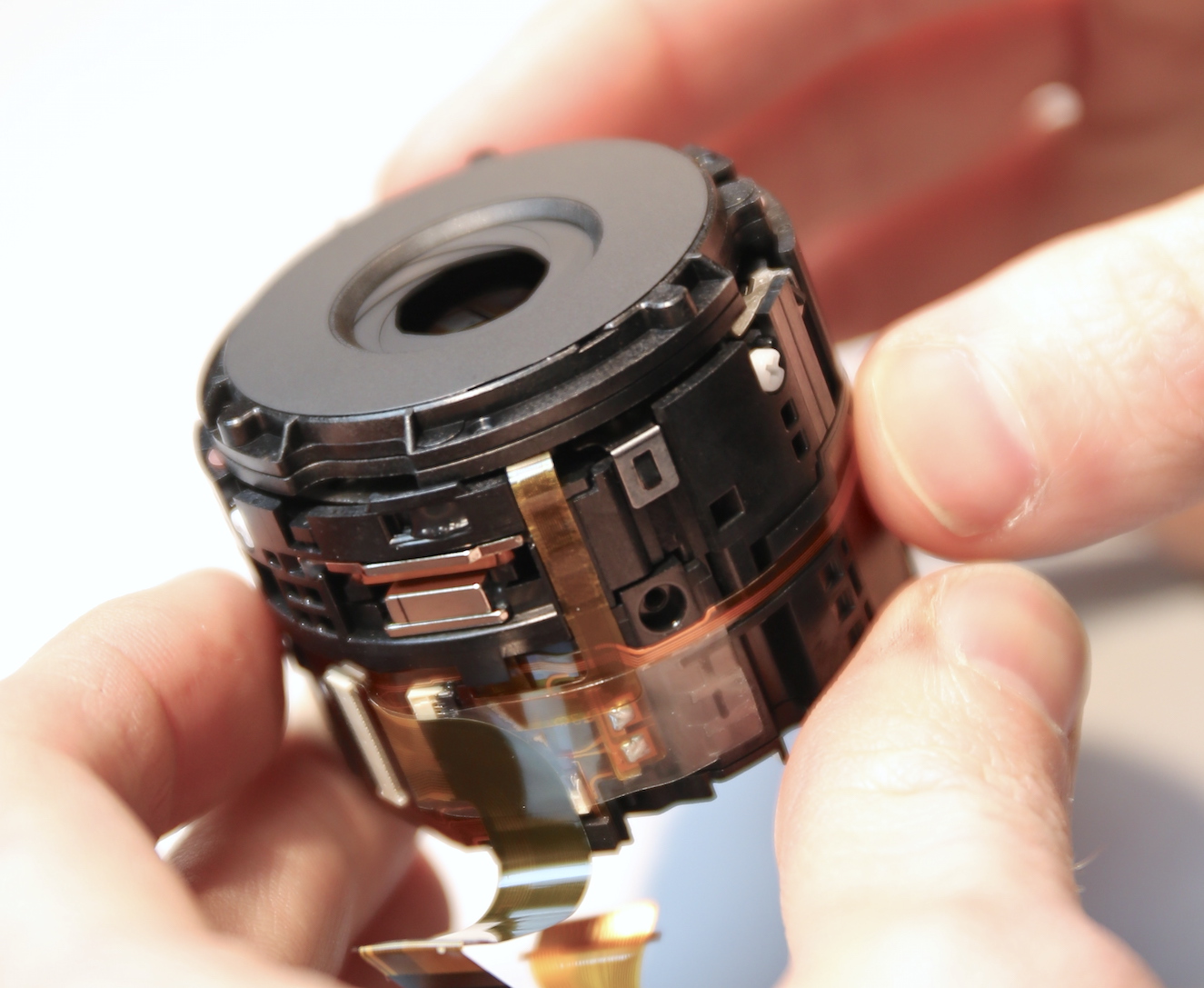
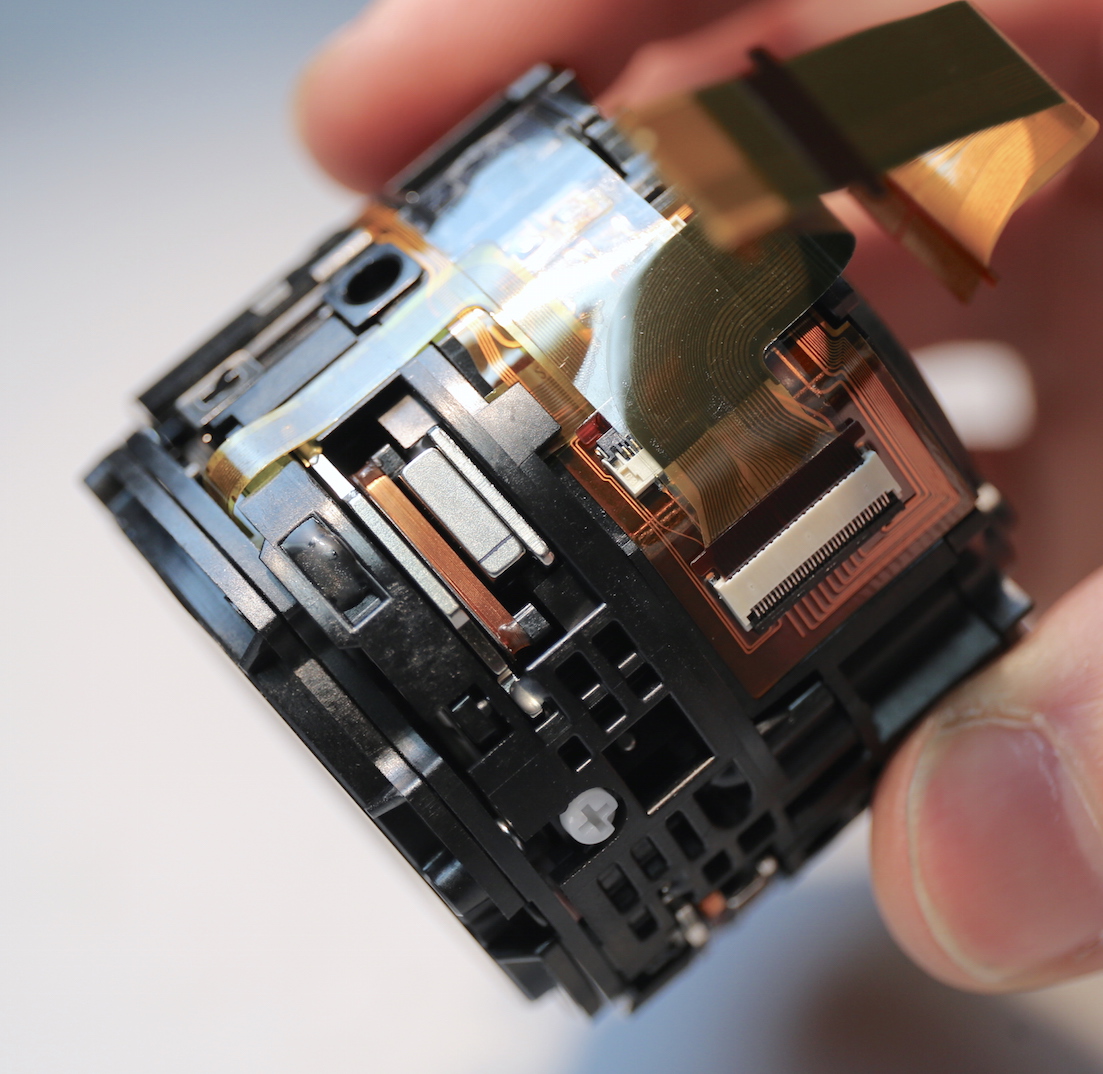
But as very occasionally happens (very occasionally being defined as about 20 times a day), I was wrong less correct than I would like to have been. There were some nice obvious screws just waiting to be removed, letting us take the rear group off.
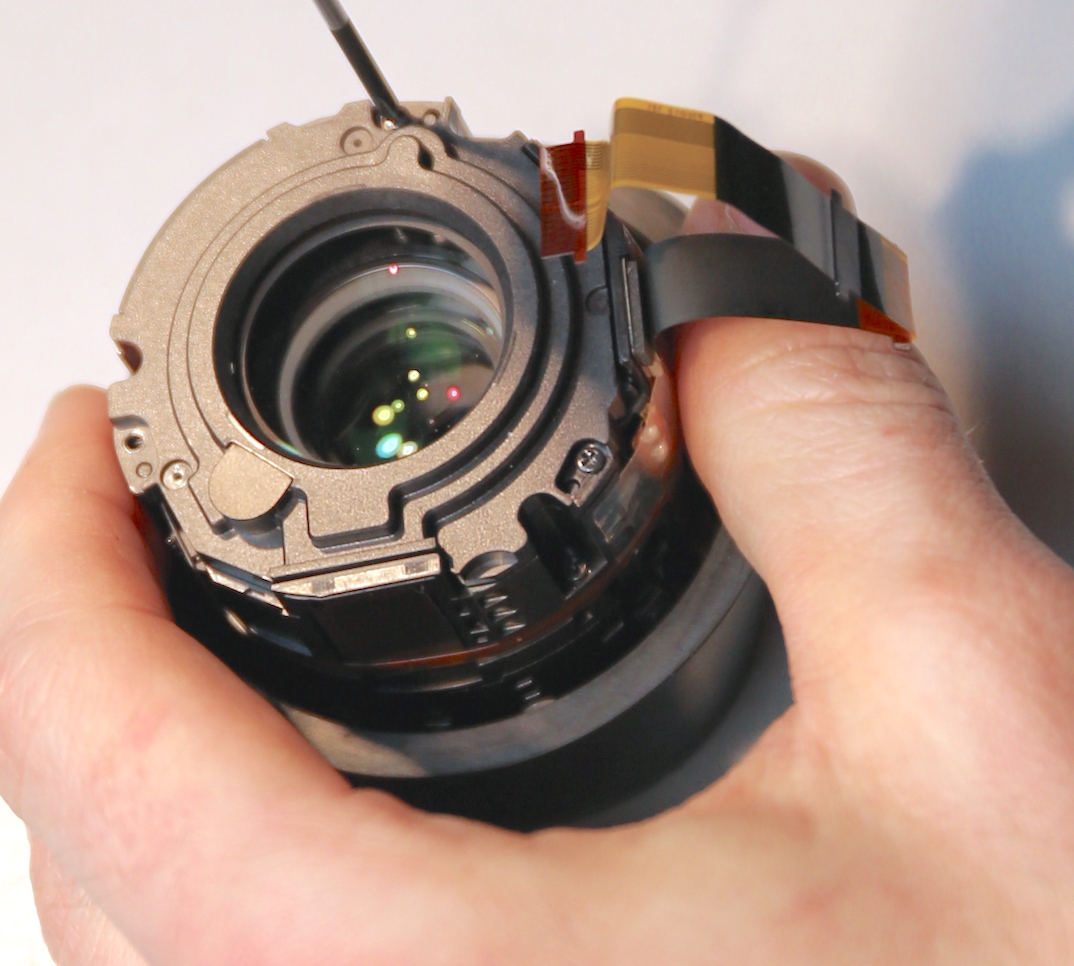
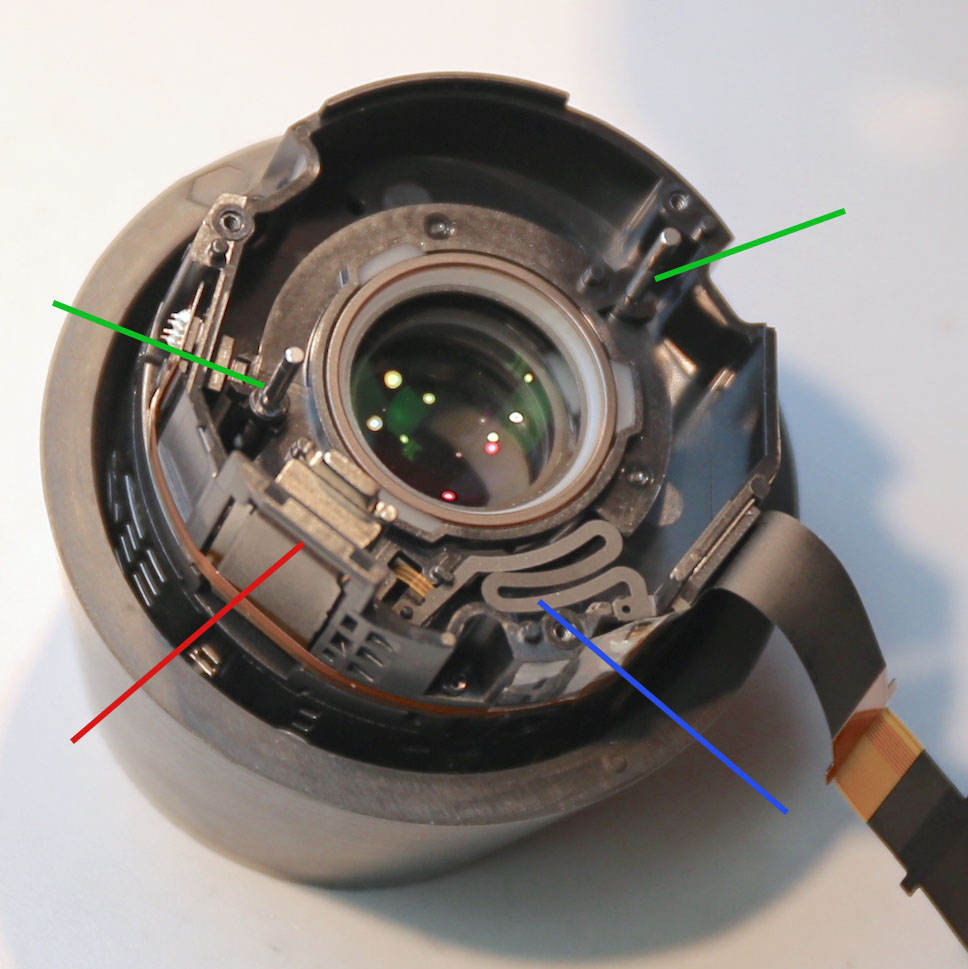
With this group removed we can look directly down at the focusing element and the electromagnetic focusing mechanism. The focusing element is obvious. Rather than being moved by rotating through slanted helicoid tracks, it slides directly up and down on two metal posts (green lines), moved by the electromagnetic (red line), that receives power from a long, mobile flex cable (blue line). That’s a very different system than most SLR lenses.
Since this lens couldn’t autofocus we took a look at the focus position sensor.
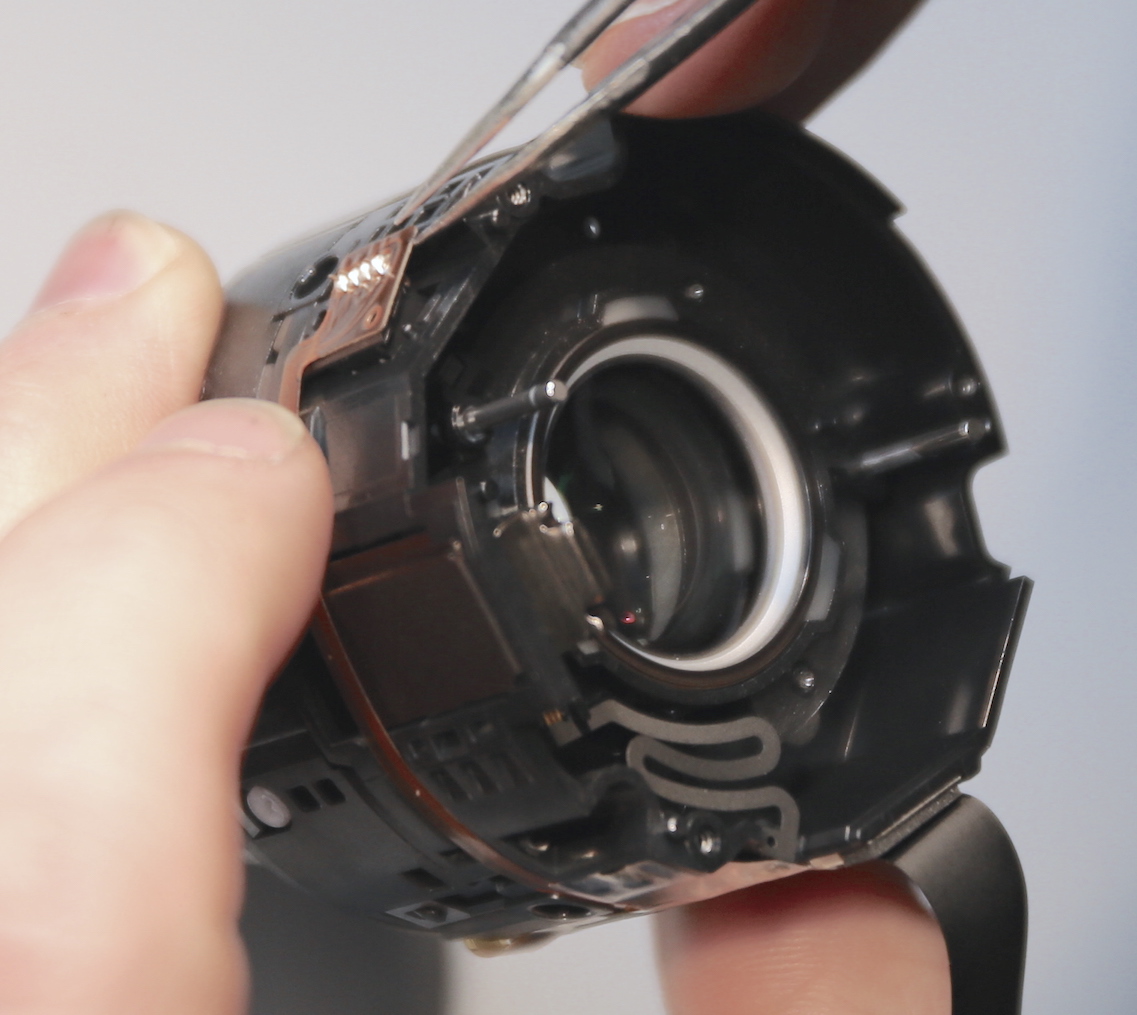
Focus position is probably more critical than zoom position, and this seems to be an electro-magnetic type of sensor (I’m not 100% certain – it might be some different kind of optical sensor), but at any rate, there were no obvious signs that anything was amiss with the sensor mechanism. (I know you’re thinking, so if you don’t even know what it is, how could you tell if something was wrong? Well, we could tell if it had a cracked flex, or broken solder, or stuff like that. But it could also be deader than dead and we wouldn’t have a clue.)
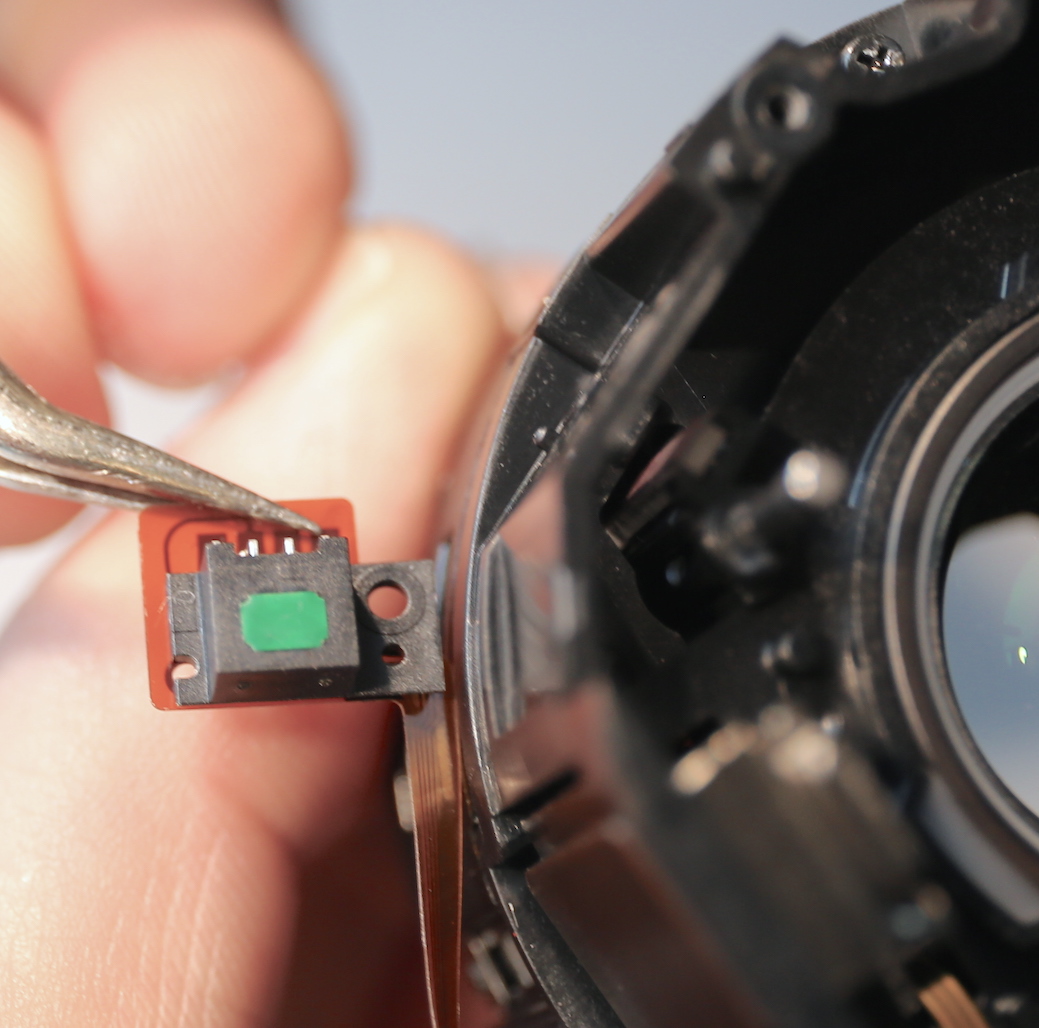
Since this lens was broken we were a bit more aggressive with messing with stuff we didn’t understand than we usually would be. We found out pretty quickly that the two metal rods the focusing element slides on could be removed.
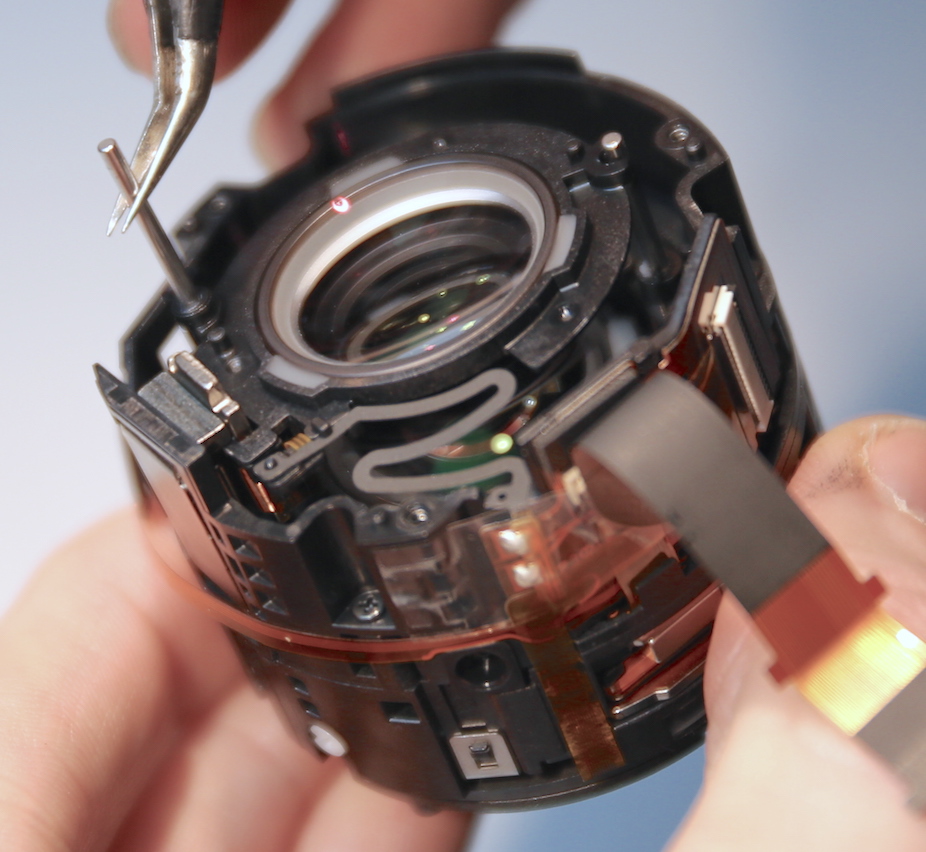
With the posts removed, we could pull the focusing assembly out of the barrel. You can see that the optical element just slides up and down within the eletromagnetic motor assembly.
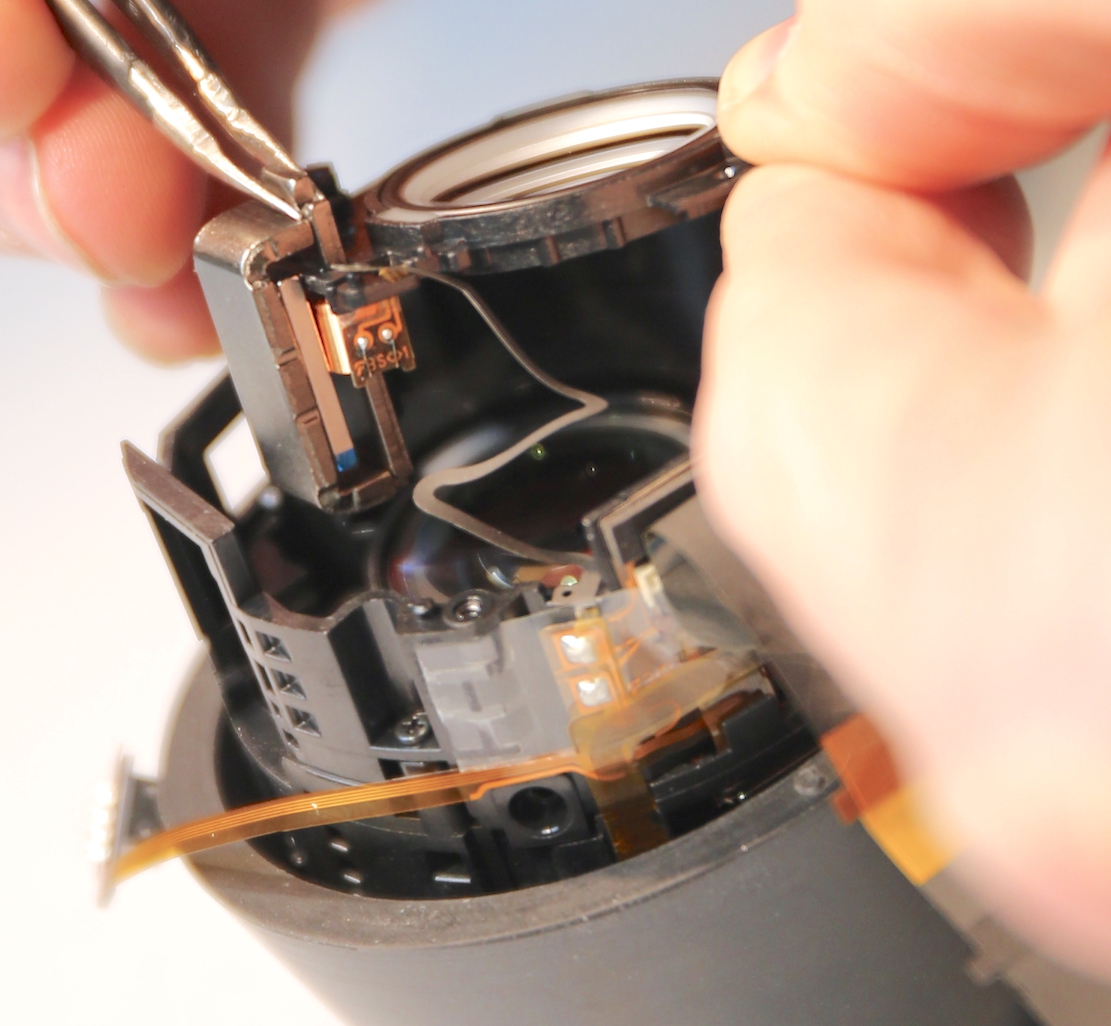
We didn’t have a lot of hope that we’d be able to fix things in here since we haven’t the slightest clue how it works. But once we started looking around we found an apparent problem. There was a dot of glue that apparently should attach the electromagnetic coil to the plastic housing of the focusing element, but the coil had become separated. You could see the imprints of coil in the glue, so it seemed pretty obvious they should be glued together.
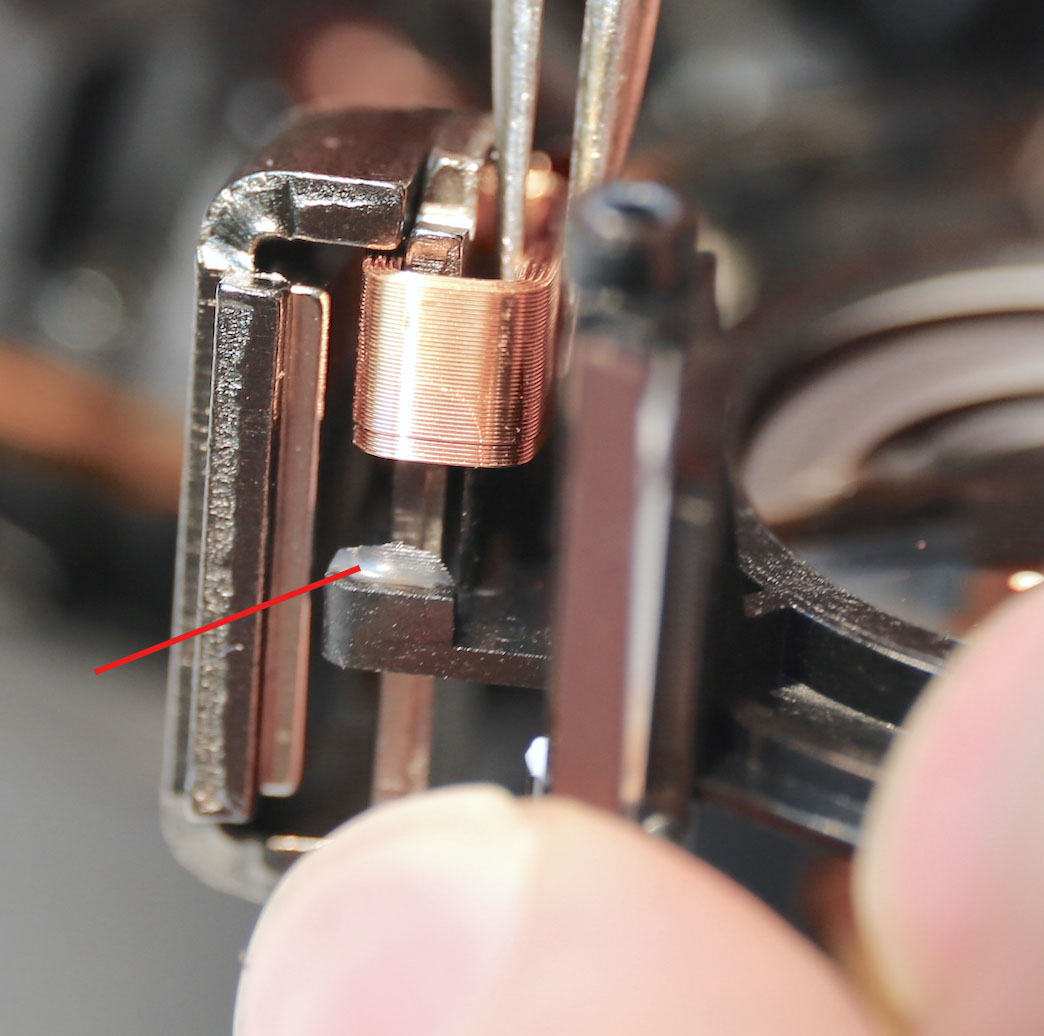
We figured we had nothing to lose, so we glued it back. (Do not try this at home unless you have a good ventilated hood or something similar. Glue fumes can totally eat the coating off of lens elements. Or can add a layer of white residue. Depends on what glue you pick.)
Much to our shock, the lens works perfectly fine after our homemade repair; at least it has so far. We’ll keep it around here for a long while, though, to see if the glue we used fails since we don’t know exactly what type of glue is originally used and how our choice (made on the scientific basis of “well, it kind of looks like this”) will hold up over time.
This concludes our little disassembly and triumphant random repair story, but you know me, I’ll have a few random comments to make.
Roger’s $0.02
My summary is that the 24-70 f/4 OSS Vario-Sonar is just what I’ve come to expect from Sony lately. Some amazingly great stuff, some rather apparently stupid stuff, and some stuff that I don’t have enough knowledge to comment on.
The amazingly great stuff should be obvious. The lens is very cleanly designed and modular. We’d never been inside of one before, but had it completely disassembled in less than 45 minutes (it will take less than 30 minutes next time). The construction is robust for a small lens and there are several very nice touches, like the cushions under the extending barrel to keep the mechanism smooth.
The apparently stupid parts are pretty obvious, too. This lens seems beautifully designed for easy reparability, and I can think of no reason it’s more expensive to repair than similar lenses from other brands. Charging such high prices is going to alienate customers pretty quickly. It’s not too hard to get new customers, but it’s almost impossible to regain a lost customer.
I would add that glue applied to smooth surfaces is unlikely to hold up forever on a frequently moving part where the force of movement is across the axis of the glue. A tiny notch or clamp from the plastic mount to the coil would have created a much more robust connection and not cost a dime if someone had simply designed it properly in the first place. So much of the lens is so thoughtfully engineered that it’s a shame such a critical connection apparently was engineered as an afterthought.
It seems that there’s not much optical adjustment capability in this lens. There are some shimable areas under the front group that we didn’t show, and there may be some other adjustments we haven’t recognized on a single disassembly (possible, not likely). In theory, you could make a lens so tightly toleranced that it doesn’t need adjustment, or could test it at every step of assembly removing and replacing incompatible elements. But those two options are far too expensive for me to believe that they are actually being done, and anecdotal reports of significant copy-to-copy variation suggest they aren’t. On the other hand, an f/4 lens doesn’t need to be as critically adjusted as an f/1.4 or even an f/2.8 lens would.
I don’t have a clue if electromagnetic focus is more or less accurate, reliable, durable, or expensive compared to the standard USM type AF seen in most SLR lenses. But from most of the comments and my own experience using the lenses, it certainly seems to work quite well.
After we’ve worked on some more of these lenses (and it seems likely we’ll have to do that) we may get a better idea about some of these things. But this first glimpse was interesting.
Roger Cicala and Aaron Closz
Lensrentals.com
April, 2015
90 Comments
John ·
So this lens has wide variations copy to copy and not reliable. I am glad not by not taking Sony system from the first time. I cannot believe SONY-Zeiss lens is design so poorly.
Shaun ·
The FE 24-70 is the weakest FE lens that I have used, which is a shame because it’s the bread and butter lens for many photographers, me included. Here’s to hoping Sony puts out a version II of this lens that is more consistent copy to copy and is sharper throughout its range. That unglued bit has me a bit nervous.
Tristan Robitaille ·
Even though the 24-70mm may be the weakest of the FE lineup I still think that modern lens designs are incredibly complex!
Barus ·
Looking through the rear element, you can see the focusing element sliding up and down by tilting the lens. You can even see the rods.
Brian B ·
Thanks for the teardown Roger!
I’m impressed!
Maybe, just maybe, articles like these will touch a nerve at Sony, leading to either, cheaper repairs, or small improvements in design!
John D ·
Long time Canon shooter that has been tempted by Sony. Lenses and cameras need to be repaired from time to time. $800 is outrageous. Canon has wonderful service and after the CPS discount a Canon repair might only cost 25% of a Sony repair. Sony is not so tempting now. Thanks Roger. Great information as always
Darin ·
“Call for print prices.”
Well done, the humor is always great and your teardown made me glad I sold the 24-70 a few months after owning it. I’d love to see the reason for shooting Sony torn down; the 135 1.8!
David Braddon-Mitchell ·
I wonder if Sony’s new Pro Service deal for photographers that they say they are rolling out in various countries will give better pricing?
Interesting about the anecdotal reports of massive sample variation. That would explain a lot: less so than the 16-70 there have been huge discrepancies between the reviews (even reviews all basically doing imatest at the same distance). I was always surprised by the complaints about the wide end: mine’s lovely at 24 over most of the field, and not bad in the corners. 70mm is a bit meh: lower resolution and contrast overall. Indeed, my copy looks like DXOs copy tests. But other, reliable, people have said they have copies no good at the wide end.
So, selfishly that’s good. But if it ever goes out of whack it looks like I’m plumb out of luck! I hope the primes are more repairable…
Jon ·
That glue bit is completely unacceptable, and Zeiss should be ashamed of themselves for letting Sony print their name on these lenses.
I was going to buy the Sony-Zeiss FE 16-35 f/4 lens, but after seeing this and the ridiculously high Sony repair costs, I’m thinking I’d rather buy the Canon 16-35 F/4 and use an adapter on my A7r..
Trenton Talbot ·
Please dissect some Fujinons too!
(XF 50-140/2.8, anyone?)
Muddy ·
Interesting article. I just bought this lens and the comments about sample variability intrigues me. I got a deal on mine and expected an average wlakaround zoom. I am pleased to say that my 24-70 outresolves my Sony Zeiss 35mm at higher ISO levels and at 70mm kicks my 70-200 f4.5 into touch.
Lasse Beyer ·
I doubt that the zoom position sensor is more reliable than a brush system. This looks pretty much like a simple carbon fader, which should wear out a lot faster than a gold plated brush. On the other hand, it’ll surely last a couple of years, and then there still is the Sony Service with appealing repair prices… 😉
Kenny ·
“Call for print prices.”
Anyone that has been following the comment threads will realize that Roger wins the Internets today with that line.
Matthew Saville ·
Funny you should put “Roger’s $0.02” at the end, because that may be the value of the glue you used, instead of an $800 repair bill.
Considering that a trained Sony technician could have this lens apart and back together in well under an hour, I’m calling major shenanigans on Sony’s repair estimate. Just another reason I am completely confused as to why the bandwagoning has managed to rage on for so long…
Pentax DSLRs have IBIS.
Nikon’s D810 now has zebra stripes, and the next generation will surely have marching ants too. (Oh and Magic Lantern has brought both to Canon for years)
A D750 and 50mm f/1.8 G weighs only a couple ounces more than an A72 and the new 55 1.8 Zeiss, yet because of the price of the Zeiss, the Nikon kit actually costs a couple hundred bucks less.
Lastly, Nikon can completely tear-down and optically calibrate a lens as big as a 24-70 2.8 or 70-200 2.8, for about $600. (I’ve had it done three times)
All while Sony throws crazy ideas at the wall to see what sticks. Wide-angle adapter lenses? F/4 zooms that actually weigh and/or cost more than their DSLR competition? (70-200 f/4, 24-70 f/4) And of course, the extremely high-priced lenses that are really only an advantage if you’re shooting 36-50+ megapixels wide open.
Sony’s apple-like influence on the masses continues to perplex me.
=Matt=
omer ·
Great article as usual
Roger you guys should consider to add repair service in addition to rent
Many will be glad to have you take care of thier lenses
Albert ·
Hi, based on my experience with linear motors (its appears to be a synchronous linear motor) the used glue is normally epoxy. In fact, standard industrial ironless linear motors have their coils supported by this epoxy resin. To be precise the coils are fully enclosed in epoxy:). And these motors can provide forces in the order of hundreds of Newtons. So it’s a very common and tested solution for fixing the coils. Maybe they only need more quantity of glue…
Albert.
Roger Knight ·
Matthew,
Its likely that part of Sony’s appeal comes from digital photographers who have grown up with most, or all, preeminent electronics coming from Sony, Samsung, Panasonic, etc. To them, Canon, Leitz, Nikon, Zeiss, etc. are simply quaint, last century names awaiting the guidance of the aforementioned technological giants.
Robbie ·
I wonder if that glue was intended to also be on the inside of the coil instead of just the bottom. Then it would have a strong shear connection to the element instead of the tension one shown. Might be a manufacturing issue rather than design.
John ·
I think Sony should make Sensor only, nothing else. Their SLR camera are also very weird. I am wondering if INTEL which the most advance fabrication in the world can make image-sensor. INTEL technology in Lithography is just too good.
Brian ·
My experience with all 3 Sony audio devices I’ve owned (all near the top of the range) is that something simple always goes wrong with them. In one case, it really looked like it was designed to fail in that way. Only 3 devices because eventually even I learn. I’ve been told that in Japan, Sony is known only for their ability to make things smaller than anyone else.
tn1krr ·
Great article as usual. I’m a Sony FE shooter, but to cover myself from these things I’ve kind of factored in the price of 4 year full coverage into every lens purchase. So when I consider a lens I put the full coverage extra into the price before making decisions. Not perfect, but qurantees I get decent mileage for my purchases.
Markus ·
So, is it a fact that (even the “Pro” line of) lenses for mirrorless systems are constructed in a simpler way and are less adjustable and repairable than lenses for DSLR’s?
And if so – is there a common reason (apart from just manufacturing cost)?
David ·
Thanks for the dissection. It’s interesting to hear your experienced (and relatively lingquistically gifted) analysis regarding little details. I also wonder how Zony lenses differ innardly from Zeiss lenses for Sony mounts (Touits and Loxias) on some rather generalized level (since there are no equivalents). In part because human beings like generalizing, in part because technical details are inneresting.
In regards to Sony audio devices I recall people at Apple asking “What is that thing” regarding my NH900 when I worked as tech supp, and the thing still works. It still isn’t as sexy looking as the NH1.
Gordon Lewis ·
I was already leery about the prices Sony is asking for its FE lenses. Now that I know they have the audacity to charge two-thirds the retail price for a simple repair (one wonders whether their repair techs actually inspected the lens or just sent back a flat estimate), there’s no way in hell I’d buy a Sony FE lens. But don’t worry Roger, I still might rent one. ; – )
Nathan ·
Hi Mr Cicala,
I very much enjoy your blog, please keep up the fine work.
The scientific rigor you employ seems to be sorely lacking from most other sources of lens reviews I’ve found on the internet.
Very little of it is relevant to my actual photography, however, as I shoot film. What I would get a real kick out of is seeing some classic, culty or interesting lenses subjected to your technical scrutiny.
Things like the Helios 58/2, the Hologon, early Tessars, the Macro-Kilar, some of the 40/2.8 pancakes.
If you were feeling particularly daring, extracting the lenses out of fabled film compacts like the Hexar, Ricoh GR or Olympus mju and testing them would be a great read.
Or on a more selfish note, the Canon FDn 50/1.2L and 85/1.2L 🙂 FD glass is having a bit of an eBay rennaissance thanks to the Sony A7 cameras being the first full frame digital able to mount them. I have these two, and they are just lovely, as sharp as any sensible person would need them to be on film at any aperture. In fact, forum grumblers and bloggers occasionally claim that they’re sharper than their EF replacements, owing to their manual focus nature. I don’t see how that would be the case, as I thought the EF versions were basically unit focusing lenses aside from their floating rear elements, but the FD series’ long obsolescence has seen them evade MTF50 tesing for far too long.
And as I already own mine I wouldn’t suffer from the attendant clamour for them if they turned out to be really good…
Unfortunately I can’t proffer mine for testing as I live in Australia, but I’m sure your network of gear-hoarding friends is vast.
And also apologies if this is a terrible place to post this, but it seemed as good a way to get a hold of you as any!
Regards,
Nathan.
E.J. Peiker ·
Holy cow, $800 for the repair by Sony. That essentially makes it a throw away item id something breaks for me since, through a corporate partnership discount program, I can get that lens for just under $1000. Sony is out of their minds.
Daryl ·
Thanks Roger, great read. btw- pictures are good also. The $800 repair is not unlike Kodak repairs, they charge 50% of new, basically flat rate repair, much higher than others, circa 1970’s.
Ken ·
Thanks for the teardown, Roger, this piece had some really ‘enlightening’ information. Coming from a background in precision engineering I caught myself staring at that glued connection in utter disbelief. It’s just as it has been primarily designed to break at some point in time or after such a lens has fallen or taken an impact of some sort – the blame would automatically be placed on the poor soul to whom it happened. Warranty? You dropped it – that’s $800, Amigo.
Dang, I was in the market for an A7R and some glass but I will sure as hell reconsider my choice.
Thanks again!
Graham. ·
Hi Roger.
Thanks for yet another very informative tear down article,
I have to say if I got that far I would probably have reassembled it and sent it in with a strongly worded message about how this would be a warranty repair, a failed glue dab, ludicrous to try to charge $800 unless they accidentally quoted in HK$, which is approximately $100!
At least Dick Turpin had the decency to use a mask and pistol to rob people!
Cheers, Graham.
R. Edelman ·
It seems that Sony does not understand glue. The lens shade on my Sony-Zeiss FE 35 mm f 2.8 came apart in two pieces. The two pieces were held together with some black rubber cement, the remnants of which could be peeled off with a finger. A little super glue gel has permanently repaired the part. The hood is easily removed, and thus can be repaired off of the lens, so no risk of fumes or glue getting to the lens elements.
greg thurtle ·
Interesting teardown Roger.
Have you found the same design features on the other FE lenses?
Rod Bracken ·
Roger,
Very informative (as always). Have you had any issues with Sony lenses not registering the aperture when you mount them to a camera? My SEL70200G wouldn’t report the aperture when I mounted it on either my NEX-7 or A7R. I sent it to Precision Camera for repair and they deemed it unrepairable. I’m still working with Sony trying to get this lens replace.
Mike Ogle ·
Since Sony has closed out its Mexican repair facility and gone to 3rd party repairs (Precision), the prices have really skyrocketed. Consumers are not happy. I understand that Lens Rental has worked out a deal with Sony to supply replacements in their Pro program, can you comment on this Roger?
Roger Cicala ·
Mike, I can’t, not because I’m under any nondisclosure, but because I have no direct knowledge other than exactly what you have already observed. Prices have skyrocketed and repair quality is deteriorating.
Kevin Purcell ·
A (sorta) concur with Albert: that’s a DC voice coil motor. It can deliver very precise movements rapidly and apply quite a large force when needed (that might be a consideration of a ultrasonic piezo motor).
The glue seems a reasonable solution to attach the voice coil to the lens assembly. The optomech guy is trying to keep the mass down (to keep focus speed up for a given current/power consumption) so they omit a coil form too (the coil is self-supporting). The problem might be either not enough glue (they try to minimize that too) or perhaps there was a sharp blow (perhaps tranverse to the lens axis) that cracked the glue. Or perhaps a part wasn’t properly prepared for the glue.
The “position sensor” might be a Hall Effect device (e.g. if they’re detecting a small moving magnet on the lens assembly to determine position). It would give continuous lens position with no contact so no friction on lens assembly. But with CDAF (or even CDAF with a PDAF hint) you would usually pull the lens to closest focus then move it out until you get sharp focus (then a little dip and pull it back a little). The position sensor would be mostly to report focal length/distance for EXIF data. They could use it for power-on diagnostics too.
Sigma have used DC voice coil motors for AF in their inexpensive Sony (and micro FourThird) 19mm and 30mm primes. They work well (they’re quick to focus) though they do have a disconcerting rattle when powered off as the lens element is not locked when powered off.
Ian ·
If I remember correctly, the Sony lens are designed to be repaired ‘in house’ rather than being needed to be sent to specific parts of the world. ( My Sigma 10-20 needed to go to Japan from the UK for repairs and had a 6 week turnaround )
This allows anyone in a competent repair shop to fix your lens should it break when you were on holiday, or on a workshop for instance, should you lose your shooting capabilities.
This may explain its rather basic structure. ( my brother in law repairs Sony parts in-house as a Sony engineer )
Ross Warner ·
The teardown was very interesting. I sent my 24-70 FE to Precision Camera for cleaning and maintenance, normally included free under the new Sony Imaging Pro Support program. They reported that they found physical damage on the optical block, a chip at the extreme edge of the rear element. I never saw this problem, so I assume that it caused no ill effects (?) or that it happened at Precision Camera. They originally quoted $916.93 for a repair — you can buy the lens new for not much more than that!
Luckily, I was covered under a three-year Service Plan with Accidental Damage from Handling, and after several days to get approval under this coverage, they repaired the lens and sent it back without charge. They say that they replaced the optical block, did a complete repair and returned all functions to factory specs, and did a “complete cleaning (internal-external) and optical system.”
What exactly is the optical block? Is that all of the of the glass elements, excepting the front element? Should this lens be as good, maybe better, than new?
Thanks, Ross
Ross Warner ·
Roger, could you please enlighten me about what the “optical block” is?
Thanks, Ross
Roger Cicala ·
Ross, what I am calling the optical block is the small central group of the lens containing most of the elements, the IS unit, focusing unit etc.
Ross Warner ·
Thanks, that’s what I supposed.
-Ross
Paul ·
Sony has no repair facilities in the USA. See my experience with Sony and (very imprecise) Precision camera when my 16-35mm Sony/Zeiss f/4 consistently failed under cold conditions.
http://www.getdpi.com/forum/sony/54818-dead-sony-16-35mm-f-4-sony-farms-out-warranty-service-usa.html
Must we consider Sony “Pro grade” products disposable?
-Paul
Sony-Rob ·
Nice work on the teardown and repair.
I have the same lens, but have damaged the front lens element. Can i buy a replacement glass? And is it a matter of unscrewing the front to replace? Any advice would be good.. (I am in Australia )
Roger Cicala ·
Sony-Rob, unfortunately (at least in the U. S.) Sony doesn’t sell just the front element, the part is for the entire optical assembly and it costs nearly as much as a new lens.
Roger
Michael Alan ·
Hi, I submerged my camera and lens while shooting a waterfall. I was able to take apart the lens pretty easily, but damaged the big fat ribbon in this photo, http://wordpress.lensrentals.com/media/2015/04/M34A1913-1024×921.jpg. Anyway to order one from you?
Michael
Roger Cicala ·
Sorry Michael, we don’t carry parts. You might try Sony USA.
Tim Martin ·
Thanks for publishing this. I am having the same symptoms with the same lens. The local repair shop refused to fix it and the warranty has expired. I think I am going to try this myself.
GW ·
Thanks so much for posting this. Same thing happen to me on the same lens. Out of warranty and Sony store in HK wanted repairs for north of $600.
For anyone in Hong Kong, this repair shop was able to do the repair for about $50 and they did a great job:
Raymond
Rm 2209 Pak Po Lee Comm. Ctre.
1A Sai Yeung Choi St. South, Mongkok.
Phone: 2332 9115
GW ·
Thanks so much for posting this. Same thing happen to me on the same lens. Out of warranty and Sony store in HK wanted repairs for north of $600.
For anyone in Hong Kong, this repair shop was able to do the repair for about $50 and they did a great job:
Raymond
Rm 2209 Pak Po Lee Comm. Ctre.
1A Sai Yeung Choi St. South, Mongkok.
Phone: 2332 9115
Martti O Suomivuori ·
Just wondering whether I have the guts to see if my 16-70mm f/4.0 has the same problem.
It rattles, that’s all it does.
What glue did you use?
Martti O Suomivuori ·
Just wondering whether I have the guts to see if my 16-70mm f/4.0 has the same problem.
It rattles, that's all it does.
What glue did you use?
SQLGuy ·
I’m trying to repair one that was dropped. This writeup was really helpful in seeing how to disassemble it and how the larger aspects work. Mine seems to go into a failed POST loop of some sort. The camera will initially recognize it, and the aperture will open to maybe 5.6 or 6.3, then it will stop way down, and it looks like the OSS element moves quite a bit, then it stops. Somewhere in there the cameras loses communications with the lens and changes to F–. It never tries to focus.
Physically it looks OK, other than a broken post where one of the mount screws attach. The focus voice coil is not loose like yours was, and I was able to move the focus element throughout its range by applying up to 1.2V to the coil. I’m thinking that maybe something is damaged in the OSS part, and I plan to open it up again to see whether I can see anything there. Any other ideas?
Thanks,
Paul
SQLGuy ·
Actually, after opening it up one more time, and closing it up one more time, I think the problem is in the aperture mechanism. It seems to have difficulty fully opening. I took a look at the OSS unit, and it moves freely in both directions, and the coils and magnets seem fine. Will probably try one more time to see if I can do anything for the aperture mechanism.
SQLGuy ·
I am now more thinking it’s the aperture unit… maybe the motor. I pulled it apart again and removed the motor, and the aperture opened as I removed it, giving the impression that something was binding there. I verified that the aperture itself could be easily opened and closed, and still could be opened and closed pretty easily with the motor back in place. I reassembled it with the aperture wide open. When I attached it to a camera, it quickly stopped down to F8 or so, then went back into its loop of F8 or about F22, and gaining and losing communications with the body. Sadly, since the aperture isn’t available separately, I think the only choice will be to replace the whole 3rd assembly.
SQLGuy ·
I’ve fixed mine. Kind of brute force, in that I ended up replacing the 3rd assembly and the outer barrel assembly. Replacing the third assembly doesn’t require removing the front of the barrel and front element from the zoom barrel, but I did remove these originally – following the teardown here. I had a bit of trouble reassembling it (wouldn’t zoom full wide). That was because I had misaligned the front barrel when I’d reattached it. Your photos were very helpful in finding that issue. Overall, $240 in parts and what would have been 30 minutes labor, if I hadn’t had to figure out the alignment issue.
Chinaka Obojiofor ·
well mine isn’t working like yours, it is recognised by camera for a few seconds then it gives F–, then recognised by camera then F–, does it for like 4 times, then it stays as F–. the lens is in perfect condition, do you think it could be the main board or just the 3rd assembly?
John Cao ·
My 3 year old sony sel35f18 does exactly the same, except it works sometimes but most times it behaves like you described. And it does not have a pattern of when to have the problem. When it’s working, it’s working… and all of sudden, it will stop working for sometime, and some days later, it might start working again.
SQLGuy ·
I am now more thinking it's the aperture unit... maybe the motor. I pulled it apart again and removed the motor, and the aperture opened as I removed it, giving the impression that something was binding there. I verified that the aperture itself could be easily opened and closed, and still could be opened and closed pretty easily with the motor back in place. I reassembled it with the aperture wide open. When I attached it to a camera, it quickly stopped down to F8 or so, then went back into its loop of F8 or about F22, and gaining and losing communications with the body. Sadly, since the aperture isn't available separately, I think the only choice will be to replace the whole 3rd assembly.
SQLGuy ·
I've fixed mine. Kind of brute force, in that I ended up replacing the 3rd assembly and the outer barrel assembly. Replacing the third assembly doesn't require removing the front of the barrel and front element from the zoom barrel, but I did remove these originally - following the teardown here. I had a bit of trouble reassembling it (wouldn't zoom full wide). That was because I had misaligned the front barrel when I'd reattached it. Your photos were very helpful in finding that issue. Overall, $240 in parts and what would have been 30 minutes labor, if I hadn't had to figure out the alignment issue.
Chinaka Obojiofor ·
well mine isn't working like yours, it is recognised by camera for a few seconds then it gives F--, then recognised by camera then F--, does it for like 4 times, then it stays as F--. the lens is in perfect condition, do you think it could be the main board or just the 3rd assembly?
John Cao ·
My 3 year old sony sel35f18 does exactly the same, except it works sometimes but most times it behaves like you described. And it does not have a pattern of when to have the problem. When it's working, it's working... and all of sudden, it will stop working for sometime, and some days later, it might start working again.
SQLGuy ·
I'm trying to repair one that was dropped. This writeup was really helpful in seeing how to disassemble it and how the larger aspects work. Mine seems to go into a failed POST loop of some sort. The camera will initially recognize it, and the aperture will open to maybe 5.6 or 6.3, then it will stop way down, and it looks like the OSS element moves quite a bit, then it stops. Somewhere in there the cameras loses communications with the lens and changes to F--. It never tries to focus.
Physically it looks OK, other than a broken post where one of the mount screws attach. The focus voice coil is not loose like yours was, and I was able to move the focus element throughout its range by applying up to 1.2V to the coil. I'm thinking that maybe something is damaged in the OSS part, and I plan to open it up again to see whether I can see anything there. Any other ideas?
Thanks,
Paul
Phyo Oo ·
Hello.
I have 16-70 f4 Zeiss . it didnt show the F number and cannot autofocus. Now i sent the lens to the service center at singapore. They reply me back the lens has a issue with lens barrels and aperture parts. They said the total repair cost will be 360 S$. Can you give me the advice?
Martin ·
Hi,
i have the same lens – and the same problem. In the oss part of the lens is a motor to set the f-stop. This glass is moving up and down freely. In my other zeiss lenses this glass stays fixed. So I think there should be some kind of detent which is broken now.
But you cannot use this guide, cause the lens is different. I dissembled everything, but I could not split it into 3 parts like in the guide for the 2470z above. So there was no way for me to fix it, I could not find a way to get into this oss part of the lens – at least not without any technical instruction guide.
After some research in the internet this seems to be a huge problem for the Sony SEL1670z. There are a lot of people complaining, that this is broken – it seems to come after some time of usage or when it was used on hot days.
Good look on your lens.
Phyo Oo ·
Hello.
I have 16-70 f4 Zeiss . it didnt show the F number and cannot autofocus. Now i sent the lens to the service center at singapore. They reply me back the lens has a issue with lens barrels and aperture parts. They said the total repair cost will be 360 S$. Can you give me the advice?
Martin ·
Hi,
i have the same lens - and the same problem. In the oss part of the lens is a motor to set the f-stop. This glass is moving up and down freely. In my other zeiss lenses this glass stays fixed. So I think there should be some kind of detent which is broken now.
But you cannot use this guide, cause the lens is different. I dissembled everything, but I could not split it into 3 parts like in the guide for the 2470z above. So there was no way for me to fix it, I could not find a way to get into this oss part of the lens - at least not without any technical instruction guide.
After some research in the internet this seems to be a huge problem for the Sony SEL1670z. There are a lot of people complaining, that this is broken - it seems to come after some time of usage or when it was used on hot days.
Good look on your lens.
Dave ·
Too many horror stories about SONY lenses and their lame service. I own a SONY FS5, but I am not inclined to invest in SONY lenses. Pity their customer service is so poor.
David Patterson ·
Too many horror stories about SONY lenses and their lame service. I own a SONY FS5, but I am not inclined to invest in SONY lenses. Pity their customer service is so poor.
Rodrigo Madera ·
Can you repair mine? have a noise all the time
Roger Cicala ·
I’m afraid we don’t do outside repairs.
richard rizzuto ·
Question for you, I need to repair my bayonet mount on my sony 55mm 1.8. Pictures are fine, autofocus is fine, but it sits on the camera slightly bent to the left. I found the replacement part online for $67. Is the electrical piece of the mount easy to reattach to the circuit board?
Michele ·
Thank-you Roger Cicala for this very cool article. I have a Sony 16-70 lens that is not working: focused stopped working completely, makes a clicking sound, error message saying the lens is not mounted correctly to camera. Have come to find out that a part in inside became unglued; repair shop said it needed new 3rd/4th assembly $700, almost the full price of the lens. It’s my first time ever having this experience, and it’s not a happy one. 🙁 TIPS ANYONE? Should I walk away, and buy another? Can it be sold for parts to at least recoup something toward another lens? The cosy or repair makes no sense. Thanks all, I’m a high-functioning amateur who is VERY bummed that my main lens broke less than 1 year after purchase (I did buy it used – no warranty.) THANK-YOU!
Michele ·
Thank-you Roger Cicala for this very cool article. I have a Sony 16-70 lens that is not working: focused stopped working completely, makes a clicking sound, error message saying the lens is not mounted correctly to camera. Have come to find out that a part in inside became unglued; repair shop said it needed new 3rd/4th assembly $700, almost the full price of the lens. It's my first time ever having this experience, and it's not a happy one. :-( TIPS ANYONE? Should I walk away, and buy another? Can it be sold for parts to at least recoup something toward another lens? The cosy or repair makes no sense. Thanks all, I'm a high-functioning amateur who is VERY bummed that my main lens broke less than 1 year after purchase (I did buy it used - no warranty.) THANK-YOU!
Pics Palacio ·
What kind of glue did you use? I have exact the same lens and problem and want to repair it myself.
JPics ·
What kind of glue did you use? I have exact the same lens and problem and want to repair it myself.
Samu Koski ·
AF motor looks like motor used to move HDD reading pins for ages. If someone else needs to fix this, roughen up the metal with a small file, remove all dust thoroughly and use 2-component epoxy.
Marco Carrarini ·
Hi Roger, I stumbled upon this article while trying to understand if my Sony 16-70/4 has a problem or not.
When I turn upside down the lens I hear a rattle noise and I can see a group behind the rear element sliding freely up and down. When I power on the camera the rattle noise stops, as the piece seems to snap into position. I use this lens since three years but I never notice this thing before.
Other than that, the lens is working fine, AF is snappy and OSS seems to be working too.
So all in all it could be normal; after all from your teardown the focusing element seems to be able to slide inside the electromagnetic motor freely, when not powered.
I own other Sony E lenses and I can hear some extent of rattle noise in almost all of them, when shaked.
But with my 16-70 it is much more evident.
What do you think ? Is it the same also with other sone e lenses that you know ?
Thank you in advance and cheers from Italy.
Ciao,
Marco
Sony Northrup ·
Hi Marco, it’s been a year you wrote this but I would like to now if you fixed your lens. My Zeiss 24-70 F4 has exactly the same issue. The rear focusing element moves losely when camera is turned off, but works fine when turned on.
Marco Carrarini ·
Hi Roger, I stumbled upon this article while trying to understand if my Sony 16-70/4 has a problem or not.
When I turn upside down the lens I hear a rattle noise and I can see a group behind the rear element sliding freely up and down. When I power on the camera the rattle noise stops, as the piece seems to snap into position. I use this lens since three years but I never notice this thing before.
Other than that, the lens is working fine, AF is snappy and OSS seems to be working too.
So all in all it could be normal; after all from your teardown the focusing element seems to be able to slide inside the electromagnetic motor freely, when not powered.
I own other Sony E lenses and I can hear some extent of rattle noise in almost all of them, when shaked.
But with my 16-70 it is much more evident.
What do you think ? Is it the same also with other sone e lenses that you know ?
Thank you in advance and cheers from Italy.
Ciao,
Marco
Allen Liu ·
I know this is an old thread, but I have a different with this lens. I broke the front glass, Found replacement but how would I take off the front ring that holds the glass down? Anyone has any experience with this?
Marco Carrarini ·
Hi,
every lens is different, but in my case I ended up disassembling the lens looking for some kind of broken detent that keeps in place the focusing element when powered off.
Eventually, I could find anything strange and the lens is still working fine, but at least I have peace of mind now. So it is "fixed", in a way...
See my teardown here
All in all I learned that the loose focusing element is a normal carachteristic of many Sony lenses, that use linear EM focus motor. If your lens AF works, I do not recommend trying to fix it.
Regards,
Marco
Erkan Ayan ·
I had same problem and fixed my lens with this guide. Thank you so much.
Pawe? Ostrowski ·
Great Job !!!! what’s the name of the tape “zoom position” ?? visible on 3-4-5 photo 🙂
Paweł Ostrowski ·
Great Job !!!! what's the name of the tape "zoom position" ?? visible on 3-4-5 photo :)
Przemyslaw Stroinski ·
Hi, it looks like, aperture never is really opened in this lens, or maybe I have some strange one. Usually in opened lens we don’t see aperture, here it is different, I can easily see leafs of aperture in f4 when I’m look from front of lens… Strange, there is place for move 3 or 4 EV.
Przemyslaw Stroinski ·
Hi, it looks like, aperture never is really opened in this lens, or maybe I have some strange one. Usually in opened lens we don't see aperture, here it is different, I can easily see leafs of aperture in f4 when I'm look from front of lens... Strange, there is place for move 3 or 4 EV.
mervyn marie ·
Good day Everyone,
I’m replacing a old Lens Anti Shake Focus Flex Cable For SONY FE 24-70mm F4 ZA OSS
I’m having trouble fitting the new one in. its the same length as the old one,but there’s a lot of slack and I’m have trouble fitting the pc board in the back of the lens. Can anyone share any advice please,
it will be greatly appreciated.
mervyn marie ·
Good day Everyone,
I'm replacing a old Lens Anti Shake Focus Flex Cable For SONY FE 24-70mm F4 ZA OSS
I'm having trouble fitting the new one in. its the same length as the old one,but there's a lot of slack and I'm have trouble fitting the pc board in the back of the lens. Can anyone share any advice please,
it will be greatly appreciated.
Dean Roden ·
Thanks for the lesson Roger. It came in handy as I dropped the same lens and had some physical internal damage. Turned out one of the metal posts inside the inner core had dislodged itself. I think i’ve fixed it, however can’t tell for sure as i’m having problems re-attaching the zoom keys. When I screwed them back in they seem to be digging into the inner barrel and preventing free movement. Almost seems as the the lug on the keys are too long, however this doesn’t make sense as they were obviously doing the job before dismantling. I’m assuming the lens should be completed closed as in set at 24mm when the keys are re-attached or do they sit inside a groove on the inner barrel which i’ve spotted. However, if i did that this would mean the lens is drawn out to about 33mm……Where am I going wrong?……Would appreciate some guidance, Thanks.
Dean Roden ·
Thanks for the lesson Roger. It came in handy as I dropped the same lens and had some physical internal damage. Turned out one of the metal posts inside the inner core had dislodged itself. I think i've fixed it, however can't tell for sure as i'm having problems re-attaching the zoom keys. When I screwed them back in they seem to be digging into the inner barrel and preventing free movement. Almost seems as the the lug on the keys are too long, however this doesn't make sense as they were obviously doing the job before dismantling. I'm assuming the lens should be completed closed as in set at 24mm when the keys are re-attached or do they sit inside a groove on the inner barrel which i've spotted. However, if i did that this would mean the lens is drawn out to about 33mm......Where am I going wrong?......Would appreciate some guidance, Thanks.
Spurks ·
Can the front lens element be removed from the extending barrel?