
The Venus 60mm Macro – A Hidden Gem for Macro Photography
Including macro shots in a portfolio or wedding album is a great way to add variation and make the work stand out. This is the time of year when we get a lot of questions not only about macro lenses but about which lenses are best for shooting weddings. These questions are often asked in the same conversation, as many photographers want to capture every detail of an event, especially the all important ring shot, but don’t want to switch lenses constantly. Recently I have been recommending a lens to customers that offers something new and fresh for their macro photography needs.
The Venus 60mm f/2.8 Macro made by an up and coming Chinese optics company is the first lens to offer 2:1 magnification with infinity focus. This basically means its possible to go from taking an ultra close detail shot to taking a portrait without switching lenses.
To show the real difference between this lens and the one already in your bag, here is a side by side comparison of the Venus 60mm f/2.8 (at 2:1) and the Canon 60mm f/2.8 (1:1). Each is at minimum focusing distance, mounted on a Canon 7D Mk II.
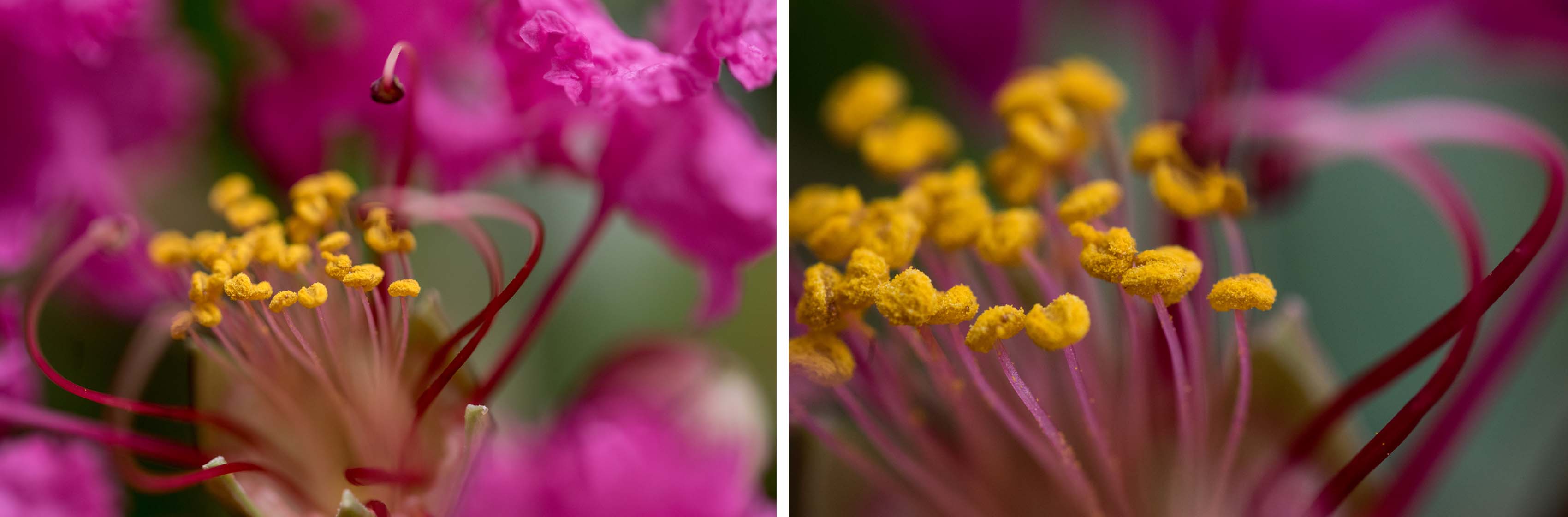
A magnification of 2:1 refers to the ratio of subject size to image size. Most common macro lenses have a 1:1 ratio creating an image on the sensor that is equivalent in size to the actual subject. A 2:1 ratio makes the image of the subject twice as large.
The vignetting and bokeh of this lens gives it a romantic feel that often comes from bargain priced manual lenses (I happen to enjoy it). The manufacturers website advises against using this lens on a full frame sensor for anything other than macro work. I tested it out and it works just fine aside from the dark corners, which are noticeable…you’ve been warned.
Here are some images to show the variation of looks that can be achieved in succession. These are shot on a full frame camera, the Canon 5D MkIII, and show vignetting.


There is one detail that some may consider a drawback. The Venus lens is strictly a manual focus lens! The manual focus allows for very deliberate focusing, but it is not the quickest option for those without experience. When focusing very close the Venus lens tends to cut out some of the available light. The proximity also narrows the field of focus which is why in the example I stopped down to f/5.6 to give a similar look to the Canon lens. So keep in mind that the Venus will have slower shutter speeds when taking 2:1 macro photos.

I found that it’s fairly easy to focus in well-lit situations, but as it gets darker you will have a harder time. If planning to shoot stopped down you will need to open your aperture, focus, and then close it down to the desired f-stop.
These images were all taken either handheld or on a tripod to show the type of results typical of events or on the go shooting.
For those interested in a more dedicated approach to macro shooting I recommend renting a Novoflex Castel Q Focusing Rail for focus tweaking. Or the Cognisys StackShot 3X Macro Rail Package for times when you need to capture every detail.

There are many great macro lenses to choose from; the Canon 100mm f/2.8L IS comes to mind. The big advantages of a lens like that are autofocus and image stabilization. The Venus, however, is a different animal with the ability to get much closer and capture shots with unexpected intimacy and detail. The flexibility gained by getting as close as possible has convinced me to actually take a macro lens to my next event rather than just using the wide end of the 24-70mm. You can try it for yourself here.
Sarah McAlexander
9 Comments
Aaron ·
Thanks Roger! I was rather curious about this lens. Looks like it’s pretty decent lens, although it doesn’t quite seem tack sharp like many other macro’s. Then again, 2:1 without bellows/tubes is not too bad 🙂
Chris K. ·
I bought a Venus 60mm macro a while back and I agree with the article…It’s a very good but not great lens. My Sony 100mm f/2.8 1:1 macro probably equals this lens, while the Sony doesn’t get as close, the resolution is painfully sharp as opposed to the blur of the Venus. But it’s a fun lens, and I always like buying fun lenses.
Brian ·
What is the working distance with this lens at 2:1?
Jeremy ·
Just turn on focus peaking and you are all set with manual focusing lenses…
Tom ·
I would REALLY like to see a first look at the newly announced Venus Laowa 15mm f/4 1:1 Macro. I love doing wide angle close-up photography, and greatly anticipate this lens. I will certainly give it for a spin when Lensrentals gets it in stock. Hopefully there are a few on order?
A ·
Thank you for an interesting report Sarah, I don’t tend to shoot wide open, but I would be curious to hear how it performs stopped down?
Most often I’d use it at f/16 as that provides the best DOF/diffraction tradeoff with my 5D2 (I do lose some sharpness compared to f/13, but it’s acceptable for my purposes).
The question is, does it sharpen up by say f/8? The vignetting isn’t a problem for me, as I tend to prefer the corners a bit darker for macro anyway.
brandon ·
That would be Sarah.
NancyP ·
As a Canonista, with a MPE65, this lens doesn’t add much. Nikonistas, or Canonistas who need a dual-duty lens, would feel differently However, the new 15mm Venus 1:1 macro looks interesting, at least for novelty shots. The various macro fora are hosting some samples from early purchasers. As for the open-focus-close-shoot dance with the aperture ring – how many people remember the old “preset” apertures of the late 1960s – early 1970s? I recently got out my old M42 mount 135-format Mamiya-Sekor 60mm f/2.8, and found that I could still operate the preset aperture very quickly.
eric westpheling ·
If you already own a decent wide angle prime lens you can get a reversing ring for $10 off amazon. My Nikkor 20mm 3.5 ais and Pentax K 28mm 3.5 both have 55mm filter threads and work exceedingly well with a reverse ring. You can get your thumbnail to fill the entire 24×36 frame easily. Working distance is a bit close though!