
Lens Teardown of the Complicated Sony FE 70-200mm f/2.8 GM OSS: Part I

A lot of you are aware that we’ve been rather puzzled by the Sony FE 70-200mm f/2.8 GM OSS lens. It didn’t test like we expected it to, which led us to reevaluate our testing methods with outside consultants (we’re now comfortable they are valid, BTW), question the accuracy of different types of autofocus, and search for the meaning of life.
The Sony FE 70-200mm f/2.8 GM is just a bit different. It has three aspheric elements, one of which is an extreme aspheric, and six extra-low dispersion elements. Ultra-low dispersion elements are pretty standard in telezooms, but aspheric elements not so much. It also has a unique autofocus system with linear motors moving a rear focusing element and a ring ultrasonic motor moving the larger front focusing group. So we were pretty interested in getting a better understanding of how this lens works.
As part of that Holy Quest, we wanted to take a look inside the FE 70-200 f/2.8, because, well, that’s what we do. They’ve been in such short supply, though, we just haven’t been able to take one apart. But a customer was kind enough to drop one of ours, jamming the focusing system. We decided the opportunity to do a repair/teardown was too good to pass up.
It’s not the first time we’ve made a bad decision, and it probably won’t be the last. It ended up being the longest and most complex (6 hours) teardown we’ve ever done. If you’re interested, read along and come feast your eyes on one of the oddest lenses we’ve ever looked into. But it’s going to be a fairly long read. (Poof! There went 90% of the blog viewers.)
I’ll warn you now, I’m going to use words like different, odd, and weird when describing the inside of this lens, especially in the second part of this two-part teardown. Don’t misread that to mean I’m saying ‘bad’ because I’m not. Sony is the one manufacturer these days that’s trying all kinds of new and different things. I love that. Sometimes new things are better, sometimes not. But it does make them different.
So Let’s Void Warranties!
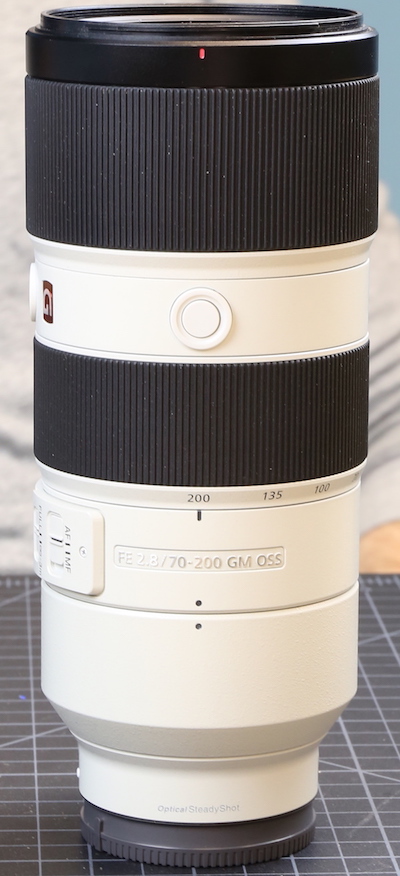
From the outside, the FE 70-200mm f/2.8 GM OSS looks pretty much like every other 70-200 f/2.8 zoom.
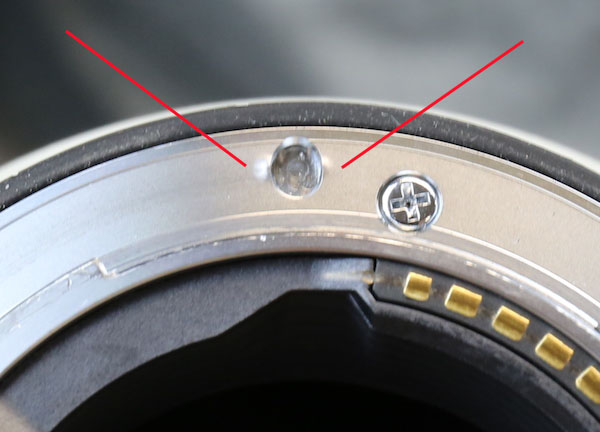
Before we start I’ll show you one close up of something we’re seeing fairly frequently with this lens: some wear around the locking pin. These are rental lenses, of course, but all fairly new to the fleet. Most of ours now have some raised metal (red lines) on either side of the lock-pin slot. This isn’t causing any problems yet, but if you have one, you may notice the same thing. If it worsens it may could cause some rotational looseness or a bit of mounting resistance, but we haven’t seen that yet.
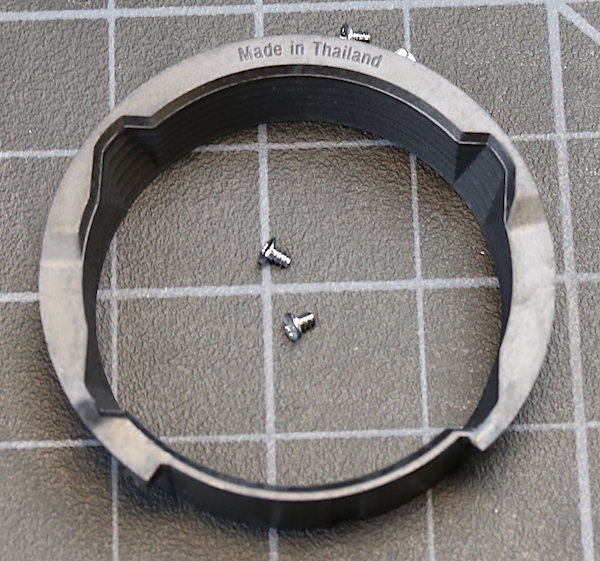
We started the teardown from the back. The rear baffle comes off after removing a couple of screws.
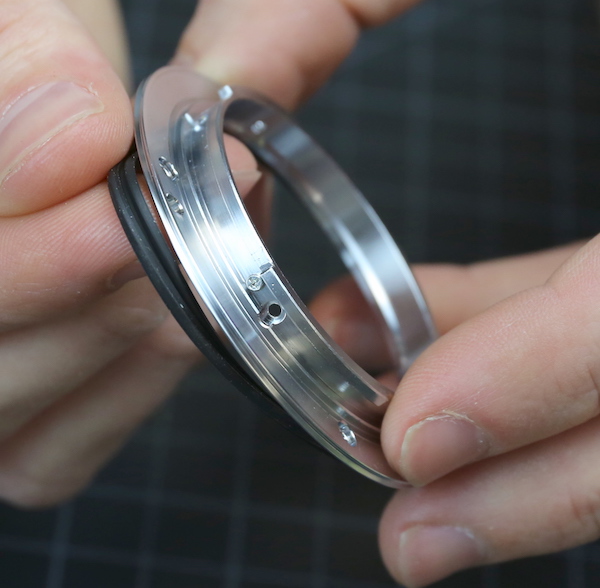
The bayonet mount comes off after removing four screws. It has a relatively robust rubber weather seal between the bayonet and the lens.
Under the bayonet, there’s a set of shims in two locations. This would correct lens tilt at the mount.
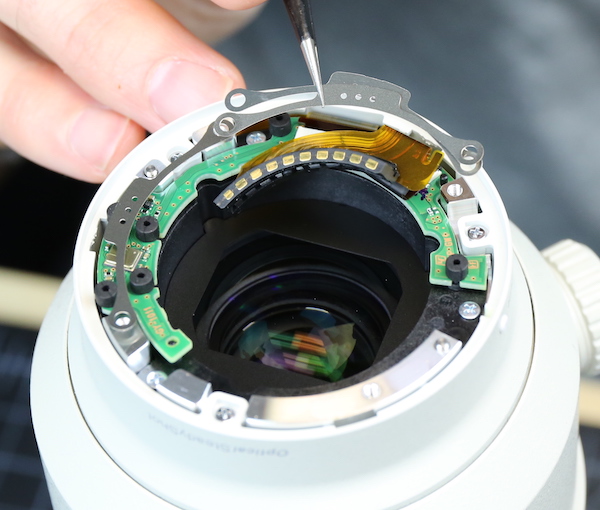
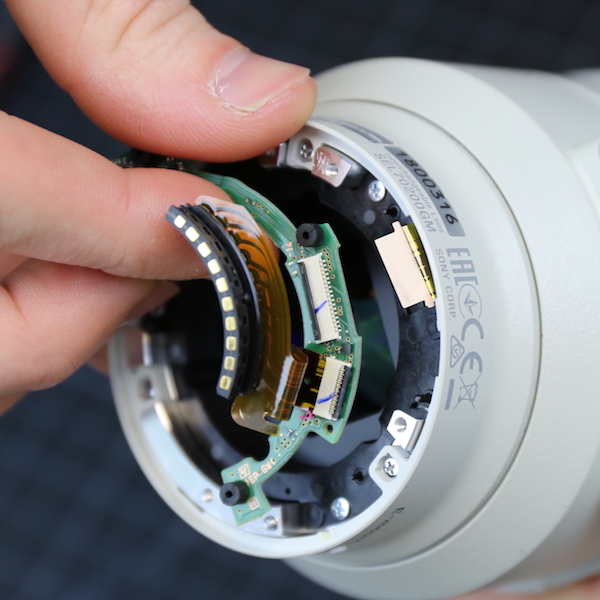
One other thing we found a bit unusual: the PCB is small and only has one large flex connecting it to all the camera’s electronics. A typical 70-200 f/2.8 would have at least half-a-dozen connections. We speculated that the lens must do a lot of processing internally rather than using the camera’s electronics. Given that there weren’t a lot of chips on the PCB, we thought we might find another PCB down in the lens, like Nikon lenses have.
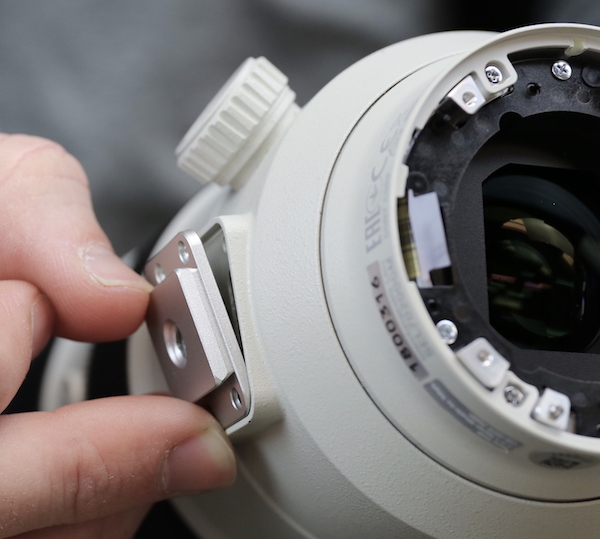
The next disassembly step is to remove the built-in tripod ring. This is actually one thing some of you might want to do someday if you get some sand or grit in it. We start by removing the mount foot plate, which as you can see is a (very slight) modification of the plate Nikon 70-200’s use. It does appear thicker and more robust than the Nikon version, though, which is a good thing.
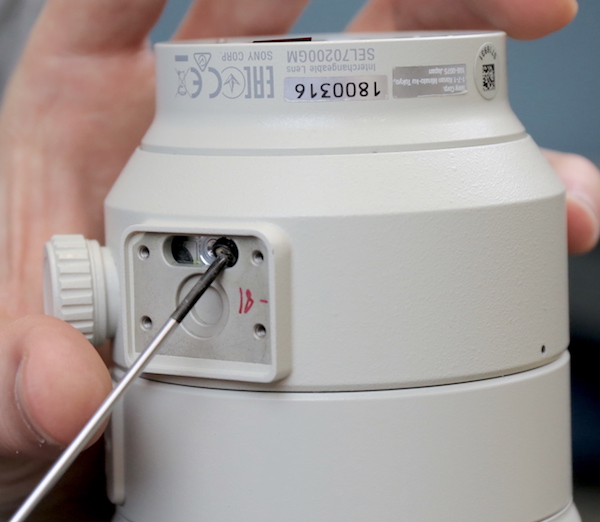
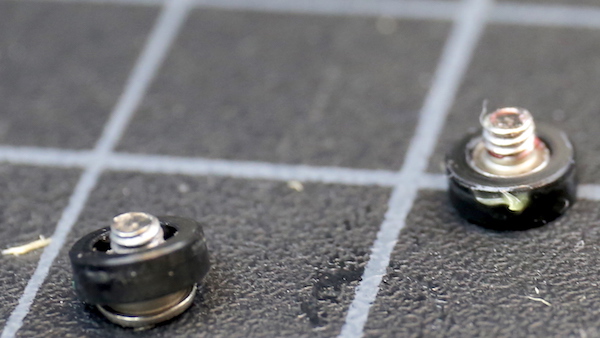
Once the plate was off, we removed the four tripod collar rollers through the opening the plate was in.
These are nice, solid rollers with thick nylon collars, built as they should be.
Once those are removed, the tripod collar slides off of the back of the lens.
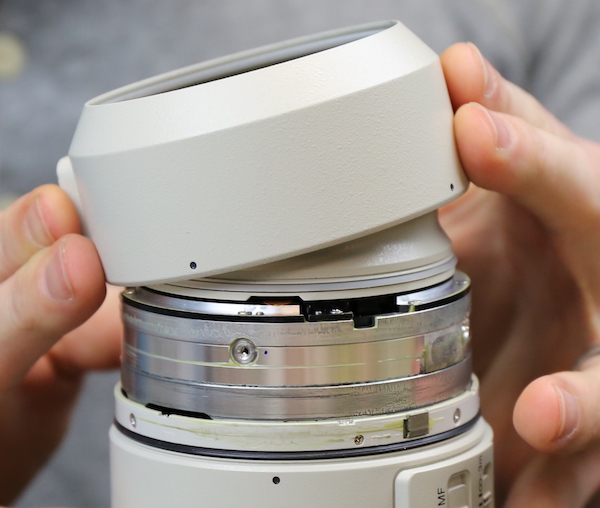
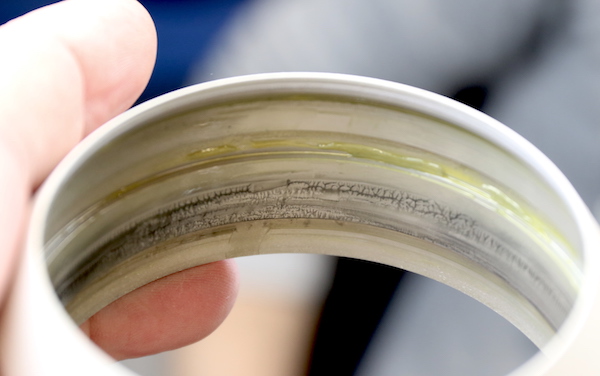
You can see thick lube around the inner barrel above, and there’s a generous amount in the collar too.
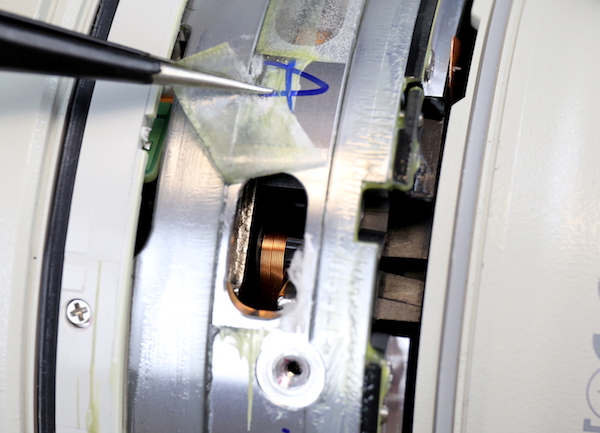
With the tripod ring off we can see some of the inner barrel. There were some taped over windows we peeked under and you can see the coils of the image stabilization system in there. Also note that there are nice thick environment resistance seals at both the top (white) and bottom (black) of the tripod ring assembly mount. You’d think that would keep sand and stuff out of there. It certainly seems like it should. But no, it doesn’t; not all the time.
Speaking of that top environmental resistance seal, it’s attached to the outer rear barrel which gets removed next.
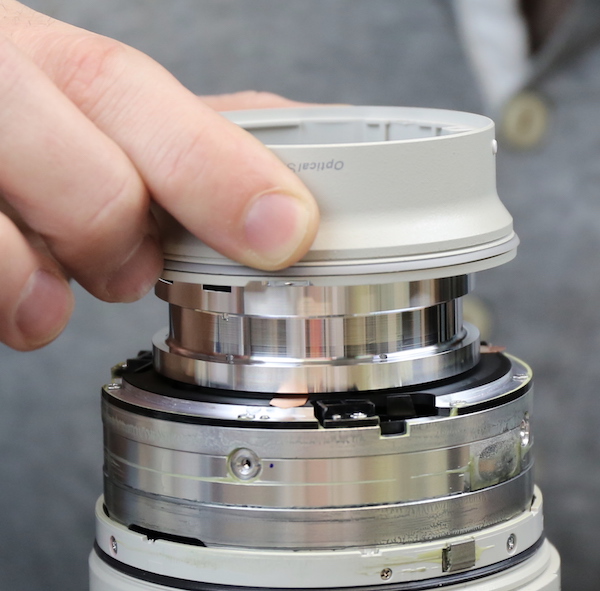
The rear inner rear barrel is exposed now, showing a good look at the single flex that carries all of the lens’s electrons. You heavy metal fans are pleased to see all this thick metal making up the inner barrel, I know.
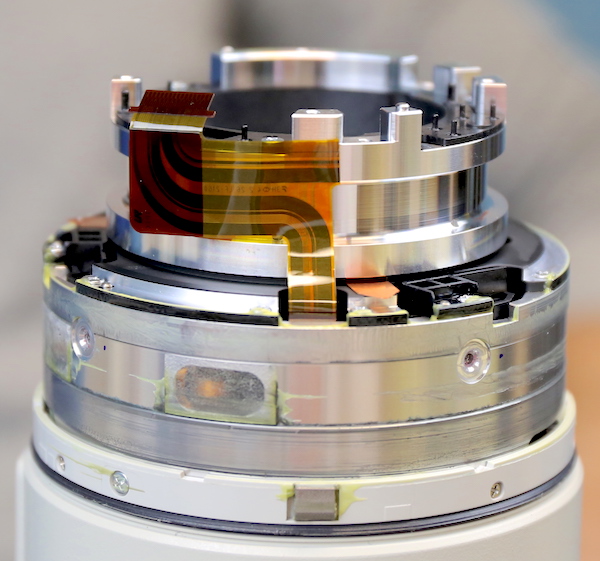
The switch panel comes off next, after removing screws and disconnecting a couple of flexes. As you’d expect, there’s a rubber gasket to seal this area too.
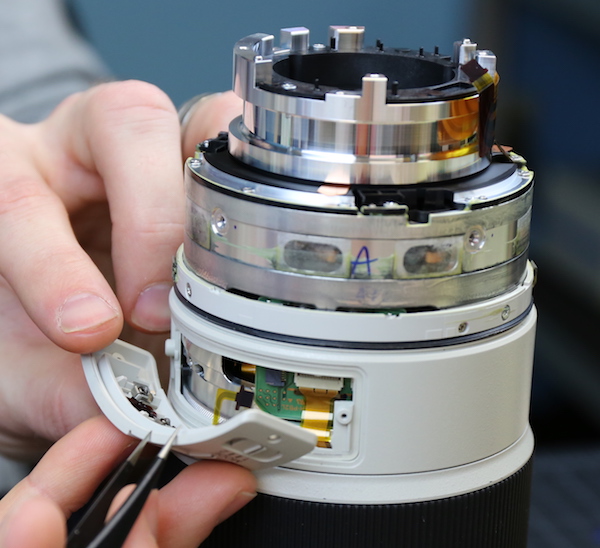
With that removed the mid barrel slides right off. Notice another rubber seal on the forward end of the middle barrel where it tucks under the zoom ring.
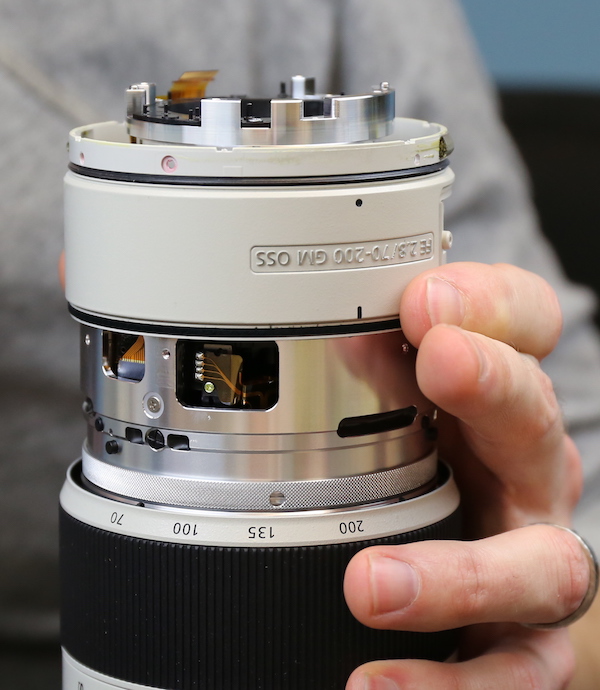
The inner barrel at this level has an interesting feature — windows that allow access to things like a zoom position sensor.
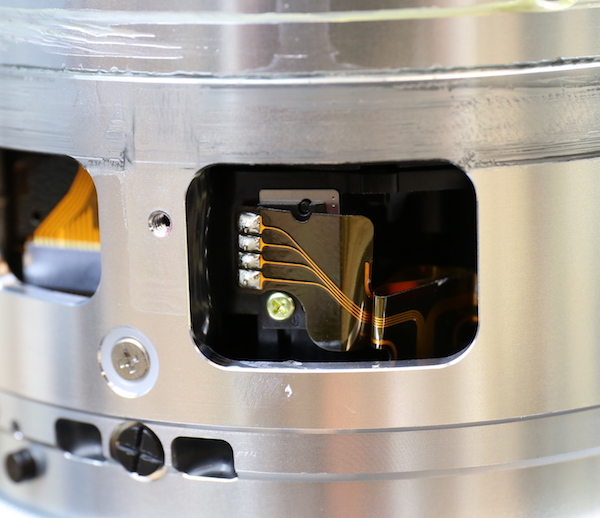
On the other side is a window over the secondary PCB we thought would be in here somewhere. We thought this was a nice feature giving access to these areas without requiring further disassembly. We should have realized there was a good reason to provide access to areas without requiring further disassembly. But we didn’t.
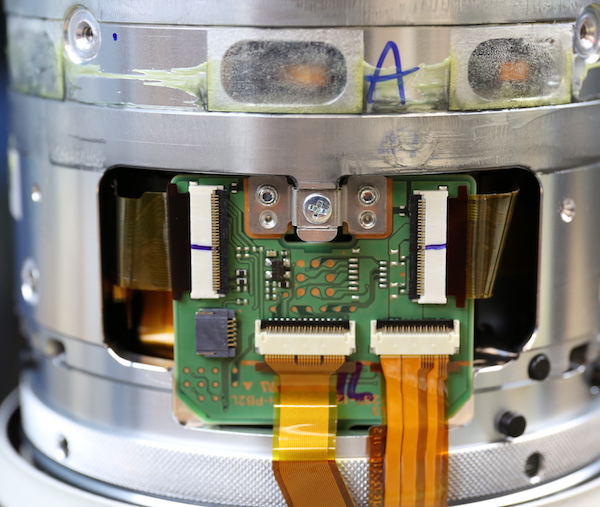
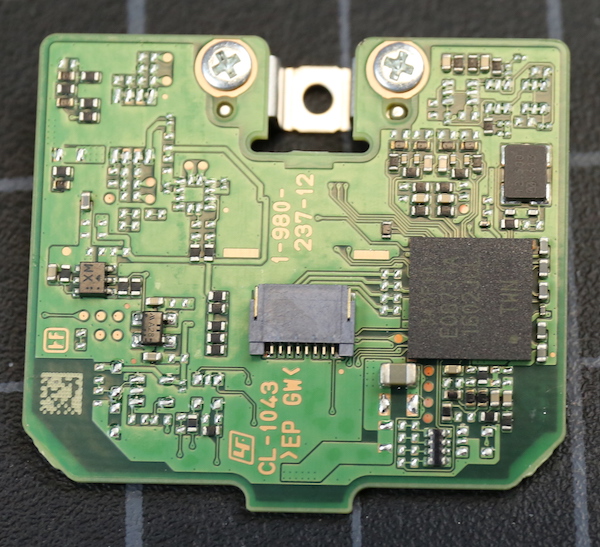
This PCB has to be removed, obviously. The underside view shows it apparently has more processing power than the main PCB we removed earlier.
The next step was to take the rubber off of the zoom ring. Underneath the rubber, the various slots and holes in the ring are covered by a thick layer of tape, again to provide environmental resistance.
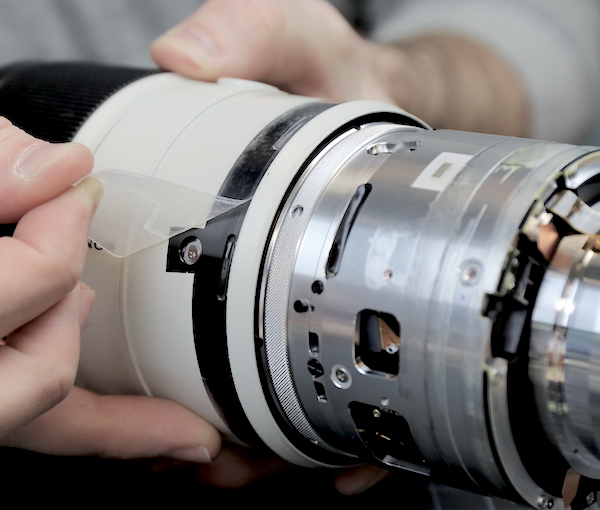
After removing the three ring attachment collars (you can see the screw for one under the removed tape above) we expected the zoom ring to slide right off. Not so much. We tried all the secret codes of rotation and nothing worked. Finally, Aaron noticed there was some silicone glue placed in the various slots around the lens, either as further sealing or to just irritate us, we’re not sure which. As you’ll see, about half of this lens by volume is silicone glue. (OK, I’m exaggerating a little, but you didn’t have to pick it all out.)
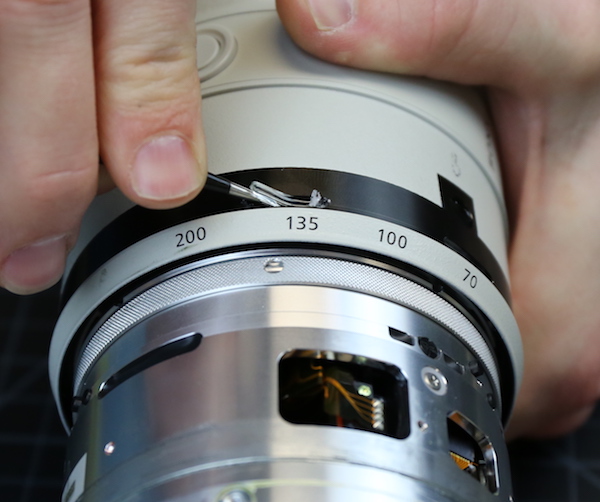
Once we got this out we could slide the zoom barrel off the lens. As an aside, have you wondered what that small silver ring with the rough grippy surface near the zoom ring is yet? We sure did. We’d never actually seen one of those before and had no idea what it would be. Stick around and you’ll understand why we named it The Southern Fairy Tale Ring.
But back to where we are. With the glue removed the zoom ring came right off. Don’t worry, we have plenty of replacement glue. And we needed it because Sony just loves this stuff, it’s all through the lens. It probably does help with weather resistance, but it makes it a pain to work on.
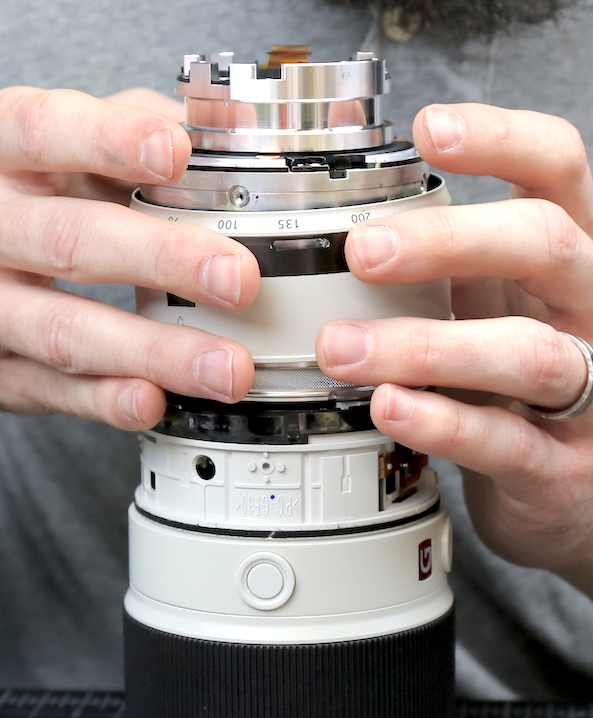
Looking at the lens at this point, it seemed pretty evident that silver ring with the grippy surface was supposed to come off next.
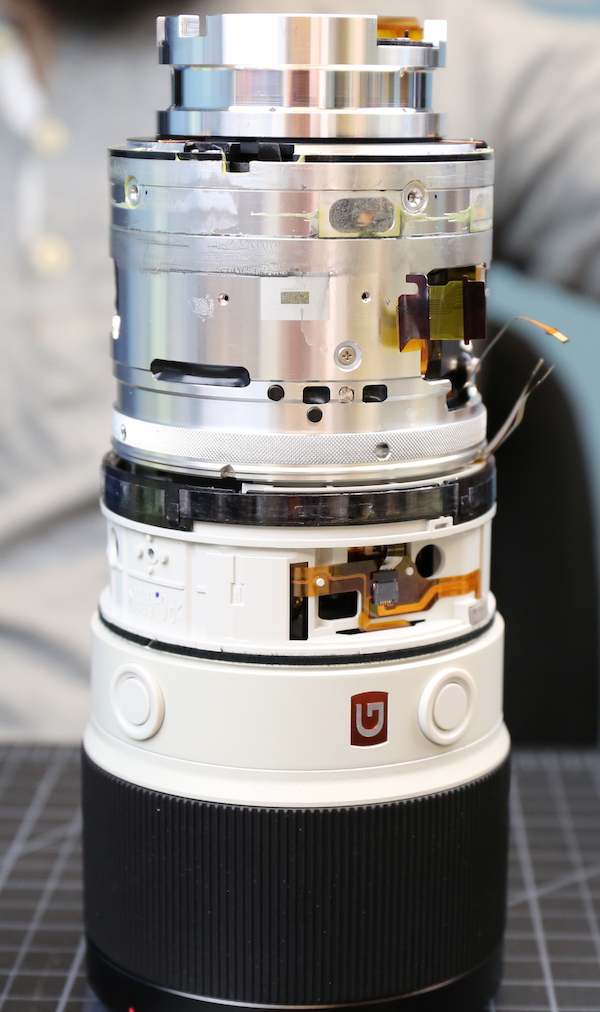
But it didn’t want to. Finally a combination of picking out more glue from under the ring, adding some glue softener, and Aaron’s really strong grip and realizing it was a reverse-threaded ring got it moving. But we spent about 30 minutes looking at basically this picture and trying one thing after another.
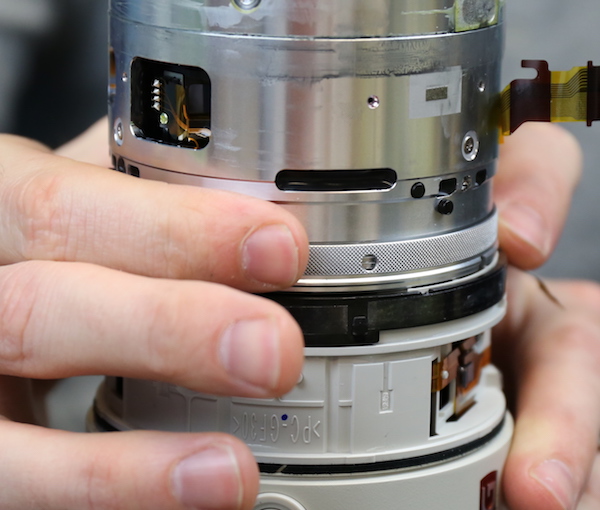
A bit to our surprise, we discovered our ring was a lock ring that held the two halves of the lens together.
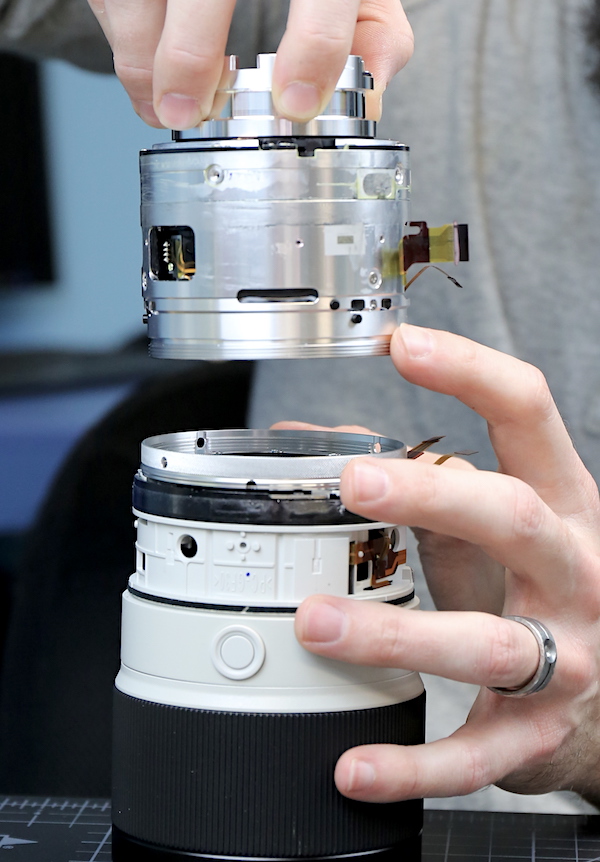
Here’s a view of where the lens divides; the bottom (mount) half is the one containing the aperture ring.
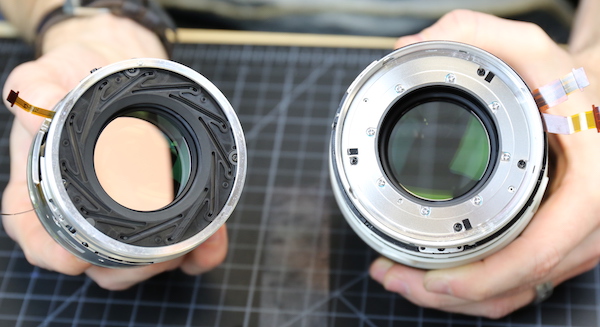
Here’s a side view.
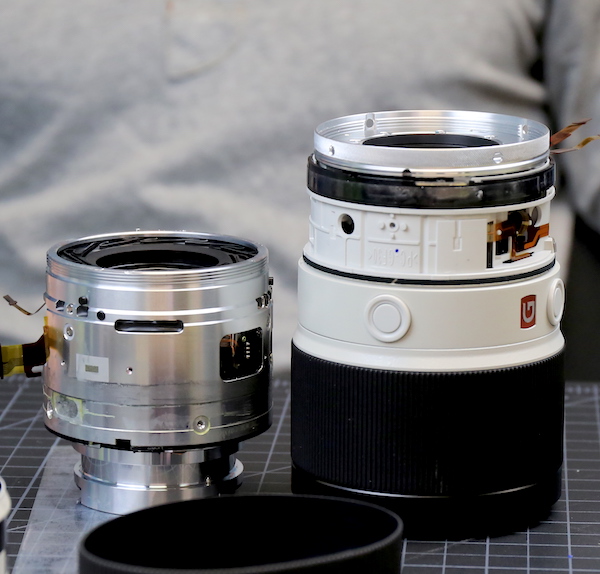
We knew this lens had a problem focusing, but weren’t sure if it was with the front or back focusing assembly. We were kind of in the mood to look into the back part, mostly because that part looked more familiar to us. So that’s what we did. First, the inner light baffle was removed.
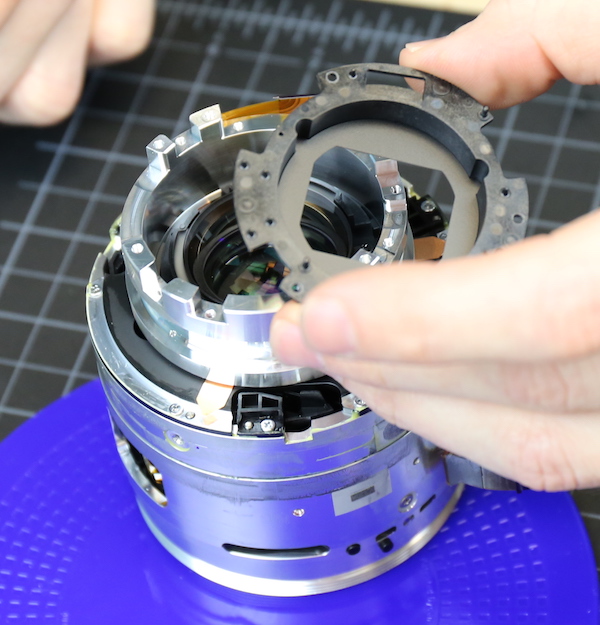
The next lens element was held in place by three screws and was obviously not a centering element, so it was removed next. You can see there are three copper shims which are under it; they obviously can be inserted from outside the barrel. Since these were all 0.15mm thickness, we assume they were for spacing only, not for tilt adjustment.
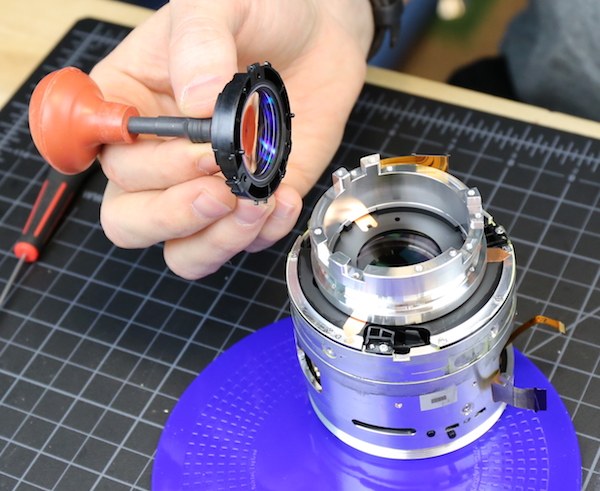
Removing a set of 6 screws and two pins let us take the rear inner barrel off the assembly. We could have left the lens element above in place and done this, but, well, it’s a tear-down and all. You can see this is some seriously solid metal back here.
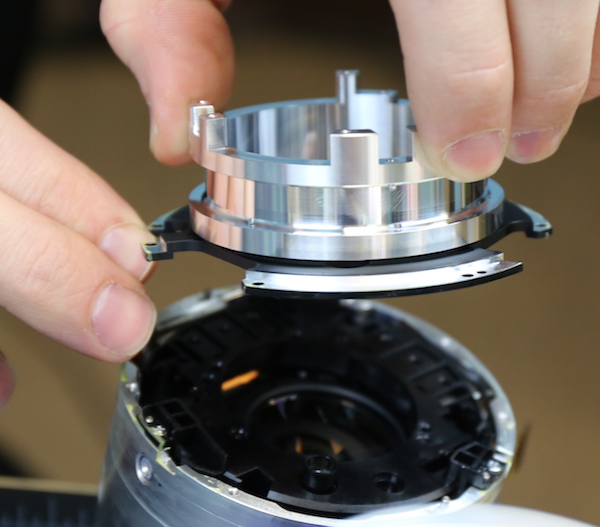
Now the big image stabilizing unit is exposed, and we can remove it. (Just to be clear, we could have done all of this rear disassembly without separating the lens.)
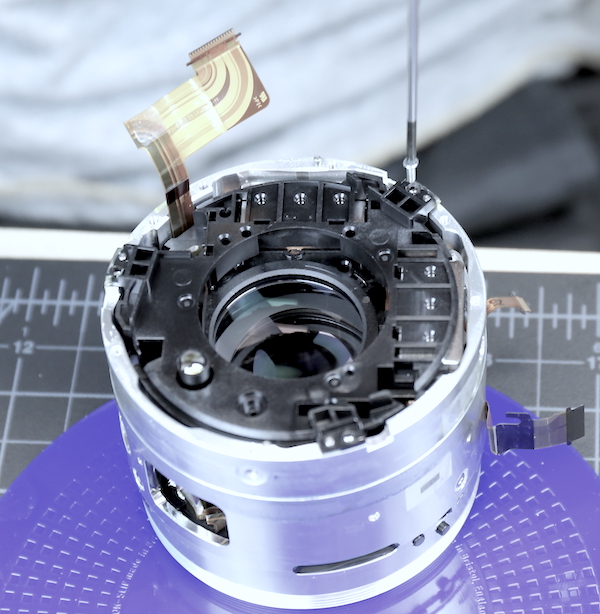
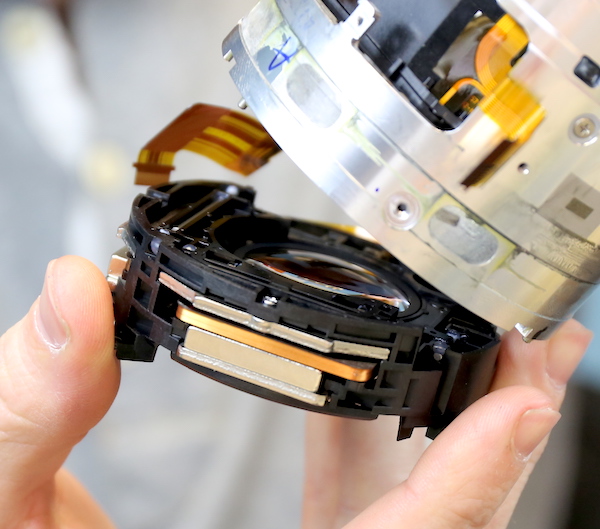
In a lot of lenses, the stabilizers are rather delicate and fragile things. This one is as fragile as a defensive tackle; it’s massive with thick metal plates and rods. I doubt this will be the first thing that breaks if you drop the lens.
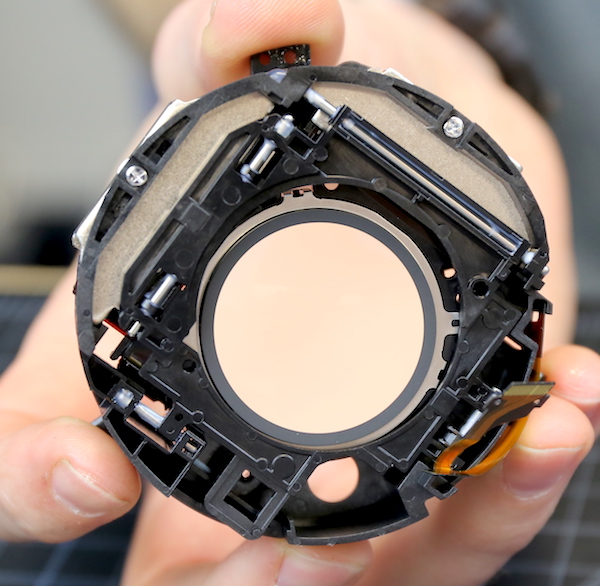
Interestingly, the IS unit is shimmed and the shims were not the same thickness, so the IS unit is being adjusted for at least tilt and perhaps spacing. That’s not unheard of, but not very common either.
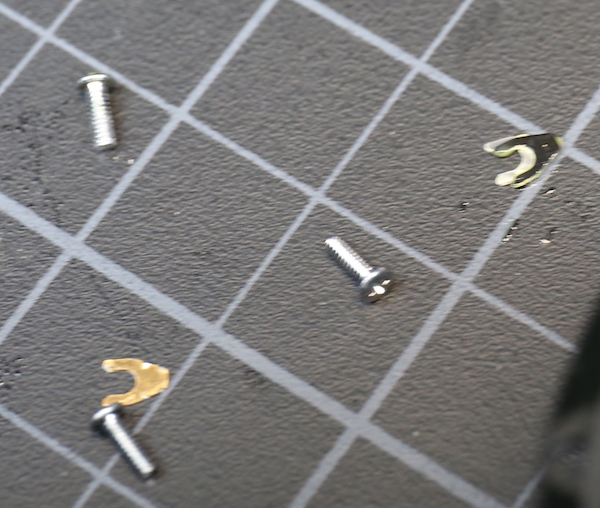
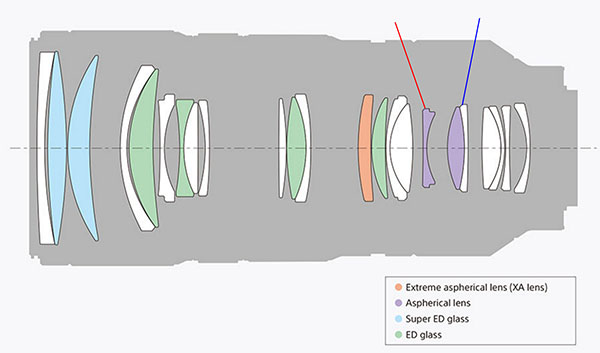
It probably needs to be a hefty unit because the stabilizing element itself is a large, aspheric doublet (blue line). Again, something kind of different from Sony.
With the IS unit out of the way, we can look down on the top of the rear focusing group.
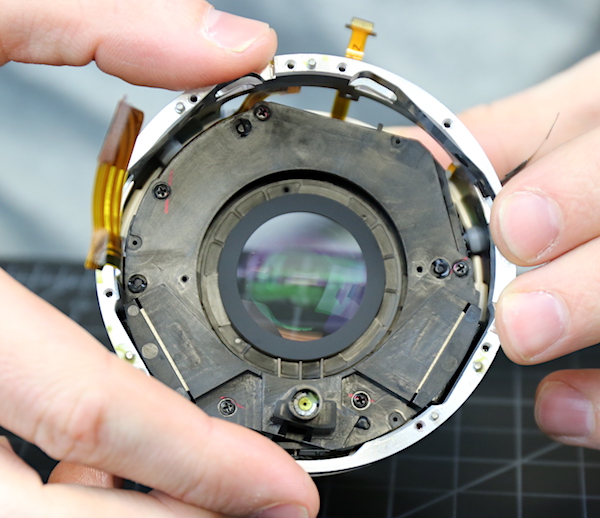
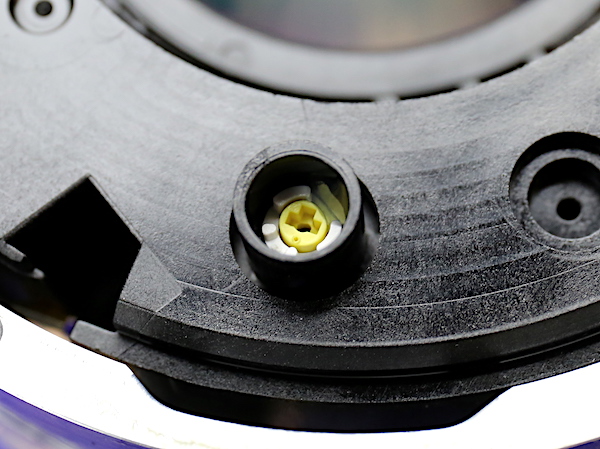
The small, raised, yellow screw you probably noticed in the image above actually adjusts the vertical rod that the electric focusing motor slides up and down on. You can see in the closeup below that it’s eccentric; turning it would move the rod a bit at this end.
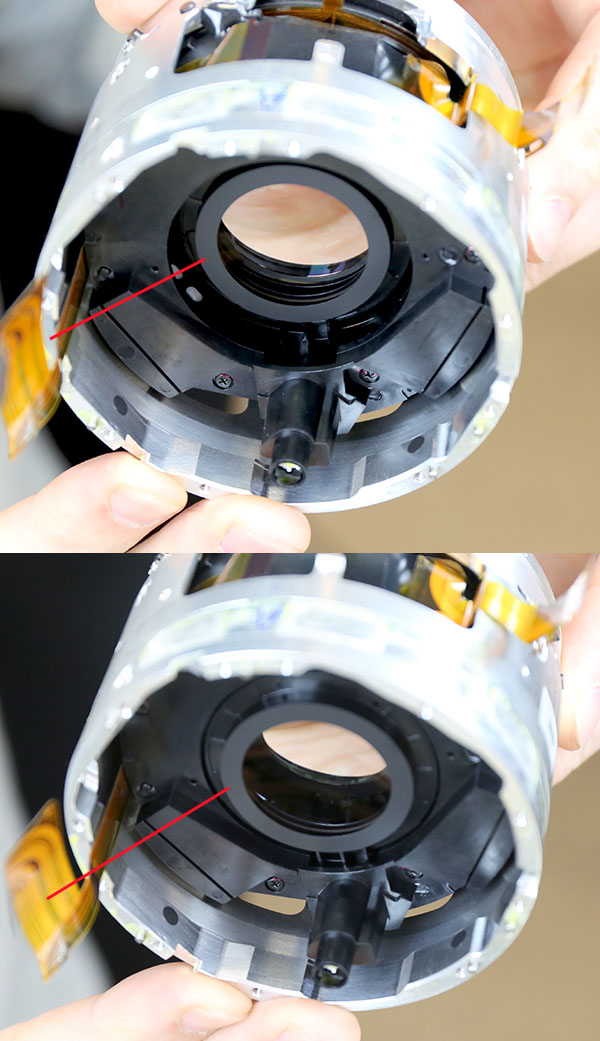
One possibility was the drop had knocked the rod out of position and the electronic motor wasn’t sliding properly. But the element (red lines) moved very smoothly through its full range, so that didn’t seem to be the problem. We had assumed this was basically a compensating group for close focus, but the amount of travel makes us rethink that. It may be a more active participant in focusing than we realized.
So, now nearly 3 hours into this teardown (3 hours is usually the time it takes to complete a teardown and reassemble the lens) we did something we never had done before. No, not break into tears – we took a snack break. What we should probably have done was quit, put the damn thing back together, and sent it in to Sony for them to tell us it would cost slightly more to repair it than it would to buy a new lens.
That’s what we should have done. But Aaron and I, we’re stubborn; and overconfident.
So, if you want to see the front half of the lens disassembled; if you want to see if we actually figured out how to repair it; if you want to see if we just gave up and started drinking heavily; well you’ll have to wait for Part II of this disassembly next week. Because this is already a long article and, as Cowboy Mouth said, “We’re a little more than halfway there.”
Or, as Churchill said, “Now this is not the end. It is not even the beginning of the end. But it is, perhaps, the end of the beginning.”
So What Did We Learn So Far?
- The Sony 70-200mm f/2.8 GM has a lot of solid construction with heavy metal barrels and proper weather sealing.
- The rollers, cams, and screws seem appropriate for what they do. They aren’t over-engineered by any means, but certainly adequate.
- The lens is designed to take apart in the middle. That’s really different for a 70-200 f/2.8, but we’ve seen some super telephoto lenses that are similar. I doubt it’s going to break in half if you drop it. Or more to the point, if you drop it hard enough to break it in half, other stuff would be breaking too.
- There’s a lot of impressive engineering in here, but not what we (from a take-it-apart perspective) would call elegant. It looks similar to a Nikon design, which isn’t a bad thing, Nikon makes lots of great lenses. That are a pain to work on. Pain to work on often (but not always) translates into expensive to repair.
Roger Cicala and Aaron Closz
Lensrentals.com
February, 2017
99 Comments
denneboom ·
Maybe the complexity is also the reason why the 70-200 f2.8 FE is so expensive.
altough to be fair, the new Nikon e version is even steeper
Roger Cicala ·
Possibly. I expect all those low dispersion and aspheric elements contribute, too, along with a dual AF system.
Frank Kolwicz ·
All that complexity and expense and no performance boost over simpler, more conventional lenses? Seems like a design failure to me. And if the serious “unnerving” is yet to come, doubly so.
Patrick Chase ·
Fast telephotos are Sony’s weak suit compared to Canon and Nikon. Their entire offering consists of two supertele primes for A-mount and this lens.
Given relative that relative lack of experience I’m not surprised that this lens under-performs relative to its cost and complexity. I’ve owned several generations of Canon telephotos, and they also had some marginal designs (at least compared to what followed) early on.
Sony simply isn’t up to scratch in this specific department, but given how fast they move I expect much more competitive designs before long. It didn’t take them all *that* long to take their standard zooms from “meh” to the 24-70/2.8 GM, after all.
Frank Kolwicz ·
“Lack of experience”? What’s wrong with the “shoulders of giants”? If this lens incorporated new technology, I could understand it (sort of, like Canon’s DO 400), but it doesn’t, it’s just “we did it our way” = complexity + expense, with no upside, unless you’re already $locked$ into Sony lenses.
If I was a new buyer and this focal length range was important, I’d take a pass.
Patrick Chase ·
As a rule it’s pretty hard to stand on a giant’s shoulders if it doesn’t want you to. Like all tech companies Canon and Nikon almost certainly hold a lot of trade secrets around their design and manufacturing processes.
Just look at the Canon 70-200 IS I vs II. They’re of similar cost and complexity, both rely on fluorite and UD, both had the benefit of computer-based optimization, etc. Canon obviously raised their game in the interim, and they’re presumably not telling their competitors how they did it.
A product doesn’t have to have a flashy feature like “DO” to incorporate and benefit from institutional knowledge and expertise. In fact the opposite can be true: The excellence of a design team often manifests more in the finer details rather than the headline features. Ditto for world-class manufacturing.
Roger Cicala ·
It may also be that Sony Imaging did the same thing that almost every lens design company does at first: hire the best designers money can buy to make the hottest, sexiest design the marketing department can imagine. Then save a bit on the optomechanical engineers, production engineers, QA engineers. It’s a very common pattern that generally gets fixed. Reliability and sample variation control aren’t sexy and aren’t particularly marketable.
Frank Kolwicz ·
That sounds more reasonable than the “black art” argument Patric Chase makes: the goods are on the market for anyone to buy and examine (cf lensrentals blog); Sony’s employees go to the same schools that CanNikoZeiss’ do; and head-hunting is a time honored corporate tradition for up-grading their staff. I simply don’t believe that Sony is in the dark about how Canon and Nikon make their lenses. Sony just decided not to do that for whatever reason and the product suffers.
Roger Cicala ·
I think Patrick has a point, though. One thing every company has to do is work around the other’s patents. So “make us tone of these that does that, except you can’t use this, or this, or this” is pretty common. In electromagnetic focusing motors, for a simple example, the first (I think) company used a U-shaped bar and a flat bar. The second company (I think) to make them used two long flat bars and two short cross bars to make a similar rectangle. Probably a patent in there somewhere.
Frank Kolwicz ·
Thank you, Patrick, for that more enlightening explanation.
More important to my point, what about the optics? That’s where I think the MTF curves and user experiences are most pointedly less than satisfactory on a price per basis. All those exotic optical elements should to my uninitiated eye add up to stellar performance and that’s what I read is failing, not the mechanics of the AF system. Why go to that level of complexity to get a “not bad” performer at a high-end price? All for “sexy” marketing? Yes, but, that was before Roger Cicala and LensRentals.
Of course, with the practice of making early adopters part of the QC process, one should expect that a final tweaking of the manufacturing process might eventually provide an upgraded lens that performs as I imagine it should, per Canon 400DOII.
Patrick Chase ·
To be honest, the more I think about it the more I suspect that Sony’s system (particularly its combination of a large sensor and heavy reliance on CDAF) may be poorly suited to Big Glass, much as rangefinders were in their day.
That would explain why they’ve kept developing the A-mount system, and why their superteles (300/2.8 and 500/4) are only available for A-mount.
Nikolai Vassiliev ·
Actually, 4/500 and this 70-200 are only 135 format fast super-teles Sony developed. 2.8/300 and A-mount 2.8/70-200 are designed by Minolta in late 1990s (marketed in 2000 with Maxxum/Dynax 7 camera and introduction of SSM motor tech.). And they both (esp. 300mm) stands pretty well against competition for 17 years!
But Sony clearly has no big experience with refinement of lens designs – Canon and Nikon for this years made few of it for this pro lens like 70-200, 300, 400, 500, 600 and has more experience.
Todd Godwin ·
It’s interesting how Sony’s work on long lenses has gone fore sure. Minolta, based on the staying power of some of their better long lenses, seems to me to have been an under-rated lens manufacturer. As Nikolai said, nearly all of Sony’s long lenses were designed by Minolta. Furthermore, it seems like Sony should pull a few of their designs back out. Minolta’s 200f2.8 is stellar, and based on a 80-200 f2.8 HS I got the other day, it’s as sharp in the center and sharper in the corners than my Tamron 70-200 f2.8 USM (which is typically considered to fair very competitively to others in this zoom range).
PhilK ·
[Sorry for reviving an old thread]
Minolta also did design work for Nikon. For example, the patent filed for the current 19mm PC Nikkor tilt/shift lens was co-filed with Minolta. 😉
And they are still doing contract optical design work to this day.
Slingers ·
My understanding of the problem for long lenses in the Sony E system is the current OSPDAF algorithms/implementation for when a telephoto is at extreme defocus are struggling to make phase measurements so they have to rely on CDAF and it introduces hunting. It’s the biggest advantage separate PDAF systems have over all mirrorless cameras. There are workarounds added into the Sony cameras with options like pre af where the camera is always searching for one focus point but they can lead to problems as say you have your lens pointed to the ground then lift it up to shoot a bird in the sky you will see the extreme defocus problems as will be focused at the mfd but needed to be at infinity plus the sky will confuse the CDAF.
Jay Dee ·
As a computer guy, and not an OE, I find your teardown presentations fascinating. At age 8 or so, it became impossible to resist the desire to know how spinning THIS dial made THAT indicator move on my Lloyds transistor radio. Out came my Dad’s worn-out #2 phillips, and minutes later, mystery solved. I’ve been fearlessly taking things apart ever since, particularly when they’re too expensive to throw away (which applies to both computer and camera stuff). But I am not brave enough to attempt a lens teardown, so I thank you for letting all of us satisfy our curiosity for free. And thanks also for everyone’s contributions to the thread. Very interesting stuff!
Patrick Chase ·
It’s called engineering, though I’ll take it as a complement that it appears to be “magic” or “black art” to the uninformed.
To see why your argument is wrong, let’s look at Sony’s objectives: They have a full-frame system that requires linear focusing (due to the way their AF systems work), To my knowledge there are no 70-200s on the market that meet those requirements, so the goods are most emphatically not on the market as you said. They had to create something unique.
As an engineer who’s been involved in many “competitive analyses”, it’s important to recognize what you do and don’t learn by examining a competitor’s product.
You do learn their nominal design and materials.
You do not learn how it was created or optimized, which is extremely important if, like Sony, your requirements diverge such that you have to change it. Also, it’s generally illegal to rip off somebody else’s design lock stock and barrel, so even if their requirements were the same Sony would need to know enough about the design and optimization process to create something equivalent-but-different.
You do not learn how it was worst-cased or toleranced.
You may or may not learn how the various components were manufactured, though in cases where there’s high added value you either won’t learn enough to recreate them, or you’ll find that the process is patented (this is the basic criterion for deciding whether to patent a manufacturing process – if you or somebody else can determine the process from the part, then you patent).
Etc…
As to “the same schools”, engineers (including optical engineers) fresh out of school are generally not very skillful product designers. I realize Brandon may object to that assertion, but it’s true and he’ll eventually recognize that to be the case :-).
Brandon Dube ·
I believe Sony made design decisions on this lens in a “Sony” fashion – ignore past products and try to do something new, or drive the price down on a technology. Traditionally, two focusing groups or more has been restricted to cinema lenses, very high resolution industrial lenses, or military applications. There is not really a clear need for it in this lens, but Sony put it in anyway. Because Sony.
I also don’t think Sony requires a linear autofocus motor in their system. The 70-200 GM, for example, is mostly driven by an ultrasonic motor. The on-sensor phase detect probably has slightly higher latency than dedicated phase detection due to the load lack of available bandwidth on the connection to the sensor and existing load on the processor (live view), but these do not really change the game on the system level. Optically, they don’t make a difference – the focusing group (or groups, in this case) will be chosen based on what suits the problem best. This decision involves autofocus speed, accuracy, aberration correction, focus breathing, and other factors.
The optomechanical design is typically made to cope with this choice. In general, it is much easier to make a mechanical design cope than an optical one. There are more simultaneous solutions in that world, so to speak.
Take the lens diagram for example, even if you know that certain elements are “ED” or “ELD” glasses, there are dozens of ED glasses that will produce radically different results if you substitute them. With ELD glasses, you could have a lens totally corrected for blue light, or one with a millimeter of defocus in the blue band depending if you picked e.g. N-FK51A instead of CaF2.
Looking at the diagram, could you tell if the radii were 50mm or 55mm? How about an asphere – do you think you could read the aspheric coefficients that produce perhaps just 50 microns of sag off of the drawing, but entirely define the performance of the lens?
In the field of optical design, there are a number of optical designers who stand out in their era. In the 19th century for example, you had Merte at Zeiss who was responsible for many of their landmark designs, in addition to Rudolph before him, and Bertele at around the same time. More towards the 1980s, Mandler at Leica was responsible for many of their most prominent designs, including the 90 APO, the noctilux, the 50 summilux, the 75 summlux, and so on. In the US, you had Kingslake who was one of the most famous designs of all time working at Kodak. There was Land at Polaroid, Robert Hopkins at American Optical and a large number of other firms, and so on.
The majority of optical components have a very standard way of being manufactures. Some companies (e.g. sigma) tend to CNC. Others (e.g. Canon) tend to traditional methods. Each has its pros and cons. Ground and polished aspheres still dominate for camera lens sized elements, and they are pretty much all made with ring tool geometry CNC platforms. Molded aspheres are becoming increasingly common – the problem has been process stability at larger sizes but that issue is more solved each year. Perhaps in 3 years in the consumer camera lens space molded aspheres will overtake ground and polished ones by volume. The molding process is generally trade secret to any one manufacture, but most of the “new” entrants into this, like Sony, are going to contract out to a super high volume molded lens manufacture in China anyway. The extent to which a customer knows their secret sauce is them saying “we can and want make that” or “we can’t or aren’t interested” and “we’ll do your 10,000 elements in 2 days so we can get back to 2 billion phone aspheres a year on the third day.”
What’s left is the historical context and knowledge of design. Canon’s 70-200 lenses are a what, six generation refinement? Their optical design techniques have gotten more sophistocated with time, as everyone’s have, but there is also a large knowledge of “this worked” and “that didn’t work” from past generations. You couldn’t hire that knowledge even if you tried.
I think it is unwise to project experience in near any other industry onto optics. The elements in your cell phone are manufactured to tolerances in the single digit nanometer scale, and aligned to within 1-2 microns. Ask most mechanical engineers to design a fixture that will impart near-zero force onto what it holds, do it to within a micron, be ultra-compact, and cost less than five cents. I believe most would tell you that you’re off your rocker. then ask them to add an axis of motion that must be very fast, very small, hold those tolerances, last at least 2 years, and also cost less than 30 cents. They might be less polite in their response. Yet apple and samsung are doing that at almost incomprehensible scale.
As for generalizing fresh out of school engineers – I think the majority are unprepared for industry regardless of the pedigree of their degree. You’ll also find that every once and a while there is someone who doesn’t really need the degree to become effective in industry. They are rare, and I would not say I fit that category, but generalizations have their limits 🙂
Patrick Chase ·
Sony’s E-mount cameras use either CDAF or hybrid PDAF/CDAF. The fact that all of their cameras rely at least in part on CDAF is why I believe that the linear motor was a requirement.
Ring-ultrasonic coarse focus plus linear fine focus as you describe actually makes a lot of sense, because as I understand it their recent cameras use the on-sensor PD elements for coarse focus and then CD for refinement.
You also have to consider video AF, which does not allow for opening the aperture to focus. I recall having read that Sony relies more on CDAF for video for that reason (and IIRC that’s why they don’t support video AF with PDAF-only adapted lenses).
Patrick Chase ·
My reply to this disappeared (flagged as spam?) so I’ll have a more succinct go at it:
Sony’s E-mount bodies use either CDAF (older) or hybid PDAF/CDAF (newer). They all use CDAF for fine focus with native lenses, and that’s why I think the linear-drive fine-focussing element was a requirement.
Video AF doesn’t allow for opening the aperture to focus, and IIRC Sony relies heavily on CDAF for video as a consequence. That’s why they don’t support video AF with adapted lenses.
Brandon Dube ·
Phase detect autofocus doesn’t require the aperture to be open all the way. Look at Canon’s dual pixel autofocus cinema cameras.
Patrick Chase ·
Canon’s dual-pixel scheme uses every pixel on the sencor and so can (and does) create adaptively-sized baselines for cross-correlation based on aperture. Sony’s scheme only masks off a small fixed subset of pixels on the sensor, and is therefore prevented from playing those sorts of games.
Even with its adaptive-baseline trick Canon’s dual-pixel scheme doesn’t perform very well at f/8 and beyond. I have a 1Dx II, and video AF gets much slower and less reliable at those smaller apertures. What I suspect is happening is that as the range of incident angles becomes small the microlens selects less strongly between left- and right-incident rays, such that the left- and right-pointing photosites have high crosstalk. Sony’s scheme would have the same limitation.
Both of Sony and Canon’s on-chip schemes share another important limitation, though: They’re both sensitive only to vertical edges.
We can quibble about this all you want, but the fact is that:
1. All Sony FE cameras use CDAF in whole or in part, which creates the requirement for a high-frequency fine focus drives.
2. Sony cameras rely heavily on CDAF for video, to the point where they disable video AF on PDAF-only adapted lenses.
Patrick Chase ·
Another repost because or errant spam-detection:
Canon’s dual-pixel scheme uses every pixel on the sensor and so can (and does) create adaptively-sized baselines for cross-correlation based on aperture. Sony’s scheme only masks off a small fixed subset of pixels on the sensor, and is therefore prevented from playing those sorts of games. As aperture becomes smaller you need to cross-correlate across smaller distances, and a masking-based scheme like Sony’s is constrained (by noise/artifacts) from using groups of adjacent pixels, so they will unavoidably have a larger minimum aperture.
Even with its adaptive-baseline trick Canon’s dual-pixel scheme doesn’t perform very well at f/8 and beyond. I have a 1Dx II, and video AF gets much slower and less reliable at those smaller apertures. What I suspect is happening is that as the range of incident angles becomes small the microlens selects less strongly between left- and right-incident rays, such that the left- and right-pointing photosites have high crosstalk. Sony’s scheme would have the same limitation.
Both of Sony and Canon’s on-chip PDAF schemes share another important limitation, though: In my experience they’re both sensitive only to vertical edges. In Sony’s case they theoretically could mask on both axes, but they don’t seem to have done so at least in the A7R ii.
We can quibble about this all you want, but the fact is that:
1. All Sony FE cameras use CDAF in whole or in part, which creates the requirement for a high-frequency fine focus drives.
2. Sony cameras rely heavily on CDAF for video, to the point where they disable video AF on PDAF-only adapted lenses.
jet ·
your gibberish is a lot of bollocks….
jet ·
“They don’t really get you customers, they keep you customers. ”
exactly that´s why i am a canon customer.
i can only laugh about the shadow pusher and sensor junkies.
the whole camera must feel right.
i also own a A7 II and to be honest i would not buy it again.
Y.A. ·
Sony has had too many opportunities to learn this lesson…. I’m convinced this is just how they work. Look at the 50 1.8 they just made, with a focusing mechanism straight out of 1986…………..
DrJon ·
Do we actually know who designed this lens? Sony in-house? Minolta? Someone else?
Are there any cluse in the design?
Patrick Chase ·
Yeah, but the Nikon is *good* (ducks and covers)
mtnman1984 ·
Why two focus groups? High energy demand with the stabilization enabled? My a7rii sucks down batteries fast as it is.
Roger Cicala ·
OH, we got some unnerving for you, but that’s in part 2 🙂
mtnman1984 ·
Awesome. Maybe I’ll remain in the Canon world. Nice tease.
Mike Aubrey ·
Win for the Hardy Boys cover.
fanboy fagz ·
wow, nice metal build on the sony.
any disassembly of sigma art lenses? curious how well theyre built. especially the 85mm.
mtnman1984 ·
Search the blog. They did an ART a while back.
Clayton Taylor ·
Put it on a t-shirt, and I will take a Medium, please.
Oleg ·
You guys have a great sense of humor 🙂 Very enjoyable reading as usual. Thanks!
Chik Sum ·
Any comparison on the build quality to the 70-200 G which have repeated reports of splitting in half even on delivery with the box not even damaged?
Roger Cicala ·
Well, we still have a lot to get through. -):
Patrick Chase ·
Now that you’ve established that the lens divides in two like that, I’m sure that a whole lot of Canikon-fanboy forum warriors will suddenly discover that they own 70-200/2.8 GMs that have split in half.
You know, kind of like how they all discovered that they owned 85/1.4s that were grinding because of the shavings.
Chik Sum ·
To be clear that I am a canon user but no fanboy by any means, I actually persuaded two of my friends to get the A7 S which gives way better high ISO performance compared to my 5D iii.
But that splitting of the F4 lens looked worrisome and in deed hold me back for recommending my friends to own it.
Just curious that the GM lens looked so toughly built, and I am wondering would it be actually learning something from the f4 lens and made improvements in the jointing mechanism
YS ·
To be clear that I am a canon user but no fanboy by any means, I actually persuaded two of my friends to get the A7 S which gives way better high ISO performance compared to my 5D iii.
But that splitting of the F4 lens looked worrisome and in deed hold me back for recommending my friends to own it.
Just curious that the GM lens looked so toughly built, and I am wondering would it be actually learning something from the f4 lens and made improvements in the jointing mechanism
Looney11 ·
So you’re more worried with the possibility that people can troll Sony than with the possibility that a lens this expensive can split in half?
A lens at this price point should last a lifetime.
Maybe the trolling can make Sony rethink the build quality of their lenses, and in the end we’ll get better products, so bring on the trolls!
Patrick Chase ·
The trolling just degrades the signal-to-noise ratio to the point where nobody can tell what’s really a problem. That was really my point, and that’s why I chose the 85/1.4 “shavings” fiasco as an example.
Now that I’ve seen part deux, it’s clear that the mid attach is a significant vulnerability, though of a more insidious sort. It won’t lead to lenses falling apart (too many screws). They’ll just get really soft.
Zen ·
So you're more worried with the possibility that people can troll Sony than with the possibility that a lens this expensive can split in half?
A lens at this price point should last a lifetime.
Maybe the trolling can make Sony rethink the build quality of their lenses, and in the end we'll get better products, so bring on the trolls!
advion ·
I really enjoy your tear downs thanks for documenting the process.
Patrick Chase ·
One thing that strikes me from staring at the diagram: That rear focusing element is *small*. It appears to be about 40% of the diameter of the front element, vs ~50% for the smallest element in the Canon 70-200.
As Brandon notes I am not an OE, so this is speculation, but: Is it possible that the requirement that the rear focusing element be light enough for available linear drives drove their design down an otherwise less-than-optimal path, perhaps with a smaller exit pupil than would otherwise have been used? Might that also explain their unusual use of aspherics, both for that focusing element and its neighbor?
jet ·
the sony mirroless lenses are as big as canon or nikons.
the hyped “size” advantage of mirrorless is pretty much gone or overall a mere 10%.
i have the feeling the sony GM lenses drain my batterys even faster.
battery life is really a bad thing with sony mirrroless cameras.
i lost good shots because the battery died at exactly the wrong moment….
Y.A. ·
Physics are physics. Optics are optics. 70mm is 70mm, 200mm is 200mm. Not sure what you were expecting.
There are no DSLR equivalents for lenses like the 28/2 or 35/2.8, and even if something comes close (like the EF 40 2.8) there are no ~450g FF DSLRs like the A7.
Not to mention 4K video and WYSIWYG + complex overlays through the viewfinder. Batteries and grips are cheap too. If DSLRs are so great, go back.
Busha Busha ·
Physics are physics. Optics are optics. 70mm is 70mm, 200mm is 200mm. Not sure what you were expecting.
There are no DSLR equivalents for lenses like the 28/2 or 35/2.8, and even if something comes close (like the EF 40 2.8) there are no ~450g FF DSLRs like the A7.
Not to mention 4K video and WYSIWYG + complex overlays through the viewfinder. Batteries and grips are cheap too. If DSLRs are so great, go back.
H.G.Schmitt ·
I’m just loving it. Please, continue tearing down more lenses.
Bob B. ·
I have no desire to EVER take a lens apart. Not even the one on my eyeglasses….but as usual…I am totally entertained with the sense of adventure and humor present in such undertakings here at Lensrental! So far I am glad that I do not have a Sony-of-my-ownie….The only thing I like halved is a grape fruit….. but I am enjoying the science versus pain with a little (or a lot) of curiosity thrown in.
Truly entertaining and am awaiting the next act!!!!
Marty4650 . ·
It took two of you six hours to tear down this lens, but it only took around 40 minutes for one worker in Thailand to assemble it. And he or she was probably getting $4 an hour. You boys need to pick up the pace if you ever want to find a good job in Southeast Asia….
Roger Cicala ·
Well, yeah, but she knew what she was doing. And we needed that snack break.
Ademeion ·
And I bet it took quite a lot more than 40 minutes for the worker in Thailand to assemble the first one.
Cesjr86 ·
Uuuummmm snack break…….
Patrick Chase ·
In addition to everything others have said, it’s a lot faster to apply silicone glue than to remove it. This lens was designed to be assembled once, but not repaired (other than the stuff that’s accessible through barrel openings).
entoman ·
I always used to think that lenses were overpriced, but the amount (and quality) of engineering that goes into them is quite amazing. The inside is so much more interesting than the outside! Thanks for yet another fascinating and reveealing tear-down. I can’t wait for part 2!
Mike D ·
Based on the videos I’ve seen on how lens elements are made from glass blank to polished and coated element, I could never believe how cheap lenses were. There has to be some sort of automation process in making the smaller elements that the manufacturers are not letting us know about. Even cheap P&S cameras have some pretty sophisticated lens elements in them.
Brandon Dube ·
A sphere is a sphere. To hand grind one from a blank takes between a half day and a full day. The traditional method would be to replace the hand with a clamping arm in a machine, and load 6 lenses on one grinder. Then you have one operator working, say, 10 spindles producing 60-120 ground lenses a day.
The polishing takes longer; Often 2-4 days depending how aggressive the grind was.
Fully automated would be CNC, which is around 50% faster overall but can only do one lens on one machine at a time. Since the grinding/generating process will only take a few minutes per cycle, you probably have one operator to one machine.
For aspheres, they’re all made on ring tool geometry CNC machines, like this: https://www.youtube.com/watch?v=4_etSKB0ueY
That is for a sphere, but the only change for an asphere is that the head angle varies as it works through the surface.
The “onion ring bokeh” phenomenon you see is a product of subsurface damage left behind from CNC grinding, which is extremely aggressive, that was not completely removed in the polishing process.
Patrick Chase ·
A fair number of aspheres for photographic lenses are glass-molded these days.
Brandon Dube ·
That number is far smaller than the number that are ground. The mix is about 7 ground to 3 molded right now. You can only mold plastics and low-Tg glasses. That gives you 16 moldable materials. You can grind any glass and any crystal, but no plastics.
Athanasius Kirchner ·
Wow Brandon, that’s a lot of very interesting stuff! Thanks for sharing it.
Mike D ·
After the CNC video was another video showing the “old school” way of producing lens elements. What a difference. However, over 1.4 billion smart phones are sold each year with 7+ lens elements in each one. These numbers don’t even include the traditional DSLR lens demand, video camera lens demand, and security camera lens demand. Wow.
Brandon Dube ·
Cell phone lenses are all injection molded plastics. Here’s a lens diagram for one,
http://www.777a7.com/img144/arnbzoptbbufjpkiyuad.jpg
They would be impossible to manufacture by any other method.
Astro Landscapes ·
Yup, like others have said, its the exact opposite that is true. These lenses are insanely cheap, and subsidized by cheap labor, considering the technology and MFG / assembly that goes into them.
TLDR, if Really Right Stuff ever decided to make “the ultimate 70-200”, and make it here in the USA, it would cost $5-10K easy.
Benz Oberst ·
Hey, but look at the bright side – you have not had to desolder anything. Yet.
EvilTed ·
You haven’t seen the pictures of the 70-200 F4 that broke apart in the middle then?
There are several documented cases around the net.
One broke bouncing around in the rear of the guys car 🙁
Astro Landscapes ·
My friend once had a 70-200 2.8 L mk1 that toppled over while on a tripod, and it turned into what I can only imagine was roughly akin to a lens baby, or a very, very soft tilt-shift lens lol.
geekyrocketguy ·
Can confirm. I’ve seen a couple Canon 70-200 f/2.8L Mk1s that turned into push-pull lenses (with about a centimeter of extension in the middle) after being dropped. One of them had to be focused by pointing the lens up or down (depending on which way you wanted to shift the focus) and shaking it.
Astro Landscapes ·
1.) That Hardy Boys photoshop is AWESOME.
2.) Can I get a T-shirt that says “LET’S VOID WARRANTIES!” on it, with a picture of your most complex disassembly on it? And it can say LensRentals.com on the back, of course.
3.) BUT WHY IS THE LENS SOFT? (said in Jack Sparrow’s voice, of course…)
Roger Cicala ·
Well, it’s been done, but I like the idea of the teardown picture.
https://www.amazon.com/Warranties-Mechanic-Engineer-Tinkerer-T-shirt/dp/B01IC16KKC/ref=sr_1_1?s=apparel&ie=UTF8&qid=1488049265&sr=1-1&nodeID=7141123011&keywords=I+void+warranties
Wigglefoot ·
Fantastic piece. You guys are fearless. And have a wonderful sense of humor.
One tiny correction:
“A bit to our surprise, we discovered are ring…”
should probably be
“A bit to our surprise, we discovered our ring…”
Roger Cicala ·
Thank you. Fixed that.
pl capeli ·
so that one ring ruled them all ……as was said your tear downs are wildly entertaining …..sort of the opposite of how things work , as the lenses you tear down , dont work
Jeff Sellenrick ·
Win for the Churchill quote
Slingers ·
Thanks for the post. These blog posts should be added to the warnings for disassembling the lens in the warranty information.
Jay Philip Williams ·
That “grippy surface” is called knurling.
Roger Cicala ·
Thank you. But ‘grippy surface’ is right up there with ‘roller thingies’ on my list of favorite things to say 🙂
Sixpm ·
So the money any lens manufacturer asking really is like crowd funding or at wholesale price as from design to manufacture plus design knowledge knowhow etc…what we pay for then is absolute bargain viewed from this perspective.
Vanitas Foto ·
Why do you think they manufacture in Thailand, Malaysia, China, etc? Cheap labor is the only way to make the lens “cheaper”.
Sixpm ·
But still can’t hide the fact that expertise, machining, production line cost is very costly, so the price we paid are tiny fraction of the setup costs and can be considered ‘cheap’ disregard where it is made or labour used.
Volker Bartheld ·
Hi Roger!
When you’re saying “Most of ours now have some raised metal (red lines) on either side of the lock-pin slot. This isn’t causing any problems yet”, emphasis should be put on the word “yet”. I’m pretty sure this will inevitably scratch and long-term create burrs in the flange of the camera in that region. The protrusion can also tilt the lens, fractions of millimeters count. Lens bajonets should be flat for a good reason. Never happened to me with the 70-200 F/2.8 Nikkor, so what you’re witnessing here is pretty embarassing for Sony IMHO. Or your Sony customers are severy lacking gross motor skills. 😉
Greets,
Volker
Martti O Suomivuori ·
I am very curious to know how many people there are in the world who are actually capable of creating a stabilized autofocus high-end zoom objective. It cannot be very many. Do they have their landmark designs that they vary according to the job at hand? Can you recognize the designer team from the product? The concentration of information is impressive…the optical properties avarious glass materials and the particularities of millions of available designs and combinations. Sensors, actuators, processors, the physical properties of metal alloys….and the extreme low tolerance engineering that is required to please the most OCD pixel peeper…
I took apart a Jupiter-3 lens and got it back together again.
That was Soviet engineering from 1920s German blueprints.
That I could handle.
I love reading Cicala et al. taking apart and reassembling the modern lenses.
They do not seem half as pricey when I actually see what’s inside. I do not think that the engineering elite has ever before been this far detached from the users of their products.
Still, a 1970s truck driver could get his engine running in the middle of nowhere with the tools he got under the seat. Now, try tto fix a Prius…
Or a camera lens.
I do realize that I belong to an earlier era.
Roger Cicala ·
Martti,
Creating the optical lens design is one thing, an individual could do that. But creating all of the electrical, mechanical, and computer engineering that goes into it requires a team.
There is a lot of ‘reusing’ both as starting places for the optical design and even moreso for the optomechanics. You do get to see the fingerprints a bit. For example, some lens designers what an even look and smooth bokeh while others are more interested in maximum resolution. Much moreso we see the fingerprints in the optomechanicals. Canons look like Canons inside, Nikons like Nikon, etc. This Sony has a lot of Nikon look inside, but not all of the Sony lenses do.
Barbu Mateescu ·
„Still, a 1970s truck driver could get his engine running in the middle of nowhere with the tools he got under the seat. Now, try tto fix a Prius…”
First, that 1970s truck would need constant maintenance. Nowadays you get a Prius (or any number of entry-level autos) and run it years on end, only checking the tires and exchanging oil + filters.
Out of 4 cars driven on about 200k kilometers (125k miles) only one needed a repair for some brake component.
Carleton Foxx ·
Silicone glue sounds like it might be handy for other photo-related projects—what brand do you prefer?
Damir ?olak ·
Give us the Part 2!
The suspense is killing us!
Roger Cicala ·
It will be out on Monday! 🙂 Sorry for the drama, I couldn’t write this all in one post. OK, not sorry for the drama. But really Part 2 is almost too long by itself.
Arpe ·
C’mon then, it’s Monday here now (NZ)!
Damir Čolak ·
Give us the Part 2!
The suspense is killing us!
Jim H ·
Does the customer who dropped the lens get any credit for this educational exercise or will you be charging them by the hour?
Roger Cicala ·
Jim, if I recall they had insurance so they aren’t getting charged.
Ian Goss ·
What a great resource you folks are! Nearly said ‘guys’, but hoping a few from the distaff side may be involved.
Prefer Anonymous ·
anyone have clues to why samsung nx2000’s cameras suddenly becoming a brick?
elektriker2007 ·
Hello Roger,
thanks for your great teardowns.
I have a small problem with my Sony SEL 70-200 GM 2.8. And although there is the following situation.
When I take pictures in cold temperatures (around 0 degrees) for about 30-40 minutes outside, the camera does not show any aperture and the AF does not work anymore. I noticed that the camera start (until a picture is shown) is approx 5-6 sec. If I come back into the heat, everything will go back after about 20-30 minutes. The problem exists only with this lens and with both bodies (A7 and A7 M3). Whether the camera is cold or not does not matter either.
As far as the situation.
I then brought my lens to service and was able to pick it up again today.
According to the service technician there, the error is known to Sony, but they do not know at the moment what it is. Sony recommends replacing the motherboard – according to the service technician this does not solve the problem. Since I have to pay it myself, I was advised not to swap the motherboard.
They have 4 or 5 70-200 GM with exactly the same problem – but it does not necessarily have anything to do with temperature. For me it is only if the lens is longer in the cold.
Since there is no solution at the moment I have taken the lens with me.
Are you aware of similar problems? I can honestly not imagine that a solution is sought …. the lens has been on the market for almost 3 years.
The lens is from May 2016.
Kind regards, Sascha
Marcin Rafacz ·
Hi i have exactly the same problem with my SEL 70-200 GM ( + A7 M3) . Has the problem been resolved?
Socrates Vela ·
I have the same problem. Did you ever figure this one out? I noticed that if I shoot at 45degF or higher, it works, fall below that and the lens stops autofocusing and I can’t control aperature.
Bjorn Spiteri ·
When I open rear cap I notice a small ring between lenses moving slightly to each side when I move it around .it does not obscure the back lense but it moves. Is it normal?
Also there is a white dot or dirt stuck inside .
Jesse Schlemmer ·
Any chance you guys could let us know how you got "A bit to our surprise, we discovered our ring was a lock ring that held the two halves of the lens together." apart. I've been trying for over an hour. Removed all the glue I could. Definitely feels like it moves and then hits something, but I'm not understanding what it could be locked on or hitting.
Hoping after all these years someone responds or remembers! Sony basically told me to fix the lens costs more than a new lens and found the main flex cable at the top ripped in half.