
Canon’s Holy Grail – Using the Canon 200mm f/1.8 L USM
Certainly, you’re probably aware of Canon’s 85mm f/1.2L, and the Canon 50mm f/1.2L, but Canon has a long history of incredibly fast lenses, many of which that have since seemingly disappeared off of the face of the Earth. Many of them are now called the Holy Grails of Canon Glass and for legitimate reasons. Among those ‘Holy Grails’ are the likes of the Canon 50mm f/1.0, the Canon 300mm f/1.8L, the 1200mm f/5.6L, and of course, what we have here… the Canon 200mm f/1.8L.
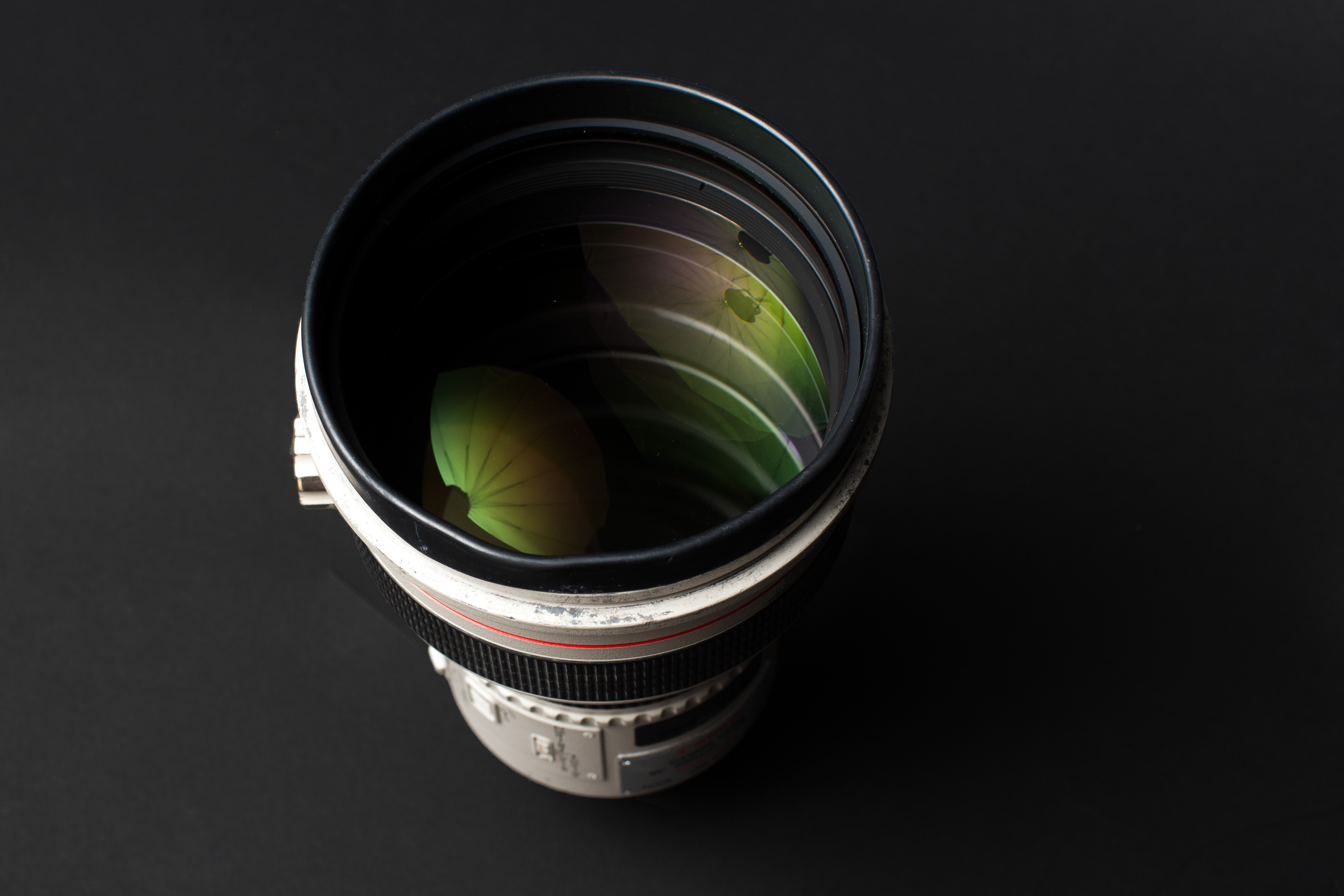
For those of you who have been long-time readers of this blog, you may know that both Roger and I share the same appreciation for the Canon 200mm f/2L IS, with both of us probably naming it our favorite lenses when asked. But back from 1988 til 2004, Canon made an even faster 200mm lens. At an incredible f/1.8, there were only approximately 8,000 units produced in its 16-year run. And with many of them assumed destroyed or lost, many people estimate that just a few hundred of these lenses exist.
So when I got word that my friend and event photographer Air Butchie had one of these monsters, I had to get my hands on it and compare it to the beloved Canon 200mm f/2L.
Build Quality
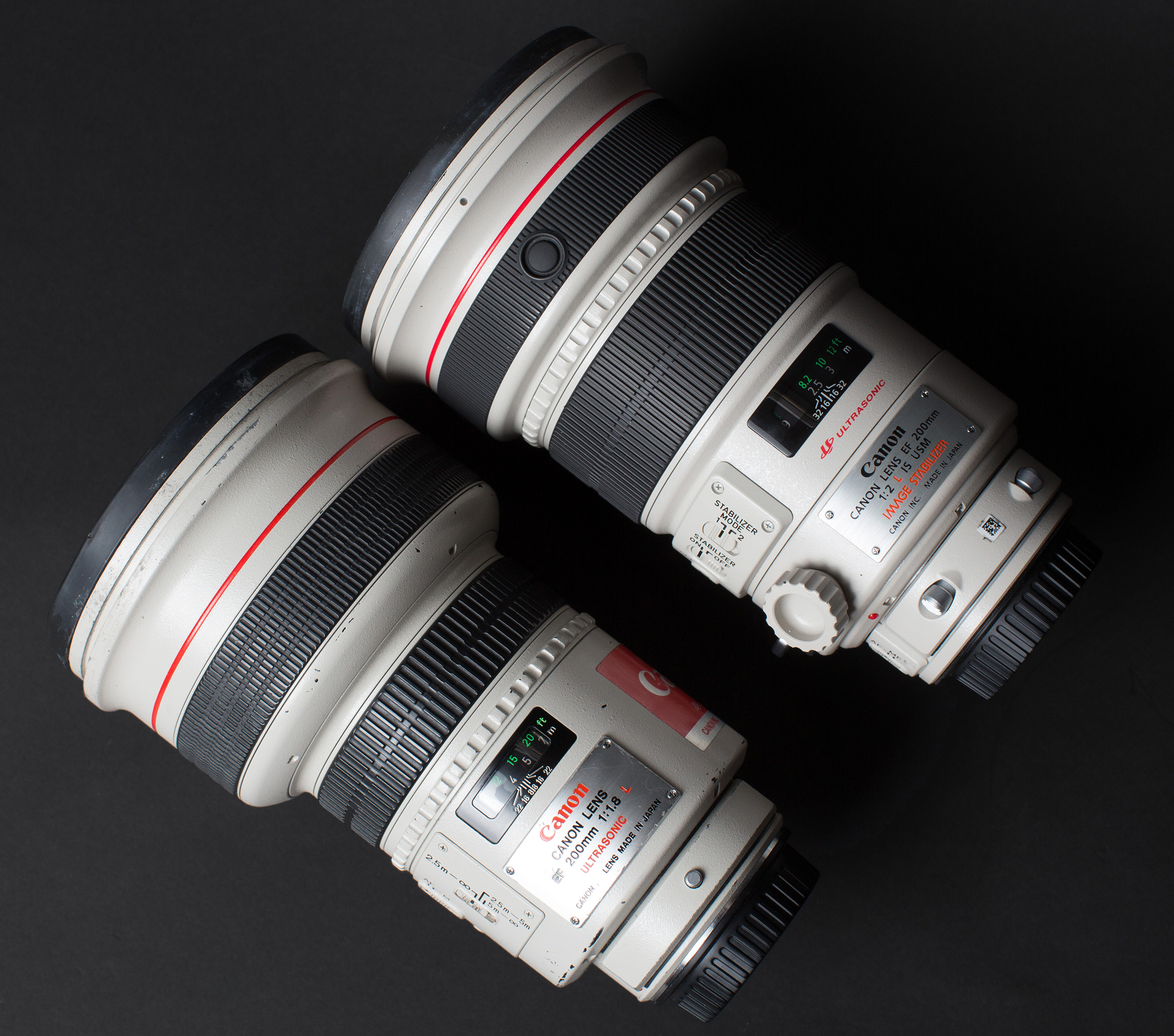
To start with the comparison, it’s always most natural to look at them cosmetically. One thing you may notice is that it shares the same size and shape of the Canon 200mm f/2L for the most part, appearing only slightly larger at the front element of the lens. And the build quality is exactly what you’d expect from a premium L series lenses. As you can probably see, the Canon 200mm f/1.8L is beaten up, but still works as if it were brand new. As for comparing it to the Canon 200mm f/2L, both share the beefy size and weight. At 6.6 lbs (3,010g) without the half-pound lens hood, the Canon 200mm f/1.8L is well balanced but will give your arms a workout in handheld situations. However, with the Canon 200mm f/2L at 5.6lbs (6.2lbs with the hood), the older f/1.8L version doesn’t feel much more substantial at all.
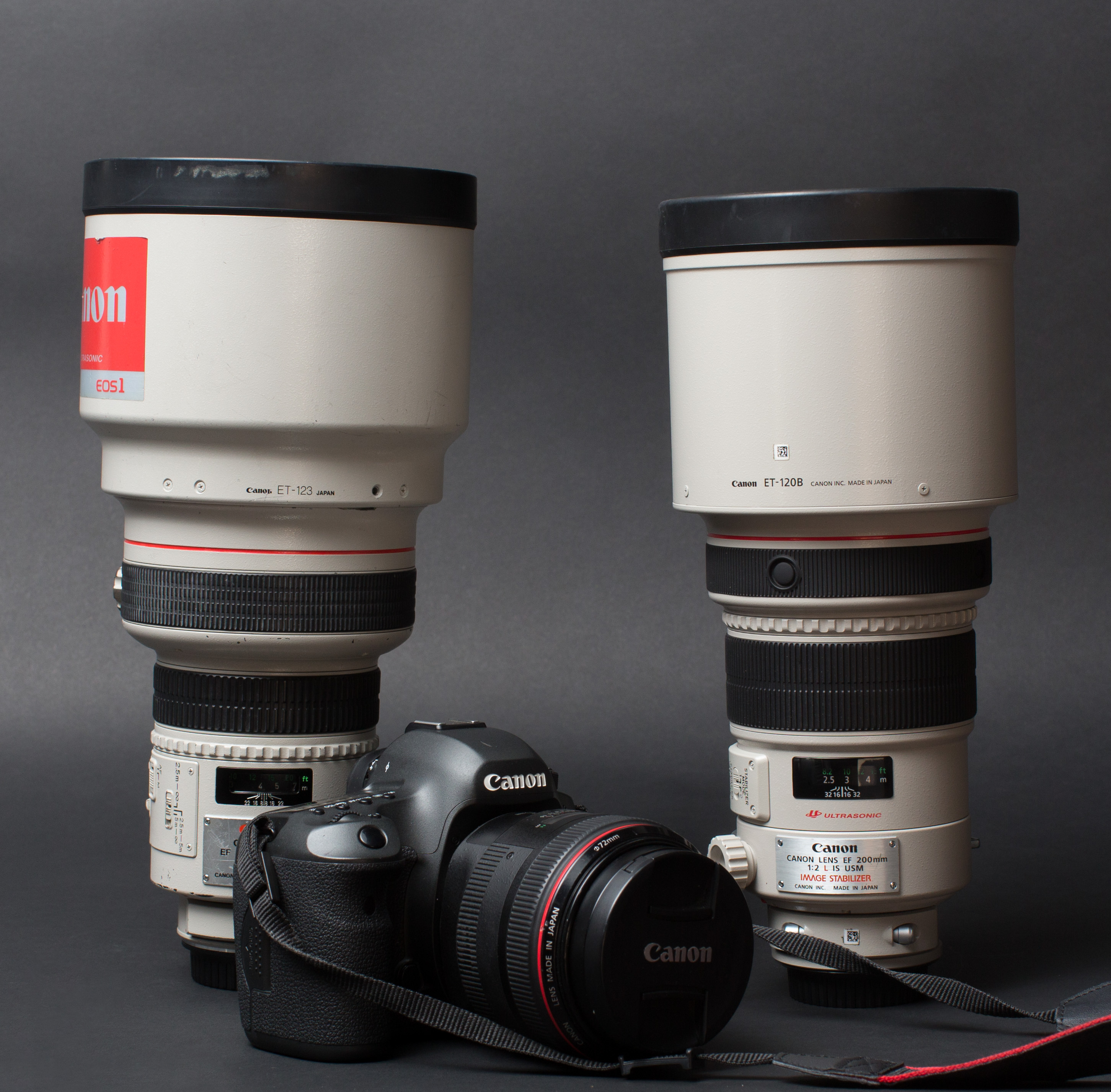
The biggest significant difference between the Canon 200mm f/1.8L and the Canon 200mm f/2L comes with the focusing system. Using a focus-by-wire system, the Canon 200mm f/1.8L shares the same focusing ideology as the Canon 85mm f/1.2L (and a few others) where manual focusing can only be done when the camera is powered on and switched to manual. However, to counteract this unique focusing design, the lens also has a switch, allowing you to adjust your manual focusing speeds from the precision mode, to normal, and even a fast pace mode – for fast moving objects. All this aside, the autofocus system seems to be every bit as fast as the Canon 200mm f/2, and I’ve had very little issue with accuracy, even at f/1.8 (and while handholding; which is impressive).

There is no doubt why this lens has the nickname ‘The Eye of Sauron’. A Hobbit/Lord of the Rings reference, The Eye of Sauron is a symbol of the antagonists’ quasi-omnipotent power and a thing to both fear and respect. The Canon 200mm f/1.8L earns this name for not only its massive front element and legendary sharpness but also its extreme rarity within the modern world. Additionally, the lens holds some manifested danger; built originally in 1988, its creation is before Canon introduced a lead-free policy. At that time, Canon had introduced lead in their grinding process for the optics, so opening a lens like this up might increase your likeliness of lead poison. See, it even shares some of the same danger as Sauron as well.
Image Quality
If I were to describe this next section in a single word, it’d be incredible. With my limited use of the Canon 200mm f/1.8L, it shows absolutely no signs of age. The autofocus is accurate and zippy, and the lens shows no signs of optic issues, despite the fact that it’s beaten up outer shell (which you may be able to see above) shows it’s age and use. Checking the date code of the copy of the Canon 200mm f/1.8L I have access to, it shows it was built in Japan in 1992. With it being impossible to service over the last 13 years, and the prolonged use it gets from its owner, I’m quite surprised that I’ve faced absolutely zero back or front focusing issues.

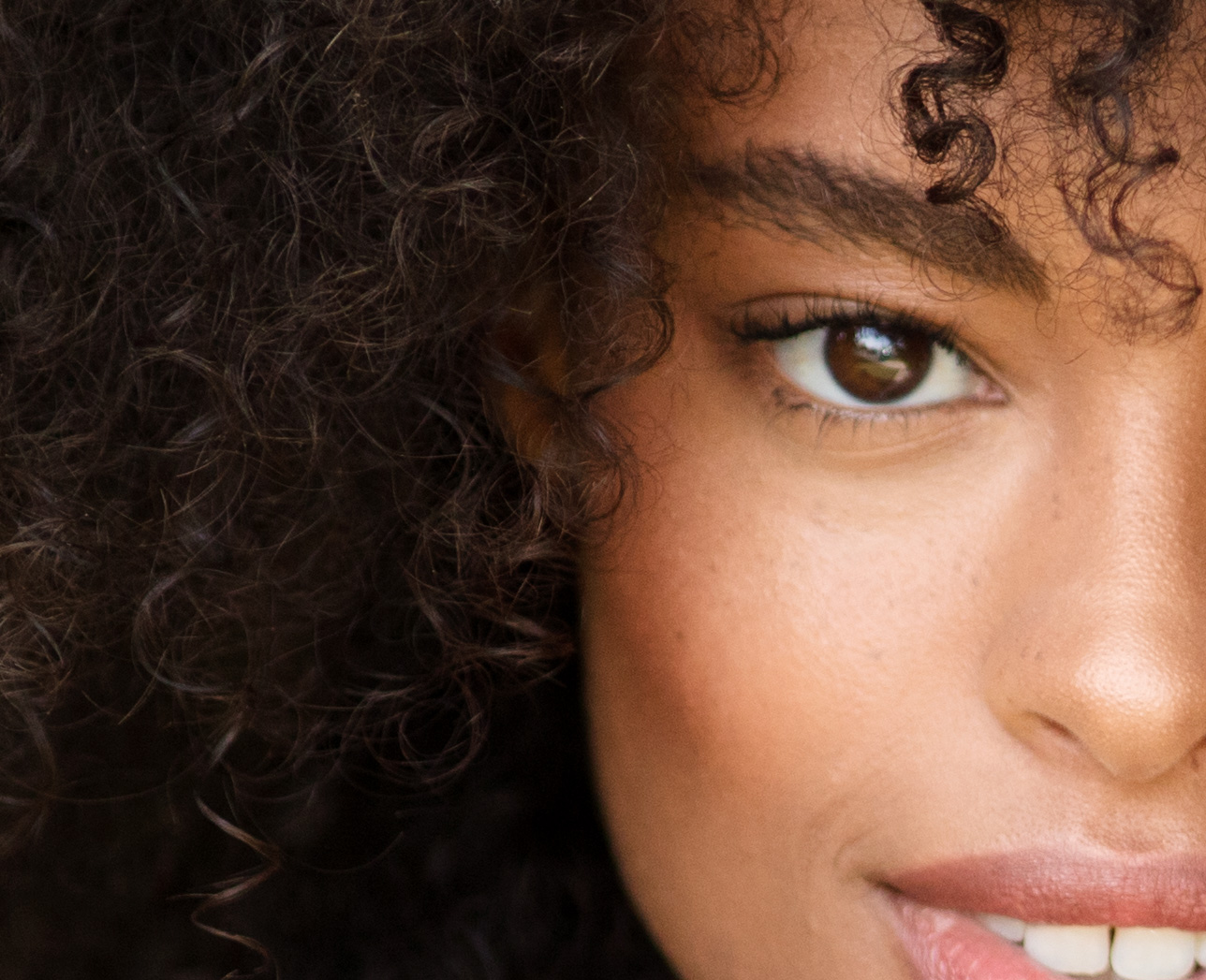
Sharpness is something I can’t really describe in a single adjective, but rather, you need to use a Canon 200mm f/2L IS for yourself to understand how incredibly sharp this lens is. There is a reason why so many people often argue that the Canon 200mm f/2L IS is the sharpest lens in the Canon lineup, and while using the Canon 200mm f/1.8L, I’ve found where Canon got its sharpness inspiration from. While the f/1.8L version might not be able to match the incredible sharpness of the newer f/2 version, it does put up quite a fight and looks every bit as sharp when using 100% crops. We’re hoping to be able to ship this f/1.8L version out to Roger in Memphis so that he can give it his proper Olaf MTF testings if there is enough interest for it. So if you want to see how it holds up to his tedious testing, be sure to leave a note in the comments below.
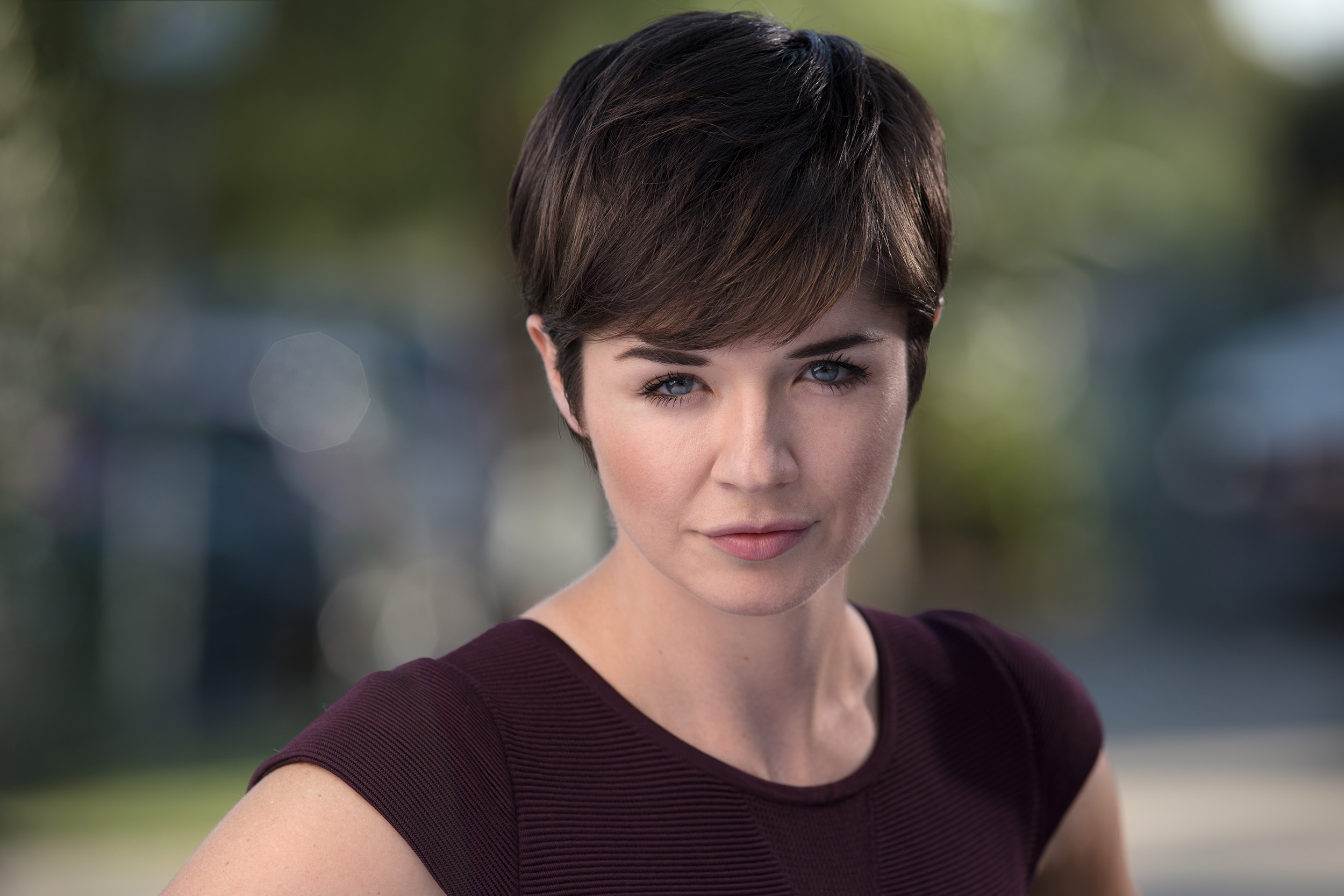
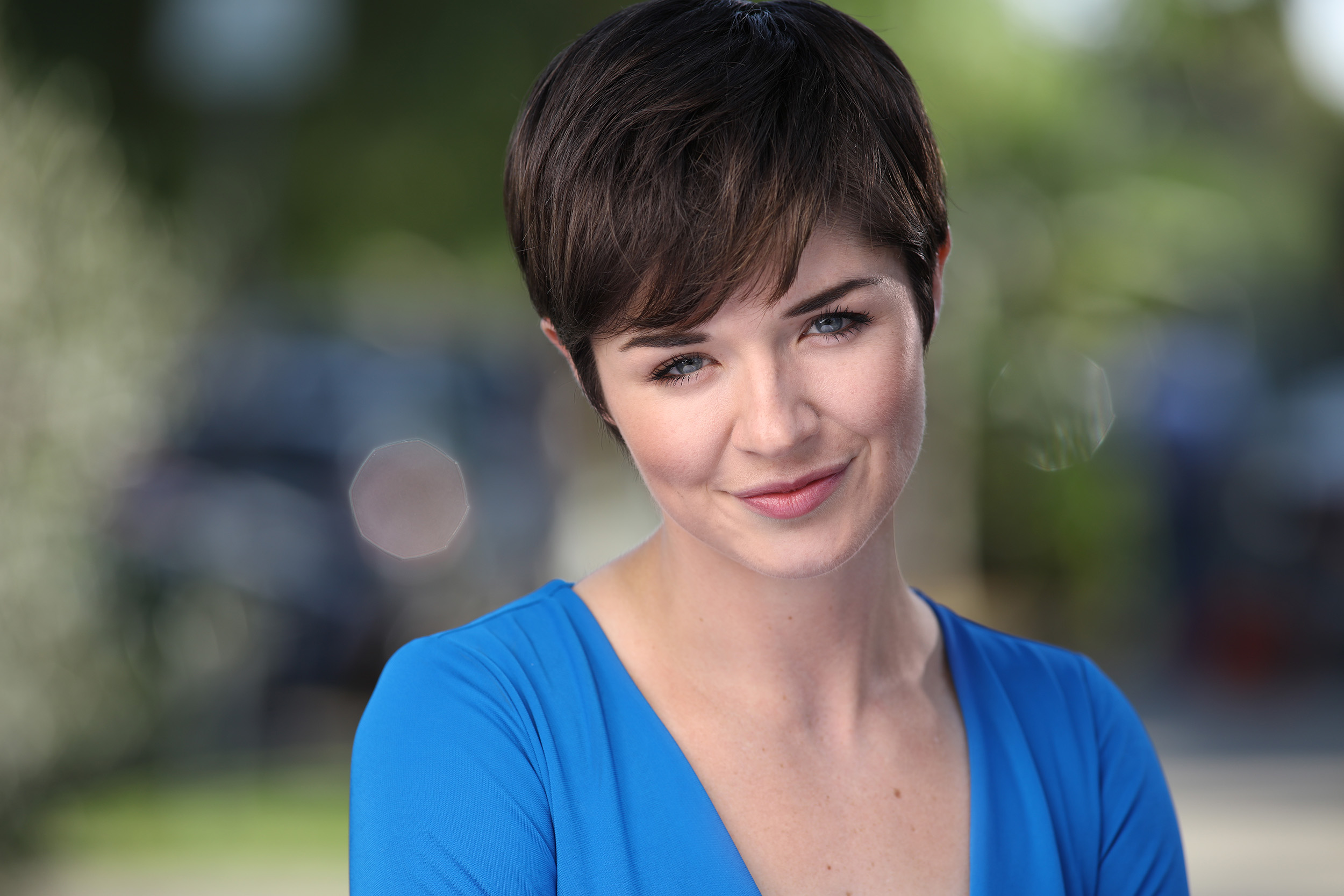
So Why Was It Discontinued?
This is the age old question that seems to leave everyone scratching their heads. This lens, among a few listed in the intro, is considered one of the holy grails of Canon glass; so why did Canon decide to discontinue it and replace it with a slower version? Well, one culprit seems to be sales. From its introduction in 1988, until its retirement in 2004, the Canon 200mm f/1.8L only saw 8,000 sales. And the slow sales have plenty of its contributing factors. For one, 200mm is a strange focal length. A bit on the long side for portrait photography, and short on the sports photography side, 200mm is limited to indoor sports and is a bit of a black sheep in many of the sport telephoto scenes. Especially when you consider that in its retirement year of 2004, 5-megapixel sensors were considered the cutting edge of technology, so cropping while maintaining a high-resolution image was not yet possible. So for it being replaced with the f/2 version, there are several contributing factors. For one, is f/1.8 really needed on a 200mm lens? Bokeh snobs would argue that of course it’s required, but it doesn’t serve much need, which is why we see Canon replacing their f/1.2 lenses with f/1.4 lenses.

Another thing to note is that while this lens was retired in 2004, its replacement with the Canon 200mm f/2L wasn’t introduced until four years later in 2008. With a new autofocus system and image stabilization, the Canon 200mm f/2L IS proved to be the better option for photographers obsessing over the 200mm focal length. Along with limited sales, many also believe that the culprit for the four years without a wide apertured 200mm comes with Canon needing to uphold their environmentally-conscious agreement to remove lead from their lens manufacturing process.
Conclusion
For a full week, I had both the Canon 200mm f/2L and the Canon 200mm f/1.8L in my arsenal, and time and time again, I chose the f/1.8 version to be mounted to my system. Was it better? Probably not, but I just seemed to have more appreciation for the f/1.8L version. This has plenty of contributing factors, and possibly all lead back to my ego and knowing I’m shooting with a lens that is far rarer than its counterpart. But even ego aside, I saw no disadvantage to using the Canon 200mm f/1.8L and saw the incredible sharpness that made me fall in love with the Canon 200mm f/2 during my first ventures into this prime focal length. That said, this is all a pipe dream. With only a few hundred of these lenses still in existence, and the inability to get them serviced and repaired if damaged, one can only assume that finding one of these will only become more and more difficult as time goes on, and those prices will continue to creep up as a result. That said, Canon has done an incredible job with the Canon 200mmf/2L, a lens still being manufactured and is just as beloved as it’s older, and slightly faster brother.
Special thanks again to my friend and esteemed photographer Air Butchie for handing off his Canon 200mm f/1.8L to me to use and test. For even more photos with the Canon 200mm f/1.8L, be sure to follow my Instagram as I release images as they’re retouched.
133 Comments
MM ·
Have one of these gorgeous lenses….images are stunning & unique…..will use it til it dies……
Zach Sutton Photography ·
You’re a lucky person then. These 200mm f/1.8L are getting harder and harder to find out in the wild.
MM ·
Have one of these gorgeous lenses....images are stunning & unique.....will use it til it dies......
Zach Sutton Photography ·
You're a lucky person then. These 200mm f/1.8L are getting harder and harder to find out in the wild.
Carleton Foxx ·
How DARE you even THINK of shipping this lens?????!!!!! You might as well just throw it off the Santa Monica Pier. It must be hand carried in one of those briefcases handcuffed to your wrist. I don’t even know if I’d trust flying in an airplane (they have been known to crash). It would be much safer traveling in an all-steel, impenetrable four-wheel vault like a ’67 Plymouth Belvedere.
Zach Sutton Photography ·
Hahah. I’m actually flying from LA to NYC tomorrow, and the owner of the lens said I’m more than welcomed to take it with me to NYC. I’m not going to though, cause I’d be terrified the entire time. If it was shipped out to Roger for MTF testing, you can be it’ll be sent in a nearly bombproof case to make sure it arrives unharmed.
Arthur Meursault ·
No loss if this lens gets the usual treatment from Spirit Airlines.
whereisaki ·
And you can bet United Airlines gave that gorilla a bonus.
Zachary Reiss-Davis ·
To the credit of everyone who works at Lensrentals, I’ve rented much smaller dollar value packages from you that effectively arrived in bomb-proof packaging.
Heck, this custom pelican case has a Fujifilm X-T20 and two lenses in it; probably MSRP $2500 total, and felt pretty bomb-proof when it arrived a couple of weeks ago!
https://uploads.disquscdn.com/images/564f60ca4cf5bfcbcab734fc105d532db4f6a2a56eec649dba90a2fd10e3055b.jpg
Øystein Søreide ·
They are professional lens. And they ship nicely. The can take a beating and still live well.
Carleton Foxx ·
I meant that someone would probably steal it along the way because it is so rare and desirable.
I personally would have a hard time resisting the temptation to swipe this lens—but I would only take it on a joy ride and then bring it right back.
Øystein Søreide ·
Steal it? Seriously, almost noone know about the lens in the first place. And secondly I really believe that most that do know about it are more kind than you. I would never lend any lens from anyone without the owners permission.
Carleton Foxx ·
And there you have the difference between the American sense of humor and the rest of the world.
Here in America it is considered humorous and somewhat acceptable if you can get away with a small crime as long as no one is hurt or actually loses their property. So for instance, teenagers here in the US once thought it was hilarious to steal a car, drive it around for a while and then return it to the exact same spot so that the owner never knew it was missing. In a work setting, the office jokester will play similar pranks with staplers and other small work tools.
So the thought behind my humor was that it would be funny if someone borrowed the lens for an hour or two while it was in the baggage transfer labyrinth, shoot some photos and then sneak it back in before anyone notices, with print of the photos taken neatly tucked inside the case.
Obviously not as funny as I thought it would be, but now you know a little more about how the American mind works.
Øystein Søreide ·
It might be fun for someone.
mrvco ·
short-termwiferentals.com!
HokumsRazor ·
short-termwiferentals.com!
Miguel Trujillo ·
If you take my wife for a joy ride, please don’t bring her back.
Carleton Foxx ·
And there you have the difference between the American sense of humor and the rest of the world.
Here in America it is considered humorous and somewhat acceptable if you can get away with a small crime as long as no one is hurt or actually loses their property. So for instance, teenagers here in the US once thought it was hilarious to steal a car, drive it around for a while and then return it to the exact same spot so that the owner never knew it was missing. In a work setting, the office jokester will play similar pranks with staplers and other small work tools.
So the thought behind my humor was that it would be funny if someone borrowed the lens for an hour or two while it was in the baggage transfer labyrinth, shoot some photos and then sneak it back in before anyone notices, with print of the photos taken neatly tucked inside the case.
Obviously not as funny as I thought it would be, but now you know a little more about how the American mind works.
Miguel Trujillo ·
If you take my wife for a joy ride, please don't bring her back.
Carleton Foxx ·
I meant that someone would probably steal it along the way because it is so rare and desirable.
I personally would have a hard time resisting the temptation to swipe this lens—but I would only take it on a joy ride and then bring it right back.
shooter2jim ·
I’d ship it insured for $6k and hope they lost it so I could get a 2.0. Why would someone want to hold on to “ancient” technology that can’t be repaired, all for the sake of 1/3 of an f-stop and octagonal bokeh balls? The 2.0 is superior in every way and won’t leave you with a $6000 paperweight when something malfunctions.
Weed Man West Vancouver (BC) ·
Canons lenses are as well made as virtually anyone except possibly Zeiss or Leica. I first tries this lens at an open house at an optical company. Even with a mere Canon 40D handheld, I could see his fine hairs on his nose from across the room at 1/15 second. I found a 2nd hand one being sold by an senior who bought it thinking it weighed 3.6 POUNDS not Kilograms, and found it too heavy to use much. Otherwise I would have needed to buy a beater released by a news agency.
I also found a pair of NOS focus motors on eBay around the same time for $750 each, so I have a way to repair the most common fault this lens has.
I do use it often and people ask to look through it and I seldom allow it as you really can’t discern much this way. I will mount their camera and take a photo or two but this is a problematic thing to do, as this is how I came to own mine.
Carleton Foxx ·
How DARE you even THINK of shipping this lens?????!!!!! You might as well just throw it off the Santa Monica Pier. It must be hand carried in one of those briefcases handcuffed to your wrist. I don't even know if I'd trust flying in an airplane (they have been known to crash). It would be much safer traveling in an all-steel, impenetrable four-wheel vault like a ’67 Plymouth Belvedere.
Zach Sutton Photography ·
Hahah. I'm actually flying from LA to NYC tomorrow, and the owner of the lens said I'm more than welcomed to take it with me to NYC. I'm not going to though, cause I'd be terrified the entire time. If it was shipped out to Roger for MTF testing, you can be it'll be sent in a nearly bombproof case to make sure it arrives unharmed.
Arthur Meursault ·
No loss if this lens gets the usual treatment from the baggage apes at Spirit Airlines.
https://youtu.be/749iU2Zv1k...
Zachary Reiss-Davis ·
To the credit of everyone who works at Lensrentals, I've rented much smaller dollar value packages from you that effectively arrived in bomb-proof packaging.
Heck, this custom pelican case has a Fujifilm X-T20 and two lenses in it; probably MSRP $2500 total, and felt pretty bomb-proof when it arrived a couple of weeks ago!
https://uploads.disquscdn.c...
shooter2jim ·
I'd ship it insured for $6k and hope they lost it so I could get a 2.0. Why would someone want to hold on to "ancient" technology that can't be repaired, all for the sake of 1/3 of an f-stop and octagonal bokeh balls? The 2.0 is superior in every way and won't leave you with a $6000 paperweight when something malfunctions.
Weed Man West Vancouver (BC) ·
Canons lenses are as well made as virtually anyone except possibly Zeiss or Leica. I first tried this lens at an open house at an optical company. Even with a mere Canon 40D handheld, I could see his fine hairs on his nose from across the room at 1/15 second. I found a 2nd hand one being sold by an senior who bought it thinking it weighed 3.6 POUNDS not Kilograms, and found it too heavy to use much. Otherwise I would have needed to buy a beater released by a news agency.
I also found a pair of NOS focus motors on eBay around the same time for $750 each, so I have a way to repair the most common fault this lens has.
I do use it often and people ask to look through it and I seldom allow it as you really can't discern much this way. I will mount their camera and take a photo or two but this is a problematic thing to do, as this is how I came to own mine.
Carleton Foxx ·
By the bye, when you shoot headshots are you always at base ISO?
Zach Sutton Photography ·
A lot of my work is actually shot at ISO 50. I use a lot of lighting on location, so high ISO isn’t my priority, but rather low ISO. Anything that can help cut down the power of the sun is always helpful.
Brian F Leighty ·
Isn’t iso 50 not a real iso? I thought I’d read the camera just takes the raw image and halves the levels. Can you confirm? I’d like to shoot at 50 but I don’t for that reason
Zach Sutton Photography ·
Yeah, I think that is true….though I’m not 100% sure. I’ve heard rumors of people claiming that you lose contrast when you shoot at ISO 50, since it is a digital representation of 50…but I’ve done independent tests and have seen no changes in the contrast or color between the two.
MrPeabody ·
That’s good to hear. I want to use ISO100 equivalent with my Nikon D700 that has a base ISO of 200 and I was wondering if image quality would be affected. Even if contrast is affected a bit, it’s something that can be easily adjusted in post-processing.
Zach Sutton Photography ·
Yeah, I think that is true....though I'm not 100% sure. I've heard rumors of people claiming that you lose contrast when you shoot at ISO 50, since it is a digital representation of 50...but I've done independent tests and have seen no changes in the contrast or color between the two.
Zach Sutton Photography ·
A lot of my work is actually shot at ISO 50. I use a lot of lighting on location, so high ISO isn't my priority, but rather low ISO. Anything that can help cut down the power of the sun is always helpful.
Andre Yew ·
Yes, please have Roger measure it on OLAF!
Christopher J. May ·
It would be interesting to see how it stacks up in testing. Back in the days when Photodo was the place everyone went to get their numbers to argue about the supremacy of their lenses, the 200mm f1.8L was the king of them all, clocking in at a 4.8 (whatever that means). It gave Canon shooters the world over something to quote to Leica and Zeiss aficionados (who could only muster 4.6’s, IIRC).
It would be nice to see some metrics from Roger that actually mean something, though.
Christopher J. May ·
It would be interesting to see how it stacks up in testing. Back in the days when Photodo was the place everyone went to get their numbers to argue about the supremacy of their lenses, the 200mm f1.8L was the king of them all, clocking in at a 4.8 (whatever that means). It gave Canon shooters the world over something to quote to Leica and Zeiss aficionados (who could only muster 4.6's, IIRC).
It would be nice to see some metrics from Roger that actually mean something, though.
Zak McKracken ·
One piece of information I’m missing (and which I think may play a crucial role in the story of why Canon only sold 8000 of these lenses): What did they used to cost, compared to the 200 f/2 IS?
Roger Cicala ·
They were pricey, but similar to the 300 f/2.8 of the day, which is about where they are now. Interestingly, when these could be bought fairly easily used, the biggest source was wedding photographers, especially in South Korea and other areas in Asia. It was, for a while, apparently the “Badge of Professional Wedding Photographer” in some areas.
Zak McKracken ·
One piece of information I'm missing (and which I think may play a crucial role in the story of why Canon only sold 8000 of these lenses): What did they used to cost, compared to the 200 f/2 IS?
Roger Cicala ·
They were pricey, but similar to the 300 f/2.8 of the day, which is about where they are now. Interestingly, when these could be bought fairly easily used, the biggest source was wedding photographers, especially in South Korea and other areas in Asia. It was, for a while, apparently the "Badge of Professional Wedding Photographer" in some areas.
David Alexander ·
Did you take any comparison shots of the same subject at f/1.8 and f/2?
Zach Sutton Photography ·
I did, though they weren’t the most flattering shots of Michelle, and the difference at that point was pretty minimal, simply because of the large distance from the subject and the background
Zach Sutton Photography ·
I did, though they weren't the most flattering shots of Michelle, and the difference at that point was pretty minimal, simply because of the large distance from the subject and the background
asad137 ·
I worked on a stratospheric balloon project where we used 200mm f/1.8Ls as the lenses for our star-tracking cameras (they were mounted on Redlake scientific CCD cameras and placed inside a pressurized canister for high altitude use). And then we stopped them down to f/4 to get uniform PSFs across the frame! I sadly never got the chance to put one of them on my 60D…
Oh, and definitely YES to measuring on OLAF and comparing to the f/2L IS!
Mike Aubrey ·
Seconded on OLAF, if there’s time. I know it’s only one copy and there are hazzards with that, but still…
Weed Man West Vancouver (BC) ·
That is an interesting project. I liked the SuperWasp one. Do you have any links to websites about it?
asad137 ·
I worked on a stratospheric balloon project where we used 200mm f/1.8Ls as the lenses for our star-tracking cameras (they were mounted on Redlake scientific CCD cameras and placed inside a pressurized canister for high altitude use). And then we stopped them down to f/4 to get uniform PSFs across the frame! I sadly never got the chance to put one of them on my 60D...
Oh, and definitely YES to measuring on OLAF and comparing to the f/2L IS!
Mike Aubrey ·
Seconded on OLAF, if there's time. I know it's only one copy and there are hazzards with that, but still...
Mike ·
Ha! I worked on a web series pilot with Michelle in Toronto. It’s fun to see her show up here. 🙂
Mike ·
Ha! I worked on a web series pilot with Michelle in Toronto. It's fun to see her show up here. :-)
Peter Kelly ·
Although the sharpness is praised to the rafters, the first shot illustrates perfectly why there is very limited use for such a lens (apart from the weight, price, and health reasons!).
For while the tip of the model’s nose is in perfect focus, her eyes are dreadfully soft, and therein is the difficulty with all ‘extreme fast’ lenses: nailing focus becomes very difficult and demanding of the camera.
Given the autofocus abilities of cameras from the same era (the modern 5DS fails here!), it’s little surprise that this lens never would have fully served its purpose and was discontinued. After all, why pay so much for a lens to use its maximum aperture, but have an appalling ‘keeper’ rate?
Weed Man West Vancouver (BC) ·
Which is why you use the single AF pip to focus on the eyes, recompose then make your exposure
Peter Kelly ·
Focus and recompose works least well with fast lenses wide open.
As you move the plane of focus tilts and is then out for the important part. That’s why pros regard the joystick moving focus spot after composition as so important.
I suspect what you recommend could well have been used in these examples, highlighting the difficulty and the mistake.
Peter Kelly ·
Focus and recompose works least well with fast lenses wide open.
As you move the plane of focus tilts and is then out for the important part. That's why pros regard the joystick moving focus spot after composition as so important.
I suspect what you recommend could well have been used in these examples, highlighting the difficulty and the mistake.
Peter Kelly ·
Although the sharpness is praised to the rafters, the first shot illustrates perfectly why there is very limited use for such a lens (apart from the weight, price, and health reasons!).
For while the tip of the model's nose is in perfect focus, her eyes are dreadfully soft, and therein is the difficulty with all 'extreme fast' lenses: nailing focus becomes very difficult and demanding of the camera.
Given the autofocus abilities of cameras from the same era (the modern 5DS fails here!), it's little surprise that this lens never would have fully served its purpose and was discontinued. After all, why pay so much for a lens to use its maximum aperture, but have an appalling 'keeper' rate?
Rico Pfirstinger ·
I used to have one of those between 1994 and 2007 and very much regret selling it along with all my other heavy Canon gear. It was in perfect optical condition, since the 200mmF1.8 saw much less action than my 400mmF2.8 and 300mmF2.8. Today, I would love to use it on my Fuji GFX with a Techart EF adapter. The results (not sports photography, but portraits) would be just magical.
David B ·
This is my dream lens. Something tells me
There are more than few hundred left because I see a number of them owned by people all over the world. Also their used prices are much much cheaper than f2 version. By the way Sony photographer Jason Lanier uses it on Sony A7r2 and despite its age the af speed with adapter is perfectly fine and you get a benefit of IBIS with a Sony on this lens.
Please have Roger do the test. I will get this lens one day…
David B ·
This is my dream lens. Something tells me
There are more than few hundred left because I see a number of them owned by people all over the world. Also their used prices are much much cheaper than f2 version. By the way Sony photographer Jason Lanier uses it on Sony A7r2 and despite its age the af speed with adapter is perfectly fine and you get a benefit of IBIS with a Sony on this lens.
Please have Roger do the test. I will get this lens one day...
MEJazz ·
So what’s the point of a 1.8 lens if you shoot at f4? Even the prime-pipe (200/2.8L) would get you exactly same results at f4
teila ·
(1) A significant number of people who regularly use the 200/f2 shoot it wide open most of the time.
(2) Depending on the lens, it may or may not give you the same colour/quality results of the 200 f/2 even at the same aperture. I can’t attest to the 200 f/2.8, but I am familiar with the 200 f/2. A 100mm Zeiss macro doesn’t look like the same from Canon or Nikon irrespective of what aperture you’re using… and all of them great lenses.
(3) Even though you have your aperture *set* at f/4…. the camera focuses with the lens wide open first and the difference between f/2 and f/2.8 is more than just academic.
MEJazz ·
I am sure one does not buy a $5000 lens (200 f2) over a $650 one (200 f2.8) to use it at f4 just because the “look” from it is different or because the camera can’t autofocus at f/2.8 and NEEDS f/2 for AF to work.
When you pay like 10x times the price of a lens to go from f/2.8 to f/2 is to shoot at f/2. I know cause i leave my 50/1.2 at 1.2 all the time, or else I’ll just use 50/1.4 if I’ve to shoot at f/2.8 or smaller.
teila ·
Irrespective of why someone may or may not buy the faster lens has nothing to do with whether or not an f/4 lens yields the same results. “Results” are important both in the form of utility (lack of hunting, focus speed, lens features, etc.) and image quality / rendering. Whether those results in the form of utility and or the final image rendering between the faster and slower lens is worthy of spending over $5k for the faster lens is an entirely different topic and has nothing to do with your false statement.
Please don’t speak for others based on your experience in photography. The fact of the matter is that many photographers who shoot everything from portraits to fashion/glamour indoors have realized that using a faster lens can greatly minimize hunting whether the lens is a 17-35 f/2.8 or 500mm f/4. I find it inefficient and embarrassing to stand in front of clients with a 120mm f/4 lens loudly whirring back and forth hunting focus (I quickly resort to man. focus). Using a modeling light isn’t always practical and in most of the *same cases*, using a much pricier $4k, 90mm f/2.8 lens eliminated hunting and provides a markedly brighter viewfinder than the slower lenses. The same between using a 70-200 f/2.8 vs. the f/4 version in many cases…. and is why a significant number of photographers and myself, buy faster glass by default.
MEJazz ·
So what's the point of a 1.8 lens if you shoot at f4? Even the prime-pipe (200/2.8L) would get you exactly same results at f4
teila ·
(1) A significant number of people who regularly use the 200/f2 shoot it wide open most of the time.
(2) Depending on the lens, it may or may not give you the same colour/quality results of the 200 f/2 even at the same aperture. I can't attest to the 200 f/2.8, but I am familiar with the 200 f/2. A 100mm Zeiss macro doesn't look like the same from Canon or Nikon irrespective of what aperture you're using... and all of them great lenses.
(3) Even though you have your aperture *set* at f/4.... the camera focuses with the lens wide open first and the difference between f/2 and f/2.8 is more than just academic.
(4) Brighter viewfinder which can matter a lot when shooting outdoors at dusk or indoors where the 200 f/2 is commonly used.
MEJazz ·
I am sure one does not buy a $5000 lens (200 f2) over a $650 one (200 f2.8) to use it at f4 just because the "look" from it is different or because the camera can't autofocus at f/2.8 and NEEDS f/2 for AF to work.
When you pay like 10x times the price of a lens to go from f/2.8 to f/2 is to shoot at f/2. I know cause i leave my 50/1.2 at 1.2 all the time, or else I'll just use 50/1.4 if I've to shoot at f/2.8 or smaller.
teila ·
Irrespective of why someone may or may not buy the faster lens has nothing to do with whether or not an f/4 lens yields the same results. "Results" are important both in the form of utility (lack of hunting, focus speed, lens features, etc.) and image quality / rendering. Whether those results in the form of utility and or the final image rendering between the faster and slower lens is worthy of spending over $5k for the faster lens is an entirely different topic and has nothing to do with your false statement.
Please don't speak for others based on your experience in photography. The fact of the matter is that many photographers who shoot everything from portraits to fashion/glamour indoors have realized that using a faster lens can greatly minimize hunting whether the lens is a 17-35 f/2.8 or 500mm f/4. I find it inefficient and embarrassing to stand in front of clients with a 120mm f/4 lens loudly whirring back and forth hunting focus (I quickly resort to man. focus). Using a modeling light isn't always practical and in most of the *same cases*, using a much pricier $4k, 90mm f/2.8 lens eliminated hunting and provides a markedly brighter viewfinder than the slower lenses. The same between using a 70-200 f/2.8 vs. the f/4 version in many cases.... and is why a significant number of photographers and myself, buy faster glass by default.
Is 2 full stops alone worth the premium in the utility of shooting a lens indoors where many 200 f/2 lenses are used in both action and or glam/portrait photography? It may not be to you, but it is to many others and myself. That's not say everyone needs or even cares about that same level of utility. :)
Best in photography you you!
David Williams ·
The very 1st paragraph is wrong, there was never a Canon 300 F1.8. It would be as big as a car.
So they added faster AF, sharper glass, and massive weight reduction for only a 1/3rd of a stop. I owned the 200 F2.0 and it was miles ahead of this old tank….but it really didn’t set my work apart like the 300 f2.8 L IS USM did. That one was in an entirely different realm.
Maybe the got rid of the 50mm f1.0 cause it sucked as much as the current 85 f1.2 does now.
I’m a die hard Canon fan, but those lenses are junk…ok maybe not the 200 f1.8 but the F2.0 version far make up for it’s 1/3-stop handicap, especially since cameras are so much cleaner than film ever was, so just boost the ISO one click.
Liam Kelley ·
https://petapixel.com/2017/04/27/canon-300mm-f1-8-yes-monster-lens-exists/
You were saying?
David Williams ·
Dang,…i’m not even sorry i was wrong, a little embarrassed…however this is not an EF lens or even F lens. PE? interesting.
Mike Aubrey ·
No idea what the PE stands for, but it has AF and has an EF mount on it–fourth sentence in.
ChainedToTheWheel ·
“Pretty Expensive”
Michael Clark ·
Possibilities that have been long suggested:
Pretty Expensive
Physical Education (the class you’ll need to ace to be able to handle it)
Physically Enormous
Prototype EF
Almost all known PE lenses were originally sold to clandestine agencies of various governments. A few were sold to military and slightly less exotic law enforcement agencies.
To the best of my knowledge, which has been extremely limited with regard to PE lenses since a new job I got in the 1990s didn’t require a security clearance like the one I had before that did, Canon does not officially acknowledge or document their existence publically.
That’s all I’m going to say about that.
Adam Fo ·
Nikon made a 300 f2 AI and later AIS. A large expensive lens most of which have ended up converted for the film industry.
DrJon ·
(Slightly belatedly) Actually there was a Canon 300mm f1.8 lens:
https://petapixel.com/2017/04/27/canon-300mm-f1-8-yes-monster-lens-exists/
David Williams ·
The very 1st paragraph is wrong, there was never a Canon 300 F1.8. It would be as big as a car.
So released an f2.0 version and added faster AF, sharper glass, and massive weight reduction for only a 1/3rd of a stop. I owned the 200 F2.0 and it was miles ahead of this old tank....but it really didn't set my work apart like the 300 f2.8 L IS USM did. That one was in an entirely different realm.
Maybe they got rid of the 50mm f1.0 cause it sucked as much as the current 85 f1.2 does now.
I'm a die hard Canon fan, but those lenses are junk...ok maybe not the 200 f1.8 but the F2.0 version far made up for it's 1/3-stop handicap, especially since cameras are so much cleaner than film ever was, so just boost the ISO one click.
Liam Kelley ·
https://petapixel.com/2017/...
You were saying?
David Williams ·
Dang,...i'm not even sorry i was wrong, a little embarrassed...however this is not an EF lens or even F lens. PE? interesting.
Mike Aubrey ·
No idea what the PE stands for, but it has AF and has an EF mount on it--fourth sentence in.
ChainedToTheWheel ·
"Pretty Expensive"
Michael Clark ·
Possibilities that have been long suggested:
Pretty Expensive
Physical Education (the class you'll need to ace to be able to handle it)
Physically Enormous
Prototype EF
Almost all known PE lenses were originally sold to clandestine agencies of various governments. A few were sold to military and slightly less exotic law enforcement agencies.
To the best of my knowledge, which has been extremely limited with regard to PE lenses since a new job I got in the 1990s didn't require a security clearance like the one I had before that did, Canon does not officially acknowledge or document their existence publically.
That's all I've got to say about that.
DrJon ·
(Slightly belatedly) Actually there was a Canon 300mm f1.8 lens:
https://petapixel.com/2017/...
Arthur Meursault ·
THESE PHOTOS AREN’T SHARP!!! Not even close. Especially considering it’s a 200mm lens.
https://uploads.disquscdn.com/images/af797f1db29f0e3256497b5e3ac375a70e71fd151bc09528c991bf4070f5c641.jpg
Oleg ·
The DoF is just too shallow. Otherwise it’s quite sharp.
I shoot the f/2 version and it’s pretty much impossible to get both eyes in focus @ portrait distance wide open.
https://flic.kr/p/Xm5c4v
Arthur Meursault ·
Post a 100% crop of the eyes. No one can tell anything from a tiny little photo.
Oleg ·
Click on the photo, a full size image is available on Flickr. It’s not about sharpness, it’s about getting both eyes in focus 🙂 This picture is a composition of two. While the left eye (which I aimed for) was perfectly in focus, the right eye was completely off. I always shoot in bursts, and luckily had another frame with the right eye in focus. All I’m trying to say is shooting this lens wide open close to your subject is as hard as the 85/1.2, maybe even harder – the DoF is tiny and proper focusing is critical. Unlikely Zach would be able to get full lashes in focus.
Oleg ·
It’s ISO 1000, some detail is lost, but the sharpness is still there. The DoF is ~2mm at best.
Oleg ·
It’s ISO 1000, some detail is lost, but the sharpness is still there. The DoF is ~2mm at best. https://uploads.disquscdn.com/images/cdb60d1730655b0bb4f40f6f0ad052a7c4b74aacbda1c18eadb262d78f753b41.jpg
Arthur Meursault ·
That’s pretty sharp esp for 1000 – f2 @ 200mm is some very shallow DOF. I sometimes shoot the 300mm 2.8 Nikon for portraits and get similar results. Getting both iris reflections in critical focus isn’t a priority for me as it requires both to be in the same focal plane which is rare with toddlers.
Bottom line, I am not impressed with the Canon 200mm 1.8 or Zach’s definition of ‘sharp’. I know that the Nikon 70-200 VRii, the 200mm f4 and f2, the FL 70-200, the 300 2.8 VRii can all do significantly better than this old Canon lens. Clearly, your 200mm f2 can also.
Oleg ·
I like the 300/2.8 too, and often can’t decided which one to pick LOL. The Canon 200/2 is one of the oldest “big whites” on the market along with the 800/5.6. The Nikon 200/2 VR II is newer/better I think.
Gosh1 ·
Same observation- accepting very shallow DoF of these superfast lenses – these shots with 200 f1.8 are not sharp.
I have the current model of both the 200 f2G and 300 f2.8G Nikkors – both exhibit remarkable acuity fully open. So does the updated 70-200 f2.8E FL. Would like to see comparisons to these top Nikkors, and also Nikon’s new 105 f1.4E
Michael Clark ·
The way most Canon cameras [everything from around 2005 to at least through the 7D Mark II at the end of 2014,. The new 80D sensor may be different] handle the 1/3 stop ISO settings makes the +1/3 settings (125, 250, 500, 1000, 2000, etc.) noisier than full stop and even -1/3 stop settings that are quite a bit higher.
Basically the sensor stays at the nearest full ISO setting. If the camera is computing exposure based on metering it “pulls” exposure 1/3 stop for the +1/3 settings and “pushes” exposure 1/3 stop for the -1/3 stop settings. The raw files include instructions to “push” exposure 1/3 stop for the +1/3 stop settings when converting the raw to a raster format and to “pull” exposure 1/3 stop for the -1/3 stop settings when converting them. Even when shooting in manual exposure mode the meter will be biased by the 1/3 stop either way. If the meter shows proper exposure at ISO 200, f/5.6, 1/250, it will show exposure as 1/3 stop too bright for ISO 250, f/5.6, 1/250 when metering the exact same scene, even though the sensor amplification and ADC will be identical.
The net effect is that the +1/3 stop ISO settings have the same effect as exposing to the left 1/3 stop. When exposure is pushed in raw conversion, the noise floor is raised 1/3 stop as well. The -1/3 stop ISO settings have the same effect as exposing to the right 1/3 stop. When the exposure is pulled in raw conversion the noise floor is lowered. Both the +1/3 and -1/3 settings come at the expense of 1/3 stop dynamic range. You lose it on the top end when “pushing” development for the +1/3 setting, you lose it on the bottom end when you “pull” the development of the -1/3 stop settings.
In good, controlled studio lighting you’ll probably not notice unless you are killing the ambient or doing other types of low key work. In low existing ambient light, though, ISO 125 can be noisier than ISO 1250! ISO 1000 is about the same as ISO 3200!
Arthur Meursault ·
Granted – focus is slightly off in my photo as it should be on the iris and not the lashes. But still, I don’t see any lash definition in Zachs photos.
Arthur Meursault ·
THESE PHOTOS AREN'T SHARP!!! Not even close. Especially considering it's a 200mm lens.
https://uploads.disquscdn.c...
Uneternal ·
“…absolutely zero back or front focusing issues.”
Very next picture: Focus on the hair instead of the eyes.
WKYA_Radio ·
LOLOL
I thought the writer must be nuts or something…that eye is way off.
Maybe it’s just..uh, subjective?
Profoto ·
I had the EF 200/1,8L for a few years, but changed to the, in my view, more usefull EF 200/2L IS.
There are a few things about then 200/1,8L I want to point out:
– It was discontinued around 2006 due to a ban on products with lead. The lens elements contains lead.
– It stopped being produced in 1998 along with the other non-IS supertelelephoto lenses. (Source: Canon Europe). They had large amounts in stock due to low sales.
– The minimum focusing distance is 2,5 meter and can be a challange when taking portraits
– I don’t fint the 200/1,8L to be well balanced at all. It’s front heavy just like the Nikon 200/2 VR and therefore the tripod mount is placed on the front. The 200/2L IS is much easier to handheld. This is of course subjective.
– The FDn-version, FD 200/1,8L, is much more rare than the EF-version.
– The 200/1,8 do not perform well with teleconverters
kirill krylov ·
my 200/1.8L worked with x1.4 converter quite well with I ds mkIII.
but I am agree with all other Your’s point.
Weed Man West Vancouver (BC) ·
You forgot the small tripod foot it has, easily fixed with a Really Right Stuff one, along with a LensCoat. https://imgur.com/a/iMLbw
Adam Fo ·
Most of the FD 200 f1.8 L had their backs chopped off and converted for use in film industry rental houses.
Profoto ·
I had the EF 200/1,8L for a few years, but changed to the, in my view, more usefull EF 200/2L IS.
There are a few things about then 200/1,8L I want to point out:
- It was discontinued around 2006 due to a ban on products with lead. Some lens elements contains lead.
- It stopped being produced in 1998 along with the other non-IS supertelelephoto lenses. (Source: Canon Europe). They had large amounts in stock due to low sales.
- The minimum focusing distance is 2,5 meter and can be a challange when taking portraits
- I don't fint the 200/1,8L to be well balanced at all. It's front heavy just like the Nikon 200/2 VR and therefore the tripod mount is placed on the front. The 200/2L IS is much easier to handheld. This is of course subjective.
- The FDn-version, FD 200/1,8L, is much more rare than the EF-version.
- The 200/1,8 do not perform well with teleconverters
And: Canon is not the replaceing the EF 85/1,2 II with the EF 85/1,4L IS, it's a complement. Most likely there will be a EF 85/1,2L III one day. But sure, the 50/1,2L replaced the 50/1L. My guess is we'll see a 50/1,4L IS soon and later a 50/1,2L II.
kirill krylov ·
my 200/1.8L worked with x1.4 converter quite well with I ds mkIII.
but I am agree with all other Your's point.
Weed Man West Vancouver (BC) ·
You forgot the small tripod foot it has, easily fixed with a Really Right Stuff one, along with a LensCoat. https://imgur.com/a/iMLbw
Phil Aynsley ·
The other unique point with the EF200f1.8L is that it was the only EF lens that became available as a NFD lens as well, the year following the EF’s release. Apart from the different mount that meant the diaphragm had to be mechanically actuated, the focus was mechanical etc. The number of those built would be really low!
Phil Aynsley ·
The other unique point with the EF200f1.8L is that it was the only EF lens that became available as a NFD lens as well, the year following the EF's release. Apart from the different mount that meant the diaphragm had to be mechanically actuated, the focus was mechanical etc. The number of those built would be really low!
Arthur Meursault ·
Granted - focus is slightly off in my photo as it should be on the iris and not the lashes. But still, I don't see any lash definition in Zachs photos.
Claudia Muster ·
I think Roger only does Olaf tests when he has at least 10 copies?
Arthur Meursault ·
That's pretty sharp esp for 1000 - f2 @ 200mm is some very shallow DOF. I sometimes shoot the 300mm 2.8 Nikon for portraits and get similar results. Getting both iris reflections in critical focus isn't a priority for me as it requires both to be in the same focal plane which is rare with toddlers.
Bottom line, I am not impressed with the Canon 200mm 1.8 or Zach's definition of 'sharp'. I know that the Nikon 70-200 VRii, the 200mm f4 and f2, the FL 70-200, the 300 2.8 VRii can all do significantly better than this old Canon lens. Clearly, your 200mm f2 can also.
Gosh1 ·
Same observation- accepting very shallow DoF of these superfast lenses - these shots with 200 f1.8 are not sharp.
I have the current model of both the 200 f2G and 300 f2.8G Nikkors - both exhibit remarkable acuity fully open. So does the updated 70-200 f2.8E FL. Would like to see comparisons to these top Nikkors, and also Nikon's new 105 f1.4E
darylcheshire ·
I have the 50mm f/1.2L lens and I was fascinated to read about the 50mm f/1.0L.
I understand there were back focus issues and perhaps the razor thin DoF not being fully understood.
Plus it doesn’t have all the modern coatings. Maybe it had lead glass too, I think it was discontinued in 2006 or so.
darylcheshire ·
I have the 50mm f/1.2L lens and I was fascinated to read about the 50mm f/1.0L.
I understand there were back focus issues and perhaps the razor thin DoF not being fully understood.
Plus it doesn't have all the modern coatings. Maybe it had lead glass too, I think it was discontinued in 2006 or so.
jrconner ·
A fascinating lens and report. A third of a stop is of little practical difference, but of great advertising value. The lens was designed when films, then sensors, were slow compared to today’s high ISO cameras. With today’s fast cameras, a 200mm f/2 is more than fast enough for shooting action in dim light, and the focal length is more than adequate on an APS-C camera. Indeed, the focal length seems odd only when not viewed in historical context: the 200mm has a long and honorable record of useful service.
That said, I hope that Roger, et al, can put the Canon f/1.8 on his test bench and compare it to the contemporary f/2.
jrconner ·
A fascinating lens and report. A third of a stop is of little practical difference, but of great advertising value. The lens was designed when films, then sensors, were slow compared to today's high ISO cameras. With today's fast cameras, a 200mm f/2 is more than fast enough for shooting action in dim light, and the focal length is more than adequate on an APS-C camera. Indeed, the focal length seems odd only when not viewed in historical context: the 200mm has a long and honorable record of useful service.
That said, I hope that Roger, et al, can put the Canon f/1.8 on his test bench and compare it to the contemporary f/2.
Jan Madsen ·
I have a really nice sample (1996, hardly used), and concur with the article. It is really sharp, and the AF is very good. Scared about the fact that it someday may malfunction – somebody hopefully will be willing/able to service it. But I don’t use it much, that 3kg (+ hood!) is really annoying when walking around. Test on OLAF: Yes!
Jan Madsen ·
I have a really nice sample (1996, hardly used), and concur with the article. It is really sharp, and the AF is very good. Scared about the fact that it someday may malfunction - somebody hopefully will be willing/able to service it. But I don't use it much, that 3kg (+ hood!) is really annoying when walking around. Test on OLAF: Yes!
Michael Clark ·
The way most Canon cameras [everything from around 2005 to at least through the 7D Mark II at the end of 2014,. The new 80D sensor may be different] handle the 1/3 stop ISO settings makes the +1/3 settings (125, 250, 500, 1000, 2000, etc.) noisier than full stop and even -1/3 stop settings that are quite a bit higher.
Basically the sensor stays at the nearest full ISO setting. If the camera is computing exposure based on metering it "pulls" exposure 1/3 stop for the +1/3 settings and "pushes" exposure 1/3 stop for the -1/3 stop settings. The raw files include instructions to "push" exposure 1/3 stop for the +1/3 stop settings when converting the raw to a raster format and to "pull" exposure 1/3 stop for the -1/3 stop settings when converting them. Even when shooting in manual exposure mode the meter will be biased by the 1/3 stop either way. If the meter shows proper exposure at ISO 200, f/5.6, 1/250, it will show exposure as 1/3 stop too bright for ISO 250, f/5.6, 1/250 when metering the exact same scene, even though the sensor amplification and ADC will be identical.
The net effect is that the +1/3 stop ISO settings have the same effect as exposing to the left 1/3 stop. When exposure is pushed in raw conversion, the noise floor is raised 1/3 stop as well. The -1/3 stop ISO settings have the same effect as exposing to the right 1/3 stop. When the exposure is pulled in raw conversion the noise floor is lowered. Both the +1/3 and -1/3 settings come at the expense of 1/3 stop dynamic range. You lose it on the top end when "pushing" development for the +1/3 setting, you lose it on the bottom end when you "pull" the development of the -1/3 stop settings.
In good, controlled studio lighting you'll probably not notice unless you are killing the ambient or doing other types of low key work. In low existing ambient light, though, ISO 125 can be noisier than ISO 1250! ISO 1000 is about the same as ISO 3200!
WKYA_Radio ·
LOLOL
I thought the writer must be nuts or something...that eye is way off.
Maybe it's just..uh, subjective?
Adam Sanford ·
Zach, the 85mm f/1.4L IS is not a replacement for the 85 f/1.2L II. Those will continue to be sold alongside one another.
Weed Man West Vancouver (BC) ·
By all means, give it a Olaf MTF test.
One thing to pay attention to is that TWO versions of this lens exist. The one you had is the first version, it has a curved front element and the coatings tend to look yellow/orangey. The second version has a FLAT front element and its coating look green and bluish. The front element is actually a coated optical window made to protect the first UD element behind it.
Maarten de Boer ·
I know your reply is over two years old but I’m going to reply anyway as information is scarce.
I own the first version (11006) and I just noticed it has a flat(ish) front element that has a green coating. Are you sure it’s not the other way around?
Weed Man West Vancouver (BC) ·
By all means, give it a Olaf MTF test.
One thing to pay attention to is that TWO versions of this lens exist. The one you had is the first version, it has a curved front element and the coatings tend to look yellow/orangey. The second version has a FLAT front element and its coating look green and bluish. The front element is actually a coated optical window made to protect the first UD element behind it.
Maarten de Boer ·
I know your reply is over two years old but I'm going to reply anyway as information is scarce.
I own the first version (11006) and I just noticed it has a flat(ish) front element that has a green coating. Are you sure it's not the other way around?
John Robert Williams ·
Interesting article, Zach. Your story states the EF200 1.8 build dates as ‘1988-2004’, and a contributor below mentioned that there were two types of 200 1.8’s built….this review is on the first series, the one I’ve owned since new is a series 2 with the flat front glass. The build date shows it left the factory in May 2006. (UM0550) and a serial # 17505. Who knows? I may have the last one built. Good news to those that own or have a broken 200 1.8, Mr. Eddie Houston in Scotland (The Lens Doctor) can repair the EF200 1.8’s if needed. http://www.thelensdoctor.co.uk/page18.html A point that may have been missed on the EF200 1.8, is that it indeed had leaded elements. Canon, and all of the top lens makers knew that leaded glass dropped the refractive index and raised the contrast of the lens. As a result, the 200 1.8 (type 2) has a resolving power and contrast that makes every other lens seem foggy and veiled. I have the EF135 f2 and the EF85 f1.2II and both of those lenses seen hazy and foggy compared to the rendition of my EF200 1.8. I have used the lens daily in the studio and on location. It has no performance loss in focus speed or accuracy using the EF 2XII. Compared to the sample images in this article, my lens is WAAAAY sharper. Attached is a 100% crop, subject 15′ from the camera, made with my 1Dx. Roger, if you want to test my EF200 1.8 type 2, here it is…….. https://uploads.disquscdn.com/images/697b6611db4a65e8761d9b48523ebb0131d8ad9a8e2067ba6c2e0de1c0eae6f8.jpg
John Robert Williams ·
Interesting article, Zach. Your story states the EF200 1.8 build dates as '1988-2004', and a contributor below mentioned that there were two types of 200 1.8's built....this review is on the first series, the one I've owned since new is a series 2 with the flat front glass. The build date shows it left the factory in May 2006. (UM0550) and a serial # 17505. Who knows? I may have the last one built. Good news to those that own or have a broken 200 1.8, Mr. Eddie Houston in Scotland (The Lens Doctor) can repair the EF200 1.8's if needed. http://www.thelensdoctor.co... A point that may have been missed on the EF200 1.8, is that it indeed had leaded elements. Canon, and all of the top lens makers knew that leaded glass dropped the refractive index and raised the contrast of the lens. As a result, the 200 1.8 (type 2) has a resolving power and contrast that makes every other lens seem foggy and veiled. I have the EF135 f2 and the EF85 f1.2II and both of those lenses seen hazy and foggy compared to the rendition of my EF200 1.8. I have used the lens daily in the studio and on location. It has no performance loss in focus speed or accuracy using the EF 2XII. Compared to the sample images in this article, my lens is WAAAAY sharper. Attached is a 100% crop, subject 15' from the camera, made with my 1Dx. Roger, if you want to test my EF200 1.8 type 2, here it is........ https://uploads.disquscdn.c...
movielighter ·
Was able to get my hand on one of these monsters. This article was a HUGE factor in me wanting to locate one to purchase. I can honestly agree with everything said, this lens is pure magic. It really does some amazing things to people who are in front of the camera. These photos are from my first and second wedding using the lens. I had sent it to be serviced shortly after, found a store in Michigan, Midwest Camera Repair that can still do work on these.
https://uploads.disquscdn.com/images/249e448354bfe12c09414868cf79c24588285142be7d1166d53a7e5ed086b75a.jpg https://uploads.disquscdn.com/images/49170f6d91a81036de83dfca4c353672be1d671b6afa8b214b610e23bf74eddf.jpg
Michael A. Gruich Jr. ·
Was able to get my hand on one of these monsters. This article was a HUGE factor in me wanting to locate one to purchase. I can honestly agree with everything said, this lens is pure magic. It really does some amazing things to people who are in front of the camera. These photos are from my first and second wedding using the lens. I had sent it to be serviced shortly after, found a store in Michigan, Midwest Camera Repair that can still do work on these.
https://uploads.disquscdn.c... https://uploads.disquscdn.c...
Claus Possberg ·
Zach, did you know, Canon launchend the EF200f/1.8 together with a manual FD200f/1.8 Version?
These have been only in production for some month, it was the transition time from FD to EF. Ultra rare.
This lens is incredibly sharp. I use it adapted on a Sony A7R3 for shooting flying Lava on Vulcanoes – short exp. times and high ISO are necessary to prevent the Lava ball to look like stripes in darkness or blue hour. My example of the FD Version (believed only <20 of the around 80 produced still exist) is still mint…
Claus Possberg ·
Zach, did you know, Canon launchend the EF200f/1.8 together with a manual FD200f/1.8 Version?
These have been only in production for some month, it was the transition time from FD to EF. Ultra rare.
This lens is incredibly sharp. I use it adapted on a Sony A7R3 for shooting flying Lava on Vulcanoes - short exp. times and high ISO are necessary to prevent the Lava ball to look like stripes in darkness or blue hour. My example of the FD Version (believed only <20 of the around 80 produced still exist) is still mint...
Shao Kahn ·
Main disappointment about 200 / 1.8 – a bad bokeh shape. From f/2 it looks not good: saw teeth. At f/4 “saw teeth” became octagon form. And of course weight, size, slow AF and MFD only 2.5m. So there no surprise that 200/1.8 lens not became a legend and price pre-owned 200/1.8 is 1/3 from pre-owned 200/2.
Shao Kahn ·
Main disappointment about 200 / 1.8 - a bad bokeh shape. From f/2 it looks not good: saw teeth. At f/4 “saw teeth” became octagon form. And of course weight, size, slow AF and MFD only 2.5m. So there no surprise that 200/1.8 lens not became a legend and price pre-owned 200/1.8 is 1/3 from pre-owned 200/2.
DrJon ·
Very belatedly can I say that I understand there were two versions of the EF 200/1.8 and the second one (c. 1996 on) didn't have this issue.
From a post by isenegger in the comments here:
https://www.dpreview.com/vi...
George Andrews ·
My God my God why did I sell mine why why