
5D Mk III AF points and 3rd Party Lenses
First, for those of you who aren’t aware, the new AF system in the Canon 5D III has different available autofocus points with different lenses. Canon has listed all of their lenses in the 5D III manual (pages 78-84 for those of you who don’t do manuals much) telling you which of the 61 AF points are active and whether they are horizontal only, cross, or dual-cross sensors with that lens.
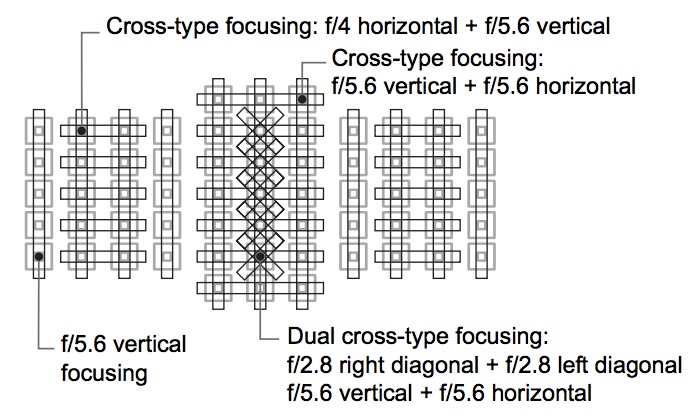
Understandably, Canon did not feel a need to publish similar data for 3rd party lenses, but a lot of people have asked us to look into that. We’ve done that for all of the lenses we stock and have put the results in tabular form below.
Some Limitations
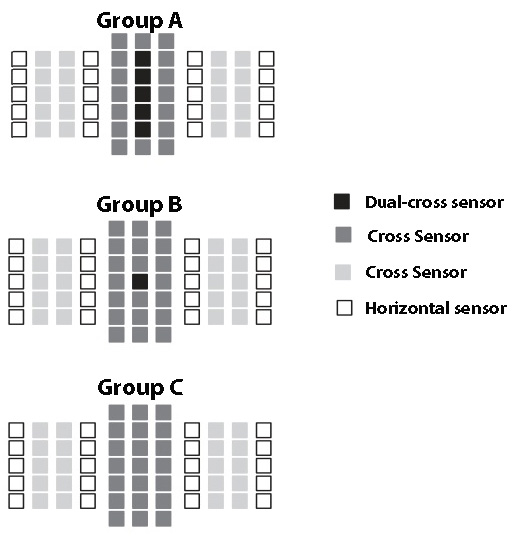
The 5D III doesn’t tell us on-camera if the 5 dual-cross sensors are active as dual-cross or simply as cross-type sensors. What are referred to by Canon as Groups A, B, and C lenses all show the same pattern on the camera’s LCD. All 3 of these groups use all 61 AF points and the 41 cross points are active as cross points. We have no way to tell with third party lenses if the central points are acting as single or dual-cross. (Other than knowing the dual-cross sensors are NOT active if the maximum aperture of the lens is smaller than f/2.8, because Canon has said that.) Anyway, for purposes of this post, we’ll call them all Group C, because that’s all we can tell.
We also can’t absolutely confirm that the other sensors are active in the way the camera tells us they are when a third-party lens is mounted, but they certainly seem to be. We did confirm that each individual point the camera said was active could actually be used to autofocus the lens. We also compared a vertical line target in portrait and landscape mode to try to determine if sensors that were cross (horizontal and vertical) seemed to AF equally in either orientation and if horizontal only sensors did better in landscape mode. We did think what the camera was telling us was accurate, but it’s hard to be certain: sometimes a horizontal sensor can focus on a horizontal target.
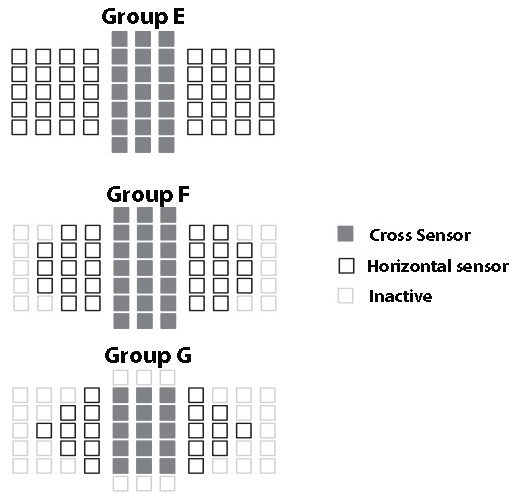
So you can avoid running back and forth to the manual, here are the other pertinent AF patterns. (We didn’t find any Group D or H lenses among the third party lenses, which isn’t surprising, there are only a couple of them in Canon’s lineup.)
Results
I can’t say that this information is going to make a huge difference to anyone, but people have been curious about it. So for what it’s worth, here’s the data.
Sigma
| SIGMA | AF Group |
| 4.5mm f/2.8 fisheye | C |
| 8mmf3/3.5 fisheye | C |
| 8-16mm f/4.5-5.6 DC HSM | C |
| 10mm f/2.8 fisheye | C |
| 10-20mm f/3.5 DC HSM | C |
| 12-24mm f/4.5-5.6 II | C |
| 15mm f/2.8 fisheye | C |
| 17-50mm f/2.8 /EX DC OS | C |
| 20mm f/1.8 | C |
| 24-70mm f/2.8 EX DG | C |
| 30mm f/1.4 | C |
| 50mm f/1.4 HSM | C |
| 50-150mm f/2.8 HSM OS | C |
| 50-500 f/4.5-6.3 HSM OS | C |
| 70mm f/2.8 Macro | C |
| 70-200 f/2.8 EX DG HSM | C |
| 70-200 f/2.8 EX HSM OS | C |
| 85mm f/2.8 EX DG HSM | C |
| 120-300mm f/2.8 OS | C |
| 105MM F/2.8 Macro | E |
| 150mm f/2.8 Macro | G |
| 150mm f/2.8 Macro OS | E |
Tamron
| Tamron | AF Group |
| 17-50m f/2.8 XR DiII ASPH | C |
| 17-50mm f/2.8 XR ASPH VC | C |
| 18-270mm f/3.5-6.3 VC PZD | C |
| 24-70mm f/2.8 Di VC | C |
| 28-75mm f/2.8 XR Di LD | C |
| 28-300mm f/3.5-5.6 VC | F |
| 70-300mm F/4-5.6 VC USD | E |
| 90mm f/2.8 SP Di Macro | C |
| 200-500mm f/5-6.3 SP Di | C |
Other
| Tokina | AF Group |
| 10-17mm f/3.4-4.5 fisheye zoom | E |
| 11-16mm f/2.8 | E |
| 12-24mm f/4 Pro DX II | E |
| 16-28mm f/2.8 Pro Fx | C |
| All Zeiss ZE | C |
| Voigtlander 20mm f/3.5 SL-II | C |
| Voigtlander 40mm f/2 SL-II | C |
Roger Cicala
Lensrentals.com
June 2012
20 Comments
Steven ·
That is one pretty awesome AF system. This comes from me and my 550D with one cross type, and 8 others!
CarVac ·
I find it surprising that the Bigma (50-500) is in group C at all, since it’s never even fully f/4.
Roger Cicala ·
CarVac, one thing to remember is we’re going by what the camera is saying it’s AF sensors are doing: with a third party lens I’m not positive they might not lie 🙂
I say that because we know that some (I don’t know if it’s all, but it definitely is some) third party lenses tell the camera they are a certain Canon lens. It could be the camera is turning on AF sensors because it’thinks’ a certain lens is there, but they won’t work because the lens isn’t as wide an aperture as the camera expects.
Roger
stu ·
do you have the schematic diagram of Canon 7d’s AF sensor? or even the Nikon D800?
Steve Runyan ·
Basic (but not necessarily dumb) question. What, practically do i do with this information? (or the information from Canon on their lenses)
Roger Cicala ·
Steve,
I don’t really know. Lots of people asked, so I guess they have some plans. Other than knowing some lateral AF points won’t work (and I never use them anyway), I’m not sure what for. Maybe someone else will chime in.
Roger
Vladimir Krzalic ·
It’s always nice to know the limitations of your camera. The 5D mk3 would certainly be used for weddings and it’s good to know when and why you would need to use/not use some other than center AF points.
Also, birdwatchers have special 3rd party lenses that have limitations and it would be nice to know that they are. At least I think that is the case.
Anton ·
What about Canon lenses? Are they all “A”? Does Canon limits its AF with third party lenses on purpose?
By the way, who puts crop-lenses on 5dmk3?
Roger Cicala ·
Anton – nobody puts crop lenses on 5DIIs. But I’m assuming Canon’s next crop camera will have this AF system. This way I don’t have to retest.
Roger
John Thomas ·
@Steve Runyan: (Double)Cross-Type sensors are much more precise and sensitive in low-light conditions. It can make all the difference between a keeper and a miss when one shoot a photo journal in a low-light event, especially if it is fast-paced.
@Anton: No, not all Canon lenses are “A”. Also, Canon does not limit its AF with 3rd parties. In fact, the main factor isn’t the brand (very big grin) but the iris diameter for each lens. This will determine which AF points will be enabled.
Just my2c & HTH
John Th.
Mike B ·
You have the Sigma 85mm mislabelled – you have it as a 2.8, but it is a 1.4
Andrzej ·
Great article!
One thing, my Sigma 15mm f/2.8 fisheye (EX DG) shows as group G (and not C). Something wrong/different with mine or mistake in your list?
Michael C ·
Since some users might try to use the lateral points with a lens that doesn’t allow them to function, Canon has prevented the frustration of not being able to achieve focus when the user expects it.
Is it also possible one reason Canon is doing this is for focusing speed when the user has enabled auto-selection using all focus points? By turning off the focus points that would not function properly with a specific lens attached, the processor does not have to include the signal from those points in its calculations. The less data to process, the faster it will complete the calculation and send instructions to the lens.
Deep ·
Curiously, the older 28-70 f/2.8 is a group A lens but the 24-70 is a group B lens. I am guessing the 24-70 II is also group A lens (not in the manual, probably because it was released afterwards).
Jon ·
Do you guys know if the new Sigma 30mm 1.4 DG does any better than its predecessors?
Thanks for the great post!
Roger Cicala ·
Jon,
I think the Sigma 30mm f/1.4 is it’s predecessors. They haven’t changed that lens in several years.
Stephane ·
which group is the CANON EF 24-70mm f/2.8L II USM
sfordphoto ·
Thanks for testing, Roger. Do you have any plans to test the Sigma 35mm f/1.4 Art?
Greg Dunn ·
I know this is an old thread, and possibly new info has come to light (or not). But what you’re saying here is that some 3rd party lenses “may” be group A or B, but there’s no way to be sure? All you can be certain of is that they’re at least group C?
I’m guessing this is a matter of the lens telling the camera its make and aperture when it is initialized, and the camera then decides whether it’s going to allow the dual-cross sensor to be active. Canon presumably wouldn’t want to give the 3rd party lenses any potential advantage over their own.
Greg Dunn ·
I know this is an old thread, and possibly new info has come to light (or not). But what you're saying here is that some 3rd party lenses "may" be group A or B, but there's no way to be sure? All you can be certain of is that they're at least group C?
I'm guessing this is a matter of the lens telling the camera its make and aperture when it is initialized, and the camera then decides whether it's going to allow the dual-cross sensor to be active. Canon presumably wouldn't want to give the 3rd party lenses any potential advantage over their own.