
Sigma Optimization Pro and USB Dock
“Commerce makes progress. Fortune passes everywhere.” – Frank Herbert
A few years ago I was accused of being a Sigma hater. (For the record, I did hate their quality control and so-called repair service at that time, and I didn’t hesitate to say so in this blog.) For the third or fourth time in the last year, I’m about to be accused of being a Sigma fanboy.
I’m pretty certain I haven’t gone soft over the last 4 years. I am certain, though, that Sigma Photo, Inc. has changed a lot in that time. Truth is, they’re making serious waves in the photo industry these last few years. They’ve improved their repair service and quality assurance. They’ve released some world-class lenses at way less than world-class prices lately. And now they’ve released their USB dock and Optimization Pro software.
I’ve spent the weekend playing with it. Partly because I really think this is a revolutionary product and I wanted to see how it worked. Partly because I desperately need a ‘Honey, I’ve really got to do this for work’ excuse or I’d have been restaining the deck.
My conclusion, as usual, first: if anything is going to get the attention of those who like to disable features in firmware, overprice lenses, and limit our ability to customize, this might be it. I did some adjustments this weekend, in about 10 minutes, which would have required a trip to factory service on a Canon or Nikon lens. And let me stop the Fanboy stuff before it starts: you may never have needed to make this adjustment on your 10 or 20 Canon or Nikon lenses, but I’ve sent dozens of them to factory service adjustments for exactly the issue I’m going to demonstrate today.
Quick Overview of the USB Dock and Optimization Pro software
The directions are pretty simple:
- Make sure you buy the dock in the proper mount (Canon, Nikon, or Sigma).
- Download the Optimization Pro Software HERE. It’s about 3.4 Mb in a zip file, available for Windows or Mac.
- Open the software, put the lens in the USB dock, and plug the USB port in your computer.
Once you hook things up the program the program opens to a nice, straightforward main page.
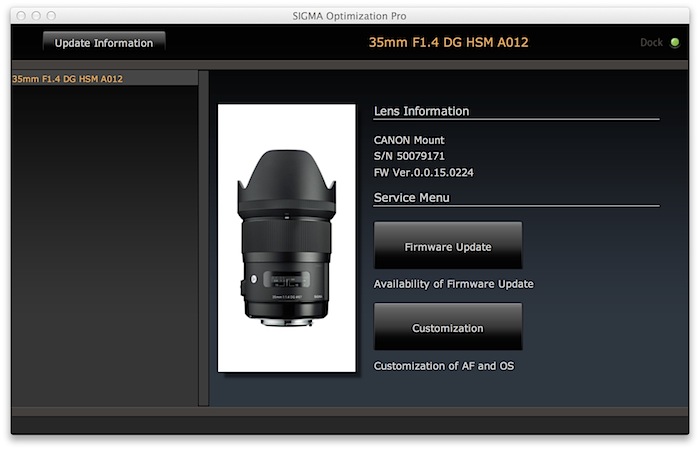
The firmware update button reads the lens’ firmware and lets you know if you need a firmware update. Push yes and it updates in about 20 seconds.
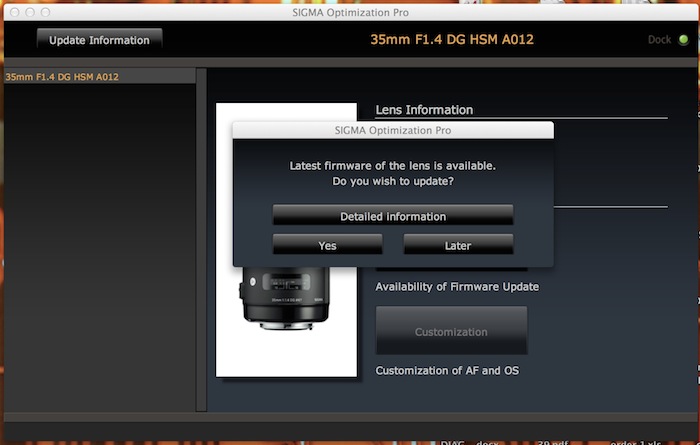
Adjusting a Lens
First of all, there’s a nice 10-minute video that Sigma made that shows you the use of the device very clearly HERE. If you’re like me, though, you might prefer a 30 second blog read. It really is that simple. Actually, 10 minutes is more time than it took me to do my first adjustment on the 35mm f/1.4 (of course, without reading any manuals).
I should be clear, I don’t do a full-ballistic, OCD, 600-shot microfocus adjustment. I’m too aware that phase detection AF is a shotgun, not a sniper’s rifle. I’ll take nearly perfect in 10 minutes rather than perfect in 4 hours every time. Plus, like I said, I’ve got a deck to stain. Unless I can put it off so long that my wife gets frustrated and does it herself.
I chose a lens that is perfect for this software. This copy of the 35mm f/1.4 is perfect on my Canon 6D at close and intermediate distances, but at long distances it backfocuses badly. I can do a microfocus adjustment to correct long-distance focus, but then the lens is frontfocusing at near distances. Without the Sigma dock and software, the only option was a trip to the factory service center to change the lens parameters.
Since I was at home instead of the office, I didn’t have Focal, LensAlign charts, or any of the other things that seem to be considered necessary tools for autofocus adjustment these days. So I made do with a placemat and my back yard.
Since I plan on using this lens outdoors in daylight I wanted to adjust it in daylight (autofocus can change slightly in different lighting conditions, if you aren’t aware). I started with a placemat set in front of a picture window.
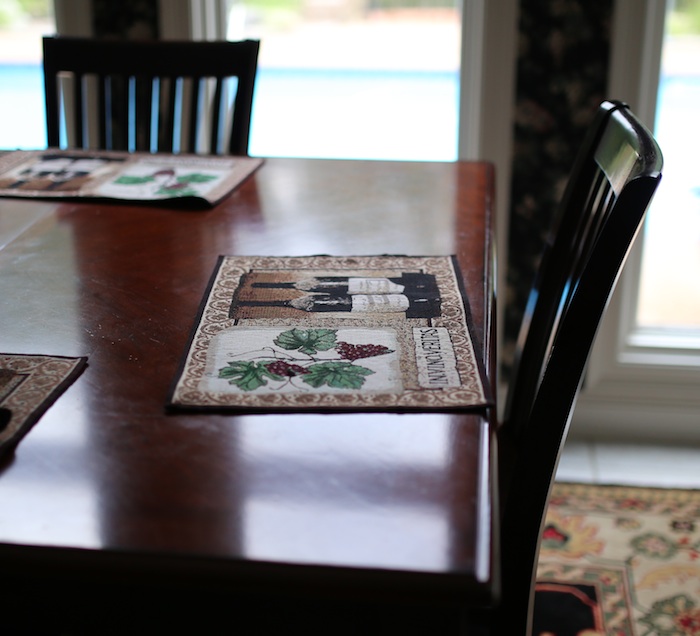
Spot focusing on the tip of the green leaf, I took several shots each at minimum focusing distance, 3 feet, and 6 feet. They all showed focus was accurate, as in the samples below.
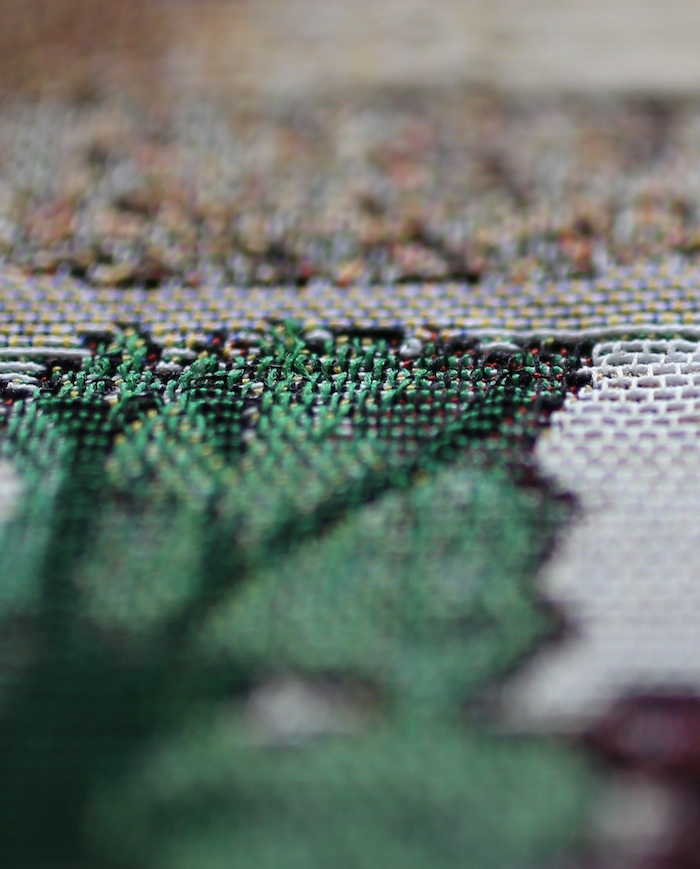

Focusing at longer distances, however, showed the lens backfocused quite dramatically. In this image the focus point was on the small yellow leaf in the foreground (I’ve cropped the image to show the area behind the focus point).

Opening up the Sigma adjustment window shows I can make adjustments at 4 distances. With the 35mm, 3 of those are close: roughly 0.3, 0.4 and 0.7 meters. The other is infinity.
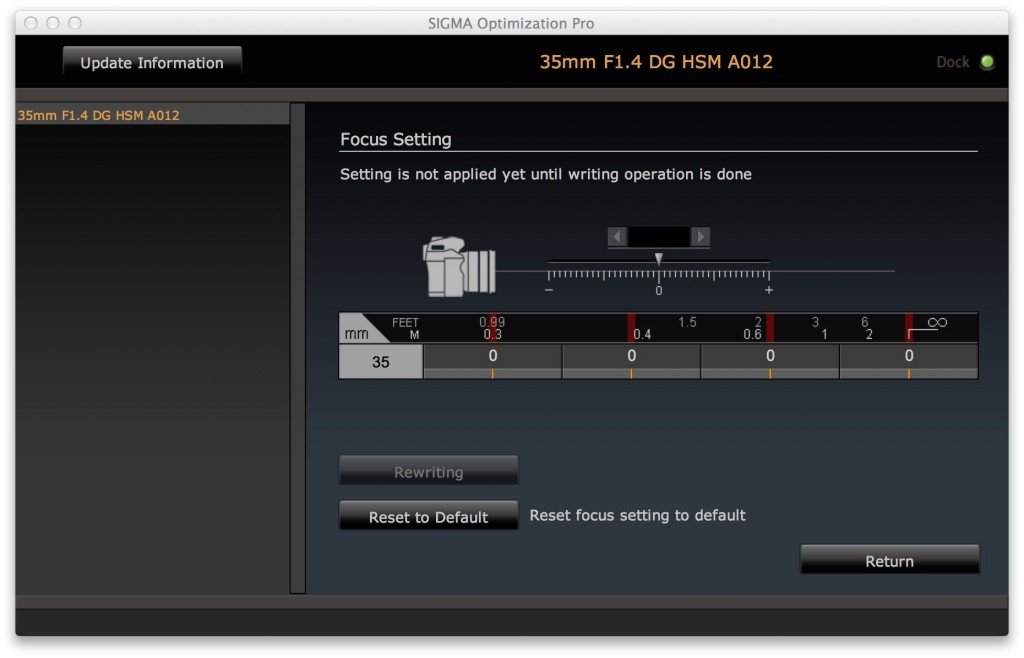
I left the close adjustments at zero and gave infinity adjustment a -12. You just click on the area you want to adjust, move the slider the amount you want adjusted, and then click the “Rewriting” button. (The “Rewriting” button is the only part of the software that isn’t totally intuitive; it isn’t highlighted until after you click on it.)
A repeat shot outside showed -12 was way too much adjustment so I went back and reset the infinity adjustment to -8. That was spot on as shown in the image below. I rechecked AF at closer distances and it had not changed a bit.
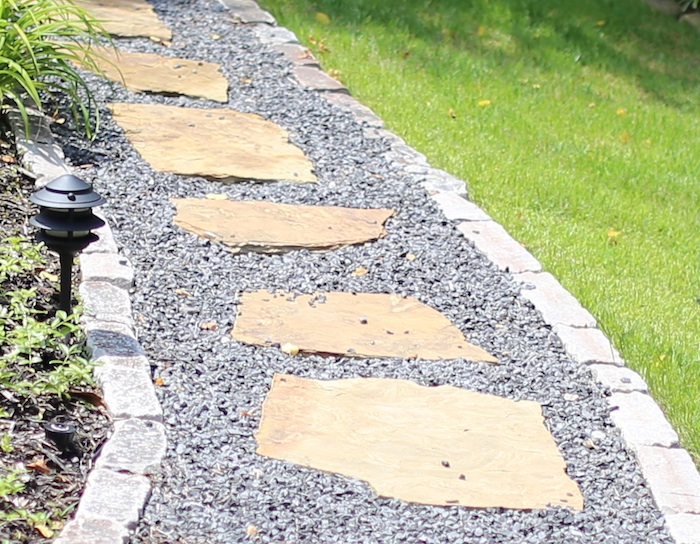
Total elapsed time for firmware update, focus checks, focus adjustments, and final check was just about 10 minutes. Obviously a zoom lens, which can be adjusted both at different focal lengths for different focusing distances at each focal length, will take longer.
Conclusion
For the even slightly gear-head amongst us, this is an awesome tool, giving us the ability to fine-tune autofocus adjustment much more completely than simple camera microfocus adjustment. At $59, I consider it an amazing bargain for anyone who owns one of the Sigma Art, Contemporary, or Sports lenses (it does not work on older lenses).
I’ve already heard a couple of people complain that it should be included with the lenses but I disagree. First, the price is very reasonable and the software is free. Why would they include it with each lens (which probably means each lens costs $59 more) when you only need one for all of your lenses? Not to mention half the people who got it would never use it.
I’ve heard others state that only Sigma lenses need such a device. I’ll meet them part way: I think there is probably a more frequent need for such adjustment on third-party lenses, but I can absolutely guarantee you that the big-boy’s lenses do indeed have this same kind of problem, at least occasionally.
Whether they need it more frequently or not, now Sigma DOES have such a device. Which means, for example (just pulling a random lens out of my hat), the Sigma 35mm f/1.4 is now not only sharper and less expensive, but also more accurately adjustable than the manufacturer’s 35mm f/1.4. I wonder if anyone is hearing footsteps*****?
Roger Cicala
Lensrentals.com
June, 2013
* For my non U. S. readers, hearing footsteps is a term used to describe an American football player, who, thinking he is wide open and about to catch a pass, unexpectedly hears the footsteps of an unseen opposing player about to crush him.
70 Comments
David ·
Great review, Roger. I haven’t had any focussing problems with my Sigma 35/1.4, but it’s nice to know I can adjust it if required.
I also had the chance to shoot for a day with both my Sigma and a friend’s Canon 35L. I’m not much of a pixel peeper, but I couldn’t tell the difference, either when shooting or in post processing. The Sigma is every bit as good as the Canon, and probably a bit better according to the numbers. This article just reinforces that.
Richard Matheson ·
Great piece, Mr. Cicala–even-handed and concise. And timely, too, I might add. I wonder how this dock performs on zoom lenses, i.e. whether the # of adjustments is just four and what impact, if any, making these focus adjustments will have on autofocus speed? Thanks for your impressions.
Roger Cicala ·
Richard,
I can’t say anything about AF speed yet, but on zooms there are adjustments for 4 focus distances at each of 4 zoom ranges, so 16 total.
eddy ·
Thanks for the hearing footsteps explanation, really help me understand how the USB Dock works.
Guido ·
That’s a very nice solution – maybe for the next 5 years. The Camera-Future is mirrorless – even for the majority of SLR-like Bodies. I guess that in the next years most cameras will get a combination of Phase-AF and Contrast-AF. And with Contrast-AF Front- and Back-Focus are no longer issues. I know that the combined Phase- and Contrast-AF is a mess on some current camera models like the Canon EOS M. But it will improve in the next years.
Bob ·
I wonder how long before this thing is hacked so it can adjust Canon lenses too………?
HomoSapiensWannaBe ·
Roger,
I am very happy with the Sigma 35/1.4 on a D600, but suspect some minor focus issues depending on distance. I will try this nifty tool which seems a great value. Anyway, I’ll probably buy more Sigma lenses going forward so it will be a good investment. (A 24/1.4 or 1.8 would be awesome, along with a 24-70/2.8 with VR and a super wide zoom, among others…)
What about using the same lens on multiple bodies? It seems you can only fine tune it for a particular body. Aren’t there variations in focus performance due to the body?
CarVac ·
Awesome stuff, Sigma.
Sean Setters ·
One note about updating the Sigma 35mm f/1.4 (for Canon) with the Optimization Pro Software – the software allowed me to update my Sigma 35mm f/1.4’s firmware, but it didn’t tell me what got fixed in the new firmware version. If you click the button that says “Detailed Information,” it only tells you the version number of the firmware update.
I called Sigma USA to find out what had changed in the new firmware version. They told me they didn’t have that information asked me to send an official request for information (through their website’s support) which they would forward to Sigma Japan. When Sigma Japan responds, they promised to forward me the information.
Why in the world wouldn’t Sigma make firmware change notes widely available? That doesn’t make sense to me. :-/
Sean
Content Editor, The-Digital-Picture.com
Sean Setters ·
By the way, Roger, my Sigma f/1.4 had the same backfocus issue at infinity focus, but not as bad as yours. Mine required a -2 adjustment with a 5D Mark II.
Leon Matsui ·
I’ve been playing with the Sigma 35mm 1.4 Art for about a month now. Jus an awesome lens. You’re right, most of us are not interested in adjusting. Being able to do it at home means I might though. My copy has given my 7d new life with consistent results and crisp sharp images that I couldn’t get with some of my efs lens. I recently upgraded to a 5d mk 3 and was about to sell both of my 7d’s because of the images I got with the 5d. The sigma gives me awesome low light capabilities for both camera bodies. Not a techie, old film guy revisiting my passion. still wish they had a diagonal split screen to focus.
Leon
Tony ·
How does this system handle the situation where one lens is used on multiple bodies?
Roger Cicala ·
Tony, we’re still trying to figure that out. Hopefully, we’ll adjust the lens to even out any distance-specific issues, then use camera calibration if required to adjust it to a different camera. But I don’t have enough experience yet to say that’s going to work.
Tony ·
Roger: So when a Sigma lens is mounted on a Canon body, the body will recognize the lens (make, model, and serial number) just as if it were a Canon lens — and thus permit the camera to store lens-specific microfocus adjustments?
sabawa ·
dear sigma… please allow the dock to update the firmware on the siggy 50 1.4 so i can be totally happy. thanks 🙂
Ben ·
Roger, do you have any plans to take a look at the new 120-300? Initial feedback on forums from owners of the new model is extremely positive especially concerning tuning with the dock. I’m sure a lot of people would like to read your take.
sabawa, I’ve been thinking how nice it would be if Sigma offered an upgrade service for the 50 and 85 which updated the lens’s electronics with dock compatible. I know it wouldn’t be cheap, but it would be cheaper than buying new lenses when they get the Art treatment.
Roger Cicala ·
Ben, I played with the 120-300 and the dock today. Very impressive set of customizing numbers, but it’s going to take me some time to see what things like OS adjustment and AF speed adjustment really do. Trouble is I can’t keep my hands on one long enough to do much, they come back in the morning and go back out that afternoon until we get more copies.
Fred ·
How is that similar to Reikan Focal? I just calibrated a brand new 70-200 2.8L II and I’m getting +2(W) +4(T), did it a few times even with the distance calculations that was default.
Joel Ruiz ·
I wish this worked on the Sigma 85mm f/1.4, which works really well with my 5Dc, but it misses focus at all distances with my 5DmkIII 🙁
Dave L ·
When you first connect the S35 to the dock and the program tells you there is an update you can see what the update does in the info window but only if you do it before you update the lens. The update for the S35 was for compatibility with the dock program.
At least that’s the way it worked for me 🙂
Troy Past ·
Roger, if you did a review of the 120-300 Sport you would be one of the first, and I imagine you would get alot of web hits. The lens has been out for awhile but zero reviews on Amazon, BH, Adorama etc..
Roger Cicala ·
Troy, I plan to as soon as I can keep my hands on a copy long enough to do it. We just haven’t been able to get enough to fill renter’s requests yet.
Renato ·
By the way, are you happy with your 6d choice?
Roger Cicala ·
Renato,
I am – at least as happy as I ever am, because I’m always fighting the green grass on the other side. But I’m still loving the WiFi-App setup and taking pictures every weekend, and had no buyer’s remorse, so I do think I made the ‘best compromise’ choice for me.
Roger
Chris ·
Hi Roger,
great article as always. And a big thanks from one of your non U.S. readers, hadn’t heard the ‘hearing footsteps’ one before.
Although I have to admit hearing so many positive things about the new 35A really is difficult. I have too many lenses as it is and spent way too much money the last two months already 🙁 But the more I read about it and the USB dock the more I get that special itch that means I’ll have to check my bank account again 😉
Keep up the great work!
David ·
Hey Roger,
thanks for the great article!
It certainly gives me some hope, because I just love the 35 F1.4 but I ran into the exact same problem on my 5DIII as you did on your 6D.
I face quite a strong back-focus as soon as I optimize the lens for close-up shots.
However, for me the numbers are much worse: I have to set the 5DIII in FMA to +15 for the lens to be spot on. Yet, then the lens performs truly excellent up to about four meters of distance.
I must admit that I haven’t really used this lens for larger distances, since my major field of application is low-light indoor shooting. Hence, I made my peace with that flaw (at least in a certain way).
Thus, great to know that there is light at the end of the tunnel!!
Ben ·
Chris, I’m a US reader and watch American football and wasn’t familiar with it either.
Jake, AKA CyberDyneSystems ·
Thanks for the fascinating review Roger.
I have always been enthusiastic about SIGMA lenses, they have such innovative options. I am very glad to hear that your view of their QC and service is improving, and I too have been very amazed with some of the more recent achievements.
I suspect this tool and the options it provides will appeal to a select few, but it (especially at it’s unreal fair price!) and the new wave of offerings, are going to go a LONG way toward prodding the other guys in the right direction as well. Competition is good.
Now when do SIGMA put OS on the 500 and 800 prime and the 300-800mm!? 🙂
Samuel H ·
This is awesome. Specially if you put it against Canon and Nikon including AF microadjustment only in DSLRs costing $1K or more. Way to go, Sigma!
(also: yet another reason to go for a cheap camera and expensive glass; a D3200 with sigma 35mm sounds like a pretty little beast)
Ajit ·
Finally the review I have been waiting for ever since the USB dock was to be made available in late May, and by June 10 from all the major US retailers.
It’s great to know the USB dock does work well.
I had returned my 35 1.4 copy a few months back before I knew of this device… my copy back then had to be adjusted to +18 which was quite bad. The color and sharpness though was amazing.
CarVac ·
Oh man how I wish there were a relatively small aps-c 18/2 from Sigma…
Jason ·
I’m not being cynical (seriously) but this is an inspired product (srly!!).
Not only do you sell another product (the dock).
But you have the potential to reduce the warranty work and returns by the serially unhappy (a lens is never sharp until you’ve had different copies of it!), AND chances are people will tune your lenses and potentially get better results than they otherwise might have making your brand more attractive.
Very clever.
Useful too.
BEP ·
This is great, well done Sigma. I just bought the Canon 200mm f/2.8L and it appears to have focus issues at long distances, and my camera doesn’t have focus adjustment. That is frustrating.
Just a little note: in their demo video, the “Rewriting” button seems to work as it should: it isn’t active until you modify something, which makes sense.
Bob T ·
Thank you again for running the test. Hopefully the 120-300 will stay in stock long enough for you to test it.
Have you tried the dock on a camera that doesn’t have MA capabilities? Like the 60d? I’m wondering if the process would be any different since you can’t use MA values as a baseline.
Jasper ·
I found a Dutch video about the USB-dock, it has English subtitles as well 😉
http://www.youtube.com/watch?v=BnTG773FFhM
Ed Okie ·
“Since I plan on using this lens outdoors in daylight I wanted to adjust it in daylight (autofocus can change slightly in different lighting conditions, if you aren’t aware). I started with a placemat set in front of a picture window.”
I wasn’t aware of AF differences, outdoors vs indoor tungsten. How, or in what AF direction is it affected? I’ve been going through extensive pushups with the Dock and 35mm lens using studio tungsten with a 5D Mk III and to be kind with words “it ain’t easy, nor consistent”
Pregnant question: Should the camera body be micro-adjusted FIRST before using the Sigma Dock? (Canon’s focus-check setup rule is 50X lens millimeter, just shy of 6 feet for this lens.) Huge backfocus is troublesome at infinity; short distances as close as 1′ are remarkably sharp at f/1.4 At infinity it’s dreadful. Infinity sharpness doesn’t clear up until about f/4, best at f/5.6 to f/8
Roger Cicala ·
Ed,
Lighting differences cause differences, but because the manufacturers are all so secretive about their sensors and algorithms, predicting the difference is impossible. Some lenses not at all, some very much.
Personally, I turn off the camera adjustment, then adjust the lens at various focal lengths. Then I use camera adjustments if I’m shooting the lens on different cameras.
All of that being said, 90% of the time when I hear someone having bad trouble with AF microadjustment, the reason is they’re trying to do more than is possible. Remember with an f/1.4 lens, camera phase detection AF is a crap-shoot. If you take 20 shots in a row on a tripod with a fixed target you’re going to get a few in front, a few behind, a few right on. The results, graphed, are a shotgun pattern. That’s just how it is, you can’t ‘nail focus’ with AF to the degree you can with careful live view focusing. With an f/1.4 lens, usually about 1 in 7 or 8 are way off. It’s just how it is.
Microfocus adjustment moves the shotgun pattern so the center is where it’s supposed to be, but it can’t, under any circumstances, make the shotgun pattern smaller. Truly, I’ve never, ever spent more than 20 minutes MF adjusting a lens, but I have pretty reasonable expectations.
All of that being said, occasionally you get a bad lens that has either a slipping AF motor or a decentered element (which makes the light coming from opposite sides out of phase). In this case you can’t get accurate MF adjustment.
Your 35, though, sounds much like the one I did that was fine out to about 15 feet but horridly front focused at infinity. The dock was just the ticket to straighten that out.
Roger
John ·
Roger: thanks for this very useful thread.
I found that I needed to dial my D700 to +19 for close- to mid-distances in order to attain good focus, but this made the lens back focus significantly as a result. Figuring I could fix things with the dock (thanks to your post), I kept the lens in spite of the fact that I was pushing it on the camera’s AF micro-adjustment (also I am lazy and wanted to use the lens). Interestingly, when I finally received my dock and updated the lens’s firmware, the near/far AF discrepancy disappeared – both in real world use and with Focus Tune on test charts. Roger: do you know whether Sigma implemented a firmware update that would account for this?
Oddly enough, when I tried correcting for the lens’s inherent front-focusing tendencies using the dock, the variability in autofocus (i.e., size of the scatter shot) went through the roof. I threw in the towel and set the lens back to default settings and my camera back to +19. Not sure why this should be the case but it wasn’t worth spending more time trying to deal with it.
Hopefully between the dock and AF micro-adjustment, the lens will be within tolerances on my next camera!
papa2jaja ·
My Sigma 35mm f1.4 has a front focus too severe for the in-camera adjustment to be able to cope with it, and when objects in the ‘Infinity’ range are sharp, the focussing ring is still about 10mm before its end stop. Is it possible to adjust the latter using the USB dock?
Roger Cicala ·
papa – it might be but also simply upgrading the firmware through the doc has fixed a lot of these severe problems. Although if you’re shooting an Nikon D800 I think the firmware doesn’t do much good – Sigma hasn’t incorporated that camera yet.
papa2jaja ·
Thanks Roger! Indeed, Nikon D800 and D600 here, both have the probs. Sigma Service has upgraded the firmware but both probs remain. I’ll try the USB dock! Is there any way of knowing when they will include the D800 into the firmware?
Roger Cicala ·
papa, I don’t think it’s going to be soon. I will say it doesn’s seem to affect center point with the D800, but peripheral points are often not usable with the 35mm Siggie. Personally I find it worth the inconvenience because the lens is spectacular (but I really shoot 90% on center focus anyway so it probably affects others much more than me).
papa2jaja ·
I shoot center point exclusively, too. Still I have a the probs – 10cm or more front focus, objects in the infinite range are sharp way before the lens reaches its ‘infinite’ setting. I’ll report back if the Dock was able to fix it.
Thanks for your report regarding the Dock and how to use it!
papa2jaja ·
Using the dock, I was able to adjust the focus perfectly in the ranges up to around 7 meters. In the end there was a front focus left at 7 meters, which I cured by moving the infinite from +7 to (also) +9. The values are now +9, +9, +7, +9.
Everything from 0 to 8 meters can be focussed on really well at f1.4. Also everything beyond approx. 12 meters is really sharp, up until infinity. Images which are taken focussed on these areas are sharp, contrasty, and with strong colours, really beautiful.
But it seems that there is a ‘blind area’ somewhere between approx. 9 meters and 11 meters (values estimated based on fence poles which are approx. 2m apart, in lack of better options, apologies…) in which I seem to be unable to focus. When I focus in that ‘blind area’, it seems that infinite gets sharp, but not that area. I have not had the time to determine this in utmost detail, I still have to find both the time and the scenery for this, but it seems that there is this blind area.
I wonder, is this possible at all? Everything perfectly focussable from 0 – 8 meters, then a blind spot between approx. 9 – 11 meters, and everything else beyond that sharp again no matter where I focus, as long as it is further away that maybe 12 meters? I’ll do more testing on the weekend, of course.
Mick ·
My copy of the Sigma 35mm f/1.4 misses focus randomly on a D800 body. Unfortunately I can’t find a pattern in this behaviour. I’m thinking about buying the USB dock to update the firmware (if necessary). Maybe this helps.
Roger Cicala ·
Mick,
There are lots of problems with the Sigma 35 and D800 using anything except center point. The dock doesn’t seem to help off-center points much from what I’ve seen.
Roger
Mick ·
That’s not what I wanted to hear, but hey, you can’t have it all. The results from the center point are erratic too. Maybe I’ll return it. But I’m afraid I’ll have to go through a lot of shipping it back and forwards between me and the shop. Sigma can’t solve this, but the’ll keep me on a leach for a while.
john ·
Your wife will stain the deck?
ricardo ·
Sigma quality control sucks!!! I order the usb dock a few days ago, finally today it arrives, I unpacked the dock and when I try to attach the 35mm f1.4 it not fit!!! I verified the box and it says canon mount, but the dock have a diferent mount, i think it was a sigma mount…. the most strange thing is that the serial number on the box (just below the label “canon mount”) is the same as in the usb dock itself, but on the warranty card says “F/sigma” so i presume it is a label mistake!!!
Tinster ·
I got the Sigma 35mm 1.4 last week. All I can say is WOW. This lens is sharp. I check the focus on my D800 at 2ft, 3ft, 4ft all the way to 10ft and then at 18ft by moving the test object along a tiled floor. Each tile is 12 inches in length. The result is perfect focus all the way. I am extremely happy. No need to buy this USB dock. Keep up the good work. I will buy more Sigma lenses in the future.
Brian B ·
Reikan FoCal + Sigma dock.
Has anyone developed a workflow for use with the Sigma dock and Reikan FoCal? This seems like it could be a great combination.
Michael ·
Thanks for posting the review of the Sigma dock. I am having a terrible time with a new Sigma 24-105 art lens which won’t produce a sharp image unless I manually focus. I’ve spent 3 days testing, micro adjusting, testing again and still don’t have a good result. Then I heard about the dock that may solve my problem.
Sounds good based on your description but, you didn’t mention the impractability of what is required to get the readings in the 1st place. You skipped the most labor intensive and time consuming part of the process! One must set up your gear, shoot, make notes of how it was shot, relocate to a desktop, download, adjust blindly, do it all again and again…all for only 1 shot! To set up all the scenarios one might use on a lens you will spend 3 days!
Roger Cicala ·
Michael,
I’ve never spent more than 20 minutes on a prime or 45 on a zoom. Ever. I think people sometimes approach this like they’re zeroing in a sniper’s rifle. Since phase detection AF is, at best, a shotgun pattern, spending hours agonizing over an exact number if a fool’s errand. Ambient lighting changes (not just amount but color), AF sensor inaccuracy, AF sensor mark placement inaccuracy, and a host of other things mean the best AF is a scattergram of points around your center point.
I have an area in my front yard (grass makes a great background for finding where the sharpness is) with several good AF points at various distances. I go out, shoot the distances at the different zoom ranges, check to see where AF was front of backfocusing, adjust that on the dock, and recheck. Usually I have to make one or two fine-tunes on a zoom, sometimes 1 on a prime.
Roger
Karl Wendlinger ·
Roger,
I am wondering, why you dont use the AF Adjustment of the camera to find the correct values for the 4 distances and apply them afterwards in the dock at once. There you can also adjust -20/+20. Like this you dont have to check if the adjustment in the dock works.
Or do you think that you cant use the MICRO-AF-values of the camera? Are they somehow different from what the dock does to the lens?
By the way: I am pretty dissapointed with both of my SIGMA art lenses. The 50 and the 35. AF is a big issue. Sometimes it nails it and sometimes it is way off. Although i have calibrated the heck out of them… Sometimes it works perfectly, sometimes not. The distances you can adjust wont help much for other distances and especially for different AF points.
In the 35 mm there is for example no setting for 2 to 3 meters. You have 0,3/0,4/0,6/infintiy… After calibrating best possible for the given distances i can calibrate in the dock it works nice at the given distances (of course only in the light i calibrated them, but not in other light situations and mostly also not in other AF poits) I get a horrible front focussing at a focus point that lies between the infinity setting and the 0,6 meters (for example 3 meters) with the 35 mm especially at outer AF points with my 1 DX.
These lenses are not usuable for any documentary work, like wedding photography. AF is just not working with them. Whatever Canon does to make these lenses fail. It works. I will have to bring both of them back. I hate it, because my 35L is no way near the image quality of the 35 art, but the IQ is useless for me, when the AF outcome is a lottery.
I dont care if SIGMA or CANON are to blame, but its a shame that this lenses are sold as AF lenses. And its a shame that you have this outstanding glass which you can only use in MF for perfect results. If i want a MF lens, i use a LEICA camera and lens.
I never had these kind of problems with any of my Canon glass. These lenses are brilliant for MF, but useless for AF. You state it yourself: AF performance can change at so many occasions. I never experienced so HORRIBLE differences in AF Performance with my Canon ölenses (even not with the cheaper ones) like i do with these SIGMA lenses. All this despite the fact, that the SIGMA art glass it probably is the best glass i had on my 1DX at the given focal lengths 35 and 50 mm.
Roger Cicala ·
Kari,
The camera can set the entire lens for front or backfocus, but can’t adjust it at particular distances. With a lot of lenses (not just Sigma, but it does seem to affect Sigma primes, where with Canon it’s mostly zooms) the lens my backfocus at one distance, front focus at another. The camera can’t do anything about that, but the dock can.
That being said, we do sometimes set the variation in the dock (+4 at infinity, +2, at long distance, 0,0 at shorter distances for example) for the lens, then set MFA in each camera for overall adjustment. We generally only do that when one lens might be used on several cameras.
I would also mention that the Sigma lenses tend to be camera specific, which is why I always recommend talking to people who shoot your exact camera type before deciding. It may do great on a 5DIII but be inaccurate on a 70D, for example.
Roger
Karl Wendlinger ·
Hi Roger,
thanx for your reply. I understodd this difference between MICRO AF in the camera and the dock. What i meant was shooting the different dock relevant distances and finding the right adjustmenst first only by using the micro AF for the different distances first in the camera. you select exactly the disctances you need for the dock and make your test shots while adjusting the micro AF in the camera for every distance until you get the best indiviual results. these values then you apply in the USB dock. thats what i did. and as i said, it works under the same light for the given distances, but it does not work at the distances between for example o,6 meters and infinity in the case of the 35 mm.
For example on the 35 mm:
Shooting at 0,3 meters with different micro AF values in the camera. finding the one that works best. then changing the distance of the object to 0,4 meters and again checking for the best in camera micro AF adjustment. after that for 0,6 and finally for infinity. after the procedure connect the lens to the dock and apply the different values.
in case of my 50 mm after this procedure i had the values:
0,4 = +12
0,7 = +12
1,5 = 17
INFINTY = 0
these were the values at which the lens produced the best results when adjusting the micro AF in camera at different distances. i used the micro af adjustement like a screening tool after applying the values in the dock directly to the lens, i then set the in camera adjustment back to zero.
Am i not making the procedure clear enough or do you think that this does not work and i need to find the correct adjustments with micro AF set to zero in the camera and trial and error directly in the dock, like you did?
Perhaps my idea in fact does not work and i got only usable results just becasue the SIGMA lenses sometimes perform spot on? The nearer the distance, the better it worked.
Thanx for your support
Karl
Roger Cicala ·
Hi Kari,
I misunderstood your original comment. I’ve never tried to do what you’re doing, so I can’t say if it’s a great idea or a bad one. I would guess adjusting with the dock is more accurate, but I’m not certain. My reason for thinking so is that a Sigma lens is accepting a Canon protocol and data array from the camera (probably one of the reasons Sigma lenses often identify themselves in EXIF data as a Canon lens), then the chips in the Sigma lens modify that protocol for the lens motors and feedback. I would assume that adjusting in the lens would be more accurate but that’s just an assumption.
True confessions now: my microfocus protocol with Sigma lenses probably would just embarrass most people. I take the camera and lens outside where I have a gravel path with stepping stones. I focus and take a couple of shots at each focusing distance, go back in and look at the pictures, hook up the dock and make some rough adjustments, go back outside and shoot them again, check and make fine tuning adjustments if needed. It takes me maybe 15 minutes.
As you mention, though, light makes a big difference with certain cameras. Since I shoot 90% outdoors I adjust outdoors, but I have noticed that a distinctly different light can throw my MFA off.
Roger
Karl Wendlinger ·
Roger,
If i understand you correctly you say, that the micro adjustment in the camera cannot produce different results at different distances?
is this correct?
Thanx, Karl
John Paventi ·
Something I do not comprehend. What distances do the micro adjustments correspond to in the real shooting environment? When I adjust inside one of the four-section parameters, am I adjusting the lens to only be in focus within those limited measurements shown within the four-section chart? For example, within the section that shows 1.5 feet (0.4 meters), is that the distance I need to place my target from the sensor plane? And, if so, what shooting distance does that equate to? Or, is that the actual shooting distance (1.5 feet) that I am adjusting the focus for?
Harold U. ·
Excellent article Roger, along with the other ones regarding “Soft Lenses” from the past.
Recently got a Sigma 18-35mm Art, and have definitely seen it front focus by about an inch or so in typical phase detection. However it focuses spot on, tack sharp through live view (Canon 7D MKII & DPAF) at all distances and focal lengths.
Question, will straight out of the sensor auto-focus always be precise (ie: Live View & DPAF), even if I adjust the in-camera Microfocus adjustments for phase detection? Or even if I adjust the lens through the USB dock?
Roger Cicala ·
Harold,
If I understand the question correctly, yes it will. Microfiches adjust and the Sigma dock only work on the phase system. The contrast detection system does no calibrate differently with adjustment.
Roger
Arthur ·
Hi, is there any guide to estimates the value of adjustment for the 18-35 on a 550D? For a close range, both 18 and 35 are in focus, however the nightmare begins when I move 1m away. It has front focus.
Jimmy C. ·
My copy of the 35mm f1.4 also has focusing problem on longer focusing distance, and this device seems to be great. However I probably will use it for only once or twice, so I think it would be great if we can rent it. Will LensRental provide rental service for this in the near future? If so, I would love to get it and calibrate my lens at a lower cost.
David Arkin ·
Roger,
I have been reading this thread about the dock. From the example above of BackFocusing you go to a negative side of the scale (-12) at the start.
When I read the manual:
When you adjust the value, click the ?? buttons in the spin box, or drag the ? button of the slider (Shifting focusing towards the front requires “-“ side, while back focusing orientation requires “+” side).
I get confused by their syntax.
My question is if the camera/lens shows Backfocusing then you go to which side of the scale? If you place a number into the Dock program for lens then do you turn of the AF Fine Tune of my D-810?
Thanks for clarifying this.
David Arkin
Art M. ·
Roger, did you develop a sense of what the plus or minus 20 steps actually correspond to, and whether their is a clear relationship to the plus or minus offered on Nikon D750 or D810.
(That is, if I use Dot Tune and find I need +10 at a given FL/distance on the Nikon, will that correspond to +10 on the Sigma dock?)
Thanks very much,
Art
michaelstone1972 ·
Roger, did you develop a sense of what the plus or minus 20 steps actually correspond to, and whether their is a clear relationship to the plus or minus offered on Nikon D750 or D810.
(That is, if I use Dot Tune and find I need +10 at a given FL/distance on the Nikon, will that correspond to +10 on the Sigma dock?)
Thanks very much,
Art
pete guaron ·
Hi Roger – thanks for this article – I recently bought a couple of their ART lenses (24mm & 50mm), they’re lighter for traveling than the other lenses I use on my D810.
From what I’ve read, you’re on the money suggesting that it’s not just Sigma lenses that need such a device. However, it seems to be “just Sigma” that is providing one.
I definitely need it for the 24mm w/angle. Manual focus is always an alternative of course, but not necessarily the most practical choice. The 50mm needed a very slight tweak, and I have to say that even without, the results from the 50mm were outstanding on my first shoot with these two lenses. Not so with the 24mm, because it needs quite a substantial adjustment – and so I am picking up my USB hub next week.
For those who manage to convince themselves that “this stuff doesn’t apply to my lenses – it only happens to other people”, that’s fine – soft focus lenses were all the rage back in the day, for portrait work especially, because it spared everyone the agonies of retouching and pared years off many people’s faces – LOL
pete guaron ·
Hi Roger - thanks for this article - I recently bought a couple of their ART lenses (24mm & 50mm), they're lighter for traveling than the other lenses I use on my D810.
From what I've read, you're on the money suggesting that it's not just Sigma lenses that need such a device. However, it seems to be "just Sigma" that is providing one.
I definitely need it for the 24mm w/angle. Manual focus is always an alternative of course, but not necessarily the most practical choice. The 50mm needed a very slight tweak, and I have to say that even without, the results from the 50mm were outstanding on my first shoot with these two lenses. Not so with the 24mm, because it needs quite a substantial adjustment - and so I am picking up my USB hub next week.
For those who manage to convince themselves that "this stuff doesn't apply to my lenses - it only happens to other people", that's fine - soft focus lenses were all the rage back in the day, for portrait work especially, because it spared everyone the agonies of retouching and pared years off many people's faces - LOL
Waxy Parsnips ·
After reading your article on AF calibration – The 35mm Art lens to be precise. I too own this incredible lens and up until a week ago, I was unfamiliar with this calibration issue. Reading through your article on this lens and calibrating it with the Sigma Cal.. dock, it seems to me that your only issue was the “infinity” setting on the lens. I just recently purchased the dock myself and like you, I prefer to use common items throughout the home to shoot and use as a guide to see if in fact that the lens is out of proper calibration. At what distances did you shoot the photos of the placemat on the table at? I assume you took one photo at each distance (4 photos) that the software program is set up for for this particular lens? (35mm 1.4 ART) Thanks in advance!
Waxy Parsnips ·
After reading your article on AF calibration - The 35mm Art lens to be precise. I too own this incredible lens and up until a week ago, I was unfamiliar with this calibration issue. Reading through your article on this lens and calibrating it with the Sigma Cal.. dock, it seems to me that your only issue was the "infinity" setting on the lens. I just recently purchased the dock myself and like you, I prefer to use common items throughout the home to shoot and use as a guide to see if in fact that the lens is out of proper calibration. At what distances did you shoot the photos of the placemat on the table at? I assume you took one photo at each distance (4 photos) that the software program is set up for for this particular lens? (35mm 1.4 ART) Thanks in advance!