
Lensrentals Repair Data: 2012-2013
Correction: Lenses called “Rokinon” in the “Weeks to Failure” rate incorrectly included Bower & Samyang branded products. Because of this error, data for lenses called “Rokinon” lenses has been removed. We apologize for this inaccuracy, and any confusion that may have resulted therefrom.
What Is This?
We have a unique opportunity: We own a very large number of lenses and cameras subjected to rather harsh conditions. Basically, we have a laboratory set up to stress test photography equipment and we share those results with you.
Our numbers reflect heavy and hard use. Your personal equipment shouldn’t fail nearly as often; it isn’t subjected to rental conditions. But this does provide some comparison about how fragile various pieces of equipment are.
It’s not completely scientific, but with data on over 12,000 copies resulting in over 2,000 repairs it’s a bit more useful than posts on a forum going back and forth between “mine’s great” and “mine sucked.”
This list is not a comment about how good a lens is. It’s simply data about how often it breaks under harsh conditions. Some of my favorite lenses and cameras are rather fragile.
Some Things to be Aware of
First of all this is our largest survey ever. This is a full year’s data (the last report was for 6 months) and we have a lot more lenses and cameras than we used to have, going out on a lot more rentals. A larger sample size helps improve data accuracy, and this sample is more than twice as large as any we’ve done previously.
We present our data as the number of rental weeks per failure. That levels the playing field since nothing (as best we can tell) stops working while sitting on a shelf. For example, if we had 100 copies of a lens, each rented for 30 weeks during the year, and we’ve had 30 repairs, that lens averages 100 rental weeks per failure.
Equipment Age
Our average item is less than a year old, and none are more than two years old. For the vast majority of items the average copy is just under a year old.
But if an item has been released in the last 8 or 9 months, all the copies are new and repairs may seem falsely low. They may also seem falsely high – a problem that was noticed with the first production run may be quietly fixed before subsequent production runs. For example, the battery doors on the first batch of Nikon D800 cameras broke if you looked at them hard, but we’ve not seen that at all since the first 6 months.
When an item is discontinued we still stock it for a while, so all of the copies are nearly two years old and the repair rate may get higher. This year the Canon 24-70 f/2.8 and 5D Mk IIs are good examples of discontinued items where the fleet is older. This may also happen to a lesser extent when demand drops. For example Nikon D600 and D800 demand has dropped compared to last year, so we haven’t added many new copies and the fleet average for those cameras is over a year old.
The Failure Rate Is Higher This Year
How we do this survey is always a work in progress. I made one major change between last year’s survey and this year’s. I call more repairs ‘failures’ and fewer ‘damage’. Damaged items don’t count for this survey, so if a lens is dropped and dented, while it goes to repair we don’t count it as a failure.
But I noticed something while looking at our data. We’ve always considered a broken AF/MF switch, for example, to be damage. That makes sense, part of the lens is broken off. But when I took 31 broken AF/MF switches out of the repair spreadsheet and moved them to the ‘damaged’ side, I noticed that 14 of them were from one lens; the Canon 35mm f/1.4L. That means almost half of the AF/MF switch replacements were done on a lens that accounts for 1% of all of our copies.
I found a lot of similar examples. Lots of lenses get dropped (our customers email and tell us). Most are absolutely fine afterwards. With a few, though, every time a copy gets bumped the zoom key jumps out of its slot, elements shift and the optical resolutions changes, and the barrel breaks in half.
So I decided, by the power vested in me as keeper of the spreadsheets, that it made more sense to consider ‘indirect damage’ to be more about fragile lenses and less about minor drops and bumps. Obviously, front or rear element scratches, sand or water in the lens, dented filter rings and broken hoods are direct damage and don’t count in our numbers. Everything else is now a repair.
New Lenses are Now Repaired, Not Returned
Last year, if a lens had a problem ‘out of the box’ we sent it in for exchange and it didn’t show up on the repair list. This year, we sent it in for repair (there were business reasons for that). This increased the repair rate, too. (When you buy 5,000 or so lenses a year, that 3% out-of-the-box problem rate means another 150 repairs.)
I also counted repeat repairs as separate repairs this year. If a lens went in to repair, came back not fixed, and went back again it counted as two repairs (last year it would have been one). I did this thinking if it was your lens, you would definitely consider it two repairs. I also thought if a company was worse at getting things fixed the first time, our data should reflect it somehow.
Because of these changes, the failure rate was nearly twice as high as last year. Last year’s report cut off ‘high failure rate’ at less than 155 rental weeks per failure. This year it’s 60 rental weeks per failure. It also means you can’t compare a lens’ weeks-until-failure rate from last year to this year and say “it got worse”, because almost every lens got worse. On the other hand, if one got better, it really did get better.
Equipment Failure Rates
Limitations and Disclaimers
This is an annualized repair rate of the period from July 1, 2012 to July 1, 2013. We list the 5% of our inventory that had the highest repair rate (fewest rental weeks per failure).
We make no comment at all on lenses that we have less than 10 copies of (that’s not enough data to be useful) or that have been in stock less than 3 months — unless something spectacular is going on.
The following lenses or cameras we carry were NOT evaluated because we have less than 10 copies or they were in stock less than 3 months.
- Canon: 180 f/3.5 L; MPE-65 Macro; 800mm f/5.6 IS L; 200-400 f/4 IS L; 400mm DO IS
- Nikon: 14mm f/2.8; 16mm f/2.8; 20mm f/2.8; 200mm f/2.0 VR; all PC-E lenses
- Sony: all Alpha prime lenses; NEX 20mm f/2.8; NEX30mm f/3.5 macro; NEXOSS; 55-210;
- Tamron: 180 f/3.5
- Sigma: 20 f/1.8; 70mm f/2.8 Macro; 105mm macro; 180 f/2.8 OS; 300-80mm
- Panasonic: All cameras except GH2, 45-175mm lens, 100-300 lens
- Olympus m4/3: 9-18mm
- All Leica, Pentax, Fuji, and Schneider items
If we carry the lens and it isn’t listed above or below, then its weeks per failure was greater than 60 weeks.
I used the following descriptions of the sample size: Very large – over 3,000 rental weeks and 200 copies; Large – over 1,000 rental weeks and 90 copies; Moderate – over 400 rental weeks and 40 copies; Small – under 400 rental weeks, 10 to 40 copies. The larger the data sample, the more reliable the results. Small samples sizes are more likely to just be random events.
We’ll look a little further into those by telling you what it was that went wrong. If 4 different things go wrong in 4 different lenses out of 50 in stock, it’s likely to be random. If all 4 have exactly the same problem, it’s more likely there is a weakness in the lens.
The average rental weeks per failure for all lenses and cameras this year was just over 100 . Everything fails eventually, but it usually takes a long time to do it.
Finally, the usual ‘don’t read this and lose your mind‘ caveat applies: These are heavily used, frequently shipped lenses. A lens owned by someone who uses it on weekends, takes good care of it, and doesn’t ship it around the country would have a much lower failure rate.
Lenses with High Failure Rates
First, let’s give you an idea of how well things last in general. I screened over 350 lenses for failure rates. The distribution by rental weeks per failure is shown in the table below (It’s not a bell curve because I lumped all the long-term survivors into the category > 140 weeks). Overall I find it pretty impressive how well lenses hold up under harsh conditions.
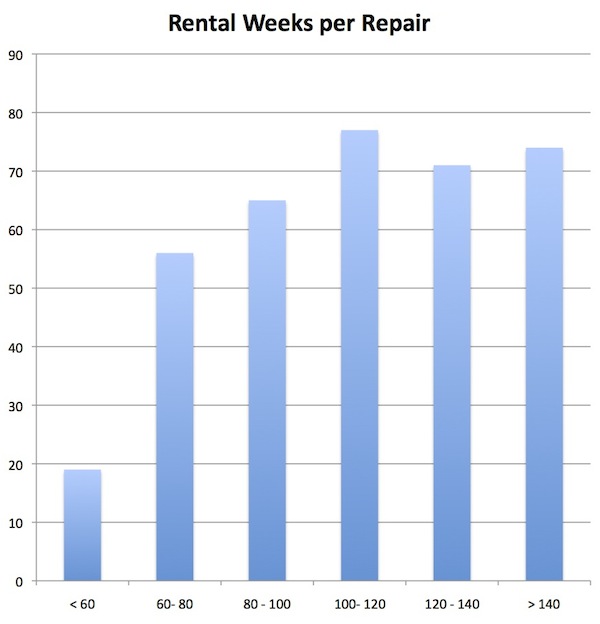
The 19 photography lenses with repair rates more frequent than every 60 weeks are listed below.
| Lens | Weeks to Failure | Sample Size | Common Problems |
|---|---|---|---|
| Tamron 17-50 f/2.8 VC | 37 | Small | Optics (4), Focus jam (3), Zoom jam (2), VR |
| Sony 18-200 OSS LE | 37 | Small | Zoom jam (4), electronics (3) |
| Nikon 70-200 f/2.8 VR II | 39 | Large | Zoom jam (16), Optics (15), tripod footplate (8) |
| Nikon 14-24 f/2.8 | 40 | Large | Zoom jam (17), Optics (3), Aperture (2) |
| Sigma 70-200 f/2.8 OS | 40 | Small | Motor (3), OS unit (2), Optics (2) |
| Sigma 50-500 OS | 41 | Moderate | Motor (3), OS unit (3), zoom (3), optics (3) |
| Canon 14mm f/2.8 II | 41 | Large | Optics (11), focus assembly (2) |
| Tamron 24-70 f/2.8 VC | 42 | Moderate | focus jam (4), Optics (2), VC (2) |
| Canon 70-200 f/2.8 IS II | 42 | Very Large | Optics (29), IS (7) , loose barrel (7), zoom jam (6) |
| Sigma 120-300 OS | 45 | Small | AF Motor (3), OS system (2) |
| Canon 70-200 f/4 IS | 51 | Moderate | Optics (5), electrical (2) |
| Sony 70-200 f/2.8 | 51 | Small | AF motor (4) |
| Canon 24-70 f/2.8 | 58 | Very Large | Optics (21), Zoom jam (3), focus jam (2) |
| Tokina 11-16 f/2.8 II | 58 | Moderate | AF/MF Clutch (6), loose barrel (5), AF motor (2), Diaphragm (1) |
To give you some perspective, I’ve included a table of video items we carry, because generally video gear is more fragile than photo gear (and probably gets abused more). The first two items are two of our highest repair video items, the CP.2 lenses are our most durable item, the rest just a couple of random picks I was interested in.
| Item | Weeks to Failure | Sample Size | Common problems |
|---|---|---|---|
| Cooke Panchro Cine Lens | 6 | Small | Focus cams break (6) |
| Sony FS 7U camcorder | 26 | Moderate | Broken viewfinder (4), Broken handle (3), Loose LCD (3) |
| Manfrotto 504 HD fluid head | 47 | Moderate | Leg locks (6), pan spring (4) |
| Black Magic Camcorder | 60 | Moderate | Broken SSD reader assembly (5) |
| Zeiss CP.2 lenses | 140+ | Large | Optics (2). focus (2) |
Cameras
You may have noticed no cameras made the list this year, which is a good thing. The highest repair rate camera was the Nikon D800 (65 weeks to repair), mostly because of autofocus problems. Nothing else was less than 80 weeks to repair. I should mention that part of the reason is I didn’t include some common problems as repairs: the D700‘s peeling grips, D600’s dust issues, and buttons popping off of the OM-D I didn’t consider failure since most people will take care of them at home. Even if I did include those things, though, those cameras would still not have made the list.
However, some common problems we saw a year ago like the 5D Mk III having bent CF pins and the D800 battery doors snapping off seem to have been fixed and have ceased to be an issue at all. Camera bodies, both SLR and mirrorless, had the lowest repair rates we’ve seen in 5 years.
Removed From the List
Off the list this year are the Canon 35mm f/1.4 and 100-400 IS; Nikon 105 f/2.8 VR Micro and 16-35m f/4 VR; and Tokina 16-26 f/2.8. For completeness I’ll mention that the Canon and Nikons above were barely off, all of them in the 60-70 weeks to repair range. The Tokina did seem to be better this year, with nearly 90 weeks per repair.
A Few Observations
Several other lenses on the list have small sample sizes, so there is more concern that they may just be a random event – just a few less repairs and they wouldn’t be here. I think that may be true for the Tamron 17-50 f/2.8 VC – it hasn’t been here before and there seem to be several different problems going on. The Sony 18-200 OSS LE is a new lens that has already had one recall. Since many of it’s problems were electronic I suspect it’s something that will be fixed before next year’s report.
The other small sample-size lenses are here every year, for the same problems, so I do think they really are fragile lenses.
Other conclusions I think are valid:
- Every manufacturer has some great lenses and some weak lenses.
- 70-200 f/2.8 lenses are likely to fail no matter who makes them. We think of them as ‘built like tanks’ because they have that heavy, all-metal case. That case, though, is as packed with mechanics and electronics as anything you’ve ever seen. There’s a LOT of stuff in there that has to work perfectly. Inevitably, some of that stuff breaks.
- Sigma’s big zooms still have trouble with their HSM motors and OS units, but Sigma really does seem to be doing better. Their large zoom lenses are still on the list but the frequency is lower than it used to be, in a year when my new accounting system made most numbers look worse. Sigma’s prime lenses and smaller zooms have excellent repair rates.
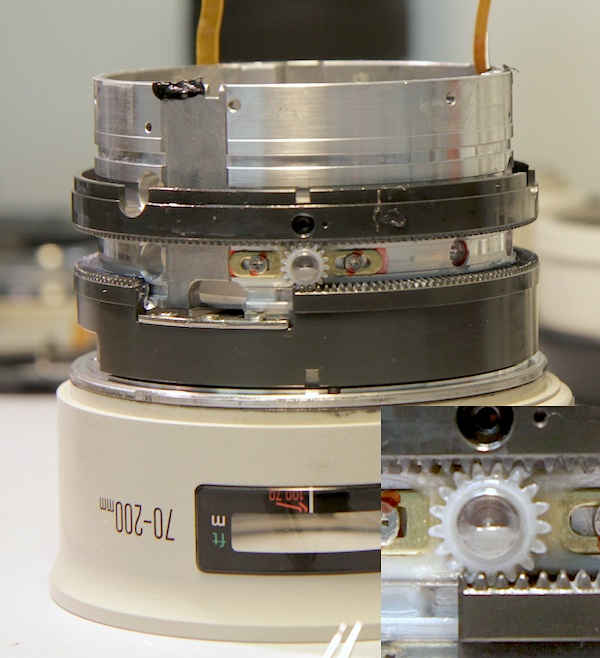
The insides of 70-200 lenses are densely packed with working parts.
The Most Reliable Lenses
I get asked every year to name the most reliable lenses, but I decline. There are two reasons. First, the repair curve is rather one-tailed – we have outliers that get repaired a lot, but because we sell everything at two years of age, there is a huge glop of lenses with low repair rates. I can give you a simple generalization, though: If you want to buy a lens that will last decades, then you want a completely mechanical prime lens.
It’s just logic. Electronic components get hot, or moist, and eventually capacitors leak or solders break.
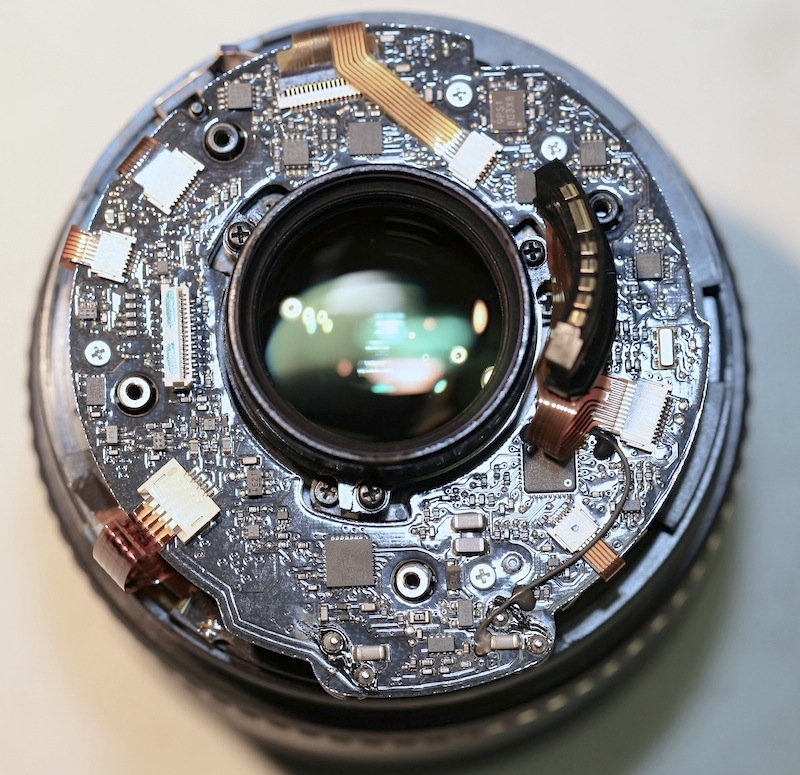
Zoom mechanisms move a lot and eventually the components supporting the zooming elements wear out. (Focus elements move too, but not as much and generally with a lot smaller mass.
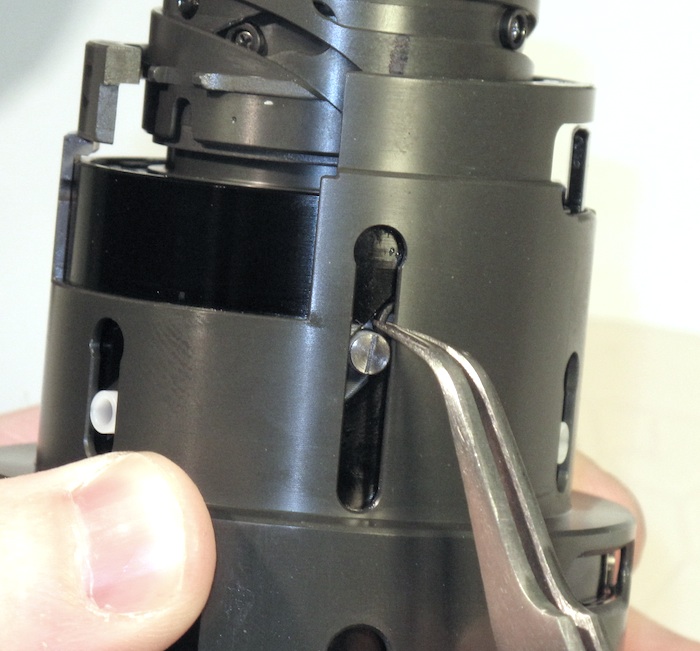
All focusing motors will fail eventually. They are electronic and they move.
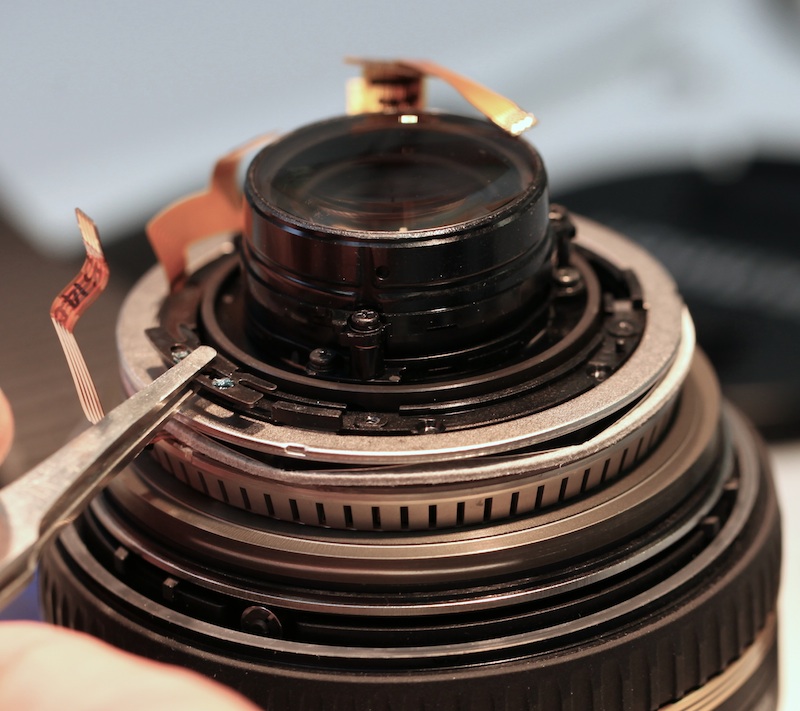
An IS unit is electronic, has a motor, and moves hundreds of times a second.
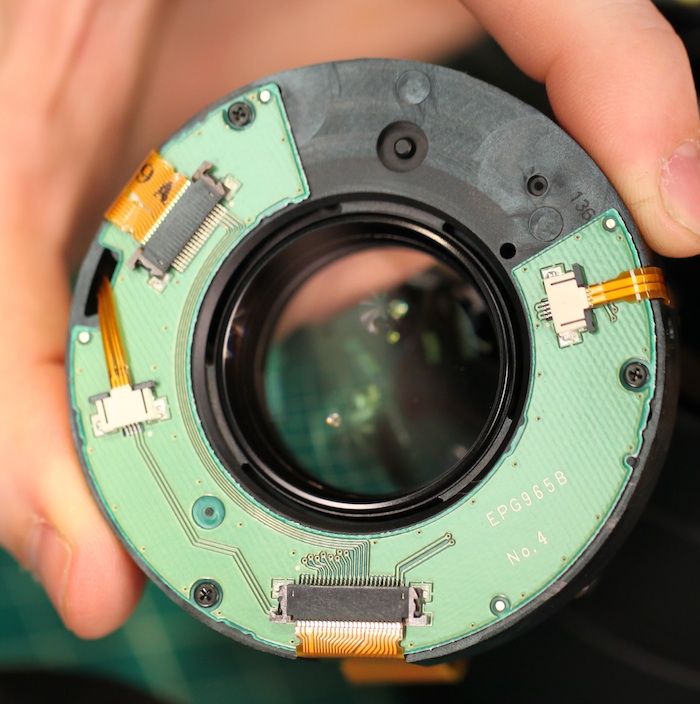
All of that being said, do I want an autofocus lens that zooms and has a stabilized image? Yes, I do. But the simple reality is the more complex a lens is, the more likely it is going to be to fail someday. It is no coincidence that the lenses that last 120+ weeks at Lensrentals are generally primes without image stabilization, and the ones that frequent the most repaired list are usually zooms with image stabilization.
I’ll pause a second here for those of you who don’t believe in the laws of physics to say, “Well, my IS zoom has lasted 10 years without a problem.” That’s cool; statistics suggest many IS autofocus zooms will last 10 years if you’re careful with them.
But if we look at large numbers the failure rate will be higher for zooms than primes, for lenses with IS than lenses without it, and even for autofocus lenses than for manual focus lenses. I’m not certain about mechanical versus electronic apertures – we see similar numbers of failures in both.
Factory Service Center Report
I care about this a more than most of you, probably, since I send things in for repair every single day while many of you have never sent anything in for repair. But someday you will need a repair, trust me on that.
Remember that service varies greatly geographically. We are U.S. only; service is very different in Europe, Asia, even Canada. The data below is only pertinent to you if you live in the U. S.
In general, factory service got better in late 2012 and 2013. I suspect widespread consumer complaining, particularly about Nikon USA, accounts for some of that. I know that some companies began looking at service as an opportunity to enhance their own reputation. Tamron announce with their ‘3 day guarantee repair’ turnaround time and Sigma an enhanced ‘commitment to quality assurance’ program. Nikon started to sell some consumer replaceable parts on their website.
Turnaround Time
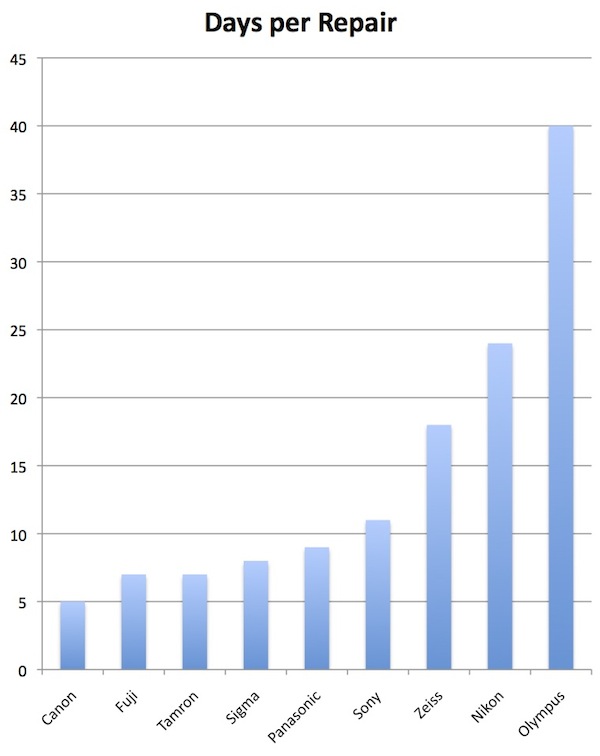
Repair turnaround time had a few changes compared to last year. Olympus had some disarray this year. (In case you weren’t aware, Olympus suddenly closed their repair center and for several weeks no one knew where anything was, or even where you could send a repair.) Their average turnaround time is higher because several items were gone for several months during the chaos, but even if I took those away they still would be the slowest by a good margin.
Sony made a huge improvement compared to last year, dropping from around 30 days on average to 12. Nikon actually is improving more than it appears at first glance. Repair turnaround time has decreased from nearly 30 days in late 2012, to around 20 days now. Most of the other Factory Service Centers stayed about the same.
I didn’t list Leica because they don’t really have a U. S. repair center; most things have to go to Germany. Their turnaround time is leisurely at nearly 35 days, but this includes shipping, reshipping, customs clearance, etc.
Repair Costs
Repair costs went up just a bit this year, but not anything like the sudden jump we saw in early 2012.
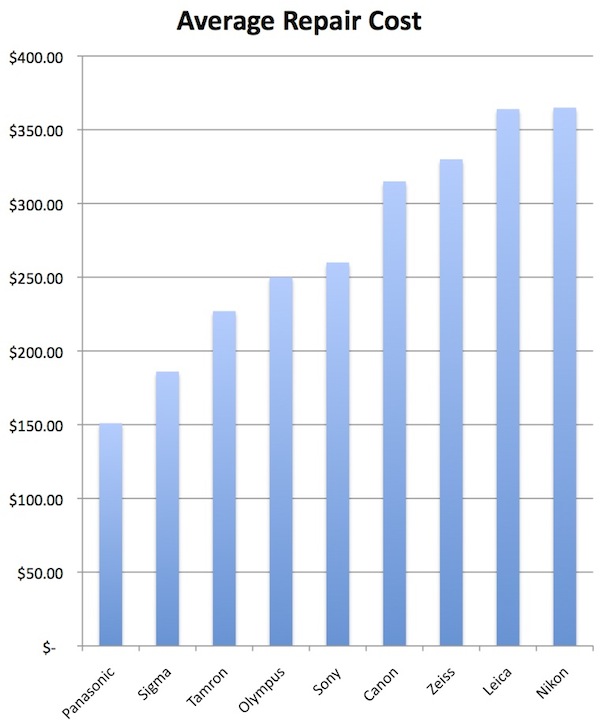
Tokina is absent from the table because we stopped sending anything in to them years ago. If we can’t fix it ourselves, we use an independent service center. They may be much better now, but I have no information either way.
Before you start dancing a jig about your brand’s low repair costs or complaining about its high costs, remember that repairs are generally a flat, tiered rate based on the item’s sale price. That means for a $500 lens, a basic repair is probably $80-$100, while for a $2,000 lens the basic repair is likely $200-$225. When you consider mirrorless gear generally costs a lot less than SLR gear and third-party lenses cost less than brand-name lenses, it should be obvious some of the price difference in this graph is just from that.
Obviously, the 4 companies with the highest repair prices are repairing the most expensive equipment. From a purely ‘price of equipment’ standpoint, Panasonic, Sigma, Tamron, and Olympus are about the same, while Sony fits in between the two groups (which is expected given it’s mixture of equipment).
One thing I’ve started seeing that I really don’t like: some companies (Sony particularly) have started charging a nonrefundable repair estimate fee. If you send your lens in with a scratched element and decide after seeing the $600 replacement cost that you’ll just live with it, it can cost you $135 to get your lens back. This is something you want to check before you send an item in for repair (unless you know it’s so totally broken you’d throw it away if it can’t be fixed).
One reason I really don’t like this is simple: even a non-working lens or camera is worth something sold for parts (check eBay – some things go for more than half the new price when sold as ‘not working, for parts only’). If anything, the company should be paying you for keeping your ‘not repairable’ item. I guarantee you they aren’t throwing it away.
The other reason I don’t like it is it’s cheating. If you call and ask the replacement costs for a 16-350mm Bazooma front element, they usually tell you we have to look at before we can give you a quote, even though it’s a flat-rate fee. So basically they’re saying, “it will cost you $135 for us to tell you how much the charge is.” I can understand needing to see the lens before deciding the fee for more complex things, of course.
I will point out that this year I didn’t even consider sensor replacements in figuring repair costs because we’ve simply stopped replacing scratched and damaged sensors. At $1,000 to $1,800 for a full-frame sensor replacement, it doesn’t make economic sense anymore; we either convert the cameras to infrared or part them out. I mention this because I’ve always said, “learn how to clean your own sensor.” I’m getting hesitant to say that to someone who’s never done it before. Scratching a sensor during cleaning is rare, but nowadays it’s a devastating expense if it does happen.
Battery & Chargers
I didn’t include this in the main part of the article, because honestly I think it might be us — simply because I haven’t heard much about it in any online forums. When I looked at replacement parts we’ve purchased this year one thing really jumped out at me: battery chargers.
We have several hundred battery chargers, obviously. When they break, we buy a replacement charger. For chargers in general, we replace about 2% per year. With two exceptions. All smaller Nikon chargers (MH-18a, MH-22, MH-24, MH-25, MH-26, and Mh-27) are replaced at a rate of 14% to 16% per year. All Fuji chargers (BC45W, BC50, BC65N) are replaced at a rate of 17% to 21% per year. No other charger is over 2%.
Since I haven’t seen anyone complaining about this online, I have to consider it’s something we do. My first thought is that we ‘top off’ batteries constantly. A battery comes back from rental with 2/3 of a charge, but we fully charge it before sending it out. This isn’t what most people do at home. So it may be those chargers get stressed somehow by our topping them off day-in and day-out. The other brand’s chargers might have some circuitry that isn’t bothered by that.
But any of you have other suggestions, please let me know and help me figure this one out.
ADDENDUM!! Looking at the list and saying “Canon has the highest repair rate because they have the most lenses on the list” is pretty silly. We carry far more Canon lenses than any other brand. So they would be expected to have far more lenses in the ‘high repair’ list. The fact that they don’t dominate the list actually indicates they have a lower repair rate (they do, slightly, but it’s certainly not significantly lower).
Looking at things statistically (as best as can be done) there really isn’t a significant difference either by all lenses, or by fraction of lenses with higher repair rates between any of the brands. There are some slight overall differences in repair rate by brand but none that seem statistically significant, or even close to it.
I repeat, every brand has some fragile lenses. If you must Fanboy go ahead. But don’t start your comment with “Roger Said” ’cause Roger didn’t.
Roger Cicala
Lensrentals.com
August, 2013
136 Comments
Kai ·
Roger,
Thanks for providing the data as usual. One question though: the Nikon 70-200 f/2.8 VR II occurs twice in the list of shortest rentalweeks to repair rates, but with two different reason lists:
1) Zoom jam (16), Optics (15), tripod footplate (8)
2) Optics (29), IS (7) , loose barrel (7), zoom jam (6)
What gives?
/PS: I think you forgot to change the month/year in the footer signature – we’re in August 2013, not September 2012. Well, at least I am 🙂
Roger Cicala ·
Kai, thank you! The second one was the Canon 70-200 f/2.8 IS II. I spent so much time doing spreadsheets analysis (about 20 hours) before I finally typed up the tables that I just got brain dead – and WordPress has a lovely feature that the tables don’t show up in editing mode. I’ve corrected that, and the date.
Roger
Jay Frew ·
Thanks Roger!
By publishing this data, you and your company provide a unique and Extremely Valuable, Free Service to photographers.
Cheers! Jay
Roger Cicala ·
Thank you Jay! I needed that. This year it took me almost 30 hours to crunch the data and write this up (which is why there haven’t been any blog posts for a while).
Jeremy ·
It sounds like from a long term lens reliability perspective, a system that supported IS in body and had simpler AF (screwdriver) may have an advantage? (At least for those of us that keep their gear more than 2 years.)
Roger Cicala ·
Jeremy, I agree with the in-body IS (assuming you change cameras every couple of years but keep lenses long term). Screw drive focusing though is often less accurate or slower, and drive screws strip. Not saying it’s worse, but it probably isn’t better.
Ian Anderson ·
The Canon 14mm f/2.8 II certainly sticks out considering it’s a prime and lacks IS. Maybe it’s time for one of Roger’s famous disassemblies to see why the lenses are having issues…
Roger Cicala ·
Ian – It is always optical adjustments with those, every time. I haven’t figured it out quite yet, but I can say it’s one of the most difficult for us to adjust in-house. A tiny variation in tilt or centering at the rear element makes massive distances in optical resolution.
Siming ·
I wonder how much of what we’re seeing is due to the primary uses of the lens. What I mean is this: I bet a lot of the 70-200 2.8 rentals are for sports or wildlife, whereas something like the 85 1.2 would be mostly for in-studio portrait work. That’s a big difference in working environment, which may be one of the reasons we see the 70-200 so often in the shortlist. Thoughts, Roger?
Roger Cicala ·
Siming – I do agree that has to have some effect (and was one of my thoughts when I looked at 35mm f/1.4 AF/MF switches – that’s not a lens I picture getting banged around often). 70-200s tend to be action and sports lenses and do probably get banged around more. They also are heavier, so there would be more momentum if it drops or get’s banged on something.
On the other hand, 300 f/2.8 and all the long telephoto primes are probably used in similar situations and are on the ‘hardly ever repaired’ list. I also noticed that 70-200 f/4 lenses are not high repair items – but the Canon 70-200 f/4 IS lens has quite a bit higher repair rate than the f/4 NON IS. Similarly the Canon 70-200 f/2.8 NON IS is significantly lower than the IS.
So I think perhaps the combination of densely packed working parts, zoom, IS and use make the 70-200s high on the list. I’m an IS fan and want it on my lenses but inevitably it’s going to be a thing that breaks.
Daniel G. ·
It’s a shame about the Rokinon/Samyang lenses. They seem to have nice optics, but $500 is pretty steep for a lens that seems like it’ll break easily and can’t be fixed. Yeah it’s drastically cheaper than many alternatives, but that’s a heck of a lot of money for a paperweight!
Roger Cicala ·
Daniel, remember these are heavily used and not as carefully cared for as a personal lens would be. Being forewarned they are fragile will hopefully help people keep them running longer.
And that $500 compares pretty well when you consider you can buy one for 25% of the price of the top ‘name brand’ alternatives, and compares well with the $400 or so you’ll pay to repair that same name-brand lens.
Joe ·
That Canon/Nikon/etc don’t pay LR to collect this data and report back is kind of sad. “Silent Changes” that improve the lens life would be appreciated by all gear addicts.
Siming ·
Ahh yes I hadn’t thought of the telephoto primes. Thanks Roger.
PS: Also, I’m an engineer, so I get giddy when you have data to back up everything 😀
Eddie Wrei ·
I always look forward to this post the most. As an old, retired Quality Engineer, I miss collecting, analyzing and reporting results like this. Great job, thorough and very good data for people to use…and free too! Your assumptions are very important for people making lens purchasing decisions, whether they are considering new or used. Thank you, sir!
Kenan ·
I just want to say to everyone… do not drop Canon 50mm f1.4 lenses on their sides. Don’t even let these lenses fall a few inches. The first time mine broke, it was from a mighty 4-5 inch tumble from the top of a guitar case. Good lens but there’s something inside that controls the focus and can break very, very easily if they hit the ground on their sides. I’ve done this by accident more than once and have a venerable 50mm f1.4 paperweight sitting around right now that I’m trying to decide what to do with. Again. Repair? Sell? Buy a new one? Buy something else? Just do not drop your 50mm f1.4…
Tomas ·
I would love to know if the Voigtlander Nokton lenses ever have to be repaired. I ask because I dropped one of mine a few weeks back and I think it broke my toe.
Roger Cicala ·
Tomas, they do need repair, but getting it dones is something else entirely – nobody can get parts. We fix some in house simply by scavenging parts so we can make one good lens out of two broken ones. Replacing the bent hood on one with the good hood from another with a scratched rear element for example.
Robert Panick ·
Hey Roger, since you’ve called it out so many times before. Has the new Sigma 120-300 f2.8 been more reliable than the old one? I know it’s still new yet, so the data might not be complete yet.
Kay O. Sweaver ·
Call me crazy but I’d like to see a lens assembled from all the broken parts. Zombielens!
Andreas ·
I love your scientific approach and I’m a happy customer but as a scientist: could you please label your y-axis(axes in general) correctly? Sometimes it’s in the title, sometimes not. The first one is particularly confusing because the title is the x-axis label there. Keep up the good work!
Mike ·
Thank you so much, Roger for your titanic and very useful job!
Very informative as always. And, please, let me one short question:
what about AF-S Nikkor 70-200_4,0 VR?
I didn’t find any mention of it.
Thank you in advance.
Best regards, Mike.
Roger Cicala ·
Mike, we don’t have a ton of copies, but so far the Nikon 70-200 f/4 VR has been trouble free!
Tony Bologna ·
This is one of the single greatest contributions to photographers on the web. As always, FANTASTIC!
The Canon 50mm 1.4 used to be on here for AF motor failure. Do you still see this often or do you suspect Canon silently fixed this during the production process?
Roger Cicala ·
Tony, we still see some motor failures, but not quite as frequently as prior years. It’s off the list this year, but if recall not way off — something like 70 weeks per failure if I recall correctly.
Chris ·
20 hours crunching numbers! That’s dedication, I’ve got to say I also really appreciate all the effort you put into your posts. Keep up the good work. Thanks again. Chris
SwampYankee ·
Thanks for this. My favorite post of the year. It’s also an excellent guide to those buying used equipment. Lets folks know what to look for.
Jeffrey D ·
I’ve had to send way too many Canon lenses off for in warranty service. It gets to be rather disappointing. In fact I had a 24-105 f/4 that ended up going back 4 times. The 4th time they finally replaced the zoom assembly, but only after I included a video with the lens demonstrating the problem.
Jasmine ·
Roger, thank you so much for your efforts in compiling and sharing this data. You mentioned that “The highest repair rate camera was the Nikon D800 (65 weeks to repair), mostly because of autofocus problems.” Is this in reference to the infamous left autofocus issue or something else ?
Roger Cicala ·
Jasmine, it was largely the left AF issue, but there have been a few other AF problems – I believe from the AF sensor becoming misaliged with use.
Bill Adkins ·
Roger: Great report, nothing but the best.
rondhol ·
All Rokibowyang in the list except the fisheye 8mm APS-C lens. Is it also as bad as others in the build quality that held together with small screws and glue?
It makes me think to get 17-40mm instead of 14mm rokibowyang for 2x price. How do you think Roger?
Roger Cicala ·
Rondhol,
Both are good lenses. I actually own a Bower 14mm because I like the wide-wide, f/2.8 and it’s amazingly sharp. When I travel, though, I grab a 17-40 because of it’s flare resistance and the usefulness of the zoom. I wouldn’t make the decision based simply on reliability unless I was really tough on lenses with lots of travel and constant use. If that’s the case, though, the 17-40 is a rock, it never breaks.
Alexander ·
As a Nikon owner, this sheet is kinda discouraging to see 🙂
Torben Christiansen ·
Hi
Great great article. You really have a great knowledge database that is of great value to anyone that cares about photography. I think you might even get to generate an extra income on this information. Let me give you an example that I think many amateurs that comes to. You lens get broken and you have to consider is it worth getting it repair compared to getting a new lens. Just getting a quote for a repair costs (here in Denmark) $100, so being able for example select the lens and the expected type of repair and getting an average quote on the cost of the repair sure would help a lot. You have displayed the information for each company and I bet you have the information in your spreadsheet. I know I would pay $10 for a average quote for how much it would cost to repair the focusing motor on the first Nikon edition of the 70-200 2.8 VR…
Jakob Teuffel ·
Thanx Roger for your Great Work!!!
You mentioned that it’s not as Importent how much a repair is but how much it is compared to the Item’s New Price.
So a relative Relative repair-/new-price Chart by Manufacturer would be extremely interesting.
Don’t get me wrong. You earned my full respect and thanks for all the work you did and spread for free, but if it’s possible to add this chart (e.g. Next year) I’d be really happy.
Kind Regards
Jake
Dewan Demmer ·
A nice read. An interesting perspective based on data I, myself, as a consumer could never collect. The opinion given is fair and even handed which means any opinion given is worth noting.
Samuel H ·
* THANKS THANKS THANKS THANKS THANKS
* I woulnd’t have expected such high failure rate from the RokiBowYangs. They feel quite good when holding them. Go figure.
* Nikon should be ashamed: two flagshilp lenses near the top of the list (14-24 f/2.8 and 70-200 f/2.8 VR), plus slow and expensive repairs
* Now that you mention the slower demand for the D600 and D800… LensRentals is also in a great position to provide information about market share: would you care to provide relative revenue numbers for “cameras” and “lenses” by different manufacturers? B&H data would be even better, but they’re not nearly as nice and open as you are 🙂
(yes, I know it can be a bloodbath in the comments, but nothing is worse than an uninformed argument)
Roger Cicala ·
Samuel, I don’t know that our data would reflect general use. For example we rent a lot less Nikon this year, but I suspect that’s largely because we rented a ton of D800s, D600s, and new Nikon lenses early on when people were deciding to buy. There’s fewer new products and feeding frenzies going on this year. Similarly we rent way more m4/3 lenses than you’d expect from the number of cameras, but much of that is being rented by video people because there are a lot of m4/3 video mounts.
B&H or other big retailers know much more than we would about various popularities, but I’m sure they’re under nondisclosures for that kind of stuff.
Bob B. ·
GREAT data and discussion!
Now I can go out and tell everybody “what Roger said”!!! LOL.
Seriously though,Thanks for publishing this info. There is some bravery involved there.
Markus ·
Hey Roger,
as Jay already mentioned, this data collection is extremely useful and sth. which cannot be obtained easily otherwise. This is real knowledge from actually using and wearing stuff, sth. the manufacturers try to hide from end users as much as they can (which makes me ask why as positive trends, e.g. for the D800 are quite good arguments in favour of the product and the manufacturer!).
It’s definitely good to know not only which lens/camera is designed very well optically but also which one does mean less hassle for the user. At least in term of design flaws and systematic failure.
Plus you guys have the very special opportunity to give us some insight on trends: Which stuff is improving by silent modification or improved quality control, etc.
It would be even interesting to get more information: The worst 20 or 30 lenses (you already named some close competitors) and also some general observations on the least fragile lenses/cameras or brands/series of lenses (if such an evaluation can be made in a way that makes sense).
Thanks a lot for the very labour-intensive work and keep on going!
Markus
P.S.: I t would be interesting to know if the manufacturers do pay attention and do react (e.g. on the topic of chargers & batteries)
Markus ·
By the way: Is the Canon 24-70/2.8 in your list the version II of that lens or is ist still the older model which tends to wear out as you have already mentioned in another blog post?
Roger Cicala ·
Markus, the Canon on the list is the version I, the old one, which has always graced the list. The version II is fairly new and except for what seems to be an amazing ability for the front element to scratch (we don’t count scratches, but this has gotten my attention) seems pretty trouble free, at least early on.
Lester ·
Fantastic! We would be able to draw some very interesting statistical conclusions if we knew the standard error of the averages you show. For example, the drop in average repair time for Nikon from 30 days to 20 days. If the standard error was 6 or 7 days or more, then this would suggest that the drop was not significant, ie it was statistical noise; but if the standard error was 3 or 4 days or less, then the drop would be “statistically significant”. For example, average rental weeks to repair for the Canon 70-200 f/2.8 IS II is 42, but for the Mk I is 51. If the SE is 5 or larger, then the difference between 42 and 51 is likely noise; but if the SE is 4 or less then the difference is likely to be statistically significant. SE is quite easy to calculate. Any time you calculate an average for some data, just calculate the standard deviation as well, and divide by the square root of the number of data items. Then, rule of thumb is, any difference larger than 2 SEs is probably significant…
Roger Cicala ·
Lester, the data sets are markedly nonparametric so I think a true statistical analysis would require a nonparametric analysis of variance or regression analysis. It’s been a decade since I did statistical analysis for scientific publications, but I remember enough to remember I don’t want to do those anymore 🙂
rondhol ·
24-105mm L is also very solid. I did not see it in the list for many years. Besides that, it is nice cheaper because came as kit. It has IS and autofocus. I am also wondering how Tamron 24-70VR in long terms compared to the 24-70mm II canon.
Roger Cicala ·
Rondhoi, the Canon 24-105 is one of the bulletproof lenses that never seems to fail. The Tamron 24-70 f/2.8, Nikon 24-70 f/2.8 and original Canon 24-70 f/2.8 have always been on the list or nearly on the list — not awful but not great. The new Canon is too soon to tell, although as I mentioned earlier the new flouride coating on the front element seems to scratch if you blow on it hard.
BigEater ·
Rodger–for those of us who are in business, could you explain the business reason you decided to have defective lenses repaired rather than simply exchanging them? Was that a request from the people who sell you the lenses?
Roger Cicala ·
BigEater, that’s a large part of the reason, we were able to negotiate some more favorable terms. It also turns out that there are some difficulties with buying, returning, and rebuying an item from an accounting standpoint. To a lesser degree, and depending on a variety of factors, returning often meant weeks until we could get a replacement, while in-house repair meant it could be renting the next day and with some brands even sending to the factory got it back in-hand more quickly than we could buy a new copy.
someone ·
Roger said: “…I’ve always said, “learn how to clean your own sensor.” I’m getting hesitant to say that to someone who’s never done it before. Scratching a sensor during cleaning is rare, but nowadays it’s a devastating expense if it does happen.”
Sounds like you have a great idea for your next blog post, “How to properly clean a sensor” (unless I missed it in a past blog). You’ve cleaned more than anyone else I’m sure, so please teach us how!
Randy ·
Thanks, Roger. It’s great to hear that US factory service has improved, even if they had to be shamed into it. And it really does depend on where you are. Nikon service in Japan has been a totally different experience.
Joachim / CH ·
This sensor cleaning method video of one of lensrentals’ experts might help you:
http://wordpress.lensrentals.com/2010/04/how-to-clean-a-camera-sensor
KeithB ·
Roger:
I am being a bit selfish here, but I notice that you list the Sigma 50-500, but not the Sigma 150 – 500.
Is that because:
You don’t carry the the 150 – 500
The 150 – 500 is much more reliable (I hope)
The 150 -500 and the 50-500 are so similar that it is really academic.
Roger Cicala ·
Keith, the correct answer is A. We don’t carry the 150-500.
BigHank53 ·
Battery chargers:
You’re not causing more stress by using them to top off batteries. What you are doing is using them at a higher duty cycle: many hours per day instead of thirty minutes. I would not be at all surprised to find that the Fuji and Nikon chargers that are failing at high rates are sharing some common circuitry, perhaps even the entire circuit board.
For your in-house needs, I’d be tempted to buy some dedicated Li-ion chargers designed for R/C airplanes and gut the defective factory chargers, adding a battery-side connector. I can’t imagine it would take more than fifteen minutes to mod the bad charger, and you could then swap various battery heads to match demand. You’d still need stock chargers to send out with the cameras, but those would be seeing the typical low user duty cycle.
Oskar O ·
Great article once again. I think the decision to include the Rokinon lenses was right due to two reasons 1) people need to know what the differences are and reliability could weigh in a purchase decision (also explains why certian lenses cost more) and 2) it would be hard to justify leaving out one brand, particularly since many brands have low cost lenses — where to draw the line and on what grounds?
I for one was interested to see how Rokinon faired in this, as I tend to prefer the “lasts a lifetime” models, but it’s good to have alternatives.
CarVac ·
Man, the Samyang 35/1.4 falls apart if you look at it. Mine fell 1 foot onto my bed and dislodged the rear group.
I can see why you charge 90% of the rental cost of the Canon 35/1.4L despite the factor of three difference in purchase cost…
Douglas ·
Roger – firstly, thanks for doing this. Secondly, given your theory of greater complexity leading to more frequent failures, I’m surprised that the various tilt/shifts lenses don’t feature more prominently in the list – is this because you didn’t have enough rental hours for these lenses, and if not do you have some other theory?
Roger Cicala ·
Douglas, we have plenty but I don’t consider them complex: no AF system, no IS, and simple mechanical gears and levers that move the tilt and shift base around. I would also guess they tend to be used in more careful situations, often tripod mounted, etc.
Nick ·
Thanks for this informative insight 🙂 I also help out with the operations for a local rental outfit and the thing’s I’m seeing do match yours. Our charger death rate is relatively low even for the Nikon chargers but maybe it is because of or much lower volume of use? Also our Nikon 70-200’s have mostly been fine and have only “died” after getting dropped/banged around.
BTW have you had any unusually high occurrences of mechanical failure in the AF or zoom mechanism of the new Sigma 120-300? Maybe we are just unlucky with the sets here =p
Roger Cicala ·
Nick, we used to see a fair number of zoom failures in the 120-300s, but that seems to not be much of an issue anymore. The AF/OS failures, though, are fairly constant. Inside the lens there’s one unit that contains the AF motor and OS unit – I suspect rather than disassemble that, for most repairs they just replace the entire thing (much quicker) and it comes back with AF / OS unit replaced.
Our Nikon 70-200s have two optical problems pretty regularly: front element decentering and a rear element that ‘pops out’ of the molded retaining clip that holds it in place. In both cases center sharpness remains good – the corners get soft. I think a lot of people don’t notice it because with that lens they’re usually working with centered subjects.
Roger
Steve ·
Roger,
Interesting you mention the 24-70 II scratching easily. I sent mine to Canon for fine hairline scratches on the inside and outside of the front element. They replaced it no problem under warranty. I noticed the new element has a tiny mark on the bottom about 1mm long and I think I only ever touched the glass once before putting a filter on. Never ever marked a lens before this one.
I also rented a 8-15 from Canon and seen it has similar coating scratches. Have you noticed other lenses with the flourine coating more scratched up?
Roger Cicala ·
Steve,
We haven’t noticed it to the degree we have with the 24-70 – we get a number of 8-15 scratches but lenses with ‘bugeye’ front elements have some tendency to do that. Plus we only have a few dozen 8-15s compared to a hundreds of 24-70 IIs.
Roger
Chris ·
Hi Roger, am I correct in thinking from reading your reply to Rondhoi and the post etc that in general the F2.8 zooms tend to fail more frequently than the F4 zooms and slower? If so what would be your thoughts on why? More complexity in achieving F2.8? More built in correction for element alignment? Or other factors such as the uses they are put to and who by?
Roger Cicala ·
Chris, there is a difference with the f/2.8 zooms generally failing a bit more, although the difference isn’t huge. I’m not sure of the reason. Useage, weight of components, momentum being larger when they get banged around (which might mean shipping is a culprit) are all possibilities and I’m sure there are others.
David Randall ·
I own Canon Cameras and mostly Tamron Lenses.
I have a Love/Hate relationship with Canon Repair. They are either fantastic, or horrible. But the turnaround time, including shipping is always less than a week.
On the Tamron side, AMAZING Service. Turnaround time is always less than a week. And, with a 6 year warranty, I have only had to pay for one repair.
I have a 28-75mm f/2.8 that I dropped and broke 8 months into ownership. They charged me $180 and replaced 2 elements and the focus assembly. It came back in 6 days and worked better than new.
With most companies that’s it for the warranty, or they only give you 30-60 days. But Tamron continued the 6 year warranty.
It has since been back twice and each time they end up replacing an element or 2 and some electronics. I sent it back 1 month before the warranty ran out, just to get a firmware update and, well, because they always do an excellent job of cleaning it and I’m finally selling it for an upgrade. They replaced 2 elements, and the focus assembly (again). It works so well on my new 6D I don’t want to sell it for an upgrade!
Steve ·
Roger,
One final question in regards to the Canon 70-200 II… Have you had many USM issues with any of the 70-200’s from Canon? I got another copy recently, used, and when pointed upward the USM slips. If you turn the focus ring one way, the focusing elements slip and don’t move. If you turn the other way, they move fine. Looked it up and seen quite a few other people with the same issue on youtube and forums, but notice no USM/focusing issues listed in your 70-200 repairs. Have you seen this before? And what causes this to happen with the USM? Mine currently is being repaired by Canon, thankfully!
Thanks again for all the wonderful insight, Roger.
Roger Cicala ·
Steve,
We’ve seen that exact thing a few times. I think it’s always been a tension adjustment in the USM motor when it happens, but it hasn’t been as frequent as some of the other issues. I think we’ve seen it 3 or 4 times.
Roger
L.P.O. ·
Can’t help but ask: does Canon’s 50/1.4 lie somewhere on the map? My understanding is that the Micro USM AF mechanism of that lens is particularly brittle and it gets lots of complaints in discussion forums. How does it look to you?
Roger Cicala ·
LPO the 50 f/1.4 is always near the list and always for USM motor failures, but never quite on it. I suspect the fact that non of ours are more than 2 years old helps that lens more than some.
A ·
I’m wondering whether the power supply issues are related to the different voltages and frequencies of mains power around the world?
Nick’s post hints that I might be on the right track; Singapore (where I believe he is) is a 240V/50Hz country, but the USA a 110V/60Hz country.
As a matter of interest, are the failing power supplies labelled as international supplies (i.e. 110V-240V 50/60Hz), or are they purely 110V/60Hz?
The very cheapest power supplies are often single voltage; so it could be that they’re just the cheapest PSUs available – which would suggest they’re slightly marginal in the first place. Cheapest rarely means best designed and best quality 😉
I know with appliances using AC motors that the motors work best at their designed frequency, and may burn out prematurely if used at a different frequency, even if the voltage is otherwise the same. There’s an outside chance that that’s what’s going on – they’re 50Hz transformers being near the limits and are a bit outside their tolerances when running on 60Hz.
Or it could be completely unrelated, and just be that a bad batch went through 😉
Incidentally Japan has probably the oddest power supply in the world – they use 100V (and are nearly unique in doing so), and they’re also nearly unique in having different halves of the country on different supply frequencies. The eastern side is on 50Hz, whilst the western side on 60Hz.
Lester ·
Roger said, “…I think a true statistical analysis would require a nonparametric analysis [and] I don’t want to do those anymore”.
Couldn’t agree more, wouldn’t want to suggest that you do! But what I mentioned was standard deviation and standard error, that is, some measure of variability. Heck, a range could do as well, something that accompanies each mean that you calculate, just an extra cell that reports STDEV(A1:A123)/SQRT(COUNT(A1:A123)) or whatever for every AVERAGE(A1:A123)… Then (us) statistically-minded folk would be able to figure it out from there (smile)!
Markus ·
Interesting to read that you regard electronics more prone to failure than mechanics. I always thought that everybody would move to more electronic parts because they are more compact, cheaper and more reliable.
L.P.O. ·
Roger,
thank you so much for your answer regarding the 50/1.4. So, in this case common wisdom seems to correlate with your experiences. Nice.
The personal reason I asked the question was that the Canon 50/1.4 is the only lens I’ve ever broken (yes, USM AF/MF). I treat my lenses not with utmost care, but pretty gently. That lens never saw a proper bump, still it broke.
I’ve also taken to heart the Rokinon warning(s) your list contains. I have the excellent 14/2.8 under the name of Samyang, and will be very careful with it so as not to lose it. Because I for sure love the image quality!
Mass ·
Thanks Roger for these stats. I love the stats on repair time, they are damning for some manufacturers.
Mark ·
As far as I know Rokinon lenses carry no serial numbers – so how do you track specific lenses, e.g. for repeat failures / lemons / batch issues?
Incidentally Samyang lenses do have serial numbers (observed as I have several of each brand).
Roger Cicala ·
Mark, all of our lenses get tagged with bar codes as soon as we purchase them. That’s actually what we track in the system (although for most lenses the bar code pulls up their serial number).
j. hamann ·
I never saw 70-300mm L IS. It has USM and IS and never appear in the list. Probably New generation lenses has better durability. 70-200mm L 2.8 and 100-400mm L almost always in the list from the IS, autofocus, or zooming failure.
Omer Einav ·
Great Work Roger thanks for taking the time to share this info with us !
Nick ·
Thanks Roger for the insight on the 70-200’s as well. We just recently also discovered a weirdissue with the new Sigma 120-300. If kept relatively level, one of our copies has a tendency to have the AF disengage if turned too fast past the min distance or past infinity.
Once disengaged the AF fails and turning the manual focus ring does nothing. Tilting the lens slightly up or down resolves this problem instantly though, just thought I’d share 🙂
Steven ·
Roger,
Appreciate your kind help with everything! I do have one final question (last one, I promise!) about the 70-200 II… As stated previously, mine had the AF/MF slipping and Canon replaced the main barrel assembly and adjusted the USM collar or something… When I got the lens back, the slipping issue was fixed but it still returns a bit more slowly one way than the other when the focus ring is turned and the lens pointed upward.
But my other issue is when I got the lens back I had a rubbing noise at MFD when the lens hunts for focus. Always makes this scrape noise each time when it hits that MFD point. If you tilt the lens sideways at all, the noise goes away… And changes if you point it up/down. I sent the lens back in and they called me today saying it is not abnormal with this type of barrel/USM design on the 70-200 II and other super-tele’s… That there are two collars or barrels inside the lens that may contact or something at the extremes of the focus range, but will not cause any issue or effect performance at all.
They said the USM tested flawlessly and speeds and accuracy were both excellent.
Anyway, they basically told me they can loosen the collars to suppress the noise or even replace the USM, but they said it is working perfectly and may not fix the noise I am hearing. Found this strange, but curious on your two cents… I told them to do whatever they felt was needed (or not needed) as long as it wont give me problems later on. I was told their lead tech was going to look over the lens again and make sure all functions and everything were fine before shipping back to me again.
Does this sound right to you about the faint “rubbing/scraping” noise I am hearing at the MFD end of the focus range? I have had a few of these lenses and never heard this before, but they are pretty confident with me that it is non-issue due to the design of the lenses internal focusing and such.
Thanks again Roger!
Roger Cicala ·
Steven,
That does sound right (maybe right isn’t the correct word, but certainly ‘not unusual’). We’ve seen the up-down tilt change noise both from AF and from the IS unit. A certain % of them have noisier IS units and they don’t seem more likely to develop problems than others. I do know there are several areas where barrels ‘barely touch’ in that lens at certain distances, and there are also gears, rather than just helicoid units with the zoom mechanism.
So, while the noise makes everyone (us included) a bit concerned, I can say that our evidence is exactly what Canon said: it doesn’t seem to be any real problem, just a noise.
Roger
Nqina Dlamini ·
Great data represantation. Great article, truly enjoyed it.
Jaye ·
Hi Roger,
Just a quick question. Let’s say if the electronic part of the lenses fail, for eg: the IS unit or the AF fails. Can the lenses still work? If I turn the IS off and use it in Manual Focus, does it still work flawlessly thought without the aid of the electronics.
Thanks.
Roger Cicala ·
Jaye,
That’s often, but not always, true with IS units: turn them off and the lens works fine otherwise. AF motors vary but most of the time if the AF motor has failed manual focus doesn’t work properly (some MF systems focus through the AF motor) or the lens gives an error message. Some can still be used as an MF lens though.
Andy ·
Could you post the raw data so that we could do our own analysis of the data?
Roger Cicala ·
Andy, unfortunately I can’t give out exact number of copies we own, rental frequencies, etc. We’re a market leader in a competitive business and the number of each item we have at different times of the year is information our competitors would dearly love to have. Even things like what repairs we can do in-house is nondisclosure – knowing which items we can fix tells a competitor they can learn to fix those too, while knowing what we can’t fix saves them hundreds of hours learning they can’t fix it either. There’s actually some very good arguments made by management here that I give out far more information than I should already – a smart competitor (and we have a lot of competitors we respect, because they’re smart) learns a lot about us from this article already.
Roger
Neal Spero ·
Another great article.I am a zoom person. i own a 5d mark 111. I have all older zooms .which of the newer zooms would you recommend?.
Roger Cicala ·
Neal, there’s not many recommendations I’d make on the basis of reliability – I want lenses with good optics. A 70-200 f/2.8 IS II is a great lens. I’d definitely buy one for my 5DIII if I shot in that focal range even though it has a higher chance of needing a repair. If money was no object, I’d absolutely want a 24-70 f/2.8 Mk II also.
At the wider end I’d consider primes, though, simply because I don’t love the 16-35 or 17-40 Canon zooms.
Jaye ·
Hi Roger,
To be more precise, can I use the canon 70-200 ii lens as a MF lens if the AF fails? How about the 24-70 ii as well, can it be used as a MF lens if the AF fails. There shouldn’t be a problem right? Since these 2 lenses are not focus by wire design. I’m quite concerned as I use these 2 lenses extensively for my assignments, now hearing that the 70-200 ii has reliability issues, I’m afraid that the lens will fail on me mid shoot. So I was wondering if the electronics were to fail, can I still use it or I might need a backup lens. Do you also happen to know how long canon will continue to service a lens after it has been discontinued.
Thanks.
Hank Dietz ·
As usual, interesting data well presented.
I’m a professor with a background in parallel supercomputing and now working in computational photography. For what it’s worth, my mere 125+ lenses, mostly old manual focus via eBay, show a significant failure rate too — with the key difference that most failures do not render the lens inoperable. Problems with old lubricants/dirt and largely cosmetic defects like loose external parts head the list. Of course, I’m only seeing the long-term survivors when buying 20+ year old equipment sold as being in working condition.
The failures that you’re seeing on modern lenses sound more like the failures I’ve seen running thousands of PCs in cluster supercomputers since 1994: it’s specific weak/defective parts/design rather than things slowly wearing out. For example, we’ve had various particular models of network switches, disk drives, power supplies, and motherboards with 100% failure in less than a year… while most of our PC hardware has had no issues at all — with some in continuous operation for as long as a decade.
I think most complex modern devices have this type of failure profile, largely because the design cycle is now too short to do extensive testing and refinement. In the 1980s-1990s, my research group did a lot of alpha and beta testing for various computer makers — helping them refine their product before release. Now, that process is gone; what would have been called alpha test versions tend to get shipped as final products. It also seems much more common now that once a product ships, engineering doesn’t get to tweak it much… a side effect of short product lifetimes and big investments in tooling, etc.
Anthony ·
Wow, it’s amazing; Roger said that Canon lenses are worse :-p
Nice article Roger, thanks for shedding some light to a subject that non of us could have a (statistically meaningful) opinion.
Andrew Macpherson ·
Great report, a fascinating read, thank you for sharing so clearly your experiences.
When the D800 came out and Canon dropped us old 1Ds Mklll owners without a matching product I went back to Nikon (I’d started with them 20 years previously) by my limited experience with trying to get someone there on the phone, or a timely repair has taught me the error of my ways. I’ll be back to CPS and their exceptional service as soon as they put out a high rez (the rumored medium format?) camera.
liam faulkner ·
is oil spots another common problem with the d700 and d800????
Roger Cicala ·
Liam, that hasn’t been much of a problem, the D3s and D3x were the bad oil actors.
Paul ·
Thank you so much for taking the time to put together this article and sharing this information.
Just wanna say that, as a one-time (and henceforth occasional) customer, this kind of free-spirited, sensible commentary on your part is one of the things that attracted me to your company.
Ken Sky ·
Roger,
This has been a most informative article & discussion but begs the question, “Where do all those heavily used 2 year old lenses go?” Is there some seedy used car lot -er – camera shop with a dubious salesman that sells them. Or do they get factory refurbished before re-cycling?
Roger Cicala ·
Ken,
Some never make it to the two year mark, of course. Others are rough enough that they become parts. The ones that are in good shape and optically sound get sold by http://www.lensauthority.com/
Andrew Krucko ·
A well written article which is thoughtful, informative and measured! Thank you Roger!
Eric Tastad ·
Thanks Roger, can you comment on what mounts the Rokinon fails on or is it pretty uniform across mount types? (i.e. are failure rates similar between Nikon, canon, etc?)
Roger Cicala ·
Eric, it seems pretty uniform in all mounts and in photo or cine versions of the lenses. They have a solid outer shell, but the inner workings are rather frail and identical in all mounts.
KC ·
Thank you Roger for a most informative article.
My own thoughts on the reliability of the 70-200f/2.8 lenses of all brands is that, I am guessing those people who rent one of these proverbial workhorses would really be putting it to work when it is in their hands.
I know it’s impossible, but if we were calculating the mumber of camera actuations (or some other measure of usage) between failure, I reckon the our workhorse might actually do quite well!!
Anyway, excellent article and thanks for sharing!
Peter K Burian ·
Very interesting. AND interesting to see how long it takes some companies to complete a repair. Nikon seems surprisingly slow.
I am a Nikon Pro Service member, thankfully, so I get much quicker repair turnaround.
HM ·
Wow, interesting side note on the 35mm 1.4L and the frequency of repairs to the AF/MF switch. The only lens repair I’ve ever required was for a detached AF/MF switch on my 35mm 1.4L lens. Canon, bless their heart, performed the repair free despite the lens being out of warranty.
melgross ·
Roger, it doesn’t seem to me that you should blame yourselves for high charger fault rates. If company A has its chargers break at a 2% rate, at your usage, and company B has a 20% breakage with the same usage model, then it’s clear that company B is doing something wrong in their design, or manufacture.
While I’m retired, and so don’t use my equipment the way I did before, from that older usage, I did always top off my batteries. I suspect that it’s not an uncommon pattern for many pros. So your findings should correlate to what those pros are doing. Don’t disregard that data, as it’s indicative of a real problem.
Paul S ·
Roger – great article! I read in detail this morning and scanned again. What I didn’t find was information on lenses that pass through your inventory without ever experiencing a repair. I know the focus was which lenses exhibit the most problems and how frequently. But, a bit of information on how many or percentage that never have a problem helps give a context / support that equipment is *mostly* rock solid even under heavy use. Thanks.
Dude ·
The older nikon and stuff like that is better
pellicle ·
Hi
Since you mention “remember that repairs are generally a flat, tiered rate based on the item’s sale price. That means for a $500 lens, a basic repair is probably $80-$100, while for a $2,000 lens the basic repair is likely $200-$225”
It might be then interesting to add a graph similar to the average repair cost, but making it average repair cost over the dollar cost of the item 🙂
Great work, thanks heaps for publishing this 🙂
Brooks Gelfand ·
You mention repeat repairs – items that were returned from the factory as repaired, but were not properly repaired.
Do you have any figures (that you could publish) that show which brands have the most repeat repairs? Do you see any statistical difference in repeat repairs between the various factory repair facilities?
Roger Cicala ·
Brooks, the one thing that stands out is repeat repairs are most commonly for optical resolution. I didn’t notice any other huge differences.
Brooks Gelfand ·
Thank you, Roger.
If I understand your reply, you see no difference in the rate you have to send items back among Canon, Nikon, Sony, Fuji, or Panasonic. All of the major manufacturers fail to “get it right the first time” equally.
Brian ·
When you say that Voightlander … repairs just aren’t happening… is that because repair capability (facility?) is not worthwhile, or because there are no repairs to be made? My general interpretation is the former, but the latter is reasonable given that most of their lenses are simple, small, manual focus primes.
Roger Cicala ·
Brian, Few places will work on them, and the wait for parts is often months, if they can be found at all.
Tom Fama ·
Very interesting. Well done. You have a unique data set. Could more conclusions be derived? Thanks.
Geoff ·
From the UK, where I also dealt with repairs, but for consumers cameras [including pro’s]. There were some lenses which went off for repair more than others, a case in point being the Canon 50mm F1.4 lens, usually with faulty focussing. And we always found it irritating when items with obvious problems came back from repair unrepaired. Interesting piece.
Brian ·
Roger, readable and informative article as always.
Do the Nikon and Fuji battery chargers get noticeably warm, especially as compared to other brands? Perhaps setting a fan to blow across them would reduce the failure rate. Or set them on a slab of aluminum…
I also wonder about electrical noise and spikes causing the failures. I know you have many chargers, but plugging them into quality surge suppressors might fix the problem if you aren’t already doing that. Different brands could easily differ in how well protected they are, and these are electronic devices so they are susceptible to such damage.
Bruce ·
Roger – interesting as always.
Could you comment on reliability of the ZE vs ZF / ZF.2 lenses?
Regards etc.
Roger Cicala ·
Bruce,
I can’t tell any difference. They are all quite reliable.
derek ·
a great write-up , thanks a lot for your time and great knowledge.
I am glad I sold my 70-200mmf2.8 VR2 for the Zeiss 135mm f2 APO.
thanks again.
Steve ·
Are you able to make any observations or conclusions about manufactured locations for lens in general? A few long-term professional photographers have lived by the rule of buying the version of a lens that was made in Japan rather than the Philippines (for example where the same lens is made in multiple locations).
This may have held true a decade ago, but can the similar be said these days? Or maybe there are no longer any lenses being made in multiple locations for a fair enough assessment.
Roger Cicala ·
Steve,
I certainly can’t, but the ‘made in’ designation is fairly meaningless these days. ‘Assembled in’ is one country, but I bet every lens contains parts made in multiple countries of origin. It’s like automobiles.
Micah ·
Roger, I’m curious (and would be extremely grateful!) if you could give a hint from your data and experience about which of these two lenses you’ve seen more/worse failures with: the Nikon AFS 28-70 or the 24-70? They both appear from the outside to have similar mechanisms and performance, but I’m wondering if one has proven more durable in your experience.
Roger Cicala ·
Micah,
I can’t say – our 28-70 lenses failed with I think more frequently, but they were also older copies we kept in stock because there was demand for video shooters at a time when we otherwise would have stopped carrying them.
Jesse Brauning ·
But Bower, Samyang, and Rokinon are just different badges on the same lenses.
john ·
Dear Roger,
Could you please explain Why Samyang lenses is removed from the list? ARe they actually reliable? But the internal structure is already observed and it is indeed very fragile. Do you have any statistics number for any of them? I have fisheye 8mm Samyang that still works because I only use it less than 10 times in a year. But my kit lens 18-55mm IS is used continuously more than 20k shot in 3 years and still works perfectly although from the beginning it is not well build with a lot of wiggle.
Roger Cicala ·
John,
Rokinon took offense to my grouping them with Samyang and Bower lenses. I considered them identical but Rokinon stated emphatically they are not identical, that they have some different quality assurance procedures. Next year we’ll have plenty of numbers to do Rokinon by themselves.
John ·
Thanks Roger, Good to know. I think Rokinon is a kind of importer that only sell SAMYANG lenses, and Samyang is the Global Name. Bower is an importer who import many things just like Sunpak, Vivitar and Samyang lenses is one of their items besides flash, filter, etc.
In my conclusion, Samyang Lenses are very good optically but not the mechanics and reliability. I know their CAPS are made of very cheap plastics and cracks/broken not more than 200 pinches. Chinese generic Caps are better especially for the fisheye lens.
Ray ·
What is meant by optic failure, since damage to glass isn’t included. Would that be something like haze, glass alignment/position, or is it a mechanism failure? Looks like something that may come up on my highly used Canon 70-200mm f/2.8. thanks for a great article.
Roger Cicala ·
Ray, it’s a lens that with no apparent sign of damage becomes optically unacceptable. Usually an internal adjustment has gone out of whack, or a helicoid collar has broken off.
Rajiv B Mapp ·
Hey Roger,
Looking at your repair data, i wonder how many times you rent a particular lens? I was looking at renting Canon 100mm f/2.8L IS Macro and since this is often used as a handheld lens, I often wonder if the lens i’m getting is decentered… i know you guys have amazing facilities when it comes to testing but i was wondering if you’ll have any data on the average number on times a lens has been rented in its lifecycle…
on a seperate note, your work is amazing and thank you for providing such a great service 🙂
Fred ·
Hi! Do you intend to update this very interresting study ?
Todd ·
Roger said, “But don’t start your comment with “Roger Said” ’cause Roger didn’t.” Oops! Did I just open Pandora’s box? Sorry I couldn’t resist. But this is a great article. You are obviously still tweaking your system here but this still provides so much useful information even when you consider all the variables. I imagine that after looking at all that data for an extended period of time your head must be spinning. I know mine would. But still I’m looking forward to seeing what else you folks come up with from all the data you collect. Fascinating!
Todd ·
Roger said, "But don’t start your comment with “Roger Said” ’cause Roger didn’t." Oops! Did I just open Pandora's box? Sorry I couldn't resist. But this is a great article. You are obviously still tweaking your system here but this still provides so much useful information even when you consider all the variables. I imagine that after looking at all that data for an extended period of time your head must be spinning. I know mine would. But still I'm looking forward to seeing what else you folks come up with from all the data you collect. Fascinating!
repair toronto ·
Hello...
The article you do produce on a weekly base really the best. I have found a similar website. Go through the https://www.a-repair.com/ to know more about repair toronto
Heinz Horst von Hinz ·
An update would not go amiss. Doesn’t have to be as concise, but I guess many are curious how modern lenses fare over time. After all we tend to sink considerable sums into them.
Heinz Horst von Hinz ·
An update would not go amiss. Doesn't have to be as concise, but I guess many are curious how modern lenses fare over time. After all we tend to sink considerable sums into them.