
Just the Lenses: Tamron 15-30mm f/2.8
Our Just the Lenses posts are optical tests where we compare various lenses on the optical bench. Unlike DxO or Imatest test results, no cameras are involved, eliminating one of the major variables. It’s particularly useful when we’re looking at third-party lenses that can be used on various cameras. It’s hard to extrapolate the results of a test made using a third-party lens on a Canon 5D Mk III when you are trying to determine how it might compare to one shot on a Nikon D800, for example. Testing on the optical bench gives a direct comparison between lenses without any other variables.
We’ve been quite interested in the new Tamron 15-30mm f/2.8 Vi DC USD, and since we already had optical bench results for two very similar brand name lenses (the Canon 16-35mm f/2.8 L Mk II and the Nikon 14-24mm f/2.8 AF-S) we thought it would make a good candidate for a Just the Lenses test.
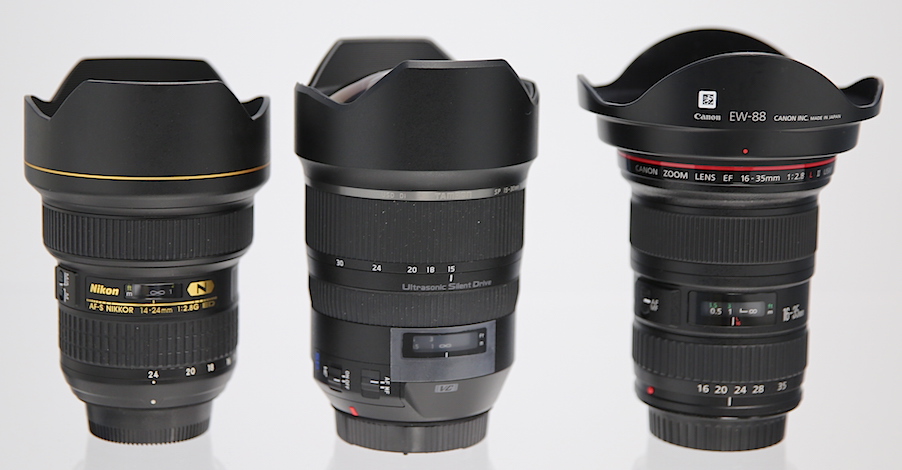
Tale of the Tape
The Tamron 15-30mm f/2.8 feels heavy and solidly built. Like the Nikon, its hood is built-in, which has advantages and disadvantages. Since it’s always on, it’s always providing protection, and it’s built more solidly than a simple hood. But if you lose the lens cap you can’t just buy a temporary replacement at the local camera store; you have to buy the special cap that fits over the hood. Not to mention if you break one of the petals it requires a trip back to factory service to be replaced.
Like the lens itself, the focus and zoom rings feel very solid. There’s no loose sloppiness in this lens, unlike some other third-party wide angles. But some may find the resistance a bit higher than they’re used to; there certainly is more resistance when zooming or focusing than with either the Nikon or Canon wide-angle zooms. Some will like it better. Some won’t.
Other factoids about the three lenses are listed below.
| Nikon 14-24 f/2.8 | Tamron 15-30 f/2.8 | Canon 16-35 f/2.8 | |
|---|---|---|---|
| Price | $1,797 | $1,199 | $1,699 |
| Weight (lb) | 2.2 | 2.4 | 1.4 |
| Length (In.) | 5.2 | 5.7 | 4.4 |
| Filter thread | none | none | 82mm |
| Aperture blades | 9 | 9 | 7 |
In size and weight, the Tamron is much closer to the Nikon than the smaller Canon lens. Like the Nikon, it can’t take screw-in filters. It’s significantly less expensive than either of the brand-name lenses, although I wouldn’t call it bargain priced. My opinion going into the test, therefore, was the Tamron would have to provide optical performance at least as good as the Canon lens (considered the weaker of the two manufacturer’s wide zooms) to be competitive.
Optical Bench Results
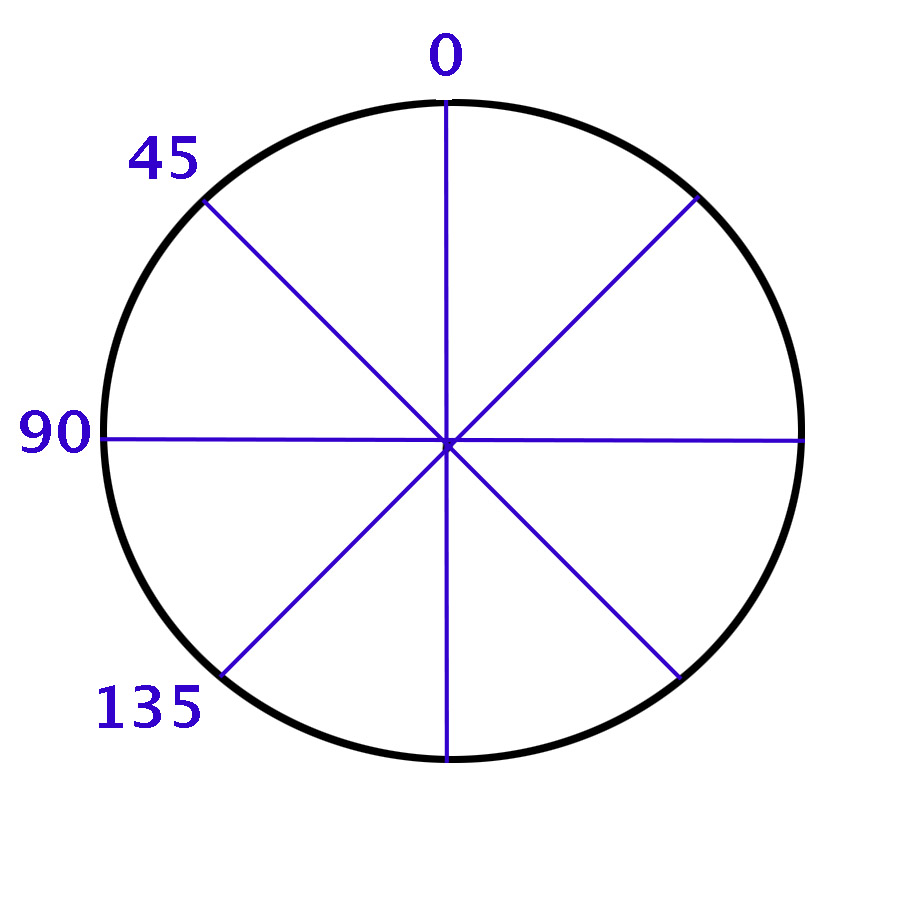
All lenses were tested on a Trioptics Imagemaster Vertical MTF Station. Five copies of each lens were tested and the results averaged unless noted otherwise. Each copy was tested in four rotations with 0 degrees being standard camera orientation, the cut being made from the left edge to the right edge of the field of view. The additional cuts were made after 45, 90, and 135 degrees of rotation on the bench.
Results at the Wide End
The graphs below represent the average of 20 MTF readings for each lens (5 copies of each lens, with 4 MTF readings each) at the widest end of the zoom range, comparing the Tamron to the Nikon and Canon zooms. Note that the readings are actually at slightly different focal lengths: 14mm for the Nikon, 15mm for the Tamron, and 16mm for the Canon.
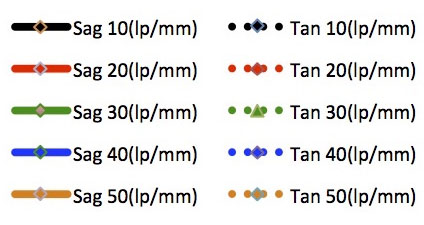
If you don’t speak MTF, don’t worry. It’s not hard. Higher on the vertical axis is better. Dotted and solid lines of the same color close together are better (far apart is astigmatism). The horizontal axis goes from the center of the lens at “0” to the edges of the lens at “-20” and “+20”. Lower lp/mm (black and red lines) have association with strong contrast, while higher lp/mm are associated with ability to resolve fine detail.
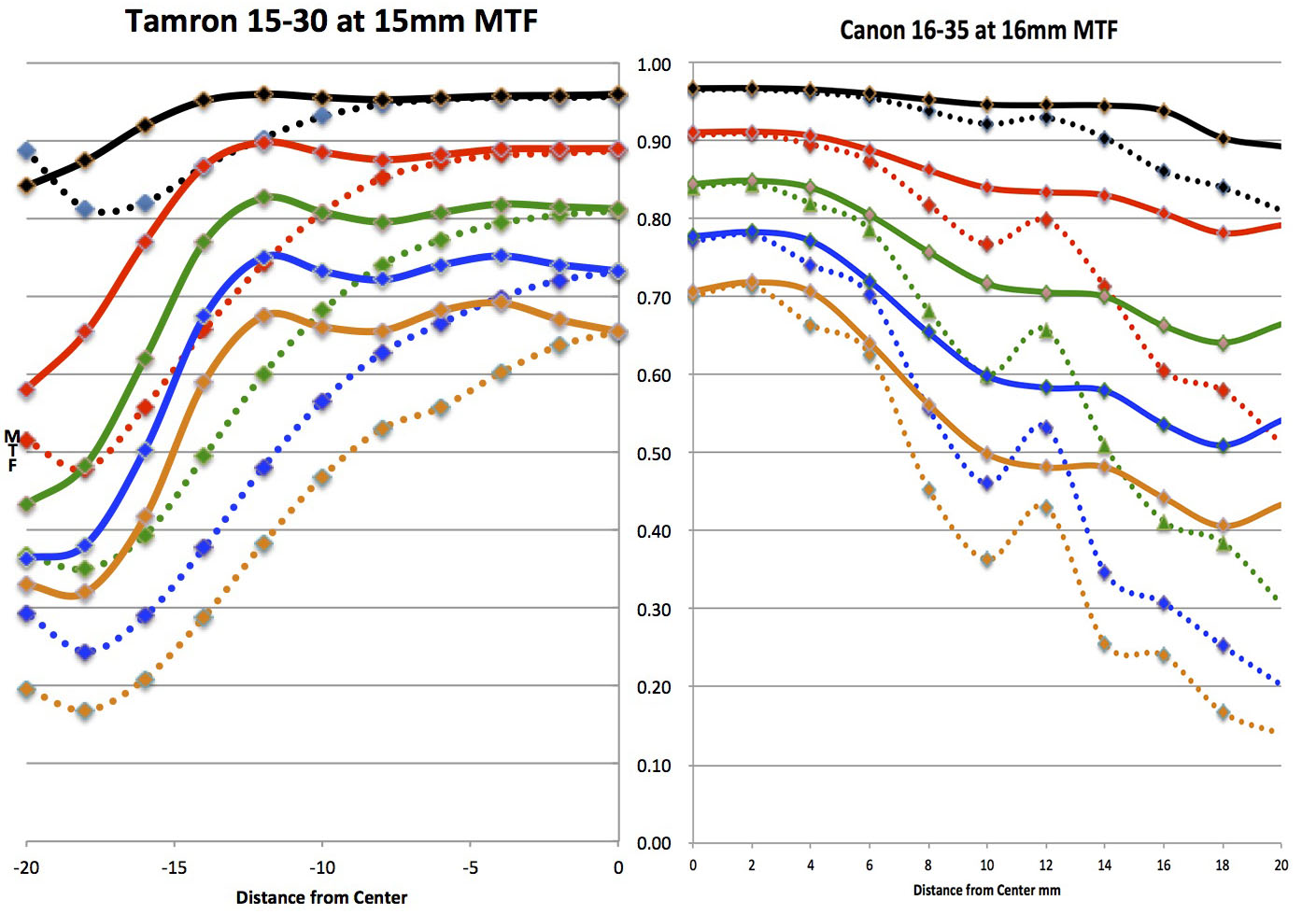
Looking in the center 1/3 of the image (0 to 6mm from center) the Tamron doesn’t resolve quite as well as the Canon, although it is still very good and very close. In the middle 1/3 of the image (7 to 15mm from center) the Tamron is actually a bit better. In the outer 1/3 of the image, though the Canon is superior. There’s not a clear-cut winner here. I won’t call it a tie because they are different. A landscape shooter for whom the corners are critical might prefer the Canon. A wedding shooter needing the middle of the image for group shots might like the Tamron better.
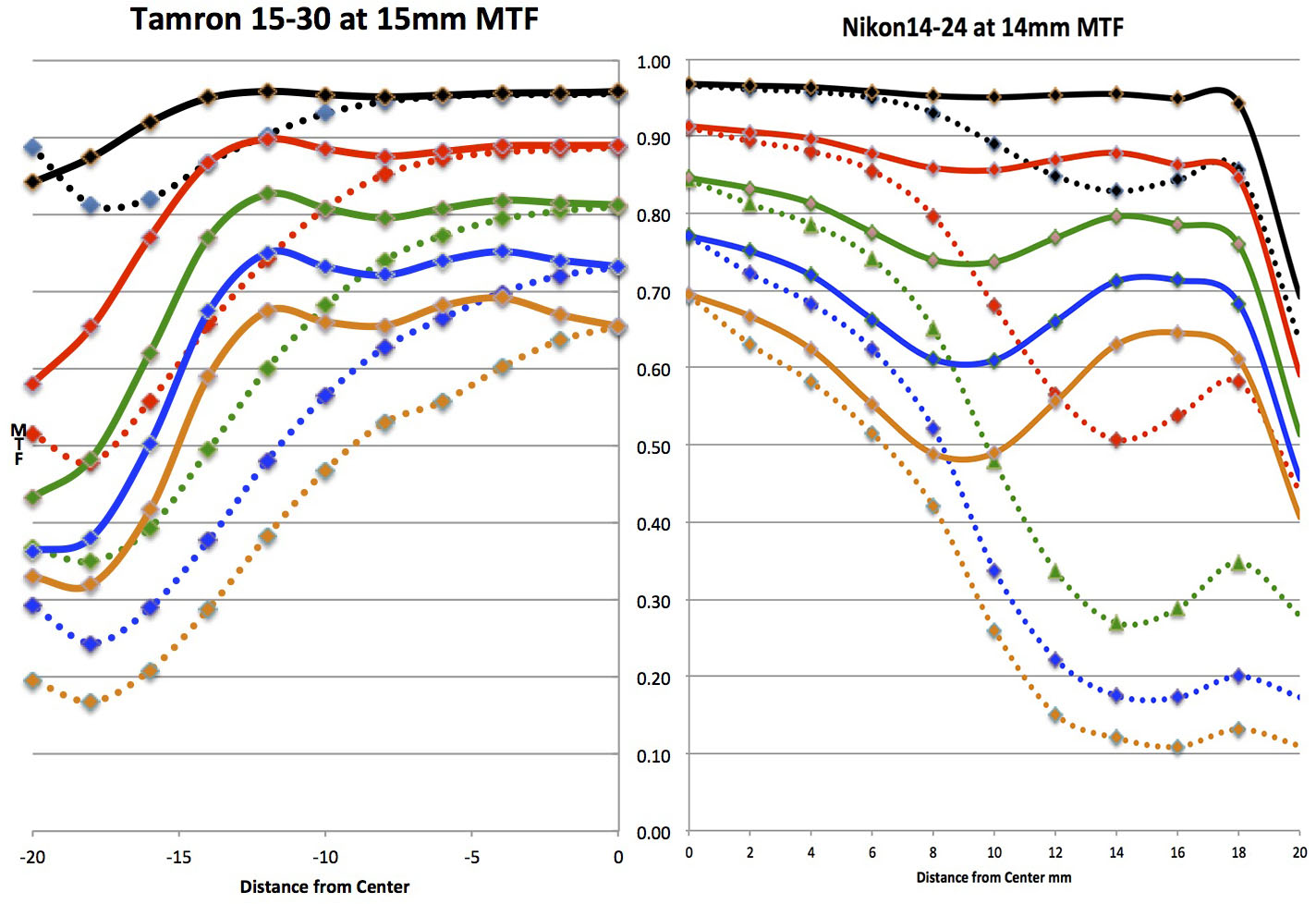
Compared to the Nikon 14-24 f/2.8 AF-S, the Tamron is just a tiny bit behind in center resolution, and about equal or a little better in the central 1/3 of the image. The Nikon is much better in the edges and corners in the sagittal plane, which it’s famous for, and roughly the same in the tangential plane. Technically, the Nikon has more astigmatism in the corners, but that’s because of the increased sagittal resolution, the tangential resolution is about equal in the two lenses.
Overall at the wide end the Tamron does well. It’s perhaps not quite as good as the two manufacturer’s zooms, but very close.
Results at the Long End
There’s a greater difference in focal length here, with the Nikon at 24mm, the Tamron at 30mm, and the Canon at 35mm. So some might say we’re comparing apples and oranges. On the other hand, the extreme ends of the focal range are what we like to test since it’s where any weaknesses usually show up.
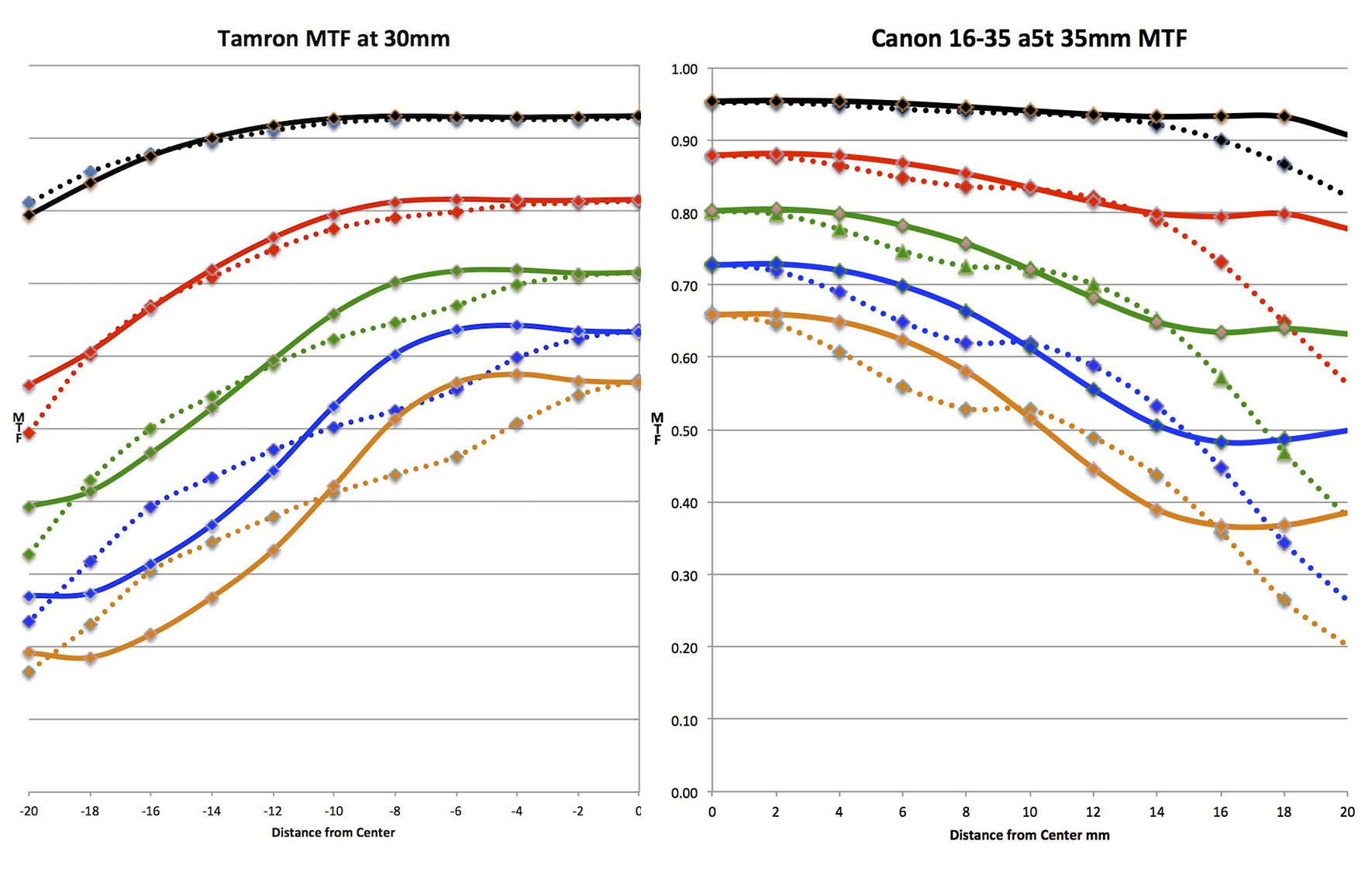
At the long end, it’s apparent that the Canon is just a bit better than the Tamron both in the center and off-axis.
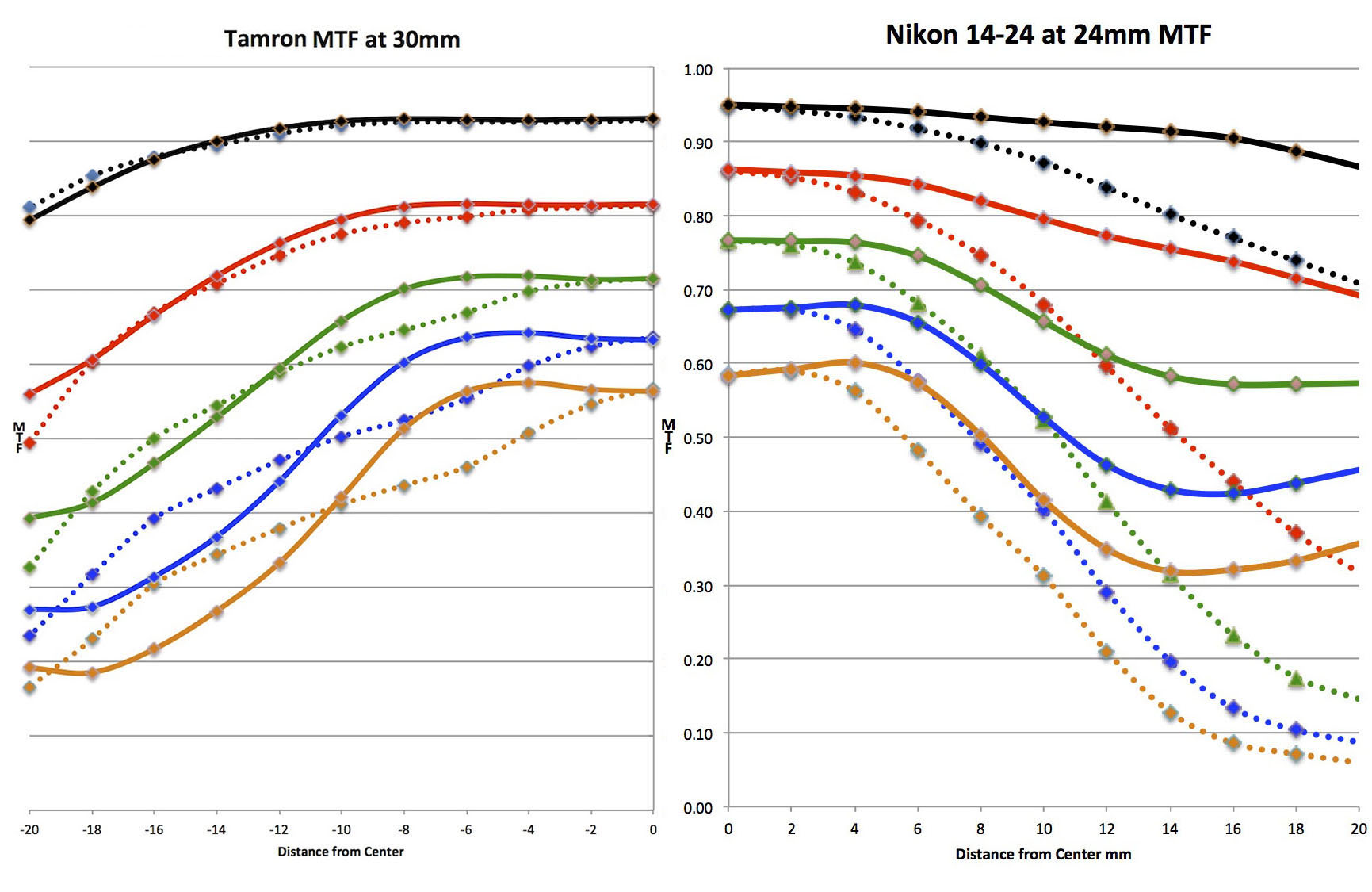
Again, the comparison shows that the Tamron just isn’t quite as good as the Nikon at the long end.
23mm Comparison
Let’s remember, though, that the long end of the three lenses is quite different. For that reason I thought it worth comparing them all at about the same focal length, so we ran another set at 23mm to give a direct comparison at that focal length. This might give a slight disadvantage to the Nikon, since this is near its extreme focal range. On the other hand, the Nikon lens designers got a slight advantage because they didn’t design the lens to zoom as far as the others. So I’ll call it all even.
And I’m glad we did check, because the information is worthwhile, demonstrating a different philosophy of lens design.
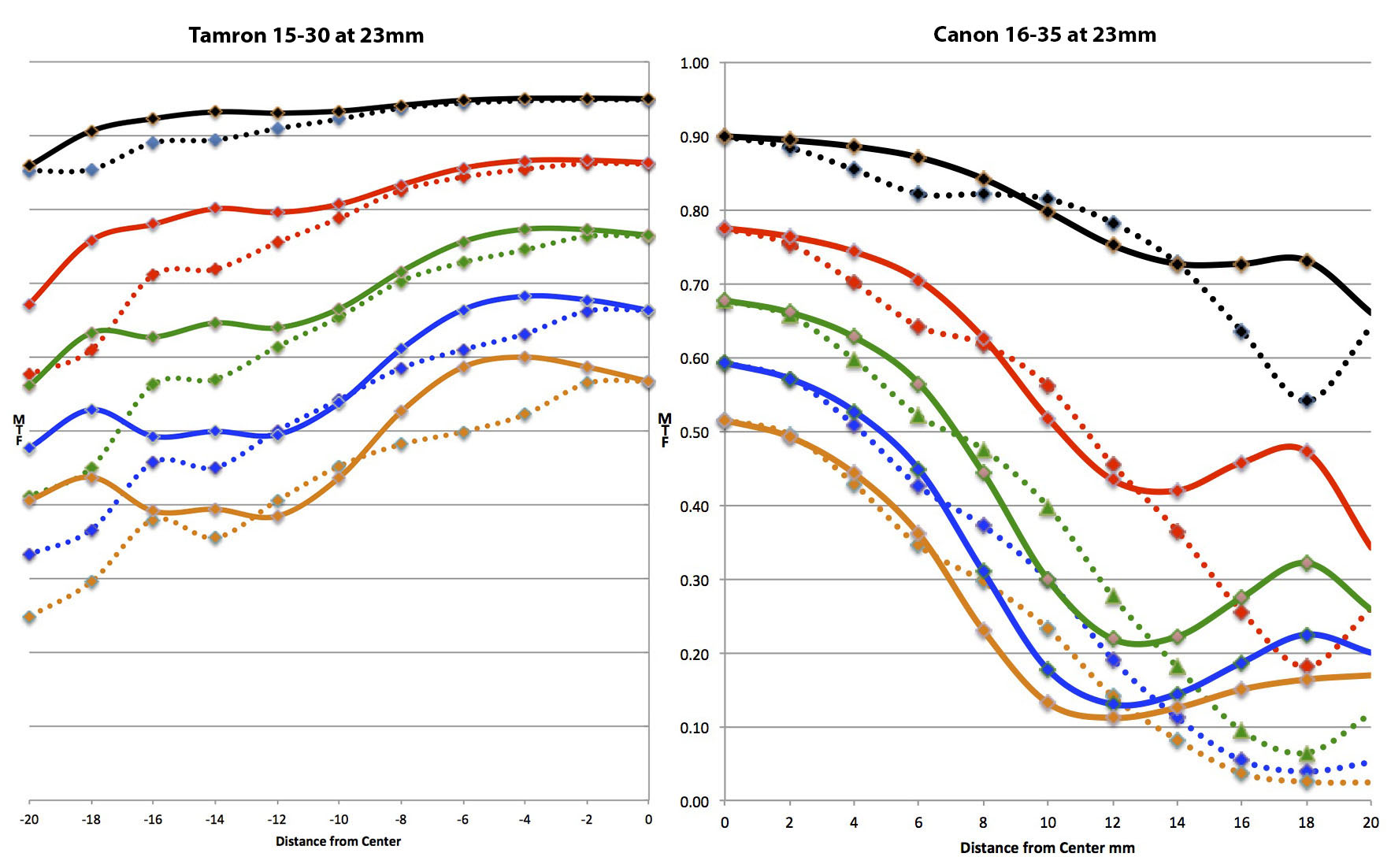
The Tamron is at its best here in the middle of the zoom range, with a better MTF curve than at either extreme. The Canon, on the other hand, appears to be at its weakest here; not as good as it is at either extreme and not as good as the Tamron at 23mm. (Remember, this is the average of 20 MTF readings from 5 copies, and there were no bad copies.)
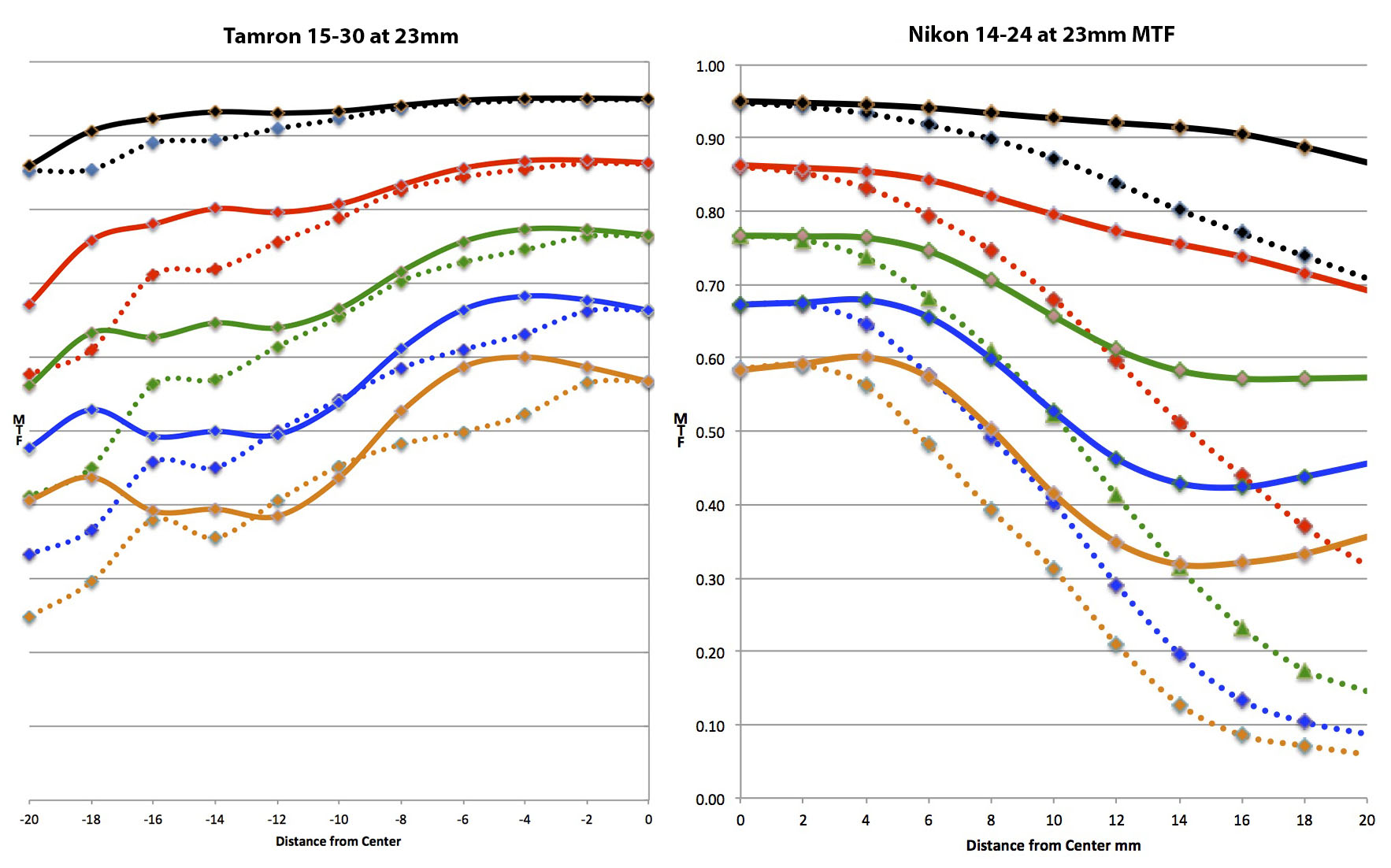
Compared to the Nikon, the Tamron is holding its own when shot at 23mm with an MTF curve that’s as good as the Nikon’s, and perhaps a bit better since it has less astigmatism. That’s pretty remarkable.
Field Curvatures
Field curvatures give us a lot of nice information, explaining sometimes why corners are softer (because they are not in the plane of focus of the center of the lens used for the MTF graphs), and demonstrating visually the lens’ astigmatism. I’m just showing the curves for all three lenses at 23mm. The curves are similar in shape and direction at both ends of the zoom. In the case of the Canon lens, though, they are much less severe at areas other than the mid-point of the zoom.
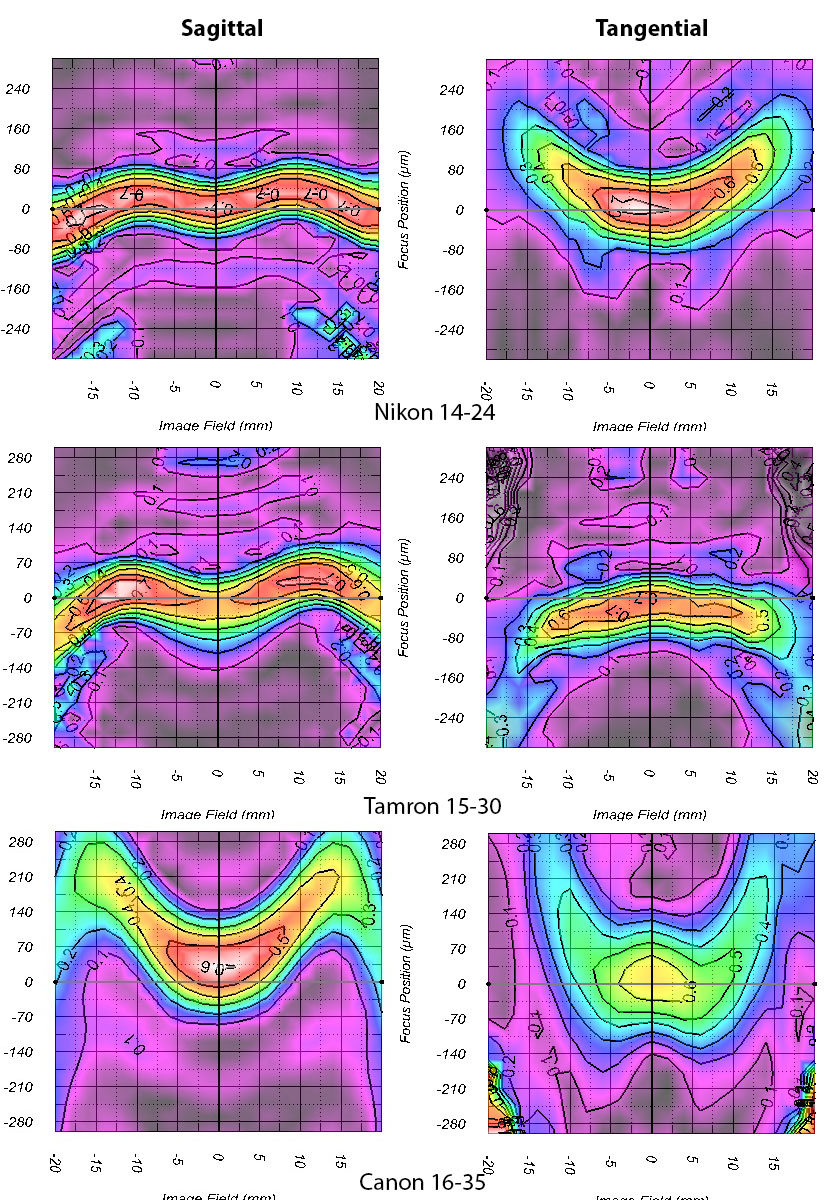
Looking at the graphs above (all done at 24mm) we can see, for example, part of the reason for Nikon’s superb corner and edge performance in the sagittal plane. The field curvature has a little “mustache” shape, but really stays in the same plane of focus as the center all the way out to the edges. The tangential field has a pretty wicked “U” curve, which also explains some of the astigmatism we see on the Nikon graphs.
The Tamron’s field curvature at this focal length is much like the Nikon’s in the sagittal plane, and has much less curve in the tangential plane. Again, this shows the ‘sweet spot’ of the Tamron lens. At the wider end there is more astigmatism and at the longer end some loss of resolution.
The Canon’s field curvature is more severe than the others although the sagittal and tangential curves are similar in shape through most of the field. (Please forgive the broader “depth of field setting” on the Canon curves. I accidentally moved a slider when generating these and they take so long to do that I decided to go with it as it was rather than redoing it. Tying up a $200,000 machine for an hour when we need it for other things isn’t always possible.)
Summary
Like so many tests, this one just emphasizes the fact that different lenses are different.
At the wide end of the zoom range, the optical differences are complex. In the middle 2/3 of the field the Tamron holds its own or is a bit better, but it’s not quite as good in the corners. At the long end (30-35mm) the Canon lens is better than the Tamron. At 23mm, though, the Tamron is as good as the legendary Nikon 14-24, and clearly better than the Canon 16-35. And, of course, the Tamron comes at a significantly lower price than either of the manufacturer’s lenses.
So which one do you want? As is usually the case, it’s an individual decision. If you have a good 24-70 zoom already and plan on using this lens from the wide end to 24mm, then the Tamron is right up there with the other two at 24mm and just a bit behind at the wide end. For Canon shooters who want to their wide zoom at focal lengths longer than 24mm, the Canon is better and goes further. The Nikon doesn’t go longer than 24mm, so the Tamron gives some extra reach to Nikon shooters, although at slightly lower resolution.
Choices are nice, aren’t they? But deciding can be complicated.
Roger Cicala and Aaron Closz
Lensrentals.com
February, 2015
69 Comments
Ian ·
Roger & Aaron, thank you as always for your interesting and informative blog posts. These results are interesting really do cast some light on the differences in design philosophy among the three lens makers. Keep up the great work!
Eric ·
Thank you for the test ! It could be nice to add the Canon 16-35mm f4 to the test… Yeah I know, this is not me that does the job 😉
Roger Cicala ·
Eric, we were testing at f/2.8 for this batch. My own opinion is that people who don’t need f/2.8 should be shooting the f/4, it’s a better lens. . . . at f/4.
Matt ·
You should test the Tokina 16-28 f/2.8, too! I’ve seen some reviews that show it has similar performance to the Canon lens, and some that show it is worse.
I was really hoping the new Tamron lens would be significantly better than the existing offerings, but it looks like it’s just different. Maybe I’ll just give up on the search for a wide angle f/2.8 zoom and get the Zeiss 21mm.
Roger Cicala ·
Matt, the Tokina is another lens with a lot of sample variation. Some copies are rocking, some have a bad corner.
sloma_p ·
How many Tamrons did you test? Results I’ve seen from this lens so far (other test sites/blogs) indicate it’s clearly superior to Canon 16-35L II, especially in the corners.
Roger Cicala ·
sloma, copies of each lens.
One thing I would add is that 16-35 Canon’s are commonly slightly decentered. Ours are checked on a pinhole collimator for that or they don’t make the test batch. If we had tested random 16-35s they wouldn’t have been quite this good.
Shepherd ·
Happy to see your analysis here. I’ve been interested in this lens since it was announced, to replace my badly-decentered and generally beat up Nikon 16-35mm f/4 VR. (That lens was used for about 1,500 miles on the Appalachian Trail…) Even if it is heavier, the wider aperture would be welcome and I prefer to have VR instead of carrying a tripod on long hikes. There will always be tradeoffs when limiting one’s camera weight for backpacking. As much as I’d like to carry primes all the time, I think when I’m going months without access to my camera bag I prefer a long zoom, wide zoom, and a normal prime to give me something fast! Hope this one will be the wide zoom for the next long hike.
Richard Fisher ·
Great work. I am looking forward to your review of the new 11-24 and hopefully similar analysis comparing the Canon 11-24 to the Nikon 12-24 and ideally comparing the newish canon 16-35 F4 to the older Canon 16-35 F2.8 II
Adam ·
I don’t suppose you tested these at f/11 too? One review I read had similar results to this wide open, but found the Tamron beat the canon by a fair bit at f/11.
Also do any of these tests reveal coma correction? The canon has pretty terrible coma, the Nikon almost none, i’m hoping the Tamron is closer to the Nikon in this regard, but I haven’t seen any great tests of it yet.
Jean-Daniel ·
With these type of lenses, I would have appreciate a lot more a comparison at the landscape shooting apertures(f/8, 11, 16). I assume some prople are certainly using these lenses at f/2.8 but I am not dure it is common.
As well, the 16-35mm f/4 would have been a better contender since it is better than the f/2.8L II in the corners.
My 2 cents
JD
Matt ·
Do the Canon and Tokina lenses become decentered with use, or just come that way from the factory? (I’m guessing both) If I buy one, do I need to worry about it becoming decentered eventually?
My main use for f/2.8 wide angle is milky way shots, but it would be great if there was one lens that could do that really well in addition to having the flexibility of autofocus and zoom for wide angle landscapes and general use that would be at f/4 or higher.
George Kash ·
Thank you Roger !
Great and very useful information here .
Waiting eagerly for your review and test of the Canon 11-24 😉
Gene P. ·
Doesn’t Nikon still make the 17-35 2.8 lens? If yes, would that be a better comprison than the 14-24?
Roger Cicala ·
Gene, I’m not sure if they still make it, but there are some available. It’s not a great lens though, a much older design.
KimH ·
Hi Roger, Aron
Thanks for this!
It IS surprising what you find and what is meant to be gospell. And proving that every manafacturer has the same constraints and tradeoffs to do – but some do it better.
Example – I hear from users that the N 14-24 f2,8 is horrible wrg2 flare (which is not what you test – understood) – not sure about the other 2. Is there a machine you can buy which test this :o) Let’s call it your version of Measurement-GAS
My very next thought was C. 16-35 f4 and maybe even the new C. 11-24 f4. Is f4 a topic on its own, if you don’t need 2,8 etc-.etc-.
I keep visiting and reading – in awe.
publius ·
Let’s remember this is one lens from huge batches of lenses. Your results WILL vary. I do not trust a poll sampling of one. The manufacturers often present their MTF in theoretical results based on physics since they know that is the average. Some will be better and some not so good. Therein lies the real test – quality control. Does Tamron have as good quality control on their production lines as Nikon or Canon? when they test their lenses before packaging, are their acceptability limits as tight as Nikon or Canon? Two separate points. Each may perform quality controls, but if one company allows a greater deviation from the standard, the customer may get something great or poor. At least with Canon’s micro-adjustment feature, I can correct some deviations for my particular lens and body combination. Can I do the same for a Tamron lens?
Roger Cicala ·
Publius, as we said, it’s not one lens, it’s the average of 5 copies of each lens.
Pedro Pires ·
Hello Roger, congratulations for the review. Just one thing with your comment on sample variation… are you also noticing that decentering with the Canon’s 16-35mm f4 L as well? Or is there any sign of some sort of improvement in QC?
Roger Cicala ·
Pedro, we haven’t noted as much decentering on the 16-35 f/4.
Omesh ·
Hi Roger,
You are a legend! It’s great to see another one of your well-controlled and informative lens comparisons.
In terms of the results, I’m quite surprised. I was expecting the Tamron to perform better. I’ve been preparing to sell off my 16-35mm f/2.8 USM II but it looks like it might be worth keeping. My copy delivers great AF accuracy and speed and is not de-centered.
I’ve gone through my LR5 catalogue and discovered that when I’m using a zoom I’m using it at its extreme settings about 80% of the time and I am a huge fan of 35mm, so the Canon scores some serious brownie points there for my usage.
A quick question: The Tamron looks sharper in the critical mid-frame zone which makes up the bulk of the image area but there is a lot of astigmatism… Would this imply that the Tamron will suffer from coma? A primary application I’d use such a wide-angled, wide-aperture for is astro, so coma is a real concern.
Best regards,
Omesh
Carlos Paredes ·
Which aperture was used for the MTF graphs? Are the lenses wide open?. Not all lenses improve the same stopped down… specially for the Tamron (thanks to VC) the performance at F4 or F5.6 is an additional interesting subject.
Charlie ·
Interesting. Most wide zooms I rack to the ‘ends’; I don’t use the middle too much. I’m surprised the Canon 2.8 did this well.
Massimo ·
Would be nice to see how different a prime lens such as the Zeiss 2.8/15 would be.
Florian ·
Thanks for the test! Since I own Sony A and E mount bodies, choise isn’t that difficult if I lime to stay compatible with each… 😉
But I am curious how the native Sony/Zeiss 16-35 (in A as well as E mount version behaves). Not to forget another beast, the Sigma 12-24mm…
Dave ·
All these tests wide open, right?
Thanks very much for this test, and all of your articles!
Roger Cicala ·
Dave, yes, all wide open
NancyP ·
Thanks for all this information. I am glad to hear about less decentering on EF 16-35 f/4 L (considering this lens). I am amazed that you have the time to do these tests.
Damián ·
Great job!
It would be really nice from you if you could add the metric measures next to the imperial you use in north america. I mean, cm, grams, etc.
The same way you do with the filter thread.
Cheers.
Massimo Foti ·
Nice, Thanks. I just wish you added Tokina 16-28 f/2.8 too
Cat ·
Does it mean, all three are worse then Canon 4,0/16-35 mm L?
The Tamron and the Nikon with their curved glass are heavy load and very sensible for dust
and difference between 15 and 16 mm is not the world.
And are there so many night shooters that need f:2,8?
Pawel ·
Canon 16-35/2.8 II is very useful for street or reporter shootings. It offers an excellent center quality full opened and delivers a very good performance for wide settings (16-25mm) from f/4 onward. The amount of vignetting at f/2.8 can be critical for some purposes. One has to stop it down to f/5.6 for landscapes, when a corner to corner image quality is needed, but most landscapes are took at f/5.6 – f/8 anyway. Considering that, the field quality is far more better than the technical performance.
Personally I found Nikon 14-24 too heavy for a fine and effective work and too prone to flare (no autofocus on 5D III and 6D of course). The image quality is perfect at 21mm, but at 14mm I would highly recommend Canon 14/2.8 II which is the unsung hero here, so well controlled and as good as it gets, but also overpriced.
Zeiss 21/2.8 Ze is a stellar performer at f/2.8 and onward, except the amount of vignietting at f/2.8 – f/4. The lateral CAs are extremely low, so one can see the image resolution even more fine than it is. The distortion is well controlled but not so easy to correct with PhotoShop due to the secondary mustache distortion curve. The lens is perfect for a low light landscape photography and for a quiet, reflective or contemplative style of photography.
Kuba ·
Are those MTF’s really from 16-35/2.8 II ?
Look at my sample pictures:
Canon 16-35 2.8 II at 2.8:
http://www.kubacichocki.pl/test/tamron1530/can16.jpg
http://www.kubacichocki.pl/test/tamron1530/brzeg_canon.jpg (focus on the top of the frame)
http://www.kubacichocki.pl/test/tamron1530/corner_canon.jpg (focus on Tamron box)
Tamron 15-30 2.8 VC at 2.8:
http://www.kubacichocki.pl/test/tamron1530/tam15.jpg
http://www.kubacichocki.pl/test/tamron1530/brzeg_tamron.jpg
http://www.kubacichocki.pl/test/tamron1530/corner_tamron.jpg
And a lot of my sample pictures from Tamron 15-30 (full size):
http://www.canon-board.info/testy-sprzetu-25/recenzja-tamron-15-30-2-8-vc-usd-99121/
Bartosz ·
I guess there is few mistakes in this comparison:
1) MTF chart @ wide and tele looks like from Canon 16-35 L IS f/4 not 16-35 L f/2.8 but chart @23mm is probably from Canon 16-35L f/2.8
2) Is it Canon version II (photo) or mark I (text)?
3) Are you sure that Nikkor is better then Tamron @ wide end? If I read these two charts with no mistake Tamron results looks better.
Roger Cicala ·
Bartosz, the Canon versions are Mk II, I’ve added that in the text. I didn’t think about it because we haven’t had Mk I 16-35s for many years.
Mike ·
Thanks again, Roger, for the great service and valuable information you provide to the photographic community. I rented one of these from you and took some sample shots this past weekend. I don’t own anything wider than 24mm so it’s a type of photography that I’m not really that familiar with. I was thoroughly impressed with the quality, handling, and operation of this lens. The fact that it compares favorably in image quality to lenses costing 40-50% more makes me think it is going to be very well received. Add to that the fact that it has image stabilization and, in my opinion, you have a real winner. It seems that many people feel that IS (VC) in a wide angle is not that useful. My testing was very limited but the benefit when hand holding at 15mm and 1/10 second was remarkable. See images 99 and 100 of may samples at http://mijz.com/Tamron_15-30. All of these images were taken with my Canon 6D.
Mike ·
* my samples
Matthew Saville ·
@Matt, in short, YES. The Canon 16-35 will eventually become de-centered, unless you baby the crap out of it. And even then, no promises. I don’t have the same volume access to lenses as Roger does, however I work in post-production so I’ve seen tens of thousands of images from various copies of the Canon 16-35. In short, they all sucked.
The Tokina, from the images I’ve seen, probably has an equal or greater chance of being DOA, (decentered on arrival) …or getting decentered with moderate use.
Personally, as someone who spends days on end blasting down dirt roads in the desert, needless to say NEITHER lens is acceptable lol. The 14-24 has been the ONLY lens I can trust to stay sharp, if you get a sharp copy, which is also far more likely compared to the others.
Matthew Saville ·
All in all, I must say I’m kinda disappointed. Not because (as most others would argue) “if Tamron wants to charge $1200 for this lens, it’d better be flawless!” …but instead, because they thought they could get away with making a freaking 2.5 lb lens. Simply put, if you want to make a lens HEAVIER than either the Nikon 14-24 or the Tokina 16-28, it had better be flawlessly sharp.
Different priorities, different priorities.
If coma and vignetting are lower than on the Nikon 14-24, though, I’d consider it for astro-landscape photography. It would require simultaneously owning a crop-sensor kit with something lighter like the new Tokina 11-20, though, for lighter weight travel work…
Goran ·
My thoughts exactly Matthew! Having a couple of other more than capable lenses for low-light and astro I see no need for this heavy and imho relatively expensive lens. Others that shoot a lot of stars might think otherwise, but hey they already own at least one astro-dedicated lens right?
David ·
> I’ve seen tens of thousands of images from various copies of the Canon 16-35. In short, they all sucked.
I’ll construe this narrowly to mean you aggregated the images of terrible photographers. If you’re talking about the lens, then I’m impressed to see a troll on this site.
Chris Miller ·
I’m more interested in distortion figures than sharpness, it is more relevant to my line of work. Do you not test for that? Thanks,
Andrew ·
Amazing test very very thorough! It appears there may be some mistake though… please see your previous test of the Canon 16-35mm f/4L vs Canon 16-35 f/2.8L II.
http://wordpress.lensrentals.com/2014/07/canon-wide-angle-zoom-comparison
The Canon f/2.8L II test charts from this article look identical to the Canon f/4L IS charts from the Canon Wide Angle Zoom Comparison article.
And the Canon f/2.8L II @ f/4 test charts from that previous article look much worse than the Canon f/2.8L II @ f/2.8 in this article.
Please correct me if I’m wrong… but it seems like perhaps the charts in this article are actually the Canon f/4L IS?
Roger Cicala ·
Andrew and others, I see what you are saying. I spent some time today trying to track this down and it may be that our database has a mislabeled lens: we pulled the comparisons from data gathered before I was out sick and while I was gone it was refiled. It’s possible during the refiling it was mislabelled. We’re going to re run a set of 16-35 f/2.8 lenses to make certain but weren’t able to do that today. I have to leave for WPPI Saturday and want to do this recheck myself, so for now consider that the 16-35 results at 16 and 35 might be wrong. The 23mm I know are correct because I ran them for this test.
Roger
Andrew ·
Ah I see well thanks for the follow up. Can’t imagine the amount of time it takes to conduct these tests, but I really appreciate that you do them!
Looking forward to seeing further findings 🙂
Lars ·
Thank you for all your wonderful comparisons!
Would you please check the mtf curves for the Nikon 14-24? They seem to differ from the ones presented at the end of the Canon wide angle zoom comparison.
Lars
Eric Tung ·
Hello, Roger. I have looked through the test and I found maybe the MTF result of Nikon 14-24F2.8 at 14mm F2.8 is wrong? Because the mtf chart is totally different from another test you did in “Canon Wide-Angle Zoom Comparison”
http://wordpress.lensrentals.com/2014/07/canon-wide-angle-zoom-comparison
when you compare canon 16-35F4 at 16mm vs Nikon 14-24F2.8 at 14mm.
John H ·
It’s funny and ironic how the inter-webs work. It’s been the gospel truth for the longest time that ultra-wides are highly utilitarian, but far from what some would call “prime lens” perfect. Yet many still post as if $1200 and VR should translate to perfection.
If nothing else, your report shows this to be yet another “more than good enough” lens for most casual shooters, and not at all bad for the discriminating pixel-peeper. The VR alone makes it a no-brainer for many. I happen to be one of the lucky few with a perfectly suitable Tokina 16-28 and the lens isn’t decentering right in front of my eyes. I use it when needed for travel documentary and it’s sweet. Paid $500 for it barely used, with the original box and materials.
Were someone to pick this or any of these UW lenses up and just go shoot with them (rather than study charts) they’d be happy. Ignorance IS bliss.
Niels ·
I was one of those on the Tamron 15-30 band wagon, until I rented it + Nikon 14-24, Zeiss 15, and Tokina 11-20; then took pics. The Nikon, which I was biased against because of: A) Action of the zoom & MF rings, B) User reviews of flare issues, and C) Lensrentals Repair Data 201-13.
Emphasis on apertures f8 & f11, focal length 15mm. Zeiss & Tamron could close to the Nikon sharpness, sometimes, but the 14-24 was always on top. Flare control was comparable among these 3 … Tamron significantly better than the other 2, with the Tokina being pathetic (like the 11-16 & 12-28).
1st Zeiss lens that I didn’t like, out of 3.
Tamron was fantastic w. flare, nice fluid MF & zoom rings, but doesn’t hold a candle to the Nikon in image quality. Also didn’t like the 15mm being closer to 16mm; not much of FOV gain from someone w. 17-55.
Bad copy of the Tamron? Then it happened twice: Rented it last week, and the Lensrentals receipt shows 2 different S/N’s.
Stefan ·
Niels: Could you post the comparison images? So far you are the only one I’ve seen this kind of “negative” Review.
Niels ·
Hi Stephan: Will post either Fri or Sat night. Of note, didn’t look at center area of the lens; when breaking the composition into a 3×3, I was looking at the outer squares & at f11. Can post the f2.8, f5.6, f8, & f16 results if interested.
Niels ·
Hi Stephan,
http://graphitepaddle.smugmug.com/Photography/Super-wide-lens-testing/
Except for the 1st two compositions, the others had focus points close up. Favoring the Nikon was based on 100% of points in the upper third of the composition. Guess what? Looking at other areas of the composition, it was closer or had the Zeiss 15mm, or Tamron coming out on top. Focusing was always manual. (When I switched the Tamron & Nikon to AF, did see much of a difference.)
OT: Flare results went from being close (but clearly favoring the Tamron), to the Nikon being bad, but not as bad as the reviews on it lead me to believe.
Bottom Line: Not disparaging Roger’s testing, but think the ultimate test for any buyer is to test these lenses on THEIR camera, on compositions THEY expect to see.
Robin Perkins ·
Any testing or opinions on the Tamron’s “Coma” Big factor for my nightscapes.
Stefan ·
Thanks for sharing. I don’t Think your tests really are scientificall. First, you Lightning conditions are different since the sun sometimes shine and sometimes don’t. Secondly you converted using DxO which do you automated funcions to render it and as you Point out, Nikon has been applied lens corrections. I have used DxO and it uses alot of algorithms to enhnance sharpness where it lacks sharpness and do this in different degrees all over the image. Likewise CA, distorsion and vinjetting.
You should have shot when the lighting consitions were the same at all time otherwise its hard to test them head to head as you did. And the RAW converter should have been totally reseted in all parameters.
/Stefan
Roger Cicala ·
Stefan, I never do this, but really, you should read the article before you comment.
Niels ·
Stephan,
DXO lens modules: 14-24 was the only supported lens. Since DXO hasn’t added a module for the Zeiss 15mm, it’s safe they never will. Tamron is very new, and odds are a module will be added … but when?
DXO PP: Std. DXO corrections, minus any ClearView processing. IF I did this part right, I would stick w. that procedure, except set the exposure to ‘as shot’. Or maybe I would tweak the sliders to get the best picture that I know how, since that’s what I would be doing in real shooting conditions.
Lighting conditions & Time of day: Shot w. one, then another, and then the other, hitting my key composition pts & a few other. BETTER WAY: Rent one D7100 per lens, minus my camera. Also rent (or buy) an A/S-compatible QR plate, so I could swap the cameras out to the tripod. (This minimizes composition variation problems, as a bonus.) But even on a cloud-less day, this is not perfect, because a few minutes can cause enough of a shadow shift.
Composition: My biggest regret, which was also thwarted by the Tamron not starting at 15mm. Better than 1 camera/lens mentioned above –> Use one of the candidate lenses, and get at least one pic for each test composition, then upload to the mobile device of your choice (e.g. iPad, iPhone, etc., etc.). This will give you something to match when testing the other lenses. Why is this important? Once you pick a lens to buy, you will be looking for a good copy. You will NOT be getting the lighting conditions that you had before, but at least you can match the composition.
Preconceptions at the start: A) Nikon 14-24 would suffer a quick death because of flare issues. Reality: Issue was over-hyped. Flare bad, but within my tolerance. B) Zeiss 15mm would be sharpness king, but would lose because I want the flexibility of a zoom. C) Had a bad copy of the Tamron the previous week, so this one would be edged out barely in image IQ by the Zeiss, but would still best against flare.
Bottom Line: No the Tamron-Zeiss-Nikon test wasn’t scientific, but got in enough test shots to be confident enough for a purchase.
Since I did my testing, bought the Nikon & pitted against my walk-around lens; Nikon 17-55 f2.8. Other than looking at center areas, cannot believe hot pitiful the 17-55 looks.
Stefan ·
Roger Cicala: My comments was for Niels comparison. I have no objections to yours. All seems to be in order. Cant either comment the others about if the MRT-curves are correctly named.
Roger Cicala ·
My apologies, Stefan. I thought you were referring to the optical bench article.
Roger
Bruce Wilson ·
Hi Roger,
Many thanks for the review with lenses only.I don’t want to what the Tamron is like on Canon when I wold be mounting it on a Nikon D 810. I like the VC and reduced flare compaired with the Nikon. Would the Tamron have high enough image quality to use architecture and landscapes for magazines or, would I be better off with the Nikon?
I would appreciate your thoughts.
Roger Cicala ·
Bruce, from a sharpness standpoint I’m comfortable that it would. My tests don’t check for distortion and that would be critical, so I’d definitely check some review sites concerning that.
Roger
Bruce Wilson ·
Thanks Roger
Danny Ungrue ·
Thanks for the in-depth review, Roger! I must confess I’m virtually illiterate when it comes to the uber technical aspects of your review. However, I would appreciate your frank and honest opinion as I’m on the fence between the Tamron 15-30 and the Nikkor 14-24. Unfortunately I live in in a small town (Kenai, Alaska) and there is no opportunity to rent lenses thus I’m left basing my decision on reviews and opinions. I’ll be mounting my lens on a Nikon D810. I shoot a lot of auroras and nightscapes in the fall/winter and landscapes in the spring/summer. The cost isn’t an issue. Based on my photographic pursuits, which lens do you think would serve me best?
Roger Cicala ·
Danny, first of all you can rent them I’m pretty sure – we ship to anywhere in Alaska that FedEx or UPS will deliver.
As to the choice, in this case I think things are close enough optically that I’d go with the less Expensive Tamron unless there’s something about the Nikon that’s better for your kind of shooting. That kind of thing is more likely to show up in actual review, I think, rather than just optical testing like we do.
Roger
Gabriel ·
Do you feel the Tamron 15-30mm with LAEA3 on my A7ii will be an improvement over the FE 16-35mm F4 aside from the 2.8 speed? I am thinking it may have better sharpness across the frame even wide open from reviews I have read.
Of course, its bigger.
Mark Harris ·
Do you feel the Tamron 15-30mm with LAEA3 on my A7ii will be an improvement over the FE 16-35mm F4 aside from the 2.8 speed? I am thinking it may have better sharpness across the frame even wide open from reviews I have read.
Of course, its bigger.
Gabriel ·
Is this lens superior to the Sony FE 16-35mm F4? I am considering with my LAEA3 for my A7Rii.
Mark Harris ·
Is this lens superior to the Sony FE 16-35mm F4? I am considering with my LAEA3 for my A7Rii.
yitzchak ·
Oy… I can see the virtues of each of these lenses, with no clear-cut winner. I like the reach of the Tamron better, but it loses to the Nikon at the wide end, so the question comes down to where you are likely to use the focal lengths of either lens. If you shoot 14mm, there is only one option; if you want to reach beyond 24mm, the Tamron bests the Canon.
yitzchak ·
I should add, however, that you tested the Canon 15-35 L Mark II, but now Canon is at Mark iii, so you’re not up to date in your comparison, Roger…