
The Nikon 300mm f/4E PF ED VR Test: Or Why I Don’t Test Just One Copy
As most of you know, we generally test multiple copies of a lens when we evaluate it, simply because we are so aware of copy-to-copy variation. But I got caught between a rock and a hard place this week. We received exactly one copy of the new Nikon 300mm f/4E PF ED VR lens and the purchasing department told me it would be at least a week and probably longer before any more come in. But I’ve been dying to know how it measured up against the existing Nikon 300mm f/4 ED AF-S lens.
So I did what I had to do and ran the one copy through Imatest, comparing it to a batch of several copies of the older model. We used the new high-resolution, backlit film charts that we’ve been using for telephoto lens test lately, and shot all the tests on a Nikon D810 test camera so we would generate the highest possible resolution.
I always like to mention my expectations going into testing. The existing 300mm f/4 AF-S is a very, very good lens. The new PF ED VR brings a lot of new technology to the table, and we know from experience with Canon that Phase Fresnel (what Canon calls Diffraction Optics) technology has historically not give the resolution that a good optical lens does. On the other hand, Canon’s second generation DO lenses seem to be every bit as good as their standard optical telephotos. So I hoped the new lens would be optically as good as the old one, but wouldn’t be shocked if it were a bit better or a bit worse.
Even if it wasn’t quite as good optically, the PF ED VR has a lot of attractive features: an excellent VR system, a tiny size, better coatings, and an all electric aperture system with no mechanical linkages. (Most of you won’t consider the latter a great advantage, but most of you don’t work on lenses for a living.)
For emphasis: this is somewhat of a failed test. The results we got for the 300mm f/4E PF ED VR lens are good, but other copies may well be better. I’ll speculate on how much better, but until we get more copies, that’s all it is, speculation.
A Quick Look at the Lenses
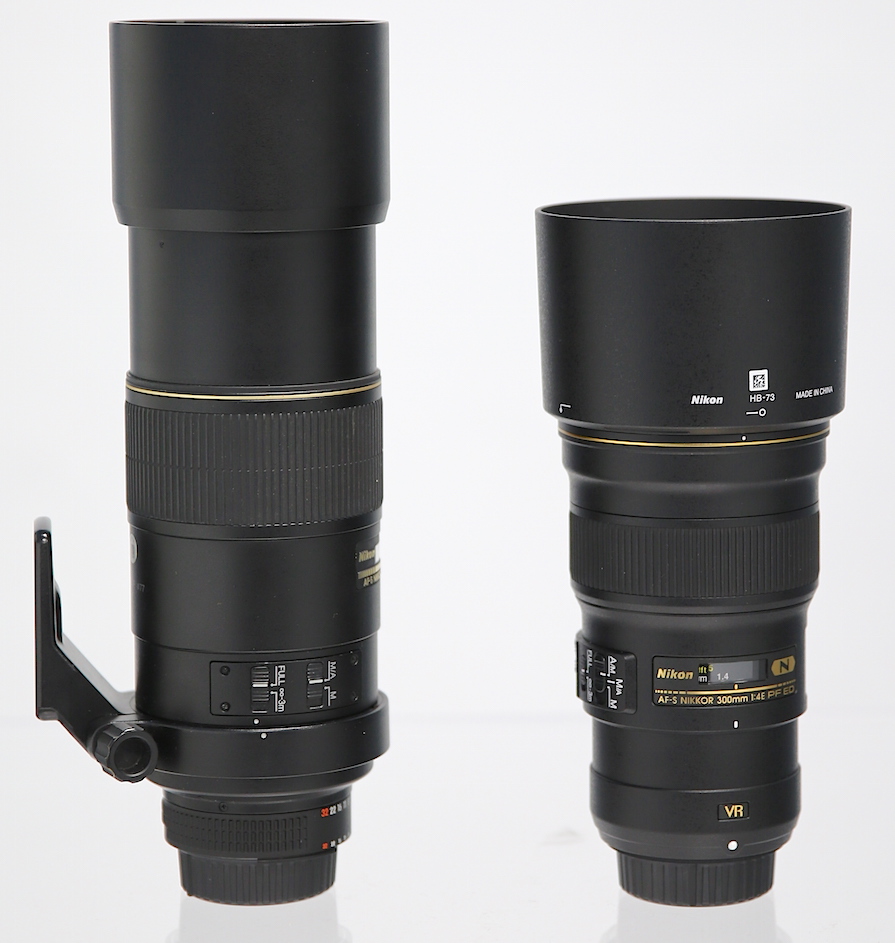
The side view shows at a glance just how much smaller the new 300mm lens is. It can’t show you the weight difference, but the new lens, at 1.66 pounds, weighs about half as much as the original version.
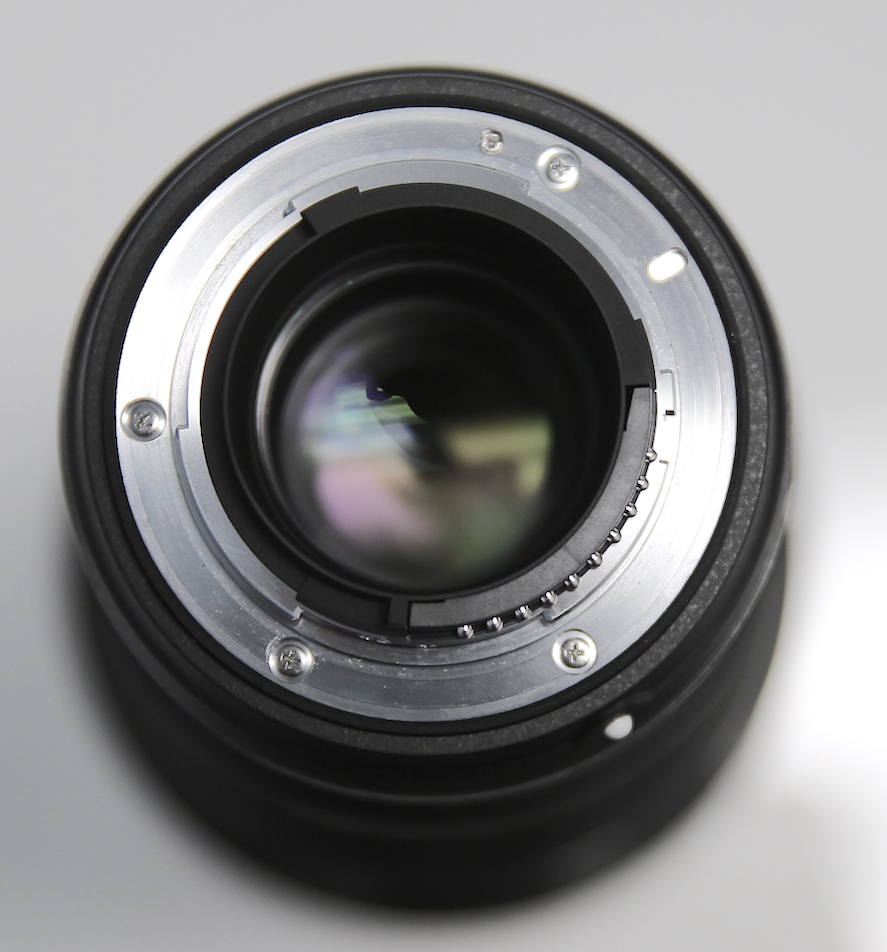
The view from the mount shows that, like the other “E” lenses, there is no mechanical aperture lever. The aperture in this lens is completely electronic.
Imatest Results
Below is a simple table showing the Imatest results as we usually present them: Center point, Weighted average of 50 points across the front of the lens, and average of the 8 corner results (4 horizontal, 4 vertical) given in Line Pairs / Image Height from unsharpened raw images.
| 300mm f/4 AF-S | 300mm f/4E PF VR | |
|---|---|---|
| Ctr | 1550 | 1600 |
| Avg | 1255 | 1205 |
| Corner | 1160 | 1040 |
The results seem somewhat straightforward at first glance. The new lens is a bit sharper in the center, not quite as sharp in the corners, but the two lenses are very close in resolution. Certainly with only one copy of the new lens tested I wouldn’t want to say more than ‘equivalent in resolution’ to the original version. It’s advantages in size and VR speak for themselves. I’d want one if I shot at this focal length a lot.
But …
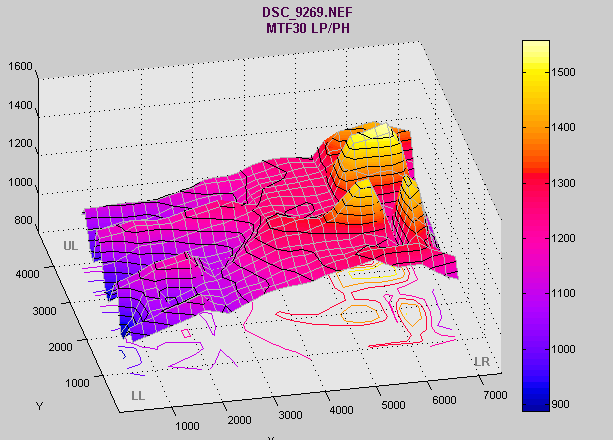
There’s more to it (or at least there should be more to it) than just letting the computer spit out numbers. When we look at the actual graphs of the Imatest results, the 300mm f/4E PF VR graphs all show the sharpest point not near the center of the lens, but off to the right side of the image. It looks like the lens is slightly decentered or tilted. This isn’t bad, by any measurement, but it’s noticeable.
Our Imatest set-up self-checks to be certain we are correctly aligned, but just to be sure we tore it down, set it back up, and got similar results. We then put the lens on OLAF, our 5-micron-pinhole-collimator testing machine, which confirmed the lens was just slightly decentered.
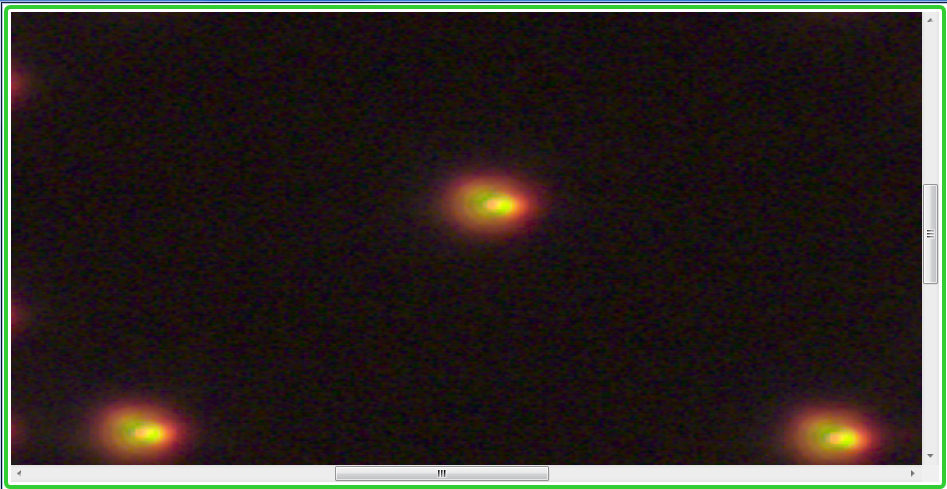
If you look carefully it’s apparent that the rings for each dot are not perfectly symmetrical; they’re slightly shifted to the left. Again, this isn’t a horrible result by any means. A really bad lens would be smeared 300% or more times on one side compared to the other, this is not bad at all.
Still, it’s apparent this lens is slightly decentered.
What Does That Mean for the Results?
I’m going to speculate here, because we don’t have experience with decentered Fresnel lenses. When we get another half-dozen copies we may find they are all just like this – that a slight degree of decentering doesn’t affect the lens at all. (There are several lenses like that, where every copy is slightly decentered and the resolution is just fine.)
We may find that a well-centered copy is far superior to this one, particularly in the corners, but perhaps even in the center.
What we can say is that the new lens is at least the equal, from a resolution standpoint, to the old lens. That’s about all for now.
When I get a half-dozen copies in and tested, I’ll be able to say a lot more. What I suspect I will find is the center resolution after testing multiple copies will be about what it is here — just slightly better than the original 300mm f/4 AF-S. I think that because our maximum resolution point, while off-center, was not up near the edge of the image. My experience is that the center resolution won’t change much on a well-centered copy, it will just return toward the center of the image.
I expect we will see somewhat better numbers in the corners, and therefore in the overall average of the lens, probably making it slightly better than the original lens in all areas. Not greatly better, possibly not enough that you’d even notice it in a photograph. But at least as good, in a much lighter lens with excellent VR. That will definitely make this a worthwhile purchase for a lot of people.
The real bottom line? Testing one lens creates about as many questions as it does answers, at least for an OCD guy like me.
Roger Cicala and Aaron Closz
Lensrentals.com
February, 2015
40 Comments
Aaron ·
Typo in the first paragraph, I think you mean “300mm” not “30mm”
Roger Cicala ·
Thank you, Aaron. I seem to really be struggling with “300” the last few articles. I did that in the Canon article last week too.
Roger Knight ·
Roger,
Did I miss an in-house joke? Would you please expand on your comment that, “There are several lenses like that, where every copy is slightly decentered and the resolution is just fine.)” Any particular significance to the smiley face at the end of the sentence?
Are you speaking particularly of very cheaply produced bargain lenses? I find it hard to accept that any lens would be intentionally decentered in manufacture.
Thanks as always for your labors of love.
Roger Cicala ·
Roger,
They aren’t designed to be decentered, but perhaps a bit of decentering is built into the tolerances of the design. And no, I’m not just talking about consumer grade lenses. There are top line lenses were every copy, nearly, has lab-detectible decentering, just a bit. For example, 70-200 IS II and VR II lenses, are going to have a bit of tilt at some focal length. It’s just how it is. Would you notice it in a photo? No, I doubt it, any more than you would notice this lens bit of decentering in a photo. But in a lab test? Sure.
CarVac ·
@Roger Knight:
That’s not a smiley face, that’s a closing paren.
Tony ·
The comparison MTFs published by Nikon, lead me to hope for a significant improvement.
Perhaps calculated MTF’s do not take account of tolerances in manufacture and assembly.
Roger Cicala ·
Tony, that is true, they do not. Those are computer-generated theoretical MTFs. On the other hand, we still don’t know how much the decentering affected this lens and won’t until we get others to test.
Steve ·
I can understand decentering for a more complex zoom, but higher end primes should not come out of the factory like this. I am disappointed.
susan ·
Roger, the tone of your post here suggests deep disappointment in the performance of the (admittedly) single specimen. Am I reading you accurately??
Roger Cicala ·
Susan,
It’s much more disappointment that I can’t trust the test sample. I really wanted to know and right damn now 🙂
I think the lens is probably better than the 300 f/4 AF-S, which is high praise, but I can’t prove it.
Roger
Craig ·
Thank you for the early review. Will look forward to an update with n> 1 samples.
Is it possible to test a strong source of light on the PF vs. the older 300? Am curious to see how much flare is present in this new lens and how well the ‘PF flare control’ software manages it. From a practical standpoint, will it stand up to headlights in planes, trains and automobiles?
Marko Solic ·
Roger,
would it be difficult to show imatest results not as numbers, but as ranges of numbers? (I hope that’s the correct expression in english)
It could be done on an elementary school level, so let’s say you have a dozen copies of a lens and the resolution in the centre ranges from 900 to 1000, with 960 being the average. So you write the result as ‘960 +/- 60’.
That way you could instantly compare not only resolution, but also sample variation between different lenses.
Cheers,
Marko
P.S. Love the blig and everything you do here! 🙂
Andrew ·
Thank you for the very prompt and rigorous “solo” test of the Nikon 300’s Roger… I can understand your frustration.
In my “amateurish” testing with a single sample of the 300 PF, I found a more significant difference in IQ between the old and the new in the centre. But then, I’ve probably got a “decentred” right eyeball while Imatest and OLAF are perfectly tuned.
FWIW, my copy and a friend’s are currently at Nikon being calibrated to our camera bodies. I will be sure to refer them to your testing and ask them to check for any decentering issues.
Thank you once again.
Andrew
Otto ·
“The view from the mount shows that, like the other “E” lenses, there is no mechanical aperture lever.”
You mean G lenses.
BILL ·
REALLY appreciate the review, though I find it a bit disappointing relative to the new lens. I have the AF-S version (creme colored one!), and a lighter, VR version 300/4 would be cool, but ONLY if it’s sharper and built right (for $2000.).
If all the new ones are designed for slight de-centering tolerance, this doesn’t say much for the resolution potential. If the de-centering isn’t to be expected, it’s sad Nikon would let this copy out the door. If I spend 2K, I don’t want to wonder about whether or not I’ve got a prime specimen. I’m cheap and picky. 🙂 THANKS for the review.
Alan ·
Great article. Do you have a test of the NX 16-50 and 50-150 coming up also?
Norn ·
Roger, this might be a noob question – but I’ll ask anyway. What’s causing the mountain and valley pattern in the left of the of the Imatest image? I don’t recall seeing it in any other Imatest results you’ve posted (I could be wrong).
Roger Cicala ·
Norn, I believe that’s the result of the decentering.
Roger
Achim Kostrzewa ·
Is it possible that the Center decenter Problem Could have to do with the VR element?
Pieter kers ·
Hello Roger, thanks for testing again… 🙂 I just used the new 300MM PF lens and tested it against the older 300mm f4 ED lens with mechanical AF and no VR.
My findings are – the new PF lens is sharper and has less color problems – both are good enough for 36MP.
I used a Nikon V3 to see what the centre does: then you see that the PF lens can handle a 135MP FF sensor ( in the 18mm wide centre) and it works very good with the latest 2x converter.
but..all in all… to get a sharp photo the problem is not the optics but the handling; keeping it steady enough… VR is important.
Sometimes i have a sharp photo@ 1/30s sometimes an unsharp one @1/320sec both with VR on.
James Conner ·
Will you be testing the PF lens to see how it handles flare? Especially flare from point sources of light in cityscapes and in astrophotography.
Wally ·
One question on resolution, how high could it get? Isn’t 1600 lp/ph pretty near the theoretical maximum for a 36mp sensor? If you assume a 2/3rds resolution for non-perfect alignment of the pixels with the test pattern you end up at 1640 lp/ph
GGVA ·
The misalignment might be due to some shift of position of VR mobile group when the lens is not powered by a camera?
Robbertvw ·
@pieter kers:
I also bought this lens last saturday (@ cameratools), and experienced big problems with getting sharp images at shutter speeds around 1/200s with VR turned ON. At lower speeds like 1/30s it was better.
On Wednesday I returned to the store and two other lenses we tried had the same problems. The store will contact Nikon and they should get back to me asap with a solution.
It seems a quite large shipment of the lens is affected because I already have contact with other Dutch users that are experiencing problems.
Trenton Talbot ·
Et tu, Brute?… Roger, these are not Fresnel lenses! Here, let me explain: http://trentontalbot.me/demystifying-diffractive-optics/
Nathan ·
I’m curious how the AF speed is, with and without the TC14E III.
I am pleased with the AF speed of the 80-400 AF-S. I’m hoping the new lens (with TC) is the same or better…
Roger Cicala ·
Nathan, Joey checked it out without the teleconverter and found it a tiny bit faster than the original one – but I’m talking stopwatch faster, not notice it in real life faster.
John ·
@ Roger
Does the lens have metal construction?
Brian ·
I had the lens about 3 days before it came out. I used it with a 1.7 tele on a D4S which is my normal setup for a walkaround lens using the current 300 F/4D for many years. That combo has given me amazingly sharp images consistently. I popped on the new 300 F/4 PF and went out in my yard to shoot birds as I have 1000 times before. It’s as controlled as I can get shooting wildlife. The lens was clearly not as sharp as the current 300 F/4. I was greatly disappointed, while I don’t use VR I was looking forward to a light lens. Now don’t get me wrong, the current lens is heavier but surely no biggy for handholding all day. It’s also $600 cheaper and in my opinion better for what I shoot. For the record I did not have VR on and shot it at 1/1600 and 1/2000.
Nathan ·
Thanks Roger, how does the AF speed compare with the 80-400 AF-S? That’s the lens I have experience with 🙂
Nathan ·
John it is plastic.
Richard ·
Any additional words on the results with this lens and VR. I was disappointed to read Brians comments regarding performance without VR. I have had one on order as of the day it was announced from B&H. I have a 2.8 but was very interested in a walk around lens. I am wondering if Nikon has a hold on the lens. Not many around in the US
Steve ·
B&H originally said this lens would ship Feb 5 but they still have not received it from Nikon. Anyone know the reason for the delay or when it will be available?
Henry Albert ·
Since I’m an old fart and getting less steady by the second (it seems), I’m very interested in this lens. I’ve had various 300s since `78 and love the focal length. Plus I’ve been experimenting lately with a 300/4 af-s on a V1 and I’ve been knocked out by the quality of the images. The new lighter VR lens would seem to be a great match.
But I’m not interested in being a beta tester for Nikon so I’m going to wait a bit before plunking down my cash. (My 750 is in California for its anti-flare vaccination as I type this.) Nikon appears to have adopted the old General Motors scheme of using early adopters as final quality control testers. Ask someone who bought the final iteration of the Camaro in it’s first production year and they’ll tell you more. Nikon is heading down the same path, it seems. Self-oiling sensors, lopsided focus arrays, custom unexpected flares, VR that fuzzes your image at particular shutter speeds . . . jeez. I may or may not buy one of the new 300s eventually, but if I do it’ll be after the beta testing by early adopters is complete and the bugs have been eradicated.
Mac Walter ·
i am a serious amateur wildlife photographer who has been doing this sort of things, esp. BIF for over ten years. I currently am using a D7100 as I mainly handhold and don’t want to locked into a tripod and us in smaller lenses,I need the reach. I used the previous 300/4 version with good results for many years and when the new 80-400mm VR ii came out I rented it. I was very impressed with the Vr and most esp. The speed of the AF. Tho not as sharp overall as my 300/4, I found I was able to get many more good quality photos with the newer lens speedier AF. Almost as fast as my 70/20/2.8 VR ii. So when the new 300/4 came out I rented it as well. Tho very light and with good IQ, I was disappointed with the lens speed of AF. Tho clearly faster than the older 300/4 I found it often would get lost and could not reacquire without help. So I tried a simple test where I focused on clouds in the sky with my 80-400 and no problem. But with the new 300/4 ,it would not focus on the clouds. It clearly is less able to distinguish vague borders and I found when going after BIF, it was not as fast as my 80-400 but better than my older 300/4. My gut feeling is that at least for this copy, my older 300/4 was a hair sharper. Realize that I am going for objects in the center of the frame. I do hope that maybe with a correctly centered lens, this will improve. Until then, I will wait a bit.
Wade Tregaskis ·
Any update w.r.t. testing more copies? Like most wildlife shooters I’m supremely interested in this for it’s unique combination of purported quality and lightness. It seems there’s still some disagreement in the general community on the quality aspect, though. As I trust Roger’s objective measurements far more than the “because I said so” methodology of most other reviewers, I’m kinda waiting for the results here to determine my purchasing decision. No pressure. 😉
Roger Cicala ·
Wade, It’s on our list but the repair department has been overwhelmed lately and we just haven’t had much testing time at all.
Adam ·
Having shot for a while with one of the “fixed” copies of the lens, I can say that it is difficult to complain about the optics of the lens. Really great IQ on the D750 with a couple of caveats:
The bokeh isn’t the most beautiful I have ever seen. Smooth, but not the perfect round circles that are the trademark of perfect bokeh.
And the bigger caveat — the VR still isn’t so hot on the D750 at shutter speeds between 1/80 and 1/200. At 1/250, every image is tack sharp. Even at 1/40, many many images are tack sharp. But between 1/80 and 1/200, you get some double-image blur. Very noticeable if you pixel peep, not super noticeable when viewing at normal size. Worst at 1/125 and 1/160.
So realistically, you are getting some benefit from the VR… but you might need to avoid certain shutter speeds.
I’ve seen others with the D750 report the same results.
Roger, would love to see some testing with this lens on a few different bodies, at those shutter speeds, to determine whether the double-image-VR blur still impacts all camera bodies, or some more than others.
Tuco ·
Rented PF (w/TC14) and AF-S lenses from LR to compare.
No news other than the PF worked a treat on the D3S. What I haven’t read but found was how well the PF focuses vs. the AF-S. While capable of capturing similar quality shots, using the AF-S was old-fashioned work vs the effortless PF. VR worked flawlessly at 1/125 on the D3S. Viva VR, small size and really good AF.
PF color is flatter, more (modern) neutral. Bokeh is neutral and unexpectedly good on the PF and preferred to the AF-S.
It is a great lens and I would have bought my rental. If it were close, the AF-S at half the price would win. But, it isn’t. *A good example* has leagues better usability than the AF-S. It’s just an expensive, sweet machine (with a shaky rep).
I would like to know how the new lenses ‘vary’….
Mischa Bachmann ·
Damn! Why didn’t anyone demand that follow-up test?
Roger, I love your work and I’m really drawn to this lens (even though it’s gravitational force is quite low). Now I really need your input regarding copy to copy variation.
Please, be a nice guy and test some more PFs for me?