

What Is A Monochrome Sensor And Why Does It Exist?
Leica cameras have always been exciting to me. I think it’s mostly because of how expensive they are. Holding and using something incredibly out of my budget gives the shooting experience a little extra magic. But even with that magic, I normally pass over them to rent something more practical. When the original Leica M Monochrom camera came out in 2012, I, and others around the office thought it was interesting. But why make an $8000 camera that can’t even shoot color photos?
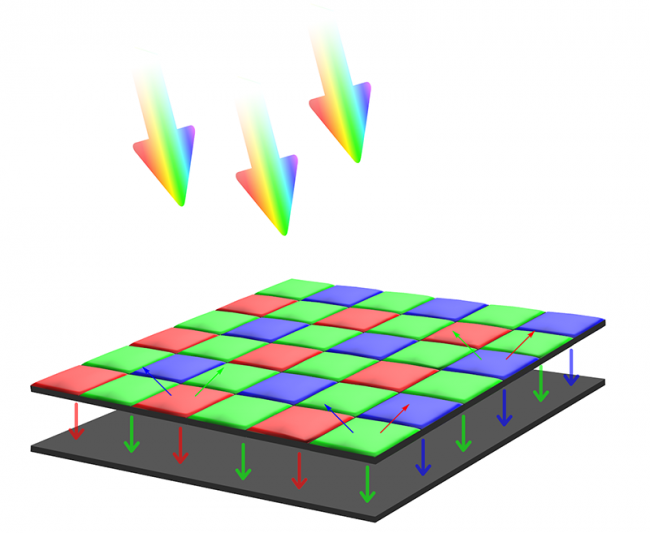
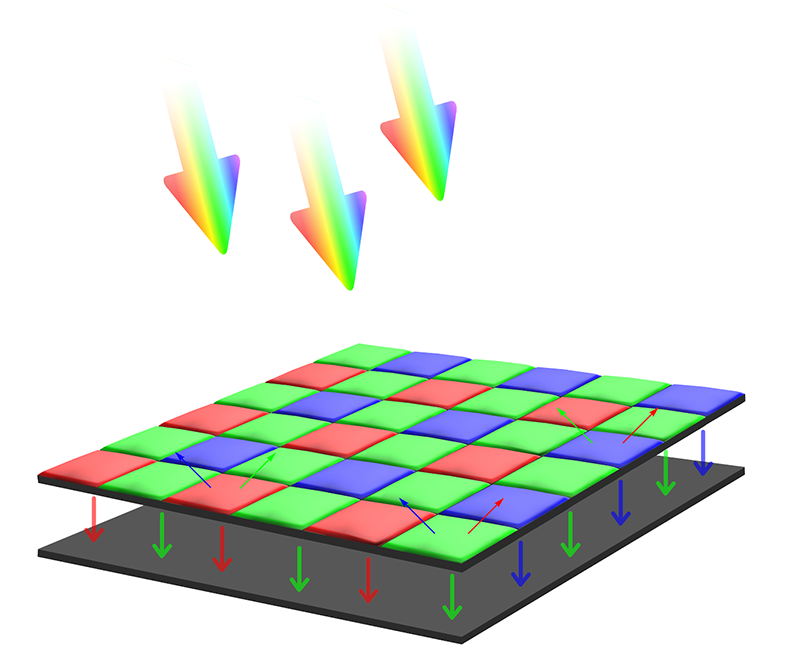
The idea is that the sensor will yield a more detailed image, and perform better in lower light. To explain simply, each pixel on the Monochrom sensor is capturing light and only reading luminance values. A pixel on a color sensor is reading light that has been filtered by using color filter array (CFA) to distinguish between green, red, and blue. You can see in the illustration below the grid pattern normally used, with each photosite only recording one color. By removing color from the equation, all the light is hitting the sensor uniformly, and can lead to a more detail captured.
I don’t want to debate whether or not a monochromatic sensor can render more detail. I will leave that to the comments section. I’m simply curious if there is a noticeable difference when compared in the normal mediums in which we view photographs; especially considering the resolving power of recent cameras. To find out, I’ve taken side by side photos with the Leica M Monochrom (Typ 246) and the Sony Alpha a7R II and blind tested some people in the office. I wanted to know if they would be able to tell which camera costs roughly $5000 more and has the dedicated monochrome sensor. The cost difference doesn’t matter so much when you can rent, but it’s an interesting factor to consider. I also want to note that this is not a technical comparison. These images were taken in real world situations with cameras that have different metering systems. Multiple exposures were taken of each image to ensure the closest visual match. The lenses used are the Leica 35mm f/1.4 Summilux M ASPH II and the Leica 50mm f/1.4 Summilux ASPH.
Let me introduce the panel of experts.
 | Leica shooter and owner of an M9, Zeiss certified, BFA in Photography, Lensrentals Repair Manager, Expert in all things photography |
| Aaron Closz | |
 | Leica and Sony Shooter, Senior Lensrentals Technician, walking encyclopedia |
| Joey Miller | |
 | Co-Owner of Lensrentals.com, not a photographer, extreme skeptic |
| Drew Cicala | |
What Are We Looking For In This Comparison?
Aaron: We should be seeing finer detail out of the Leica because it’s not interpolating the information. Essentially each pixel site is recording the luminance value hitting it …and that’s it. Whereas with the Sony, we are going to get luminance values of three different pixels mixed together to give us the information. So we should technically be able to see a higher resolving power from the Leica. How that is translated into bokeh when shooting with narrow depth of field I am curious to see. I would imagine it’s different but very difficult to tell the difference in the out of focus areas between the two. It’s going to be a matter of finding where we can see the – as opposed to your general contrast which is what we are going to see here- see if there is a difference of how smooth or harsh something might look. There should also be an interesting difference in how it is translating the colors.
Aaron continues to share his thoughts on doing a comparison like this one.
Aaron: People are always wondering why people would pay this much for a Leica and why they can charge so much, but typically if you are the person doing these things you aren’t questioning it. You understand why you are willing to do it. You aren’t just buying into a philosophy- it’s a philosophy you are pursuing yourself.
Drew: There is that but like most things- that’s the reason people started doing it but it’s not why most people do it now. It’s like buying a Maserati.. it costs 15 times more than your Ford Focus but only goes twice as fast. It’s twice as good at this one specific thing but it costs 15 times more and it does literally everything shittier. You’re more uncomfortable, you can’t store anything in it, you can’t strap your kids in the back seat but it does this one thing twice as good as the average car. So for people that really care about that and that’s what matters to them more than anything else- it’s worth the money. But for every person that does it for that reason, there are 20 people who buy it because they are willing to overpay to get the best possible thing and status symbol. They don’t actually care that they have a fast car, they care that they have a Maserati. And Leica is the same thing. Because you know, If I’m willing to overpay in this one narrow area it shows I’m a high-end consumer. And a lot of those people have a Maserati because it goes really fast, but guess what, they have another car to go to the grocery store. And when they just need color pictures of their kids they have something besides the Leica Monochrom for that.
Is there a noticeable difference? Here are the images.


Drew: I’m going to say the left one is the Leica. It seems to have more in focus.. or resolving more.. or more contrast. I’m just guessing that one is the Leica.
Joey: I think I’m the opposite, I think the one on the right is the Leica because I think it has smoother transitions from highlights to shadows.
Aaron: Yeah…I think I have to agree with Joey. It’s the amount of contrast and again, how smooth it is in the highlights. I’m also looking at the noise here in the background and if we are at that high of an ISO.. it just looks more smoothed out on the left. The slight exposure differences are a bit funky. I’m wondering how different the metering is.
(Answer: Left: Leica M Monochrom (Typ 246), Right: Sony Alpha a7R II)


Drew: I guess the one on the left is Leica. Just looks more like a Leica to me. From what I see from Leica images, it looks more like that. I don’t know if this means anything…because I’m not one of you people, but it’s interesting to me that the foreground is much brighter but the background is much darker in one image.
Aaron: Yeah, that’s very interesting.
Joey: I’m going to say the one on the right is the Leica. There are more controlled highlights, and again, slightly higher contrast.
Aaron: Hmm.. are they focus in the same area?
Joey: Looks only slightly different. I like this a lot.
Aaron: I almost want to say the left one is the Leica. This one is really tricky. I get more detail out of the left one. hmm.. Yeah, going Lefty.
(Answer: Left: Leica M Monochrom (Typ 246), Right: Sony Alpha a7R II)
At about this time Drew checked out because he has a business to run. It is very interesting though that he has guessed each comparison correctly over the Leica experts. Maybe they are overthinking it?


Joey: I think I gotta go with the one on the left as the Leica. Looks more detailed. Smoother transitions.
Aaron: The left one is crisper.
Joey: Wait, does that look like purple fringing? but not purple- around the collar…
Aaron: Yeah… it’s only on one of them
Joey: I may switch my answer…hmm…no I’m sticking with Leica.
Aaron: yeah me too…I think the right one is Mr. Leica.
(Answer: Left: Sony Alpha a7R II, Right: Leica M Monochrom (Typ 246))


Joey: One on the Right is the Leica.
Aaron: The right one is Leica.
(Answer: Left: Sony Alpha a7R II, Right: Leica M Monochrom (Typ 246))


Joey: I’m going right [for Leica], more controlled highlights, more detail.
Aaron: Yep, me too.
(Answer: Left: Leica M Monochrom (Typ 246), Right: Sony Alpha a7R II)


Joey: I’d say the right is Leica.
Aaron: I agree. The dynamic range seems better in the photo on the right.
(Answer: Left: Leica M Monochrom (Typ 246), Right: Sony Alpha a7R II)


The exposures on this set are slightly different. When Shooting, the light was changing a lot and when set to the same exposure I was getting different results on each camera.
Joey: Ok I think the left is Leica. Wait, no… The one on the right
Aaron: I think its right as well. Lefty looks noisier. I think I’m going back on myself… I find myself looking at different things each time. Detail.. texture.
Joey: so the obvious answer is.. does it matter? We have side by sides… if we were just given an image would it matter?
Aaron: I think if you are noticing something consistently with a particular set up it’s not going to matter as long as you like what you are getting.
Joey: It’s like picking your film stock.
Aaron: Sometimes you will get more appealing results with one setup…I’ve only ever seen Monochrom images that are extremely contrasty to the point where they look grainy. I don’t know if I’m confronted more with imagery that has been processed. I haven’t used the particular camera a lot to know what image comes straight out of it. I almost expect that over exposure.
(Answer: Left: Sony Alpha a7R II, Right: Leica M Monochrom (Typ 246))
——
This is what Joey and Aaron had to say after I showed them the answers to each comparison.
Joey: I wonder if the Sony has a better dynamic range… I think I know what camera I’m going to buy now.
Aaron: I’m curious to see the original color images to see how each color translates.
Joey: I prefer the Sony. Though, I would be interested to see a comparison at ISO 25000. I’d like to check for banding. Personally, I prefer the Leica in some of them. I thought the skin tones in the portraits looked better. I’ve always come from the standpoint of the tool being the least important part; never geeked out on expensive equipment. I assumed the Leica Monochrom would be better and I think it’s definitely more fun to shoot, but the Sony did outperform in certain situations.
Aaron: I prefer the simplicity of the Leica and I’m engaged with the things that matter most, I’m not doing anything else with a Leica camera but making photographs. Bottom line, shoot with what inspires you and excites you and makes you want to shoot.
I think it depends on your intent. I really believe that the print would be better with the Leica, but it’s something we would have to test. Just because from a technical standpoint, we should get a cleaner, finer resolution on the Leica. I’d be very curious.
Joey: But does the resolution bump on the Sony make up for it?
Aaron: That’s an interesting way to look at it.
Joey: They may be neck and neck.
Final Scores: Drew: 2/2 Joey: 2/7 Aaron: 4/7
Conclusion
While the reasoning behind the experts’ guesses was sound, it was often wrong. I did find the note of possible fringing in the third comparison to be a great observation, but surprisingly it wasn’t enough to tip the panel in the correct direction.
After sharing this comparison and getting feedback, I think it would be very helpful to see how the cameras would react differently in extreme color conditions such as a bright red sunset or extreme high ISO (25000). It may just be that the Leica Monochrom is only a better tool for certain situations. So much better that we could tell the difference? It doesn’t seem so.
What are your thoughts on this comparison? How many answers did you guess correctly? We would love to hear your opinions in the comments below.
Sarah McAlexander
Lensrentals.com 2016
51 Comments
DV ·
Something to keep in mind with these comparisons is that on a bayer array camera, the nature of B&W conversion can change depending on user taste. A monochrome sensor behaves much like black and white film, and you need to use lens attached filters to filter out certain frequencies to enhance an image or capture the proper contrast of a scene based on the light source. Remember the bag of blue, orange, and yellow filters? Were any of these Leica shots taken with lens filters used? What were the B&W conversion settings in LR/C1/RAW converter du jour?
On a Bayer camera, while there may be less pure luminance information, you have gained spectral information based on the filtered colors in the array, which allows you to effectively simulate those filters in post without quality loss. So while you may not get the absolute maximum in luminance information, you may make up for it with tonal controls that would be otherwise unavailable. Whether or not sacrificing some pure resolution for this flexibility is the right choice is, IMO, an exercise left for the creative user.
James ·
I got two out of seven, which is pretty bad considering I own an A7RII ?. I think the shooting experience of the Leica might be more enjoyable since I really like rangefinders but based on this I wouldn’t get one for image quality alone.
Joey Miller ·
At least the three of us agree on one thing. Beards are great.
Albert ·
Couldn’t use one even if I wanted to. Skin gets incredibly irritated.
Joey Miller ·
To be fair, Drew shaved off his beard recently. But I will never betray mine like that.
J.L. Williams ·
I really enjoyed this. I’ve suspected all along that a lot of gear bias wouldn’t stand up to a double-blind comparison test, and this made a good case. Clearly the differences were so minor that the identifications were no better than chance.
It also interested me that nobody ever said, “I’m stumped” — they always came up with both a choice and a rationale for that choice, even though the results show the rationales must have been fictitious. It seems the power of myth in photography is very strong…
jrconner ·
Consultants are often wrong, but never stumped. The same is sometimes true of experts.
Ben C ·
That’s sometimes said to be a good adage for parenting, too 🙂
Snugge Dr. ·
it would be interesting to see a comparison using native e-mount glass ie 35mm or 55mm sony zeiss and comparable leica glass.
Chris ·
I’m curious to see if the leica monochrom would do a good job as an astrophotography camera, using different filters and stacking the differently filtered images together
Joey Miller ·
You know, I’ve been thinking along similar lines. I may run some tests this spring when the weather is more cooperative. I’m currently testing lenses for astro use, with the goal of making a definitive list of stuff we carry and how well it performs for star stuff.
obican ·
So if they flipped a coin each time, it’d be correct more often than Joey and Aaron. Funny.
almeich ·
Only if they flipped the coin a large number of times.
obican ·
Some guy at CoinRentals.com had some very extensive testing with a very large number of coins and none of the US coins can be reliably used in such a scenario. Too much sample variation.
Joey Miller ·
I should register that domain.
Hannes Böck ·
very, very funny!
Boris Massieux ·
I don’t know if I would get a better result to such type of test. However, what really surprises me when people discuss such differences is that they seem to not recognize a Leica type of image due to the Leica treatment. All Leica camera I’ve been able to use, when in monochrome mode, have a special treatment of color sensibility, which I guess is due to algorithm use. Blue colors are always treated in a special way, yellows/oranges too. In my opinion, Leica really take care to bring more dynamism and contrast (I mean differences in areas of the photo due to differences in the color of the objects within – e.g. a walking pass in the middle of a green field under a bright blue sky with clouds – to better separate them). You can recognize that if you are used to see Leica files.
binotto ·
Thanks for a really fun article! I’m guessing that the greater dynamic range of the Sony sensor plays a role in those “smoother transitions”. That and a lot more pixels. The monochrome sensor does punch above its weight (this was clear comparing the original Monochrome with the M9) – just not that much above its weight. In the end, I think the appeal of the Monochrome is in the creative constraint it gives you in the shooting process.
Joey Miller ·
100% agree. I will say there is a romance shooting with the Monochrom. It’s akin to loading an old film camera with TMax or Acros 100 and just rolling with it. Sometimes romance is worth it.
Albert ·
Interesting, and fun. That said, I have never posted a BW image without choosing precisely how I wanted it post-processed. Also, with so many attractive options to aid in this, it is really hard to understand the appeal in a pure monochrome camera. Silver Effex 2 is my personal go-to.
Hannes Böck ·
Leica is about the shooting experience and the lenses. not about the light registering medium. there was no leica film and no leica sensor. what you saw and see today is the optical qualities of the lenses. so if you shoot 2 different sensors with leica lenses you will get a “leica image”. if you want to know if the monochrom leica is any good you have to compare it with a film leica.
if you want to compare systems you have to shoot the sony with sony lenses. if you shot the leica monochrom with sony lenses the difference would be bigger then between the 2 sensors. i am pretty sure that you can make your samples look identical in post.
but i understand that the question was if it´s better to leave out color information before or after registering of the light. to answer that you might want to get the brightness levels matched. otherwise you can´t judge translation of color to grey tones and your test is missing the point.
Ben C ·
To be fair, it is Leica that is making the Leica name also about the sensor. You can’t say the sensor is not part of the equation when Leica themselves are making a claim for a monochrome sensor giving one of their models a distinct advantage.
DISQUS ·
Right on brother! Leica was a venerable camera and lens maker but has become a fallacy driven by emotion, bias and profiteering.
Like what Hannes said, for most of Leica’s history it was film. Nowadays Leica is playing catch up with the Japanese makers who have far more resources to develop digital technology. Far be it from me to rain on peoples’ parade and say the emperor has no cloths, but if you’re on the fence about Leica and are thinking of buying with the belief that it makes technically better images because “it must be better because it cost so much”, and “you get what you pay for”, save your money. You buy Leica for the shooting experience you get with a rangefinder that is simpler to use than it’s Oriental counterparts. The other reason is so you can feel good about showing off your $7000 camera to your friends. Don’t buy into the hype and don’t believe 90% of what the reviewers say. News flash, most reviewers are beholden to the camera makers in some way and want to preserve their relationship with them and keep getting free gear, vacations and who knows what else.
Rockwell is not beholden to Leica but he likes German stuff, being German himself. I recall him writing about men with low self-esteem.
Carleton Foxx ·
Great test and another feather in the cap of LensRentals. But one of the things people always say is that lenses only show their differences when shot at very wide apertures or at the extremes of their focusing range. I can’t seem to find the f-stop these pictures were shot with. Were they all at a 4 or 5.6? Or were some at f/1.4?
Sarah McAlexander ·
Carleton, Thank you for the kind words! These photos were shot with a range of f-stops. f/1.4 to f/8. Each set was shot with the same lens at the same aperture setting to eliminate as many variables as possible when comparing image quality.
DrJon ·
I’m going with DV (below) to agree that a colour sensor just offers so much more flexibility in post-processing. For example using Black+White Projects (my favourite monochrome conversion tool) you just select the colour filter you want to apply and see what you get. This is much more convenient than having to decide before taking the shot and most likely only having a small screen (with who knows what DR) to decide from.
Butanding ·
I got 6 out of 7, and I haven’t even held a Leica (I do have the A7R II). Are you sure about the results for the first image?
Sarah McAlexander ·
You have a good eye! Yes, The displayed answer is correct. Can’t win ’em all.
Sri Prabha ·
Great comparison to start off with. A few points, with clarity and prescence settings in Lightroom ,one can match outputs quite closely. Another big point,is actual printing. Here is where you may see some differences,but it’s highly doubtful. At the end of the day, whatever you’re most comfortable making work with is important, but I’m highly suspectful of paying 8000 for a camera. I’d rent it for sure though.
Jonathan_T ·
fascinating stuff, agree with J.L. Williams, this should be done more often in photography tests to remove fanboyism and prejudice.
Jonathan Stewart ·
Wonderful article. The comments show the bias and preconceptions of the “experts,” while their results show nothing better than chance guessing. To my eye, I preferred the Sony images most of the time. Fringing, by the way, is a function of the optic, not the sensor, so if they’re both using the same lens, it shouldn’t matter. Your article is essentially a blind taste test of a $100 bottle of wine vs. a $20 bottle, and the “experts” couldn’t tell the difference, and then when confronted with their failure, come up with some weak rationalizations. Great job.
taildraggin ·
It’s remarkable how good the sensors are in disposable cameras today.
DISQUS ·
If I remember correctly, Kenny Rockwell tested the Leica lenses on the Sony and got soft results. He concluded that the Leica lenses and the Sony sensor didn’t play well together. A better approach may have been to use one of the better Zeiss lenses designed for the Sony.
Mr Will ·
Ken Rockwell tested his arse and discovered that it was the bendy bit half way along his arm.
James Clark ·
I’ve heard the same from Phillipreeve. Something about filter stack thickness.
RandomCameraInfo ·
James, youre a sad little fool
James Sarrett ·
I hit every one, but I think I know why. Hint: it’s not resolution. It seems to me that in images this small, made from ones that large, and where you have sampled at or greater than the maximum spatial frequency of the lenses, you’ll get basically the same sharpness from both captures, when you’ve downsampled (assuming you did it well, and photoshop usually does). All the ‘fine detail’ is pretty much gone when you get to the web resolution. i.e. if you had a white pixel next to a black one, at half the resolution you’re back to a grey one, which is what you would have seen with the same lens on a camera that only sampled at the half resolution.
To my eye, the real difference in them is the tone mapping, and the overall exposure curves from each. I see what looks (sort-of) like a higher gamma applied in the Leica images. Some of that can be pushed around by the RGB->Gray conversion factors, and some of it is just in the on-camera image processing (and the sensor and ADC). Plus if you’re using a higher bit-depth pipeline, (e.g. RAW + photoshop), you can often push that around a fair bit.
Since it’s for art and not photometrics, I say go with what works for you. I’m getting what I want out of a old 150$ Canon EOS-M.
Lee ·
Interesting and smart choice picking a larger megapixel camera for your “CFA/bayer” camera. That should somewhat equalize the results. If you did M240 vs M246 (or A7 II vs M246, if we wanted to compare across brands) I would expect a very clearly visible difference in detail and noise. At least that’s what the Epic [standard] vs Epic Monochrome tests show.
Paul Menard ·
with the older monochrom i tried it was much sharper at 100% than bayer, so if you had access to that you could probably tell easily.
sigma cameras are extremely good at black and white, with the foveon sensor :), i think i prefered the foveon sensor but the leica glass…
Mark Cho ·
This was a great article, super interesting. I own both (well, an A7s II not an A7R) and I often find myself wondering why the Leica. However, it is supremely enjoyable to use as well as very discreet, even more so than the A7s II.
It makes sense to me that the Sony has better dynamic range, it’s a far more modern sensor and ultimately these sensors are commodity parts, available to whoever wants to buy them as long as the price is right.
I did find trying to check for resolution and sharpness to be nearly impossible in these sample images. It looks like it got resized for web use? Plus, I couldn’t always tell if it was a case of one camera being slightly better focused than another? I particularly felt that way about the bearded driver image.
I think another interesting angle for the article would be to add the question: “Which image did you like better?” rather than “Which is Sony, which is Leica?”. I think people view these images suffering with confirmation bias, possibly identifying the “better” image as the brand they prefer?
In any case, both are great cameras. Personally, I tend to use the Sony mostly for work and the Leica mostly for play.
markchodotcom ·
This was a great article, super interesting. I own both (well, an A7s II not an A7R) and I often find myself wondering why the Leica. However, it is supremely enjoyable to use as well as very discreet, even more so than the A7s II.
It makes sense to me that the Sony has better dynamic range, it's a far more modern sensor and ultimately these sensors are commodity parts, available to whoever wants to buy them as long as the price is right.
I did find trying to check for resolution and sharpness to be nearly impossible in these sample images. It looks like it got resized for web use? Plus, I couldn't always tell if it was a case of one camera being slightly better focused than another? I particularly felt that way about the bearded driver image.
I think another interesting angle for the article would be to add the question: "Which image did you like better?" rather than "Which is Sony, which is Leica?". I think people view these images suffering with confirmation bias, possibly identifying the "better" image as the brand they prefer?
In any case, both are great cameras.
Chas Herren ·
24mp camera equals 42mp camera. at least. End of story.
Jo Brodsky ·
violates everything about good testing – including: letting judges hear each others’ comments, a ridiculously tiny statistically irrelevant participant panel, far too few trials, no control over images – etc etc etc – entirely meaningless in other words – and more – stupid and misleading.
VPR ·
Great article and, as others have noted, a good exercise in “bias detection”. Both cameras are great, just different (although the Leica clearly loses on price)
TCav ·
There are lots of ways to do B&W conversions, so without knowing what method was used, it’s difficult to know how a 36MP RGB sensor would compare with a 24MP B&W sensor.
See http://www.dyxum.com/dforum/case-study-conversions-to-black-white_topic29870.html
Theorist ·
In your opening explanation, you don’t say anything about the post processing that I saw. Was nothing done?
Also, one of the comments addresses the issue of physical color filters. Perhaps you should have used these as appropriate with the Leica to indicate what it can do at its best.
Finally, the left image of the woman at the end does not expand.
Guilherme Mauricio ·
These guys are no experts, trying to compare dynamic range, noise, and highlight control between the Leica and the Sony. And sadly, neither does the author seem to know what Leica Monocrhoms are about.
They’re about micro contrast. Which translates into “true resolution” and perceived sharpness in high frequency detail.
To properly take advantage of the lack of Bayer filter, you need highly detailed textures (fabric is a good example, but the pictures here are a little bit too close to make a difference) or extremely fine detail (grass at a distance). And you need to compare full resolution photos – of course, with the same resolution. Once you resize the image, you’re comparing the image editing’s ability to downsample pixels.
Take a look at Sony’s sample pictures for it’s pixel shift tech incorporated into the A7R III and look at the images in full resolution. These guys know what they’re doing, and that’s the sort of difference you should be looking for in a bayered vs debayered photo.
This “test” was a total flaw.
James Clark ·
The minute someone uses the term “micro contrast” I die laughing. What are you even on about here??
RandomCameraInfo ·
James, your extreme ignorance is sad and pathetic
drDave Elliott ·
If you looked for gradations and detail in the contrast, it was almost always the Sony which provided it. And the Leica clipped into white when the Sony did not.
James Clark ·
This is exactly what I was looking for. Cheers!