
Sony FE 16-35mm f/2.8 GM Sharpness Tests
Well, I’ll say to start with I’ve probably had more requests for the Sony FE 16-35mm f/2.8 GM MTF tests than any lens in recent memory. People are excited about it. About half the requests have been very reasonable “I’m hoping to see MTF results before I decide between this lens and that.” And, as has become far too common with Sony lenses lately, about half were fanboyish “I can’t wait to see the new Sony FE 16-35 smoke the Canon 16-35mm f/2.8 Mk III.”
For those who don’t like to read, I’ll save you lots of time. This is a very good lens with interesting characteristics that I think will make it a photographer favorite. It’s expensive, but not massively more than the Canon 16-35mm f/2.8 Mk III. But if you’re a fanboy looking for numbers that ‘destroy’ the competition, you’ll have to go to one of those number-generating sites that say it pulled 72.3 smoke units out of their butt. This post won’t be for you.
MTF Curves
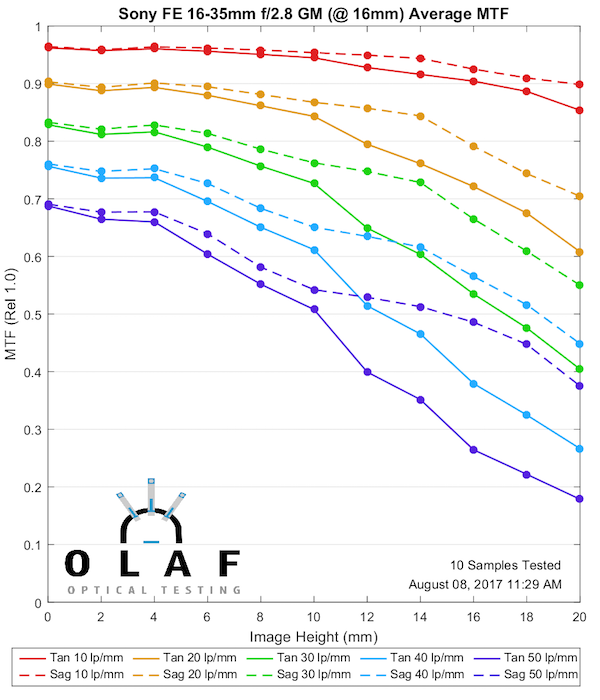
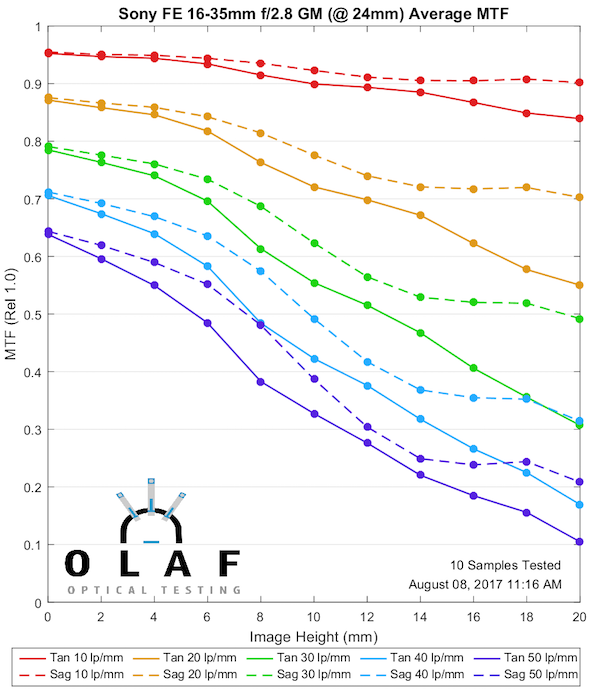
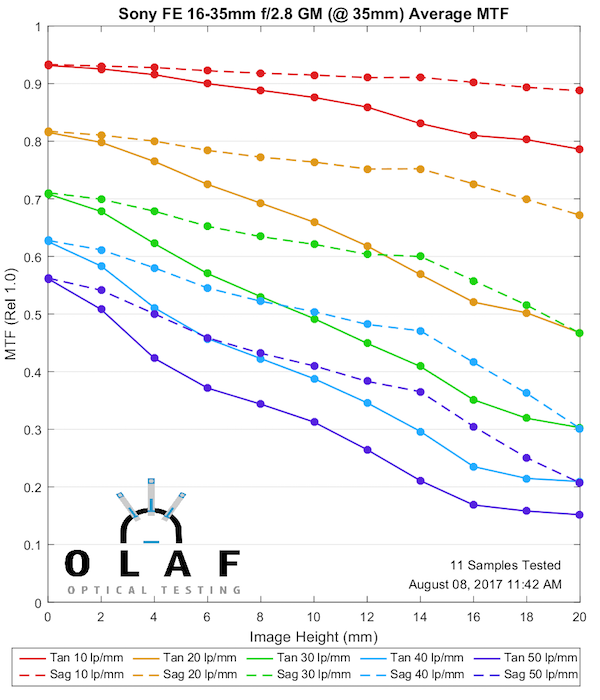
As always, these are the average curves obtained by testing 10 lenses, each at four different rotations from edge-to-edge. So each point on the MTF graph is the average of 80 readings for each frequency.
16mm
The lens is at its best at 16mm, where it’s sharp in the center even at higher frequencies. It maintains sharpness very well through the middle half of the image, then fades a little bit, but not much. There is a little astigmatism-like separation of the sagittal and tangential curves in the outer half, but again far less than we expect in a wide-angle zoom. This is an excellent performance at 16mm as I’ll show you in some later comparisons.
More than just absolute numerical performance, the MTF curves suggest a very smooth, even performance across the entire image frame. That’s something few wide-angle lenses of any type do, much less a wide-angle zoom.
24mm
Like most wide zooms, things aren’t quite as sharp at 24mm, both in the center and out towards the edges. Still, this is a very good performance, and the lens is still going to generate nice, sharp images here.
35mm
Following the usual wide zoom pattern, things fall off a bit more at the long end of the zoom range. It’s not bad, by any means, but not nearly as sharp as it was at 16mm. As is the usual case with wide angle zooms, at 35mm you’d probably be better served by changing over to your 24-70mm lens, but this is still very usable.
Full-Field MTF Patterns
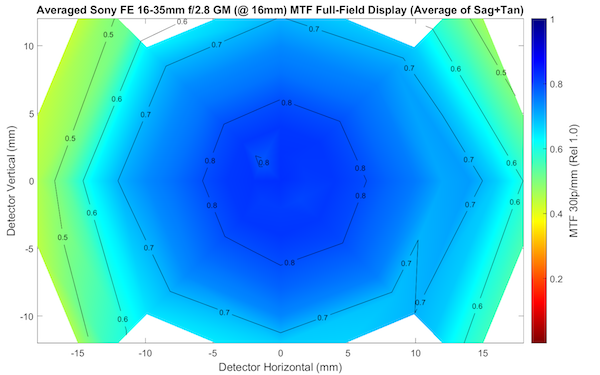
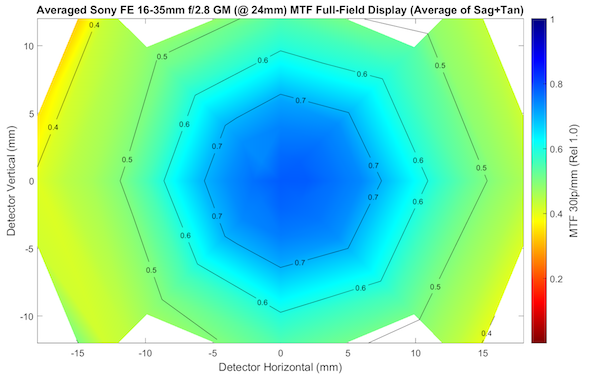
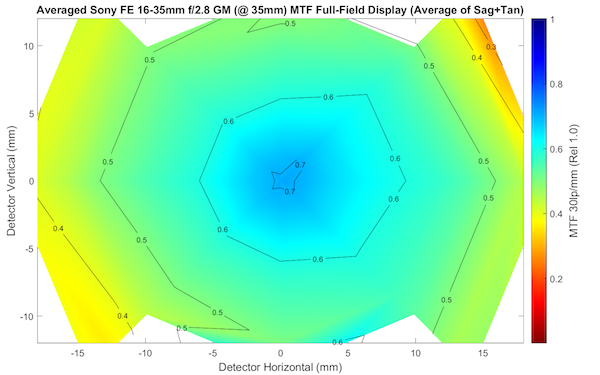
For those who don’t like MTF, this provides a nice, intuitive look at the relative sharpness of the lens at various focal lengths.
These are done at 30 line pairs/mm and are the average of Sagittal and Tangential numbers, so we’ve lost a lot of data that you can see in the MTF graphs in exchange for a more intuitive overview. Basically dark blue is as sharp as you would like; lighter blue is reasonably sharp, green and yellow is somewhat blurry but can be improved with some aggressive post processing.
16mm
24mm
35mm
MTF vs Field vs Focus (AKA Field of Focus Curves)
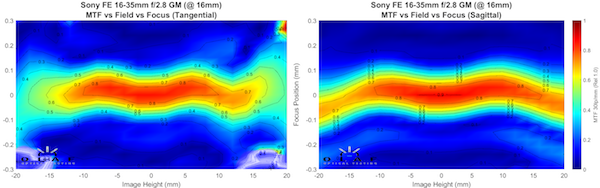
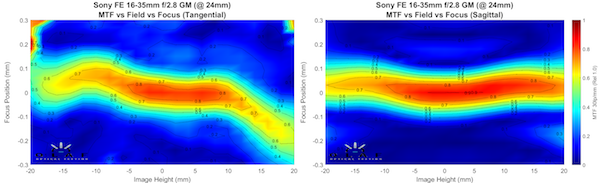
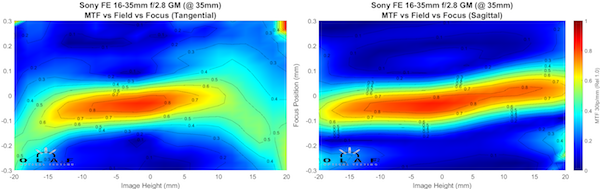
These are possibly the most useful curves we can give you. I need to point out that these are not the average of 10 lenses, rather they are examples of a single lens that was fairly representative. Since it is a single lens, you may see a little field tilt here or there, most zooms have some. (If you’re wondering why we don’t average 10 of these, it’s because they take about 30 minutes each to do and have enough data points that trying to average them would bring our computer to it’s knees.)
16mm
A very slight mustache field at 16mm. This is excellent, though, for a 16mm lens. Notice that the sagittal and tangential curves match up very well, which we expected after seeing the MTF curves above.
24mm
The field flattens somewhat at 24mm. This copy is slightly decentered at this focus distance and has a little tilt in the tangential field. This isn’t severe, by any means, but would be noticeable if you pixel-peep. If you untilt the tangential curve in your mind, you can see that at the edges the tangential field is not lined up with the sagittal field, which we saw in the MTF curve again.
35mm
At 35mm the sagittal field is quite flat. The tangential field is flat in the middle 2/3 of the image but shifts pretty dramatically at the edges. There’s going to be edge astigmatism at the 35mm focal length. This copy is well centered, but slightly tilted. The tilt is slight enough (draw an imaginary line across the graph at “0” on the X axis) that it probably is not noticeable even with pixel peeping. Probably.
Comparisons
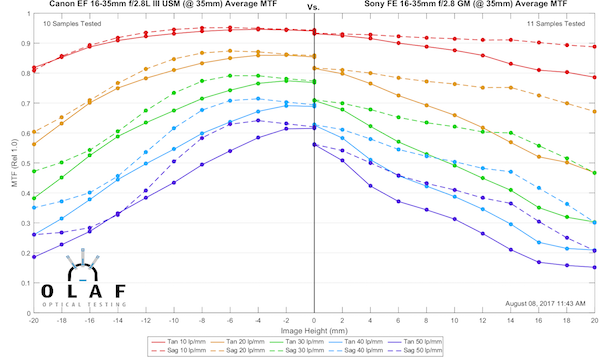
Sony FE 16-35mm f/2.8 GM vs Canon 16-35mm f/2.8 L Mk III
The Canon 16-35mm f/2.8L Mk III is arguably the best 16-35mm f/2.8 lens, and therefore we consider it the standard at this focal length.
16mm
The Canon has an amazingly high resolution right in the center, especially at higher frequencies where the difference between it and the Sony is dramatic. But the Sony’s smooth curves give it better resolution in the outer half of the image, and the Sony has less sag-tan separation (this can be caused by either astigmatism or lateral color) so it’s likely to have a smoother look and could have smoother bokeh (lots of other factors contribute to bokeh).
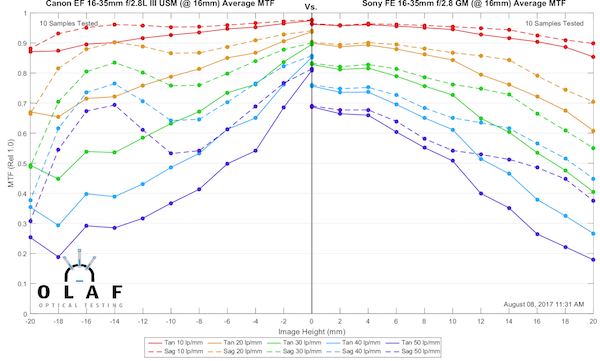
As an aside, I’ll use this as a good example of why single-number ratings are so silly. If you weight the center of the image, the Canon’s going to have a higher rating. If you rate the entire image evenly, they’re going to be pretty equal. If you rate astigmatism as a huge problem, the Sony will have a better rating. My non-numeric rating is they are both excellent, but I expect they’ll have a very different look, and different people will prefer one over the other.
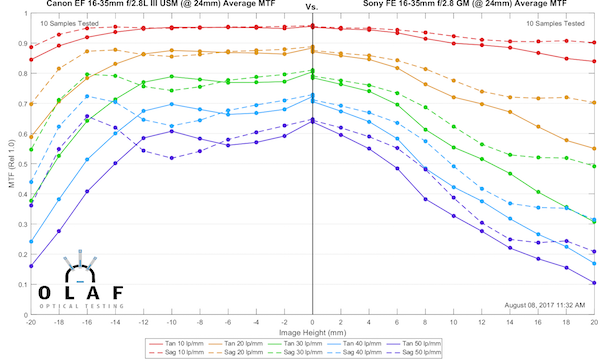
24mm
At 24mm center resolution is pretty equal. Throughout most of the image the Canon maintains slightly better resolution, although it drops off at the edges.
35mm
The 35mm the Canon has a bit better resolution through most of the image, and the sagittal-tangential difference is now clearly better on the Canon. They’re both good though, and this is not a huge difference by any means. As I mentioned earlier, if you’re carrying a 24-70mm f/2.8 lens you’ll find it’s slightly better at 35mm than either of these, but both are still very acceptable.
Sony FE 16-35mm f/2.8 GM vs. Sony 16-35mm f/4 ZA OSS
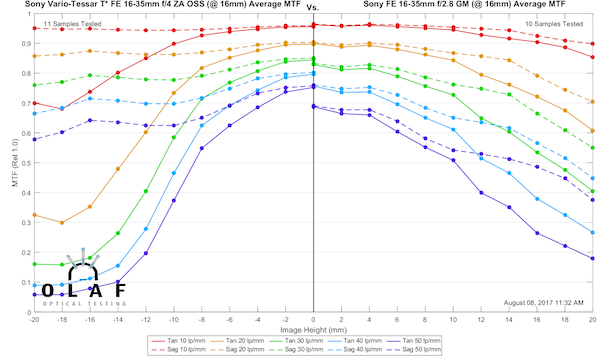
This is a logical comparison that will be a choice for a lot of people. The ZA is a very good lens and significantly less expensive.
Remember the ZA OSS is being tested at f/4, the GM at f/2.8, so we would expect the ZA to have better MTF performance. (Before you ask me to test the GM f/4, the cost of a 10-lens, 3-focal length run is $3,700, so if you’d like it done just send a check with your request.)
16mm
At 16mm, the ZA does have higher resolution in the center 1/3 of the image, although things would probably be even if we had tested the GM lens at f/4. Away from the center, though, even at f/2.8 the GM is clearly better.
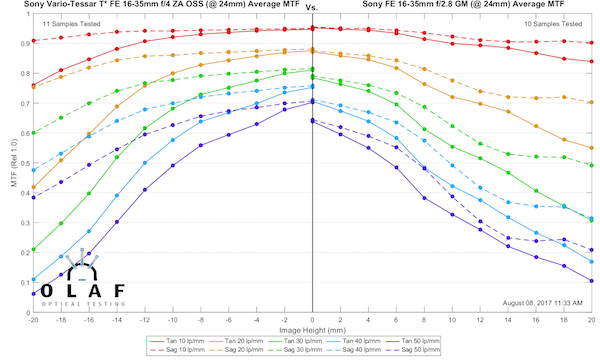
24mm
Things are more even at 24mm. The ZA is better at higher frequencies in the middle half of the image, but there is still far more sagittal-tangential separation on the ZA lens.
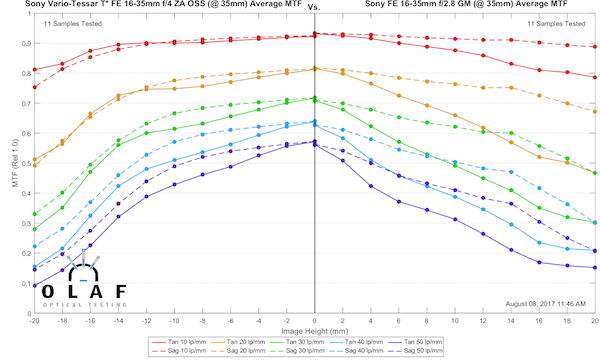
35mm
Things change a little at 35mm, where the ZA actually has less sagittal-tangential separation, but again the GMs performance at f/2.8 is very similar to the ZA’s performance at f/4. The bottom line is if you want to shoot at f/2.8 you don’t have to give up resolution to do so. That’s a very big deal.
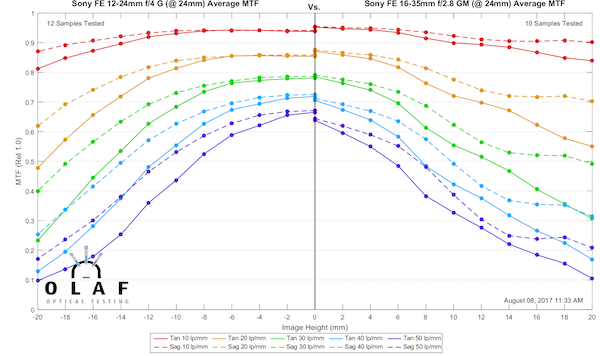
Sony FE 16-35mm f/2.8 GM vs. Sony FE 12-24mm f/4
I put this comparison up because I know some people are interested in it. Obviously, the 12-24m is much better from 12-16mm. I don’t have 16mm data on the 12-24 because we only test 2X zooms at their extremes. But I can compare them at 24mm. There’s not a lot of difference between the GM at f/2.8 and the 12-24mm at f/4.
Variation
The FE 16-35 f/2.8 GM repeats a pattern we’ve seen fairly often, but it’s a bit more extreme than usual. At 16mm and 24mm it’s pretty consistent. At 35mm it’s a random crap shoot. How random? At 35mm, copy-to-copy variation is, well, going to cause some issues.
Let me just show you the full field displays for the first 11 lenses I tested at 35mm. These are the ones that went into making the average in the display above.
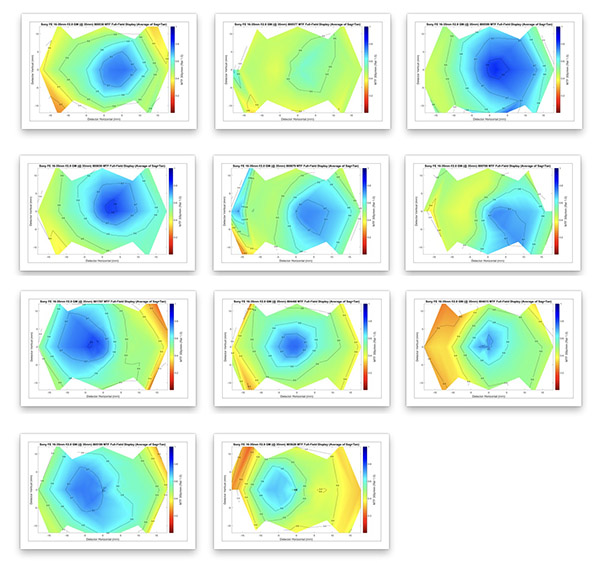
I’m not posting the 16mm and 24mm variations trying to keep this reasonably brief, but at those two focal lengths there wasn’t much variation. We had one copy that was truly bad out of 11 tested at 24mm, but that copy was excellent at 16mm and 35mm. All of the copies we tested were very similar at 16mm.
Conclusion
The Sony 16-35mm f/2.8 GM lens is an excellent optic at 16mm and 24mm. If you want to shoot wide at f/2.8 on an FE mount camera it’s probably the optic of choice. The 16-35 ZA f/4 is a good lens and a lot cheaper if you don’t need f/2.8, but the GM is just better optically. It’s not better or worse than the Canon 16-35mm f/2.8L Mk III, it’s different, and some people will certainly like it’s look better.
But if you plan on using it at 35mm, which I generally don’t recommend for wide zooms if you have alternatives, well, you’re probably going to go through several copies before you find the one you want. Personally, I think it’s a really good 16-24mm f/2.8 zoom that can be used at 35mm if you have to.
Roger Cicala and Aaron Closz
Lensrentals.com
August, 2017
102 Comments
Joel Cure ·
Thanks for this. For better or worse, I essentially exchanged my Sony 16-35 F4 (which was my most used lens at 16mm) and some dollars for the Sony 12-24 rather than upgrading to the 16-35 F2.8. My penultimate purchase was the 24-70 2.8 GM which I like a lot (though I struggle nailing sharp focus with that lens). I haven’t received the 12-24 yet (and wish you had tested it at 16). But unless I’m misinterpreting things here, I don’t think I made too big of a mistake. I will still not own a “fast” lens wider than 18 (have the Batis), but I’ll make do.
DislikeATT ·
I owned the 16-35f4 ZA and it simply was not Sharp as my 16-35 2.8 GM. I am not talking a small difference either… to my eye the sharpness perceived is significantly higher. I sold the Zeiss
Joel Cure ·
Thanks for this. For better or worse, I essentially exchanged my Sony 16-35 F4 (which was my most used lens at 16mm) and some dollars for the Sony 12-24 rather than upgrading to the 16-35 F2.8. My penultimate purchase was the 24-70 2.8 GM which I like a lot (though I struggle nailing sharp focus with that lens). I haven't received the 12-24 yet (and wish you had tested it at 16). But unless I'm misinterpreting things here, I don't think I made too big of a mistake. I will still not own a "fast" lens wider than 18 (have the Batis), but I'll make do. I really had my doubts about what to do after reading the eariler Lens Rental review comparing the Sony 16-35 F4, 16-35 2.8, and 12-24 lenses...
DislikeATT ·
I owned the 16-35f4 ZA and it simply was not Sharp as my 16-35 2.8 GM. I am not talking a small difference either... to my eye the sharpness perceived is significantly higher. I sold the Zeiss
ll-ll ·
Thank you Roger for providing this valuable data. I can’t buy a lens these days without seeing your MTF data. Do you think the variation at 35mm will tighten up as Sony’s manufacturing for this lens becomes more mature ? At least for other industries manufacturing tolerances sometimes improve over the life of the product.
Roger Cicala ·
I think it’s possible. I also want to look at more samples. This was more than I expected, and I have low expectations for wide-angle zooms at the long end. Might be an early batch issue.
Brandon Dube ·
I expect you’ll have to eat your words, lens manufactures have never improved optical consistency after the fact 🙂
ll-ll ·
Thank you Roger for providing this valuable data. I can't buy a lens these days without seeing your MTF data. Do you think the variation at 35mm will tighten up as Sony's manufacturing for this lens becomes more mature ? At least for other industries manufacturing tolerances sometimes improve over the life of the product.
Roger Cicala ·
I think it's possible. I also want to look at more samples. This was more than I expected, and I have low expectations for wide-angle zooms at the long end. Might be an early batch issue.
Brandon Dube ·
I expect you'll have to eat your words, lens manufactures have never improved optical consistency after the fact :)
Chik Sum ·
Roger, as I know that your lens will be shipped more frequently than any private owned lens, actually will the variations and decenteribg being caused by the “careful handling” of the lens which maybe, say having a centering group more prone to move around?
Roger Cicala ·
Chik, new lens tests are done straight out of the box, before any rentals have occurred.
We do occasionally see a lens that has been dropped get decentered, detecting that kind of change is why we test (not everyone volunteers they dropped a lens, although most renters do, actually). The more interesting thing to me is that most lenses, unless they’ve been damaged, have exactly the same optical fingerprint two years later that they did when we received them.
Chik Sum ·
Thanks Roger,
So does that means most of the time even with a lens dropped which may not result in decentering, or after adjusting it after confirmed decentering will have same behavior pattern/fingerprint? if so it;s pretty interesting that even a drop severe enough to cause decentering can just go back to almost perfect as in out of the box condition. in imagination I would have thought some non-adjustable internal holding mechanism would have slight shift which alters the fingerprint of a lens
Roger Cicala ·
I meant if it hasn’t been dropped or damaged, it doesn’t change. But once it has been knocked out of alignment it’s never going to have the exact same MTF. Within range, of course, but something like that tiny bit of upper right corner softness now is gone, or there’s more astigmatism on the left side. Those are ‘optical bench’ level measurements, though, not something you’d likely notice taking pictures.
Chik Sum ·
Ic, I have misunderstood that as unless it’s broken is some parts like the internal helicoil or barrel etc. Even after adjustment of cantering The lens would have same fingerprint after two years .
Kinda off topic, but we’re there cases where you can find a dropped lens to show no broken parts to replace (I mean like cracked barrel) and yet the elements are knocked so far off that adjustments can’t properly align the lens in the end?
YS ·
Roger, as I know that your lens will be shipped more frequently than any private owned lens, actually will the variations and decenteribg being caused by the "careful handling" of the lens which maybe, say having a centering group more prone to move around?
Roger Cicala ·
Chik, new lens tests are done straight out of the box, before any rentals have occurred.
We do occasionally see a lens that has been dropped get decentered, detecting that kind of change is why we test (not everyone volunteers they dropped a lens, although most renters do, actually). The more interesting thing to me is that most lenses, unless they've been damaged, have exactly the same optical fingerprint two years later that they did when we received them.
YS ·
Thanks Roger,
So does that means most of the time even with a lens dropped which may not result in decentering, or after adjusting it after confirmed decentering will have same behavior pattern/fingerprint? if so it;s pretty interesting that even a drop severe enough to cause decentering can just go back to almost perfect as in out of the box condition. in imagination I would have thought some non-adjustable internal holding mechanism would have slight shift which alters the fingerprint of a lens
Roger Cicala ·
I meant if it hasn't been dropped or damaged, it doesn't change. But once it has been knocked out of alignment it's never going to have the exact same MTF. Within range, of course, but something like that tiny bit of upper right corner softness now is gone, or there's more astigmatism on the left side. Those are 'optical bench' level measurements, though, not something you'd likely notice taking pictures.
YS ·
Ic, I have misunderstood that as unless it's broken is some parts like the internal helicoil or barrel etc. Even after adjustment of cantering The lens would have same fingerprint after two years .
Kinda off topic, but we're there cases where you can find a dropped lens to show no broken parts to replace (I mean like cracked barrel) and yet the elements are knocked so far off that adjustments can't properly align the lens in the end?
User Colin ·
I’d be interested to know some stats for how often such a lens is shot at f/2.8? Can they be gathered from Flickr/etc? I would guess that for outdoor photographers the answer is never. So if it costs so much to test at both f/2.8 and f/4 why don’t you just test them all at f/4. Then you could show valid scientific charts comparing the lenses, without all the handwaving about “probably better”.
Someone shooting indoors at f/2.8 is clearly desperate for light, probably not using base ISO, and so likely doesn’t have “pixel peeping sharpness” at the top of their priorities vs “accurate autofocus” and “good bokeh” and “wide zoom range”. So how the lens performs, sharpness wise, at f/2.8 isn’t likely to be as relevant as f/4 or smaller.
Roger Cicala ·
I can’t tell you about the stats on who shoots what where.
As to why we test at f/2.8, remember our purpose here is to establish a standard for measuring our lenses going forward, and to tell us is optical adjustments have brought a lens back to normal. The widest aperture is the most sensitive for that purpose and that’s why we always test there. Many lenses that aren’t OK at f/2.8 look fine at f/4.
We publish our results because people are interested in what we have, but we don’t have the resources to do all the tests everyone would like to see.
User Colin ·
I'd be interested to know some stats for how often such a lens is shot at f/2.8? Can they be gathered from Flickr/etc? I would guess that for outdoor photographers the answer is never. So if it costs so much to test at both f/2.8 and f/4 why don't you just test them all at f/4. Then you could show valid scientific charts comparing the lenses, without all the handwaving about "probably better".
Someone shooting indoors at f/2.8 is clearly desperate for light, probably not using base ISO, and so likely doesn't have "pixel peeping sharpness" at the top of their priorities vs "accurate autofocus" and "good bokeh" and "wide zoom range". So how the lens performs, sharpness wise, at f/2.8 isn't likely to be as relevant as f/4 or smaller.
Roger Cicala ·
I can't tell you about the stats on who shoots what where.
As to why we test at f/2.8, remember our purpose here is to establish a standard for measuring our lenses going forward, and to tell us if optical adjustments have brought a lens back to normal. The widest aperture is the most sensitive for that purpose and that's why we always test there. Many lenses that aren't OK at f/2.8 look fine at f/4.
We publish our results because people are interested in what we have, but we don't have the resources to do all the tests everyone would like to see.
6degrees ·
Thank you for providing details comparison.
If somebody can provide similar comparison between Sony 16-35mm F2.8 GM and Zeiss Batis 2.8/18 or Zeiss Loxia 2.8/21, that would be great.
I was in the first group preordered Sony 16-35mm F2.8 GM from B&H. I returned and asked for exchange after I saw some dusts inside the zoom lens the first day I received it. I did not even try it.
Tianhang ·
A Chinese user compared 16-35 GM and Loxia 21 (though it is not a MTF test). According to his sample images, these two lens performs pretty similar in terms of sharpness at 21mm.
Sid ·
I’ve compared my two copies, and they are essentially equal in terms of sharpness. The GM has a flatter field and the Loxia has better sunstars (IMO) and a marginally better coma performance.
I’m only keeping both due to differences in weight so that I have options when packing my camera bag for a trip.
Zoltán Üveges ·
Is dust a common issue with (brand new) GM lenses? I’m about to switch to Sony FE system and a bit worried about the dust sealing. Have you got your second copy already?
6degrees ·
Thank you for providing details comparison.
If somebody can provide similar comparison between Sony 16-35mm F2.8 GM and Zeiss Batis 2.8/18 or Zeiss Loxia 2.8/21, that would be great.
I was in the first group preordered Sony 16-35mm F2.8 GM from B&H. I returned and asked for exchange after I saw some dusts inside the zoom lens the first day I received it. I did not even try it.
Sid ·
I've compared my two copies, and they are essentially equal in terms of sharpness. The GM has a flatter field and the Loxia has better sunstars (IMO) and a marginally better coma performance.
I'm only keeping both due to differences in weight so that I have options when packing my camera bag for a trip.
Zoltán Üveges ·
Is dust a common issue with (brand new) GM lenses? I'm about to switch to Sony FE system and a bit worried about the dust sealing. Have you got your second copy already?
Matt ·
So who is going to start the Kickstarter for $3,700 to make Roger regret doing the comparison at f4?
Athanasius Kirchner ·
I was thinking Kickstarter would be an excellent idea to test lenses that Roger doesn’t have the interest to do. Stuff like walk around lenses or APS-C UWAs…
SpecialMan ·
But would it be enough money for him to brave the wrath of the the anti-Pentax cabal and tell the world the forbidden truth that Takumars are the best of all lenses?
Athanasius Kirchner ·
I was thinking Kickstarter would be an excellent idea to test lenses that Roger doesn't have the interest to do. Stuff like walk around lenses or APS-C UWAs...
VPR ·
As with previous blog posts, this was terrific. I also appreciate the comments from the various readers who, like me, deeply appreciate all the diligent analysis that Roger Cicala and his “merry men” put into producing these posts. Thank you.
WRT the 16-35mm f/2.8 GM from Sony, I must say that after reviewing these data, I’m increasingly inclined towards the view that having two primes (say the Basis 18mm f/2.8 or something similar and the Sony 28mm f/2) might be a better choice (assuming one doesn’t already have the 24-70mm F/2.8).
I’ll wait until we get the bathrooms redone in our house… my partner has been very patient with my photography purchases of late… best not to push my luck.
Sanjeev Das ·
OTOH, if you want some wide angle shots of the progress of your bathroom…
VPR ·
Sorry, all… I meant to write “Batis”
A Canuck ·
As with previous blog posts, this was terrific. I also appreciate the comments from the various readers who, like me, deeply appreciate all the diligent analysis that Roger Cicala and his "merry men" put into producing these posts. Thank you.
WRT the 16-35mm f/2.8 GM from Sony, I must say that after reviewing these data, I'm increasingly inclined towards the view that having two primes (say the Basis 18mm f/2.8 or something similar and the Sony 28mm f/2) might be a better choice (assuming one doesn't already have the 24-70mm F/2.8).
I'll wait until we get the bathrooms redone in our house... my partner has been very patient with my photography purchases of late... best not to push my luck.
Sanjeev Das ·
OTOH, if you want some wide angle shots of the progress of your bathroom...
A Canuck ·
Sorry, all... I meant to write "Batis"
Dianoda ·
Hi Roger, totally unrelated question, but… will we ever see any MTF testing for Fuji’s GF lenses or any other modern medium format system lenses?
Roger Cicala ·
Dianoda, our bench can only test 40mm wide at the plane of focus, so we can’t test MF lenses to the sensor edges.
Dianoda ·
Hi Roger, gotcha, thank you for the response. Given that the camera has been on the market for a while now, I was getting curious about the relative lack of GFX/GF lens coverage on the blog (likewise for the Hasselblad XD1 and XCD lenses), limitations of the test bench would go a long way to explaining the lack of MTF charts for any GF or XCD lenses. I’ll just cross my fingers and hope for a future GF/XCD lens teardown.
Dianoda ·
Hi Roger, totally unrelated question, but... will we ever see any MTF testing for Fuji's GF lenses or any other modern medium format system lenses?
Roger Cicala ·
Dianoda, our bench can only test 40mm wide at the plane of focus, so we can't test MF lenses to the sensor edges.
Dianoda ·
Hi Roger, gotcha, thank you for the response. Given that the camera has been on the market for a while now, I was getting curious about the relative lack of GFX/GF lens coverage on the blog (likewise for the Hasselblad XD1 and XCD lenses), limitations of the test bench would go a long way to explaining the lack of MTF charts for any GF or XCD lenses. I'll just cross my fingers and hope for a future GF/XCD lens teardown.
Adam Palmer ·
These are the best lens reviews anywhere on the web.
Messier77 ·
Has anyone tested this against the Batis 18mm at f/2.8?
Roger Cicala ·
I haven’t run MTF numbers on the Batis 18mm I’m afraid.
Messier77 ·
Bummer…thanks for the quick response!
Roger Cicala ·
I haven't run MTF numbers on the Batis 18mm I'm afraid.
Messier77 ·
Bummer...thanks for the quick response!
obican ·
SAR: Roger Cicala (from Lensrentals) says the new Sony FE 16-35 smoke the Canon 16-35mm f/2.8 Mk III.
This one was easy :). Didn’t even have to read the rest of the article or even look at the graphs.
Roger Cicala ·
Just like they don’t 🙂
obican ·
SAR: Roger Cicala (from Lensrentals) says the new Sony FE 16-35 smoke the Canon 16-35mm f/2.8 Mk III.
This one was easy :). Didn't even have to read the rest of the article or even look at the graphs.
Roger Cicala ·
Just like they don't :-)
Chik Sum ·
Hi Roger. another question, as you found the 35mm MTF at the 35mm end might show quite some observable inconsistent sharpness at a few samples (I assume the ones with orange or red zones) did you try to take one copy and see if you can adjust the centering elements until all focal lengths looked fine?
Roger Cicala ·
Chick, we have not tried optically adjusting this lens yet.
Chik Sum ·
Thanks Roger, but if then I can imagine the coming problems with the 35mm end, it looked way out to be easily pixel peeping noticable
YS ·
Thanks Roger, but if then I can imagine the coming problems with the 35mm end, it looked way out to be easily pixel peeping noticable
disqus_mIbIklv07L ·
Roger, any updates on this? I’m very interested in this lens but plan to use it frequently at 35mm f2.8. Given the variation noted above, how significant will these issues show up optically shooting something like a center or rule of third’s framed portrait wide open? Would most of these issues show up at the edges which would be OOF in the aforementioned scenario or do they affect the entire frame? Thank you!
disqus_mIbIklv07L ·
Roger, any updates on this? I'm very interested in this lens but plan to use it frequently at 35mm f2.8. Given the variation noted above, how significant will these issues show up optically shooting something like a center or rule of third's framed portrait wide open? Would most of these issues show up at the edges which would be OOF in the aforementioned scenario or do they affect the entire frame? Thank you!
YS ·
Hi Roger. another question, as you found the 35mm MTF at the 35mm end might show quite some observable inconsistent sharpness at a few samples (I assume the ones with orange or red zones) did you try to take one copy and see if you can adjust the centering elements until all focal lengths looked fine?
tomskyphoto ·
Looks like a very good lens but then all the GMs didn’t disappoint so far. Wide angles also seem to become the domain where there is a mirrorless advantage when it comes to size and weight. Like the 12-24/4 G the 16-35 GM is remarkably small and lightweight for its specifications.
Won’t get it as I already have an excellent copy of the 16-35/4, at least between 16 and 24 mm, while it’s a bit meh at 35. But then this seems to be not much different with the GM either.
Nathan Connolly ·
Hi Roger, I’m interested in your testing technique for zooms. I asked about IS lenses a few weeks ago, and whether or not they positively locked down their shaky elements with IS off or when unpowered, and this is sort of in the same area. Do you test the zooms pointed straight ahead, or down, or up, or what? My point being is there any mitigation for the mechanical deflection of the extending zoom element as it moves outwards, owing to gravity? Do you find that the droop is substantial in any new lenses, or that it is optically significant? And on a related point, do you see a difference in simply physically long or heavy lenses, deflecting from the lens mount under their own weight? And even if you do test the lenses pointing straight up and down, has it occurred to you to try and measure such a change when shooting horizntally, as one normally would? I know that it seems like splitting hairs, but surely this must have crossed your tortured scientist’s mind at some point…
Roger Cicala ·
Hi Nathan,
Our testing is done vertically with the lens pointed up. When we used Imatest and an older optical bench we did test horizontally and on extending barrel zooms it wasn’t uncommon to see drop as you suggested. Large lenses were always supported by the lens, not the camera, so I can’t say anything about sag at the camera mount in general, although I’ve seen it in real life.
IS units that don’t physically lock down present a problem when testing in that the lens has to be given a ‘quiet down’ time period between measurements. This also happens with very large or long focal length lenses. For example we pause a fraction of a second between each movement/measurement for a non-IS standard focal length lens, but may have to pause a couple of seconds between each measurement for a non-locking IS unit to settle down.
Nathan Connolly ·
Hi Roger, I'm interested in your testing technique for zooms. I asked about IS lenses a few weeks ago, and whether or not they positively locked down their shaky elements with IS off or when unpowered, and this is sort of in the same area. Do you test the zooms pointed straight ahead, or down, or up, or what? My point being is there any mitigation for the mechanical deflection of the extending zoom element as it moves outwards, owing to gravity? Do you find that the droop is substantial in any new lenses, or that it is optically significant? And on a related point, do you see a difference in simply physically long or heavy lenses, deflecting from the lens mount under their own weight? And even if you do test the lenses pointing straight up and down, has it occurred to you to try and measure such a change when shooting horizntally, as one normally would? I know that it seems like splitting hairs, but surely this must have crossed your tortured scientist's mind at some point...
Roger Cicala ·
Hi Nathan,
Our testing is done vertically with the lens pointed up. When we used Imatest and an older optical bench we did test horizontally and on extending barrel zooms it wasn't uncommon to see drop as you suggested. Large lenses were always supported by the lens, not the camera, so I can't say anything about sag at the camera mount in general, although I've seen it in real life.
IS units that don't physically lock down present a problem when testing in that the lens has to be given a 'quiet down' time period between measurements. This also happens with very large or long focal length lenses. For example we pause a fraction of a second between each movement/measurement for a non-IS standard focal length lens, but may have to pause a couple of seconds between each measurement for a non-locking IS unit to settle down.
Michael Fang ·
Thanks Roger for the review, have you tested vignetting wide open @ 16mm? It is pretty severe on the Canon’s 16-35 III.
Roger Cicala ·
Hi Michael, I don’t do vignette testing, I’m afraid.
Michael Fang ·
Thanks Roger for the review, have you tested vignetting wide open @ 16mm? It is pretty severe on the Canon's 16-35 III.
Roger Cicala ·
Hi Michael, I don't do vignette testing, I'm afraid.
Steven Kornreich ·
Roger, If you already own the FE 24-70/2.8GM, would you recommend the 12-24/4 over the 16-35/2.8GM ?
Thanks
Roger Cicala ·
I would personally, but I don’t really need f/2.8 in a wide zoom and I do like shooting ultra-wide. Others would feel differently.
Steven Kornreich ·
Roger, If you already own the FE 24-70/2.8GM, would you recommend the 12-24/4 over the 16-35/2.8GM ?
Thanks
Roger Cicala ·
I would personally, but I don't really need f/2.8 in a wide zoom and I do like shooting ultra-wide. Others would feel differently.
vasile ·
thank you roger. it will be nice , sometime in the future, to have them compared with the only ultra-wide native prime (the batis 18). and why zeiss are not making any fast ultra wide primes ? (because sony didn’t do it for the A-mount either…)
Roger Cicala ·
I’ve had the Batis on my to-do list for a while, but family illness severely reduced my time in the office this summer and our intern had to leave early, so we’re months behind.
vasile ·
all the best and God bless your family.
vasile ·
thank you roger. it will be nice , sometime in the future, to have them compared with the only ultra-wide native prime (the batis 18). and why zeiss are not making any fast ultra wide primes ? (because sony didn't do it for the A-mount either...)
Roger Cicala ·
I've had the Batis on my to-do list for a while, but family illness severely reduced my time in the office this summer and our intern had to leave early, so we're months behind.
Messier77 ·
Roger:
How would you compare the copy-to-copy variation between the 12-24 f/4 and the 16-35 f/2.8 GM?
Thanks
Roger Cicala ·
There’s more variation with the 16-35, most notably at the 35mm end.
Messier77 ·
Thanks! Seems like the 12-24 is the better bet for getting a good copy to shoot UWA.
Leonardo Visentin ·
I am noto sure of this… If UWA stands for “ultra wide” and sample variation for 16-35 is “focused” on the 35mm-side, I am inclined to say that if you don’t need 12-15mm range, there’s no particular reason to prefer 12-24 to the GM. If instead you need 12-16mm at most no comparison to a 16-35 should stand, because it does not cover 12-15 range… Apples to apples..
Leonardo Visentin ·
I am noto sure of this... If UWA stands for "ultra wide" and sample variation for 16-35 is "focused" on the 35mm-side, I am inclined to say that if you don't need 12-15mm range, there's no particular reason to prefer 12-24 to the GM. If instead you need 12-16mm at most no comparison to a 16-35 should stand, because it does not cover 12-15 range... Apples to apples..
Messier77 ·
Roger:
How would you compare the copy-to-copy variation between the 12-24 f/4 and the 16-35 f/2.8 GM?
Thanks
Roger Cicala ·
There's more variation with the 16-35, most notably at the 35mm end.
Ian Hugh ·
Hi Roger. Which camera body did you use for these tests? Are those test results of the lens (like MTF graphs) independent of which camera body you use?
Roger Cicala ·
No bodies are used in the making of our tests. These are all from an optical bench; camera independent.
Brandon Dube ·
We always give lens-only MTF. There is no camera sensor component involved.
You would multiply this by the camera sensor MTF to get the system MTF.
Brandon Dube ·
We always give lens-only MTF. There is no camera sensor component involved.
You would multiply this by the camera sensor MTF to get the system MTF.
Richard Sumilang ·
Hiya, I’m interested in getting this lens but I’ve been considering getting the 35 f1.4 as well to save a few bucks. Plus, it’s a f1.4! Your review says that 35mm is this lenses weakest point and the 16-24 range is its strongest. I’m most interested in this lens as a 35mm lens with the rest of the range as bonus to not have a separate wide angle. How would you rate the 35mm quality on this lens vs the 35 zeiss 1.4? Thank you!
Richard Sumilang ·
Hiya, I'm interested in getting this lens but I've been considering getting the 35 f1.4 as well to save a few bucks. Plus, it's a f1.4! Your review says that 35mm is this lenses weakest point and the 16-24 range is its strongest. I'm most interested in this lens as a 35mm lens with the rest of the range as bonus to not have a separate wide angle. How would you rate the 35mm quality on this lens vs the 35 zeiss 1.4? Thank you!
waldoh ·
Is 35 usable when you stop down even with the sample variation?
terry Stahly ·
Why would a person keep their 12-24G if you seldom shoot wider than 16mm? You are saying this lens should be thought of as 16-24mm lens.
Is my 35 2.0 ZA or 35 1.4 Distagon is a noticeably better choice at 35 than the 24-70GM.
TRS ·
Why would a person keep their 12-24G if you seldom shoot wider than 16mm? You are saying this lens should be thought of as 16-24mm lens.
Is my 35 2.0 ZA or 35 1.4 Distagon is a noticeably better choice at 35 than the 24-70GM.
Dr Jiulin Teng ·
Any guess why Sonys tend to have such wide copy variance?
Specific designs that magnify imperfections?
Dr Jiulin Teng ·
Any guess why Sonys tend to have such wide copy variance?
Specific designs that magnify imperfections?
John Draper ·
If you take requests, I would certainly like an objective review of the Sony 28-135mm pz G lens. Mostly on sharpness and chromatic aberration. I can’t seem to find any objective review and would like to replace my Sony 24-240mm. I already have the 16-35mm gm reviewed here and not thrilled with any objective test results on the sony 24-70mm GM.
I would be open to other suggestions as well. Thanks in advance.
John Draper ·
If you take requests, I would certainly like an objective review of the Sony 28-135mm pz G lens. Mostly on sharpness and chromatic aberration. I can't seem to find any objective review and would like to replace my Sony 24-240mm. I already have the 16-35mm gm reviewed here and not thrilled with any objective test results on the sony 24-70mm GM.
I would be open to other suggestions as well. Thanks in advance.