
Canon’s Ultra Rare Lenses – Using the Canon 50mm f/1.0L
A month or so ago, I was able to get my hands on the Canon 200mm f/1.8L Lens and test it for a review on Lensrentals.com. It was an experiment of an article, as often, we try to discuss gear that we can stock and rent out to our customers. With the Canon 200mm f/1.8L being wholly discontinued and unserviceable, it’s not something we could rent out. However, the readers seemed to enjoy reading about this relic of a lens, so we decided to find another ‘Holy Grail’ of lenses, and I got my hands on the Canon 50mm f/1.0L.
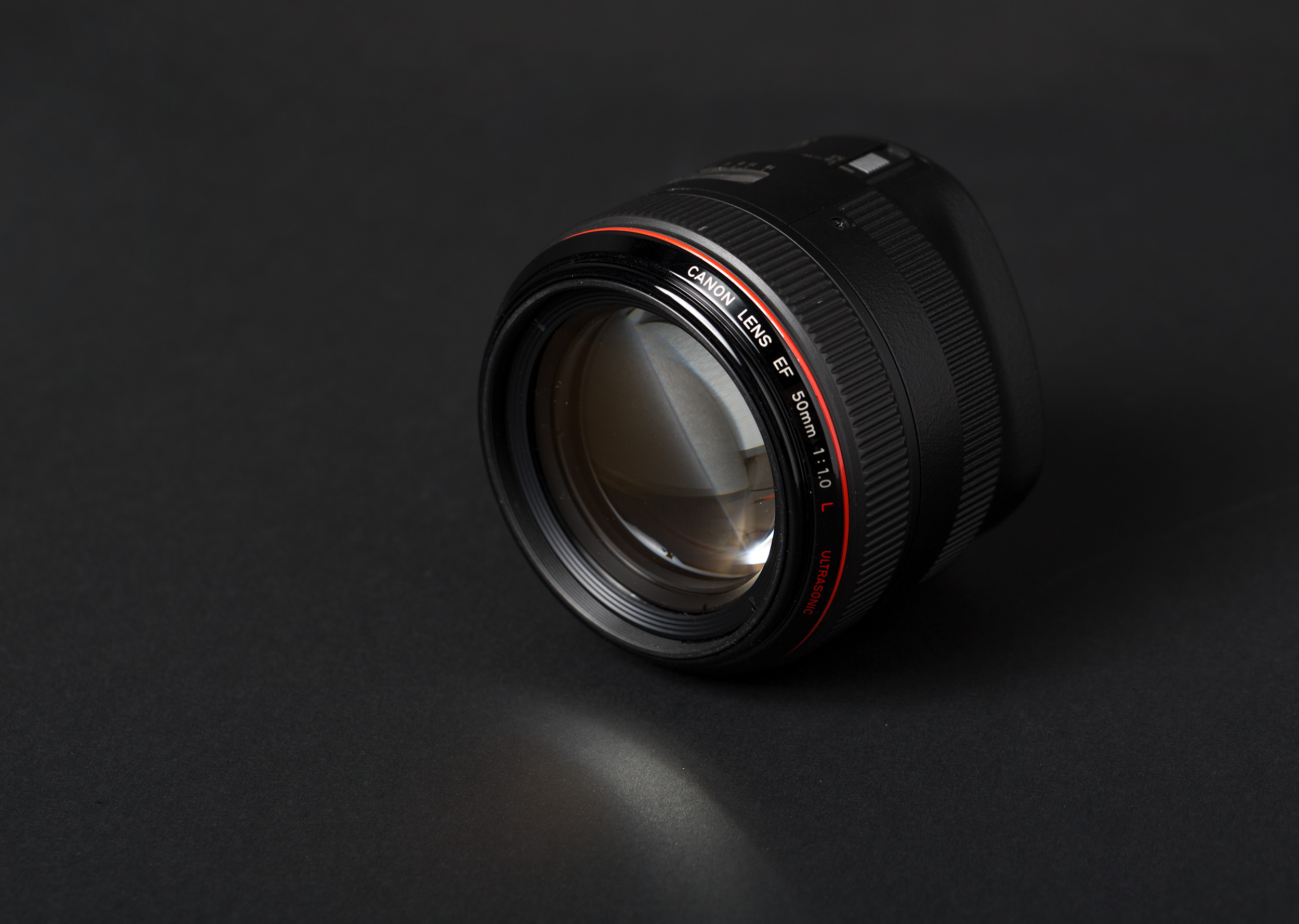
This lens was graciously loaned to me by Julian Chen out of Santa Monica, CA.
History of the Canon 50mm f/1.0L
The Canon 50mm f/1.0L was introduced in 1989 and is the fastest AF lens available in EF mount, and one of the fastest lenses in the world. At 1018 grams, the Canon 50mm f/1.0L is also an incredibly well-constructed metal-bodied lens, and considered to be one of the best built Canon 50mm’s in the world. Sadly, however, because of its razor-thin depth of field and slow focusing (by today’s standards), the Canon 50mm f/1.0L was discontinued in 2000 and has been hard to find ever since.
The Canon 50mm f/1.0L works on all EF mount camera systems, and uses the Focus-by-Wire system found on the Canon 85mm f/1.2L II, meaning while accurate, the focus is slower when comparing it to more modern designs. Priced at ~$2,500 during the majority of its production run, the Canon 50mm f/1.0L was considered way too expensive for the average photographer, leading to its inevitable production end. However, if you have to have one, many can still be found on eBay for $3,800 – $4,500.
Comparing the Canon 50mm f/1.0
When it came down to comparing this lens, I figured the most obvious comparison to make would be against the Canon 50mm f/1.2L, right? Well, wrong. In fact, the Canon 50mm f/1.2 and f/1.0 versions are entirely different by design, and the Canon 50mm f/1.0 is based more on the Canon 85mm f/1.2L I than anything else. So while I do not have a version 1 of the Canon 85mm f/1.2L, being that it was discontinued in 2006 and replaced with the Mark II lens of the same name – a lens I do in fact, have.
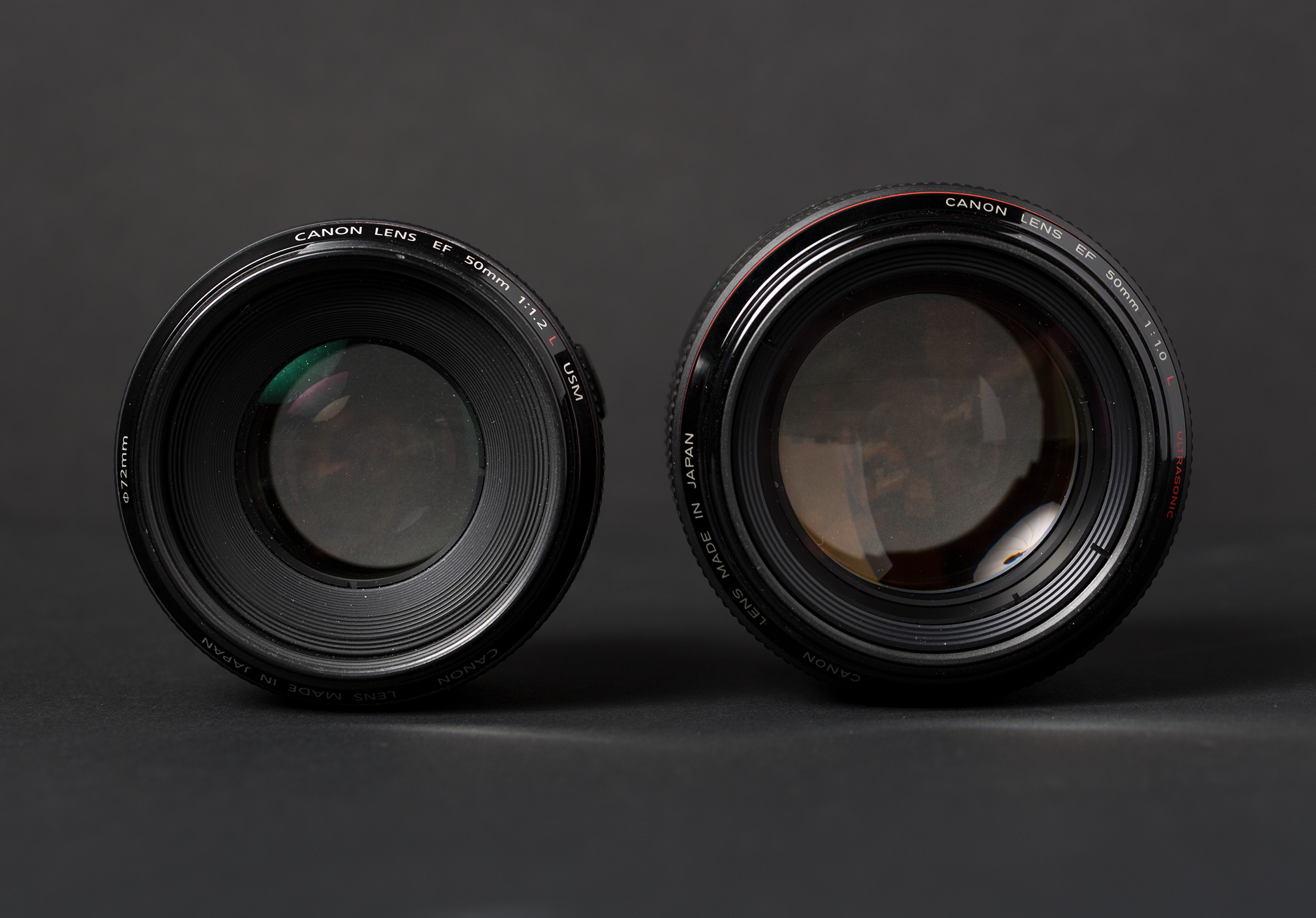
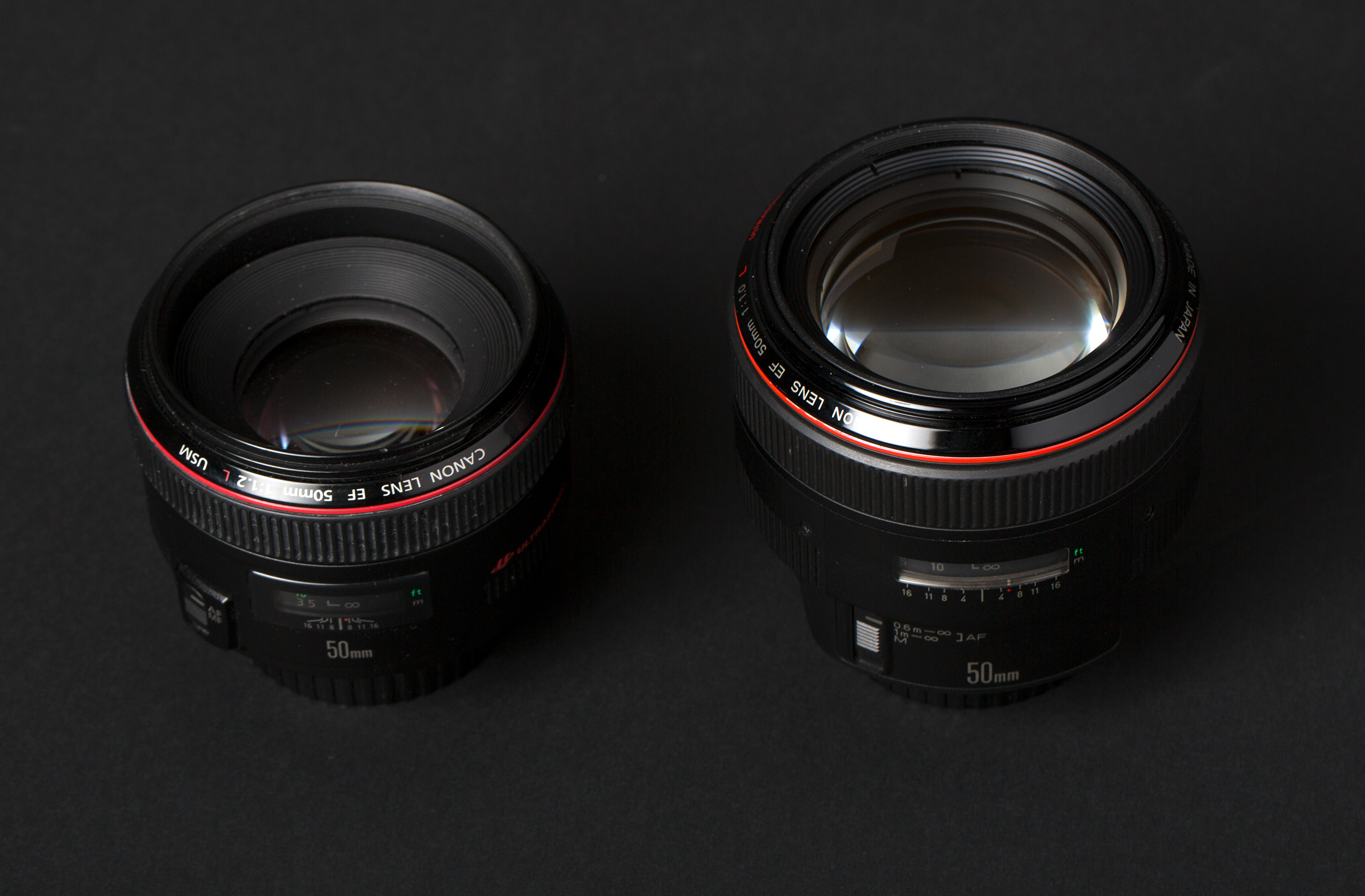
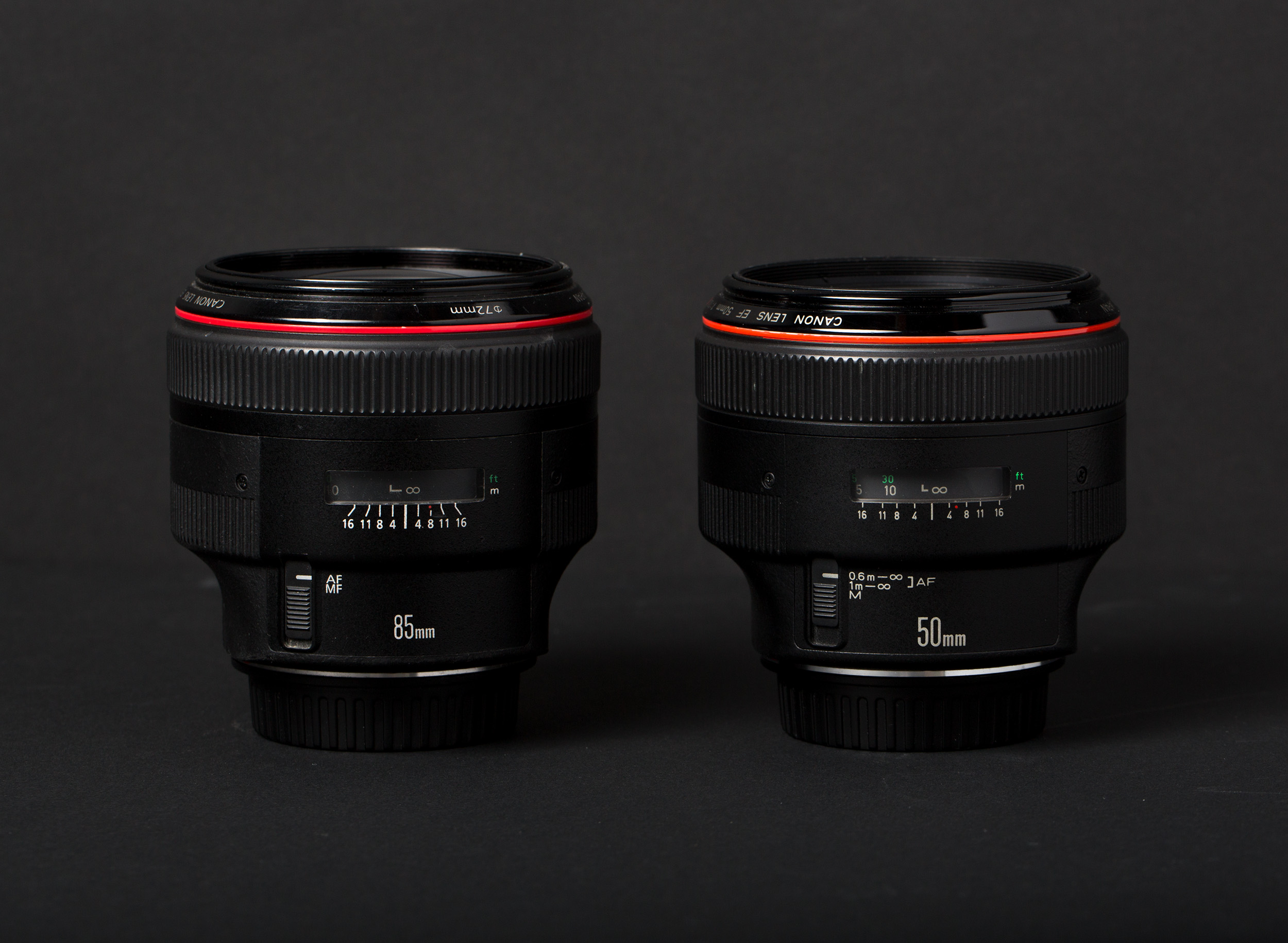
From a visual standpoint, the Canon 50mm f/1.0L looks nearly identical to the Canon 85mm f/1.2L II, with its front-heavy design, leaving you with a large front element, and asymmetrical design from front to back (as seen below). The images are very much similar from one to the next as well. I’ve put together a small table of these three lenses below to give you an idea of how it compares to the competition.
| Lens | Price | Min Focusing Distance | Aperture Range | Weight |
|---|---|---|---|---|
| Canon 50mm f/1.2L | $1,300 | .45m | f/1.2 - f/16 | 590g |
| Canon 50mm f/1.0 | $4,000 (Used) | .6m | f/1.0 - f/16 | 1,017g |
| Canon 85mm f/1.2L II | $1,850 | .95m | f/1.2 - f/16 | 1315g |
Build Quality
The Canon 50mm f/1.0L has a lot to it that makes it quite a bit different than the other options in the same focal length. As mentioned above, the Canon 50mm f/1.0L is based more on the Canon 85mm f/1.2L design than it is of it’s younger brother, the Canon 50mm f/1.2L. Because of it’s larger dense body, the Canon 50mm f/1.0L no doubt feels premium to the touch. If you’ve ever held the Canon 85mm f/1.2L, you’ll know what I’m talking about. But it’s dense body is well balanced, and feels good on the camera. The added cuff at the base of the body makes it easy to hold when mounting, and just further mimics the feeling of the Canon 85mm f/1.2L.
But with the larger body, also comes a few little-added things that many people might not know about the Canon 50mm f/1.0L. For one, people will often assume that the f/1.0 version has a 1/3rd stop over the Canon 50mm f/1.2L, but that’s actually false. In fact, it has 2/3rds of a stop, being able to implement both f/1.1 and the f/1.0 f-stops.

A second surprise is the focusing system on the Canon 50mm f/1.0. Using the same focus-by-wire system as the Canon 85mm f/1.2L, the focusing system is slow by comparison. To help counteract this, Canon has added two focus distances on the focusing switch, to help speed along the process. giving you the option of focusing in two different ranges (0.6m – infinity and 1m – infinity), this option should both speed up the focusing of the lens, as well as provide better accuracy. That said, for the interest of my testing, I kept it in the 0.6m – infinity mode for the entire duration of my testing.

Image Quality
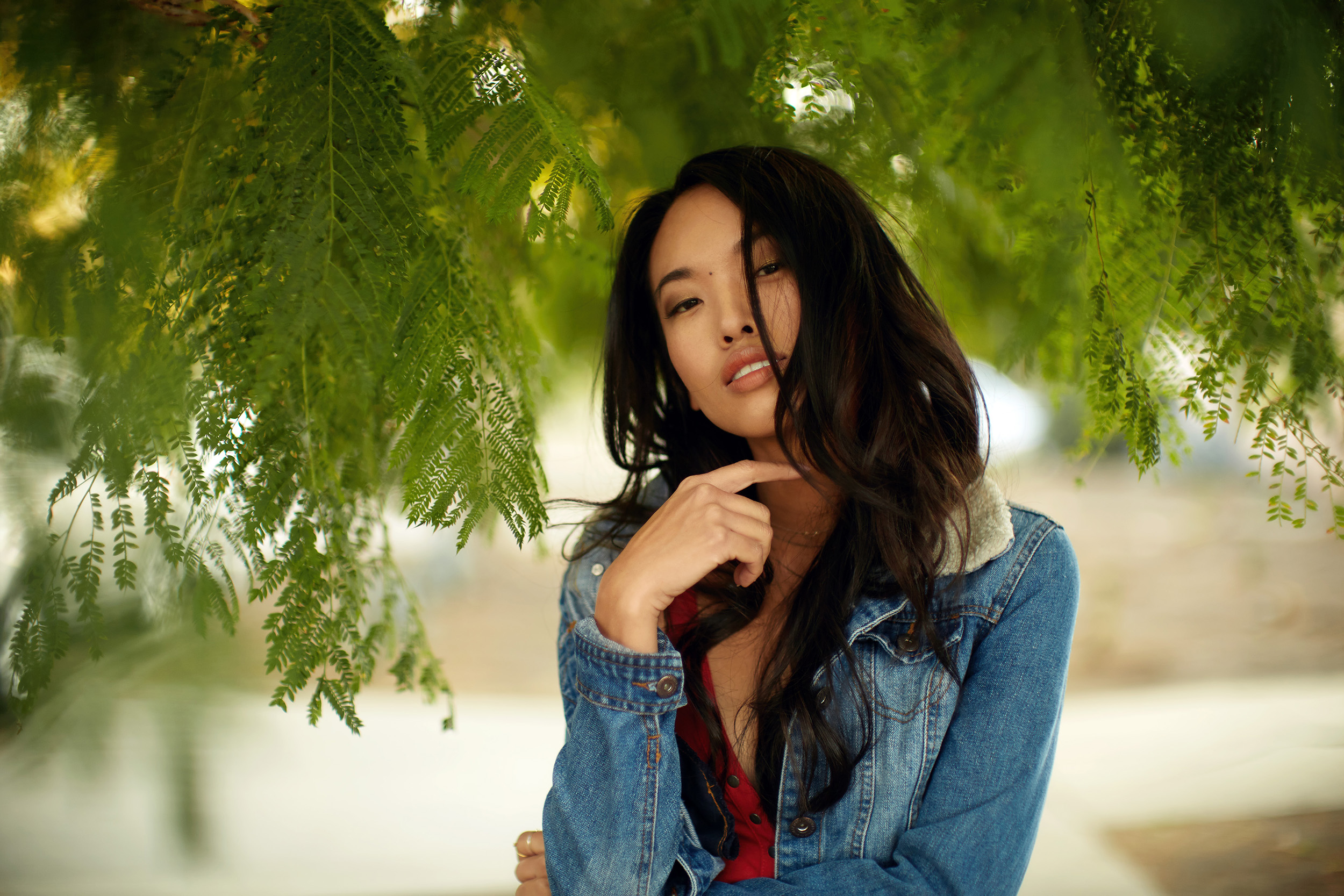
I took plenty of photos with the Canon 50mm f/1.0L during my week with it, but I figured it was best to give a more scientific approach to its image quality. In short, it’s pretty mediocre. It vignettes a lot at f/1.0, and its sharpness is pretty lackluster, especially when compared to the competition. Below are some test photos, comparing the Canon 50mm f/1.0L to the Canon 50mm f/1.2L and Canon 85mm f/1.2L II. All of these were shot on a tripod, 55 inches from the stem of the lemon (conveniently pulled from my lemon tree), with the focus point being where the stem meets the body of the lemon.
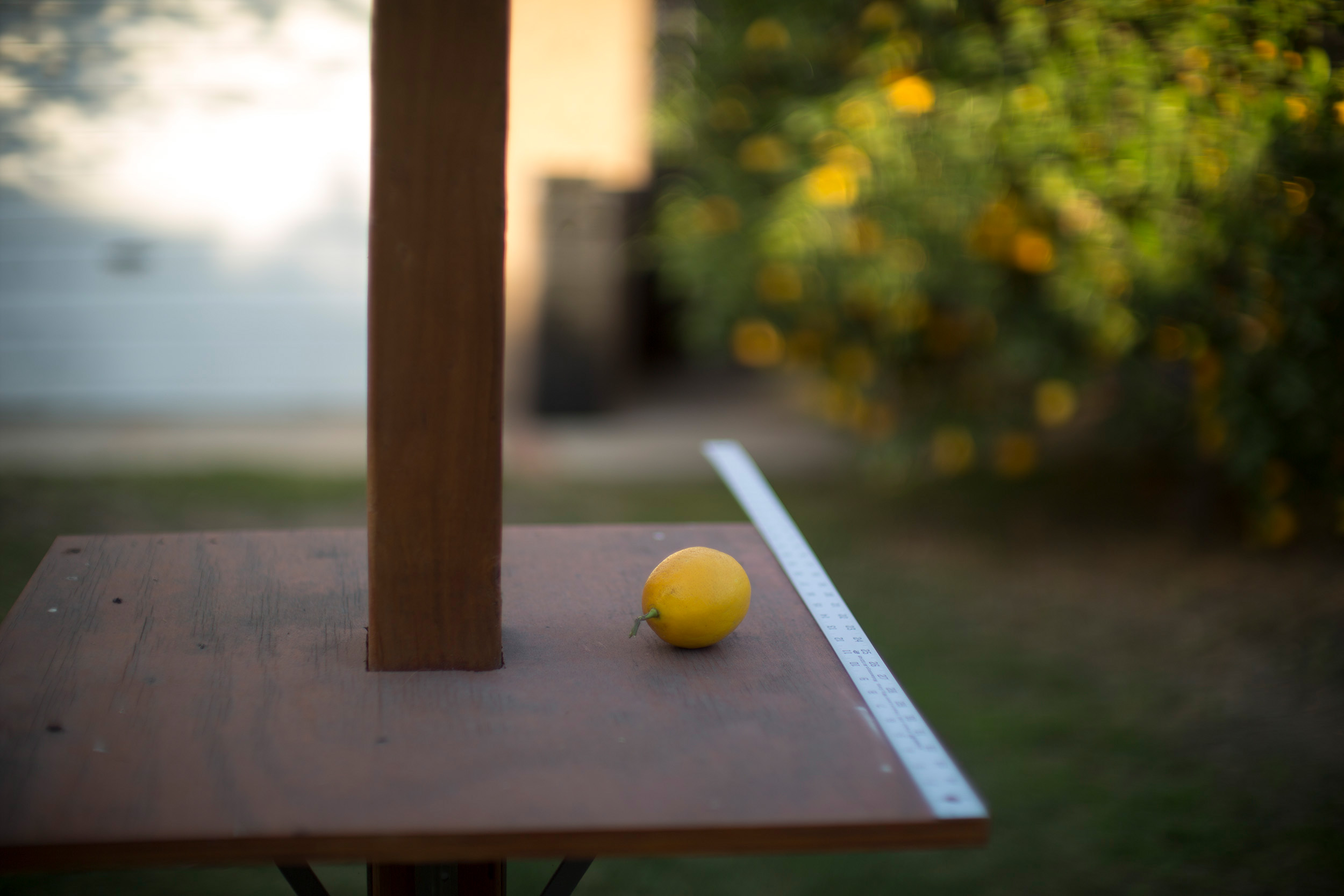
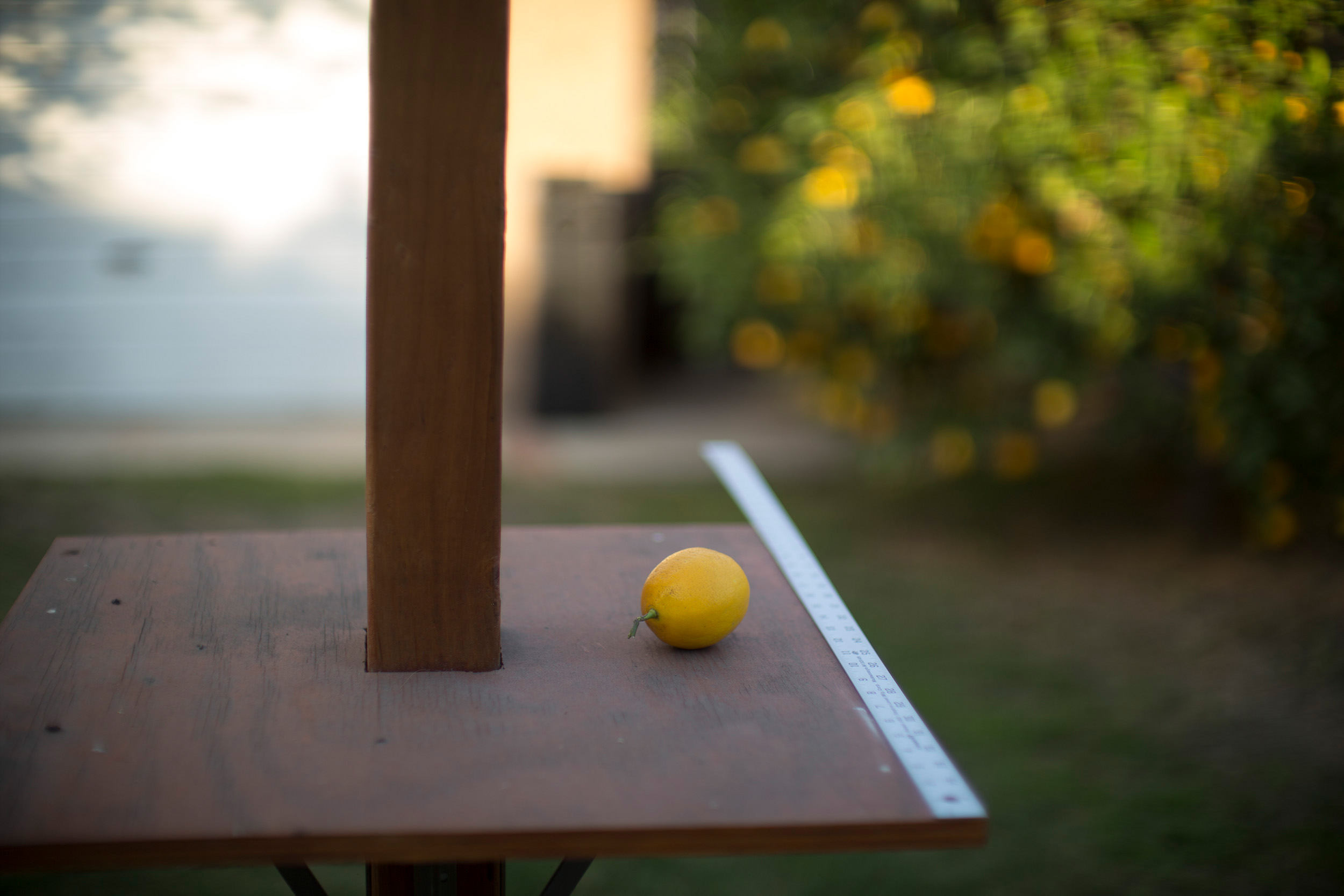
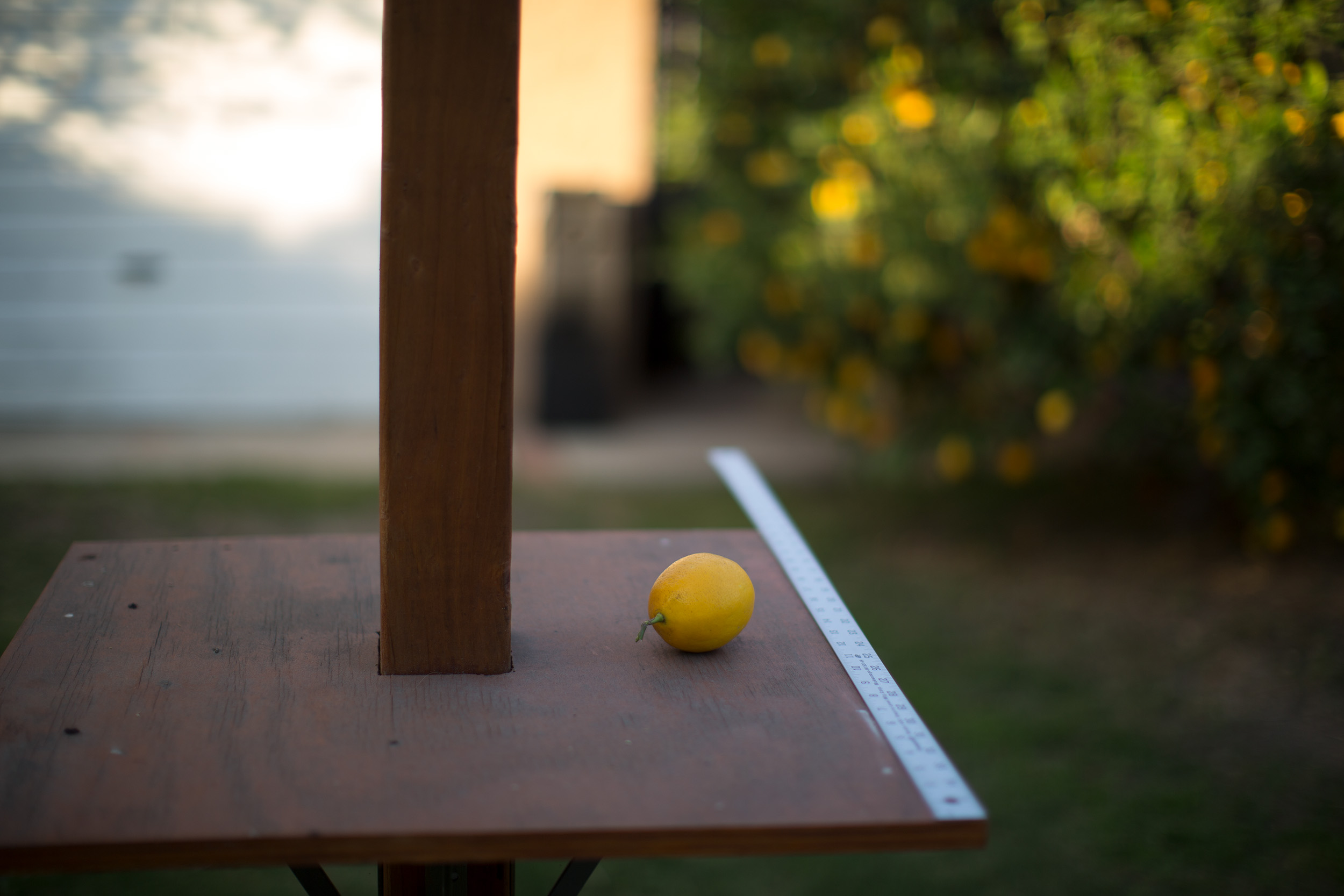
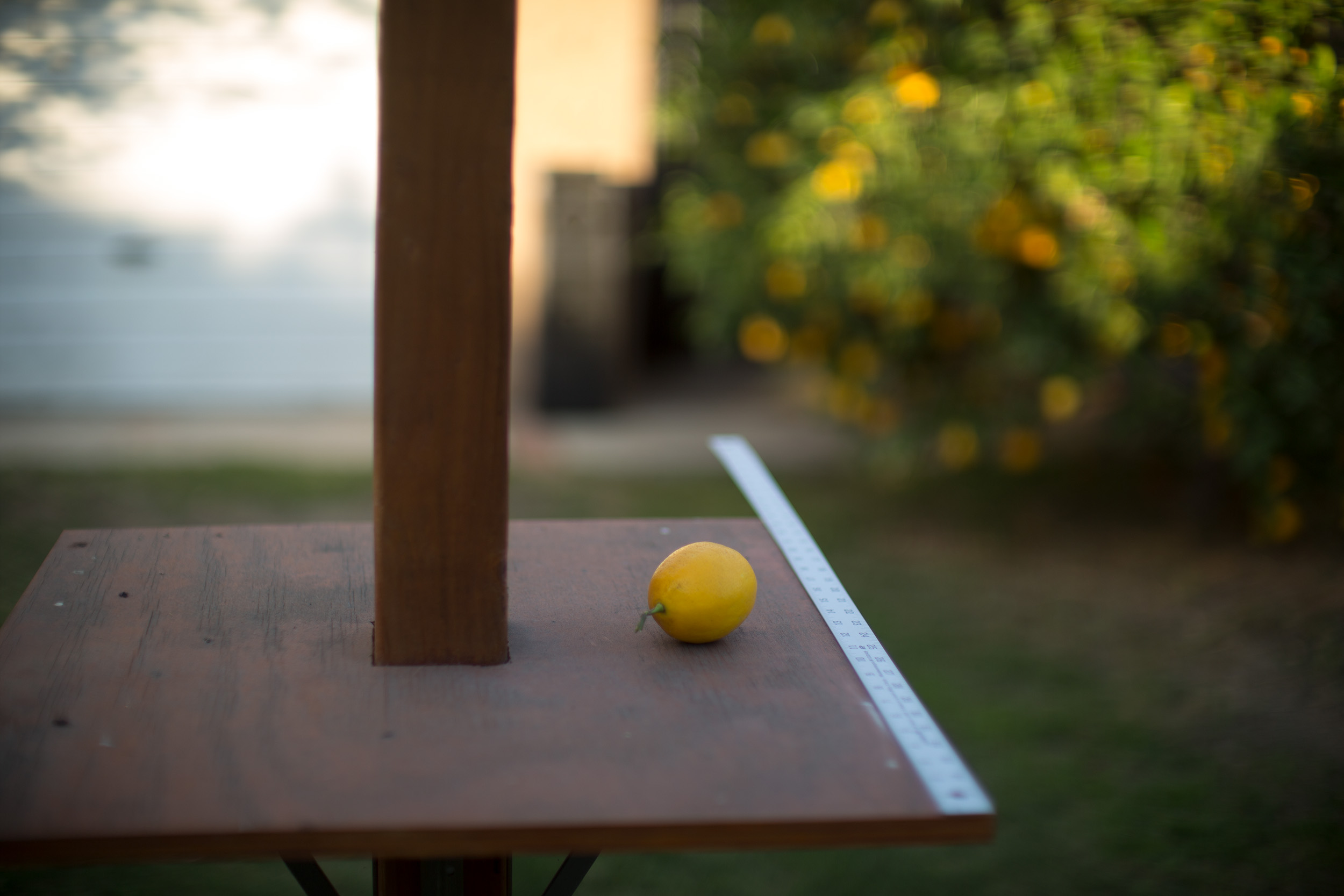
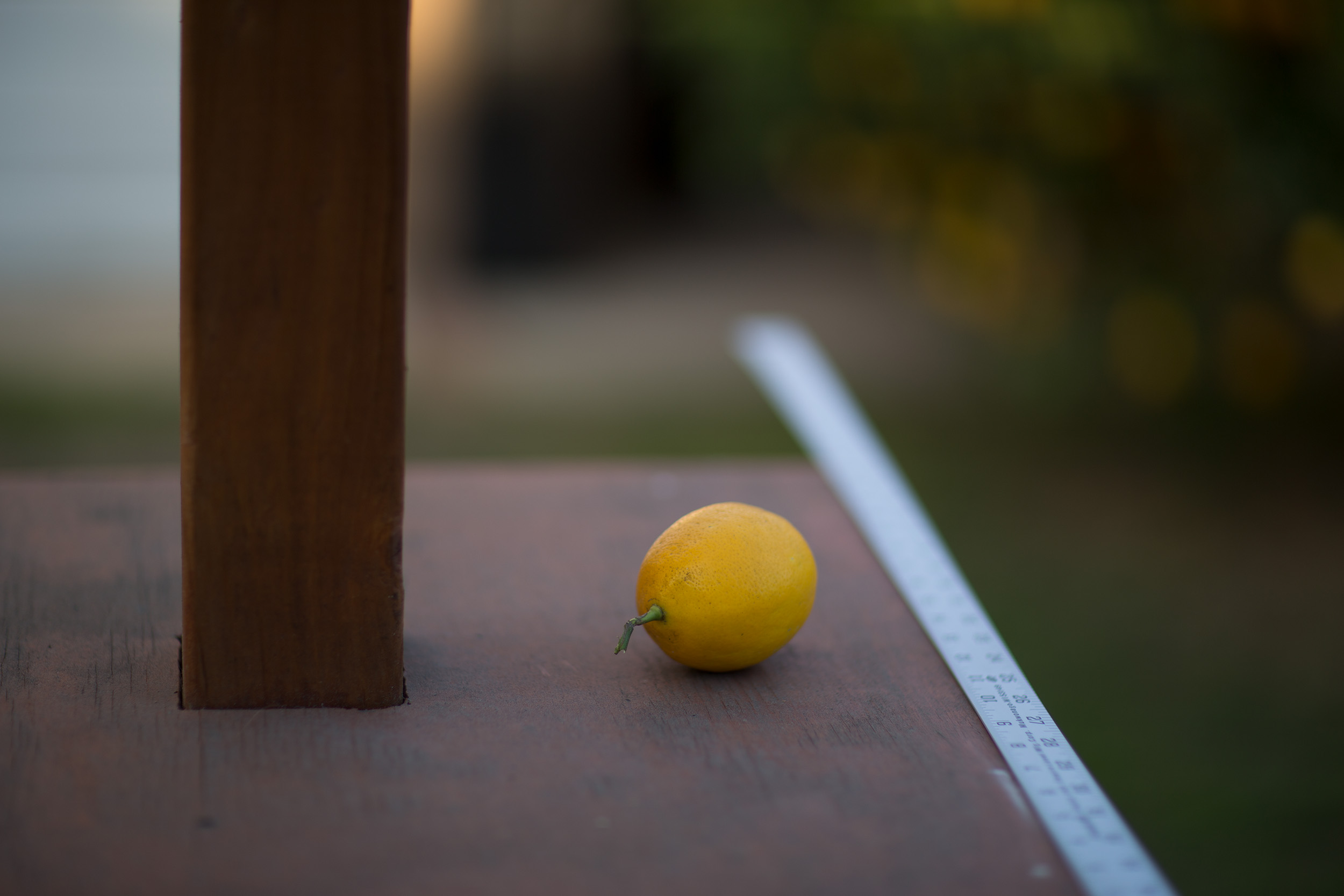
In addition to the vignetting, I also had a number of sharpness issues with the lens. First, this certainly has to do with it being a lens I was pretty actively shooting at f/1.0, giving you a razor-thin focus plane. But after showing some photos to Roger, he was also able to assess that the copy of the Canon 50mm f/1.0L I had, looked to be decentered. Not exactly a surprise, given the copy I had was 25+ years old and hadn’t been serviced in 20 years. At f/1.0, the depth of field is less than .8 of a centimeter, and when shooting handheld, it’s easier to just say that the Canon 50mm f/1.0 doesn’t really have a focus plane wide open, and many of the photos I took were slightly out of focus.

When shooting at the widest apertures (f/1.0, f/1.1, and f/1.2) there seemed to be quite a bit more bokeh cutoff from the mirrorbox than I’ve seen before in lenses. This most often happens at lenses with wider apertures and transforms your circular bokeh into trapezoidal or semicircular bokeh balls. I believe this has to do with and is more apparent with the extremely wide aperture capabilities of f/1.0, but I don’t know the science behind it enough.
Conclusion
So is the Canon 50mm f/1.0L worth seeking out and owning? Well, probably not. It’s sharpness and usability pales in comparison to the Canon 50mm f/1.2L, and is priced more for rich lens collectors than working photographers. However, leading up to this review, people have asked me what I thought of the Canon 50mm f/1.0, and I’ve been calling it ‘The best worst lens I’ve ever used”, because, well that is what it is. Are you going to get gloriously sharp images from it? No. Are you going to get a nonflaring workhorse? No. But are you going to get a giddy, excited feeling when spinning that dial and seeing f/1.1 and then f/1.0 on that top digital screen? Yeah, probably. So in short, the Canon 50mm f/1.0L is flawed, and it shows its age. But it still has elegance in its imperfections, and it still has a certain charm that sways people into paying $4,000 just to experience it.
221 Comments
Adam Sanford ·
More clipped bokeh balls! It cannot be unseen. 2nd to last pic, top side. D-balls for bokeh.
*Thanks* mirror box. Why can’t you be wider than the wide open iris of the lens and stop serving as a undesirable bokeh shape template, eh?
^^^ is my current working theory, please validate this or talk me down — I’m genuinely curious ^^^
Brandon Dube ·
The mirror box clips the bokeh. The exit pupil (loosely, aperture) must be viewable without obstruction by the sensor to avoid the beam being clipped, causing increased vignetting and clipped-looking bokeh.
If you look at the mirrorbox of a 5D series camera, there is a baffle directly behind the flange that is essentially a cutout of the sensor area. It masks the drive mechanisms for the mirror above, and AF subassembly below. Since that cutout is smaller than the rear element, it blocks part of the beam of light forming the image for some or all parts of the field of view.
The 1D series cameras have a slightly more open mirrorbox, with the mechanics allowed to be moved backwards a bit by the 7mm thicker body, and clip bokeh a bit less. They also use higher current batteries and can drive the 85L II’s focus a bit faster than the 5D and lower series bodies.
Oleg ·
Does it mean this won’t be an issue if Canon goes mirrorless?
Brandon Dube ·
If a line could be drawn from any point on the inner diameter of the bayonet to any point on the sensor without being obstructed, it would be completely a nonissue. If they went mirrorless and kept the same “busyness” (for lack of a better word) immediately under the flange of the mount, it would make no difference.
Oleg ·
Thank you Brandon!
Adam Sanford ·
Brandon — A+ thank you
Oleg, mirrorless pulls the mirror box out as a potential obstruction, but we don’t know the throat diameter of a future Canon mirrorless setup and they may go tiny with that, which may become problematic for f/1.2 lenses. But if they design it right as Brandon speaks to above, it should be circular balls all the way…unless the EF to EF-mirrorless (future mount) is designed to have stuff in the light path. (Also, Sony could pooch this as well with their EF adaptors.)
Peter Boorman ·
There are lenses where the lens itself clips the full beam from the wide open aperture: this the usual cause of the “cats’-eye bokeh” seen with some, especially, FSU, lenses and is known as mechanical vignetting. You also see it often using large format lenses wide open – but then they’re usually expected to be focused wide open and then shot closed down at least a couple of stops, so it’s not generally an issue in use. (That’s why some older LF lenses used to be described as “covers 4×5 from f5.6” or whatever, because wider than that you get mechanical vignetting from the body of the lens itself, which produces strong vignetting in the image as well as the odd shaped OoF highlights.)
The ‘clipped bokeh balls’ seen with the Canon 50/1.0, though, seem to have straight lines along the edges, and right angles in the corners, so I’m pretty sure it’s the mirror box here, as you say, rather than the lens itself (unless the lens has a rectangular baffle at its back end, which I don’t know but think unlikely.)
Assuming you’re right about the mirrorbox being the cause, and the 1D bodies having more space in there than the 5D series do, then the lens will vignette less on the 1D bodies as well.
(Now I want to put one on a GFX to see how it behaves with no mechanical vignetting, and what the usable image circle is in that situation…)
Brandon Dube ·
“Mechanical vignetting” is a term invented by the photography community. I would recommend not using it, since there is no distinction between that and just “vignetting.” Vignetting is, by definition, a mechanical process.
tko ·
yeah the rear lens element is cut in order to fit the electrical contacts. that’s why the image looks clipped when you have light sources in the background.
CheshireCat ·
Not really. The clipped bokeh is due to the mirror box.
Adam Sanford ·
More clipped bokeh balls! It cannot be unseen. 2nd to last pic, top side. D-balls for bokeh.
*Thanks* mirror box. Why can't you be wider than the wide open iris of the lens and stop serving as a undesirable bokeh shape template, eh?
^^^ is my current working theory, please validate this or talk me down -- I'm genuinely curious ^^^
Brandon Dube ·
The mirror box clips the bokeh. The exit pupil (loosely, aperture) must be viewable without obstruction by the sensor to avoid the beam being clipped, causing increased vignetting and clipped-looking bokeh.
If you look at the mirrorbox of a 5D series camera, there is a baffle directly behind the flange that is essentially a cutout of the sensor area. It masks the drive mechanisms for the mirror above, and AF subassembly below. Since that cutout is smaller than the rear element, it blocks part of the beam of light forming the image for some or all parts of the field of view.
The 1D series cameras have a slightly more open mirrorbox, with the mechanics allowed to be moved backwards a bit by the 7mm thicker body, and clip bokeh a bit less. They also use higher current batteries and can drive the 85L II's focus a bit faster than the 5D and lower series bodies.
Peter Boorman ·
There are lenses where the lens itself clips the full beam from the wide open aperture: this the usual cause of the "cats'-eye bokeh" seen with some, especially, FSU, lenses and is known as mechanical vignetting. You also see it often using large format lenses wide open - but then they're usually expected to be focused wide open and then shot closed down at least a couple of stops, so it's not generally an issue in use. (That's why some older LF lenses used to be described as "covers 4x5 from f5.6" or whatever, because wider than that you get mechanical vignetting from the body of the lens itself, which produces strong vignetting in the image as well as the odd shaped OoF highlights.)
The 'clipped bokeh balls' seen with the Canon 50/1.0, though, seem to have straight lines along the edges, and right angles in the corners, so I'm pretty sure it's the mirror box here, as you say, rather than the lens itself (unless the lens has a rectangular baffle at its back end, which I don't know but think unlikely.)
Assuming you're right about the mirrorbox being the cause, and the 1D bodies having more space in there than the 5D series do, then the lens will vignette less on the 1D bodies as well.
(Now I want to put one on a GFX to see how it behaves with no mechanical vignetting, and what the usable image circle is in that situation...)
Brandon Dube ·
"Mechanical vignetting" is a term invented by the photography community. I would recommend not using it, since there is no distinction between that and just "vignetting." Vignetting is, by definition, a mechanical process.
tko ·
yeah the rear lens element is cut in order to fit the electrical contacts. that's why the image looks clipped when you have light sources in the background.
David Bateman ·
Thank you for the report. Did you have the chance to test it on a Sony via adapter?
The lemon shot the 1.1 of the 50mm looks the same as the 1.2 of the 50mm f1.2 to me. Also the depth of field of the 1.0 lens at 1.2 seems greater. Maybe the 50mm 1.2 is wider than you think or the 1.0 is really not 1.0. What were the exposure values for all the lemon shots, ie shutter and iso values.
Thank you again, my lust for this extreme lens is gone.
Zach Sutton Photography ·
I wasn’t able to test it with a Sony system, because the time I had with it was extremely limited.
I’m not in front of the computer that has the EXIF data on it, but I believe all the shots were shot at ISO 100, and at 1/800th on the f/1.2 setting (So 1/1000th for f/1.1 and 1/1250 for f/1.0). I’ll double check those numbers for you when I get home.
One thing I noticed with the Lemon shot was that there was slightly more barrel distortion from the 50mm f/1.0L. I’m not sure if that had something to do with it being slightly decentered, or maybe just my eyes playing tricks on me…but thats one thing I noticed when looking at the two images from it and the 50mm f/1.2L.
As for your lust, it’s still a pretty incredible lens. I think people want it for the same reason they want a Leica Noctilux. It’s not nearly as good as the counterparts, but it’s still a marvel of a lens.
David Bateman ·
Thanks for the reply. Those numbers maybe correct, but are they actually? Would be good to know the real values when you have a chance to look at the exif data.
Thanks,
David
Stanislaw Zolczynski ·
There is another thing to F:1. One is F-stop another T-stop. I heard that old Noctilux F:1 has better transmission then Canon. Any general thought on it?
CheshireCat ·
The apparent DoF difference is because the comparison shots have been focused differently (and the decentered copy of the 50/1 did not help with this).
David Bateman ·
Thank you for the report. Did you have the chance to test it on a Sony via adapter?
The lemon shot the 1.1 of the 50mm looks the same as the 1.2 of the 50mm f1.2 to me. Also the depth of field of the 1.0 lens at 1.2 seems greater. Maybe the 50mm 1.2 is wider than you think or the 1.0 is really not 1.0. What were the exposure values for all the lemon shots, ie shutter and iso values.
Thank you again, my lust for this extreme lens is gone.
Zach Sutton Photography ·
I wasn't able to test it with a Sony system, because the time I had with it was extremely limited.
I'm not in front of the computer that has the EXIF data on it, but I believe all the shots were shot at ISO 100, and at 1/800th on the f/1.2 setting (So 1/1000th for f/1.1 and 1/1250 for f/1.0). I'll double check those numbers for you when I get home.
One thing I noticed with the Lemon shot was that there was slightly more barrel distortion from the 50mm f/1.0L. I'm not sure if that had something to do with it being slightly decentered, or maybe just my eyes playing tricks on me...but thats one thing I noticed when looking at the two images from it and the 50mm f/1.2L.
As for your lust, it's still a pretty incredible lens. I think people want it for the same reason they want a Leica Noctilux. It's not nearly as good as the counterparts, but it's still a marvel of a lens.
David Bateman ·
Thanks for the reply. Those numbers maybe correct, but are they actually? Would be good to know the real values when you have a chance to look at the exif data.
Thanks,
David
Stefanie Daniella ·
will bokeh balls be fully round on a EOS M (M5/M6/M100) wide open at f1.0?
EF50mm f1.0L will be a nice 80.7mm f1.6L portrait lens on Canon APSC mirrorless dcams?
Zach Sutton Photography ·
In theory, probably.
Admittedly, I don’t know the full science behind the clipping of the bokeh, so it’s more of a Roger question. But it seems that clipping becomes less apparent at longer focal lengths, so the focal length extension you get from the smaller sensor size along with the lack of a mirror box should translate to little to no clipping.
Brandon Dube ·
The focal length does not change when you change the sensor. Here’s a nice, older video on the subject: https://www.abelcine.com/articles/blog-and-knowledge/tutorials-and-guides/a-lens-is-a-lens-is-a-lens
Dan ·
Obviously the actual focal length of the lens isn’t changing when used on a crop sensor. The effective field of view would be 75mm due to the cropping. Stefanie Daniella where did you get 80.7mm?
Maybe more important to point out is that the aperture most definitely does not change at all to 1.6. It is still f/1 but cropped down.
The resulting image recorded by an aps-c sensor will be the exact image (with different noise and dynamic range) captured by a full-frame sensor but cropped down.
Not sure why this is always confusing people. I have an a7rii and an a6000 and use the same lenses on both. The a6000 just gives a cropped portion of the same image but with a higher pixel density since it is a 24mp crop.
Stefanie Daniella ·
50mm/1.00x = 50mm aperture diameter: 50mm f/1.000
80.7mm/1.614x (Canon APSC)= 50mm aperture diameter (no change): 80.7mm f/1.6 (f/1.614)
36/22.3=1.614x (1.614349775)
76.6mm/1.532x (Sony APSC)= 50mm aperture diameter (no change): 76.6mm f/1.5 (f/1.532)
36/23.5=1.532x (1.531914893x)
50.3mm/1.002789x = 50mm aperture diameter (no change):
50.3mm f/1.003
36/35.9=1.002789x (1.002785515x) Sony “FF”
Crop: Horizontal FoV Factor
Dan ·
My question was rhetorical. Giving an equivalent field of view for aps-c sensors due to the cropping of the image circle makes sense but aperture, depth-of-field, and the related blur cannot be compared giving a ratio like you are doing.
An 80.7mm f/1.6 lens won’t produce an image that looks anything like a 50mm f/1 lens and to compare them is nothing less than pointless.
SpecialMan ·
People learn this nonsense of lenses magically changing their f/stops over at DPReview.com. They call it “equivalence” and the editors are guilty of making an entire generation of photographers hopelessly confused about focal lengths and f/stops.
Just another way the internet is making us stupider by the minute.
Stefanie Daniella ·
Canon’s own EF to EFM (flange-extension) “adapter” would be a good start
it doesn’t have horizontal cropping upper/lower baffles like other lens adapters for going from FF-Lens-to-APSC Mirrorless bodies
when Canon introduced its UWA Rectilinear EF11-24mm f/4 Zoom, one was showcased on an EOS M APSC Camera
(working like: WA 17.754-38.736mm f/6.456L Zoom (ff.equiv.fov))
Adam Sanford ·
*If* the SLR mirror box is the reason for the clipped bokeh balls (a plausible but not to my knowledge proven reason), then a mirrorless camera — which lacks a mirror box — shouldn’t demonstrate this.
Stefanie Daniella ·
EF to EFM flange-extension “adapter” would be a good start
it doesn’t have horizontal cropping upper/lower baffles like other lens adapters for going from FF-Lens-to-APSC Mirrorless bodies
CheshireCat ·
Don’t know about the M “mirrorless box” :-)… but certainly the bokeh is not clipped on the Sony A7.
I would not use the 50/1 on anything other than full-frame. You would lose a lot of the overall character of the lens.
Stefanie Daniella ·
will bokeh balls be fully round on a EOS M (M5/M6/M100) wide open at f1.0?
EF50mm f1.0L will be a nice 80.7mm f1.6L (FF.equiv.FoV) portrait lens on Canon APSC mirrorless dcams?
Zach Sutton Photography ·
In theory, probably.
Admittedly, I don't know the full science behind the clipping of the bokeh, so it's more of a Roger question. But it seems that clipping becomes less apparent at longer focal lengths, so the focal length extension you get from the smaller sensor size along with the lack of a mirror box should translate to little to no clipping.
Brandon Dube ·
The focal length does not change when you change the sensor. Here's a nice, older video on the subject: https://www.abelcine.com/ar...
Dan ·
Obviously the actual focal length of the lens isn’t changing when used on a crop sensor. The effective field of view would be 75mm due to the cropping. Stefanie Daniella where did you get 80.7mm?
Maybe more important to point out is that the aperture most definitely does not change at all to 1.6. It is still f/1 but cropped down.
The resulting image recorded by an aps-c sensor will be the exact image (with different noise and dynamic range) captured by a full-frame sensor but cropped down.
Not sure why this is always confusing people. I have an a7rii and an a6000 and use the same lenses on both. The a6000 just gives a cropped portion of the same image but with a higher pixel density since it is a 24mp crop.
I notice a lot of people comment criticizing fast m43 lenses saying they aren’t really 1.2 etc. and would be much slower on full-frame. This is also wrong. A 24mm/1.4 m43 lens gives the same result on a full-frame sensor but rather than being cropped, the image vignettes dramatically because the image circle doesn’t cover the 35mm format sensor.
Stefanie Daniella ·
50mm/1.00x = 50mm aperture diameter: 50mm f/1.000
80.7mm/1.614x (Canon APSC)= 50mm aperture diameter (no change): 80.7mm f/1.6 (f/1.614)
36/22.3=1.614x (1.614349775)
76.6mm/1.532x (Sony APSC)= 50mm aperture diameter (no change): 76.6mm f/1.5 (f/1.532)
36/23.5=1.532x (1.531914893x)
50.3mm/1.002789x = 50mm aperture diameter (no change):
50.3mm f/1.003
36/35.9=1.002789x (1.002785515x) Sony "FF"
104.05mm/2.0809x (m43) = 50mm aperture diameter (no change): 104.05mm f/2.1 (f/2.0809)
36/17.3=2.0809x (2.080924855x) m43 "2x" crop
Crop: Horizontal FoV Factor
obviously, if i mention an APSC camera, i am quoting FF.equiv.FoV, not changing actual FL or Apertures (only ratios translated for APSC users: FoV is "cropped" (narrow version of FF; image size remains same, but cropped))
Dan ·
My question was rhetorical. Giving an equivalent field of view for aps-c sensors due to the cropping of the image circle makes sense but aperture, depth-of-field, and the related blur cannot be compared giving a ratio like you are doing.
An 80.7mm f/1.6 lens won’t produce an image that looks anything like a 50mm f/1 lens and to compare them is nothing less than pointless.
SpecialMan ·
People learn this nonsense of lenses magically changing their f/stops over at DPReview.com. They call it “equivalence” and the editors are guilty of making an entire generation of photographers hopelessly confused about focal lengths and f/stops.
Just another way the internet is making us stupider by the minute.
Stefanie Daniella ·
Canon's own EF to EFM (flange-extension) "adapter" would be a good start
it doesn't have horizontal cropping upper/lower baffles like other lens adapters for going from FF-Lens-to-APSC Mirrorless bodies
when Canon introduced its UWA Rectilinear EF11-24mm f/4 Zoom, one was showcased on an EOS M APSC Camera
(working like: WA 17.754-38.736mm f/6.456L Zoom (ff.equiv.fov))
admittedly, such narrow aperture diameters would not push so far out to the edges of inner diameter of adapter baffles as a 50mm aperture diameter on the 50mm f1.0 ...
so, someone could test this out ... lens rental folks?!?! :D
Adam Sanford ·
*If* the SLR mirror box is the reason for the clipped bokeh balls (a plausible but not to my knowledge proven reason), then a mirrorless camera -- which lacks a mirror box -- shouldn't demonstrate this.
But a poorly thought through adaptor that didn't consider clearance for such a large aperture lens might still demonstrate this on mirrorless. Someone just needs to shoot some test shots with it and show how it looks.
CheshireCat ·
Don't know about the M "mirrorless box" :-)... but certainly the bokeh is not clipped on the Sony A7.
I would not use the 50/1 on anything other than full-frame. You would lose a lot of the overall character of the lens.
Walter Lysenko ·
How did you come up with the 2/3 stop? There is a 0.263 stop difference between f/1.2 and f/1 since 2^0.263=1.2.
Yoan ·
I believe it’s actually exactly half a stop between f/1 and f/1.2.
Walter Lysenko ·
You’re right. I forgot about the square root. The actual difference is 2*log(1.2)/log(2) = 0.526 stops. (Or 2^(0.526/2)=1.2/1.0)
Tim Cooper ·
This would be true if you were actually getting f/1.2. In reality lens manufacturers denominate the two third-stops between f/1 and f/1.4 as f/1.1 and f/1.2 in order to avoid using too many figures.
Yoan ·
I believe it's actually exactly half a stop between f/1 and f/1.2.
Walter Lysenko ·
You're right. I forgot about the square root. The actual difference is 2*log(1.2)/log(2) = 0.526 stops. (Or 2^(0.526/2)=1.2/1.0)
CheshireCat ·
The Canon 50/1.2 and the 85/1.2 are actually f/1.27, but Canon marketing prefers the f/1.2 labels than the more proper f/1.3. Guess why ? 😉
Walter Lysenko ·
And what is the actual f-number for the f/1 lens?
CheshireCat ·
It is supposed to be a true f/1, using the best technologies available back then (a super-complex design with 11 elements, 2 of which aspherical).
As reported in other posts, the lens was a flagship item for Canon to show off their superiority. It was never meant to sell well. It seems that only about 4500 copies were ever made; fewer are still functional, and even fewer are still in pristine optical condition (and thus not often on the market).
Walter Lysenko ·
So the actual ratio of f-numbers between the f/1.2 and f/1 lenses is 1.27. This means the f/1 lens is 2*log(1.27)/log(2)=0.69 stops faster. Very impressive.
CheshireCat ·
Correct. About 2/3 of a stop faster.
It may not seem a big deal, but it is a challenge for optical engineers (especially 30 years ago).
CheshireCat ·
Correct. About 2/3 of a stop faster.
It may not seem a big deal, but it is a challenge for optical engineers (especially 30 years ago).
CheshireCat ·
It is supposed to be a true f/1, using the best technologies available back then (a super-complex design with 11 elements, 2 of which aspherical).
As reported in other posts, the lens was a flagship item for Canon to show off their superiority. It was never meant to sell well. It seems that only about 4500 copies were ever made; fewer are still functional, and even fewer are still in pristine optical condition (and thus not often on the market).
CheshireCat ·
The Canon 50/1.2 and the 85/1.2 are actually f/1.27, but Canon marketing prefers to call them f/1.2 rather than more properly f/1.3. Guess why ? ;-)
fricotin ·
Didn’t Canon offer a .95 50mm in the late 60s ?
Alan ·
You’re quite correct. The f0.95 lens was fitted (if I remember correctly without looking it up) to the Canon 7 or 7s (Dream?) camera. I don’t believe it was ever fitted to a SLR type camera. Last time I saw one I was in Olongapo in the Philippines (around 1999) and a roadside trader offered it to me (with the camera) for next to nothing – I just didn’t have enough cash with me. I asked him to keep it for me but when I went back next day with the cash he’d already sold it elsewhere. Moral of the story – carry plenty of cash but beware of pickpockets!
Lawrence Dunn ·
This is the lens you seek.
I bought a Sony mirrorless so I could use this lens. You can’t mount it on an Eos EF Mount Camera because the Canon 7 Mount flange-sensor distance is less than the Eos EF. I picked up the 50mm f0.95 earlier in 2017 with a longer term plan on getting a camera to use it on.
https://uploads.disquscdn.com/images/07b830860732916748b6ae7620181551b9296aa176366aee2d57f9d7a53e248f.jpg
Alan ·
You're quite correct. The f0.95 lens was fitted (if I remember correctly without looking it up) to the Canon 7 or 7s (Dream?) camera. I don't believe it was ever fitted to a SLR type camera. Last time I saw one I was in Olongapo in the Philippines (around 1999) and a roadside trader offered it to me (with the camera) for next to nothing - I just didn't have enough cash with me. I asked him to keep it for me but when I went back next day with the cash he'd already sold it elsewhere. Moral of the story - carry plenty of cash but beware of pickpockets!
Lawrence Dunn ·
This is the lens you seek.
I bought a Sony mirrorless so I could use this lens. You can’t mount it on an Eos EF Mount Camera because the Canon 7 Mount flange-sensor distance is less than the Eos EF. I picked up the 50mm f0.95 earlier in 2017 with a longer term plan on getting a camera to use it on.
https://uploads.disquscdn.c...
Uneternal ·
Yes, it’s a rangefinder lens, and fans call it “the dream lens” cause of its characteristics.
Peter Boorman ·
I think I recall it was the British photo press that gave it that name at the time the lens came out, and it stuck. There are also versions of it made for broadcast TV, and it may be those that originally got the name (those broadcast versions sell for a bit less than the ones for the Canon 7s rangefinder because they can’t be converted to M-mount: I don’t know whether they can be converted for use on mirrorless, but if so they might be a cheaper option for use on Sony Alphas etc.)
Jukeboxjohnnie ·
I think your stunning final pictures shot at 1.4 proves that’s all you need!
Mike ·
Except for when you just need that wee bit more.
Jukeboxjohnnie ·
I think your stunning final pictures shot at 1.4 proves that's all you need!
RagnarDanneskjöld ·
This is a great lens but can you show us some shots where you deactivate “Portrait Mode”
Steve Suthan ·
I can’t tell of you’re being sarcastic, but if you are, you deserve a like.
RagnarDanneskjöld ·
( ;
RagnarDanneskjöld ·
This is a great lens but can you show us some shots where you deactivate "Portrait Mode"
Steve Suthan ·
I can't tell of you're being sarcastic, but if you are, you deserve a like.
Oleg ·
Zach, thank you for the article. I guess Zeiss 50mm f/0.7 is next? 😉
Zach Sutton Photography ·
If you got a lead on one….yes 🙂
CheshireCat ·
Can’t adapt the Zeiss 50/0.7 even on a Sony mirrorless camera, certainly not with infinity focus.
Besides, the lens does not cover full frame.
Brandon Dube ·
If a line could be drawn from any point on the inner diameter of the bayonet to any point on the sensor without being obstructed, it would be completely a nonissue. If they went mirrorless and kept the same "busyness" (for lack of a better word) immediately under the flange of the mount, it would make no difference.
Zach Sutton Photography ·
If you got a lead on one....yes :-)
Adam Sanford ·
Brandon -- A+ thank you
Oleg, mirrorless pulls the mirror box out as a potential obstruction, but we don't know the throat diameter of a future Canon mirrorless setup and they may go tiny with that, which may become problematic for f/1.2 lenses. But if they design it right as Brandon speaks to above, it should be circular balls all the way...unless the EF to EF-mirrorless (future mount) is designed to have stuff in the light path. (Also, Sony could pooch this as well with their EF adaptors.)
Steve Suthan ·
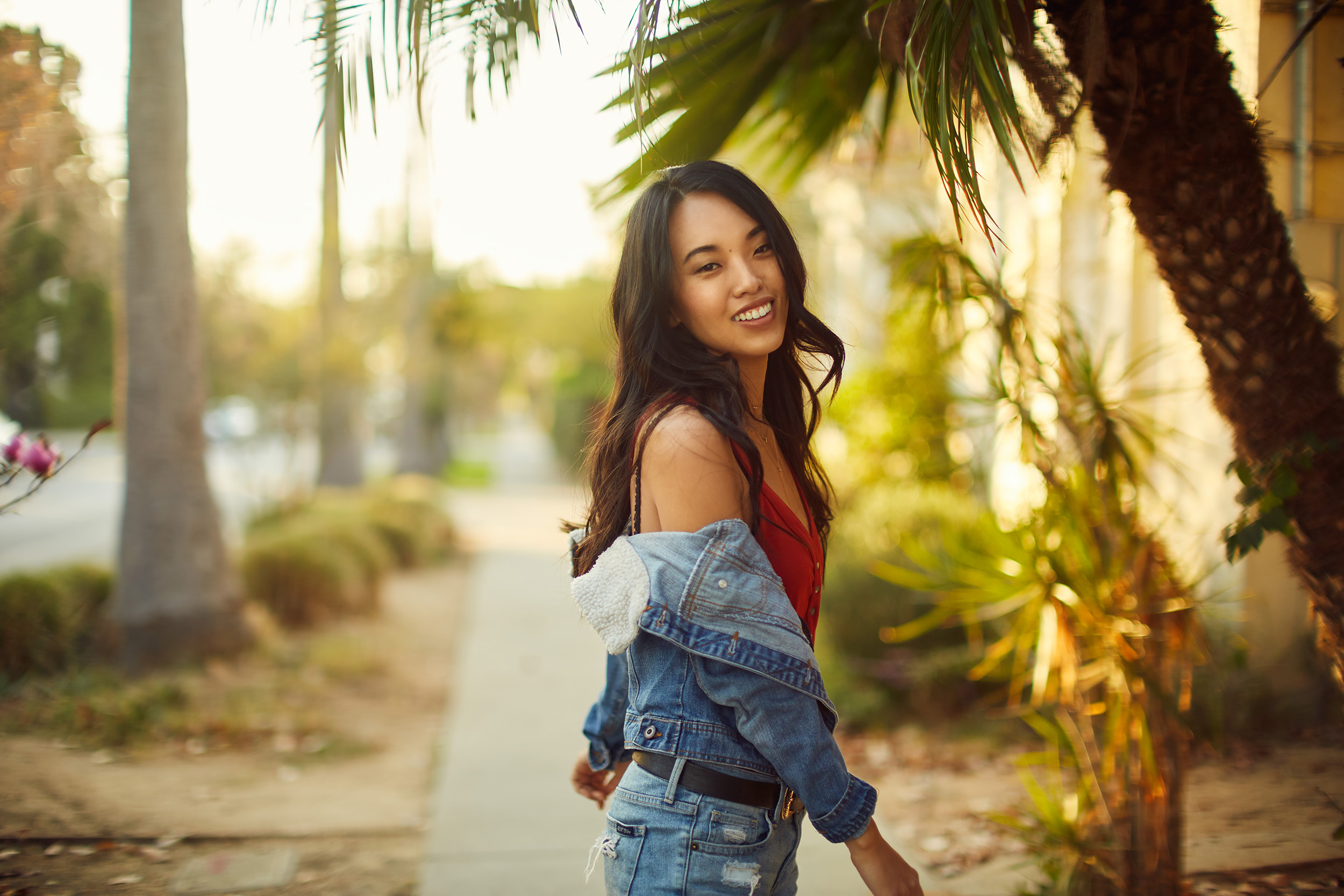
The last photo really showcases the “look” of this lens. Seems pretty sharp, although it may not be, as it’s a compressed and sharpened web copy. To me, the only thing that lets this lens down is the price, slow focusing, (maybe) softness, and CA. I think a 50mm 1.8 could do better that the 1.0, stopped down to the same degree. https://uploads.disquscdn.com/images/8aa1588a0030cea10176c5259373c6d59a6a2b1db902bd3326b3cb2d81d6166c.jpg
Refurb7 ·
It does look pretty, however.
Steve Suthan ·
The last photo really showcases the "look" of this lens. Really nice photo, and love the bokeh. Seems pretty sharp, although it may not be, as it's a compressed and sharpened web copy. To me, the only thing that lets this lens down is the price, slow focusing, (maybe) softness, and CA. I think a 50mm 1.8 could do better that the 1.0, stopped down to the same degree. https://uploads.disquscdn.c...
Silenced by PetaPixel ·
It does look pretty, however.
Claudia Muster ·
And where’s the MTF chart? We want MTF charts!
Zach Sutton Photography ·
In order to get MTFs of these kinds of lenses, we’d need to have them shipped to Memphis (I’m based in LA, where it’s MUCH easier to find these types of lenses). With them not being serviceable, it’s really rolling the dice having them shipped out to Memphis to run it through the Olaf machine.
Alan ·
I am happy to lend my personal one to Memphis if Roger wants to test it. It is not sharp like my 200/1.8 (or my TEC 110FL telescope) but it is surprisingly good on my 5ds (again at short focus not infinity)
Claudia Muster ·
And where's the MTF chart? We want MTF charts!
Zach Sutton Photography ·
In order to get MTFs of these kinds of lenses, we'd need to have them shipped to Memphis (I'm based in LA, where it's MUCH easier to find these types of lenses). With them not being serviceable, it's really rolling the dice having them shipped out to Memphis to run it through the Olaf machine.
Rob Crenshaw ·
This review is spot-on. I bought one earlier this year on eBay and it’s an anachronism for collectors. Forget about the fact I spent money, let’s pretend it was free and not valuable. For actual use, my friend’s Sigma Art lens is much sharper wide open, as is the Canon 50mm f/1.8 STM, at a loss of 1 and 2 stops respectively, which is not much in the real world considering high ISO performance (I’m using a 5DSR), and the tradeoff of this lens’ sharpness at anything less than f/1.8, in which case you might as well use the STM, which I do.
The other problem is how SLOW the AF is. It’s not slow, it’s abysmal. And because it is focus by wire, you can’t rush it like you could if it were mechanical manual focus. So where this lens would shine, when it’s dark and absolute sharpness is not needed but a mood and moment is, it cannot focus fast enough to capture anything live and unfurling before you, like a show in a dark club.
Since it requires patient and methodical focusing, work pace crawls, so you have to invent shots it’s good at. Portraits? Meh, I’d rather use a longer focal length. Car photography? (That’s what I bought it for) Meh, I’d still rather use an 85mm, but is the bokeh of the 50mm f/1.0 enough to justify it’s own look and kind of shot? For me, no, the sharpness is unusable for cars at f/1.0, so I’m stopping down to f/1.8-2.8 anyway, I’ll use the $100 featherweight and 1000x faster focusing STM thanks.
But let’s say I do want a dreamy creamy look at 50mm. Then I pull out the Holga and run film thru it. Seriously, I do this and it looks great. Scan the film on a flatbed and voila.
This lens was designed and manufactured to do two things: provide a working photographer a usable 2/3 stop over a 1.4 back when FILM was slow and that extra speed meant a usable shot vs a throwaway, and to embarrass Nikon. The lens was announced with the original EOS system way back when and, together with the 85mm f/1.2L, Canon wanted statement lenses to woo photographers to this new system, in hopes of taking the pro market. The rest is history, and in that context it’s a great lens to own, but not to use.
Arthur Meursault ·
“it’s a great lens to own, but not to use”
Using as an ashtray is use.
NSU67 ·
Nope
Arthur Meursault ·
Yes it would be. Or as a paperweight. Ashtray or paperweight. As simple as that.
Arthur Meursault ·
Of course it is.
USING is a ‘use’.
Use as an ashtray = use.
Use as a toilet = use.
What part of use don’t you get? You’re without use or better said – you are useless.
Arthur Meursault ·
Of course it is.
USING is a 'use'.
Use as an ashtray = use.
Use as a toilet = use.
What part of use don't you get? You're without use or better said - you are useless.
GuyWith ·
What a great analysis. People under 50 have no idea how much of a life-or-death issue larger f/stops used to be. And actually, I bet f/1 is still useful if you’re an international spy trying to photograph secret nuclear missile plans in the dark recesses of a facility carved out of a mountainside.
Rob Crenshaw ·
True true, but you know what’s more useful? My mini spy camera with a built-in light that will make short work of copying those documents. It doesn’t look like a huge camera, and nobody would suspect I was a spy because this camera is so ubiquitous and cleverly disguised. It’s called an iPhone.
NSU67 ·
I use my 50 1.0 to shoot portraits anywhere, anytime and in any available light. Done in under 30 minutes.
brett turnage ·
Great analysis. I too shoot cars for a few major car publications, and I just added an 85mm f/1.2 II to my bag and it’s amazing for my work, but the curiosity of the legendary 50mm 1.0 has always intrigued me until this review. It’s nice to see another car photographers perspective of this lens on the same camera that I use (5DSR).
Rob Crenshaw ·
I’d rather have the 85mm you have than the 50 I have, but I went a slightly different route in pursuit of a fresh perspective: I bought the 90mm f/2.8 TS-E. The problem with the f/1.0, sharpness aside, is that DOF is so shallow, what do you focus on? The headlights? The A-pillar? You can’t have both, so pick one. A point inbetween? Then nothing is in focus! A car needs to have some focus point for the eyes to rest on and lock on to, and some DOF from that point. Generally I pick the headlights, but at f/1.0 the rear of the car is indistinct and thus I lose the car’s form. So I bought the TS-E in hopes that I could have it all: subject isolation, exact focus at a point of my choosing, and control over DOF beyond stopping down. That conclusion will have to wait though, the TS is a complicated lens to learn to use effectively, and I suspect it’ll take 6-12 months of use to understand it.
brett turnage ·
I bought the 85mm f/1.2 II as my low light specialist. I did an entire shoot at an engine shop a few weeks ago, and the low light forced me to shoot at 3200 iso, which isn’t great especially for the magazine. I live with that iso, but wasn’t happy with the results and also had a hard time capturing fast action movement of subjects. You can’t really tell a guy on a boring or honing machine to stay still, and you also don’t want to distract him with flash, so I knew that I need something that could operate in low light situations, capture fast moving motion, and do it while allowing me to keep my iso as low as possible. The 85mm which I got last week is a dream, but nailing focus on it is something you have to practice. I practice with it everyday and so far for 3 shoots. For me it’s getting comfortable with the lens and figuring out when I need to stop it down to enlarge the DOF, and when it’s okay to play at 1.2 aperture. It’s kinda a tricky lens because the picture on the back LCD will look great, but on the computer you can see that you might want a larger depth a field in a particular situation, so it’s really left up to knowing the lens and remembering presets so that I can get the best from a shot. I honestly love this lens, I never thought I would say that since my 70-200 f/2.8 was my absolute favorite, but the pictures that I get from the 85mm are just magical. It has the x-factor that I have never experienced before.
I almost bought a tilt shift lens a few months ago when I needed a wide angle for engine shots, interior photos, and for tight places in shops, but decided to go with the 16-35 f4 IS, which is a great lens, but I almost bought the tilt shift for its ability to correct for distortion (no alien headed people).
With our 5dsr’s having iso similar to a crop sensor because of pixel density and in the fine detail setting with the automatic max being 3200 iso, this lens has been the answer. I can now handhold in dark situations while capturing motion and have iso range between 50-1000 max depending on the ambient lighting.
I imagine with your 1.0 you have to use a nd filter or polarizer if you shoot in daylight because on my 1.2 I’m maxed out on the shutter speed if I shoot wide open on a bright day.
Rob Crenshaw ·
Yes, I usually have a polarizer, it seems de rigeur for outdoor car photography so I can play with reflections, or take 2-3 shots and composite the best aspects of each.
Tbph, the way I got around the high ISO limitation of the 5DSR is to buy Nikon as well. 😀
I got a D850 for its sensor, and just a few lenses for lower light shots. They needn’t be the ultrafasts bc the files are so pushable, and their 85mm f/1.8 is superb.
So I guess (ironically), my low light specialist is Nikon. LOL!!!
brett turnage ·
That’s one way of dealing low light. As we all know we have to have tools in our bag to answer every situation that we face. Check out Ken Rockwell’s review on the 1.0 if you haven’t already. Hopefully you can figure out how to make it work for your shoots. If not, you have a serious collector piece that will only gain in value if you don’t sell it.
Rob Crenshaw ·
It was actually Ken’s piece that pushed me to buy it. He was very enthusiastic, but I think in this case it may have been a bit of pandering. The lens has so much CA wide open – wait, I’ll just post my notes. I apologize if it seems repetitive to what I wrote above!
This old school lens will take some time to explore. It is big, heavy, slow to AF, and suffers from heavy color fringing at wider apertures. By normal testing standards the resolution and vignetting are abysmal until f/4, and never really come into focus at all. The 50mm f/1.8 STM will take much clearer, sharper pictures at wider apertures. The f/1.0 L has great contrast compared to the f/1.8, but in this era of digital that’s not relevant. At smaller apertures it is consistently good, the equal of the f/1.8, and even f/16 diffraction is not that obtrusive, but at f/8 corner blur and color fringing is still noticeable. Buying this lens to shoot at f/8 is not it’s purpose, and such usage would be better addressed with the $100 STM. So what good is it then? I don’t know yet, but between f/1.0 and f/2 are three intermediate settings, and low light pictures should be possible at handhold-able speeds. Real world pictures are contrasty, but difficult to get in focus at f/1.0. Using Live View apparently helps, but testing at infinity did not suggest any increase in focusing accuracy. It’s a one-trick pony, which is that there isn’t another AF lens that goes to f/1.0. So can it take pictures no other lens can take?
Outdoors under sunlight, no. The lens doesn’t become cohesive until f/2, so there’s no reason to not use the STM, there’s no “magic look” from f/1-1.8, it just looks crappy vintage, blurry with fringing. For this kind of look a Lensbaby is hugely more pleasing, and the vintage look achievable with much less expensive albeit slower lenses. So it’s down to shooting under extremely dim conditions, or at its closest focus, where the background blur is so creamy. Is it worth the weight, cost, and slow AF?
Indoors under dim light? Maybe? It’s only one stop difference from the (better) Sigma ART and 1.5 stops from the STM. Will the bump in ISO to achieve the same shutter speed be noticeable? And if so, bothersome? It seems this is a film era product, and there’s not much reason to choose this over an f/1.8–f/2.
brett turnage ·
Yah, Ken’s review was an incredibly glowing. I use his reviews to inform my buying decisions, but I weigh it versus other reviewers, and I’ve seen other reviews where the pictures were unusable because almost everything was blurry or as Kai W said. “the 1.0 was softer at all apertures than your nan’s dinner.” I mentioned it as a perhaps you can learn to use the lens like you tilt shift lens, so it’s not a wash.
When I look at the pictures of the lemon above the details lost in both the 50 1.0 and the 50 1.2 are stark compared to the dirt in the lemon’s skin that is visible in the 85.
Like you said, if it’s not in focus or if the car is not in focus across it’s length, then it is going to hurt your shots. The mag that I shoot for, Hot Rod, they like some shots to be very artsy with bokeh, but it still has to be within reason. I have a shoot at a transmission manufacturer in a few weeks and for it, I will use 1.2 for some shots, but I have to stop it down to larger apertures or the shoot would be a wash. I think with my lens the 1.2 is great for some shots but other situations like needing to shoot a person under a car on a lift, or an entire transmission being assembled might call for a larger DOF.
Rob Crenshaw ·
I’ve been pretty lucky following Ken’s advice, but lensrentals has the advantage of sota testing eqpt and multiple samples. I was willing to pop on the 1.0 bc I got it for slightly under market with a lucky low bid, so I figured if I didn’t find a use I could sell it again in a few years, maybe Ken’s right and it’ll even increase in value.
It’s true that there is no baseline for these old lenses, but barring massive damage which would shift all the elements and cause all sorts of optical problems, if the lens exhibits normal fixed lens behavior (vignetting and a drop in resolution as you move towards the corners, worst wide open and gradually disappearing a few stops down), and doesn’t show any anomalies in focus, it’s OK. It may not be the sharpest example, but usually there are obvious signs that something is wrong. I’ve returned brand new lenses bc of decentering, where one whole big corner area never comes in focus!
I’m curious what aperture(s) you use the most for professional work. Mine is all amateur, and I find myself using f/2.8-4. Wider apertures have too little DOF, and smaller ones start to render the background. This is assuming a walkaround normal zoom, if I’m using the 100-400 then all bets are off, I’ll use a longer focal length to isolate just the right background, and generally the aperture doesn’t matter much.
And if I could choose a legendary lens, absolutely it would be the 200/1.8. No need to worry above unsharp pictures, the MTF charts are uh, off the chart. 😀
brett turnage ·
I agree with you. Unless it’s a really beat up lens, it should not be super out of spec.
The aperture that I choose really depends on the type of photography that I’m doing in the article and whether or not it is my solo article or if it is an article directed by one of the editors. If it is the former I have more leeway to determine the artistic direction, but if it is for the Senior technical editor, then I have to shoot it the way that he likes it. For technical articles everything is usually small apertures f/16-f/32 because they want everything in frame completely clear, and they don’t care about diffraction. However, if I’m shooting a scored cylinder wall, then I will put on the 50mm f/2.5 macro and shove it right down the cylinder and shoot at f/8 so that they can zoom into the picture to show the tiny knicks and other damage. Most of my technical shots I shoot are done with my 70-200 f/2.8 and the exposures can be pretty long, but with the wifi adapter installed, I’m across the room planning the next shot, so I’m not waiting for the exposure to finish or worrying about camera shake. For panning shots its all 70-200 f/2.8, usually set at f/11 because they want the car perfectly clear.
For my own articles I will play around with f/1.2 for some shots. I might be 15-20 feet back to elongate the DOF, but I find that the subject isolation of the larger aperatures adds a feeling to an image that would not exists if most or everything was clear in the shot. For instance, a shot I took last weekend of a technician spray painting a flex plate to check for lateral runout. I took two versions of the same shot, one at 1.2 and another at 5.6. The 5.6 image looked average, but nothing jumped out at you because everything clear it was not apparent what you are supposed to focus on. The same picture at 1.2 was drastically different, your eyes were immediately drawn to the hand, the paint can, and the spray going on to the flex plate, and it was clear not relying on a caption to explain what was happening (although it would still have a cation because it’s a tech article).
I had 3 shoots last week, and I used it to test out the 85mm. I primary shot the first car at 1.2 and like before I used the distance between me and the car to expand the DOF. I think I was back about 30-40 ft, which for a car still filled the frame. I loved the pictures that I got at that aperture, but as I’m sure you know if you are shooting cars that are not yours, you have to assume that you will never have the opportunity to reshoot. So getting duplicate shots that are at different apertures is key. I don’t want to only have 1.2 because blown up there might be something annoying that might bug the editor in chief who is the main decider of all content. So better safe than sorry.
brett turnage ·
I agree with you. Unless it’s a really beat up lens, it should not be super out of spec.
The aperture that I choose really depends on the type of photography that I’m doing in the article and whether or not it is my solo article or if it is an article directed by one of the editors. If it is the former I have more leeway to determine the artistic direction, but if it is for the Senior technical editor, then I have to shoot it the way that he likes it. For technical articles everything is usually small apertures f/16-f/32 because they want everything in frame completely clear, and they don’t care about diffraction. However, if I’m shooting a scored cylinder wall, then I will put on the 50mm f/2.5 macro and shove it right down the cylinder and shoot at f/8 so that they can zoom into the picture to show the tiny knicks and other damage. Most of my technical shots I shoot are done with my 70-200 f/2.8 and the exposures can be pretty long, but with the wifi adapter installed, I’m across the room planning the next shot, so I’m not waiting for the exposure to finish or worrying about camera shake. For panning shots its all 70-200 f/2.8, usually set at f/11 because they want the car perfectly clear.
For my own articles I will play around with f/1.2 for some shots. I might be 15-20 feet back to elongate the DOF, but I find that the subject isolation of the larger aperatures adds a feeling to an image that would not exists if most or everything was clear in the shot. For instance, a shot I took last weekend of a technician spray painting a flex plate to check for lateral runout. I took two versions of the same shot, one at 1.2 and another at 5.6. The 5.6 image looked average, but nothing jumped out at you because everything clear it was not apparent what you are supposed to focus on. The same picture at 1.2 was drastically different, your eyes were immediately drawn to the hand, the paint can, and the spray going on to the flex plate, and it was clear not relying on a caption to explain what was happening (although it would still have a cation because it’s a tech article).
I had 3 shoots last week, and I used it to test out the 85mm. I primary shot the first car at 1.2 and like before I used the distance between me and the car to expand the DOF. I think I was back about 30-40 ft, which for a car still filled the frame. I loved the pictures that I got at that aperture, but as I’m sure you know if you are shooting cars that are not yours, you have to assume that you will never have the opportunity to reshoot. So getting duplicate shots that are at different apertures is key. I don’t want to only have 1.2 because blown up there might be something annoying that might bug the editor in chief who is the main decider of all content. So better safe than sorry.
NSU67 ·
I disagree
Rob Crenshaw ·
That’s deep.
NSU67 ·
I posted some examples of my use of it. It’s my favourite lens. After carefully reading your review, I think maybe I like it for many of the reasons you don’t. If you bought it to stop down, you didn’t buy the right lens, that’s for sure. You do mention indoors in poor light, that’s one of my favourite uses of it. I shoot cars with it at 1.0 btw. Have no trouble with being outdoors too.
Rob Crenshaw ·
Where did you post pix? I’d like to see them! Since I do actually have this lens within easy reach, I’d like to see what I’m missing, and whether your results work for me. And in case I miswrote, I did not buy the lens to stop down, but mainly for low light night shots of cars.
NSU67 ·
I’ve made 2 posts with pictures in the main feed and 1 post with a picture in the comment. I’m using it with a Sony A7R III this weekend CAN’T WAIT. Since you said cars, here’s a car shot. Vignette is added/enhanced in all of my pictures post. https://uploads.disquscdn.com/images/3e2fb8e4f26a9feeef36cf0d0ca05da24e99667f524fbe3d69632de95ed5f35c.jpg
Rob Crenshaw ·
Nice shot!! Nice car, I want one. But that’s not at f/1.0, and shows the same nervous bokeh mine does. Look at the gridded window above the car. Point is, if this isn’t at f/1.0-1.2, the 1.8 will take a better picture.
Your other shots are really nice as well, you use this lens within its capabilities. The moody shots are undemanding for resolution, not like the 6D is very high-res anyway. The camera may be part of the reason you do not find the lens lacking, it isn’t high resolution enough. I did not know the Nikon 24-120 was resolution limited until I bought the 850, on the 810 it was superb. Your moody shots do not have many areas of fine detail, or high contrast, they are also in diffuse light. The CA problem is MUCH worse in better lighting. That said, your shots are great, and your work suits this lens very well, I can see why you like it.
NSU67 ·
Thanks Rob. That is at F1.0 I never stop it down. It’s just at a longer focal distance so has a bit more depth of field. I also add sharpening to my my car shots which might be throwing you off. I have a Sony A7R III rented for this weekend and will be using all my canon primes on it. I can’t explain how excited I am. Personally, I’m not so fussy about resolution.. it’s the overall image I’m more interested in. The 1.0 gives me the ability to shoot anywhere, anytime, with available light. That’s worth it’s weight in gold right there. I do most of my photo shoots in 30 minutes on my drive home from work. I just find some shade and bang off portraits.
Rob Crenshaw ·
Ah I see, the car shot you just stepped back a bit. I’d be interested to see what you think of the lens after using it on a much higher-res camera like I do, you may see it differently. My approach is different: I can blur detail easily, but cannot create detail that isn’t there, and I’m not fussy about grain, so I can also shoot anytime, anywhere, I just bump the ISO.
NSU67 ·
I find high ISO works for scenes, not for faces. At least that’s with my Canon 6D. I’m playing with it now (very early stages) with the Sony A7R III. I do want a very __limited__ focal area.. I don’t mind if most of the image is a blur. It’s NOT a resolution monster.. but that’s respectable enough and does what I want it to. https://uploads.disquscdn.com/images/84706c34c7951da898b7ea717534652627777a72407283f3facd46ff16443434.jpg Here’s a quick test sample.
Rob Crenshaw ·
The 6D is noisy at high ISO, I shot with one for years. But it didn’t bother me, I don’t mind noise, in fact I like noise more than I like the intentional blurring cameras perform to smooth it out, along with the corresponding loss of detail. It just reminds me of grain. That said, I just did a similar test to what you’ve done. https://uploads.disquscdn.com/images/6e2cca6b96a2df8497aa8cfdd897df6880d7ed1673e5253db2ff5c43aa563c5b.jpg https://uploads.disquscdn.com/images/e125f4b7aa939458a9f0fc18994f87dea1c2be25bcfe32ec660af5f0852a88cc.jpg https://uploads.disquscdn.com/images/f7dd55bb84b7ba1cd26ec1be7dbeac1f21c26a3923f450c4a08dcdd41c39ac73.jpg
NSU67 ·
Yes I see your point about the 1.8 STM. And I’m inclined to agree. the 50 1.0 IS a one trick pony, but that trick is really great. It’s only good for a wide view and OOF stuff. But that’s what I enjoy.
Rob Crenshaw ·
I think one-trick pony is an apt description, and the reason for the love and hate: your work either encompasses that trick or it doesn’t. Yours does in spades, mine doesn’t. If I’m doing blur everything except my focus point I use a bendable Lensbaby. It’s exceptionally sharp and, depending on aperture, blurs OOF areas to unrecognizable. It’s got a nice look that suits my subject, but is way too blurred for some! https://uploads.disquscdn.com/images/7ad499928df08a96770115351c9a287801a80b26490d0232569739b7a0f78ef4.jpg
NSU67 ·
Wow that’s neat.. don’t think that’s really suitable for portraits though : POrtrait with Sony A7R III and 50mm 1.0 wide open.
https://uploads.disquscdn.com/images/36daa77cee4bf54b76ded839ab7118d90ca1f3c637c033214f464e1ddf0880c7.jpg
Rob Crenshaw ·
I’ll post a portrait and you can see for yourself. This was a grab shot over lunch, so please don’t judge! Same 2.8 aperture disk. Lensbaby behavior is different from normal: it’s got a very sharp sweet spot, which transitions quickly into massive blurring. The smaller apertures widen the sweet spot and reduce the blur. The lens collar is flexible, allowing some built-in tilt, so plane of focus can be razor thin. This shot is slightly OOF, I just missed it. https://uploads.disquscdn.com/images/99c4472b5eb8f86e31f2ec4254196c37f14bb1b74cb97e0a0032b2a794465967.jpg
NSU67 ·
Cool effect for sure!
Peter Boorman ·
Never used this lens (and have little desire to) so I’m sure your experience is accurate – but someone ought to point out that f1.0 is a full stop faster than f1.4, not 2/3 of a stop, and f1.8 is a stop and two thirds slower than f1.0, not two stops.
I completely agree with you that the 50/1.0 was all about Canon wanting to be seen to ‘trump’ Nikon, especially when they knew they had to address the bad PR impact of all the FD users who had had their investment rendered obsolete at a stroke by the introduction of the EF mount. History has shown just how successfully Canon did weather that potential storm, and thrive thereafter.
Rob Crenshaw ·
Yes, thanks, by the time I’d gotten to the end of that initial review it was just a tossoff number from an internal debate. I actually thought about that 2/3 stop comment before I hit Post, and wondered whether that was true, but was too lazy to look it up. I thought probably it was a full stop. But instead of looking it up, I snuck in the word “usable”, which gave me leeway to argue that the lens isn’t actually an f/1.0, that its measured light transmission would be less than a full stop. Practical versus theoretical. I then thought about changing it to a generic and unarguable “usable slight increase in speed over a 1.4”, but for reasons of laziness left it quantified because I didn’t realize my experience would generate such a long discussion. 🙂
rich schineller ·
Brilliant synopsis and companion piece to Zach’s article. Now that you’ve had the Sigma art lenses, which would you recommend for low light with the 1DC?
Thank you!
Rob Crenshaw ·
No idea, I only borrowed the Sigma lens for an afternoon of shooting against the 1.0L. And it’s funny this should come up now, I just shot with the 1.0L on Monday, it was a car shoot. Much of what I wrote already holds true now, I just don’t get what this lens is useful for. For the “sharp detail into surrounding blur” shot I’d much rather use a lensbaby, which has horrid color balance but is extremely sharp in the center, and that sharpness area is controllable with aperture discs. It’s brilliant, I get better results, and it’s $100 or so.
JLee ·
This review is spot-on. I bought one earlier this year on eBay and it's an anachronism for collectors. Forget about the fact I spent money, let's pretend it was free and not valuable. For actual use, my friend's Sigma Art lens is much sharper wide open, as is the Canon 50mm f/1.8 STM, at a loss of 1 and 2 stops respectively, which is not much in the real world considering high ISO performance (I'm using a 5DSR), and the tradeoff of this lens' sharpness at anything less than f/1.8, in which case you might as well use the STM, which I do.
The other problem is how SLOW the AF is. It's not slow, it's abysmal. And because it is focus by wire, you can't rush it like you could if it were mechanical manual focus. So where this lens would shine, when it's dark and absolute sharpness is not needed but a mood and moment is, it cannot focus fast enough to capture anything live and unfurling before you, like a show in a dark club.
Since it requires patient and methodical focusing, work pace crawls, so you have to invent shots it's good at. Portraits? Meh, I'd rather use a longer focal length. Car photography? (That's what I bought it for) Meh, I'd still rather use an 85mm, but is the bokeh of the 50mm f/1.0 enough to justify it's own look and kind of shot? For me, no, the sharpness is unusable for cars at f/1.0, so I'm stopping down to f/1.8-2.8 anyway, I'll use the $100 featherweight and 1000x faster focusing STM thanks.
But let's say I do want a dreamy creamy look at 50mm. Then I pull out the Holga and run film thru it. Seriously, I do this and it looks great. Scan the film on a flatbed and voila.
This lens was designed and manufactured to do two things: provide a working photographer a usable 2/3 stop over a 1.4 back when FILM was slow and that extra speed meant a usable shot vs a throwaway, and to embarrass Nikon. The lens was announced with the original EOS system way back when and, together with the 85mm f/1.2L, Canon wanted statement lenses to woo photographers to this new system, in hopes of taking the pro market. The rest is history, and in that context it's a great lens to own, but not to use.
Arthur Meursault ·
"it's a great lens to own, but not to use"
Using as an ashtray is use.
GuyWith ·
What a great analysis. People under 50 have no idea how much of a life-or-death issue larger f/stops used to be. And actually, I bet f/1 is still useful if you're an international spy trying to photograph secret nuclear missile plans in the dark recesses of a facility carved out of a mountainside.
JLee ·
True true, but you know what's more useful? My mini spy camera with a built-in light that will make short work of copying those documents. It doesn't look like a huge camera, and nobody would suspect I was a spy because this camera is so ubiquitous and cleverly disguised. It's called an iPhone.
brett turnage ·
Great analysis. I too shoot cars for a few major car publications, and I just added an 85mm f/1.2 II to my bag and it's amazing for my work, but the curiosity of the legendary 50mm 1.0 has always intrigued me until this review. It's nice to see another car photographers perspective of this lens on the same camera that I use (5DSR).
JLee ·
I'd rather have the 85mm you have than the 50 I have, but I went a slightly different route in pursuit of a fresh perspective: I bought the 90mm f/2.8 TS-E. The problem with the f/1.0, sharpness aside, is that DOF is so shallow, what do you focus on? The headlights? The A-pillar? You can't have both, so pick one. A point inbetween? Then nothing is in focus! A car needs to have some focus point for the eyes to rest on and lock on to, and some DOF from that point. Generally I pick the headlights, but at f/1.0 the rear of the car is indistinct and thus I lose the car's form. So I bought the TS-E in hopes that I could have it all: subject isolation, exact focus at a point of my choosing, and control over DOF beyond stopping down. That conclusion will have to wait though, the TS is a complicated lens to learn to use effectively, and I suspect it'll take 6-12 months of use to understand it.
NSU67 ·
I disagree
JLee ·
That's deep.
NSU67 ·
I posted some examples of my use of it. It's my favourite lens. After carefully reading your review, I think maybe I like it for many of the reasons you don't. If you bought it to stop down, you didn't buy the right lens, that's for sure. You do mention indoors in poor light, that's one of my favourite uses of it. I shoot cars with it at 1.0 btw. Have no trouble with being outdoors too.
JLee ·
Where did you post pix? I'd like to see them! Since I do actually have this lens within easy reach, I'd like to see what I'm missing, and whether your results work for me. And in case I miswrote, I did not buy the lens to stop down, but mainly for low light night shots of cars.
NSU67 ·
I've made 2 posts with pictures in the main feed and 1 post with a picture in the comment. I'm using it with a Sony A7R III this weekend CAN'T WAIT. Since you said cars, here's a car shot. Vignette is added/enhanced in all of my pictures post. https://uploads.disquscdn.c...
JLee ·
Nice shot!! Nice car, I want one. But that's not at f/1.0, and shows the same nervous bokeh mine does. Look at the gridded window above the car. Point is, if this isn't at f/1.0-1.2, the 1.8 will take a better picture.
Your other shots are really nice as well, you use this lens within its capabilities. The moody shots are undemanding for resolution, not like the 6D is very high-res anyway. The camera may be part of the reason you do not find the lens lacking, it isn't high resolution enough. I did not know the Nikon 24-120 was resolution limited until I bought the 850, on the 810 it was superb. Your moody shots do not have many areas of fine detail, or high contrast, they are also in diffuse light. The CA problem is MUCH worse in better lighting. That said, your shots are great, and your work suits this lens very well, I can see why you like it.
NSU67 ·
Thanks Rob. That is at F1.0 I never stop it down. It's just at a longer focal distance so has a bit more depth of field. I also add sharpening to my my car shots which might be throwing you off. I have a Sony A7R III rented for this weekend and will be using all my canon primes on it. I can't explain how excited I am. Personally, I'm not so fussy about resolution.. it's the overall image I'm more interested in. The 1.0 gives me the ability to shoot anywhere, anytime, with available light. That's worth it's weight in gold right there. I do most of my photo shoots in 30 minutes on my drive home from work. I just find some shade and bang off portraits.
JLee ·
Ah I see, the car shot you just stepped back a bit. I'd be interested to see what you think of the lens after using it on a much higher-res camera like I do, you may see it differently. My approach is different: I can blur detail easily, but cannot create detail that isn't there, and I'm not fussy about grain, so I can also shoot anytime, anywhere, I just bump the ISO.
NSU67 ·
I find high ISO works for scenes, not for faces. At least that's with my Canon 6D. I'm playing with it now (very early stages) with the Sony A7R III. I do want a very __limited__ focal area.. I don't mind if most of the image is a blur. It's NOT a resolution monster.. but that's respectable enough and does what I want it to. https://uploads.disquscdn.c... Here's a quick test sample.
JLee ·
The 6D is noisy at high ISO, I shot with one for years. But it didn't bother me, I don't mind noise, in fact I like noise more than I like the intentional blurring cameras perform to smooth it out, along with the corresponding loss of detail. It just reminds me of grain. That said, I just did a similar test to what you've done. https://uploads.disquscdn.c... https://uploads.disquscdn.c... https://uploads.disquscdn.c...
NSU67 ·
Yes I see your point about the 1.8 STM. And I'm inclined to agree. the 50 1.0 IS a one trick pony, but that trick is really great. It's only good for a wide view and OOF stuff. But that's what I enjoy.
JLee ·
I think one-trick pony is an apt description, and the reason for the love and hate: your work either encompasses that trick or it doesn't. Yours does in spades, mine doesn't. If I'm doing blur everything except my focus point I use a bendable Lensbaby. It's exceptionally sharp and, depending on aperture, blurs OOF areas to unrecognizable. It's got a nice look that suits my subject, but is way too blurred for some! https://uploads.disquscdn.c...
NSU67 ·
Wow that's neat.. don't think that's really suitable for portraits though : POrtrait with Sony A7R III and 50mm 1.0 wide open.
https://uploads.disquscdn.c...
JLee ·
I'll post a portrait and you can see for yourself. This was a grab shot over lunch, so please don't judge! Same 2.8 aperture disk. Lensbaby behavior is different from normal: it's got a very sharp sweet spot, which transitions quickly into massive blurring. The smaller apertures widen the sweet spot and reduce the blur. The lens collar is flexible, allowing some built-in tilt, so plane of focus can be razor thin. This shot is slightly OOF, I just missed it. https://uploads.disquscdn.c...
Peter Boorman ·
Never used this lens (and have little desire to) so I'm sure your experience is accurate - but someone ought to point out that f1.0 is a full stop faster than f1.4, not 2/3 of a stop, and f1.8 is a stop and two thirds slower than f1.0, not two stops.
I completely agree with you that the 50/1.0 was all about Canon wanting to be seen to 'trump' Nikon, especially when they knew they had to address the bad PR impact of all the FD users who had had their investment rendered obsolete at a stroke by the introduction of the EF mount. History has shown just how successfully Canon did weather that potential storm, and thrive thereafter.
JLee ·
Yes, thanks, by the time I'd gotten to the end of that initial review it was just a tossoff number from an internal debate. I actually thought about that 2/3 stop comment before I hit Post, and wondered whether that was true, but was too lazy to look it up. I thought probably it was a full stop. But instead of looking it up, I snuck in the word "usable", which gave me leeway to argue that the lens isn't actually an f/1.0, that its measured light transmission would be less than a full stop. Practical versus theoretical. I then thought about changing it to a generic and unarguable "usable slight increase in speed over a 1.4", but for reasons of laziness left it quantified because I didn't realize my experience would generate such a long discussion. :)
rich schineller ·
Brilliant synopsis and companion piece to Zach's article. Now that you've had the Sigma art lenses, which would you recommend for low light with the 1DC?
Thank you!
Rob Crenshaw ·
No idea, I only borrowed the Sigma lens for an afternoon of shooting against the 1.0L. And it's funny this should come up now, I just shot with the 1.0L on Monday, it was a car shoot. Much of what I wrote already holds true now, I just don't get what this lens is useful for. For the "sharp detail into surrounding blur" shot I'd much rather use a lensbaby, which has horrid color balance but is extremely sharp in the center, and that sharpness area is controllable with aperture discs. It's brilliant, I get better results, and it's $100 or so.
Chiumeister ·
Zach, vs the Noctilux?
CheshireCat ·
There are 3 totally different versions of the Noctilux.
The Noctilux f/1 is – subjectively – a much better lens, but you can’t use it on a reflex.
CheshireCat ·
There are 3 totally different versions of the Noctilux.
The Noctilux f/1 is - subjectively - a much better lens, but you can't use it on a reflex.
Don B ·
Clearly, one issue with the lens is it’s reluctance to be photographed. Seriously, while all the other photos are fine on my screen, the images of the lenses are so dark that most of the lens is practically invisible. Perhaps stealth photography is its real forte?
Don B ·
Clearly, one issue with the lens is it's reluctance to be photographed. Seriously, while all the other photos are fine on my screen, the images of the lenses are so dark that most of the lens is practically invisible. Perhaps stealth photography is its real forte?
Imagina Brazil ·
I used to collect fast F/1.2 Canon mount lenses. I had the EF 50mm F/1.0L and compared it to a Canon FL 55mm F/1.2 (with the EdMika conversion to EF). Shooting both at F/1.2 the FL 55mm blew away the 50mm F/1.0.
Surprisingly, a (later serial number – perhaps above 60,000) Canon FL 55mm F/1.2 Lens is the sharpest wide open of all the fast lenses I used to own and the image looks great. Very inexpensive also.
Alan ·
I have the EdMika modified FL 55 non-asphericals (two actually). My 1.0 is sharper. I may have gotten lucky!
Imagina Brazil ·
I used to collect fast F/1.2 Canon mount lenses. I had the EF 50mm F/1.0L and compared it to a Canon FL 55mm F/1.2 (with the EdMika conversion to EF). Shooting both at F/1.2 the FL 55mm blew away the 50mm F/1.0.
Surprisingly, a (later serial number - perhaps above 60,000) Canon FL 55mm F/1.2 Lens is the sharpest wide open of all the fast lenses I used to own and the image looks great. Very inexpensive also.
Turniphead ·
Interesting post; thank you Zach! Question, the lemon shots taken with the 50mm look rather back focussed, might that explain the lack of sharpness in those shots? To my eye it looks like the back of the lemon is coming into focus in the 50mm shots. Now I know there’s some field curvature, but a quick look at the ruler clearly shows the 85mm focussed at ~9″, but the 50mm is focussed at ~12″…
Turniphead ·
Interesting post; thank you Zach! Question, the lemon shots taken with the 50mm look rather back focussed, might that explain the lack of sharpness in those shots? To my eye it looks like the back of the lemon is coming into focus in the 50mm shots. Now I know there's some field curvature, but a quick look at the ruler clearly shows the 85mm focussed at ~9", but the 50mm is focussed at ~12"...
GuyWith ·
Your photos are always magnificent, but they’re too small for us to get the full impact. Would it be possible to get the sysop to post higher-res versions of your art works?
(And before you ask, yes I’m old, old, old, and I see about as well as a toy poodle with a cloudy eye, so there’s that…)
Zach Sutton Photography ·
Hey there,
Thank you for the kind words. You can click the images to get a higher resolution, which will make them a little bit larger. Unfortunately, we’re not able to really post full res photos on here most of the time because it would slow down the site considerably, and the backend of this website doesn’t allow images larger than ~2MB. It’s something I’ll brainstorm going forward though, there has to be a way to better show the images on this blog.
Claudia Muster ·
Store them on an external server and include a link?
GuyWith ·
Your photos are always magnificent, but they're too small for us to get the full impact. Would it be possible to get the sysop to post higher-res versions of your art works?
(And before you ask, yes I'm old, old, old, and I see about as well as a toy poodle with a cloudy eye, so there's that...)
Zach Sutton Photography ·
Hey there,
Thank you for the kind words. You can click the images to get a higher resolution, which will make them a little bit larger. Unfortunately, we're not able to really post full res photos on here most of the time because it would slow down the site considerably, and the backend of this website doesn't allow images larger than ~2MB. It's something I'll brainstorm going forward though, there has to be a way to better show the images on this blog.
Ian Goss ·
Please proof read to avoid typing “it’s” when you mean “its”! They have utterly different meaning and usage.
Ian Goss ·
Please proof read to avoid typing “it's” when you mean “its”! They have utterly different meaning and usage.
Alan ·
I have a good copy of the f1.0. It shines close to mfd and short focus as opposed to infinity focus. On a 5ds, eyelashes are individually resolved and it will hold its own against a GFX if you put it in a scenario of f2.8 iso 12800 vs 1.0 1600
NSU67 ·
Ditto, I love mine. Can’t understand why people say it’s useless
Alan ·
I definitely understand. Canon AF is not good enough for per pixel sharpness unless you use single point back button af and even though it is floating element, it is pretty lousy at infinity focus (which is where most lenses are tested).
Using Reikan Focal, I actually get better performance when a UV filter is on the lens as opposed to noUV filter.
NSU67 ·
https://uploads.disquscdn.com/images/bd139e5b49fed88abae9c27bfc7ad89c1d780d198fe4aa170a329568a6a0e6e5.jpg https://uploads.disquscdn.com/images/c3959152a98be7d40700046cfff11c7071f5502fcb573d3b7aaff1edade80d34.jpg Mirrorless eye focus is where it’s going to really shine. No back or front focus issues at all. But in general, people just don’t get that YOU DON’T USE IT FOR THE SHARPNESS. When it’s super sharp it’s amazing and really cool.. but I also don’t mind the mild missfires.
NSU67 ·
I have an A7R III rented for this weekend.. will report back
Alan ·
I have a good copy of the f1.0. It shines close to mfd and short focus as opposed to infinity focus. On a 5ds, eyelashes are individually resolved and it will hold its own against a GFX if you put it in a scenario of f2.8 iso 12800 vs 1.0 1600
NSU67 ·
Ditto, I love mine. Can't understand why people say it's useless
Alan ·
I definitely understand. Canon AF is not good enough for per pixel sharpness unless you use single point back button af and even though it is floating element, it is pretty lousy at infinity focus (which is where most lenses are tested).
Using Reikan Focal, I actually get better performance when a UV filter is on the lens as opposed to noUV filter.
NSU67 ·
https://uploads.disquscdn.c... https://uploads.disquscdn.c... Mirrorless eye focus is where it's going to really shine. No back or front focus issues at all. But in general, people just don't get that YOU DON'T USE IT FOR THE SHARPNESS. When it's super sharp it's amazing and really cool.. but I also don't mind the mild missfires.
David B ·
It would be very interested to try this lens on a latest Sony like a9 or a7r3 which has eye af.
NSU67 ·
I’m dying to try mine on one. I love the lens.
NSU67 ·
I'm dying to try mine on one. I love the lens.
NSU67 ·
I have an A7R III rented for htis weekend
JLee ·
Yes, I usually have a polarizer, it seems de rigeur for outdoor car photography so I can play with reflections, or take 2-3 shots and composite the best aspects of each.
Tbph, the way I got around the high ISO limitation of the 5DSR is to buy Nikon as well. :D
I got a D850 for its sensor, and just a few lenses for lower light shots. They needn't be the ultrafasts bc the files are so pushable, and their 85mm f/1.8 is superb.
So I guess (ironically), my low light specialist is Nikon. LOL!!!
brett turnage ·
That's one way of dealing low light. As we all know we have to have tools in our bag to answer every situation that we face. Check out Ken Rockwell's review on the 1.0 if you haven't already. Hopefully you can figure out how to make it work for your shoots. If not, you have a serious collector piece that will only gain in value if you don't sell it.
JLee ·
It was actually Ken's piece that pushed me to buy it. He was very enthusiastic, but I think in this case it may have been a bit of pandering. The lens has so much CA wide open - wait, I'll just post my notes. I apologize if it seems repetitive to what I wrote above!
This old school lens will take some time to explore. It is big, heavy, slow to AF, and suffers from heavy color fringing at wider apertures. By normal testing standards the resolution and vignetting are abysmal until f/4, and never really come into focus at all. The 50mm f/1.8 STM will take much clearer, sharper pictures at wider apertures. The f/1.0 L has great contrast compared to the f/1.8, but in this era of digital that’s not relevant. At smaller apertures it is consistently good, the equal of the f/1.8, and even f/16 diffraction is not that obtrusive, but at f/8 corner blur and color fringing is still noticeable. Buying this lens to shoot at f/8 is not it’s purpose, and such usage would be better addressed with the $100 STM. So what good is it then? I don’t know yet, but between f/1.0 and f/2 are three intermediate settings, and low light pictures should be possible at handhold-able speeds. Real world pictures are contrasty, but difficult to get in focus at f/1.0. Using Live View apparently helps, but testing at infinity did not suggest any increase in focusing accuracy. It’s a one-trick pony, which is that there isn’t another AF lens that goes to f/1.0. So can it take pictures no other lens can take?
Outdoors under sunlight, no. The lens doesn’t become cohesive until f/2, so there’s no reason to not use the STM, there’s no “magic look” from f/1-1.8, it just looks crappy vintage, blurry with fringing. For this kind of look a Lensbaby is hugely more pleasing, and the vintage look achievable with much less expensive albeit slower lenses. So it’s down to shooting under extremely dim conditions, or at its closest focus, where the background blur is so creamy. Is it worth the weight, cost, and slow AF?
Indoors under dim light? Maybe? It’s only one stop difference from the (better) Sigma ART and 1.5 stops from the STM. Will the bump in ISO to achieve the same shutter speed be noticeable? And if so, bothersome? It seems this is a film era product, and there’s not much reason to choose this over an f/1.8–f/2.
brett turnage ·
Yah, Ken's review was an incredibly glowing. I use his reviews to inform my buying decisions, but I weigh it versus other reviewers, and I've seen other reviews where the pictures were unusable because almost everything was blurry or as Kai W said. "the 1.0 was softer at all apertures than your nan's dinner." I mentioned it as a perhaps you can learn to use the lens like you tilt shift lens, so it's not a wash.
When I look at the pictures of the lemon above the details lost in both the 50 1.0 and the 50 1.2 are stark compared to the dirt in the lemon's skin that is visible in the 85.
Like you said, if it's not in focus or if the car is not in focus across it's length, then it is going to hurt your shots. The mag that I shoot for, Hot Rod, they like some shots to be very artsy with bokeh, but it still has to be within reason. I have a shoot at a transmission manufacturer in a few weeks and for it, I will use 1.2 for some shots, but I have to stop it down to larger apertures or the shoot would be a wash. I think with my lens the 1.2 is great for some shots but other situations like needing to shoot a person under a car on a lift, or an entire transmission being assembled might call for a larger DOF.
I commend you on trying it, especially with Ken's "THIS IS THE BEST LENS EVER!!!" review, which mentioned working professionals, if I had the cash on hand I might have also went for it. I think the issue with the older lenses as LensRentals has talked about is that there is no base line of performance, since they have not been serviced in over a decade. It's a risk as it is an unknown as how well one lens will perform and whether or not it will still be near the correct specifications. Still, that might not prevent me from buying a legendary like the 200mm f/1.8.
JLee ·
I've been pretty lucky following Ken's advice, but lensrentals has the advantage of sota testing eqpt and multiple samples. I was willing to pop on the 1.0 bc I got it for slightly under market with a lucky low bid, so I figured if I didn't find a use I could sell it again in a few years, maybe Ken's right and it'll even increase in value.
It's true that there is no baseline for these old lenses, but barring massive damage which would shift all the elements and cause all sorts of optical problems, if the lens exhibits normal fixed lens behavior (vignetting and a drop in resolution as you move towards the corners, worst wide open and gradually disappearing a few stops down), and doesn't show any anomalies in focus, it's OK. It may not be the sharpest example, but usually there are obvious signs that something is wrong. I've returned brand new lenses bc of decentering, where one whole big corner area never comes in focus!
I'm curious what aperture(s) you use the most for professional work. Mine is all amateur, and I find myself using f/2.8-4. Wider apertures have too little DOF, and smaller ones start to render the background. This is assuming a walkaround normal zoom, if I'm using the 100-400 then all bets are off, I'll use a longer focal length to isolate just the right background, and generally the aperture doesn't matter much.
And if I could choose a legendary lens, absolutely it would be the 200/1.8. No need to worry above unsharp pictures, the MTF charts are uh, off the chart. :D
NSU67 ·
https://uploads.disquscdn.com/images/215c7a21f0538866c3ba1d9ccd63609730d579fbca635cb70e387104e1b7f48e.jpg https://uploads.disquscdn.com/images/3e2fb8e4f26a9feeef36cf0d0ca05da24e99667f524fbe3d69632de95ed5f35c.jpg https://uploads.disquscdn.com/images/4aa88d7c2c83f2e8cc74e83fca2c327edd977c2f35f213d38fde3ec1f11e1fa5.jpg Couldn’t disagree more. Pretty much the only lens I use. And I have: 24 1.4 II, 35 1.4 II, 50 1.2 (Sold), 85 1.2 II, 85 1.4 IS, 70-200 2.8 II (stopped using because 200), 200 2.0
I _did_ buy the 85 1.4 to carry around with me, not because I don’t like the 85 1.2 II, because I do, but I like the 50 1.0 more and simply stopped using it.
NSU67 ·
https://uploads.disquscdn.c... https://uploads.disquscdn.c... https://uploads.disquscdn.c... Couldn't disagree more. Pretty much the only lens I use. And I have: 24 1.4 II, 35 1.4 II, 50 1.2 (Sold), 85 1.2 II, 85 1.4 IS, 70-200 2.8 II (stopped using because 200), 200 2.0
I _did_ buy the 85 1.4 to carry around with me instead of the 85 1.2 II, not because I don't like it, but I like the 50 1.0 more and simply stopped using it when I got the 1.0. The 1.4 is a more versatile lens and suits me perfectly because I now needed a medium range 'point and shoot' prime.
If you're stopping down the 1.0, you don't get it.
NSU67 ·
I can capture a running toddler with it wide open and come up with a useable image with a lowly 6D.. which I like to call the Crayon 6D https://uploads.disquscdn.com/images/781fee6dd937b5c5b6b949eafc6172082586084aaa0cd49c3756e116762283fe.jpg https://uploads.disquscdn.com/images/5eb514d320209169fca1cac26e6393ea20d00ef89d2fec20e51675bcc5e9d5b0.jpg https://uploads.disquscdn.com/images/bd139e5b49fed88abae9c27bfc7ad89c1d780d198fe4aa170a329568a6a0e6e5.jpg
NSU67 ·
I can capture a running toddler with it wide open and come up with a useable image with a lowly 6D.. which I like to call the Crayon 6D https://uploads.disquscdn.c... https://uploads.disquscdn.c... https://uploads.disquscdn.c...
Wilson Laidlaw ·
In a way it is similar to the even more expensive at the time, Leica 50mm f1 Noctilux (not the current f0.95 version, which is more of an all rounder). Great at what you can achieve with it but ultimately a bit of a “one trick pony” for shallow DoF shots with dreamy, aberration generated OOF. The contemporary 50mm/f1.4 Summilux Version III (my favourite Leica 50mm lens) was a far more useful all round performer.
Wilson Laidlaw ·
In a way it is similar to the even more expensive at the time, Leica 50mm f1 Noctilux (not the current f0.95 version, which is more of an all rounder). Great at what you can achieve with it but ultimately a bit of a "one trick pony" for shallow DoF shots with dreamy, aberration generated OOF. The contemporary 50mm/f1.4 Summilux Version III (my favourite Leica 50mm lens) was a far more useful all round performer.
Michael ·
Was a great lens in it’s time but there’s much better ones available now. Don’t know why some are saying it was slow to focus, I always found it to be quick enough to shoot runners.
Michael ·
Was a great lens in it's time but there's much better ones available now. Don't know why some are saying it was slow to focus, I always found it to be quick enough to shoot runners.
NSU67 ·
Here’s a sample with the Sony A7R III https://uploads.disquscdn.com/images/84706c34c7951da898b7ea717534652627777a72407283f3facd46ff16443434.jpg
NSU67 ·
Here's a sample with the Sony A7R III https://uploads.disquscdn.c...
NSU67 ·
Better comparison images https://uploads.disquscdn.com/images/07dd87aeb7ca45e9c800b160fc5be52eeaeda08f75c018c8d2b99547e22e0142.jpg https://uploads.disquscdn.com/images/de9764badfa483bb016b2887d0fbb6365d9aef70784a39b6e88e86514d21fe61.jpg
NSU67 ·
Better comparison images https://uploads.disquscdn.c... https://uploads.disquscdn.c...
NSU67 ·
Clean 50mm 1.0 shot with the Sony.. man oh man
https://uploads.disquscdn.com/images/993e3040bcf501e6c3096cbfccc9f501b98bb9cdeab41a014aeebe291e989d2f.jpg
NSU67 ·
Clean 50mm 1.0 shot with the Sony.. man oh man
https://uploads.disquscdn.c...
????? ?????? ·
Could you try this lens on Sony’s A7 with simple adapter? It’s interesting to chek THE bokeh without mirror’s cutoff.
CheshireCat ·
Lens is much better on A7. No bokeh cutoff.
Слава Третий ·
Could you try this lens on Sony's A7 with simple adapter? It's interesting to chek THE bokeh without mirror's cutoff.
NSU67 ·
50 1.0, wide open on a Sony A7R III https://uploads.disquscdn.com/images/b31651f87e3131f14f2da1846cee0ea3d9dc729684c6426690f37d22f9b6c96d.jpg
NSU67 ·
50 1.0, wide open on a Sony A7R III https://uploads.disquscdn.c...
Jestaplo Photography ·
I am thinking of buying this lens as I shoot a lot of weddings but its quite costly.
Peter Boorman ·
I think I recall it was the British photo press that gave it that name at the time the lens came out, and it stuck. There are also versions of it made for broadcast TV, and it may be those that originally got the name (those broadcast versions sell for a bit less than the ones for the Canon 7s rangefinder because they can't be converted to M-mount: I don't know whether they can be converted for use on mirrorless, but if so they might be a cheaper option for use on Sony Alphas etc.)
CheshireCat ·
Can't adapt the Zeiss 50/0.7 even on a Sony mirrorless camera, certainly not with infinity focus.
Besides, the lens does not cover full frame.
CheshireCat ·
People buy this lens for its unique character (because, yes the lens is uniquely “flawed”).
Apart from the shallower depth of field, and the discussed aberrations wide open, colors are rendered with more pastel tones, and the flare has a multi-rainbow signature that I wish you had shown in your examples.
The lens shines on Sony mirrorless full-frame bodies, as there is no mirror-box to spoil the bokeh.
There’s more to a photo than sharpness, yet the very few good copies around are more than sharp enough for any artistic usage (arguably sharper than the EF 50/1.2), and savvy post-processing can produce stunning results on real subjects.
Is it worth as much as a Zeiss Otus ? That is very subjective.
But stay away from this lens if you need to take photos of fast moving subjects or test charts 😉
P.S. The generic “unusable depth of field” argument is nonsense. Some people don’t seem to understand that DoF varies with focus distance.
CheshireCat ·
People buy this lens for its unique character (because, yes the lens is uniquely “flawed”).
Apart from the shallower depth of field, and the discussed aberrations wide open, colors are rendered with more pastel tones, and the flare has a multi-rainbow signature that I wish Zach had shown in the examples.
The lens shines on Sony mirrorless full-frame bodies, as there is no mirror-box to spoil the bokeh.
There’s more to a photo than sharpness, yet the very few good copies around are more than sharp enough for any artistic usage (arguably sharper than the EF 50/1.2), and savvy post-processing can produce stunning results on real subjects.
Is it worth as much as a Zeiss Otus ? That is very subjective.
But stay away from this lens if you need to take photos of fast moving subjects or test charts ;-)
P.S. The generic “unusable depth of field” argument is nonsense. Some people don’t seem to understand that DoF varies with focus distance.
Astro Landscapes ·
There is something to be said for the CLOSENESS that you get with a medium / normal focal length lens that can still produce this amount of background blur. In other words, sure you could match this level of blur with a super-telephoto lens, but it would look totally different. At 50mm, you totally feel the nearness of the subject.
Personally, I’m not obsessed with bokeh enough to spend $4K on it, but at the same time I appreciate the beautiful look that it offers for flattering portraiture. I’d definitely consider buying an old manual focus ~50mm f/1.0, if one existed. I’m also definitely considering the 35mm f/1.2 that I think is available on Sony FE. Alas, I’ll have to settle for an old Nikon 50/55/58mm f/1.2 AI-S etc in stead. Still plenty of background blur for me, and you can’t beat the prices which can be as low as $400 if you get the right lens!
Astro Landscapes ·
There is something to be said for the CLOSENESS that you get with a medium / normal focal length lens that can still produce this amount of background blur. In other words, sure you could match this level of blur with a super-telephoto lens, but it would look totally different. At 50mm, you totally feel the nearness of the subject.
Personally, I'm not obsessed with bokeh enough to spend $4K on it, but at the same time I appreciate the beautiful look that it offers for flattering portraiture. I'd definitely consider buying an old manual focus ~50mm f/1.0, if one existed. I'm also definitely considering the 35mm f/1.2 that I think is available on Sony FE. Alas, I'll have to settle for an old Nikon 50/55/58mm f/1.2 AI-S etc in stead. Still plenty of background blur for me, and you can't beat the prices which can be as low as $400 if you get the right lens!
Jan Klosowski ·
I kind of disagree with the verdict. Portraits look phenomenal. The ultra-strong bokeh is genuinely one of a variety. It has this unique, blurry but very picturesque effect that cannot be easily mimicked with technically better lenses. Those are the photos that your fellow photographers will ask you about “how did you do this? What lens it was?”.
Jan Klosowski ·
I kind of disagree with the verdict. Portraits look phenomenal. The ultra-strong bokeh is genuinely one of a kind. It has this unique, blurry but very picturesque effect that cannot be easily mimicked with technically better lenses. Those are the photos that your fellow photographers will ask you about "how did you do this? What lens it was?".
Nate Gates ·
Would love to see the f 1.0 on the new EOS R with Canon adapter. Curious to see if the bokeh clipping will be gone.
Ashley Pomeroy ·
For a long time the only review of this lens on the internet was by a chap called William Castleman – he tested it way back in 2003 or so with a 1v film camera and the original Canon 1Ds.
His conclusions were essentially the same as yours. It was soft wide open, no sharper than the f/1.4 stopped down, and for portraits the 85mm f/1.2 had more pleasing bokeh and better background separation. I’ve always wondered what people thought of it in the 1990s, but even though Google Books has scans of a bunch of photography magazines it was obscure even then.
Having said that it’s one of those lenses that everybody wants to try at least once. The early EOS years are fascinating, because a lot of the first and second-generation lenses were discontinued before the major digital photography sites came along. I’ve always wondered what the 80-200mm f/2.8L was like, or the 50-200mm f/3.5-5.6L, or the 28-90mm f/2.8-4L.
Ashley Pomeroy ·
For a long time the only review of this lens on the internet was by a chap called William Castleman - he tested it way back in 2003 or so with a 1v film camera and the original Canon 1Ds.
His conclusions were essentially the same as yours. It was soft wide open, no sharper than the f/1.4 stopped down, and for portraits the 85mm f/1.2 had more pleasing bokeh and better background separation. I've always wondered what people thought of it in the 1990s, but even though Google Books has scans of a bunch of photography magazines it was obscure even then.
Having said that it's one of those lenses that everybody wants to try at least once. The early EOS years are fascinating, because a lot of the first and second-generation lenses were discontinued before the major digital photography sites came along. I've always wondered what the 80-200mm f/2.8L was like, or the 50-200mm f/3.5-5.6L, or the 28-90mm f/2.8-4L.
Stefanie Daniella ·
Canon EF50mm F1.0L
what kind of image circle does it have?
55mm? (like other EF50mm F1.2L II?)
Can it be used on a X1D 50C II or GFX50/100
@ FF FoV 39.3mm F1.0 (Aperture Diameter 50/1.0)
If it has a 55mm image circle:
How much hard circular vignetting
would a Metabones-EF-EOSR-SpeedBooster 0.71x create
on an EOS R?
Would it be able to use the full 55mm image circle diameter (or less)
and reduce it by 0.71x (1.408450704x) down to 39.05mm image circle?
without suffering lopsided baffle-blocking non-circular bokeh balls?
SO:
@ 39.05mm image circle
50mm F1.0 x 0.71 = 35.5mm F0.71 Brightness
Result for EOS R:
@ Maximum (3:2)
32.49 mm x 21.66 mm
(1.107979905x net sub-FF FoV crop)= net FF FoV 39.33 mm F0.71
6060 x 4040 = 24,482,400 pixels (more pixels than 1.6x or 1.5x crop)
@ Maximum (4:3)
31.24 mm x 23.43 mm
(1.152368758x net sub-FF FoV crop)= net FF FoV 40.91 mm F0.71
5828 x 4371 = 25,474,188 pixels (more pixels than 1.6x or 1.5x crop)
or …
Less? (Less than 55mm image circle)
Using better center part of lens, so enjoy less soft corner vignetting?
Use only regular 43.267mm (of a more usual FF) image circle diameter
sqrt(1872) = 43.26661530 mm
and reduce it by 0.71x (1.408450704x) down to 30.72mm image circle?
+ without suffering lopsided baffle-blocking non-circular bokeh balls?
SO:
@ ONLY 30.72mm image circle (more typical of S35 + APSC Sensors)
50mm F1.0 x 0.71 = 35.5mm F0.71 Brightness
Result for EOS R:
@ Maximum (3:2)
25.56 mm x 17.04 mm
(1.408450704x net sub-FF FoV crop)= net FF FoV 50.00 mm F0.71
4868 x 3179 = 15,475,372 pixels (more pixels than 3:2 APSC Mode!)
@ Maximum (4:3)
24.58 mm x 18.43 mm
(1.46460537x net sub-FF FoV crop)= net FF FoV 52.00 mm F0.71
4584 x 3438 = 15,759,792 pixels (more pixels than 3:2 APSC Mode!)
Without availability of large 55mm image circle diameter EF Lens
if:
?testing on Medium Format 44×33 sensor cameras
or
?testing Metabones-EF-EOSR-SpeedBooster 0.71x on EOS R (EOS R5?)
then:
?the full potential of EF50mm F1.0L isn’t fully realized
?the actual limitations (undisclosed) by Metabones for their EF-EOSR SPEEDBOOSTER 0.71x isn’t fully reckoned (and buyers must buy-to-try, to find out its potentials, or limitations)
Anyone with experience in the above scenarios, would help!
????
Stefanie Daniella ·
Canon EF50mm F1.0L
what kind of image circle does it have?
55mm? (like other EF50mm F1.2L II?)
Can it be used on a X1D 50C II or GFX50/100
@ FF FoV 39.3mm F1.0 (Aperture Diameter 50/1.0)
If it has a 55mm image circle:
How much hard circular vignetting
would a Metabones-EF-EOSR-SpeedBooster 0.71x create
on an EOS R?
Would it be able to use the full 55mm image circle diameter (or less)
and reduce it by 0.71x (1.408450704x) down to 39.05mm image circle?
without suffering lopsided baffle-blocking non-circular bokeh balls?
SO:
@ 39.05mm image circle
50mm F1.0 x 0.71 = 35.5mm F0.71 Brightness
Result for EOS R:
@ Maximum (3:2)
32.49 mm x 21.66 mm
(1.107979905x net sub-FF FoV crop)= net FF FoV 39.33 mm F0.71
6060 x 4040 = 24,482,400 pixels (more pixels than 1.6x or 1.5x crop)
@ Maximum (4:3)
31.24 mm x 23.43 mm
(1.152368758x net sub-FF FoV crop)= net FF FoV 40.91 mm F0.71
5828 x 4371 = 25,474,188 pixels (more pixels than 1.6x or 1.5x crop)
or ...
Less? (Less than 55mm image circle)
Using better center part of lens, so enjoy less soft corner vignetting?
Use only regular 43.267mm (of a more usual FF) image circle diameter
sqrt(1872) = 43.26661530 mm
and reduce it by 0.71x (1.408450704x) down to 30.72mm image circle?
+ without suffering lopsided baffle-blocking non-circular bokeh balls?
SO:
@ ONLY 30.72mm image circle (more typical of S35 + APSC Sensors)
50mm F1.0 x 0.71 = 35.5mm F0.71 Brightness
Result for EOS R:
@ Maximum (3:2)
25.56 mm x 17.04 mm
(1.408450704x net sub-FF FoV crop)= net FF FoV 50.00 mm F0.71
4868 x 3179 = 15,475,372 pixels (more pixels than 3:2 APSC Mode!)
@ Maximum (4:3)
24.58 mm x 18.43 mm
(1.46460537x net sub-FF FoV crop)= net FF FoV 52.00 mm F0.71
4584 x 3438 = 15,759,792 pixels (more pixels than 3:2 APSC Mode!)
Without availability of large 55mm image circle diameter EF Lens
if:
▪testing on Medium Format 44x33 sensor cameras
or
▪testing Metabones-EF-EOSR-SpeedBooster 0.71x on EOS R (EOS R5?)
then:
▪the full potential of EF50mm F1.0L isn't fully realized
▪the actual limitations (undisclosed) by Metabones for their EF-EOSR SPEEDBOOSTER 0.71x isn't fully reckoned (and buyers must buy-to-try, to find out its potentials, or limitations)
Anyone with experience in the above scenarios, would help!
😊😄😆😙
JasonBeck ·
Ohh I bet this fucker is razor sharp at 3.0 lol.
Andrii ·
It would be interesting to get pictures from digital cameras of that time, for example Canon 1ds m1 & m2. I’m sure there wouldn’t be any issues with focusing speed and image clarity. When testing professional lenses, make sure to use professional cameras, not the 5D…
Andrii ·
It would be interesting to get pictures from digital cameras of that time, for example Canon 1ds m1 & m2. I'm sure there wouldn't be any issues with focusing speed and image clarity. When testing professional lenses, make sure to use professional cameras, not the 5D...