
The Not Very Long Awaited Teardown of the Canon RF 70-200mm f/2.8 IS
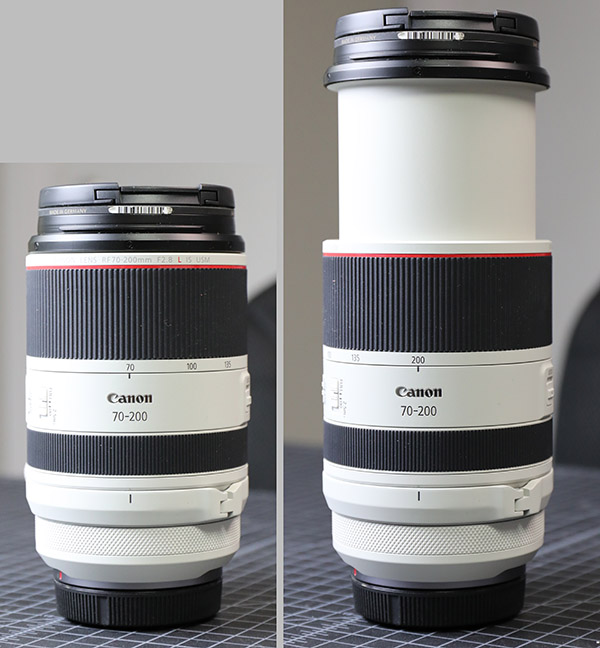
Long ago, a visiting Canon engineer put a box on my workbench, grinned, and said: “You’re going to like this.” Then he pulled out a mock-up of the RF 70-200mm f/2.8 IS lens, and my jaw dropped. I’ve been doing this stuff for a long time. My jaw drops very infrequently. My only comment was, “That’s going to sell you a lot of cameras.”
Now the lens is here and available. The jaw-dropping part is that (when not extended) it’s only 5.75 inches long and weighs only 2.35 pounds. Extended, of course, it’s nearly as long as a more normal 70-200 f2.8 lens, although it’s still a pound lighter than the EF (or Sony or Nikon) versions.
There’s a lot of ‘how did they do that’ in this lens. Obviously, some of how they did that was going to an extending barrel design, but that doesn’t explain the weight difference. Another is that they were able to reduce the amount of glass; the RF has 17 elements in 13 groups, compared to 23 elements in 19 groups for the EF version. Canon claims that the shorter back focus distance with a wider opening allows them to place larger elements closer to the sensor to achieve this. The fact that the rear element is a large aspheric with subwavelength coating, and that the other rear elements are large, supports this.
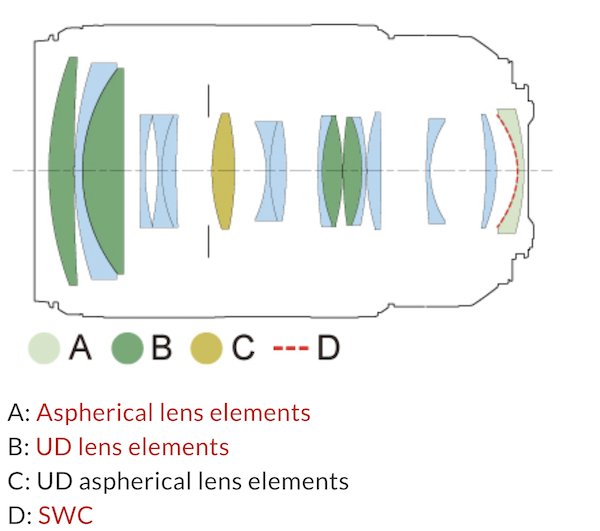
https://snapshot.canon-asia.com/taiwan/article/en/rf70-200mm-f28l-is-usm-6-things-you-need-to-know
There are also some interesting tidbits we know about this lens, like the fact that it has two separate focusing groups, each with its own motor. The bottom line is we couldn’t wait to open one up and see what was inside.
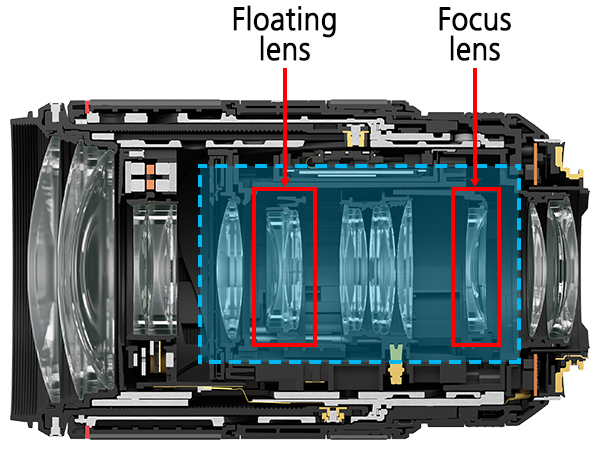
https://snapshot.canon-asia.com/taiwan/article/en/rf70-200mm-f28l-is-usm-6-things-you-need-to-know
Before we start, though, let’s get the extending barrel discussion out of the way. Some of you HATE extending barrel lenses. That’s cool; don’t get one. Some of you like to call them dust pumps. That’s cool, too, although it’s incorrect. (We take care of over 20,000 lenses. The most common ‘dusters’ among current lenses all happen to be primes that don’t zoom at all.)
Let’s Take Things Apart
Aaron wants me to start by saying he did this tear-down under duress. We didn’t have any of the cheap Dynamite #00 screwdrivers he loves, so he had to work using a more expensive, but apparently completely unacceptable, Huijadi #00. You can’t tell from the pictures, but he bitched during nearly every screw removal.
Opening the Front
The tripod ring is a pretty standard design, unscrew the knob a turn and pull out to unlatch it. The latch is Canon’s standard e-clip-holds-in-place design.
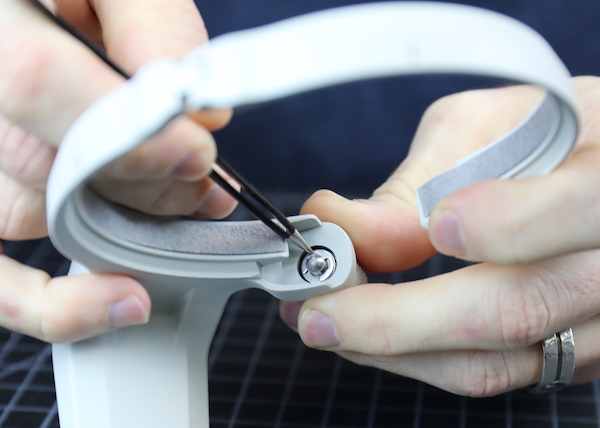
The hinge is just a press-in expansion rod. This is not the most robust of tripod rings we’ve encountered when it’s off the lens. If you remove it a lot, I’d suggest closing it back up before dropping it in your camera bag; with some leverage, the hinge could bend. Mounted on the lens, though, it’s quite sturdy.
Looking at the front of the barrel, it seems the filter ring should be easy to remove. This is a good thing, filter ring replacement is a reasonably frequent repair, and on some lenses, it’s overly complicated and expensive.
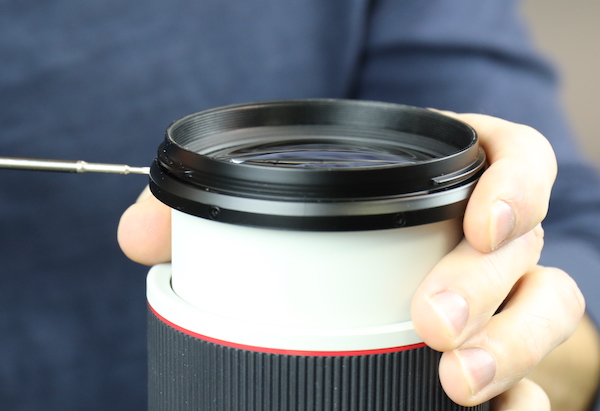
The ring does come off with just the removal of the external screws. It seems silly, but it’s a big deal if you ever repair lenses. With some lenses, a filter ring replacement requires a nearly complete tear-down.
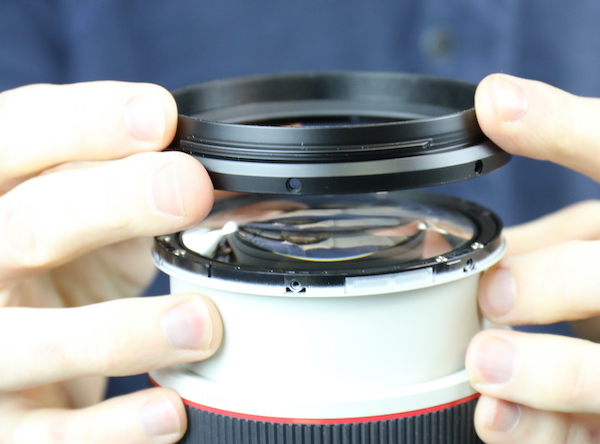
As expected, there is a foamed sealing ring between the filter barrel and the front element.
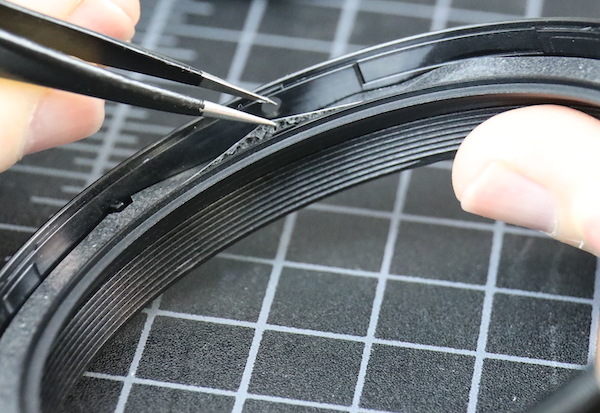
And a new thing we hadn’t seen before. The ports under the filter ring are covered with a breathable filter. This would let air pass through as needed but would filter out dust particles. Nicely done.
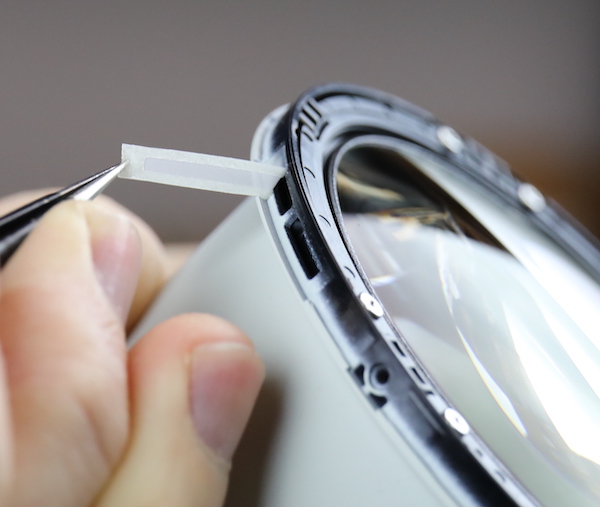
It seemed the front group was held in place by six screws, and we didn’t see anything to suggest shimming or centering adjustment, so we removed those.
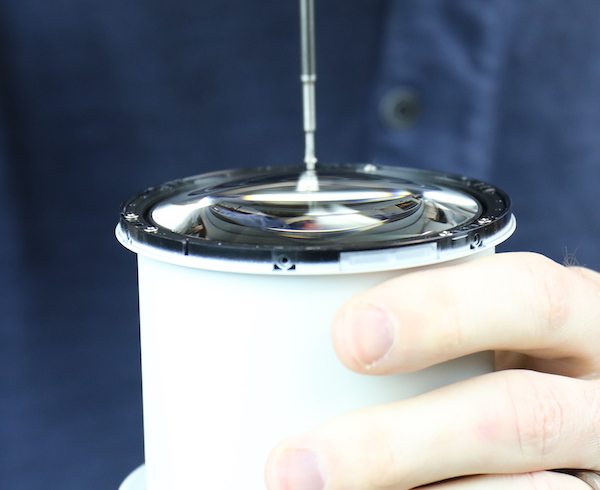
After which the front element came right out. I need to emphasize the lack of shims or adjustment on the front group of an extending barrel lens is unusual; it means the barrel has to be kept to very close tolerances as it extends. It also means the front element has been designed to not be one of the more critical elements in the lens.
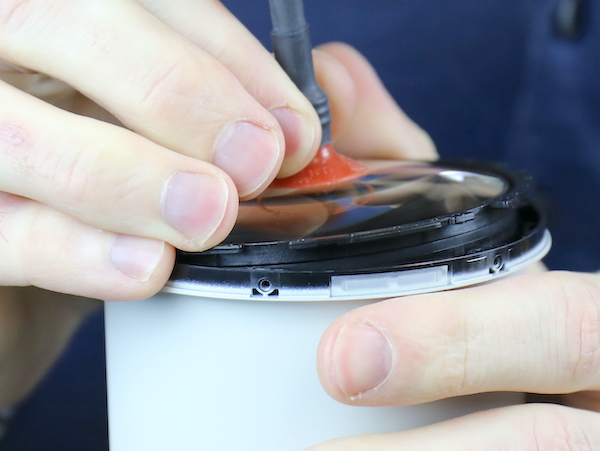
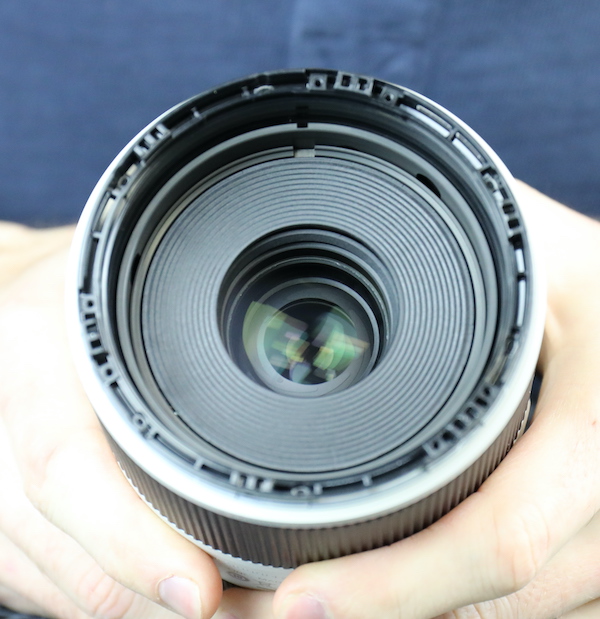
Looking down into the now empty barrel, we see a light shield and a reasonably large IS unit. There’s no further disassembly we can see here, so we’ll turn things over and open up the back next.
Removing the Rear Barrel
Lens mounts are lens mounts, and this one isn’t really different. The visible screws were removed, and the rear light baffle popped out.
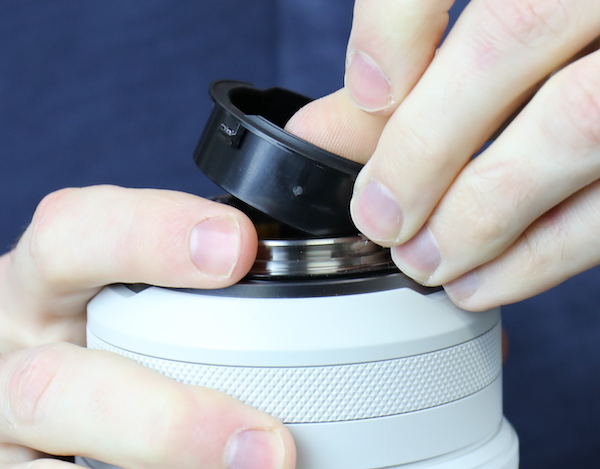
The metal bayonet mount comes off next. It has the usual Canon rubber weather sealing around the base.
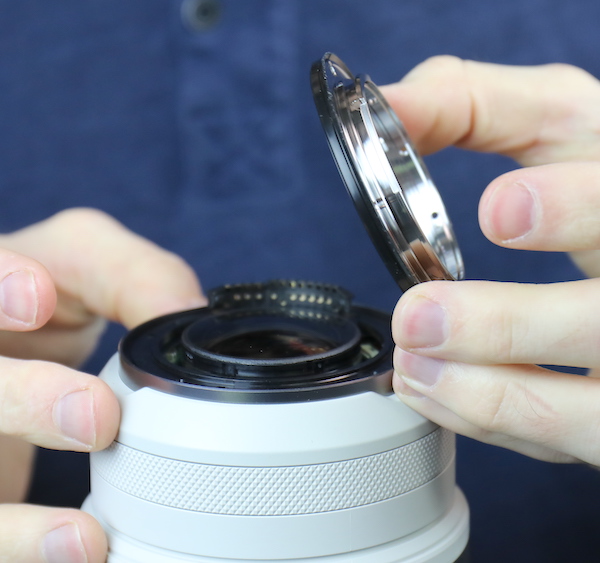
There is a polycarbonate spacing ring that comes off next. Sometimes these are sized in place of rear shimming, but we didn’t see any markings indicating either this or the bayonet thickness, came in different sizes. Note also there is a plastic insulator over the top of the PCB (still in the lens).
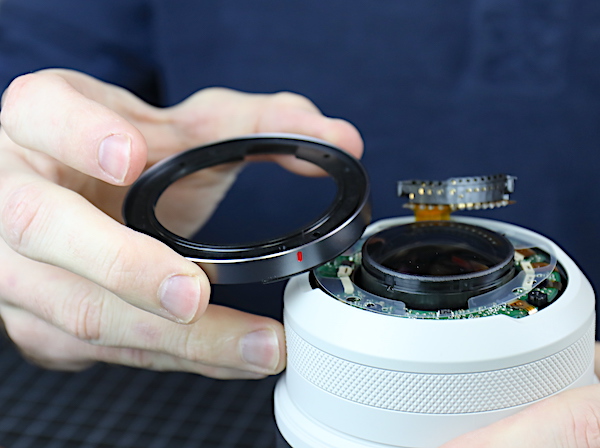
The PCB is held down by a couple of screws. Under one of these is what looks like a spring clip. This is actually a ground; the spring action keeps it held in place to do its grounding job.
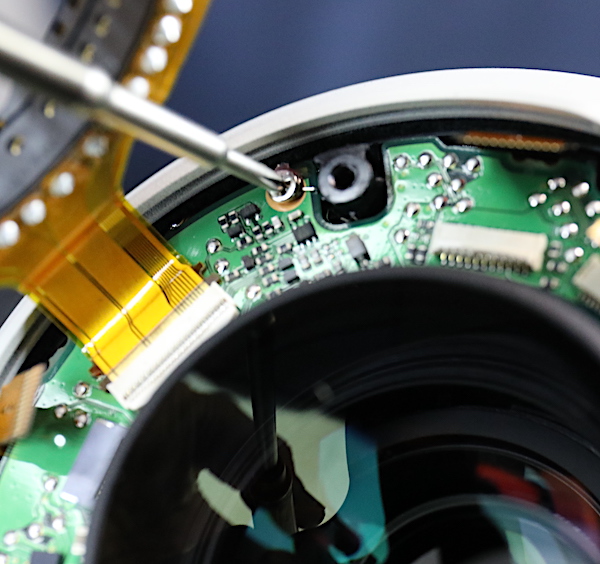
As with all RF lenses, the PCB has more flex connections coming and going than the EF lenses do. There are two groups of copper-covered induction coils sandwiching chips. From the positions of flexes, we assume each of these sets is the current source for one of the two focusing motors. There’s also what is probably a processor chip and an EPROM back here.
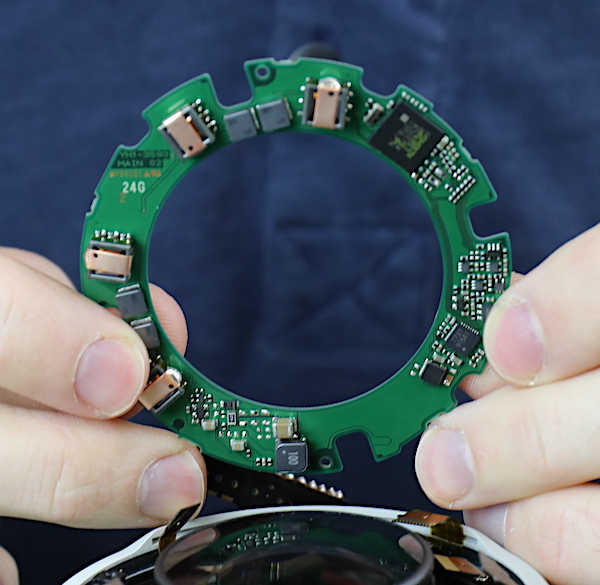
Now we’re starting to boldly go where we’ve never been before. RF lenses tend to be more involved in the rear barrel because of the increased electronics. If you’ve noticed, in this lens, there’s no switch plate, the switches are all mounted directly into the barrel, so things are a little bit scarier. A switch plate can be removed and show the other end of flexes; in this case, we’re not sure what’s going where.
There are three screws begging to be removed now.
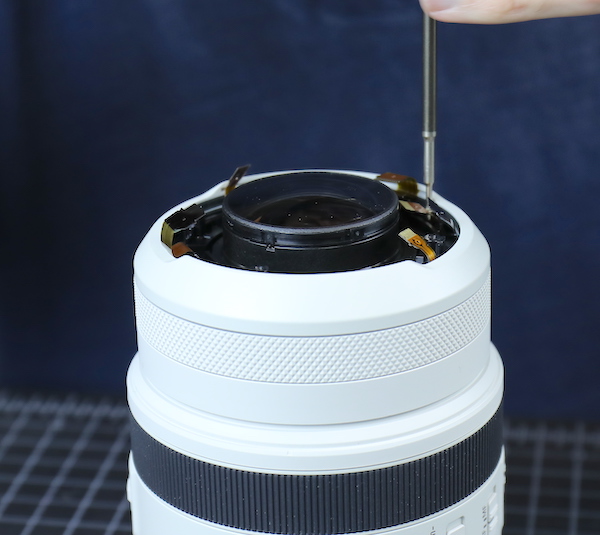
That let us take off the rearmost fixed barrel.
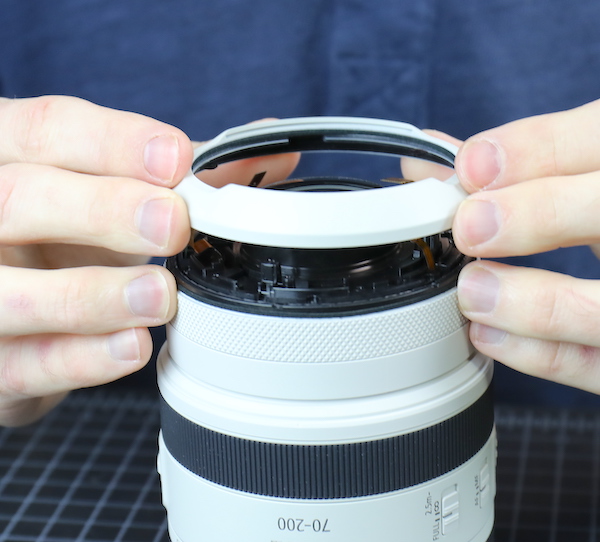
And then the grounding spring we noticed earlier.

The programming ring slides off next.
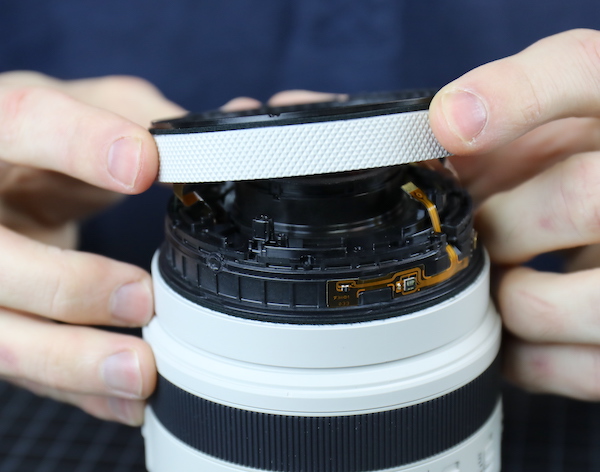
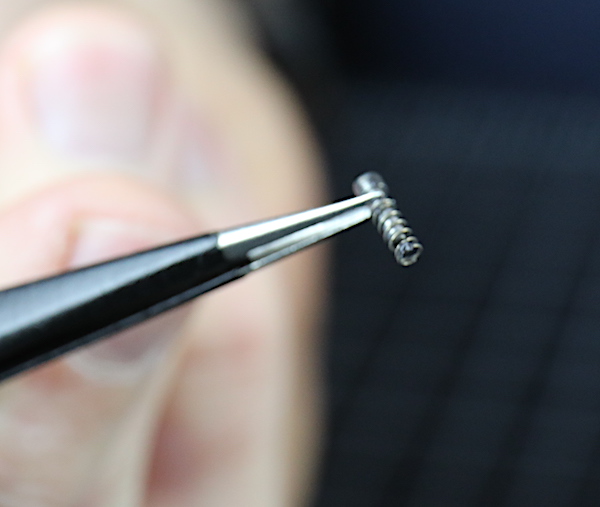
There’s a small, spring-loaded rod that gives the slight clicks you feel when rotating this ring. Usually, a spring-loaded ball bearing is used for this, but the rod-and-ball seems to give tactile ‘click’ feels without any sound being made; maybe that’s better for video use. From our long experience, things with springs like to spring out onto the floor, and this rod will be a lot easier to find than a ball bearing.
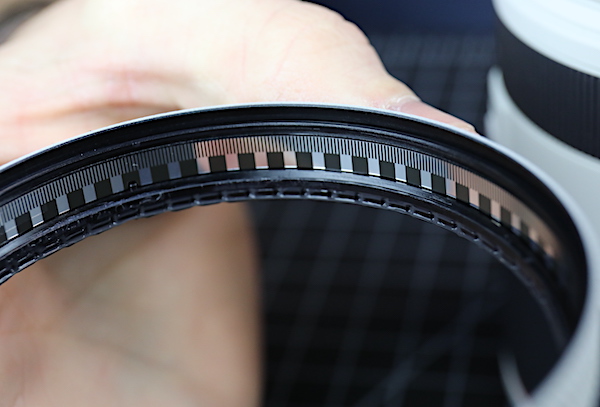
Inside the ring are the optical markings that the camera reads when you rotate it.
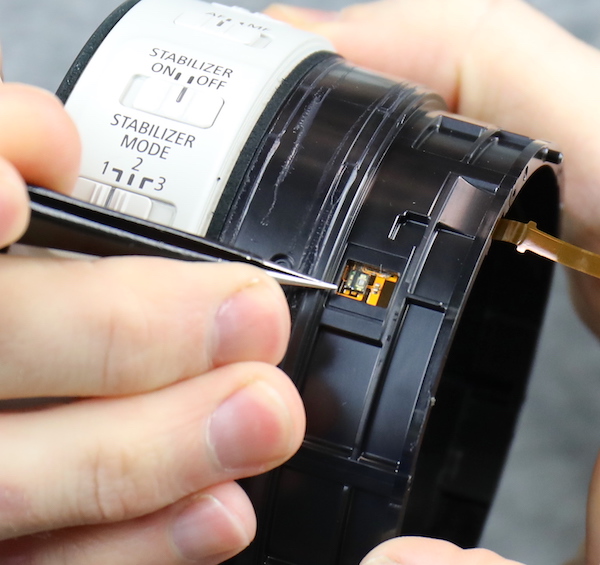
On the inner barrel underneath the ring, you can see the optical sensor that does the reading.
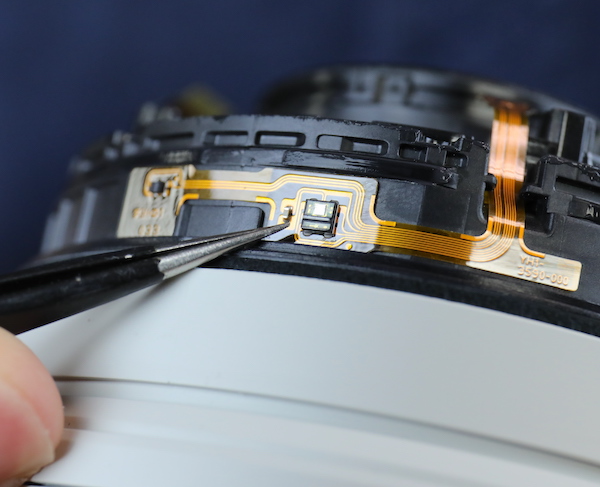
On the same barrel, located 90 degrees apart, are the two movement sensors for the image stabilizer. The flex from these goes back to the PCB, not directly to the IS unit. Perhaps there’s an analog-to-digital conversion or some other reprocessing going on in one of the PCB chips.

Looking down onto the rear barrel, you can see 6 (actually you only see 5 in the picture) screws that are screaming, “take me, take me.” You can also see several flexes, some with metal attachment plates that are strongly suggesting they’d like to tear if we try to force them through the too-small slots the seem to have been threaded through.
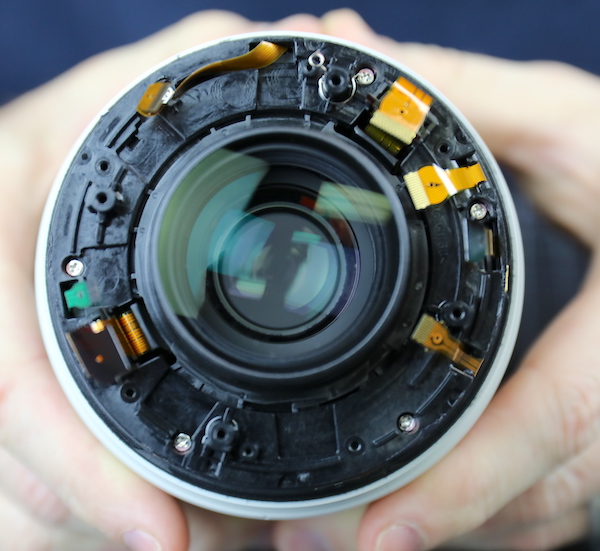
As we do in such risky situations, we looked at our other options for proceeding with our disassembly. Since the only ones we could think of involved table saws, Aaron continued to remove the screws (complaining about his screwdriver the entire time), then spent literally 20 minutes slowly backing the barrel up while threading flexes through their slots. You can see in the image below he’s made like 2mm worth of progress.
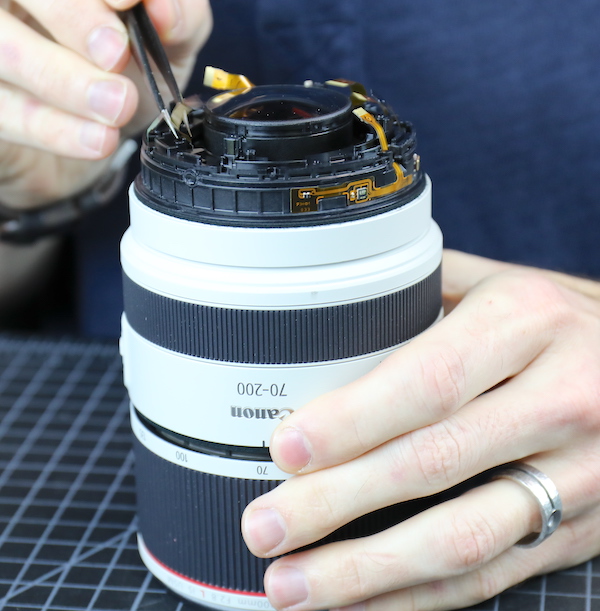
But eventually, and with no loss of electrical conductivity, the outer rear barrel came off. As you’d expect, there’s a foamed seal along the forward edge.
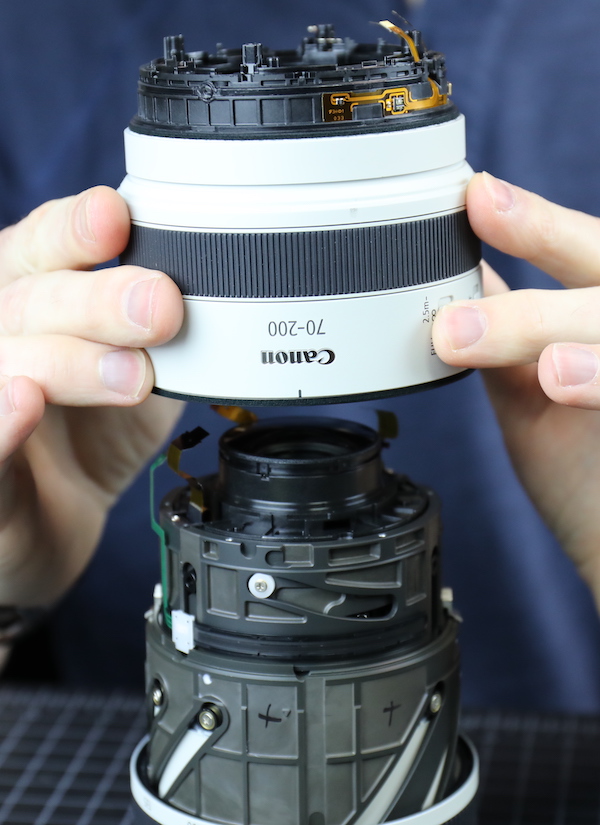
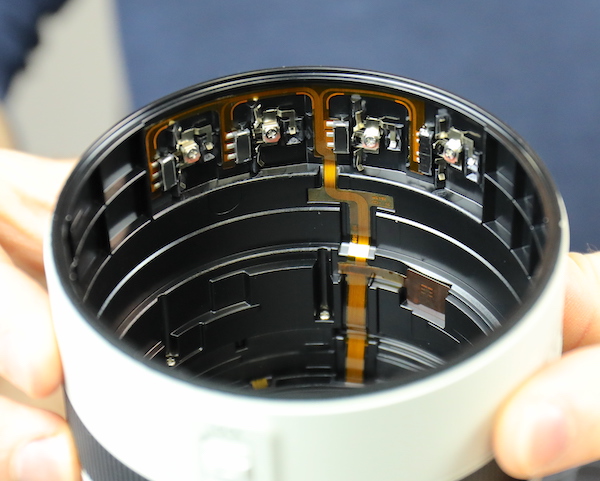
Looking inside the barrel gives us one of those moments where we salute Canon’s engineers, the flexes are all beautifully laid out and organized, going directly to their appointed place with no wandering about allowed. Notice how all the switches just take up one small flex; there’s not a lot of electron transfer needed to signal ‘on’ or ‘off’ compared to the amount of information that IS or focusing requires.
Disconnecting the flexes and removing a couple of pins lets us separate the barrels (again, note the foam sealing ring between every barrel piece).
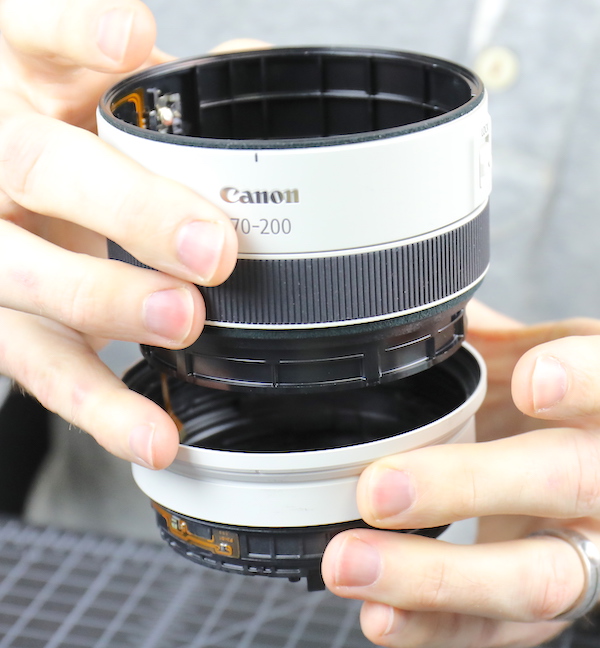
The focusing ring slides off the barrel. I don’t show it, but there is a spring washer underneath it, giving that smooth resistance you feel when turning it.
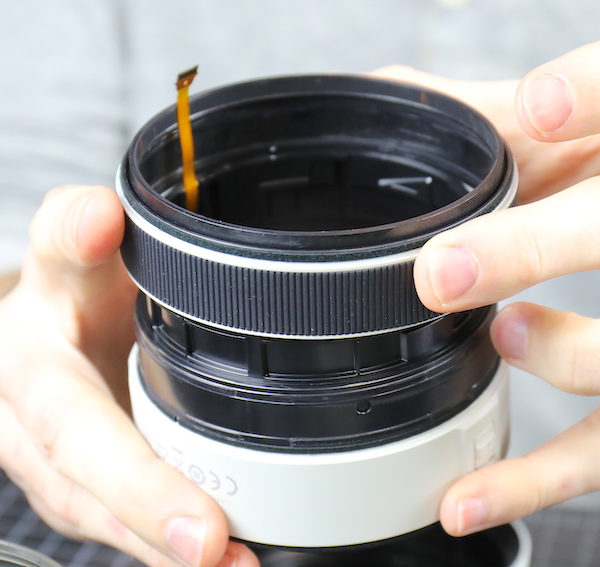
Under the ring, of course, is an optical position sensor.
The Inner Workings
With the rear barrel off, we start finding out some interesting things. First, I had mentioned earlier that the extending barrel would have to be held to close tolerances. If you’ve had a consumer-grade zoom with extending barrel, you may be aware that the barrels can have some play in them, allowing them to droop a bit when fully extended. This adversely affects optics.
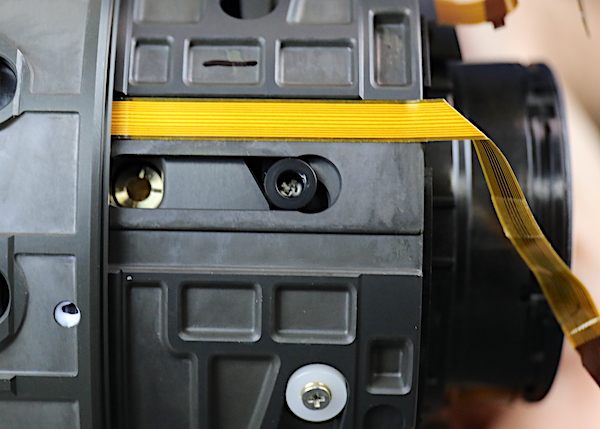
The Canon RF 70-200mm has about the most robust extending barrel mechanism I’ve ever seen. There aren’t the usual three cams sliding about to move this barrel, there are three pairs of them, and each is very large and robust.
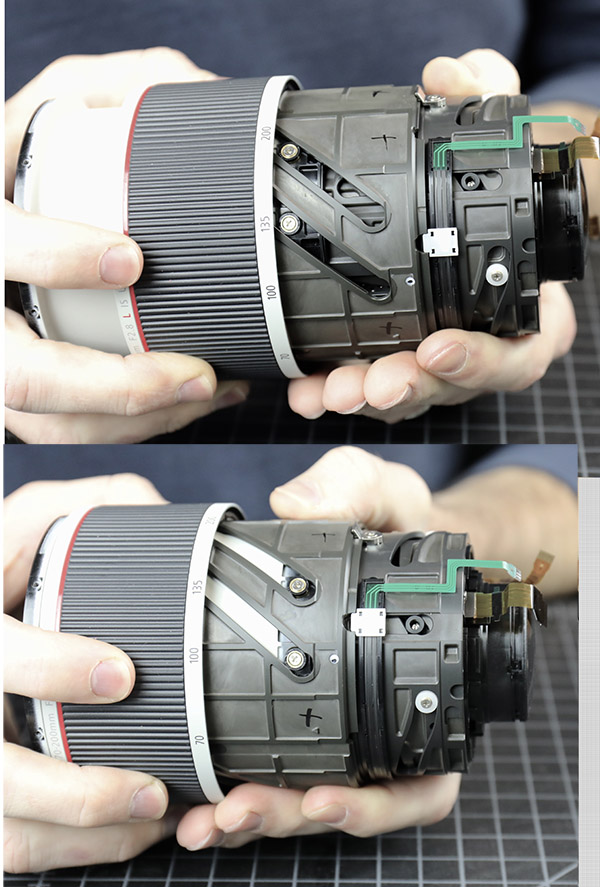
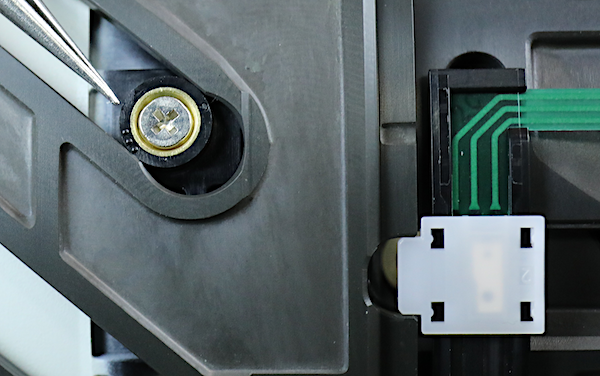
Close-up, you can see each of the six consists of a large screw, brass collar, and nylon (it’s probably not really nylon, but I have no clue what, so I’ll pretend it’s nylon) ring around the brass. Later in the disassembly, we found that each of them is sized, assuring a perfect fit in its slot with no looseness or binding. The plastic cover with green wires to the right is a magnetic position sensor; these are modern versions of the electronic brushes lenses have always had. I don’t know if they’re more accurate, but they are self-contained and less delicate for sure.
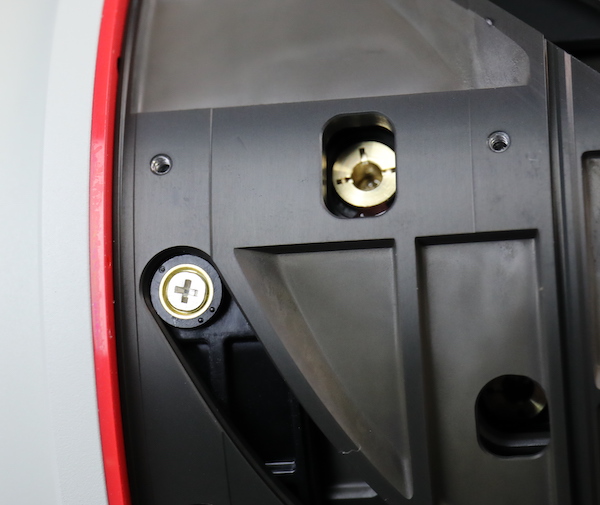
Rotating the barrels a bit, we can see another large sliding cam for the rear focusing group (black) with a large, brass eccentric collar for an optical adjustment just in front of it.
Looking back towards the front, we can see the zoom ring is held on by three sets of two screws. At the bottom of the opening between them, we can see another eccentric collar. Notably, all of the eccentric collars we’re seeing are heavy brass, not plastic, and there are none of the glued-in-place silicone glops we’ve grown to hate so much. That means these are sturdy enough to stay where they are set (brass is better at that than plastic), and no need to pick out bits of glue if an adjustment is necessary.
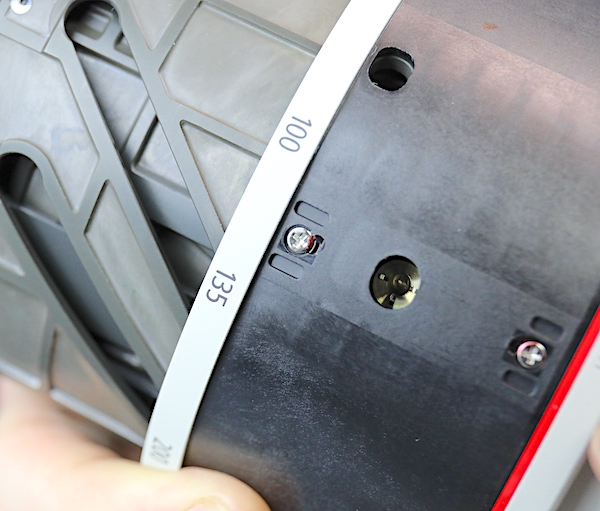
Back to disassembling, removing those six screws lets us slide the zoom ring off of the inner barrel.
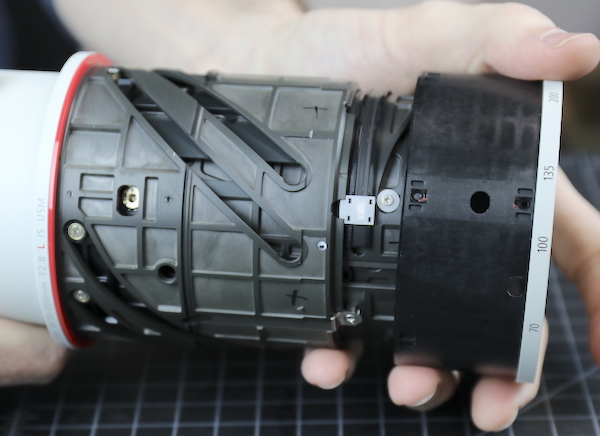
This gives us a better look at the set of eccentric adjustment collars you saw between the screws holding the zoom ring on.
Now, if you want to reproduce what our teardowns are like in real-time, spend the next 20 minutes looking at something from 16 directions. It took us quite a while to decide what the safest next step was. Eventually, we took off the focus sensor, took out the front barrel cams and stop clips, and then spent about 15 minutes sliding the external zoom barrel off without tearing any flexes.
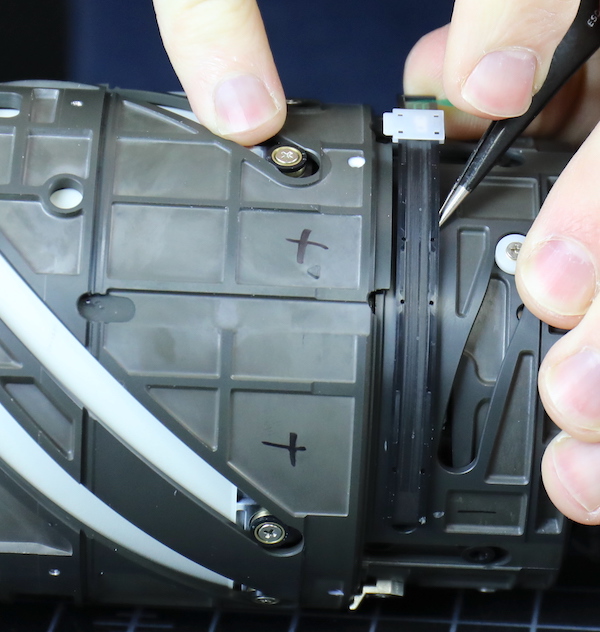
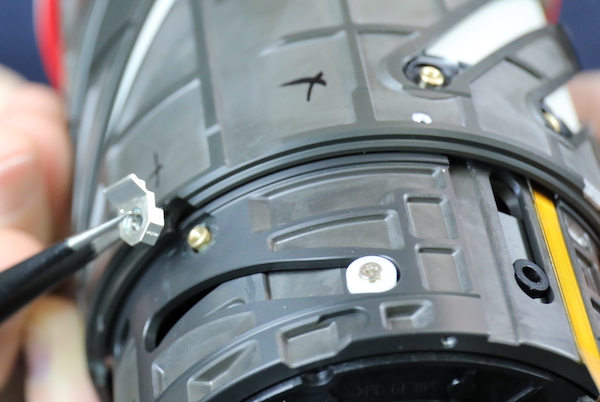
And finally, the outer cam barrel is off. To the right, you can see all of the roller hardware laid out in a grid; this is where we discovered they were specifically sized to keep the extending barrel smooth and without sag or play, so each had to go back to the correct position.
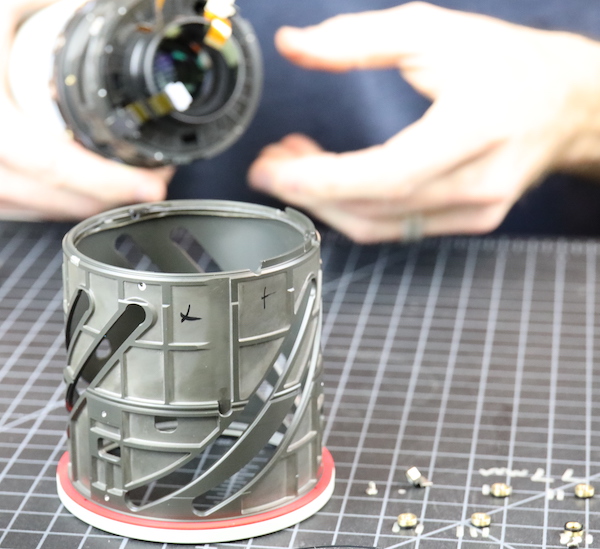
Despite all the disassembly we’ve done, we’ve barely scratched the surface.
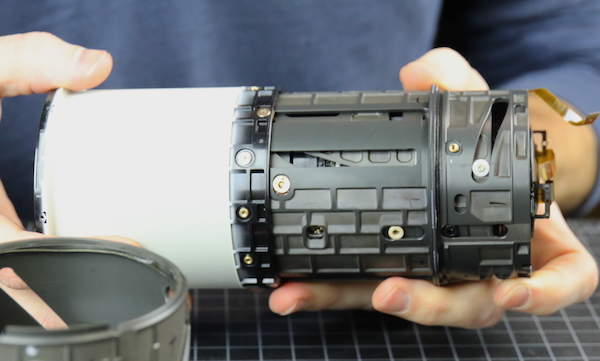
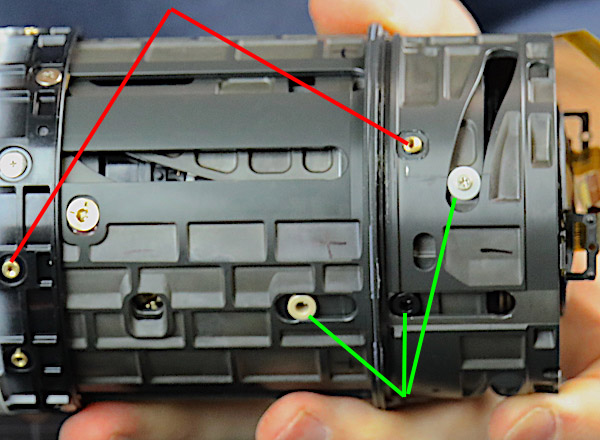
To kind of show you around, the red lines are pointing to the brass posts that held the bearings we just took out. Green lines are pointing to the focusing group collars that are still in place. The takeaway is the engineering, despite the lightweight of the lens is very robust. Every moving part is large and sturdy and held steady by more than one set of collars or bearings, so there’s no chance of unwanted movement.
The focusing element bearings are removed next.
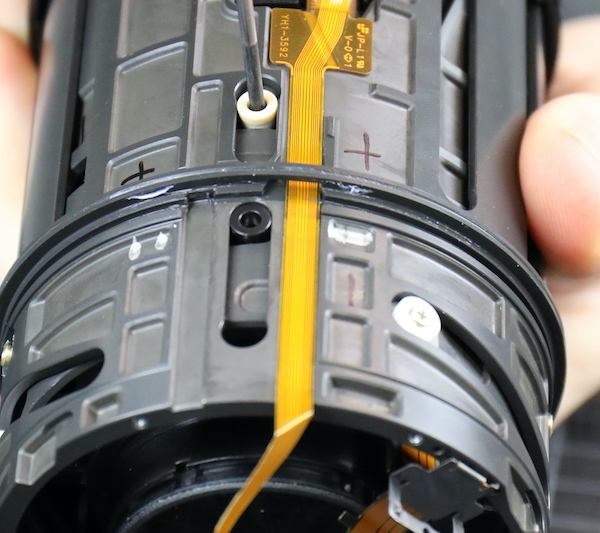
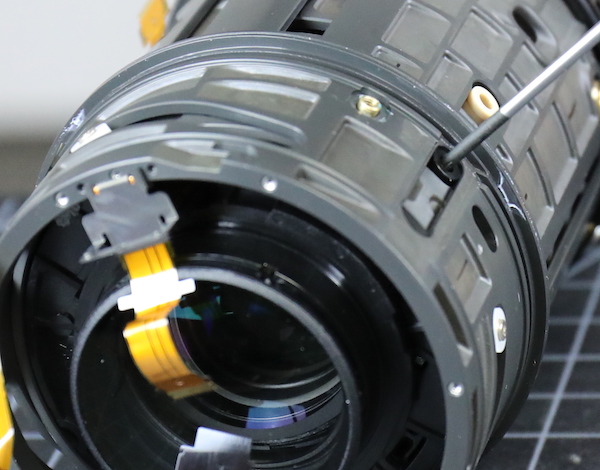
Once those are all out and the flexes cleared, we can slide the focusing assembly out of the inner cam barrel.
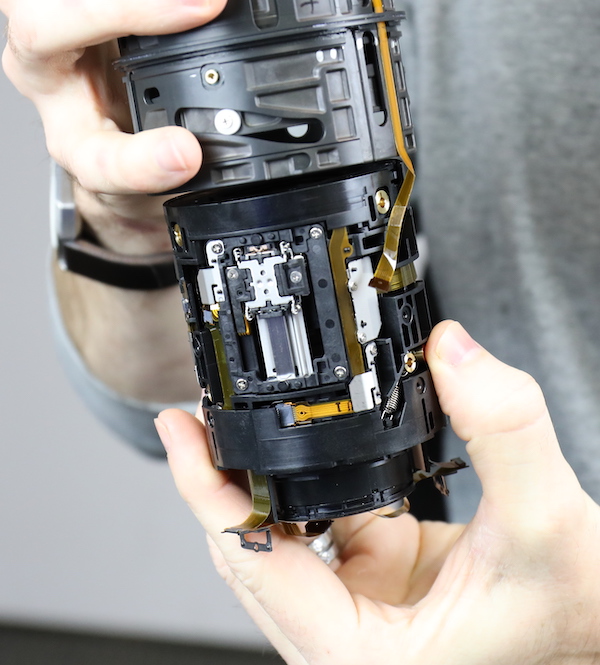
The outer barrel now contains just the IS unit (that’s the IS flex running along the barrel). You can also see one of the large, brass eccentric collars that adjust the IS unit optically.
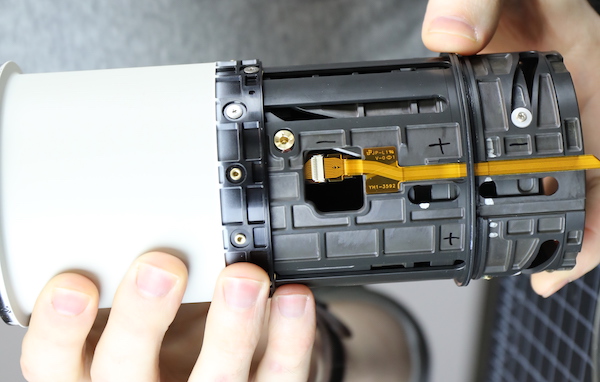
Looking inside shows the large IS unit. We’re not going to take this apart, it requires factory programming, and we don’t have that kind of equipment.
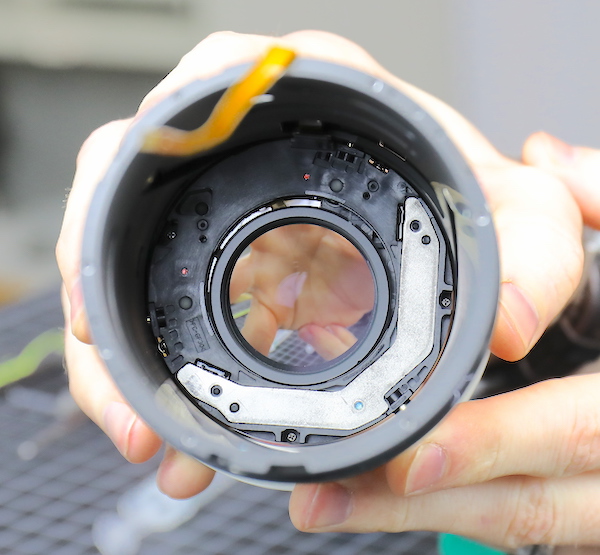
The Focusing Assembly
The interesting parts of the lens are mostly in the inner focusing assembly, not only electronically, but also optically. We took off the front group (3 elements) at the start, and the IS unit (3 more elements) is in the barrel we just showed you. The other 11 elements of the lens are all back here. This ‘glass at the rear’ design is what allows this lens to be both shorter and lighter than other 70-200mm lenses. The linear focusing motors are also smaller and lighter than ring USM type motors.
Looking at the assembly, the first thing we noticed is the doubled eccentric adjustment collars; these appear to adjust the fixed groups between the two focusing elements. There’s another single adjustment collar toward the front. This one adjusts the fixed element in front of the front focusing group.
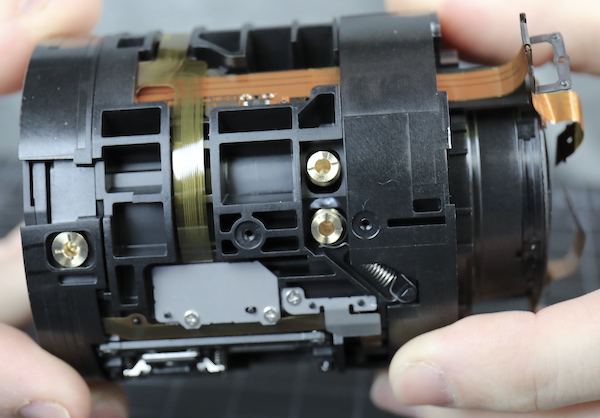
Rotating the assembly around a bit, we can see one of the linear focusing motors. In the early days of such motors (circa 2015, before Canon used them), they were often a bit fragile and in a couple of early lenses, sometimes broke. As you can see, these are not your grandfather’s linear motors; they’re heavily constructed things with multiple clamps and screws holding everything in place.
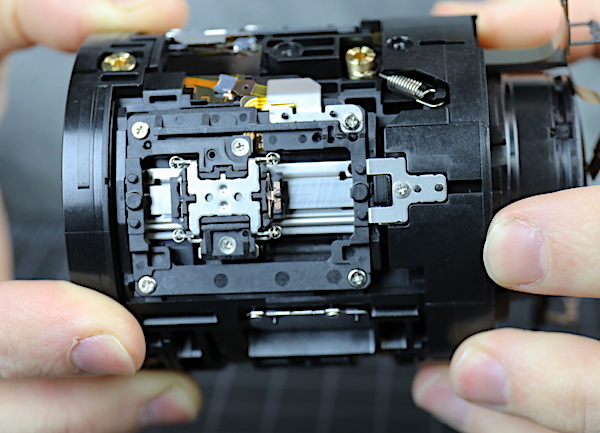
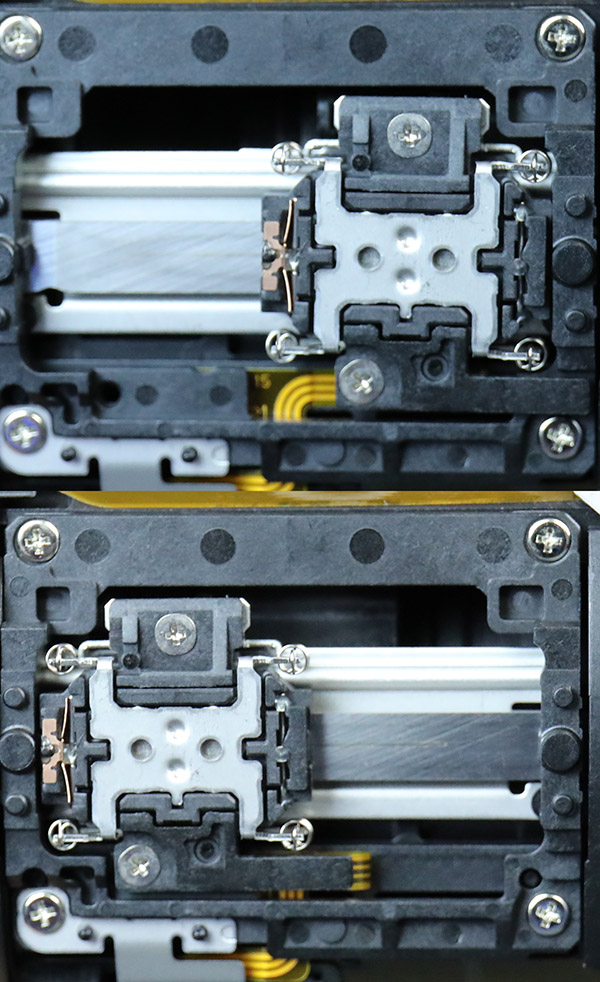
The closeup below shows the travel of one of the focusing motors.
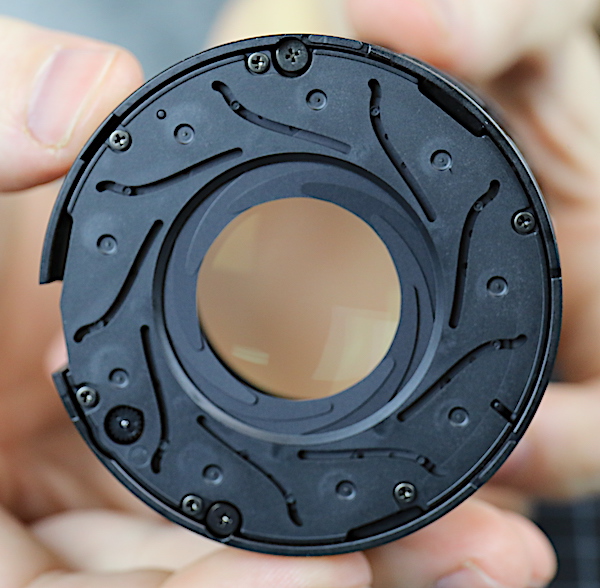
Looking at the front of the focus assembly, we see the aperture. Right behind the aperture is the front fixed element in this barrel. The aperture is very smoothly circular, as you would expect (but don’t always find) in a lens of this price.
The rear group moves during focusing but is attached to the motor from the outside by keys and clips. This same motor moves the internal rear focusing group simultaneously.
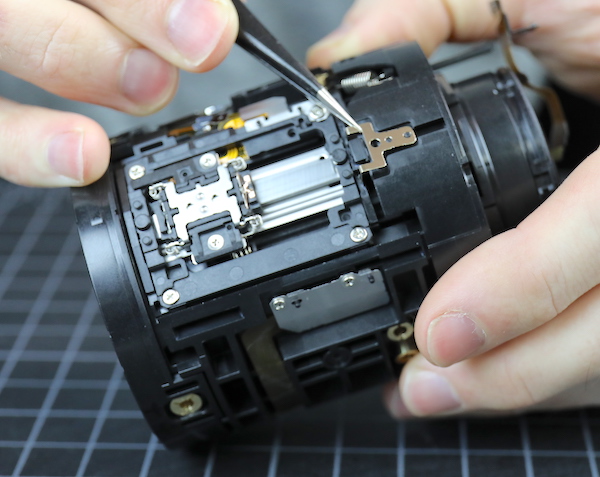
Removing those keys and a few more screws lets us take off the rear group.
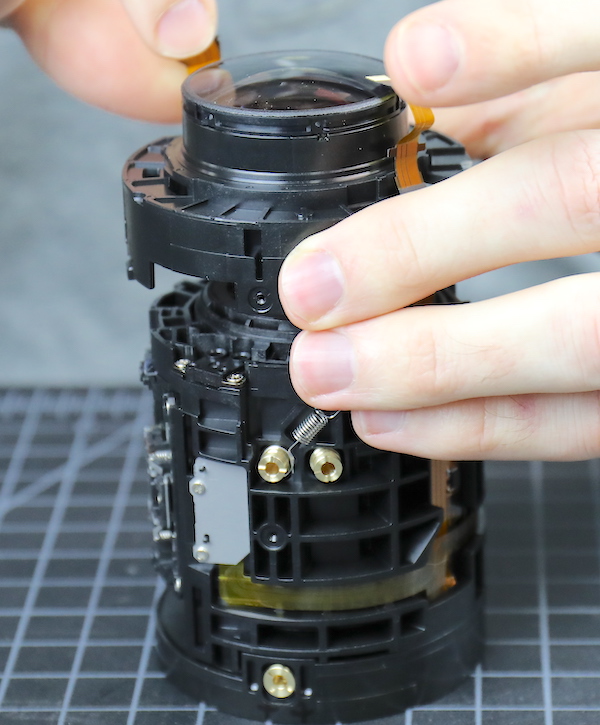
Now looking down at the back of the focusing assembly, we see the rearmost focusing element. As you can see, looking at it (and from the lens diagrams above), it’s a strongly curved meniscus.
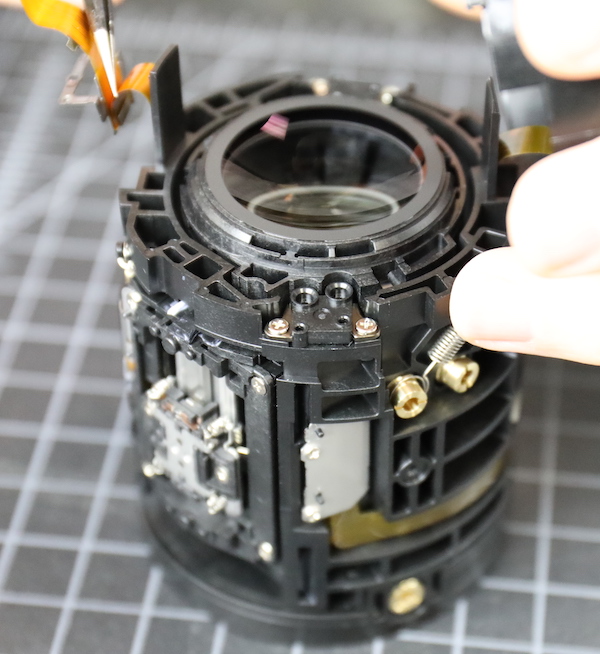
Here’s a view of the rear focusing group’s travel range (compared to the fully back position above). Note how it slides on double posts, not the single posts we usually see in liner focusing assemblies. This provides more stability to prevent any tilt of the element as it moves during focusing.
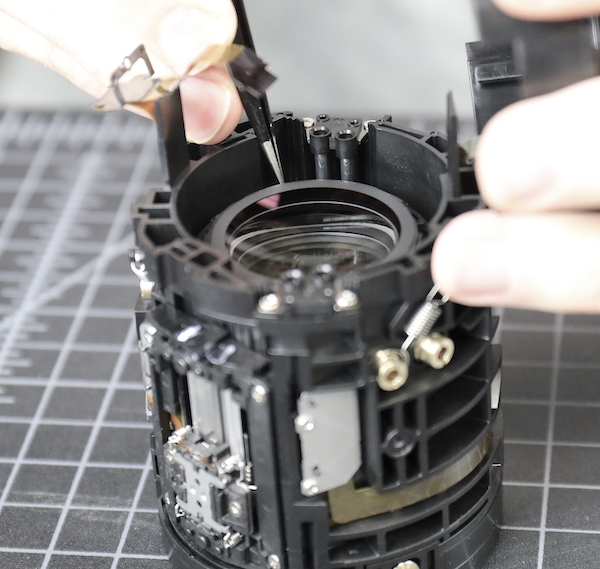
Taking apart the focusing motors and elements is doable, but our call is no good can come of it. There’s really nothing more we’d learn by doing it, and we’d have to readjust all those optical adjusting collars. What is apparent is that, in all likelihood, this entire focusing assembly is one part. If it breaks, the entire assembly (motors and optics) would be replaced as a unit. That’s going to be an expensive part. On the other hand, we doubt it’s a part that will really ever need replacing. This is SLB (Strong, Like Bull) engineering, and the area is well protected.
Conclusions and Impressions
I’d strongly encourage you to look at our teardowns of the Canon EF 70-200 f2.8 IS lenses and the two-part teardown of the Sony 70-200mm f2.8 GM lens for comparison to this. You’ll pretty quickly reach a couple of conclusions. The first conclusion is that this article should have been two parts, like the Sony one; it’s too long.
The second conclusion is in the years since those lenses were released, a LOT of engineering progress has been made. The Canon RF 70-200mm f/2.8 is a complex beast, but you get a quick feel for it being organized complexity, and it’s actually a much simpler layout than those other lenses. Some of that is from the improved optical design; there’s less glass floating around. Some of it is the use of linear focusing motors.
Most of it is superior electro-mechanical engineering and a brand-new, ground-up design. It’s clear those other lenses were improvements on existing designs. Over the years, as various versions of the lenses have been released, it’s apparent that they started with the previous design and modified it. Like a lens paleontologist, we could see the bones of the original beast with layers of new complexity and modifications added in the newer version. (Yes, I’m very aware it was Sony’s first FE 70-200mm lens, but, to be polite, it heavily borrowed from other 70-200mm lenses mechanically).
This lens was a new design from the ground up. There’s no ‘that’s the way we’ve always done it’ holdovers. That’s a lot more work for the designers, but the result is a beautifully engineered, fully modern lens. It’s clean, functional, and straightforward.
It’s obviously very robustly engineered from a mechanical standpoint. The internal composites are strong as hell. There are double cams, rods, and posts everywhere. There’s no play in any moving parts. We can’t imagine there will ever be play in the moving parts unless you run over it with a truck. You could describe it as ruggedized, but I’m going to stick with Strong, Like Bull, and suggest we refer to this as the RF-SLB 70-200mm f/2.8 from now on.
There are a lot of nice touches, like the air filter tape over the openings around the front group. Will it prevent the lens from getting dust inside? Of course not; every lens gets dust inside. But it’s helpful and shows they’re trying. It’s also the first lens in a decade that I can say was obviously designed with ease of repairability in mind, at least as far as they could. Replacing the filter ring or front or rear element is going to be quick and straightforward. The downside is, like many lenses with linear focusing systems, that focusing assembly is probably a ‘replace not repair’ part, and that will be an expensive, albeit rare, repair.
There are some of you who are going to scream about how you want metal lenses. OK, Boomer, go get you a metal lens and show us how strong you are. On every other 70-200mm lenses we’ve disassembled, there are multiple metal parts that we can bend with our fingers. There’s not a damn thing we can bend with our fingers in this bad boy. This is going to hold up better than a metal lens, it’s probably sturdier, and it weighs far less.
I haven’t tested it optically. I haven’t even shot with it. But after looking inside it, I want it. The engineering in here is pure art. And even I, the person who mocks construction at any chance I get, can’t find anything to complain about.
Like Montel (sort of) said: This is how you do it!
Roger Cicala and Aaron Closz
Lensrentals.com
December 2019
165 Comments
Andre Yew ·
Hey Roger and Aaron, thanks for this amazing (and brave) tour of what should be a great lens!
On one of your recent podcasts, you mentioned that cine lenses were designed to be regularly torn down and serviced. Is the construction of those lenses very different from this, and how much of the cine lens price premium would you guess comes from this kind of design? I’m wondering whether stills lenses can economically be designed so that they’re maintainable over a long lifetime.
Roger Cicala ·
I think by far the biggest part of the price is simply the numbers. A manufacturer sells many thousand photo lenses, compared to several hundred or a few thousand cine lenses. Things like design, machining jigs, engineering, all get spread out over the expected number of lenses sold.
The accuracy of Cine lenses is part of it too. If you put a Cine lens focus ring at 18 feet, it’s plus or minus an inch. A photo lens at 18 feet is plus or minus, oh, could be 7 or 8 feet sometimes. And as you say, being set up for easy repairability and adjustment adds some too, but not the greatest part.
Nicholas Bedworth ·
Speaking of numbers, it would be interesting to hear how you took Lens Rentals from an idea to a 20,000 lens inventory…
Roger Cicala ·
It’s a really long story that is largely a series of accidents. It was not my plan. It’s a Southern Fairy Tale.
You know the difference between a Fairy Tale and a Southern Fairy Tale? A Fair Tale starts “once upon a time”. A Southern Fairy Tale starts “Y’all ain’t gonna believe this shit.”
Nicholas Bedworth ·
???
Andre Yew ·
Hey Roger and Aaron, thanks for this amazing (and brave) tour of what should be a great lens!
On one of your recent podcasts, you mentioned that cine lenses were designed to be regularly torn down and serviced. Is the construction of those lenses very different from this, and how much of the cine lens price premium would you guess comes from this kind of design? I'm wondering whether stills lenses can economically be designed so that they're maintainable over a long lifetime.
Roger Cicala ·
I think by far the biggest part of the price is simply the numbers. A manufacturer sells many thousand photo lenses, compared to several hundred or a few thousand cine lenses. Things like design, machining jigs, engineering, all get spread out over the expected number of lenses sold.
The accuracy of Cine lenses is part of it too. If you put a Cine lens focus ring at 18 feet, it's plus or minus an inch. A photo lens at 18 feet is plus or minus, oh, could be 7 or 8 feet sometimes. And as you say, being set up for easy repairability and adjustment adds some too, but not the greatest part.
Brandon Dube ·
Service too. Arri just put out an ad for what their ($40k/ea) cinema lenses can go through. https://www.youtube.com/wat...
Between two of the machines they show about $300k of equipment, and it will have cost them ~$100-$200k to have built their clean room (though without face masks it isn't a clean room at all).
The parallel that some photo lenses have to be fixed with is a screwdriver, a pretty good hand to rap it on the table with, and a mallet for when that doesn't do the trick.
Nicholas Bedworth ·
Speaking of numbers, it would be interesting to hear how you took Lens Rentals from an idea to a 20,000 lens inventory...
Roger Cicala ·
It's a really long story that is largely a series of accidents. It was not my plan. It's a Southern Fairy Tale.
You know the difference between a Fairy Tale and a Southern Fairy Tale? A Fair Tale starts "once upon a time". A Southern Fairy Tale starts "Y'all ain't gonna believe this shit."
Nicholas Bedworth ·
😄😄😄
Andreas Werle ·
Thanks for showing us the teardown, Roger!
This is nice work done by Canon. Why are filter rings and front elements not always as easy to remove? No balls to spring at the floor, neat layout of flexes inside the barrel, sturdy exending mechanism, beautiful exccentric collars made of brass without silicone around them – everything made beautiful. Cant wait for your MTF-measurements!
Greetings Andreas
Andreas Werle ·
Thanks for showing us the teardown, Roger!
This is nice work done by Canon. Why are filter rings and front elements not always as easy to remove? No balls to spring at the floor, neat layout of flexes inside the barrel, sturdy exending mechanism, beautiful exccentric collars made of brass without silicone around them - everything made beautiful. Cant wait for your MTF-measurements!
Greetings Andreas
Olandese Volante ·
Bravo!
That’s how us engineers like our pornography! 😉
Roger Cicala ·
It’s pure sexy, isn’t it??
Olandese Volante ·
Indeed. Mouth-wateringly sexy.
Now I just need to win a lottery 😉
Jeffrey Yang ·
LOL?Hopefully I won the lottery before You!! With this pound off beast, and lighter body, I do have to now seriously consider changing to mirrorless FF.
Olandese Volante ·
Bravo!
That's how us engineers like our pornography! ;)
Roger Cicala ·
It's pure sexy, isn't it??
Olandese Volante ·
Indeed. Mouth-wateringly sexy.
Now I just need to win a lottery ;)
Jeffrey Yang ·
LOL,Hopefully I won the lottery before You!! With this pound off beast, and lighter body, I do have to now seriously consider changing to mirrorless FF.
Brandon Dube ·
The double-cam is a win win. The increased constraint will make the barrel run more true, and the air where the (composite, which used to be metal) used to be reduces weight more. They probably only saved a few grams doing that, but a few grams here and there adds up to a point faster than you might think.
The single motor for both focus groups is really smart too. It keeps the positions of the two focusing groups from getting desynced. If they were desynced, the optical quality would probably tank quickly. So this is fewer parts (a win) and better optical reliability (a win). Canon really showing that they are smart as hell when unburdened with legacy with this one.
Roger Cicala ·
You know, when I saw you commented, I was expecting something about Aaron’s screwdrivers. 🙂
Brandon Dube ·
Heh, I’ve moved on. Swiss-Tool or bust! Too bad they just gave up making imperial sized hex drivers, and I think there’s about a 0 change they make stuff with JIS sizes :~)
I suppose I’ll settle for Wera hex-plus if I have to, but I won’t like it.
Brandon Dube ·
The double-cam is a win win. The increased constraint will make the barrel run more true, and the air where the (composite, which used to be metal) used to be reduces weight more. They probably only saved a few grams doing that, but a few grams here and there adds up to a pound faster than you might think.
The single motor for both focus groups is really smart too. It keeps the positions of the two focusing groups from getting desynced. If they were desynced, the optical quality would probably tank quickly. So this is fewer parts (a win) and better optical reliability (a win). Canon really showing that they are smart as hell when unburdened with legacy with this one.
Roger Cicala ·
You know, when I saw you commented, I was expecting something about Aaron's screwdrivers. :-)
Brandon Dube ·
Heh, I've moved on. Swiss-Tool or bust! Too bad they just gave up making imperial sized hex drivers, and I think there's about a 0 change they make stuff with JIS sizes :~)
I suppose I'll settle for Wera hex-plus if I have to, but I won't like it.
Jeff ·
Awesome tear down Roger! As a new adopter on this particular lens, I was most hoping you would find the time to tear this apart. Wish granted!
Unfortunately I had to send mine back to Canon 2 days after I received it because my copy suffers from front focusing (by about 3mm) at MFD, 200mm and 2.8. The problem gets better as you zoom out to 70mm or step back from MFD. The problem is 100% repeatable and even in MF the focus guide turns green 3mm in front of the target.
If you read the posts about this issue on dpreview and FM Forums, dozens of people have confirmed this problem. One camera shop tested every copy and all had the issue. Are the copies you have problem free? Thanks Roger.
Dragon ·
That sounds like a firmware problem. Note that dual pixel AF doesn’t work like CDMA. It works just like a DSLR, except that there isn’t the possibility of misalignment since the sensor is the source of the PDAF info. There is still, however, the possibility for the lens to misinterpret where it is told to go (focus wise). I have a Tamron 18-400, and after carefully tuning all the focus points with the Tap-in console to the DSLR PDAF on an otherwise very accurate (i.e. consistent between Mirror focus and DPAF) 70D body, the lens works great in DSLR mode and is off focus just about everywhere in live view. I suspect the answer will be to tune it to live view and then tweak the micro focus adjust to get the SLR function in sync. Haven’t had the time and don’t use live view that much on that camera, but the experience shows that DPAF can focus incorrectly if the firmware is not accurately tweaked.
Jeff ·
Awesome tear down Roger and Aaron! As a first adopter on this particular lens, I was most hoping you would find the time to tear this apart. Wish granted!
Unfortunately I had to send mine to Canon 2 days after I received it because my copy suffers from front focusing (by about 3mm) at MFD, 200mm and 2.8. The problem gets better as you zoom out to 70mm or step back from MFD. The problem is 100% repeatable and even in MF the focus guide turns green 3mm in front of the target.
If you read the posts about this issue on dpreview and FM Forums, dozens of people have confirmed this problem. One camera shop tested every copy and all had the issue. When you run your optical tests I’m sure you’ll see this right away if your copy has the issue. Even if not, I’d love to hear your thoughts on how this is even possible, as it’s so strange to have a front focusing lens on a mirrorless camera.
Dragon ·
That sounds like a firmware problem. Note that dual pixel AF doesn't work like CDMA. It works just like a DSLR, except that there isn't the possibility of misalignment since the sensor is the source of the PDAF info. There is still, however, the possibility for the lens to misinterpret where it is told to go (focus wise). I have a Tamron 18-400, and after carefully tuning all the focus points with the Tap-in console to the DSLR PDAF on an otherwise very accurate (i.e. consistent between Mirror focus and DPAF) 70D body, the lens works great in DSLR mode and is off focus just about everywhere in live view. I suspect the answer will be to tune it to live view and then tweak the micro focus adjust to get the SLR function in sync. Haven't had the time and don't use live view that much on that camera, but the experience shows that DPAF can focus incorrectly if the firmware is not accurately tweaked. If there are as many of these lenses as you indicate with this problem, expect to see a firmware update.
Jim A. ·
Thanks for sharing all the hard won knowledge you acquire with those of us in the cheap seats. I really enjoy the detailed teardowns and the wide breadth of experience you guys bring to the task. It’s truly engaging and I have no doubt the engineering folks at the camera lens manufacturers take a keen interest in your take on the work they’ve done, and occasionally wince at the beating they deserve when there are preventable shortcomings. It’s good to give out encouragement for the quality work done, and to offer constructive criticism to the areas in need of improvement. Even for the small minority of people who service the equipment. Your information and influence makes a difference in the progress of the technology I think. A very positive influence. Recognizing the great performance of some engineers out there drives others to improve. Thanks for moving the ball.
Jim A. ·
Thanks for sharing all the hard won knowledge you acquire with those of us in the cheap seats. I really enjoy the detailed teardowns and the wide breadth of experience you guys bring to the task. It's truly engaging and I have no doubt the engineering folks at the camera lens manufacturers take a keen interest in your take on the work they've done, and occasionally wince at the beating they deserve when there are preventable shortcomings. It's good to give out encouragement for the quality work done, and to offer constructive criticism to the areas in need of improvement. Even for the small minority of people who service the equipment. Your information and influence makes a difference in the progress of the technology I think. A very positive influence. Recognizing the great performance of some engineers out there drives others to improve. Thanks for moving the ball.
David Bateman ·
Excellent review. This will sell some Canon lenses for sure. I never got along well with older Ef Canon lenses, but this one looks interesting. I would like to see how it tests on OLAF.
Now the problem for Canon is they don’t have a RF camera I would be interested in owning. All current models look to be a compromise.
Is it odd to like the design of the lens, and now want an adapter to mount it to a better camera?
Trey Mortensen ·
Well if Canon rumors are accurate, 2020 might be a busy year for Canon in the camera body department
David Bateman ·
Excellent review. This will sell some Canon lenses for sure. I never got along well with older Ef Canon lenses, but this one looks interesting. I would like to see how it tests on OLAF.
Now the problem for Canon is they don't have a RF camera I would be interested in owning. All current models look to be a compromise.
Is it odd to like the design of the lens, and now want an adapter to mount it to a better camera?
Kenneth_Almquist ·
As someone who is better at taking things apart than putting them back together again, I have a question. There are three flexes that pass through holes in the outer rear barrel. How do you get the flexes through the holes when reassembling the lens? It looks like an impossible task.
Roger Cicala ·
The short answer is Aaron. I’d have torn 2 of the 3.
geekyrocketguy ·
After a deeply traumatizing experience in which I tore a flex on an out-of-production lens when I was a broke college student, I now run far away from working on products containing them…
Roger Cicala ·
The short answer is Aaron. I'd have torn 2 of the 3.
geekyrocketguy ·
After a deeply traumatizing experience in which I tore a flex on an out-of-production high-end lens when I was a broke college student, I now run far away from working on products containing them...
Athanasius Kirchner ·
A little bit of yarn is attached to the flex, and then led first through the whole. The part where the technician needs to reattach their hair from pulling it all out is optional, and comes later ?
Athanasius Kirchner ·
A little bit of yarn is attached to the flex, and then led first through the whole. The part where the technician needs to reattach their hair from pulling it all out is optional, and comes later 🤣
Fazal Majid ·
Interesting indeed. I’d love to see you tear down one of the new Z Nikkors like the 24-70/2.8S to see if they have also upped their game for high-resolution digital sensors. And of course, the Noct…
Roger Cicala ·
It’s on the schedule; but the schedule starts back in mid January.
Fazal Majid ·
Interesting indeed. I'd love to see you tear down one of the new Z Nikkors like the 24-70/2.8S to see if they have also upped their game for high-resolution digital sensors. And of course, the Noct...
Roger Cicala ·
It's on the schedule; but the schedule starts back in mid January.
Camera Punk ·
I’m amazed that it doesn’t gain weight when extended.
Baconator ·
LOL
Camera Punk ·
Hehe! Forget physics — nobody has picked up on the parenthetical, grammatical error yet.
Baconator ·
Ha! I just noticed it. 2x LOL.
Franck Mée ·
Actually, it does. All the air that gets inside when the lens volume increases has mass. If it’s one liter bigger at max length, then the lens also is 1.2225 g heavier at max length (so it weighs quite precisely 1.2 mN more).
BUT Archimedes’ doing it’s job, by spreading one liter, the lens also gains quite precisely 1.2 mN more buoyancy, so it FEELS like it’s the exact same weight.
Physics really is a beautiful science, when you think of it. 😀
Roger Cicala ·
Epic post!
Trey Mortensen ·
Don’t forget the longer moment arm, which will make the lens feel heavier (torque-ier?) when it’s extended 😉
Stefano 6884 ·
ah shit I am two days too late then
Camera Punk ·
You forgot to account for dust intrusion, which Roger reckons that even the air filter tape won’t prevent. Also, it’s the mass that increases by 0.01225 Kg, rather than its weight — which, as you rightly imply remains zero by virtue of the displacement principle.
Camera Punk ·
You forgot to account for dust intrusion, which Roger reckons that even the air filter tape won’t complately prevent. Also, it’s the mass that increases by 0.01225 Kg, rather than its weight — which, as you rightly imply, effectively remains zero by virtue of the displacement principle.
Franck Mée ·
Actually, weight increases too. Weight is not “how strong it is pulled towards Earth center”, it is “mass times gravity”, therefore if the lens gains mass, it gains weight.
It also gains buoyancy, and “how strong it is pulled towards Earth center” is the combination of several forces (here: weight minus buoyancy). So HSIIPTEC remains the same. But weight does increase.
Here is a quick and dirty forces drawing over Roger’s first picture. By the way, this diagram is NOT at scale. 😉
https://uploads.disquscdn.com/images/899aa8c7f07141677a7aafa37ab709b7f5e0cf4b01d8a734ca820a0c923a6758.jpg
T N Args ·
I think you outgeeked yourself this time. The apparent weight does not change. And that is the only weight that matters.
It is best not to use the term weight as unconditionally as you seem wont to do. Your usage I would call ISO-defined weight, as the term needs an adjective if one is going to quantify it.
Furthermore, the ISO-defined weight also does not change when the lens is extended. This is because the lens is open to the atmosphere. Consider a fruit bowl: would you include the volume of the air that the bowl ‘holds’ in calculating the ISO-defined weight? I sure hope not. What if the bowl is extended so it is almost a sphere, but with a 5 cm hole? Still, no. What if it is a 1 cm hole? This is now roughly equivalent to the lens in question. The air must not be considered.
Physics really is a beautiful science, when you think of it.
cheers
Ilya Zakharevich ·
In my school, the weight was the force applied to the object from its support (with the opposite sign). So it is m·g minus all the other forces acting on the object. (Magnetic, archimedian etc.)
For example, a freely falling object is weightless.
Brandon Dube ·
I have been out-geeked…
Brandon Dube ·
I have been out-geeked…
Ilya Zakharevich ·
??? Should not it be 12 mN?
Franck Mée ·
It should, and it is now. Thanks for the correction! 😉
Franck Mée ·
It should, and it is now. Thanks for the correction! ;)
Stefano 6884 ·
does it feel the exact same weight tho? also considering the change in weight distribution when you extend the lens? angular momentum and all that?
Baconator ·
Very impressive! The RF MTF tests are long overdue 😉
Roger Cicala ·
So is the RF mounting plate and electronic driver for the optical bench. 🙁
Baconator ·
:’-(
Baconator ·
Very impressive! The RF MTF tests are long overdue ;)
Roger Cicala ·
So is the RF mounting plate and electronic driver for the optical bench. :-(
Baconator ·
:'-(
Franck Mée ·
Hey Roger, there’s an important error in your article. It’s barely 20’000 characters long, therefore it is most definitely not “too long”. There’s a beginning, there’s an end, and there’s a logical way of getting from that one to this one, so it’s just the right length.
There ain’t no such thing as a too long article, anyways. 😉
Franck Mée ·
Hey Roger, there's an important error in your article. It's barely 20'000 characters long, therefore it is most definitely not "too long". There's a beginning, there's an end, and there's a logical way of getting from that one to this one, so it's just the right length.
There ain't no such thing as a too long article, anyways. ;)
Franck Mée ·
Actually, it does. All the air that gets inside when the lens volume increases has mass. If it's one liter bigger at max length, then the lens also is 1.2225 g heavier at max length (so it weighs quite precisely 12 mN more).
BUT Archimedes' doing it's job, by spreading one liter, the lens also gains quite precisely 12 mN more buoyancy, so it FEELS like it's the exact same weight.
Physics really is a beautiful science, when you think of it. :D
Roger Cicala ·
Epic post, Franck!
Trey Mortensen ·
Don't forget the longer moment arm, which will make the lens feel heavier (torque-ier?) when it's extended ;)
Brandon Dube ·
I have been out-geeked...
Mike Broomfield ·
It does not appear that the RF system has any tele extenders yet. Looking at the lens x-section it seems that the rear element is too close to the mount to accept a tele that is built the conventional way that the EOS system uses where the front element juts into the rear of the lens. I wonder if that means there is another way of designing tele extenders and they’ll be released later, or if this lens will not be compatible if/when Canon release them.
Roger Barnett ·
I imagine you have your answer by now, Mike, 2 years later. I ordered my R5 on it’s release date, and also picked up my first RF lenses, the 70-200 2.8 and 24-105 f/4. There’s not room for the RF extenders with the new 70-200. There is, for the RF 100-500. As I still have a 5D IV and 7D II, I will be keeping my quite full EF kit for who knows how long, so my 2 RF lenses mean I have essentially duplicated those two focal lengths. Not quite as my Tamron EF 24-70 is a 2.8 and not as large a zoom range. I’m impressed with the image quality of the both RF’s. I’ve seen some tests that note that the EF 70-200 II may be a tad better at least at some settings, but both, as everyone seems to agree, are stellar performers.
Now, if bank robbing were legal, I’d be getting that new 1200 f/8 that has me drooling….
Mike Broomfield ·
It does not appear that the RF system has any tele extenders yet. Looking at the lens x-section it seems that the rear element is too close to the mount to accept a tele that is built the conventional way that the EOS system uses where the front element juts into the rear of the lens. I wonder if that means there is another way of designing tele extenders and they'll be released later, or if this lens will not be compatible if/when Canon release them.
Roger Barnett ·
I imagine you have your answer by now, Mike, 2 years later. I ordered my R5 on it's release date, and also picked up my first RF lenses, the 70-200 2.8 and 24-105 f/4. There's not room for the RF extenders with the new 70-200. There is, for the RF 100-500. As I still have a 5D IV and 7D II, I will be keeping my quite full EF kit for who knows how long, so my 2 RF lenses mean I have essentially duplicated those two focal lengths. Not quite as my Tamron EF 24-70 is a 2.8 and not as large a zoom range. I'm impressed with the image quality of the both RF's. I've seen some tests that note that the EF 70-200 II may be a tad better at least at some settings, but both, as everyone seems to agree, are stellar performers.
Now, if bank robbing were legal, I'd be getting that new 1200 f/8 that has me drooling....
Jim H ·
Hi Roger & Aaron,
Great teardown but quick question about your tools of the trade. Maybe it is an inside joke about screwdriver brands but I would like to know where you get them as well as the forceps shown in the photos. Half of my kid’s toys require fine screwdrivers plus small bits fall off which need some manual dexterity. The cheap brands sold on the South American rainforest are rubbish.
Brandon Dube ·
If you want the Rolls Royce of tweezers, you can’t do much better than the RHINO brand. They’re passivated stainless steel, which is engineer for nonmagnetic noncorrosive ESD safe, and durable. Aaron’s screwdriver preferences are probably different than mine, but if you want good cheap ones, Wiha is reasonable. Wera is a little higher end and pretty good. If you must have made in USA, Bondhaus is the standard in a lot of shops.
Jim H ·
Thanks Roger & Brandon.
Roger Cicala ·
https://www.zoro.com usually has Wihah and Microtools.com is a good source for screwdrivers, forceps, etc.
Scott ·
It’s funny you brought this up Jim … I’ve been wondering about the full complement of tools (and expendable products – lubes, adhesives, etc.) Aaron et al use to service lenses. I’ve been keeping an eye out for brand names and casual mentions but I’d be really interested to learn more about the tools on the bench so to speak.
Roger, any chance you’d be up for an article that covers off the tools of the trade? Also, as always, another great teardown BTW.
KeithB ·
iFixit also sells tools like this, though I don’t have an opinion as to their quality.
Jim H ·
Hi Roger & Aaron,
Great teardown but quick question about your tools of the trade. Maybe it is an inside joke about screwdriver brands but I would like to know where you get them as well as the forceps shown in the photos. Half of my kid's toys require fine screwdrivers plus small bits fall off which need some manual dexterity. The cheap brands sold on the South American rainforest are rubbish.
Brandon Dube ·
If you want the Rolls Royce of tweezers, you can't do much better than the RHINO brand. They're passivated stainless steel, which is engineer for nonmagnetic noncorrosive ESD safe, and durable. Aaron's screwdriver preferences are probably different than mine, but if you want good cheap ones, Wiha is reasonable. Wera is a little higher end and pretty good. If you must have made in USA, Bondhaus is the standard in a lot of shops.
Roger Cicala ·
https://www.zoro.com usually has Wihah and Microtools.com is a good source for screwdrivers, forceps, etc.
Scott ·
It's funny you brought this up Jim ... I've been wondering about the full complement of tools (and expendable products – lubes, adhesives, etc.) Aaron et al use to service lenses. I've been keeping an eye out for brand names and casual mentions but I'd be really interested to learn more about the tools on the bench so to speak.
Roger, any chance you'd be up for an article that covers off the tools of the trade? Also, as always, another great teardown BTW.
KeithB ·
iFixit also sells tools like this, though I don't have an opinion as to their quality.
Urbex Mark ·
Great article thanks!
Have you done a teardown of the FTZ adapter? I’m really curious what’s inside, and specifically how big the aperture actuator is.
Roger Cicala ·
We haven’t, I’m afraid.
Urbex Mark ·
Nobody has, last I checked.
Urbex Mark ·
Great article thanks!
Have you done a teardown of the FTZ adapter? I'm really curious what's inside, and specifically how big the aperture actuator is.
Roger Cicala ·
We haven't, I'm afraid.
JosephAndrews ·
I’m always amazed how difficult taking apart a laptop (or a cellphone) is…when I do it for the first time.
Both the time required and the effort needed diminish by a least a factor of two when I repeat the process…although I sometimes need to be careful to still dot the I’s and cross the T’s as far as details are concerned on the second goaround.
When the lensrental team ‘gets’ good’ at disassembling this lens, how long will it take?
One more thing–this line from the piece is pure gold: “The engineering in here is pure art.”
Having a bit of experience at this sort of thing, there’s some pure art in your own work, too. Thanks for posting.
Roger Cicala ·
Joseph, this took us three of hours for the disassembly, but that includes stopping, taking pictures, etc. Aaron put it back together in perhaps 90 minutes, and I would guess next time an hour or so would be the disassembly time.
JosephAndrews ·
I'm always amazed how difficult taking apart a laptop (or a cellphone) is...when I do it for the first time.
Both the time required and the effort needed diminish by a least a factor of two when I repeat the process...although I sometimes need to be careful to still dot the I's and cross the T's as far as details are concerned on the second goaround.
When the lensrental team 'gets' good' at disassembling this lens, how long will it take?
One more thing--this line from the piece is pure gold: "The engineering in here is pure art."
Having a bit of experience at this sort of thing, there's some pure art in your own work, too. Thanks for posting.
Roger Cicala ·
Joseph, this took us three of hours for the disassembly, but that includes stopping, taking pictures, etc. Aaron put it back together in perhaps 90 minutes, and I would guess next time an hour or so would be the disassembly time.
Michael Khalsa ·
The RF lenses are very impressive. A question that comes to mind is if these are all being built, or at least the current set including the 35mm 1.8, to resolve on the rumoured 75mp eos rs sensor?
Another question, if you do not mind sharing, are the worst ‘dust-eaters’ for the primes you mentioned.
Thanks, I really enjoy these.
Roger Cicala ·
OK, I’m not commenting on ‘will it resolve’ because I’ll go on a 20 minute rant. Of course it will resolve.
Biggest dusters: 85 f1.2, 105mm f1.4s, 70-200 f/2.8s, 150-600s are fast horses. The biggest variable to ‘how dusty is it’ is probably ‘how much do the front and rear elements magnify it’.
To be fair, in olden times some extending barrel zooms (Canon 100-400 old version, Sigma Bigma) were the dustiest. Like so many things, progress was made. I believe that progress is more like “we know the front element is going to magnify, we know there is air flow, let’s design the air flow so it doesn’t pool under the front element”, but I don’t know for sure.
Here’s what I know for sure:
Every lens has air flowing through it, there are no air-tight lenses.
Air has dust in it.
Dust in air likes to settle on solid objects.
That glass stuff in your lens makes things look bigger, smaller, sharply in focus and sharply out of focus. Including what’s inside the lens.
When you take a lens apart to clean out dust it’s interesting how the horrid dust you saw on the second element almost disappears when you take the first element off.
When you take apart a lens to not clean out dust it’s interesting how dusty the inside might be even though you didn’t really see it.
There is generally less dust (not no dust) in lenses that we just opened new in box, too.
I sum this up in Roger’s Rule #63: If you don’t see dust in your lens, you don’t have a bright enough light.
KeithB ·
You forgot to add the fact that the lens elements are probably charged with static electricity which makes things worse.
Roger Cicala ·
We don’t work under ionized blowers. We did invest some money in them, believing the logic that they would put the same charge on glass and dust and make it easier to clean. After a few months we threw them out.
Michael Khalsa ·
The RF lenses are very impressive. A question that comes to mind is if these are all being built, or at least the current set including the 35mm 1.8, to resolve on the rumoured 75mp eos rs sensor?
Another question, if you do not mind sharing, are the worst 'dust-eaters' for the primes you mentioned.
Thanks, I really enjoy these.
Roger Cicala ·
OK, I'm not commenting on 'will it resolve' because I'll go on a 20 minute rant. Of course it will resolve.
Biggest dusters: 85 f1.2, 105mm f1.4s, 70-200 f/2.8s, 150-600s are fast horses. The biggest variable to 'how dusty is it' is probably 'how much do the front and rear elements magnify it'.
To be fair, in olden times some extending barrel zooms (Canon 100-400 old version, Sigma Bigma) were the dustiest. Like so many things, progress was made. I believe that progress is more like "we know the front element is going to magnify, we know there is air flow, let's design the air flow so it doesn't pool under the front element", but I don't know for sure.
Here's what I know for sure:
Every lens has air flowing through it, there are no air-tight lenses.
Air has dust in it.
Dust in air likes to settle on solid objects.
That glass stuff in your lens makes things look bigger, smaller, sharply in focus and sharply out of focus. Including what's inside the lens.
When you take a lens apart to clean out dust it's interesting how the horrid dust you saw on the second element almost disappears when you take the first element off.
When you take apart a lens to not clean out dust it's interesting how dusty the inside might be even though you didn't really see it.
There is generally less dust (not no dust) in lenses that we just opened new in box, too.
I sum this up in Roger's Rule #63: If you don't see dust in your lens, you don't have a bright enough light.
KeithB ·
You forgot to add the fact that the lens elements are probably charged with static electricity which makes things worse.
Which raises a question: Do you guys work under an ionizing blower to make sure you don't add any charge when you repair these, or do ESD damage to the lens electronics?
Roger Cicala ·
We don't work under ionized blowers. We did invest some money in them, believing the logic that they would put the same charge on glass and dust and make it easier to clean. After a few months we threw them out.
Macman ·
Excellent teardown article yet again from “The Teardown Kings” I have 2 questions. Did the lens work to factory spec once reassembled by Aaron? and were there any parts left over after the reassambly? These 2 questions usually haunt me when I tackle something of this nature myself. So I have resorted to sending my projects to “A lens guy”
Roger Cicala ·
It worked fine. There are NEVER any parts left over. Sometimes an unnecessary screw appears on the table by some form of metallic spontaneous generation. . . .
Just kidding. All parts accounted for and worked totally unchanged specs.
Andreas Werle ·
metallic spontaneous generation. . . . 😀
Macman ·
Excellent teardown article yet again from "The Teardown Kings" I have 2 questions. Did the lens work to factory spec once reassembled by Aaron? and were there any parts left over after the reassambly? These 2 questions usually haunt me when I tackle something of this nature myself. So I have resorted to sending my projects to "A lens guy"
Roger Cicala ·
It worked fine. There are NEVER any parts left over. Sometimes an unnecessary screw appears on the table by some form of metallic spontaneous generation. . . .
Just kidding. All parts accounted for and worked totally unchanged specs.
Andreas Werle ·
metallic spontaneous generation. . . . :-D
Franck Mée ·
Actually, weight increases too. Weight is not "how strong it is pulled towards Earth center", it is "mass times gravity", therefore if the lens gains mass, it gains weight.
It also gains buoyancy, and "how strong it is pulled towards Earth center" is the combination of several forces (here: weight minus buoyancy). So HSIIPTEC remains the same. But weight does increase.
Here is a quick and dirty forces drawing over Roger's first picture. By the way, this diagram is NOT at scale. ;)
https://uploads.disquscdn.c...
T N Args ·
I think you outgeeked yourself this time. The apparent weight does not change. And that is the only weight that matters.
It is best not to use the term weight as unconditionally as you seem wont to do. Your usage I would call ISO-defined weight, as the term needs an adjective if one is going to quantify it.
Furthermore, the ISO-defined weight also does not change when the lens is extended. This is because the lens is open to the atmosphere. Consider a fruit bowl: would you include the volume of the air that the bowl 'holds' in calculating the ISO-defined weight? I sure hope not. What if the bowl is extended so it is almost a sphere, but with a 5 cm hole? Still, no. What if it is a 1 cm hole? This is now roughly equivalent to the lens in question. The air must not be considered.
Physics really is a beautiful science, when you think of it.
cheers
Ilya Zakharevich ·
In my school, the weight was the force applied to the object from its support (with the opposite sign). So it is m·g minus all the other forces acting on the object. (Magnetic, archimedian etc.)
For example, a freely falling object is weightless.
pmmc ·
I used this lens in the rain.
Since the inner barrel was wet, the water was wiped off.
When the inner barrel was stowed and stretched again, traces of wetness on the inner barrel remained in a diagonal line.
If you wipe the water again and zoom, the inner barrel will get wet again.
Repeatedly zooming and wiping 4 times, it finally disappeared.
I think this means that the inside of the zoom ring is wet.
Looking at your disassembly process, I’m worried that I’m not sure how the zoom part is sealed.
https://uploads.disquscdn.com/images/def489b4de85b184d6e01632750e396894bb05dec6bb4ab2d0070dc755759b25.jpg
Bob ·
That’s my concern as well. As a working pro, my lenses also get wet covering sports, jostled by the crowd at events or post-game scrums, and occasionally lightly banged into things. The 70-200 is a bread-and-butter lens. I don’t care about an extra couple inches of storage space, but I absolutely care about an additional and unnecessary failure point in a lens I use on every single assignment.
pmmc ·
I used this lens in the rain.
Since the inner barrel was wet, the water was wiped off.
When the inner barrel was stowed and stretched again, traces of wetness on the inner barrel remained in a diagonal line.
If you wipe the water again and zoom, the inner barrel will get wet again.
Repeatedly zooming and wiping 4 times, it finally disappeared.
I think this means that the inside of the zoom ring is wet.
Looking at your disassembly process, I'm worried that I'm not sure how the zoom part is sealed.
https://uploads.disquscdn.c...
Roger Cicala ·
On of my favorite amusements is reading the whatever-to-English Google translation of the translations of my blog post into other languages. Today, courtesy of my new favorite blogger, Adolfo at fotochismes.com, I got this gem:
“The good of Roger Cicala, master and lord of Lens Rentals and owner of a machine that measures MTF’s that would be the terror of the shopkeepers, today takes the knife of butchers and, blood stained to the eyebrows, offers us the scavenging of this lens beast that seems to be liked a lot.”
I’m going to see if I can get my title changed from “Director of QA” to “Master and Lord of Lensrentals and Terror of Shopkeepers”
KM ·
That’s about as accurate a translation as I’ve ever seen!
Roger Cicala ·
One of my favorite amusements is reading the whatever-to-English Google translation of the translations of my blog post into other languages. Today, courtesy of my new favorite blogger, Adolfo at fotochismes.com, I got this gem:
"The good of Roger Cicala, master and lord of Lens Rentals and owner of a machine that measures MTF's that would be the terror of the shopkeepers, today takes the knife of butchers and, blood stained to the eyebrows, offers us the scavenging of this lens beast that seems to be liked a lot."
I'm going to see if I can get my title changed from "Director of QA" to "Master and Lord of Lensrentals and Terror of Shopkeepers"
KM ·
That's about as accurate a translation as I've ever seen!
Mel Gross ·
Looking at the tear down is terrifying. It doesn’t seem possible to put it back together. Better you guys than me.
Nemo Niemann ·
Great article! I’ve built my own computers since the mid-80’s. This makes my palms sweat (in a bad way) at the thought of tearing that lens apart. Better you than I!
While I’ve been slowly drifting towards the EOS R camp (I do own an R), it’s really the lens like this and the 24-70/2.8 that will probably tip things further.
Thanks again for the tear down.
Nemo Niemann ·
Great article! I've built my own computers since the mid-80's. This makes my palms sweat (in a bad way) at the thought of tearing that lens apart. Better you than I!
While I've been slowly drifting towards the EOS R camp (I do own an R), it's really the lens like this and the 24-70/2.8 that will probably tip things further.
Thanks again for the tear down.
jon Gang ·
Any idea why RF 70-200 IS is on (I can hear the constant noise so assuming it’s the IS. Not touch the shutter button yet.) when you turn on the power (instead of half way push the shutter button to start IS)? The same noise is there even if you turned IS off (the IS switch on the lens to OFF position). I can’t think of the noise is from somewhere else except from IS system.
For EF 70-200 f2.8L IS USM II and EF 16-35 f4L IS USM, the IS is on as soon as you turn on the power (with EOS R, RP). The IS noise will be off after 8 seconds (while both lenses on 5D Mark IV, the IS will be off in 2-3 seconds after you push shutter button and release it). Both lenses IS will not start work until you push the shutter button half way while used on 5D Mark IV. It mush be controlled by the EOS R, RP. Can’t think about why!!
The constant IS on for RF 70-200 might due to the time from IS turned on to fully functioning could be longer than you push the shutter button, get focused and take the 1st picture? So the IS need to be on all the time to make the camera/lens picture ready any time? But, can’t you even turn it off by hard switch?? The EOS R, RP and RF 70-200 is always making small noise (although it’s small ) if you leave the power on??
Unless the small motor noise is not from the IS system, otherwise I would really concern about the IS will over work. It would be defective if you can’t turn the IS off.
Roger Cicala ·
You sure you aren’t hearing the electronic focus motors? The IS unit is up at the front of the main barrel, the motors down near the rear. Not sure how things will echo but you might be able to tell.
jon Gang ·
The focus motors won’t start ’til you push the shutter button half way, correct? I know what the sound like while focusing. It’s different. Unless the focus motor is running without pushing shutter button. Well, just turn the power on and without touch any button, the motor noise starts. For 5D Mark IV or 6D (EF 70-200 f2.8L IS USM II and EF 16-35 f4L IS USM), only when you push the shutter button the noise starts. I don’t think it’s the electrionic focus motor. The sound is from the middle or back of the barrel (close to camera).
Mike Mulaw ·
I hear the same noise you refer to on all of my RF lenses when the camera is turned on (no AF or IS) – not sure what it is.
jon Gang ·
Any idea why RF 70-200 IS is on (I can hear the constant noise so assuming it's the IS. Not touch the shutter button yet.) when you turn on the power (instead of half way push the shutter button to start IS)? The same noise is there even if you turned IS off (the IS switch on the lens to OFF position). I can't think of the noise is from somewhere else except from IS system.
For EF 70-200 f2.8L IS USM II and EF 16-35 f4L IS USM, the IS is on as soon as you turn on the power (with EOS R, RP). The IS noise will be off after 8 seconds (while both lenses on 5D Mark IV, the IS will be off in 2-3 seconds after you push shutter button and release it). Both lenses IS will not start work until you push the shutter button half way while used on 5D Mark IV. It mush be controlled by the EOS R, RP. Can't think about why!!
The constant IS on for RF 70-200 might due to the time from IS turned on to fully functioning could be longer than you push the shutter button, get focused and take the 1st picture? So the IS need to be on all the time to make the camera/lens picture ready any time? But, can't you even turn it off by hard switch?? The EOS R, RP and RF 70-200 is always making small noise (although it's small ) if you leave the power on??
Unless the small motor noise is not from the IS system, otherwise I would really concern about the IS will over work. It would be defective if you can't turn the IS off.
Roger Cicala ·
You sure you aren't hearing the electronic focus motors? The IS unit is up at the front of the main barrel, the motors down near the rear. Not sure how things will echo but you might be able to tell.
jon Gang ·
The focus motors won't start 'til you push the shutter button half way, correct? I know what the sound like while focusing. It's different. Unless the focus motor is running without pushing shutter button. Well, just turn the power on and without touch any button, the motor noise starts. For 5D Mark IV or 6D (EF 70-200 f2.8L IS USM II and EF 16-35 f4L IS USM), only when you push the shutter button the noise starts. I don't think it's the electrionic focus motor. The sound is from the middle or back of the barrel (close to camera).
Mike Mulaw ·
I hear the same noise you refer to on all of my RF lenses when the camera is turned on (no AF or IS) - not sure what it is.
Henry Winokur ·
Roger (and Aaron), just wanted to thank you for your skills in writing and screw-drivering! My question isn’t about the lens. It’s about what your photographic set up is to take the pics? What camera, what lens? Tripod / handheld? Lights?
thanks!
Roger Cicala ·
Henry, it’s mostly lighting that’s improved over the years; we’ve got some cheap soft boxes surrounding the table. For pics it’s pretty simple; Canon body, 24-70 f/4 IS lens at f5.6. It makes it nice to be able to go from regular pics to macro without changing lenses.
Henry Winokur ·
thanks!
j fortunato ·
Roger I am a big fan of yours and your opinions on gear, I was a little surprised to hear you say primes gather more dust, do you think that could be because we likely change them more in the field? I know myself when I mount up 2 zooms on my bodies I don’t usually have to remove them until I get home in my clean filtered room and wipe the gear down, btw I have rented a few cameras from you guys over the last year and your staff is amazingly kind and helpful, kudos to whoever hires them and you have a lifelong customer in me
Roger Cicala ·
Thank you! I honestly think the biggest variable in “I see dust” is the front and back lenses; you SEE it more. It’s probably not a coincidence that the old ‘dust pumps’ had pretty strong front elements. Today we see 85mm, 105mm, 135mm and 70-200 f/2.8 lenses as dustier. See.
The reason I emphasize that so much is that when we open lenses up; to clean dust out or for other reasons, it’s surprising that a lenses that had no visible dust has a ton, or that the massive dust we saw was hard to find once the front or back element was gone.
j fortunato ·
Roger I am a big fan of yours and your opinions on gear, I was a little surprised to hear you say primes gather more dust, do you think that could be because we likely change them more in the field? I know myself when I mount up 2 zooms on my bodies I don't usually have to remove them until I get home in my clean filtered room and wipe the gear down, btw I have rented a few cameras from you guys over the last year and your staff is amazingly kind and helpful, kudos to whoever hires them and you have a lifelong customer in me
Roger Cicala ·
Thank you! I honestly think the biggest variable in "I see dust" is the front and back lenses; you SEE it more. It's probably not a coincidence that the old 'dust pumps' had pretty strong front elements. Today we see 85mm, 105mm, 135mm and 70-200 f/2.8 lenses as dustier. See.
The reason I emphasize that so much is that when we open lenses up; to clean dust out or for other reasons, it's surprising that a lenses that had no visible dust has a ton, or that the massive dust we saw was hard to find once the front or back element was gone.
Ilya Zakharevich ·
As usual: a lot of thanks for a wonderful virtual adventure!
Now a request: you write:
“On the same barrel, located 90 degrees apart, are the two movement sensors for the image stabilizer.”
However, the photo of this sensor is not too good; even with image enhancement, I can only guess some letters on the chip: a guess is E VR 031 BV or some such! Do you have better photos, or some additional info on sensors used in different cameras/lenses?
The reason to care: as this discussion on DPReview shows, the measurements of Jim Kasson of IS performance on α7rIV match very well the quality of widely available cheap movement sensors. This shows that knowing the type of the sensors has a reasonable chance to correlate with the “quality” of IS subsystem.
Roger Cicala ·
Ilya, here's a close up. It's an Ipros gyro sensor but I don't have any more information than that.
https://uploads.disquscdn.c...
Nicholas Bedworth ·
Now, how about the long-awaited MTF analysis and teardown of the Sony SEL100400GM? ?
Nicholas Bedworth ·
Now, how about the long-awaited MTF analysis and teardown of the Sony SEL100400GM? 🙂
Roger Cicala ·
Henry, it's mostly lighting that's improved over the years; we've got some cheap soft boxes surrounding the table. For pics it's pretty simple; Canon body, 24-70 f/4 IS lens at f5.6. It makes it nice to be able to go from regular pics to macro without changing lenses.
Jeff ·
Roger, if I remember correctly the Canon 35mm f/1.4L II had a metal core. Is it the same with this lens?
Brandon Dube ·
Who cares. Engineers a whole heck of a lot better than you or I at designing precision opto-mechanical assemblies for mass production and durability no doubt made an intelligent choice on a sixth(?) generation product.
CTK ·
Roger,
Have you ever considered running a side business of testing & calibrating lenses? Throw them on the optical bench, get a pre-test… if they are good, send them back, if not, tighten them up, re-test them, hopefully see an improvement and then send them back
There are a lot of sharpness freaks out there who would def pay big money for those services.
Roger Cicala ·
Testing, yes we went into some detail studying a business plan and while it seemed viable, I decided I was too old to start another business. It was a six figure investment with logistics, insurance, personnel, etc. Calibrating we also looked at but it wasn’t financially viable.
Busha Busha ·
Roger,
Have you ever considered running a side business of testing & calibrating lenses? Throw them on the optical bench, get a pre-test... if they are good, send them back, if not, tighten them up, re-test them, hopefully see an improvement and then send them back
There are a lot of sharpness freaks out there who would def pay big money for those services.
Roger Cicala ·
Testing, yes we went into some detail studying a business plan and while it seemed viable, I decided I was too old to start another business. It was a six figure investment with logistics, insurance, personnel, etc. Calibrating we also looked at but it wasn't financially viable.
Roger Cicala ·
Ilya, here’s a close up. It’s an Ipros gyro sensor but I don’t have any more information than that.
https://uploads.disquscdn.com/images/373ff62bb6af9b9b5c60c7c677de9ace430d2c34d30c00d21b952a83539c1a57.png
Rafael Wagner ·
Dear Master and Lord of Lensrentals and Terror ofShopkeepers, I ask you for your wise advice.
Hello Roger, there are also many fans of you and your blog
in Germany. I am one of them. Thank you very much for your teardown of the
Canon RF. I really like the lens, and use it a lot. What do you say from your
experience that the IS unit is constantly shaking without power?
As soon as the lens is removed from the camera, the IS unit will shake. Even if the
camera is turned off or goes into standby. Can this have a negative effect on
long term use or e.g. on a safari of several days?
https://www.canon.co.uk/pro...
Developers' comments on the IS Group: „Other design innovations were made
possible by the technical advantages of the RF mount. "The IS lock
mechanism was removed to make the lens lighter," says Development Leader
and Mechanical Design specialist Toshihiro Okuda. "On EF mount lenses, a
lock ring is required to keep the heavy IS lens group in place when not
receiving power. With an RF mount, however, the lens always receives power
while it is attached to the camera, eliminating the need for a mechanical
lock."
Do you have experience with similar stabilization units without mechanical lock? It would be nice to hear your opinion.
s f ·
Have you compared RF lenses to Zeiss Mattis & Otis lenses?
Is there another article on that? Is there an update to this post, where you’ve tested this lens?
In general, when a camera, like the EOS R, goes into 4k crop mode, it only uses the center portion of the lens. On one hand, that uses the best portion of the lens, optically, but it bypasses the overall lens design; eg, drawing attention to the center, like a Cooke lens. How do RF lenses perform in this cases, at Full-Frame and in crop mode?
s f ·
Have you compared RF lenses to Zeiss Mattis & Otis lenses?
Is there another article on that? Is there an update to this post, where you’ve tested this lens?
In general, when a camera, like the EOS R, goes into 4k crop mode, it only uses the center portion of the lens. On one hand, that uses the best portion of the lens, optically, but it bypasses the overall lens design; eg, drawing attention to the center, like a Cooke lens. How do RF lenses perform in this cases, at Full-Frame and in crop mode?
John Cornicello ·
A question about the IS on this lens. Whether I have IS switched on or off the lens sounds the same. Is that expected? I believe that the lens is always getting power from the body (EOS R), but should the IS components be in operation when IS is switched off? Or am I hearing something different? I have the camera on a tripod and in manual focus so it isn’t the focusing motors that I hear. There is no change in the sound when I switch back and forth between IS on and off. And no change in sound when I intentionally shake the camera.
John Cornicello ·
A question about the IS on this lens. Whether I have IS switched on or off the lens sounds the same. Is that expected? I believe that the lens is always getting power from the body (EOS R), but should the IS components be in operation when IS is switched off? Or am I hearing something different? I have the camera on a tripod and in manual focus so it isn't the focusing motors that I hear. There is no change in the sound when I switch back and forth between IS on and off. And no change in sound when I intentionally shake the camera.
TK ·
Wow Roger, this is a fantastic write-up!!
About extending barrel lenses, I only dislike them because they tend to get loose and wobbly over time, in fact I just returned a new RF 24-105 L last week because out of the package the extending barrel had significant play when handled. Ordered an RF 70-200 f4, fingers crossed the build is solid.
TK ·
Wow Roger, this is a fantastic write-up!!
About extending barrel lenses, I only dislike them because they tend to get loose and wobbly over time, in fact I just returned a new RF 24-105 L last week because out of the package the extending barrel had significant play when handled. Ordered an RF 70-200 f4, fingers crossed the build is solid.
UPDATE: The tolerances are tight! No play in the barrel from 70-180. From 180-200 there is some play. Not bad at all.
Arbica Mriea ·
Finally, the long-awaited teardown of the Canon Eos R10 It's intriguing to see what's under the hood and how this lens is constructed. Thanks for the in-depth peek behind the scenes!
Scott ·
Are the 3 sets of 2 eccentric collars how the zoom is adjusted? My lens and become very stiff and inconsistent. from 70 100 its somewhat loose, then tight from 100-200. Is there a standard way to adjust it?