
Mythbusting: Parfocal Photo Zooms
About twice a week I get a call from a photo-videographer wanting to know which photo zoom lenses in a certain focal length are parfocal (stays in focus while changing focal lengths). It’s understandable why they would ask; a superb photo zoom is 1/10th the cost of a good video zoom.
They get pretty mad when I tell them that none of them are. Often, they’ll tell me they know this lens is or that one is, because LensGuruGod1232 on their favorite forum shoots with this lens and says it is. They may even – if they’ve done some research – pull up an old article I wrote years ago listing some photo lenses that were parfocal and add that to the argument.
I have to tell them that article doesn’t count anymore. For one thing, parfocal is not an absolute definition. What is acceptable as parfocal to one person in one situation is unacceptable in another. Also, equipment has changed. A lens that might have appeared parfocal on a small sensor shooting standard definition video may be obviously not parfocal on a large modern sensor shooting 4k video. Finally, I’ve gotten older and wiser. Some things I wrote about years ago, I now realize are, um, well, less correct than I would have liked.
Today I’m going to demonstrate something I’ve known for a while, but that I haven’t written about. Sorry about that, but there’s lots of stuff I know that I haven’t written about. You see, I like to have written, but I don’t really like to write. I also know a lot of you really don’t like to read, so I’ll put the summary of the article right here at the top so you don’t have to read any further.
The ‘parfocalness’ of a photography zoom has significant copy-to-copy variation.
If you want to read further, I’ll give you a numeric demonstration and talk about why this is so. But the useful conclusion is in that one line above. So, the next time LensGuruGod1232 tells you the Wonderbar 24-70 f/2.8 lens is parfocal, remember that only means, at best, that some copies of it are. If your standards or sensors are different than his, maybe none of them are.
Let’s Focus Some Lenses
We took 10 copies of a good quality zoom lens (the Nikon 70-200 f/4 VR) each of which had been optically tested and found to be excellent. Then we set the focal length to 70mm, and carefully focused it on our optical bench. Why the optical bench? Because it gives us a numeric read out of the best focus position. You could do the same test if you have a reasonably accurate focus collimator and 10 copies of a lens handy.
We wrote down the focus position at 70mm and then, not touching anything else, zoomed the lens to 200mm. We then had the bench find the most accurate focus position at 200mm and made a table of the difference in focus position for each copy.
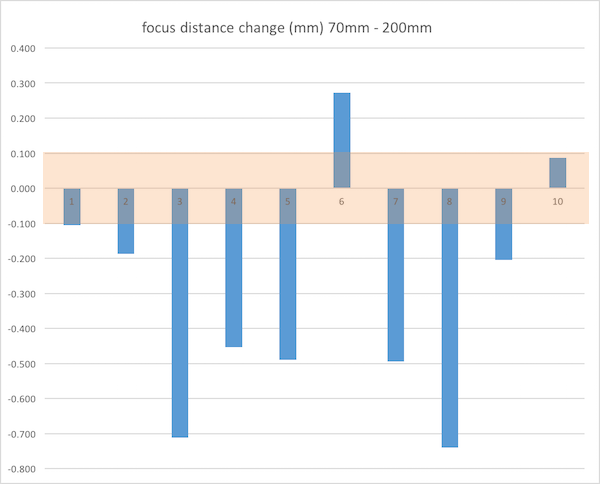
The point is that the amount of focus change while zooming varies from copy to copy. Some shift hugely, some just a little. Most shift to the negative side, a couple to the positive.
Yes, there are some zooms where the average amount of shift is smaller than this. There are others where the average amount of shift is larger. But with every photography zoom we test, there is some copy-to-copy variation in how much focus shift occurs when you zoom from one end to the other.
I put an orange box around the area where we felt you could, at least arguably, call the lens parfocal. This isn’t a scientific box, it’s just where the focusing reticle, to me, still looked reasonably sharp.
If you want a more scientific comparison, we can compare to what we see if we do the same test using a cinema zoom. (We do this with cinema zooms pretty often, when we are checking to see if they remain parfocal.) If we average out the absolute change in best focus for the Nikon 70-200 f/4 VR in the graph above, when zooming from 70mm to 200mm it is 0.374mm. When we do the same test with a Zeiss 70-200 T2.9 lens the average change is 0.008mm.
If we look at the extremes, the photo zoom ranged from 0.742 to -0.273, a range of 1.12mm. The Zeiss 70-200 T2.9 cine zoom had a range of 0.05mm. Anything greater than that requires servicing.
Again, there are some photography zooms better than the Nikon as far as parfocal abilities. But there are none that we’ve seen that don’t have zoom variation. In other words, when someone says a photo zoom is parfocal, the truth is it’s not badly not parfocal, and even then there will be some copies that are more not parfocal than others.
Why Is This So?
The question really is, “How could it be otherwise”? Cinema zooms are made with a moving compensating group that has the specific purpose of maintaining focus while the lens is zoomed. This group is adjustable to make certain it compensates properly.
Photography zooms do not have anything like this compensating group. Additionally, as Aaron and I often see, when we adjust a photography zoom for the best optical performance we often change the ‘best focusing’ point at different focal lengths.
What’s the takeaway point? No photo zoom is going to be absolutely parfocal. Some may well be close enough for your purposes, but check the copy in your hands on the camera you’re going to use. Remember, when someone tells you a certain photo zoom lens is parfocal, that means their copy on their camera held to their standards.
Roger Cicala and Aaron Closz
Lensrentals.com
March, 2016
40 Comments
Maya ·
Interesting. Some people seem to think that some lenses (maybe the Olympus 12-40mm), when powered on, continuously adjust the focusing elements to “fake” parfocal-ness. Is it realistic to imagine that these can receive software adjustments on the production line or in repair centres to tailor the movement to a specific copy, like what the cine zooms adjustable compensation group does, or is it something manufacturers won’t bother with ?
Roger Cicala ·
Maya, it would certainly seem possible. It’s also possible that they autofocus as they zoom quickly enough that parfocal doesn’t make any difference, the lens remains in focus.
Maya ·
Oh, I hadn’t thought about AF-ing while zooming. I can’t test this now as I no longer have the 12-40, but what I found weird is that I felt the AF element(s ?) was moving while zooming, and yet, at least on my copy, I didn’t feel that its degree of parfocal-ness (is that a word ?) was particularly tight.
Also, now that some people are actually starting to use Canon’s DPAF in video for professional use (at least my ex-flatmate did), do you think that designing autofocusing EF lenses with a degree of parfocal-ness in mind (whether it’s mechanical of “faked”) is going to become a priority in the future ?
bdbender4 ·
I think as AF improves this will cease to matter. Maybe we should borrow some terms from golf: if a lens is mechanically parfocal, then it’s parfocal. Period. If focus is maintained while zooming via firmware, then it’s “birdiefocal”. If maintained by software (soft vs. firm) then it’s bogiefocal. You heard it here first.
Roger Cicala ·
I like it!
Michael Newsom ·
I think the message from phone cameras and almost every other gadget is ‘software rules.’
Larry Templeton ·
I’ve rented the Panasonic 14-140mm OIS from you guys a couple times, and I was convinced the lens was doing its best to remain “parfocal” during zooms (on a Blackmagic Pocket cam, which doesn’t have continuous AF). If my zoom was done slow enough, it seemed to work, but if it was too fast the adjustment would sometimes appear visible or it’d end up off the mark a little. *shrug*
Turniphead ·
As you rightly say, I think increasing sensor resolution has shifted the definition of parfocal somewhat. I tested my Canon 24-105 f4L on my 10D and agreed with other online posts that said it was parfocal. I subsequently tested it on my 5D2 and concluded it really wasn’t!
Bruno ·
Isn’t the Micro-Nikkor 70-180mm f/4.5-5.6D ED supposed to be parfocal?
Doug Laurent ·
it is.
LouM ·
My background is light microscopy. The definition of parfocality in microscopy is that objectives (lenses) are parfocal if objects remain in focus when going from objectives of narrower DOF (hi mag, hi NA) to objectives with larger DOF (lower mag, smaller NA).
The same would hold for photographic zoom lenses. The lenses you tested have their narrowest DOF at 200mm and widest DOF at 70mm. If you did the experiment starting at 200mm and going to 70mm, I expect you would get much better results.
Roger Cicala ·
Lou, actually not. These are absolute focus points. We did it actually back and forth several times on a couple, more concerned that mechanical zoom mechanisms might shift. There is no difference.
Roger
Darin ·
It also seems that what may have seemed relatively parfocal when new is far from it a year or two of heavy use later. At least that’s my experience with photographic lenses.
Yugo Nakai ·
Sounds like a perfect niche market for LensRentals to enter: hand-selected parfocal (within 0.1 mm) photo zooms for videographers using DSLRs/MILCs! For sale or for rental, these would command premiums, and the removal of them from the general photography pool of rentals wouldn’t hurt still photographers.
Roger Cicala ·
Yugo, I always think about this, but when you consider the amount of time it would take to select a parfocal zoom, given the odds, the added cost would be more than the market would bear. I don’t spend 15 minutes testing one lens to see if it’s parfocal, I spend hours testing a dozen to find a couple that are. That’s really expensive – and even then it’s only ‘relatively’ parfocal. Someone is going to complain that it wasn’t as parfocal as they thought it would be.
Roger
Yugo Nakai ·
There’s always someone who will complain (though I don’t have to deal with them). 🙂
I mean, maybe just flag them in your database any time you find one (such as in the set you described in your post) and you can slowly build up a stock, right?
Roger Cicala ·
That’s true, except stock rotates in and out fast. I can’t keep a subset of ‘parfocal zooms’ that can’t rent for anything else without making turnover more complex. But I also can’t send a puller to go through 100 copies of a given lens to find one of the 4 parfocal ones without taking a lot of time. It could all be done, but I expect the rental cost would easily be double.
And even then it won’t be as parfocal as a cine lens, it will be “Roger says this is as parfocal as you could hope”. But then certainly Bob is going to think it should have been more parfocal than it was. Because it’s still a judgement call.
Roger
Trevor Overman ·
If someone wanted to determine if a copy of a specific lens is parfocal, should they test the ends of the zoom range, or would they need to test more focal lengths as well. For example if you found a copy of the 70-200mm that was very close to parfocal when comparing the focal lengths of 70mm and 200mm, could you find that the same lens was not as close to parfocal at 135mm?
Hannes Böck ·
along the lines of maya further down i think that in the not so distant future parfocality will be reached by automatic af correction. like ca and distortion correction already happens in camera. lenses will still breath though. but maybe even this can be corrected on the fly in camera by resizing (but then the image would warp starngely…). if it´s desireable is a different question. i naturally prefer an optically corrected lens. the beauty of handling a cine lens, it´s reassurimg weight and the evenly luminated crisp and contrasty image that stays absolutely fixed as you pull focus is always a moment of wonder for me.
photo lenses don´t need all this unfortunately.
roger you could have pointed out more clearly that there is no need for parfocality in an af lens and would only add to the cost.
thank you for the time you put into your great articles! always a pleasure to come here.
even though i will never rent from lensrentals since i´m in europe.
obican ·
So if I drop my lens very carefully, is there any chance it might become parfocal?
Florent ·
Thanks for another very interesting article, Roger.
Do you know if the behavior is symmetrical? In other words, is the behavior identical whether I focus @ 70mm and then zoom to 200mm or focus @ 200mm and zoom back to 70mm? Thanks.
AaronClosz ·
Most parfocal tests would be done by a person visually, in which case one would need to start with the narrowest depth of field (i.e. 200mm) and zoom to the wide end. In our tests there is a machine finding best focus for a given spacial frequency, which is why we can start wherever we like 🙂
Vancouver Video Production ·
But is does matter. Because you are testing wide to telephoto and not the other way around, your results will be different than what one experiences in the field. I’m betting that if you were to retest starting at 200mm as the baseline and then zoom out that the results would not be as dramatic because when you go from telephoto to wide your depth of field increases and it might still be in focus.
Roger Cicala ·
You are correct and we agree — direction of zoom matters in the field (and of course when we are testing cinema zooms to be certain they fall within specifications). For at least some photo zooms, we do find the results going from long-to-near are less dramatic, but there is still significant variation in how parfocal a given copy is.
Doing optical adjustments reinforces the point – correcting a lens optically often (not always) changes how near to parfocal a lens is.
Obviously, some photo zooms are never parfocal enough for any reasonable video application. Others often are often parfocal enough for many uses. Our point, though, is just because one person used a copy of a photo zoom and found it sufficiently parfocal, that doesn’t mean the next person using another copy of the same lens is going to find the same thing.
BTW – since you probably wonder why we chose to go from near to far, it was nothing more complicated than the direction of turning the zoom with the lens mounted to the optical bench. It was easier to turn it this direction and my biggest concern was being certain we didn’t disturb the setup 🙂
Roger
Lee ·
Really interesting. This is one area I *didn’t* expect copy-to-copy variation. I expected variation in absolute focus position (ie where infinity focus is collimated / the accuracy of distance marks) but not *relative* variation. Always love learning something new from your blogs.
Now of course you have to do a bunch of tests to find out how parfocal cine zooms really are 😀
Roger Cicala ·
Lee, we’ve done that (I touched on it in the article). They are so parfocal that if I graphed them there woulnd’t be any bars. They’d all be within 0.05mm or less, mostly much less.
Dave Hachey ·
As always Roger, nice article and most informative. I’m sure this matters most to videographers, and hopefully they know enough to rent the right lens. For us mere mortals who merely aspire to be photographers, it’s not really a concern. At least not to me.
Samuel H ·
Extremenly interesting. I didn’t see this one coming. At all.
So I’ll post a question that I find completely obvious, just in case it actually isn’t. When a lens is focus-by-wire, I would think that making it parfocal is just a matter of writing the appropriate firmware (i.e. one that makes sure there’s an adequate focus shift when you change focal length). Is that actually the case, or is it more difficult than I’m actually thinking?
(I’ve read the comments about AF being so good you don’t need the lens to actually be parfocal, but I’m talking something different: a baked-in correction that doesn’t actually use AF) (If the manufacturer doesn’t want to program it lens-by-lens, it can at least be done by the user, it’s just AFMA but with different settings for different focal lengths, and using live view you can actually let the camera do the work for you)
Roger Cicala ·
Samuel, I think continuous refocusing during zoom is possible and we could well see it. Programmable parfocalness is theoretically possible, but would be much more difficult and I doubt the photo companies have any interest in doing it.
Ilya Zakharevich ·
Note that the corrections should be found out separately for several focus distances.
Otherwise the idea that building this table (at a particular focus distance) can be let to the camera’s CDAF system is really nice! (Should be especially easy for zoom-by-wire designs!)
Samuel H ·
Of course.
It would work as follows:
– put the camera on a tripod, zoom in on your target, lock everything
– tell the camera you are going to adjust parfocalness on your zoom
– the camera does live-view AF
– zoom out a bit
– the camera does live-view AF and takes note of the difference at this focal length
– zoom out a bit more
– repeat until you reach the other end of the zoom
When it’s done, the camera interpolates those measurements and knows how it has to adjust focus as you zoom in or out.
(it may not be perfect if parfocalness varies with distance to target, but well, it should be an improvement anyway)
Samuel H ·
This Nikon automated AFMA adjustment could be a first step towards the thing I was describing:
http://www.dpreview.com/news/3468248279/nikons-automated-af-fine-tune-explained
Dennis L Sørensen ·
Sony E PZ 18-110mm f/4 is a fly by wire parfocal lens. There is a small servo that adjusts the focus as you zoom. It’s is programmed into the lens, even when you have manual focus on the camera. so as you zoom, it know when it “should” be in focus.
Michael Clark ·
And if you zoom slowly enough it can actually keep up…
zogzog ·
I wonder if cheaper lenses that are more geared for video (like, say, Canon’s EF-S 18-135F3.5-5.6STM) would turn out to be more parfocal than a 70-200 simply because of shorter absolute focal lengths and slower maximum aperture.
Michael Clark ·
Since STM lenses are ‘focus-by-wire’, the compensation can be done electronically. But you are correct that narrower apertures and shorter focal lengths allow the focus error introduced by zooming to be masked by the wider depth of field.
Neil Cowley ·
so can I sue Sony for false claims on the 28-135 and get a discount? :-/
balazer ·
I have boatloads of TV and photographic zoom lenses, and based on the many tests I’ve done in my long quest for parfocalness I can tell you that a good chunk of the photographic zoom lenses are quite parfocal, even in 4k. The best of them are just as good as a modern TV zoom lens.
But you’ll only know how parfocal a lens really is if you adjust the back focus. If you didn’t (and it sounds like you didn’t), then your conclusions are invalid. A lens is almost never parfocal if you just stick it on the camera. The back focus must be adjusted, either with a built-in back focus adjustment, or by changing the flange focal distance, with a mount adjustment, shims, a helicoid adapter, etc. Photographic zoom lenses rarely make those adjustments easy, seeing as how parfocalness is not a priority for photo shooting. Find a way to make the adjustment, and then you discover just how parfocal the lens is. The camera’s sensor-to-flange distance can vary too, so the adjustment really needs to be done for a particular camera. Even the temperature can change back focus.
Yes, the degree of parfocalness in zoom lenses varies from model to
model and from copy to copy. But that’s not saying anything. Every
aspect of lens performance varies.
A lens can be less than perfectly parfocal in a lot of different ways. The cams could have too much play, causing the focus to shift every time the zoom direction changes. Or the cam path might be imprecise, causing the focus to shift at one end or the other of the zoom range, or in the middle. Some lenses are quite parfocal over a good 80% of the zoom range, and lose it at the very end. A lens might be acceptably parfocal at one aperture setting, but not at a larger one. Stopping down by just one stop can make a huge difference in some lenses. Some zoom lenses are parfocal at one focus distance, but not at another. Some lenses are parfocal when held horizontally, but not when tilted up or down.
If a lens is even remotely close to being parfocal, then it has a zoom compensating group. That makes it a zoom lens by definition, and zoom lenses are parfocal by definition. If a lens doesn’t have compensating group, it’s called a varifocal lens, and it is wickedly far from being parfocal. Varifocal lenses don’t even have a single focus distance scale marked on the lens. The focus distance scale will depend on the focal length, if it even has a distance scale marked.
There is a third category: lenses that are parfocal, but only electronically. They’ll lose focus momentarily when you zoom in or out, but then snap back into focus as soon as the focus motor has a chance to catch up with whatever the zoom encoder is saying. A lot of mirrorless lenses fall in this category.
TV and cinema zooms are more parfocal than photographic zooms (on average) for two reasons. One is that they were designed to be, with very tight tolerances in the zoom cams. The other is that the flange focal distance has been adjusted very carefully.
ChrisInCalif ·
Why test the lenses by focusing at 70mm then zooming out to 200mm? This seems backwards. Why not focus at
the higher focal length then zoom back down (because it is easier to see what you’re focusing on at highest focal length)?
OnTheOtherHand ·
In this test it doesn’t matter which end of the zoom range you start, because you refocus at the other end.
The advice to focus zoomed in and then zoom out to take your picture is based on the lens not changing focus, which now is obviously it does, and as a saving grace, that when you zoom out, the wider angle, combined with the greater depth of field will mask the fact that the lens is not in perfect focus.