
Sony FE 50mm f/1.8 MTF and Consistency
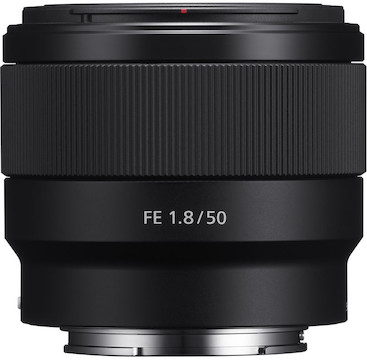
Sony has cranked out a bunch of new lenses lately, and one of their latest got my attention: the FE 50mm f/1.8. It did so for a couple of reasons. First, I wasn’t expecting it, since they already have the really good FE 55mm f/1.8 ZA lens in their lineup. Second, I’ll admit I expected them to suffer from the inevitable comparisons with Canon’s ‘nifty fifty’ the 50mm f/1.8 STM lens.
The Canon lens is small, inexpensive, quite sharp, and has some of the lowest copy-to-copy variation we’ve ever tested. Copy-to-copy variation has been a weakness in the FE lineup. While Sony was clearly making progress with that I wasn’t sure they were ready to take on the reigning variance champion. The sony lens is a little larger and more expensive, but then again, if you shoot Sony FE you’re kind of used to ‘a bit more expensive’ lenses and at $250 this is a really affordable lens.
As always, I remind you that this isn’t a review of the lens, simply a lab test of multiple copies on our optical bench to assess MTF and variation.
MTF
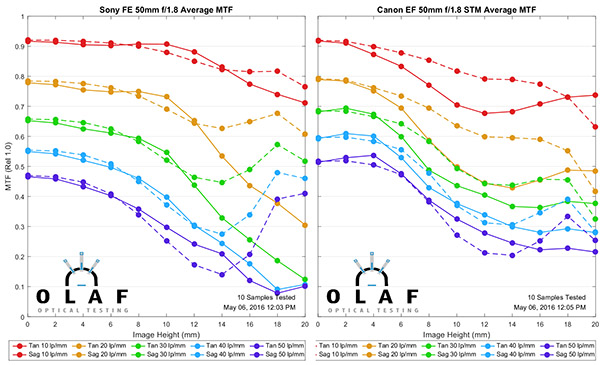
Well, we’ll go with the logical comparison first, the Canon 50mm f/1.8 vs the Sony 50mm f/1.8. The Sony actually does better at the lower frequencies, indicating it’s probably a more ‘contrasty’ lens, while the Canon is better at higher frequencies, so it may have superior fine detail resolution. Both are really quite good, though, and I should really use ‘different’ rather than ‘better or worse’ to compare them.
Of course, a lot of Sony shooters want to see the FE 50mm vs 55mm comparison. There’s quite a price difference and while there’s a lot more to a lens than MTF curves, people probably want to see what the MTF differences are.
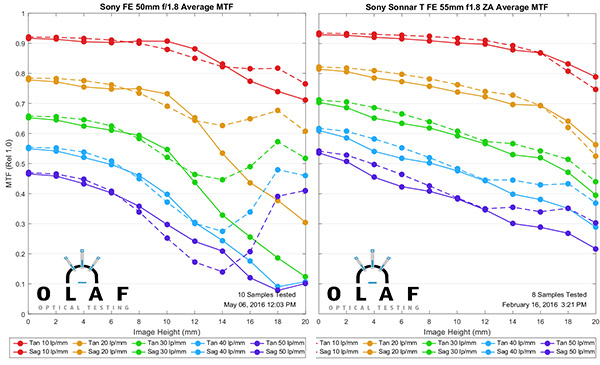
The 50mm is a very good lens and quite a bargain at the price. But there are reasons the 55mm costs more. It’s clearly better across the field than either of the ‘nifty-fifty’ lenses. But the usual rule of ‘increasing resolution is increasingly expensive’ does apply. You get a better lens, but you pay a lot more.
Sample Variation
This is the portion of the test where I just expected Sony to not compare very well. But guess what? The copy-to-copy variation on the FE 50mm f/1.8 is superbly low. Remember, the Canon 50mm f/1.8 STM is the standard against which all other lenses are measured. It’s amazingly consistent. The Sony is very close to that. In some ways (center sharpness variation) it’s actually a bit better. So hat’s off to Sony, they’ve made an FE lens that from a copy-to-copy variation standpoint is as good as anything on the market.
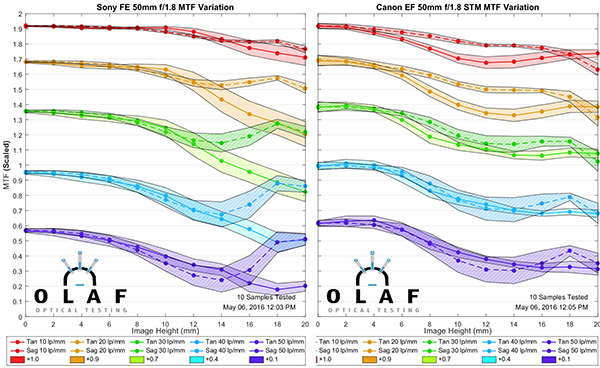
Let’s show you how good by comparing the variation of the new 50mm with the 55mm, which has a lot of sample variation. (I’ll go ahead and add, because desperate fanboys continue to ask, the variation for 55mm lenses is the same now as it was then.)
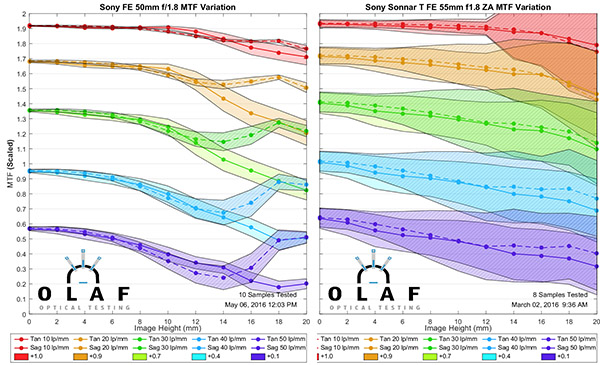
To summarize, then, if you buy a 50mm f/1.8, chances are it’s going to be just about like every other 50mm f/1.8. Sure, there will be a few bad copies, there always are. But they’re very consistent.
We’ll probably tear one of these down soon and take a look inside to see if we can determine just why sample variation is so low. The Sony is a ‘unit focus’ lens with no separate focusing element, if I read their release information correctly, which may have something to do with the lower sample variation.
Roger Cicala and Aaron Closz
Lensrentals.com
May, 2016
38 Comments
Mike Aubrey ·
Looking at the difference between the FE55 and the new FE50, it seems that your worst case scenario for a bad copy of the FE55 is that it does no better or slightly worse than the new lost cost lens. Not an encouraging prospect.
Still, sonnar bokeh vs. planar bokeh should also come into the equation for the decision.
David Braddon-Mitchell ·
Sure; but the worst case scenario would be a sending back scenario. Annoying – very – but not the end of the world.
I got used to it with Canon in the early 2000s before they upped their game.
But I’m so pleased Sony seems to be getting better; here in Australia returning lenses is a real pain and usually involves citing chapter and verse of the consumer law, and talking to managers, which is all quite stressful.
Mike Aubrey ·
Totally agree!
S.Yu ·
Keep in mind that’s not the typical Sonnar, the ZM 50/1.5 is pretty much typical Sonnar (though it lacks the cemented triplet it gets very close) and any typical Sonnar should look like that. Sony’s just using the name because it’s obviously not a Planar nor a Biogon nor a Distagon but still allegedly Zeiss. Everything’s non-Distagon non-Planar non-Biogon(not many symmetricals in the Digital age in the first place though) is sort of Sonnar these days, because it’s the only name that wasn’t properly defined in the beginning. Zeiss used the name for Ernostar type lenses for a short period too.
Mike Aubrey ·
I know. But in terms of bokeh, it still looks fairly close. It’s certainly not planar OOF blur, that’s for sure. And the difference is still worth something in choosing lenses. My point was simply that independent of the quality (resolution) of a given copy FE55, there are still reasons to choose it.
S.Yu ·
Yeah, but it looks as though there’s a pretty significant chance a ~$800 FE55 you get would be even less sharper than this $250 FE50, so at least in my personal opinion it wouldn’t be worth it until they get QC solved.
Mike Aubrey ·
Just buy in a store where you can try a couple copies before purchase.
Or use an online retailer with a solid return policy. For all of Amazon’s faults, they’re at least good for that.
I paid $550 for mine used. I don’t know where it falls on the spectrum. I’ve tested centering and it looks good, but I can’t know for other things. Still, for what I paid, I’m content.
S.Yu ·
I just don’t know what degree of sharpness I should be expecting, my current 50mm used for years is an old Contax, and I suspect it’s already decentered…
Larry Templeton ·
You are wiser than most of your peers. If the lens looks great to you based on your teat(s), then you do indeed have a “good” copy. The desperate hunt for theoretical or speculative quality gains suggest that those hunting don’t actually have a “real” standard by which to compare lens quality or performance (or they are engaging in neurotic behavior). It’s nice to see someone set the standard them self in a time when specs and numbers often mean more to people than what’s behind them.
gggplaya ·
Love my FE 55mm, so sharp and the bokeh is so smooth. I had a sigma art 50mm before on my canon, the zeiss is definitely nicer.
Neroon ·
I have it and debating returning it. The AF speed is terrible. It’s better on the A7RII. On the A7II and older, not so much…
Roger Cicala ·
This is a really important point — and makes this a good reminder that what we’re doing is analyzing the heck out of just the optics of a lens. Good optics are necessary in a lens, but not by a long shot the only important aspect when considering it.
Neroon ·
At 1.8 the lens is softer and slightly less contrast. At 2.8 my Bokeh test looks great.
Larry Templeton ·
Is this a telephone pole or power line support? At f/8 would I be able to tell? ?
Neroon ·
Stop sign post 🙂
Y.A. ·
That is a bummer man! I was very happy with the AF performance of my A7 + Techart + 50 STM. Looks like I’m keeping the STM
Neroon ·
Retuned and refund processed
June angelus ·
So it costs twice the Canon 50 STM but only a “different lens”, not better?
D. Garlans ·
If you buy into a Sony system, complaining about the price isn’t really an argument that holds any water. Everything Sony makes is more expensive than their competitors. It’s just the nature of the beast. If you want good pricing, get a Pentax…
revaaron ·
How much is Pentax’s nifty fifty?
Roger Cicala ·
That would sum it up nicely 🙂
gggplaya ·
Canon is clearly a better “VALUE”. But not necessarily a better performing lens. I happen to own the canon 50 stm and the sony FE 55mm which is an incredible lens.
sickheadache ·
Yes, I went over the Paper Work and Rented from LensRental and came up with the far gone conclusion….Sigma 50mm 1.4 Art is the Best 50 Hands Down. Otus is 55mm lol and 4 Grand. lol
ChuckMz ·
“foregone conclusion”
D. Garlans ·
How does the lens compare to the old Sony E-mount 50/1.8 OSS lens for the crop sensor cameras?
Obviously crop vs full frame makes the comparison rather difficult, but it’d still be interesting to see how the old model stands up.
Danny Wilson ·
Hey Roger, are you still using ±1.5 standard deviations for your shaded regions?
Roger Cicala ·
Danny, we’ve gone to +/- 1 SD to try to make the graphs not overlap so much.
Michael Andrew ·
Roger- thank you for this article. Question for you, what are your thoughts about DXOs “perceived megapixels” as relates to system image sharpness? There are many photographers out there who believe a FF lens on a crop body changes the optical performance of the lens to be less sharp because this invented metric includes resolution into its calculation. I respect your thoughts and insights, what is the truth of the matter?
Larry Templeton ·
Please answer this Roger… 🙂
Roger Cicala ·
Well, I didn’t really understand the question. 🙂
Larry Templeton ·
Hmm, I thought it made sense when I read it. ?
So, to ask what I thought he asked, I would absolutely love to know what your take is on DXO’s “perceptual megapixel” calculation? Whether it’s bogus or brilliant, it factors into so many debates online between those of use who aren’t smart enough to think (and test) for ourselves… or just lack the time.
The second part of what I thought he asked is, What’s your take on the optical performance when using a full frame lens on a crop sensor camera? My experience has been that (usually) I’m better off, in terms of IQ, using a lens that matches my sensor’s size. What is your quick take on that? I know this question is a bit thick, but where I hang out on the web, it’s constantly debated.
Thanks so much for any insight you’re willing to shell out!
Roger Cicala ·
Thanks, Larry. I was tired when I read it, might not have had all my neurons engaged.
I’ll do the second one first because I honestly don’t think that’s a generalization that can be made. There are some awesome crop sensor lenses and while I can’t just say they are better optically than the equivalent full frame, sometimes they are. And always they are smaller, lighter, cheaper. If I shot crop sensor I’d have some crop-sensor lenses in my bag, but depending on brand would probably have some FF lenses in there too.
The DxO PP calculation is both bogus and brilliant. Brilliant in that it answers a demand from the people who want a simple scale that says better or worse. DxO’s math is always correct and they are way better at math than I am. Bogus in that any time someone won’t disclose their methods, it’s bogus. DxO doesn’t disclose what their formulas are. For examples, we don’t know how their testing method looks with a very astigmatic lens. We know they test circular dots on their chart, but is their original number an average of the circle, certain edges at certain locations, heck we don’t even know their testing distances.
But mostly I don’t like generating massive numbers on limited testing. DxO, to me, measures the height of one third grader and says it’s 58.43567 inches, while a single 4th grader is 59.94352 inches, therefore 4th graders are 1.50776 better than 3rd graders on average. That’s an invalid conclusion and the numbers suggest it’s more scientific than it is. There have been too many examples where their results have been silly because they’ve had a bad copy, then quietly changed later after people have ridiculed them.
The other problem is the weighting of the formula, and while they aren’t as secretive about that, their weight may have nothing to do with the way you shoot. Should their ‘blur scale’ be weighted at f/8 or wide open, or evenly about the range? Should it be weighted differently for various cameras because diffraction sharpening will occur at different apertures depending on pixel density? I have my thoughts and they have theirs, both are relevant. But their number is only for their thoughts.
On the other hand, I think they are brilliant at testing cameras, which is what their background really is. And some of their specific lens subtests (not their overall number) are pretty useful.
Michael Andrew ·
Roger- thank you so much for taking the time to answer, I very much appreciated hearing your thoughts on the matter. Best wishes- Michael
Neroon ·
I contacted Sony today and they have no answer and not even a confirmation that there is a firmware update coming. I am returning mine tomorrow. If and when they get their shit together on this lens I might repurchase it.
NightPhotographer ·
Roger Cicala
Hello
Since I am going to get a Sony A7R II and due to the fact that I love my Zeiss lenses, I asked Zeiss if they could change the mount of my 135mm APO from ZF.2 to ZE. Since ZE lenses stay wide open on Sony cameras till the moment of exposure, achieving precise focus with a telephoto lens becomes easier so I wanted to change the mount of my 135mm APO from ZF.2 to ZE. In response, Zeiss told me that 135mm ZF.2 was totally different from ZE and changing the mount would not be possible. Since Sigma already offers this service for their lenses, I don’t think changing from mechanical aperture to electronic aperture is that difficult. What I infer from the answer I received from Zeiss is that difference between ZF.2 and ZE lenses are more than the aperture mechanism. I checked the DPR comparison tool and noticed that the Otus 85mm 1.4 was soft at the corner on the D810 whereas it’s sharp on the 5DSR.
http://www.dpreview.com/reviews/image-comparison/fullscreen?attr172_0=canon_eos5dsr&attr172_1=nikon_d810&attr172_2=canon_eos5dsr&attr172_3=nikon_d810&attr174_0=1&attr174_1=1&attr174_2=1&attr174_3=1&attr175_0=zeiss_otus_85mm_1p4&attr175_1=zeiss_otus_85mm_1p4&attr175_2=canon_85_1p8&attr175_3=nikon_85_1p8g&normalization=full&widget=247&x=-0.8788124307822898&y=0.7727021150846086
to my surprise, It is not even as sharp as the Nikon 85mm 1.8G so I have become curious to know how different ZF.2 and ZE lenses are. Since these lenses are super expensive and I just own Nikon cameras, It’s not possible for me to investigate it myself. Have you ever compared ZF.2 lenses to their ZE counterparts with regard to image quality and sample variation? I know this comment is not related to the post but I didn’t know how to contact you and you are the only person whose investigation I trust.
Cheers
Physicsonboard ·
I love the Loxia 50mm 🙂
Neroon ·
It would be interesting to revisit this with the new firmware…
Said AZIZI ·
Hi Roger !
Do you know what are the main causes of lens variation ?
Thanks