
Canon 16-35mm f/2.8L Mark III Optical Bench Tests
I tend to not get overly excited about new releases. The last few years have seen a lot of incremental upgrades that rarely blow me away. Usually, I end up thinking the new version of whatever is better than the last version. Not “rush out to the store and buy it” better, but “consider upgrading if you use it a lot” better.
Canon, though, (and Sigma) have hit some real home runs with optics lately, so I was a bit excited when Canon decided to upgrade one of their weaker lenses, the 16-35mm f/2.8, to a Mark III version. And if you don’t want to read the article I’ll summarize: rush out to the store and buy it.
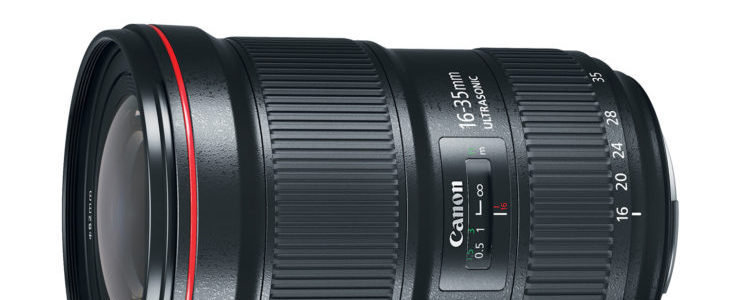
As always, this isn’t a full review; that isn’t what I do. This is optical bench tests. Usually, I say stuff like ‘wait until the reviewers tell you how good it handles, and focuses and what the bokeh is like’ before you decide if it’s a good lens. Not this time. Optically this is such a big improvement that you just need to get it. If there are problems with that other stuff, then learn to deal with them.
MTF Tests
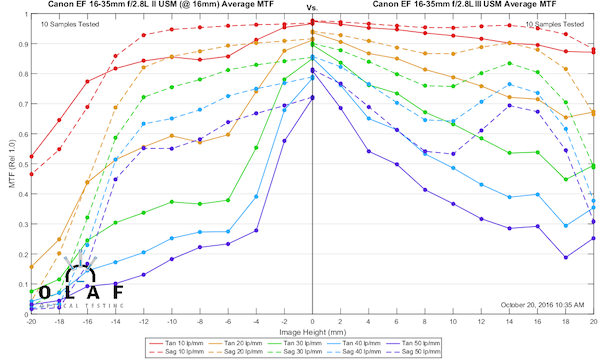
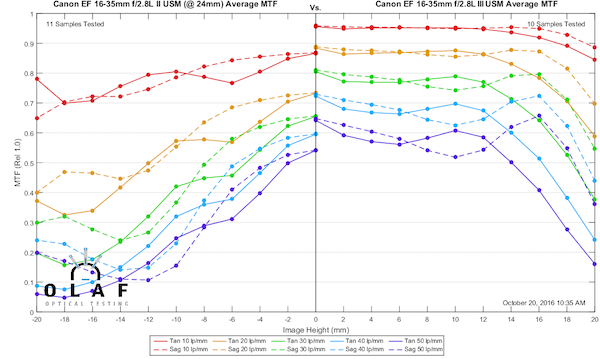
Markus has made me a shiny new software tool that makes it easy for me to compare MTF curves between one lens and another, so I’m going to play with that for this post. As always, if you don’t speak MTF higher is better; dotted and solid lines of the same color close together is better; and on the horizontal axis “0” is the center of the image and “20” is very close to the corner. The rest is details.
Canon 16-35mm f/2.8 Mk III vs 16-35mm f/2.8 Mk II
The logical comparison, of course, is the Canon 16-35 f/2.8 L Mk II (left side) with the Canon 16-35mm f/2.8 L Mk III (right side). Here are the MTF charts for both lenses (the graph is the average of 10 lenses tested) at 16mm, 24mm, and 35mm.
At 16mm
At 24mm
At 35mm
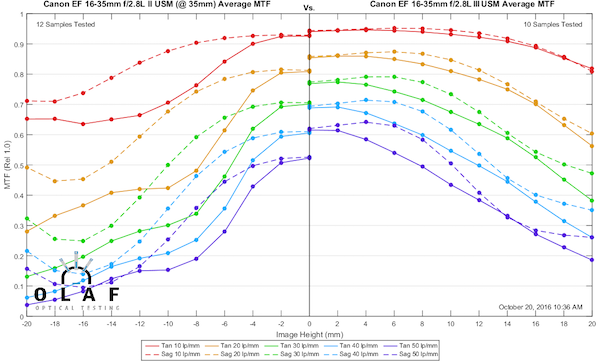
At all focal lengths, the Mk III is clearly better than the Mk II both in center and off-axis sharpness. It also has far less astigmatism at both ends of the zoom range. This isn’t close at all. It’s a dramatic, easy-to-tell-in-your-photograph difference. The mark III version is dramatically better.
Canon 16-35mm f/2.8 Mk III vs 16-35mm f/4 IS
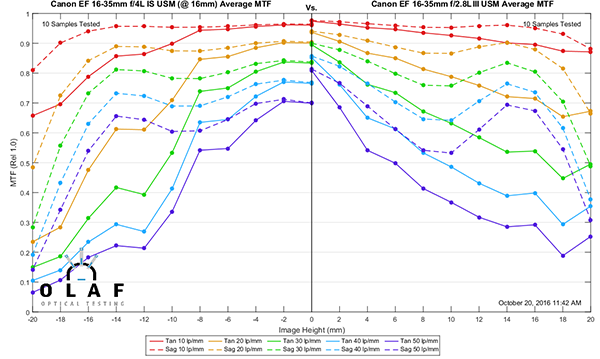
The Canon 16-35mm f/4 IS is a sharper lens at f/4 than the f/2.8 Mk II is at f/2.8. The mark III was so much better, though, that I thought it was worth making a direct comparison.
At 16mm
At 35mm
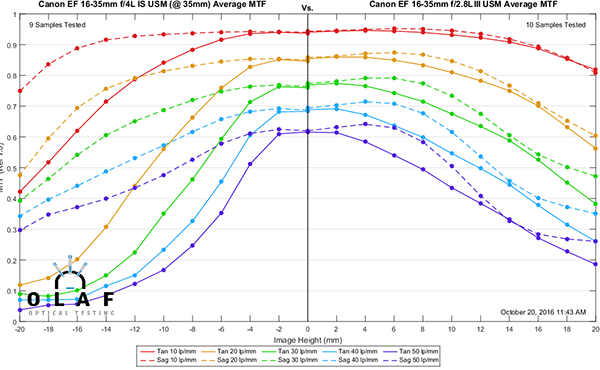
Giving up a stop of aperture is a huge disadvantage for MTF testing, but despite that, the 16-35mm f/2.8 Mk III is slightly better at f/2.8 than the 16-35mm f/4 IS is at f/4. There’s not a lot of difference, obviously, and I wouldn’t choose the f/2.8 Mk III purely on the basis of sharpness; the f/4 is less expensive and has IS. But if you need f/2.8, then there’s no sharpness penalty for going with the wider aperture lens.
Canon 16-35mm f/2.8 L Mk III vs Canon 24-70mm f/2.8 L Mk II at 24mm
The 16-35mm has been considered the weakest of the modern Canon zooms for some time. If I had an option for another lens, I generally went with the other lens. This comparison is one that I was really interested in since I tended to use the 16-35mm as a 16-22mm really and changed to a 24-70mm zoom whenever I could. The Canon 24-70mm f/2.8 Mk II is about as good as we see in a standard range zoom so I didn’t expect the 16-35mm Mk III would be as good but thought it might be reasonably close.
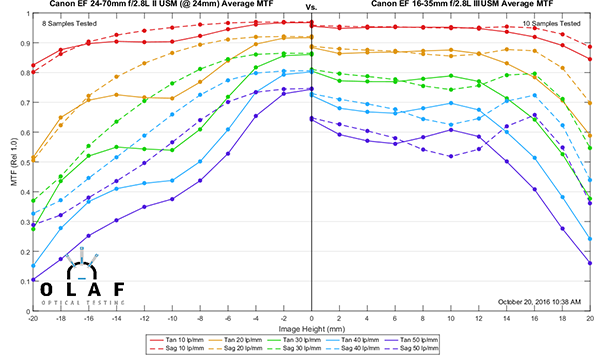
The 24-70mm is, indeed, a bit sharper in the center. As we go away from the center, though, the 16-35mm actually is better by the middle of the frame. It might well be the better landscape/architectural lens at 24mm. I’m pretty surprised by this.
Canon 16-35mm f/2.8 Mk III vs Nikon 14-24mm f/2.8 at 24mm
I hesitated to make this comparison, first because I know fanboys are going to start screaming online about it, and second because these aren’t really zooms of the same range. This is the middle of the Canon range but the extreme end of the Nikon. But for years now, the Nikon 14-24mm f/2.8 has been the gold standard of wide angle zooms and I was interested to see if Canon had finally caught up. They’ve done better than catch up.
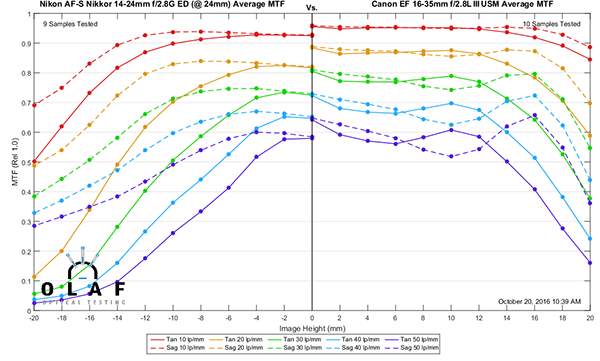
I can keep doing comparisons for pages, but the bottom line is clear. From an MTF standpoint, the Canon 16-35 f/2.8 Mk III is the best f/2.8 wide-angle zoom I’ve ever tested.
Copy-to-copy Variation
The sample variation for wide-angle zooms is usually pretty significant, but the new 16-35mm f/2.8 Mk III keeps that under pretty good control. Below are the variation spreads at 3 focal lengths (most zooms have one focal length at which variation is highest).
16mm
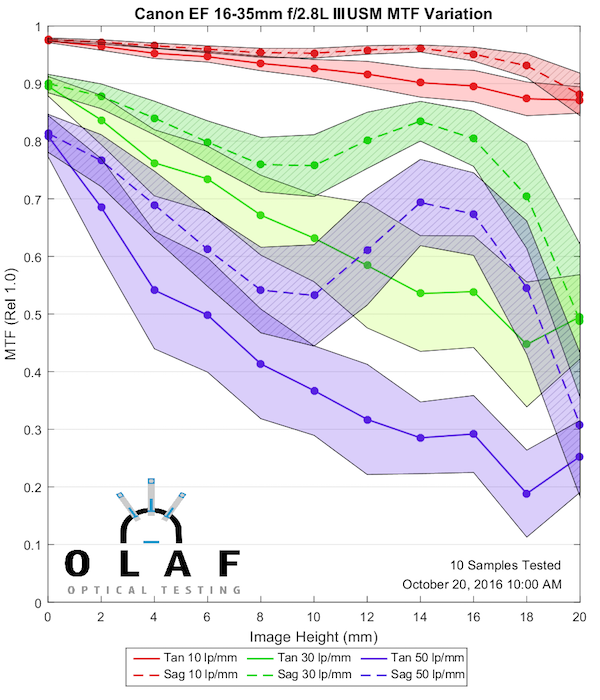
24mm
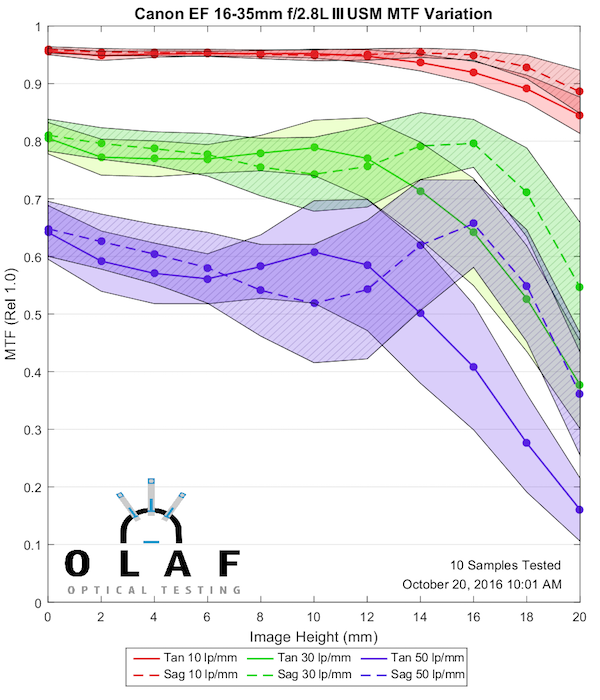
35mm
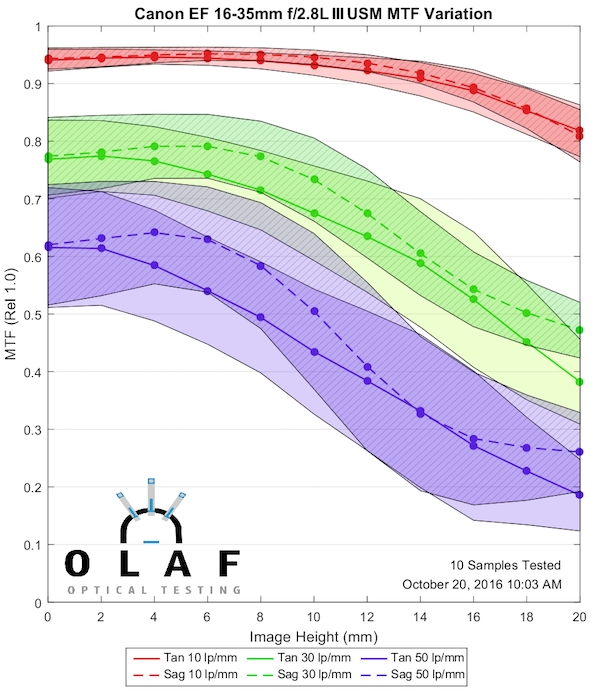
The copy-to-copy variation for this lens is quite reasonable, but if you see it in your copy you’ll probably notice it at 35mm. Still, it clearly has less variation than the 16-35mm Mk II.
Summary
This summary is quick and simple. From a resolution standpoint, the Canon 16-35mm f/2.8 Mk III is the best f/2.8 wide-angle zoom available. You might be better served with the f/4 IS and some money in your pocket. There are also some very good wide-angle f/2.8 zooms available from third party manufacturers that are a lot less expensive and might offer more bang-for-the-buck. But if your style of photography needs the highest resolution you can get with a wide-angle lens, well this is it. I don’t use a wide-angle zoom all that often, but when I do, it will be this one.
Roger Cicala, Aaron Closz, and Markus Rothaker
Lensrentals.com
October 2016
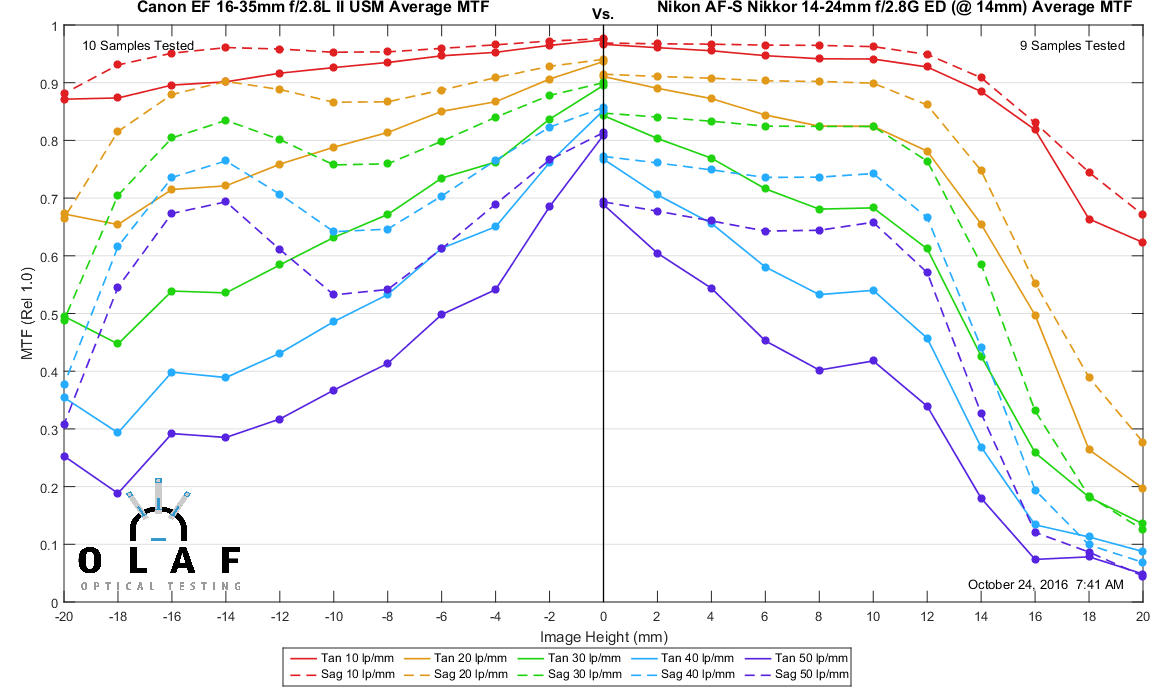
Addendum: A few Nikonians are upset because I only showed their favorite lens at 24mm, not 14mm where it is best (and they are correct, that is where it is best) I’ve posted the Canon at 16mm vs Nikon at 14mm comparison below. And because I know it’s coming next, I don’t have the Nikon measured at 16mm, but at 18mm, where I do have data, it is not as good as it is at 14mm.
83 Comments
Melbar ·
canon did it again….
Melbar ·
canon did it again....
Tom ·
Canon’s superb new lenses tend to take time for the prices to approach sanity, but you do get what you pay for. I find the 16-35mm f4 IS astonishingly good, as is the 35mm f2 IS (both of which have dropped in price substantially since release). Interestingly, some of Nikon’s latest releases (such as the new 19mm f4 perspective control lens) have substantially higher prices than Canon equivalents, so maybe Canon pricing is not as bad as it first seemed…. the 35mm f1.4L II seems the hardest to swallow, but we can thank Sigma for that….
Adam Sanford ·
I’m a daylight landscaper, and I’m hanging on to my 16-35 f/4L IS. The only thing this f/2.8L III offers me is back pain. There is no upside for me to get this new offering.
inyourbase ·
Back pain? Are you 100 yeas old?
I love my 16-35 2.8 III. It’s ridiculously sharp
Veldask Krofkomanov ·
First of all, it’s hyperbole.
Second of all, for a normal shooter who hops in and out of his car, the weight difference is nothing. For a long distance, week- or weeks-long backpacker/photographer, where we count every ounce, this is a huge difference in weight. It all adds up, and in order to reduce weight, you do so by a few grams or an ounce, or more, on every piece of gear you own, as long as you keep the functionality (or sometimes, you even reduce functionality if your weight savings is significant). So yes, I’ve bought new $500 sleeping bags because they save me a few ounces. Again, by itself, it obviously won’t break your back. But if all your gear reduction can save you 10 pounds, when you’re hiking 15 miles a day and gaining 4000 ft of elevation and then losing 4000 ft of elevation on average, for a week or longer, that weight saving is truly important.
inyourbase ·
No shit it’s hyperbole. So is calling you 100 years old 😉
DrJon ·
I have the 16-35 f4 and I’ll be keeping it (partly as the IS is so useful indoors) but I’ll really miss the difference in the corners at the wide end, so will lust after the III a little (luckily the price will help me get over that).
Tom ·
Canon's superb new lenses tend to take time for the prices to approach sanity, but you do get what you pay for. I find the 16-35mm f4 IS astonishingly good, as is the 35mm f2 IS (both of which have dropped in price substantially since release). Interestingly, some of Nikon's latest releases (such as the new 19mm f4 perspective control lens) have substantially higher prices than Canon equivalents, so maybe Canon pricing is not as bad as it first seemed.... the 35mm f1.4L II seems the hardest to swallow, but we can thank Sigma for that....
Well done Canon, this is an impressive optic. For the vast majority of users, however, the 16-35mm f4 IS L will have a wider shooting envelope and all but indistinguishable image quality.
Adam Sanford ·
I'm a daylight landscaper, and I'm hanging on to my 16-35 f/4L IS. The only thing this f/2.8L III offers me is back pain. There is no upside for me to get this new offering.
inyourbase ·
Back pain? Are you 100 yeas old?
I love my 16-35 2.8 III. It's ridiculously sharp
Veldask Krofkomanov ·
First of all, it's hyperbole.
Second of all, for a normal shooter who hops in and out of his car, the weight difference is nothing. For a long distance, week- or weeks-long backpacker/photographer, where we count every ounce, this is a huge difference in weight. It all adds up, and in order to reduce weight, you do so by a few grams or an ounce, or more, on every piece of gear you own, as long as you keep the functionality (or sometimes, you even reduce functionality if your weight savings is significant). So yes, I've bought new $500 sleeping bags because they save me a few ounces. Again, by itself, it obviously won't break your back. But if all your gear reduction can save you 10 pounds, when you're hiking 15 miles a day and gaining 4000 ft of elevation and then losing 4000 ft of elevation on average, for a week or longer, that weight saving is truly important.
inyourbase ·
No shit it's hyperbole. So is calling you 100 years old ;-)
DrJon ·
I have the 16-35 f4 and I'll be keeping it (partly as the IS is so useful indoors) but I'll really miss the difference in the corners at the wide end, so will lust after the III a little (luckily the price will help me get over that).
Adam Sanford ·
Resolution wise, it looks to be a formidable upgrade. But not *all* is well with it:
http://www.the-digital-picture.com/Reviews/Lens-Vignetting-Test-Results.aspx?FLI=0&API=0&FLIComp=0&APIComp=0&Lens=1073&Camera=979&LensComp=986
This needs to be corroborated, of course, but over 4 stops of vignetting in the corners at 16mm f/2.8. A few specific camps of photographers will likely throw a fit over this drawback.
Tom ·
Interesting about the vignetting….. It’s a good job the new 5D IV has improved dynamic range and more easily boosted files. Trying to vaguely correct 4 stops of vignetting with the 5D II or III would not have a pleasant outcome. Even fully correcting the vignetting on the 16-35 F4 IS leads to obvious colour noise and horrible image quality in the extreme corners on the 5D III, so one has to just leave much of the vignetting in place (which is usually OK with me).
Barbu Mateescu ·
And the 11-24 f/4L is just the same. Including the sad performance of vignetting more when used at f/8 than some competition at f/2.8 🙁
Eric Calabros ·
Its like designed for smaller than FF image circle
Adam Sanford ·
Resolution wise, it looks to be a formidable upgrade. But not *all* is well with it:
http://www.the-digital-pict...
This needs to be corroborated, of course, but over 4 stops of vignetting in the corners at 16mm f/2.8 is not trivial. A few specific camps of photographers will likely throw a fit over this drawback.
Tom ·
Interesting about the vignetting..... It's a good job the new 5D IV has improved dynamic range and more easily boosted files. Trying to vaguely correct 4 stops of vignetting with the 5D II or III would not have a pleasant outcome. Even fully correcting the vignetting on the 16-35 F4 IS leads to obvious colour noise and horrible image quality in the extreme corners on the 5D III, so one has to just leave much of the vignetting in place (which is usually OK with me).
Barbu Mateescu ·
And the 11-24 f/4L is just the same. Including the sad performance of vignetting more when used at f/8 than some competition at f/2.8 :(
Eric ·
Its like designed for smaller than FF image circle
Chik Sum ·
I am actually owning the ver II from 2009 onwards, while I rarely use it after upgrading to 5D mk III, but I found the output from it is actually quite satisfied at normal output level (at daytime I tend to use F8-F11, and if night time astro-photography or Aurora shooting the corner resolution isn’t noticeable with the vignetting anyway)
While the image quality of this mk III lens is superb, but with the kidney and liver selling price I would rather save a fortune from upgrading..
YS ·
I am actually owning the ver II from 2009 onwards, while I rarely use it after upgrading to 5D mk III, but I found the output from it is actually quite satisfied at normal output level (at daytime I tend to use F8-F11, and if night time astro-photography or Aurora shooting the corner resolution isn't noticeable with the vignetting anyway)
While the image quality of this mk III lens is superb, but with the kidney and liver selling price I would rather save a fortune from upgrading..
Erkan Özgür Y?lmaz ·
I would love to see Nikon 14-24 @16 mm vs Canon 16-35 f/2.8 @16 mm
Barbu Mateescu ·
Hear hear!
…on the other hand, as one of the (un)lucky few that get to use both systems, I wouldn´t change the 14-24 yet; it’s more than excellent when it comes about the image.
The one comparison that anybody can do, without using OLAFs or masonry shots: 16-35 has easy-peasy filtering options, while for the 14-24 you only get clunky contraptions that leak light between the filter and the front element.
On the other hand, I very much doubt that anybody would jump ship, no matter the results of any possible comparisons between 14-24 and 16-35III
Adam Sanford ·
+1. This. People love the new 15-30 f/2.8 VR Tamron as well… until you try to filter it.
There’s a reason why Canon never ‘chased the squirrel’ with the 14-24 — it makes the lens a speciality landscape tool and effectively neuters it for events (where you might need an ND for bright outdoor work), travel (CPL), etc. I’m glad they chose to stick to a filterable / all-purpose 16-35 and then offered an 11-24 for those with ultra-ultrawide sickness.
William Dyer ·
I have the 15-30 and added the “collar of shame” filter device. It works well, but yes, it eats up a lot of camera bag space and the filters are darn expensive. Still I am happy with the performance of the Tamron 15-30!
DrJon ·
Err, or you could say they made a 11-24mm squirrel…
Erkan Özgür Yılmaz ·
I would love to see Nikon 14-24 @16 mm vs Canon 16-35 f/2.8 @16 mm
Barbu Mateescu ·
Hear hear!
...on the other hand, as one of the (un)lucky few that get to use both systems, I wouldn´t change the 14-24 yet; it's more than excellent when it comes about the image.
The one comparison that anybody can do, without using OLAFs or masonry shots: 16-35 has easy-peasy filtering options, while for the 14-24 you only get clunky contraptions that leak light between the filter and the front element.
On the other hand, I very much doubt that anybody would jump ship, no matter the results of any possible comparisons between 14-24 and 16-35III
Adam Sanford ·
+1. This. People love the new 15-30 f/2.8 VR Tamron as well... until you try to filter it.
There's a reason why Canon never 'chased the squirrel' with the 14-24 -- it makes the lens a speciality landscape tool and effectively neuters it for events (where you might need an ND for bright outdoor work), travel (CPL), etc. I'm glad they chose to stick to a filterable / all-purpose 16-35 and then offered an 11-24 for those with ultra-ultrawide sickness.
William Dyer ·
I have the 15-30 and added the "collar of shame" filter device. It works well, but yes, it eats up a lot of camera bag space and the filters are darn expensive. Still I am happy with the performance of the Tamron 15-30!
DrJon ·
Err, or you could say they made a 11-24mm squirrel...
sala.nimi ·
These are at full aperture. How about closed down even a little. You cannot always tell closed down aperture from MTF at full aperture.
Adam Sanford ·
IQ sample tool here at TDP: https://goo.gl/ZwZekS
(Watch the arrow when you mouseover to see which is which. Feel free to modify aperture or compare against other lenses while you are there.)
Hypnoswan ·
using that tool to compare with the f4 version:
– results show the f4lens @16mm (where I use it most) around f5.6-f8, is actually sharper in centre and close in the edges so I certainly wouldn’t upgrade for the 16mm end. I never use it wide open so wide open comparisons are less interesting.
However at @24mm and 28mm the differences at f5.6 or f 8are a trade off between whether you prefer edges or centre (the f4 lens generally looks better in centre but worse edges) but really it’s too close to bother worrying about; and at 35mm the f2.8 looks better all round.
That’s using the chart. I would like to see more IRL images to compare .
I would love to upgrade to any lens that will give me a noticeable improvement on my camera (Canon 5dsR), however it seems that unless I know whether I have the best copy available of my lens then I might have improved simply by testing more versions of the same lens before buying.
The suggestion someone made that you could make money offering ‘test-assured ‘ lenses may not be so unworkable as it seems at first. People pay a LOT for Leica lenses on the basis that the QC is superior, it would still be cheaper to buy a canon 16-35 lens with your testing fee on top tan fork out for Leica (or Zeiss) glass. I could well be tempted.
The only reason I use zooms rather than prime lenses is because I hate dust bunnies and detest the palaver of removing them in post. I know you can map them but it’s still a palaver. I use one zoom when I go out, only changing lenses indoors in good conditions. Yes I probably an nuts, but it’s my gear and tat’s what I do with it. So If a zoom gets anywhere nearer primes Im all for it. In fact I think the 16mm end is at least as good if not better than the Canon 14mm, so forget whether it’s zoom-v-prime (though I loved your article on that), I will be using a zoom for UWA and will pay for the very best that’s available.
why?……….. ‘becuz oi’m warth it’
😀
Adam Sanford ·
IQ sample tool here at TDP: https://goo.gl/ZwZekS
(Watch the arrow when you mouseover to see which is which. Feel free to modify aperture or compare against other lenses while you are there.)
Hypnoswan ·
using that tool to compare with the f4 version:
- results show the f4lens @16mm (where I use it most) around f5.6-f8, is actually sharper in centre and close in the edges so I certainly wouldn't upgrade for the 16mm end. I never use it wide open so wide open comparisons are less interesting.
However at @24mm and 28mm the differences at f5.6 or f 8are a trade off between whether you prefer edges or centre (the f4 lens generally looks better in centre but worse edges) but really it's too close to bother worrying about; and at 35mm the f2.8 looks better all round.
That's using the chart. I would like to see more IRL images to compare .
I would love to upgrade to any lens that will give me a noticeable improvement on my camera (Canon 5dsR), however it seems that unless I know whether I have the best copy available of my lens then I might have improved simply by testing more versions of the same lens before buying.
The suggestion someone made that you could make money offering 'test-assured ' lenses may not be so unworkable as it seems at first. People pay a LOT for Leica lenses on the basis that the QC is superior, it would still be cheaper to buy a canon 16-35 lens with your testing fee on top tan fork out for Leica (or Zeiss) glass. I could well be tempted.
The only reason I use zooms rather than prime lenses is because I hate dust bunnies and detest the palaver of removing them in post. I know you can map them but it's still a palaver. I use one zoom when I go out, only changing lenses indoors in good conditions. Yes I probably am nuts, but it's my gear and tat's what I do with it.
So If a zoom gets anywhere nearer primes Im all for it. In fact I think the 16mm end is at least as good if not better than the Canon 14mm prime, so forget whether it's zoom-v-prime (though I loved your article on that), I will be using a zoom for UWA and will pay for the very best that's available.
why?........... 'becuz oi'm warth it'
:D
Cesjr86 ·
Roger,
I am sure that the Sigma 15-30mm isn’t as sharp as the 16-35L III but with the ability to have Vibration Compensation would you still choose the new 16-35L?
Roger Cicala ·
To me these are specialty lenses and it very much depends what you’re using them for. Very different if you’re doing landscape vs architecture vs astro, etc. I could see interior photographers, like upper end real-estate, who shoot on a tripod going nuts for this lens. A walk-around photog might well prefer IS and f/4 would be fine. A landscape photog may be may eliminate all the choices with bulging front elements because they want a filter.
But the person who wants best resolution and flat fields with low astigmatism, this 16-35 f.28 III is my recommendation.
Cesjr86 ·
Thanks Roger I appreciate your incite
Cesjr86 ·
Roger,
I am sure that the Tamron 15-30mm isn't as sharp as the 16-35L III but with the ability to have Vibration Compensation would you still choose the new 16-35L?
Roger Cicala ·
To me these are specialty lenses and it very much depends what you're using them for. Very different if you're doing landscape vs architecture vs astro, etc. I could see interior photographers, like upper end real-estate, who shoot on a tripod going nuts for this lens. A walk-around photog might well prefer IS and f/4 would be fine. A landscape photog may be may eliminate all the choices with bulging front elements because they want a filter.
But the person who wants best resolution and flat fields with low astigmatism, this 16-35 f.28 III is my recommendation.
Ruy Penalva ·
If I have to choose I choose the best! I will buy one asap. I was not impressed by 16-35 f/4 IS despite Roger praises on its sharpness.
DrJon ·
One of the things about the f4 is it has really good IS, I was getting 5Dsr-sharp shots at 1/5th and 1/6th recently (somewhere I couldn’t use a tripod) which a f2.8 non-IS lens just isn’t doing.
DrJon ·
One of the things about the f4 is it has really good IS, I was getting 5Dsr-sharp shots at 1/5th and 1/6th recently (somewhere I couldn't use a tripod) which a f2.8 non-IS lens just isn't doing.
ITN ·
The 14-24mm Nikkors sharpest side is the 14mm end, not the 24mm. It’s a little disingenuous to choose the 24mm end for MTF comparison. It’s like “if you ask the right question you can get the answer you wanted.” It has also remarkably even luminosity and colour across the frame. If you have to correct substantial amount of vignetting the result will have amplified noise towards the corrected areas, and if you start at high ISO to begin with, this can be a problem.
Roger Cicala ·
I blame myself, I knew better than to put a Nikon comparison up because I always get some ‘you hate Nikon’ response. (By the way, now I get you hate Nikon because I don’t put Nikon comparisons up, so I guess that’s not the answer either.) But you had me at ‘disingenuous’. When someone accuses me of manipulating data, I always appreciate it if they at least express themselves with a nice turn of phrase.
You are correct, the Nikon is at it’s best at 14mm. As I said in the article, the Nikon lens isn’t very comparable to the Canon, being different range and very different design (the large front element creates some limitations, but also prevents a lot of the vignetting the Canon has, for example). Feel free to compare and point out the areas where Nikon’s MTF is better. (And don’t get me wrong, the Nikon has several clear advantages – I’ve shot with it often and there are still times I would choose it as the best wide-angle for the job. But I test resolution and other optical things and that isn’t one of the reasons I’d choose the Nikon. It has been for many years because the Nikon was, as I described it, clearly the best wide-angle zoom on the planet. It may be again when the 14-24mm II comes out. It’s just not today. )
ITN ·
Comparisons are welcome and appreciated, but a balanced perspective would be very helpful when presenting such data. Lens design involves tradeoffs and one parameter does not tell the whole story. If you present something other than a complete picture of a lens’s performance then you can expect questions to be asked. I understand why you measure and present only MTF data but you have to consider what kind of an effect this has on the readers, if you have their best interest in mind. In this case the MTF has been achieved by sacrificing another important parameter, as mentioned by other posters below. If you fail to mention that, expect your objectivity to be questioned. It is not about “love” or “hate.” I always try to look at things from the perspective of what is best for the user, for their application.
Brandon Dube ·
Vignetting cannot be measured with the rigor of the MTF bench without buying more (very expensive) optical testing equipment. Putting the two together would be similar to preparing a $30/lb steak on an All Clad pan, cooked on a Thermador range and plating that next to pre-packaged Walmart Special vegetables prepared on the Walmart Special pan, cooked on a 30 year old and unmaintained induction cooktop.
To take off my foodie hat and put on my lens design hat, MTF isn’t “one” parameter of lens design. It is the single number or single function metric that sumarizes image resolution. In general, a design is judged by its MTF, distortion, and size. This is preferable to comparing the coefficients for each aberration. I would not say the MTF was achieved at the cost of vignetting, rather that size was. A bulbous front element would capture more of the off-axis ray bundle and reduce vignetting (and change the field curvature) compared to the relatively flat, highly aspheric element Canon has chosen.
It is interesting to me that a lens so highly corrected comes out, but people find the relative illumination so incredible. The 24L II has a roughly equal amount of falloff, but no one seems to discuss that. Samyang’s 14mm lens, famous for its low price and the astrophotography it allows, also has about the same falloff. Sigma’s 20mm f/1.4 has only around 1/2 stop less vignetting at f/1.4, and still I do not remember this degree of fuss over that lens’ falloff.
Kers ·
I have no problems with Lensrentals favours Canon, ( for good reason probably) but i had some problem with ‘The Ultimate 50mm test’ without Nikon.
I guess it was not the final ultimate last ever 50mm test….
Roger Cicala ·
I can totally understand that one — but that wasn’t my test so I’ll claim innocence there. And I totally agree, there are 3 different Nikons I’d like to have seen in that one.
Joey Miller ·
Best comment.
Omesh Singh ·
I am a keen astro shooter. I have the 24L II and do complain about it’s vignette. The thing to remember though is that you can close it down by 2 stops and it’s still f/2.8. With the 16-35L III, if you close it down 2 stops then you’re at f/5.6 which is kinda weak sauce for astro. My lens of choice is the 35L II at f/2.
Hoping there is another well corrected wider fast prime on the way like a bulbous 16 or 18mm f/2 or an ultra-fast 20 or 22mm f/1.4.
Roger Cicala ·
I understand what you’re point, and I don’t disagree. But in nearly 100 articles now, including this one, I say very clearly, “this isn’t a lens review, it’s the MTF bench test results.” The Canon 16-35 f/2.8 Mk III has the highest MTF of any wide-angle zoom. That’s what I said, and it’s factual. That doesn’t mean it’s the best lens for every purpose, the best choice for every photographer, or anything else. It just has the highest MTF. I welcome discussions, like the ones on this thread about why it is NOT the best choice for every photographer. (My own thoughts are it’s the best choice for only a few, but they will really welcome this option.)
There are dozens of lens reviewers, me becoming number 25 doesn’t add a bit to the fund of knowledge out there and I probably wouldn’t be very good at it. There is no one else presenting MTF bench results and no one else testing multiple copies for variance. Me doing that does add something to the fund of knowledge available. I do it because I think the data is valuable to the community and I want to give something back while I can. That is probably coming to an end, but I still think the contributions have been very worthwhile.
Like any human, I’m not completely balanced, but I work pretty hard to not play favorites and any time I think I might be so disposed I point it out in the article. This time I definitely wasn’t. The Nikon has been my go-to wide angle for years. When I make comparisons I try to keep it in the family. A Canon shooter considering this lens wants to know how it improves over the old version, how it compares to other third party options, but probably isn’t deciding “Canon or Nikon”. A few are, not many. I made the one comparison simply, as I said, because that’s the gold standard. I’ve done the same with some Nikon lenses when the Canon lens was the gold standard (the 24-70 f/2.8 zooms come to mind).
Roger
ITN ·
The 14-24mm Nikkors sharpest side is the 14mm end, not the 24mm. It's a little disingenuous to choose the 24mm end for MTF comparison. It's like "if you ask the right question you can get the answer you wanted." It has also remarkably even luminosity and colour across the frame. If you have to correct substantial amount of vignetting the result will have amplified noise towards the corrected areas, and if you start at high ISO to begin with, this can be a problem. If you want to appear objective, show the vignetting profile at 16mm for the Canon 16-35/2.8III as well as for the Nikon 14-24.
Roger Cicala ·
I blame myself, I knew better than to put a Nikon comparison up because I always get some 'you hate Nikon' response. (By the way, now I get you hate Nikon because I don't put Nikon comparisons up, so I guess that's not the answer either.) But you had me at 'disingenuous'. When someone accuses me of manipulating data, I always appreciate it if they at least express themselves with a nice turn of phrase.
You are correct, the Nikon is at it's best at 14mm. As I said in the article, the Nikon lens isn't very comparable to the Canon, being different range and very different design (the large front element creates some limitations, but also prevents a lot of the vignetting the Canon has, for example). Feel free to compare and point out the areas where Nikon's MTF is better. (And don't get me wrong, the Nikon has several clear advantages - I've shot with it often and there are still times I would choose it as the best wide-angle for the job. But I test resolution and other optical things and that isn't one of the reasons I'd choose the Nikon. It has been for many years because the Nikon was, as I described it, clearly the best wide-angle zoom on the planet. It may be again when the 14-24mm II comes out. It's just not today. )
ITN ·
Comparisons are welcome and appreciated, but a balanced perspective would be very helpful when presenting such data. Lens design involves tradeoffs and one parameter does not tell the whole story. If you present something other than a complete picture of a lens's performance then you can expect questions to be asked. I understand why you measure and present only MTF data but you have to consider what kind of an effect this has on the readers, if you have their best interest in mind. In this case the MTF has been achieved by sacrificing another important parameter, as mentioned by other posters below. If you fail to mention that, expect your objectivity to be questioned. It is not about "love" or "hate." I always try to look at things from the perspective of what is best for the user, for their application.
Brandon Dube ·
Vignetting cannot be measured with the rigor of the MTF bench without buying more (very expensive) optical testing equipment. Putting the two together would be similar to preparing a $30/lb steak on an All Clad pan, cooked on a Thermador range and plating that next to pre-packaged Walmart Special vegetables prepared on the Walmart Special pan, cooked on a 30 year old and unmaintained induction cooktop.
To take off my foodie hat and put on my lens design hat, MTF isn't "one" parameter of lens design. It is the single number or single function metric that sumarizes image resolution. In general, a design is judged by its MTF, distortion, and size. This is preferable to comparing the coefficients for each aberration. I would not say the MTF was achieved at the cost of vignetting, rather that size was. A bulbous front element would capture more of the off-axis ray bundle and reduce vignetting (and change the field curvature) compared to the relatively flat, highly aspheric element Canon has chosen.
It is interesting to me that a lens so highly corrected comes out, but people find the relative illumination so incredible. The 24L II has a roughly equal amount of falloff, but no one seems to discuss that. Samyang's 14mm lens, famous for its low price and the astrophotography it allows, also has about the same falloff. Sigma's 20mm f/1.4 has only around 1/2 stop less vignetting at f/1.4, and still I do not remember this degree of fuss over that lens' falloff.
Kers ·
I have no problems with Lensrentals favours Canon, ( for good reason probably) but i had some problem with 'The Ultimate 50mm test' without Nikon.
I guess it was not the final ultimate last ever 50mm test....
Roger Cicala ·
I can totally understand that one -- but that wasn't my test so I'll claim innocence there. And I totally agree, there are 3 different Nikons I'd like to have seen in that one.
Omesh Singh ·
I am a keen astro shooter. I have the 24L II and do complain about it's vignette. The thing to remember though is that you can close it down by 2 stops and it's still f/2.8. With the 16-35L III, if you close it down 2 stops then you're at f/5.6 which is kinda weak sauce for astro. My lens of choice is the 35L II at f/2.
Hoping there is another well corrected wider fast prime on the way like a bulbous 16 or 18mm f/2 or an ultra-fast 20 or 22mm f/1.4.
Roger Cicala ·
I understand what you're point, and I don't disagree. But in nearly 100 articles now, including this one, I say very clearly, "this isn't a lens review, it's the MTF bench test results." The Canon 16-35 f/2.8 Mk III has the highest MTF of any wide-angle zoom. That's what I said, and it's factual. That doesn't mean it's the best lens for every purpose, the best choice for every photographer, or anything else. It just has the highest MTF. I welcome discussions, like the ones on this thread about why it is NOT the best choice for every photographer. (My own thoughts are it's the best choice for only a few, but they will really welcome this option.)
There are dozens of lens reviewers, me becoming number 25 doesn't add a bit to the fund of knowledge out there and I probably wouldn't be very good at it. There is no one else presenting MTF bench results and no one else testing multiple copies for variance. Me doing that does add something to the fund of knowledge available. I do it because I think the data is valuable to the community and I want to give something back while I can. That is probably coming to an end in the next year or so, but until then I will continue to think these are unique and worthwhile contributions.
Like any human, I'm not completely unbiased, but I work pretty hard to not play favorites and any time I think I might be so disposed I point it out in the article. This time I definitely wasn't. The Nikon has been my go-to wide angle for years. When I make comparisons I try to keep it in the family. A Canon shooter considering this lens wants to know how it improves over the old version, how it compares to other third party options, but probably isn't deciding "Canon or Nikon". A few are, not many. I made the one comparison simply, as I said, because that's the gold standard. I've done the same with some Nikon lenses when the Canon lens was the gold standard (the 24-70 f/2.8 zooms come to mind).
Roger
Jeremy R ·
ill stay with my Nikkor 14-24
DrJon ·
On Canon, with something like the 16-9 adaptor?
Jeremy R ·
ill stay with my Nikkor 14-24
Lee ·
I realize you have to handicap the Nikon for the extra 2mm, but it still seems to my eyes that it’s further behind this new lens at the wide end than at 24! I expected the opposite.
And boy does it obliterate the 16-35 II. Canon is on fire lately. I think new 35/1.2 and or the Sigma Art’s really scared Nikon, early indications are they tried *way* harder on the 105/1.4 than on the 58/1.4 and other 1.4 primes.
Could be an interesting new competitive era.
Roger Cicala ·
I’m pretty excited about testing the 105, everything I see about it is superb. Unfortunately we can’t keep them in stock long enough to test yet, but it’s coming.
David Alexander ·
Nikon’s design indifference is a significant reason I didn’t pursue the D500. It’s actually insulting how bad the 58/1.4 is relative to the asking price. It’s a $300 lens inexplicably sold for $1500. Given that it’s the only first-party choice for a crop portrait lens, it soured me on the whole system.
Lee ·
I realize you have to handicap the Nikon for the extra 2mm, but it still seems to my eyes that it's further behind this new lens at the wide end than at 24! I expected the opposite.
And boy does it obliterate the 16-35 II. Canon is on fire lately. I think new 35/1.4 and or the Sigma Art's really scared Nikon, early indications are they tried *way* harder on the 105/1.4 than on the 58/1.4 and other 1.4 primes.
Could be an interesting new competitive era.
Roger Cicala ·
I'm pretty excited about testing the 105, everything I see about it is superb. Unfortunately we can't keep them in stock long enough to test yet, but it's coming.
David Alexander ·
Nikon's design indifference is a significant reason I didn't pursue the D500. It's actually insulting how bad the 58/1.4 is relative to the asking price. It's a $400 lens inexplicably marked at $1600. Given that it's the only first-party choice for a crop portrait lens, it soured me on the whole system.
DrJon ·
Any chance of a comparison to the 11-24? As I have the 16-35 f4 and find the IS too useful indoors to get rid of it, but don’t really like the corner sharpness at the wide end, the 11-24 would seem a better way of improving that (rather than having two 16-35s).
(BTW I was encouraged by the corner performance shown by the plots above as I didn’t do any tests on mine, just used it and was disappointed in the relative corner/centre sharpness when compared to the 10-22 on crop, although the centre is amazingly sharp.)
DrJon ·
Any chance of a comparison to the 11-24? As I have the 16-35 f4 and find the IS too useful indoors to get rid of it, but don't really like the corner sharpness at the wide end, the 11-24 would seem a better way of improving that (rather than having two 16-35s).
(BTW I was encouraged by the corner performance shown by the plots above as I didn't do any tests on mine, just used it and was disappointed in the relative corner/centre sharpness when compared to the 10-22 on crop, although the centre is amazingly sharp.)
FantasticMrFox ·
Every time I look at the sample variation charts I’m pretty disappointed. If what I am seeing up there is ‘pretty good control’, as the author states, then I don’t want to know the sample variation in lenses that have average, or even below average quality control …
FantasticMrFox ·
Every time I look at the sample variation charts I'm pretty disappointed. If what I am seeing up there is 'pretty good control', as the author states, then I don't want to know the sample variation in lenses that have average, or even below average quality control ...
Class A ·
A always knew you were a smart cookie, but your personal camera choices confirm it once more! I use a Pentax K-1 myself; it is such a joy to use and filled with useful features.
Gabriel ·
Any chance of comparing to the Tamron 15-30mm?
Mark Harris ·
Any chance of comparing to the Tamron 15-30mm?
Roman ·
Thank you for the great article! Has anyone noticed a poor image quality when zoomed in 100%? I own 5D Mark III and recently bought a new Canon 16-35mm f 2.8 iii lens. Not sure what I am doing wrong, but I am not happy with overall quality when the image is 100% zoomed in. I tried multiple shots and compared to other L lenses I own. When I zoom in the image, it has a lot of noise. Is there a setting that needs to be changed as this is a new generation lens? I updated my camera firmware, but that didn’t affect the image quality. Anyone experienced this? Or is this normal?
noagendafirst ·
Hello. I am about to purchase my first FF camera, which I can’t decide on between A7r3 and 5Dm4, but I want to get a nice wide zoom for landscapes. Because my pockets aren’t that deep I was looking at the Canon 16-35mm F4 IS L and wanted your opinion on whether it is a good alternative to the newer 2.8 iii version? I doubt I will use it for anything except landscape/scenic photography so would that extra stop make a difference? Also is the 2.8 iii version a lot better overall than the F4? I checked on DXO and they didn’t give either lens great reviews compared to Sony. Unfortunately I don’t understand your graphs much but I reallly enjoy the blogs your company does as a whole. Thank you for any advice ?
noagendafirst ·
Hello. I am about to purchase my first FF camera, which I can’t decide on between A7r3 and 5Dm4, but I want to get a nice wide zoom for landscapes. Because my pockets aren’t that deep I was looking at the Canon 16-35mm F4 IS L and wanted your opinion on whether it is a good alternative to the newer 2.8 iii version? I doubt I will use it for anything except landscape/scenic photography so would that extra stop make a difference? Also is the 2.8 iii version a lot better overall than the F4? I checked on DXO and they didn’t give either lens great reviews compared to Sony. Unfortunately I don’t understand your graphs much but I reallly enjoy the blogs your company does as a whole. Thank you for any advice 🙌