
Painting Zoom Lenses with a Broad Brush – Roger’s Law of Wide Zoom Relativity
I’ve been writing peer-reviewed scientific papers for way longer than I’ve been blogging about optics. I value significant numerical information presented with methods that allow reproducibility as much as anybody. But way too many people who can’t define either spurious accuracy or spurious resolution believe (and unfortunately create) nonsense numbers on the internet and repeat them as though they mean something.
So I decided to write a post that presents some data from over a hundred lenses, but without any specific numbers, and nothing that says a given lens is better or worse than anything else. (And yes, I’m fully aware that tomorrow someone will link to this post to claiming I said one of these lenses is way better than another. As best I can determine I’ve only said about 30% of what I’m said to have said).
So why would you bother reading it? Because I bet by the end of it, I will show you something you probably didn’t know about zoom lenses. While it’s geeky, it might actually be useful to you. So this is a post for everyone. If you hate numbers, there aren’t any. If you want to learn a general law of lenses, I’ll show you one. If you like looking at beautiful landscape images and discussing photographic technique, well, OK, then it’s a post for almost everyone.
So What are We Going to Do Today?
Well, let’s take a pricey optical bench, add nine copies each of a bunch of zoom lenses. Let’s measure the MTF, not just across the middle but also from top-to-bottom and corner-to-corner. Rather than give you the several hundred MTF numbers that generates for each lens, I’ll just plot one frequency in a graph. (The frequency is 30 line pairs/mm, which is a good frequency because it’s relatively high resolution, suitable for today’s high-resolution sensors). And I’ll just map the sagittal numbers because it cuts the number of graphs in half and the conclusions are the same either way. So one lens, tested at one focal length would look like this.
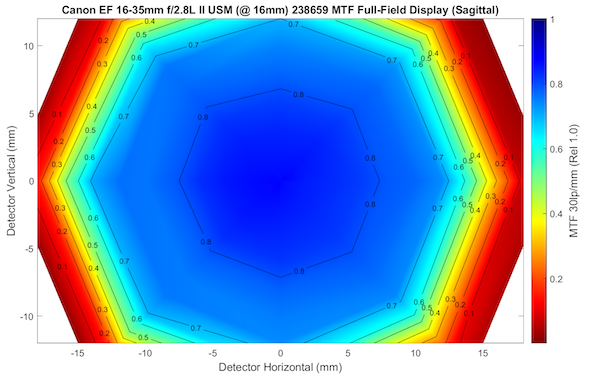
In the center, where things are blue, the MTF is pretty high, 0.8 or greater. At the edges, where things are red, the MTF is very low, 0.2 or less. This is actually a very good copy of this lens at 16mm, quite sharp in the center with the inevitable blurring in the corners that is the hallmark of it’s kind. But, as I’ve often said, zoom lenses vary. So let’s look at thumbnails of 9 more copies of the same lens, the Canon 16-35 f/2.8 Mk II at 16mm. Why thumbnails? Because we don’t need to look at details here; we’re just getting an overview.
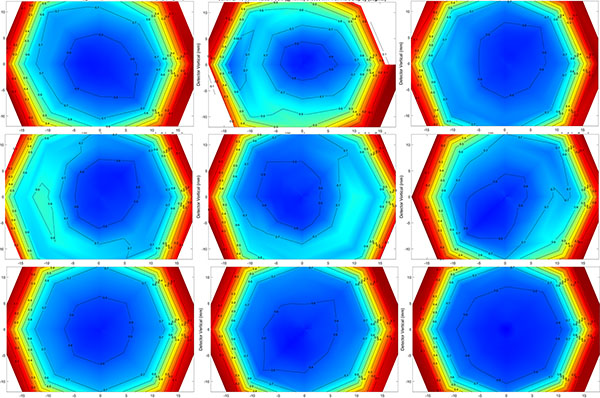
All of those lenses easily passed our screening tests and are good copies. On the highest resolution test charts on a 5Ds, even the top center one passes. But you can see each is a little bit different than the others.
Now let’s take those ten lenses above and average them together, so we get a picture of what a ‘typical’ Canon 16-35mm f/2.8 Mark II should look like. As you may have noticed, just to amuse myself, I chose the ‘most typical’ copy for the image above; it looks almost identical to the average one below.
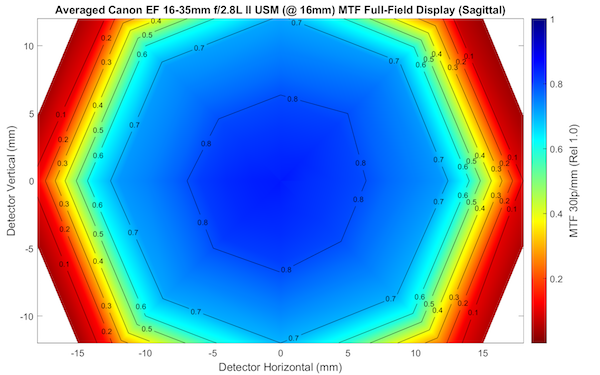
From here on out, when I show you a graph of a lens, it will be an average of 9 acceptable copies of that lens. The definition of ‘acceptable’ changes depending upon the lens and the focal length, of course, because not all lenses are equal, and a given lens isn’t equal at different focal lengths. But that’s what we’re here to talk about.
There is one thing I want to repeat. This is partial data; we’re looking at one MTF frequency and only the sagittal MTF at that. Don’t go fanboy and try to use this to do a lens comparison. It’s representative of the other frequencies, and tangential data follows a roughly similar path. But using these pictures to say this lens is better than that lens is, well, fanboy drivel.
So What Happens at Other Focal Lengths?
Well, we started with the Canon 16-35 f/2.8 Mk II at 16mm, so let’s look at it at 24mm, and 35mm, too. This should surprise none of you, we’ve known for a long time this lens was sharpest at 16mm and then softens up as you zoom in. It’s actually a tiny bit better at 35mm than it is at 24mm, but neither focal length is nearly as sharp as 16mm except at the very edges.
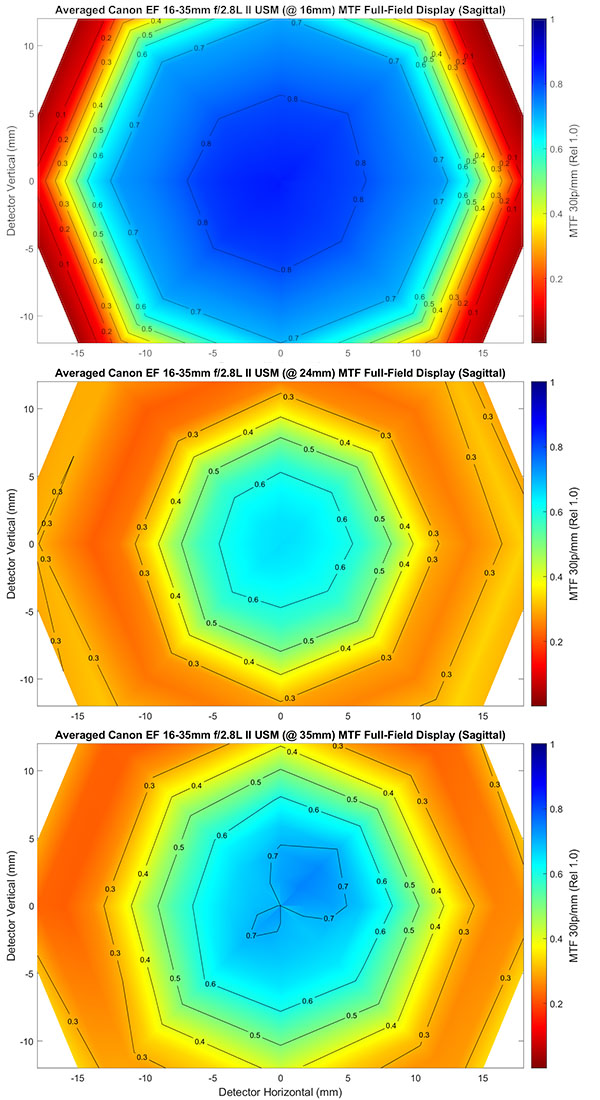
Now the question you should be asking, or at least the question I would be asking, is “Did they all get softer or did some get really soft and bring the average down”? I’ll just tell you that at 24mm they basically all got softer, but at 35mm there was a combination of softening and more variation. Here are the thumbnails of the lenses that went into making up that average.
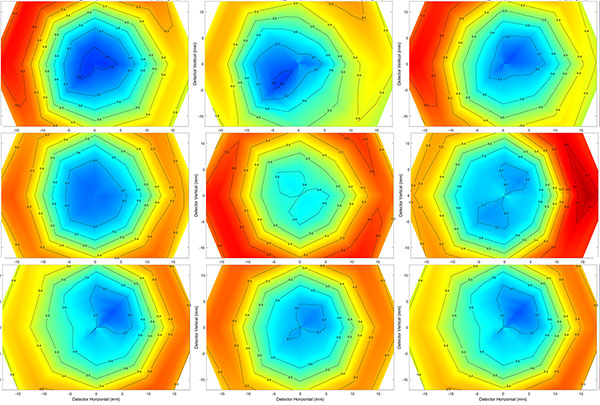
So there is more variation at the long end, but none of these 9 are as good at 35mm as they are at 16mm. The takeaway point is the Canon 16-35mm f/2.8 Mk II is best at 16mm and then gets weaker at longer focal lengths.
So let’s compare that to some of the other wide-angle zoom options. (Oh, and because someone will ask, I’m using an average of 9 because that’s plenty to show the tendency here. I’ve done it with lots more copies, and the averages don’t change much.)
What About Other Wide-Angle Zooms?
I know you all want your zooms to be even at all focal lengths, so let’s look at your shopping choices among the wide angle zooms and see if we can find that. Below I’ve placed the average graphs at 16mm, 24mm, and 35mm for the Canon 16-35mm f/2.8 III and the 16-35mm f/4 IS Canon lenses. Remember, the f/2.8 lens is tested at f/2.8; it would be somewhat sharper if tested at f/4.
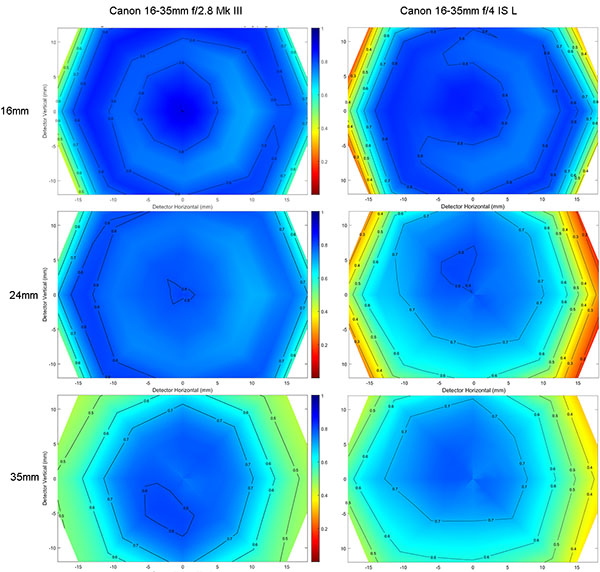
Both of these retain more sharpness at the longer focal lengths than the older design does. In fact, the 16-35mm f/2.8 Mk III is indistinguishable at 16mm and 24mm, losing a bit of sharpness at 35mm. The quick takeaway message is the new lenses are probably worth the upgrade from the Mark II; they don’t fall off as much as you zoom in. But I’ve got more of a point to make, so let’s continue
Let’s take a look at two third-party options in roughly this focal length; the Tokina 16-28mm f/2.8 AT-X Pro and the Tamron 15-30mm f/2.8. I’m doing these just at the two extremes of focal length here.
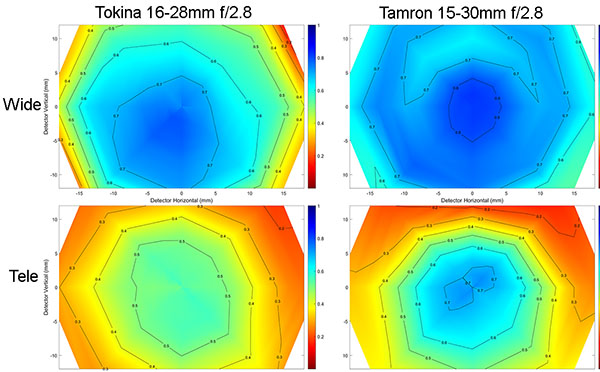
You may be starting to see a pattern here; sharper at the wide end, weaker at the long end. How about some Nikon wide zooms. Nikon tends to design somewhat differently; maybe they don’t have this pattern.
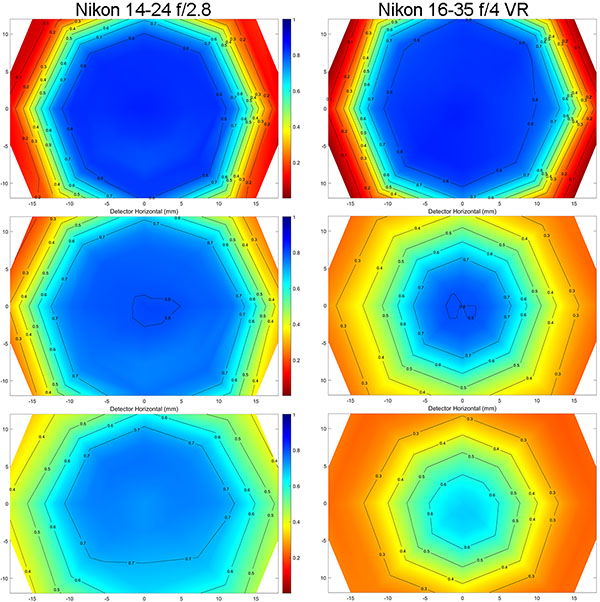
Well, the Nikon’s show the same typical pattern, sharpest at the wide end, softer at the longer end. Like the Canon 16-35mm f/2.8 Mk II, the Nikon 14-24 f/2.8 is better at the edges at 24mm, but the central half of the image is softer. The edge improvement may be an effect of less field curvature than anything else, but I won’t argue the point.
I have data on two more wide zooms I’ll throw up in the same graph. They have nothing in common, they’re just the two I haven’t shown yet, and two lenses fit reasonably well into one image. The Canon 17-40mm f/4 L is an old design; the Sigma 12-24 f/4 Art is a very new one. (BTW we now test 2X or fewer zooms only at the two ends, which is why there’s no middle data for the Sigma).
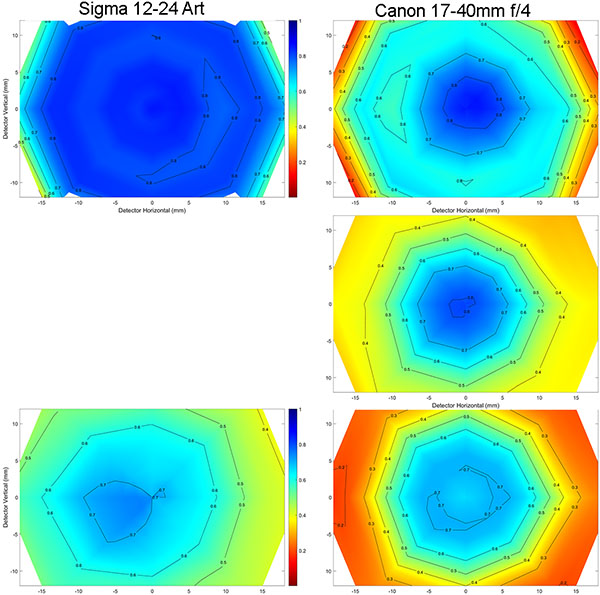
At this point, I think, the pattern is pretty clear. For simplicity sake, I think it best we give this pattern a name, and I think the logical name would be “Roger’s Law of Wide Zoom Relativity” since wide zooms are relatively sharper at the wide end. Are there exceptions to this law? Yes, but they are few and far between. For a few of these sets of 9 copies, there’s one lens that’s better at the long end than at the wide end, but for most there are none. No set tested averaged better at the long end than at the wide end.
Is this useful to know? Yes, it is. If you’re going to test your brand new lens, either by taking pictures or using a test chart, test the long end. If the lens is weak, that’s where it will be weakest. With some of these lenses where the difference is great, you might consider shooting at the wider end you can, either by foot-zooming a little closer or by changing to another lens when appropriate.
I know what you’re thinking now, though. You’re thinking, well, that’s just for wide zooms, right? Let’s take a look.
Standard Range Zooms
I’m not going to bore you with lots of text; you’ve got the drill now. I’m just going to show you graphs. Like the ones above, the wide end is on top, the longer end on the bottom.
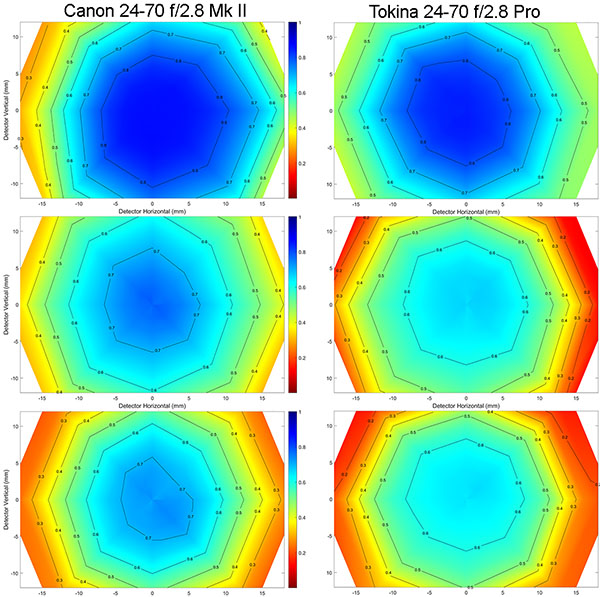
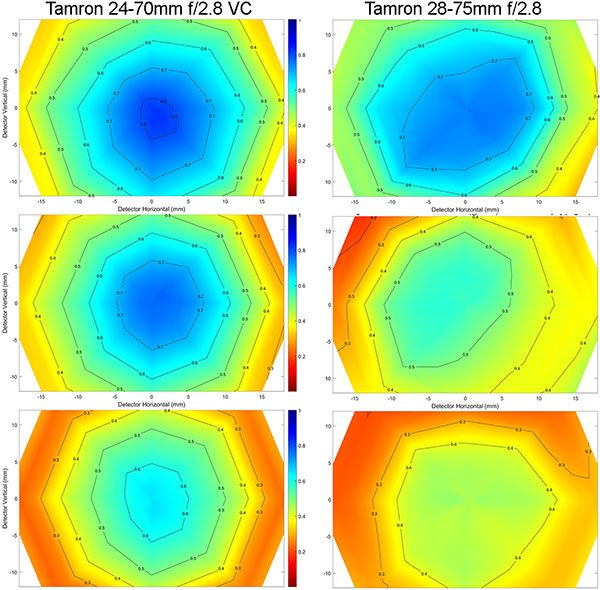
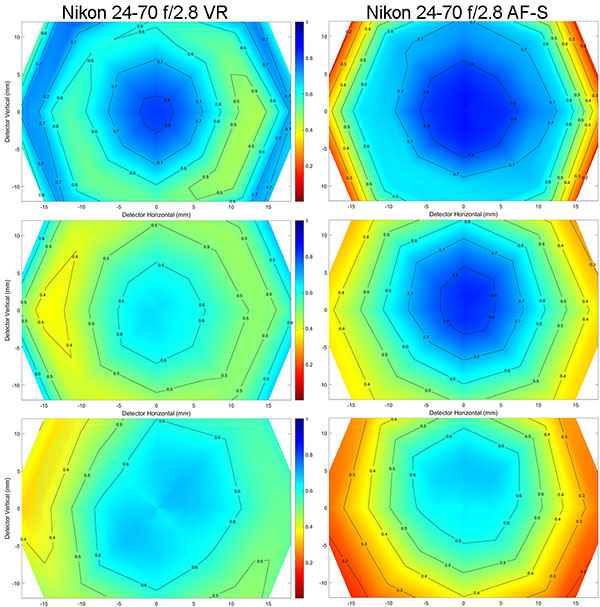
The graphs for Sony lenses can look a little different because at some focal lengths the built-in baffles cut off some of the edges, but the same thing happens – better performance at the wide end.
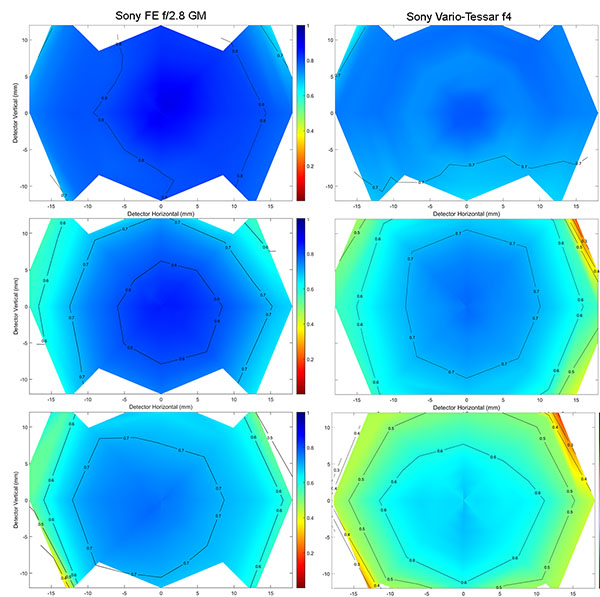
Again, you can see the pattern; standard range zooms tend to resolve better at the wider end, not as well at the telephoto end. I didn’t show them, but 24-105mm and 24-120mm zooms have the same pattern. So the Law of Wide Zoom Relativity seems to hold true for zooms that go from wide to slightly telephoto. I can’t tell you if it’s true for superzooms, like 18-270s, because I will never, ever test them. Life is too short to test 10x zooms. I can tell you that it’s not true for 70-200 zooms, but that’s the subject of a future post.
So what does this mean for actual photography? For me, it means I shoot my wide zoom at the wide end as much as possible and reach into my bag for the 24-70 zoom when that’s an option. The choice is a little less clear when things approach 70mm, and the choice becomes a 70-200mm lens, but, as I said, we’ll consider that later.
Why Might This Be So?
This seems a bit counter-intuitive, doesn’t it? Historically, it’s been harder to design wide-angle lenses, and with prime lenses, we tend to accept that wide-angles will be less sharp, at least in the corners, than longer lenses. So I would have expected the wide end to be less sharp in these zooms, or maybe that some would be better at one end than the other. But what we saw was 17 zooms tested, 17 sharper at the wide end. (You might argue about 2 of the 17 having better edges at the long end, but not better overall resolution.)
I can’t say for certain why this would be so, but you know me, I’m happy to speculate.
All zooms, whether they have an extending barrel or not, have at least two elements (and usually more) that move during zooming. The elements move along helical tracks, rotating as they go. Moving elements away from each other can magnify aberrations, which would reduce MTF, of course. The lens designer would attempt to correct for that, but lens design is always a compromise. The simple act of moving an element might tilt it or alter spacing from ideal.
However, there’s no reason I know of to think one position is better than the other. The movements of the zoom elements are usually complex. It’s not as simple as ‘when you zoom in, elements move further away from each other.’ If only the extending barrel zooms acted this way, then that might have something to do with it, but that’s not the case. A couple of these actually extend to get to the wide end and are ‘at rest’ in the center of the zoom range.
Lens design probably has more to do with it. Zoom lenses are designed, as best I understand, from a starting focal length. Then the design is modified to allow it to zoom, then corrections made for the aberrations that the zooming created and the cycle repeats until either the lens designer’s deadline hits or the marketing department is satisfied. It would make sense to start the design at the widest end which is probably the more difficult to design. That might, then, remain the better end when the design is complete.
The complexity of designing the wide end is probably less today with modern lens-design software, but in the optical industry, old habits die hard. If the practice was to begin a design at the wide end, that’s probably still the practice now. Not to mention the reality of lens design is that the designer usually begins with an existing lens, then modifies it. They rarely start the design from scratch.
Finally, and I know more about this than I do about lens design, there is the optical adjustment of the lens. For every zoom lens the adjustments are done at the wide end first, then a set of separate and more limited adjustments are done at the long end. But the rule of ‘get the wide end right, then tweak the long end’ is pretty universal for zooms.
So, to summarize: I don’t know why, exactly. The above was just me speculating on some logical reasons.
But I think it’s a useful and interesting thing to know, and something I’ve never heard talked about. With very, very few exceptions, every wide and standard range zoom is sharpest at it’s widest end.
Roger Cicala, Markus Rothacker, Aaron Closz, and Brandon Dube
Lensrentals.com
March, 2017
Addendum: Just because I know it’s coming, let me take a moment to comment on the inevitable people who will say, “I know you presented thousands of data points on hundreds of lenses, but you’re wrong because I have one that’s different.”
You actually might. Depending on the lens type tested between 0% and 15% are actually sharper at the long end. It does happen. It’s just not the general rule.
Second, we consider the fact that we see more detail when we zoom the lens to be the same as sharpness. If my subject fills up 10% of the frame and I zoom in, so it fills up 30% of the frame, I will see more detail. That’s not the same as sharpness. What the data I showed says is, within reason, if you shot an image at 70mm, then moved so that you had exactly the same framed image at 24mm, the 24mm image would have more detail.
And third, especially with wide zooms, if you shoot a test chart make sure you shoot different sizes of the same chart at the same distance. If you get close to a chart at the wide end, you may start approaching minimum focusing distance where lenses are less sharp.
165 Comments
Carleton Foxx ·
You are a saint for doing this.
Panacea ·
<- Edified.
Deanaaargh ·
Given the obvious ( I assume) complexities of designing UWA lenses why are so many of the widest lenses zooms? of course there are exceptions Nikon Canon and Sigma all produce 14mm modern(ish) primes (the Nikkor is from 1999). But there are seemingly many new ever more extreme UWA zooms on the market most notably the 11-24 Canon. Even in the MFT world neither Olympus nor Panasonic produce a prime wider than 24mm equiv. Why aren’t these extreme wide angles being covered by prime lenses especially given the sacrifices in the corners the zooms make?
Brandon Dube ·
The zoom lens is, in a sense, the only new lens design form since the retrofocus design in the 1930s (or 1950, if you consider angenieux’s retrofocus the first “retrofocus” lens). An 11mm lens for EF mount has a telephoto ratio (ratio of its back focal length to effective focal length) of about 4:1. Historically, designs outside the range of about 0.66:1 to 2:1 ~ 2.5:1 have been considered extreme, both in specification and difficulty.
The retrofocus design has a great deal of astigmatism and distortion that require great care and skill to reduce. It is also difficult to stretch the length of the lens (and its focal length) away from a starting solution. This largely has to do with the astigmatism and distortion I mentioned.
There are an enormous number of zoom lens design types and strategies to develop them. But in general, a ‘good’ zoom lens will maintain a similar aberration balance as it is zoomed. A consequence of this is that, speaking generally, until you reach a mechanical limit you can often continue to zoom arbitrarily while maintaining reasonable image quality. Often, even if the IQ becomes bad, the optimizer in the lens design code can make it pretty good again, perhaps at the expensive of performance at a different focal length or the requirement to add an element or two.
The zoom motions in ultra wide angle zoom lenses are mostly pretty small. E.g. the 70-300L extends about 2 inches from 70-300mm, and a 70-200mm lens is doing about that internally. On the other hand, the front group of 16-35mm lens may only move 1cm through its zoom range. ‘Stretching’ the motion another mm or two to reach 15mm or 14mm may be relatively easy.
Distortion and astigmatism are still a challenge – they are in all wide angle designs – but as long as you have a good zoom that is well behaved, pushing it to shorter and shorter focal lengths is a lot easier than stretching your 21mm design to 14mm, or your 14mm design to 11mm.
Deanaaargh ·
Thank you for your thoughts, I had not considered the inherent difficulties associated with back flange ratios, perhaps the newer mirrorless offerings will eventually have something to say about this. Though as you brought up astigmitization is likely to be an issue until something like curved sensors come about( if ever)
Athanasius Kirchner ·
Great reply. One observation, though: I think you were meaning to say “longer and longer” instead of shorter focal lengths, in the last paragraph. Or did I miss something?
Brandon Dube ·
The relative positions of the zoom groups determines the focal length. They can be reconfigured (zoomed) to a longer focal length or a shorter focal length arbitrarily. I do mean shorter and shorter — if you have e.g. a 16-35mm zoom lens, it may be relatively easy to make it go as far as 14mm or 15mm. If you have a 16mm prime lens design, making it into a 14mm lens may require much more work because of the difficulty in adjusting retrofocus designs. A zoom lens is a totally different design form that may (and often is) better behaved.
Athanasius Kirchner ·
That’s really interesting, thanks for sharing. I wouldn’t have guessed.
Roger Cicala ·
A good question and one I don’t have any answer for.
Deanaaargh ·
You do have many great answers for questions some of us haven’t even thought to ask.
Thanks for the blog.
Turniphead ·
I think the reason for the prevalence of zooms is that’s simply what the majority of users want in that focal length range. A high end full-frame 11mm lens would be a very niche lens – I probably wouldn’t buy it; but a high end 11-24 zoom covers pretty much the most interesting range of focal lengths for me – so if I had the money, I’d buy it!
I think the main reason we don’t see many primes wider than 24mm equiv on MFT is that they’d be excessively large and bulky compared to the rest of the system. Most MFT buyers chose MFT because they wanted a smaller and lighter system, so I doubt they would sell as well as the somewhat less wide (but much smaller, cheaper and lighter) pancakes.
El Aura ·
The Leica M has seen quite a number of extreme wide-angle lenses. The lack of a TTL viewfinder probably has something to do with that as well as the general trait of the M system of having pretty compact lenses (for what they offer).
Some new manufacturers (Venus, Irix) have discovered extreme wide-angle primes (11 & 12 mm) on SLRs as a niche they could occupy.
Turniphead ·
El Aura: Don’t forget 24mm (equiv) primes on MFT would be 12mm lenses on full frame; and there aren’t that (m)any Leica rectilinear lenses that wide. Wider than 24mm (equiv) would take it down to 11mm or less, which is getting into distinctly exotic territory. That’s what we’re talking about here. That said, I was surprised when Oly launched the 7-14mm!
This is one of the biggest drawbacks of MFT in my opinion, whilst you gain with the long lenses (smaller and lighter compared to the equivalent full frame lens), real ultrawide is generally impractical. I have a Rokibowyang 14mm, which I regularly shoot on my 5D2; there simply isn’t anything to match that in MFT terms – probably because designing and manufacturing a 7mm rectilinear lens would be (at best) challenging and expensive.
Agreed about the Venus and Irix lenses, but they are still niche, and even they’re only 22mm and 24mm equiv on MFT!
El Aura ·
Re-using lenses from larger formats often has drawbacks unless you use a focal reducer. But designing a 7 mm lens for m43 isn’t any more difficult than designing a 14 mm lens for FF (as long as the flange distance shrinks together with the sensor size, which it does).
Turniphead ·
Fair point, but I’d have thought that the ever increasing angle the light would be hitting the corners of the sensor at might prove problematic without curved sensors or heavily tweaked microlenses/design?
El Aura ·
If you don’t need lenses on smaller formats to have the same equiv. f-stop, then nothing changes with the angle of the light as you go the smaller sensor sizes. Imagine a schematic drawing of a FF lens with lines indicating how light rays pass through that lens and hit the sensor. Think of this lens drawing to have dimensions labelled in inches.
Now, change the dimension labels from inches into centimetres. Now, you suddenly have a lens drawing for a 1″ sensor. Has anything changed with the angles of the rays of light? No, even the f-stop remains the same.
Turniphead ·
Actually it seems logical to me that they would be sharper at the wide
end; as you’re using the whole of the front element at the widest
setting (and probably the largest amount of the other elements too). As
you zoom in you’re magnifying the centre portion of the front element,
so any tilts/curvature variations/imperfections are made more visible by that
magnification. I think all conventionally designed zoom lenses should be
sharper at the wide end as a result.
Roger Cicala ·
That seems logical and at least as good as any of my suggestions, maybe better.
wg ·
Magnifying also makes for lower resolution, in principle, similar but opposite to adding a speedbooster to a FF lens for, e.g., MFT.
The front group(s) of elements in principle create the image, the groups/lenses behind it magnify this image, and therewith not only magnify any imperfections as you state, but also decrease resolution simultaneously..
In modern lens designs there may well be compensationary tricks for this, but never for the full 100%.
I also think the fall-off is clearest with WA zooms, basically because the front elements are quite large in relation to the actual FL, and any imperfections from an optical view point are largest.
Sean T ·
Excellent point turnip – that also covers the superzoom family too.
Geoffrey Forrest ·
You are right. Also, what about the fact that WA lenses have an “Apparent Sharpness” and a deeper depth of field. One doesn’t need an auto-focus 18/21/24/28mm lens, when you can set it at 3Ft or 8Ft, more or less, depending on your needs, and at f5.6/6.1/8.
and get faster shots, with no AF lag. Test Samyung lenses against Nikon/Canon/Sony,
Remember the Sony Zeiss are not made by Zeiss and the Panasonic Leicas are not made by Leica and many lenses are made by Sigma, and most smaller Leicas are made by Panasonic in Thiland. The main difference, my Nikon 16- 85 is made in Thiland and says it on the lens. Most of the cameras are made, “Everywhere”. Leicas are not even, “Made in Germany”, They are made in Portugal and/or Austria.
Itai Basel ·
If test is done correctly and not handheld with autozoom – I think apperant sharpness is less of a factor – but I am not as savvy as others on this thread
geekyrocketguy ·
“I’ve been writing peer-reviewed scientific papers for way longer than I’ve been blogging about optics.”
I’ve been reading this blog for many years and didn’t know this. What was your previous career?
I have to say thank you for your data-driven approach to lens reviews, which is something that other reviewers don’t do. I spend a lot of time making Python plots that look like yours–I’ve done some optical analysis and lens design, but most of my work is data analysis for detector characterization.
Roger Cicala ·
My first career was in medical research.
Sggs ·
If we have to use the zoom at the widest and change 16/35 to 24/70, woudnt be wiser using primes?
Roger Cicala ·
Many do. But a lot of people do carry the ‘two zoom set’.
Patrick Chase ·
Depends how much you like cropping. You can’t always zoom with your feet, particularly for things like landscapes.
I worked that way for a long time (24-70 + 14 and 20 primes) and finally broke down and added a WA zoom.
I still use T-S primes (17 and 24) for a lot of subjects though.
Patrick Chase ·
This is a question for Brandon and any other OEs who might be lurking…
Could the tendency towards lower resolution on the long end be related to the increased size of the entrance pupil? Even variable-aperture zooms tend to have significantly larger entrance pupils on the long end than on the short, and I can come up with totally hand-wavy theories as to why that might worsen some aberrations. I’m curious to know if that’s viewed as a significant complication?
On a related note, what ‘turniphead’ says below about only using the entire front element on the wide end isn’t universally true. If you look at any 70-200/2.8 you’ll see that the entrance pupil occupies almost the entire front element diameter on the long end.
Brandon Dube ·
A larger pupil has the capacity for more resolution (there is ‘less’ diffraction). If you only increased its size without changing the aberrations, the resolution would go up.
The EP of most 70-200s is buried deep inside the lens, I would not at all say it ‘occupies’ the front element.
Patrick Chase ·
The EP of a 70-100 most certainly ‘occupie’ the front element at infinity, where you test on the bench. It’s depth in the lens is irrelevant under those conditions.
Brandon Dube ·
The entrance pupil does not know or care where the object is. It is the image of the aperture stop seen through the elements in front of the aperture stop. If you intend to test the lens more than just along the optical axis, you care a great deal where it is.
Patrick Chase ·
OK, let’s use numbers. A typical 70-200/2.8 has a 77 mm filter thread and a 200/2.8 = 71.4 mm entrance pupil. You can hand-wave all you want, but the fact is that the entrance pupil does occupy almost the entire front element diameter on the long end at infinity focus. At closer focus the cone of light has nonzero angle and will be smaller at the front element than at the EP, so object location DOES matter in this context.
You’re absolutely right that the FoV limits how deep the EP can be and/or how much of the front element it can occupy without vignetting, but that’s irrelevant to the point I was making.
Brandon Dube ·
I encourage you to hold a 70-200mm f/2.8 lens in your hand, look through the front of it, rotate the lens or do whatever you need to do to enhance your depth perception, and tell me where the aperture appears to be.
It is very deep in the lens, far from the front element.
Patrick Chase ·
Abolutely agreed. Then back up to infinity, do the same thing, and note that the entrance pupil now appears to occupy almost the entire front element regardless of where it’s located in the lens. My point was never about the depth/location of the EP, and I can’t understand why we’re arguing about that. It’s a canard.
w.r.t. the FoV argument, these lenses do vignette wide-open, so again there’s no contradiction :-).
Brandon Dube ·
If you’re licking the front element or infinitely far away, the aperture stop didn’t move. The image of it is still at the same spot.
Of course the on-axis beam (not the EP) covers most of the front element at the telephoto setting. the FoV is quite narrow, so the chief ray is not all that displaced from the optical axis and the edge of field beam and on axis beam are almost colocated. If the front element of a lens with a narrow FoV was significantly larger than the EP, the system would have to be extremely long, or have a grossly and wastefully oversized frornt element.
Patrick Chase ·
Fair enough – I suspect that if I’d said “on-axis beam at the front element” instead of EP we would have been in violent agreement, though that wasn’t the wording the post I was addressing used.
For examples of lenses with a narrow[-ish] FoV and a front element significantly larger than the EP, the two that spring to mind are the Sigma Art and Zeiss Otus 85/1.4s. I suspect that it’s no coincidence that both have exemplary off-axis performance compared to other lenses in the class.
Athanasius Kirchner ·
Kinda OT: Does this in part explain the massive front elements used in retrofocal UWA zooms? In principle, if the effective FL is short, the need for a large physical aperture should be negated. I’m quite sure this doesn’t apply to retrofocal designs, I just don’t know why.
Brandon Dube ·
Here’s a fisheye raytrace I posted some time back:
http://imgur.com/3HW1psW
None of the field points use very much of the lenses in front at all. In this specific design, it is the goal of the first 3-4 elements to convert a 170 degree field of view into a more modest ~90 degree field of view. Then the next 6 elements image that 90 degree field of view onto a sensor.
The same principals apply to a wide angle retrofocal design.
David Bateman ·
From your test we can clearly see that the olympus 12-100mm f4 is the best lens.
Joking aside, how come I rarely see m43rds lens tested? I know you have them and post like this I was expecting to see a Panasonic or Olympus lens thrown in there. Are there testing issues with 43rds lenses on Olaf? Or are 43rds lenses not tested?
Thank you for all the hard work! These posts really are interesting and you beyond the reseach paper minimum of 3 data points, or even 5. You must really like good p values.
Roger Cicala ·
We can test m4/3 and do sometimes. Part of it is volume. It’s easy to grab 10 copies of something we carry 300 of, but not so much when we only own 20 or so. There’s also the inevitable fanboy arguments about the different sensor sizes and what the tests show or don’t show. But I will try to do some more m4/3 comparisons soon.
David Bateman ·
Thank you, it would be awesome to see the 43rds data. Since you haven’t tested it I think the fan boy claims have run crazy there.
Also my self as a m43rds user would be good to know if the 12-100mm f4 is perfect claim, is true.
I appreciate all you hard work
Nivedita ·
Roger – We are really appreciate these types of blog posts and perhaps we are unfairly demanding more..
I am assuming that Pentax lenses are also In the same case as m43 due to the lack of availability in large numbers to test. I am curious to see how some of the recent ones from Pentax are (like the 70-200 and 150-450 – not the Tamron rebadged ones like 24-70 or 15-30). When I handled these lenses (very briefly), I got the feeling that they are built like a tank (and heavy). Not sure whether that is correct as looks and initial feeling can be deceiving…
El Aura ·
There is the question whether one should plot the MTF numbers for twice the resolution per millimetre with m43 lenses (to achieve the same total resolution, m43 lenses need to have a ‘resolution’ that is twice as large as that of FF lenses, except that m43 sensor lag FF sensors in resolution, though maybe 1.5x the resolution would be more appropriate).
Piotr Krochmal ·
Thank you Roger. I’ve got very similar reflections after working with all my zoom lenses, But what you do is science and you got proof. Also thanks to yours tests I’m more aware at calibration. So two weeks ago I make a bunch of tests shots and send two my zooms to recalibration.
What I see more that there is some extraordinary lenses there: Sony FE 2.8 Canon 16-35 III and Sigma 12-24 all of them are very blue!
I saw test shots when Sigma 12-24 was sharper than Laowa 12 D just Wow.
almeich ·
I have the Sony 16-35 mm and an A7r2. I know the lens is less “sharp” at 35 mm than at 16mm, but that is no problem for me; I bought it for the wide end. And I have the 2.8/35mm.
Some day I shall get around to do some test shooting with the 16-35. I’ll shoot (without moving the camera) at 35 and 28 and compare the 35-shot with a 28-shot cropped to show the same area as the 35. It shall be fun to see if more is lost by cropping than gained by avoiding the extreme long end of the zoom range. The 42 mp sensor has a lot of detailed information to play around with.
Greg Timms ·
I always imagined lenses were designed this way because of how they’re used. In the wide end you’re trying to fit in extra elements into the frame so better edge/corner performance is more desireable, and on the long end you’re pinning down a subject so edge/corner performance isn’t as important.
There are probably going to be use cases that don’t adhere to that, but I imagine the most common use cases would follow the above statement
Michael Clark ·
Or maybe our use cases in practice have followed the strengths and weaknesses of the lens designs, whether or not we are fully cognizant of why we tend to use them that way.
Omesh Singh ·
For landscape you’d want good detail from corner to corner, but for portraits you’d have a more center-weighted subject. (i.e. more likely to have out-of-focus background in the corners of frame for portraits.)
Scott Kirkpatrick ·
I noticed something that never gets settled with verbal thrust and parry alone on other forums. In cases where you show an IS or VR lens along side its brother without stabilization, the color scheme makes it clear that resolution has been sacrificed for optical stabilization. The Nikon 24-70s are a clear example. And this is even though the stabilizing element was probably immobilized during the test.
Patrick Chase ·
That seems pretty obvious to me, but maybe that’s just because I’m an engineer.
Additional constraints (i.e. “the lens must include a movable stabilizing group”) lead to either compromises in existing performance parameters (resolution etc), additional cost/complexity, or both.
For an example of a case where throwing money at the problem fully mitigated the performance penalty, see the Canon 70-200 IS II vs non-IS.
Athanasius Kirchner ·
Are you sure that that’s the case? I get the feeling that the IS II was a complete redesign, and it’s possible that the design goals were simply much higher than before, and so even if impacted by the stabilization group it performs much better than older models. Of course, IS technology was improved in between, but the Nikon 24-70mm VR is using a state of the art stabilizer, and it clearly isn’t immune…
Patrick Chase ·
I don’t know of many (any?) cases where IS has been added to an existing resign, without significant rework.
In order to function as such the IS group has to have a fair amount of optical power, so its very presence will ripple out through the optical formula. It is possible to *disable* IS in a design that was optimized with it by replacing the IS group with equivalent fixed elements, and Tamron seems to have done that in some versions of their 150-600 for example, but that’s very different from adding it to a “true” non-IS design.
Brandon Dube ·
An optical image stabilizer would want to have as little optical power as possible, not a large amount. If you give it a large amount of power, the tolerance sensitivity will be extreme and the image quality will be extremely bad.
Patrick Chase ·
“as little as possible” and “a fair amount” aren’t contradictory.
Intead, they merely reflect the fact that the power of the group is a tradeoff between two things: Cost/weight/responsiveness of the stabilizer on the one hand, and tolerance sensitivity on the other.
Are you saying that you believe that a stabilizing group is weak enough that one could be added to an existing design, without significantly re-optimizing the formula?
Brandon Dube ·
The function of a stabilizer is to cause a ray to deviate a controlled amount. The target deviation is typically small – microradians or so. To cause that on a strongly curved element would require mere microns of decenter, which would also have catastrophic consequences for image quality due to tight tolerances on surfaces with lots of power.
Quickly adjusting the stabilizer is typically not a problem – its weight is quite low and they are usually suspended in tensioned spring systems that reduce the necessary force.
Adding a stabilizer to a design is simply the act of identifying a group you wish to use as a stabilizer. If the tolerances are ok on it and there is room in the mechanical assembly for the supporting hardware, no changes are necessary to the optical design.
Because the stabilizer is likely to be ‘passively decentered’ most of the time due to an unrepeatability in its return to a rest position, the nominal performance of an image stabilized design often must be higher than a non stabilized design. However, this is not a hard and fast requirement.
Patrick Chase ·
Can you describe what you mean when you say that the deviation is “microradians or so”?
In terms of the angle of rotation to be compensated, numbers presented on this very blog indicate that camera shake has rotational velocity on the order of hundredths of radians per second. (https://www.lensrentals.com/blog/2013/07/good-vibrations-designing-a-better-stabilization-test-part-i/).
Making reasonable assumptions about shake frequency and minimum shutter speed, it’s obvious that a competitive IS system would need to compensate deviations on the order of milliradians.
Athanasius Kirchner ·
The 70-200mm f/2.8 IS II was a complete redesign from its predecessor, which included IS. That one was very different from the previous one, too. The point is that, beyond “money”, the design goals for the 70-200mm IS II were much higher, just like with the 24-70mm f/2.8 II.
Telezooms rarely display this behavior, though, even when a stabilized version can be compared with one that isn’t.
tresemes ·
The corners on the VR version are better.
Scott Kirkpatrick ·
I’m not sure which comparison you are looking at, In the Nikon 24-70, the VR on the left is inferior at all focal lengths. In the Nikon 14-24 against the 16-35 VR, the widest are very close, but the VR is a stop slower. And at longer focal lengths, it’s no contest.
tresemes ·
I’m talking about Nikon’s 24-70s, which are the ones you mentioned. You do realize that blue is better and red is worse, right? There’s no red color on the VR’s graph, it does seem to have a wavy field curvature but resolution gets better towards the edges whereas the original only gets worse. Here’s a more thorough comparison by the man himself, where they arrive to that conclusion, that center resolution has been sacrificed for better corners.
https://www.lensrentals.com/blog/2015/10/nikon-24-70mm-f2-8-ed-af-s-vr-sharpness-optical-bench-testing/
I wasn’t going to talk about other lenses but since you did…the stabilized Tamron 24-70mm matches or betters the 28-70mm, the Canon 16-35mm f4 IS is much better than the 17-40mm f4, and even CaNikon’s first stabilized 70-200s were better than the non-stabilized lenses they replaced.
Anyway, my point is that even if it were true that VR messes up the original MTF I’ve yet to see a brand that just takes an old lens, throws in a stabilizer and calls it a day; they make whole new designs to overcome that or even improve on the original.
The stabilizer, from my experience, DOES add a variable in real life that can result in uneven sharpness sometimes; but when it comes to “controlled” tests like this one I fail to see an example where “resolution has been sacrificed for optical stabilization”, the only thing that’s sacrificed for stabilization is our wallets.
https://uploads.disquscdn.com/images/7c6e8bec169baf0616e804820745c2584a9ee36a3b48a9b672295a721fa6de88.jpg
Scott Kirkpatrick ·
Also, I hope you take a crack at the very complex recent Leica and Olympus uber-zooms. The 24-90 Leica is rather weird at its wide end, leaving a lot of barrel distortion and lateral chromatic aberration to be tidied up in software, as the WarpRectilinear coefficients in the raw files make clear. The 90 end is more conventional, and is said to be inferior to the wide end. The middle focal lengths (35-75) have the best reputation. But that may be because of skepticism about the 24 behavior, not fact. And the Olympus 12-100 is claimed to be another state of the art, clean sheet design…
Roger Cicala ·
We did take a 24-90 apart: https://www.lensrentals.com/blog/2016/02/a-peak-inside-the-leica-vario-elmarit-sl-24-90mm-f2-8-4-asph/ We’ve MTF tested some and they’re very good. I haven’t published the results because we haven’t tested 10 copies yet but the one we’ve tested follow the 90mm end is weakest pattern.
Scott Kirkpatrick ·
I read over the Leica technical data sheets just now, and it seems more complicated. The saggital contrast wide open seems to get better as focal length increases, but the tangential MTFs wide open get worse. If you look just at f/5.6, the quality 2/3 of the way out from center doesn’t vary much at all. But “weakest at 90 — why did they bother.?” is the most common impression with that lens. (The 90-280, which came out 6 months later, is good at 90, and still good at 280.)
OTOH, my Leica R 21-35 follows your pattern exactly. It’s great at 21, nothing special at 35. (Both on the spec sheet and in reality.) Its mechanics are conventional — one moving group. But the R 28-90 has four groups, and groups 2 and 4 both move, by different amounts, as focal length changes. In this one the wide end seems inferior to the long end. Also, there is astigmatism (sag-tng differences) at the wide end and very little of that at the long end.
Brandon Dube ·
You can’t have a zoom lens with only 1 moving group! There must be at least one zoom and one compensator group.
Scott Kirkpatrick ·
I’m just responding to the engineering drawings in the Leica technical specs. They show the rear section of the lens moving steadily closer to the front section, without any apparent change in the spacing of the elements in the moving section. The compensation must involve relatively small corrections of one of those moving elements.
Roger Cicala ·
If you look at the teardown, the Leica has more moving elements than about anything else we’ve ever taken apart.
Patrick Chase ·
I think that Scott’s comment about “one moving group” was in regards to the Leica 21-35, not the 24-90. You’ve only torn down the latter right?
Scott Kirkpatrick ·
The drawing suggests that the front and rear groups are each rigid. Looking at the actual lens the front group moves back a bit more than the drawing suggests and the back group moves forward a bit less as I crank the focal length from 21 to 35. The aperture blades are in the second group. Seen from the rear they stay constant in size. Seen from the front they get bigger as I go from 21 to 35. Focusing movements appear to move only the front group.
Patrick Chase ·
It’s called “marketing copy” for a reason.
w.r.t. your observation about the 90-280 having less variation across its FL, it’s important to recognize that 90-280 is a smaller zoom ratio than 24-90, and that all-tele zooms have historically been better performers than wide-to-tele ones of similar cost/complexity.
Patrick Chase ·
The front section is also moving back, per those drawings.
El Aura ·
This hasn’t been pointed out so far, but all lenses whose test results you presented here are constant aperture lenses. I know that is not how variable aperture lenses work but one could argue that ‘stopping’ down a stop at the long end should improve IQ, everything equal, and thus at least partially compensate for the effect you presented here.
Geoffrey Forrest ·
Leica had a great name back in the 60s to a few years ago, because of the rangfinder system and the fact that they tests the lenses and rejected about 10%. Now the field has caught up with them, i.e., The Sony 7IIs, (To which you can adapt a, Leica Lens or any other.) and many of the other CSC camera. The new Fuji XGF takes care of all of the “problems” for $9,500 with a 25-52 zoom or wait for a wide non zoom, if you have
the money. It will be much cheaper than the new H’blad and much-much cheaper than the, Leica S, at $21,000+, with a lens. The best camera/lens is always the next camera.
The next few years will prove it. Wait until 2018 at Photokina in Cologne.
Andrew Milne ·
So I have a question, and a theory. What is the image circle of these various zooms at various zoom lengths? I would not be surprised to find that the image circle is much bigger at the wide end, and that the reason the image is better is because you are sampling only the inner part of the image circle, while you are taking the edges of the image circle when you are zoomed in.
Athanasius Kirchner ·
There’s an easy way to test that hypothesis, and it seems to be wrong. Image circles tend to increase in size towards the middle of the zoom range in retrofocal designs (common in SLRs). Many then decrease, but are still larger than at the wide end.
How has this been tested? With APS-C lenses on 135 cameras. Nikon F, Sony E and Pentax K tests have shown this effect consistently. There are some Minolta tests floating around, too, but those were made with film. Now, with the GFX getting all sorts of nice adapters, I think we’ll have a definite answer for 135 format lenses as well.
El Aura ·
I have rather seen the opposite, at least for pure wide-angle zooms. An example is the Nikon DX 12-24 mm f/4 that can cover FF up to about 17/18 mm (something I have tested myself when I moved from Nikon DX to FX).
Athanasius Kirchner ·
You’re completely right! I should’ve checked instead of posting straight ahead. I’ll edit my reply.
El Aura ·
No, your original post was correct. The Nikon 12-24 mm can be used on FF between 18 and 24 mm. Meaning, the image circle is larger at the long end.
(I also had to edit my post a few minutes after posting because I got it wrong.)
Andrew Milne ·
Actually, having read your replies I am wondering if I have this the wrong way round anyway. I was assuming that the edges of the image circle are naturally going to be worse than the center, so using more center is going to mean better resolving power. BUT using just the center of the image circle (zooming in on it, essentially) means you are enlarging the flaws/ reducing the resolving power that the center has. So (crudely) if you have a center that can resolve 50 line pairs/mm well, and you zoom in x2, you now resolve only 25 line pairs/mm. It seems in theory like both effects will be relevant – using the whole image circle means better center/worse edges, using a sample of the image circle will mean more consistency but lower resolving power.
So new theory: the red around the edge of the wide angle charts is a result of the edge limits of the focal design, with the full image circle being used. The general fading out as you go longer is a result of using less of a larger image circle, with the corresponding reduction in resolution from the enlargement effect.
Of course, actual facts (like knowing the actual image circles) would be much better than my amateur speculations!
Athanasius Kirchner ·
Once again, you’re right. Partially. My apologies to everyone on this thread, especially the OP.
Most lenses, like the Nikon 12-24mm f/4, Sony E 10-18mm f/4, or Pentax/Tokina 10-17mm fisheye, increase the image circle’s size at longer FLs. And yet there are others, like the Pentax 16-45mm f/4, that exhibit the opposite behavior. So, no general “law” can be derived from this.
Thinkinginpictures ·
“mininum focusing distances where lenses are less sharp”…well, I learned something today. Didn’t know that.
Roger Cicala ·
There are exceptions to that; all macro lenses for example, but it’s another general rule.
User Colin ·
I’m wondering about your conclusion
“So what does this mean for actual photography? For me, it means I shoot my wide zoom at the wide end as much as possible and reach into my bag for the 24-70 zoom when that’s an option”.
These are tested wide-open and at infinity. While wide-open seems to be a worst-case, how well does it correlate with f/5.8 or f/8? Some resolution charts I see elsewhere demonstrate variation on how quickly a lens “sharpens up” as you close the aperture. For two lens designs, where at f/2.8 lens A is a little better than lens B, would it occur that lens B was better at f/5.6? Even if “sharper at f/2.8 always means sharper at f/5.6”, is the difference at f/5.6 practically significant (especially when one takes lens copy variation into account). I’m thinking about those resolution bar charts on other review sites, where the base isn’t at 0, so the chart look much more dramatic than reality. Could it be that at 24mm both your zooms are much the same at f/8? Is testing them at f/2.8 the psychological equivalent of not starting your chart at 0 — the differences are amplified more than is fair? As you point out, even the worst looking lens in the group of 9 passed your resolution chart, which would say to me that it is “sharp enough”.
Your other conclusion:
“What the data I showed says is, within reason, if you shot an image at 70mm, then moved so that you had exactly the same framed image at 24mm, the 24mm image would have more detail.”
This assumes that focusing has no effect on sharpness. You note that “approaching minimum focusing distance where lenses are less sharp” so it clearly has some effect at the extreme close end, but how much does focusing affect sharpness in general? We know macro lenses are designed to be sharp at close focus, so lens design does affect focus sharpness. There also seems to be a variety of ways of focusing the elements (most obviously wrt whether the barrel extends). Is there any data on how sharpness is affected by subject distance (ignoring the effect of atmosphere as distance becomes huge)? Does doubling the subject distance from 10m to 20m, say, have an effect that is significant here?
There are other factors too, such as if your 24-70 has IS or perhaps it has faster or more accurate autofocus. Does anyone test autofocus accuracy over a range of distances or over a range of focal lengths? The lens could be as sharp as a knife but if the focus is incorrect, or you have an unsteady hand, then that counts for nothing.
William Lewis ·
This fits with my limited experience with zooms on micro4/3 as well. But then I am biased against zooms to begin with as I leaned photography with only a “nifty 50” and the only zooms that were marginally worth the time of day cost thousands of dollars.
I’ll still stick to my 17, 25, & 50 primes, thank you very much.
Rob. S. ·
While I do like the 17/1.8 and 25/1.8 Olympus lenses myself, too, I actually have gotten the impression that the 12-40/2.8 zoom is sharper and more consistent across the frame at both focal lengths…
Matt Austin ·
If your speculation holds, I wonder about the Canon 24-70 f/2.8L vI that extends as you go from tele to wide. If the base focal length it was designed for was 70 and then extending it to 24 was added in, would that the graphs for that lens show the opposite pattern?
Roger Cicala ·
Matt, I wonder about that too, but all the copies we have are older and were optically adjusted multiple times by us, so I don’t think it’s a good sample population.
Ilya Zakharevich ·
Since you optically adjust them “often” anyway: can you try to start at the long end? They you would be able to check the conjecture that “one side is better than the other” ONLY due to the preference in optical adjustment!
If when “adjusting for the long end” you see that your thumbnails for wide/tele just “switch places” (tele becomes perfect edge-to-edge, while wide is “good in the center only”), then this would support the opinion that “with a typical wideangle composition the edges matter, with a typical tele composition edges matter less”.
Patrick Chase ·
Roger’s old ‘imatest’ results suggest otherwise. https://www.lensrentals.com/blog/2013/01/canon-24-70-f4-is-resolution-tests/
Both generations of the Canon 24-70 exhibit modest degradation on the long end, though. I don’t hesitate to use my 24-70 II at 70 mm (now that I have a good copy. The first one was dismal on one side from 40 mm up).
Michael Ogle ·
I am curious if your findings are the reason some lenses from yester year were designed with vari-aperture like the Tamron 17/35 f2.8 to 4?
Roger Cicala ·
I don’t think that’s the reason, but I could be wrong. I think it was more simplicity of design.
John Krumm ·
I still saw numbers, and even some decimals, but I understood it anyway. Sharper wide, softer long. I also suspect the long shots are affected by atmospheric diffraction and the rotation of the earth. I’d elaborate, but there are numbers involved.
Roger Cicala ·
Are you saying the earth is round and spins????? I mean, professional basketball players are saying it’s flat. How can you go against that?
Geoffrey Forrest ·
The earth is closer to egg shaped and you are flat.
Max Dallas ·
If it wasn’t for Kelly Ann Amway and Sean Spicer, I’d say your comment is the silliest thing I’ve seen this year.
Perry Winkle ·
Oh no, Lensrentals has a cuck infestation.
T N Args ·
What about long telephoto lenses. The designers must know that buyers really buy it for the long end. Can’t they design them to be best at the long end? Shouldn’t they be doing that? What do the numbers say?
Roger Cicala ·
The 70-200s are more regular, there’s no specific pattern like we see with the wide and standard zooms. We don’t feel comfortable making comparisons on long telephotos on the optical bench. We do some spot measurements, but the time it takes is huge and vibration begins to be a factor.
T N Args ·
Thanks Roger. I was thinking more of the 100-400 and 150-600 types which (correct me if wrong) generally seem to fade at the long end, and manufacturers must know that is the end buyers are most keen about. Makes me wonder if your hypothesis about designing from a starting focal length is right, or if some other principle is in play.
Roger Cicala ·
That’s my impression too, but I don’t have the numbers and graphs to show.
Thom Hogan ·
My experience with many of these is that they’re consistent and fine out to a point and then fade. The new Nikon 200-500mm is actually very, very good at 400mm. But at 500mm it’s weaker. Ditto the other telephoto Nikkor zooms, except perhaps for the new 70-200mm f/2.8E.
Athanasius Kirchner ·
Which begs the question, why are telezooms generally better 50mm or 100mm before their maximum focal length? It could well be the same phenomenon that causes the “fade” on standard and wide zooms, and maybe it has little to do with design, and everything else with some other factor.
Thom Hogan ·
And I think you might have part of your answer there, Roger. It’s something I’ve speculated on, too. Lenses that go from wide angle to less wide angle or normal or telephoto have an interesting property to them: they are often bigger than expected. A 70mm f/2.8 lens doesn’t need a 77mm front element, but for some reason 24-70mm f/2.8 lenses now need an 82mm front element. I think the designers are designing the wide end first and then finessing the long end for these lenses.
Max Dallas ·
Vibration as in Talia Concept ? Roger – very deep indeed.
https://youtu.be/wMjovG2PqZM?t=1m44s
Matt ·
I’ve always noticed this. The 24mm of the 24-70mm is sharper than the 70mm end.
And the 35mm of a wide zoom was always less sharp than 35mm of the 24-70mm.
Sharpness alone doesn’t make the lenses better at the wide end though; Vignetting and distortion in particular are always strongest at the wide end of these zooms.
Geoffrey Forrest ·
A basic law of design: If an product/object has to perform/provide one function it is easier to produce than a product that has to perform/provide two functions and much better than one that has to perform/provide three. Meaning, If you are looking for a rtelationship with a very good looking person, then there is no real problem. If you, also expect them to be smart, more of a problem. If you expect them to be a good cook or good at something specific, less of a chance, and if you expect them to love you, you have
a real problem. Get it?
Lee ·
Thanks for another interesting piece! Since we’re talking underlying design philosophy and how it directs lens offerings, I will jump in with a tangentially-related question I’ve always wondered about:
Why don’t we see more moderate focal lengths with MTFs like, say, the 200/2 VR? The Zeiss 100MP takes on that nearly-flat shape (at a lower numerical level, of course), but it’s about the only I can think of.
It’s hard to believe it would be just market taste. The 135 APO-Sonnar and 135/1.8 Art are like *half* the size of the 200/2’s. Does people’s willingness to deal with size/weight drop off *that* fast??
So is that kind of MTF just not achievable below a certain magnification? That the Otus 85 needed to be so much bigger and exotic-glass-using than a typical 85/1.4 to approach that level just in the center (with a more typical rate of falloff) seems to suggest so. I mean, I realize the size difference is less than, say, between a 180/2.8 and the 200/2’s, but part of that is the aperture difference. (PS – I know a portrait-focused design for the Otus 85 is exactly what the market wanted, I’m just commenting on what it apparently took to get there)
DrJon ·
BTW the odd picture of Canon’s in-house testing here:
http://www.imaging-resource.com/news/2017/03/20/canon-factory-tour
Especially:
http://www.imaging-resource.com/manual-update/news/canontour/Z-IMG_0273_WB-625px.jpg
Although possibly they didn’t let them photograph all the good stuff…
Roger Cicala ·
Yep! They’re using interferometers for on axis subassembly testing and perhaps whole lens testing. That’s top of the line. But then they apparently switch to target analysis on 5DIII for off-axis whole lens testing. But that was an impressive look at Canon’s manufacturing and assembly process. They lead optomechanics by a large margin.
DrJon ·
Are you concerned for the implications of having aberration data in the lens for when DPP supports using this (as presumably it’s all invalidated every time you mess with a lens)?
Brandon Dube ·
They only know the aberrations on axis. DPP can only accurately work with information for like 10 pixels based on that data 🙂
DrJon ·
You mean current versions? Presumably they can do anything they want to in future versions?
Also a source for how DLO currently works in DPP would be handy, as I’m unconvinced…
Brandon Dube ·
Off-axis interferometry is enormously expensive, time consuming, and complex. They are certainly only doing it on-axis which only gives them information about the lens relevant to a very small region near the optical axis.
DrJon ·
But they do other tests for off-axis performance!?!
Roger Cicala ·
I think that’s where you saw ‘mounted to 5D III and taking pictures of a proprietary test chart’.
Brandon Dube ·
But not with an interferometer 🙂
Roger Cicala ·
That’s already the case in some lenses (not Canon though, so far), and also the case for replacing IS units of AF motors, etc.
El Aura ·
Roger, you are probably right that this phenomenon has rarely been talked about. But I think every avid lens test reader pretty much knew this already.
Patrick Chase ·
So I’m a bit slow, and finally recognized something obvious about LR’s MTF testing methodology: The fact that the bench uses a broadband source means that lateral chromatic aberration degrades sagittal MTF.
I’d been wondering why some lenses that I know to have very little astigmatism (particularly the Canon 200/2 and 300/2.8) appeared to have a fair bit in Roger’s tests, and I suspect that may be the cause.
I’m not advocating that you do anything different. Simple narrowband MTF measurements don’t adequately penalize axial CA, so that wouldn’t be a reasonable solution. The only viable approach I can think to disentangle the impact of lateral color would be to do separate R, G, and B narrow-band measurements at the same focal point. If all 3 of those are high but the broadband is low in the saggital then you can be reasonably certain that lateral color is at fault. The obvious problem is that doing so would be bloody expensive and time-consuming.
Roger Cicala ·
Exactly what you said, Patrick!
Brandon Dube ·
lateral color degrades tangential MTF and does not affect the sagittal MTF. The axis of an MTF measurement is normal to the line spread function.
Patrick Chase ·
Argh, obviously you’re right. It is in fact the tangential that’s depressed in the lenses I cited: https://www.lensrentals.com/blog/2015/07/supertelephoto-mtf-curves/.
Somehow I got it in my head that MTF was described in terms of the direction of the modulation (which is a common convention for similar metrics in some other domains) rather than its normal.
Sean T ·
This is fantastic, thank you Roger. How interesting. I appreciate the terrific variety of lenses examined too.
Frank Kolwicz ·
So, *that’s* why I’m disappointed with my zoom lens selections since I went digital and now 5Dsr digital as well!
The long end of a zoom lens is most important for me and the ability to have occasional shorter focal lengths available was just a convenience. Well, I have been told that I have a tendency to do things ass-backwards.
Geoffrey Forrest ·
Test non-zooms like a100mm or 200mm and stick with that, depending on what you are looking for or should I say, depending on what you are looking through.
Hunter45 ·
That’s actually supposed to be “bass-ackwards”…
Alec Kinnear ·
There is the odd zoom which does very well across its focal length. Canon’s EF 24-70mm f/4 L IS is particularly good across its range while the various iterations of its EF 24-105 L f/4 L are particularly poor.
I mainly shoot primes as you usually get what’s written on the tin. Canon’s EF 85mm f/1.8 doesn’t sharpen up at all until f/2.2 though. Canon’s EF 50mm f/1.4 was also very soft until f/2.2 or f/2.4. And I think there’s something similar going on with the Canon EF 135mm f/2 L (doesn’t sharpen up until f/2.5 is my early guess). Sigma’s 50mm f/1.4 art on the other hand is sharpish from f/1.4 and sharp from f/1.6.
Lesson: prioritise for your real needs in terms of focal length and aperture. Don’t forget about autofocus performance as well (accuracy and speed). Those Canon lenses which are weak on wide open performance do very well on focus tests (plus they are a lot smaller and lighter than the Sigma Art series).
Michael Clark ·
Those lenses that are “weak” on wide open performance also tend to smooth the out of focus areas much better than lenses that are so corrected for flat field performance (because how well a lens can reproduce a flat test chart is what sells lenses these days, even when the intended use is for a 3D scene) that they make the out of focus areas much “busier” or even “harsher”.
BigEater ·
The amobea-like and unpredictable shape of the sharpness zone of these lenses makes me want to cry.
I’ve always thought of lenses as high-precision objects of technological wonder. Now I see they’re just as imperfect as the humans who use them. Talk about losing my religion….
Geoffrey Forrest ·
Poor baby. Don’t you know here are no absolutes and therefore nothing is/can be perfect, except me, compared to the rest of the flat world.
Matti ·
Is it me, or is the Canon 16-35 III breaking new ground? It seems the only lens in it’s wide angle zoom range segment, that keeps at least light blue sharpness up till 35mm, except at corners. And from what you always say stopping down would help even more, and it has one stop extra to do so then the 16-35mm F4 IS. It’s also (for me) not surprising the Nikon 16-35mm F4 is not so good. Sample images on flickr showed it can’t tackle 36,3 MP. Some lenses are close (like nikon 14-24mm) but it’s not 2x zoom. Also one question that keeps popping in my mind in every review is, ‘ok cool, wide open performance,’ but what about F5,6 or F8? You say it always improves on stopping down, but my guess is different lenses, have different (better /worse) response to stopping down, not?
Maybe Canon found a way, to make the zooming even more complex, so that certain sharpness loss, that goes with straight movement of 3-6 lens part forward (and keeping their distance between each other the same), now is not there, by moving each element in a different push? I’m just speculating here, but the Canon sharpness cannot be only because of elements imo, it must have to do with zooming technology, to offset it’s weakness.
Nice to see how good the Sigma 12-24mm is at 12mm. It’s almost insanely good there, primequality. Wich was my impression when i tested it. Some ppl said ‘no no no, it has soft spots’, at every focal length. But my guess is those people don’t like 12mm. I agree it’s weak at 24mm in my test shots.
Very curious if the 14mm prime of sigma will be even better then, that could be game changer for sharp wide angle shots imo.
Anyway as a guru of wide angle lenses, it’s amazing to read this ‘number crunching’, thanks for that Roger.
Patrick Chase ·
I have a 16-35 III, and it’s a great lens, but it’s not without tradeoffs. The big one is vignetting (4 stops!) at the wide end. I personally think that’s a good tradeoff as I find vignetting both preferable to and more easily/harmlessly corrected in digital workflows than blurry corners, but I don’t think they’re playing in a completely different league than, say, Zeiss or Nikon.
I do think Canon and the other two I mentioned above are a cut or three above Sony, though.
Roger Cicala ·
We haven’t published a tear down yet, but have been inside it a bit and it seems exceedingly well made, 35mm f/1.4 Mk II kind of well made.
Roger Cicala ·
From the recent visit DPReview made to the Canon factory, I bet we’re seeing some of the benefits of all that automation that their doing with lens assembly. And of course the design that allows automation.
Patrick Chase ·
This last one (design enabling automation) is a biggie that a lot of folks miss: You can’t just take any old mechanical design and automate its production. Design for assembly (DFA) becomes a huge deal in this context.
Ironically DFA was deemphasized for a long time in many products due to the seemingly limitless supply of cheap nimble-fingered overseas labor. Sony-esque design was more the norm than a Southern Fairy Tale. DFA is back with a vengeance now that the cost of automation has come down, and global unit labor costs have risen.
Marcello Mura ·
Ok Roger, so you put in our minds two precious statements:
wide and standard zoom performs better at the wide end
lens do perform less good near their MFD
Lets come to put in pratical this 2 statement. How this lead me to the choice of my lens and the way to use it?
First question: I will pick a wide lens to use on the wide end, and that is ok. When the situation allow me to do so, i will swap for my standard zoom, but… Should my 2 lenses have an overlap or it is a better strategy to not overlap. And when it comes to the moderate tele, should i put aside my zoom for a prima to keep the quality high as possible?
Marcello Mura ·
Second question (had a problem with post lengh…): should i stay away to the MFD? should i choose a lens that can focus as close as X if i need to be 2 or 3*X close? Can i compensate stopping down, like in the Nikkor 60mm micro?
Roger Cicala ·
Marcello, for the minimum focusing distance loss of sharpness, it is not universal. Macro lenses, of course, work best at minimum focusing distance and lenses with a compensating element also maintain sharpness very well. It is something to consider on other lenses, though.
I think the common ‘lens swap’ is going to be for the person who shoots a wide zoom, like a 16-35. There’s good reason to consider that a 16-20 in practice and reach for your 24-70 for anything in that range. Or, as many people are doing now with the numerous excellent wide-angle primes on the market, carrying a 14mm or 15mm prime and a 24-70 zoom, etc. The similar question comes up with 24-70 zooms at 70mm if you have a 70-200mm zoom.
The reality is, though, the convenience of a zoom is the reason for a zoom. The long end may not be quite as sharp, but a shot done at 35mm on a 16-35 is still going to have much more detail than one taken at 16mm and then cropped.
?ukasz Moszczy?ski ·
“(…) every wide and standard range zoom is sharpest at it’s widest end.”. Really?
Roger, what about that data:
– http://www.sigma-global.com/en/lenses/cas/product/art/a_24_105_4/data/
– http://www.sigma-global.com/en/lenses/cas/product/art/a_24_35_2/data/
– http://www.sigma-global.com/en/lenses/cas/product/art/a_18_35_18/data/
These manufacturer charts also have confirmation in independent reviews.
Roger Cicala ·
Apples and oranges. You’re comparing manufacturer’s computer generated ideal MTF with multi-copy actual tests. The MTFs on the computer are always excellent. Actual lenses not so always.
Don’t get me wrong, those are great lenses. And I have not tested the 24-105. However the 24-35 behaves exactly the same as the other lenses I presented here – slightly sharper at the wide end. As to ‘confirmation in independent review’ since I don’t know of any review site with access to an MTF bench, please link us up. I could be wrong, happens all the time, but I can’t believe I’m missing someone publishing MTF bench results.
Łukasz Moszczyński ·
"With very, very few exceptions, every wide and standard range zoom is sharpest at it’s widest end.".
Only few? 3 quick exceptions just for new Sigma lenses:
- http://www.sigma-global.com...
- http://www.sigma-global.com...
- http://www.sigma-global.com...
These manufacturer charts also have confirmation in independent reviews.
Magnar W. Fjørtoft ·
Great work! And also educational and fun to read your comments! Also, I am impressed what modern lens makers can do, and the quality of affordable mass produced lenses! 😉
ManFay ·
Great work! And also educational and fun to read your comments! Also, I am impressed what modern lens makers can do, and the quality of affordable mass produced lenses! ;-)
pmpm12345 ·
Long article. I’ll summarize in case people don’t have time to read it:
Roger compared many wide angle lenses. He found that they were rated as (from best to worst):
* Canon 16-35mm f/2.8 III
* Canon 16-35mm f/4 III
* Nikon 14-24mm f/2.8
* Sigma 12-24mm Art
* Nikon 16-35mm f//4
* Canon 17-40mm f/4
* Tamron 15-30mm f/2.8
* Tokina 16-28mm f/2.8
For normal zoom lenses, he found Sony was best, followed by Canon/Nikon, and Tamron was the worst.
He found that the lenses behaved better wide-angle than zoomed in. He hypothesized that this was because a zoom lens acts kind of like a built-in adjustable teleconverter, and fundamentally crops the image, leading to worse performance. He repeated this result for standard lenses, but then said he couldn’t replicate it for telephotos, which he’d write another article about.
I think the point of the article was that Sony has now caught up and passed lens giants Canon and Nikon, while, despite occasional good copies, Tamron is still a low-cost low-quality alternative. Of course, Roger didn’t say that outright since he does business with all these companies, and didn’t want to appear smear one. So there were a lot of disclaimers about how he wasn’t saying that, and a lot of verbiage about correction of aberrations and so on, designed to make the article look like it was about something else. But we could all read past that.
Roger: Please correct me if I’m wrong about anything.
Thanks for the great lens review article! This was wonderful.
Roger Cicala ·
LMAO!! You made my day!
Dragon ·
Yep, the Sony stuff is great until you have to get it fixed, then not so much. Service does matter and Tamron is actually very responsive.
Ralph Wallace ·
Roger – Please test the Canon EF-M 11-22mm f/4-5.6 IS STM
GF ·
Roger, I know you said we shouldn’t be doing comparisons, but it’s hard to ignore that 16-35 III from Canon.
Dragon ·
Roger, the EF-M 11-22 might be an exception. It is amazingly sharp at the 22mm end. Actually sharper than the 22mm pancake.
Roger Cicala ·
Thanks Dragon. I don’t have data on that, but I can see where that might be so.
Kevin Sparks ·
Fantastic results and observations I haven’t seen elsewhere. Thank you, Roger!
Curious if the Sony-Zeiss 16-35/4 also fits the pattern, and if it likewise tests as favorably overall as the Sony standard zooms included here?
Roger Cicala ·
Kevin, correct on both counts.
Geoffrey Forrest ·
What about this: To test the difference between a photo shot with a non-zoom,
16/18/21/24mm, and cropped to 20/24/28mm, Meaning, I can save a lot of time/money
buying a very fast non-zoom WA of 21/24/28. Or, for example, what about a test of the
Sigma dp0 w/21mm, fixed lens?
Don Farra ·
Roger, thank you for the presentation. One question, what other general rules of thumb have you found regarding lenses?
Roger Cicala ·
There aren’t a whole lot, actually, except the obvious ones: Zooms have more variation than primes, etc.
Itai Basel ·
You suggest that testing the wide end will give a measure of how good a lens instance is – but is it so? were’nt there specimens that showed good wide angle resolution but lacked in the mid range or at the long end?
Roger Cicala ·
Actually, I thought I suggested testing the long end since that’s where the weaknesses would be.
Brian Caldwell ·
I haven’t read all the comments here, so my apologies if I’m about to state the obvious. The reason that most wide zooms are better at their wide end has less to do with the desires of the lens designer or marketing people than the inherent properties of the basic wide zoom architecture. Almost all of these fall into NP, NPP, or NPNP types, where “N” refers to a negative-powered zoom group and “P” to a positive-powered zoom group. Unlike tele-zooms, these type of zooms generally have a moving rear group. This means that in order to maintain a constant f/# through zoom the marginal ray height gets bigger on the rear group. This is made worse by the fact that the magnification of the rear group is usually higher (e.g., closer to unity) at the long end than it is at the short end. Its worth noting that in some designs the iris diaphragm is actually cammed so the physical aperture gets larger at the long end just to maintain f/#. The net result is that its much more difficult to correct the long end than it is the short end, mostly due to spherical aberration.
Roger Cicala ·
Thank you Brian! That makes much more sense than my speculations. I appreciate you putting the scientific theory to explain the observation.
Brian Caldwell ·
No problem, Roger. I just realized I might not have been clear enough. Most wide zooms have the rear group moving away from the image plane as you zoom to longer focal lengths. So if the f/# is constant then the area of the rear group used increases for longer focal lengths. In effect, the rear group gets stopped down toward the wide end. This can be mitigated if you allow the f/# to get larger (slower) at longer focal lengths, but most people don’t like that. It is possible to give huge weighting to the long end to try to avoid the typical performance pattern, but its like pushing a big rock uphill.
Thomas ·
I always had the idea that a wide angle lens has elements with lots of power. When zooming, the elements are positioned so they ‘cancel out’ leading a longer FL. But any deviations in these strong elements will still be there, and being a larger proportion of the overall strength mean a less sharp image.
Or is this not about imperfections, but about optical design: how do I design a long lens with these very strong and strange aspherics in it?
24x36 ·
Seems like, following your statement about a zoom being designed around a “beginning” focal length, that it is such “beginning” focal length that dictates which “end” of the zoom range will probably be the sharpest, or at least relatively sharper than the opposite end (with some types “peaking” in the middle as corrections are done for other focal lengths within the zoom range).
This seems connected to the end of the zoom range that dictates the size and /or shape of the front element of the lens. For a telephoto zoom, I would expect things to work somewhat in reverse, since the front element of the lens has to be designed around the long end (which is what dictates the front element size, in particular for constant aperture zooms) as opposed to “ultra wide to wide” zooms or “standard” – what I would call “(very) wide to short telephoto zooms” (which have to be designed around the short end, due to the angle of view that must be captured) which have the short end of the zoom range dictating the shape and/or size of their front element.
Of course, I’m just speculating, too. ;-D
papaouiee ·
WTF are you talking about. You explain nothing what the graphs are, how to read them and you use abbreviations without defining them. This article is totally useless without that information.
Mike Aubrey ·
They’re just measurements MTF 30lp/mm across the image plane.
taildraggin ·
You and your staff stay after work and pick out the best lenses. So jealous.
Alec Kinnear ·
Not sure about that. It’s the photographic equivalent of working in a saloon (booze, gambling and women 24/7). Vice is tastier in small doses.