
MTF Lens Tests of the New Tamron 70-200 f/2.8 SP Di VC USD G2
There’s been a bit of rumbling lately about the new Tamron 70-200mm f/2.8 G2 zoom. Not just because it is a frontrunner in the 2017 Most Initials in the Name Award, but because a lot of people are saying it’s really quite good. The previous Tamron 70-200mm f/2.8 was a good lens, but since they only added two more characters to the name, I wasn’t sure this one would be hugely better; yet, people said it was.
When you consider that it sells for a very reasonable $1,300 compared to $2,800 for the new Nikon 70-200 f/2.8 FL ED VR, $2,100 for the Nikon 70-200 f/2.8 VR II, and $1,900 for the Canon 70-200 f/2.8 IS II lens, well, it seems worth evaluating. So we decided to put ten copies on our optical bench and take a look, even though 70-200mm zooms are a pain to test.
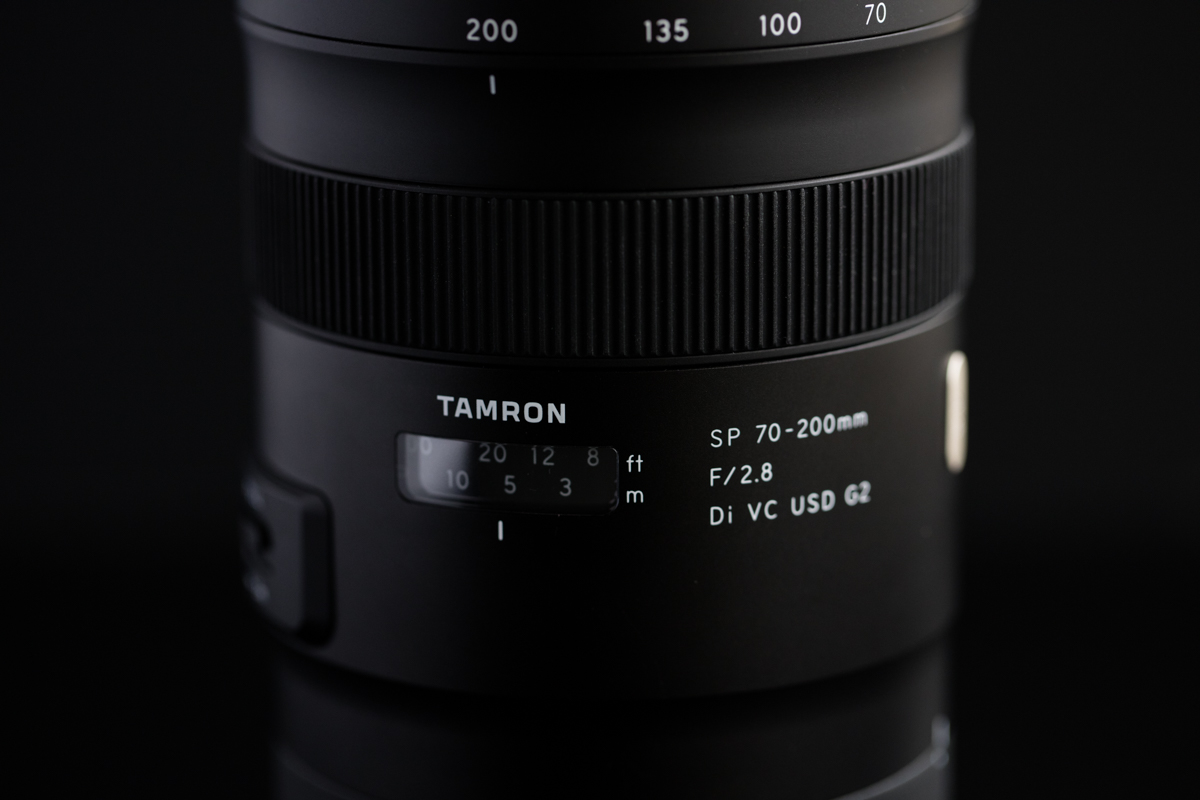
I should mention, just to avoid confusion, that this is the G2 Tamron SP 70-200 f/2.8 Di VC USD, not the slightly less expensive ‘not-G2’ Tamron SP 70-200 f/2.8 Di VC USD, nor the much less expensive Tamron 70-200 f/2.8 Di LD (IF) Macro lens. Keeping up with Tamron 70-200mm lenses is only slightly less complicated than keeping up with Nikon APS-C camera bodies.
So About the Testing Stuff
Well, as always, we’ll be showing you the MTF results obtained by averaging ten copies tested on our optical bench. To give you some idea of copy-to-copy variation I’m also going to use the Full Frame MTF displays that we’ve talked about in this article and that one. Of course, if you are already planning your comments to show the tests are all invalid and your favorite brand is wayyyyy better than this, you probably should at least glance at those posts. I mean, you can’t claim the data is all wrong unless you at least understand the methodology. Oh, wait, of course you can.
First, let’s look at the average MTF chart for the Tamron SP 70-200 f/2.8 yadda yadda G2 at 70mm, 135mm and 200mm. If you don’t speak MTF much, just remember higher is better, lines of the same color close together are better, and I’ll point out other little things as we go along.
At 70mm
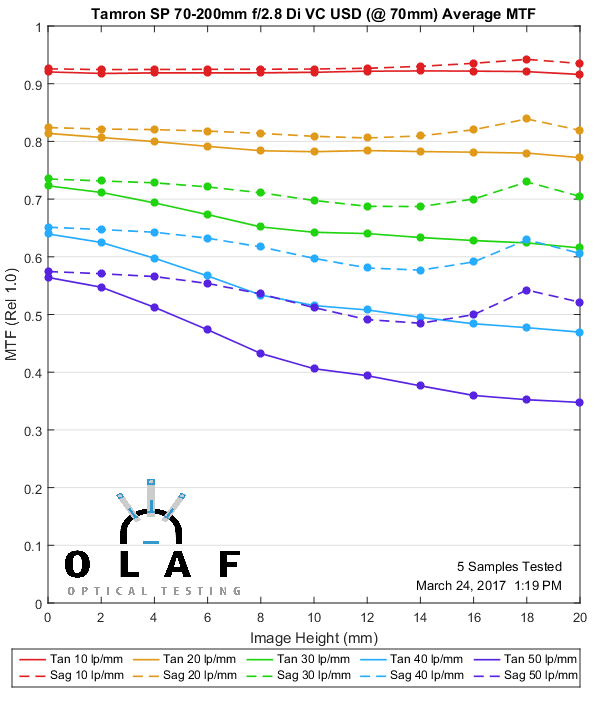
The most impressive thing that jumps out at me is how the Tamron is maintaining high MTF all the way out to the edges of the image plane. Zooms generally fall off as they approach the edges, but the Tamron doesn’t. There is some astigmatism-like separation of the sagittal and tangential curves off-axis, but it’s not severe. (We say astigmatism-like because it can be caused by true astigmatism or lateral chromatic aberration. From here on out I’ll just call it astigmatism.)
At 135mm
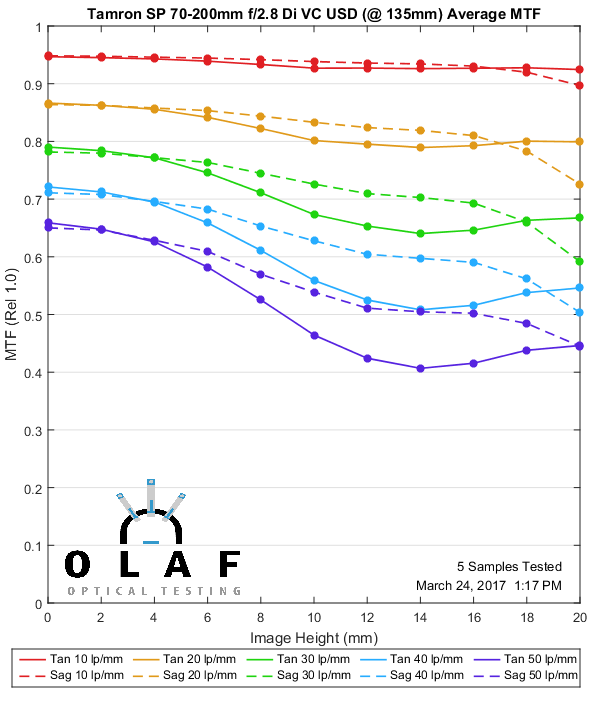
At 135mm the lens is actually resolving better than it did at 70mm. A fair number of 70-200 zooms are weakest here at the mid-range. There is less astigmatism at this focal length, too.
At 200mm
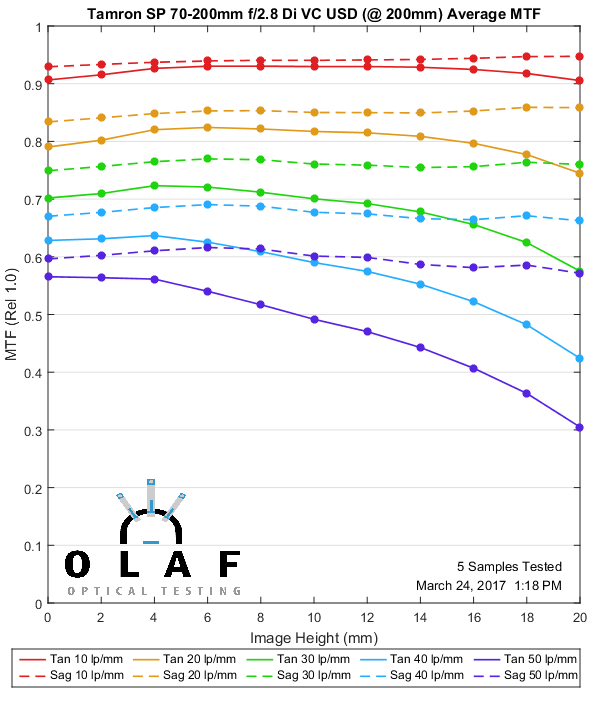
Performance drops just a bit at 200mm, becoming similar to what we saw at 70mm, which is still quite good. You’ll notice at the center the sagittal and tangential curves aren’t together, which they should be in theory. That’s because our bench lines up with the geometric center of the lens. At 200mm and longer, sometimes the optical center is 1 or 2mm away from the geometric center. For those lenses, the ‘no astigmatism’ point is sort of a circle around the center. It would make no difference in a photograph, but it makes a slight difference in the tests.
Overall, though, the Tamron puts in a very good performance. These are excellent MTF results.
How About Some MTF Comparisons?
That seems pretty reasonable. Since most people will be looking at this as an alternative to Canon and Nikon 70-200mm zooms, that seems the comparison to make. Let’s start by putting it up against the Canon 70-200 f/2.8 IS II, which is an excellent lens.
Tamron vs. Canon at 70mm
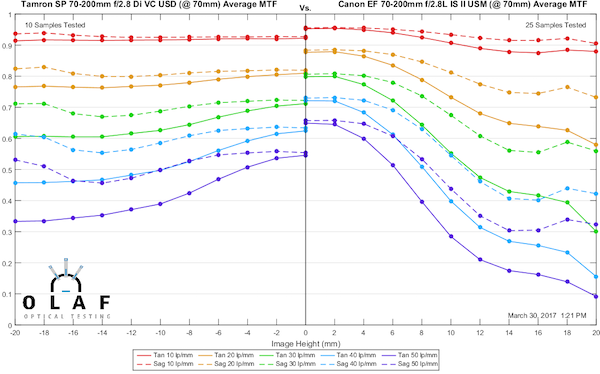
The Canon is clearly better in the center at 70mm, especially at higher frequencies (fine detail resolution). Away from the center and towards the edges, though, the Tamron catches the Canon and is better at the edge of the image field.
Tamron vs. Canon at 135mm
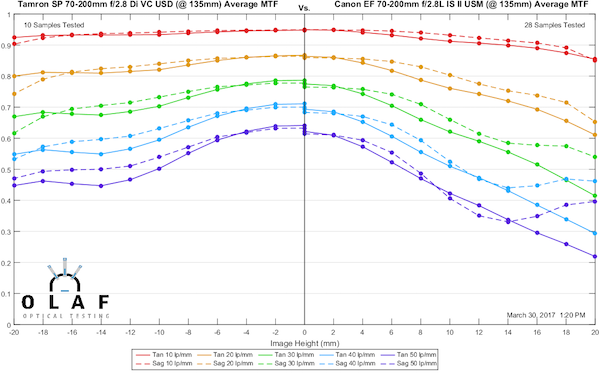
At 135mm, where the Tamron is strongest, the two lenses are pretty even. The Tamron is a bit better at the edges, but otherwise, there’s little to separate them.
Tamron vs. Canon at 200mm
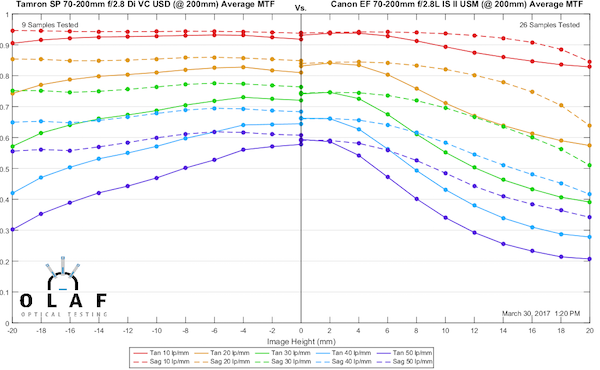
The story is much the same at 200mm. From a pure MTF standard, the Tamron is as good in the center and perhaps a bit better at the edges.
We need to provide a comparison for Nikon shooters, too, and unfortunately for the Tamron that means a comparison with the Nikon 70-200mm f/2.8 FL ED VR, which is currently the best 70-200 zoom on the planet.
Tamron vs. Nikon at 70mm
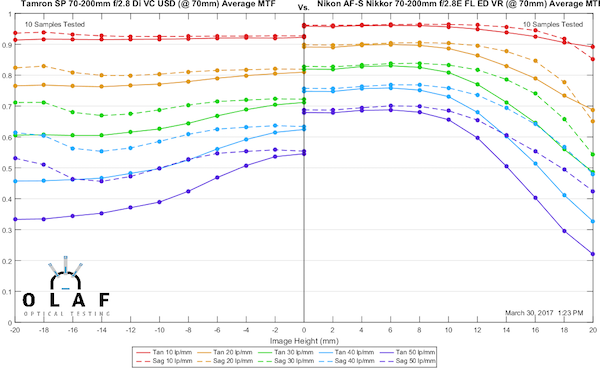
OK. The Nikon’s better at 70mm. What did you expect?
Tamron vs. Nikon at 135mm
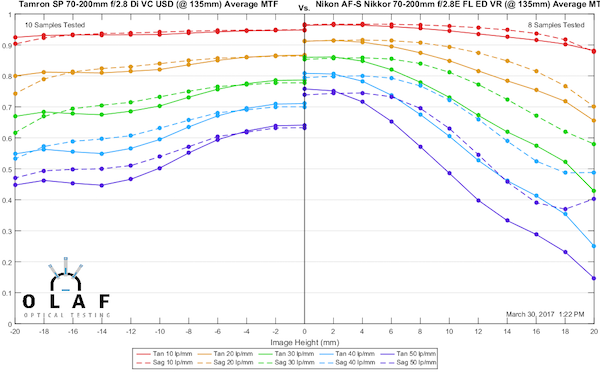
And there’s a big difference at 135mm, too, particularly in the higher frequencies, although the Nikon does fall off at the edges enough for the Tamron to catch it there. But let’s face it, most people are most interested in center sharpness at these longer focal lengths, and no zoom in this range is as sharp as this Nikon FL ED VR (including the VRII Nikon).
Tamron vs. Nikon at 200mm
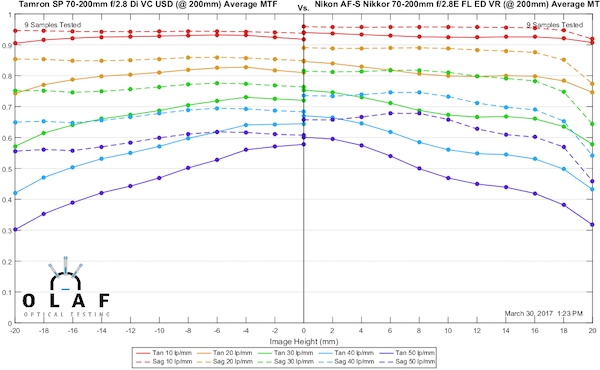
At 200mm things are much more even. The Nikon is a tiny bit better, although the central false astigmatism of the test masks it somewhat. But it’s pretty close, it really is.
Let’s Look at Variation (a Bit Differently)
At 70mm
Over the years we’ve tried to summarize variation a lot of different ways, none of which worked perfectly. So I’m just going to start showing you the actual tested copies with actual data so you can see how each varied. Here are thumbnails of the MTF full-frame displays at 70mm for all ten lenses (dark blue is best, green adequate, yellow-green getting noticeably soft).
One thing to mention, this is actual data, and you’ll notice some white areas. This is where we removed data points, something we rarely have to do. This lens has a very easily moved vibration reduction element that does not lock down. That has no effect when you’re taking a picture, but if the lens is on a very delicate optical bench and a truck drives by or someone drops a 50-pound box of supplies in the next room, the vibration showed up in the readings very obviously, so we deleted that data. We would usually have repeated the run, but in this case we were under time pressure to get these back in stock and I didn’t look at the data until after the testing was completed.
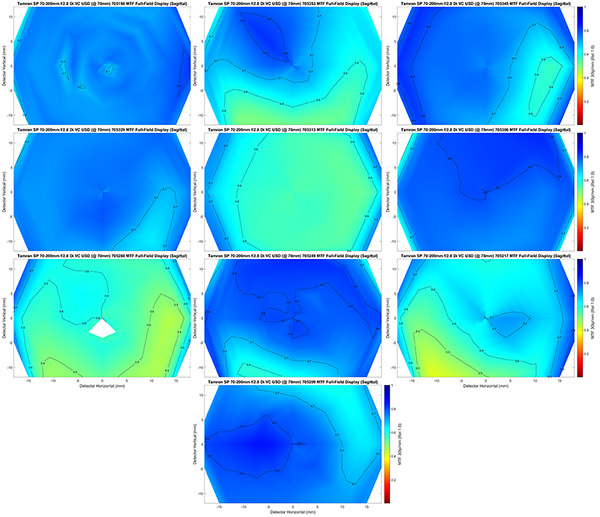
If you want my verbal summary, three copies are pixel peeping perfect (all blue), three are photography perfect (dark blue with some off-axis light blue), one (top middle) is adequate. Three have some issues at 70mm. They’re OK, but if you chart-tested carefully you could probably tell the three weren’t quite as good as the others.
Before you scream ‘throw this one or that one out,’ let’s explain this a little further with a couple of important points. I’m showing you ten lenses right out of the box, as they ship and that’s what we do. Second, let’s look at them at other focal lengths because they’re zooms. And third, I’ll give you some comparison zooms in an addendum so you can see what 70-200mm zooms vary like in the best of circumstances. Then you can scream ‘throw them out’, just scream it about all zooms as I do.
At 135mm
The same copies are in the same positions so you can look and see how they change at different focal lengths. Don’t try to kill yourself reading the shrunk down test run numbers in the thumbnails.
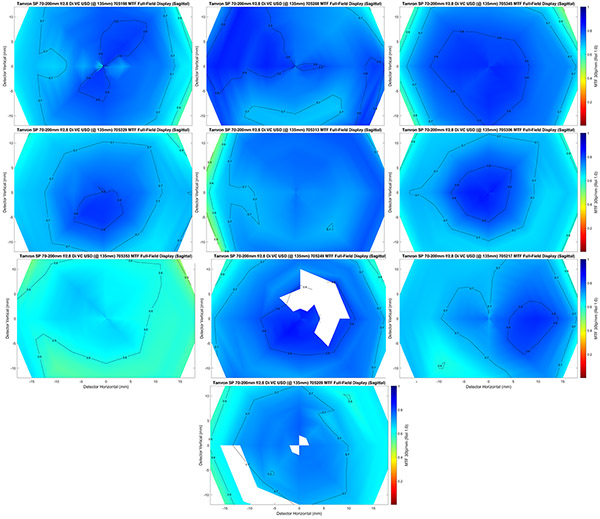
Overall, you can see there’s less variation at 135mm with this lens, they’re almost all pretty good. That lower left one, that was weak at 70mm is still weak at 135mm, though.
At 200mm
You get to see the more ugly underbelly of my testing life because my last testing copy was grabbed for rental before I could complete it’s testing at 200mm, so we only have nine results here. Other than the gap, they are again in the same location by copy. This is not what usually happens when we test, but usually, we have at least many dozen copies and getting them for testing is not a strain. With this lens, we have less than two dozen right now, and they’re in and out of stock pretty quickly.
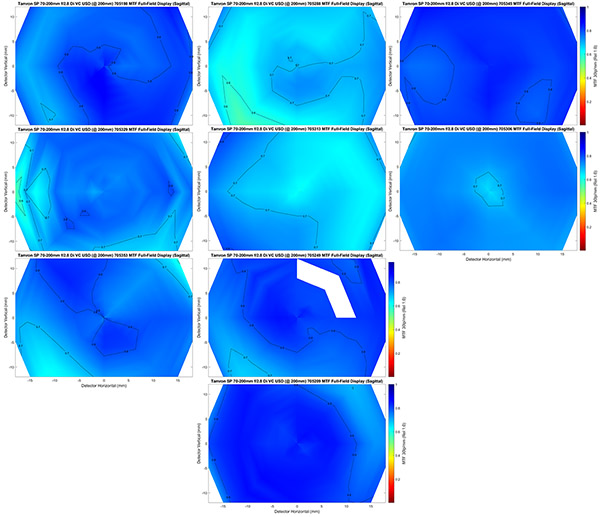
If nothing else, this should give you some understanding about why I roll my eyes when someone says they want a perfect copy of a zoom. By my reading, there’s one of these nine that is excellent at all focal lengths. It’s the nature of zooms. But the good news, since most people shoot 70-200mm lenses at the longer range, is that at the majority are good at the long end, in fact the variation is quite low.
And for those of you who want to make rash statements about what you expect of your zoom lens (and remember, expectations are a down payment on disappointment) take a glance at the addendum where I’ve put similar charts for a very, very good lens; the Canon 70-200 f/2.8 IS II. And for you fanboys, no the Nikon and Sony 70-200s aren’t better than the Canon. Zooms are zooms, not matter how much you want to bang your fist on the table and demand that they shouldn’t be.
So What Did We Learn Today?
That if you’re looking for a 70-200mm zoom and the Nikon or Canon offerings are a bit too pricey, the Tamron 70-200mm f/2.8 G2 is worth looking into. From an MTF standpoint, it’s about as good as the Canon 70-200mm f/2.8 IS II, which means it’s as good as the Nikon 70-200mm f/2.8 VR II. It’s not as good as the Nikon 70-200mm f/2.8 FL ED VR, but then again, nothing is. And the price difference could buy you a nice second lens.
As always, I’ll repeat, the MTF results make it worth a look. I’m not a lens reviewer, and many things like handling, color, flare, autofocus speed, and accuracy are going to matter as much or more as MTF results. But there are plenty of lens reviewers who will tell you that stuff.
But as far as optical resolution goes, the Tamron is excellent at a really excellent price.
Roger Cicala and Aaron Closz
Lensrentals.com
April, 2017
Addendum: Canon 70-200 f/2.8 IS II
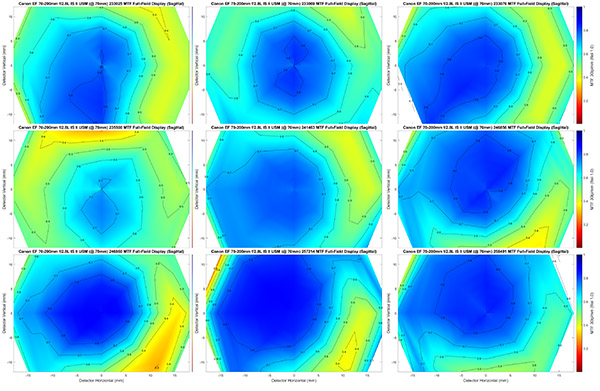
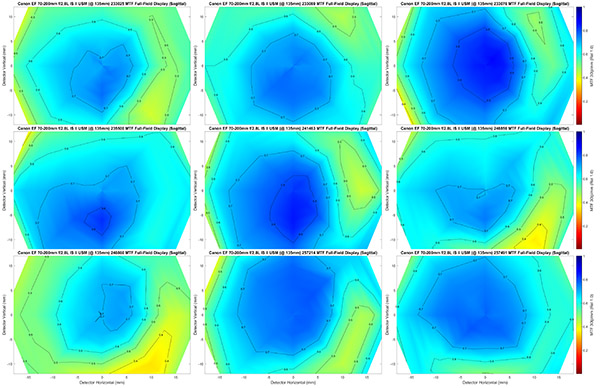
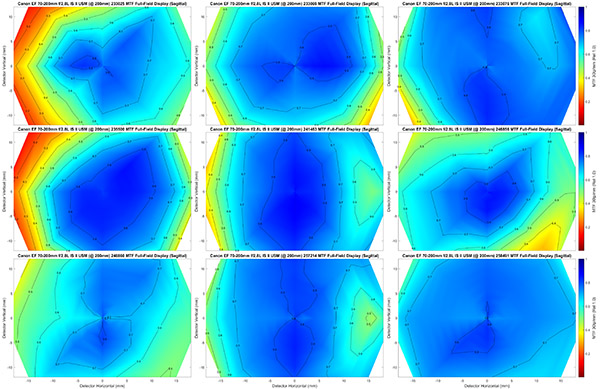
I just put this here, so you have a comparison. Again, each copy is in the same position in the graph for each focal length, so the top left corner is one lens, etc.
I just used thumbnails of 9 randomly selected copies because nine fits in the images better. I’ve got dozens and dozens, and these are good representatives. And if I replaced them with similar ones from other 70-200 zooms, it would look about the same. But making these takes time and time isn’t something I have enough of. But if you notice one that’s perfect at every focal length, feel free to point it out.
At 70mm
At 135mm
At 200mm
113 Comments
Nyarlathotep ·
Once again, thank you Roger. It is great to see these tests. It helps keep our expectations of lenses and variation realistic 😉 That said, the Tammy looks promising at first blush, hope its other attributes (AF, VR, Bokeh, color, etc.) have comparable performances to its MTF.
If you had a chance to play with one of these off the bench, quick and dirty opinion: how did the AF feel? Snappy or sluggish? With most zooms it isn’t a big deal for me one way or another, but with the 70-200 workhorses, AF is a important.
Roger Cicala ·
I only had it on a Canon 5DIII and it felt pretty quick, but of course with third-party lenses how it does on camera A doesn’t necessarily reflect how it will behave on camera B.
Nyarlathotep ·
Good point. I am in the Nikon ecosystem, so I will have to wait and see. Thanks for the follow-up.
Nyarlathotep ·
Once again, thank you Roger. It is great to see these tests. It helps keep our expectations of lenses and variation realistic ;) That said, the Tammy looks promising at first blush, hope its other attributes (AF, VR, Bokeh, color, etc.) have comparable performances to its MTF.
If you had a chance to play with one of these off the bench, quick and dirty opinion: how did the AF feel? Snappy or sluggish? With most zooms it isn't a big deal for me one way or another, but with the 70-200 workhorses, AF is a important.
Roger Cicala ·
I only had it on a Canon 5DIII and it felt pretty quick, but of course with third-party lenses how it does on camera A doesn't necessarily reflect how it will behave on camera B.
dadohead ·
“Expectations are a down payment on disappointment.” Classic Roger. That should probably be on the wall above the register at every tattoo parlor in the United States.
Nyarlathotep ·
That’s some proper good advice right there. Gotta love the Roger witticisms.
silmasan ·
Witsdom!
Troy Phillips ·
Love it ….. lol.
dadohead ·
"Expectations are a down payment on disappointment." Classic Roger. That should probably be on the wall above the register at every tattoo parlor in the United States.
Nyarlathotep ·
That's some proper good advice right there. Gotta love the Roger witticisms.
Troy Phillips ·
Love it ..... lol.
Yair ·
Thank again for the great work!
Brandon Dube ·
It only took almost 2 years, but I seem to have gotten you addicted to full-field displays 🙂
Roger Cicala ·
LMAO! You mean you aren’t rolling your eyes like you used to when I pulled them up 🙂
Brandon Dube ·
It only took almost 2 years, but I seem to have gotten you addicted to full-field displays :)
Roger Cicala ·
LMAO! You mean you aren't rolling your eyes like you used to when I pulled them up :-)
Mike ·
Many photographers know this, but some don’t: Tamron lenses zoom the same direction that Nikons do (clockwise = zooming in) while Sigmas zoom the same direction that Canons do (clockwise = zooming out).
After using Canon for 24 years, my muscle memory was pretty ingrained so I didn’t switch to Nikon until there were good zooms available from Sigma: I found that I just missed too many photos when in the heat of the moment I turned a Nikon or a Tamron zoom ring the opposite way of what I wanted.
Many photographers may be more adaptable than I am, but if in doubt it’s worth renting for a weekend before buying any lens that’s opposite of your custom.
Mk.82 ·
Nice thing with Focus-By-Wire lenses is that you can swap the focus ring direction as you please.
Missed change for manufacturers is to allow binding that digital focus ring to do something else than just focus when in S-AF/C-AF mode (like change aperture or ISO with that ring).
But wait when we get more like Olympus 12-50mm internal electronical zoom lenses with manual clutch mechanism, where we could choose which direction the lens zooms when rotating it….
Missed change for ie. Olympus not to allow changing that with their 12-50mm, 14-42EZ, 14-42PZ and a 45-175PZ.
I have my mind set as well to Canon, Clockwise = Zoom Out. But my mind is wired to Clockwise = focus Close.
I so would like to change the focus direction to opposite.
Greg Dunn ·
Not all Sigmas. The 50-100 does not zoom in the Canon direction, as it constantly reminds me every time I shoot with it. Maybe the others do, but I don’t own any of them.
Mike ·
Many photographers know this, but some don't: Tamron lenses zoom the same direction that Nikons do (clockwise = zooming in) while Sigmas zoom the same direction that Canons do (clockwise = zooming out).
After using Canon for 24 years, my muscle memory was pretty ingrained so I didn't switch to Nikon until there were good zooms available from Sigma: I found that I just missed too many photos when in the heat of the moment I turned a Nikon or a Tamron zoom ring the opposite way of what I wanted.
Many photographers may be more adaptable than I am, but if in doubt it's worth renting for a weekend before buying any lens that's opposite of your custom.
Mk.82 ·
Nice thing with Focus-By-Wire lenses is that you can swap the focus ring direction as you please.
Missed change for manufacturers is to allow binding that digital focus ring to do something else than just focus when in S-AF/C-AF mode (like change aperture or ISO with that ring).
But wait when we get more like Olympus 12-50mm internal electronical zoom lenses with manual clutch mechanism, where we could choose which direction the lens zooms when rotating it....
Missed change for ie. Olympus not to allow changing that with their 12-50mm, 14-42EZ, 14-42PZ and a 45-175PZ.
I have my mind set as well to Canon, Clockwise = Zoom Out. But my mind is wired to Clockwise = focus Close.
I so would like to change the focus direction to opposite.
Greg Dunn ·
Not all Sigmas. The 50-100 does not zoom in the Canon direction, as it constantly reminds me every time I shoot with it. Maybe the others do, but I don't own any of them.
Thomas Lozinski ·
Wait, the VR1 is better than the VR2? Did I miss something?
LensNut ·
Roger can you publish MTF result for Nikon 70-200 FL version just like what you did for Canon 70-200 IS II?
Roger Cicala ·
I assume you’re talking about the individual lens full-frame MTFs? I’m working on a post now for all the 70-200s that is like what we just did for the wide and standard zooms. I’ll probably use the FL for individual lens example.
LensNut ·
Yup the 9-thumbnail MTF figures at 70/135/200 just like what you have done for Canon 70-200 IS II as part of the addendum
Troy Phillips ·
Very good thanks for all you do.
I bought the Nikon 70-200 after reading your review and several others. I’m good light I really like it. It’s replacing my old Nikkor 80-200 ads-d. The motor went out. In low light the keeper rate is about the same. But with the new lens I get fewer tack sharp keepers. The old lens either hit solid or missed good. Lol if that makes since. I shoot live music in low light a lot. The new lens gets totally confused with smoke it the air.
Guess I’m still in love with the old afs-d . Oh and at close focus the old 80-200 afs-d is a true 200mm and the new fl lens is about 180mm .
Roger Cicala ·
I assume you're talking about the individual lens full-frame MTFs? I'm working on a post now for all the 70-200s that is like what we just did for the wide and standard zooms. I'll probably use the FL for individual lens example.
Troy Phillips ·
Very good thanks for all you do.
I bought the Nikon 70-200 after reading your review and several others. I'm good light I really like it. It's replacing my old Nikkor 80-200 ads-d. The motor went out. In low light the keeper rate is about the same. But with the new lens I get fewer tack sharp keepers. The old lens either hit solid or missed good. Lol if that makes since. I shoot live music in low light a lot. The new lens gets totally confused with smoke it the air.
Guess I'm still in love with the old afs-d . Oh and at close focus the old 80-200 afs-d is a true 200mm and the new fl lens is about 180mm .
Marc P. ·
Very interesting Test, Roger. At least here into Germany, the price difference (currently) between this all new, shiny Tamron 70-200 2.8 G2 vs the Canon 70-200 2.8L II IS is less then <150 EUR, the Tamron costs 1600 EUR, whileas the Canon about 1720 EUR…so it's ~120 EUR Difference….for instance. I'd guess Canon Users are because simply of that using their native Lens. Things would get more interesting, when the Tamron G2 would be around ~1200 EUR then, for the Telephoto Fans.
HF ·
Agree. This is why I still bought the Canon (helps for CPS, too). The difference optically is not that huge either, as seen here, too.
Roger Cicala ·
Thank you, Marc. I didn’t realize the prices were so much closer over there. Here the Tamron is about 70% the price of the Canon. I’m not sure about servicing either. In the US both Tamron and Canon service is very good, but I know that varies geographically.
Marc P. ·
You’re welcome, Roger. Yes, Tamron Support here into Germany is also being great – i’ve brought my 28-75/2.8 AF into Service about a 3/4 year ago, and they fixed it really fast, and calibrated the AF new
The Prices from the Canon vs. Tamron Lenses here are way close together, at least into germany at the Moment, but i do expect the Tamron to get perhaps at least some 200-400 EUR cheaper within the next 6-12 Months, because then it’ll be easier to be a (cheaper) Alternative for the genuine Canon Lenses, albeit not a worse one….and Tamron would possible sell more of them, if more people looking for a cheaper (in price terms) Alternative.
If i’d have the Money, i’d get the new 70-200/2.8 SP G2 Tamron for my trusty, old EOS 5D. But reality is often different, so i must work with my 55-250 STM on my old EOS 40D or -50D Body, but i am fine with that.
Personally, i dislike the white colored Telephoto Lenses from Canon & Sony, i do know it’s for a reason, but i just dislike it from the optical appearance onto a black DSLR Body.
Please keep up your great blog Roger, i love to read new articles here, also the geek ones. 🙂
best regards,
Marc
milkod2001 ·
Price is very close, no point to go with Tamron if you use Canon body. With Nikon’s latest 70-200 at: €3199.99 Tamron is fantastic deal.
Marc P. ·
Very interesting Test, Roger. At least here into Germany, the price difference (currently) between this all new, shiny Tamron 70-200 2.8 G2 vs the Canon 70-200 2.8L II IS is less then <150 EUR, the Tamron costs 1600 EUR, whileas the Canon about 1720 EUR...so it's ~120 EUR Difference....for instance. I'd guess Canon Users are because simply of that using their native Lens. Things would get more interesting, when the Tamron G2 would be around ~1200 EUR then, for the Telephoto Fans.
Roger Cicala ·
Thank you, Marc. I didn't realize the prices were so much closer over there. Here the Tamron is about 70% the price of the Canon. I'm not sure about servicing either. In the US both Tamron and Canon service is very good, but I know that varies geographically.
Marc P. ·
You're welcome, Roger. Yes, Tamron Support here into Germany is also being great - i've brought my 28-75/2.8 AF into Service about a 3/4 year ago, and they fixed it really fast, and calibrated the AF new
The Prices from the Canon vs. Tamron Lenses here are way close together, at least into germany at the Moment, but i do expect the Tamron to get perhaps at least some 200-400 EUR cheaper within the next 6-12 Months, because then it'll be easier to be a (cheaper) Alternative for the genuine Canon Lenses, albeit not a worse one....and Tamron would possible sell more of them, if more people looking for a cheaper (in price terms) Alternative.
If i'd have the Money, i'd get the new 70-200/2.8 SP G2 Tamron for my trusty, old EOS 5D. But reality is often different, so i must work with my 55-250 STM on my old EOS 40D or -50D Body, but i am fine with that.
Personally, i dislike the white colored Telephoto Lenses from Canon & Sony, i do know it's for a reason, but i just dislike it from the optical appearance onto a black DSLR Body.
Please keep up your great blog Roger, i love to read new articles here, also the geek ones. :-)
best regards,
Marc
milkod2001 ·
Price is very close, no point to go with Tamron if you use Canon body. With Nikon's latest 70-200 at: €3199.99 Tamron is fantastic deal.
Federico Gallinari ·
it would be nice to see how they behave with the extender, from some reviews it seems that the 2x + Tamron is less performance than the canon is2 + 2xIII, and while the yield in the short focal lengths will be certainly enough for its purpose, normally the use of extender aims catch small things and far (also requiring crops sometimes).
Apparently there are also problems on the diaphragm display (communication) using TC Tamron lens of canon and vice versa .
I think that Tamron did an excellent lens, but would estimate the yield closely with extender and mechanics (duration and quality).
Federico Gallinari ·
it would be nice to see how they behave with the extender, from some reviews it seems that the 2x + Tamron is less performance than the canon is2 + 2xIII, and while the yield in the short focal lengths will be certainly enough for its purpose, normally the use of extender aims catch small things and far (also requiring crops sometimes).
Apparently there are also problems on the diaphragm display (communication) using TC Tamron lens of canon and vice versa .
I think that Tamron did an excellent lens, but would estimate the yield closely with extender and mechanics (duration and quality).
?ukasz Moszczy?ski ·
Thank you Roger for a fast review of this new lens.
MTF results are important, there is no doubt. But one of the equally important elements of lens performance (for some people) is also AF speed and accuracy.
This is evidently a new trend… Sigma and Tamron are currently producing excellent optics, but in many cases their AF is far from perfect. I had the opportunity to test the Tamron 70-200 f/2.8 G2 compared to the Canon 70-200 f/2.8 IS II. Their AF motor speed is at the same level, but for Tamron you need next 0.3-0.5 seconds to confirm the focus. That’s a lot, if lens is supposed to work for a reporter.
Roger Cicala ·
I completely agree! For me, MTF is kind of a screen that says ‘is this worth looking into’. I want a sharp lens, that’s a given, but there are many sharp lenses I don’t want. 🙂
Łukasz Moszczyński ·
Thank you Roger for a fast review of this new lens.
MTF results are important, there is no doubt. But one of the equally important elements of lens performance (for some people) is also AF speed and accuracy.
This is evidently a new trend... Sigma and Tamron are currently producing excellent optics, but in many cases their AF is far from perfect. I had the opportunity to test the Tamron 70-200 f/2.8 G2 compared to the Canon 70-200 f/2.8 IS II. Their AF motor speed is at the same level, but for Tamron you need next 0.3-0.5 seconds to confirm the focus. That's a lot, if lens is supposed to work for a reporter.
Roger Cicala ·
I completely agree! For me, MTF is kind of a screen that says 'is this worth looking into'. I want a sharp lens, that's a given, but there are many sharp lenses I don't want. :-)
Joshua A ·
Thanks for the lens review and insights Roger. Out of curiosity, I know youve said in the past that you can’t test Sony ? and Pentax K mount lenses due to the unwarranted expense of the OLAF camera mounts, but I was wondering if you would consider a proposal of sorts.
If a dedicated group of Pentaxians or Sony users were to get together and raise the funds needed for a mount, would you consider testing lenses from Pentax/Sony when the mood to test them struck you? Regardless of the answer or lack thereof, thanks for the awesome blog!
Roger Cicala ·
Joshua,
We would. We actually had some random discussions about crowd-sourcing to do that. Sony alpha wouldn’t be too bad because few lenses are electromagnetic, so only a mount is needed; a couple of thousand dollars. Pentax requires a camera driven mount, so in addition we’d need sacrifice a Pentax camera and lens, and do a lot of wiring like we had to do to test FE lenses. I’d love to do it, because I find Pentax lenses really, really interesting. But Olaf Optical bleeds time and money like you can’t imagine.
Patrick Chase ·
Olaf Optical also drives rental traffic in a nontrivial way. You can safely assume that none of my expenditures would have happened without your blog. I’d had bad experiences in the past with rental houses that had very little understanding of the products or control over their stock, and your blog was what made me rethink my resulting aversion to rental.
Joshua A ·
Thanks for the reply mate.
It’s a terrible shame that thorough lens testing like you do here with OLAF is so time consuming and expensive. I’m an avid Pentaxian with a significant investment in the system, and use it professionally as my main system, and its a shame that Pentax doesn’t have the market share of the other Big 3 mounts do (Canon EF, Nikon F and Sony E).
I’m just intrigued to know how the new DFA* 70-200mm f2.8 measures up to the competition. From personal testing and use, the lens seems incredibly sharp across the field, similar to the Tamron 70-200mm f2.8 G2, but with an equalised test like OLAF, its near impossible to actually compare it to it’s peers under lab conditions.
Joshua A ·
Thanks for the lens review and insights Roger. Out of curiosity, I know youve said in the past that you can't test Sony α and Pentax K mount lenses due to the unwarranted expense of the OLAF camera mounts, but I was wondering if you would consider a proposal of sorts.
If a dedicated group of Pentaxians or Sony users were to get together and raise the funds needed for a mount, would you consider testing lenses from Pentax/Sony when the mood to test them struck you? Regardless of the answer or lack thereof, thanks for the awesome blog!
Roger Cicala ·
Joshua,
We would. We actually had some random discussions about crowd-sourcing to do that. Sony alpha wouldn't be too bad because few lenses are electromagnetic, so only a mount is needed; a couple of thousand dollars. Pentax requires a camera driven mount, so in addition we'd need sacrifice a Pentax camera and lens, and do a lot of wiring like we had to do to test FE lenses. I'd love to do it, because I find Pentax lenses really, really interesting. But Olaf Optical bleeds time and money like you can't imagine.
Patrick Chase ·
Olaf Optical also drives rental traffic in a nontrivial way. You can safely assume that none of my expenditures would have happened without your blog. I'd had bad experiences in the past with rental houses that had very little understanding of the products or control over their stock, and your blog was what made me rethink my resulting aversion to rental.
Joshua A ·
Thanks for the reply mate.
It's a terrible shame that thorough lens testing like you do here with OLAF is so time consuming and expensive. I'm an avid Pentaxian with a significant investment in the system, and use it professionally as my main system, and its a shame that Pentax doesn't have the market share of the other Big 3 mounts do (Canon EF, Nikon F and Sony E).
I'm just intrigued to know how the new DFA* 70-200mm f2.8 measures up to the competition. From personal testing and use, the lens seems incredibly sharp across the field, similar to the Tamron 70-200mm f2.8 G2, but with an equalised test like OLAF, its near impossible to actually compare it to it's peers under lab conditions.
Mk.82 ·
Quick Question, Yes or No… Is this lens good purchase?
Patrick Chase ·
Based on this and other reviews I’ve seen: It looks like a pretty good value.
With a really good third-party lens like this one the tradeoff is between a bunch of money saved and some possibility of incompatibility now or in the future. For example, many 3rd-party lenses have problems with Canon’s vignetting corrections on recent bodies (my 1Dx II has this problem with my Sigma 35 and 85 Art lenses). AF accuracy/precision can also be a problem, though reports about the Tamron G2 are positive so far in that respect.
Bill Boyes ·
That concern is mitigated by the ability to update firmware on the Tamron.
Patrick Chase ·
I can update the FW on my Sigma, too, but they hadn’t fixed the vignetting correction issue as of the last time I bothered (it’s been a few months, admittedly)
Patrick Chase ·
I can update the FW on my Sigma, too, but they hadn't fixed the vignetting correction issue as of the last time I bothered (it's been a few months, admittedly)
Mk.82 ·
Quick Question, Yes or No... Is this lens good purchase?
Patrick Chase ·
Based on this and other reviews I've seen: It looks like a pretty good value.
With a really good third-party lens like this one the tradeoff is between a bunch of money saved and some possibility of incompatibility now or in the future. For example, many 3rd-party lenses have problems with Canon's vignetting corrections on recent bodies (my 1Dx II has this problem with my Sigma 35 lens). AF accuracy/precision can also be a problem, though reports about the Tamron G2 are positive so far in that respect.
Horshack ·
As a landscape shooter who relies heavily on the 70-200mm focal range, the Tamron looks like the best of the three for across-the-field sharpness. Even against the new Nikon the Tamron beats it at all three focal lengths at the extreme edges, interestingly by an amount roughly equal to the delta of the Nikon’s advantage over it at the center.
Diallo_Jamal ·
You shoot landscapes at 2.8 when you want the extreme edges sharp? Interesting.
Horshack ·
Nope
Patrick Chase ·
The Canon 70-200’s corners clean up nicely by f/5.6, in my experience. As others have pointed out, we generally care more about center sharpness when shooting a lens like this wide-open, so that’s a good set of tradeoffs for me.
I don’t have experience with the other two, but DPreviews’ stopped-down sample images from the Tamron also looked pretty good.
Horshack ·
The Canon’s corners sharpen up @ f/5.6 but they’re still visibly softer than the center, at least on the 5DSR.
Patrick Chase ·
If you’re looking for maximum possible quality out of a 5Ds R in the corners then IMO you shouldn’t be shooting a zoom at all. Wrong tool for the job and all that…
Horshack ·
The flexibility and versatility of using a zoom doesn’t disappear when it’s mounted onto a high-resolution body, nor does the flexibility and versatility of a prime increase.
Patrick Chase ·
No, but the high resolution of the high-res body certainly disappears when you put a zoom on it, which was my point.
If you’re obsessive enough about IQ to accept the downsides of a 5Ds R (which is slower, produces more moire, has less dynamic range, worse high-ISO performance, worse AF, worse video, etc compared to its lower-res counterparts) then the lack “versatility and flexibility” with primes should not be a concern to you.
Zooms do make sense for many uses for the exactly the reasons you give. High-res bodies make sense if resolution is what you’re after. Sticking a zoom on a high-res body and then complaining about lack of ultimate corner sharpness is just daft, though, because it means that you used the wrong tool for the specific job (or you’re pixel-peeping where it’s not warranted). If you doubt me just look back through Roger’s blog at the many field diagrams and OLAF shots he’s published from “top quality” zooms.
I use zooms a significant percentage of the time, including the one you’re griping about. I’m happy with their performance, but that’s probably because I don’t ask them to do things that I know they cannot. I have primes for those jobs.
Horshack ·
If zooms weren’t intended to be used on higher MP bodies then why are lens designers using expensive elements to improve the resolving ability of their lenses, with particular attention to full-field sharpness?
Patrick Chase ·
It’s all relative.
Adding exotic elements in zooms makes them sharper than zooms without, and expands the range of applications they can serve. Adding similar exotic elements to primes makes them sharper still.
Today’s zooms are indeed sharper than primes from, say 15 years ago (see Roger’s 70-200/2.8L II vs 200/2.8L II comparison from a while back), but that’s not a relevant comparison because we didn’t have 50 MP FF bodies back then. At any given time the highest-res bodies on the market (like the 5Ds R) tend to be well matched with the highest-res lenses on the market, and for the most part those are primes. That’s particularly true if you care about corner performance as you do, as that’s where zooms suffer most.
Patrick Chase ·
Here’s a concrete example: The Sigma 85 has slightly less “exotic content” than the 70-200 f/2.8 with 4 exotic elements in the Sigma vs. 6 in the zoom.
If you look at Roger’s measurements the Sigma at f/1.4 matches the zoom at 70 mm and f/2.8 in the center and spanks it off-axis. By the time you stop the prime down to f/2.8 there is absolutely no comparison. That doesn’t mean that the Canon is a bad zoom, it just means that variable focal length isn’t free and you shouldn’t expect leading-edge performance from any remotely affordable zoom.
Which reminds me: IS isn’t optically free either.
Mike A ·
Downsides of a 5DS R – compared to what? Compared to a 5D Mk3 – same DR, better AF, down-sampled it has superior DR and ISO performance. Compared to Mk4? The 5DS R has visibly more detail, sharpness and overall “pop”. It appears you don’t shoot them side by side and compare. For reference, I own a 5DS R, 5DMkIV & A99II. BTW – the Sony is better than both Canons…
Sergiu Mosoia ·
Me too – btw, Sony is not better than both Canons, at all.
Sergiu Mosoia ·
Me too (and I had the 5DS as well) – btw, Sony is not “better” than both Canons, at all. Different, yes. But this is not about cameras, but about lenses – and I can tell you that I am experiencing some strange issues with the 24-70 f/2.8 II on the MK IV… the same lens having none on 5D III…; 70-200 II works the same on both.
Patrick Chase ·
The Canon 70-200's corners clean up nicely by f/5.6, in my experience (including shooting ISO targets with my example). As others have pointed out, we generally care more about center sharpness when shooting a lens like this wide-open, so that's a good set of tradeoffs for my uses.
I don't have experience with the other two, but DPreviews' stopped-down sample images from the Tamron also looked pretty good.
Horshack ·
The Canon's corners sharpen up @ f/5.6 but they're still visibly softer than the center, at least on the 5DSR.
Patrick Chase ·
If you're looking for maximum possible quality out of a 5Ds R in the corners then IMO you shouldn't be shooting a zoom at all. Wrong tool for the job and all that...
Horshack ·
The flexibility and versatility of using a zoom doesn't disappear when it's mounted onto a high-resolution body, nor does the flexibility and versatility of a prime increase.
Patrick Chase ·
No, but the high resolution of the high-res body certainly disappears when you put a zoom on it, which was my point.
If you're obsessive enough about IQ to accept the downsides of a 5Ds R (which is slower, produces more moire, has less dynamic range, worse high-ISO performance, worse AF, worse video, etc compared to its lower-res counterparts) then the lack "versatility and flexibility" with primes should not be a concern to you.
Zooms do make sense for many uses for the exactly the reasons you give. High-res bodies make sense if resolution is what you're after. Sticking a zoom on a high-res body and then complaining about lack of ultimate corner sharpness is just daft, though, because it means that you used the wrong tool for the specific job (or you're pixel-peeping where it's not warranted). If you doubt me just look back through Roger's blog at the many field diagrams and OLAF shots he's published from "top quality" zooms.
I use zooms a significant percentage of the time, including the one you're griping about. I'm happy with their performance, but that's probably because I don't ask them to do things that I know they cannot. I have primes for those jobs.
Horshack ·
If zooms weren't intended to be used on higher MP bodies then why are lens designers using expensive elements to improve the resolving ability of their lenses, with particular attention to full-field sharpness?
Patrick Chase ·
Sarcastic answer: They're doing that so that the zooms will produce decent images on the mainstream pro-level bodies.
More thoughtful answer: Adding exotic elements in zooms makes them sharper than zooms without, and expands the range of applications they can serve. Adding similar exotic elements to primes makes them sharper still.
Today's zooms are indeed sharper than primes from, say 15 years ago (see Roger's 70-200/2.8L II vs 200/2.8L II comparison from a while back), but that's not a relevant comparison because we didn't have 50 MP FF bodies back then. At any given time the highest-res bodies on the market (like the 5Ds R) tend to be well matched with the highest-res lenses on the market, and for the most part those are primes. That's particularly true if you care about corner performance as you do, as that's where zooms suffer most.
Patrick Chase ·
Here's a concrete example: The Sigma 85 has slightly less "exotic content" than the 70-200 f/2.8 with 4 exotic elements in the Sigma vs. 6 in the zoom.
If you look at Roger's measurements the Sigma at f/1.4 matches the zoom at 70 mm and f/2.8 in the center and spanks it off-axis. By the time you stop the prime down to f/2.8 there is absolutely no comparison. That doesn't mean that the Canon is a bad zoom, it just means that variable focal length isn't free and you shouldn't expect leading-edge performance from any remotely affordable zoom. That's why I have both the 70-200 and the 85 prime.
Which reminds me: IS isn't optically free either.
Mike A ·
Downsides of a 5DS R - compared to what? Compared to a 5D Mk3 - same DR, better AF, down-sampled it has superior DR and ISO performance. Compared to Mk4? The 5DS R has visibly more detail, sharpness and overall "pop". It appears you don't shoot them side by side and compare. For reference, I own a 5DS R, 5DMkIV & A99II. BTW - the Sony is better than both Canons...
Sergiu Mosoia ·
Me too (and I had the 5DS as well) - btw, Sony is not "better" than both Canons, at all. Different, yes. But this is not about cameras, but about lenses - and I can tell you that I am experiencing some strange issues with the 24-70 f/2.8 II on the MK IV... the same lens having none on 5D III...; 70-200 II works the same on both.
Horshack ·
As a landscape shooter who relies heavily on the 70-200mm focal range, the Tamron looks like the best of the three for across-the-field sharpness. Even against the new Nikon the Tamron beats it at all three focal lengths at the extreme edges, interestingly by an amount roughly equal to the delta of the Nikon's advantage over it at the center.
SpecialMan ·
I have a pretty high credit card limit, so statistically speaking how many copies of a new lens do I have to order from Amazon to ensure a high probability of getting one that is excellent?
Patrick Chase ·
How would you determine if yours is “excellent”? Do you have a Trioptics Imagemaster just sitting around somewhere?
Even with a good ISO target you’d have trouble distinguishing “good” vs “excellent”. IMO you should take enough test shots to weed out the bad ones (maybe 10%, plus or minus depending on brand and complexity), and accept that lenses have variability in the real world.
Even Roger’s MTF tests are only at infinity focus for the most parts, so the pecking order he determines might not be relevant to, say, tight portraits.
Patrick Chase ·
How would you determine if yours is "excellent"? Do you have a Trioptics Imagemaster just sitting around somewhere?
Even with a good ISO target you'd have trouble distinguishing "good" vs "excellent". IMO you should take enough test shots to weed out the bad ones (maybe 10%, plus or minus depending on brand and complexity), and accept that lenses have variability in the real world.
Even Roger's MTF tests are only at infinity focus for the most parts, so the pecking order he determines might not be relevant to, say, tight portraits.
Roger Cicala ·
One. Chances are that one is going to be excellent for photography with no noticeable defects unless you measurebate. The odds of that one being excellent may vary from 75% to 95% depending on the exact model in question, but odds are any single copy is going to be fine.
Now if you want one that is pixel peeping perfect at all focal lengths and all focusing distance, with no measurable tilt, etc. it will vary by brand but it will certainly be in the thousands of copies. We have many thousand copies of zooms and I’ve never seen one.
Roger Cicala ·
One. Chances are that one is going to be excellent for photography with no noticeable defects unless you measurebate. The odds of that one being excellent may vary from 75% to 95% depending on the exact model in question, but odds are any single copy is going to be fine.
Now if you want one that is pixel peeping perfect at all focal lengths and all focusing distance, with no measurable tilt, etc. it will vary by brand but it will certainly be in the thousands of copies. We have many thousand copies of zooms and I've never seen one.
Patrick Chase ·
OK, here’s one option that Roger is probably too circumspect to raise:
LensRentals screens their lenses pretty well, so if you want a known non-lemon one option is to rent one, test it just to be sure, and “keeper-ize” it. I just did that with a 16-35 f/4L IS.
I’ve also used rented lenses to serve as reference points for purchased ones, for example I weeded out a much worse than average 24-70 f/2.8L II (the only truly bad “L” lens I’ve ever purchased) that way.
Patrick Chase ·
OK, here's one option that Roger is probably too circumspect to raise:
LensRentals screens their lenses pretty well (this blog isn't why they have the fancy toys after all), so if you want a known non-lemon one option is to rent one, test it just to be sure (I have 2X and 4X 12233 charts and a pile of self-authored SW for things like SFR analysis as a result of my previous career in imaging, but all of that is overkill), and "keeper-ize" it. I just did that with a 16-35 f/4L IS.
I've also used rented lenses to serve as reference points for purchased ones, for example I weeded out a much worse than average 24-70 f/2.8L II (the only truly bad "L" lens I've ever purchased) that way.
Timur Born ·
So the optics are good, but in the past I wasn’t convinced by the mechanics and electronics of Tamron lenses. It’s 1000 EUR less than the Nikon, but only 80 EUR less than the Canon. So it seems like a good idea to wait for prices to come down a bit anyway.
Duncan Dimanche ·
the canon is 1800$… the newest one that is
Timur Born ·
So the optics are good, but in the past I wasn't convinced by the mechanics and electronics of Tamron lenses. It's 1000 EUR less than the Nikon, but only 80 EUR less than the Canon. So it seems like a good idea to wait for prices to come down a bit anyway.
Duncan Dimanche ·
the canon is 1800$... the newest one that is
Julian Ray ·
As always Roger, thank you for MTFing us -Again. I love your honesty and humor. One thing I would love to see is a follow up in about a year or two on how these lenses, actually all the lenses you test, hold up to usage. It is one thing to crack open a new box and bench the babe but quite another to see how the lens fares, mechanically and optically, after it has been out in the real world. Thanks.
Roger Cicala ·
Julian, we constantly doing that – it’s part of the reason we test them when we get them. We rarely see a change optically unless the lens has either been dropped or we see something else going wrong, for example it feels a little rough zooming or focusing, etc.
But very consistently we have a customer tell us they dropped the lens, but it seems fine and then testing shows it’s not fine optically. The same thing when a lens comes back with a dented filter ring, etc.
Julian Ray ·
Thanks Roger.
Roger Cicala ·
Julian, we constantly doing that - it's part of the reason we test them when we get them. We rarely see a change optically unless the lens has either been dropped or we see something else going wrong, for example it feels a little rough zooming or focusing, etc.
But very consistently we have a customer tell us they dropped the lens, but it seems fine and then testing shows it's not fine optically. The same thing when a lens comes back with a dented filter ring, etc.
Tony Thompson ·
Roger I’d really appreciate some help if you can
I’m on to my second copy of the lens (first was soft as mush)
Second seems really good upon initial shots though the zoom ring is noticeable stiffer and before the VC engages it mades a very short audible rattle esque sound and after it disengages, is this something you have noticed on your copies?
I had a Sigma 105 macro that done the same thing when the OS engaged but ALOT louder!
Thanks for any help
Tony Thompson ·
Maybe more like a very low clicking sound as it engages/disengages.
Roger Cicala ·
Tony, I think that’s the normal sound for this lens. The VC doesn’t lock in place so when the electrons go through the magnets it clicks into place. Seems to work very well though.
I never worry about stiff zooms as long as it’s fairly uniform through the range. When there’s a ‘sticky place’, as in the resistance increases right at 135, or somewhere, that’s a problem sign sometimes.
Tony Thompson ·
Thanks very much Roger.
Yes it’s pretty uniform and to be honest I like how it’s not super loose the zoom
This is definitely optically way better than my first copy so I’m glad I don’t need to return it
Thanks again !! 🙂
Roger Cicala ·
Tony, I think that's the normal sound for this lens. The VC doesn't lock in place so when the electrons go through the magnets it clicks into place. Seems to work very well though.
I never worry about stiff zooms as long as it's fairly uniform through the range. When there's a 'sticky place', as in the resistance increases right at 135, or somewhere, that's a problem sign sometimes.
Tony Thompson ·
Thanks very much Roger.
Yes it's pretty uniform and to be honest I like how it's not super loose the zoom
This is definitely optically way better than my first copy so I'm glad I don't need to return it
Thanks again !! :)
Tony Thompson ·
Roger I'd really appreciate some help if you can
I'm on to my second copy of the lens (first was soft as mush)
Second seems really good upon initial shots though the zoom ring is noticeable stiffer and before the VC engages it mades a very short audible rattle esque sound and after it disengages, is this something you have noticed on your copies?
I had a Sigma 105 macro that done the same thing when the OS engaged but ALOT louder!
Thanks for any help
ipdouglas ·
I believe what most consumers/customers/photographers want is some assurance that what they buy is a good sample and does not have any faults. We cannot measure other than by using an item for its intended purpose. Additionally most of us are not in any position to compare like with like?
I have a Nikon 70-300mm VR that I always felt was poor and never reflected magazine (and such-like) tests. My wife has a Nikon 70-300mm VR which is outstanding? It is significant that my wife’s copy has a USA serial number. This indicates that Nikon are streaming the ‘best’ to USA or that poor version (in the factories) are not being fixed or destroyed allowing poor versions onto the street.
It is significant that Nikon seem unable to carry out effective Quality Control and Quality Assurance in recent years with many recalls and other unacknowledged issues plaguing Nikons.
I am not sure how us the consumer/customer/photographer can be confident of buying lenses unless we pay much higher prices for premium/professional products?
As they say … you get what you pay for.
What we need is a bulk buyer that sells on tested ‘good’ versions at a price premium
ipdouglas ·
I believe what most consumers/customers/photographers want is some assurance that what they buy is a good sample and does not have any faults. We cannot measure other than by using an item for its intended purpose. Additionally most of us are not in any position to compare like with like?
I have a Nikon 70-300mm VR that I always felt was poor and never reflected magazine (and such-like) tests. My wife has a Nikon 70-300mm VR which is outstanding? It is significant that my wife's copy has a USA serial number. This indicates that Nikon are streaming the 'best' to USA or that poor version (in the factories) are not being fixed or destroyed allowing poor versions onto the street.
It is significant that Nikon seem unable to carry out effective Quality Control and Quality Assurance in recent years with many recalls and other unacknowledged issues plaguing Nikons.
I am not sure how us the consumer/customer/photographer can be confident of buying lenses unless we pay much higher prices for premium/professional products?
As they say ... you get what you pay for.
What we need is a bulk buyer that sells on tested 'good' versions at a price premium
Fink ·
Finally someone to address manufacturing variation. Good Job. And I’m speaking as someone who helped construct control charts for a semiconductor manufacturing plant.
We used 20 data points consecutively taken to construct such a chart and had both mean and standard deviations calculated. When in production, a ‘tested’ run was added to the database and may or may NOT create an out of control condition. Based on chart evaluation rules.
I’d be curious ot see the raw data, but I won’t hold my breath until I turn blue if I don’t get it! Few would want to wade thru what is certainly a daunting amount of information just for curiousity.
Fink ·
Finally someone to address manufacturing variation. Good Job. And I'm speaking as someone who helped construct control charts for a semiconductor manufacturing plant.
We used 20 data points consecutively taken to construct such a chart and had both mean and standard deviations calculated. When in production, a 'tested' run was added to the database and may or may NOT create an out of control condition. Based on chart evaluation rules.
I'd be curious ot see the raw data, but I won't hold my breath until I turn blue if I don't get it! Few would want to wade thru what is certainly a daunting amount of information just for curiousity.
Fink ·
Why won’t this thing let me log in? I just wanted to thank Roger for taking to time to answer my questions about manufacturing variation in lenses. Lots of data and based on my experience with control charts, No Fun Whatsoever.
Fink ·
Why won't this thing let me log in? I just wanted to thank Roger for taking to time to answer my questions about manufacturing variation in lenses. Lots of data and based on my experience with control charts, No Fun Whatsoever.