
My Not Quite Complete Protective Filter Article
Well, I’ve written (with some misgivings because it has a tendency to create rioting in the streets) several articles about protective filters. Articles that say sometimes you shouldn’t use protective filters, and others that say sometimes you do need to use protective filters, and most recently, one showing how cheap filters can ruin your images.
Because no good deed goes unpunished, the result of all this has been about 762 emails asking if this filter was better than this other filter. I answered most with I don’t know for sure because I don’t test filters and, of course, everyone asked me to test filters. To which I said no. Life is too short.
Even Drew, who I sort of work for, asked me to test filters and write up the results. I told him I’d need at least $1,500 worth of filters to make even a basic comparison, which I thought would end the conversation. But next thing I know Drew was ordering $1,500 worth of filters. I told him I’d get around to it some day.
Then Brandon, who sort of works for me, emailed and said he could build a gadget to measure transmission and polarization through filters if I wanted to start testing filters. I told him I’d get around to it some day. Then he said it would have lasers. Someday became right-damn-now; because of lasers. We’ve got lots of cool toys at Olaf and Lensrentals, but no lasers.
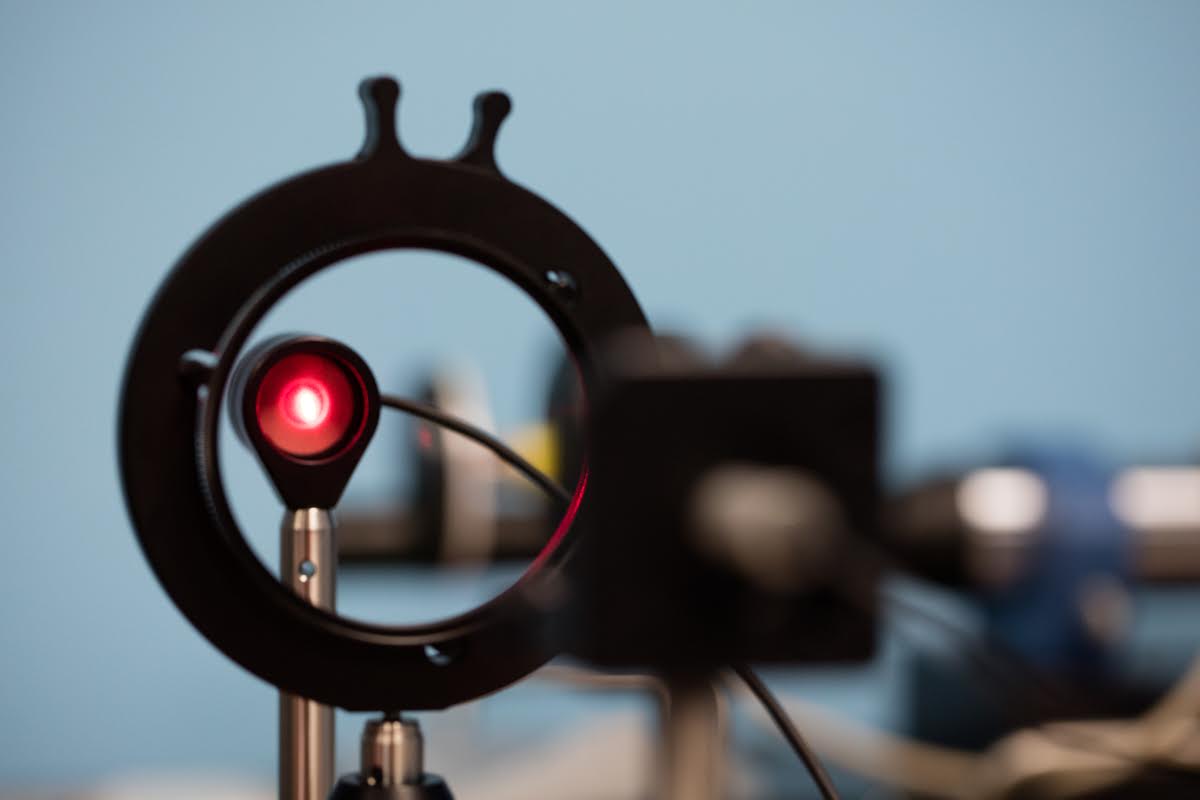
So today I will show you the results of testing a couple of thousand dollars worth of clear and UV filters using a couple of thousand dollars worth of home-made laser light transmission bench and a lot of thousand dollars worth of Olaf Optical Testing bench. So that we get this out of the way now: please don’t email asking me to test your favorite $6 UV filter. I’ve opened up Pandora’s Filter Box with this, and it’s already going to lead to way more work than I wanted to do. I’ll maybe do some testing of circular polarizing filters later, and maybe some testing of variable neutral density filters after this. Maybe not. I’ve got ADD, and I get bored easily. Even with lasers.
I like to keep these articles, well, no geekier than they just have to be. But I also want our methods to be transparent. So I’m going to give an overview of methodology in the article and put the geekier stuff in a methodology addendum at the bottom.
Light Transmission
OK, everybody should know this by now. Plain uncoated glass passes through about 96% of light and reflects back 4%. It does this at both surfaces so if you shine a light through a flat piece of uncoated glass, about 92% of the light passes through. The rest reflects hither and yon. (Yes, I know there will be an argument in the comments telling me ‘hither and thither’ is actually the correct verbiage. But ‘yon’ which is the contraction of ‘yonder’ actually means ‘some distance away, but still within sight’ whereas ‘thither’ means ‘in that direction.’ Scattered light isn’t in a particular direction. So, there’s a thing you know now.)
We are aware that coated glass passes through a lot more light, but how much more varies, depending on the coating. Some manufacturers state the transmission on the filters you buy; most don’t. Even when they do state it, well, I don’t trust anybody anyway. So we set up a relatively simple experiment to test transmission ourselves.
We aimed a collimated laser diode (635nm wavelength) at an optical power (brightness) meter in a dark room. First, we measured the background light. Then we turned on the laser and took multiple readings of its power (brightness) to measure the strength of the laser’s light. Then we placed one of the filters in a self-centering mount in the beam path and repeated the measurement. We repeated this process several times for each filter, and for way too many filters.
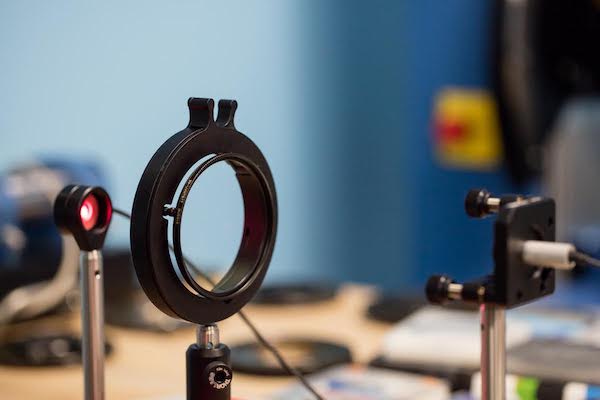
The ratio of laser strength with a filter in the pathway to laser strength without the filter in the pathway lets us know how much light is passing through the filter. If we multiply that times 100, we get the % transmission of light through the filter. We can assume that the rest of the light is being reflected either hither or yon. Perhaps both.
Some, but not all, filters come with a manufacturer’s statement of expected light transmission, so we were interested in seeing how our measurements compared to theirs. We also wondered if clear filters had better transmission than UV filters (since we’re not interested in the UV-filtering aspect). And, of course, we were interested in finding out if brand-name filters were better, and if expensive filters were better than inexpensive filters.
| Manufacture | Filter | Measured | Manufacturer's Claim | UV /Clear | Cost (77mm) |
|---|---|---|---|---|---|
| Leica | UVA II | 99.9 | UV | $225.00 | |
| Nikon | Neutral Color NC Filter | 99.8 | C | $70.00 | |
| Marumi | Exus Lens Protect | 99.7 | 99.7 | C | $50.00 |
| B+W | MRC Clear Transparent | 99.7 | 99.8 | C | $45.50 |
| Heliopan | UV SH-PMC Multicoated | 99.7 | 99.8 | UV | $156.00 |
| Chiaro | 99-UVBTS | 99.7 | 99.0 | UV | $100.00 |
| Hoya | HMC Multicoated UV(C) | 99.5 | 99.7 | UV | $20.00 |
| Hoya | NXT HMC UV | 99.5 | 99.7 | UV | $54.00 |
| Zeiss | T* UV Filter | 99.5 | UV | $124.00 | |
| Canon | Protect | 99.5 | C | $60.00 | |
| Hoya | HD Protector | 99.5 | 99.4 | C | $40.00 |
| B+W | MRC Nano Clear | 99.4 | 99.8 | C | $48.00 |
| Mefoto | Lens Karma | 98.7 | 98.0 | C | $45.00 |
| Tiffen | Digital HT Multicoated | 98.7 | UV | $45.00 | |
| Chiaro | 98-UVAT | 98.6 | 98.0 | UV | $50.00 |
| B+W | UV-Haze | 97.8 | 99.8 | UV | $43.00 |
| Heliopan | Protection | 97.3 | C | $96.00 | |
| Tiffen | Clear | 91.4 | C | $33.00 | |
| Chiaro | 90-UVAT | 90.3 | 90 | UV | $10.00 |
| Tiffen | Digital Ultra Clear | 90.1 | C | $43.00 |
You can sort the table and play with it if you want. There are a couple of things worth noting. First, I don’t see any increased transmission with clear filters compared to UV filters. Second, our measurements are reasonably consistent with the manufacturer’s claims (for those manufacturer’s that make claims). Several filters transmitted light better than the manufacturer claimed. Only one (B&W UV Haze) was lower than claimed, and this may be because it was the only ‘UV Haze’ filter tested. It may have been designed to tune out light at the wavelength of our laser. There were several ‘reasonably priced’ filters that had a very good transmission.
You may think that a 1% difference in transmission is not a big deal. What is a big deal, though, is that the light that’s not transmitted is being reflected. Reflections can cause ghosting, glare, and decreased contrast and it is a big deal. To emphasize this point, I’ll repeat the table, but this time shows the percent of the light that DOESN’T transmit through the filter.
| Manufacture | Filter | Reflection % | UV / Clear | Cost (77mm) |
|---|---|---|---|---|
| Leica | UVA II | 0.1 | UV | $225.00 |
| Nikon | Neutral Color NC Filter | 0.2 | C | $70.00 |
| Marumi | Exus Lens Protect | 0.3 | C | $50.00 |
| B+W | MRC Clear Transparent | 0.3 | C | $45.50 |
| Heliopan | UV SH-PMC Multicoated | 0.3 | UV | $156.00 |
| Chiaro | 99-UVBTS | 0.3 | UV | $100.00 |
| Hoya | HMC Multicoated UV(C) | 0.5 | UV | $20.00 |
| Hoya | NXT HMC UV | 0.5 | UV | $54.00 |
| Zeiss | T* UV Filter | 0.5 | UV | $124.00 |
| Canon | Protect | 0.5 | C | $60.00 |
| Hoya | HD Protector | 0.5 | C | $40.00 |
| B+W | MRC Nano Clear | 0.6 | C | $48.00 |
| Mefoto | Lens Karma | 1.3 | C | $45.00 |
| Tiffen | Digital HT Multicoated | 1.3 | UV | $45.00 |
| Chiaro | 98-UVAT | 1.4 | UV | $50.00 |
| B+W | UV-Haze | 2.2 | UV | $43.00 |
| Heliopan | Protection | 2.7 | C | $96.00 |
| Tiffen | Clear | 8.6 | C | $33.00 |
| Chiaro | 90-UVAT | 9.7 | UV | $10.00 |
| Tiffen | Digital Ultra Clear | 9.9 | C | $43.00 |
You can determine what you want to call acceptable and not acceptable. To me, there’s a very obvious break between filters that reflect about 0.5% or less and those that reflect 1.3% or more. There’s another big gap between the three filters at the bottom of the list and everything else. Whether the difference between, say 0.3% and 0.5% is significant I don’t know, and if there is a difference it probably only shows in certain conditions. I’m pretty confident the difference between 0.5% and 1.3% is significant, though, and I’ll bet my house that 8% reflection causes problems.
Optical Issues
Just because the light gets through the filter doesn’t mean it gets through without distortion or aberration. Here’s the opportunity to make fun of marketing (OK, to laugh at the people who blindly buy into marketing). One of the filter manufacturers proudly states they grind their filters flat to 1/10,000 of an inch. Sounds pretty impressive, doesn’t it?
Imaging-grade surface flatness is usually considered 1/4 of a wavelength, which is around 150 nanometers. That 1/10,000 of an inch the marketers are bragging about is 2540 nanometers. So what the advertising actually says is ‘our filters are guaranteed not even to be close to optical grade.’
Significant waviness in the filter surface can distort the light rays passing through. There are lots of ways to look at how irregular the surface of a filter is, but in our last post, we used pinhole collimated lights to look at how much aberration a terrible filter caused. We thought it would work well to do that again. It’s certainly simple: we’re shining tiny pinholes of light through a lens; then we put filters in front of the lens and see if they have any effect.
We tried different methodologies for a couple of days and settled on testing center pinholes on a 70-200mm f/2.8 lens at 200mm. The lens we used for the test is very slightly decentered, which is true for slightly more than half of 70-200 zooms at 200mm. Optically it passes every test we have; this amount of decentering is normal. But I was curious if a bad filter might have more effect on a lens with slight issues. (We double-checked later; the filters that did the worst on this test still sucked on a perfectly centered lens, and the good ones still looked good.)
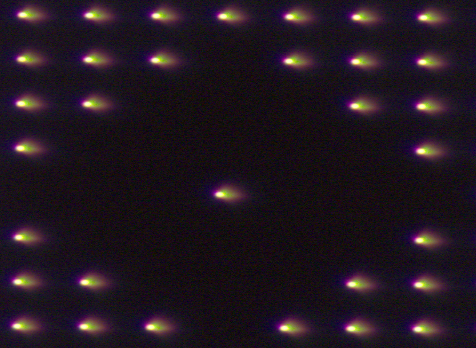
If you want more details about methodology, there’s an addendum at the bottom of the article. For now, I’ll try to keep it brief because this is a long post. Here’s how the lens rendered 5-micron pinholes at 200mm. You can see the slight decentering flare going to the right.
Now here is how the lens rendered just the center pinhole, magnified a bit, with each of our test filters in place.
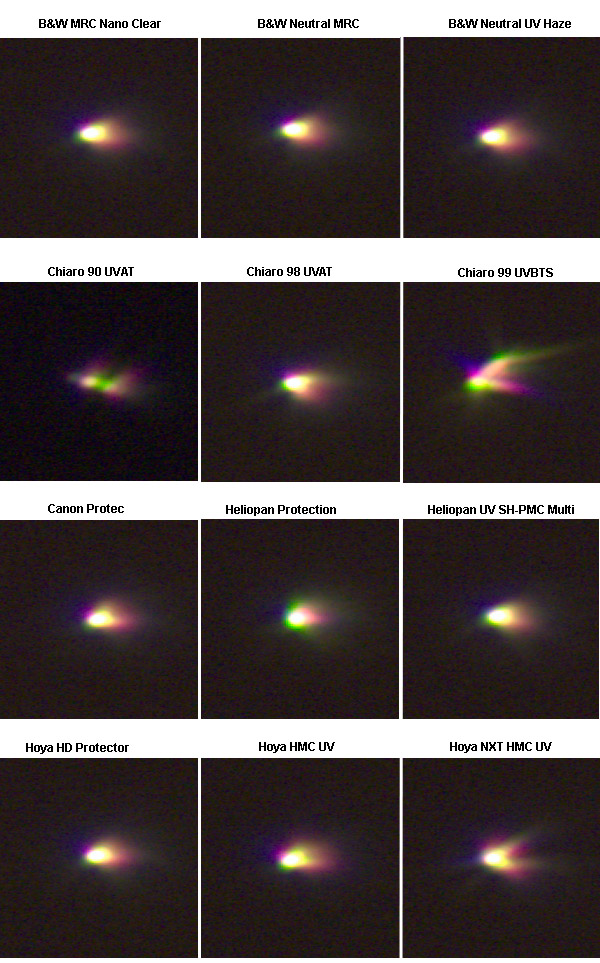
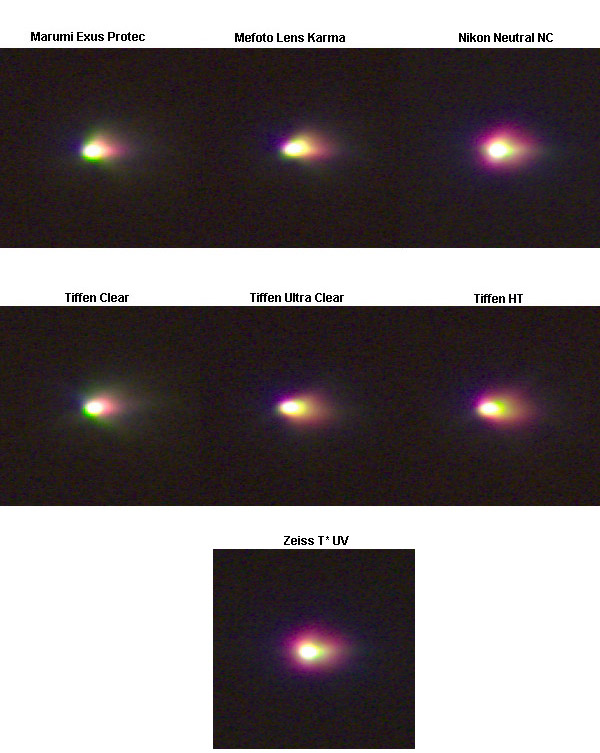
This is subjective data, of course, and I gave you full-size images so you can make your personal opinion. But Aaron and I spend all day adjusting lenses by evaluating changes in these kinds of dots. We looked at them separately, and both had exactly the same subjective conclusions:
Filters that had no significant effect: All B&W, Canon Protect, Chiaro 98 UVAT, Heliopan Protection, Heliopan UV SH-PMC, Hoya HD Protector, Hoya HMC UV, MeFoto Lens Karma, Nikon Neutral, Tiffen Ultra Clear, Tiffen HC, Zeiss T* UV
Filter may have had an adverse effect: Hoya NXT HMC UV, Tiffen Clear;
Filter had a significant adverse effect: Chiaro 90 UVAT, Chiaro 99 UVBTS
Conclusion
I set out to do the mother of all filter tests and put this subject to rest for good. But, I failed to remember what should be on my family coat-of-arms: “No good deed goes unpunished.”
Instead, I got the step-mother of all filter tests because it’s got some good stuff that is useful, but it doesn’t cover everything, and while it answers some questions, it raises others. We probably should test transmission at more wavelengths of light than just the single one we chose. We didn’t even consider (nor are we interested in) testing UV blocking power. We wanted to know how much good light gets through and how much the filter would affect our image. But it’s possible that a blue or green wavelength laser might behave differently.
The bigger question, the one I didn’t want to consider, would be ‘is there sample variation in something as simple as a filter’? The reason I wonder is the Chiaro results. I’m not surprised that the $10 Chiaro isn’t as good as the $50 filter. But it is surprising that the $100 filter is far worse than their $50 filter in this test. Chiaro doesn’t make their own glass and filters; they subcontract it, as best I can tell. But it makes me wonder about quality control for bulk quantities of filter glass. Are there bad batches? I don’t know.
As to the results we have, though, I personally wouldn’t consider any filter that reflects more than 1% of light, which eliminates 8 of the filters we tested. I’d also eliminate the Chiaro, Tiffen Clear, and Hoya NXT on the basis of the distortion test (the latter two may be OK, but there are other options at the same price). What we’re left with on my not-quite-completely-tested acceptable filter list are the following:
| Manufacture | Filter | Reflection % | UV / Clear | Cost (77mm) |
|---|---|---|---|---|
| Hoya | HMC Multicoated UV(C) | 0.5 | UV | $20.00 |
| Hoya | HD Protector | 0.5 | C | $40.00 |
| B+W | MRC Clear Transparent | 0.3 | C | $45.50 |
| B+W | MRC Nano Clear | 0.6 | C | $48.00 |
| Marumi | Exus Lens Protect | 0.3 | C | $50.00 |
| Canon | Protect | 0.5 | C | $60.00 |
| Nikon | Neutral Color NC Filter | 0.2 | C | $70.00 |
| Zeiss | T* UV Filter | 0.5 | UV | $124.00 |
| Heliopan | UV SH-PMC Multicoated | 0.3 | UV | $156.00 |
You now have as much information as I do. This is, I know, where I’m supposed to put a click-bait statement like “the Wunderbar UltraClear” is the absolute best filter. That’s kind of silly for filters, I think. Most of us just want to know which ones won’t screw up our images. Personally, there’s nothing I see that makes me feel like the highest-priced filters are worth the money, at least on the basis of these screening tests. The Hoya, B&W, and Marumi filters on the list above all have good reputations and are reasonably priced. They should all do just fine.
As always, use in the field is the ultimate proof, but these are what I’d select from. It might be that in your own type of photography you might find one is superior to another. On the other hand, for critical work, it only takes a few seconds to remove the filter and put it back on.
The elephant in the room, of course, is whether there is variation in filters. If one batch of glass is wavier than another, it could make a difference. I don’t have any firsthand knowledge, but I seriously doubt that every filter is being put on an interferometer before packing and shipping. And yes, we will probably do screening on a larger number of filters to see if we detect variation.
And I should mention that I was only interested in the glass for these tests. Whether a thin-mount or thick-mount housing is used may be of primary importance to you when selecting a filter, but the glass inside should be the same whether the housing is thick or thin.
Roger Cicala, Brandon Dube, and Aaron Closz
Lensrentals.com
June, 2017
Addendum
For the more technically inclined, here are some details most people don’t care about.
Transmission
- We aligned the filter so that the reflection from the first surface returned to the laser diode, ensuring the measurement was at an angle of incidence of 0 degrees. Performance might have been different at different angles of incidence, but this should be the best performance the filter could do.
- The actual formula is { =100*([With]-[Ambient])/([Without]-[Ambient]) } since we subtracted the power reading of ambient light from all measurements. While small, this could have made a slight difference in the proportions.
Distortion
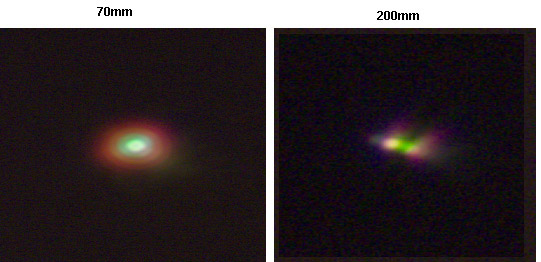
- Short focal lengths are less affected by bad filters, at least in the center. The effects we saw at 200mm were less severe at 70mm. As evidence of this claim, here is the Chiaro 99 UV at 70mm and 200mm.
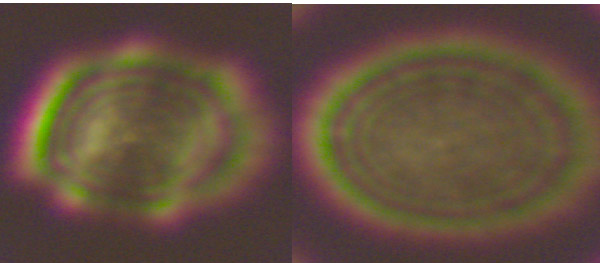
We tested the lenses both at best focus and defocused (to look at bokeh effect). While the defocused images are interesting, we didn’t find any filter that only affected bokeh; if the defocused circle was bad so was the pinhole. The bokeh circles might be considered more dramatic, though. Here is the defocused Chiari 90 from above compared to one of the other filtered lenses.
244 Comments
Caleb Barrett ·
I always look forward to these. Thanks for taking the time.
bipedal ·
I always look forward to these. Thanks for taking the time.
Fazal Majid ·
Thanks for the thorough analysis, as usual.
If you get bored with lasers, you can always try spectrometers. It would be interesting to see what the spectral transmission curve looks like.
I would also be interested in how the new Sigma ceramic filters compare.
Roger Cicala ·
Fazal, that has been discussed. The financial reality is a spectrometry set up is an order of magnitude more expensive than the simple laser power meter. Maybe someday.
Brandon Dube ·
If he wants to pay for the hardware I’m happy to put together my design 🙂
Brandon Dube ·
If he wants to pay for the hardware I'm happy to put together my design :)
Fazal Majid ·
No doubt. I wonder how Allbinos.com measure the transmission curves on the binoculars they review.
You do carry the Sekonic C700R SpectroMaster in your stable, wouldn’t it be possible to shine a stable incandescent light source through the filter and compare with/without, or is that instrument not precise enough?
Roger Cicala ·
I just would be nervous about the measurement with that instrument. It’s awesome in the field, but I don’t know that it’s lab grade.
Fazal Majid ·
No doubt. I wonder how Allbinos.com measure the transmission curves on the binoculars they review:
http://www.allbinos.com/160...
You do carry the Sekonic C700R SpectroMaster in your stable, wouldn't it be possible to shine a stable incandescent light source through the filter and compare with/without, or is that instrument not precise enough?
Roger Cicala ·
I just would be nervous about the measurement with that instrument. It's awesome in the field, but I don't know that it's lab grade.
Søren Stærke ·
Great article. I work an optics laboratory with all kinds of lasers and spectrometers. We do food analysis and spectroscopy, so we got it all covered. If to u are interested in getting the spectral curves, I could do it for you for free.
Roger Cicala ·
Soren, drop me an email roger at olafoptical.com That sounds fun
Roger Cicala ·
Soren, drop me an email roger at olafoptical.com That sounds fun
Maya ·
+1 for Sigma ceramic filters. I’ve never tried one, but I’m really curious. Many thanks anyway to the Lensrentals & Co teams for the effort.
SolJuJo ·
I have two. In my drawers. I wanted to show off how sturdy they are and dropped from about 10 inches a little piece of tungsten on a supported Sigma protector.
I didn’t break, but the scratch reminds me “better only show off if you already tried before” and after a second glance it tells me “why showing off?”
Ayoh ·
I think optyczne.pl / lenstip.com has already done such tests
Fazal Majid ·
Thanks for the thorough analysis, as usual.
If you get bored with lasers, you can always try spectrometers. It would be interesting to see what the spectral transmission curve looks like.
I would also be interested in how the new Sigma ceramic filters compare.
Maya ·
+1 for Sigma ceramic filters. I've never tried one, but I'm really curious. Many thanks anyway to the Lensrentals & Co teams for the effort.
SolJuJo ·
I have two. In my drawers. I wanted to show off how sturdy they are and dropped from about 10 inches a little piece of tungsten on a supported Sigma protector.
I didn't break, but the scratch reminds me "better only show off if you already tried before" and after a second glance it tells me "why showing off?"
Ayoh ·
I think optyczne.pl / lenstip.com has already done such tests
Graham Stretch ·
Hi Roger.
Proof that resistance is futile, thank you for succumbing to the temptation provided by the lasers and providing us with a well reasoned and transparent test.
Thank you for the time and effort and financial investment in this and all the other tests and also for clarifying hither and yon!
Yet another well written, humorous and informative post.
Cheers, Graham.
Graham Stretch ·
Hi Roger.
Proof that resistance is futile, thank you for succumbing to the temptation provided by the lasers and providing us with a well reasoned and transparent test.
Thank you for the time and effort and financial investment in this and all the other tests and also for clarifying hither and yon!
Yet another well written, humorous and informative post.
Cheers, Graham.
Henning Wulff ·
Did the Leica filter get dropped after the first round, or did you have to very carefully repackage it and give it back?
Roger Cicala ·
Henning, we couldn’t get it in 77mm size, so I couldn’t test it on the 70-200 zoom. But since we had one I thought we’d do the transmission just to see.
Roger Cicala ·
Henning, we couldn't get it in 77mm size, so I couldn't test it on the 70-200 zoom. But since we had one I thought we'd do the transmission just to see.
DrJon ·
Sorry to be a pain, but I find one of the most annoying qualities of filters is the reflection from the backside (oh, BSI, well it least it works for sensors) when it’s dark out and a bright light is in the image. That light then reflects back off the sensor and back again off the filter (the rear I assume), giving a large and usually green blob in the image. (The lens does a much better job, I don’t know how much is better coatings and how much is the lack of flat surfaces, I suspect he latter.) I stopped using Hoya SMC and HD as I thought they were bad compared to the B+W MRC Nanos (as I don’t always have the time to remove hood and filter before taking a shot).
How about it? Pretty please? Just needs a camera, lens and bright light.
Brandon Dube ·
That is exactly what we measured. The % reflectance (reflection % as Roger labeled it) is the number you should look at.
DrJon ·
Okay, but does the angle of incidence make any difference (between different filters – that was my first thought reading the article, can two be 99% straight on but 97/95 at 10 degrees) and are all the filters coated the same on both sides (I’d have thought they would be but who knows, I guess depends if they are free-standing, as I’d assume, or lying down when deposition occurs)?
When looking at filters they usually really non-reflective head-on, but tilt them and that’s often not so.
Roger Cicala ·
DrJon, it might. We decided to just check straight on because it was more reproducible as a comparison. We could have measured 30 or 45 degree angles fairly accurately with a little work, but the time involved in being accurate would have been significant.
Brandon Dube ·
The AoI can make an enormous difference. 0deg vs 10deg is not likely to be all that different – usually a coating performs worst near about 60 degrees for “typical” optical glass with n=1.5. For the first or air-to-glass surface, 0-25 degrees or so might as well be the same. For the second or glass-to-air surface, 0-15 degrees is ‘the same.’
The coating is surely the same on both sides for a quality filter that is coated on both sides. They’re coated in planetary coating chambers, suspended above a tiny crucible that the evaporate precious metals in. They waft up and deposit on the glass, and voila – coated.
DrJon ·
Okay, but does the angle of incidence make any difference (between different filters - that was my first thought reading the article, can two be 99% straight on but 97/95 at 10 degrees) and are all the filters coated the same on both sides (I'd have thought they would be but who knows, I guess depends if they are free-standing, as I'd assume, or lying down when deposition occurs)?
When looking at filters they usually really non-reflective head-on, but tilt them and that's often not so.
Brandon Dube ·
The AoI can make an enormous difference. 0deg vs 10deg is not likely to be all that different - usually a coating performs worst near about 60 degrees for "typical" optical glass with n=1.5. For the first or air-to-glass surface, 0-25 degrees or so might as well be the same. For the second or glass-to-air surface, 0-15 degrees is 'the same.'
The coating is surely the same on both sides for a quality filter that is coated on both sides. They're coated in planetary coating chambers, suspended above a tiny crucible that the evaporate precious metals in. They waft up and deposit on the glass, and voila - coated.
DrJon ·
Sorry to be a pain, but I find one of the most annoying qualities of filters is the reflection from the backside (oh, BSI, well it least it works for sensors) when it's dark out and a bright light is in the image. That light then reflects back off the sensor and back again off the filter (the rear I assume), giving a large and usually green blob in the image. (The lens does a much better job, I don't know how much is better coatings and how much is the lack of flat surfaces, I suspect he latter.) I stopped using Hoya SMC and HD as I thought they were bad compared to the B+W MRC Nanos (as I don't always have the time to remove hood and filter before taking a shot).
How about it? Pretty please? Just needs a camera, lens and bright light.
Thomas Geist ·
Since some of your readers surely are located in Europe it might be worth mentioning that Heliopan filters are way less expensive there. In Germany the filter you tested can be had for around 80 Euros which makes it more reasonable.
Heliopan are ridiculously overpriced in the US.
Thomas Geist ·
Since some of your readers surely are located in Europe it might be worth mentioning that Heliopan filters are way less expensive there. In Germany the filter you tested can be had for around 80 Euros which makes it more reasonable.
Heliopan are ridiculously overpriced in the US.
Jean-François Alexandre ·
Absolutely clear, express and unstoppable, as usual!
It recuts my preferences, having worked a few years in the group Cokin in the evaluation of competitive products.
Bravo Roger, thank you, have a nice day from France.
Jean-François Alexandre ·
Absolutely clear, express and unstoppable, as usual!
It recuts my preferences, having worked a few years in the group Cokin in the evaluation of competitive products.
Bravo Roger, thank you, have a nice day from France.
Chris Jankowski ·
This may be of interest to some folks:
A Polish language website – optyczne.pl published a series of tests of UV and polar filters. To their credit, they publish their methodologies (this would keep Roger happy). Their tests are re-published in English translations on the website – lenstip.com.
Here are pointers to the English language translations of the tests:
http://www.lenstip.com/113.1-article-UV_filters_test.html
http://www.lenstip.com/120.1-article-UV_filters_test_-_supplement.html
http://www.lenstip.com/115.1-article-Polarizing_filters_test.html
http://www.lenstip.com/119.1-article-Polarizing_filters_test_-_supplement.html
http://www.lenstip.com/index.php?art=139
Please note that some of these tests are 10 years old now. Products change, even filters.
Their methodology is different than Roger’s. Their scoring system differs too. However, they also found that the best filters in their ranking are not necessarily the most expensive ones.
Brandon Dube ·
In the second link (120…) they claim they’ve captured interference fringes. They most assuredly have not — there is no type of interferometer (Fizeau, white light, michelson, lateral shearing, etc) that produces such sharp fringes with that large of a spacing.
Their spectral transmission charts are difficult to comprehend, as is their notation for extinction coefficient. IMO.
Robson Robson ·
I had a supershort look at the transmission spectrum of the Samyang HMC UV filter and I can’ t really see any interference fringes. The layer with the smallest band gap is of aroundish 3.8 eV (too lazy to plot alpha square). After looking at the spectrum at least I don’ t ask myself if interference fringes would valid measuring at a different wavelengt. I suppose in IR the transmission goes down because of the excitation of some free carriers. Some of the other spectra are bizarre, though.
Brandon Dube ·
I’m talking about this image:
http://www.lenstip.com/upload2/16851_interf.jpg
They use this as a “homogenaeity” test – inserting the filter into an expanded laser beam. There is no way for this to generate fringes, as there is only one beam. You can see this shadowing effect because of uneven absorption across the filter surface, but the contrast here is excellent and the filter would have to be enormously bad for that to be the case.
If it is truly interference fringes they would need an interferometer (some types are given in my last comment), but there is nothing that makes fringes that look like this.
Robson Robson ·
Oh, just looked at the UV/VIS spectra and thought I did not see oszillations due to film thickness. That’ s why I didn’ t understand your comment.
Considering the picture above, could the streaks be due to tensions in the glass sheet? Furthermore, could said streaks be kinda related to the smeared out dots you observe in your pinhole tests?
Anyhow, at least for the filters these measurements don’ t look inhomogenious (when shown) in the lenstip test except for the cokin filter. Together with 10% reflection (if no light is absorbed) I suppose I won’ t be buying any cokin filters any time soon.
Brandon Dube ·
There won’t be substantial anomalies in the internal stress of the substrate, optical glass is too good for that.
If this was an interferogram (they claim it is, but it cannot be) it would directly be a measurement of the surface shape of the filter. Since the surface shape is not flat, the change in the spot would (roughly) be the abs()^2 of the FT of the pattern. There are so-called induced aberrations caused by putting this newly aberrated beam through the master lens, but they are probably not that huge a contributor.
Chris Scholz ·
Yes, that is a strange and convoluted explanation of their optical flatness test.
Could one not use a “simple” inteferometric flatness test? I guess you’ll have to take the filter out of the mount though.
https://en.wikipedia.org/wiki/Optical_flat
https://www.edmundoptics.com/resources/application-notes/optics/optical-flats/
Also wondering, Roger, why do you shoot the backreflection back into your source? Usually people try to avoid this, that’s why the build APC connectors in fiber optics.
I guess the power level of the reflection is so low and maybe our source has an output isolator that this is probably not an issues. Still, i don’t understand why you would want to reflect the beam back into your source, in general that is a bad idea.
And finally, when talking about linear values in the order of 0.1, maybe a dB scale would be more meaningful?
Brandon Dube ·
You can’t use a newton’s interferometer to test the flatness of coated optics, unless your test plate is coated the same as the part you are testing. The intensity mismatch will cause the fringe contrast to be extremely poor.
This intensity mismatch issue is also true with a Fizeau or other type of interferometer.
The backreflection is shot into laser diode because this is an easy and very sensitive way to ensure that the filter is at normal incidence. This is a bad idea if the source is sensitive to this, i.e. can be damaged or destabilized. This is not the case with the diode we used here.
I discussed with Roger converting the reflection coefficients into db or simply photographic stops. We chose not to write this up that way.
Chris Jankowski ·
This may be of interest to some folks:
A Polish language website - optyczne.pl published a series of tests of UV and polar filters. To their credit, they publish their methodologies (this would keep Roger happy). Their tests are re-published in English translations on the website - lenstip.com.
Here are pointers to the English language translations of the tests:
http://www.lenstip.com/113....
http://www.lenstip.com/120....
http://www.lenstip.com/115....
http://www.lenstip.com/119....
http://www.lenstip.com/inde...
Please note that some of these tests are 10 years old now. Products change, even filters.
Their methodology is different than Roger's. Their scoring system differs too. However, they also found that the best filters in their ranking are not necessarily the most expensive ones.
Brandon Dube ·
In the second link (120...) they claim they've captured interference fringes. They most assuredly have not -- there is no type of interferometer (Fizeau, white light, michelson, lateral shearing, etc) that produces such sharp fringes with that large of a spacing.
Their spectral transmission charts are difficult to comprehend, as is their notation for extinction coefficient. IMO.
Robson Robson ·
I had a supershort look at the transmission spectrum of the Samyang HMC UV filter and I can' t really see any interference fringes. The layer with the smallest band gap is of aroundish 3.8 eV (too lazy to plot alpha square). After looking at the spectrum at least I don' t ask myself if interference fringes would valid measuring at a different wavelengt. I suppose in IR the transmission goes down because of the excitation of some free carriers. Some of the other spectra are bizarre, though.
Brandon Dube ·
I'm talking about this image:
http://www.lenstip.com/uplo...
They use this as a "homogenaeity" test - inserting the filter into an expanded laser beam. There is no way for this to generate fringes, as there is only one beam. You can see this shadowing effect because of uneven absorption across the filter surface, but the contrast here is excellent and the filter would have to be enormously bad for that to be the case.
If it is truly interference fringes they would need an interferometer (some types are given in my last comment), but there is nothing that makes fringes that look like this.
Robson Robson ·
Oh, just looked at the UV/VIS spectra and thought I did not see oszillations due to film thickness. That' s why I didn' t understand your comment.
Considering the picture above, could the streaks be due to tensions in the glass sheet? Furthermore, could said streaks be kinda related to the smeared out dots you observe in your pinhole tests?
Anyhow, at least for the filters these measurements don' t look inhomogenious (when shown) in the lenstip test except for the cokin filter. Together with 10% reflection (if no light is absorbed) I suppose I won' t be buying any cokin filters any time soon.
Brandon Dube ·
There won't be substantial anomalies in the internal stress of the substrate, optical glass is too good for that.
If this was an interferogram (they claim it is, but it cannot be) it would directly be a measurement of the surface shape of the filter. Since the surface shape is not flat, the change in the spot would (roughly) be the abs()^2 of the FT of the pattern. There are so-called induced aberrations caused by putting this newly aberrated beam through the master lens, but they are probably not that huge a contributor.
Chris Scholz ·
Yes, that is a strange and convoluted explanation of their optical flatness test.
Could one not use a "simple" inteferometric flatness test? I guess you'll have to take the filter out of the mount though.
https://en.wikipedia.org/wi...
https://www.edmundoptics.co...
Also wondering, Roger, why do you shoot the backreflection back into your source? Usually people try to avoid this, that's why the build APC connectors in fiber optics.
I guess the power level of the reflection is so low and maybe our source has an output isolator that this is probably not an issues. Still, i don't understand why you would want to reflect the beam back into your source, in general that is a bad idea.
And finally, when talking about linear values in the order of 0.1, maybe a dB scale would be more meaningful?
Brandon Dube ·
You can't use a newton's interferometer to test the flatness of coated optics, unless your test plate is coated the same as the part you are testing. The intensity mismatch will cause the fringe contrast to be extremely poor.
This intensity mismatch issue is also true with a Fizeau or other type of interferometer.
The backreflection is shot into laser diode because this is an easy and very sensitive way to ensure that the filter is at normal incidence. This is a bad idea if the source is sensitive to this, i.e. can be damaged or destabilized. This is not the case with the diode we used here.
I discussed with Roger converting the reflection coefficients into db or simply photographic stops. We chose not to write this up that way.
Dave Hachey ·
One of the most useful features of Lensrentals.com is the education you guys provide! Every time I visit your web site I feel a little bit smarter. About the only filters I use are polarizers and ND grads, only because I have to for the particular image. The absolute best filter I have is provided by my insurance agent.
Dave Hachey ·
One of the most useful features of Lensrentals.com is the education you guys provide! Every time I visit your web site I feel a little bit smarter. About the only filters I use are polarizers and ND grads, only because I have to for the particular image. The absolute best filter I have is provided by my insurance agent.
Leo ·
Leica. The decisive UV filter.
Louie G ·
Excellent article! Thank you.
One question/verification about B+W filters: MRC clear transparent is the F-Pro and MRC nano clear is the XS-Pro?
Roger Cicala ·
That is correct, Louie
Louie G ·
Excellent article! Thank you.
One question/verification about B+W filters: MRC clear transparent is the F-Pro and MRC nano clear is the XS-Pro?
Tim ·
Thank you for your wisdom. Aint nothing wrong with geeks, without them we would still be in the horse and buggy age..but I digress.
Fifty something years ago a friend of my fathers who was a world renowned photographer was explaining the difference between great lenses and really great lenses.
One of his pronouncements was, “As a rule of thumb, the less glass you put between your subject and the film, the better.”
He was quite big on a yellow filter for his landscapes….
Tim ·
Thank you for your wisdom. Aint nothing wrong with geeks, without them we would still be in the horse and buggy age..but I digress.
Fifty something years ago a friend of my fathers who was a world renowned photographer was explaining the difference between great lenses and really great lenses.
One of his pronouncements was, "As a rule of thumb, the less glass you put between your subject and the film, the better."
He was however quite big on a yellow filter for his landscapes....
Marc P. ·
I’d being interested on how good (or bad) the way lowcost Tianya XS-Pro1 UV Filter is, Roger…because i do use them since Fall 2014 (onto my older, therefore cheap(er) aquired MF lenses collection) – within the last 25 years, and therefore, i can’t spent the money for always having a Carl Zeiss T* UV, B&W XS Nano Pro (or F-Pro MRC 010 cheaper) or Hoya HD Series….it’ll cost too much, but i need(ed) to protect the Front Lens Element from Dust, Pollen, Fingerprint, etc..so far, i don’t see Image Degradation with them.
best regards
Marc
Marc P. ·
I'd being interested on how good (or bad) the way lowcost Tianya XS-Pro1 UV Filter is, Roger...because i do use them since Fall 2014 (onto my older, therefore cheap(er) aquired MF lenses collection) - within the last 25 years, and therefore, i can't spent the money for always having a Carl Zeiss T* UV, B&W XS Nano Pro (or F-Pro MRC 010 cheaper) or Hoya HD Series....it'll cost too much, but i need(ed) to protect the Front Lens Element from Dust, Pollen, Fingerprint, etc..so far, i don't see Image Degradation with them.
best regards
Marc
obican ·
Typo: Chiaro 99-UVBTS .03
Should be 0.3
Roger Cicala ·
Thank you! Fixed that.
obican ·
Typo: Chiaro99-UVBTS.03
Should be 0.3
Artem Holstov ·
I am not a specialist of any kind in this, but are you sure that using just a laserbeam to measure the transmission is representative of the way that the glass would transmit the whole spectrum of visible light wavelengths?
Roger Cicala ·
Artem, no, all we can really say is that is how it transmits red light. We’ve got some other wavelengths of lasers ordered. But the fact it agrees so well with the manufacturer’s findings does give the concept some credence.
Joel ·
“But the fact it agrees so well with the manufacturer’s findings does give the concept some credence.” – Actually it doesn’t. It might just mean that the manufacturer’s also used a red light laser. Sorry, it’s just the scientist in me 🙂
You might be able to combine lensed blue lasers with LEDs to produce white light as they do with the new Audi “laser” headlights.
Roger Cicala ·
Artem, no, all we can really say is that is how it transmits red light. We've got some other wavelengths of lasers ordered. But the fact it agrees so well with the manufacturer's findings does give the concept some credence.
Joel ·
"But the fact it agrees so well with the manufacturer's findings does give the concept some credence." - Actually it doesn't. It might just mean that the manufacturer's also used a red light laser. Sorry, it's just the scientist in me :)
You might be able to combine lensed blue lasers with LEDs to produce white light as they do with the new Audi "laser" headlights.
Peter Kelly ·
Unfortunately, there are some aspects of these filters that you haven’t tested and not knowing the answer would render the rest of the information moot.
That is, how well do they protect and how much do front elements need protecting in the first place?
In other words, if we are talking about protection from dust and dirt, how many ‘cleanings’ can a front element withstand before any measurable deterioration beyond normal age? If they last into the ‘hundreds’ then a protector is pointless, as I doubt if I clean my front element more than once a week at the very most (dirty conditions), but sometimes weeks go by. That would mean a front element would survive perfectly well for decades.
Then we would need tests for physical impact, to see if there is any occasion where a filter saves the front element. I believe all front elements will be far stronger than any filter and so the real danger is that the filter may actually exacerbate potential damage. I have never seen an example that demonstrates a filter has ‘saved’ a lens.
Then we come to cost. If you drop a lens, you will need to have it checked and calibrated, at the very least, and likely repaired anyway. I suspect that the cost of a front element would be a relatively small proportion. Why spend extra on more ‘elements’?
I will continue to act as I did before and not waste my money on degrading my images!
Roger Cicala ·
Peter, I linked to a number of articles that discussed much of that. The reason for the test was partly just what you bring up: we’ve found the cost of front element replacement has increased massively for some lenses ($3,000 front elements for some Otus lenses, for example) and some of the newer coatings seem more fragile. This is NOT a recommendation for blanket filter use, I’ve been against that for a decade. But there are some situations and some lenses where I now use them.
Michael Cox ·
Which filter/s do you ship with the Canon 24-70 f2.8 MkII with as I read somewhere (may have been one of your posts) that there can be a problem with some low profile filters scratching the front element on this lens?
Roger Cicala ·
It’s sporting the B&W Clear MRC Nano XS Pro. We chose that arbitrarily for the ‘is it worth filtering’ experiment. Now we’re trying to take a logical look at what we should use going forward.
Michael Cox ·
Thanks
Roger Cicala ·
It's sporting the B&W Clear MRC Nano XS Pro. We chose that arbitrarily for the 'is it worth filtering' experiment. Now we're trying to take a logical look at what we should use going forward.
Peter Kelly ·
Unfortunately, there are some aspects of these filters that you haven't tested and not knowing the answer would render the rest of the information moot.
That is, how well do they protect and how much do front elements need protecting in the first place?
In other words, if we are talking about protection from dust and dirt, how many 'cleanings' can a front element withstand before any measurable deterioration beyond normal age? If they last into the 'hundreds' then a protector is pointless, as I doubt if I clean my front element more than once a week at the very most (dirty conditions), but sometimes weeks go by. That would mean a front element would survive perfectly well for decades.
Then we would need tests for physical impact, to see if there is any occasion where a filter saves the front element. I believe all front elements will be far stronger than any filter and so the real danger is that the filter may actually exacerbate potential damage. I have never seen an example that demonstrates a filter has 'saved' a lens.
Then we come to cost. If you drop a lens, you will need to have it checked and calibrated, at the very least, and likely repaired anyway. I suspect that the cost of a front element would be a relatively small proportion. Why spend extra on more 'elements'?
I will continue to act as I did before and not waste my money on degrading my images!
Roger Cicala ·
Peter, I linked to a number of articles that discussed much of that. The reason for the test was partly just what you bring up: we've found the cost of front element replacement has increased massively for some lenses ($3,000 front elements for some Otus lenses, for example) and some of the newer coatings seem more fragile. This is NOT a recommendation for blanket filter use, I've been against that for a decade. But there are some situations and some lenses where I now use them.
As someone who repairs lenses all day, I'm not a believer that filters protect from impacts. I think they protect from flying sand, salt spray, burning sparks (you wouldn't believe the number of burned front elements we replace) and reduce the need for cleaning.
There is also the scratch issue. Many people don't care about scratches because they have such little effect (if any) on images. Many others do, because they affect resale value. One of the reasons we became interested in the topic was after never having filters on any lenses, the Canon 24-70 f/2.8 Mk II scratched so frequently we were replacing around 30 front elements a month. After putting filters on all of them that has dropped to 3 a month. It's currently the one lens in our fleet that ships with a filter in place. There are another 4 or 5 lenses we may put them on for the same reason.
Nivedita ·
Roger,
Thanks for the great article! We really appreciate these types of articles!
One question is about Breakthrough Photography Filters. They seem to be getting a lot more attention and I can see many people (including their own web site) claiming it to be “the best filter”. I am just curious to know why it was excluded from this test. I understand that you were not planned to test all the filters, but with all these recent attention on those filters, I am trying to see such claims like “the best filter” is really something that needs to be considered.
Roger Cicala ·
Nivedita,
We simply went to BHPhoto and bought one of every filter they had in stock in 77mm size – apparently they were out of stock at the time. For my purposes, having found a number of filters that passed our little tests just fine in the $50 and under range I don’t have any burning desire to test more $100 filters. We might when we get into it more.
SolJuJo ·
Yeah, let’s come to the point at which the filter costs more than the lens it should protect 🙂
Which you already pointed out when you compared filter costs against front lens costs.
EVener ·
good question! I know they make two grades of UV filters.
Nivedita ·
Yes, their X4 series are expensive (compared to B+W, Hoya etc.). They also provide 25 year warranty. At the same time whether it is worth is something that I am looking for. A Marumi Exus 77mm is around $50 and BP X4 is $100.
EVener ·
I cannot tell you a thing about their UV filters. I have three of their filters: a Polarizer, a 6-stop ND and a 10-stop ND filter. I am happy with those. All are screw-in models. In real world shooting the breakthrough heavy ND filters do indeed live up to their claims of having minimal color shift compared to the 6 and 10 ND filters I have used (Helipan and I think B+W).
chaos215bar2 ·
Comparing their highest end filters with nano coating to B+W, Breakthrough Photography seems to cost twice as much and, as far as I can tell, they both use the same glass from Schott. What makes Breakthrough Photography better?
Nivedita ·
Don’t know and I am also trying to understand that.
It seems Breakthrough Photography filters have 16 layers of coating where as B+W has 8 on one side (I read this somewhere, not sure about it. Also, Breakthrough Photography filters have Nano coating on both the sides. I do not know whether these differences in coatings result in twice the cost 🙂 Also, are these coatings are really worth compared to what is offered in B+W or Marumi? Not sure…
chaos215bar2 ·
B+W filters have to be coated on both sides (only one side coated would still result in about 96% transmission according to the information above), so 8 layers per side vs. 16 total are exactly the same. I also don’t actually see any references to the Breakthrough Photography filter having a nano coating on both sides, though if the nano coating does indeed result in 0.3% less transmission as this test suggests, you probably wouldn’t want it on the inside of the filter where its water and dirt repellant properties won’t do much good.
Again, aside from the admittedly handy looking knurling on the outer rim of the Breakthrough Photography filter, it looks like exactly what B+W is selling for slightly less than half the price. Of course, I’m certainly not claiming there isn’t some other difference I’m simply missing, just trying to understand the pricing.
Nivedita ·
From Breakthrough Photography web site, they are saying that they use Nano coating on both the sides (it is one of their main claims).
The pricing is also my main question. I have not found whether these 16 layers of coatings and Nano coating on both sides is worth the cost (double price of B+W or Marumi)
James ·
I’m fairly sure it’s marketing hyperbole. They are calling theirs 16 layers (on two side combined) against 8 on bw but bw is also double sided and they conveniently leave that out. I wrote to them a long time ago and they said they didn’t know if bw was double sided. Only that bw uses an 8 layer system.
Nivedita ·
Don't know and I am also trying to understand that.
It seems Breakthrough Photography filters have 16 layers of coating where as B+W has 8 (only on one side - I read this somewhere, not sure about it). Also, Breakthrough Photography filters have Nano coating on both the sides. I do not know whether these differences in coatings result in twice the cost :) Also, are these coatings really worth compared to what is offered in B+W or Marumi? Not sure...
chaos215bar2 ·
B+W filters have to be coated on both sides (only one side coated would still result in about 96% transmission according to the information above), so 8 layers per side vs. 16 total are exactly the same. I also don't actually see any references to the Breakthrough Photography filter having a nano coating on both sides, though if the nano coating does indeed result in 0.3% less transmission as this test suggests, you probably wouldn't want it on the inside of the filter where its water and dirt repellant properties won't do much good.
Again, aside from the admittedly handy looking knurling on the outer rim of the Breakthrough Photography filter, it looks like exactly what B+W is selling for slightly less than half the price. Of course, I'm certainly not claiming there isn't some other difference I'm simply missing, just trying to understand the pricing.
Nivedita ·
From Breakthrough Photography web site, they are saying that they use Nano coating on both the sides (it is one of their main claims).
The pricing is also my main question. I have not found whether these 16 layers of coatings and Nano coating on both sides is worth the cost (double price of B+W or Marumi)
James ·
I'm fairly sure it's marketing hyperbole. They are calling theirs 16 layers (on two side combined) against 8 on bw but bw is also double sided and they conveniently leave that out. I wrote to them a long time ago and they said they didn't know if bw was double sided. Only that bw uses an 8 layer system.
Nivedita ·
Roger,
Thanks for the great article! We really appreciate these types of articles!
One question is about Breakthrough Photography Filters. They seem to be getting a lot more attention and I can see many people (including their own web site) claiming it to be "the best filter". I am just curious to know why it was excluded from this test. I understand that you were not planned to test all the filters, but with all these recent attention on those filters, I am trying to see such claims like "the best filter" is really something that needs to be considered.
Roger Cicala ·
Nivedita,
We simply went to BHPhoto and bought one of every filter they had in stock in 77mm size - apparently they were out of stock at the time. For my purposes, having found a number of filters that passed our little tests just fine in the $50 and under range I don't have any burning desire to test more $100 filters. We might when we get into it more.
SolJuJo ·
Yeah, let's come to the point at which the filter costs more than the lens it should protect :)
Which you already pointed out when you compared filter costs against front lens costs.
Vortex ·
so much time.. and then most photos from people interested in this kind of stuff look boring and crappy.
no tech can replace an artistic vision.. you guys bother too much about the wrong things.
Vortex ·
so much time spend on this.. and then most photos from people interested in this kind of stuff look boring and crappy.
no tech can replace an artistic vision.. you guys bother too much about the wrong things.
Ilya Zakharevich ·
Roger, a lot of thanks!
However, you said: “the center pinhole, magnified a bit” about the images in your gallery. Due to this unknown magnification, one cannot compare images “with filter” to the image “without filter”. Could you also add the “without filter” image (magnified the SAME way) to the gallery, please?
Moreover: did you get any scientific sounding support for the light being scattered “yon”? I would suppose that all but “unmeasurable amount” would be reflected “thither”…
Roger Cicala ·
Sloppy vebiage on my part, Ilya. The images were all the same, with and without filters, I just cropped down the center point to 100% for the closeup images. I was trying to give everyone a look at the reticle pattern with the first picture, so it was compressed to 600 pixels by the blog platform.
I hope to get a thithermeter soon and use it to differentiate the thither scatter from the yon reflection. 🙂
Ilya Zakharevich ·
I might have been unclear. The multiple-pinholes (“no filter”) image is 476px × 348px. I see no way to get a higher resolution image. The other images either have 2.5× circle of confusion (but then you won’t call them adequate), or have different magnification.
From my POV, it makes sense to be able to compare no-filter vs with-filter directly?—?hence a need for same-magnification images.
Roger Cicala ·
Ilya, they are screen captures from the computer that runs the bench. The overview image on that program is 3 screens of the 476 X 348 across the screen for left, center, and right. That’s what the first image is taken from. When we concentrate on any image (in this case the center) we simply make it full size which is what all the ongoing images were from.
I didn’t put a full-size of the no filter image in the article because the majority of the filter images looked just like the non filter image, I thought it redundant and was trying to keep an overly long article as little overlong as I could.
Ilya Zakharevich ·
“…looked just like the non filter image…”
I was under impression that this was the kind of a sentence which you would like to avoid at any cost…
Brandon Dube ·
The images you’re looking at constitute a star test. This is a qualitative, rather than quantitative measure. There is no need for absolute rigor in things like magnification. It is generally implicit that the viewer will understand the size the image of the pinhole “should” be, and is capable of this 2.5x resizing in their brain. If you are looking for numerical analysis, this isn’t the test for you.
Ilya Zakharevich ·
Roger, a lot of thanks!
However, you said: “the center pinhole, magnified a bit” about the images in your gallery. Due to this unknown magnification, one cannot compare images “with filter” to the image “without filter”. Could you also add the “without filter” image (magnified the SAME way) to the gallery, please?
Moreover: did you get any scientific sounding support for the light being scattered “yon”? I would suppose that all but “unmeasurable amount” would be reflected “thither”...
Roger Cicala ·
Sloppy vebiage on my part, Ilya. The images were all the same, with and without filters, I just cropped down the center point to 100% for the closeup images. I was trying to give everyone a look at the reticle pattern with the first picture, so it was compressed to 600 pixels by the blog platform.
I hope to get a thithermeter soon and use it to differentiate the thither scatter from the yon reflection. :-)
Ilya Zakharevich ·
I might have been unclear. The multiple-pinholes (“no filter”) image is 476px × 348px. I see no way to get a higher resolution image. The other images either have 2.5× circle of confusion (but then you won’t call them adequate), or have different magnification.
From my POV, it makes sense to be able to compare no-filter vs with-filter directly — hence a need for same-magnification images.
Roger Cicala ·
Ilya, they are screen captures from the computer that runs the bench. The overview image on that program is 3 screens of the 476 X 348 across the screen for left, center, and right. That's what the first image is taken from. When we concentrate on any image (in this case the center) we simply make it full size which is what all the ongoing images were from.
I didn't put a full-size of the no filter image in the article because the majority of the filter images looked just like the non filter image, I thought it redundant and was trying to keep an overly long article as little overlong as I could.
Ilya Zakharevich ·
“…looked just like the non filter image…”
I was under impression that this was the kind of a sentence which you would like to avoid at any cost…
Brandon Dube ·
The images you're looking at constitute a star test. This is a qualitative, rather than quantitative measure. There is no need for absolute rigor in things like magnification. It is generally implicit that the viewer will understand the size the image of the pinhole "should" be, and is capable of this 2.5x resizing in their brain. If you are looking for numerical analysis, this isn't the test for you.
Jim Warthman ·
Excellent article, Roger. Thanks very much for taking the time and expense to test these filters. Also, the comments and your responses have added to the topic.
Perhaps an oversight, but I didn’t see the Marumi Exus Lens Protect listed in the lists of optical issues (no significant effect, adverse effect, significant adverse effect).
Roger Cicala ·
It was an oversight = there were no significant effects with the Marumi
Jim Warthman ·
Excellent article, Roger. Thanks very much for taking the time and expense to test these filters. Also, the comments and your responses have added to the topic.
Perhaps an oversight, but I didn't see the Marumi Exus Lens Protect listed in the lists of optical issues (no significant effect, adverse effect, significant adverse effect).
doog ·
“a methodology addendum at the bottom”.
I know I’ve stumbled into the right place. Come for the genial bantering instruction, stay for the after-school
doog ·
"a methodology addendum at the bottom".
I know I've stumbled into the right place. Come for the genial bantering instruction, stay for the after-school
pl capeli ·
great article
Ramiro ·
I own two B+W XS-Pro Digital 010 (37 and 46mm).
Does this model correspond to any of the B+W filters tested? I hope they’re not of the “UV haze” type…
Snikt ·
It will say right on the filter. Clear, or UV Haze, or UV, etc… Pretty sure the 010 are only UV or UV/Haze though and the 007 are Clear
Ramiro ·
I own two B+W XS-Pro Digital 010 (37 and 46mm).
Does this model correspond to any of the B+W filters tested? I hope they're not of the "UV-Haze" type...
Snikt ·
It will say right on the filter. Clear, or UV Haze, or UV, etc... Pretty sure the 010 are only UV or UV/Haze though and the 007 are Clear
Matt ·
Roger, that bokeh test is pretty interesting, seems to show the waviness of the filter. As bokeh can often show lens problems that don’t show in a focused image (dust, glass bubbles, decentering of aspherical elements) it could be a good way to test the flatness of a filter.
Matt ·
Roger, that bokeh test is pretty interesting, seems to show the waviness of the filter. As bokeh can often show lens problems that don't show in a focused image (dust, glass bubbles, decentering of aspherical elements) it could be a good way to test the flatness of a filter.
Mark Friedman ·
About a year or two ago, Steve Perry of the Backcountry Gallery website ran some extensive tests on whether it actually necessary to protect a lens with a filter. The video is on YouTube and is interesting.
Joel ·
When I started reading the article, purely out of curiosity as I never use a filter (M8 excepted), and I saw that you’re using a red laser, I thought “WTH”. I am very surprised that you didn’t use a standardized white light source, perhaps an LED with less heat variation, as a light source. You might also check blue v. red light to see if it even matters.
Roger Cicala ·
Joel, we intend to. We have to buy more lasers first. Hate that 🙂
Brandon Dube ·
A white light LED is generally not suitable for spectroscopy, there is a huge peak in either the UV or blue portion of the spectrum, then a notch just to the right of that, followed by a wide peak around yellow.
This gives you very bad SNR in the blue, at that notch.
Other colors will of course have different transmission — spectral transmission curves are rarely anything like a box function.
Joel ·
Agreed, however you can easily filter those wavelengths out. The SNR value in the blue light might not have an effect on this particular test.
Brandon Dube ·
If you go from a monochromatic measure of transmission to one with a spectral component, you’re going from saying “the transmission is xyz” with the understanding that that is at a specific wavelength to “the transmission t(lambda) = f(lambda).” It is true that you can take the average value of this over some bandwidth, and that is how the t/# is defined.
It is IMO a easier argument to say “here’s the transmission at xyz” than it is “here is the transmission at xz, excluding y because our setup is not very good.”
Brandon Dube ·
If you go from a monochromatic measure of transmission to one with a spectral component, you're going from saying "the transmission is xyz" with the understanding that that is at a specific wavelength to "the transmission t(lambda) = f(lambda)." It is true that you can take the average value of this over some bandwidth, and that is how the t/# is defined.
It is IMO a easier argument to say "here's the transmission at xyz" than it is "here is the transmission at xz, excluding y because our setup is not very good."
Joel ·
When I started reading the article, purely out of curiosity as I never use a filter (M8 excepted), and I saw that you're using a red laser, I thought "WTH". I am very surprised that you didn't use a standardized white light source, perhaps an LED with less heat variation, as a light source. You might also check blue v. red light to see if it even matters.
Roger Cicala ·
Joel, we intend to. We have to buy more lasers first. Hate that :-)
Brandon Dube ·
A white light LED is generally not suitable for spectroscopy, there is a huge peak in either the UV or blue portion of the spectrum, then a notch just to the right of that, followed by a wide peak around yellow.
This gives you very bad SNR in the blue, at that notch.
Other colors will of course have different transmission -- spectral transmission curves are rarely anything like a box function.
Antoine B. ·
Wonder where the Kenko filters have gone? It’s one of the biggest filters brand here in Japan so I am surprised not to see them in the list
Roger Cicala ·
I don’t know. B&H didn’t have them so we didn’t try them.
Roger ·
Hoya/Kenko/Tokina are all the same company. The Kenko Pro1 Digital and Hoya Pro 1 are the same. Even the packaging is very similar. I puzzled over the same thing trying to buy a Hoya filter in Japan before realizing they were the same and that the Japanese prices are decent.
http://www.kenkotokinausa.com/
Someone ·
I believe Kenko and Hoya are same or at least closely related to each other.
Antoine B. ·
Wonder where the Kenko filters have gone? It's one of the biggest filters brand here in Japan so I am surprised not to see them in the list
Roger Cicala ·
I don't know. B&H didn't have them so we didn't try them.
Roger ·
Hoya/Kenko/Tokina are all the same company. The Kenko Pro1 Digital and Hoya Pro 1 are the same. Even the packaging is very similar. I puzzled over the same thing trying to buy a Hoya filter in Japan before realizing they were the same and that the Japanese prices are decent.
http://www.kenkotokinausa.com/
Claudia Muster ·
One may poke fun at Leica as much as one likes, but 99.9% transmission is impressive.
Mike Carper ·
It seems that the Leica filter is missing from the second part of the article.
Roger Cicala ·
We only had it in 62mm size so it couldn’t be used on the 200mm lens for the second part of the tests.
Bo Benson ·
Wouldn’t a 77mm to 62mm reduction ring have worked? (As you only looked at the center hole)
Roger Cicala ·
We only had it in 62mm size so it couldn't be used on the 200mm lens for the second part of the tests.
Bo Benson ·
Wouldn't a 77mm to 62mm reduction ring have worked? (As you only looked at the center hole)
Shield Block ·
Only people who poke fun at Leica are the people who can’t afford one and are jealous.
John Smith ·
In fact it’s the opposite. Leica users are very often scrubs wearing cameras as jewelry, or scrub gadget collectors.
Lawrence Beck ·
Or those who bought their Leica glass and cameras used, including the 280 APO, 400 pre modular APO 2.8 and the 400 APO 2.8 Modular along with the 800, and suffered through such repeated and horrendous service with Leica that we’ve decided to forego the pain of ever buying another Leica lens or camera. It was once a great marque. Today it’s jewelry for those who care to display the red dot.
Shield Block ✓ᵛᵉʳᶦᶠᶦᵉᵈ ᵗᵉᵃᵖᵒᵗ ·
Only people who poke fun at Leica are the scrubs who can't afford one and are jealous.
John Smith ·
In fact it's the opposite. Leica users are very often scrubs wearing cameras as jewelry, or scrub gadget collectors.
Lawrence Beck ·
Or those who bought their Leica glass and cameras used, including the 280 APO, 400 pre modular APO 2.8 and the 400 APO 2.8 Modular along with the 800, and suffered through such repeated and horrendous service with Leica that we've decided to forego the pain of ever buying another Leica lens or camera. It was once a great marque. Today it's jewelry for those who care to display the red dot.
tbutler67 ·
So in the hypothetical possibility that you do test polarizing filters, when might these tests happen?
I’m planning on upgrading from a cheap one to a real one, and I trust your reviews more than anyone else’s I’ve read. ^^;;
Roger Cicala ·
I would guess it’s going to be late July or early August. And thank you!
tbutler67 ·
You’re welcome! And I guess I’ll just have to wait…
TerryB ·
These excellent tests were carried out some years ago, but as you will still find many of these filters around today, you may find these links useful.
http://www.lenstip.com/113.1-article-UV_filters_test.html
http://www.lenstip.com/115.3-article-Polarizing_filters_test_Test_procedure.html
tbutler67 ·
So in the hypothetical possibility that you do test polarizing filters, when might these tests happen?
I'm planning on upgrading from a cheap one to a real one, and I trust your reviews more than anyone else's I've read. ^^;;
Roger Cicala ·
I would guess it's going to be late July or early August. And thank you!
tbutler67 ·
You're welcome! And I guess I'll just have to wait...
TerryB ·
These excellent tests were carried out some years ago, but as you will still find many of these filters around today, you may find these links useful.
http://www.lenstip.com/113....
http://www.lenstip.com/115....
Thomas ·
I have been very happy with my Marumi filters.
Astro Landscapes ·
In the real world, the biggest difference isn’t going to be brightness or sharpness, it’s going to be FLARE DOTS. And, if the filter is really junky, added haze when shooting into the sun.
I don’t always use UV filters, but I own a complete set of B+W’s just in case I encounter nasty weather.
It’s better to have one and barely ever use it, than to need one in a risky situation, and scratch your front element.
Brandon Dube ·
The transmission losses have negligible impact on the brightness of the image. Where they do not have negligible impact is where the lost light goes — it is reflected, and contributes to flare.
Astro Landscapes ·
In the real world, the biggest difference isn't going to be brightness or sharpness, it's going to be FLARE DOTS. And, if the filter is really junky, added haze when shooting into the sun.
I don't always use UV filters, but I own a complete set of B+W's just in case I encounter nasty weather.
It's better to have one and barely ever use it, than to need one in a risky situation, and scratch your front element.
Brandon Dube ·
The transmission losses have negligible impact on the brightness of the image. Where they do not have negligible impact is where the lost light goes -- it is reflected, and contributes to flare.
Janus Ng ·
I am a bit confused regarding Hoya filters. Could Roger clarify it? In the article, it said,
“…
Filters that had no significant effect: All B&W, …, ***Hoya HMC UV***, …
Filter may have had an adverse effect: ***Hoya NXT HMC UV***, Tiffen Clear;
…
As to the results we have, though, I personally wouldn’t consider any filter that reflects more than 1% of light, which eliminates 8 of the filters we tested. I’d also eliminate the Chiaro, Tiffen Clear, and ***Hoya NXT*** on the basis of the distortion test (the latter two may be OK, but there are other options at the same price). …”
I would assume that is good but is bad.
However, was left in the “not-quite-completely-tested acceptable filter list” but was eliminated.
Was the enlisting of in “not-quite-completely-tested acceptable filter list” a mistake? Or the endorsement of earlier section were mistakes?
I am particular interested in since it is the cheapest filter listed in the acceptable list.
Roger Cicala ·
The Hoya NXT was taken off on the basis of borderline optical distortion test. This may have been overly harsh, both aaron and I said ‘might have an effect’. But we had lots of other choices that to our test did not have an effect so we eliminated the two ‘might have’ filters.
Like all our testing, we’ll modify things as we do more work. Variation is quite possibly an issue that we don’t have a grasp on yet. I’ve gotten to talk to several manufacturers since I wrote this and that topic has come up with them several times.
Janus Ng ·
Thanks a lot Roger!
Your articles are so informative and useful! Superb!
So it means Hoya NXT HMC UV was listed incorrectly in the acceptable filter list. Please update the table. https://uploads.disquscdn.com/images/ee5706b2f36e58365dbcee0cc96639505625d5ea14edaa6ae2eb1dd1160912c2.png
Roger Cicala ·
Done! And thank you.
Fengshui ·
I am a bit confused regarding Hoya filters. Could Roger clarify it? In the article, it said,
"...
Filters that had no significant effect: All B&W, ..., ***Hoya HMC UV***, ...
Filter may have had an adverse effect: ***Hoya NXT HMC UV***, Tiffen Clear;
...
As to the results we have, though, I personally wouldn’t consider any filter that reflects more than 1% of light, which eliminates 8 of the filters we tested. I’d also eliminate the Chiaro, Tiffen Clear, and ***Hoya NXT*** on the basis of the distortion test (the latter two may be OK, but there are other options at the same price). ..."
I would assume that [Hoya HMC UV] is good but [Hoya NXT HMC UV] is bad.
However, [Hoya NXT HMC UV] was left in the "not-quite-completely-tested acceptable filter list" but [Hoya HMC UV] was eliminated.
Was the enlisting of [Hoya NXT HMC UV] in acceptable filter list a mistake? Or the earlier section should have endorsed [Hoya NXT HMC UV] instead?
I am particular interested in [Hoya HMC UV] since it is the cheapest filter listed in the acceptable list.
Roger Cicala ·
The Hoya NXT was taken off on the basis of borderline optical distortion test. This may have been overly harsh, both aaron and I said 'might have an effect'. But we had lots of other choices that to our test did not have an effect so we eliminated the two 'might have' filters.
Like all our testing, we'll modify things as we do more work. Variation is quite possibly an issue that we don't have a grasp on yet. I've gotten to talk to several manufacturers since I wrote this and that topic has come up with them several times.
Fengshui ·
Thanks a lot Roger!
Your articles are so informative and useful! Superb!
So it means Hoya NXT HMC UV was listed incorrectly in the acceptable filter list. Please update the table. https://uploads.disquscdn.c...
Claudia Muster ·
Concerning the marketeers: Could it be that the original claim was 1/10,000 millimeters, and then a metrically challenged translator translated that to 1/10,000 inch? 1/10,000 millimeters sounds perfectly reasonable. I’m seeing lousy translations all the livelong day.
Roger Cicala ·
Very good point and one that would make sense. On the other hand, that brand seems to be very flatness challenged in further testing, so I don’t know.
Claudia Muster ·
Concerning the marketeers: Could it be that the original claim was 1/10,000 millimeters, and then a metrically challenged translator translated that to 1/10,000 inch? 1/10,000 millimeters sounds perfectly reasonable. I'm seeing lousy translations all the livelong day.
Roger Cicala ·
Very good point and one that would make sense. On the other hand, that brand seems to be very flatness challenged in further testing, so I don't know.
Harry Dubetz ·
Not sure if anyone else mentioned this but there is an additional consideration in buying a filter: how good are the filter threads? Many of us have wished we had a filter wrench out in the field at some point or other. Most filters have threaded plastic, but some (B+W comes to mind) have brass.
Roger Cicala ·
Very good point. Of cut more than a few filters off of lenses.
SolJuJo ·
The you should take a look at hammerforum. 😀
Roger Cicala ·
Very good point. I've cut more than a few filters off of lenses.
SolJuJo ·
The you should take a look at hammerforum. :D
Chris Newman ·
I’ve always chosen, when practical, to protect my lenses for peace of mind, particularly because if they get dirty, I prefer to risk scratching a filter when cleaning them than scratching the front element or leaving the lens dirty. When I bought my film SLR outfit, there was little independent advice on the quality of lenses or filters, and so I chose mainly on the basis of the manufacturers’ reputations and the retailers’ advice. In the digital age the internet offers many assessments of lenses, but there is little information on filters, and manufacturers seem to keep their sales pitches subjective. (I remember studying a Hoya filter catalogue a few years ago, where they had used a different metric to describe the performance of each range of filters, so without looking up retail prices it was impossible even to decide which were their basic and better ranges.) Thank you so much, Lensrentals and Lenstip, for providing some independent data.
In addition to the quality of filters, I am still looking for authoritative guidance on whether to choose UV or clear protective filters. As shown in the Lenstip tests, UV filters don’t have an absolute cut-off, but a region in the violet to ultraviolet wavebands where they transition from clear to opaque. I assume also that our eyes don’t have a sharp cut-off, but become less sensitive to light as the wavelength decreases from violet to ultraviolet, and possibly also the eye tissue may become less transparent. I read that digital cameras include a UV filter over the sensor, so I assume that the manufacturer will have made a good choice for the characteristics of this filter, and I will get more lifelike images by using a clear protective filter than by risking additional reduction at the violet end of the spectrum with an extra UV filter. But I would very much like to receive confirmation or correction of this. Unfortunately I don’t find Lensrentals’ comment that you didn’t see any increased transmission with clear filters compared to UV filters very helpful, as measurements were at 635nm, in the red-orange area of the spectrum. My main concern is how much “visible” light a UV filter might exclude at the violet end of the spectrum.
Roger Cicala ·
I agree Chris. Like I said in the article, we’ve opened Pandora’s filter box and will have to do a lot more testing. Spectrometry is being done, other wavelengths of lasers have been ordered, etc. This was a baby step. Or more likely the first step down the rickety stairs to a dark cellar in a horror movie.
Chris Newman ·
I’ve always chosen, when practical, to protect my lenses for peace of mind, particularly because if they get dirty, I prefer to risk scratching a filter when cleaning them than scratching the front element or leaving the lens dirty. When I bought my film SLR outfit, there was little independent advice on the quality of lenses or filters, and so I chose mainly on the basis of the manufacturers’ reputations and the retailers’ advice. In the digital age the internet offers many assessments of lenses, but there is little information on filters, and manufacturers seem to keep their sales pitches subjective. (I remember studying a Hoya filter catalogue a few years ago, where they had used a different metric to describe the performance of each range of filters, so without looking up retail prices it was impossible even to decide which were their basic and better ranges.) Thank you so much, Lensrentals and Lenstip, for providing some independent data.
In addition to the quality of filters, I am still looking for authoritative guidance on whether to choose UV or clear protective filters. As shown in the Lenstip tests, UV filters don’t have an absolute cut-off, but a region in the violet to ultraviolet wavebands where they transition from clear to opaque. I assume also that our eyes don’t have a sharp cut-off, but become less sensitive to light as the wavelength decreases from violet to ultraviolet, and possibly also the eye tissue may become less transparent. I read that digital cameras include a UV filter over the sensor, so I assume that the manufacturer will have made a good choice for the characteristics of this filter, and I will get more lifelike images by using a clear protective filter than by risking additional reduction at the violet end of the spectrum with an extra UV filter. But I would very much like to receive confirmation or correction of this. Unfortunately I don’t find Lensrentals’ comment that you didn’t see any increased transmission with clear filters compared to UV filters very helpful, as measurements were at 635nm, in the red-orange area of the spectrum. My main concern is how much “visible” light a UV filter might exclude at the violet end of the spectrum.
Roger Cicala ·
I agree Chris. Like I said in the article, we've opened Pandora's filter box and will have to do a lot more testing. Spectrometry is being done, other wavelengths of lasers have been ordered, etc. This was a baby step. Or more likely the first step down the rickety stairs to a dark cellar in a horror movie.
Nika ·
Nikon has launched new series of filters ARCREST with 0.1% reflectance
one side AR (anti reflection ) coating.
Link to nikon japan site
translate.googleusercontent.com/translate_c?depth=1&hl=en&ie=UTF8&nv=1&prev=_t&rurl=translate.google.com&sl=auto&sp=nmt4&tl=en&u=http://www.nikon-image.com/products/accessory/about/arcrest/&usg=ALkJrhikRJydefbza8e0KiTuDtZ0nRwAqw
Nika ·
Nikon has launched new series of filters ARCREST with 0.1% reflectance
one side AR (anti reflection ) coating.
Link to nikon japan site
translate.googleusercontent...
Michael Steinbach ·
Thank you, thank you, thank you! This is a discussion I have had sooo many times when I have friends and relatives that buy junk filters. I will be sharing this link. Great job Roger.
Marc P. ·
I do think, one important point have had being forgotten into here: As Test, there was a red (visible) Laser Diode being used, with a specific, given wavelength (635nm exact as Roger stated here into this article). Filters that might transmit 99.9% of the light here, and also all others, might be totally different at other wavelengths of light, that means -spectrum.
Not to crush the Party, but just as a sidenote.
Good Light !
Marc
Roger Cicala ·
A good point Mark. I have gotten some spectrometry results and overall they suggest transmission is fairly uniform through the spectrum in clear filters, with sometimes a little loss in the blue range in UV filters. We’ve gotten a green laser and reproduced most of the readings with no change in that. An article will follow, once I get the backlog of 8 articles out of the way.
Roger Cicala ·
Marc, that’s why my now broke ass just bought a spectrometer. 🙂
I knew I was opening Pandora’s box.
Nick ·
Just think though. Now you can test High CRI LED lights and compare them to incandescent and fluorescent lights!
Marc P. ·
It seems really you’ve opened it… 😉
Marc P. ·
I do think, one important point have had being forgotten into here: As Test, there was a red (visible) Laser Diode being used, with a specific, given wavelength (635nm exact as Roger stated here into this article). Filters that might transmit 99.9% of the light here, and also all others, might be totally different at other wavelengths of light, that means -spectrum.
Not to crush the Party, but just as a sidenote.
Good Light !
Marc
Roger Cicala ·
Marc, that's why my now broke ass just bought a spectrometer. :-)
I knew I was opening Pandora's box.
Nick ·
Just think though. Now you can test High CRI LED lights and compare them to incandescent and fluorescent lights! What kind of photos are enhanced by a didymium filter?
Marc P. ·
It seems really you've opened it... ;-)
Jan Stenberg ·
Hi Roger.
I’m using a brand that is produced in Japan and sells at least here in Europe and claims to have a 99,5% transmission and a Digital High Grade Super Protective surface.
If I send you two 77mm (one UV, and one CPL) filters will you test them? I’m not affiliated with the brand, but have bought a substantial pile just on the specs and am getting a bit curios whether I’ve made a wise choice.
Best regards Jan
Roger Cicala ·
Jan, if you email me the brand I probably have tested them since this article was written. But in general, those that have claimed superb transmission do, indeed, have superb transmission. And lousy glass.
Roger Cicala ·
Jan, I’d be happy to test one for you, but I’m not familiar with the brand.
Jan Stenberg ·
Hi Roger.
I'm using a brand that is produced in Japan and sells at least here in Europe and claims to have a 99,5% transmission and a Digital High Grade Super Protective surface.
If I send you two 77mm (one UV, and one CPL) filters will you test them? I'm not affiliated with the brand, but have bought a substantial pile just on the specs and am getting a bit curios whether I've made a wise choice.
Edit:
After some research my question maybe is: The full name of the filter is "Dörr (Doerr) UV 77mm Digital high grade Super Protect", is that actually a rebranded Marumi filter? If so, what version? In the web store I purchase my filters that is the more expensive version of two versions.
Best regards Jan
Roger Cicala ·
Jan, I'd be happy to test one for you, but I'm not familiar with the brand.
Bassel Mattroud ·
Great article, informative. makes me wonder about what to believe about professional photographer’s recommendations about lenses and filters.
Bassel Mattroud ·
Great article, informative. makes me wonder about what to believe about professional photographer's recommendations about lenses and filters.
EsaKivivuori ·
What happend to Leica UVA II ?
Michel A ·
When measuring transmission at 0 degrees care must be taken this does not contribute to extending the laser cavity and influence gain. Optical isolator may be required.
Brandon Dube ·
A laser driven to saturation is not affected by back reflections.
KWNJr ·
What happened to the leica filter?
It was in the first comparison but is missing afterward.
KWNJr ·
What happened to the leica filter?
It was in the first comparison but is missing afterward.
Sorry, I just dug thru the many comments/replies and saw that you lacked a 77mm leica filter.
KWNJr ·
Did you try any gelatin filters?
Paolo Palmero ·
I wish the Sigma ceramic filter was included!
shaikh imran ·
Most of my customer only ask for UV filter for protection only. Reason if just in case they drop the lens there may be some protection.
James Cowley ·
Great article. I would add one caveat. I sent off for a 77mm filter for my nikon 300 f4 v. So, I just clicked on the cheapest thing Ebay had (it was about $1.50). I started noticing ghosting around my images and other fuzzy crap. I was thinking there was something wrong with the lens, then I unscrewed the filter and everything was fine. I’d have to say, don’t go cheaper than Hoya or Fotasy.
James Cowley ·
Great article. I would add one caveat. I sent off for a 77mm filter for my nikon 300 f4 v. So, I just clicked on the cheapest thing Ebay had (it was about $1.50). I started noticing ghosting around my images and other fuzzy crap. I was thinking there was something wrong with the lens, then I unscrewed the filter and everything was fine. I'd have to say, don't go cheaper than Hoya or Fotasy.
Nacho Estrada ·
damn good article, nice to see some one prove it than just say “in my experience
this brand is better than all the others.
Nacho Estrada ·
damn good article, nice to see some one prove it than just say "in my experience
this brand is better than all the others.
alsotps ·
Thank you for this. I have to replace a filter, so I thought I would check my own choice….B&W. Given the tests, I’ll stick with it. but your tests were quite helpful. I will change type, but not brand.
alsotps ·
Thank you for this. I have to replace a filter, so I thought I would check my own choice....B&W. Given the tests, I'll stick with it. but your tests were quite helpful. I will change type, but not brand.
Michael Messing ·
I’m confused about the Hoya HMC UV(c) filter you listed. In your transmission testing, you show that Hoya claims 99.7% transmission and you tested it to have 99.5% transmission. When I look up the filter, Hoya claims that the light transmission is over 97%. Am I looking at the wrong filter or is there some other discrepancy?
Michael Messing ·
I'm confused about the Hoya HMC UV(c) filter you listed. In your transmission testing, you show that Hoya claims 99.7% transmission and you tested it to have 99.5% transmission. When I look up the filter, Hoya claims that the light transmission is over 97%. Am I looking at the wrong filter or is there some other discrepancy?
Ziyuan Yao ·
The “B+W UV-Haze” filter in your test, which measured a 97.8% light transmission rate but claimed a 99.8%, is it the single-coated “UV Haze 010” (without “MRC”), or the “UV Haze MRC 010M”, or the “UV Haze MRC-Nano 010M”?
Ziyuan Yao ·
The "B+W UV-Haze" filter in your light transmission test, which measured a 97.8% transmission rate but claimed a 99.8%, is it the single-coated "UV Haze 010" (without "MRC"), or the "UV Haze MRC 010M", or the "UV Haze MRC-Nano 010M"?
Jason Wong ·
What good is this? You didn’t test how much UV they blocked!
Roger Cicala ·
Because we don’t care how much UV they blocked. The sensor stack does a nice job of that. 🙂
Roger Cicala ·
As the title says, “Protective filter article”. I don’t give a flying one about how much UV they block. I just want to know if they adversely effect image quality.
Jason Wong ·
What good is this? You didn't test how much UV they blocked!
Roger Cicala ·
As the title says, "Protective filter article". I don't give a flying one about how much UV they block. I just want to know if they adversely effect image quality.
Sammy01 ·
This is fantastic. I only wish you had tested even more brands. Where I live (Sydney, Australia), Hoya, Kenko and Manfrotto are the only cheap brands. And every retailer seems to only carry or stock one for each filter size. I don’t want to go with online sales due to the delay, possibility of damage and possibility of counterfeit.
Sammy01 ·
This is fantastic. I only wish you had tested even more brands. Where I live (Sydney, Australia), Hoya, Kenko and Manfrotto are the only decent cheap brands. (There are others that will turn your photo into mush.). And every retailer seems to only carry or stock one for each filter size. I don't want to go with online sales due to the delay, possibility of damage and possibility of counterfeit.
The worst filters I have seen were cheap Chinese filters branded as "Massa". I use them only when storing lenses.
Darwin Wilde ·
Great work – wish I had come across it sooner. Bought B+W XS-PRO MRC Nano UV Haze Protective UV Filter Ultra-thin on ebay and after the fact, unfortunately, inquired about if it was really made in Germany as box showed. Should have know better for $36 and was informed it was a copy. Are the lower priced B+W filters in your listing actually made in Germany or are they the Chinese version. Thanks.
Darwin Wilde ·
Great work - wish I had come across it sooner. Bought B+W XS-PRO MRC Nano UV Haze Protective UV Filter Ultra-thin on ebay and after the fact, unfortunately, inquired about if it was really made in Germany as box showed. Should have know better for $36 and was informed it was a copy. Are the lower priced B+W filters in your listing actually made in Germany or are they the Chinese version. Thanks.
bstrom ·
Just read this while looking for a filter to put on a Fujinon enlarger lens I’ve adapted for my Sony a7r3 – gonna use Nikon’s clear one based on your measurements. Nice to catch up with how these controversial accessories can affect our images. Thanks for a great test effort!
Scott Weaver ·
How would the Polarpro Quartline filters compare to these results?
Tech We Love ·
So wait, is the Leica UVA II the best then, and what is the best now ?
Anton Csiky ·
Dear Roger,
thank you very much for the loads of work and testing you did. I’m no professional but an delighted enthusiast. You gave me an in depth overview to filters. It will never be possible to cover all aspects and favor everybody.
Best wishes and greets from Nuremberg, Germany,
Arthur Cichi
Anton Csiky ·
Dear Roger,
thank you very much for the loads of work and testing you did. I'm no professional but an delighted enthusiast. You gave me an in depth overview to filters. It will never be possible to cover all aspects and favor everybody.
Best wishes and greets from Nuremberg, Germany,
Arthur Cichi
luke ·
what I would like to see from you guys is article talking about if it’s worth using filters. You have real life take on the lenses you rent i how strong is front element and if wiping it without filter does produce any degradation?
luke ·
what I would like to see from you guys is article talking about if it's worth using filters. You have real life take on the lenses you rent i how strong is front element and if wiping it without filter does produce any degradation?
Ziggy ·
Lens focal length is a big variable though.
See https://clarkvision.com/art...
Brandon Koh ·
Thank you for this immensely detailed analysis. If I’m reading it correctly, it would seem that the B+W 007 Basic Clear Filter transmits light better than the 007 Master (MRC nano) clear filter and would be a superior choice?
Brandon Koh ·
Thank you for this immensely detailed analysis. If I'm reading it correctly, it would seem that the B+W 007 Basic Clear Filter transmits light better than the 007 Master (MRC nano) clear filter and would be a superior choice?
aphonic ·
Any chance you would roll a 2025 update to this! May of the filters aren’t available, then there’s the debate about successors, where hiya says the (c) is just the older thicker version of the (0) but others say it’s also better. Etc. nice job, any chance we can get an updated version?
Donald_USMC ·
Dear Roger,
I realize I am excruciatingly late to this party, and I appreciate the work that was put in to bring these results to us. The most impactful lessons I learned from one of my photography professors, was that "In photography, nothing is cheap, and nothing is easy." And he was right! So, much appreciation to you.
My question has to do with the passage of time and UV-Haze filter improvements. I happen to have one of the poorest performing UV-Haze filters on all my lenses regarding light reflectance; B+W UV-Haze MRC Nano with a 2.2% reflectance rate. Yup, I got sold a bill of goods. I do end up in high elevations from time to time, so I prefer that style of clear filter. Roger, I would like to know if you are going to have an updated protective filter experiment that includes filters like Breakthrough Photography's X2 and X4 clear filters and more releases from the brand names we all know and
grumble…love?Thank you so much for your great work,
Don
Donald_USMC ·
Dear Roger,
I realize I am excruciatingly late to this party, and I appreciate the work that was put in to bring these results to us. The most impactful lessons I learned from one of my photography professors, was that "In photography, nothing is cheap, and nothing is easy." And he was right! So, much appreciation to you.
My question has to do with the passage of time and UV-Haze filter improvements. I happen to have one of the poorest performing UV-Haze filters on all my lenses regarding light reflectance; B+W UV-Haze MRC Nano with a 2.2% reflectance rate. Yup, I got sold a bill of goods. I do end up in high elevations from time to time, so I prefer that style of clear filter. Roger, I would like to know if you are going to have an updated protective filter experiment that includes filters like Breakthrough Photography's X2 and X4 clear filters and more releases from the brand names we all know and
grumble...love?Thank you so much for your great work,
Don