
About Getting Your Camera Wet… Teardown of a Salty Sony A7sII
People think that because I expect the worst and try to prepare for it, that I’m negative. That’s not it at all. I’m not a negative person; I’m cheerfully cynical. If I expect the worst and it doesn’t happen, I’m happy because things went better than I expected. If I expect the worst and it does happen, I’m happy, because I can tell everyone, “See, I told you this would happen.” So I expect the worst because that keeps me happy.
This post is a superb example of why expecting the worst is reasonable. There are all kinds of badness in this one post. There’s nothing good here at all. Well, except for Aaron’s disassembly. That’s very good. Everything else here is about mistakes.
Here’s a list of bad things that we’ll discuss.
- Camera manufacturers market their equipment as weather resistant. But if you get water inside the camera the warranty is void. So that’s pretty much “we guarantee it will work unless it breaks.”
- People think weather resistant means waterproof because they want to believe that.
- Service Centers play the impact/moisture damage card so much that everyone assumes they are full of …shirt… when they say so.
- There are two kinds of photographers: Those who have ruined a camera from water damage and are careful about water and see #2.
- Most service centers won’t work on a water damaged camera, even if you pay them. Some won’t even open it up to look inside if they see evidence on the outside.
So here’s the background. A Sony a7sII camera came back from rental and was completely dead when tested. The sharp-eyed tech noted some corrosion around a couple of screws.
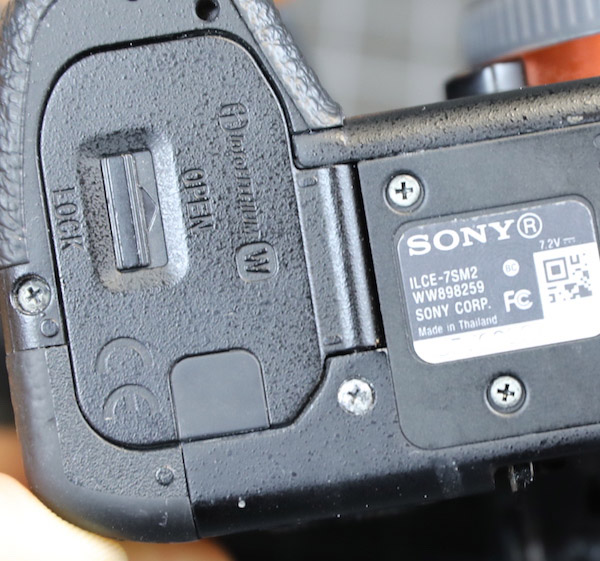
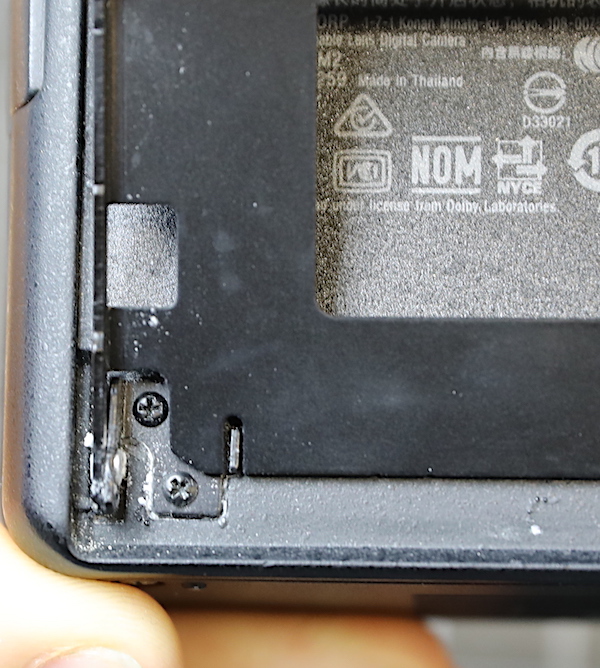
That’s not very impressive, but the camera was dead and had been rented near the ocean. (I should probably add that this kind of thing is on our inspection checklist, so two different techs would have to miss the corroded screws for the camera to go out this way. I’m not saying it’s impossible, but it’s not likely.)
Since the camera was bricked, it was going to need repair if possible. We know from long experience that this service center would refuse to even open the camera because of the corrosion on the screws. So we opened it up to look inside ourselves.
Just so you can play detective along with us, the two corroded screws were on the lower left part of the camera, near the battery door, so we started this exercise thinking salt water might have splashed up onto the left-bottom side of the camera.
So, Salt Water or Coincidence? You Make the Call.
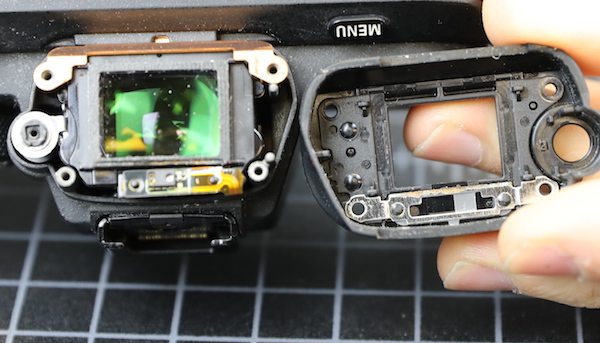
We started by taking off the Sony a7sII viewfinder cover. There’s some dust under there but no signs of corrosion. The copper piece left behind on the out-of-focus camera body would be completely corroded with the slightest exposure to salt water.
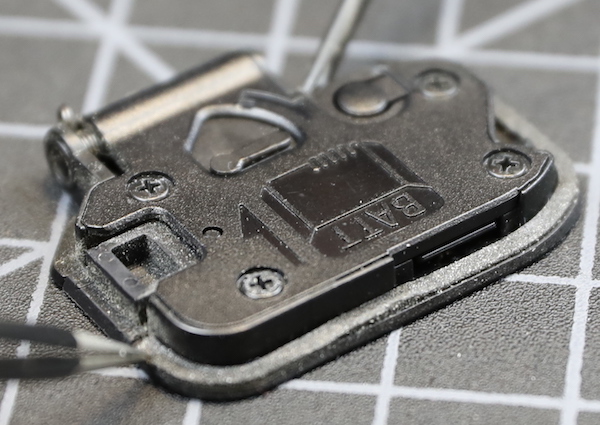
Next, we took off the battery door. This is an easy water access because the foam seal doesn’t go all the way around the door (it stops where the forceps are pointing). There’s no obvious corrosion here although one screw does look corroded and the stripping itself looks dingy.
Removing the bottom plate, though, shows that this camera definitely got salt water inside. The white stuff is actual salt residue. If a new tech has a question about whether it’s salt, we tell them to taste it. (An experienced tech can taste it and tell which coast the water was from.)
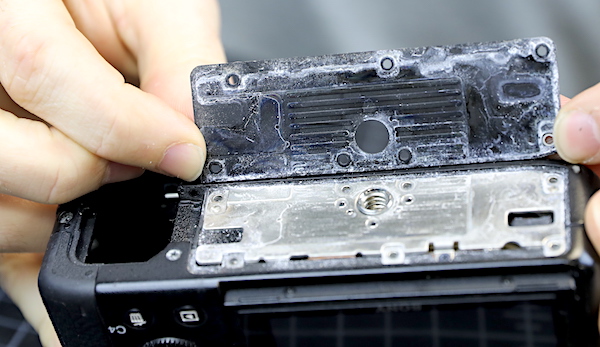
By this point we’ve pretty much ruled out the ‘camera coincidently died’ theory and have pretty well confirmed ‘got splashed with salt water and the outside was wiped down carefully’ theory. It’s probably no coincidence that the two corroded screws and the leaky (by design, not by a defect) battery door are right in this area.
But we also know that the viewfinder had no salt in it so we had some hope that camera might not be a total loss. You know hope? That happy sensation that life crushes out of you? So we continued the disassembly to see how bad things were.
Taking that metal base plate out to see the inside made us feel worse. The salt was literally caked inside.
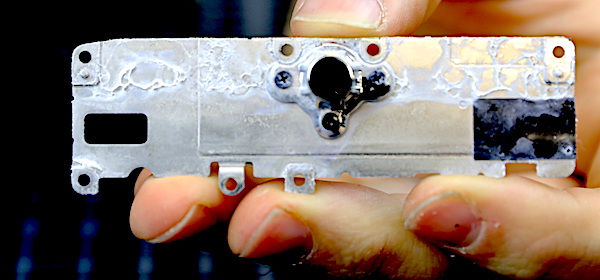
Up until now, there was just salt on body parts. That could be cleaned, and anti-corrosion treatment applied. But this ‘weather resistant’ camera has absolutely no weather resistance on the bottom. With that metal plate out you can see there’s a nice clear path up inside to all the important parts. The metal plates you see are the camera’s sensor and the IBIS system. So that hope we had, well, the reality is a 6 point favorite over hope.
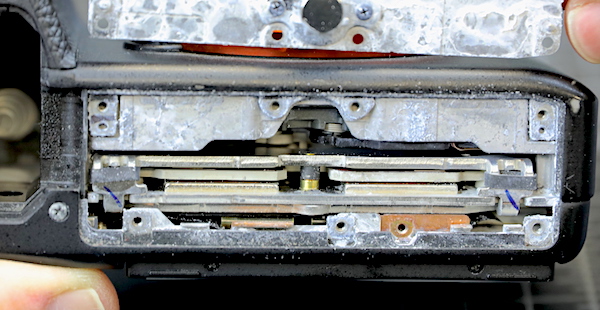
The next step is to remove the camera back and to do that we first have to take the LCD off.

There’s more salt caked around the base of the LCD hinges.
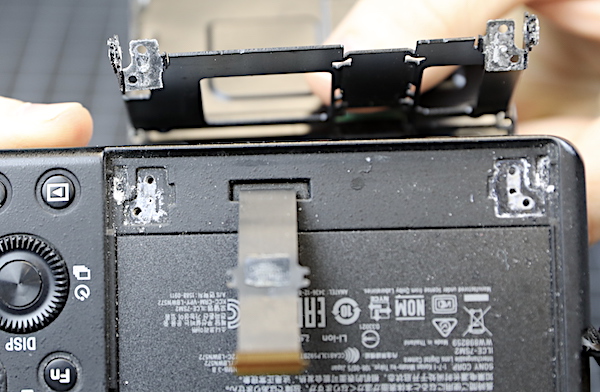
The next step was to remove the back of the camera.
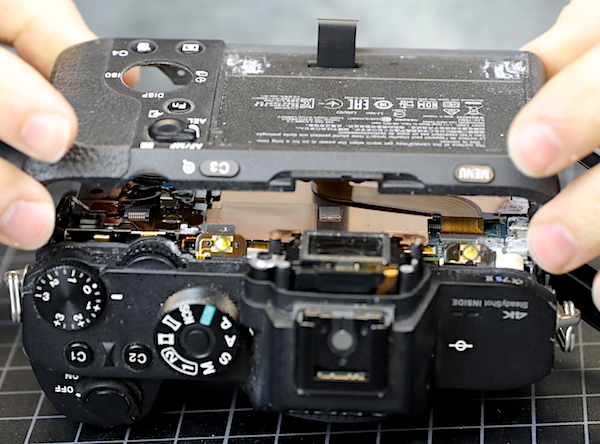
This finished crushing the last of our hopes and dreams that this camera might be salvageable.
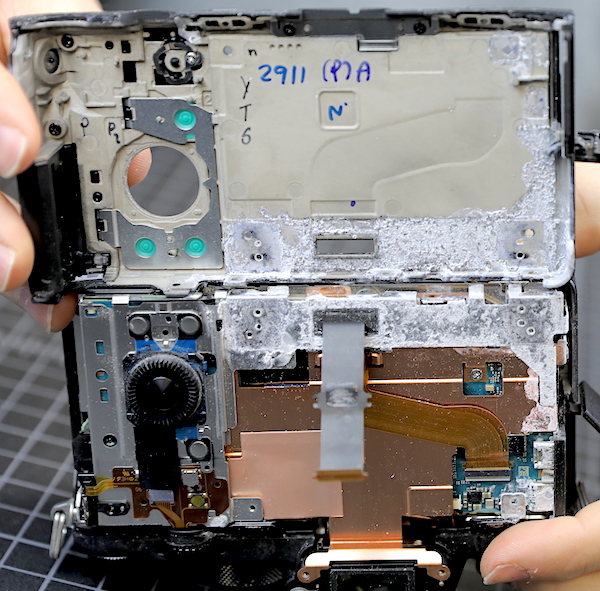
Yep, that’s salt caked inside the back along the bottom of the camera, and along the side where the ports are. At the bottom right, just above Aaron’s finger, you can see the HDMI and multiports as they insert into the main PCB. They’re both covered in salt and corrosion, so at the least, the main board has to be replaced.
But the amount of salt and corrosion here and on the bottom means we wouldn’t trust anything in this camera, ever again. It can’t even be a parts donor — the chance that those parts will eventually corrode and fail is too high. That’s why many service centers won’t repair water damaged cameras; they have to give a warranty after the repair and chances are very high something they didn’t replace is going to fail during the warranty period.
Just to complete the exercise lets see what the rest of the insides look like. The aluminum plate comes off next. You can’t tell from the picture, but there’s been enough corrosion that the metal surface is pitted, that’s not just salt you see in this picture.
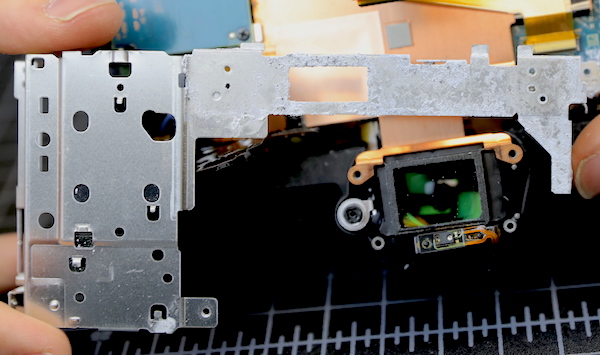
Likewise, the copper plate underneath, even though it didn’t get nearly as soaked, is already pitted and discolored. Saltwater just eats up copper.
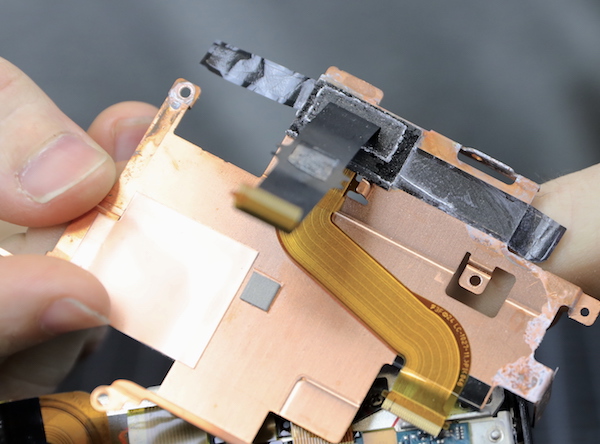
The SD card assembly gets removed next, and it, too, has enough corrosion that it would require replacement.
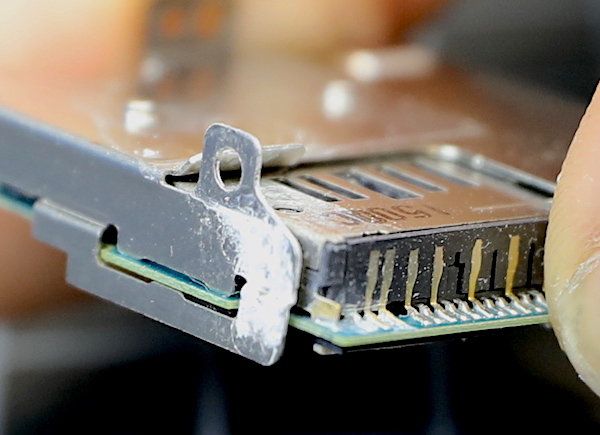
With the covers off we can look at the damage on the board a little better.
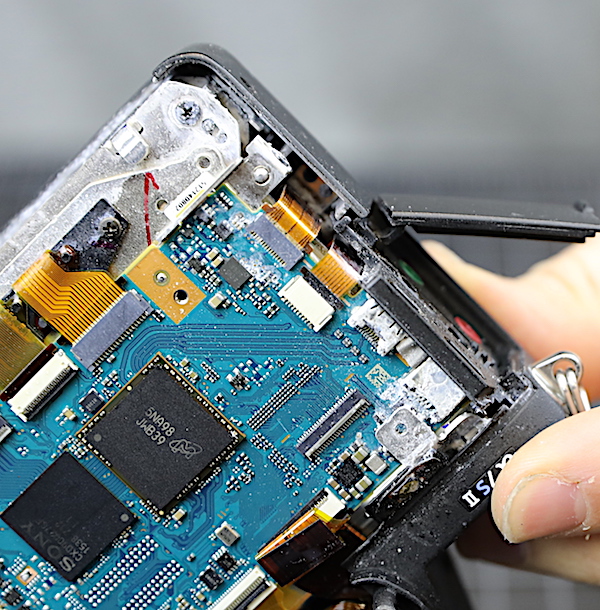
Looking a little closer shows that the actual pins and traces around the ports are dissolving.
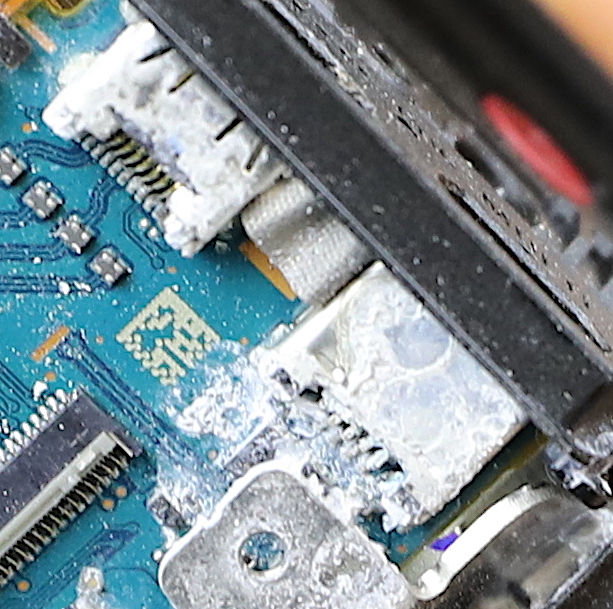
And on another area of the board, the traces and pins are nearly as bad.
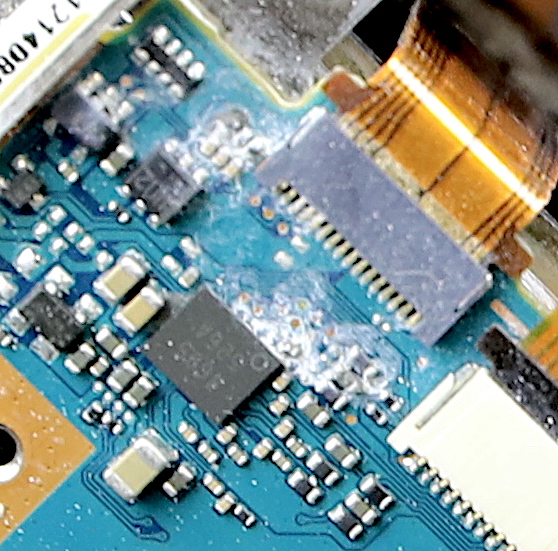
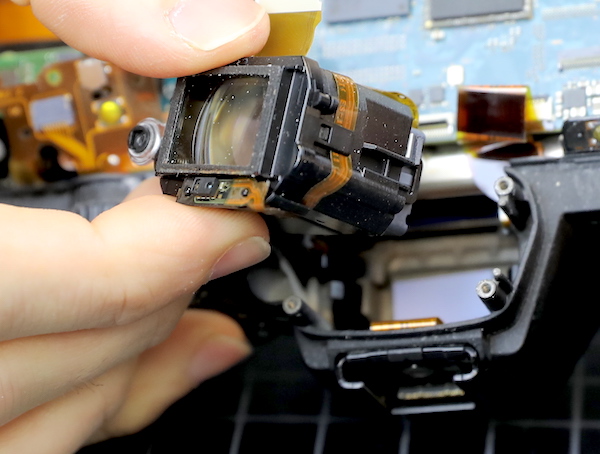
Even though we hadn’t seen any apparent corrosion around the viewfinder we took it out just to make sure there was none on the inside; there wasn’t.
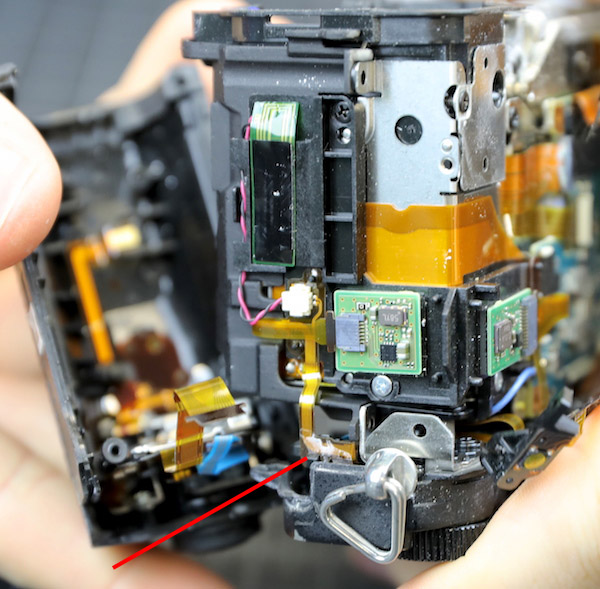
We took off the grip to assess the battery box. While the box was fine we saw another leak in a poorly sealed area – the camera strap lugs don’t have a seal and some water had obviously leaked in there (red arrow).
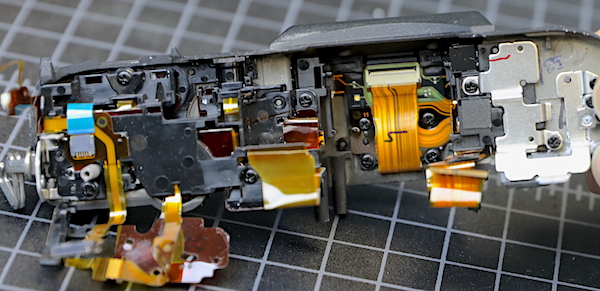
The top assembly came off next, and at first glance, it all seemed OK.
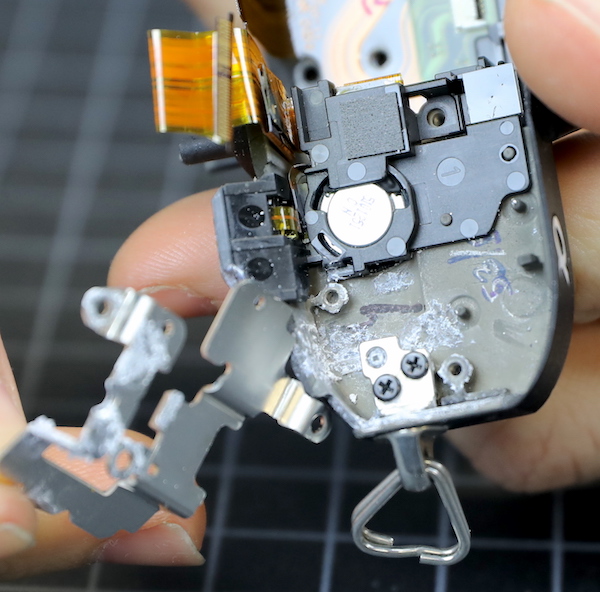
However, when we took off the metal plate to the right, we found more salt and corrosion underneath it.
Not that it matters, but the bottom of the PCB seems to have remained dry.
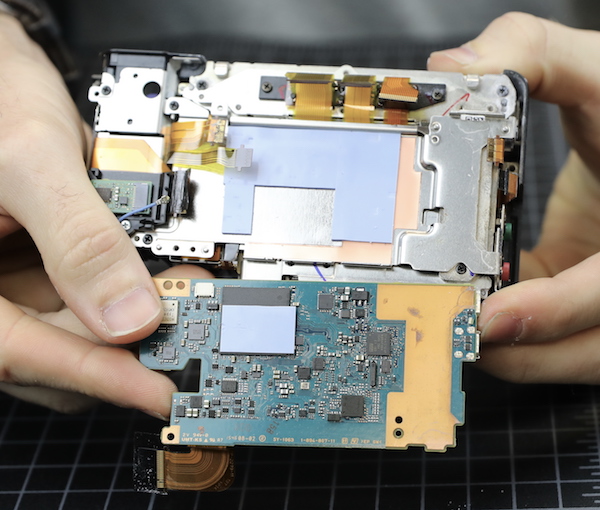
Removing the next layer of shielding lets us look at the in-body stabilizer (thick aluminum pieces) and the circuit board behind the sensor. There’s a little salt tracking along the right edge and some corrosion of the screw in the upper right (in the picture). The marks are from the assembly; I’m not trying to draw your attention to anything.
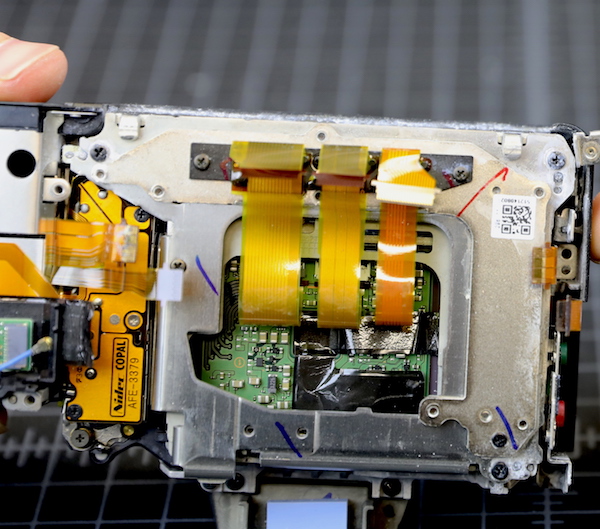
The corroded screw, along with a few others, holds the IBIS in place to the camera chassis.
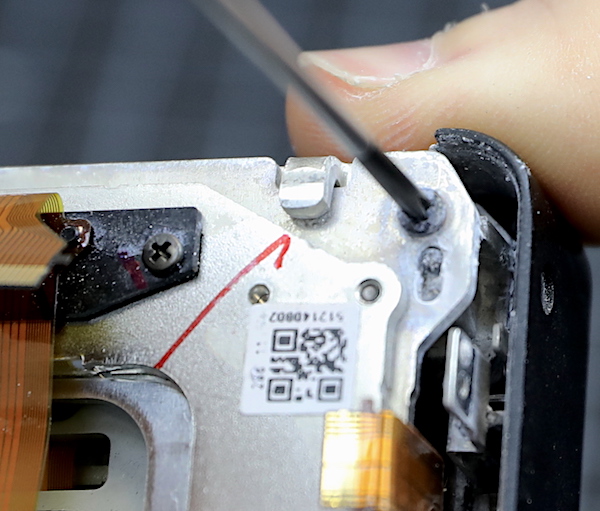
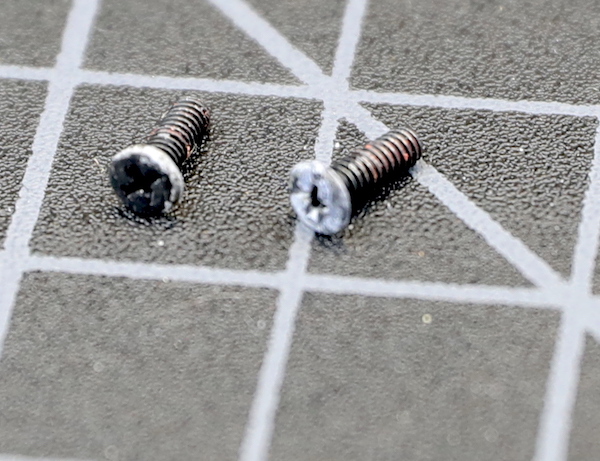
After removing them it became apparent that even screws that looked OK on the surface had some corrosion along the head.
The sensor itself seems fine, and the film of salt in the two corners of the IBIS doesn’t seem too bad to look at.
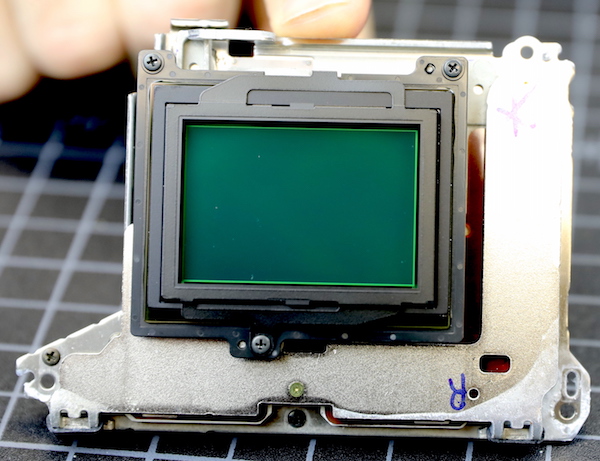
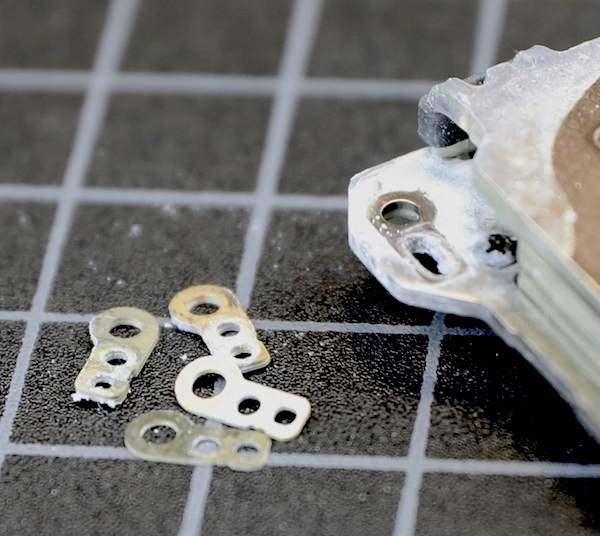
But salt water tends to wick into the areas where it can do the most damage. The sensor / IBIS assembly has to be shimmed to the chassis to keep it appropriately aligned to the lens mount; a tilt of 10 microns might be noticeable. The shims and shim mounts had soaked up salt water to the point they were fusing together; we had to pry the shims off.
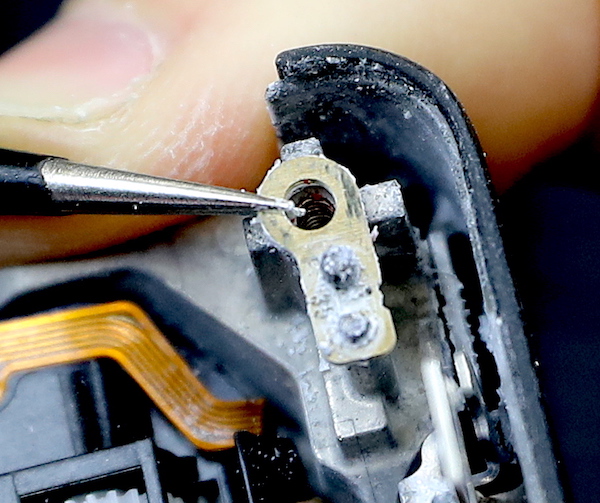
After removal, it becomes evident that the shims and mount areas were much more affected than the film of salt on the back of the sensor assembly suggested.
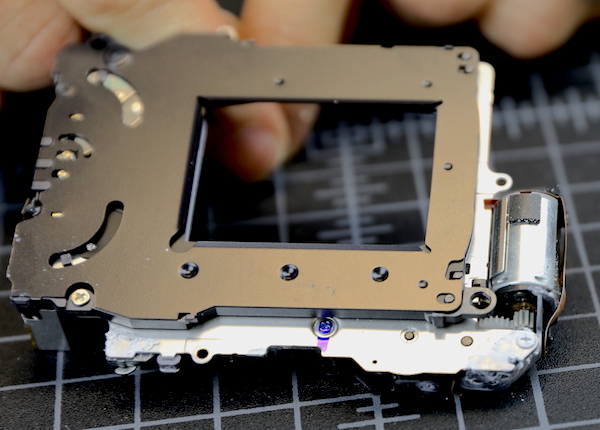
The last piece out was the shutter assembly. We had assumed it would be protected, but nope. You can barely see it because I overexposed the picture, but there’s salt over by the motor and gears of the shutter assembly, too.
So, a Little Detective Work
This camera here was never fully submerged in water; the sensor chamber and viewfinder were clean. The reality is, the entire top assembly was clean except for the edges where water leaked in from the strap lugs or ports. But the bottom and port side was pretty saturated. So the likely scenario was taking pictures near the surf and water splashed up from below and probably behind. Looking at the salt stains on the chassis supports that idea; the bottom and edges are saturated. The edge stains go higher than the lens mount, there would have been marks in the sensor chamber if the camera had sat in water that deep.
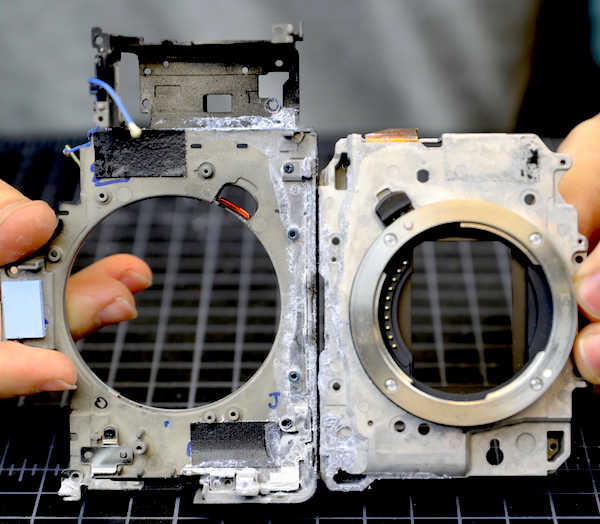
So What Did We Learn Today?
Salt water is really, really bad for cameras. Even in small quantities. Really. Bad.
If this had been fresh water there’s a chance the camera would have survived. Saltwater, no way.
Trusting ‘weather resistance’ is risky business.
They all say they have it. But none of them define what it is or how much they have. This camera had easy water access from the battery door, the entire bottom, and around the camera strap lugs that we showed you. It also has two rotating dials that you can pour water through, but this splash didn’t hit those. The viewfinder and hot shoe are a bit leaky, too.
Wiping the camera off carefully and saying it never got sprayed with water isn’t very efficient at anything other than establishing your level of trustworthiness.
And just before it starts, we don’t discuss interactions with individual customers.
While I rarely defend the service center, there are good reasons why they won’t touch your water damaged camera.
On the front end, this didn’t look that bad. But repair would have been impossible. You’d have replaced the entire camera except for the viewfinder. Even when it’s less severe, you can never be sure what part has just enough corrosion to fail in another month or two. (That’s why we won’t reuse the viewfinder even though it seems fine.) As an aside, one of the reasons we’re so vigilant about corrosion is we have seen a lot of cameras that got splashed and seemed fine fail two or six weeks later.
The beach is the sworn enemy of your gear. If the salt-spray doesn’t get you, the sand will. When you go into hostile territory, take appropriate precautions. And yes, Johnny, I know you spend every weekend photographing on the beach and nothing bad has ever happened to your camera. Yet.
Roger Cicala and Aaron Closz
Lensrentals.com
October, 2017
220 Comments
Arthur Meursault ·
My doctor has me on a low salt diet. It prevents these kinds of things.
Arthur Meursault ·
Another clear case in point on how salt causes one's blood pressure to rise. Nice work Roger.
obican ·
Roger Cicala (from Lensrentals) says A7SII is being rented more than all Nikon cameras combined because it has an EVF that is completely saltproof.
Dymo Lai ·
My e-m5 Ii and 12-40 seems to have better weather resistance. They are soaked with ice and rain in Yosemite last year and still survived.
Joey Miller ·
To be fair, ice and rain still isn’t salt water, though.
Turniphead ·
…indeed and the plural of anecdote isn’t data 😉
Joey Miller ·
To be fair, ice and rain still isn't salt water, though.
Turniphead ·
...indeed and the plural of anecdote isn't data ;)
harvey ·
my em5.2 has gone back to Olympus because it died in a high humidity environment. Came back and it still does it.
Impulse_Vigil ·
What’s a high humidity environment? Mine lives year long in PR’s 90% humidity but I do try to store it with desiccants etc. Going on two years now with it…
I haven’t taken out my much older GF6 lately to see how it’s doing, that one’s actually been near the sea mist despite the lack of sealing, now I’m curious whether it’s given up the ghost.
Impulse_Vigil ·
What's a high humidity environment? Mine lives year long in PR's 90% humidity but I do try to store it with desiccants etc. Going on two years now with it...
I haven't taken out my much older GF6 lately to see how it's doing, that one's actually been near the sea mist despite the lack of sealing, now I'm curious whether it's given up the ghost.
Andre Yew ·
Wow, sorry about the dead camera and the deadbeat customer!
How long ago do you think this camera was exposed to salt water? That level of corrosion seems pretty bad.
Carleton Foxx ·
Agreed. I think that Det. Roger needs to do a little more digging in the records. I’ve destroyed a lot of stuff with salt water and it seems like it would take more than a 1-week rental to get to that level of corrosion.
Roger Cicala ·
I’m pretty sure that was one splash, but the camera didn’t get taken apart for at least 2 weeks after the splash so lots of time for that to corrode.
Rodrigo Andrade ·
I am also not convinced by the splash scenario, too much salt. I once did run a sort of control experiment, I fell on a bonefish flat with a nexus 5 phone on my shirt pocket. The Nexus 5 is (was) not weather sealed and It was throroughly soaked. It additionally remained in my soaked shirt pocket for an additional 10-15 minutes until I remembered it was there and dried it. So I interpret this to be a “splash” worse case scenario. However when I disassembled the phone, the corrosion was restricted to the proximal edges of the case with little wicking further inside. Given this experience, the damage you found suggest to me a more sustained sitting in saltwater rather than a brief splash. But of course there is the issue of time to cleanup, which we cannot control for. Perhaps next time you have a dead body you can run some controlled tests. Thanks for the article.
Tord55 ·
A phone has very little air volume inside, a camera a lot more, especially if a big lens is attached. If the air is colder than the camera, the sudden immersion will lower the air pressure inside a lot, resulting in air and water will be sucked into the camera, as no camera is airtight and watertight to 100% (or you would not need silica gel packs inside the camera UW house, which even professional UW houses need).
To me, a mere amateur, the scenario, must have been either a leaking uQ hose, or someone parked the camera in a puddle of salt water for a while, say used on the deck of a boat and a wave splashes over it and the surrounding area, and it takes a few seconds before anyone notices.
The splash cools the camera, naturally, and the water is sucked up, as simple as that.
Larrry ·
That was my thought as I read this, particularly if the prior rentals were in a coastal area. Reminded me of a personal experience where I rented a diesel truck from UHaul. A few days later they called me about the gas I put in it that destroyed the engine stranding the renter after me. I pointed out to them to check the recorded in/out odometer readings. It showed I put around 10 miles that didn’t budge the fuel guage and didn’t have to put any fuel in it. They hung up when they saw that.
Andre Yew ·
Wow, sorry about the dead camera and the deadbeat customer!
How long ago do you think this camera was exposed to salt water? That level of corrosion seems pretty bad.
Carleton Foxx ·
Agreed. I think that Det. Roger needs to do a little more digging in the records. I've destroyed a lot of stuff with salt water and it seems like it would take more than a 1-week rental to get to that level of corrosion.
Roger Cicala ·
I'm pretty sure that was one splash, but the camera didn't get taken apart for at least 2 weeks after the splash so lots of time for that to corrode.
Rodrigo Andrade ·
I am also not convinced by the splash scenario, too much salt. I once did run a sort of control experiment, I fell on a bonefish flat with a nexus 5 phone on my shirt pocket. The Nexus 5 is (was) not weather sealed and It was throroughly soaked. It additionally remained in my soaked shirt pocket for an additional 10-15 minutes until I remembered it was there and dried it. So I interpret this to be a "splash" worse case scenario. However when I disassembled the phone, the corrosion was restricted to the proximal edges of the case with little wicking further inside. Given this experience, the damage you found suggest to me a more sustained sitting in saltwater rather than a brief splash. But of course there is the issue of time to cleanup, which we cannot control for. Perhaps next time you have a dead body you can run some controlled tests. Thanks for the article.
Tord55 ·
A phone has very little air volume inside, a camera a lot more, especially if a big lens is attached. If the air is colder than the camera, the sudden immersion will lower the air pressure inside a lot, resulting in air and water will be sucked into the camera, as no camera is airtight and watertight to 100% (or you would not need silica gel packs inside the camera UW house, which even professional UW houses need).
To me, a mere amateur, the scenario, must have been either a leaking uQ hose, or someone parked the camera in a puddle of salt water for a while, say used on the deck of a boat and a wave splashes over it and the surrounding area, and it takes a few seconds before anyone notices.
The splash cools the camera, naturally, and the water is sucked up, as simple as that.
Larrry ·
That was my thought as I read this, particularly if the prior rentals were in a coastal area. Reminded me of a personal experience where I rented a diesel truck from UHaul. A few days later they called me about the gas I put in it that destroyed the engine stranding the renter after me. I pointed out to them to check the recorded in/out odometer readings. It showed I put around 10 miles that didn't budge the fuel guage and didn't have to put any fuel in it. They hung up when they saw that.
Carleton Foxx ·
Amateurs! Just boil it! That’s what they would do at the famous Nikon repair center in Taiwan.
https://nikonrumors.com/2013/03/17/nikon-repair-center-saves-a-lens-damaged-by-salt-water-by-boiling-it.aspx/
Carleton Foxx ·
Amateurs! Just boil it! That's what they would do at the famous Nikon repair center in Taiwan.
https://nikonrumors.com/201...
Adam ·
And thus was born the LensRentals after-market water sealing conversion service. For a mere $2000….
Adam ·
And thus was born the LensRentals after-market water sealing conversion service. For a mere $2000....
Romano ·
So, this is why even the “tough” Olympus camera my daughter owned said clearly in the manual that to maintain the warranty you have to soak it in fresh water for 10 minutes after using it in the sea…
Nice graphic explanation, thanks
Dean Cho ·
Olympus Tough cameras are great. I have two TG-5 and have snorkeled with them in saltwater. If you rinse them in a sink and then soak them in a pot of freshwater after, they are fine. But there is one screw (of three) under the removable lens ring that tends to get a bit of corrosion. Just take a Qtip with a little anti-corrosion wax (like Froglube) and wipe it down.
Romano ·
So, this is why even the "tough" Olympus camera my daughter owned said clearly in the manual that to maintain the warranty you have to soak it in fresh water for 10 minutes after using it in the sea...
Nice graphic explanation, thanks
Turniphead ·
My s/o’s colleague dropped her iPhone in the toilet, and then proceeded to try and dry it by sticking it in a bag full of salt. *eek* As soon as I heard the word salt, I said, well she can kiss that goodbye. I was right, it never worked again!
Devil's Advocate ·
She was right as long as the salt didn’t absorb so much water it dissolved itself and then got into the phone. I’m pretty sure the phone was dead without the bag of salt. Most people would use a bag of rice instead of salt these days which seems to work in some circumstances.
Turniphead ·
My s/o's colleague dropped her iPhone in the toilet, and then proceeded to try and dry it by sticking it in a bag full of salt. *eek* As soon as I heard the word salt, I said, well she can kiss that goodbye. I was right, it never worked again!
Devil's Advocate ·
She was right as long as the salt didn't absorb so much water it dissolved itself and then got into the phone. I'm pretty sure the phone was dead without the bag of salt. Most people would use a bag of rice instead of salt these days which seems to work in some circumstances.
Ally Aycock ·
This was maybe your most suspenseful post yet, Roger.
Ally Aycock Patterson ·
This was maybe your most suspenseful post yet, Roger.
David Bateman ·
The wicking an damage your seeing to me imply that the camera may not have been splashed, but rather placed down in a small puddle of salt water on a railing or table. So small the photographer may not have even noticed in the excitement of the photo shoot.
I have heard similar story, of photographers bracing a pro Nikon or Canon on a boat railing, not noticing a small puddle or pool of salt water. Then latter the camera dies and they are confused.
This came up in a comparison to an Olympus E3 on a trip.
David Bateman ·
The wicking an damage your seeing to me imply that the camera may not have been splashed, but rather placed down in a small puddle of salt water on a railing or table. So small the photographer may not have even noticed in the excitement of the photo shoot.
I have heard similar story, of photographers bracing a pro Nikon or Canon on a boat railing, not noticing a small puddle or pool of salt water. Then latter the camera dies and they are confused.
This came up in a comparison to an Olympus E3 on a trip.
TinusVerdino ·
Some people just do not know what weather resistance means. It is not the same as water proof. And then they get angry at the brand for disappointing their unrealistic expectations and turn into avid brand trolls sharing the b’hurt experience with customer service that told them the damage is not covered under warranty.
TinusVerdino ·
Some people just do not know what weather resistance means. It is not the same as water proof. And then they get angry at the brand for disappointing their unrealistic expectations and turn into avid brand trolls sharing the b'hurt experience with customer service that told them the damage is not covered under warranty.
Pete Atkinson ·
If an underwater housing leaked it’s likely that most divers would surface holding the housing by the right handle, thus soaking the port side of the camera more than starboard… Might be worth checking the client’s FB feed for underwater photos.
Ales Berka ·
The underwater housing for such camera costs about the same as the camera (almost), it doesn’t make sense to me somebody would rent the camera, but had the housing. Or is there a housing rental anywhere too?
Darryl Johnston ·
Hi Pete
Still in Phuket?
Darryl
Pete Atkinson ·
If an underwater housing leaked it's likely that most divers would surface holding the housing by the right handle, thus soaking the port side of the camera more than starboard... Might be worth checking the client's FB feed for underwater photos.
Ales Berka ·
The underwater housing for such camera costs about the same as the camera (almost), it doesn't make sense to me somebody would rent the camera, but had the housing. Or is there a housing rental anywhere too?
Darryl Johnston ·
Hi Pete
Still in Phuket?
Darryl
ohbohb ·
Roger, can you outline what “appropriate precautions” would be in this case (except from not bringing your camera there)?
Roger Cicala ·
Personally, I use a lot of plastic bags and rubber bands. In a rain storm I look like an old-fashioned large format shooter with a focusing hood – my heads in the plastic bag with the camera.
Claudia Muster ·
Be careful with sticking your head in a plastic bag, though.
Mike Earussi ·
I find this works pretty well for most circumstances:
https://www.bhphotovideo.com/bnh/controller/home?A=details&O=&Q=&ap=y&c3api=1876%2C%7Bcreative%7D%2C%7Bkeyword%7D&gclid=Cj0KCQiA84rQBRDCARIsAPO8RFx2DJXAnGlE293BlpBwoAS7kH0veLAqZ9T566XyvH6RK8pxN5-YHgYaAkyCEALw_wcB&is=REG&m=Y&sku=1049380
You might consider renting them just in self-defense.
Howard Tyree ·
The same here. Even though i use a water resistant camera I’ve have always used a plastic bag or shield on my cameras in the rain.
ohbohb ·
Roger, can you outline what "appropriate precautions" would be in this case (except from not bringing your camera there)?
Roger Cicala ·
Personally, I use a lot of plastic bags and rubber bands. In a rain storm I look like an old-fashioned large format shooter with a focusing hood - my heads in the plastic bag with the camera.
Mike Earussi ·
I find this works pretty well for most circumstances:
https://www.bhphotovideo.co...
You might consider renting them just in self-defense.
Howard Tyree ·
The same here. Even though i use a water resistant camera I've have always used a plastic bag or shield on my cameras in the rain.
Stanislaw Zolczynski ·
Gee, my old Nikonos camera brings a tear to me eye. Two O-rings, one for the lens mount another for the body and you were 105% safe. Why they don`t make stuff like that any more.
Fil ·
Nikonos III, 13 o-rings total. But only two you mention were user-serviceable(unless one knew how to reach the other).
But true, I wish the manufacturers would stick to the standards of those days, plus the mandatory pressure tests of 150% over recommended / rated maximum depths.
I won’t even go into sheer production sloppines in the manufacturing of today’s seals and sealing surfaces.
Fil ·
Nikonos III, 13 o-rings total. But only two you mention were user-serviceable(unless one knew how to reach the other).
But true, I wish the manufacturers would stick to the standards of those days, plus the mandatory pressure tests of 150% over recommended / rated maximum depths.
I won't even go into sheer production sloppines in the manufacturing of today's seals and sealing surfaces.
Hrunga Zmuda ·
That was a big mistake for Nikon to cancel that line of cameras. I was about to buy one and a few lenses when they dropped the axe. If they had just discontinued it to bring out a digital version, that would be awesome.
Still waiting…
Hrunga Zmuda ·
That was a big mistake for Nikon to cancel that line of cameras. I was about to buy one and a few lenses when they dropped the axe. If they had just discontinued it to bring out a digital version, that would be awesome.
Still waiting...
Jeffrey Reed ·
Would either Lenscap or LenscapPlus have covered what seems like inadvertent damage?
Roger Cicala ·
From the Lenscap FAQs: “Please note, in all cases (except when renting gear clearly labeled for use underwater), we consider water or sand damage to be negligence.”
Eloise ·
What about if a bear attacked a rental causing it to get wet? 🙂
Roger Cicala ·
From the Lenscap FAQs: "Please note, in all cases (except when renting gear clearly labeled for use underwater), we consider water or sand damage to be negligence."
Eloise ·
What about if a bear attacked a rental causing it to get wet? :-)
mijami ·
When my weather resistant D200 was quite new I took it out on a ferry in Brisbane, Australia. Sitting up front to get some good snaps, an unexpected wave splashed over the front of the ferry, significantly wetting the camera. I was devastated but wiped it down and sponged it with tap water when I got home. Years later and it has never missed a beat. The salinity at that location is about 2/3 seawater so I was lucky.
CG462 ·
So which ILC cameras have the best weather resistance?
Roger Cicala ·
I cannot say first-hand, I’ve never tested it. The general consensus is Pentax. I can say that I’ve written off some of every brand from salt-water damage, though, including Pentax.
Roger Cicala ·
I cannot say first-hand, I've never tested it. The general consensus is Pentax. I can say that I've written off some of every brand from salt-water damage, though, including Pentax.
Panacea ·
I hope you aren’t serious about having the techs taste the “salt”. That’s a mix of ocean salts and metal oxides (from its corrosion), most notably magnesium/aluminum oxides from the body and heatsinks, and probably some lead oxide from the solder traces. I don’t believe Japanese electronics Mfgs. have gone lead-free yet.
Roger Cicala ·
Sigh. No, of course not.
Barbu Mateescu ·
Royal water is a bit tastier than acetic acid.
(unbelievable to live in a world where even the jokes need to be signaled…)
Panacea ·
The seemingly ridiculous is only so if you haven’t seen it before. And of course the most-parochial minds find it easiest to judge what is and isn’t “common sense” relative to their narrow experiences.
Hell, when I was in school there existed chemistry professors who still mouth-pipetted toxic (read: most) reagents. Yes, the die-hard old-schooler had to receive special permission from the Dept. to do so. Smelling chemicals (“wafting”) is still a valid technique in some parts.
Roger Cicala ·
My background is medical, we have a lot of gross ‘tasting’ jokes. My favorite is that during a lab on urinalysis the professor says “I’m going to demonstrate the importance of using your own senses”, dips his finger in the urine, licks his finger, and says “Ah, the sugary taste that happens with diabetes”. Then instructs each student to taste for themselves. The professor then says “If you’d used your own senses, you would have observed that I dipped my middle finger in the urine, and licked my index finger.” Urban legend of course.
Barbu Mateescu ·
Royal water is a bit tastier than acetic acid.
(unbelievable to live in a world where even the jokes need to be signaled...)
Panacea ·
The seemingly ridiculous is only so if you haven't seen it before. And of course the most-parochial minds find it easiest to judge what is and isn't "common sense" relative to their narrow experiences.
Hell, when I was in school there existed chemistry professors who still mouth-pipetted toxic (read: most) reagents. Yes, the die-hard old-schooler had to receive special permission from the Dept. to do so. Smelling chemicals ("wafting") is still a valid technique in some parts.
Roger Cicala ·
My background is medical, we have a lot of gross 'tastes like' jokes. My favorite is that during a lab on urinalysis the professor says "I'm going to demonstrate the importance of using your own senses", dips his finger in the urine, licks his finger, and says "Ah, the sugary taste that happens with diabetes". Then instructs each student to taste for themselves. The professor then says "If you'd used your own senses, you would have observed that I dipped my middle finger in the urine, and licked my index finger." Urban legend of course.
Clayton Taylor ·
BUT….if you did, I bet they would report that Gulf Coast salt tastes like crude oil, CA Pacific salt like sunblock, FL salt has a slight hint of cannabis, and Long Island Sound salt tastes like, well, s**t.
Confused in Montara ·
Well, *southern California* water tastes like sunblock. Northern California water might taste a little of neoprene.
Clayton Taylor ·
BUT....if you did, I bet they would report that Gulf Coast salt tastes like crude oil, CA Pacific salt like sunblock, FL salt has a slight hint of cannabis, and Long Island Sound salt tastes like, well, s**t.
Kai Harrekilde-Petersen ·
Everyone has gone lead-free for several years now, even the Class-III medical devices,
All thanks to RoHS (and REACH) compliance.
Panacea ·
I hope you aren't serious about having the techs taste the "salt". That's a mix of ocean salts and metal oxides (from its corrosion), most notably magnesium/aluminum oxides from the body and heatsinks, and probably some lead oxide from the solder traces. I don't believe Japanese electronics Mfgs. have gone lead-free yet.
Kai Harrekilde-Petersen ·
Everyone has gone lead-free for several years now, even the Class-III medical devices,
All thanks to RoHS (and REACH) compliance.
Andrew Dodd ·
So how much are you selling this unassembled pile of wall ornaments for? 😉
No need for even an ESD bag, just a plain ziploc is fine, the ornaments are already NFG. 🙂
Roger Cicala ·
Sorry, I already trashed everything but the viewfinder rubber and the battery door. 🙂
Andrew Dodd ·
So how much are you selling this unassembled pile of wall ornaments for? ;)
No need for even an ESD bag, just a plain ziploc is fine, the ornaments are already NFG. :)
Roger Cicala ·
Sorry, I already trashed everything but the viewfinder rubber and the battery door. :-)
md23 ·
Re service centers playing the water damage card… absolutely. Nikon Canada once cheated me out of a warranty repair for a misfiring hot-shoe, claiming that it had suffered moisture damage. The camera was less than one month old and had never been even close to water. “Maybe your bag is not ventilated enough” was the best response the rep could muster. (The camera has since been close to water plenty of times, and has even suffered a splash of saltwater that doesn’t seem to have left any permanent damage, not even to the hot-shoe).
md23 ·
Re service centers playing the water damage card... absolutely. Nikon Canada once cheated me out of a warranty repair for a misfiring hot-shoe, claiming that it had suffered moisture damage. The camera was less than one month old and had never been even close to water. "Maybe your bag is not ventilated enough" was the best response the rep could muster. (The camera has since been close to water plenty of times, and has even suffered a splash of saltwater that doesn't seem to have left any permanent damage, not even to the hot-shoe).
Eli Rosenberg ·
Hi Roger. In regards to the mount shims — do you regularly have to realign the mount and sensor on your [non soaked] rentals? Do impacts and drops cause the aforementioned 10+ micron mis-alignments?
Roger Cicala ·
Eli, we do not. Unless the sensor or lens mount is replaced it is not necessary. Realigning an AF sensor in a mirrored SLR is required sometimes, but it has to be done at an authorized service center. It requires computer programs we don’t have access too.
Eli Rosenberg ·
Hi Roger. In regards to the mount shims -- do you regularly have to realign the mount and sensor on your [non soaked] rentals? Do impacts and drops cause the aforementioned 10+ micron mis-alignments?
Roger Cicala ·
Eli, we do not. Unless the sensor or lens mount is replaced it is not necessary. Realigning an AF sensor in a mirrored SLR is required sometimes, but it has to be done at an authorized service center. It requires computer programs we don't have access too.
Astro Landscapes ·
“There are all kinds of badness in this one post.”
Stay cynical, Roger. You make my day.
Astro Landscapes ·
"There are all kinds of badness in this one post."
Stay cynical, Roger. You make my day.
Astro Landscapes ·
…Meanwhile, when an Olympus user gets salt water on their camera… https://uploads.disquscdn.com/images/bf3fe79eb120030056b569dbab608e02b63a9a7bd5623a0663aa83b9c17b0770.jpg
Astro Landscapes ·
But, seriously folks, yes, salt water is CAMERA CANCER. Stay away from it. Do not set your camera down on boat railings, or near tide pools. Especially when it’s getting older and all those little rubber ports on the side / bottom aren’t doing their job as well. And if your camera does get splashed, yank the battery and wipe it down with a damp (fresh water, not salt water, duh) cloth immediately.
…and if your rental camera is truly damaged, don’t be an ass, fess up to it. They’ll know it was you!
Zen ·
https://www.youtube.com/watch?v=A7hvJTGW4BA
Astro Landscapes ·
yeah, I’m sure that camera was non-operational within a few months LOL. Among non-CaNikon brands, the Olympus and Pentax weatherproofing is legendary, and many would argue even better than most CaNikons that claim to be weather sealed.
Meanwhile, I’ve lost count of how many Sony’s I’ve heard tales of dying in the wilderness under only moderately tough conditions. I wouldn’t take my chances…
Astro Landscapes ·
...Meanwhile, when an Olympus user gets salt water on their camera... https://uploads.disquscdn.c...
Astro Landscapes ·
But, seriously folks, yes, salt water is CAMERA CANCER. Stay away from it. Do not set your camera down on boat railings, or near tide pools. Especially when it's getting older and all those little rubber ports on the side / bottom aren't doing their job as well. And if your camera does get splashed, yank the battery and wipe it down with a damp (fresh water, not salt water, duh) cloth immediately.
...and if your rental camera is truly damaged, don't be an ass, fess up to it. They'll know it was you!
Zen ·
https://www.youtube.com/wat...
Astro Landscapes ·
yeah, I'm sure that camera was non-operational within a few months LOL. Among non-CaNikon brands, the Olympus and Pentax weatherproofing is legendary, and many would argue even better than most CaNikons that claim to be weather sealed.
Meanwhile, I've lost count of how many Sony's I've heard tales of dying in the wilderness under only moderately tough conditions. I wouldn't take my chances...
spider-mario ·
https://www.youtube.com/wat...
John Dillworth ·
Lets come at this from a different angle. Which high rental cameras have you NOT, seen water damage from? I have heard of people washing salt water off their Canon 1DX with a hose. How do the top of line Canons and Nikons hold up?
Roger Cicala ·
I don’t remember seeing a D5 or 1Dx with obvious salt-water damage, but we rent far fewer of those, and I expect the rentals tend to be to more experienced photographers.
EddieX ·
I can test that for you if you wish…
Roger Cicala ·
I don't remember seeing a D5 or 1Dx with obvious salt-water damage, but we rent far fewer of those, and I expect the rentals tend to be to more experienced photographers.
EddieX ·
I can test that for you if you wish...
disqus_mn1vCGF1To ·
My D810/16-35 was totally pummeled by a wave about 6 weeks ago (rogue ‘blowhole’ effect through the rocks, storm swell, knocked me over). Within 2mins I dumped a liter of fresh water on it (all I had), ran it under tap when I got home and later sealed body & lens into a pelican case with 2 big tubs of moisture absorber for 3 days. So far so good…. Funny this guy says they see cameras fail 2-6 weeks later. We shall see…
shonangreg ·
8 weeks after the saltwater exposure, how’s the D810/16-35 doing now?
Hrunga Zmuda ·
A friend was hit by a wave with her D810 and Sigma 35mm 1.4 Art lens.
Total loss. Repair shop wouldn’t touch it. Insurance paid for a D850 replacement, and she lucked into a store nearby having one in stock! The Sigma was toast.
disqus_mn1vCGF1To ·
Well to update, its been about a year and the camera/lens are mostly fine. I say mostly as the D810 can no longer control aperture on older manual aperture lenses. I’ve read the cameras have a dedicated circuit board just under the top of the lens mount for this. So that was damaged, but otherwise fine. Taking it to a repair shop on a trip in a couple weeks and see if they willing to repair…
disqus_mn1vCGF1To ·
My D810/16-35 was totally pummeled by a wave about 6 weeks ago (rogue 'blowhole' effect through the rocks, storm swell, knocked me over). Within 2mins I dumped a liter of fresh water on it (all I had), ran it under tap when I got home and later sealed body & lens into a pelican case with 2 big tubs of moisture absorber for 3 days. So far so good.... Funny this guy says they see cameras fail 2-6 weeks later. We shall see...
shonangreg 🅲🅰🆃🅰🅻🆈🆉🅴🆁 ·
8 weeks after the saltwater exposure, how's the D810/16-35 doing now?
Hrunga Zmuda ·
A friend was hit by a wave with her D810 and Sigma 35mm 1.4 Art lens.
Total loss. Repair shop wouldn't touch it. Insurance paid for a D850 replacement, and she lucked into a store nearby having one in stock! The Sigma was toast.
disqus_mn1vCGF1To ·
Well to update, its been about a year and the camera/lens are mostly fine. I say mostly as the D810 can no longer control aperture on older manual aperture lenses. I've read the cameras have a dedicated circuit board just under the top of the lens mount for this. So that was damaged, but otherwise fine. Taking it to a repair shop on a trip in a couple weeks and see if they willing to repair...
Scott Daniel ·
“You know hope? That happy sensation that life crushes out of you?” Favorite quote! Great knowledge and entertaining too!
Scott Daniel ·
"You know hope? That happy sensation that life crushes out of you?" Favorite quote! Great knowledge and entertaining too!
Chik Sum ·
that’s a sad ending for a camera! but roger, IF the user just get the salt water splash and send back to you guys acknowledge the problem, are there ways to save for at least some parts to be reusable or even can be repaired with reasonable cost? If so any suggestion on what to do if one have such mishaps to either rental or own cameras for that?
Roger Cicala ·
I think by the time a camera gets back to us, there’s no hope. I can’t say there’s hope in seconds. If it happened to me I would immediately turn the camera off, take out the battery, and rinse the area with fresh water. There are videos of, and people who say, dunk the whole camera in fresh water if the splash is bad. Then I’d leave every door and the battery compartment open, dry it thoroughly (probably surround it with silica packets, etc.).
Would that save the camera? Probably not, but it’s all I can think of. Fresh water, if it’s clean fresh water (rain or snow particularly) is often survivable. Salt water never is.
Roger Cicala ·
I think by the time a camera gets back to us, there’s no hope. I can’t say there’s hope in seconds. If it happened to me I would immediately turn the camera off, take out the battery, and rinse the area with fresh water. There are videos of, and people who say, dunk the whole camera in fresh water if the splash is bad. Then I’d leave every door and the battery compartment open, dry it thoroughly (probably surround it with silica packets, etc.).
Would that save the camera? Probably not, but it’s all I can think of. Fresh water, if it’s clean fresh water (rain or snow particularly) is often survivable. Salt water never is.
Achim Schäfer ·
In the mid 70s I was taken photos with my Canon FTb (water resistancy wasn’t “invented” yet 🙂 )when I stood near a fire hose that bursted… Both me and the FTb were wet all over… I just dryed first me and then the FTb – and everything was fine again. The cam worked up to 2005 when I sold it to a collector…
In 2000 I had a big mobile phone (a Siemens P1 digital cell phone, http://www.oebl.de/D-Netz/Geraete/Siemens/P1/P1.html) mounted in the second spare wheel well in the back of my car. In a heavy rain storm the seal of the luggage compartment lid couldn’t resist and the phone body stood in around half an inch of muddy water for some hours… The phone was a total loss – I even tried to clean the PCBs in an ultrasonic bath – corrosion had already done its work…
Conclusion: clear water isn’t your enemy – but muddy or salty water is one of the worst enemies you can think of!
YS ·
that's a sad ending for a camera! but roger, IF the user just get the salt water splash and send back to you guys acknowledge the problem, are there ways to save for at least some parts to be reusable or even can be repaired with reasonable cost? If so any suggestion on what to do if one have such mishaps to either rental or own cameras for that?
Roger Cicala ·
I think by the time a camera gets back to us, there’s no hope. I can’t say there’s hope in seconds. If it happened to me I would immediately turn the camera off, take out the battery, and rinse the area with fresh water. There are videos of, and people who say, dunk the whole camera in fresh water if the splash is bad. Then I’d leave every door and the battery compartment open, dry it thoroughly (probably surround it with silica packets, etc.).
Would that save the camera? Probably not, but it’s all I can think of. Fresh water, if it’s clean fresh water (rain or snow particularly) is often survivable. Salt water never is.
Achim Schäfer ·
In the mid 70s I was taken photos with my Canon FTb (water resistancy wasn't "invented" yet :) )when I stood near a fire hose that bursted... Both me and the FTb were wet all over... I just dryed first me and then the FTb - and everything was fine again. The cam worked up to 2005 when I sold it to a collector...
In 2000 I had a big mobile phone (a Siemens P1 digital cell phone, http://www.oebl.de/D-Netz/G... mounted in the second spare wheel well in the back of my car. In a heavy rain storm the seal of the luggage compartment lid couldn't resist and the phone body stood in around half an inch of muddy water for some hours... The phone was a total loss - I even tried to clean the PCBs in an ultrasonic bath - corrosion had already done its work...
Conclusion: clear water isn't your enemy - but muddy or salty water is one of the worst enemies you can think of!
Dakota Rakov ·
Are there any good ways to make the water resistance better on these cameras? Maybe some wax around things like buttons or battery door? The wheels on top seem pretty impossible. Is there nothing inside the housing where the wheel is?
Roger Cicala ·
The best way I know, and I shot in some ugly downpours, is to use plastic bags liberally. My opinion (and it’s just that) is weather resistance will keep drops of water out of most places, but soaking is going to break through eventually. If I was shooting near surf I would either use a camera I don’t mind writing off, or have it (and my hands) in a large plastic bag that covers everything but the filter on the front of the lens.
One other thing that is more about dust and sand, but also when there’s heavy salt mist in the air (you know, you can smell the salty sea smell) is don’t change lenses unless you have a lens change bag. Once that lens is of nothing is protected the slightest bit.
Roger Cicala ·
The best way I know, and I shot in some ugly downpours, is to use plastic bags liberally. My opinion (and it’s just that) is weather resistance will keep drops of water out of most places, but soaking is going to break through eventually. If I was shooting near surf I would either use a camera I don’t mind writing off, or have it (and my hands) in a large plastic bag that covers everything but the filter on the front of the lens.
One other thing that is more about dust and sand, but also when there’s heavy salt mist in the air (you know, you can smell the salty sea smell) is don’t change lenses unless you have a lens change bag. Once that lens is of nothing is protected the slightest bit.
Brian Frappier ·
I make up a ‘camera condom’ with saran wrap and tape every year for our local colour festival. People look at my like I am crazy, then I send them your colour race article.
Roger Cicala ·
The best way I know, and I shot in some ugly downpours, is to use plastic bags liberally. My opinion (and it’s just that) is weather resistance will keep drops of water out of most places, but soaking is going to break through eventually. If I was shooting near surf I would either use a camera I don’t mind writing off, or have it (and my hands) in a large plastic bag that covers everything but the filter on the front of the lens.
One other thing that is more about dust and sand, but also when there’s heavy salt mist in the air (you know, you can smell the salty sea smell) is don’t change lenses unless you have a lens change bag. Once that lens is of nothing is protected the slightest bit.
Brian Frappier ·
I make up a 'camera condom' with saran wrap and tape every year for our local colour festival. People look at my like I am crazy, then I send them your colour race article.
Fil ·
You can’t really w(e)at(h)erproof the camera itself if it wasn’t designed that way.
To be really safe, consider investing in an ewa-marine (or similar) sealed bag. This, so far, is the best, easily stowable protection.
Fil ·
You can't really w(e)at(h)erproof the camera itself if it wasn't designed that way.
To be really safe, consider investing in an ewa-marine (or similar) sealed bag. This, so far, is the best, easily stowable protection.
Giiba ·
Think that’s bad. You should see the inside of a camera after a soaking from orange jucie…
Chris Keats ·
rye and diet coke is worse, believe me. (take your pick, the soaking or the drink)
Giiba ·
Think that's bad. You should see the inside of a camera after a soaking from orange jucie...
Patrick Veitch ·
Hypothetical – if your camera gets saltwater on/in it, is it worth rinsing it in fresh water thoroughly and letting it dry carefully… or are you just wasting your time?
Roger Cicala ·
Patrick, this is speculation, so don’t take it as The Truth. But since it’s almost certainly going to be dead anyway, I don’t see what you have to lose, honestly.
James Sarrett ·
I have a friend who used to be a tech at Panavision. He said that their recommendation was to soak it in antifreeze (ethylene glycol), *BEFORE* it ever had the chance to dry out. Then send it to the shop still soaking so they could disassemble and clean every part. That’s probably more work than you’ll ever get for a hobbyist camera, but an irreplaceable film camera might be worth it. He told me this after my poor custom Lytro underwater housing had a cut o-ring on the last day of diving, and had dried out and corroded traces on the main PCB. it was a sad day.
FWIW, salt water corrodes (and dissolves) most metals, but it mostly does the damage while drying out. If you can keep it wet until disassembly that’s probably your best shot, but it’s not a bet you should expect to win very often.
Tord55 ·
Have a friend who slipped into a salinas with this beloved 300mm lens and his pro Nikon DSLR, submerged his gear totally, in that very salty surrounding! After retrieving the stuff, he did just that, rinsed it and kept the two in a pail of water till it reached Nikon repair shop in Bangkok.
Amazingly, the lens, after having some minor parts replaced, survived the event, while the camera (of course) did not!
Fil ·
Please read https://pevly.com/waterproofing-key-underwater-photography/
Graham Orbell ·
Patrick, in my opinion it’s best to first gently use a vacuum cleaner to try to suck some of the salt water out. Not so close that you suck the seals out. Wipe down with a damp rag. Then take it to a repair shop as quickly as possible. That should at least delay the inevitable. Washing with fresh ( as you ask ) is likely to wash the salt further into the works.
Patrick Veitch ·
Hypothetical - if your camera gets saltwater on/in it, is it worth rinsing it in fresh water thoroughly and letting it dry carefully... or are you just wasting your time?
Roger Cicala ·
Patrick, this is speculation, so don't take it as The Truth. But since it's almost certainly going to be dead anyway, I don't see what you have to lose, honestly.
James Sarrett ·
I have a friend who used to be a tech at Panavision. He said that their recommendation was to soak it in antifreeze (ethylene glycol), *BEFORE* it ever had the chance to dry out. Then send it to the shop still soaking so they could disassemble and clean every part. That's probably more work than you'll ever get for a hobbyist camera, but an irreplaceable film camera might be worth it. He told me this after my poor custom Lytro underwater housing had a cut o-ring on the last day of diving, and had dried out and corroded traces on the main PCB. it was a sad day.
FWIW, salt water corrodes (and dissolves) most metals, but it mostly does the damage while drying out. If you can keep it wet until disassembly that's probably your best shot, but it's not a bet you should expect to win very often.
Tord55 ·
Have a friend who slipped into a salinas with this beloved 300mm lens and his pro Nikon DSLR, submerged his gear totally, in that very salty surrounding! After retrieving the stuff, he did just that, rinsed it and kept the two in a pail of water till it reached Nikon repair shop in Bangkok.
Amazingly, the lens, after having some minor parts replaced, survived the event, while the camera (of course) did not!
Fil ·
Please read https://pevly.com/waterproo...
Anders Burstein ·
Sony A7 is not weather resistant at all it is just a little splash proof in some areas…
Anders Burstein ·
Sony A7 is not weather resistant at all it is just a little splash proof in some areas...
EsaTuunanen ·
It’s not cynicism, just accurate observing.
“The power of accurate observation is commonly called cynicism by those who have not got it.”
-George Bernard Shaw
EsaTuunanen ·
It's not cynicism, just accurate observing.
"The power of accurate observation is commonly called cynicism by those who have not got it."
-George Bernard Shaw
Magnar W. Fjørtoft ·
I am one that use some of my Sony cameras a lot at the coast, and might be a bit too lazy to protect them from salt water spray. Never dropped any camera into salt water though. Never had a problem. But then, I am highly aware of the risk, and I would never sell a camera that has been exposed to harsh coastal climate like this. Sometimes you just have to take some calculated risk to get your pictures, I guess!
ManFay ·
I am one that use some of my Sony cameras a lot at the coast, and might be a bit too lazy to protect them from salt water spray at stormy days. Never dropped any camera into salt water, though. Never had a problem. But then, I am highly aware of the risk, and I would never sell a camera that have been exposed to such harsh coastal climate. Sometimes you just have to take some calculated risk to get your pictures, I guess! Oh, I don't pay for any insurance, and I don't rent cameras, so don't blame me if the cost of your incurance or rental costs are raising! ;-)
Tom Cass ·
I suspect the camera was dropped in shallow salt water, landed on it’s bottom and was half submerged. I find it hard to believe some water splashing on it could result in this much water getting inside.
Howard Tyree ·
No… i think they took the camera in the surf. They were just irresponsible, negligent and unconcerned about someone else property. I’ve seen this attitude with certain people over and over again.
Tom Cass ·
I suspect the camera was dropped in shallow salt water, landed on it's bottom and was half submerged. I find it hard to believe some water splashing on it could result in this much water getting inside.
Howard Tyree ·
No... i think they took the camera in the surf. They were just irresponsible, negligent and unconcerned about someone else property. I've seen this attitude with certain people over and over again.
Sam Spicer Photography ·
One year later and my Sony A7ii is still going strong since an unfortunate tumble…
https://petapixel.com/2016/12/01/sony-uk-said-camera-beyond-repair-sony-thailand-fixed-120/
Chris Keats ·
remember the old filmy days? when you dropped your camera in the water and could see it quite clearly there about 2 feet down, and pretended it was gone and called your insurance company.
Phil Esposito ·
that’s the last time I take my D7100 to Coney Island
Phil Esposito ·
that's the last time I take my D7100 to Coney Island
Winsant surat ·
very good representation on what salty weather can do to your device… People must take care……
Trev ·
Miracles Do Happen: The CBC had an article of a camera found immersed in a lake:
http://www.cbc.ca/news/canada/north/yukon-camera-lost-carcross-facebook-mystery-1.4387213
It sounded like great press for the camera maker, but obviously not subject to the actions of salt…
Henri de Feraudy ·
What are the options of having protection around the camera that can easily be mounted for a day at the sea?
Do we really have to go all the way to using a plastic case?
Fil ·
Look up Ewa-Marine program. Not so cheap as the next improvisation, but well worthy of investment.
Henri de Feraudy ·
What are the options of having protection around the camera that can easily be mounted for a day at the sea?
Do we really have to go all the way to using a plastic case?
Fil ·
Sadly, not even the camera manufacturers sometimes fully invest in understanding what the protection from water actually is, or should be. So no wonder that majority of users wouldn’t really understand all it entices. Add that to the curious mixture of wording used to describe or advertise the feature, and you get the picture.
This is one very well written and useful article, highlighting the fact that even waterproofed devices are not corrosion-protected. Once the seals fail (and these do fail, mainly because the users don’t understand the limits, and/or how to maintain these in good working order), the innards will flood and corrode.
Being an active diving photographer or 50+ years, I’ve seen my share of flooded equipment of all sorts, also the effect of saltwater corrosion – even on an old air cylinder where the bottom weld point corroded through and let the pressurized air escape (wrong welding material was used), but this is extremely rare. So let me add some simple reading here, so as to avoid more of such experiences: https://pevly.com/waterproofing-key-underwater-photography/
Fil ·
Sadly, not even the camera manufacturers sometimes fully invest in understanding what the protection from water actually is, or should be. So no wonder that majority of users wouldn't really understand all it entices. Add that to the curious mixture of wording used to describe or advertise the feature, and you get the picture.
This is one very well written and useful article, highlighting the fact that even waterproofed devices are not corrosion-protected. Once the seals fail (and these do fail, mainly because the users don't understand the limits, and/or how to maintain these in good working order), the innards will flood and corrode.
Being an active diving photographer for 50+ years, I've seen my share of flooded equipment of all sorts, also the effect of saltwater corrosion - even on an old air cylinder where the bottom weld point corroded through and let the pressurized air escape (wrong welding material was used), but this is extremely rare. So let me add some simple reading here, so as to avoid more of such experiences: https://pevly.com/waterproo...
H.G.Schmitt ·
Any fish ever found inside a camera? Not even a terribly small one?
Roger Cicala ·
Not fish, but sand and seaweed several times. Might have been some fish eggs, we didn’t look that close. BTW – seaweed smells pretty bad when it rots.
Roger Cicala ·
Not fish, but sand and seaweed several times. Might have been some fish eggs, we didn't look that close. BTW - seaweed smells pretty bad when it rots.
LALAWYER2016 ·
I had a new Sony A6000 with New 16-70 lens and new hvl43m flash mounted on it. I was on Caribbean cruise and during one outing I saw my
3 year old at the time submerge in 3 feet
Of water. The camera with lens and flash was on a strap on
My
Shoulder. It was either protect the camera or pull my kid from water. I chose to pull my
Kid out and in that my Sony deeped
For 1/5 sec in Caribbean Sea. So a6000 was instantly dead and I understand. What I had some hope for were the lens and flash
However the lens died just as quick. And the flash too. Salt water. Happy that my home insurance paid for the replacement – no I didn’t get a6000 again
However my Olympus em1
Is my favorite camera to take to the beach. Just as someone else showed here – after a
Day at the beach even if I have send on it, I just take it to my hotel room and literally
Wash under tap water. Never any issue. Good job Olympus!
LALAWYER2016 ·
I had a new Sony A6000 with New 16-70 lens and new hvl43m flash mounted on it. I was on Caribbean cruise and during one outing I saw my
3 year old at the time submerge in 3 feet
Of water. The camera with lens and flash was on a strap on
My
Shoulder. It was either protect the camera or pull my kid from water. I chose to pull my
Kid out and in that my Sony deeped
For 1/5 sec in Caribbean Sea. So a6000 was instantly dead and I understand. What I had some hope for were the lens and flash
However the lens died just as quick. And the flash too. Salt water. Happy that my home insurance paid for the replacement - no I didn’t get a6000 again
However my Olympus em1
Is my favorite camera to take to the beach. Just as someone else showed here - after a
Day at the beach even if I have send on it, I just take it to my hotel room and literally
Wash under tap water. Never any issue. Good job Olympus!
Matti Koski ·
I slipped on icy rock and fell into sea in January with Pentax K-1 and their 15-30 “WR” lens. The camera-lens combo was at the bottom of the sea for over 20 minutes and when I finally got back after changing backup clothing I managed to fish it up from the sea. It looked pretty much like your Sony. Pentax sealing on the body is heavy duty but 15-30 WR very much not. Not that it would matter in this case with full dive…
Matti Koski ·
I slipped on icy rock and fell into sea in January with Pentax K-1 and their 15-30 "WR" lens. The camera-lens combo was at the bottom of the sea for over 20 minutes and when I finally got back after changing backup clothing I managed to fish it up from the sea. It looked pretty much like your Sony. Pentax sealing on the body is heavy duty but 15-30 WR very much not. Not that it would matter in this case with full dive...
Tord55 ·
Recently, as reported over at DPReview by the person in question, a guy wanted to shoot his big aquarium fishes better so he just slightly dipped his D750, with a nice lens on (if I got the details right from memory), to get better shots …
I gather it was a saltwater aquarium ….
And his new gear stopped working …
He was clearly upset because the repair center wanted a lot of money to even handle it …
Tord55 ·
Deleted, see above note!
Tord55 ·
Recently a guy over at DPReview Forums did something I never thought anyone would do willingly: He dipped his nice Olympus and lens in his aquarium to get better shots of some fish!!!
Luckily, not saltwater fish, but he was mightily upset that the camera gear stopped working, and that repair would be very costly!
You think I’m pulling your legs?
Not so: https://www.dpreview.com/forums/post/60191096
Roger Cicala ·
And people yell at me and say “Everybody knows this”. 🙂
Tord55 ·
Recently a guy over at DPReview Forums did something I never thought anyone would do willingly: He dipped his nice Olympus E-M1 and PRO lens in his aquarium to get better shots of some fish!!!
Luckily, not saltwater fish, but he was mightily upset that the camera gear stopped working, and that repair would be very costly!
You think I'm pulling your legs?
Not so: https://www.dpreview.com/fo...
Roger Cicala ·
And people yell at me and say "Everybody knows this". :-)
Arvydas Šniukšta ·
“People think that because I expect the worst and try to prepare for it,
that I’m negative. That’s not it at all. I’m not a negative person; I’m
cheerfully cynical. If I expect the worst and it doesn’t happen, I’m
happy because things went better than I expected. If I expect the worst
and it does happen, I’m happy, because I can tell everyone, “See, I told
you this would happen.” So I expect the worst because that keeps me
happy.”
This is exact way I am thinking 🙂
And as it is my hobby resurrecting dead items, I honestly can confirm that salt water is cancer for electronics… And all water sealing on modern non pro cameras, is only valid in autumn mist conditions…
Arvydas Šniukšta ·
"People think that because I expect the worst and try to prepare for it,
that I’m negative. That’s not it at all. I’m not a negative person; I’m
cheerfully cynical. If I expect the worst and it doesn’t happen, I’m
happy because things went better than I expected. If I expect the worst
and it does happen, I’m happy, because I can tell everyone, “See, I told
you this would happen.” So I expect the worst because that keeps me
happy."
This is exact way I am thinking :)
And as it is my hobby resurrecting dead items, I honestly can confirm that salt water is cancer for electronics... And all water sealing on modern non pro cameras, is only valid in autumn mist conditions...
Color Crush ·
I learned last year never to take a camera to the beach. A few grains got into my kit lens and it took a while for the grinding noise to go away. I knew one guy that ruined the a7R dials from too many beach shoots. The moment you swtich lenses, in-between the process a gust of wind can blow a few grains in the sensor housing which could cause scratches or shutter issues. Avoid the beach unless you being paid handsomely for the shoot.
Graham Orbell ·
The excellent camera repair guy I used in the days of film once told me that if my camera gets splashed with salt water, to pick it up by the carry strap and swing it around my head and throw it further out to sea, because he can’t / won’t fix it. ( not with a rental of course )
In over 50 years of pro work I’ve never needed to do that…yet.
Mi_ka ·
great advice! should be in any camera’s owners manual! 😀
Hrunga Zmuda ·
Just remove the memory card first. Download the files, and throw away the card reader. 🙂
Mi_ka ·
Once I just splashed a not weather resistant DX7630 for maybe a third of a second just barely in sea foam from a surprisingly bigger wave hitting me by the beach while I was framing from low angle and the camera died instantly.
When I opened it a few days later I was shocked to find corrosion pretty much everywhere except the sensor-lens assembly.
I have been a semi-pro electronics technician since the early ‘90s and have had unfortunate water splashes on stuff and I expected there would be some minor water intrusion but no way to the extend I discovered later on disassembly, given the seemingly very minor incident.
It seems that sea water foam lacks the surface tension that prevent uncontrolled intrusion through orifices and button holes and it seems sea foam crawls all over the inside of the camera if it just finds a small entrance point to the body even more so as the micro bubbles expand as they heat up in there. Maybe if it was not sea water foam but just a similarly small splash from plain sea water my chances could have been better…
Maybe that A7 was standing close to the sea surface when some higher than expected foamy wave hit its base and foam crawled through the base.
Devil's Advocate ·
You also have the issue that a decent slop of water on a warm camera will cool it and the air inside, causing the air to contract and suck water in. Once in it’s capilliary action time……
Mi_ka ·
absolutely correct – I wonder whether the weather resistant bodies/lenses properly incorparate air pressure compensation ports that leave out at least most of the intruding condensation by use of some hydrophobic filter or so
or the expected use is to leave the camera to dry out without a lens and a battery after each rainy session?
Mi_ka ·
Once I just splashed a not weather resistant DX7630 for maybe a third of a second just barely in sea foam from a surprisingly bigger wave hitting me by the beach while I was framing from low angle and the camera died instantly.
When I opened it a few days later I was shocked to find corrosion pretty much everywhere except the sensor-lens assembly.
I have been a semi-pro electronics technician since the early ‘90s and have had unfortunate water splashes on stuff and I expected there would be some minor water intrusion but no way to the extend I discovered later on disassembly, given the seemingly very minor incident.
It seems that sea water foam lacks the surface tension that prevent uncontrolled intrusion through orifices and button holes and it seems sea foam crawls all over the inside of the camera if it just finds a small entrance point to the body even more so as the micro bubbles expand as they heat up in there. Maybe if it was not sea water foam but just a similarly small splash from plain sea water my chances could have been better...
Maybe that A7 was standing close to the sea surface when some higher than expected foamy wave hit its base and foam crawled through the base.
Devil's Advocate ·
You also have the issue that a decent slop of water on a warm camera will cool it and the air inside, causing the air to contract and suck water in. Once in it's capilliary action time......
Mi_ka ·
absolutely correct - I wonder whether the weather resistant bodies/lenses properly incorparate air pressure compensation ports that leave out at least most of the intruding condensation by use of some hydrophobic filter or so
or the expected use is to leave the camera to dry out without a lens and a battery after each rainy session?
Mi_ka ·
great advice! should be in any camera’s owners manual! :-D
Morgan C. Gordon ·
Roger, have you ever used a rain cover while shooting in wet or sandy conditions (Kata, Peak Design, Think Tank Photo, etc)? Do you have any opinions as to the level of protection they provide compared to your plastic bags and rubber bands method?
Geoff Moseley ·
But what’s the solution?
Should we still remove the batteries (to avoid a possible short circuit) and drop the lot into a bucket of fresh water? Preferably distilled?
Geoff Moseley ·
But what's the solution?
Should we still remove the batteries (to avoid a possible short circuit) and drop the lot into a bucket of fresh water? Preferably distilled?
Devil's Advocate ·
The problem with water and lightning damage is the damage done which you can’t see – the various short circuits caused often allow excess voltage into parts of chips that can’t cope with it and the chip becomes degraded internally. This results in reduced lifespans, often manifested as an intermittent fault that gets worse as time goes by. I reckon the A7 in question was sat in a salty puddle at some point.
Devil's Advocate ·
The problem with water and lightning damage is the damage done which you can't see - the various short circuits caused often allow excess voltage into parts of chips that can't cope with it and the chip becomes degraded internally. This results in reduced lifespans, often manifested as an intermittent fault that gets worse as time goes by. I reckon the A7 in question was sat in a salty puddle at some point.
Drew Armstrong ·
I purchased the A7R3 because of an increased level of weather proofing. This still has me nervous. With my Canon 7D Mark 2 my solution to clean off the salt water splashes was to leave it out in the rain. Roger, if my own camera (Not a rental) gets splashed… with salt water what is the best course of action? Take the battery out… Repeatedly rinse with fresh water in the same manner as it got salt water wet to begin with and then let it sit to dry for a week with silica gel packages in a Pelican case?
Drew Armstrong ·
I purchased the A7R3 because of an increased level of weather proofing. This still has me nervous. With my Canon 7D Mark 2 my solution to clean off the salt water splashes was to leave it out in the rain. Roger, if my own camera (Not a rental) gets splashed... with salt water what is the best course of action? Take the battery out... Repeatedly rinse with fresh water in the same manner as it got salt water wet to begin with and then let it sit to dry for a week with silica gel packages in a Pelican case?
Anthony New ·
Re rates of corrosion, I try to keep my cameras out of salt water, but have run a lot of radio-controlled model boats. Immersion of electronics even in moderately salty water will destroy pcb tracks in a few hours or less if the unit is powered, due to electrolysis. Submerged receivers retrieved or cleaned next day are just scrap. 🙁
However a brief exposure (even complete dunking) of electronic parts is often repairable if the battery is removed *immediately* and the unit rinsed thoroughly in clean water (tap water is usually okay but distilled is better) to clean out all the salt/brackish water/whatever, then left to dry.
Optical parts and sensors may conceivably need much more careful cleaning and/or replacing.
Anthony New ·
Re rates of corrosion, I try to keep my cameras out of salt water, but have run a lot of radio-controlled model boats. Immersion of electronics even in moderately salty water will destroy pcb tracks in a few hours or less if the unit is powered, due to electrolysis. Submerged receivers retrieved or cleaned next day are just scrap. :-(
However a brief exposure (even complete dunking) of electronic parts is often repairable if the battery is removed *immediately* and the unit rinsed thoroughly in clean water (tap water is usually okay but distilled is better) to clean out all the salt/brackish water/whatever, then left to dry.
Optical parts and sensors may conceivably need much more careful cleaning and/or replacing.
Douglas Watt ·
First rate piece, and of course confirming what has been out there as the conventional wisdom for a long time, namely that salt water is death to any kind of electronic gear, even ‘water resistant’ cameras. Another superb technical review by Roger, as we have all come to expect!
Douglas Watt ·
First rate piece, and of course confirming what has been out there as the conventional wisdom for a long time, namely that salt water is death to any kind of electronic gear, even 'water resistant' cameras. Another superb technical review by Roger, as we have all come to expect!
Logan William Vandenberg ·
You say you arent full of shit and then you write “An experienced tech can taste [the salt residue] and tell which coast the water was from.”
Roger Cicala ·
Humor gets so lost on some people. . . .
Tuolumne ·
That was dry humor. 😉
Logan William Vandenberg ·
You say you arent full of shit and then you write "An experienced tech can taste [the salt residue] and tell which coast the water was from."
CA Geographer (near Roseville) ·
That was dry humor. ;-)
leo tam ·
All the film Leica folk always claim how durable their vintage cameras are because they work after being used in the rain… Just because the shutter still fires doesn’t mean there isn’t corrosion on the metal bits and haze on the finder…
leo tam ·
All the film Leica folk always claim how durable their vintage cameras are because they work after being used in the rain... Just because the shutter still fires doesn't mean there isn't corrosion on the metal bits and haze on the finder...
marcellus2 ·
ttt
Hrunga Zmuda ·
Just remove the memory card first. Download the files, and throw away the card reader. :)
John Glavey ·
Hi Rodger, i reckon that camera was submerged in sea water for much longer than a minute. If you wish i can send you photos of an A7R which had a cannon tilt and shift lens fitted and was fully submerged in the sea for at least half a minute with at least 75% less corrosion. Thanks for the article as i try and salvage my second disaster, very long exposures and rouge waves are my feeble excuse.
Ernest Green ·
FWIW I had salt water splash all over my cheapo Canon M and Canon M3 mirrorless bodies all the time (I photograph the beach a lot and set up for long exposures along the water edge and occasionally get hit by a rogue wave) and never had any problems. Not even with corrosion. Not even on the screws. Those little Canon Ms are beasts. That must have been extremely heavy dousing.
YogaSlackers ·
What is the anti-corrosion treatment you speak of? I have a dying Pentax k-1. I want to try and salvage.
steve wander ·
I bought a Olympus C8080 that was a scuba dive flood victim. all I needed was the CMOS sensor and I got it! It worked flawlessly in my blind but dry C8080. Everything was caked in salt just like yours but the CMOS and board were cleaned with distilled water and rinsed in 99% IPA and fingers crossed…worked! The battery had a sticker on it that showed it had gotten wet.
steve wander ·
I bought a Olympus C8080 that was a scuba dive flood victim. all I needed was the CMOS sensor and I got it! It worked flawlessly in my blind but dry C8080. Everything was caked in salt just like yours but the CMOS and board were cleaned with distilled water and rinsed in 99% IPA and fingers crossed...worked! The battery had a sticker on it that showed it had gotten wet.