
Roger’s Rants: My Canon/Nikon Mirrorless Camera Unfanboy Opinion
I’ve gotten about 632 texts and emails over the last couple of weeks. About half of them are “I’m a Nikon / Canon shooter. Should I preorder a Z / RF camera?” My answer is generally no. The reason is simple; unless you just have to play with the new technology and have money to burn, wait until the 2nd generation when the prices are way lower, some of the bugs are worked out, and more native lenses are available. (Yes, I’m aware you can shoot lenses on an adapter. You can also shoot lenses on the SLR you already have.)
The other half of the questions are “Who has the best mirrorless camera.” My answer is generally I refuse to play fanboy wars, which are typically nasty discussions between people who are already committed to a brand and people who have never tried the brand. But, of course, at this moment in time, Sony has the best mirrorless full-frame cameras. They should, they’ve released about a dozen of them, while Canon and Nikon have not quite released 1 and 2 respectively.
A few people, though, knowing I rarely recommend Generation 1 technology and don’t wallow in the fanboy cesspool, have asked “So where do you think this is going.” That’s a good question. And following my usual ‘often wrong but never in doubt‘ philosophy of life, I’m willing to speculate.
Cameras and Electronics
Sony has a much more mature technology which gives them a lead, of course. They also are a huge electronics company and sensor manufacturer, so I think it’s reasonable to believe they’ll keep that lead for the next couple of years. Then again, being Sony, they have a menu that is best described as ‘you get used to it.’ I think Canon and Nikon did really well as far as first generation ergonomics, especially if the goal was to keep their own customers from migrating over to Sony.
Both Canon and Nikon did one thing I hadn’t really expected, and the more I’ve researched it, the more important I think it will be. They went with very wide mounts (54mm for the Canon R, 55mm for the Nikon Z6/7). This is an especially big jump for Nikon (the F-mount was only 44mm) and wider than Sony’s 46.1mm E mount. Why does this matter? Because of optics.
Optical Differences
A wider mount allows lens designers more freedom. Wider aperture lenses are possible. Mount diameter is one reason Canon had f/1.2 lenses, and Nikon hasn’t, for example. Wider lens mounts also allow lens designers more freedom to correct aberrations and do all kinds of cute optical things. I’m sure the designers at both firms are salivating at the fun they’re going to have.
One thing to always remember, though, is lens design is still a compromise. The graphic from Canon’s white paper on the new mount shows it perfectly.
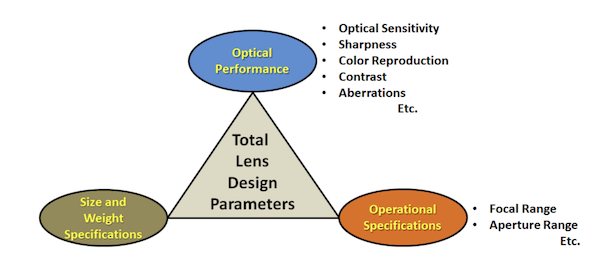
Designers can reduce the size and weight of a given lens, improve the optical performance, or increase aperture on the new mounts. To a lesser degree, they can do two out of three, and perhaps to a small degree all three in a given lens.
What Will This Mean?
At this moment in time, Sony has a much larger native-mount lens selection. They have also demonstrated the ability to release lenses at a very rapid pace and will have more native-mount lenses for years to come. Canon certainly has the resources to catch Sony if they want but given Canon’s conservative nature and dominant SLR position; I don’t expect that (but remember, I’m often wrong). I don’t think Nikon has the resources to do so for two reasons. First, Nikon has, in recent history, released new lenses at a slower pace. Second, Nikon has downsized significantly, and this has included lens designers. I meet a lot of designers and engineers from a lot of companies and ‘formerly at Nikon’ seems to be part of the introduction most of the time.
But both Nikon and Canon designers will have a significant advantage to work with going forward. Sony, Canon, and Nikon all make some excellent lenses. Going forward I think Canon and Nikon will have the opportunity to perhaps make ‘more exceptionaller’ lenses.
However, when we discuss optics and imaging we have to address the pink elephant in the room; image manipulation. Obviously, in-camera jpgs are strongly influenced by in-camera processing, but more and more we see evidence that RAW files are also manipulated in-camera. Electronic correction of optical aberrations may make optical differences in lenses less apparent, although it will never eliminate it.
What About All That Other Stuff?
Most of that I find rather inconsequential, although it’s obviously life-and-death to many Fanboys. One has in-body stabilization; the other doesn’t. One has probably better focusing than the other. I can’t imagine anyone is going to change from Nikon to Canon based on the mirrorless system.
A lot of people will buy their brand’s 1st Generation mirrorless cameras and use an adapter. Personally, I think Canon’s Control Ring is the most interesting thing I see for right now, and making it available on an adapter was brilliant. Lots of people won’t use it. I will, though, it seems very usable and intuitive to me.
But these first-generation cameras feature-for-feature probably aren’t as good as Sony’s multiple current offerings. Both will be more competitive in a year or two, although I suspect Sony’s cameras will have some advantages still. They’ll certainly be good enough for job 1, which is to slow the migration away from their own brand over to Sony.
My own opinion is eventually (3-5 years) mirrorless will be a significant portion of both Nikon and Canon’s business and the lenses, more than the cameras, will be the driving force. The early lens releases probably give us a hint of how each manufacturer plans to go forward.
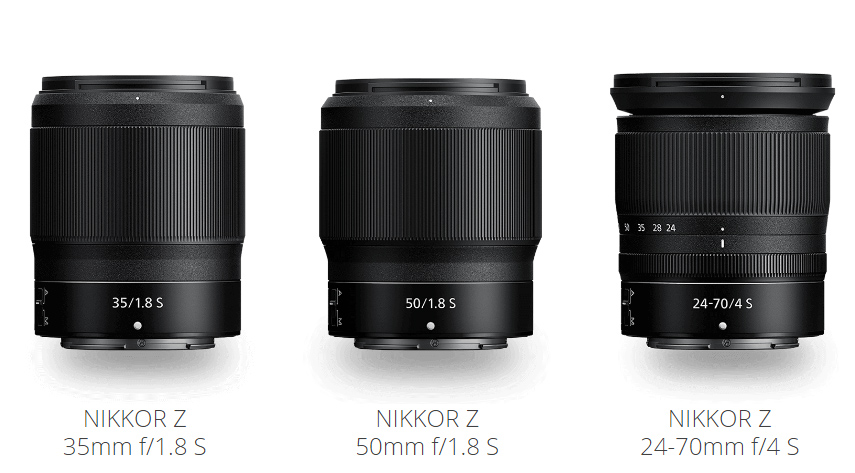
Nikon started with three very practical native-mount lenses; a 24-70mm f/4 and 50mm f/1.8 and 35mm f/1.8 primes. Given the optical triad of performance, size, and specifications, Nikon seems to be leaning towards the compromise of somewhat smaller and somewhat better optically while fleshing out a practical, useful lineup. Their roadmap looks to emphasize useful and practical, but there is the spectacularly dramatic 58mm f0.95 on deck.
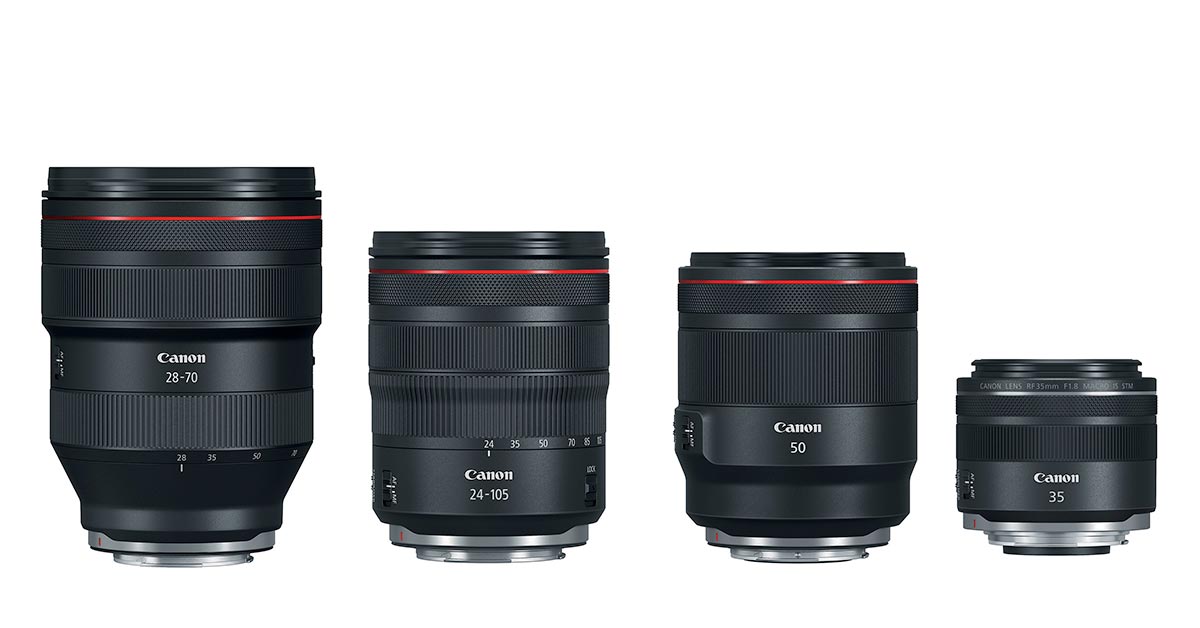
Canon started with three show-off lenses (and I don’t mean that in a bad way; I love optical show-offing). The 50mm f/1.2 and 28-70mm f/2.0 are all about amazing optics and big apertures, but they are huge beasts. The 35mm f/1.8 Macro is a bit smaller, a bit wider aperture, good optics, and a Macro feature (not that I’ve ever found 35mm full-frame macro lenses particularly useful), while the 24-105 IS is practical. Canon hasn’t released a roadmap but has said they are working on a series of fast lenses of f/2.8 or more, so I suspect some workhorse zooms are upcoming.
Logic suggests that from a pure optics standpoint upcoming Canon RF and Nikon Z lenses may be better than Sony’s, although it will be years before they have a similarly broad lineup. Logic also suggests Canon RF and Nikon Z lenses will be better than their SLR lenses; perhaps more so for Nikon who has a much larger mount now.
For both companies, the adapted lens route certainly makes it practical to dip a toe into their mirrorless offerings, although for me it will be another generation before I do. It won’t be a long wait for those with patience. Look at how much the Sony A7 series has improved over basically three years. Then again, Sony won’t be standing still over the next couple of years, either.
Interesting times.
Roger Cicala
Lensrentals.com
September, 2018
You can preorder the Canon R and Nikon Z6/Z7 now.
182 Comments
wshinn ·
What about the fuji XT3?
Zach Sutton Photography ·
The Fuji X-T3 is an APS-C sized sensor, so it’s not really a worthy comparison to the Sony a7’s and the new Nikon and Canon mirrorless systems.
That’s not to say that Fuji’s are inferior…they’re just in a different class.
wshinn ·
They aren’t in a different class. I don’t see how that is justified when a camera is just a tool. There are many choices our now. I’m not a fanboy but I think it’s ignorant to not include the Fuji XT3 in this article considering it was announced they day after the new canon. This article does no justice to discussing cameras as a whole, not just two brands .
Zach Sutton Photography ·
A full frame sensor has 2.5 times the surface area of an APS-C sensor.
wshinn ·
The Fuji XT3 has one more card slot than both these cameras and better dynamic range. Oh wait, that’s not mentioned in the article. Again, I don’t care about the brand but a justified report on mirrorless cameras.
Torsten ·
You may wish to read the title again. It clearly says “Nikon” and “Canon” and not Fuji. You appear to be on the wrong page… I am curious though, where is your evidence for the claim that the XT3 has better dynamic range than the Z7? Bill Claff’s data shows the D850 has close to 12 stops photographic dynamic range at base ISO against the X-T2 with 10. In order for the XT3 to beat the Z7, Fuji would have had to improve their sensor by at least two stops, or Nikon would have had to drop the ball and go down two stops, or a mix of both. Where’s your evidence that that has happened?
wshinn ·
The XT3 has 12 stops with their BSI X trans 4 sensor. Also, the first system to feature a quad core processing unit. These are things that are clearly missed in this article. You may want to read my post again. I don’t agree this is a fair and just article. You have your opinion. I have mine. The XT3 beats out these two systems in so many ways except FF. It’s just what it is.
SolJuJo ·
You mean with the tremendous IBIS the X-T3 has? Or the fully articulated LCD? Or the rather laggy touchscreen Fuji is able to make? The forgotten user settings among the masses of dials? In terms of dynamic range 12 stops are already a little bit dated. Look, if one ever goes to a Fuji forum and dares to point out some tiny features might be a little so-so, it’s a thing of nanoseconds until the first Fuji fan boy hastes around the corner with a glowing torch to send the intruder back to the dark lands of the less illuminated.
So, this blog post didn’t sail under false flag, it clearly states the subject will be Canon/Nikon mirrorless – it doesn’t say “fair comparison of all mirrorless stuff available”. 😉 Settle down at the shiny lands of green red white suns, enjoy the endless superiority of a new body which is already in the “special offer zone” before it hits the shelves.
It’s not a question of “beats the two systems” as these will have a couple of following bodies and start with masses of genuine lenses to go very well with the bodies. And if you come up with “size and weight”, just take a look at the last Fuji lenses – no significant smaller size than their FF equivalent counterparts, price about the same as FF lenses. Great stuff, no doubt, but it will take a bit more than only more buttons and dials.
Graham Stretch ·
I think it was fairly evident that this article was solely about the new FF mirrorless offerings when it talked about first generation hardware, I don’t know about Nikon but Canon has several generations of APS C mirrorless bodies available!
Based on this it would seem that it ignores Nikon, Canon, Sony and Fuji crop sensor mirrorless bodies for complete fairness of the article! ?
Torsten ·
And Olympus, Panasonic, Yi and Leica, possible also Samsung!
wshinn ·
Your taking it a bit extreme here, but whatever makes your ego feel good. I don’t care about the brand but I do care about color science and Nikon and Canon don’t have it. I’ll shoot natural skin tones all day. I’m done here I have better things to do than read your bitterness.
bdbender4 ·
Obvious troll alert. I have had 6 Fuji bodies and 10 lenses, and have sold them all. That doesn’t make Fuji bad, just my preference. The X-T3 and 16-55 zoom are about the same size and weight and in-the-ballpark price as the Nikon Z6 and 24-70. I personally don’t want something that large and heavy and pricey in APS-C when I can now have it in FF.
Torsten ·
They are “missed” in the article because the article is not about Fuji, as the title says.
Where is your evidence that the XT3 has 12 stops dynamic range and the Z7 only 10?
David Cartagena ·
Hi. Fuji have been making cameras with this mount for some years where Canon and Nikon just released new mounts. Thats the reason for this article I guess.
But agreed they get too much attention (IMHO) especially since the Z and R cameras are quite underwhelming.
Have a nice day ?
Jean-Baptiste Labelle ·
Size of sensor is NOT a matter of opinion. FF has much bigger sensor. Considering that Sony has also a BSI sensor and measured as state-of-the-art, I do not know how you can claim that it is a matter of “opinion” that the FF cameras here, discussed in context of bringing competition to the Sony FF mirrorless, are in the same discussion with a smaller sensor camera.
You really start to look like a troll with all your answers on the subject that should be crystal clear by now.
HF ·
Is there a serious test out confirming the DR thing, Dpreview, DXO, Bill Claff? Very very unlikely an APSC sensor with 2.25 times smaller area will trounce the same generation FF camera. That is fan boy talk. And at what ISO, base ISO? High iso? The Nikon Z seems to perform similarly to the D850 sensor. Fuji won’t beat it.
Ph?m Anh ·
Have you ever seen anyone mentioned Canon 5D mk IV in a comparison between gfx 50s, 645z, Phase One?
Mr. Not-A-Fanboy, please spare us the common sense.
wshinn ·
They are all Fuji XT3, Canon EOS R, Nikon Z series are all mirrorless. Which beckons the full report on mirrorless systems. I could care less about the brand. I just want a proper report. Spare me the silly comments .
Phạm Anh ·
Have you ever seen anyone mentioned Canon 5D mk IV in a comparison between gfx 50s, 645z, Phase One?
Mr. Not-A-Fanboy, please spare us the common sense.
Joe Alfano ·
The article makes total sense. The top 3 FF mirrorless cameras at their present price points are these cameras. They are in direct competition with each other. Anyone thinking of buying a FF camera, not APS-C or micro4/3, would think about their choice of these cameras. The Fuji XT3 looks great but it’s not direct competition.
Franklin Berryman ·
Should he also include m43 and cameras with 1″ sensors on the one hand, and the GFX and X1D on the other?
Panacea ·
A worthy entry for poorer, more-feeble photographers who can’t afford/handle a 135-format MILC.
Panacea ·
A worthy entry for poorer, more-feeble photographers who can’t afford/handle a 135-format MILC. And children.
/s
wshinn ·
Who rained on your parade? Lol.
Panacea ·
You keep using that phrase. I do not think it means what you think it means.
wshinn ·
What phrase? I’ve been a professional photographer for 16 years, I’ve shot with canon for 7, Nikon for 7 and Fuji for 2. All three are amazing brands.
Panacea ·
And yet you still can’t tell an APS-C camera from a 135-format camera, and understand why it’s pointless to compare the two. Tsk tsk.
wshinn ·
That’s not what his article is about. Maybe you should read it. He’s talking about the mirrorless systems. There’s no need to demean me but I guess it makes yourself feel good. My comment was never designed to initiate offense but apparently it did to your sensitivity. This doesn’t bother me as I have plenty of work. I just don’t believe this article is well rounded. It’s my perspective not yours. Honor it or walk away.
SolJuJo ·
No, he’s talking about two new players in mirrorless market and the perspective he expects them to have.
Throwing in stupid, brainless sentences like “Honor it or walk away.” falls back to yourself. Take your own advice more seriously.
David Cartagena ·
That certainly depends of what you are shooting! And BTW. You are sounding very condescending.
Have a nice day all ?
Panacea ·
I’m being condescending because wshinn called Roger Cicala “ignorant” for not including his not-really-comparable pet system in this article even when the focus is plainly obvious.
” I’m not a fanboy but I think it’s ignorant to not include the Fuji XT3 in this article considering it was announced the day after the new canon.”
You tell me if that doesn’t define oneself as a joke worthy of total ridicule in every way.
Athanasius Kirchner ·
/s stands for “end sarcasm”
FredLinda Lord ·
I’m waiting for Canon to make further improvements despite my strong inclination to jump in and be a beta tester. Sony is not on my radar and Nikon is no better at this point despite the recent introduction of the 500mm f/5.6.
Bennie The Bouncer ·
I’m still waiting for a wide-angle, large-aperture lens that doesn’t suffer from horrific coma and chromatic aberration when shooting the night sky. I’m perfectly happy with my (Canon 6Dmk1) camera, as when it has a good lens, it takes great pictures. I’ve yet to find a good, wide lens for it though, and I’ve tried a lot of lenses. 🙁
I do wonder if the wider mount will open the door for this, and if so, I could possibly be persuaded to make the leap. We will see.
Roger Cicala ·
That will be interesting. Nothing, even my optical bench, shows the flaws in a lens like astrophotography.
l_d_allan ·
Is that because of how demanding astrophotography is in the corners? Is your optical bench IQ tests more weighted to evaluating the center?
SolJuJo ·
Whenever I see the pictures of the four pretty cool Canon lenses, I look at their mounts and keep on thinking “why is it necessary for Canon to sort of equalize the sizes?” Or make them look like organ pipes while in real life the 28-70 is kind of a glass bucket? Anyway, not important, I enjoyed another excellent read of one of the wiser persons in the photographic internet world, thanks a lot.
dave9t5 ·
Roger, the control ring on the lens has some bigger potential implications for Canon’s body design and market control plans in the longer term.
In Canon’s article, that you link to, they state “An important reason is the change in control layout on the compact EOS R camera […] with the smaller EOS R, many of those buttons no longer adorn the rear or top of the camera body.”
This seems hint at a direction for EOS-R bodies. Future EOSR bodies (perhaps basic models at lower price points or super compact bodies) could be made with very limited on-body controls such as no dials.
One justification would be to save cost or reduce size on the body. Certainly mirrorless bodies are getting smaller but the lenses are not, so it makes sense to try to move some controls to the available real estate on the lens.
But equally important, in order to have a complete set of controls the camera system would require both native body and lens. That would potentially exclude 3rd party lens makers from offering lenses compatible with these bodies with partial controls as they would have to circumvent patents and communications protocols. A buyer for such “entry level” or super-compact bodies would have to buy native Canon lenses. Users could still purchase more expensive models that have on-body controls and pay a “compatibility tax”.
Roger Cicala ·
Very good points, Dave. That makes perfect sense.
Carl ·
I sure hope Canon releases bigger RF bodies with a more traditional DSLR button layout. I can adjust shutter, aperture, and ISO all with one hand on my 5DIV….why would I want a setup that makes me use 2 hands (i.e. aperture on lens dial)? I like the added functionality, don’t get me wrong…but lets not lose what was so right about the Canon DSLR form-factor and button layout.
dave9t5 ·
Smaller economical bodies don’t preclude the release of larger more featured bodies. Both could exist in a product line.
You still can’t make all your manual adjustments with one hand. Focus and zoom manual adjustments are on the lens for dSLRs.
Until recently with many brands, aperture adjustment was also on the lens. Many people still miss that or decried the loss of that feature.
It just shows there is no consensus for where to place controls.
Cameron Braun ·
One point I don’t see anyone making in regards to this control ring is, why didn’t they put it on the rear of the lens, near the mount, so that it’s in the same physical location no matter which lens you have mounted? Seems like such an obvious oversight and no one has questioned it.
David Cartagena ·
The EOS R and Nikon Z has some weird button placements and are missing some important ones, all said without have tried them in my own hands, but the Sony 7 cameras has in the latest generation placed all the vital buttons on the right side of the camera which is important especially with longer and heavier lenses. Regarding the control ring I think it’s a great idea which also Sony has on the new 400 f/2.8.
If the future Canon bodies lack wheels and buttons like this R, it will be a lesser usable camera when used with other older adapted lenses, that is if anyone will make an adaptor (I think they will but when).
Refurb7 ·
Canon is offering an adapter with a control wheel right from the start.
Les ·
One of the “big” reasons for the control ring is the size of the rear LCD. Higher-end Canon digital SLRs always had a control wheel next to the LCD, but there’s no space for that with the R’s big articulated rear screen.
It makes sense to move that control to the lens.
dave9t5 ·
Yes, good point. Smaller bodies + bigger rear screens.
Mk.82 ·
@Dave 9t5 “Roger, the control ring on the lens has some bigger potential implications for Canon’s body design and market control plans in the longer term.”
For now 8 years (since first Olympus mirrorless m4/3 E-P1 came out) I have been recommending Olympus to implement a firmware feature to change FBW lenses focus ring to function ring when in AF mode, and disable it when in MF mode. That even more since 2012 when E-M5 was released but stopped couple years ago.
I found it strange that they totally have the straight information when the focus ring is rotated and how much, and it should be simple thing to change it to be read when AF is enabled and allow that way Function calls be made.
Well, Canon did it now, surprise! And they did it even by adding a third ring to lenses just for it (IMHO bad idea).
Frank Sheeran ·
> Certainly mirrorless bodies are getting smaller but the lenses are not
The lenses CAN. Look at a Leica 35mm f/2 or 50mm f/2. Add a focus motor and the Canon control ring. Canon could be making that.
Currently they feel they need IS. However, I find the resulting size too big; I’d have bought a smaller 35/1.8 without IS.
Canon is almost surely going IBIS, though it’s not clear to me that it will be phyiscally-moving or digital as seen in movie shooting. With that, or if you’re a Nikon/Sony user, then you DO have smaller lenses.
Chik Sum ·
Hi roger,
I am kinda of an interested 5D3 user, although at this point I am still preferring the ovf feeling it seems the RF mount is the way forward.
The adapter with control ring is surely a sexy thing, but I remember read your article some years ago that no adapter is going to do good for optical bench testing, and that in somewhere else I saw ppl actually reporting with wide lenses it’s actually noticeable for misalignment even with great adapters like the metabones.
Can you test a few of the adapter from canon and Nikon themselves and see if the result will be more controlled and acceptable as for no practical loss of IQ? I did cane into customers zoom in a group photo and complain for side unevenness with a very slightly tilted lens before
David Cartagena ·
There have to be some mechanical play in the mount although very small. And the thickness of the complete adaptor also have to be made with a tolerance.
With an adaptor you have the tolerances of the two mounts and the thickness of the adaptor (also the rings on the adaptor) that come i to play.
So it is inevitable that there will be worse precision in the distance to the sensor with an adaptor, and that can affect your IQ in numerous ways.
With that said most use adaptors on cameras with great results. It’s mostly just an extra hassle.
Have a nice day?
YS ·
Hi roger,
I am kinda of an interested 5D3 user, although at this point I am still preferring the ovf feeling it seems the RF mount is the way forward.
The adapter with control ring is surely a sexy thing, but I remember read your article some years ago that no adapter is going to do good for optical bench testing, and that in somewhere else I saw ppl actually reporting with wide lenses it’s actually noticeable for misalignment even with great adapters like the metabones.
Can you test a few of the adapter from canon and Nikon themselves and see if the result will be more controlled and acceptable as for no practical loss of IQ? I did cane into customers zoom in a group photo and complain for side unevenness with a very slightly tilted lens before
i_felonious ·
thank you Roger. So how long will EF be with us? will the 5d Mark V be DSLR, Mirrorless or maybe both?
Roger Cicala ·
I’m sure it will be here long after I’ve retired, and there will be lots of people who still prefer the feel of an SLR and such. But I bet in a decade the RF lenses will be considered better.
i_felonious ·
no doubt about many of us preferring DSLRs. so you’re saying that the 5d Mark V will most likely be a DSLR as well as, say, the 7dIII and the next generation 1D body? I know EF lenses will be around for at least a few more years by necessity but it surprises me that you think the DSLR will be — if that’s what you’re saying. anyhow I value your opinion and I appreciate your time!
Jalan Lee ·
I agree with you Roger. I am a wedding/portrait photographer. Two Canon 5D IV cameras (one is just a backup I’ve never used). Solid workhorse system that produces beautiful results. As a camera system nothing really competes – not the best in any single category but the best all around combination of features. Never had a failure and the camera in no way limits my photography.
The new cameras are neat but still a long way to go before I would drop my DSLR’s. Battery life 3000-4000 shots and 2 card slots at a minimum – maybe overkill but it would make me really nervous to only have one slot for a wedding. I also worry about the life of the viewfinder – my LED monitors start to dim after 3-4 years so why wouldn’t the viewfinder? My 1980 Bronica ETRS medium format film camera still works like a champ. Honestly, my skill is the limiting factor and not my camera system so a bit more this or a bit more that is really not that important. Someday – maybe not Roger’s 2nd generation – I’ll “upgrade” when it is really an “upgrade”. Thanks for the review!
i_felonious ·
I love my 5d4 and have the latest generation canon lenses. in fact I have never been happier with any camera equipment since I got the Canon AE-1 in 1980. but I also loved the earphone jack on my iPhone 6s but apple did away with it.
I think there’s a good chance the 5d Mark V will be mirrorless. don’t really see the reason for keeping the mirror or offering both DSLRs and mirrorless. I think that’s the type of thinking that hurt Nikon in past when they tried to dictate to the market that 1.5 crop was the sweet spot.
yeah i’m old and resistant to change but that’s what I see happening. EF lenses will be around for a few more years but when i’m ready for the 16-35L IIII it will be R mount.
like you I plan to keep using what I have for 2-3 more years. the only thing that interests me now is sensor technology and I think we are near a peak there.
Jean-Baptiste Labelle ·
Mr Cicala, you articles are famous in photo hobby and professionalism world and your experience does not need any reminder.
But I find it funny that it is usually the people the more versed into a topic that are the more blind seeing the trend coming.
For me mirrorless, is like, all kind of disruption: digital camera, new smartphone “type” with the iPhone introduction, social media, online merchandise site…and the same thing is happening with EV where people, even now, still do not believe in a rapid switch whereas the Model III is already in value the MOST sold car and number 5 in quantity.
Same thing happened for mirrorless. Canon (and Nikon) are obviously benefiting from their brand name (as are legacy ICE manufacturers or Blackberry and Nokia in the past) but this is clear that DSLR has just no future.
It started with premium ML where you can get rid more easily of the inherent compromise of every new technology and Sony, from an consumer electronic background (although they obviously inherit from Minolta optic expertise), reached supremacy on FF mirrorless in, what, 4 years? Less time that Canon took to go from one model (5DII) to its successor (5DIII).
And if the number is correct, even if Nikon would double their FF sales, they would just reach Sony.
Yes, Canon is still by far, the number on in ILCE but because they are mostly selling dirty cheap camera, and not with their sales of 1Dx or 5DS. Plus, you have an inherent huge inertia because of the lens investment.
But it is clear that not only Sony is already dominating the market of FF and is impacting more and more Canon and Nikon (when you consider that after 4 years, they sale more than all, for some long established, Fuji, Olympus, Panasonic, Ricoh… COMBINED) and that there is no surprise seeing Canon and Nikon chasing Sony as they have no choice.
“People” do purchase DSLR, not because they prefer the “feel of an SLR” but because Canon and Nikon as camera brands are impregnated in their mind, because they were the only real significant player when they growed up and saw their parents shooting them and because you can find a 400$ kit in every Wallmart and supermarket and those people believe that it is the “safe” choice.
But the dominance of Sony on FF is showing that for more informed and dedicated people, willing to put their à priori aside, mirrorless is statistically considered as better as DSLR.
It is only a matter of time to have this impact trickling down to the whole market Canon and Nikon market share.
I DO believe that Canon (and Nikon) have the possibilities to remain dominant for the next decade, but certainly not while continuing only selling DSLR (and if the first place of the lukeward M serie in Japan is an indication of that).
Abimanyu Boentaran ·
I was looking to get a second body to mount my tele.I am using a 6d and thank God I waited, will get the R for my 11mmzoom and super fast 35mmL mk2 85mm 1.2L mk2 and my old 6d for the 100-400mmL mk2.
Roger, you forgot to mention Canon’s color rendition. Sony has not matured yet with their color rendition and icky menu.
David Cartagena ·
Well I have used Sony since 2007 and have always preferred their colors. Imho color is subjective because not one person see colors equally
https://www.pdnonline.com/gear/cameras/the-best-cameras-for-color-reproduction-ranked/
Graham Stretch ·
So often we get the Sony hasn’t got the colour rendition right yet!? Colour is a subjective thing so get it how you like it in Lightroom (or your preferred software) and make a colour profile and use it!
No I’m not a Sony fan boy, I use Canon! ?
NgentotLu ·
I was looking to get a second body to mount my tele.I am using a 6d and thank God I waited, will get the R for my 11mmzoom and super fast 35mmL mk2 85mm 1.2L mk2 and my old 6d for the 100-400mmL mk2.
Roger, you forgot to mention Canon's color rendition. Sony has not matured yet with their color rendition and icky menu.
John Dillworth ·
I think Canon has another huge advantage over Nikon. They make their own sensors. Now we could argue that Sony has superior sensors but once you get past the pixel peeping the practical differences doesn’t seem to bother Canon buyers. Nikon will always have to pay more for their sensors than Sony or Canon. Sony and Canon essentially get their sensors at cost while Nikon will always have to pay a premium to Sony resulting in their cameras costing more that Canon or Sony. This will (has) result in decreased margins for Nikon meaning less dollars for R&D. Superior innovation might help, as Canon moves slow, but Nikon will remain at a financial disadvantage.
Eamon Hickey ·
Sony sensors are made by a different subsidiary of Sony than the one that makes the cameras. Sony Semiconductor sells its sensors to Sony Imaging, just as it does to Nikon. It’s possible that Sony Semiconductor gives Sony Imaging a discount that it does not give to Nikon, but that’s not actually likely, for two reasons.
First, Sony Semiconductor has its own P&L; it needs to show a profit, and harming its own profits in order to increase Sony Imaging’s profits would hurt its perceived performance. Its executives are in a contest with executives of other Sony companies to see who rises to the top of the Sony corporate pyramid; there’s a limit to how much they’ll sacrifice to make potential internal rivals look good at their own expense (a very low limit). Also, the success of Sony Semiconductor is far, far more important to the overall Sony group than the success of the still camera business of Sony Imaging. If one of the two is going to be forced to sacrifice, it ain’t gonna’ be Sony Semiconductor.
Secondly, Nikon is a significantly bigger customer of Sony Semiconductor than is Sony Imaging’s still camera unit. Nikon orders still camera sensors in significantly higher volumes. So Nikon has the power of volume ordering on its side, and it just wouldn’t be good business for Sony Semiconductor to drive away one of its biggest customers by intentionally disadvantaging it. (Not to mention the signal that would send to Sony Semiconductor’s other still camera imaging customers, like Olympus, Panasonic, Pentax et. al.)
David Cartagena ·
Don’t forget that it is much easier to work with somone in your own organisation like Sony semiconductor and Sony imaging are.
That makes it easier to develop new products and put the newest technology inside.
KeithB ·
Hah hah, hah! You have never worked in a corporation, have you? When I was at Motorola, it took a vice president to intervene and get two divisions to work together.
As far as cost, I have seen it done two ways: One is that internal customers got it for cost which gave the manufacturer 0 incentive to work with the internal customer. The other, much more workable solution is to give the internal customer the lowest price you gave your external customers minus 10%.
David Cartagena ·
Motorola is probably not the best example. The company I work in was once owned by Motorola, and that did not go well, now we are part of Taiwan based GWC the third largest Silicon wafer manufacturer in the world and we are great at working together all over the world, from Taiwan, to Italy, Denmark, Japan, and the US.
So maybe i am the wrong person to learn about working together.
John Dillworth ·
Excellent points. thank you
Athanasius Kirchner ·
Let’s be honest here – both Nikon and Sony Imaging are fleas compared to clients like Apple and Huawei, so it’s quite doubtful that either gets deferential treatment 😀
I don’t think Sony Imaging get a discount, but they obviously work very closely with Semi – all the sensor tech that they get ahead of competitors, and sometimes for their exclusive use, should be proof enough of that.
Eamon Hickey ·
Yes, certainly, the smaller sensors, for cell phones and much else, are 1000X more important than ILC sensors.
I’m asking this seriously, because I haven’t followed developments closely enough: what sensor technology that Nikon and others could use does Sony Imaging get first, or exclusively? The sensor in the A9 is pretty unique in the marketplace right now, but nobody else has needed what it can do. (Presumably, Nikon will sometime in the next 2-3 years.) Other than that, what technologies are you referring to?
Athanasius Kirchner ·
It’s, as you indicate, the stacked sensors that SI have been using exclusively for over four year now, even in a category with lots of competitors (1″ sensors). Apparently, the Fujifilm X-T3 doesn’t use a stacked sensor either, meaning that Sony Imaging are keeping an iron grip on that piece of tech.
BSI tech for 35mm sensors was also an exclusive for at least two years for Sony; it’s conceivable that Nikon might’ve used it earlier if they had refreshed the D810 sooner, but given the current development cycles it looks far more likely that they started the design of the D850 once the A7RM2 was finalized and operating as a test bed for the current chip. And this, in turn, means that SI were using prototype BSI sensors much earlier than that.
It’s also worth noting that Nikon have been forced to stick with Sony now, after they gobbled the competition up. Nikon used to be quite “promiscuous” in terms of sensor fabs, and it’s quite likely that their relationship with Sony Semi is a little strained or guarded because of that.
Thom Hogan ·
I doubt that Sony Imaging is keeping an “iron grip” on stacked sensors. Instead, they opted for an expensive sensor development earlier than the other camera companies. Sony is a company that tends to promote leading edge technologies; sometimes it works out well, sometimes it doesn’t. But betting on stacked early was a financial risk. No one else really wanted to make US$1200 compact cameras with tight margins.
Nikon remains promiscuous with sensors. They continue to do their own R&D, as well. Sony Semiconductor still gets more money from Nikon for sensor production than they do from Sony Imaging, though that number has narrowed as Nikon’s product line has narrowed. I think it would be at great financial risk if Sony Semiconductor tried to play favorites now.
TurtleCat ·
A lot of people aren’t interested in facts. They just want to believe they picked the best horse.
Athanasius Kirchner ·
Why do you assume that the margins on the 1” cameras are ‘tight’? Do you have a source for that? The model proliferation alone should be a good indicator of the profits made on those cameras, and I personally doubt that the margins are slim (especially since they don’t move much volume).
Sony Semi doesn’t play favorites (I mean, the X-T3 just got their newest APS-C sensor earlier), but it’s evident that they do have some sort of agreement with Imaging. Developing sensors like the ones on the A7RM2 and A7S isn’t cheap, and those two cameras represent a tiny amount of overall sales; at their current prices, Sony Imaging would probably incur a loss if they had to pay for everything themselves.
Thom Hogan ·
It’s a relative thing. In CES the difference between a 35% GPM and a 40% GPM is meaningful.
But to answer your question, the Nikon DL decision is pretty illustrative of how tight things are. Nikon cancelled the DLs because they fell under their margin/demand curves. That’s the thing about the RX100, for instance. The models that are selling best are the older ones at discount, not the new one at above US$1000.
This is the tricky play that Nikon eventually decided against continuing: as overall demand keeps going down, high prices also push that demand further down (or you can take less margin). You can leave older generation gear in the market and try to milk out the tail, but I’m pretty sure that’s turned unprofitable for a couple of the Sony products now. It did for a couple of Nikon products and Olympus and others.
Sony Semiconductor has “some sort of agreement” with Fujifilm, Nikon, Olympus, Panasonic, Pentax, and Sony imaging groups. It may even have one with Canon for the 1″ and smaller sensors. It seems very clear that every one of those companies is driving different technologies at their core. I’ve reported, for instance, that Sony Semiconductor warned Nikon about potential yield issues with the 45mp sensor and offered the 42mp sensor only seen in the A7Rm3 as an alternative. Likewise, the 36mp sensor used originally only by Nikon eventually found its way into Pentax and Sony products. There’s a ton of pollination going on with the camera companies buzzing about the flower at the center, Sony Semiconductor.
And no, I don’t think Sony Imaging would incur a loss if they “had to pay for everything themselves.” Because of the way those companies are established, they actually DO have to pay for everything. Failure to do so and not reporting it in their public financials would be a huge fraud liability.
Eamon Hickey ·
Actually, I think the X-T3 argues against your main point, assuming its sensor is made by Sony. The X-T3’s sensor is the highest performance APS-C sensor on the market right now—none of Sony Imaging’s own APS-C cameras can match it.
So if Sony Semiconductor were trying to put Sony Imaging’s competitors at a disadvantage, why would they give their most cutting edge APS-C sensor to Fuji before they gave it to Sony Imaging?
The X-T3 sensor is definitely not a stacked sensor (I asked Fuji), but I’m guessing that’s exactly what Fuji wanted. They got A9-level performance in a sensor that is undoubtedly significantly cheaper than a stacked sensor would have been. Sony gave Fuji technology that allowed them to match the A9 (albeit in APS-C) and beat all of Sony Imaging’s own APS-C cameras, at conventional sensor prices.
Obviously, if the X-T3 sensor is not made by Sony (I have no information either way) it’s a different story.
Athanasius Kirchner ·
We’ll see. I’m operating on the basis of the rumored A6500 successor, which would equip the same 26MP chip, except stacked. If it pans out, it’d be a strong confirmation of SI’s exclusivity regarding that technology.
Eamon Hickey ·
Yes, maybe an A6500 successor will tell us something. I guess I’m not sure what Sony would gain by using a version of the X-T3’s sensor with stacked architecture? The X-T3 already does 20fps with AF and no blackout (30fps with a slight crop), plus 4k 60P video. (I have an X-T3 for testing right now, and all of this works quite well.)
So Sony could presumably beat those numbers with a stacked sensor, but do they really think that would move very many buyers? And of course, there would be a big cost penalty. A stacked sensor is essentially two sensors sandwiched together. I’m sure that does not double the cost of the device, but it certainly raises it significantly. So I’m not sure I’m seeing a value proposition in this scenario.
Stanislaw Zolczynski ·
Rumors say it`s made by Samsung.
Eamon Hickey ·
The possibility had occurred to me, but rumors don’t mean much to me—so many are wrong or contradictory. When and if there’s an actual teardown, I’ll be interested.
Thom Hogan ·
You seem to forget all the sensor tech that Nikon Imaging got before Sony Imaging.
I don’t think Sony Semiconductor would have the large sensor options it does today without Nikon’s pollination. That brought SS dual gain, PD on sensor, column ADC, and more. People seem to think Sony Semi invents all the tech in their sensors. Quite a lot of it is licensed. This is the dirty secret throughout the imaging world: there’s a ton of licensing that never gets mentioned. BIONZ, EXPEED, and DIGIC all have licensed technologies in them, too.
So, to “be honest,” Sony Semiconductor is making sensors for Fujifilm, Nikon, Olympus, Pentax, and Sony these days, and they’re doing custom work for every one of those except Pentax. Some of that custom work is integrating licensed technology, some is incorporating tech from those imaging groups themselves. Some comes from things that SS figures out from their smartphone sensor clients. And some comes from SS’s own R&D.
Athanasius Kirchner ·
Sure, and it changes what I pointed out how..?
Even if Aptina pioneered some of this stuff with Nikon, for some doggone reason they refused to spread the love to larger sensors – that was Sony’s work.
If the Z’s have OSPDAF (well, the fact that they even exist) it’s thanks to Sony. Nikon would’ve let that die on the vine in their 1 system. Oftentimes it’s not the inventor of a technology, but the entity that makes said tech usable and widespread, that (rightfully) gets the credit.
Thom Hogan ·
You’re making assumptions here, not reporting how it actually happened. And you’re making a statement about Nikon mirrorless which is clearly wrong, since they now have new cameras that have sensor PD.
Also, why is it so important who gets “credit”? We currently have Canon, Fujifilm, Nikon, Olympus, and Sony with on-sensor PD cameras. Likewise, we have Fujifilm, Nikon, Olympus, and Sony with sensor IS (which was invented at HP, by the way). In each case, the companies are doing somewhat different things with underlying tech.
Anthony ·
Hey Roger, as a long time M43 user, I humbly request including “full frame” in the title, as having a discussion about “mirrorless” and only mentioning the three latecomers to the format seems disingenuous to the field of mirrorless cameras. I know it is not intended, but it is the result of not mentioning any of the other players / products in the mirrorless field. None of which are “full frame” mirrorless, which seems to be the silent qualifier of your article.
Roger Cicala ·
Anthony, I usually try hard to be politically correct, but I think Canon / Nikon in the title should avoid the disingenuous tag for only mentioning newer cameras.
Anthony ·
I was thinking that too, and then there’s Sony in the picture & the discussion. Sony FF mirrorless not newer. So it appears FF is the differentiator, not newer, unless you consider Sony’s entry into FF mirrorless in 2013 to be considered new.
Devil's Advocate ·
Agreed – aside from the sensor size is the A7xx a better camera than an E-M1ii? I don’t think so.
Alec Kinnear ·
For professional use, MFT and APS-C have shown their limitations. Daytime only or BW in low light (Fuji).
Ryan Graham ·
Do you have any opinion on the feasibility of a Sony E to Nikon Z adapter? Given the Nikon’s slightly shorter flange distance and comparatively massive mount diameter, it seems at least theoretically possible for a ‘mount within a mount.’
The Canon R has a longer flange distance than Sony E, making a Sony E to Canon R impossible. But if there were a way to shoot Sony’s lenses on the Nikon, that could be a huge boost to Nikon while they fill out their Z lens line. They could really steal some of Sony’s user base.
David Bateman ·
Nikon is really a lens company first. I don’t see that happening. Also the slow down Roger hints to in DSLR market, I think is due to Nikon focus on this new Mirrorless mount. So I think a lot of really good Nikon glass will come first and it will take years for third parties to crack the mount code to release lenses. Nikon specifically said they were not sharing.
Also it was hinted that Nikon will have a second none premium Z lens line. The S line is the premium line.
Stanislaw Zolczynski ·
Sony 12-24 on Nikon Z. Wow!
obican ·
Roger Cicala (from Lensrentals) says Sony has the best mirrorless full-frame cameras (Amazon link here).
John Draper ·
I guess they would considering they’ve been at it a whole lot longer. Must be the best sensors too, since Nikon uses them huh? LOLOL
Bob B. ·
I think your speculations and honest are very good.
Yeah…I have an extensive Canon System…and an extensive Olympus System. We both know which one is more fun to use. I will not buy any Canon Mirrorless moving forward because of the no-IBIS choice. When you have been using incredible mirrorless cameras for years with IBIS, well…Canon…Huge MISS!
Thanks for your thoughts Roger. GOOD stuff!!!!
…and yes…at this point the Sony “body” is the clear leader…
As far a my FF adventures go…I will just stick with my 5D IV for the time being with no excitement for the Canon offering.
Natt Lin ·
Regarding the lenses, Can you pls comment in engineering perspective, how Leica with much smaller mount can produce a very high quality lenses with lower number of glasses and in much smaller footprint, ie the 50 Summilux ASPH compare to the new RF 50 1.2L?
Natt Lin ·
I mean even with now the shorter flange distance, why the lenses still so big?
Stanislaw Zolczynski ·
Good point. At least fast wides should be smaller.
ching ·
zeiss loxia lenses are substantially smaller than dslr equivalent (milvus).
12-24 is smaller
16-35 is lighter
15mm voigt is smaller
12mm voigt is smaller
10mm voigt is smaller
My belief is that lenses are big because they can be.
Roger Cicala ·
There are several reasons. One is superb engineering with little time pressure. Another is, like any other lens, the design trade-offs chosen. Leica doesn’t hesitate to use exotic glass, tighter manufacturing controls and not care as much about expense. Finally, Leica trades off some things (and has consistently over time so their users are used to it and generally like the foibles) like field curvature or vignetting; a much thinner optical cover glass (remember the required UV filter issues on some early digital cameras?), etc.
It’s basically like ‘how does Porsche get all that horsepower and performance out of those small cars?: Time, money, and great engineering.
Every lens, every single lens ever made, has a design team that chose what compromises to make. Size is one of the easy compromises. If we make it a little bigger it can be better and cheaper. We can make it smaller and cheaper, but it won’t be optically as good. We can make it smaller and optically great; it will be more expensive.
The Sigma Arts are a great example: the design team was told make it optically great, make it inexpensive. And the answer is obvious; well, fine, but it’s gonna be big.
Natt Lin ·
Thanks for your explanation!
ching ·
To answer his question, the microlenses on the outer perimeter of the sensor are angled inwards, on a Leica sensor, to mimic the behaviour of film. That is the primary reason they’re superior.
“A wider mount allows lens designers more freedom.”
I always thought the Sony mount is already bigger than required for full-frame lenses. I’ve read this comment a few times. Do you have any data on this blog to back it up? I am not trying to pick a fight with you, but I’ve read this claim over and over and I’ve yet to see any evidence.
Derek W ·
It’s not just Leica, Voigtlander also just released a 50mm 1.2 for the Leica M-mount that is small and weighs less than 350g. A couple things Roger didn’t mention that are important:
1. The lenses are manual focus only, so no space needed for electronics or motors.
2. The minimum focus on most of these rangefinder lenses is 70cm or 2.3′ which is a smaller operating range than most lenses which probably makes lens design easier.
citrate ·
Does wilder mount necessarily give better optical performance? Several f/e mount lenses are better than the corresponding ef mount ones.
Is it possible to make f/1.2 lenses for a smaller mount? I don’t know. But you can adapt ef mount 50mm and 85mm f/1.2 lenses to e mount with autofocus and no obvious loss of optical performance. So I don’t see why f/1.2 autofocus lens is not possible for e mount.
Stanislaw Zolczynski ·
when you look at compact cameras lens layout you can see that the back glass element is bigger then in conventional designs to avoid the vigneting. Nikon made 50/1.2 and 58/1.2 lenses but they were manual.
Adam Fo ·
Nikon still make the 50mm f1.2 Ais
Roger Cicala ·
It is possible, no question. And we’re never guaranteed better optics. But a wider mount makes it possible to make better optics, absolutely.
pest ·
If Zeiss can do Otus on f-mount, Canikon needs to bring something really impressive to proof there claim about the advantages of there new bigger mounts. Let’s see.
Khürt L. Williams ·
Thsi blog post was too logical. 🙂
> Yes, I’m aware you can shoot lenses on an adapter. You can also shoot lenses on the SLR you already have.
David Bateman ·
Roger your first two sentences made me question if people also email you to ask if they can go to the bathroom. Really don’t people think anymore? Or is the internet suppose to do that for them now.
I am not a Canon user, but the first Canon offering made me think that if I was a Canon user holding out. Now is the time to jump over to Sony. Really for same price point you get a A7mk3 and metabones or sigma AF adapter to use your Canon lenses. The feature set on the Sony is much better.
The Z6, I am actually interested in. But will definitely wait a couple years. At least now is the time to pick up AF-D lenses, as the used prices have fallen due to no support on the Z mount.
At least they were low last week. The 60mm Macro I want has gone back up.
Larry Templeton ·
I think it’s easy to forget how complicated high quality ILC systems are, especially when it’s of real interesting to you. I have a lot of smart friends who sound really ignorant, period, when asking questions about camera brands and options— but that’s simply because I don’t realize how much useless information has accumulated in my head on the topic. If I were to start speaking to one of them about taxes, for instance, I’d quickly sound like a much bigger idiot than them (and justifiably so).
Regarding Sony, I think some of the “fanaticism” people observe in those users comes from dealing with the inbred bias that’s built in to anyone who’s long been into photography toward Nikon, and particularly Canon. Even people who genuinely believe they lack sentiment and are above fanboyism sometimes have a strange way of “admitting” that Sony has the best full frame mirrorless camera at the moment. The lack of enthusiasm (where it’d otherwise be there in spades for Canikon had they achieved the same advancements) is usually pretty obvious. We’re all human though, and these brands sort of “house” the things we’re passionate about.
Mako ·
Nikon DOES sell a 50 mm 1.2 !!!
Roger Cicala ·
True, I’d forgotten that one. And I’ve shot with it several times.
T N Args ·
Hi Roger, thanks for your sane thoughts on this insane topic.
Your article looks quite a bit at the DSLR user’s perspective on the 3 mirrorless full frame options. But what about those (like me) thinking of stepping up to one of these 3 “from the outside”? What would your thoughts be from that perspective? Someone wanting to enter one of these 3 systems for the first time, and stay there for a while? cheers
Roger Cicala ·
If I Sony is your first choice I’d buy into that now. The technology is more mature although they are still in a pretty rapid improvement phase, particularly with improving their optics and infrastructure.
If I could, though, I’d try hard to wait a year. Even waiting 6 months will probably save you a lot of money and clarify what’s coming quite a bit.
T N Args ·
I wouldn’t normally think it good advice to hold in one’s GAS, but in this case I’ll make an exception. Thanks
Manuel Wenaud ·
I just wish Nikon will use their new wider mount to re-create a Nikon S3 ! With 24 Million pixels, I would hang out with it till I die ! Mr Nikon, do you hear me ? I want a rangefinder !
Sam ·
Mr. Cicala,
Let’s suppose that you “omitted” m4/3 && Fuji because of sensor size , for a moment.
Where is the Leica SL full frame mirrorless camera system with an L-mount then?
Is this some sort of creative marketing campaign going on or I am missing something ?
Of course this is YOUR site and your business, but let’s be fair for a moment and pretend that we all talk the same language.
cheers!
Sam
Roger Cicala ·
I”m really trying to follow this ‘left out’ thinking. When I do a Leica SL teardown, or a micro-4/3 lens report I don’t get a bunch of Canon and Nikon folks saying “why didn’t you talk about us?”
Thom Hogan ·
Okay, Roger, I’ll debate you ;~).
The reason why you (and I for that matter) are getting so many “should I” emails is simple: there are perceived (and real) advantages to mirrorless long term (true WYSIWIG, smaller, less mechanical complexity to break). Canon and Nikon were later to serious mirrorless entries than Fujifilm, Olympus, Panasonic, and Sony. But Canon and Nikon have a tremendously huge user base, and that user base is anchored by accumulation of EF and F mount lenses.
So here we have Canon and Nikon finally making their move, and it appears that the move easily incorporates (most) existing lenses without loss of functionality, so people are anxious about whether “it’s time” or not.
IF we were debating for someone just out of college and starting from scratch with no accumulated equipment, then yes, if they needed a full frame camera system, almost certainly the Sony A7/A9 lineup should be what they look at first.
But that’s not who’s sending you (or me) emails about the new system and whether it’s time to move.
The answer is simple: for many, it’s not time yet. Even the third-generation Sonys have a tough time matching the top DSLRs in focus performance with fast moving and erratic subjects. Sports, birding, some wildlife, some other types of photography still are best done with a DSLR. I’ve tried all with the A7Rm3/A7m3/A9 against my D5/D850/D500. The DSLR still wins in these areas, though the gap is narrow now.
On the landscape side? I think things are completely different. With no real penalty in using your existing EF/F lenses and a trickle of “better” lenses, the R/Z system start to have some advantages. Maybe true of travel and portraiture photography, too.
It’s all the in-between photography that’s where the muddy waters still are and you can’t answer the question. That said, DSLRs didn’t stop working, and it’s still tough to argue where a mirrorless camera is better, so most people can wait until these new cameras have gone through a thorough evaluation before having to make a choice.
I think it’s not to be overlooked that both Canon and Nikon are loudly promoting the optical benefits of the new mount. The fact that you can use new optics where the exit pupil moves forward and isn’t clipped by the mount, or put larger elements closer to the sensor, seems to be inspiring the next generation of lens design. Both Canon and Nikon are optical companies at heart. They seem to think that mirrorless is not just about removing the mirrorbox, but gives them the opportunity to rethink optics. I don’t think it’s a coincidence that Nikon went from having to work in the most restrictive mount to suddenly having the least restrictive.
Roger Cicala ·
Thom, I actually spent about 30 minutes looking for a point to debate; but as usual in your writing, there’s no logic there I can really disagree with. At least not with anything strong than ‘well maybe they’ll . . . ‘, which, as you say, the muddy waters in between.
My biggest questions going forward that I think we’ll get some clarity on in another year are things like this:
Will Canon go balls-to-the-wall in mirrorless, or will the keep most of their resources milking the cash cow of SLR.
Does Nikon still have the resources to bring out a lot of new lenses quickly (I think this one is probably yes).
What will Sony be doing? Obviously, their knee jerk is always ‘we’ll market more and have more traveling road shows’, but they also seem to be putting resources into support infrastructure and quality assurance.
What about the others? Panasonic seems to be jumping to full-frame soon. Will Olympus follow?
2019 should be fun and interesting. After that, though, there probably won’t be anything left to argue about so I’ll plan on retiring 🙂
Roger
Thom Hogan ·
Let me try to answer your questions as best as I can from what we know so far.
1. Will Canon go balls-to-the-wall mirrorless? Customers will determine that now. To some degree, the fact that Sony managed to get to the top dollar position in the US full frame market—albeit with a lot of new product releases in a time when Canikon were mostly quiet—has forced their hand. So, the sub-answer is: yes, we’ll see a lot more mirrorless activity from them now. But I don’t think it’ll stop any DSLR activity (as happened at Nikon). Canon will let buyers decide.
2. Does Nikon have the resources? Not only is the answer to this yes, but one thing I see from my contacts is a renewed energy that wasn’t so much there a year ago. They seem to be looking forward to the challenge of the new mount.
3. What will Sony do? A7Sm3, A9m2, more lenses to fill the lineup out short term. Staggered releases to keep the PR engine going. But the challenge for Sony if the Canikon entries hold serve is simple: where do they find new customers from? Because Canikon will hold their current bases, I think. The days of sampling/leaking/switching are mostly over now. My advice to Sony is hit colleges hard. Educational discounts, targeted career starter programs, etc.
4. Yes, Panasonic will join the party, though no one seems to know why. They’ll also be a bit late, as we’re talking next summer before cameras are really in the wild. The only thing I can think of is that Panasonic thinks that there’s an advantage to 8K with a larger sensor. They simply don’t have the dealer base or support infrastructure—which you mentioned Sony is still beefing up—to sell all that many here in the US.
5. Olympus does not seem to be going full frame any time soon. Next big release from them should be another m4/3 camera.
To me, it’s exciting because we’re starting to see the conservative design/development schedules give way to new ideas, new approaches, new products. It’s what is needed to revitalize the camera market.
I’m hear you on retirement. I almost did it this year.
FWIW, I rented the 180-400mm from you last month. Your staff and customer handling is excellent. There were two issues with FedEx, but your people handled that without blinking, and the right way. You should be proud.
Benz Oberst ·
While hitting the education field sounds like a fine idea, I wonder if you’ve ever seen what a camera that came out of a photography class looks like. You need products with Craftsman ruggedness and Craftsman-type service to survive there.
Roger Cicala ·
Thom, I think your point #3 is the summary of all: “The days of sampling / leaking / switching are mostly over now.” I think there will be some ship jumping for the next year back-and-forth with a net of zero change. And some more two-system shooters. But the annual statistics won’t change like they have been.
I wonder if you’ve whispered that advice to Sony; I had some time with their Director for Educational Markets very recently 🙂 If so they listened to you way more than they do to me.
My opinion is pretty much yours; this will be good for everyone and we’ll have more competition in good ways. Sony will try to get the QC and customer support in better order, Canon and Nikon will release lenses and improve cameras. Panasonic will (I suspect) try to carve a full-frame SLR video niche and be successful at it.
And I just put this down because I see some signs that make me speculate. Watch Fuji. I don’t think they’re going full-frame but they’re doing some REALLY aggressive optics lately. I wonder if they are going to try dominating the APS-C niche, assuming others are going to ignore it.
Roger
Thom Hogan ·
Fuji is definitely all-in with APS-C. They made a choice and they’re sticking to it. This gives them some price/size potential advantages (compared to “equivalent” full frame offerings).
But that’s one of the reasons why I questioned Canon with their RF versus M mirrorless strategy. M doesn’t lead naturally to RF due to the mount decisions; there won’t be an adapter. Thus, Canon’s current strategy of APS-C sensor being mostly true consumer is at loggerheads with Fujifilm’s APS-C sensor being consumer AND prosumer AND pro. The EF-M lens lineup is going to look pathetic against the Fujfilm X lineup (already is, actually). Fujifilm can offer the consumer someplace to go, Canon can’t (not without releasing a lot more bodies and lenses in the M series).
As I’ve noted before, Fujifilm was correct in putting their two systems two stops apart (e.g. APS-C and smallMF). Canikony have the one stop apart problem, where if they do high-end APS-C it’s clearing competing with their low-end full frame, and if they make APS-C just consumer and full frame prosumer/pro they don’t look so good.
Panasonic seems to be following the two-stops apart notion with m4/3 and full frame (with, I think, as you noted, a video emphasis). It becomes the same thing in video as in stills: the two stop approach lets you do full lines at both ends, and lets you clearly differentiate. Super35 (APS-C) and full frame aren’t far enough apart in video, either, to build clear, differentiated lines.
RC Jenkins ·
http://disq.us/p/1rg7u0w
My take on what I’d like to see for mirrorless formats, for the larger players:
FF: Fuji
Brandon Dube ·
I think the slowness of Canon and Nikon to “real” (FF) mirrorless has less to do with milking DSLRs and more to do with aversion to failure. I doubt they were waiting because they were betting against mirrorless;
they both witnessed firsthand the death of Kodak caused by betting against the new technology. When is the last time you saw Canon or Nikon release a lens that breaks in half in peoples’ bags? Or a camera that overheats when you shoot 6 minutes of video? A serious camera that gets 300 shots of battery life?
There are hiccups to be sure (D600, 24-70/2.8L II coatings, etc) but so rarely failures. My intuition is that Canon is in a pivotal time where they are bringing fully automatic lens (and camera?) production online in more than “artisanal, small batch prototype” volumes and that their R&D budget, which is centralized among their business units, was heavily devoted to production engineering. They were also expanding into cinema, which would monopolize optical and opto-mechanical designer time, as well as refining DPAF. In addition, their digic CPUs probably are not as good as what Sony can do, so they had to wait some time for more processing power / efficiency, and likely battery technology too.
So now in late 2018, the time is right where they can economically mass manufacture these optics and cameras, get decent battery life, release lens designs at a steady clip, and have good autofocus instead of releasing a more half-baked camera.
Canon seems comparatively bad at electronics, so they may have been more hamstrung on that side of things. Nikon seems comparatively bad at robust, high volume production or optical design, whichever causes their lens releases to be much fewer inbetween than Canon’s. Perhaps their talent was only available in time to reach a release now. Perhaps they were playing chicken and waiting to see who would take on Sony.
It seems to me that the bottom of the camera market is continuously eroding. First P&S cameras went because smartphones were as good. I suspect now that there is reasonable quality fake DoF control in phones, the prospect of selling a $500 APS-C DSLR or MILC kit with an f/5.6 kit lens which only gets you more megapixels is not so good. Or selling a M4/3 camera with a $200 f/2.4 pancake lens. All of the market segments have moved up in price more recently, likely because the margins are better and the sales #s on the lower end stuff are dwindling. Even in the FF ring, the days of the affordable lenses are over. Even the cheaper models, like a 24-105 f/4, are north of $1000 now.
I wonder how much of this has to do with the end-of-an-era change in optical manufacturing. A spindle spherical polisher from e.g. Strasburgh can be had for, say, $5k. A single optician can man up to 8 or so spindles, each of which could handle up to, say, 36 lens elements. A new pad or pitch pour is only needed intermittently, perhaps once a week. The optician has a cost to the company of maybe $60k/yr after benefits, and may have a cycle time for their step of, say, 4 hours. The machines last a lifetime with minimal maintenance. This is extremely economical and has minimal capital equipment spending. In contrast, the type of CNC optical grinders and polishers that would be deployed in such high volume production are likely in the 250-500k range, work individual pieces at a time, and an operator can only run say, 4 machines at a time. The machines cost more, and the production per machine is much lower than that of a spindle. Granted, you do not need to find master opticians to tend the machines, an extremely rare commodity these days, but the cost of production inevitably rises. So perhaps the low end of DSLR and MILC is not disappearing because the market doesn’t want it, but simply because it is not economical in the new status quo.
Eric Bowles ·
The one thing holding back Canon right now is their memory cards. They can’t release a CFast camera when that format is a dead end and there is a clear migration to CFExpress and UHS-II SD cards. They don’t want to announce a flagship camera that uses CFExpress when cards are unavailable, or with XQD when it is known to be replaced with CFExpress. So a Canon flagship mirrorless camera is held hostage until CFExpress cards are available. Sony is largely in a similar position with their SD UHS-II cameras. The edge won’t hold for long, but Nikon’s choice of XQD with compatibility with CFExpress is providing a short term edge.
Taki Tsonis ·
Roger after all the time and effort you invested in the new testing methods and equipment, is it just me or have you retired already? 🙂
I’m noticing 1 review per month and 1 lens test every 2nd month!
And with the mirrorless war hotting up, I’m sure everyone would love to see as many reviews/tests/comparisons as possible in the near future and make up their own minds.
Roger Cicala ·
Taki,
I haven’t, although I’m taking vacation time this year for the first time in a long time. The vast majority of my time in 2018 has been devoted to the Rapid MTF Testing project – https://www.lensrentals.com/blog/2018/06/developing-a-rapid-mtf-test-for-photo-and-video-lenses/ While it doesn’t make for sexy blog posts, it’s probably the most important thing we’ve done and it’s a time magnet. For example, I’ve had to write and test over 200 machine scripts; one for each lens in each mount. It’s worth it though, our testing accuracy increases from 96% to 99.9%. I’m traveling for another week but then should be settled back in with a lot of output starting in late October.
All of that being said, I am cutting down some in 2019.
Matti ·
I don’t get why a bigger mount is BETTER for image quality. If it was better why only use now? Why Sony use relative small? if it has no downsides then what about it? Wide angle certainly can be stronger, but from what i get, if that ‘bigger mount’ also wants the compensated bigger glass in front to capture it, then you need bigger glass elements to profit in at least some parts of the lens (if up and downscaling is uses in the ray pattern), if it’s contstant (like a telelens), i doubt we will see much advantage.
Also again, everything has an up and downside. period. So again why after all this time finally use a big mount wich has seemingly only advantages with massive image quality boost? And still smaller lenses due to flange… My opinion, it sounds to good to be true.
Something will suddenly pop up ‘ow, didnt know wide mounts would do this to IQ’. Like flare will probably increase (just a wild guess), with similar flare reduction as now.
The only thing i know is that the sensor didnt grow. And oversized lenses already existed (Sigma 85mm art), so compensate for corner weakness). The only thing that changes is that the ‘glass mass’ can be a bit closer to camera with already having impact. But the sensor doesn’t grow, and the glass in a way doesnt either. You can just put the elements closer to body.
Geoff C. Bassett ·
Sony’s mount was purely accidental. They had their crop sensor bodies with E-mount, upon realization that they could cram in a full frame sensor to the same mount that is what they went with. They chose that instead of going with another new mount shortly after introducing E-mount, that is the only reason.
HF ·
Do you have insight beyond that we usually have, or is it just an educated guess?
Roger Cicala ·
Actually, it seems likely that a larger rear element should allow a lot less glass in the front of the lens. That being said, I am not a highly trained lens designer, just read a lot about it and understand some basics.
Benz Oberst ·
That would have a side benefit of being able to make lighter body and still maintain weight balance.
Adam Fo ·
Roger, when you get the chance measure the diameter of the R 50mm f1.2 front element. It looks smaller than the EF equivalent.
Someone ·
It is not sudden at all. When Canon released their EOS system in 1987 they already emphasized its larger diameter (54 mm, only 1 mm narrower than Z) as their advantage by releasing a 50/1.0 lens that no other SLR lens could have. Nikon F mount was widely criticized for its size since then. All newer mounts were relatively large too: m4/3 is extremely large for the sensor size, Fuji X is relatively big too. So the issue is known, and companies were striving for larger mount for a long time, it is compatibility that held them back from changing mounts.
Stefanie Daniella ·
the modular control ring mount is not just about remove custom control away from camera body
but to allow more creative control over visual effects “paired” on the lens hand:
for now, conventional lens rings cover focus, aperture, and aperture
and if there are effects from paired control, they are confined only to those three, or two
but adding a control ring that can allow “paired control” with other visual effects, expands creative possibilities beyond the “usual two or three”
includes manual variable ND/Polarizer/Graduated/Color filters (or electronic versions)
hand/finger control dials/knobs/wheels on camera bodies do not lend themselves as well to such “visual paired controls” on as operated by the “lens-hand”
creative flexibility using that extra control ring is only limited by imagination, rather than being bounded by the classic two/three “focus/zoom/aperture”
Carl Eberhart ·
Roger, as usual you make sense, you bring the right perspective, one of balance. For me, I think mirrorless cameras are a bit of a joke.
From the standpoint of optics, is not a shorter flange distance ALWAYS going to be subject to stronger ghosting via the reflection off the sensor onto the rear lens element?
I get that casual stills and video photographers like the idea of a light weight camera / lens. What annoys me about mirrorless fanchildren though, is the idea that getting rid of the mirror and prism, is “advancing camera technology”. It’s not doing that. It’s downsizing it, but it’s not simplifying or advancing it. It’s trading one set of problems, for a different set of problems.
While I agree these larger lens mounts ARE progress…the idea that getting rid of the advantages of a mirror (really two mirrors) has for autofocus, over combining it all into one sensor (both imaging and autofocus)…seems very false to me.
Has Sony’s A9 managed continuous autofocus as well as the D5 or 1DX2 ? Has it REALLY? (I realize the focus fine tuning issues might seem like a hassle, but honestly…other than those who have gone from an entry level DSLR to a mirrorless camera…I don’t see an inherent advantage…Logically it’s fine to have autofocus on the sensor plane itself, but focus fine tuning found in all the more serious DSLR’s, compensates for the front/back focus anomalies that can and do occur).
So other than casual video (I say casual vs. the serious video of a cinema camera), why is there an advantage into miniaturizing a camera body, and then mounting it onto a huge lens?
Adam Fo ·
Many fast lenses exhibit focus shift when stopped down. The increased depth of field doesn’t cover that shift in many instances. An SLR is focusing with the lens open.
The Canon R is focusing stopped down up to f5.6 making focusing more accurate on fast telephotos.
Stanislaw Zolczynski ·
And there`s no back or front focusing issues with on-sensor focusing.
Someone ·
Canon R focuses wide open, it is Nikon Z that foceses stoppped down to 5.6.
Frank Sheeran ·
> The increased depth of field doesn’t cover that shift in many instances.
Like what specific instance?
Jean-Baptiste Labelle ·
The fact that we discussed if the 2000$ A7III (=A9) AF is “really” at parity with a 6500$ top of the line, Canon biggest camera seller in the world, flagship camera is telling, isn’t it?
I don’t understand how keeping the mirror is bringing any advantage as we can see that even the Achilles heel of mirrorless now as revert to one of it strength (A9 with 20fps continuous AF with zero blackout time and complete silence).
So yes, mirrorless is ALSO downsizing, which, in itself is already a pretty big deal and advantage.
But if mirrorless, with EVF, would not be an advantage, you would not have Liveview on DSLR, would you?
Michael Clark ·
You only get that 20 fps if you’re saving jpeg or compressed raw. Uncompressed raw drops the frame rate to 15 fps or less, depending on the lens.
Greg Dunn ·
> Has Sony’s A9 managed continuous autofocus as well as the D5 or 1DX2 ? Has it REALLY?
Not in my experience, or in the unbiased tests I’ve seen. All you have to do is look at what sports photographers use at critical events and you see that no one who does this for a living is willing to fully trust mirrorless camera autofocus yet. I just shot two world championship tournaments with a dozen other photographers, and the ONE person who was using a mirrorless camera admitted to pre-focusing for all his action shots.
Even focus fine tuning (which I use, and appreciate) doesn’t seem to be a deal breaker – I have several friends who either don’t have or don’t use it and they get great shots too. Tolerances are much better these days than in the past. The important thing is that they can trust their camera to deliver good focused images and if it works for them, great.
Show me a mirrorless which autofocuses as quickly as even my Canon 7d mkII (~$1000) and I’ll think about it.
Carl Eberhart ·
Agree…but then you’re preaching to the choir.
Frank Sheeran ·
> Show me a mirrorless which autofocuses as quickly as even my Canon 7d mkII (~$1000) and I’ll think about it.
Have you tried the R since posting this? It may need several weeks of use before you get the most out of its AF.
odddave ·
Nikon is coming out with a Z mount 58mm f0.95. How many thousands will that cost, for what? another third of a stop? Here is how you own the night without breaking the bank.
https://uploads.disquscdn.com/images/bd467245b04c23eed6e8f1cccf657f41ff45608eb76230f2be0d2d3ccbd55293.jpg
Adam Fo ·
No, it’s almost twice as fast. The 1/3 f-stop chart is:
0.9
1.0
1.1
1.2
1.4
1.6
1.8
2
RC Jenkins ·
And it is 4 times faster than an F/1.8. 4x is also the same as the difference between:
::ISO 800 & ISO 3200
::shutter speed 1/400 & 1/1600
::full-frame & micro four thirds
::F/2.8 vs. F/5.6
::a car traveling 50mph and one going 200mph
So this comparison is like a putting a sports car from 1972 against the latest and greatest. Like this:
https://uploads.disquscdn.c...
That's not even considering the difference in image quality, particularly wide open. That 55mm F/1.2 lens has some pretty severe optical consequences for the speed. Here's the similar 50mm F/1.2 to get a feel for performance (the red lines):
https://www.lensrentals.com...
Want to compare to higher quality optics? The existing Nikon 58mm F/1.2 Noct. And even this lens isn't perfect:
https://photographylife.com...
...And this lens routinely goes for over $3k. Used.
So I wouldn't say that old 55mm F/1.2 lens is "owning the night" so much as "invited to the party." This new lens is sending out invites for the afterparty.
dave ·
Unless it rains, snows, sand or whatever, then you at least gotta go back to the bank to get more money to buy another. The ergonamics are so bad that it’d probably throw it out the window of the car anyway.
CameraCrazy ·
Both new cameras are garbage with 1 card slot. Redundancy is GOD, and no serious pro is buying EITHER except as a weekender / vacation TOY. the Z7 is a D5000-ish mirrorless camera with poor interface and inaccurate AF
Benz Oberst ·
Umm, who do you think buys 99.95% of these cameras?
ching ·
I really like your teardown posts. Would you be able to do a teardown or any objective testing of the Profoto B10?
Roger Cicala ·
Ching we generally don’t do lighting tear downs; I can put all the disclaimers and warnings I want but I know the posts end up being ‘how to’s’ sometimes for people doing it yourself. I don’t feel bad for them if they ruin a camera or lens, but the amount of current that could be stored in strobe capacitors could hurt someone bad and I’m not willing to encourage ‘look inside your strobe’.
Olandese Volante ·
“Hurt someone bad” is a bit of an euphemism, the charge on the capacitors in a studio strobe could be lethal.
As someone who repairs valve amps for a living, I’ve had a few brushes with charged high voltage caps, ‘cuz I forgot to check before I started poking into the circuitry – and I can tell you, getting zapped with 400V or so is thoroughly unpleasant.
bdbender4 ·
Son of a gun, a discussion between Thom and Roger. You are the two that I look to for insight into the camera market amidst the hurricane of on-line drivel.
Personally I cleaned house of my accumulated stuff earlier this year (old Nikon lenses, Canon EF setup, Fuji X setup) and kept only a Canon M5 and a few lenses. I was hoping for the rumored M5 Mark II, which still seems to be out there, but now have no confidence in the future of EF-M. Thom’s article on the current plethora of mounts raises the EF-M question, too.
So, being in a place to start fresh, I have been unable to resist GAS as common sense would dictate, and pre-ordered a Nikon Z6 with the 24-70. Among other things it is a bit less bulky than the equivalent Canon R with 24-105 – and $800 less expensive (!?). We shall see…
Roger Cicala ·
I think Thom and I are like the Knights of Logic in the dying days of chivalry. The fanboys now have crossbows and the outcome is inevitable, but we’re old and stubborn and believe in our ways. 🙂
JarnoP ·
A very good article. I am very happy to see both Nikon and Canon entering the FF MILC market and saw it more a “system introduction” rather than “camera launch”. I do not know is Nikon’s stopped down focusing a limitation of the current cameras, lenses or the system. Canon did great in many aspects although it let the door open bit too much for Sony fanboys to cry. As if they would buy Canon in any case.
SpecialMan ·
You say wait for the second generation but at any moment of any day one of us could be carried off by a giant eagle. Would we really want our last thought in the world to be “I wonder if the Z7 autofocus was really better than my D810.”
Pete Myers ·
Hi Roger:
I guess this is as good a place as any to ask you to consider doing an article on measured performance of dSLRs with Optical Low Pass Filters (OLPF) in contrast to mirrorless without. I for one think that this is a huge issue with mirrorless camera systems, and the majority of dSLRs. Aliasing is basic, real, and leads to terrible issues in Bayer matrix decoding. Out of convenience and cost savings, it seems that the leading manufacturers have abandoned OLPFs, with notable exception of the Canon 5D MK IV and the flagship Nikon and Canon press cameras. There seems to be so much concern over other issues that are minor or irrelevant to image-making with mirrorless, but the lack of an OLPF gets skipped over like a flat stone. I think your testing system would quickly get to the point with some hard data. Please give it some thought.
Roger Cicala ·
Pete, I agree with the need, but I don’t do on-camera measurements anymore. It’s simply me going ‘this is what we can contribute, no one else does bench optics and variance measurement’. There isn’t enough time to do everything and honestly there are other people who can do camera testing better than I can.
Pete Myers ·
Hi Roger. I hear you on the time issues. But there are few people that have the reputation that you do for optical testing, and the aliasing issue with mirrorless is simply being conveniently overlooked by the entire industry. Someone has to stand up and show that the Emperor has no cloths! 🙂 And you have all the toys under one roof. Maybe one of your associates there at the company might take up the project? The results really should be quite dramatic and worth the effort.
Hey, all I can do is bring up the subject—no test lab in my office. hee! hee! hee!
Take care amigo, Pete
Someone ·
Spot on.
Thanks for sharing your views.
Dragon ·
I am not as bleak about the EF-M line as many now seem to be. I have an M3 and most of the M lenses. The camera is slow, but takes very good pictures and the lenses are both very small and very sharp, which is pushing on at least two corners of Larry Thorpe’s triangle. My thought is that Canon will optimize the M-line for portability, while the opening lens salvo in R is clearly focused on performance over size and weight. I think that makes a clear distinction that overrides Thom Hogan’s 1 stop, 2 stop point below. The release of the 32mm f/1.4 M lens at the same time as the R intro should have clearly sent the message that the M-line is not being abandoned, but rather being purposed. In short, If I just want pictures to remember a trip and want to reach everything, I’ll take a super zoom. If I need really good pictures and size and weight is a challenge, I’ll take the M3. If I want the best possible images, I’ll lug the 5DSR and the heavy glass that goes with it. Taking an R to the party isn’t going to be noticeably smaller or lighter than the 5DSR, so image quality has to be goal of that line. My take is that the M5 II will be a very popular camera when it comes out. Ain’t prediction fun?
SpecialMan ·
What is this with all the sentences and paragraphs and punctuation? Words say nothing.
Teardowns are the only language that means anything nowadays.
PitchBlack ·
From a Fashion perspective: I recently joined the mirrorless world, having shot Nikon for years and before that Canon. I had been waiting forever for Nikon to do something with mirrorless and finally just gave up. I’m not sad that I did.
From a fashion perspective, mirrorless offers serious advantages. The most important is that the highly centralized focus points of a DSLR makes. The reason is simple, really: in nearly all of my shots, the eyes of the model lie outside the highly centralized location of the focus points of Nikon full frame DSLRs. You just do not frame fashion shots in those points. It’s rare. There really are only two solutions to this problem, both of which have disadvantages. You can either back up and crop to your final image. This of course wastes megapixels, reduces slightly your image quality (distance degrades image quality), and affects depth of field (distance to subject affects background blur, and if you back up and crop, you’re essentially changing your DOF by up to a stop). The other option is to focus and recompose, which is highly prone to error when shooting wide open (which I do a lot), and affects your shooting rhythm and composition.
The eye focus is also extremely helpful when shooting models. It’s not perfect, but it works great. I have found that the number of keepers wide to near wide open (1.4 to 3.2) has increased dramatically. And by dramatically, I mean from around 75% to about 95%.
I had planned on using both systems, but I find myself now only rarely using the Nikon, and then only in the studio when I’m shooting at above ƒ8 or so where focus isn’t ever really an issue.
Could I use the Nikon? Sure. The Canon? No, since I love the added DR for post. Would I use the Nikon? No. I won’t shoot a campaign with one memory card. I just won’t do it. Maybe next year there will be more options, but I am more than happy to be able to shoot almost 18 months with t he Sony before something comes along from Nikon that makes sense.
I too am not a fanboy. Cameras and lenses are tools. I use the best tools for the job. For fashion right now, the Sony is undeniably the best tool. If Nikon floors me next year, sure, I’ll buy one.
dave ·
Everyone needs to just pick the best tool for their job. For me a Sony isn’t even the discusion as the ergonamics (no need to say more) but more importantly, I’d got thru like 100 sony’s a year just during storm season. I do shoot nikon but I’d pick up a pentax if they could get a decent af and fps, I still might for astro. If the panosonic is any good then I wouldn’t be opposed… The name matters in some reguards (like quality build) but so many people are afraid to try something else.
A Canuck ·
I think that Roger has hit the nail on the head–the huge increase in the diameter of the lens mount is perhaps the most significant distinguishing characteristic of both the Nikon and Canon mirrorless designs. Thank you for this.
Paul Price ·
Roger,
Excellent content, as usual. With all these new mounts, do you know yet
when your equipment might be able to perform your usual optical evaluation of lenses for the new mounts?
Roger Cicala ·
Paul, I’m expecting by late 2018 for Canon R mount. Fuji electronic, m43 electronic, and Nikon Z are going to have to wait more on obtaining parts to make the mount, although Fuji has said they will help us with parts; if that occurs then they will be 2018 also. Without being able to buy parts we have to sacrifice both a camera and a lens to make the electronic mount.
dadohead ·
Wait. Logical, well-thought-out, rational analysis without any attendant ad hominem hair-pulls? Do you guys understand how the internet works?
dkphotoman723 ·
Nice article. I guess my one quibble would be with your comment, “Sony has a much more mature technology which gives them a lead, of course.” I think it depends mainly on what the photographers priorities are. If someone is mainly interested in the “gear” and the “tech,” then I guess most will agree with you. If someone is more interested in photography, they may not agree with “of course.” Sony may have big head start in FF mirrorless, but this doesn’t explain their inferior ergonomics (in the minds of most reviewers, I would think). Nor does it explain that in most comparisons I have seen or read about, their color science does not come close to being as good (or popular) as Canon’s. I briefly owned both the A7 and A7 II and found them to be very compromised from a photographer’s (rather than a technological) point of view. The A7 underexposed by 1 stop, the A7 II by an even larger 1 1/2 stops. The kit lenses (all I could afford) had very poor IQ away from the image center. And, as mentioned, inferior color and ergonomics, in my opinion. While I have not yet tried their 3rd generation cameras, I would be very hesitant to universally acclaim Sony to have the lead or to be the best choice for someone just getting a FF mirrorless camera. To many folks, it is not just about the “tech.”
Martti O Suomivuori ·
I am old and I have had Canon FD, Olympus OM, Nikon…until the EOS system was introduced and at the same time my eyesight got worse. Of course EOS was the choice. Digital…
Now after 15 years on EOS digital I started to have my doubts. I got an A6000 sony as the second body, adapter.
I had the hunch that the next generations of Sony mirrorless would be the stuff dreams are made of.
Most certainly the A6000 with a Metabones adapter did not work at all as I had expected. So many times I got blurred faces with sharp background wall and also no picture at all as the lens went shaver mode, whirred and refused to take a picture. What a disappointment, after all the firmware upgrades!
Now, as I am totally in peace with my 5D4 and the lens setup I am content with…I finally gave the sonyA7III a chance.
Why?
I have a cervical discal hernia.
And also, I got the Zony 55mm f/1.8 lens that on the A6000 (what a mess) gave me the most beautiful shots ever.
The 7AIII is on its way. I just hope it won’t let me down.
Hanno De Beer ·
Hi, will the larger size of the Z-mount allow the design of a 400mm f2? Or is the flange still not wide enough.?
Brandon Dube ·
The optics on the front of a 400/2 would likely be prohibitive to manufacture.
Michael Clark ·
If the historians of photography in the future ever compile a list of Roger’s best quotes, this one will be on page one:
“Yes, I’m aware you can shoot lenses on an adapter. You can also shoot lenses on the SLR you already have.”
Pure Gold!
JB ·
Roger,
Is lens telecentricity (or lack thereof) going to play a role in how well these 24x36mm sensors perform with their much shorted flange to sensor distances? The Canon whitepaper you referred to vaguely refers to the new large mount diameter giving them the opportunity to correct aberration by moving rear elements closer to the sensor plane. But Canon never specifically says their goal is improving telecentricity of their designs.
Olympus is the only manufacturer I know of that specifically touts their telecentric lens design. Are any of the other manufacturers currently producing lenses with explicitly telecentric designs?
I have always assumed Canon and Nikon have avoided that topic because of their reliance on their respective huge legacy glass collections that were optimized for film and most likely lack that crucial design element to optimize for digital sensor exposure.
Thanks for your thoughts.
Roger Cicala ·
JB, good question but I’m afraid one I don’t have an answer for. Until we see 6 or 10 lenses we just won’t know.
IMReyet ·
Roger,
Is lens telecentricity (or lack thereof) going to play a role in how well these 24x36mm sensors perform with their much shorted flange to sensor distances? The Canon whitepaper you referred to vaguely refers to the new large mount diameter giving them the opportunity to correct aberration by moving rear elements closer to the sensor plane. But Canon never specifically says their goal is improving telecentricity of their designs.
Olympus is the only manufacturer I know of that specifically touts their telecentric lens design. Are any of the other manufacturers currently producing lenses with explicitly telecentric designs?
I have always assumed Canon and Nikon have avoided that topic because of their reliance on their respective huge legacy glass collections that were optimized for film and most likely lack that crucial design element to optimize for digital sensor exposure.
Thanks for your thoughts.
Frank Sheeran ·
Talk of “getting the bugs out” is quite reasonable but now that it’s here and I’m using it every day the R doesn’t seem to have much I’d call bugs. It seems fairly mature. Sure, some niggles, some of which may be fixed by firmware updates and some not, but I don’t see any deal-breakers.
Talk of “how many lenses in the system before you switch over” may not be the right metric. The EF->RF adapter is no bigger or odder to use than a teleconverter or extension tube, and we never looked askance at using those when needed. We just put them on and kind of forget them. I’m using all my longer EF lenses with the R and don’t feel lens availability is a reason to hold off buying. The EF lens simply don’t feel like second-class citizens to me, especially given that the body is substantially thinner too.
That said, to the extent you feel a need for natives before switching, the answer is mission-dependent. For reporting, travel, and wedding/event, then the trinity lenses are just about here, with the slower longer alternatives 24-105 already, and 100-400 coming. Are there any other lens these specialties need or currently use out of the 100-lens EF lineup? To the extent you insist on native lenses these user bases could move over to R within the next year. OTOH, sports and wildlife can forget it for now.
Note that the longer primes (135+) never have glass anywhere near the mount, which means that they’re not constrained by the EF’s film-flange distance, which means they don’t need a recompute for the RF system. Meanwhile, these lenses are also all fantastically sharp edge to edge, so they don’t need a recomputute to account for changing design tech or market taste, unlike the way 50s and 85s have been turning from symmetric Gaussian designs to 14-element monsters. That means, making a native-mount version of all the white primes is just a matter of a few parts at the back to be 24mm longer, a new CPU, and I suppose the new programmable ring. They could literally introduce a dozen in one summer should there be a need (such as before the Olympics?) without even talking to the optics guys.
As to 3-5 year horizon, I think Canon may be 90% mirrorless by then, or more. They need something for wildlife whereby you might use the finder for hours before snapping a shot, and mirrorless LCD finders will eat batteries. Even there, though, they might have a token SLR that’s a special version of the top mirrorless, in the same way the pellicle cameras used to be a special model. While the CURRENT SLRs may have some advantages at the admittedly mid-range R, I don’t see any reason why SLRs would have any LASTING advantage.
John Draper ·
As seen in these comments, so much for the unfanboy Stuff LOL
“imma crying cuz you didn’t give the kudo’s to the brand I purchased” Is pretty much the comments here. LOLOL
Akvinat ·
Roger, in a recent interview Sigma CEO said (if I understood correctly) it is easier to design focusing group for Canon RF lenses, because you don’t have to include possibility of contrast detect focusing. Could it be significant advantage of RF mount? Not for third party lenses, they still have to be universal, but for first party lenses?