
Sony FE 135mm f1.8 GM Early MTF Results
As is sometimes the case, I got access to a couple of pre-release copies of the new Sony FE 135mm f1.8 GM lens. Of course, if I get access, it gets MTF bench tested. I mounted the first one, sipped my coffee and then lost my mind and started shouting various expletives, enough to bring Aaron running in from the other room to see what I’d broken.
I hadn’t broken anything; I just saw MTF curves higher than anything I’d ever seen in a normal-range lens. (Lenses like 400mm f/2.8 super telephotos, are about this high. But those are super telephotos. And f/2.8.)
Anyway, I tested the two copies we had and sent a subtle note of congratulations to some friends at Sony. The note turned into a video conference with one of the designers of the lens and some phone calls that went like “you can write up those two copies” and “no, I only write up 10-copy sets”. This turned into Sony giving me to access to 8 more copies and permission release the test results early.
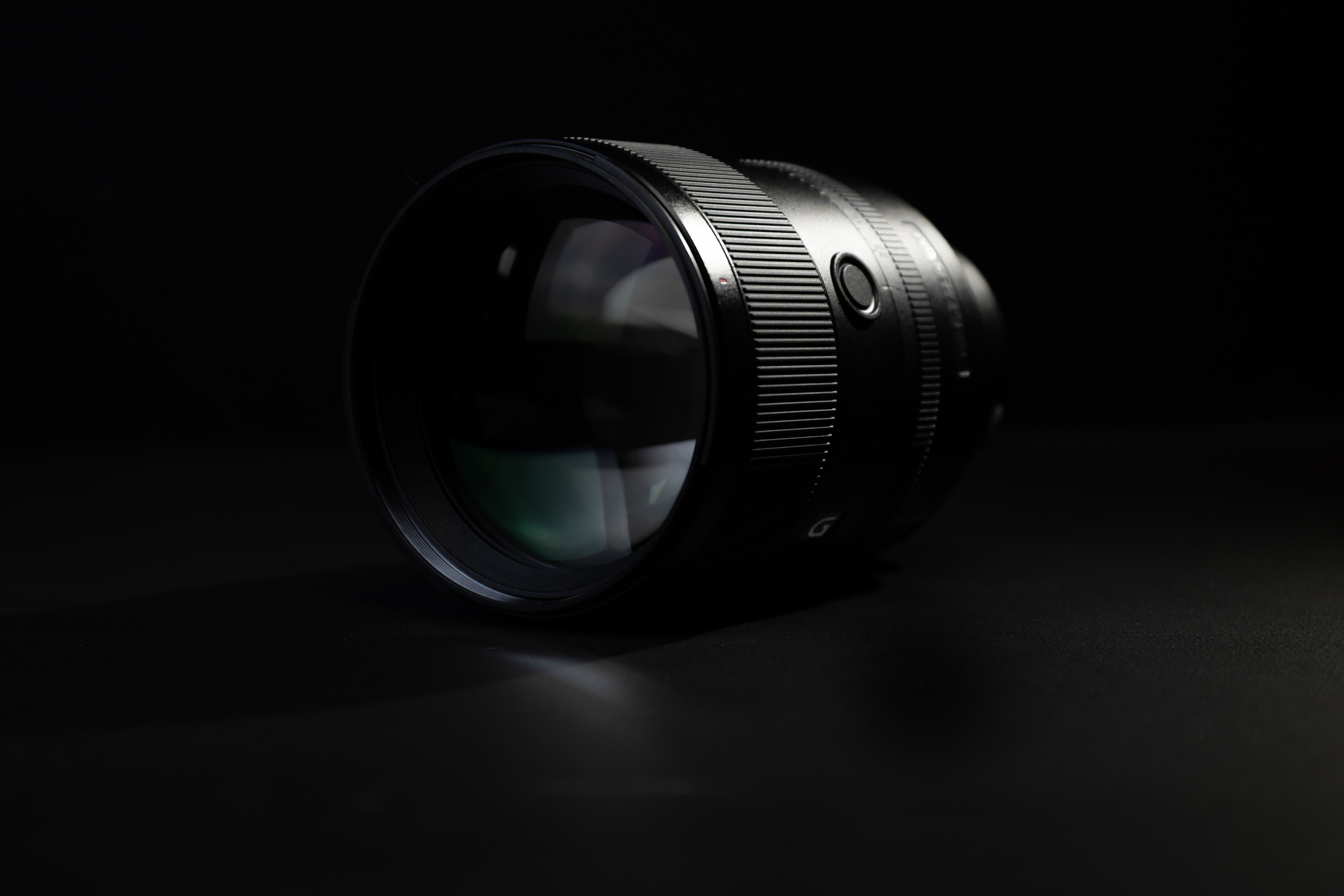
So, this write up is my usual MTF post; 10 new-from-box copies tested and averaged. They are Sony’s own copies, however, not the usual lenses we’ve bought off the shelf. I’ll repeat the test in 6 weeks when we get our own copies, but I have no reason to think it will be different. And just to be clear, Sony didn’t hover over me or approve my results; they’ll see this blog post for the first time exactly when you do.
A Bit About the Lens
I was permitted to share a bit of the background I was given on this lens; it has some new features. The paired linear motors moving two separate focusing groups haven’t been done before. There have been some attempts at paired focusing groups in zooms, but not in primes, and the pairs have generally been one ring and one linear motor. Also, these are new linear motors (depending on how you count, 4th generation) that are much more powerful and robust than earlier ones. This is the same motor design used in the Sony FE 400mm f/2.8 GM OSS lens, which we showed you in the teardown of that lens.
If I understand correctly, this focusing system allows the 135mm f1.8 GM to execute up to 60 AF instructions per second. {Correction: I misunderstood this part during the teleconference. What was said was that the A9 can give 60 instructions per second, and that this and the 400 f/2.8 come closest to keeping up with that.} That is faster than anything else Sony has made and does it to a higher degree of accuracy than they’ve achieved before.
Optically, the lens has what Sony’s engineers call the largest ‘extreme’ aspheric element ever made, and it’s up in the front of the lens, which they say helps both sharpness and bokeh. I think ‘extreme’ aspheric may be more of a marketing, than an optical, term. But what was very clear is they have (and I saw micrographs to demonstrate it) been able to polish this aspheric to a smoother degree than has been possible, reducing or eliminating any onion-skin bokeh.
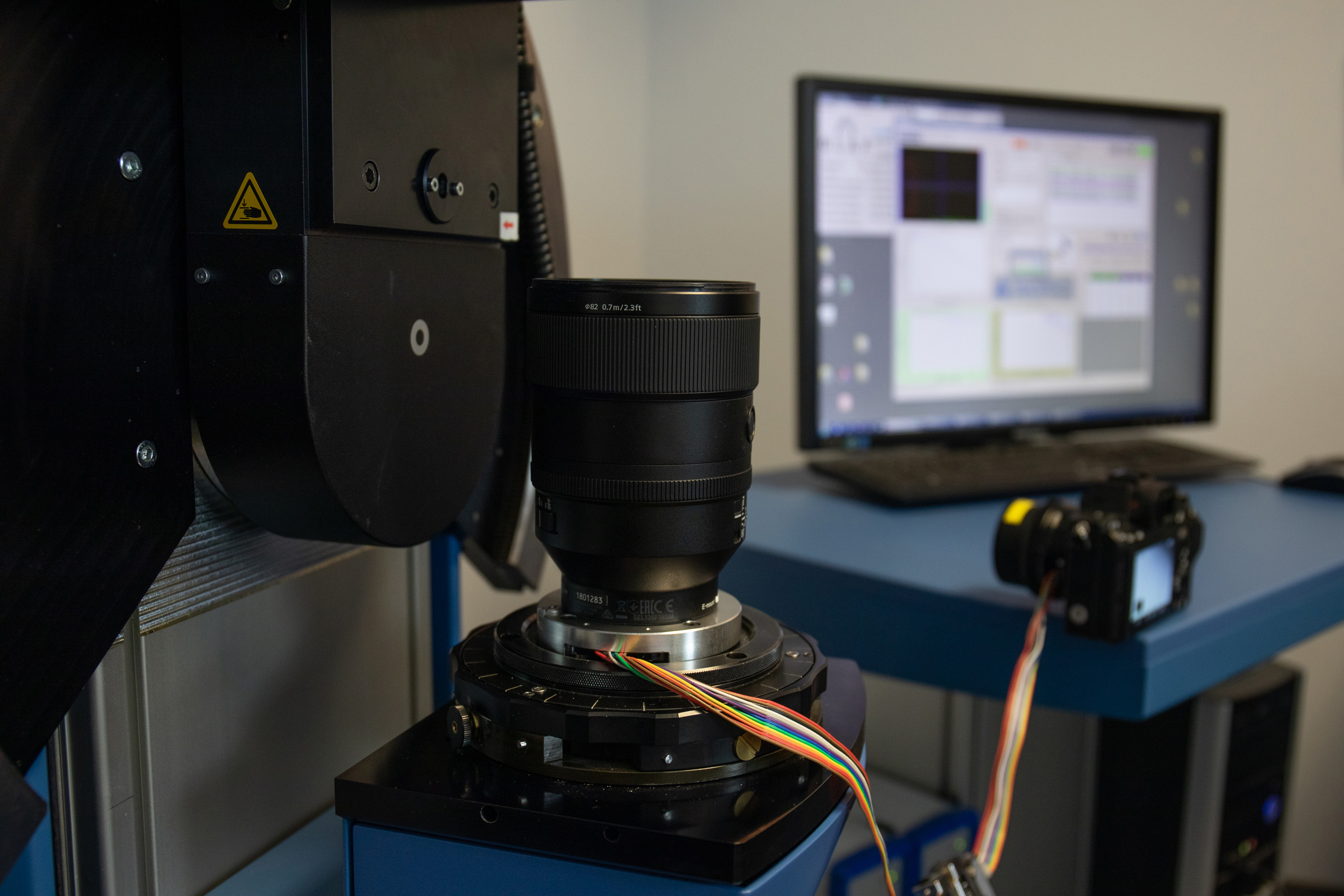
There were more features, like the 11-blade aperture and the aluminum-magnesium composite chassis (the same material used in the Sony 400 f2.8 again). I’m not trying to make this into a lens review; it’s just my report of MTF tests. But I wanted to let you know that I was really impressed by the discussions I had with Sony engineers. As many of you who follow this blog know, ‘impressed’ has not always been my opinion of Sony’s lenses. But I’m impressed this time.
MTF Results
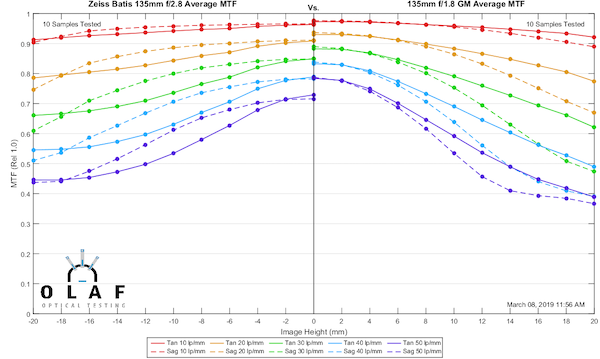
Let’s make this simple and straightforward. In the center, that’s the highest MTF I’ve seen on a non-supertelephoto lens. The highest. Let’s put particular emphasis on the purple line, which is 50 lp/mm. That’s a higher frequency than any manufacturer tests (that we know of), appropriate for fine detail on the highest resolution cameras. We would consider an MTF of 0.5 at 50 lp/mm to be very acceptable. This is hugely better, nearly 0.8 in the center. We’ve never seen that kind of resolution before.
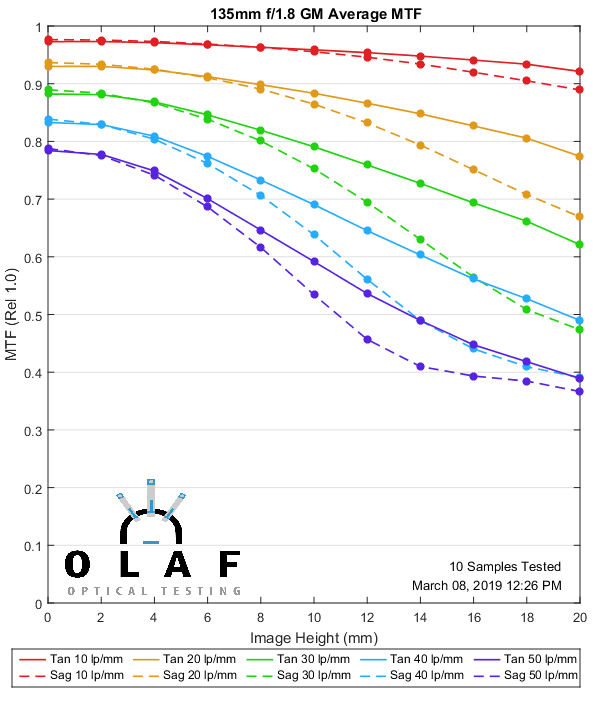
The MTF drops away from the center, of course, but even at the very edges, the readings are still quite high.
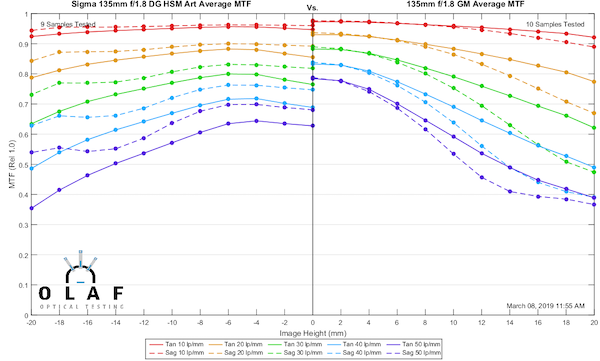
Let’s compare it to the Sigma 135mm f1.8, which until today was the sharpest 135mm we had tested. In the outer 1/2 of the image they’re pretty even, but in the center half, the Sony GM is dramatically better, especially at higher resolutions.
I’ll also throw up a comparison with the Zeiss 135mm Batis, which is really excellent, although not wide-aperture. The Batis has a considerable advantage since it’s being tested at f/2.8. Even at f/1.8, though, the Sony 135mm GM is clearly better in the center half of the image.
But Wait! There’s More!
Aaron brought up that this was the highest center resolution either of us remembered seeing on standard testing, with 50 lp/mm reaching a ridiculous 0.78 MTF. We have, in the past, tested lenses at a higher frequency for ultra-high resolution sensors (150 megapixels). We found that a lot of lenses that were really good at standard frequencies died quickly at higher frequencies.
So we tested the 135mm GM up to 100 lp/mm, something we don’t normally do.
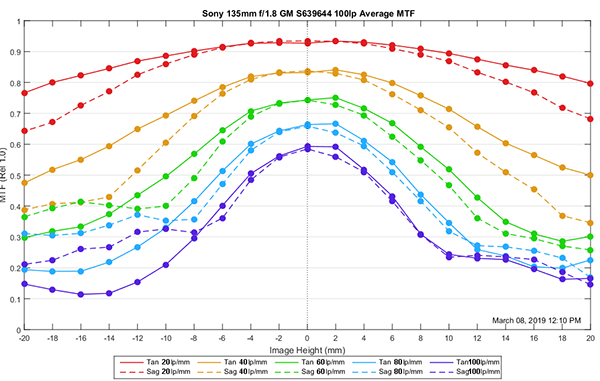
These results are insanely good. At 100 lp/mm the Sony 135mm f/1.8 GM has a higher MTF than most excellent primes do at 50 lp / mm. If you don’t speak MTF, basically that means this lens can resolve fine details that would be a blur on excellent lenses.
Back when we were doing that ultra-high resolution testing we tested all the lenses stopped down to f/2.8 or f/4; there was no way to get the kind of resolution our client needed otherwise. So we tried the 100 lp test at f/2.8. Honestly, I thought the resolution wouldn’t go up all that much. As is so often the case, I thought wrong.
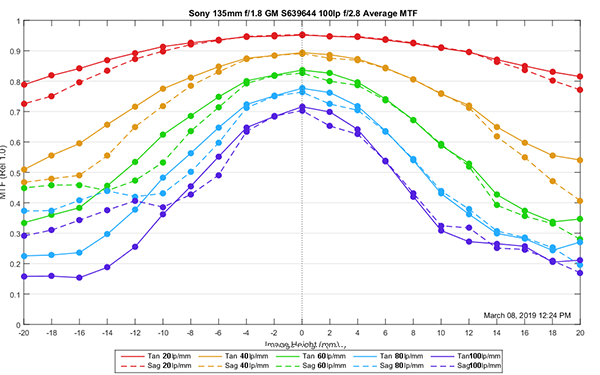
No lens we’ve ever tested has resolved 100 lp/mm this well at any aperture. One other lens was close, but I can’t tell you the name of it. We were under such strict nondisclosure that we never referred to it by name. It was just referred to as ‘the lens in question’ and was a huge prototype. But even that lens wasn’t quite this good at 100 lp/mm.
What does this mean for you? Well, in a couple of years if you are shooting a 90-megapixel camera, this lens will be the one that wrings the most detail out of that sensor. Right now it looks at your 43 megapixels and goes, “that’s cute.”
Summary
This has been an MTF test. It has only been an MTF test. If it had been an actual lens review, I would have 762 images showing you pretty models, dramatic landscapes, and bokeh examples. Lens reviewers will do that in a while; be patient.
But as far as the test goes, the results are pretty simple. This is the sharpest lens we’ve tested. Period. (At last count, that’s out of 300+ lenses tested.)
Roger Cicala and Aaron Closz
Lensrentals.com
March, 2019
170 Comments
Astro Landscapes ·
(Insert George Takei “OHHHHH MYYYYYY” meme here)
Justin ·
“Right now it looks at your 43 megapixels and goes, “that’s cute.”“
Can’t wait for a tear down to see how they did it. Nor can I wait for an 80mpx sensor.
J.L. Williams ·
I’m betting the secret is an enhanced Southern Fairy Tale Ring…
JJ ·
Oh no no no … it needs an ‘Extreme’ Southern Fairy Tale Ring for that.
?
Mike Aubrey ·
And just an hour ago I was comparing the Sigma and the Batis to each other out of curiosity. I didn’t expect this today.
Wow.
Roger Cicala ·
Welcome to my world, Mike. I didn’t expect it ever.
zipduck ·
Good shit, sony.
Brenda ·
The latest survey demonstrates that on average 75% people are active into on-line activities. The internet world has become bigger and more beneficial and bringing an ample amount of money making opportunities. Working at home on line tasks are trending and transforming individual’s everyday lives. The key reason why it is in demand? Mainly because it grants you to work from anywhere and any time. You get much more time to invest with your family and friends and can plan out journeys for getaways. Men and women are making nice earnings of $24000 weekly by utilizing the effective and intelligent ways. Performing right work in a right direction will definitely lead us in the direction of success. You can start to earn from the first day at the time you browse through our web-site. >>>>> PLU.SH/njexd
obican ·
Roger Cicala (from Lensrentals.com) says Sony FE 135/1.8 GM is cute.
Andreas Werle ·
Thanks for this Test, Roger. If I remember well you did the "Ultra-high resolution Testing" at 200 lp/mm. The Sigma 135/1,8 made 35% contrast and the Otus 85 mm ca. 40%.
https://www.lensrentals.com...
j.a. ·
I thought it would be sharp but these tests put this lens in pixel peepers heaven!
I guess that results in 50lp/mm and 100lp/mm means heaps of micro contrast which is truly amazing
Jimmy Andino ·
Considering the outstanding motor advances in Sony’s new FE 400, 24 and now 135mm lenses, I wonder if there is ANY chance Sony might redesign the motor for their amazingly sharp but kinda slow focusing 85/1.4?? Roger, could you ask Sony about this?
Roger Cicala ·
I can ask them, but if they tell me it’s under nondisclosure. But you’ll be able to tell when they do, it will be called a Mk II.
Larry Templeton ·
Has Sony ever made a mk II lens that has involved an optical improvement? I know they updated focus motors in a lot of their most expensive A-mount lenses to work with their A to E adapters. But many times I’ve wondered why Sony doesn’t offer optically improved successors to their lenses—particularly thise with wide appeal— like the FE 24-70mm f/4?
JJ ·
I can’t imagine they will redesign this relatively new lens any time soon …
You can buy the 85/1.8 for AF speed and this 135mm for best portrait ? (I will do it that way)
Alce ·
When Canon plays in the same market as you play….better to have good lenses
Unrest ·
True, and when Nikon, Sigma, Zeiss, Leica, etc. play in the same market as you play….better to have good lenses.
Glynn Williams ·
Roger, thanks for this article. Sony are producing some excellent lenses. I wonder how high MTF reaches on the Sony 400mm F/2.8 compared Nikon and Canon’s equivalents?
cryssy ·
I'm curious about that also, because I have seen some 100% crops of Sony FE 400/2.8 + 2x and wide open it's seems to be a bit softer compared with the Canon 400/2.8 II + 2x III. Maybe it's because of the design to make it more lightweight and balanced toward the mount?
This theory is confirmed by this tests https://www.the-digital-pic...
and also this https://www.the-digital-pic...
Seems while they make the lens more lightweight with each iteration, they also made it more softer.
monopodman ·
I think it’ll be very similar. It seems that regular primes only now approach the performance level of supertelephoto primes and that’s why we see such incredible lenses like 135 GM – so much better than older designs. However, 400/2.8 were already at the top of optical excellence for years.
PJ Smith ·
The new sony 400mm 2.8 is a sharp lens, however the Nikon 400mm 2.8 is sharper. I’ve seen both MTF charts, and I own the Nikon 400mm 2.8 VR. The 800mm 5.6 however is probably the sharpest lens in current production. It’s near perfect and it should be for $16,000. The Nikon lenses have 4 large elements, 2 of them being ED elements in the front of the 400 and 800, where the Sony has only one large front element. Sony cheapen out on the new 400mm 2.8, and had to overcorrect for it in the back part of the lens. There is only one element in the front 60% of that lens.
monopodman ·
What about the new Canon 400 III? It uses the same “cheap” technique as Sony and its MTF is almost indistinguishable from the 400 II (and for 600 III it’s exactly the same as II)
P. S. Use Canon JP since they haven’t updated old lenses to their new MTF calculation technique for their US website
Also, if we take teleconverters into account, then Canon and especially Sony are better. I can’t wait for native mirrorless TC (and native primes) for the Z and R mount
PJ Smith ·
I know, I didn’t say they were bad lenses or not sharp. I just prefer the Nikon design and I would bet my life that the Nikon’s have a T-Stop lower than the other two. You can either have 3-4 large and expensive elements at the front or 1 element at the front and tons of little elements in the rear to correct for the lack of them at the front. They are all great lenses and anyone would be happy with any one of them. I’m not sure what you mean about teleconverters, because the newest Nikon TC-14E III is amazing. I have one and can not really see any loss of image quality and if I had to I would say 5% loss of sharpness.
Unrest ·
+ 1. The Nikon 400 2.8 FL is still king at that focal length!!
xaositectt ·
ah the “sony cheaped out” guy from the sony alpha forums. nice to see you spread the same crap everywhere.
PJ Smith ·
I have never in my life been on Sony Alpha anything, I don’t even own Sony. I have tried out the A9 and I really liked it overall and someday may switch to Sony. However yes they did cheap out on the 400mm 2.8, as it only has one thin front element. If you guys knew anything at all about optics and glass, then you wouldn’t be arguing. A super-tele lens cost so much money because of the hand made, hand ground and hand polished very large front elements. The reason the Canon 1200mm 5.6 cost $100,000 is for that exact reason. It takes a month to make the front elements. Sony also uses a cheap mount on their camera’s, have you ever seen one being broken? You can snap them in half with your hands. Even though the A9 is probably a better camera than a Nikon D5 or Canon 1Dx, it is definitely cheaper to make and feels cheaper in your hands. You guys sound like such idiot Sony fanboys. You know nothing about what your talking about.
xaositectt ·
while I think your ability to pour 2000 characters of random pretentious crap here about imaginary dosagreements is nothing sort of amazing, you are unfortunately still full of shit about sony “cheaping out” with the sony lens. your points about “overcorrecting” and “cheaping out” are the pure nonsensical bullshit of a salty nikon fanboy.
PJ Smith ·
Obviously you don’t know anything about optics. Of course it cost less to produce a super-tele with only one large front element. You just say the same thing over and over again while not actually saying anything. Sony is an electronics company, not a camera or optics company. That is why they have Zeiss and that is why they outsource repairs, etc. There is nothing wrong with Sony or loving Sony. Whatever makes you happy and whatever camera works for you, that’s all that matter’s. I have tried to remain civil and even praise the Sony A9, but you Sony fanboys get so butthurt when someone points something out about your beloved Sony. You are the worst of people in the camera community. You never admit when you’re wrong and you defend Sony, even when I also am saying some nice things about Sony. Why can’t someone like something, but be critical of something else? This has nothing to do with brand loyalty.
John Draper ·
And as an electronics company they are far ahead of Canon or Nikon (probably why Nikon uses Sony sensors in their better cameras). Years ahead in mirrorless and great in “steadyshot” (in camera stabilization, so hand held in slightly longer exposures).
Of course, like anything there is a downside – IMO. No mirror to protect the sensor from dust and debris esp. when changing lenses. Maybe should have a curtain to close when a lens is removed and auto open when the camera is on. Just my opinion.
xaositectt ·
I didn’t say anything “over and over again” 😉 you didn’t even manage to read the 3 lines I wrote you without making up random shit about it.
your comment is nothing but a word salad about random topics and personal comments about sony fanboys, which for some weird reason you think I am, a person who doesn’t even own a sony camera 😉 and your personal comments are basically just “NO ITS YOU WHO IS A FANBOY”. are you like 12 year old? how about instead of rambling like a childish moron you provide explanation or evidence as to how Sony “cheaped out”, a retarded statement that you pulled straight out of your ass.
Roger Cicala ·
Neither Nikon nor Canon ‘hand make’, ‘hand grind’ or ‘hand anything’ on the current supertelephoto line. The 1200mm f5.6 yes, but that was long ago in a factory far, far, away.
PJ Smith ·
Oh ok so machines and robots make everything on the current super-tele lenses. I guess the videos from inside the factories are faked. So your saying Nikon and Canon do not hand assemble, inspect and polish, etc. the glass on pro-level glass. So everything I have read and witnessed over the years is all fake? Also since you chimed in with the Sony lover’s, would you not agree with me that the Sony 400mm 2.8 would cost less to produce than the Nikon. Seeing as it has one front element and not four?
Roger Cicala ·
Of course they hand assemble. To some degree they hand inspect. But no, they do not hand-polish or hand grind any lens elements, neither in the current supertelephotos, nor in any other current lens.
Thinkinginpictures ·
I hope for your sake that before you published this, you stocked up on your order the 135mm GM. Lensrentals shipping is about to go into overtime in April.
KarenEngel ·
Was considering adding the Sigma but now have to wait for the 135 GM photographic tests…
JJ ·
The first comparisons I found showed very similar rendering with an A7riii. AF at low light and AF speed is where the Sony is definitely better. Less weight.
And I love this aperture ring!
Dave Hachey ·
Dammit Roger, I was all set to buy the Sigma 135/1.8, and you spoiled it for me. Now I have to get this lens, and that secret Sony 100 MPx body to go with it. My wife will be pissed. I also need a wide angle landscape lens to go with it. Now my kids will be pissed too, it’s coming out of their inheritance. Luckily I have some Canon stuff to sell.
monopodman ·
Won’t they inherit the lenses as well?
Dave Hachey ·
Hard to split a lens without decentering it. My kids never liked to share.
Cdave ·
Tangent.
I’m curious if you’ve ever looked at the inexpensive but (I think; for what it’s worth, LensTip compared it favorably to the Zeiss APO Sonar 135/2) excellent Rokinon 135/2. I don’t imagine it can quite compete, but for under US$500 (!) it earned a place in my bag. I use it on APS-C, and think it is spectacular. Yup, manual focus and unstabilized.
Roger Cicala ·
It is very excellent and a true bargain for the money. UNLESS you expect 4 equal corners. I’m not being snarky, I think 135mm is a long portrait or short action lens and corners shouldn’t be critical.
Frédéric Auchère ·
Thank you for the all the very informative tests. For comparison, do you have the MTF measurements for the Rokinon (or Samyang)?Doing astrophotography, so the MTF comparison would be super interesting.
Originaru ·
100 lpm will be my point of interest in the next reviews, i wonder if this dramatic quality is related to the mithycal 3d pop.
Muster_Mark ·
Absolutely outstanding. By the way, what is the correct way to compare MTF results between sensor formats? My understanding is that for smaller sensor formats one looks at higher lp/mm numbers to get comparable results. Is there a way to make this precise? Thanks.
Roger Cicala ·
You are correct. And there is. And I’m not going to talk about it because then 498 people are going to start about why the correct way is meaningless because they don’t like that. Then 837 people are going to start in about depth of field; there will be anarchy; and well, life is too damn short.
JJ ·
Ohhhh … give it a try for the tech nerds here. They deserve to get feeded with some facts and math. ?
I bet it’s about pixel size? (20Mpix on m43 are xyMpix on FF and you need the same resolution of the lens for them?)
Them Bees ·
I imagine pixel pitch is the more appropriate measure, since you are concerned with pairs of lines.
Michael Sandman ·
But wait! It’s meaningless because the pixel size is important as the number of pixels and the depth of field will cause bokeh to be different with a different sensor size…
Ok, now you need only 497 nerds of one sort and 836 of the other. Meanwhile, thank you for publishing this ( and all your other resolution tests and tear-downs),
Hunter45 ·
“feeded”???? I don’t think that is a word. And spell-check flags it, too.
Michael Clark ·
I bet it is about different enlargement ratios for different format sizes to be displayed at the same size. That goes for both lp/mm and DoF.
David Alexander ·
I’ve yet to see anarchy among the followers of this blog. Perhaps in the forums, but surely you’re not monitoring those? We like when you pontificate.
Michael Bielecki ·
Roger, you said some very nice things about the a-mount 135ZA years back. Does the GM put it to shame as badly as it put the (quite decent) 135 Art to shame?
Roger Cicala ·
The ZA was a rebadged Minolta and a superb lens in the day. But no lens from that time period could resolve fine detail like this.
Michael Ogle ·
What lens was it rebranded from?
Michael Bielecki ·
While I don’t expect the 135ZA to match the modern performance of the new 135GM (after all, the Zeiss 135f2 APO does best Sony’s A-mount version), I am surprised to hear that the ZA was a rebadged Minolta. Perhaps it was a design Minolta patented, but never put into production? Very interesting.
Roger Cicala ·
My apologies, that was an error on my part – I was traveling all day and shooting too quick off the cuff. It was not rebadged, but I was told it was originally a Minolta design way back in the day.
Mike Fewster ·
The role of Minolta in Sony lens design is interesting. The whole Minolta lens department went to Sony. Minolta lenses, when they went for it, were just superb. It is probably impossible to determine all the DNA today but I’d love to hear from someone inside the lens division of Sony discussing the amalgamation of the Minolta optical engineers into the Sony camp.
roXplosion ·
I think the confusion is with the 85ZA, which (superficially) resembles the Minolta 85/1.4G. It is a different design, but quite often (mistakenly) described as a re-badged version of the Minolta. The ZA135 was a completely new design, there were no similar Minolta lenses.
DV ·
This is correct. The 135 1.8 ZA has no prior Minolta version and was a new by Zeiss design for 2006. It was not a rebadge or old design.
The 135 ZA was one of the sharpest A-mount optics ever made, but thirteen years is a long time in lens design and it was only just edged by the Sigma. Its main flaw was the fact that it relied on the in-body AF motor and the AF was not fast.
roXplosion ·
I finally acquired the 135ZA about a year ago, and it boggles my mind that something could be better than this lens (I’m not doubting reports of better lenses— it just boggles my mind). I use it for concert photography and the AF is just fast enough for an acceptable number of keepers from a dark punk show. The GM is quite a temptation to move to E-mount.
DV ·
It doesn’t surprise me that the sigma is “better” than the ZA in resolution because it throws more glass at the problem. The fact that the 135 GM beats the ZA and the Sigma while weighing less than the ZA (950g for GM vs 990g for ZA) is impressive indeed.
Marvinski ·
I don’t think that is entirely correct. Technically the 85ZA is a rebadged of the Minolta 85/1.4G(D), the Zeiss touch is the extra element at the end for the extra correction to meet the Zeiss standard. Which magically get the Blue badge and image quality rival the legendary Minolta 85/1.4GDL.
More on this is…I’m sorry for all the Sony Zeiss fans is….non of the Sony Zeiss are designed by Zeiss…they are all designed in house by Sony, and “approved” by Zeiss….So technically most if not all the early A mount ZA was a rebadge/modified Minolta lens (either from prototype or old design)….hence that why I like the Amount ZA than the Emount ZA
roXplosion ·
My understanding of the Minolta/Zeiss differences and origins is different, and I’m sure would be a fascinating discussion… but much off topic here.
Marvinski ·
Yes, that would be a very interesting discussion.
By not going off topic too much…even tho I already did….I just leave one more piece here…just food for thought to save it for another day.
https://uploads.disquscdn.com/images/6f45ea0d143b461c0b08ec6011475fc83a569114e8751a3f73ac9325b89a77f7.png
Unrest ·
A bit of an exaggeration to say the GM puts the 135 Art “to shame”.
DrJon ·
Is there any way to tell if this lens requires software correction for distortion, etc., which would mean that users with cameras won’t get this level of performance?
Roger Cicala ·
It didn’t have a lot of distortion on the bench, so I can’t imagine they’re corrective too much .
DrJon ·
Thanks, I feel there must be a level of correction where the performance takes a dive as the pixels are just getting spread too thin, but don’t know if that could be built into bench testing, you’d need to know the algorithms (the parameters being in the lens)? I find it interesting that on some lenses the DXO corrections give me a noticeably different FoV to standard m43 ones, for example.
Michael Ogle ·
How does this compare to the sony 90mm macro?
Roger Cicala ·
No comparison. Not even slightly close.
abcjeff ·
Better or worse?
Them Bees ·
Shouldn’t that be fairly obvious from the content of the review?
JJ ·
… at infinity focus. ?
Roger Cicala ·
OK, at infinity focus the Sony 90 Macro is not great compared to other similar range macros because sample variation is extremely high. At close focusing tests it’s excellent and variation is lower. But the best single copy 90 Macro I’ve tested at infinity is not as good as the average 135mm GM.
Hopefully that clears things up, although I’m sure we’ll have to have 3 or 4 ‘my 90 Macro is awesome’ comments. There are good copies at infinity out there. In fact over half of them are really good. Not most, but over half.
Alfonso Bresciani ·
waiting for mine!!!!
Katharine Elizabeth Henry Alex ·
….I’m not a tech person so what I’m getting is “New lens good. Sharpest lens. Will need to sell kidney to get it .”
John Talstad ·
So, you got ten copies.
How was the copy-to-copy variation?
Roger Cicala ·
John, it was low but lets repeat these were Sony’s lenses, not production run off the shelf lenses.
Sean ·
I bought the Rokinon 135/2 in 2015 and I believe I have the greatest copy ever made. In fact, if I were to sell it today with it's perfect bokeh (e.g., https://www.flickr.com/phot... ) and sharpness, I could easily get $1,200 for it used (just believe me because I believe me; it's that good). But even with the greatest copy ever made, I am still strongly considering the new Sony FE 135/1.8. I can't help it.
Roberto Vivancos ·
Sony: Take my money
Sezai Ercan ·
In your tags you state that this is an OSS lens: “Sony FE 135mm f/1.8 GM OSS”. Can you confirm it has optical stabilisation? I looked at many photos of this lens and also went through some descriptions and could not confirm any OSS built into this lens. But perhaps those were all pre-pdroduction copies and the real thing will have OSS?
Roger Cicala ·
I didn’t make the tags, but it is not OSS.
Sezai Ercan ·
Ok. Thanks for the heads up.
Michael Pierce Mystro ·
Wow! Go Sony.
Matthew Breitbart ·
I’d be curious to see how it stacks up against the Nikon 200mm f/4 Micro, at least in terms of sharpness…
Ben ·
Are you all going to tests GF lenses at some point?
iKonOkLasT ·
Should have a Zeiss 135 APO comparison…
Larry Templeton ·
That might’ve been more or less addressed in the “This is the sharpest lens we’ve tested. Period.” remark. IDK. Maybe the Otus 100mm has an more sinister trick up its sleeve.
The progress we’ve seen in lenses has been so fast that many yoots of today do not even understand why or how a 50mm f/1.4 prime *wouldn’t* be sharp wide open and into the corners.
Collectively we all participate in moving the goal posts just as fast as progress can be made, and sometimes faster—which leads to the worst types of complaining…about weight, or size, or the way some focus rings appear to collect dust faster than usual.
iKonOkLasT ·
Not really. Something happened with the early Zeiss ZE/ZF2 datasets and Roger has never really corrected them or amended the older articles. Should also get in touch with Bryan Carnathan as I believe TDP is using some of the older data.
Charles FX ·
What happened with the early Zeiss datasets? I remember Zeiss had to come in at some point to recommend / refine the testing done on their Otus MTF’s ? Seem to be a lot of variables / changes to these MTF tests done here…. Sony supplying units also skewing data no doubt – be interesting to see the retail editions…
Roger Cicala ·
As you wish.
https://uploads.disquscdn.com/images/9a8bedc709d3a5d1f2a4cf48a7a84fb720fce08318fa55f304e47c8594986c6c.png
iKonOkLasT ·
Thanks!
Edward Avis ·
Very impressive. Do you have a comparison for Canon's 135mm f/4 tilt-shift lens?
Erkan Özgür Y?lmaz ·
OMG I’m now blown away, I know how sharp the Zeiss is, and this charts makes sense now. Thanks Roger.
David Bateman ·
“showing you pretty models, … Lens reviewers will do that in a while; be patient.”
Skip the lens review, you will have pretty models in the future? Will this be you and Aaron in bikinis?
Or will you take photos of Star wars models, like the millennium falcon?
Roger Cicala ·
Duh! Star Wars models. https://uploads.disquscdn.com/images/81e9c41125288f5287b6bd19916082ab1cd8abce9b42234ca384e8e82df6ace4.jpg
Søren Stærke ·
Nice Thorlabs snack boxes in the background 😉
geekyrocketguy ·
They’re the best part of any Thorlabs order. 🙂
Roger Cicala ·
ABSOLUTELY!! And then the boxes make very handy small parts bins.
Although note to Thorlabs: Don’t send “Memphis barbeque flavor” chips in the snackboxes going to Memphis. We know better.
T N Args ·
Hi Roger, are there any consequences to having a steeper sharpness drop-off from centre to edge, vs a lens with a lower peak but more consistency across the frame?
Mike Earussi ·
It’s the ultimate portrait lens. A landscape lens needs to be more consistent across the frame since the edges are also important.
Roger Cicala ·
What Mike said below for certain. But there will be a different ‘look’, especially out of focus areas. I think that’s more of a preference thing, and less of a this is better than that thing. Nikon, for example, tends to value that smooth side-to-side look in their lenses more; while Sigma and Sony tend to value highest resolution.
For me, I like the even side-to-side kind of lens in a wider angle (maybe partly because that’s harder to pull off) and give me center resolution in the longer ones since I tend to use those as portrait or action lenses. (Probably should mention I also tend to center my subjects in shots and then crop for placement rather than shoot them off center.)
T N Args ·
Thanks Roger, it’s very interesting.
dafranklin ·
Roger, maybe you can’t comment on this, because you may not have tested it, but I wonder how this excellent Sony lens compares with the Canon EF 200 mm f/2.0, another lens with a very good reputation, and also not a super telephoto.
Roger Cicala ·
I have tested the Canon, not to 10 copies, but close. The Sony is a bit sharper in the center of the image, but I think we’re getting into the ‘splitting hairs’ area here.
bokesan ·
I’m in complete agreement with this lens – 40-50 mp _are_ cute. I want more of those 😉
Not that worried about my older lenses though. I’ve often seen false color using a 70’s F-mount lens on the Nikon 1 J5. A FF sensor with the same pitch would be 150mp. Yes, that was center and slightly stopped down, but I’m really looking forward to using the same lenses on a 100mp FF body. I think nobody should be worried about their Otuses getting outdated at this time, even though sharper lenses are cropping up everywhere.
Sami Reinikainen ·
Is there finally something sharper than Sigma 50-100mm?
Roger Cicala ·
In a zoom? No. But don’t fall into the ‘zoom sharp as a prime’ trap. Center? sure. Edges? Nope.
CheshireCat ·
I wonder how much being “Sony’s own copies” is affecting the results.
I was impressed by how much sharper my brand-new off-the-shelf Canon EF 135/2 came back after being sent to Canon for proper tuning.
Roger Cicala ·
My own question is more about copy-to-copy variation. These were very consistent but I won’t consider that real until I see off-the-shelf lenses tested. But certainly most of the off-the-shelf lenses should be this good. Perhaps nearly all.
Mike Earussi ·
Your bench tests are all well and good (or exceptional) but now try and get that resolution in a real life outdoor portrait session handheld (it is designed as a portrait lens after all). Even with Sony’s IBIS I’d be very surprised if the max resolution could be obtained. Still, this would make for an interesting test if you choose to do it.
Roger Cicala ·
Mike, I think if conditions and technique were excellent (say mirror lock up, manually focused, mounted on a tripod shot) you’d notice the center difference on a high-resolution camera. But I agree with you; hand-held normal shooting I doubt the Sigma and Sony are noticeably different.
Mike Earussi ·
That’s what I thought. This also means that any future increase in sensor resolution will also negated by hand holding.
Akvinat ·
It will be like with car top speed. Some cars have higher top speed than others, but it rarely matters…
GuyWith ·
You’re forgetting about handholding’s best friend—the strobe. Good studio strobes give you a motion-stopping 1/12,000 of a second flash duration. If you want to gang a bunch of speedlights you can get as fast as 1/40,000.
Regardless, if you are shooting portraits you have to use a tripod because it breaks the flow if you stop everything to adjust lights when you drift out of place. The tech is there; might as well use it.
monopodman ·
I’ve seen “professional” portrait photographers whose every photo had noticeable handshake and misfocus. And some even use top of the line lenses (85/1.2L, 200/2L, Sigma 135/1.8 etc) and somehow claim they appreciate their superior resolution!
But I’m still sure that it’ll be possible to extract this lens full potential with proper handholding technique and fast SS. And honestly, I don’t care if I’ll be able to see the difference between the top 135mm lenses because those are the best lenses optically in absolute terms after supertele primes.
Also, I think this lens is targeting sport and action as much as portraiture
Mike Earussi ·
With the extra added AF motor (hopefully) increasing its AF speed, it has the possibility of being an excellent sports and action lens. If fact this may prove, under real world conditions, to be more important than its exceptional resolution.
mclaren777 ·
I never trust manufactured-supplied stuff for reviews (lenses, cars, etc) so I look forward to your testing of retail units.
Ernest Green ·
Looks great. Big fan of your articles. Love me a blazingly high MTF 50 line pair chart. I wonder though if these relative differences (super high performing lenses vs. “normal” ones) can be realized at normal resolutions everyone views photos on. I’m guessing usually a cellphone (instagram) or best case, flickr, full screen on, say, a 24″ monitor. Or even printed 20×30. In other words, when does your typical medium grade prime or zoom start to fall short in real world use?
I suppose billboard size it might start to make a difference? How about physically large medium format glass. Easier fine detail resolving power due to the size of the glass alone?
i’m no stranger to spending money on good glass if it’s called for. But we live in an age where lots of “normal” glass is really good for practical use. And your occasional large print.
I’ve gotten great photos out of normal lenses. I don’t know how well this will show on this chat thread (compression and all that) but here’s just a regular old Canon 6D (I have an EOS R now) and Canon 100/2 prime. ( From a moving car. And this shows fantastically at very high res. out to the corners. Seems to show fine if you click on it:
https://uploads.disquscdn.com/images/4c3cfa94b395bd1ac47c6c5e0e9d3e753ac2658fe6e024971385fca809fbb336.jpg
Carleton Foxx ·
If I am not mistaken, that particular optic is one of Roger’s favorites, so maybe it’s not the best example of a ‘normal’ lens.
Michael Clark ·
You are probably thinking of the EF 135mm f/2 L. At one time a few years ago Roger said something to the effect that it was his favorite lens at that time.
The EF 100mm f/2 is a more humble lens that is the larger “cousin” to the EF 85mm f/1.8. Other than the differences in focal length and maximum aperture their design is very, very similar. The front six elements (the front and middle groups) are almost identical in concept. Only the rear groups are significantly different.
While not considered “bad” by any means, The 100/2 is not the legend the 135/2 is for many long time Canon shooters.
bdbender4 ·
Well son of a gun. It’s not the same as it ever was.
geekyrocketguy ·
Out of curiosity, will we be seeing MTF results of the Sony 24 1.4 anytime soon? Other sources have reported that’s the best 24 1.4 out there.
Roger Cicala ·
We haven’t been able to keep them in stock long enough to test them.
Nick Podrebarac ·
Looking forward to my rental of it next month…sorry for adding to your problem 🙂
oratrix magna ·
it would be interesting a comparison with SAMYANG 135 mm F2 ED and with the Voigtlander 110 mm f 2.5 apo macro … exceptional lenses …
Eddy Kamera ·
that huge prototype tho…
Friedhelm ·
Will you really see it on a 42MP cam compared to the Sigma 135/1.8?
I doubt it…
monopodman ·
I’m sure that I won’t. But I expected the GM to be slightly worse than Sigma in MTF, not better!
The GM is worth the money because it’s lighter / smaller and guarantees the best AF performance.
Andreas Werle ·
As you perhaps deleted my Post, because I inserted a link to the respective lr-blog-post, i will try it again (without a link):
Thanks for this Test, Roger. If I remember well you did the “Ultra-high resolution Testing” at 200 lp/mm. The Sigma 135/1,8 made 35% contrast (200 lp/mm) and the Otus 85 mm ca. 40% (200 lp/mm), both at f4. As the Sony did 70% contrast at f2.8 for 100 lp/mm and the Otus 85 ca. 70% contrast at f4 and 80 lp/mm, the Sony is or may indeed be a little bit better. But this is of course due to the fact, that the Sony is not as fast as the ca 4 years “old” Zeiss. Anyway, well done Sony.
Greetings Andy
geekyrocketguy ·
I’ve noticed that the LR spam filter sometimes blocks comments with links in it. So your post may not have been deleted by a human, but merely sent to some spam purgatory.
Roger Cicala ·
Sorry, Andy. We have been getting slammed with spam and some of it offensive so we’ve had to set the bots to the tightest filters and it is definitely stopping some posts.
Accutous ·
That this beat Sigma is pretty darned incredible. Now wrinkles will look like butt cracks.
Gerard R ·
Roger, I read that Leica tests their SL line of lenses at 50 line pairs/mm. The 90mm APO SL Summicron shows around 85% contrast for 40 lp/mm in the published Leica MTF charts.
Have you all planned to test the Leica SL lenses? The MTF of the new 35 APO SL Summicron presented at the latest LHSA conference showed above 90% contrast for 40 lp/mm, which should be on par with this 135/1.8 Sony.
https://uploads.disquscdn.com/images/af089ac4e672f4bbc8ebc56657a3282f4c89e552ad88f0ed67befa941af28a57.jpg
https://uploads.disquscdn.com/images/d4f0b177c15be44787c365ba995c0fdd8feb9f9b227414c2e6e123b9ee4d3d9b.png
Roger Cicala ·
Gerard, I do plan to, but we haven’t had a mount made yet.
Gerard R ·
Hi Roger, did you all get an L Mount made yet?
Mike Aubrey ·
Are the Leica MTF charts calculated or measured?
Lines that high look a calculated chart where diffraction isn’t accounted for.
Scott Kirkpatrick ·
Leica’s MTF charts have always been as calculated. But the whole SL Summicron series has MTF charts that look every bit as good as Roger is showing for these, with the 35 (now shipping) the strongest of the lot. Also, This series has two linear motors shifting two separated focus elements, so it is not clear that the new Sonys are the first to do this. I hope Roger and Aaron get their L-mount setup to handle the L-mount alliance products soon, from Leica, Panasonic, and Sigma.
appliance5000 ·
ow does the canon 135 tilt shift compare? Mine seems so sharp I can hardly imagine something sharper – my eyes hurt looking at a photo.
Stephen Cassidy ·
How does the lens compare to the Sony A-mount Sonnar T* 135mm f1.8 Zeiss lens?
Darin ·
It’s better. I own the a mount and the sigma 135 and this shows better than the sigma in sharpnes, and the sigma is better than the a mount sonar. On the other hand the a mount 135 can have truly magical moments, yet to get one with the sigma.
A Canuck ·
This is good reviewing at its finest. Thanks, Roger. The lens does look as if it will be pretty awesome. I like my Batis 135 all the same (I do a lot of hand-held shooting–it’s nice and light for such a long lens).
Manzur Fahim ·
Amazing! Thank you very much for the test, Roger. Much appreciated.
By any chance, would you do a test on the Fuji GF110mmF2 lens?
Roger Cicala ·
Don’t have the mount to test Fuji yet.
Carleton Foxx ·
Shouldn’t we all be freaking out over moiré with such a high res lens?
Claudia Muster ·
A word about copy variation? And I’m sure missing that nice colourful field curvature plot.
Roger Cicala ·
I’m not going to publish variation on manufacturer’s lenses. Not till we get of the shelf copies.
Claudia Muster ·
Sounds sensible. Thanks.
John Draper ·
They are available now.
Chik Sum ·
Hi Roger,
Any insight into other optical correction? Like pleasing bokeh, lack of coma etc.
From what I read and lust for the otus 50mm and 28mm was that it’s a great dslr lens which excels at everything not just shear sharpness, will be interesting to have such a comparison
YS ·
Hi Roger,
Any insight into other optical correction? Like pleasing bokeh, lack of coma etc.
From what I read and lust for the otus 50mm and 28mm was that it’s a great dslr lens which excels at everything not just shear sharpness, will be interesting to have such a comparison
mikko ·
Very impressive numbers there, interesting indeed what this lens accomplishes.
I am new to this fantastic blog – but slowly devouring it 🙂 – so I’m not entirely sure the question I have is pertinent:
Since you have a few Voigtlander lenses for E-mount in your rental catalogue, is there any chance you might carry out MTF tests on them in the future?
I couldn’t help thinking that Voigtlander’s two recent Apo Lanthar makro lenses for Sony E-mount might yield some interesting results. Not to mention a tear-down.
On the other hand, and this goes to the pertinence of my query, I have never found or stumbled on MTF tests on any of Cosina’s Voigtlandet lenses, and it got me thinking that it could be for a reason other than lesser popularity of manual focus lenses, and perhaps contraints imposed by the manufacturer. Not that time and money aren’t the most obvious constraints, and considering that the consumer base for such lenses probably represents a very small niche, it might not be the most obvious investment.
I’m sure I’m not the only one who’d like to see some MTF charts for Cosina’s Voigtlander lenses for E-mount, so at least I could leave that wish here for the record 🙂
Anyhow, having said that, I’ve got some 15 tabs worth of juicy articles on this blog waiting for me 😉
Cheers!
Roger Cicala ·
We have some Voigtlanders, but often not enough copies to do a series. Voigtlanders are particularly high with sample-to-sample variation so I’m not willing to publish less than a full set of 10.
mikko ·
Thanks for your kind reply, Roger.
I have indeed had a few personal experiences with Voigtlander copy-to-copy variation, specifically the UWA Heliars. I believe the Apo Lanthar makro lenses are made with smaller tolerances, though.
Both Apo Lanthar lenses have enjoyed excellent reception by online accounts, and are largely believed to be among the technically finest lenses available for the E-mount. None of the available reviews feature MTF charts, but clearly suggest these could be spectacular and perhaps on par with the Sony 135mm f/1.4 GM.
I own both lenses and can only confirm their fine performance, almost flawless apochromatic correction, beautiful color rendition and saturation, superb contrast and microcontrast, but my geek enthusiast side can’t easily renounce the idea of seeing the measured prowess of some of today’s finest optic designs.
Who knows, perhaps an opportunity could present itself in the future for a more accurate testing scenario.
Thanks again for your reply and keep the stream of interesting reviews, discoveries and tests flowing.
Cheers!
Steve ·
Such nonsense …
Roger Cicala ·
A thoroughly written, well-researched, and complete comment.
David A. Grano-De-Oro ·
This is great. Personally I would love for a lens manufacturer to make lenses that are all apochromatic as well as resolving the football shaped bokeh/ mechanical vignette around the outer frame of the image without resorting to an STF design.
Adam Dosskey ·
Wow!
Michael Clark ·
Actually, he said the Sony FE 135/1.8 GM thought their 43 MP cameras were cute.
Franz Graphstill ·
I have my copy now. It’s awe-inspiring. It really rewards manual focus. It produces razor sharp images wide open.
Martin Huisman ·
In my field of science, when we test ‘something’ multiple times we plot data-points with their respective errors.
Say, standard deviation (SD) or standard error of the mean (SEM).
I’d be very keen to see -in general whenever you test multiple copies- you plot data this way, so we can visually assess in one view how much variation there is accross lenses of the same model and/or between measurements (lp/mm for instance, since usually errors increase along with increase of precision).
Roger Cicala ·
Martin, I think that’s true for most fields of science. In this case we have a lot of errors to consider: Each lens is done at 4 rotations and there is variation in each rotation. For each rotation there is also variation from one side compared to the other. Then there is variation for the 10 different copies for each of the above.
We can’t treat it as 80 measurement points since some, but not all of the measurements are related, being same lens. Although, interestingly intra- lens variation is sometimes greater than inter- lens variation off axis.
We’ve had numerous discussions both with optical science people and statistics people on the best way to analyze said variation. I would guess we’ve had about 6 or 7 adamant opinions, none of which agreed, and another dozen ‘well all of them tell you something opinions about those. Monte Carlo analysis is the accepted method in the optical field, but then no one has analyzed this much data per lens, nor has anyone really done such analysis at high frequencies (variation increases the higher you go).
We came up with a method in house and refined and changed it over the years, but I can’t say that it’s the ‘right’ analysis since smarter people than me don’t agree about it so I stopped publishing it since this is the internet and people love to overreact and abuse things.
Here’s a variance graph that we use in-house. The area is not actually +/- 1.5 SDs (our calculation includes SD, but modifies it slightly) but it’s in that ballpark.
chriswilliams ·
Old Post, New Question.
So, this lens has been on “backorder” for months now. Will the “second batch” be as good as the first? (Is the delay even a manufacturing thing?)
Really wondering if they continue to build top quality even after the first round has sold out…
Franz Graphstill ·
Well, we’ve tried it on the next higher resolution now – the 60Mpixel A7R IV, and the 135 GM is still quietly thinking to itself “that’s cute”.
cameron.hamill@gmail.com ·
Excellent article. Thanks a lot for your MTF charts and for your explanations of them. I’ve learned a lot!
Franz Graphstill ·
What were the results six weeks later, @roger_cicala:disqus ? You mention planning to re-test when you got your shipment. I am guessing that they came out about the same?
Manzur Fahim ·
Just wondering if this lens is still the sharpest, detail resolving lens, in Sony platform, or in any platform? Also would it be possible to review Fuji GF lenses? I love the blogs that you do here.
joel richards ·
Were you ever able to test the copy variance for the 135GM? I’m curious how much the resolution varied? Sony’s earlier lenses were sometimes great . . . but only if you got the rare “good” copy.
sahil brar ·
Roger I appreciate what you do for the community and rarely disagree with your findings but I dont think that the little more centre sharpness should make you declare this as the sharpest whereas the Sigma 135 lens performs way better overall across most of the frame. That clearly qualifies as a superior optic overall. Also the sigma samples and sony samples were not acquired the same way and that makes me somewhat doubt because I kind of adament on the Sigma being the overall winner by a definite margin while keeping its superior rendering still aside.
Hubert Baierl ·
When the Batis 135 was released, back then I had the A7 II, when I tried it in a local story, I was blown away. Knowing a discount will come soon, because the "list price" of 2000 €uro was high, I bought it … and i still love it a lot. It is fully usable at F2.8, which is why having a prime and not some zoom.
I hate to replace the Batis 135 mm, but I will do a 1-on-1 comparison with the SEL135F18GM in a not too distant future. I am still on an A7 IV (now) and curious whether I will notice a big enough difference to also (!) own the SEL135F18GM. Yes, it could well be that my camera body just can't sufficiently exploit the GM speed.
The maximum I would spend on a camera body is the A7RV, but not the A9 or the A1 … too much $.
Subject to how the body line-up evolves the A7RV might become my second body, one day. The A7IV was a big step forward in terms of contineous eye-AF.
If someone has real-life 1-to-1 Batis 135 mm to SEL135F14GM image comparison and experience to share, I'd appreciate that, to complement to my yet to come own findings.
Back to the Batis 135mm: Zeiss publishes typical measured MTF data, not the "marketing material" that you see from Sony. When I saw the Zeiss Batis 135 MTF, I knew what I am gonna get. I am not disappointed. Looking at real MTF, as opposed simulated and free of diffraction from Sony, is always one of my key criteria when considering a lens. (yes, we all know, that's only the beginning, but if the MTF is lousy, the rest can't make up for it)
aloha from Germany
Hubert