

I’ve been doing lens stuff for a long time now. Long time. Trust me; it’s hard to remain polite the 843,911th time some newbie goes into hysterics because there’s dust in their lens. Telling them it doesn’t matter a bit, and that all their other lenses have dust they just can’t see ( because different optics magnify dust more than others, or because they’re using some puny little baby light to look into their lenses) won’t stop the hysterics, I know. But I’ve reached a Zen place of peace and contentment and can generally ignore them and not respond.
I get a bit less Zen when they come back a day or two later and scream in all caps, “THEY WANTED $350 JUST TO GET THE DUST OUT”. I can ignore that when it’s some online forum, although I will admit ‘ignore’ in this case generally means not hitting send after I spend 20 minutes writing a two-page response in quatrains with multiple references.
Every so often, though, someone emails me and offers me a ‘reasonable’ price (usually about $50) to clean out their lens. At this point, everything is not Zen, and a day or two later I typically regret the snarky response I made telling them why my charge would be twice the original sales price of the lens in question.
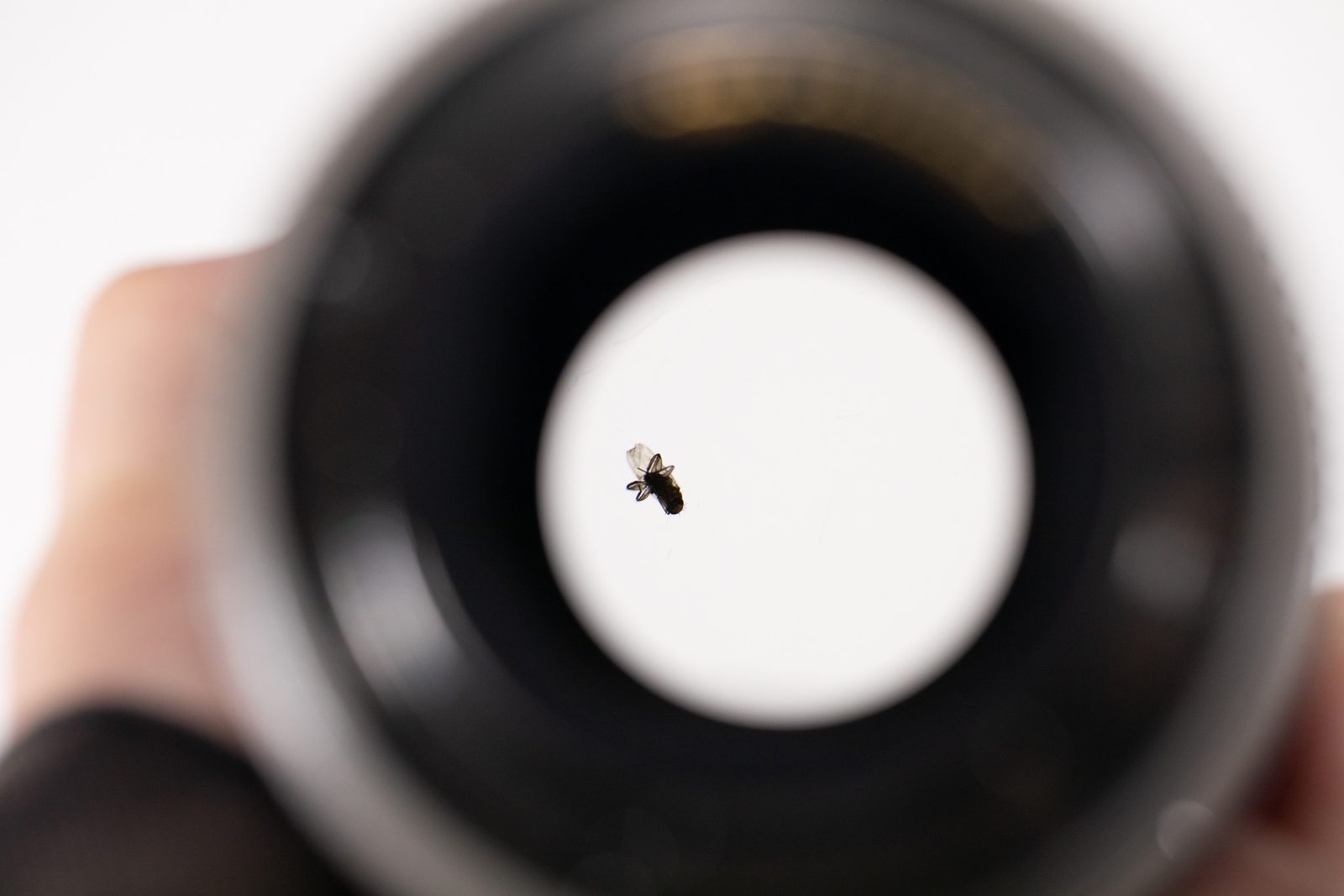
Anyway, we had a Canon 70-200mm f2.8 IS II lens come back from rental with a fairly large sized fly inside. It’s hard to take pictures of a fly deep inside a lens, so we put the lens on a white box to do it; that’s why it appears rather backlit. Here’s the fly as viewed from the rear element.
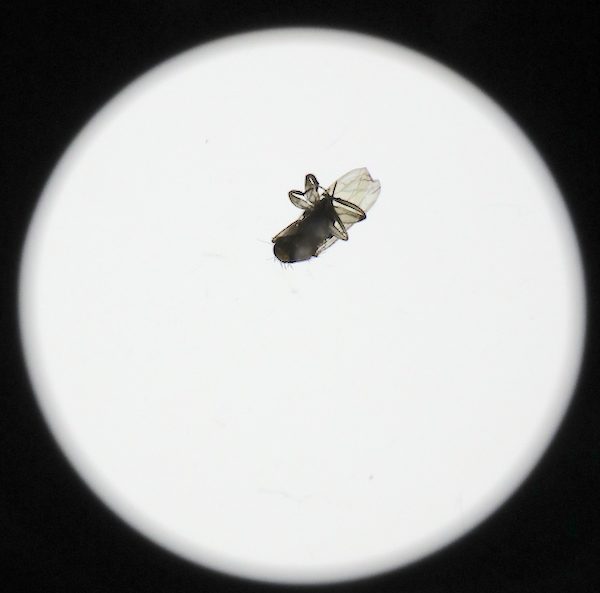
In case any of you entomologists want to take a shot at telling us what kind of insect this was, here’s a close-up.
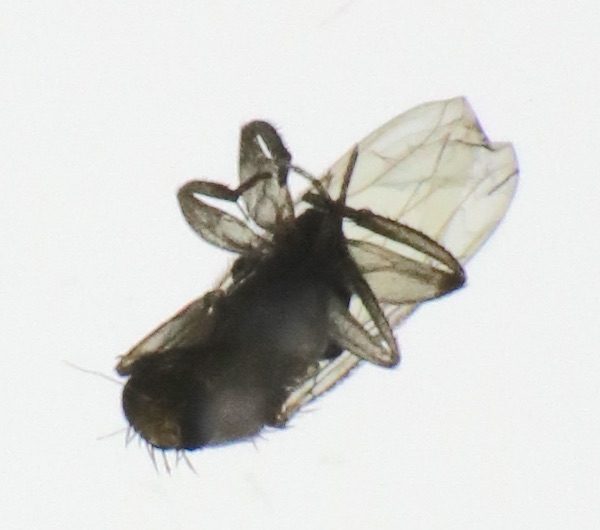
Of course, if there’s going to be a fly in the lens, it’s going to be way deep inside where it’s really hard to get to. I don’t know why flies do that, but I promise you they do. You never see a fly just under the front or rear element. They get into the deepest groups, leaving little fly parts all over, and usually, get smushed by the zoom or focus element.
So, this seems like a good time to do a blog post showing that 1) this big-ass fly had almost no effect on image quality, so that little dust speck you’re frantic about sure doesn’t, and 2) getting flies (or dust) out of a lens is a lengthy and difficult process that takes a long time.
Now I think we all agree that the fly really did need to be removed, but by the time you finish this post, hopefully, you’re going to agree with me that that dust speck in your lens probably is just fine right where it is. Not to mention, I bet there’s a really good chance that if we remove this fly, the lens will never have another fly episode. If we remove some dust, though, there’s a 100% chance there will be more dust in the lens in a few weeks.
How Does a Lens Perform with a Fly in It?
Pretty well, actually. We took pictures of test charts, even ran a complete set of MTF tests. We took images stopped down, and at all focal lengths.
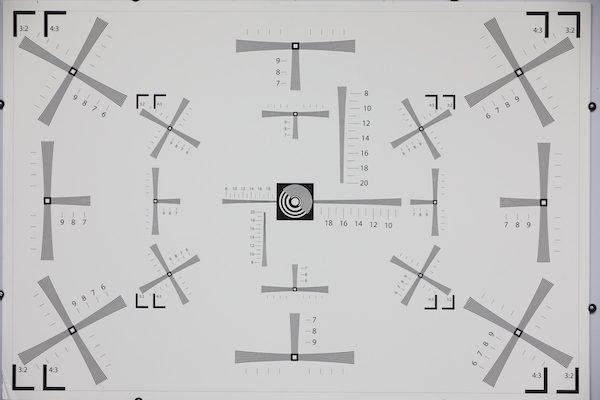
There was no sign there was a fly inside the lens until you stopped it down to f/13. Then we started to see a shadow.

Stopped down to f/22, zoomed back to 70mm, and focused at minimum focusing distance, we could get a pretty sharp, black blob. Just so nobody claims ‘see, that’s why you don’t want dust in your lens’, I’ll add there’s lots of dust and a couple of detached fly legs lying around and you don’t see any sign of them. Takeaway message: if your dust spec is smaller than a fly (about 4mm by 1.5mm) it’s not showing up in your images.

So Let’s Go Fly Hunting
We’ve already done a complete tear-down of this lens, so I’m just going with an overview of the disassembly for this post. We start by getting the rear barrel off. The rear baffle pops out.
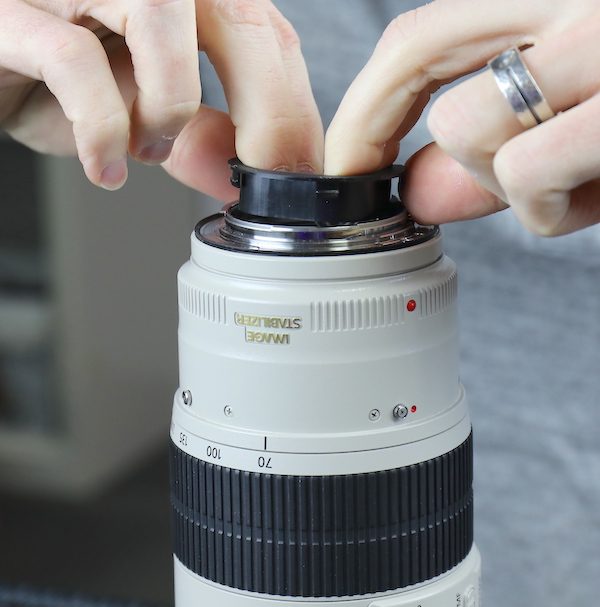
Then we take the screws out that hold the electrical connections to the bayonet (already done in the photo) and remove the 8 screws under the tripod ring that hold the outer barrel on (being done in the photo).
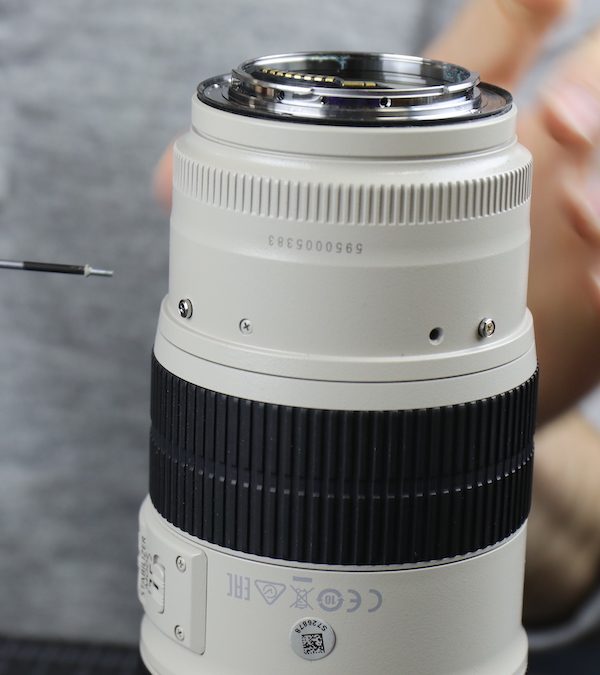
After the screws are out the rear barrel slides off, showing the electrical chaos that is the back of the Canon 70-200 f/2.8 Mk II/III.
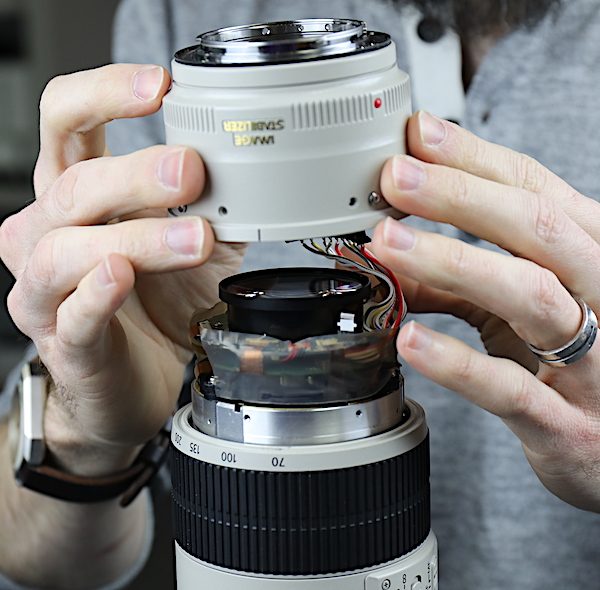
Next the zoom rubber is peeled down, the screws holding the zoom barrel removed, and the zoom barrel comes off.
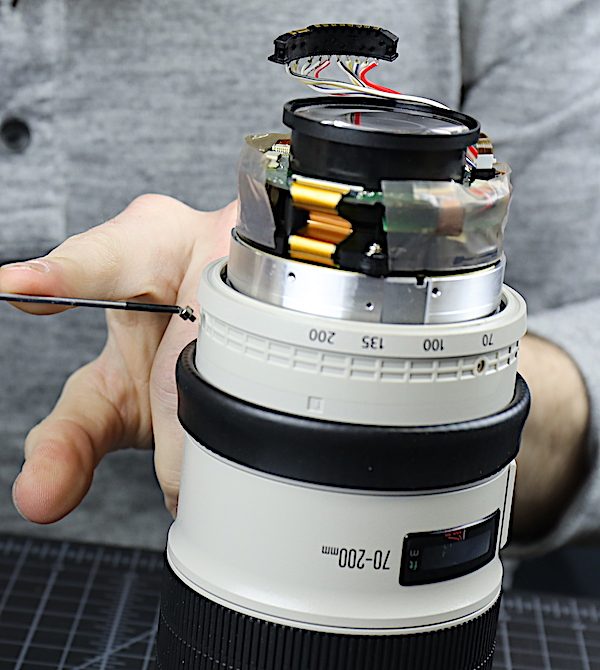
This exposes the reverse gear mechanism. It’s there so when you turn the zoom ring one way, the internal zoom barrel turns the other way. Because, why not make something simple as complex as you can? (There actually are good reasons for this; I’m just tired of 70-200mm zooms in general so I feel like mocking them. No lens is more tightly packed full of complex stuff than the 70-200 f2.8 of whatever brand. More stuff, if you work at Lensrentals repair department, means more stuff that breaks and more stuff to take apart to get to the stuff that’s broke.)
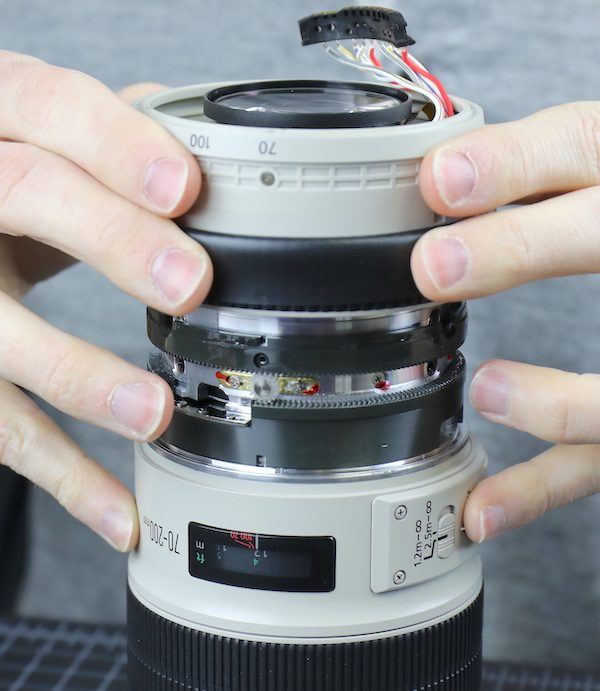
Speaking of electric chaos, the rear element needs to come off next, which means undoing the tape that keeps everything stuffed into a barrel shape, undoing 613 flexes from two (yes two) PCB boards, and then removing the screws holding the rear element in place. If you’re doing this at home and you’ve gotten to this part, well, you screwed up. The rear group is a centering group so you’ll need some high-power optical equipment to recenter it when you put things back together.
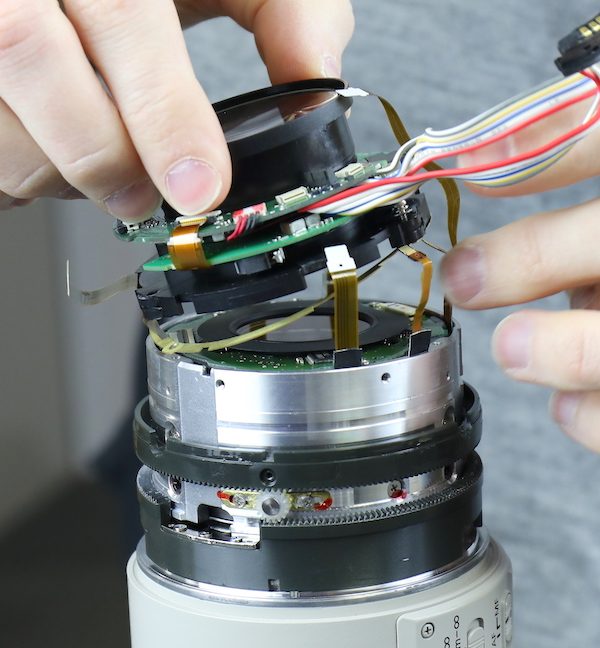
With the rear group and all those nasty soldered wires removed, we can remove the screws and bearings that keep the Image Stabilizer in the proper image stabilizing position.
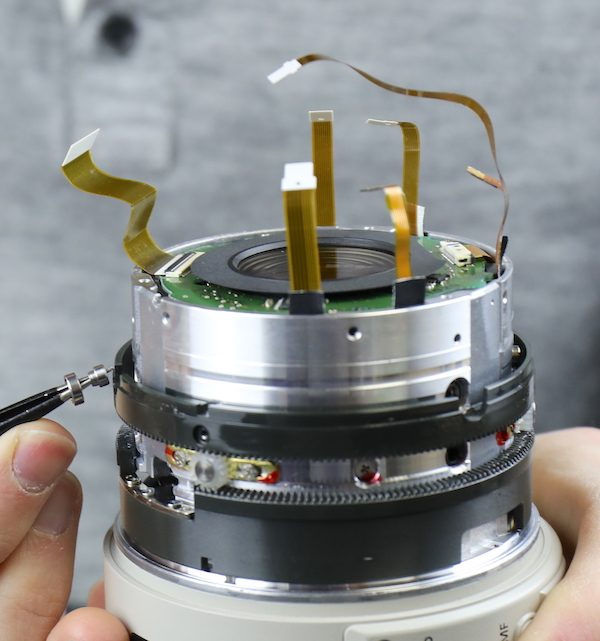
And get that thing up out of there.
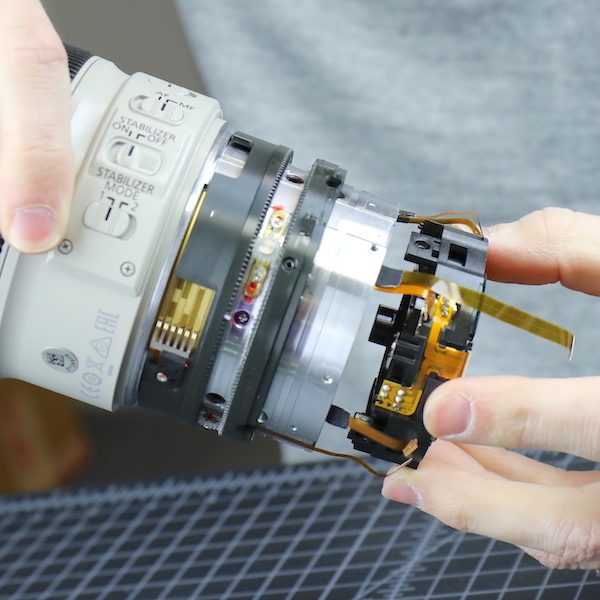
There’s a solo element that has to come out next. This element is held by eccentric collars over screws and optically adjusts for tilt. Again, unless you’ve got some optical equipment, don’t take this out at home. It has to be readjusted during assembly.
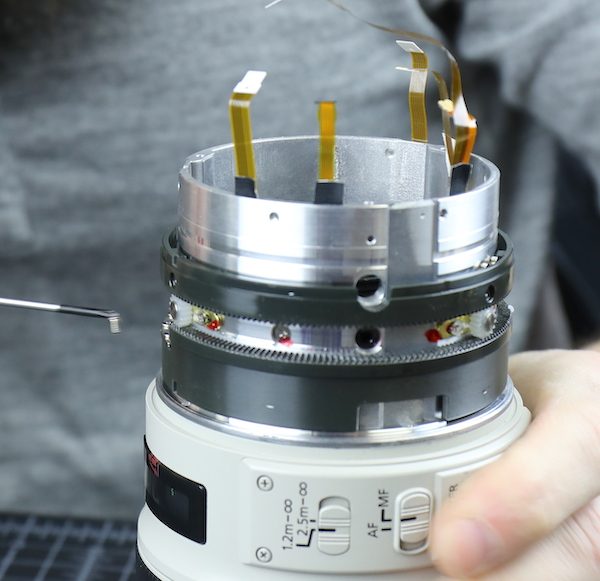
Once the stuff that holds the element in place is removed, the element can be removed. This, my friends, is the basic rule of all disassembly; it isn’t complicated (although it gets complex). “Take out the stuff that’s holding stuff, then take out the stuff it was holding.”
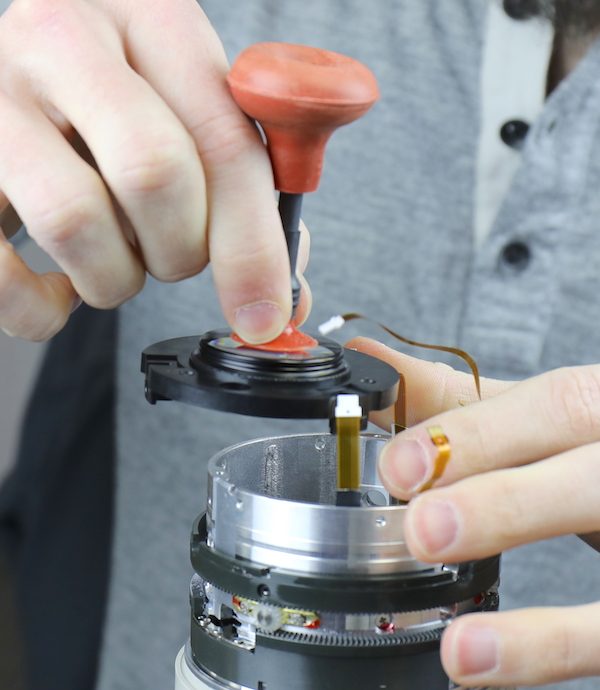
I know it seems like we’ve removed a lot of optics, but we’re nowhere close to Mr. Fly’s level yet. We can, however, finally get a decent picture without backlighting.
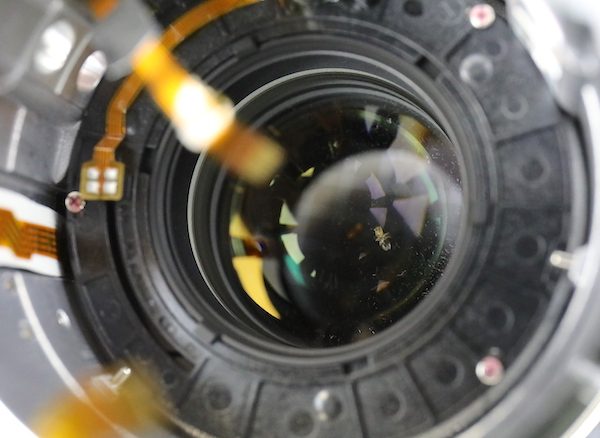
Close up you can see the other problem that happens when an insect lives in a lens for a while. They leave insect hair, parts, and unmentionable stuff scattered throughout the lens. Spiders are worse; they’ll spin a web in there. Every time. Have you ever tried to clean spider webs off of glass?
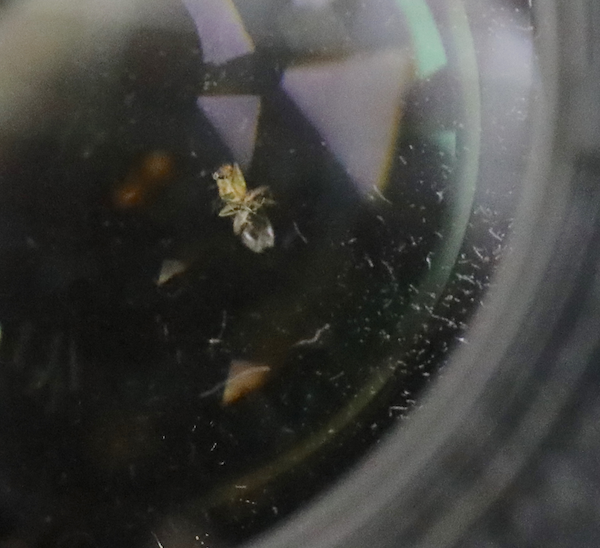
We continue to follow the rule of ‘take out the stuff that’s holding it … .
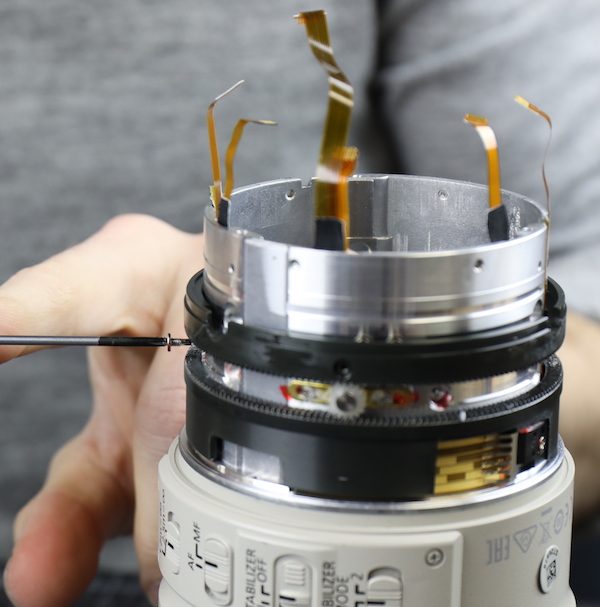
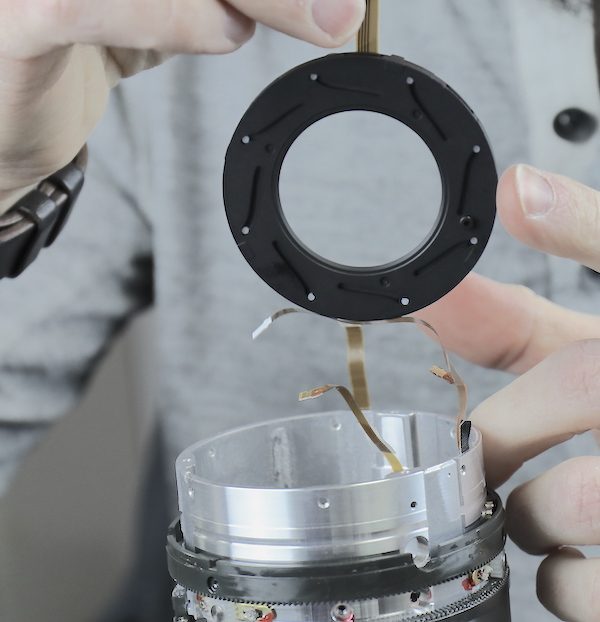
then take out the stuff that was held’. This time our efforts are rewarded with a nice aperture assembly. It’s kind of like archeology; carefully digging down one level at a time.
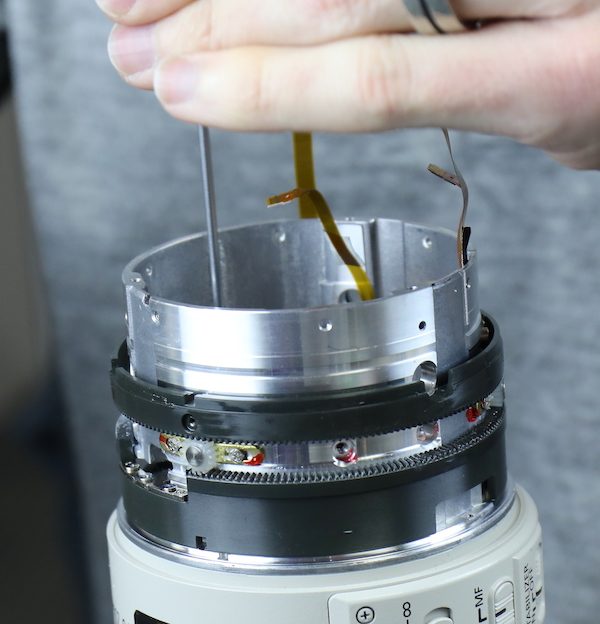
That lets us get to the screws holding the reverse-gear barrel onto the front part of the lens.
After which we can remove that barrel. There’s no more optics in this barrel, BTW.
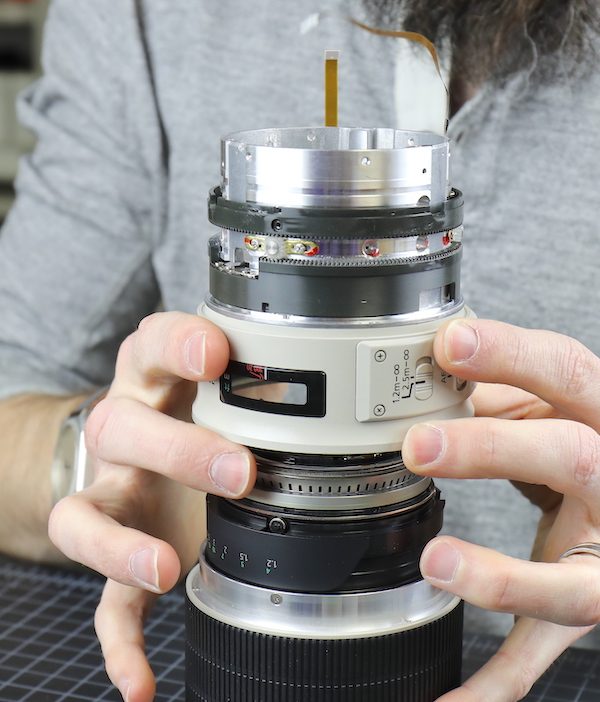
I’ll try to speed things up a bit by not showing you all the screw removals. At this point, a lot of sealing tape was removed. (We wanted to inspect each seal. This is a weather sealed lens so we considered that there might be a defective or missing seal that gave fly access. That was not the case, every seal was in place and effective.) After a half-dozen screws and posts are taken out, the focusing ring is removed.
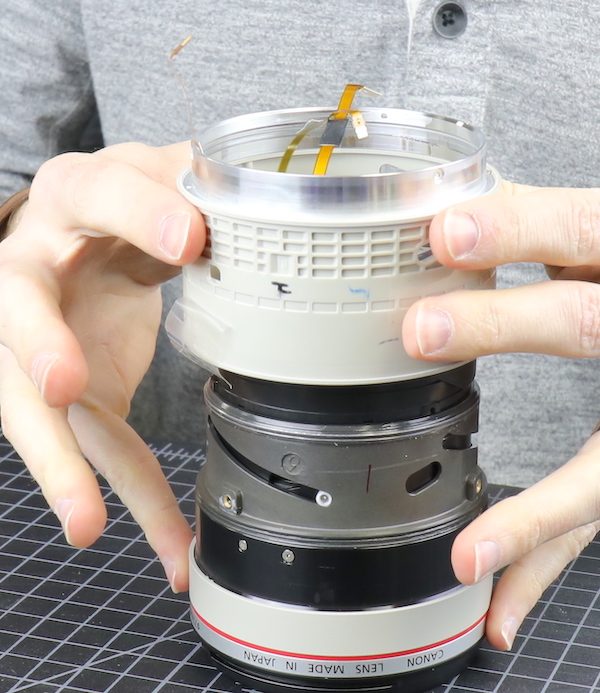
A quick intermission photo, just to emphasize how much we’ve taken apart without getting to the fly. Aaron’s removing a bunch of screws holding the filter barrel in place while I’m practicing my photographic art. (Yes, I know. It needs more practice.)
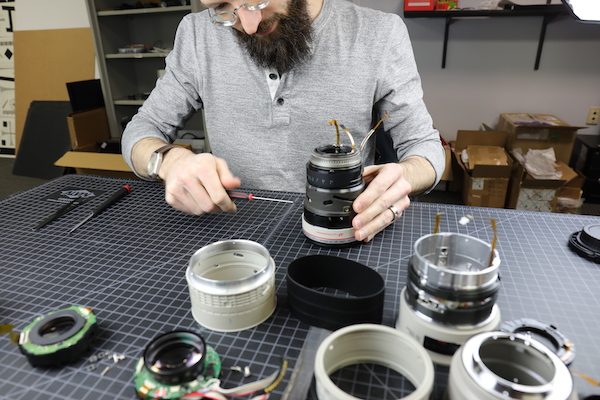
With the filter barrel off we can remove the front group. This is a pretty time-consuming thing; the front group has eccentric collars to adjust tilt and also rotates to adjust spacing, so there’s a lot of stuff holding the front group stuff in place. All of which has to be readjusted during reassembly.
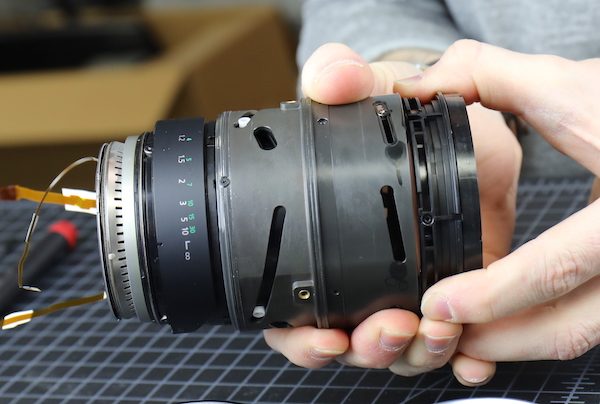
The front group is a pretty big (and expensive) bit of glass. Because we’re close to fly level, Aaron was looking to see if our little buddy had been up here and left some hair or things behind. We saw no evidence of it.
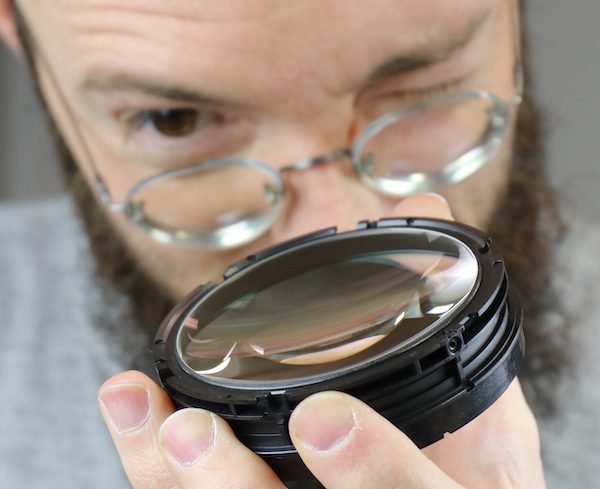
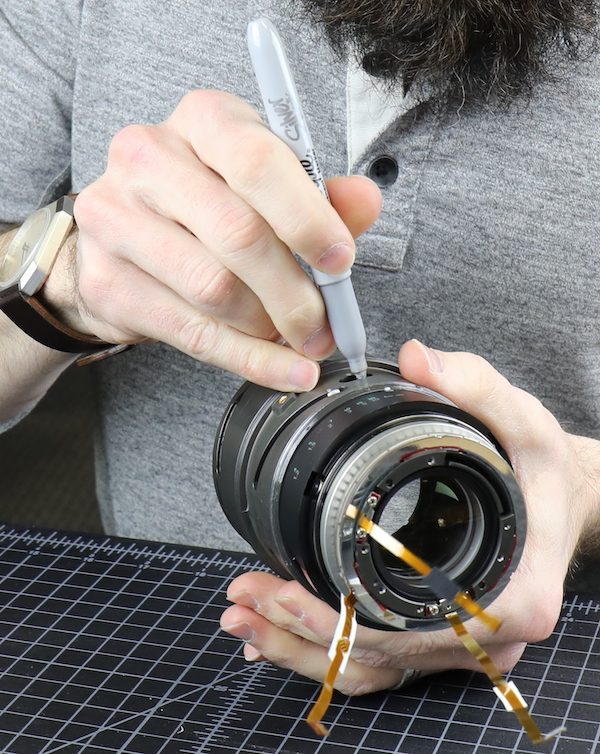
Just in case you’re wondering about lining everything up during reassembly, here’s the third rule of disassembly (the second is keep your parts organized and in order): mark where the cam barrels should line up.
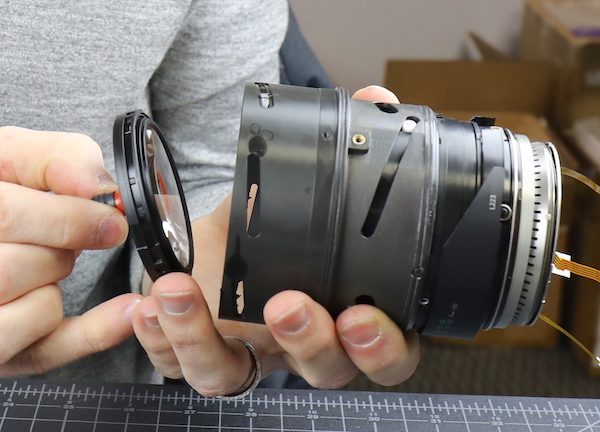
There’s another adjustable element that got removed, this is the second group and is the focusing element.
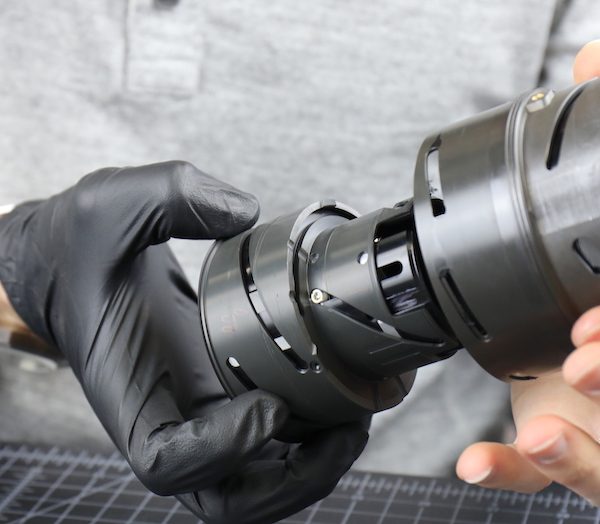
Removing some more screws and cams lets us slide out the inner optical assembly. You can tell stuff is getting real now, cause Aaron put a glove on to remove the inner cam barrels. Here’s a secret: sometimes in blog posts, I’ll substitute a reassembly photo for a disassembly photo that didn’t turn out well. You can usually tell because ‘no gloves on’ is disassembly, ‘gloves on’ is reassembly. This one is an exception because inner cam barrels often have lube on them. It’s quicker to take a glove off than to clean the lube off your hands so you don’t smear it on other parts.
Now we’re down to fly territory and we can call in the forensic team to remove the body.
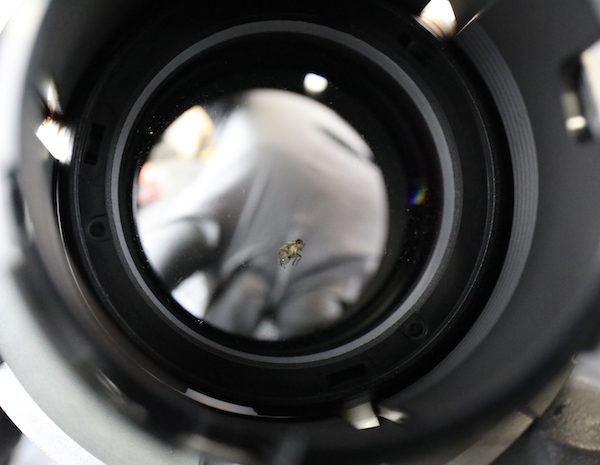
I really wanted to draw a little chalk outline around the body. Aaron really didn’t want to clean that off the glass later so I didn’t get to. But it would have been a great photo.
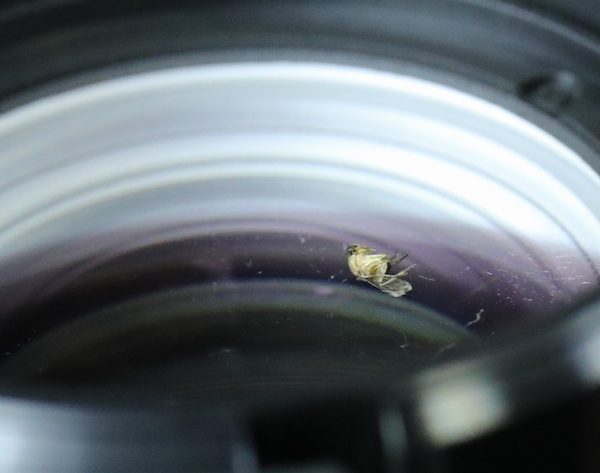
A closeup shows how much gunk our little friend left behind. This stuff, even without the fly, would make this a very dusty lens, but remember we saw absolutely no effect on the images.
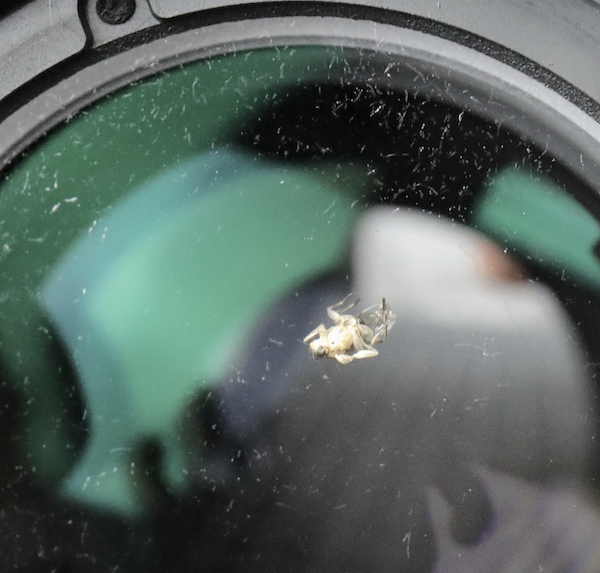
And there are fly parts and more gunk on other lenses in this area; although we didn’t notice them anywhere else.
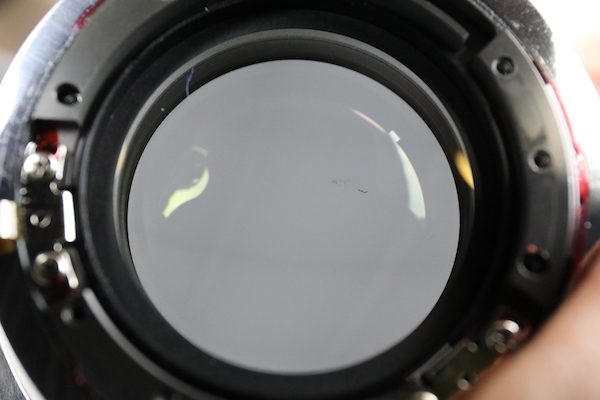
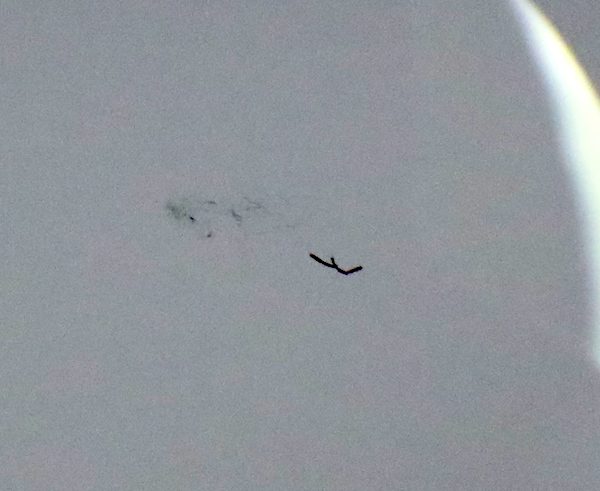
There’s actually a little smear of fly innards on this element. Remember, in this area, the elements are moving and move very close to each other. So the forensic team has determined the cause of death to be squishing. Yep, the lens swatted the fly.
I won’t show you a dozen pictures of Aaron cleaning all the elements, and another 20 of the reassembly. But here’s a summary of the work done to put this lens back in service:
- Disassembly: 1.0 hours
- Cleaning elements: 0.75 hours
- Reassembly: 1.0 hours
- Initial optical readjustment: 0.5 hours
- MTF testing and final optical adjustment: 0.5 hours
- The use of a lot of expensive equipment
If you assume a repair tech makes $30 an hour, that costs the company $45 with all taxes, expenses, and benefits. Plus money for space, tools, and overhead. And optical adjusting equipment charges range from $50 to $250 per hour depending on which machine. So the repair cost to do this fly removal was $169 in labor charges and $200 in equipment use and overhead; $369 total. Unless you’ve found a nonprofit repair shop they’re probably going to charge more than that.
You can probably get it done for less. Volume does discount things. I doubt most repair shops will spend an hour optically adjusting the lens or use anything close to our equipment (most still do optical adjustments using a chart or projector). But still, $350 seems like a pretty fair price to me. Of course, a less complicated lens or a better fly location would have made it less expensive.
Final Thoughts
Our first question was, well, how did he get here? This lens had been in service with us for 15 months so it didn’t get put in at the manufacturing plant during assembly. We only found fly evidence in the moving inner elements; there was no clear trail from an entry point. All of the lens seals were intact and the lens had a filter on from day 1. We couldn’t find the tiniest possible entry point around the barrel or front element.
We think getting in from the rear is most likely. There is a small crack where the rear baffle (the very first photo) seats around the rear element. With the cap on or mounted to the camera, this area wouldn’t be accessible, but caps aren’t always on or perhaps get put on with something inside them. My own thought is perhaps our fly got in at the maggot stage and hatched inside. The gaps we saw around the rear baffle look too small for a full-grown fly to get in. But that’s just a guess. I am not knowledgeable in the ways of flies.
I think this does serve as a good demonstration of how little effect even a very large object inside the lens has. It would have a more dramatic effect, probably, if it had been located closer to the rear element. It’s also a really good demonstration on why we (nor anyone else who’s qualified) won’t clean the dust out of your lens for $50. Sure, a lot of lenses are easier to do than this one, but it’s still time-consuming and often technically difficult.
Roger Cicala and Aaron Closz
Lensrentals.com
April, 2019
64 Comments
bdbender4 ·
“Cluster flies”: I lived in Vermont for a long time, in an old house. Every Spring the cluster flies would hatch in some of the window frames, and cluster in the windows seeking the light. Mostly between the inner and storm windows. So their eggs or maggots or whatever could survive through the winter. Thus do I commend your maggot theory, or maybe egg.
Mike Aubrey ·
Thanks for bringing the repair costs into perspective. It’s an easy thing to complain about from a consumer perspective, but we really don’t know how much work goes in this.
Ilya Snopchenko ·
Thanks for the unbridled entertainment reading this (including choice parts aloud) has caused both me and my coworkers. It was a much needed bit of recreation for our office staff here. If I had been in the US I would’ve totally rented a lens from you to help your business since your stories are so fun to read (and at times like this, downright funny). 🙂
Ilya Snopchenko ·
Thanks for the unbridled entertainment reading this (including choice parts aloud) has caused both me and my coworkers. It was a much needed bit of recreation for our office staff here. If I had been in the US I would've totally rented a lens from you to help your business since your stories are so fun to read (and at times like this, downright funny). :)
James ·
My first thought was also a maggot or egg, but don’t those have to eat something to grow into an adult fly? Wouldn’t imagine he’d have much food in the lens.
Frank Sheeran ·
agreed, he’d have to have been already adult…
looking at my 70-200/2.8IS, there’s potentially space enough in the back for him to get in…
Confused in Montara ·
Oh no! I think you missed an opportunity to really address the dust question–you could have run your full battery of optical tests before and after. Half in jest, but more seriously I’ve always “heard” that dust in a lens–severe dust–will affect contrast and flare, not actually causing a shadow on the negative…and contrast and flare are two of the things you pay $$$ for in lenses. Next time…. 🙂
brnpttmn ·
CLAFR (Clean Lube Adjust Fly Removal).
J.L. Williams ·
It’s a good thing the lens didn’t perform randomly “better,” or people would be contacting you now wanting flies inserted into their lenses…
Nick Podrebarac ·
I’d pay a reasonable price for this fly-lens service. Say….50 bucks?
Paul Bishop Jr. ·
Wow.. I do believe you are the ONLY facility with the capability and willingness to take on such a task. This is the reason I rent my equipment from only your company.. I do personally understand how expensive the equipment can get in both dollars and time ( Not a off the shelf item. And then the cost to maintain its accuracy. Not cheap either.
Nate Weaver ·
A great topic for a subsequent blog post would be WHY one single large object in the optical path does not effect image quality as one would expect.
The short answer is every bit of all the lens surfaces contributes to the light hitting any single spot on the sensor.
But that’s a difficult idea to really understand, could use some clarification.
Gary ·
Did the last person to rent it get dinged for fly removal or had they bought the total coverage insurance?
Roger Cicala ·
Gary, we didn’t consider this the renter’s fault. Just one of the weird things that happens.
Mark Hubbard ·
When I was nineteen, I came across a used Rolleiflex 2.8F twin-lens-reflex at a renowned camera shop in Westwood (an upscale part of Los Angeles, just off the campus of UCLA) that had a small bubble in the Zeiss Planar 80mm taking lens. The price was right, so I asked the middle-aged store owner if I should be concerned that the bubble would affect image quality. He told me I could hole-punch a piece of masking tape and put it right in the center of the taking lens and use the camera for ten days, and if I could see any indication of its presence in my 2-1/4″-square transparencies, he would take the camera back and give me a full refund. I never did that test, of course, and the Rolleiflex took hundreds of flawless photos for about ten years before a friend accidentally dropped it onto concrete. The bubble never appeared in any photos at any aperture or distance, even when the sun was in the frame. Lesson learned for life.
Barry Goyette ·
I used to work at a lab just a block or so from that store…and spent my lunch hours in there pouring thru the used gear. Thanks for taking me back. I believe I have a Zeiss t* 50mm lens for a Contax 35 that I bought there, that has a dead ant in it to this day.
hugh crawford ·
I have a collection of expensive lenses that I have purchased at bargain prices because there is some sort of weird thing in there. Big scratches, opaque paint chips and bugs have hardly any effect at all compared to smears and haze.
The one exception is when you are shooting wide open with big out of focus point source highlights on a dark background. That is when you might get a big light disk with a sharp silhouette of the bug.
krzysiunet ·
You can always publish such photos as a proof of UFO/aliens 😉
leo tam ·
My dad has a linhof 100 2.8 planar where the front element is wrecked. Still beautiful photos. Same with a 53 biogon that was dropped (cracked rear element in it), and an early hasselblad 80 planar with some extreme separation. Sure, I won’t pay full price for them, but well worth the steeply discounted prices he got these at
Mr Keyboard ·
Hi Roger. I wonder if LR would consider offering lens repair service one day. I feel LR would do a much better job than most repair shops, possibly even the official ones. I once sent my decentered Canon 70-200/4 IS to Canon factory service. They charged me $300 for the repair but when I got back the lens, it was still badly decentered. Even though Canon eventually repair my lens for the second time without additional charge, it wasn’t a great repair experience. I think LR can do a better job. I would choose LR even if LR charges more.
Roger Cicala ·
Unfortunately, we’re two weeks behind on our in-house repairs. We couldn’t take any outside work.
Wayne Young ·
Time to expand the facilities? 🙂
Devil's Advocate ·
Agreed, Roger’s been telling us they’re flat-out for a long time now…..
Achim Schäfer ·
Hi Roger, YMMD after having a long day fixing what my forerunners had left in a project… 🙂
But I’m a bit astonished about your cost calculations and times – both seem a bit “low” for me, really: $30/h (26,50 €/h) for a technician with those skills might be ok but in Germany we calculate the real costs with taxes etc. for the company with at least factor two without any profit for the company. And only 1 hour for reassembly all those parts including reconnecting those dammned flexible PCBs and resoldering tiny cables? You should be happy to have Aaron and do everything to keep him happy! 🙂
Last year a friend of mine dropped her Nikon D810 with a 70…200/2.8 Nikon lens. Both bayonets were broken resp. bent. An official Nikon repair shop in Munich charged her 1.800,- € (2.034,-$).
Roger Cicala ·
Achim, I’m sure you’re correct; I think most for profit companies would double or at least 150% the employee actual cost. I also left off the added cost that would have to be there for correcting repair damage: if you tear a flex, or strip a screw thread, or scratch an element on 1 of every 40 repairs (I’m guessing but that seems close to our rate) then you have to figure the replacement part costs in there, too.
Nizar Noor ·
Wow how bizarre
runbei ·
The correct, professional approach for avoiding flies in lenses is to spray them thoroughly with Flit. Failing that, please put a clear plastic bag (check the produce section at Whole Foods) over the moving parts of the lens. If you DO have dust in your lens, you can easily remove it by firing up the pressure washer in your apartment complex’s pool tool shed, and having a friend hold the lens while you carefully direct the washer spray into any visible crevices. This will not void your warranty, as after the lens dries no one will ever know. OTOH, if you prefer to persist in believing that dust will affects your image, and you like the effect and want to intensify it, simply enlist the aid of a small child to walk down a path with powdery dust surface and ask them to shuffle and kick while you follow at a crouch, extending and closing the lens with the zoom ring. You are very welcome, have a nice day.
Scott Fairbairn ·
After reading this article, I couldn’t help but wonder how many hairs from Aaron’s beard end up inside lenses?
mark bohrer ·
I was wondering that myself. I used to work above a submicron semiconductor fab area, and always saw folks in there wearing white bunny suits with everything covered up, not just netted. That kept hair, dust, skin follicles, etc off of silicon wafers. I was a design engineer so I didn’t have to wear one.
Michael ·
It’s almost summer. Time to get the silica bags out.
Rob Maver ·
Great article, I’ve definitely become a lot less worrisome over the years about dust and objects in lenses and have been more relaxed and picked up some bargains as a result.
I shared this article with a friend who has some spaghetti in his 85mm. Not even kidding.
Martin Pot ·
I once found a cockroach in a lens:
https://uploads.disquscdn.c...
PA ·
Of course you can’t see the fly. You need a macro lens for that!
etudiant ·
The specimen looks a little like a fruit fly, which are a common pest. it may have been attracted by some odor from the lubricant or sealant used with the lens.
I’d guess the insect did crawl into the lens as an adult, as you found no remains of a pupal case.
Norberto ·
Why rear disassembly? If only disassembly front lens and front helicoid group, you save a lot of time.
Roger Cicala ·
Not so much rear as complete. When this happens, as was the case here, there’s stuff all through the lens and we plan on cleaning all the elements. Does it matter for photography? No. Will customers complain about some fly parts in the lens? Yep.
Olaf Freeman ·
When I look from the front of my ef 24-105 f4 L extended to 105 and illuminated from the back, besides distinct specs/debris I also see more or less uniformed layer of fine dust on the rear elements/groups. Doesn’t it affect overall sharpness and contrast? The lens is more than 10 years old and dust is expected; it was never cleaned (inside). The point is though, that being in the way of light everywhere on the surface of those rear elements, it must cause some diffraction. I understand that I am seeing magnified picture, but it doesn’t make the dust coverage less uniformed and less distinct from the glass surface.
Olaf Freeman ·
Actually, I realized my previous comment was misplaced—yes, individual specks will take real luck to affect an important part of an image.
I was taking about cleaning the elements in general; it seems beneficial for a used lens, because there is probably a layer of fine dust that becomes a part of the glass surface.
DrJon ·
I have one exception on dust not being noticeable and will say that I usually clean dust off the front of a lens if I’m shooting anything with bokeh balls, as I find the dust appears as patterning inside the balls..
DrJon ·
Oh and my favourite article on this...
http://kurtmunger.com/dirty...
(It its own post in case it gets anti-spammed.)
Joey Miller ·
I had a customer once complain to me that a Nikon 135 DC we sent him had something inside it that kept showing up in his images. When we got it, back, I checked and there was nothing inside, but the customer had put two big fingerprints on the front element, and those were showing up in the bokeh balls. When he sent me an image to clarify what he was seeing, I sent him a picture of the fingerprints that coincided perfectly. We both learned something.
James Tappin ·
Did you do any testing to determine the level of diffraction of light from bright out-of-field sources by the fly? surely a possibility since it was well forward.
Tony Northrup ·
OK, I’m never complaining about repair costs again.
Fillkay ·
On the matter of how the fly got there, I wonder if it was in the camera mirror box as the lens was mounted? It would then try to reach the light through the gap in the rear baffle. Otherwise, I’m baffled [groans].
mikeo_b ·
I used to worry about dust too until the first time I looked at mirror lenses almost 50 years ago. When I saw the secondary mirror right in the middle of the lens you suddenly realize that “stuff” inside a lens is not going to affect the image much at all unless it occupies a significant portion of the aperture real estate. Obviously it might show up in highlight bokeh, as someone else here mentioned (e.g. doughnut bokeh in a mirror lens) but it would need to be in exactly the right place if it were to show up at all.
George Barroso ·
Roger, I don’t believe that this lens (Canon 70-200mm f/2.8 IS L II) is fully weather sealed until it’s mounted on a body.
Its not something I ever wondered whether the back piece entirely sealed the lens, but!
I have 2 of these in for service right now (I own and I’m the primary technician at a repair shop), and just took a quick look
The plastic cover back that sits inside the lens mount does not fully contact the 7th optical group, so there is enough room for an insect to fly into the lens; if the lens is left without a rear cap, IMO…
Roger Cicala ·
George that’s where I think access had to occur. Everything else is sealed tight. My guess is a lens cap sat around and the bug was in it when it was replaced.
Wayne Young ·
Did anybody feel the fly was a camera bug that get caught?
Morris Erickson ·
Tell the customer that the manufacturer requires you to leave the dust in place. It is a factory “spec”.
mark bohrer ·
Very humorous look at lens disassembly. You’ve also convinced me I never want to even try doing my own lens repair.
Either Leica has very complex lens construction, or they pay their US technicians German wages, with bonuses just to double the repair time. There’s a reason my Leica gear goes to Steve’s Camera Service Center in Culver City CA (formerly Rudy Ling’s) or International Camera Technicians in Mountain View CA instead.
JRHill53 ·
This is a great read, thank you.
Dan Zemke ·
I suspect the adult fly got into the lens when is was being assembled at
the factory. Or perhaps when it had previously been repaired. The fly probably wedged itself in a small crevice before
dying. Eventually, it fell out and became visible.
Maggots need food to grow.
DanZ ·
I suspect the adult fly got into the lens when is was being assembled at the factory. Or perhaps when it had previously been repaired. The fly probably wedged itself in a small crevice before dying. Eventually, it fell out and became visible.
Maggots need food to grow. Lens lubrication or seals seem like unlikely candidates.
Ross McLendon ·
At least a spider would take care of the fly.
PhotoJoe55 ·
So it wasn’t Canon’s fault, because it didn’t happen at the factory, but why would they leave an opening for something so large to fit in? Isn’t that a faulty design? And if a fly can fit in, this thing must suck in dust like a vacuum cleaner! I think that’s why they eliminated Push/Pull Zoom Lenses. I would send the report and the bill to Canon! They should thank you, for finding this faulty design.
Jonathan Delano ·
Good pics and great example of the skill and patience needed to do the job.
s4ducati ·
Well, that was entertaining.
One question; what’s the chance that either another fly or leftover lunch will fall from Aaron’s beard back into the lens?
Mark Koeppen ·
CSI latest episode above! Loved it. I had a ‘Coke’ bottle that had a fly inside the bottle with the cap on. It apparently flew into the neck of the bottle just before the cap was attached. I should have kept it but I went back to the store, grossed them out, and got a new bottle.
the_ownage ·
So that’s where they hid Mazinger Z!! Must be from the factory in Japan, being built during lunchtime.
Olaf Freeman ·
Looks like abandoned exoskeleton of a cockroach nymph—the way insects grow with incomplete metamorphosis.
This means the animal not just got into the lens, but also successfully changed size and left 🙂
Barry Siegel ·
Roger, it probably got in there like those ships get into bottles. Have you ever had a lens returned with a ship in it?
David Truland ·
I was just re-reading this – because it’s fun – and noticed your point that “the lens had a filter on from day 1.” Now, I’m not saying I do this, and I checked the rental agreement just to be sure, but don’t you think that a lot of lessees take the filter off the minute they open the box?
Juerg Brechbuehl Diplombiologe ·
I am surprised your technician only spends one hour for the disassembly and one hour for reassembly. I would have expected two to three hours each.
I would very much appreciate at tour of your workbench, how you organize your work so as not to loose parts and to keep the electronics away from static discharges, and who you keep things clean so as not to insert new dust.
Victor Engel ·
The consensus on a Diptera (fly) Facebook group is that this fly is in family Phoridae, so not a fruit fly as others have suggested.