

OK. First and foremost this is a fun post. It is not episode 362 of “Should you put a UV filter on your lens”. Some people use them. Some don’t. There’s not enough bandwidth to ever end that argument.
But here at Lensrentals, we have a ton of filters. We have some really good, very expensive filters. We have some OK, middle of the road filters. And because some customers, uhm, happen to return a very cheap filter in place of the one they were sent, we’ve obtained some crappy filters. Brand names aren’t necessary. If it cost $22 in 77mm size, it’s a crappy filter.
Anyway, one of the techs has to clean all those filters, make sure the threads are OK, and test them out. Honestly nobody likes to do it, so it gets put off until we need some filters or there’s just nothing else to do. So the other day Kenny is cleaning filters and testing the threads by mounting them one in front of the other until he made a nice mountain of 50 UV filters.
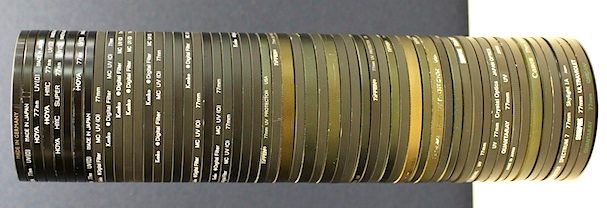
Not being the kind of people to let well enough alone, we decided to mount them to a 5D Mk II and 300 f4 we had handy and take a few pictures.
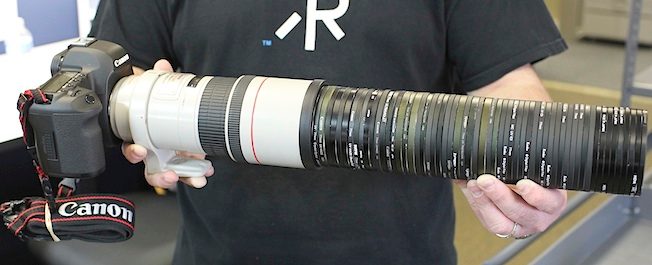
And of course see if the filters affected image quality. See if you can tell which images was shot with the 50 UV filters, and which without:
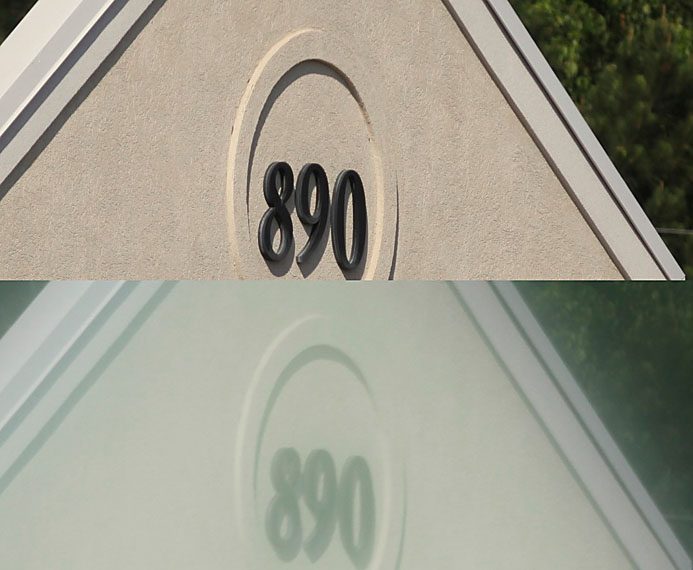
Of course there’s a lot of vignetting and haloing on the full size image:
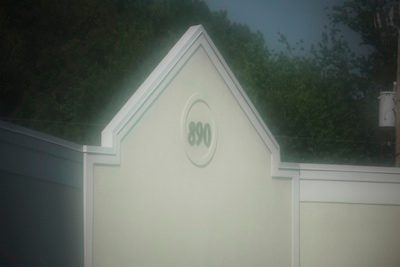
Compared to no filters
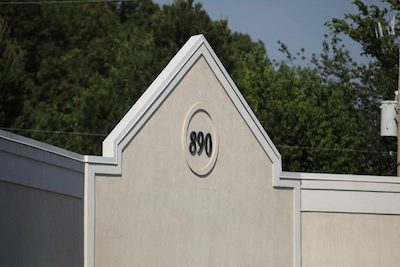
Roger, do you have anything constructive to say, or are you just wasting blog space again?
Yes, actually I do. Fifty filters stacked is pretty ridiculous. But in that stack of 50 filters, as I said, there are some very good ones and some very bad ones. Lets compare a stack of each, shall we?
First, I had Kenny put the worst filters on the top of the stack (all were nonbrand, or brands we know are cheap and bad) and take a picture of the stack at an angle. All were freshly cleaned and if you look straight through them reasonably clear. Like a filter should be. But if you stack them and try to take an angled picture through several layers of them, the results were ugly.
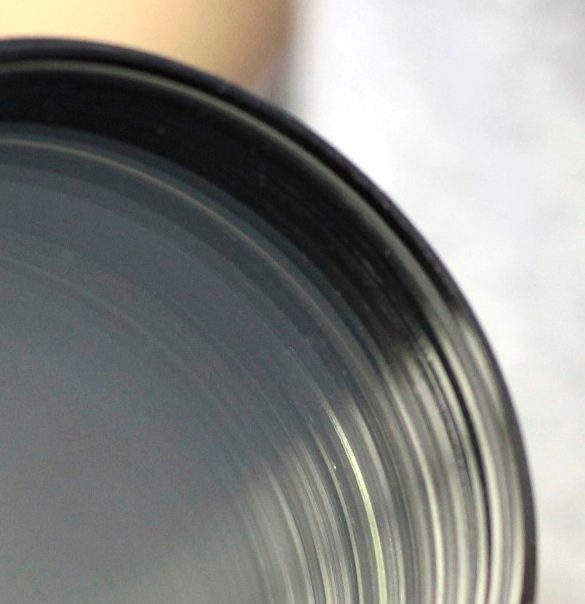
Yes, I know they don’t look clean in the image, but every one of those filters was freshly cleaned, and checked under a light. And if you look straight through them they were pretty clear. Looking at an angle tends to show you the weaknesses of a filter much better than looking straight through it. And remember: most of the light rays coming into the lens are coming in at an angle, not heading directly to the sensor in a straight line.
Now lets compare the stack with the expensive, top of the line filters (B&W, Heliopan, etc.) stacked the same way.
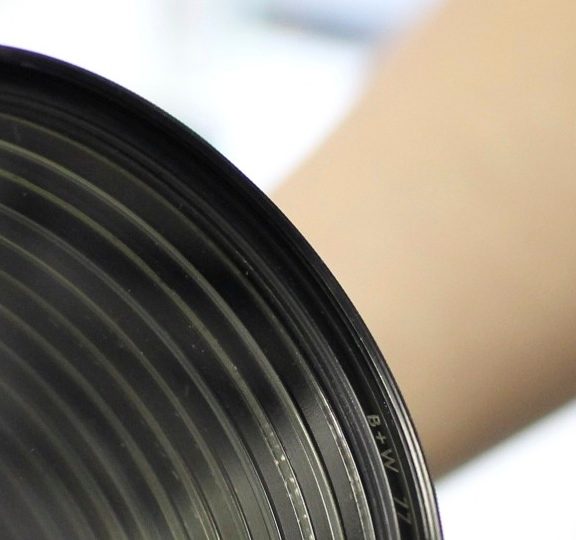
Hmmm. I’m starting to think there might be a difference here. But the proof is in the pudding. Lets modify our original experiment to something only slightly ridiculous. Instead of shooting through 50 filters, lets take the shot through 5 top of the line filters and another through 5 bottom of the line filters.
Here’s a 100% crop of a bumper sticker across the parking lot shot first with no filter, second with 5 stacked high end UV filters, and then with 5 stacked low grade UV filters.
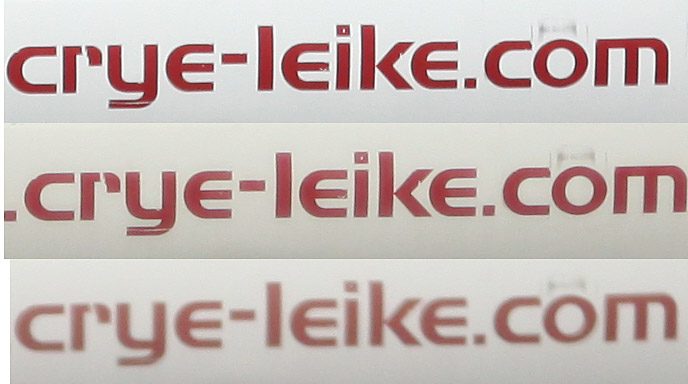
Now stacking 5 filters doesn’t have a ton of real world implications. Most people rarely stack two. But it is a fun demonstration that there really is a difference between good filters and cheap filters.
The good filters do a remarkable job: 5 stacked filters means 10 air-glass interfaces before the light even gets to the lens. That there’s only a little bit of image quality loss through all those filters is pretty impressive. This crop is from the center of the image, there’s more degradation to the sides, but still, it’s an impressive performance. And certainly lends credit to the idea that a high quality, multicoated UV filter has little effect on image quality.
Five bad filters, though, is another thing entirely. I’m completely aware, for those of you who are going to feel the need to point out the obvious, that nobody shoots with 5 UV filters. And I understand that one cheap UV filter wouldn’t have nearly as bad an effect on image quality as 5 of them. But I don’t think you can disagree that the good (and expensive, I know) filters have much less effect on image quality than the cheap filters.
BTW – before anyone asks, I avoided name brands of cheaper filters for a reason: many filter manufacturers make both pretty good, and pretty bad filters. You can tell the difference by the price or by reading carefully about the number of coatings, etc. A Tihoya $29 “high quality” filter is not the same as a Tihoya $79 “Professional” filter. This wasn’t meant to be a filter review, just a fun demonstration of the obvious.
Roger Cicala
Lensrentals.com
June, 2011
184 Comments
Dave Steinberg ·
Great post. Please don’t ever leave well enough alone!
Greg ·
If I were you, I’d publish this stacked filter technique fast to make sure you get credit for it. Someone is going to love this “fresh new look”.
Roger Cicala ·
Yep, we’ll call something like “The Dream Machine” and advertise the “soft romantic look” it gives. Plus think of the variety: don’t want a really dreamy look? Just take off 10 or 20 filters.
Joe Sankey ·
Hilarious. I can imagine the staff giggling like kids as this was getting mounted on the camera.
I think more equipment reviews should err on the side of ridiculous – it’s a lot more entertaining to read. (Let me qualify that… I think they should *intentionally* err towards the ridiculous. Way too many do that on accident as it is. Much less entertaining.)
Heidi ·
It’s not the glass but it’s the air in between the filters that’s contributing more to image degradation. Humid Tennessee air this time of the year, trapped in between filters, exacerbates the deterioration by refracting the light rays. Next time, try creating a vacuum in between each stacked filter and you shall see a marked improvement in all stacked filter examples. 😀 😀 😀
Pete Templin ·
Wait, you didn’t extend the hood on the 300/4! That should block some of the spurious light rays coming in at an angle, right? 😉
Anthony ·
My only problem with this post is that I don’t have access to that many filters to play with the “soft romantic look” myself. 😛
Thanks for the laugh at seeing that stack mounted!
Heidi ·
So… when can we expect to see stack of 50 filters available for rental?
Carl ·
Cute post Roger. The vignetting in the first shot is more due to the stack of 50 acting as a long hood, don’t you think? I’m sure Crye-Leik realtors didn’t mind you posting their name, haha. As for creating a vaccum seal between filters, that would be a bit more trouble, and also would increase the spacing between them…but I’m sure Roger will do it someday! It could be an episode of “mythbusters” or something.
I wonder if anyone has compared the material for the actual glass used in filters? I know fluorite, or otherwise synthesized glass to mimic it, is supposedly some of the highest quality glass used to make lens elements. Would it be an advantage for making a thin, flat filter element? You would think they should use something exotic, if the price is to be in the $300 range for some filters…Seems like the companies have a very high profit margin on filters…sort of like cabling in high end hi-fi.
It would be more interesting to compare a few of the high end filters, and maybe also compare the difference between a “UV Haze” filter, and a standard UV filter. I own a Kenko UV Haze filter (now discontinued) that performs unbelievably well, even though as a brand, they are sometimes spat on by those who like to spend a lot of money (Singh-Ray comes to mind).
I also own a Heliopan Circular Polarizer, so in that instance I decided to spend more. But I wonder how it would compare to other circ pols, especially the Hoya and the new Kenko line, that claim they have a finer polarizing film, which allows more light in (I see that as an advantage where circ pols are concerned. Shutter speeds get slowed horribly by mine.) I also think it’s a shame that LINEAR polarizers interfere with the metering of digital cameras, because…if you have ever worn a decent pair of polarized sunglasses, the linear effect has more profound influence on objects with highlights on them…as you rotate the sunglasses, or your head…than a circular polarizer does…at least in my opinion. Anyway, I DO UNDERSTAND the need to not devolve into a brand debate here…even though I wound up mentioning brands anyway!
Andy ·
You guys should seriously make “Stack of 50 Varying-Quality Filters (for that “soft, romantic look”)” as a rental item to see if anyone bites.
At any rate, this blog post is reason 362 of why I love Lensrentals.
John ·
Kenny deserves a raise. He apparently is a creative person who has great potential. He is able to do more than just put paperclips into a chain. Test him and give him something really boring to do to see his potential. You might get another bolg topic.
Besides that, it is an imformative blog that’ll make me think more about ‘to filter or not to filter’.
Zeno ·
For a fun demonstration of the incredibly non-obvious, do the same trick with a stack of linear polarizers, each rotated just a little relative to the next. If the first and last filters are rotated by 90 degrees from each other, it’s the same as a pair of crossed polarizers and you shouldn’t get any light through, right?
But you will get light through, and you’ll need quantum mechanics to explain why.
Try it!
alek ·
Ditto first comment from Dave – yet another great post … funny, interesting, informative, and funny – makes a good point in an easy to see manner … and methodology is solid.
Nice job Kenny & Roger!
Lee Derrickson ·
A picture is better than a thousand words. This article says more about cheap filters than any other way you could put it.
Groovy ·
Could you please repeat this with an UWA, I think this technique is great but I’m a tiny bit concerned about vignetting! Keep it up!!!
JSturr ·
That’s why I only shoot with an Iphone – filters… heh..
John H. Maw ·
I’m sure you would get the same result order no matter how the test was carried out, but the extent of the image degradation depends very much on the lighting conditions. It would be interesting to see a night scene including street lights or similar within the frame. I have found that this is a situation where even one good filter can make quite a difference.
Zoltan ·
“Brand names aren’t necessary. If it cost $22 in 77mm size, it’s a crappy filter”
Maybe you should read this:
http://www.lenstip.com/113.4-article-UV_filters_test_Description_of_the_results_and_summary.html
Note the “Hoya HMC UV” ranking (not expensive) and the Marumi MC UV (scores as well as a B+W filter costing much less) So who are you kidding with that line?
Roger Cicala ·
Actually I think that article, from a source I respect greatly, only tests the amount of UV light transmission. It does test for flare, which is important and overall light transmission. But it makes no test regarding degredation of image quality – simply evaluates the amount of UV blocked. UV blocking was quite important back in film days, but Is not the reason those shooting digital use UV filters today.
I’m not a tester but if I was looking at a test of filter quality, I’d be a lot more interested in effect on image quality than the amount of UV light blocked. Obviously there are people for whom UV blocking ability really is important. Anyway, I wasn’t trying to make the point that you have to buy the most expensive filter in the world, simply that bad filters are bad filters.
JD ·
Zoltan, unfortunately, that page doesn’t deal with any actual sample prices, so it’s hard to tell what’s going on in terms of actual cost.
But that does bring up a problem I have with all this, is that picking out a filter is tedious because every brand has its designations on multicoating, and it’s tough to know how good they are anyway.
Carl ·
John Maw. I have shot night scenes with street lights, with my Heliopan Circ Pol filter on. Even though it has 8 layers of coating on each side, there are still faint ghost image reflections of the lights. In my opinion, when shooting night scenes which include bright lights…or even when shooting something as bright as the moon at night, it is best to not use any filter at all. My experience was the same when using just the UV Haze filter. However, if the scene does NOT include very bright lights in the shot, then I don’t see why a multicoated filter wouldn’t work ok. I have even stacked both filters for night shots of the sky, for “star trails”, without any noticeable “ghost image” reflection of the stars. I have also tried Milky Way shots with the Circ Pol filter, since the sky in my area in summer, is never crystal clear, and there is always some light pollution from a nearby town. It works ok, but it holds back so much light, that I wind up having to use an ISO that is too high (with a wide angle zoom at f/2.8). So I have found the best way, is just to either wait for a crystal clear, very dark sky, or else travel to where there is one…and shoot without a filter. But again, for shooting city lights at night, it is also best to shoot without a filter.
Steven ·
Not sure if anyone is missing the very obvious, that the UV is only there to save the $1,500 lens, Reminds me of Murphy’s law, that the $1 million dollar computer will blow to protect the 10 cent fuse.
Lucy ·
The fuzzy bad filter shots look kinda like Instagram. and there’s PLENTY of people downloading that stoopid app.
Shocking ·
Not Trolling but you use the expression “the proof is in the pudding” which should really be “the proof of the pudding is in the eating” You won’t find any proof ( test ) of the quality of your pudding until you eat it. Or stick it on your lens.
Jon ·
Fun test. If you want to tackle another hot topic, perhaps you can tell us your method of cleaning filters and lenses.
Jon ·
D’oh! I just noticed the blog post on lens cleaning. A prior entry in your search engine didn’t produce any results.
Walter Underwood ·
Use a lens hood instead. If you’ve ever dropped a lens with a filter on it, you already know that the shards of broken filter don’t “protect” the lens. And fingerprints don’t hurt a lens, you just clean them off.
A lens hood can only improve a lens, a UV filter can only hurt it.
Scott ·
Fun and ridiculous yes, but still interesting. Intrapolate five filters down to one and it’s easy to see that a single crappy filter must be having some negative effect on your images.
Erik ·
At a certain large NY camera store, the basic HOYA UV in 77mm size cost around $50 while the no-name is $23. So the generic advice “If it cost $22 in 77mm size, it’s a crappy filter” is not contradicted by the lenstip article.
Bob-O-Rama ·
Hi,
I’ve made a couple videos showing that the cheap filters which claim to block UV don’t block UV at all – it uses a UV light source and scathing sarcasm.
http://www.youtube.com/bob0rama#p/u/3/U5DPVme8Ak8
http://www.youtube.com/bob0rama#p/a/u/2/5MN1n0HPmXc
— Bob
louis ·
Hi if i was you i would give this Guinness so you can claim your medal from Guinness book of records just for the hell of it before someone steals your limelight. Its all fun lets not get serious.
Jimmy ·
Hey, great blog! The idea of putting 50 filters on a lens might seem ridiculous, but then – hey – is there a better way to show that one has to invest in best filters possible if having them on the lens is what they want, and only best results count? Many thanks for the “test” 🙂
Jes ·
Ditto first comment from Dave – yet another great post … funny, interesting, informative, and funny – makes a good point in an easy to see manner … and methodology is solid.
Rob ·
I’ve used UV filters as lens protectors. Is there an alternative? I’ve never heard anything bad about UV for photos (wasn’t it a film issue?). Can we get clear lens protectors? Minimal filtration?
This test shows it’s not an issue using cheap filters because the degradation isn’t visible to the naked eye.
Herman ·
I always dreamt of owning a looooong lens…
Now I know how to achieve it!
Brainiac ·
This test is great, but it does not give answer all questions.
Please, repeat it and check the effect on image quality if you stack 50 lens caps.
Nik Caduzo ·
I understand what was the point, but I do not believe that such exaggeration can achieve the real goal. I would like to see the same image but with only one (preferably good quality) UV filter.
Bob B. ·
OK…OK…this was a REALLY fun read…plus…I decided to replace all of the $10 “T” brand filters on all of my lens last month with B&W MRC Brass Pro filters. Now I have two formats and 9 lenses to cover and that is a LOT of mulla for… in effect..ummm nothing! LOL. I ordered from Hong Kong for substantial savings…but it was still painful! I noticed an extreme quality difference all the way around when the filters arrived..the brass rings are solid and non-binding to the lens and it was more than obvious to me that the glass and the MRC coating were head above the “T” brand. Lens rental…THANKS FOR VALIDATING MY PHOTOGRAPHIC INSTINCTS!!!!!
@ID7 ·
I’m off out to buy 200 filters. Great article, thanks for erm…. doing it…. My project for the weekend!
Zoltan ·
Anyone paying $80-$100+ for a filter is only kidding themselves and making filter makers very rich.
I personally have used the Hoya HMC and Marumi MC filters and did not notice any IQ degrading with them at all. I could recommend them as good filters that are fairly priced.
Yes avoid the ultra cheapie uncoated ones by all means, yes the Hoya green range is poor and a few others. But don’t stand here and tell me b+w filters are worth the money because I’ve tried them they are not.
SN ·
Idiotic
Mr S. Tyru ·
Guys – I’ve spotted the problem, it’s not the ‘add ons’ to the right of that lens that are the problem, its the ‘add-on’ to the left of the lens
(cue Nikon v Canon debate)
Daf ·
Ha ha – fun test.
I once read somewhere and now stick to it – Why spend hundreds if not thousands on an expensive Pro lens, and then stick a piece of crap filter in front of it….
I now get the best I can within budget (but will shop around and try eBay)
Lee Duguid ·
Great post, thankfully I’ve never been a fan of UV filters….now I have a reason to hate them 🙂
Scott ·
Just use a lens cap for “protection”…Or a lens hood….A lot cheaper than expensive filters which are not worth the ectra expense. As for protecting the lens, any drop can damage more than just the front element, get yourself a good insurance policy on your gear…
JeffT ·
I think you’re making the inverse of the mistake that engineers made with the O-rings on the space shuttle – ignoring the effect of stacked tolerances.
For example, if a “good” filter lets through 99.5% of the light with perfect fidelity and causes 1% distortion, stacking 5 of them will result in 0.995^5 = 97.5% of light getting through with about 2.5% distortion.
Now if you look at a “cheap” filter that is only very slightly less “good”, let’s say 97.5% (2% more distortion than the “good” filter), stack 5 of them and the net effect is 0.975^5 = 88.1%… a very significant difference with 5, but a very insignificant difference with just one.
In reality, the effects are more subjective, but the math is the same. Stacking filters magnifies the imperfections exponentially, not linearly, and so looking at the effects of multiple filters can be very misleading when you’re trying to evaluate a single filter versus another single filter for price vs. performance.
Marc ·
No filters seems to have the best result. Is it possible to rent no filters?
Marty4650 ·
Lensbaby should market this concept. A set of 50 cheap filters that are stacked for “creative photography”….
Someone would buy it.
Ashley Pomeroy ·
This is great fun – I have a mental image of Count Von Count from Sesame Street putting all the filters together. “Von filter! Ha, ha ha! Two filters! Ha ha ha!”, and so on for an hour and a half. The shot of the B+W 77mm filters is iconic, you should put that up as a big poster in your shop.
“Now I have two formats and 9 lenses to cover” – I tend to buy a few large filters and a bunch of stepping rings, which is doubly handy because, with a full-frame camera, some of my lenses vignette a tiny bit if I use a matched filter. E.g. my Tamron 28-75mm vignettes with 67mm filters at 28mm, but not with a 77mm filter mounted with a stepping ring. Stepping rings are cheaper than filters.
Carl ·
The replies to this blog seem to have gotten out of hand last night. Apparently a bunch of people from Europe (or nightowls in the USA) think this is twitter or something…
John ·
Roger, in your vast experience of renting hundreds (thousands) or lenses thousands (millions?) of times, have you ever seen an example of a filter preventing damage to a lens?
Thanks for a great post!
Roger Cicala ·
John,
I’m sure they’ve prevented damage from blowing sand or sparks or perhaps even salt spray. Whether they can actually make a difference if a lens is dropped I doubt, but it would be rare – certainly it could happen, but somewhere between “not very often” and “very nearly never”. FWIW my opinion is the math people often use is wrong: the filter doesn’t protect the $1,500 lens, it protects the $150 front element. I just don’t think it’s cost effective.
Mike ·
I use filters on my walk around lens to protect from kids sticky fingers, dust, spray, or whatever environmental things are around. I’m not disciplined about the lens cap.
On the other hand I have dropped my D300 with Sigma 18-50 2.8 lens first four feet onto concrete. The lens hood was a great shock absorber. A small chip on the lens hood, slightly mis-threaded filter. I put a little pressure with a pipe wrench on the uv filter to pop it back strait. Other than the chip on the hood, all is good.
I’d say the shock absorbing property of the lens hood was more the savior than anything.
This is probably a case of better lucky than good….
GregL ·
I often use several filters, particularly for b&w film pics (orange, NDGrad, polariser). Some of my filters are cheapos; that 5 filter test has me feeling circumspect about even 2 filters (ie. typically NDGrad and polariser). I think I’m going to have to do a bit of testing.
Eric ·
I had an 80-200 roll off a desk in high school and ruin a perfectly good filter. It cracked and bent, but the lens threads were fine.
So it does happen. That was almost 30 years ago, though, so it doesn’t happen often…
Eric ·
did anyone notice the stack of “cheap” filters is way out of focus? that might have something to do with the quality issue. the b & w stack is sharp. could this be called “stacking” the deck?
James Kelley ·
Did you try the bumper sticker shot with one of the best and then one of the worst – a bit more real world don’tcha think?
No names of manufacturers necessary but an interesting test.
Sky_walker ·
Well, i use filters for lens protection and I think it works very well for me. I have one (kit) lens, that I an my family members occasionally use, it has never seen any filter and right now you can clearly see how the coating is damaged on the front element – both cracks and holes can be found.
So all my other, more expensive lenses use filters.
It’s a great protection against fingers, people trying to wipe-out dust or fingerprints, sand, water, etc. IF you use your lenses alone – than feel free to skip the UVs. But if you plan to borrow your lenses to people around – I strongly recommend getting a filter.
tigrebleu74 ·
Well, UV filters on digital cameras aren’t very useful anymore in the first place. There is already an excellent UV filter on the sensor of most digital cameras.
So unless you plan to do a shooting at high altitudes, were UV radiation is stronger, a simple, clear protection filter will do a fine job at… protecting your lens!
Of course, a good quality protection filter will still be better than a low quality protection filter…
Henry Posner ·
“have you ever seen an example of a filter preventing damage to a lens?”
I shot a food fight in a college frat house dining room once. Terrific mess but the filter saved me having to send an expensive lens through a washing machine and let me complete the rest of the day’s assignment.
I’ve also shot football, rugby, soccer, rodeos where being able to give a filter a good swipe also met me finish the gig.
—
Henry Posner
B&H Photo-Video
Stephane ·
ANY piece of glass stops almost all UVs. Why do you think any cheap sunglasses boast the “98% UV Block “sticker? The UV filter is the most idiotic filter, unless you shoot on top of Mt Everest on a sunny day. They are a relic from the days where you bought a lens for life. Today, you’ll probably replace it before you’ll have a chance to scratch it…
Adding a so-so filter on a good lens is like fitting your Ferrari with Ford Focus’ wheels! I find if painful to watch people with good equipment exposing their $20 filter to the sun in front of their lens hood kept in storage position of course.
Craig ·
I’ve nearly busted a lens twice. Guess what? The filter busted instead.
Scales USa ·
Although I own many filters, both very good and very cheap, I’ve moved away from everyday use of them. i might put one on if i’m concerned about protection from blowing sand but thats rare.
I have noticed a tiny improvement in sharpness, but with a very good filter, its not significant.
Thanks for the fun experiment!
Brian Zinchuk ·
Roger,
I actually did have a situation where my UV filter saved my 70-200 f2.8 VR, not once, but twice. Once, we were at the fair, and I was switching lenses. I handed it to my wife, and she dropped it, straight down onto the front onto asphalt. The UV filter shattered, the lens survived.
A second time, I was taking my shoulder bag out of the back of my SUV. I had fallen out of the habit of zipping up the large Lowepro pouch for same lens. Whamo! It fell straight onto the concrete from about 4 feet up. Again, the UV filter saved it.
On my 18-35, the UV filter also saved it as my then 18 month old dragged my camera off the kitchen table by the strap.
I am a firm believer.
Brian Zinchuk
http://www.zinchuk.ca
Josh ·
Must have been a bitch to disassemble.
Bo ·
LOL… THANK YOU – finally a great meaningful UV filter review.!
Having read all of this carefully, I will make sure never to stack more than 4 shitoya filters from the cheap bin. and I deeply appreciate the thought of renting the fine lensrentals lenses and keeping whatever expensive filters might accidentally fall off in the camera bag. Im sure nobody will notice the wallmart Haya star-quality $8.99 substitute being returned.
Thanks guys.
Bo
Bryan ·
I work in a camera store, and at least once a month we have someone come in that has dropped their lens. The UV filter is shattered, but the lens itself is fine. Depending on the lens, and how it is impacted, lens filters can help reduce the chance of the lens being severely damaged. We pretty much only recommend UV filters as extra protection for the lens.
Steve ·
I wonder what the SPF of that stack is 🙂
Jon H ·
With that stack of 50 UV filters attached, you’re ready to shoot some aging TV soap opera stars.
Adam ·
I’ve had a filter save my front element twice. (15 years of photography) Maybe I’m just really rough on my lenses.
Austin ·
A couple of years ago I dropped my brand new 17-40 f/4L (sans UV filter) onto a sidewalk. Luckily, the lens hood caught most of the impact and the lens worked perfectly for the next two years until I sold it.
On the other hand, about a year ago a 70-200 f/2.8L (sans lens hood) slipped from my grasp and landed facedown on the street. I was horrified as I saw little sparkly dust on the ground next to it, but the UV filter had taken one for the team. That lens is excellent to this day.
So one could make the case for both, I suppose 🙂
Geode ·
I have had a number of people ask why I don’t put filters on my lenses, and then I ask them why would I? They respond, well to protect the lens. In 40 years of photography I have never dropped a lens, and the only time I damaged a lens was with a cheap lens the cap didn’t fit well and put a few small sleeks in the coating of the front element when it was in the camera bag. On top of that, the only thing a filter can do is degrade optical quality. The only to get the very best shots out of those high quality expensive lenses is to ditch the filter, and cheap lenses, are well, cheap to replace, so if you do scratch them no big deal.
Edwin Herdman ·
Well, that’s a pretty good experiment and interesting results! Though I would doubt the air portion of the “10 air-glass interfaces” matters at all to the final quality: With that 300mm lens you’re already shooting through plenty of air.
@ tigrebleu74:
I used to think the same, but I’ve heard that it can make a difference – especially in long-range images. Propaby a polarizer is a better bet most of the time.
@ Bryan:
The main test is – how often has somebody dropped their lens without a filter and had it shatter? And then – If the UV filter shatters, how often do bits of the glass poke up and scratch the front element? Filters have no cushion for the thread, and depending on the lens that front element may be recessed a ways and small enough not to have been impacted anyway. For large front element lenses like telephotos/zooms, since most of the impact force is transferred right through the brass ring of the filter it may be more an indication the glass and lens design is strong than it is that the filter was actually protecting the front element. The only situation I could think of would be that the UV filter is hit by something protruding, and slows down the collision before shattering so that the force exerted on the lens itself is reduced, rather like a crumpling car design. But this can’t be the majority of cases since most falls hit flat surfaces edge-on.
bart cummins ·
thanks for the fun read & cool experiment. good points made about the uv’s maybe not helping a whole lot. though i swear by my circular polarizer.
Bill Tyler ·
I response to Edwin Herdman’s comment about the air. It’s not the air as air that’s the issue, it’s the places where air touches glass. Any time you go from a medium, such as air, with one index of refraction to another medium, such as glass, with a different index of refraction, you get both transmission and reflection of the light. So the number of air-glass transitions is indeed significant. Lens and filter coatings were developed to mitigate this effect, which is why they are important.
Scott ·
I dunno. Probably if you drop a lens, a filter is not going to help. But I used to do work that required me to move fast and not carefully, and I HAVE had filters give their lives protecting the front element and filter threads when I’ve blanged them against door frames, car doors and big rocks.
lol2011 ·
LOL You guys are hilarious using the reasoning that stacking 5 bad or good filters in front of a good lens and not getting a good image as reasoning to not use ONE good protector filter. I look forward to selling you new lenses when you damage the front coatings. If you stack 5 filters good or bad to shoot you need help. Though I will sell you those too…
Roger Cicala ·
Oh, there’s never a problem getting someone to sell you filters. Highest profit margin in the camera store 🙂
But the point isn’t “don’t use filters”, the point is “crappy filters are worse than good filters”. Not rocket science.
Yves Rubin ·
Thank you Roger! Although a bit extreme, this is the best demonstration that you shouldn’t have a filter, and if one is a careful person, the front element of the lens should be just fine for a long time…
James ·
“Stephane says:
ANY piece of glass stops almost all UVs. Why do you think any cheap sunglasses boast the “98% UV Block “sticker?”
Sorry, you are miss-informed, Glass does not stop all UV.
http://en.wikipedia.org/wiki/Ultraviolet#Natural_sources_of_UV
“Ordinary glass is partially transparent to UVA but is opaque to shorter wavelengths”
And cheap sunglasses are mandated by the government to block UV to protect peoples eyes, as there were cheap import sunglasses that had no UV block and literally cooked peoples retina causing vision loss.
http://www.fda.gov/MedicalDevices/DeviceRegulationandGuidance/GuidanceDocuments/ucm073951.htm
“Sunglasses manufactured with reflective, tinted, polarizing, photosensitizing lenses and meet ISO 8980 – 3 or ANSI Z80.3 for UV and visible light transmittance requirements”
James ·
see also here
http://en.wikipedia.org/wiki/Sunglasses#Standards_for_sunglasses
Dilbert ·
Roger, I’ve once dropped a camera with lens attached, lens first. The lens had a UV filter attached to it. The UV filter was shattered. I don’t know what would have happened if I hadn’t of had it there, but I’m not in a rush to try it out.
I’ve come to rely on the lens hood for protection as much as or more than the lens cap. When it’s slung over my shoulder and I’m bush bashing, every extra bit of protection helps. Why isn’t it in a bad? (1) full of lenses (2) take too long to get out and ready if something happens
Jon ·
I work at a camera store. I see at least half a dozen customers EVERY WEEK who come in to replace a damaged filter. Some have been damaged when something ran into the filter. Others when the camera was dropped. Most when cleaning it.
A good lens hood is a better solution to prevent damage when a lens gets dropped. A stepping ring is next, as it deforms easily in the event of a sudden impact. A filter is less effective, but still helpful. Nothing on the lens obviously means no protection.
As anyone who has ever realized long into (or after) a shoot that there was a big fingerprint on their lens can attest, the front element has little impact on the final image quality. But even a cheap filter on the front of the lens (which, again, has very little impact on IQ) will provide a lot of protection in daily use. I see it all the time with customers, and I’ve experienced it myself.
Jon ·
Forgot to mention, every pro I’ve ever known lost their lens caps years ago. I was assisting a friend at a wedding the other day. I went to shoot while he set up some light and had to laugh out loud when I saw that none of his lenses have front or rear caps. Yet his images are stellar.
Mind you his cameras and lenses spend a lot more time in the shop than mine do. Apparently he finds that preferable over taking the time to protect the gear.
To each his/her own.
hugh crawford ·
If you really want to use a filter to protect your lens when you drop it, buy the cheapest filter you can, preferably with a threaded ring made of brass or anything that is not aluminum, remove the glass, and screw the ring onto your lens. Lens shade work even better of course.
Dark Goob ·
Even a crap filter will often save your lens if you drop it. The aluminum ring (or brass on B+W) compacts nicely and translates the shock into the glass, which typically shatters radially but not inwardly. More than five times I’ve seen a lens come in for repair which had been saved by the filter in this manner, usually without even damage to the filter thread on the lens. So, at least on a big heavy lens, I’d put a UV filter, even a cheap one, instead of nothing… just in case. But on a pancake lens or micro four thirds 14-42 Zuiko, etc., there’s really no point… the lens opening is so small and non-protuberant that it’s very unlikely to be impacted by something.
barry ·
Unfortunately, when I dropped a lens the filter shattered and damaged the lens by scratching the front element.
Chio ·
Excellent. Though I would’ve like to see examples with only filter too. My camera fell down from a tripod, luckily with the cheapish 17-85mm I got, and the filter was completely broken. Nothing happened to the front element of the glass.
As for lens caps – I rarely use them, so it’s nice to have some protection.
Bruno Z ·
Seems like this whole everlasting “filter for protection” debate could arguably be subdivided into 2 different issues: dirt & smudges, and accidental drops.
Regarding the first, obviously if you have the habit of getting your front lens so dirty that you feel the need of a filter, so be it.
Now for the second crowd which is just using it as an insurance against an accidental drop, why don’t you guys just leave a step-up ring on the lens? No detrimental optical effects (on the contrary, shades a tiny bit), oh-so-cheap, and the bendable aluminium will protect your lens rim as well if not better than any filter. If your lens falls on a stick bit on the frontal lens itself, then I believe that filter or not the damage will be the same, the filter glass itself is very thin with straight faces and offers very very little mechanical protection…
Larry ·
I am surprised that Roger would not install a filter on the lenses they rent out if it were up to him.
Doesn’t the fact that Lens Rental does this already indicate that there are benefits to using the right filter, i.e., the high quality filter? Why buy all these filters if not to protect the lens? Why suffer through the indignities of receiving of receiving the lens back with cheap filters after the customers took out the expensive filter and replaced this with cheap filters?
Then there is the matter of cleaning. It is s much easier to clean the filter than to clean the front element of the lens. Even with just 2 or 3 filters at the end of a hard day, it is so much easier to clean the filters than the front elements of the lens. Imagine how the task looks like when one has to clean 50 front element in the lenses versus 50 filters. The space occupied and the weight involved makes cleaning 50 lenses a daunting task not to mention require a considerable storage and working space. Cleaning 50 filters is much easier and can be done within a small space.
Uncle Toopula ·
I want to see multiple choice 100% photo crops where the viewer has to pick a) shot without a filter b) shot w/ a single b+w UV c) shot w/ a single el cheapo UV. Finally, d) shot after front element is scratched up.
Robin ·
The real comparison is between one expensive new filter and one apparently perfect 20 year old Hoya bought at a camera fair for 2 or 3 pounds or dollars which is the only sort of filter many people ever use. Pity this key test wasn’t done.
What was interesting was how bad 5 expensive filters were. Many zoom lenses consist of 15 or more elements and yet give state of the art contrast. So what’s the problem – the coating or the flat sufaces? Pentax used to make a slightly curved ‘ghostless’ UV filter, convex at the front and concave at the rear to combat known defects from the use of flat glass surfaces.
The main purpose of a filter used to be to avoid fingerprints/rain etc reaching the front lens element and subsequent cleaning damaging the coating. Also some lenses had ‘cold’ transmission (which really mattered when you were using Kodachrome) and many photographers wanted to warm them up with 1A or 1B skylights.
Jure ·
I use only cheap filters. You must admit that by using only one filter it is almost impossible to see the diference and that 99,99999% of hobby photographers use more only one or – better – none.
:o)
Rol ·
Good article Roger and supplementary explanation JeffT (June 16, 2011 at 7:49 AM).
I think some of the reasoning specifically about the use of UV filters could be a hang over from film. I have certainly used quality UV filters with film to fractionally ‘warm’ a picture by reducing the high end blues.
As for lens protection, when out and about, multi-coated lenses (compared to a filter) are tricky to keep clean, so I’ve often used a UV or ‘skylight’ filter for convenience. A couple of times the filter has taken a scrap, so I’ve been able to replace it and continue shooting.
Interestingly, the only lens I have where the front element has been damaged, was damaged whilst being repaired by a professional service some years back. Unfortunately as it was expensive and discontinued many years ago, I’ve as yet not found a suitable replacement…
Paul Lazzaro ·
Back in the analogue seventies, I worked in a camera store, and we used to check filter quality by holding them almost horizontal, then looking at some distant object through the maximum thickness of glass.
The amount of ‘rippling’ was often substantial, and with ample stocks to look at/compare in moments of boredom it was fairly clear to see which big brands at the time were buying their glass from the cheapies and re-branding it!
Nikon and Leica were always first class, and I recall Hoya was the first independent whose stuff also measured up well, and were also early into multicoating their range/slim mounts as well.
It was all too easy to jam stacks together, so a little hacksaw notch diagonally across the front and back rings meant you could
always separate them. Today’s useless fact!
Michael ·
There seems to be a lot of debate on whether or not a filter really does protect a lens, and a lot of anecdotal evidence supporting both those who say either that one does or that it doesn’t matter. I won’t join that debate.
I will point out, however, that whenever I see a lens for sale on ebay, the condition of the front lens element is very frequently an issue (whether advertised by the seller or inquired upon by the buyer), and that lenses with even very small scratches on the front lens element seem to sell for somewhat less than those which don’t. Indeed, a selling point often seems to be whether or not that front element was protected by a filter during the ownership of the lens.
What I take from this is that whether or not a single UV filter actually does matter when it comes to actual lens protection, it may, on the other hand, count for a great deal when it comes time to sell the lens, especially for more expensive lenses where the buyer is likely to be more critical of the lenses’ condition. When it comes to selling, buyer perception is everything, whether it is grounded in practically reality or not.
Akira ·
Can you get a front element replaced for $150 as Roger states? In that case, the cost of a good filter doesn’t make a whole lot of sense except that you’re without the lens during the repair. Also, in the case of a drop, I think that the filter ring protects the barrel, which is why the filter shatters when dropped like that (it happened to me when a lens rolled out of my bag). A barrel replacement will be more than $150. Of course a lens hood would prevent that problem. I like to use a (low-profile) filter on my 10-22mm though. The front element moves within the barrel, which means that the inner parts of the barrel can be exposed. Also, the front element isn’t a flat piece of glass like it is on most lenses.
Roger Cicala ·
Akira, the price varies depending on the lens. Some are more. Some quite a bit less (the Canon 70-200 f4 for example, the front element is $83). In general wide angle lenses have more expensive front elements.
Roger
sinan ·
Creative experiment, thank you Roger.
RHB ·
How do the Ultraviolet (UV) Pro 1 Digital Multi-Coated Filters and Ultraviolet Clear Pro 1 Digital Multi-Coated Filters stack up against the more expensive B&W tested above? I’ve read the Hoya Digital Multi-Coated are supposed to be just as good. That’s mostly what I’ve been using and I certainly don’t notice any issues. I’ve used B&W but I don’t like the caps on their thin filters and their polarizers are bumpy and hard to clean. So I’ve stuck with Hoya and like the price better as well.
jean ·
I use now the cheapest uv filter 5$ from ebay for all my lenses, then when on a shoot I unscrew the filter take the shots and rescrew it to maximise quality. I paid 150$ in the past on a b&w and it would everytime get a little blurry, on all lenses L,prime,zoom. returned it to check and it was according to them the normal standard. unless weather
condition is bad or in a place with lots of people, the only use for me is to protect the front element in case my cap goes off.
dlj ·
I stopped using UV filters when I went digital years ago, and haven’t regretted it other than *one* trip, at very high altitude, where the UV created a noticeable haze increase with distance. You don’t get many opportunities like that, so remember that the default UV reduction on modern digital cameras doesn’t handle all amounts of UV, just the most common amounts. Oddly, other trips to high altitude (but not as high altitude) didn’t show the haze, so you have to be really up there (4-5+ km) to experience it.
Terry Byford ·
A great fun experiment. I have always used a filter purely for lens protection. Get scratches on that front lens element and then shoot with a light source either directly or obliquely shining into it and you can often say “goodbye” to decent pics from your expensive lens.
A few years ago I bought a Sony R1 for its fantastic Zeiss lens. Thinking I could save money, as it takes a 67mm filter, I bought cheaply only to be horrified when pointing the camera out of a window to see a staggering amount of reflections that the filter’s coating couldn’t suppress. I took the filter back and waited 3 weeks whilst the store sourced a “proper” filter for me at 5x the price. But it worked. Nuff said, I think.
Mark ·
I was always taught to spend the money on the lens. Protect it with a filter, but when it comes time to shoot take it off. Lenses are expensive, why put even a $100 UV filter on a $1200 lens….doesn’t make any sense to me.
Mike ·
More than one person has said they use a filter for protection, but remove the filter before taking the photo.
I do the same thing, but I use a lens cap for protection, not a filter.
Steve G ·
I once picke up a 70-200 Minolta ‘beercan’ tele for free because the guy ‘never got a good result with it’
Long story short – I took off the ‘store brand’ UV filter on the front and – shazam – excellent results…
Jessica ·
Personally, I prefer to leave a polarizer filter on my lenses as the “protective” filter. Since I usually want that on the lens for the photo itself anyway, it’s just easier to leave there and take it off when I don’t want it on.
Tord S Eriksson ·
I do mostly use UV filters, and if I could afford it, only Heliopan! But some lenses work better without – taking shots of the moon improved without, but Heliopan’s marvel that blocks both IR and UV cost as much as good used lens!
Craig Kozloski ·
More evidence to continue using a lens cap and hood. Not a single scratch in over 30 years.
Somewhere on the web is a page with photos taken with badly scratched front elements. Guess what? Most of the images looked great. The worst case for most scratches is reduced resale value.
Rich Gibson ·
Up till recently I did not use protection filters. I switched recently to using them. On a trip I was putting a sling mounted D700 over my shoulder but the sling slipped through my fingers and the camera and 17-35 dropped to the floor in a store. Gulp! The protection filter absorbed the drop and bent onto the lens sticking fast to it. The shock passed into my 17-35 and broke it. I’m out the filter and several hundred dollars for repairing the lens.
No I didn’t have the hood on the lens; a lesson I will never forget.
Rich
Frank Bosco ·
I use Leica UVAs, B&W UVs and Hoya HMC UV(0)s on my Leicas, Pentax’s and Nikons……not a dimes worth of difference between them….On my Rolleiflex, I can’t see the difference between no filter and the Rollei U-V Bayonet II….so my working assumption is that one UV filter has no effect no matter which one…..
Antonio ·
Great article.
I have never used UV filters (I use others that are useful for what I want to obtain). For protecting the lens I use something I call a “lens cap” 🙂 20+ years, never have had damaged a lens.
The UV filter thing seemed to me like something the store guy tells you and then gets to be “general knowledge”. Everytime I bought a lens, they wanted to stick a UV filter on it. No thanks, do not see the use of it, to protect the lens they say, no thanks, I will take the risk. And this article shows it is even worse to use them, you spend $1000 on a lens for the little extra sharpness, throw a UV filter and the reason to spend that amount of money is gone.
Paul ·
I only use a CPL or an ND when I need a CPL or ND. The “protection filter” thing started in film days as a great way to make a profit because stores didn’t really on lenses. Today there are 10x more customers.
Anyway, go get your UV protection filters and toss them into the lake. They do a very bad thing to your inage: attract flare like bees to honey. That’s a MUCH bigger problem with digital due to sensor sensitivity.
Protect your lens with th ebest thing available, a lens hood (glad all L lenses come with one). Besides the glass being set way back, you are guarded from any stray light across your lens which causes flare and decreases contrast. My $2500 Canon 70-200mm/2.8 is insanely good at transmitting contrast to the sensor, BUT ONLY WITH A LENS HOOD IN PLACE. If I ruin it with even a “good” UV, then what’s the point? Better to go buy a $300 Sigma.
Last thought: you might ask “But what about shooting in the daytime at high elevation, there’s haze, don’t I want to remove that with a UV filter?” Answer: The problem is not the midday haze, the problem is that you are shooting at midday. If you need a UV filter, you’re simple shooting at the wrong time of the day. If you want top-level photos, it is ALL about the light and the quality of your glass. If you want to shoot at midday, get a Point-n-Shoot to record your memories. But for a pro lens, destroy UV filters forever, attach your hood (YES, even indoors) and shoot when light is gorgeous, and you will succeed.
SW ·
My two bits: believing that more glass surface means more distortion, I ran a series of personal test shots off a tripod using a 24-105L Canon 77mm lens: lens only, UV Hoya filter (more expensive) and UV Quantary filter (cheaper). The shots were long-distance across an urban valley.
The with-filter shots were sharper than without. The Hoya edged out the Quantary by a tad.
Paul ·
Whoops, I should have provided an example: http://www.betterphoto.com/gallery/dynoGallDetail.asp?photoID=11517631&catID=45873
This was shot with NO filters. Had I had a UV I would have had flare all over the place. The sharpness and tone and contrast come from that Canon element staying pure as it inhales the light. Please destroy all UV filters, lol!
Wait, one exception: if you’re at the coast and it’s windy and sand and sea spray are flying all over, yes, you want to truly protect that lens in that situation.
Geert ·
I won’t go into the image quality part, but there are two practical reasons to be weary about UV filters:
1. A high quality UV filter often is about as expensive as a new front element
2. A filter damages MUCH easier than a front element.
I find a decent lens hood works very well for protecting a lens from accidental bumps and knocks.
Jeff B ·
I never use a filter on any of my fine lenses, including Leica, Canon L, and Nikon. I do however, encourage all others to use them, even if they ruin the images because I might someday buy one of their lenses on the used market and appreciate that many of the old lenses have like new front elements because the original owner never took the filter off 🙂 . Like others that have commented, I have not scratched a front element in more than 30 years of photography and I NEVER shoot with a filter because I want the ultimate contrast my best lenses can provide.
John Stone ·
I’m a big fan of using high quality filters as protection for my lenses, despite the cost. One of my hobbies is astrophotography. Astrophotography requires long exposures, which means that the lens and camera are exposed to the elements for hours at a time. During the course of this process on cool nights during humid times of year, dew can be a serious problem, or frost in winter. Some lenses are only fully weather sealed when a filter is in place. The first time you have to put a lens in a heating blanket, leave it in hot sun, or use a blow dryer to heat it up to dissipate condensation off of internal lens elements, you quickly take on a more serious attitude about these issues. I often use dew heaters and lint-free towels wrapped around the outside of the lens body to help combat these problems, but sometimes mother nature wins anyway (cable gets unplugged, dew heater battery goes dead, too cold too fast, etc).
Besides astrophotography, I love doing landscape shots. These are often in imperfect weather, on rocky or mountainous terrain with wind, snow, sand, blowing dust, or other environmental challenges. I find it a heck of a lot easier and less nerve racking to remove a UV filter from a $1800 lens to clean it carefully than to have to do the same on the lens itself. I can keep an extra UV filter in my bag that’s cleaned and ready to go in case the one on a lens gets soiled. I should mention that I _always_ use the lens hoods on my gear, both to stave off the sand and dust, the dew, and to avoid reflections from bright sun etc. I end up having to clean the lens hood and filters regularly, but my lenses have no scratches on the front elements, yet, and there’ve been a few times when I would have missed a nice shot if I couldn’t have quickly removed a soiled filter and either shot without it, or put on a clean one.
If you shoot without a filter, when the front lens element gets soiled, you have no choice but to either shoot anyway, or stop and try to clean it quickly. Cleaning too quickly/roughly is exactly how a lens coating gets scratched…
tbyrd ·
I never use filters… I understand the argument for ‘protecting’ the lens but I never understood why anyone would want to put cheap glass in front of their lenses.
BTW, Jeef B’s post (above mine) is spot on!!! I hope everyone else uses filters so I can buy your lens from you someday!!!
Rick ·
I can’t find one for my 500mm. Should i duct-tape a piece of safety glass on the hood?
Andre Oliveira ·
Thank you for the article. Very instructive.
Joakim ·
Pretty damn enlightening!
I’m new to (SLR) quality photography, and all this makes me glad because I won’t have to put lots of money on filters, just little money on lens hoods! 🙂 I will now save the filters for the beach!
Just one thought: What about polarizing filters? Seems a lot of pros use them for improved image quality of water and sky etc? Do they pose the same problems as UV filters? (They should?)
Harry ·
I’ve switched to B&W filters, and have experienced no problems ever since. If there’s no CPL filter on each lens, there is a UV filter.
lyle ·
Good way of producing fog. lol
🙂
Brad ·
Nice test. Simple 🙂
Can you do part two with some harsher lighting conditions? A bit of flare, or something with some chromatic aberration?
Joseph G ·
As a slight clarification-
UV Haze filters and Skylight filters are NOT the same filter.
UV Haze filters are absorptive of the ultraviolet portion of the wavelengths of light spectrum. Thus, they remove the haze often associated with higher altitudes. Haze filters do this by blocking the UV spectrum light rays that do not focus at the same point as visible light rays do. This is the same thing as the UV filters/protective glass on Halogen lights (as Halogen as a light source produces a high and sometimes dangerous level of UV spectrum rays). This is considered a cut-off filter. Light with a wavelength above a certain point is not passed through to the film/sensor.
Skylight filters, on the other hand, are absorptive of visible light in the higher level blue/indigo range, but do not necessarily cut out UV light. They are effectively a form of subtractive color mixing, similar to FLD’s that balance out fluorescent lights, used to make an image more appealing. Averaging less than 1/5th of a stop reduction in light transmission, they appear clear in casual observation, but closer inspection or viewing at an angle proves that they have a salmon or bastard amber tint.
As most digital cameras have a built in filter over the sensor cutting out most UV and IR light, the non-protective qualities of the UV filter are usually rendered moot. The same goes for the skylight filter, as the white balance engine in digital cameras or RAW processing software can compensate/be used to compensate for excessive blue in images. Even simple tweaking in image editing programs will work for this purpose.
John Gore ·
Nice article, and interesting comparison. I have to agree with the comments above:
-I dont use filters (due to quality loss, etc), although if I did I would only use the best quality ones as the article recommends.
-I do recommend that others use filters to protect the lens and “protect” resale value (although I have never damaged the front element of any of my lenses).
-lenses filters DO make a difference to contrast, sharpness, lens flare, etc.
-keep the lens hood on, and clean the front element regularly = best image quality.
PS: If you use a filter, notice how much dirt gets stuck between the filter and lens element? Now you have 3 surfaces to clean regularly! 😛
Each to his own, thanks for a great article! 🙂
Ilias Theodoropoulos ·
What will happen if you stack some x2 tele filters? Will that work? Will it focus?
Will you consider this for your next “free time experiment”?
MLWadester ·
Lolz, @Uncle Toopula. I enjoyed the blog post, thanks to DPReview for posting!
John M ·
Great fun test, but one thing that no-one has mentioned is that a filter being further away from the front element than normal will change the effect it has on image quality.
Now I’m just trying to work out whether that would be for the better or for the worse!
Photofaculty ·
As well as the photographic results, could you try this with circular polarising filters and do a video of how you put them all on and then how you get them all off again ?
Harald ·
Are you planning to rent the ‘stack’ of 50 filters for Soft Focus Potraiture just like David Hamilton 🙂
Urbanphotographer ·
I enjoyed the article! Thanks! Keep it coming.
@photofaculty that’s a hilarious and superb idea •lol•
Donkemaen ·
In the two shots comparing a stack of expencive filters and a stack of cheap ones.
On the stack of cheap ones, the first filter should at least look SHARP! it looks out of focus.
Carl ·
John Stone, yours is some good advice. I would like to see some of your images.
Carl ·
Tigrebleu74, yours is an example of why forum and blog response posts are less than useful at times. People tend to feel the need to weigh in on something, and then get it wrong. Then no one corrects them, and assumes their statement is fact. You state that “There is already an excellent UV filter on the sensor of most digital cameras.” Actually, the filter on the sensor is a HIGH PASS infrared filter (as opposed to a low pass UV). Cameras which have been “modified” for infrared use, have these filters removed. But there is no UV filter on a digital sensor. I’m surprised Roger didn’t correct you.
Diego ·
Very interesting article, i have some friends that buy a 1500 dlls lens and then buy a 15 dlls filter, and they have the brilliant idea of stacking a UV, and a ND from the same cheap brand, and cry because they dont have sharp images.
Ashley Groome ·
I never cease to be perplexed, by seeing a person of good, common sense, spending a couple of grand on a decent body and possibly as much again on a decent lens – and then get all bent out of shape because they have to pay 80 or 90 dollars for a decent UV filter. Go figure.
Piechie ·
Love it Roger – I actually got the link to this form an Adobe Lightroom FB post!
Glad things are going great for ya! We we going to go out shooting again?
Gary Edwards ·
Good test. Valid approach to gain observability of the effect.
RebelPhoton ·
This was actually a great opportunity to explain how the MTF of an imaging system is a result of the multiplication of all of its elements. So you might not ordinarily notice the difference in quality loss between a filter that lets through 98% of the original resolution and another that lets through 92%. (I’m making these numbers up).
But if you stack several similar filters those differences quickly add up:
0.98*0.98*0.98*0.98*0.98=0.90
0.92*0.92*0.92*0.92*0.92=0.65
So there is a very noticeable difference between a 10% loss and a 35% loss. This makes it easier to measure the difference between different brands and models.
Carlos ·
Rebelphoton has a good simplified explanation. The 5 stacked filters amplify the loss in picture sharpness to a point that our eyes can perceive the decrease in quality/sharpness of the pic. But if you compare two pics with only one filter of each kind, the results could be inconclusive to the naked eye, but yet measurable with the proper instruments.
quintanilha ·
VÁ A JORNAL DO AMEIXIAL OU ATRAVÉS DA URL http://wwwjornaldoameixial.blogspot.com E LEIA, PORQUE AINDA NÃO LEU NADA ASSIM!.
Taylor ·
Well, it depends on how you plan to use them. Filters are great when you know how to use them and when to use them.
John Kim ·
Hey, great article. Makes me wanna chuck all my cheap filters.
BADigiFoto ·
The comparison photos with the view through the cheap filters reminds me of the countless cheap commercials running after midnight on commercial TVs, addressed to mostly intellectually challenged shoppers who can be fooled with the least bit of effort that they actually need the crap sold to them and they are getting getting a promotional (just now, just for you, but wait, there’s more…) type of deals.
If you truly are serious about making such comparisons, shouldn’t you guys pay a little more attention to the correct exposure of BOTH images? I’m asking this question because I would like to assume that you haven’t purposefully made the expensive filters look sharper and the cheap ones unsharp, poorly exposed.
Those of you who are not sure what I’m talking about feel free to look at the black frame of the first filter – not just that you can’t see through the first one properly (incorrectly blamed here on the quality of filters), but you can’t even see the outside edge/frame of the filter either, which clearly can mean only one thing: the photo was poorly exposed.
And as long as there are such clear “mistakes” (as again, I wouldn’t want to call them deliberate deceptions), the trustworthiness of the entire post can be seriously questioned…
Tim Harris ·
That’s great guys! Really appreciate it. I was actually coming to the site to look for filters for an upcoming project. As always, you’ve gone the extra mile to help us out! Thanks for posting.
CCycomachead ·
Many people forget some of the other advantages of filters.
Weather Sealing. Having a filter on not only protects the front element and the lens barrel / body if dropped, but also prevents dust moisture and other debris from entering the lens, especially if the front element moves.
Yes, you can buy weather sealed lenses, like L series, but most L lenses aren’t fully sealed unless they have a filter, and yes the 24-70, 24-105, and the 16-35 all require filters to be sealed.
As far as the cost: $100 on a filter should be about right for the price of a thousand + (or even less really!) dollar lens. That’s one small piece of glass compared to the whole lens (and is a hell of a lot easier to manufacture!) so it’s really spending an ‘appropriate’ amount.
The filter as a lens cap idea is neat, but it all depends on how you use it. If I’m walking around and keep the lens cap on and do need to take a photo ‘instantly’ my lens cap is either off (and the lens is protected by the hood) or it takes me half a second to pull a cap off. If I’m rushing and I drop the cap or something is what $10 or less to replace? If I’m always taking a filter on and off I’d be worrying about the quality of that filter and that it’d be protected, because I still wouldn’t put a cheap filter on as a lens cap (because I’d be worrying about the images that got taken with the filter on). Also, I can tell through the VF if a lens cap is on, but not if a filter is.
There are also some lenses, like my 50 f1.8, where buying a quality filter doesn’t matter. The cost of the lens doesn’t justify the price of the filter. (Also while that 50 is pretty darn sharp on it’s own, its own glass isn’t as nice as my 24-70 so I have a feeling that it would be more adversely affected by a filter. Though I could be wrong about this.)
Finally, the more glass you have the more problems you are bound to run into. It’s physics, but that doesn’t mean that clear filters aren’t still useful.
Hugo Chikamori ·
Now…can we try that with 50 crappy 3 stop ND filters. I’ll see you next year for the result. It may take a month for the shutter to finally click. ~evil laughter~
Hugo Chikamori ·
Actually, Roger. I’ve got an idea for you. Stack 50 3 stop ND filters on the camera…stick the camera in front of a sloth enclosure at the local zoo…and then come back for the result in about 2 and a half hours. I’m sure you’ll get a picture of some speedy sloths.
Nolan ·
As much as I agreed with the test, please provide decent pictures of the two when making a comparison, one is clearly out of focus.
Antony ·
After dozens of convincing articles like this I STILL just can’t bring myself to pay ~£50 for ONE UV filter. I’m not shooting with the frikkin Hubble telescope here. I paid £71 for a whole Canon lens (brand new)! That 50mm prime, I hasten to add, has done me proud, and I just don’t see it getting noticeably worse with a cheaper filter.
eric ·
It seems to me that you are missing the purpose of the filter as protecting the lens. You have a £71 lens, spending the price of the lens more or less on a filter to protect it doesn’t make sense. So go with a cheap filter if you must, or no filter at all.
Roger Cicala ·
Eric,
Our point would be there’s no sense using a cheap filter to protect a lens – it reduces image quality. Plus the filter doesn’t protect the lens, it protects only the front element which costs only a tiny fraction of what the lens does. A good example is the Canon 70-200 f4 IS, where the front element costs $79. It makes little sense to buy an expensive filter to protect the front element which costs about the same as a good filter. It makes little sense to put a bad filter on the lens and reduce it’s excellent image quality.
steve ·
Both photos are in focus but they’re focused on different layers in the filter stack. The cheap filter photo is focused on the third filter in. Why? I don’t know, but it does help distinguish the individual elements a littler further into that pathetic mush of reflections…
Dave ·
I’ve not used filters for the last 20 years of photography. I had adopted the philosophy “the fewer layers of glass between the subject and the film/ccd, the better” a long time ago. I don’t buy $2,500 lenses, but I buy the mid-range lenses and stay away from kit lenses and low end lenses. I’ve never had issues with my front element getting scratched, damaged, poked, scraped, etc.
Sammy ·
For me, image quality will always be better with a filter, no matter how bad the quality of that filter. Why? Because I’m not scared to clean my filter out in the field and take shortcuts instead of waiting to get home and do it properly. I haven’t actually scratched a filter yet, but I don’t use blower brush then lens pen then wet. I just use my breath and if that doesn’t work water and/or isopropyl if available.
By the way I don’t use lens hoods often because they interfeer with flash at close range. I don’t like discovering later a good shot is ruined by flash shadow.
Also I have had a filter almost certainly save my lens. The cap got impacted slightly into the lens (or should I say filter) during transport. Shattered glass everywhere! Was very careful to clean dry only until sure it was all gone and voila, lens was fine.
CharleySDG ·
Really, really great article.
Marfie ·
I bought a cheap filter for the front of my 150-500 lens. On some shots I had banding on a particular level of out-of-focus lines (branches with bright edges, or wires) Any further out-of-focus and the banding was reduced. I did some tests and, though it did not go away, it was a lot less if I took the same shot without the filter. I have since noticed this banding on shots taken by others with long zoom lenses from 400 to 500mm. I now rely on the lens hood for protection unless I am in a harsh environment – which is not often.
Marfie ·
Thinking about the stacking of filters – with them being flat they will reflect light off their surfaces, back and forth, frequently before some of it finally reaches the lens proper. But the effect of this reflection off the front element and then back from a single filter, with the front element being convex, will (ok. might) be negligible. Though this is not the only influence the filter will have it does follow that one filter could be ok but 2 filters could have a significantly greater affect – which might still be negligible.
Wynner01 ·
To follow the logic that a lens shoots better images without filters then 5 lenses should be stacked without filters, as a control for the shots with five filters. The more layers of glass the more refraction, distortion etc no matter what they are attached to or their origin.
I keep a cheap UV filter on all my lenses in the bag when stored or transporting. Protects against dust, mud, drinks, sand, accidental rubbing, hitting, or if the lens cap comes off. In most cases you will lose less than 2% on any one shot. Most photographers are not careful enough to get 100% in the first place so you are all fooling yourselves.
If you really feel it makes a difference take it off. I bought a job lot of filters on Ebay for $52 there were 48 filters. (HOYA, TIFFEN etc)…only one was scratched and the threads damaged. I checked and they retail for over $1000 for the lot. The elitists and professionals try to encourage purchase of high end equipment, because they know it is a differentiating part of the equation that amateurs can’t afford, and therefore illustrates the quality and knowledge of the superior way. Discerning amateurs know the king is definitely not wearing clothes.
I take good and bad exposures, high and low quality shots, ones with filters and ones without. They remain a central part of my armory and I will keep them thank you. The best advice I have received yet is “fail early, fail often and fail with purpose.” If you are not failing you are not pushing yourselves…filter or no filter. you will remain mediocre professional or amateur. I often get paid for my work but refuse to become and elitist.
Wynner01 ·
Addendum:
I am also an artist and find artists are not so hung up on their equipment of the media thay use. A great or professional artist would not think to put down an amateur because he wasn’t using the best brush available ot the most expensive paint. She would encourage and help the other artist to get the best results with what they have available.
I have found in photography that there is a highly competitive and elitist attitude for those who know more or are considered professional.
They encourage the mystic they try to surround themselves with, but as time progresses equipment, technology and the availability of online tutorials and DVD instruction narrow the gap and the elitists are becoming dinosaurs. All I can say is become artists or become extinct.
Jeff L ·
50 filters at an average price of $60 is $3,000. That’s more than twice the price of that 300mm f/4 IS. So if Roger decides to rent out the filter stack, it’s not going to be a cheap rental 😉
L glass is expensive, but relatively speaking, maybe not so much. A top-end Heliopan or B+W 77mm UV filter is $158 to $183 at B&H. A stack of 15 of them would cost $2,370 to $2,745. The 15-element “stack” in the 300L costs a mere $1,359, or about $90 per element.
And the UV filter stack isn’t even white!
h pete ·
Very funny!!Perhaps you can evaluate closeup lenses stacked(showing my age)
Shots from 5mm distance will tell all.
canomike ·
Although no one is going to stack 5 UV filters for real, this little experiment does show the difference between the low quality and high quality filters. No matter the multiple interactions between the filter, the high quality filters clearly have less negative impact than the low quality. You did not try to quantify your results or over state the findings. It is a well done test with a simple but clear and well founded conclusion. The better ones are better.
canomike ·
Rule of filters: First, do no harm.
So filters that harm the image as little as possible are better. Then come the questions, can I afford the better one, should I use one at all, do I have a specific need that needs to be met by the filter, will a stack of 50 filters protect my lens from a 9mm, etc.
Lena Lauderbaugh ·
Great article. Cool.
Paul Sturtevant ·
First, I like the article.
Second, Canomike, I like how you put it together! Especially the comment on the 9mm! LOL Let’s get together and check that on out!
I would suggest that using a quality UV for protection ‘in the bag’ and for certain situations in general would usually make sense. Using one in higher UV light situations could also be of value. Take it off when doing work in a safe and low UV environment. And, as said above … use insurance or accept the risk if you do not use a UV filter.
Roger, this is a real fun article. I liked reading the comments. Even the comments I might not totally agree with.
Frampaign ·
Thank you. A great and simple experiment that I would not be able to afford to do, but it drove home the lessons. (A picture is worth a 1000 words, eh?). Enjoyed reading through the comments as well. Great information on which to base decisions.
Merci encore!
Olaf Veenstra ·
Funny article…
Why bother with an UV filter at all.
Protect the lens with a cheap and nasty lenshood.
Preferably a soft plastic one. It will keep you from knocking the front lens.
A plastic hood will absorb a shock where a metal one will transfer the shock energy to the lens causing damage.
For image quality you should use a lenshood all the time anyway!
UV filters are not required for image quality on a DSLR as they used to be on a film camera.
Desmond Spotts ·
It’s in reality a great and useful piece of information. I am satisfied that you simply shared this helpful information with us. Please stay us up to date like this. Thanks for sharing.
tom hardwick ·
Although your statement that ‘the idea that a high quality, multicoated UV filter has little effect on image quality’ may be true, many cameras have their lens hood’s efficiency considerably reduced when a filter is fitted (i e the front element is moved forward 5 mm or so). So expensive filter plus less lens hood = more flare. I’m right there with Dave’s post (Jan 19). tom.
Linuxpresso ·
Interesting article!
I feel confirmed, because I never used a filter on my D90 and especially not (!) for “protecting the lens”.
grubernd ·
roger, great article. but there is one difference about the filter and the frontlens element: on the spot instant service.
which is kinda crucial if you are out in the boons shooting anything that might smack a stone against the front surface of your lens. like mountain bikers, cars, little kids, etc. throw away the filter and keep going. actually you would put the filter into the recycling bin, of course. but usually you just get that stone on your head, so yes, filters are mostly useless.
Photographer Przemyslaw Szklarski ·
Good Test.! 🙂
Ranndy Stone ·
As a rank amateur, I am impressed by the article and the thoughtful comments. I use a Canon 700D EOS and I like photographing school fish in shallow water. Will a UV filter improve the images of the fish the way polaroid sun-glasses improve my eyes ability to see them?
Zuzu ·
Ranndy Stone:
What you are looking for is polarising filter. UV filters only filter UV light but UV is filtered in camera (as far as I know) so people generally use them for physical protection.
Polarising filters (which are used in the mentioned sunglasses as well) mute some kind of reflections.
Be sure to get circular polarising filter so it wont interfere with your cameras focusing system.
Ata ·
I have always used the UV filters on all my lens. If you use a quality one like B+W, Heliopan, Hoya, Hama, … there will be nothing wrong with image quality. In my opinion a good filter is which doesn’t any impact over image quality but does it’s duty as well and ofcourse the good filters are expensive but not as expensive as your lens’ front element.
james geyman ·
I prefer a cheap filter to protect my canon L lenses, as I often photograph southwestern US, where sandstone and sand blow with any kind of wind, and I hate the idea of scratching the front element. Most people are not experienced in replacing the front element, or shipping it off to Canon for this. In more tame environments I agree a cheap filter isn’t worth it (e.g. studio work, wedding photography, indoor portraits, etc).
Thanks for all your great blog posts. I always learn something.
NancyP ·
I missed this post earlier. Impressive stack of filters, perhaps giving rise to the “most items between sensor and subject” contest category in the 2013 PhotoGreek contests. I admit, I am a filter snob. I would go cheapie if I were to be in blowing grit, but otherwise, I just get the best multi-coated filter I can find for my largest lens, and step rings to attach it to smaller diameter lenses. I am frankly surprised that you could get any image at all through fifty filters, some of which are likely to be uncoated or single-coated.
tt ·
With the length of the lens/filters you’re going to be letting in less light to the sensor and so image quality will be worse and improve as you remove them. I understand it’s a fun test but it’s far from answering the question. If you had expensive ones one the front and removed them, you’ll get better quality image d
Heinz G ·
I use B+W filters because I like they are brass and don’t get stuck as easy as the cheaper aluminum ones. The UV filter actually saved my lens when I fumbled my camera one day while trying to put a new strap on. The filter shattered and was so dented that I could not screw it off. I removed all the glass first, then actually had to use needle nose pliers and twist/tear the filter material out of the lens threads. The lens was unmarked, undamaged and works 100%. Definitely a $1200 savings.
Jill gocher ·
yes but those crappy filters are really GREAT for making artsy pix
not everything needs to be as sharp as a tack!
and soft can be beautiful! remember Sarah Moon! we get all this stuff to mske sharp and then have to hunt for creative ways to soften!
Veli Rickhard Ojala ·
How much lightloss about? Seems to be like 1 full stop