

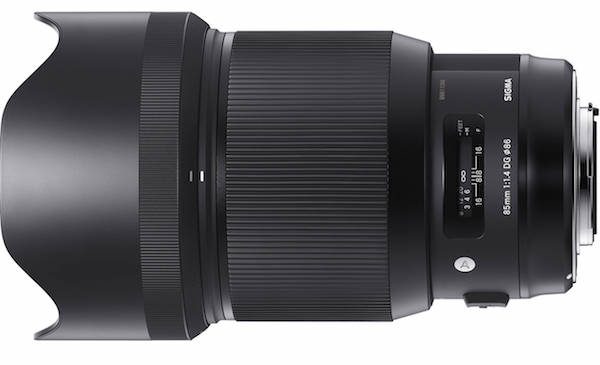
Yes, I know the Sigma 85mm f/1.4 DG HSM Art lens just too big for you; reading the online forums, you’d think it was about the same size and weight and a 600mm f/4 lens. It’s not, of course, although it is a hefty lens at nearly 40 ounces. But that’s just a few ounces more than a Canon 85mm f/1.2 L; a few less than a Zeiss 85mm Otus. So while it wouldn’t be my first choice for a backpacking lens, it’s not as wrist-breakingly huge as some make it out to be. (OK, full disclosure, backpacking isn’t my area of expertise. The closest I get to camping is staying at a hotel without room service).
While you guys get the ‘It’s so big’ jokes out of the way, I’ll point out that making a lens bigger is not a goal of the lens designer, but it is sometimes a necessity. If you want to get great optics and eliminate aberrations, you either need lots of pieces of glass or very expensive pieces of glass ground into very expensive shapes. The Sigma 85mm Art has 14 elements, compared to 8 for the Canon 85mm f/1.2, and eleven for both the Zeiss 85mm Otus and Milvus lenses. If you want to keep the price lower and the image quality excellent, then more glass is sometimes the compromise you make.
Of course, that explanation assumes that yes, they did make the image quality excellent. Given what we’ve seen from the rest of the Sigma Art line, I certainly expected this one to be excellent. And our Photo Guys article on real-world use certainly seems to suggest Sigma did the right thing with this lens. But I don’t trust what I see in photographs, so let’s get the optical bench out and see if it’s really so. (That was a joke for all the people who say ‘I don’t trust what I see in MTF plots, I want to see photographs.’ A joke.)
MTF Results
This is the MTF results generated in our usual fashion: 10 copies were tested, each at four different rotations, and all the results averaged to give you the MTF shown below.
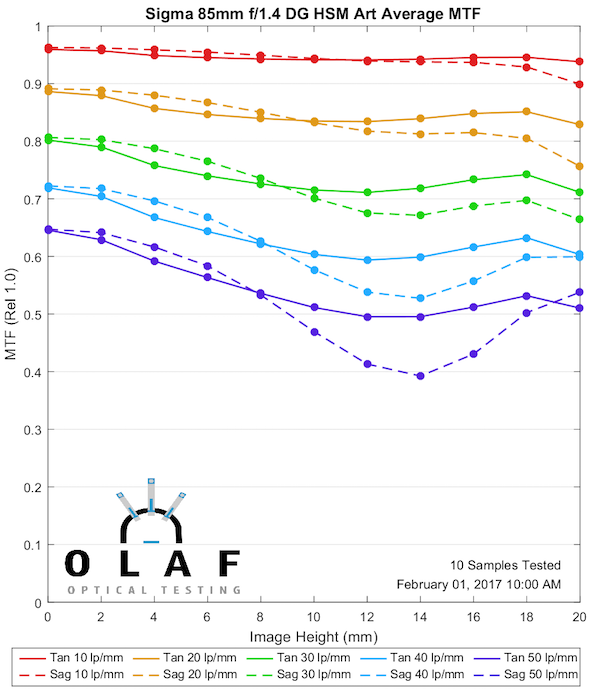
That’s most impressive to me at a glance, but it’s probably easier for you to be impressed if you look at some comparisons. So I’ll make some comparisons between the Sigma Art’s MTFs and some other lenses below. For those of you who don’t speak MTF, it’s pretty simple. “0” Image Height is the center of the lens, “20” is almost to the corner. Higher MTF is better, and if the dotted and solid lines are close together for each color, that’s good too. There’s a lot more to MTF, but that will get you by.
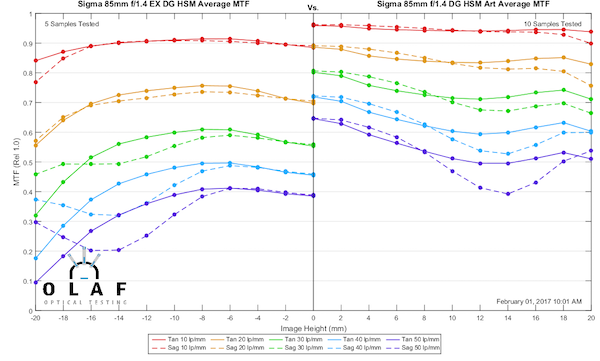
Sigma 85mm f/1.4 Non-Art vs. Sigma 85mm f/1.4 Art
First, let’s compare the new Sigma Art (on the right) to the older Sigma 85mm f/1.4 lens (left). It’s no comparison.
Sigma 85mm Art vs Zeiss 85mm f/1.4 ZE
The Zeiss 85mm f/1.4 ZE is close to the Sigma in price and makes a good comparison – unless you’re comparing autofocus capabilities, of course.
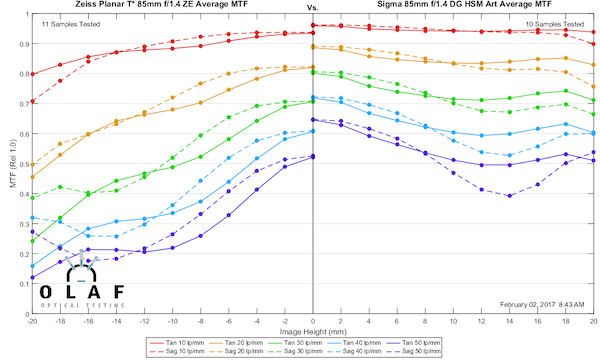
This one I have to give the edge to the Sigma. That’s not surprising, the Zeiss is a decades old design, and while it’s razor sharp stopped down a bit, it’s a little soft and dreamy looking wide open. It’s a good example of a lens people love for its unique look, rather than its resolving ability.
Sigma 85mm Art vs. Zeiss 85mm Otus
Well, sooner or later we had to compare it against the best 85mm we know of, the Zeiss 85mm f/1.4 Otus. I chose sooner.
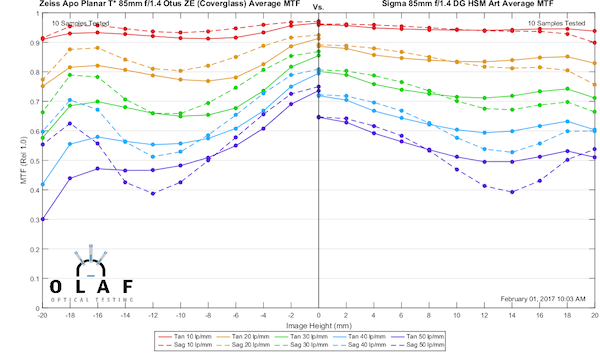
The Sigma certainly holds it’s own. Of course, the Otus is sharper in the center, especially at higher frequencies. It’s sharper than about anything other than super telephotos in the center. Away from the center, the Sigma very much holds it’s own.
Variation
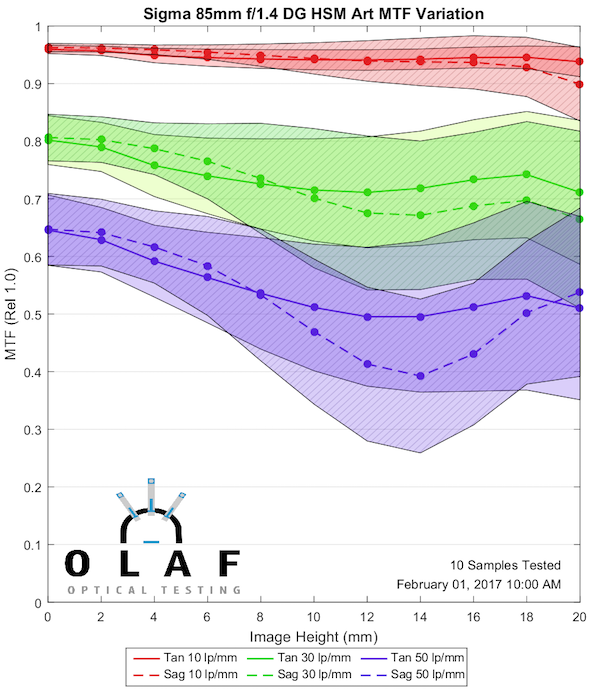
We’re still listening to outside consultants argue about the best way to present a variation number, so I’m going to stick with just using our variation graph. The Sigma shows excellent copy-to-copy variation control, as good or better than the Canon L, Nikon G, or Zeiss offerings in this focal length.
Conclusions
This was an MTF test. It was only an MTF test. Had this been an actual lens review you would have been instructed to purchase the Sigma from my affiliate link to help send my kids to college. As MTF tests go, though, this is just another ho-hum spectacular triumph for the Sigma Art series. From an MTF standpoint, it’s better than any other 85 except the Otus, and it makes a very respectable showing against that fine lens.
There’s a lot more to imaging than MTF. Even I, the ultimate MTF geek, know that. What we found out today is the Sigma is a really, really sharp lens at an excellent price. That makes it worth further investigation if you are thinking about an 85mm lens. It doesn’t make it the right choice for you, lots of other factors need to be considered. But the Big Beautiful Lens is worth a long, hard look.
Addendum:
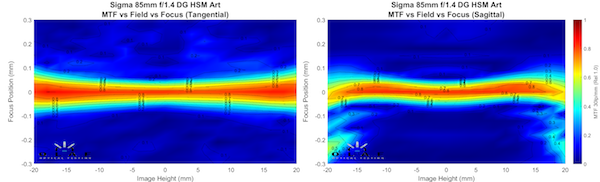
I was so impressed with the BBL that I thought I would run Field of Focus graphs on it to. Color me impressed (the graphs are colorful, get it?). It is perfectly flat from one side to the other. Superb.
Roger Cicala and Aaron Closz
Lensrentals.com
February, 2016
126 Comments
BigEater ·
A couple off people on Nikonrumors were complaining about their newish Sigma lenses falling apart. Is that something you guys have had problems with?
Roger Cicala ·
BigEater, not in recent years, not at all. If you go back 5 years or more, then yes, I was beating the bad quality drum with the rest of them. But this isn’t our Grandfather’s Sigma anymore. They’re reliable, and when something does go wrong service (in the USA at least) is excellent.
Lee ·
Not that we don’t believe the people who have had huge problems with Art lenses, but I’m amazed how many people forget that if you’ve had 1 or 2 copies of a lens made in the tens of thousands or more then your report is anecdotal if not coincidental.
Oleg ·
Thanks Roger! Much more meaningful test than the DxO garbage.
Munchma Quchi ·
DXO = Alternative Facts
Hysz ·
if anything it proves the same thing with different methods.
Teemu Kustila ·
Yep, pretty much confirms DxO tests
Hysz ·
That’s what I said, but top comments are butthurt that 3rd party lens is ‘the best’ lens. Notice the ‘ ‘.
Teemu Kustila ·
I know, I was just asserting my support for you 😀
Hysz ·
yay, I thought you were sarcastic, but I believed in you [a little]. <3
JerryC ·
People just pay for the red or gold ring, not the lens itself most of the time.
Hysz ·
True. It’s hard to imagine that every sector is targeted by marketing and photography isn’t. Of course there will be numerous ‘tricks’ to con person into buying this lens, vs some other lens. I like it how Sigma new Art line isn’t made like that, as far as ads go. It defends itself with great IQ, no need for golden/red rings to boost sales.
Larry Templeton ·
I actually pay to not have a red (or gold) ring on my lenses. I think Sigma’s (outer) lens designs are far superior to Canon and Nikon, with their “stuck in the 90’s, but trying to evolve, and can’t” look.
Larry Templeton ·
DxO doesn’t test for LoCa, coma (and much more), plus their tests numbers have a whole range of variables averaged into one single score (and then weighted curiously)— this all based off one copy of a lens.
On top of all that, they’ve been caught pandering to basically all manufactures that provide enough sway (whatever form that takes, IDK) many times over the years, by omitting, delaying, and even “revising” scores.
It’s not that I don’t use or value DxO, because I do, but their analysis of a lens should be taken with a grain of salt and supplemented with several more reviews before coming to any serious conclusions.
sickheadache ·
Oleg…Yep that confirms that Dxo mark…got it right also….Makes you look like…..fill in the blanks..and the ten that agreed with you….just goes to show us all…some have zero clue.
Oleg ·
Your message needs more “…”, that alreay indicates you have some serious issues. Speaking of DxO – their problem is consistency, and compressing results into a single number used for meaningless rating system.
42. Enjoy! 😉
Teemu Kustila ·
https://goo.gl/pHWAM1&miho
Teemu Kustila ·
https://goo.gl/kZnpHL&dobo
Adam Sanford ·
The only wildcard with f/1.4 Art lenses is AF, and both LensTip and TDP are claiming the new AF design (more power) apparently has eliminated the non-dock-correctible AF inconsistency that plagued the 35 Art and 50 Art.
So it’s an 85mm lens that outresolves everything but the Otus for 1/3 – 1/4 of the price *and it autofocuses well*. It’s not perfect — no IS, huge and heavy, weather sealing = ?? — but I still predict this will be Sigma’s biggest hit yet.
Chris ·
Focus shift is something to care about. It has something to do with optical design and cannot be corrected by AF system unless there is manufracturer correction data in your body.
Greg Dunn ·
Or in the lens. For sure the Canon system allows the lens to contain correction data at multiple focus distances, which is then passed to suitable bodies during the initialization sequence. This is programmed into a ROM during manufacture. Of course this can’t be altered by the user, but if it is indeed inherent to the design, there should be no need for that.
Chris ·
Focus shift is sharpest focal plane moving while you step down but not changing distance. In body data will allow body to predict difference between aperture at focus and aperture at capturing.
Teemu Kustila ·
https://goo.gl/9mZtoF&jcjva
Teemu Kustila ·
https://goo.gl/BDFvZv&ynjh
Teemu Kustila ·
https://goo.gl/nLkLjY&dahi
Teemu Kustila ·
https://goo.gl/y8wtPS&amil
Ian ·
Thanks as always for the great tests and write ups on the latest gear. I’m glad you didn’t put up the Canon 85L f/1.2II MTF chart as a comparison as it would probably make us cry. As you said, however, a lens is more than just a set of MTF curves, which explains why so many of us love our 85Ls despite their many optical & mechanical “charms”.
Roger Cicala ·
Ian, it did me, cause I love it too. But the 1.2 has never been about sharpness, it’s about blur. It goes from in focus to fuzzy cloud in about 2 inches.
Patrick Chase ·
I have a question about the measurements: Are you using a broadband light source for these? If so what distribution? If not what specific wavelength[s]?
I’ve looked through your blog posts from when you started working with the image bench, but didn’t see that spelled out. My apologies if you’ve already documented this.
EDIT: The datasheet for your bench says “white LED or optional halogen” fed through a collimator. Is it one of those?
Roger Cicala ·
Patrick, ours is the optional halogen passed through a photopic filter : https://en.wikipedia.org/wiki/Photopic_vision before it enters the commimator. The theory is that it should mimic the light wavelengths humans are most sensitive too, although I’m not sure I totally buy into that. In practice it’s wavelengths from 475 to 675nm with an intensity peak at about 570nm. (Those numbers are off the top of my head, I may be off a small amount)
Patrick Chase ·
That’s reasonable and fairly common practice. I mostly asked because I know the Sigma is known to have a bit of axial CA and spherochromaticism, and was wondering how that would be reflected in your MTF results.
FWIW when I was an imaging system architect (working closely with OEs) we typically used through-focus curves at multiple wavelengths. You can learn *lot* about how a system behaves that way. For example astigmatism and axial CA are easily detected.
Brandon Dube ·
The easiest way to identify astigmatism is to type tow;fie;go into Code V, or its equivalent action into Zemax, Oslo, or other design code 🙂
Personally I think the PSF has limited use in and of itself. When there are few aberrations they are useful, but after you build something and throw all the odd aberrations into things it often becomes difficult to understand what is in a PSF.
Patrick Chase ·
The OEs I worked with mostly used Zemax.
I suspect that the PSF may be more useful to somebody (like me) who was/is in the business of correcting images than to an OE. Needless to say the Fourier transform of the PSF (SFR) is *very* useful in filter design :-).
Patrick Chase ·
Sorry about the repeat-reply, but here’s a real-world example where PSFs were indispensable: Several years ago I was asked to help with a system that was having IQ issues, including grotesque variation. The simulated through-focus curves and the MTF measurements in production both looked passable, but the images had glaringly obvious astigmatism.
I finally asked the OE to simulate PSFs at 0.1 mm intervals through-focus, at which point the problem became obvious: This particular system had an off-axis reflective lens. As you are perhaps aware (I was not) those exhibit astigmatism along 45-135 deg axes instead of tan-sag. Unfortunately the through-focus curves were tan-sag, as were the test patterns used for alignment and QA in production.
Arguably the OE screwed up royally by not generating 45-135 curves to begin with, and by not insisting on 45-135 targets in mfg, but once we were in that situation examination of the PSFs was the fastest way to debug it and figure out how to proceed (alignment with the right targets helped a lot, as you might expect. Also, off-axis systems are weird).
Brandon Dube ·
Well, an Off-Axis system should be analyzed by full field displays, not a few points. Here’s some information;
http://www.dtic.mil/dtic/tr/fulltext/u2/a536338.pdf
45/135 is not always the case for an off-axis system. It depends how you have taken it off axis.
Hysz ·
I look at the pictures in this link, and I am sure you were being hostile towards me, lol. Joking, I can’t begin to understand the amount of details that went into the paper, but it seems to be the case, when one ‘angle’ so to speak can be off, and it affects the whole ‘lens’. Thing is, does ‘selective curvature’ isn’t something with mirrors only? Like telescopes, and not glass elements? From what I have seen, they should be at the same angle, because the lenses are ‘grinded’ that way, and the mirror was probably made in a different fashion [it was way bigger]. Just me, non physics thinking.
[it is first thing in the morning so I might have sounded dumb, please ignore if it was a dumb post]
Brandon Dube ·
An off-axis system is a case of a decentered system. There is no general pragma for what angles or whatever need to be analyzed. If you decenter in Y, the behavior is different to if you decenter in X, and so on. The behavior depends both on how you broke symmetry as well as the power/curvature of the elements that have had symmetry broken.
Hysz ·
Yeah, but [in my mind] X and Y decenter is easy to see and understand etc. But to have a let’s say circle, and only 11th hour up to 12th is ‘bulged’ a bit, it’s not that easy, because you might not look there. Am I understanding this correctly?
Brandon Dube ·
Sure, but a full-field display inherently looks everywhere.
Hysz ·
I see. Well this might be as good time as ever, you seem to know this thing, can you tell me if mirror is better or worse than lens in developing a prime lens let’s say. Just in theory. There are very poor mirror 500mm f8 lenses for example. What if there were some really, really good mirrors? I guess they would use them often, if they were better… But what is your take?
Brandon Dube ·
When you design with lenses, you have to deal with color aberrations. Mirrors have none.
When you design with mirrors you have to deal with the object and image being on the same side of things, so every new surface you add gets in the way of the other surfaces.
This means you have relatively few surfaces (< 3) to correct with, so you can only achieve a narrow FoV or a fast aperture, almost* never both.
I also work with CeFO (http://centerfreeformoptics.org/) on developments in aberration theory that allow you to use very strange shapes for mirrors to exceed what was thought to be the limit of what was possible in the past.
Hysz ·
for a second there I thought you send me a heart.
OK, I understand this, so some supersecret organization is actually making a ‘hybrid’ or sorts? The way you worded it seemed like mirrors only, but I hit my head today really hard, and I am sure there will be optical lens, like glass element <3
Thank you very much for everything. You are quite literally someone real famous, with that knowledge etc.
Brandon Dube ·
CeFO isn’t really secret. Many projects are sponsored by a corporate member and carry NDAs. The fundamental research we do is usually funded by NSF or someone else not interested in secrecy.
With telescopes there’s e.g. the newtonian, which is a 1 mirror design. With 2 mirrors there’s the Ritchey-Chretien, cassegrain, gregorian, and a few other forms. Three mirrors allows you to make a three mirror anastigmat, which is corrected for all of the primary aberrations except field curvature. Some TMA solutions exist that also correct field curvature but there aren’t a large number.
A TMA is near the limit for what you can do with rotational symmetry because any more mirrors is too much stuff in the way. Freeform optics are used when you tilt and decenter mirrors to get them out of the way. It depends on the size of the aperture, but at the moment we’re building/testing a design the mirrors for which fit in the palm of your hand, and each of which is > $80,000.
Freeform designs usually don’t go further than a TMA because there is a propensity for the complexity to become unweildly. 4 and 5 mirror designs have been done, though.
Usually you don’t do mirrors + lenses (a catadioptric system) because that adds color back into the mix, where only mirrors lets you design without any concern at all for color. Catadioptric freeform designs certainly aren’t a hot topic.
Hysz ·
I was joking about secret, but it made for more ‘climate’. Isn’t it possible to ‘curve the field curvature with another mirror that is kinda more cylindrical, like those: digitaltrends[DOT]com/photography/create-awesome-360-degree-videos-dslr-gopro-eye-mirror-accessory/
But not curve outwards, rather curve them in the same way [negative] than field curvature is. End result should be straight line or s something. Or just probably wasting your time, because I have no idea what am I talking about. But I am not trolling, curious.
Hysz ·
Can I share another stupid idea? What if individual pixels [photo-diodes on sensor] had an aperture? That way, once collected X% light, it would shut off, close – never overexpose.
Another thing [I really hit hard today, there was blood], what if those photo-diodes could store ‘time’. Let me explain. I imagine it[pixel] like a cup, once photons reach max, it will just sit there. So one thing is record WHEN it got this and that photon [I know, probably impossible], but then you could go back and with one future slider you could add and delete photons added after X time for example. And it would work per pixel or per sensor part so even if you overblown highlights, you can go back in time and gather 30% of light there, cool?
And last: what if pixel could grab full info > dump, gather > dump [all during one exposure]. And then you would be left with pixels that have enormous ‘cups’ mentioned earlier = incredible dynamic range?
Just say I am stupid, but I think some might be possible.
Brandon Dube ·
I don’t really know anything about sensors, sorry.
Hysz ·
was that a nice way to say I’m stupid? Or do you really do lenses, or optical thingies without sensors?
Brandon Dube ·
You don’t need to know anything about photon buckets to bend rays 🙂
Hysz ·
bbc[DOT]com/news/science-environment-36438686
Could those micro lenses be used to correct your field curvature?
Brandon Dube ·
You can use microlenses to fix field curvature. It is very expensive and prevents the development of interchangeable lens solutions.
Hysz ·
but it’s possible to fix curvature! YAAAAY! Win.I hit my head very much. And since then I am just trying things at random 🙁
BTW: They said those little lenses could be cheap in production.
Brandon Dube ·
Breaking the whole interchangeable lens thing is a pretty big deal.
Hysz ·
I am aware. I am sorry that I am wasting your time.
Well can I ask would you say DxO has a merit, or it’s like people saying :garbage, alternative facts, no pictures during tests = no tests etc.
I think DxO does a splendid job with what they can, and people are either too stubborn to learn new things, or they don’t care about ‘objective’ results, only how it renders in real time.
As far as I know there is actual testing going on at DxO, you think ‘we’ [stupid people who might have hit their head too hard] can rely on those numbers? Any alternative? [if not]
Patrick Chase ·
One last small remark on the topic of PSFs: The other place where I’ve found them useful is for simulation, particularly to get product buy-off for statistical/test limits. By this I mean that I convolved the spatially-variant PSF with reference images to model expected nominal- and worst-case behaviors.
A quick search of the literature reveals that this is a well-known technique (I didn’t know that at the time, but considered it such an obvious thing to do as to not be worthy of note). See for example http://www.imagescienceassociates.com/mm5/pubs/Image_Capture_Simulation_Using_an_Accurate_and_Realistic_Lens_Model.pdf
Brandon Dube ·
Here’s the spectrum of the photopic filter,
https://uploads.disquscdn.com/images/3705db8100c349f484861534e65a34f862770bce97d8ae717ba333511636e975.png
You would have to multiply this by the black body spectrum of the 150W tungsten bulb in the fiber source. I think its temperature is 3500K, but haven’t looked at the spec in years. The camera in the MTF bench would also have to have its spectral response multiplied into things.
In practical terms, the spectrum is heavily weighted to green, but is broadband.
Preedee Kanjanapongkul ·
Thank you for your excellent review article, Roger.
According to MTF graphs, Otus is sharper than Sigma until 8mm away from center. At 8mm and beyond, Sigma is sharper than Otus. I have suspicions that 1. Otus has some field curvature and 2. Sigma has less field curvature. I own Otus 85 and result from my own field test confirm the first hypothesis. These may explain why MTF of Otus drops rapidly and Sigma has better MTF at off-axis.
PS. If we take the actual area of sensor in to account, the total area where Otus is sharper is equal to ? x 8^2 = 201.06 sq.mm. on both APS-C and 35mm sensor. The total area where Sigma is sharper on APS-C is (24 x 16) – 201.06 = 182.94 sq.mm. and 35mm sensor is (36 x 24) – 201.06 = 662.94 sq.mm.
Roger Cicala ·
Yes, the Otus has a gentle curve, which I could see be an advantage for portraiture perhaps. But the Sigma is SO impressive.
Preedee Kanjanapongkul ·
I’ve just noticed that MTF graph of Otus in this article is better at off-axis than MTF graph from previous publication (according to https://www.lensrentals.com/blog/2016/04/sony-fe-85mm-f1-4-g-master-lens-mtf-and-variance/), which is clear that coverglass come into effect. This is implying that Zeiss had corporated coverglass thickness in their optical formulas. Surely, I don’t know that, whether Sigma do the same things or not and this makes me even more curious that MTF graph of this Sigma may be even better if thickness of coverglass used in Olaf is optimized for this Sigma.
HF ·
In terms of value, yes, probably the best. In terms of sharpness, too. But there is rendering of OOF elements, CAs, cats eyes etc. I think the Sony 85 GM to be superior, personally.
Preedee Kanjanapongkul ·
I agree with you. In term of sharpness and field curvature, Sigma is the best. While it also performs very well in term of lateral CA, vignette and distortion, it has problem with longitudinal CA which both Sony 85 GM and Otus 85 perform better. If we look at lens configuration in Sigma, Sony 85 GM and Otus 85, Otus 85 has 6 elements made of anomalous partial dispersion glasses, Sony 85 GM has 3 ED glasses and Sigma 85 has only 2 SLD glasses. These may be reasons why Otus 85 and Sony 85 GM corrected LoCA better than Sigma 85 and explain why Sigma 85 has lower price.
OOF or bokeh quality may be subjective. In my opinion, Sony 85 GM is the best among 3.
David Kudell ·
Sharpness is impressive, holding up to the Otus! Excited about the upcoming Sigma Cine Primes that will be based on the Art lenses. I’m hoping you plan to offer those for rent.
I’d love to see some AB comparison images of the Sigma vs the Zeiss Otus to check out the transition from in-focus to out-of-focus areas. I was thinking about renting each to check that out, but that would be a great LR blog post! ?
Roger Cicala ·
We certainly will David.
Carl Eberhart ·
Well done Roger, as usual sir !! The best MTF test and comparisons anywhere !!
“But, but it doesn’t autofocus consistently on the test card in the dark at a distance of 3 feet…it doesn’t have weather sealing or stabilization…therefore I’ll stick with the same brand as my camera”…hahaah….SHADDUP… 😀
The Art is clearly the king of all 85mm lenses, period. (Otus sharper in the center at higher frequencies…so what? Just encourages the few wealthy photog geeks who use it, to do “bullseye” composition, and that always sucks and looks amateurish! Unless you put your subject dead center…THE SIGMA WINS…)
Canon is having to make their new one with stabilization, because it won’t be this sharp, and they still want to charge over $2k for it…yawn…Oh and I almost forgot, they didn’t have the n**s to design a new f/1.2 85mm lens…yawn.
Oleg ·
You might be a super duper pro if the Otus is too soft and amateurish for you?
Munchma Quchi ·
Yep. Too good for the Otus. Few and far between but they’re out there.
Carl Eberhart ·
Dude get over yourself, read the tests and weep…
Oleg ·
You mad bro?
Carl Eberhart ·
Oleg who are you, and do you ever leave your parents’ basement…”bro”? When did I ever describe the Otus that way? It’s called putting words in somebody’s mouth…and it’s lying on your part. Go back to school and learn something child :)…
Oleg ·
Hey old man, I’m not your bro. Also drugs are bad, mkay? It took you 10 month to compile this pathetic cliche response! Great achievement, congrats 🙂
Carl Eberhart ·
go play in traffic child, I don’t live on this “disqus” service…
JP ·
Glad to know I’m not the only one who still puts down 2016- it’s in your signature block at the end of the article.
Roger Cicala ·
Well, I got the graphs right. At my age I’m kinda proud to have like 90% 2017s.
Lee ·
Well the MTF lines clearly start off lower, but they’re flatter, as is the field of focus. Sounds like the Otus 85 may be a little better for portraits* and the Sigma 85 Art a little better for other things like stitching for landscape and architecture.
*I don’t buy into “too sharp for portraits.” You’re lighting too harshly for your subject’s age and/or you need a better MUA.
Roger Cicala ·
We can only go 20mm off axis, so we’ll not be able to see edges on any of the MF lenses. Plus there’s the having to have a mount made for each one at $1,000 per mount.
John Krumm ·
Okay Roger, now please use your powers of persuasion to convince Sigma to start making these lenses again for Pentax so you (and I) can use them on a K1.
Roger Cicala ·
My powers of persuasion are probably negative with most of the manufacturers. Unless I promised to stop publishing if they did. Although Sigma probably likes me OK today. 🙂
JB ·
I took a shot at this a couple years ago, and I guess I’m ready to take another shot at it now…
Please, please, please stop using the “Jet” colormap for graphs like the Field of Focus presentations at the end of this post. Everything else here is done so beautifully. It just breaks my heart to see you go to all this trouble only to present the data in what is an objectively suboptimal way. If you’re in Matlab, it takes about 10 characters to switch from “Jet” to “Parula” which is immediately miles better. The “Viridis” colormap (from Matplotlib/Python land) would be even better still, and it is just a download and a few more keystrokes away.
Otherwise, this continues to be a great site with tons of great information!
Roger Cicala ·
JB, we here you. I’m actually investing a ton of other people’s time (AKA my money) into smart people reprogramming everything to be entirely MatLab free, so the MatLab stuff isn’t being worked on right now.
JB ·
Thanks for taking the time to respond! Good luck with the switch away from Matlab. Do you know what direction you’ll be heading in? There are lots of great free alternatives for static rendering out there, and an increasingly impressive array of tools for making interactive visualizations for the web. The great thing about tackling this sort of challenge now (as opposed to say 10 years go) is that virtually all the best tools come cost-free!
Roger Cicala ·
JB I have no idea, other than it’s moving to a freestanding database instead of thousands of Excel files.
Brandon Dube ·
The software is shifting to a Server/Client architecture instead of a monolithic application. The server is written in asp.net core, and the client is written in javascript. Unless we end up open sourcing it I won’t really say more than that.
I’m affiliated with Olaf, not LR, but my understanding is that the LR blog is run on wordpress and it would be difficult (read: not going to be done by LR’s programmers) to inject something like d3.js or highcharts or whatever into the blog as needed.
Lee ·
Yeah, that sort of thing is my biggest problem with WordPress (that and the 20,000 line CSS file you have to futz with if you want to customize things much)
Brandon Dube ·
Parula does not work well for this data because the gradation of Parula is too smooth. A difference of 0.1 at most spatial frequencies is about the limit of what is significant, but with Parula things are quite subtle unless the change is more on the scale of 0.3 or so. The software for this runs on a modern version of Matlab (R2015a) with Parula as a default. Among the color maps shipped with Matlab and available through cbrewer2, Jet fits this data best despite its shortcomings.
Samuel H ·
WOW, what an amazing performance. Hopefully they’ll start making E-mount versions of their Art lenses at some point…
HF ·
I thin the 85GM is a great alternative. I find its rendering even clearly better than the ART lens (less CA, almost no cats eye bokeh, plenty sharp,too) and it is smaller and lighter.
Samuel H ·
Yes, and the 85GM has bokeh to lust for, and is 33% lighter.
Then again the 85GM is 50% more expensive than the Sigma, and I have read bad stuff about its AF, particularly in video mode but also for stills.
HF ·
I have the GM and find AF to be quite good. The Batis AF is slightly faster and more quiet, but it doesn’t come close to the rendering.
Samuel H ·
The Batis is sharp but its bokeh is not good enough *for me*.
Good to also hear users saying good stuff about the AF of the GM. Are you using it for stills, or video?
HF ·
Stills mainly. It is our preferred portrait lens at portrait sessions or weddings. We don’t do studio shots where the stopped-down focussing could be a problem, but have the Batis as backup. In video mode, though, the noise is much lower than when doing stills. Maybe the drive power is reduced then.
Samuel H ·
Great to hear. Thanks.
Eloise ·
Do you have any measurements / comparisons with Tamron SP 85mm f/1.8? Seems like it might be a good alternative for people with slightly smaller budget (and physical pockets).
Roger Cicala ·
I don’t have those yet. But the 35mm and 45mm were excellent.
Lee ·
I think it’d definitely be an interesting one to look into since anecdotally it seems Nikon users are reporting better results than Canon at least with respect to CA.
Roland Delhomme ·
Gentlemen, thanks for the always fascinating discussions on optics, engineering and construction, testing, variation, methodology-time well spent and truly a joy to read. Roger, you do us all a great service; Thank You.
Marius Godeanu ·
I ordered my Sigma Art and after some “poor man’s” testing I found this:
https://mgphotographer.wordpress.com/2016/12/27/sigma-85-1-4-art-vs-sigma-85-1-4-hsm-old-model-on-d810-what-am-i-doing-wrong/
I really wanted to like the Sigma 85 Art, but is it possible I have a monster EX ( the old sigma 85 ) lens 😀 Besides the heavy purple fringing on the old lens – and a bit more sharpness in the corners, the old lady still holds her own. Or I’m doing it wrong ? Could it be that I received a lemonish 85 Art ?
Roger Cicala ·
Marius, it could be. Compared to the old one I would expect you to see a significant improvement in resolution with the new one. The old one isn’t a bad lens, but the difference should be noticeable.
Marius Godeanu ·
I didn’t find anything wrong with the Art – it’s just that my old one is simply ALMOST THERE. I was expecting more judging from the size, weight, price and the new Art formula. I will probably try another sample in the summer when I can test it properly with the way I usually shoot : contre-jour in bright summer sun 😉 hopefully it should show it’s ground there.
Hysz ·
wow, ok. Is it possible for you to send me some RAWs? just 2 would do, both 1.4 ISO 100, same distance, same light. You can send me a msg if you agree, thanks.
dyna ·
Good, bad, or ugly, I’d love to see a bench test with the Tamron SP 85mm 1.8 VC. DXO says it’s as sharp as the Sigma and it only lost by 4 points, which would be within sample variation… based on their methods, anyway. I’d be curious to see what there is to see.
Roger Cicala ·
Dyna, I was going to do it until you said, “Lost by 4 points”. Now I can’t ever. 🙂
dyna ·
Ha! Tis the American way, right? “That DXO point spread! Greater than a field goal! Impossible to overcome!” The fallacy IS rather ridiculous but it’s how some operate, unfortunately. So if there is to be one set of numerics, let there be another! And pass the bourbon because, sincerely, all the specifications are mind-numbing.
Teemu Kustila ·
https://goo.gl/vwtbq6&axisa
Teemu Kustila ·
https://goo.gl/XSR7Rj&usopy
Buc Nelson ·
yet another post about tamron, do you work for them? check his discus post history, unless he’s turned privacy off by now.
Teemu Kustila ·
https://goo.gl/q7p1S1&yzel
Nemo Niemann ·
I rented the 85 from you guys about a month ago for a shoot. I was so impressed, I contemplated buying the copy I used — it was so sharp and well behaved. Now I’m paranoid. Because I don’t really “read MFT” well (if truly at all), are all the copies really that consistent — as you stated — and there is little noticeable different in “real world” application? Or did I have a truly stellar copy and should kick myself for not going ahead and buying it, warranty or no?
Roger Cicala ·
Nemo, there’s copy variation, but it’s not bad on this lens at all. I’d expect you to see very similar results. If you don’t then exchange it.
ptakeuchi ·
Nemo, your concern is understood. I appreciate all the work Roger and his team does for the community and as a lens rental business. I rented the Sigma 50mm Art from them last year and was so impressed with the quality and leery of spending the time to buy from Adorama or B&H and go through a series of testing and returns until I was satisfied, that I bought the lightly used copy I rented from Lens Rentals. I trust them to test and clean the lenses before they go out. Time is money these days and I’d prefer not to spend my time mulling over sample variations and boxing up returns. If you have the $ and need the quality, it will likely be worth buying a used copy from LR rather than new or used somewhere else.
Nemo Niemann ·
Thanks for the “thumbs up”.
William Wilson ·
Looking forward to your review of the Rokinon 85 1.2. I’m renting the Zeiss planar in May. I’m buying an 85 prime this year. It’s just that so many options are available now. It’s getting hard to decide.
Ari ·
I seems very sharp, but AF capabilities using the outer focus points is the the most important feature at least for me. I’d love to see a comparison of AF capabilities using the outer focus points at f/1.4 between Sigma 85 1.4 Art and Canon 85 1.2L II in various conditions. I´m using almost all the time only the outer focus points. Occasionally I also would like to use it at full aperture as well or close to it on my Canon bodies.
Nemo Niemann ·
I almost always use outer focus points (usually using the the right-most focus point, but in vertical mode, so the top point), since I shoot fashion and beauty. I had absolutely no issues with either the 5Ds or the 1Dx2.
Ari ·
Thanks for the info. Good to know. Have you used the outer focus points at f/1.4?
Nemo Niemann ·
I have shot it with outer focus points at 1.4, though I rarely shoot any lens wide open. I calibrated the 85/1.4 I bought with Reikan FoCal. Great software to automatically adjust the micro focus. So, the lens was sharp when I used the outer focus points.
ptakeuchi ·
Roger, any comment on the effect of mounting this on a D810 body attached via an arca plate to a tripod? Will all of that weight hanging forward, put too much stress on the D810’s lens mount? They are roughly the same weight: Sigma 39.9oz, D810 34.9oz. I have the Zeiss Milvus 85 which is about the same weight as the Sigma though smaller so presumably less weight hanging forward.
Roger Cicala ·
It should be fine just hanging there. My concerns (and they’re just that, no scientific evidence) is that size lens hanging from a strap and getting jostled around. Static weight is one thing, but momentum of that weight falling a foot on a strap or banging into something might be more of an issue.
ptakeuchi ·
Roger, thanks for your comment. I’d assume that Sigma would have done their engineering due diligence and provided a collar with lens foot if they were concerned that there would be risk to the lens mount.
Van Forsman ·
@ptakeuchi:disqus part of the issue you’re foreseeing is that the lens mount on the camera could be bent by the lens torquing on it. If you look around online, you might find examples of it, but as roger said, it’s really an issue only with sudden acceleration, i.e. jerk.
Lacknafta ·
Looks like a super lens and I very much like the article, with the initial explanation that lots of glass has a price in weight where specially shaped glass has a price in money. I really liked the original Sigma 85 1,4 HSM on my A77, optically. The focus ring was a bit too resistant to being turned when mf:ing though and the AF was a lama being sick on yoyr shoes (it needed different micro focus adjust depending on whether coming from mfd or infinity). It also made a sort of whistling sound when AF:ing. I asked Sigma’s Swedish official repair channel about it, saying the AF accuracy issue was having a party in my attic and they said they could calibrate it but only from one direction.
Yair ·
Roger,
Can you please post a comparison of the Sigma to the Milvus , i think this is the most relevant comparison to most of us.
Thanks a lot for the great work.
Mike Earussi ·
For my work a flat field is very important, and this lens is as flat as a macro. Amazing.
Karl ·
Dear Roger! All these MTF tests at Lens Rentals are really quite interesting and helpful in deciding about lenses for anybody with a full frame DSLR or a Sony A7. Is there any reason why smaller sensor systems like M43 or Fuji APS-C are not covered at all? I know that you tested M43 lenses some years ago, but nothing like this since you are testing with OLAF. Is there any technical reason for this?
Brandon Dube ·
We don’t test APS-C or (generally) M4/3 because there are less lenses for those mounts than EF, F, etc. Fuji, etc, may require us to build a new electronic passthru for the MTF bench which is also a great investment of time. They’re also just less interesting to us.
Patrick Chase ·
Sigh. Just as I was about to buy this lens Sigma went and announced a 135/1.8 (which is currently a bigger gap in my lineup).
Let us know when you get a few of those to test, m’kay? 🙂
Martti O Suomivuori ·
Could you now please drop it and take it apart, see how much Silicone Marmalade it has eaten to become so fat.
Sigma has certainly come a long way.
JD ·
WHAT ABout comparisons to the Nikon 1.4 AF-s as well as the older AF-D?