
A Quick Look at the New Zeiss Batis 135mm f/2.8 MTF Charts
Announced from Zeiss today was the new Zeiss Batis 135mm f/2.8. You guys know I don’t like putting out MTF charts on less than 10-copy averages, but we had a chance to grab a Zeiss Batis 135mm f/2.8 prototype lens for a couple of days, so I tested it. And since we certainly aren’t going to get our hands on ten regular copies anytime soon (at least not to test) I thought I’d put this up. But keep it within reason: this is a prototype lens, and it’s one copy. So this is a hint of what we can expect.
While I don’t have a lot of comments about the lens itself, it handles, looks and feels like every other Batis we’ve touched, so you won’t have any shocks. It’s reasonably sized, too, and I expect a lot of people will be willing to forego that it’s f/2.8 and not f/2 in exchange for the more reasonable size you get with that. And others won’t. So it goes.
But here are the MTF curves of a single Batis 135mm f/2.8 lens, taken at four rotations and averaged. The reason that the sagittal and tangential aren’t perfectly lined up at the center is because of that; the optical center of the lens is about 1mm from the measured center. Since we rotate them and average, the slight difference shows up as space at “o”. When we do ten copies, that averages out.
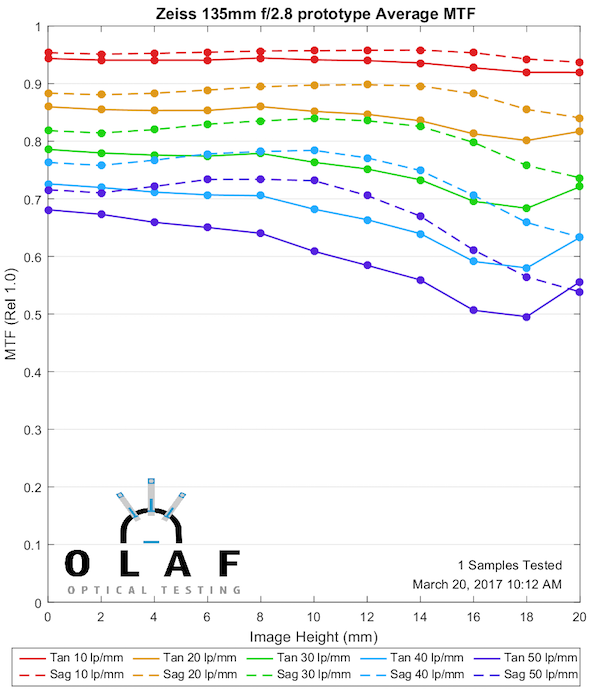
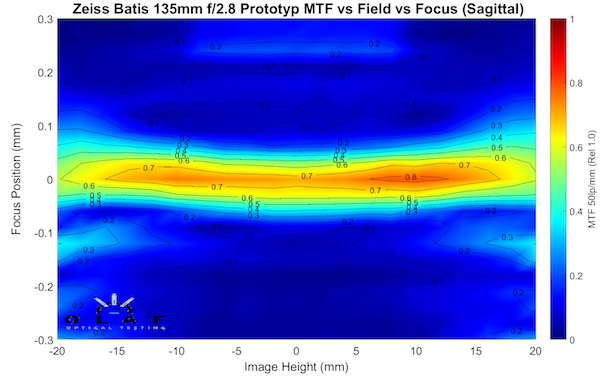
The field of focus on the 135mm Batis is nice and flat, in both sagittal and tangential planes, as we would expect from a good lens at this focal length.

To give you an idea of what kind of MTF you get for your dollar with the new Batis, I’m going to also put up the MTF charts of the Zeiss 135mm f/2.0 APO-Sonnar and the Canon 135mm f/2.0 L. Remember, as always, reducing aperture improves MTF, so both of these other lenses would be at least a little better if they were tested at f/2.8 like the Batis is.
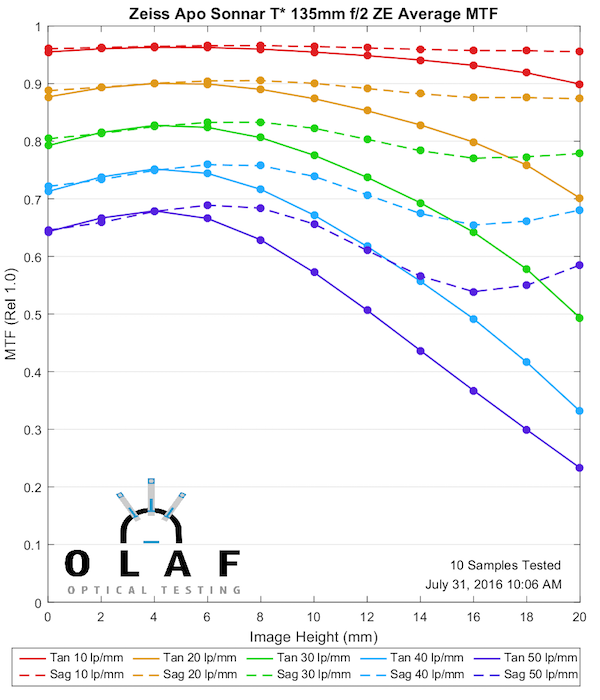
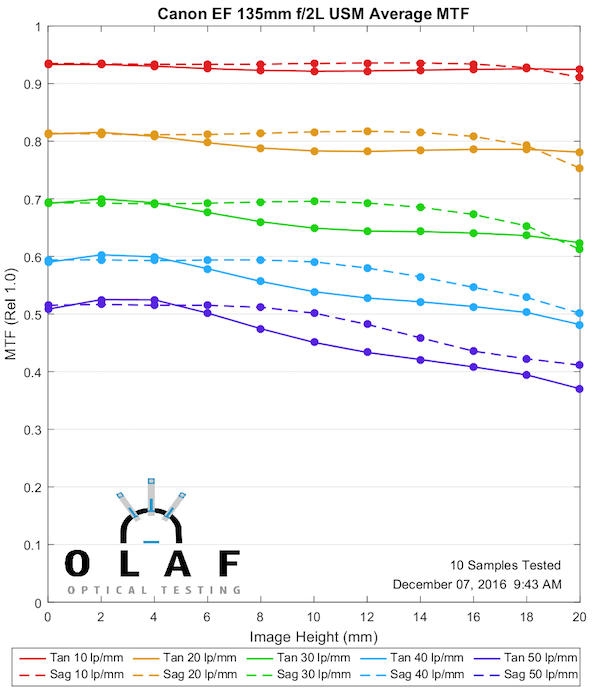
The Batis is certainly in the same conversation as either of these two lenses. As mentioned, they would both have a little higher MTF at f/2.8. I suspect the Canon, as wonderful of a lens that it is, would still lag just a bit, and the Zeiss APO-Sonnar would be a bit better compared to the Batis, but the differences would be minimal. Of course, the Batis isn’t going to shoot at f/2.0, and a lot of people want that aperture at this focal length.
We’ll get a cleaner look when we’ve been able to run ten production copies through our testing and put things on an even footing. This was, as mentioned, a prototype. But the initial results are certainly promising and are going to provide FE shooters an excellent native mount lens in a focal length where that wasn’t available before. Want to check it out for yourself? The Zeiss Batis 135mm is now available for preorder.
Roger Cicala and Aaron Closz
Lensrentals.com
April, 2017
44 Comments
hexadecimal ·
Is the MTF profile of a lens wide open enough of a fingerprint to predict the MTF profile of the lens at other apertures? I know you guys don’t want to do stop down tests, but it would be cool to at least be able to see the most likely MTF performance at small apertures.
Patrick Chase ·
Would it shock you to know that the answer is “it depends”?
https://www.lensrentals.com/blog/2016/01/what-actually-happens-when-you-stop-down-a-lens/
hexadecimal ·
Thanks for linking that article, I must have missed it when it was posted.
Patrick Chase ·
These ones are also good:
https://www.lensrentals.com/blog/2014/04/a-look-at-stopping-down/
https://www.lensrentals.com/blog/2014/09/field-curvature-and-stopping-down/
Patrick Chase ·
These ones are also good:
https://www.lensrentals.com...
https://www.lensrentals.com...
If you look at the off-axis OLAF images for the Sigma 35 f/1.4 in the first article above, you can see that lateral color contributes most of the radial "spread" at small apertures (more so than for some of the other 35s, which have more classical astigmatism)
Roger Cicala ·
Like Patrick said, it gets better, but exactly how much where varies. A common pattern is the center is maximally sharp 2 stops down, but the edges may not for 4 stops, but it varies.
There’s just a practical time aspect to doing it. This test took about 25 man/machine hours, but we need the wide-open data to set up our measurement standards and are happy to share it. Each additional aperture would take another 20 hours or so and the data is interesting, but I can’t justify the cost because it’s not useful in-house.
hexadecimal ·
Actually the article that Patrick linked below was pretty much what I was interested in. I really appreciate all the testing that you guys do and your thoroughness.
In retrospect my idea was probably a little too optimistic. If you just think of two lenses with the same optical design, but one with regular aperture blades (coated black) and one with shiny metal aperture blades, the second one would have a pretty good chance of having much worse MTF stopped down but the same wide open performance. Of course, any lens designer that puts shiny metal aperture blades in a lens would probably not be a lens designer for long 🙂
Brandon Dube ·
The aperture mechanism is opto-mechanical, lens designers don’t deal with them.
Patrick Chase ·
I suspect that a reflective aperture would actually produce veiling glare, i.e. it would degrade the global contrast of the image.
If that were the case then it might not impact MTF. MTF is a ratio of modulation at some specified frequency divided by modulation at DC. Veiling glare degrades the DC contrast as well as higher frequencies, so its impact on MTF would be self-canceling to a very rough first order.
hexadecimal ·
Is the MTF profile of a lens wide open enough of a fingerprint to predict the MTF profile of the lens at other apertures? I know you guys don't want to do stop down tests, but it would be cool to at least be able to see the most likely MTF performance at small apertures.
Patrick Chase ·
Would it shock you to know that the answer is "it depends"?
https://www.lensrentals.com...
One thing that has become apparent to me is that with broadband measurements like these the off-axis tangential MTF is degraded by lateral color, and stopping down doesn't help with that. I have the Sigma 35/1.4, and it (or at least mine) doesn't exhibit astigmatism when stopped down to the degree that the measurements in the post I linked above suggest. It does however have a bit of lateral color...
Roger Cicala ·
Like Patrick said, it gets better, but exactly how much where varies. A common pattern is the center is maximally sharp 2 stops down, but the edges may not for 4 stops, but it varies.
There's just a practical time aspect to doing it. A 10 lens test takes about 8 man/machine hours for a prime, 25 for a zoom. ,But we need the wide-open data to set up our measurement standards and are happy to share it. Each additional aperture would take another full set of testing and while the data is interesting, I can't justify the cost because it's not useful in-house.
hexadecimal ·
Actually the article that Patrick linked below was pretty much what I was interested in. I really appreciate all the testing that you guys do and your thoroughness.
In retrospect my idea was probably a little too optimistic. If you just think of two lenses with the same optical design, but one with regular aperture blades (coated black) and one with shiny metal aperture blades, the second one would have a pretty good chance of having much worse MTF stopped down but the same wide open performance. Of course, any lens designer that puts shiny metal aperture blades in a lens would probably not be a lens designer for long :)
Brandon Dube ·
The aperture mechanism is opto-mechanical, lens designers don't deal with them.
Patrick Chase ·
I suspect that a reflective aperture would actually produce veiling glare, i.e. it would degrade the global contrast of the image.
If that were the case then it might not impact MTF. MTF is a ratio of modulation at some specified frequency divided by modulation at DC. Veiling glare degrades the DC contrast as well as higher frequencies, so its impact on MTF would be self-canceling to a very rough first order.
Patrick Chase ·
So when are you guys going to get the Sigma 135/1.8 on the bench?
B&H says they have F-mount in stock and expect to ship EF by Friday… 🙂
Bob B. ·
Yes…I would be loving to see that comparison, too….but the Batis is for Sony only….frustrating to a Canon owner who might LOVE an image-stabilized, AF’ing Zeiss beauty. 🙁
Roger’s take on the Sigma would be valuable information in general, even if it was only one copy of the lens, as well.
Surprised to see it is shipping so soon. Thanks for the info.
Roger Cicala ·
I know they’re ordered and they should cross the bench on the way to stock unless I’m tied up with something else.
Patrick Chase ·
So when are you guys going to get the Sigma 135/1.8 on the bench? B&H says they have F-mount in stock and expect to ship EF by Friday... :-)
Also, it's probably worth mentioning that the Batis has optical stabilization, which may make it attractive to some. I personally use 135 for portraiture and indoor sports, so I'd take the 1 (Canon, APO-Sonnar) or 1-1/3 (Sigma) stops of aperture over OIS, but for other requirements it could be a very nice choice.
Bob B. ·
Yes...I would be loving to see that comparison, too....but the Batis is for Sony only....frustrating to a Canon owner who might LOVE an image-stabilized, AF'ing Zeiss beauty. :-(
Roger's take on the Sigma would be valuable information in general, even if it was only one copy of the lens, as well.
Surprised to see it is shipping so soon. Thanks for the info.
Roger Cicala ·
I know they're ordered and they should cross the bench on the way to stock unless I'm tied up with something else.
Adam Sanford ·
That 135L is 20+ years old and still pulls its weight vs. the modern day stuff quite well. That’s amazing.
Roger Cicala ·
It’s been my favorite lens for a decade.
Adam Sanford ·
That 135L is 20+ years old and still pulls its weight vs. the modern day stuff quite well. That's amazing.
Roger Cicala ·
It's been my favorite lens for a decade.
obican ·
I think I’ll go get the 135L soon. Batis 135 is certainly an amazing lens and I’d love to have one but… just not at that price no. Never. Sorry.
Patrick Chase ·
I’d wait a few days to find out how the Sigma performs if I were in the market right now.
It costs a bit more than the 135L, but at f/1.8 it’s also 1/3 stop faster and I suspect it will turn out to be significantly better optically. It’s a more complex formula with more low-dispersion elements, and Sigma’s designs have been pretty well-optimized of late.
There are also rumors of a new 135L IS coming later this year or next.
obican ·
I would never, ever get the Sigma. Not at that weight figure.
Patrick Chase ·
The only comparable lens that I’m aware of is the Zeiss 135 f/1.8 for Sony, and that one weighs almost as much as the Sigma (2.2 vs 2.5 lb).
The Canon weighs almost a full pound less, but it’s also slower and probably not as well corrected (you would expect Sigma to get *some* advantage out of all that exotic glass – 4 LD/FLD elements vs 2 UD in the Canon). We’ll have to wait for the measurements to know for sure though.
obican ·
You don’t seem to understand, I wouldn’t rather shoot the Canon neither but it’s the lightest modern (relatively) and good performing 135mm lens at any aperture, apart from the Batis. Both Zony and Sigma are hugely impractical for me. Batis would be perfect but I’m not paying 2000$ for one.
Patrick Chase ·
The only comparable lens that I'm aware of is the Zeiss 135 f/1.8 for Sony, and that one weighs almost as much as the Sigma (2.2 vs 2.5 lb).
The Canon weighs almost a full pound less, but it's also slower and probably not as well corrected (you would expect Sigma to get *some* advantage out of all that exotic glass - 4 LD/FLD elements vs 2 UD in the Canon). We'll have to wait for the measurements to know for sure though.
obican ·
You don't seem to understand, I wouldn't rather shoot the Canon neither but it's the lightest modern (relatively) and good performing 135mm lens at any aperture, apart from the Batis. Both Zony and Sigma are hugely impractical for me. Batis would be perfect but I'm not paying 2000$ for one.
zorglub76 ·
Why is no one mentioning Zeiss 135/1.8? That lens has been on my wish list since they released it. And it will be on my wish list forever 🙂
Patrick Chase ·
Yep, if I were a Sony shooter I’d probably choose that lens over the Batis, for reasons I spelled out in another comment below. Speed trumps stabilization for me in this focal length.
obican ·
I think I'll go get the 135L soon. Batis 135 is certainly an amazing lens and I'd love to have one but... just not at that price no. Never. Sorry.
Patrick Chase ·
I'd wait a few days to find out how the Sigma performs if I were in the market right now.
It costs a bit more than the 135L, but at f/1.8 it's also 1/3 stop faster and I suspect it will turn out to be significantly better optically. It's a more complex formula with more low-dispersion elements, and Sigma's designs have been pretty well-optimized of late.
There are also rumors of a new 135L IS coming later this year or next.
zorglub76 ·
Why is no one mentioning Zeiss 135/1.8? That lens has been on my wish list since they released it. And it will be on my wish list forever :)
Patrick Chase ·
Yep, if I were a Sony shooter I'd probably choose that lens over the Batis, for reasons I spelled out in another comment below. Speed trumps stabilization for me in this focal length.
Turniphead ·
Posting MTF plots before you have a averaged set of 10 copies tested – that’s just plain Batis 😉
Turniphead ·
Posting MTF plots before you have a averaged set of 10 copies tested - that's just plain Batis ;)
Preedee Kanjanapongkul ·
In my opinon, Zeiss has made a smart move by designing Batis 135 with f/2.8 aperture. While it may be not fast enough for some people, it has some advantages.
1. It is much easier to design lower aperture lens with high optical performance than faster lens. Although results are obtained from only one sample, Batis 135 has quite flat field and MTF looks pretty good.
2. Better balance between weight/size and optical performance.
I can’t imagine how result would be if Zeiss go all out to make high performance f/2 or f/2.8 lens like they did with their Otus line.
Preedee Kanjanapongkul ·
In my opinon, Zeiss has made a smart move by designing Batis 135 with f/2.8 aperture. While it may be not fast enough for some people, it has some advantages.
1. It is much easier to design lower aperture lens with high optical performance than faster lens. Although results are obtained from only one sample, Batis 135 has quite flat field and MTF looks pretty good.
2. Better balance between weight/size and optical performance.
I can't imagine how result would be if Zeiss go all out to make high performance f/2 or f/2.8 lens like they did with their Otus line.
Thinkinginpictures ·
I’m using the Olympus 75mm 1.8. Previously I used the Zeiss 135mm 1.8 from Sony. At this price and for me to pick up the big FF glass again…I want F2. Does it matter? Probably not. Do I want it? Yep. I imagine most feel the same way.
Thinkinginpictures ·
I'm using the Olympus 75mm 1.8. Previously I used the Zeiss 135mm 1.8 from Sony. At this price and for me to pick up the big FF glass again...I want F2. Does it matter? Probably not. Do I want it? Yep- at that price you kind of expect it. I imagine most feel the same way.