New Items

Sony FE 12-24mm f/4 G MTF Tests

Lensrentals.com, 2017

I usually don’t do any prerelease testing. Mostly that’s because manufacturers will send one prerelease copy to a reviewer. If you tell them you won’t test less than ten copies they look at you like, well, I don’t know what they look at you like because I only communicate by email. But they say nope; you can’t have ten. And I usually (unless I’m really, really interested, which is rare) just decide to wait until it is released.

The other reason I don’t often do prerelease testing is that there’s some gamesmanship about prerelease copies, especially if you’re not a giant review site. I’d rather just review ten purchased copies after release than play games.

With that in mind, I want to practice full disclosure about these ten copies. They are prerelease copies owned by Sony; not by Lensrentals. Sometimes we get the opportunity to test them for Sony before they’re released. I give them the data, make my comments, and keep my mouth shut for a while (because there is, of course, a keep-my-mouth-shut clause in our agreement). Then I wait six weeks until Lensrentals gets copies, test ten of those, and write a blog post.

In this case, because the lens tested really well, I asked permission to go ahead and do the write-up based on the tests of their copies, which they granted. If it had sucked, I wouldn’t have asked. So there, now you don’t have to read the article because I already told you it’s good.

Oh, and because someone is going to scream ‘those are hand picked copies,’ trust me, if most manufacturers could hand-pick half as well as you think they can, there wouldn’t be any reason for us to test them, would there? I’ve been doing this for years, and so far, I’ve never seen a big optical difference between pre-release copies and off-the-shelf copies.

So, About the Lens
Lensrentals.com, 2017

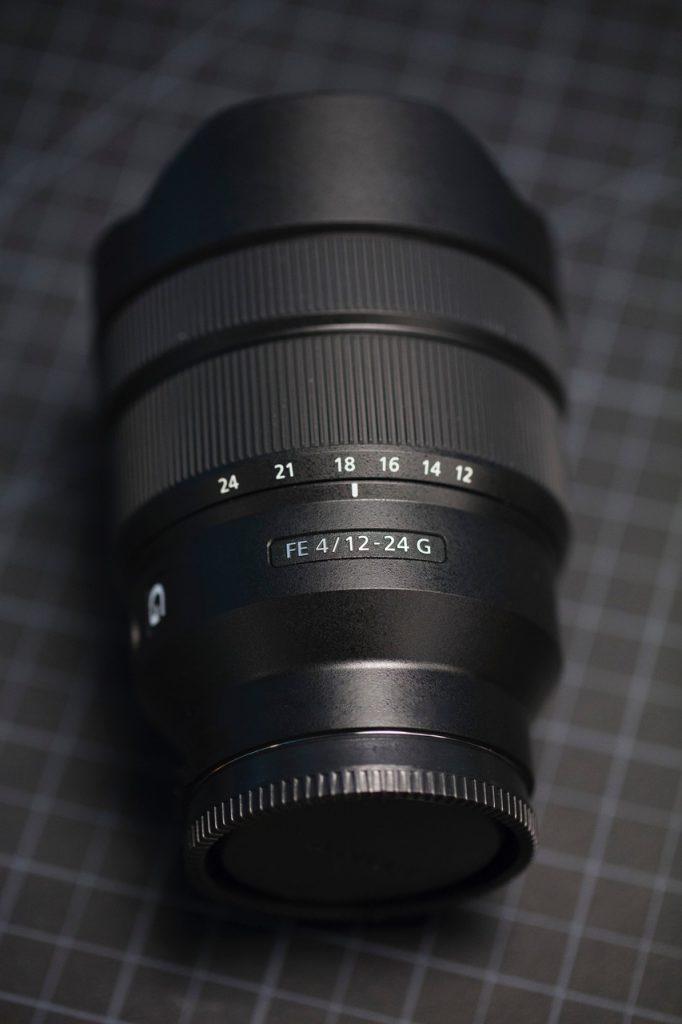
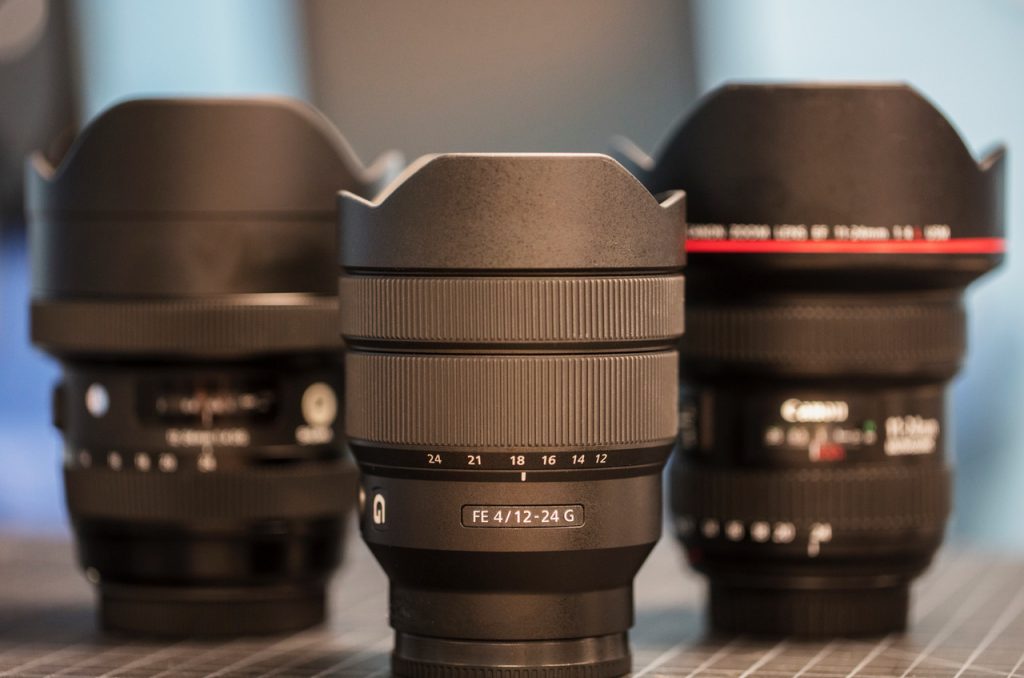
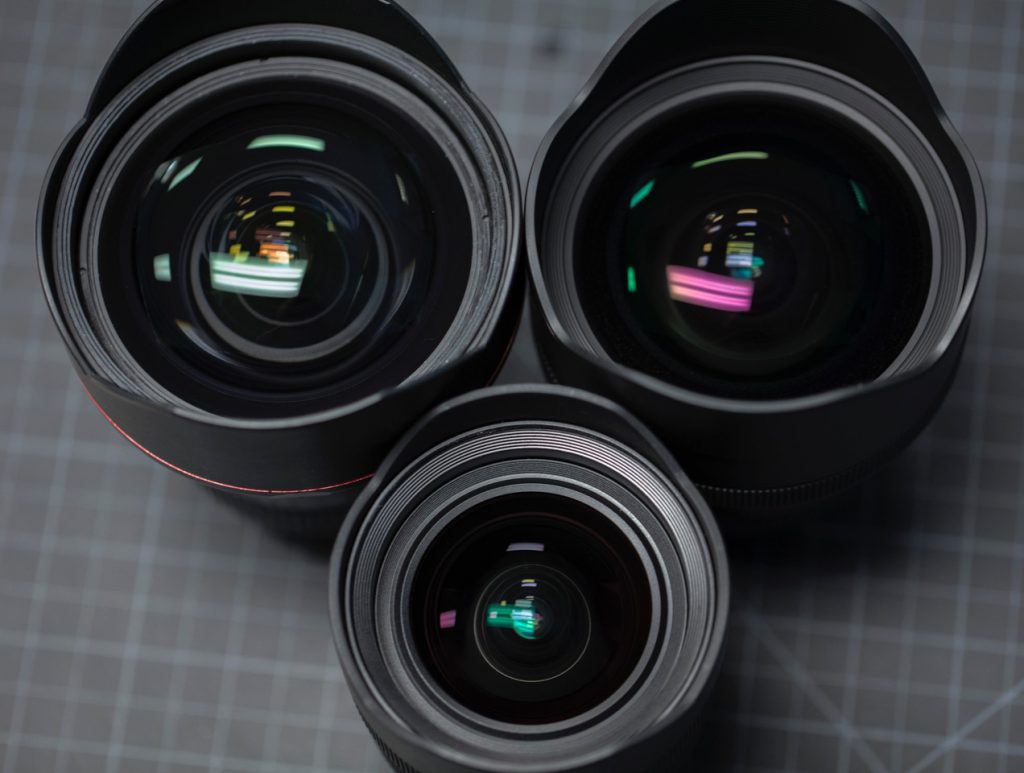
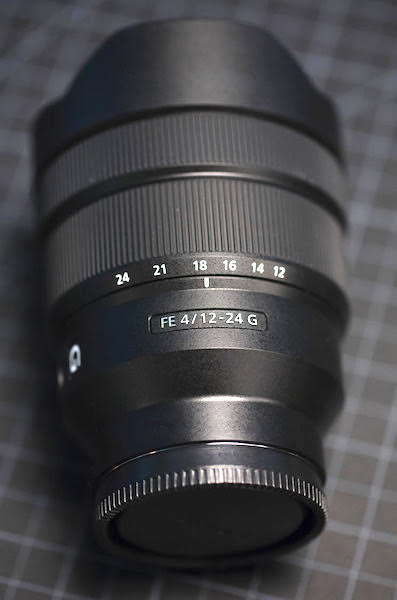
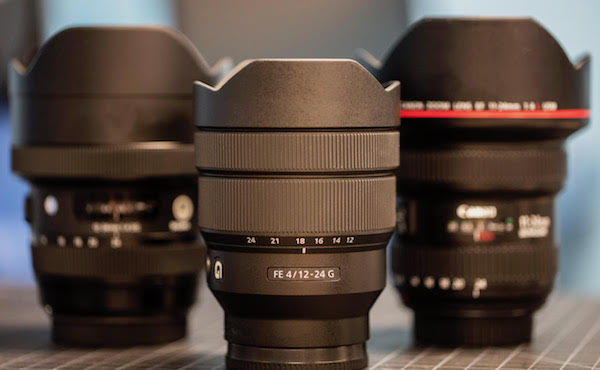
The Sony FE 12-24mm f/4 is a full-frame, ultra-wide angle zoom that will be available in August for about $1700. It has Sony’s ‘Direct Drive Supersonic Wave Motor,’ which is a linear piezo drive, like the one in the Sony FE 85mm f/1.4 GM lens. It has four aspheric elements, a curved aperture ring, yada, yada. Most impressive to me is it’s a reasonably small lens, around 4.5 inches long and weighing about 1.25 pounds (565 grams for those of you who have a logical measuring system). That’s a full pound lighter than the Sigma 12-24mm f/4 Art and Canon 11-24mm f/4 L lenses that I waxed poetic about in an earlier post. And Sony’s price is just a few hundred more than the Sigma and about $1,000 less than the Canon.

Let that soak in for a second. This is a Sony lens, that is not more expensive than the competition. It’s almost July. I’m looking for snow.

Some MTF Results

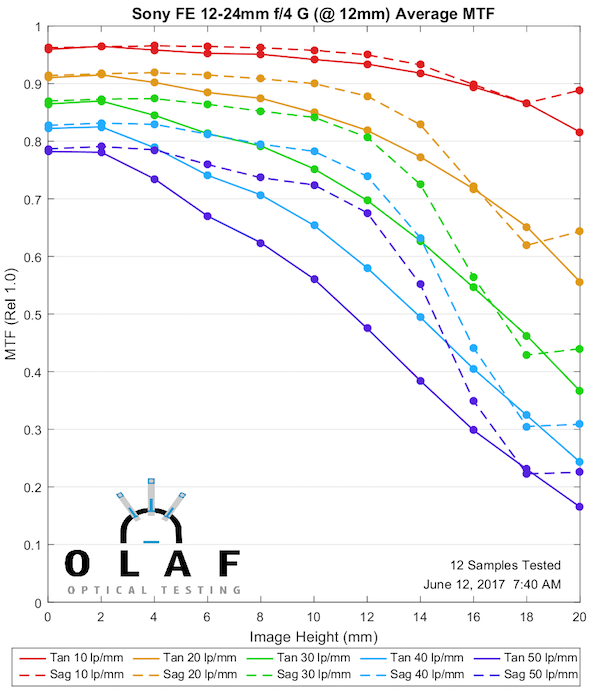
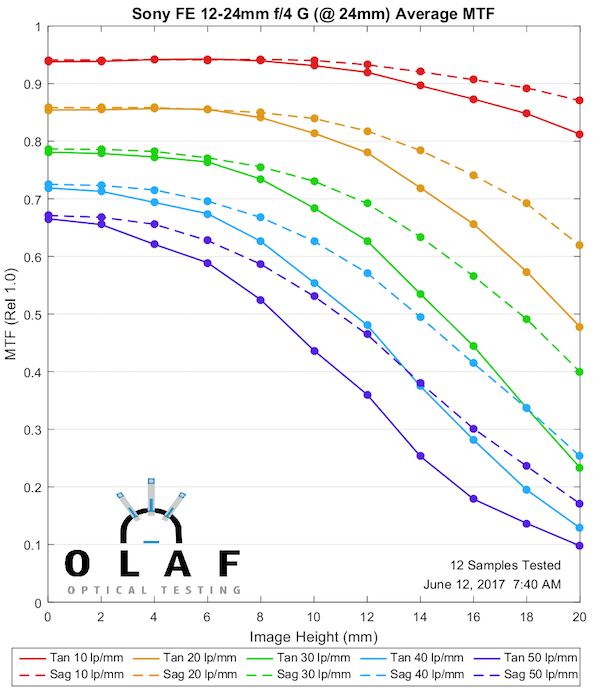
As always, these are the averaged results of ten copies, each tested at 4 different rotations. Because of the baffle used in the Sony mount there are fewer points to average at 18mm and 20mm away from center, so take those edge measurements with a tiny grain of salt.

At 12mm
Olaf Optical Testing, 2017

This is really very good. I was a bit surprised after I first picked up the lenses, which are tiny compared to the Sigma 12-24mm f/4 or Canon 11-24mm f/4, that the results would be this good.


 At 24mm
Olaf Optical Testing, 2017

The 24mm results follow Roger’s Rule of Wide Zooms; the long end isn’t quite as good as the wide end. But that’s as it should be, we don’t buy 12-24 zooms to shoot at 24mm most of the time. And honestly, it’s still quite good even at 24mm.

Sample Variation

We actually do have a variation number finally set up and approved. But until we’ve recalculated it for 500 lenses, I won’t be presenting it. I will show you our standard variance graph that basically shows you the range of these lenses. It’s better than average. Sony seems to be making progress with their sample variation in the newer designs.
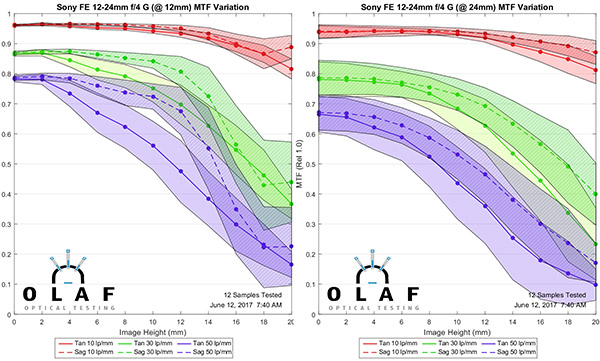
Olaf Optical Testing, 2017

Especially at 12mm, there is almost no variation in the center. As with most wide-angle zooms, if your copy isn’t quite like the others it will probably be at the long end, but this is really a good performance.

Of Course You Want Comparisons

It seemed to me the logical comparison was with the Sigma 12-24mm f/4 Art.

12mm
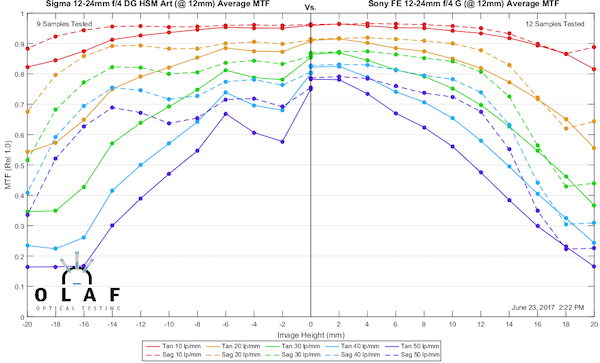
Olaf Optical Testing, 2017

I’m sure some fanboys will find some hair-splitting here at 12mm, but whatever differences are insignificant.

24mm
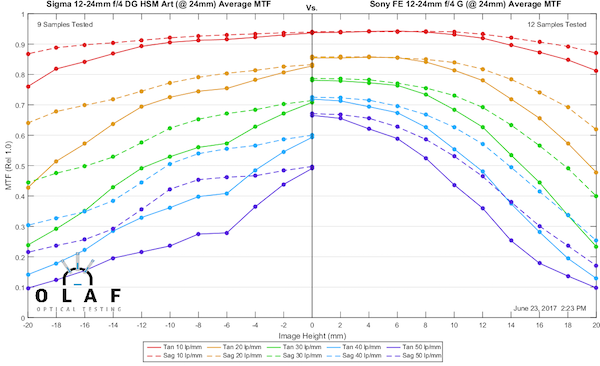
Olaf Optical Testing, 2017

At 24mm the Sigma isn’t keeping up with the Sony anymore. The Sony is clearly better both in the center and all the way to the edge.

There aren’t a ton of other logical comparisons to make, but I’ll throw a couple up.

Canon 11-24 f/4 L

There is a real difference between 11mm and 12mm, but still an interesting comparison.
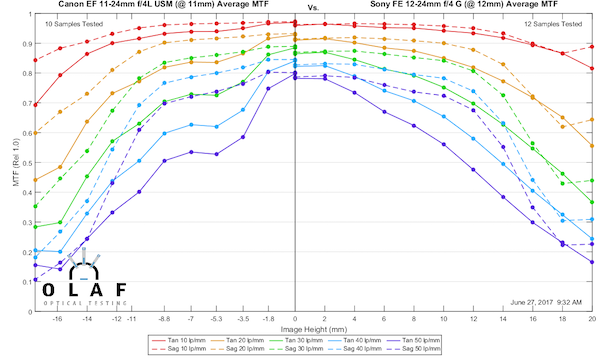
Olaf Optical Testing, 2017

And no, I’m not commenting other than ‘those are both excellent’.

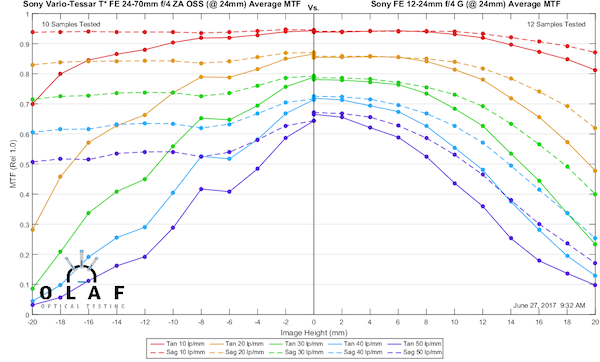
Sony Vario-Tessar T* FE 24-70mm f/4 at 24mm

This is actually a useful comparison because I think people will carry both of these in their bag and may want to choose which to use at times. This is somewhat surprising to me, as usually the short end of the longer zoom will be better than the long end of the shorter zoom. Not true this time.
Olaf Optical Testing, 2017

Summary

This was a test of the MTF of a new lens. It was not a lens review. Had it been an actual lens review you would have been instructed which lens to buy via a handy click link at the bottom of the post. It was simply an MTF test. There are lots of other things that go into selecting a wide angle lens; flare resistance, autofocus accuracy, reliability, how it handles, etc.

The MTF results tell you if the lens should be a sharp lens, and the results here indicate that it should. That makes it worth further investigation for those of you interested in this focal length. It’s one of the more impressive Sony offerings that have come out; reasonable price, excellent MTF, reasonable sample variation.

There is something that is more interesting to me in the bigger picture, though. Sony has made this lens smaller than the others in this range, which will be nice sitting on an FE camera. And they’ve done that without the customary ‘Sony surcharge’, which is nice on  your wallet. At this point, I can’t help but be very impressed.


Roger Cicala and Aaron Closz

Lensrentals.com

June, 2017


Addendum:

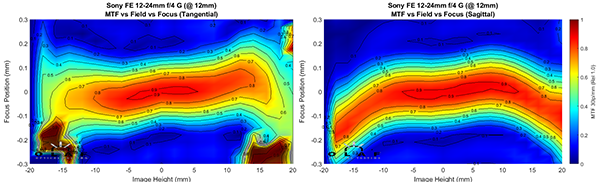
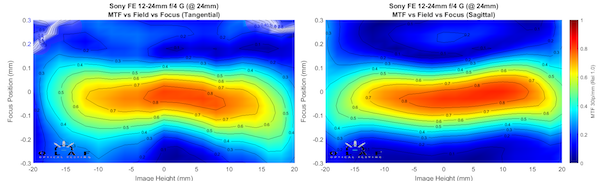
Several people have asked about the field curvature of this lens, so I’ve posted the field of focus at 12mm and 24mm. Both are really flat at infinity, most impressive.
 

Olaf Optical Testing, 2017
 

Olaf Optical Testing, 2017


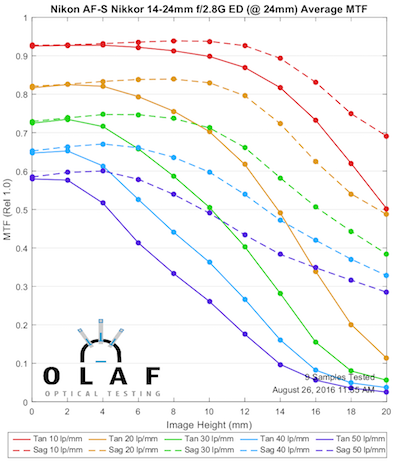
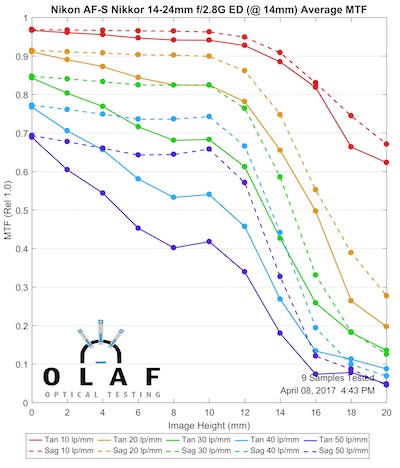
Another addendum for the Nikon 12-24
Author: Roger Cicala

I’m Roger and I am the founder of Lensrentals.com. Hailed as one of the optic nerds here, I enjoy shooting collimated light through 30X microscope objectives in my spare time. When I do take real pictures I like using something different: a Medium format, or Pentax K1, or a Sony RX1R.

Posted in New Items
  • Ivo

    Please tell me you are joking. Do you say: this is a Sony FE 1/2″-1″ F4 lens or you say 12-24 milli-logical-meters?!

  • Zé De Boni

    DXO works nicely for perspective correction. Photoshop and LR do it as well. The problem lies not in the software used, but on how the image is captured. It is wise to allow some extra space around the subject so that the final crop don’t cut part of it. Also, sometimes you get weird proportions and discover too late that the original shot should be horizontal, not vertical, or just the oposite. There is also an interesting side effect of in software perspective control, which is the loss of resolution of the area that is expanded, meaning that the maximum enlargement according to one’s standards is lower in direct proportion of the amount of correction.
    So far, the perspective control is more effective with a T/S or PC lens, because you can pre-visualize the final composition at capture. But there is a problem with DSLR’s, as the shifted lens is not aligned with the mirror, causing the OVF to blank (actually darken) on one side. Using lifeview solves this question, which shows one of the advantages of the EVF and by extension the mirrorless.
    I used the Nikon 24mm TS on the D3X, then switched to Sony A900 and the Rokinon 24mm TS with the same limitatons. Things became much more practical when I got the A99. My A900 is now retired. I also use Mamiya 645 lenses via the amazing T/S adapter by Mirex (they make it for Hasselblad lenses too).
    In fact all those lenses with extra coverage have some critical limitations. They hardly can compete in IQ with the regular primes of the FF format, because optically they behave as lenses of a larger format. The 24 TS, nominally ultra wide angle, is actually an extreme WA, which means it is more prone to all the defects expected, like distortion, poor edge resolution and CA. And those appear mostly on areas visible by shifting the lens, which is contradictory to the reason to buy them. Worse is the fact that there is no profiles for in camera or in post corrections of any PC/TS lens, as far as know. The images from shifted lenses are decentered, no information is recorded. Fifteen years ago I wouldn’t mind but today I can’t live without these software tools. Whenever I needed I tried to correct my TS images enlarging the canvas to align the optical center to the canvas center then apply a manual aberration, distortion and vignet correction. Finally I cropped off the white addiction. Insane!
    There is no substitute for the tilting function, but if the case is not of focus control but to manage perspective, then any good prime or zoom can do it with similar or even better results. From what i exposed above, a TS should be worth its higher cost only if could offer a far better, perfect IQ. I asume this from my practical experience, but recognize that this is a nice subject for an in deep research and I may change my mind if the contrary is proved. Are you reading, Roger?
    Meanwhile, I still believe that in the future the mirrorless cameras will profit from the electronic viewfinder and provide applications to visualize the perspective control, which may be manual or automatic, computing the inclination angle and the lens used, any kind of lens. But if any lens maker could offer tilting, just tilting autofocus lenses I would be the first on to order a whole set.

  • Brandon Dube

    It’s from the optical design, not the manufacturing of aspheres. If they were not polished or molded to the correct shape there would be consequences over the full field of view, not just a small annular region around the center.

  • Ed Bambrick

    Jagged comes from unpolished aspherics ? If not what then?

  • Ray Chenn

    deleted comments.

  • Michael Sandman

    I have the Canon 24mm TSE and it does indeed work just fine on Sony FF with a (Metabones) adapter. And by placing the camera on tripod, it’s possible to shift the lens left, center, and then right and get a field of view equal to about 16.5 mm. But you need a tripod; the time to take three shots; and a static enough situation so you can assemble a pano that doesn’t have a lot of ghosting. And you’re still limited to a bit wider than 17mm. A one-shot, no-tripod 12mm field of view is very tempting, although there will probably be the sort of distortion at the edges that one typically gets with ultra-wide angle.

    And.. thanks, Roger, for the MTF report.

  • Ray Chenn

    Hello, Roger, Thank you for posting such a elaborative test result. No offense, but just as a kind remind that, FE12-24mmF2.8 used DD-SSM, like a linear motor, while 85mmF1.4GM used SSM (Rotational one).

  • Thom, I didn’t get time to do curvatures yet, but I’ll try to get them done tomorrow and add them as an addendum. We had a software implosion right as this article was being done and I never got to run them.

  • Brandon Dube

    Smooth decline is definitely the lens itself. If you see it “ok, ok, ok, 16mm – not ok” it is equally likely an issue/limitation in our test equipment (no, $300,000 does not get you a perfect MTF bench). If you email technicalsupport@olafoptical.com, I can provide more information.

  • Omesh Singh

    The way these curves appear to be falling off a cliff, is that due to field curvature?

  • l_d_allan

    Thanks … I’ve got that lens listed in my “Hold” list at a vendor, and wanted to wait until the LR OLAF numbers were available.

  • KeithB

    Thom:

    You mean like this from Ken Rockwell?

    http://www.kenrockwell.com/sony/a9.htm#leica

  • JJ

    You can easily use the Canon (and most other) t/s lenses on your Sony.
    Btw the DXO correction software looks promising – anyone tried that?

  • Brandon Dube

    Smooth is better than jagged, yes

  • Justin

    Wondering if the short flange distance that allows for creative and smaller designs on the wide end would also do the same for a tilt shift design? If so maybe one day we’ll get a 15mm TS-E GM from Sony.

    I know there’s really no replacement for a TS-E. Still… I’m trying to rationalize the 12-24. Maybe I’ll just have to do so on it’s own merits.

  • SpecialMan

    Question from the non-mathlete section: Is it safe to say that when looking at your MTF charts that smooth curves are better than jagged? Or is that spurious correlation?

  • SpecialMan

    Depends on how much time you have in your life. I’ve been using the Photoshop adaptive wide angle filter, but it’s a pain so now I’m either buying a medium-sized step ladder or switching to Canon for their t/s lenses.

  • SpecialMan

    “a logical measuring system”??????!!!! Fie. As we all know lenses used to be measured in inches as God and Elizabeth I intended, not in your oh-so-modern millimeters.
    There is nothing more retro and cool than the inches and feet system—except for the national measuring system of Myanmar/Burma—where as near as I can tell, lenses are measured in ?????s.

  • Thom Hogan

    Can you say anything about field curvature, Roger?

  • Sony 85 f/1.8 MTF testing is done should be published early next week. Maybe Friday, I can’t promise.

  • Thanks a lot for testing. With this lens I will switch from Canon to Sony. And I will get a A7RII instead of a Canon 6D MKII.

  • Brandon Dube

    If you can find a way to give me more hours in a day, the Erraticism index will go public sooner 🙂

  • l_d_allan

    > We actually do have a variation number finally set up and approved.

    I’m looking forward to finding out more, and seeing numbers for a variety of lenses.

    (Hint: tests of the Sony FE85 f/1.8 would be greatly appreciated)

  • Brandon Dube

    Astigmatism is where the tangential and sagittal focal surfaces (they should be planes, they can be parabolas, “W”s, planes, there are many possible shapes) are not overlapping. Because there are numerous aberrations that have asymmetric blur (Coma is just one and it is very, very distinct to astigmatism) you cannot deduce astigmatism from a single-focus MTF measurement. We sometimes do MTF vs Field vs Focus which shows the astigmatism directly, but did not do it here.

    I have some slides on astigmatism in MTF here, https://retrorefractions.com/public/documents/Recapping-Astigmatism-in-MTF

  • Eric Stadler

    At the product launch I thought to myself, it’s a Sony 12-24mm and only $1700. It cant be that great. Good to be wrong. Nice work Sony! Really hoping the 16-35 GM has been on the bench too! I’m looking to rent one soon…

  • Justin

    In addition to potentially being a really nice ultrawide, I’m wondering if this lens could make a decent substitute for a proper shift lens. The Canon 17mm is probably the best example of an ultra wide shifting lens for architectural work. I’m thinking a 12mm lens, this good away from center might make a good candidate for software corrected perspective control. Sure you’d give up a lot of resolution, but the lens might do double duty.

  • I thought y’all would enjoy that. I probably meant to say circular, but I was reading their advertising copy, my mind was going, I could feel it. I was afraid.

  • J L Williams

    Hey, a curved aperture ring is a huge improvement… I’m really tired of fiddling with the Waterhouse stops on the lenses for my old full-frame (6-1/2 X 9-1/2 full plate Daguerreotype) camera…

    …We’re not really teasing you, Roger, we’re all just giddy at the thought of a Sony lens that’s both good and non-astronomically-priced…

  • Yu

    I think they really meant rounded aperture blades…

  • Yugo Nakai

    “Curved aperture ring” … Bwahahahaha! My stupid Nikon has annoying square aperture rings. Fanboys say it’s to distinguish from the zoom rings, but darnit, I’m gonna switch to Sony now, just you watch!

Follow on Feedly