

So, a while back I wrote a not quite complete article on UV filters. To do that, I had to buy new testing equipment and learn to test filters. This was not what I wanted to do when I grew up. But somebody has to do it, and I did get to buy new toys.
More importantly, Tyler (Who handles the purchasing) asked me why, many years ago, I chose the Circular Polarizing filters that Lensrentals stocked. A better person than me would have confessed that I’ve never known the first thing about Circular Polarizers; that I just bought the most expensive to be our ‘best’ and the cheapest to be our ‘basic.’ But instead, I just said, “Well, we should do some scientific-type testing and a more thorough evaluation now.”
Like a metaphor for my life, the results ended up being the opposite of what I expected. I thought if we found tons of differences testing simple clear and UV filters, there would be many more differences in more complex polarizing filters. So today, instead of showing you amazing differences between the various brands, I’ll just save you some money on your next CP filter purchase. That should work out for both of us: you save money, I get a shorter blog post.
I should mention our methodology has improved somewhat since we did our first filter article. I used a red laser to measure transmission then, and several people made the very reasonable suggestion that a green laser might be a better choice, being in the middle of the spectrum and all. Other people said I should get a spectrometer and measure the entire spectrum. So I did both of those things.
This should give you some hints about me as a person. If someone asks me to test a lens at a different aperture, I have a screaming fit about testing taking up a few hours of my time. Someone suggests I spend $15,000 on new equipment, and I’m like, “Yeah, great idea, that would be cool to have.”
Finally, I had no intention of testing every polarizing filter on the market. I did what I usually do; bought the ones B&H Photo had in stock in 77mm size. So we’re going to compare, in no particular order, except alphabetical, with the current price for a 77mm:
- B&W XS-Pro High-Transmission Circular Polarizer MRC-Nano $102
- Heliopan Circular Polarizer $200
- Marumi EXUS Circular Polarizer Filter $140
- Sigma Water Repellent Circular Polarizing Filter $150
- Tiffen Ultra Pol Circular Polarizing Filter $103
- Zeiss T* Circular Polarizing Filter $180
So, About the Polarizing Part
If you’re thinking about buying a circular polarizing filter, you probably want to know which ones polarize the best and which ones the worst, right? I know I did. Now we could have just gone outside and taken pictures in the bright sun and said this one’s good and that one’s bad. But we never do anything simple when we can complicate the crap out of it.
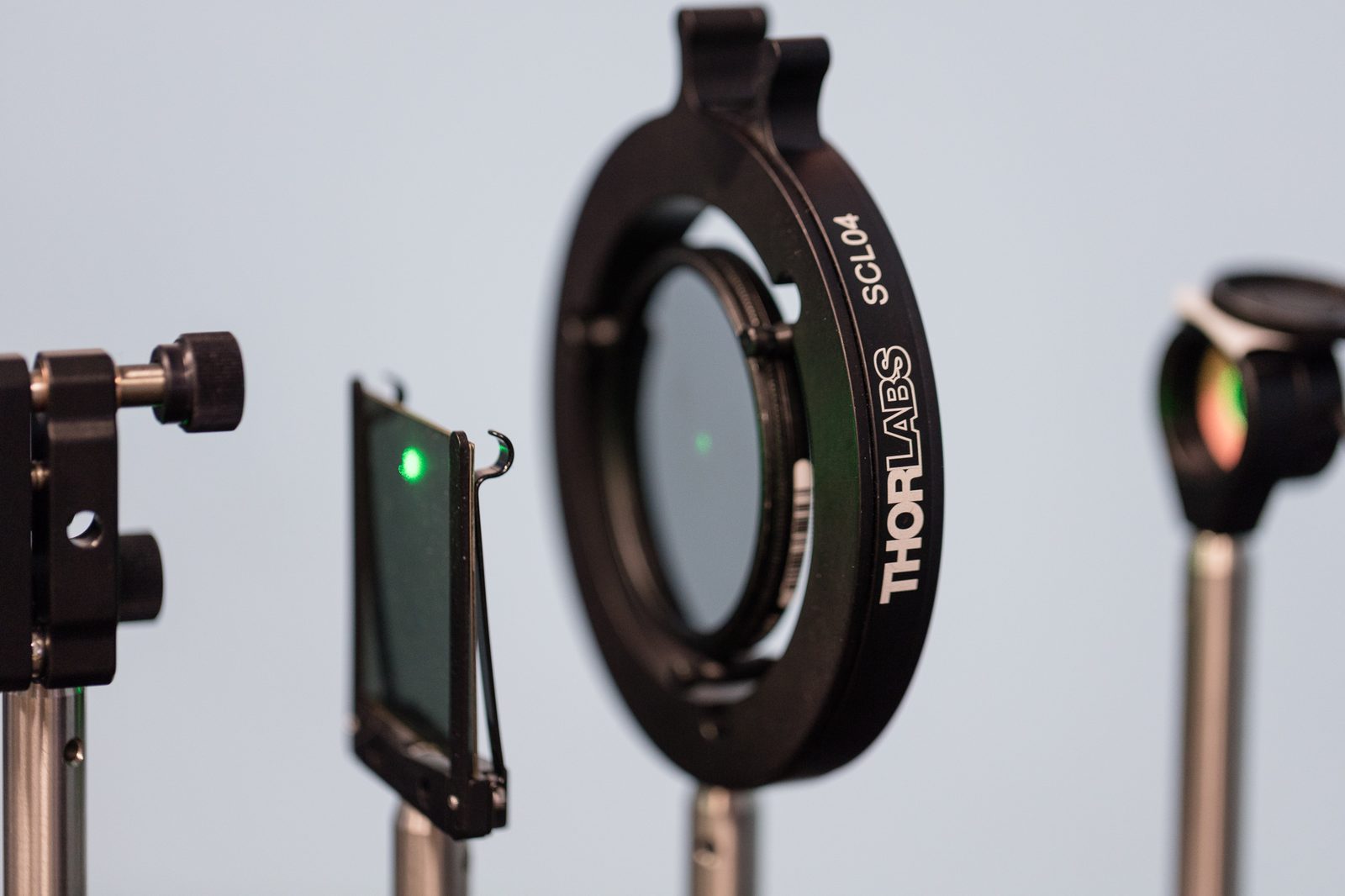
So what we did was take our laser transmission set up and modified it a bit. Primarily, this shines a laser into a power meter and gets a reading. Then we can stick mostly transparent stuff in the beam and see how much it reduces the power reaching the meter. Excellent lasers are almost entirely polarized, but I have a budget, and that budget didn’t include (much to my sorrow) $10,000 for the lab-grade, steel-melting laser I wanted. I got a little 5-_m_watt green (530 nm) diode laser.
It’s sort of polarized. So we shined that laser through two sheets of polarizing film, each of which have a 1,000:1 polarizing extinction ratio. So basically, the light that passed through the film was really, really polarized. Then we put the filter in the beam of polarized light to see how much light it let through in the open position. For now, we’ll just call it ‘most of the light.’ Finally, we moved the lens to the polarizing position, which should have blocked all of our polarizing light if the filters were really effective.
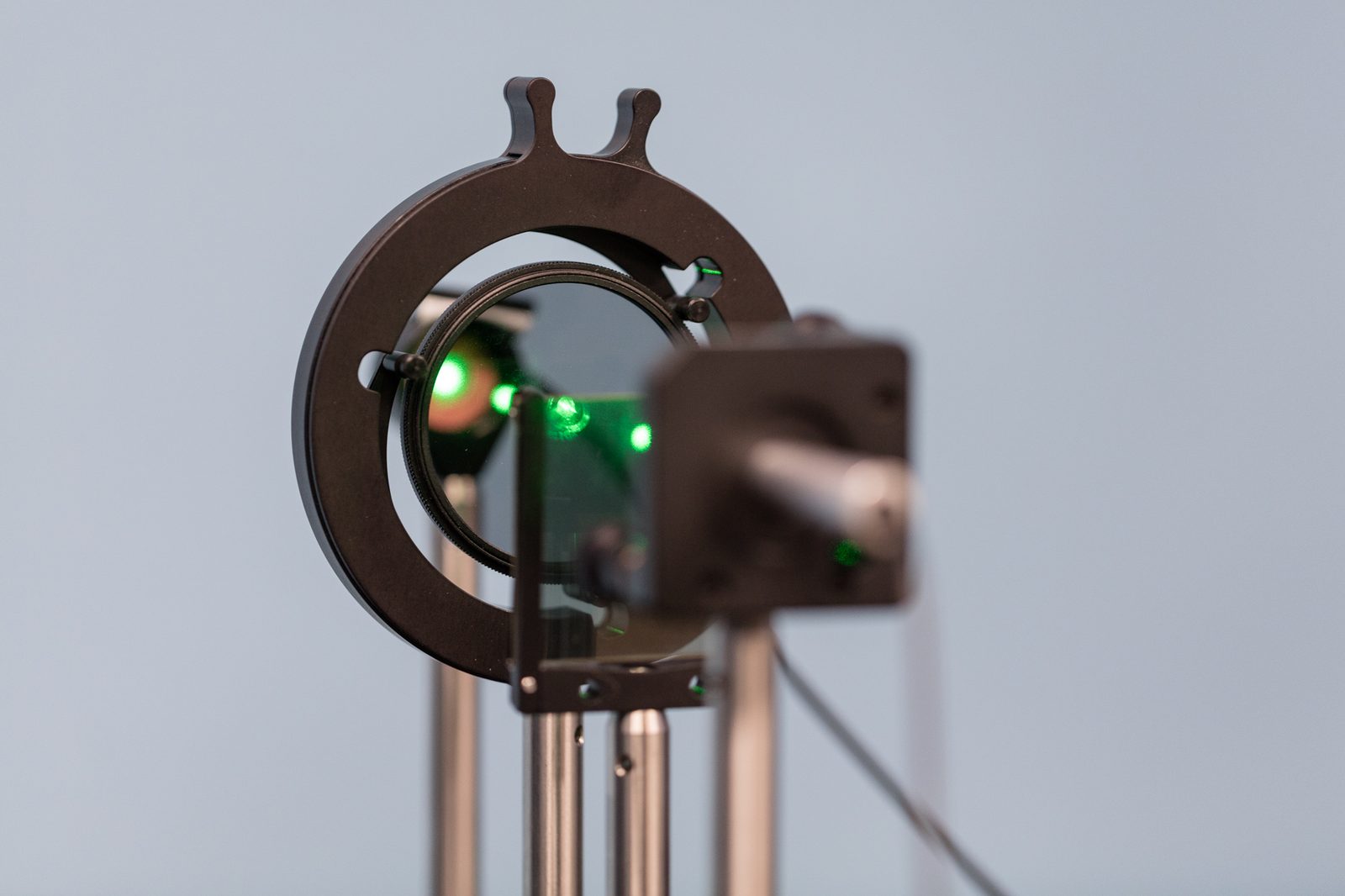
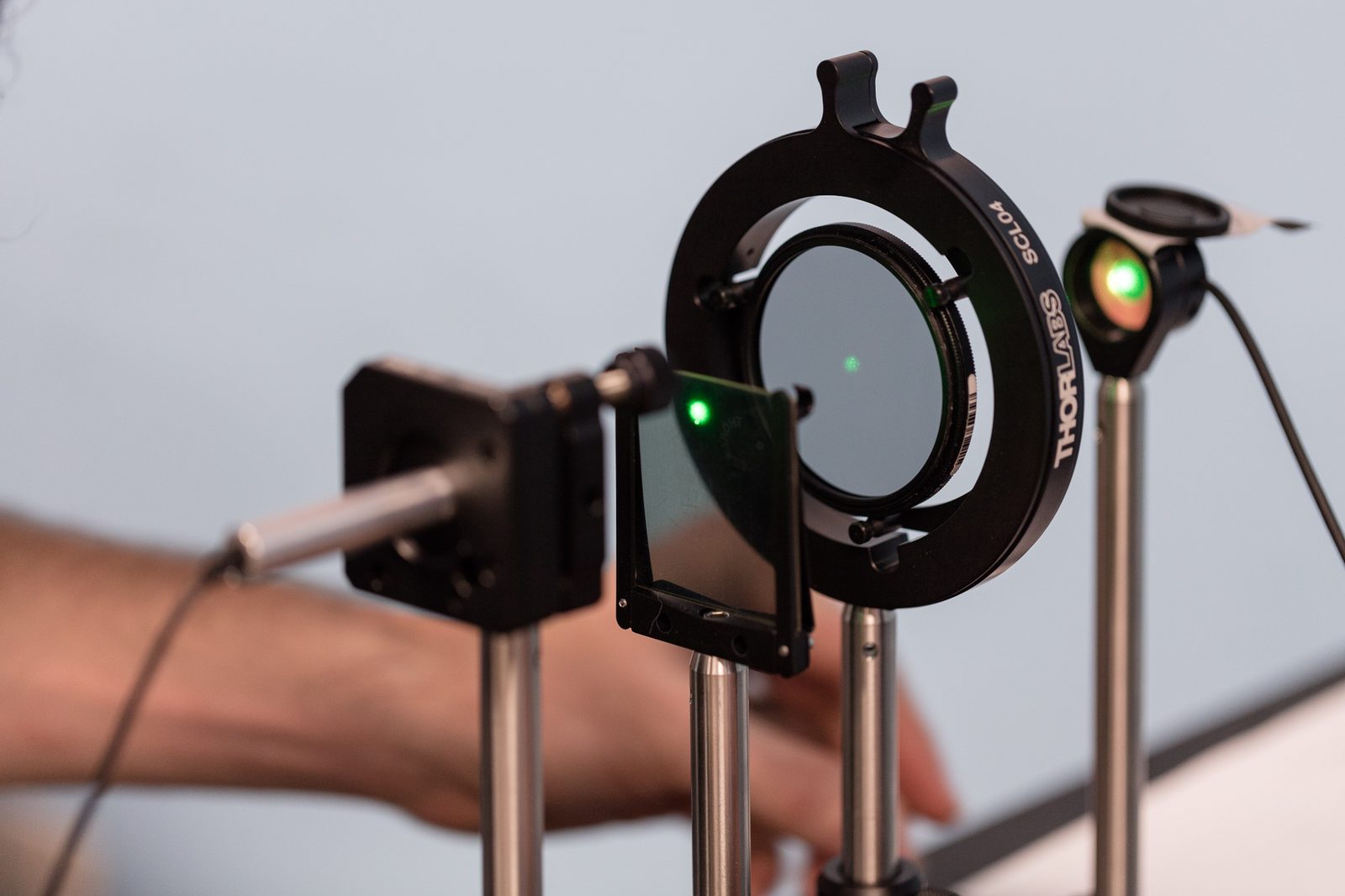
Here’s where I expected to put a table showing how efficient the polarizers were. Instead, I’ll just tell you that all of the polarizers we tested blocked all of the light, within our capabilities of measurement. They were all at least 99.9% efficient at doing their job, polarizing light. There’s something you don’t see very often; a photography product that completely does what it says it will do.
Also About the Glass
When we tested UV filters, we found several for which the glass wasn’t flat. We repeated the test on all of the CP filters, and all passed with flying colors, so I won’t bore you with repeating it. Again, my expectation was with two pieces of glass we might see more, not less, bad glass. But no, they all passed just fine. That may be that better glass is used in CP filters, or the polarizing effect evens things out. I don’t know. But they all passed just fine.
What About Light Transmission?
If you’ve ever used a CP filter you are probably aware that even when not polarizing it absorbs some light. You should be aware of this because, well, it’s darker when you look through it. We thought it would be worthwhile to see how much light it does absorb.
Why? Well, partly because we had that laser transmission bench already set up, but mostly because two of these filters claim to let more than 99% of light through. The Marumi claims it lets 99.4% of light through, and the B&W High transmission says it passes through 99.5%.
No, I’m not a rocket scientist, I’m just a regular scientist. But high-tech scientific principles tell me that since everything looks a bit dark when looking through these CP filters, it’s unlikely that more than 99% of the light is passing through the filter. But maybe that’s just me being cynical. Or maybe there are alternative facts that say darker isn’t the same as less light.
Anyway, since I was rather fired up and my BS meter was pegged at full maximum, we removed the linear polarizers and measured absolute transmission for each filter in the non-polarizing position. If you remember, when we tested clear filters the best let 99% of light through, the worst was down around 90%.
The transmission results for CP filters were:
| Filter | Transmission |
|---|---|
| Marumi | 91% |
| B&W | 88% |
| Sigma | 68% |
| Zeiss | 66% |
| Heliopan | 58% |
| Tiffen | 55% |
Now, the Marumi and B&W are nowhere close to 99% transmission, but I will admit that they did indeed have higher transmissions than the others.
Some, probably most, people don’t care about how much ND effect their circular polarizer has, and if they do they may well not want the higher transmission variety, they’d prefer a bit more light blocking. After all, if you need a circular polarizer, you probably are shooting where there is lots of bright sunlight. But the takeaway message is that higher transmission filters do tend to give more transmission. Just not as much as is claimed.
Let There Be Spectrometry
And so, in the days after the first article, the people spoke as one and said, “You show us but one wavelength of light, yet there are as many wavelengths as there are fish in the sea. Give us spectrometry, that we may see the effect on all manner of wavelengths, each unto its own kind. And make the graphs brightly colored.”
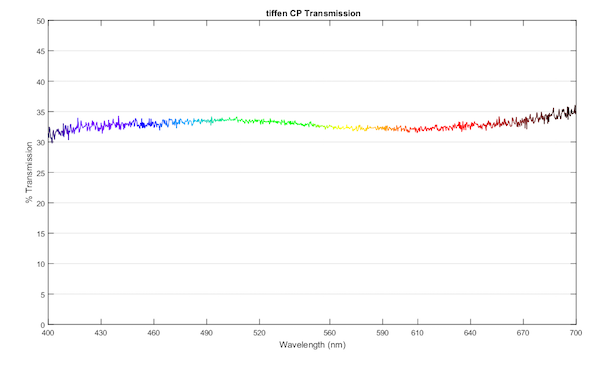
It’s taken several weeks for us to get things calibrated and running, but this post seems a good place to start using our new spectrometer. We know that some polarizers give a bit of color cast, especially when polarizing, so we thought it would be interesting to see look at their transmission spectra.
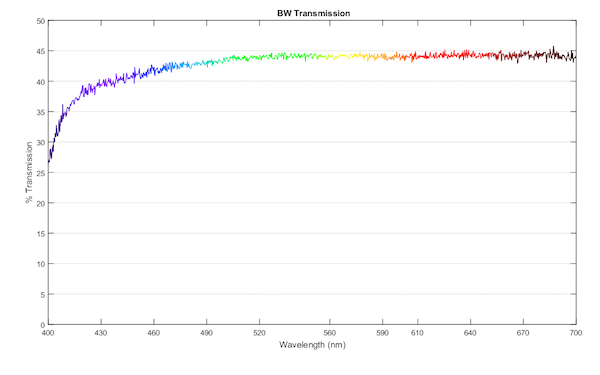
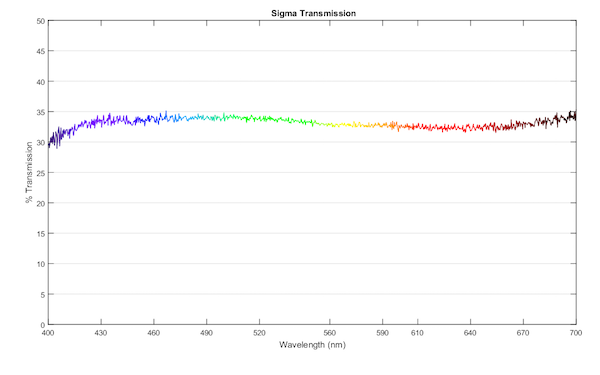
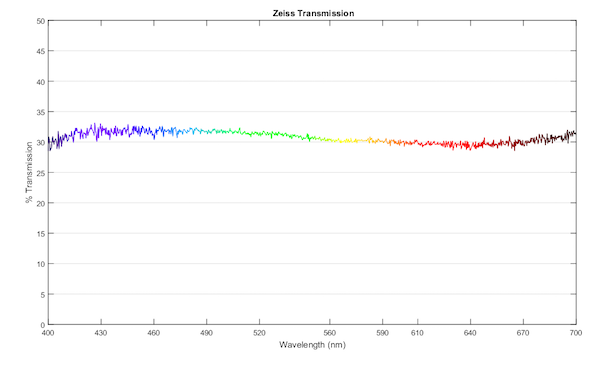
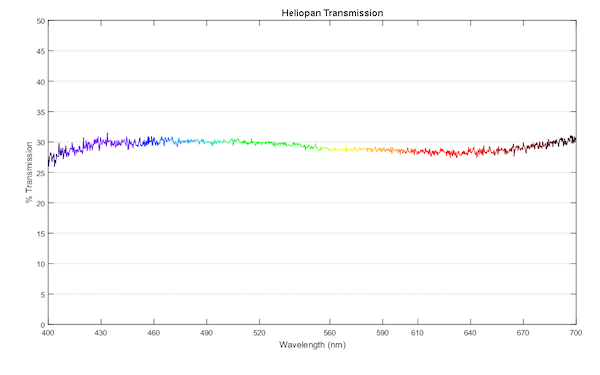
We looked at transmission both in the open and polarizing position and did not see any changes with these polarizers. I’m told there are some that do have a color change with polarizing. I’m only showing you one spectrometry report for each filter, to keep this short post short. Also, don’t put much stock in the absolute transmission between the filters. We weren’t testing for absolute transmission since we’d already done it; we just wanted to look at the curves.
The High-Transmission CPs
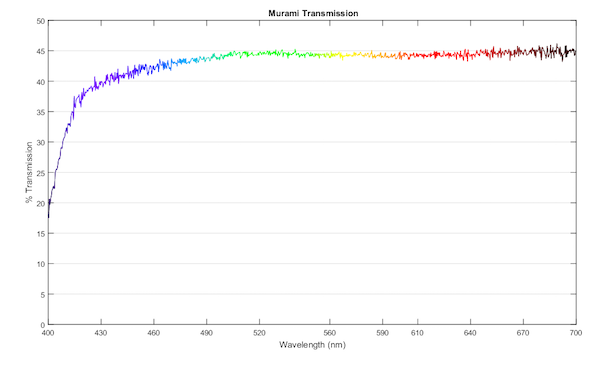
The Marumi and B&W filters have similar transmissions and very similar spectra. Both tend to have some UV filtering activity and drop off a little bit at the blue end of the spectrum.
Marumi
B&W
The Standard CPs
These all have a stronger Neutral Density effect than the first two, and their spectra are different, too. The Sigma, Zeiss, and Heliopan filters are all very similar with a bit more transmission at the blue end of the spectrum and a bit less in the red-yellow range. The Tiffen has a similar pattern, although maybe a tiny bit more of a green peak.
Sigma
Zeiss T*
Heliopan Digital
Tiffen
So What Did We Discover Today?
Well, several things, one of which is really useful. So I’ll get that one out of the way first, and then let this post just steadily deteriorate. If you are buying a circular polarizing filter because you want some circular polarizing, it doesn’t seem to matter much which one you choose; they all polarize like gangbusters. So I saved you some money today.
The second point, one which I’ve been told before I did all this testing, is set the white balance after you put the CP filter on, not before. Because CP filters will have a color cast. Or just shoot in raw and fix it later, which is what we mostly do anyway.
There is a third point, and it’s a painful one:
Once Again, Roger Lets Technology Triumph over Common Sense
I didn’t want to test filters; I really didn’t. But people wanted me to. So I chewed up my testing equipment budget to buy laser transmission stuff and an optical spectrometer, spent a few weeks getting everything calibrated and establishing norms, and then a couple of days testing these CP filters. I did this in clear violation of Roger’s Third Law: No Good Deed Goes Unpunished.
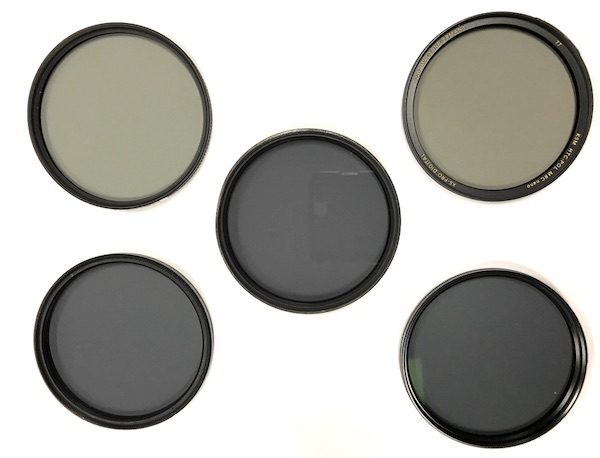
After I was done, I told Aaron I had just documented that CP filters had different light transmission percentages and different color casts. And that high transmission filters had one look, and it was different than regular CP filters, which all were really similar. Because I was proud that my investment in time and money had paid off.
Aaron took the filters from me, put them on a piece of paper, took this picture with his cell phone, and said, “Yeah, you’re right.”
Oh, and BTW – I know what you’re thinking. Yes, I’m going to publish spectrometry reports on the clear and UV filters we tested in the last article. Next week, I promise. I need a few days to recover my pride.
Roger Cicala and Aaron Closz
Lensrentals.com
September, 2017
Addendum: MTF testing
Several people made the very pertinent comment that they would expect some effect in sharpness and contrast. FWIW I took a moderate telephoto, very sharp lens (Batis 135mm f/2.8) and MTF tested it first with no filter, then with a B&W Multi-coated clear filter, then 4 of the CP polarizing filters we tested above.
The clear filter made absolutely no MTF difference.
All tested polarizers (B&W, Marumi, Zeiss, Tiffen Ultra, and Helipan) caused a slight decrease in MTF at high frequencies. There was no detectable change at 10 and 20 lp/mm. At 30 lp/mm there was a consistent 1-2% drop, at 50 lp it was about 4%. All of these CP filters were very similar, I could detect no difference between them.
This is a quick, off-the-cuff check. I’ll look at things in more depth when I have time. But the bottom line is fine detail in photos is affected a bit. I don’t find that the least bit surprising.
I’ve also ordered a couple of $40 filters and we’ll see how those compare.
149 Comments
Craig ·
Roger, excellent post – and I didn’t notice any typos either! (I’m the one who often sent you corrections).
Personally I use Nikon CP’s, because I had a couple of bad Tiffens once, and I rather like the plastic cases NIkon CP’s come in.
I have one, practical question. Those high transmission models look very intriguing to me. How much of an F stop does that transmission difference amount to? I don’t want big amounts of ND on my filters. F2.8 is slow enough already, not to mention the F4 lens I might be using.
A less important question: How thick are the rotating rings on these filters. (All of them). I have one B&W slim CP, and it’s a bear to get loose if I have it on too tight. Nothing to grab onto.
Roger Cicala ·
Craig, it’s at most a stop, I believe. And I know exactly what you mean about the stuck filters, we have that happen all the time. We tested low profile ones, but thicker are available. Kind of away from your point, but the Murami filters did get our attention by how smoothly they rotated. It was noticeably smoother than the others.
Thomas Geist ·
It looks like the Marumi might be similar to the Kenko Zéta EX (or same) which can be had for an amazingly low price. These also rotate better than any other brand I tried. And aren’t they all made by Hoya?
I recently cracked a Hoya HD3 that cost me an arm & a leg and I replaced it with a Zéta for about 1/4 the price. Couldn’t be happier.
Concerning stuck filters:
sometimes when all other means fail (including using an oil filter wrench), temperature can solve the problem. Cool the lens with the stuck filter down some (fridge) or heat it up some (just some mild warmth) and the different expansion of the lens and filter ring can all of a sudden make the filter come of smoothly.
Brian Barwick ·
I have found that using a surgical glove has always worked.
Andre Yew ·
The back of a neoprene mouse pad works well too: press the filter ring down into the pad, and rotate the lens counter clockwise. It won’t help with stuck CPLs though.
davv ·
there are filter “wrenches” available on amazon
the plastic ones are trash though. don’t bother with those.
Impulse_Vigil ·
The metal wrenches coated in tough rubber seem good, I haven’t got a filter really really stuck since I bought those tho.
odddave ·
This can introduce moisture into the lens. I use wide rubber bands wrapped around the filter. Works like a champ.
tyger11 ·
Typo: “Let’s” 🙂
John Warren ·
Also it’s B+W, not B&W…lol
Starry Dynamo ·
Typo: "Let's" :)
Johannes Dahlström ·
50% transmission should equal one stop drop in light, right? 90% is about 1/6 of a stop.
dkphotoman723 ·
B&H and probably other places that sell filters, have the specs noted. The B+W filters have a 1 to 1 1/2 stop loss of light, which is more on the minimal side of things compared to some other brands. So, not quite sure how the percentage of light transmission translates to stops.
Karl Perry ·
Final heading in the article: “Roger Let’s …” should be “Roger Lets …” The word is neither a contraction nor possessive so should not contain an apostrophe.
kain0m ·
For removing stuck filters, just grab it with the tip of your fingernails at exactly 180° apart (you’ll need both hands for that, so wedge the camera between your legs). Does wonders to remove stubborn filters, as it removes the majority of friction in the threads.
Michael Sandman ·
Or wrap a wide rubber band around it, pull tight, and turn.
And — Thanks, Roger. Informative, useful and fun.
Jimmy T ·
I also use a Xume (pronounced “Zoom”) filter adapter. If you routinely use more than one filter (i.e. CPL, ND etc.) you NEED this Xume system. No more losing pictures because of the time it takes to swap filters, no more cross threading filters, and no more stuck filters. Yes the magnets are Very Strong! This is a high quality Manfrotto product. Expensive but worth it! Also, they make a dedicated lens cap in case you need it. Please watch the video on youtube at: https://www.youtube.com/wat... I Love Xume (pronounced Zoom) and have them for every lens. I am a fan, not a stockholder.
Pete Cockerell ·
The number of stops lost is log2(100/t), where t the is the transmission percentage. So for 90% it’s log2(1.111) or about 0.15 stops. Since most calculators don’t have logs to the base 2, you can use log(100/t) / 0.3 instead, where log is base 10 log.
James Thomas ·
“…their spectra is different”
Correct: “…spectra are different”
Roger Cicala ·
oops. fixed that. Thankyou
Sean T ·
Fascinating, thank you Roger. No idea what I’m going to do with this information (aside from ignoring folks who say you have to spend lots of money to get the best), but I appreciate your work anyway.
Evan McClane ·
Great article, and lol at the conclusion. Just a quick note, you seem to have referred to the B+W filter as a Zeiss in the paragraph titled “The High-Transmission CPs.”
Roger Cicala ·
Thank you, Evan. Fixed that. Craig – you missed one 🙂
Roger Cicala ·
Thanks Evan. Fixed that.
Tig Tillinghast ·
This reminds me of the (8 years old) excellent article over at Lenstip… https://www.lenstip.com/115.4-article-Polarizing_filters_test_Results_and_summary.html, where they tested lots of filters. A similar conclusion: price was NOT a good indicator of quality. They also found that Marumi was about the best bang for buck, so that’s consistent. Finally, they found in testing lots and lots of filters that some were even not actually circular polarizers at all. May have had a few counterfeits make their way in.
Transmission was generally lower than in your sample, and there was much more cast, and not as consistent polarizing happening.
I’ve stuck with Marumi ever since.
Alan B ·
I’m gonna guess that laser is 5 mW, not 5 W
Roger Cicala ·
Correct Alan. Sigh. Fixing that too.
donpedro ·
Excellent, now you can do transmission curves when you test lenses, too! Aren’t you glad you made this investment, Roger?
Robert Stone ·
Would be interested in findings for the UV and CP filters that B&H gives away with a lens purchase. I suspect these just might perform according to your initial expectations.
Brandon Dube ·
*sheds tear* I go through all this work to design a spectrometer for imaging or nonimaging optics, and it doesn’t even get a picture in the blog post 🙁
#PayAttentionToTheMachineBehindTheCurtain
Roger Cicala ·
Well, it will on the “Ever So Massive UV Filter Spectrometry Article” that comes next. But see, I made a light shield out o some cardboard boxes. While effective, it was, shall we say, not esthetically pleasing. The Black Board came today and after I’ve made a nice professional looking enclosure, Brandon’s Spectrometer will be featured.
HenWin ·
Roger, as a journalist, you should know that you shouldn’t start any sentence with “So…”. It’s bad form…. Now I have to read the rest of the article…….
Roger Cicala ·
I know. And that I generally shouldn’t start them with ‘and’. Or ‘or’.
But I’m from the South. I’m doing good not to start each article with “Y’all pay attention, now, ya’ hear?”
Joshua Koerner ·
As someone from the south who has also studies languages fairly extensively, indo-european ones at least, y’all is actually grammatically correct! Not that you probably needed me to say that to know it 😉
Also, you just let us know what we need to tell you to buy for your next tests, and I’m sure someone will be happy to oblige 😉
HenWin ·
I’m not from the south per sé…I’m from DC and while it’s close, it ain’t there. However, my momma was from Chattanooga and I know that you are using “y’all” incorrectly. “Y’all” is singular. “ALL y’all” is plural! 🙂
wince ·
Uh, no. Y’all is plural. It’s whole reason for existence is because English doesn’t distinguish between singular “you” and plural “you” like most other languages. (And because Southerners can’t abide “youse guys”.) All y’all is for multiple plurals — Y’all on the left get chicken, y’all on the right get ribs, all y’all get dessert.
Ed Hassell ·
A professor of linguistics was once explaining emphatics in certain languages and dialects and discussing double negatives and double positives. He made the statement that in English, a double negative is actually a positive — not more negative — and that the double positive does not exist at all as a grammatical construct.
A student in the rear of the class responded, “Yeah, right.”
Michael Clark ·
‘All y’all’ is redundant, not plural.
Michael Clark ·
More than y’all wanted to know about y’all:
http://anotherhistoryblog.blogspot.com/2006/12/more-than-yall-wanted-to-now-about-yall.html
“Here’s how Lewis Grizzard handled the situation: “For some unknown reason, Northerners think Southerners use ‘y’all’ and ‘you all’ in the singular sense. Northerners will giggle and ask, ‘So where are you all from?’ I answer by saying, ‘I all is from Atlanta.'”
HenWin ·
My son is a journalist–with a LARGE online news organization–and it sickens me to hear when not just him, but everyone in the “newer” generations have suddenly started starting sentences with what I would call “illegal” words. (It’s ’cause I don’t know what those kinds of words are called, but I know bad American when I hear it.
As far as “y’all”, as I noted to Joshua, below, the proper beginning to the phrase would be “All y’all”, the plural form of “y’all”!
I’ll continue to fight my losing battle w/ trying to keep American from “progressing” by using words that belittle their original meaning! 🙂
The newest overused word, by the way, IMHO, is “adorable”. I think it has taken the place of “awesome”, which as people should know, usually isn’t.
OK, I’ve wasted enough time. 🙂
Roger Cicala ·
In a recent study (well, OK, my recent survey of the internet), 90% of photo shoots were either ‘awesome’ or ‘amazing’ or both. Which kind of makes me wonder if anyone looks up the definition of either word.
I haven’t seen quite as much adorable stuff, but I now fulling intend to work something like “our adorable spectrometer” into it.
wheatridger ·
If you can’t use “so,” then you’re left having either two separate sentences lacking any suggestion of their causal connection, reducing clarity, or using some pompous, classy word like “therefore.” Is that better writing? English is cursed with psuedo-rules and shibboleths that do little but enshrine a type of British-bred indirectness.. .such as the one about which no less of a gentleman than Churchill famously said, “Ending a sentence with a preposition is something up with which I will not put.”
Larry Coleman ·
In the version that I know, Churchill was chastised for ending a sentence with a preposition and responded, “That is the kind of pedantry up with which I will not put.”
Matt ·
Those words are called conjunctions, and according to The Chicago Manual of Style (and others) ” CMOS includes Bryan Garner’s opinion that there is “no historical or grammatical foundation”
for considering sentences that begin with a conjunction such as and, but, or so to be in error (see paragraph 5.206). Fowler’s agrees (3rd ed., s.v. “and”), citing examples in the OED that date back to the ninth century and include Shakespeare”
http://www.chicagomanualofstyle.org/qanda/data/faq/topics/Usage/faq0013.html
Conjunctions connect one thought to another, and thoughts, thankfully, don’t have to be included in the same sentence to be connected.
I believe teachers started telling their students to stop doing it because they were tired of reading papers that had every sentence start with “and.” It’s easier to tell little kids to not do something at all than it is to teach them to do something sparingly, and thus a fake rule was born.
Michael Clark ·
There is no singular form of y’all in true Southern usage! Ever.
The roots of the word are the Scots-Irish ‘Ya Awe’, which loosely translated is ‘you all’. That might explain why both Hemingway and Faulkner spelled it “ya’ll” when they used it in their writings.
Michael Clark ·
From a diatribe I wrote some time ago:
“ya’ll” is NEVER singular! “Ya’ll” is ALWAYS plural. Since “ya’ll” is a contraction of “you all”, it is a plural form of the second person singular “you”. Depending on the context it will always include second person and may include third person in the same usage. When only used in the second person it should always be plural, and as such only used when speaking to more than one person. For example, if you are female and have only one sister and I am speaking to both of you and refer to the sisters in your immediate family as “ya’ll”, then “ya’ll” would be second person plural. If you also had a third sister who is not present then it would be both second person plural and third person singular. For “ya’ll” to be used properly when speaking to only one person it MUST also include a third person referent which may be singular or plural. If only you were present but your single hypothetical sister was not, it would be both second person singular & third person singular. The two singular cases combined make it plural. If only you were present and neither of your two hypothetical sisters were, then it would be both second person singular and third person plural. The most common usage is probably when used as both second person plural and third person plural. For example, if I am speaking to you and several other Northern residents and I make a reference to “ya’ll yankees” then “ya’ll” would include all yankees, not just the ones to which I am speaking.
Jay Dee ·
We’ll only start worrying when “Like” starts the sentence. Every sentence.
I was a bit surprised at the spectrometer curves as they seem quite different from those presented by the new kid on the block–Breakthrough:
https://breakthrough.photography/products/x4-circular-polarizer
So (he-he), I’ll say their stuff needs a thorough examination in the near future, because I almost bought one instead of B+W.
BTW, your testing is, like, bitchin’–THANK YOU!
odddave ·
How about “Y’all hold my beer and watch this”?
Ally Aycock ·
I told a customer that his Switronix PowerBase 70 battery needed to charge “for a hot minute” on a tech support call today. I amended my advice once I realized that “a hot minute” was neither quantitative nor helpful. At any rate, the customer seemed to find it charming. On a side note, I’ve never been called out for saying, “y’all” on a phone call.
SpecialMan ·
The key to usage is intentionality—if the writer is conjuring a specific effect by starting a sentence with for, and, nor, but, or, yet, or so, that would be an appropriate use. If a forbidden word appears because the writer is just fumbling around for a different way to start a sentence, then it’s wrong and the perpetrator deserves a long stretch in grammar prison.
Trenton ·
One crucial measurement is missing: color shift with the actual polarization.
There’s not much you can do in post if your CPL paints the soft reflections in odd colors.
A yellow-blue polarizer is an extreme example, but most (if not all) of the polarizers change a tint of the polarized light differently depending on rotation.
Roger Cicala ·
Good point Trenton and I should have mentioned it in the article. We tested these 5 at both non and polarized and other than absolute value the color profile didn’t change. I know there are many that do, though.
otro_mas_2 ·
I have the Marumi Super Circular Polarising Filter and some days it have a green colour cast that is very annoying. In fact, I have been thinking to buy a B+W filter.
I think that sharpness and not colour cast are the most important things when using polarising filters.
David Bateman ·
I like your last section, that is science. Aaron and you know there is a difference, however you know by how much.
Question, how far a range can you spectrometer go? So, all be it a small group, want to know which cp still work in the IR spectrum. Most seem to not work at all above 700nm, if you get the curves, you will see a hard fall off. But there do seem to be some rare cp that work in the IR spectrum. Would be cool if you showed the curves out to 1000nm.
Thanks,
David
Roger Cicala ·
David, we have to change things a bit and reset controls to do IR, which we probably will one day. Unless my ADD finds another shiny new toy to play with.
Brandon Dube ·
An IR spectrometer is only like another $5k and I think we have spare ports on the integrating sphere 🙂
Franck Mée ·
Hi Roger,
fascinating and good-to-know indeed.
Now, how about some OLAF dispersion pictures, like you did for UV and protective filters? Especially in the long-focal range (I’d LOVE to find a polarizing filter for my 500mm to go try and shoot aircraft, but the one I tried was garbage past 200mm).
Yeah, always asking for more, that’s what we readers do. Sorry! 😉
Thanks again for all this work, have a nice week-end.
Roger Cicala ·
Franck I did the 200mm pinhole test on all of these and they passed easily. I didn’t put in the pics because things were getting long.
Franck Mée ·
Thanks a lot for the info! Have a nice day!
Daryl ·
Roger, the filters that drive me crazy are the high nd, 10 stop. B+w let’s in IR, the Big Stopper by Lee corrects that nicely but goes overly blue. Format Hitech does the best at neutrality in my limited testing. Would be interested in your test results with ND filters and also would like to see Format Hitech added to the field of UV, CP etc. Also, thanks for all this info on filters and your very entertaining writings.
Phillip Reeve ·
Thanks again Roger for a very entertaining read and for being the photo tech geek your are!
Mark Koeppen ·
Roger, …So,…you’ve taken a completely boring scientific subject and turned it into a completely intriquing and enjoyable read and saved us all some $$$$, thank you. My wife says ‘he’s the best’ and she should know b/c she’s also a scientist. The only experience I wanted to add to this is Breakthrough Photography’s CP filters have the best knurled framing you’d ever need on a filter and appear to product ‘0’ color casts. They’re not the cheapest but the best in my experience. Loved this article, thanks, or,….oh, yeah.
Steven Dean ·
I’ve spent a considerable amount of your tax dollars at Thorlabs, Newport and Edmund Optics (I prefer Thorlabs for most optomechanics). If you don’t have gov. funds you can 3D print a lot of optomechanics to save quite a bit of money, lots of plans on Thingiverse under the tag . There’s a project out of Michigan Tech to democratize a great deal of lab equipment through additive manufacturing. https://www.thingiverse.com/tag:open_source_optics
I bring it up because you need two kinematic mounts and an iris to get a laser going straight (laser on one kinematic and a mirror on another, see “walking the beam”). Setting up a beam expander would be good too, so your laser goes through a larger area of the CP. Then focus it back on to your power meter.
What light source are you using for the spectroscopy measurements?
Brandon Dube ·
We could 3D print if Olaf had a 3D printer. A good one for plastics is in the low thousands, one for metals is in the… high thousands? tens of thousands? A tip/tilt mount for the laser is $200, which for the time being is the right financial move for a young, financially bootstrapped research company. A larger area of the filter would be nice, but spending circa $10k to expand and then compress the beam after the filter is too expensive — that laser bench is ~$1000 in parts including the power meter.
The spectrometer is supplied light by a TL SLS201L with FGT-200 color balancing filter, which is sent through the filter collimated. Its angular and spatial spectrum is then destroyed by an integrating sphere, which has a fiber coupling on one of the ports to the spec.
Steven Dean ·
Thanks for the response Brandon. I’ve got a $1250 Lulzbot Mini that prints totally adequately to make optomechanics. You’d have to buy some hardware to go with the printed plastic (screws, springs, etc.) but you could make that $200 mount for about $5 once you had a printer and some filament. Even a $400 printer should be able to do it. I’m sure ya’ll end up needing some kind of custom bracket from time to time; and that’s where a 3D printer really excels. There are also a ton of third party places that will print for you for a nominal fee if you’d rather not deal with having a printer around the office. The big advantage of the $200 Thorlabs mount is that it requires no time on your end to set up and will not drift very much over time; but I don’t think either of those are very important considerations for a young, financially bootstrapped research company.
Expanding and re-focusing the beam should be about $100 worth of optics using a Galilean beam expander. Cheaper if you don’t go with AR coated optics.
Brandon Dube ·
I do not think a lulzbot could produce an optomechanical quality print. Ignoring requirements like stiffness and rigidity, optical tolerances are ~1 micron on scale; most cheaper 3D printers come in closer to 50um in tolerance.
The long term cost is a lot higher, but I would ultimately rather going the all aluminum and brass route from vendors like thorlabs, newport, opto-sigma, etc. With those you buy a guarantee and warranty, DIY you do not.
For the spectral transmission bench things like drift are very important. For the laser based one, things are so simple the requirements are not stringent.
Dave Hachey ·
I agree with Brandon. For professional quality work you need to go with commercial products, partly for much better specs and performance, but also for maintenance. I use to run a mass spectrometry facility with 20+ instruments running upwards of $500K. One service call would damn near kill my budget, so I did most maintenance myself (actually a techician did the work). The DIY projects I mentioned above are fun teaching tools, but I’d never use t hem in the lab.
Brian F Leighty ·
Hi Roger. Great article. Just thought I’d point out something not covered here. So I had a cheaper Tiffen polarizer filter at first. I eventually upgraded to a much nicer B+W one. The main reason for this wasn’t the amount of polarization being better but rather the Tiffen had a large loss of contrast I assume do to flare because it wasn’t multicoated
Brandon Dube ·
Brian,
Transmission is determined by absorption in the materials that make up the filter (which for a polarizer is very nonnegligible) and reflections. Unfortunately, in this case the absorption related part dominates.
We would need a scatterometer to measure the reflections off of the rear surface of the filter. That’s an $80,000 instrument, which we cannot afford.
Brian F Leighty ·
Sure understand that from a scientific standpoint you can’t show that. Just pointing out that there are reasons to get more exspensive filters
Dave ·
Nice analysis! One thing I’d point out though is you should be careful with how you discuss polarizer transmission. If you measure the transmission of a polarized laser beam which is aligned to the polarizer, then you’re measuring polarization along the transmission axis of the polarzer (which is what I think the filter manufacturers specify). However if you just look through the filter with your eyes, it will always look dark because you’re seeing the total transmission of unpolarized light, which can only be as high as 50% for an ideal polarizer. So even though some manufacturers specify the transmission above 90% their filters will still darken the image at least 1 stop.
I noticed in your spectrometer graphs the absolute transmission is much lower, I’m guessing that’s why the absolute transmission at each wavelength is much lower (all under 50%), did you use an unpolarized light source here?
Still though the spectrometer graphs are fascinating! Those differences in the curves will absolutely result in a color cast. I’d love to your spectrometer setup…do you have a true spectrophotometer or a spectrometer?
Brandon Dube ·
The laser-based bench is obviously always polarized (1M:1 or more with the sheet polarizers, ??? without). The spectral results are with unpolarized light from a SLS201L source.
If TL wants to give us a discount, that’d be lovely 🙂
Dave Hachey ·
Now I get the need to buy new toys for the lab, but geez Roger, $15K for a spectrometer! You over paid by about $14,900. There’s a whole subculture on Youtube that builds these things out of spare parts. I built something similar about 30 years ago as a science project with one of my kids (I should probably do the same with my grandson). Good article though…
https://www.youtube.com/watch?v=m6zpNSoQTV8
https://www.youtube.com/watch?v=TPB1djiq0lI
Brandon Dube ·
It’s a spectrophotometer-based transmission b ench for both imaging and nonimaging optics. It’s a lot more than a dispersive element and a light source 🙂
Dave Hachey ·
Oh yes, I know. I’ve been using spectrometers and spectrophotometers of various types for more than 50 years. Dig around on YouTube and you’ll find some interesting stuff. Next up a DIY Raman spectrometer. I have no idea what I’d use it for though. Cheers guys…
Wesley Hetrick ·
I wish you would have tested say a $30 Hoya filter. Let’s see what you get with going really cheap. Also, every CP filter I have is just 1 piece of glass. Was that a mistake or do these expensive ones have an extra piece of glass?
Brandon Dube ·
A CP filter must have two pieces of material, it is impossible to produce one that varies the angle it selects otherwise.
Wesley Hetrick ·
Ever had a pair of polarized sunglasses? Sorry, grab the threaded portion of a CP filter while touching the back glass, now spin the front ring and you will see that the glass with your finger on it in the back is moving. See, one piece of glass.
J.C. Overgaard ·
Wesley, you’re confusing linear polarizers with circular. CPL requires two pieces. Google it. I think most modern cameras handle linear polarizing filters just fine, but they screwed up autofocus on older cameras and that’s why CPLs were developed.
I agree that another test with some cheap models would be nice, and some linear polarizers, too.
TomDibble ·
“CPL requires two pieces” – only kinda sorta.
CPL requires two *films*, but those to not necessarily need to be applied to two separate pieces of glass (most basic case would be each film applied to opposite sides of a single pane of glass). My guess is that the film is applied on the “inner” surface of the glass panes which are then sandwiched together, keeping the relatively expensive and fragile films from being damaged, but an actual engineer at Hoya etc might be able to give a more technical view of it.
Also, while my cheapo CPL appears to have two panes of glass (it is fairly thick), both panes rotate at the same time (quick/easy test: put a finger smudge on the “back” side (the “quarter wave” plate) and elsewhere on the “front” side (the “polarizing” plate) then rotate the thread mount; the finger smudges never differ in their relative positions).
I third the request for a similar test on el cheapo filters.
Brandon Dube ·
There is no such thing as a film waveplate. It has to be a crystaline, birefringent material.
TomDibble ·
The polarizer as well needs to be crystalline? I thought that was a thin flexible film. But, crystalline polarizer as well as quarter wave would explain the thickness of the CPL.
Brandon Dube ·
You can make a thin film monochromatic waveplate. You cannot (or rather, no one has) made a thin film achromatic waveplate. Those films essentially make a small cavity with interference that allows perhaps millions of trips back and forth for the extraordinary polarization state in the coating, building up 1/4wave OPD. This is extremely sensitive to the wavelength, where a birefringent crystal (or other material…) naturally is reasonably achromatic.
The polarizer can be a thin film. There are many common ways used to make them.
J.C. Overgaard ·
It’s probably a linear polarizer then. See Brandon’s comment
TomDibble ·
Definitely a CPL. First, it is labeled as such. Second, stacked CPLs (or the CPL with polarized sunglasses on the quarter-wave side) don’t rotate to blackness while a linear on top of linear or CPL would; this behaves as a CPL should.
J.C. Overgaard ·
My mistake, I misread what you were saying, sorry. The two panes rotate together for a cpl and independently for a variable ND.
Wesley Hetrick ·
Even better, take a crayon or marker and draw a line on the front and back of a CP filter, now spin it.
John MacLean Photography ·
Thanks for the info Roger! I assume the “Also About the Glass” refers to sharpness across the image frame? I ask because I spent a bit of money on a Heliopan CPL a while back, but sold it after I saw how distorted the edges got compared to the B+W that I replaced it with.
Claudia Muster ·
I suspect that B&W and Marumi designed their blue-attenuating curves by purpose. It enhances the contrast in landscape photography.
Brandon Dube ·
I do not get that impression — the bulk of the transmission curve comes from the waveplate and polarizer, not the glass the polarizer is on or the coating. There are two clear types polarizing coatings/mechanisms used, B&W-style, or Zeiss-style. The B&W style matches the thin film linear polarizers sold by thorlabs or other vendors in characteristics, the Zeiss-style ones, I have no guess what they are.
Christopher Morgan ·
I don’t see where you accounted for the quantum effects of light and polarized lenses. https://www.youtube.com/watch?v=zcqZHYo7ONs
Now go forth and buy more testing equipment.
Roger Cicala ·
That just made my morning. It’s way cool and I totally did not know that.
wheatridger ·
You notice it specifies “old photographic filters,” as if they were relics like enlargers and bulk loaders.
Matthew Rakola ·
this makes me realize just how many smart people there are in the world. (And I’m apparently not one of them because I can’t keep up with this!)
appliance5000 ·
When they started rotating the Venn Diagrams, I passed out. I am now in a dark place…….
Hendrik Müller ·
This is one fantastic article, i so like your amazingly cynical sense of humor, thanks for writing it….
Only one serious question to be sure: Transmission was measured with perfectly polarized light, other than Aron with the smartphone? im i right, a polarizer with 100% transmission (measured by you) would have 50% transmission with unpolarized light?
Brandon Dube ·
The spectral transmission curves are for randomly (or unpolarized) light. The single-percent transmission numbers are for “perfectly” (~1M:1) polarized light. There are two classes — murami-style, and zeiss-style, with around 40-45% transmission and ~35% transmission, respectively, for unpolarized light.
LeFred ·
On a white paper, an Hoya HD polarizing filter looks almost like a clear filter compared to a Marumi. Maybe worth a look?
Roger Cicala ·
Might be indeed. Somebody send me one and I’ll run it through the same tests.
Carleton Foxx ·
I wonder how many companies actually make the raw material—the sheets of polarizing filter stock that get cut down for the filters…. Based on your results, I suspect that number is 2.
Roger Cicala ·
One thing I’ve learned that’s really important, though: just because the glass came from a certain company does NOT mean the glass was polished by that company. When we saw horrid optical abnormalities from clear filters the problem wasn’t the type of glass. The problem was the glass was poorly (or not even) polished.
Dickson Leung ·
Thanks for all the articles. Can you do one on variable ND filters? They seem to be two polarizers put together, but i have seen bad color shifts in some.
Roger Cicala ·
Dickson, that’s the next step. They’re very complex, really, which is why we went to ‘testing glass, then transmission, then spectrometry, then polarization’.
The VNDs are double polarizers, and we’ll have a lot more to iron out. Color cast and density of course, amount of polarization at different positions (still not quite sure how to do that), and then of course the dreaded “X” and “butterfly” effects. It will take a while.
Rick ·
the big question left unanswered is .. did Roger start a crowdfund for his laser?
Roger Cicala ·
Not yet. I’m trying to figure out what I’d do. Right now all I’ve got is “most laser resistant lenses”.
Rick ·
you could make your own “cut in half” lens series xD
Brandon Dube ·
Visit UR for IA again this fall? I could arrange a tour of the petawatt laser facility used to do nuclear fusion research 🙂
Kachadurian ·
I have long selected my polarizing filters for their color tone and not price and reputation. I like the color I get from Tiffen filters, which is just a hair warmer, but not yellow. I hate the veery cold tone from B&W filters (and find their brass rings love to bind on my lenses. YMMV. Tom
Adam Rubinstein ·
Did I miss the discussion on distortion or flare (reflections) or are those issues not relevant?
Roger Cicala ·
Well, I’m fairly certain distortion is not relevant. We can only test transmission, not reflection, and I try to limit my discussion to what we can test. Hence, “Not Nearly Complete” in the title.
wheatridger ·
I stand amused and informed, thanks!
wheatridger ·
One stop of light transmission does seem like a significant difference, though. Photographers have spent thousands of bucks to buy an extra stop in their lenses. Speed is less critical now that we have high ISOs, but a better CPL might buy you more DOF, too. I’m less interested in a filter that gives me maximum polarization, because I rarely use my present ones to their greatest extent.
tommylapi ·
Thank you for an excellent round of testing. My only concern is that you didn’t include any truly budget CP filters here, they are all premium filters. There are many $30 CP filters out there that seem to do an excellent job and I was hoping one or two could be tested alongside the more expensive ones. As it is, I think it is only safe to say, “CP filters over $100 are all basically the same.”.
Roger Cicala ·
Exactly. I will try to add some cheap ones and maybe some color-changing ones. This was one of those “here’s the test I need to do so I’ll show you what I have” posts.
Jan-Pier Loonstra ·
Well, how about flare?
appliance5000 ·
Use a lens shade?
Tord55 ·
Nice to see a test of CP filters, that taught me to use whatever I can get hold of, at the best price!
If someone want to give me a Marumi, OK, but I would not say no to any of the other!
Stefano Allari ·
my main concern with polarizers is that they could affect the resolving power of the lens and the level of sharpness in my photographs. I never looked thoroughly into this but noticed it sometimes, especially with the wide angles. Have you made or plan to do any measurements about that, Roger?
Roger Cicala ·
Stefano, we did the same ‘distortion of pinhole’ testing we did with the UV filter. All of these passed easily, which I mention in the text, but didn’t want to take up the space of posting all the images.
Roger Cicala ·
OK, on further thought, I’ve made some assumptions with that and they may not be pertinent. I’m going to run CP filter tests on known lenses on the MTF bench to make sure. You have a very valid criticisim.
Vincenzo Miceli ·
Isn’t the first property of a photographic filter to have plane and parallel faces? Is there any way to measure that? Thx!
Roger Cicala ·
We’ve tested a ton of filters, even bad ones, on the MTF bench. If they weren’t plane parallel we’d have expected some change in MTF side-to-side, but we’ve never seen one bad enough to do that. Irregularities in the glass seem to have the much greater effect on images.
Mike Earussi ·
That’s for doing this. Polarizers are a important part of photography, so having more info really helps.
BTW, here’s a link to some earlier polarizer tests just in case you didn’t know they existed:
https://www.optyczne.pl/7.1-Inne_testy-Test_filtr%C3%B3w_polaryzacyjnych.html
https://www.optyczne.pl/8.1-Inne_testy-Test_filtr%C3%B3w_polaryzacyjnych_-_uzupe%C5%82nienie.html
https://www.optyczne.pl/23.1-Inne_testy-Test_filtr%C3%B3w_polaryzacyjnych_2015.html
Roger Cicala ·
Thanks Mike, I thought most people knew of those tests, but glad to have the link up.
Ren Solomon ·
It seems to be strange to observe such HUGE deviation in transmission among aforementioned specimens! It is close to impossible to obtain the polarizing film with such a low transmission of polarized light (garbage in another word).
The only explanation would be in reflections between glass-adhesive-film-adhesive-glass interface.
Then when you add up about 4% REFLECTIONS FROM EACH INTERFACE (I ASSUME THEY DID NOT USE materials with matching RI then everything looks quite possible!
But then one will inevitably get a high level of hase thus reduced sharpness and reduced contrast.
Gary
Brandon Dube ·
4% reflection is for the fresnel losses of an interface of two mediums having a refractive index of ~1 and ~1.5.
Different technologies to achieve polarization and achieve the conversion from linear to circular polarization are used by some of these filters compared to others. Some of those technologies are most costly to the transmission of polarized light than others.
midluk ·
Did I miss something, or did you not test for the “Circular” part of CPL? You tested for the proper selection of one linear polarization direction on the input, but did nothing to measure the amount of residual linear polarization on the output. Only then you can draw your conclusion that every filter does exactly what it is supposed to do.
You should try to put a linear polarizer behind the fut (filter under test) and see if there is any difference in transmission between different orientations of the second filter. The difference between minimum and maximum transmission divided by the sum should give you the amount of residual linear polarization.
BTW: Did you check that your sensor is equally sensitive to all possible light polarizations?
odddave ·
Light that isn’t transmitted is reflected. If you are stacking filters that reflected light can start bouncing around your filters creating all kids of undesired effects. Transmission efficiency does matter. Also it’s B+W.
Brandon Dube ·
Light that is not transmitted is either reflected or absorbed. For the components of a CP filter (linear pol & 1/4wp), absorption is a pretty huge part.
odddave ·
Yes I realized after I posted I omitted the absorbtion part of this. I’m not an optical engineer and really didn’t want to deep dive into the physics. You say that it’s a huge part but the question begs, how huge?
Looking at the pictures I’d say some filters are definitely darker than others. Time for more measurements.
Brandon Dube ·
Well, a polarizer is a polarizer and a waveplate is a waveplate. On thorlabs, thin film polarizers have about 80% transmission for the state they select, and about 40% for unpol light (no surprise there, ~0% for the state they block and 80% for the state they select, average the two). I can’t find transmission numbers for a 1/4 waveplate, but a quartz or calcite crystal is clear to the eye so it is pretty high.
To find what is reflected and transmits to flare/stray light and separate that from absorption, we would need a scatterometer. They’re $80k and would serve no purpose to us except for testing filters. Not likely to happen.
Roger Cicala ·
Even less likely than not likely. 🙂
Thomas David Kehoe ·
I tested three polarizers: AmazonBasics ($13.99), Tiffen ($28.17), and Breakthrough Photography’s X2 ($89). The Amazon filter turned everything brown. Really awful color. The Tiffen looks better than the X2. The polarization is stronger, and the X2 appears to be slightly brownish.
simo ·
What about coating and durability ? it’s very important for landscapers who are constantly in contact with water and sand, and landscapers are major users of CPLs.
I think those 2 factors justify german brands prices
Roger Cicala ·
Yes it is. Someone should test that someday. It won’t be me, I test optics.
Stephen Feingold ·
Another important feature of polarizers is not optical, but the ease of rotation. Polarizers with stiff rotation make it difficult to adjust especially with thin rings and when behind deep lens hoods.
Rudy Leue ·
Wonderful test.
I have a separate question that relates to polarizing filters that I’ve not seen mentioned anywhere.
I retired in South America (Peru) after living most of my life in the U.S. and I have successfully used (meaning darkening the sky, removing reflections, saturating colors and making clouds seem like puffs of cotton candy in the sky), polarizing filters from several brands in the U.S. and they do all seem to work. I have at least five different brands here in Peru and with the exception of some reflection removal, none of them work. Why? It doesn’t make a difference which way I am pointing or the time of day, the sky never darkens and the clouds are diffused and washed out.
Roger Cicala ·
Rudy, I absolutely have no clue at all on that one. You’ve stumped me.
Rudy Leue ·
Well, what can I say? I’ve been shooting photography since I was 10, so that 52 years ago and I don’t understand. I remember years ago reading that the f16 rule didn’t work here either. I haven’t tried that one. BTW, when I was in the US, my brother and I rented equipment from you. Always wonderful service. Thank you for that and these interesting articles!
Sherwood_Botsford ·
Ok, you basically said, ‘they all work’ but really, the cheapest one on your list is still worth major beer.
Go onto ebay and search for polarizing filters and you get companies like zeikos, zomei, fotga, K&F, Haida, Freewell — It goes on and on, and some *really* cheap. Sure you get what you pay for. Or do you. If you want to continue to entertain, show us how bad it can be…
Macro Cosmos ·
Pretty nice setup you have there, I see some issues though.
1. Alignment. It’s annoying, and time consuming right?
2. Laser type. Yeah just using red could be kind of a problem. Same as green though. Green is actually highly favourable. Try testing the MTF of a lens under green light. You’d be surprised how well it performs.
My suggestion:
1. Build a cage system. A 60mm cage system from Thorlabs should do the trick. Saves bucks of buying the CPL filters too, so you can get more than twice the sample size 🙂 Why not stick to the smallest possible filter type? 49mm, some even offer 37mm ones. Too small and unconventional? SCL60C only takes up to 45mm though. The solution is to get an SM2 plate, then SM2>m42, then M42>M52mm.
2. More LASERS. Can’t have too many lasers!
I’ll happily accept the retired SCL04 lens mount. I will even cover shipping 🙂 (Please don’t tell him I actually need one but don’t wanna spend $150+ shhhhhhh…)
Now go buy more testing equipment.
Grumpy Sydneysider ·
Pretty nice setup you have there, I see some issues though.
1. Alignment. It's annoying, and time consuming right?
2. Laser type. Yeah just using red could be kind of a problem. Same as green though. Green is actually highly favourable. Try testing the MTF of a lens under green light. You'd be surprised how well it performs.
My suggestion:
1. Build a cage system. A 60mm cage system from Thorlabs should do the trick. Saves bucks of buying the CPL filters too, so you can get more than twice the sample size :) Why not stick to the smallest possible filter type? 49mm, some even offer 37mm ones. Too small and unconventional? SCL60C only takes up to 45mm though. The solution is to get an SM2 plate, then SM2>m42, then M42>M52mm.
2. More LASERS. Can't have too many lasers!
I'll happily accept the retired SCL04 lens mount. I will even cover shipping :) (Please don't tell him I actually need one but don't wanna spend $150+ shhhhhhh...)
Now go buy more testing equipment.
Rudy Leue ·
I sent you a note some time back explaining that my polarizing filters (both CP and LP from different manufacturers) don’t work here in northern Peru. They don’t work in the sky and they don’t work to reduce reflections off off things like glass surfaces. Now, I am a relative newby when it comes to photography, starting somewhere in the mid 1960’s, so I don’t know everything but this truly mistifies me.
Ashley Pomeroy ·
My understanding is that at high altitudes polarising filters are overkill – they make the sky go black instead of dark blue. Perhaps you’re up in the mountains, and the sky is already so dark that tweaking the filter seems to have no effect. I have no idea why it wouldn’t eliminate reflections though.
I remember trying out some Fuji Velvia a few years ago in the Alps, and the sky was a deep blue even without a filter. Everything looked like a 1990s magazine advert for cars or cigarettes because Velvia was really popular in the 1990s.
Fink ·
Based on many years of metrology experience, I’d say the BEST way to get definitive results from a test like this would be to test multiple examples of each filter. Each filter will have a ‘mean’ for all measureables and a standard deviation which is a measure of how much each measure varies from the mean. The idea would be that the highest quality MIGHT be that filter set which exibits the least variation. Or smallest SD.
Measuring a single sample of anything is really not the best way to determine quality. This applies even MORE to the test I read of UV/Haze filters which had some interesting properties. Again, measuring a larger sample (at least 10) would be more in line. In setting up a control chart for any given process, we’d START with 20 runs……without making any chages. That gave some other measures besides mean and SD.
Ernie Misner ·
Thank you for this CP filter test and information Roger. May I please ask an off the wall question? I use CP filters a lot for my outdoor photography and find that my Hoya HD3 and B&W high transmission filters work great and are easy to turn. I can generally leave the lens hood on (rainy NW weather), reach in, and turn the CP filter with one finger. Then I got a Breakthrough Photography “dark” CP filter and to my dismay it was very stiff to turn which required removing the lens hood to turn it. They told me that is because of the titanium material used vs. aluminum in my other CP filters so I guess I am stuck having to remove the hood with their filters. Is that your experience with the aluminum type being much easier to turn? Thank you.
Roger Cicala ·
Ernie, I think the aluminum are a bit temperature dependent. They seem to not like the cold.
Jimmy T ·
Thanks for posting this. You did an excellent job, taking MANY Baby steps for those of us who are among the uninitiated in this mystic science. Bravo!
Eric Bowles ·
Hi Roger – I know this is older data, but given the reduced transmission of the violet and blue spectrum, does that suggest that with a high transmission filter the Violet and Blue colors – such as skies – would be darker by a half stop compared to the green and red wavelengths? On the other hand, a standard filter has less falloff in the violet and blue spectrum, so tonal values would be close to the same regardless of color / wavelength.