
How Image Stabilization Works In Camera and In Lens
Image Stabilization comes in a variety of different names and types. Whether it’s called O.I.S. (Optical Image Stabilization), VC (Vibration Compensation), VR (Vibration Reduction), IBIS (In-Body Image Stabilization) or just IS (Image Stabilization), it all foundationally does the same thing – controls the effects of camera shake to produce sharper images. With the recent years, In-Body Image Stabilization has been created, and the bulk majority of the latest lens releases from Canon and Nikon come with some iteration of image stabilization. But what does all this mean, and how does image stabilization fundamentally work?
Why You Might Need Image Stabilization
Within your first year in photography, you’re likely going to learn a foundation rule of photography; while handholding, to avoid blurry images from camera shake, your shutter speed shouldn’t be slower than your focal length. So if you’re shooting with a 50mm lens, you’ll want to shoot at least 1/50th of a second to avoid camera shake. 200mm lenses should be shot at 1/200th of a second or higher, 400mm lenses at 1/400th and so on.
However, this rule changes entirely once you add Image Stabilization systems into the mix. Most modern IS systems offer 3-5 stops of image stabilization, meaning where you once were theoretically limited to 1/200th of a second on a 200mm focal length lens, you can now shoot the same images at 1/13th of a second (4-stops of exposure). This has enormous advantages, especially when working handheld or with limited available light, which is why every camera and lens developer is working to extend image stabilization to 6 stops and beyond.
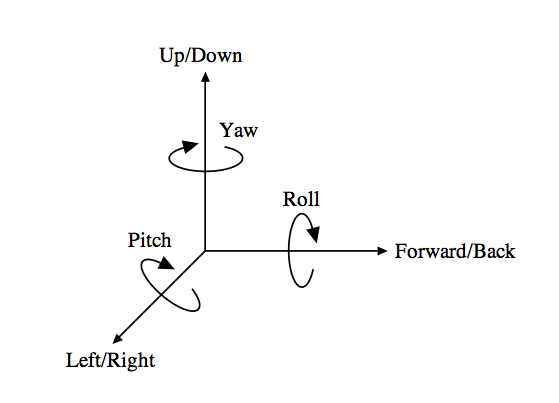
Because cameras are a three-dimensional tool, image stabilization systems need to work on up to six different planes to properly correct camera movement. The most simple camera shake will be directional shake; horizontal, vertical and forward/back shakes. Rotational shake, or commonly referred to as pitch and yaw, control the horizontal and vertical rotational movements that can occur while handholding.
How Lens Image Stabilization Works
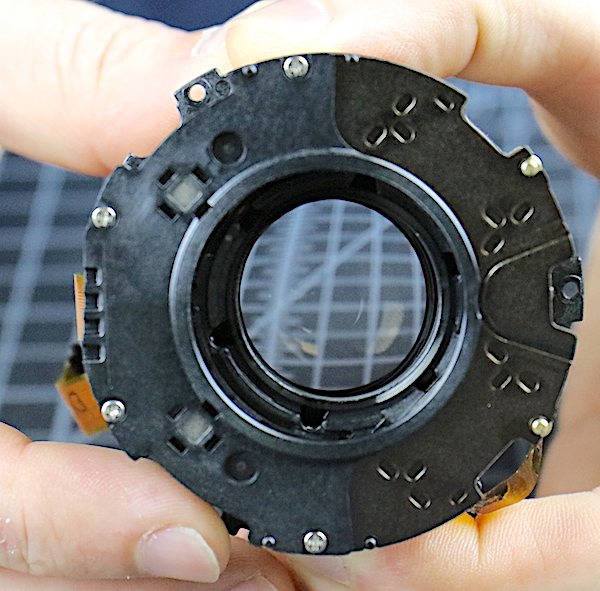
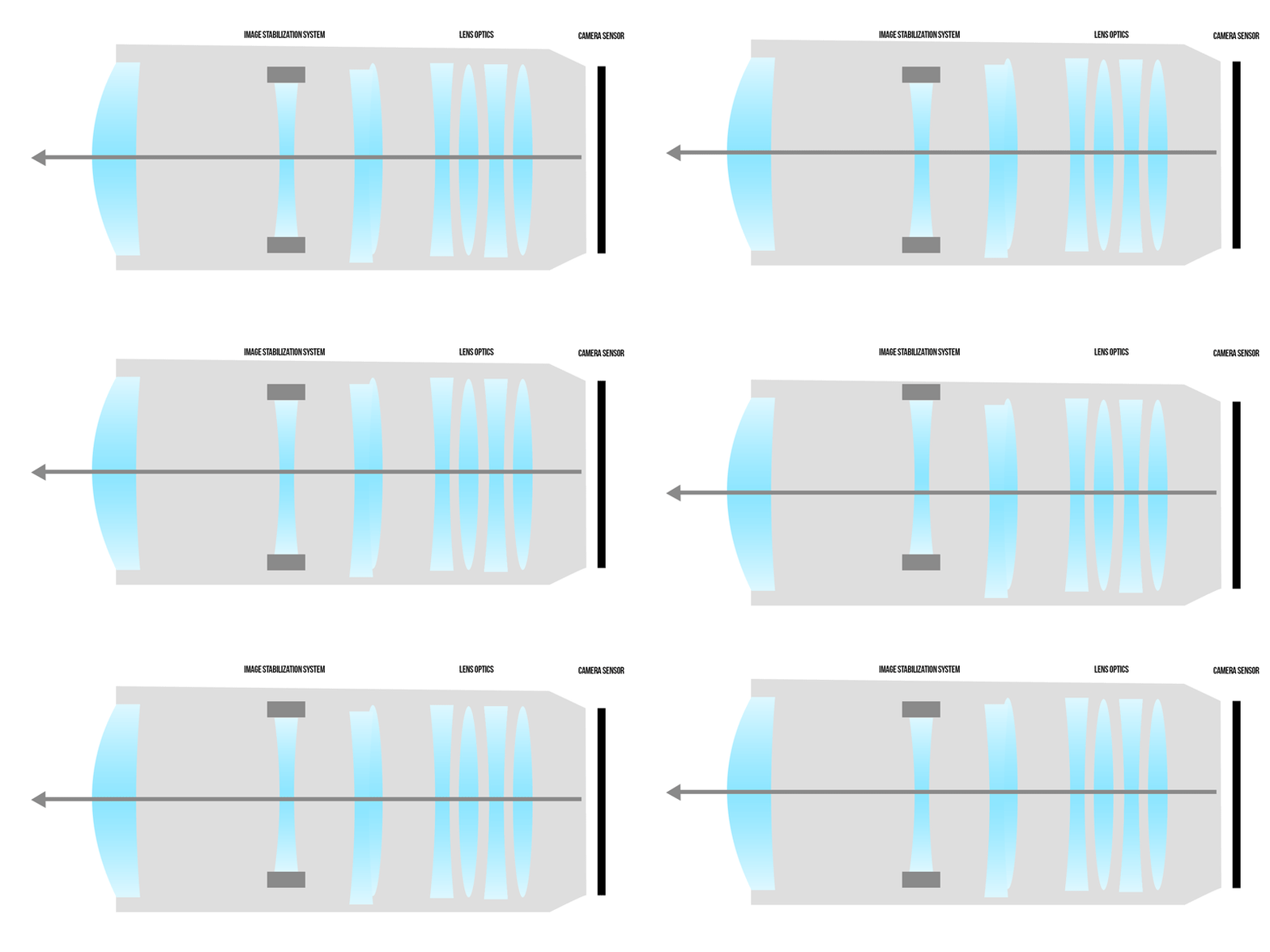
By default, image stabilization comes in two different flavors – in lens stabilization or in-camera body stabilization. These two platforms work differently, but work to produce similar results. To put it simply, in lens stabilization has a floating lens element which is controlled electronically by a microcomputer and shifts in the opposite direction of the camera shake, helping to stabilize the image. All of this is detected in mere microseconds and can give you up to 5-stops of stabilization, depending on the lens, movement, and focal length. Below is a short diagram showing you how this works to help counteract any camera shake.
In-lens image stabilization is by far the most common type of stabilization system. However, there is another type of image stabilization system that is becoming more and more popular, commonly called In-Body Image Stabilization (IBIS).
How In-Camera Stabilization Works
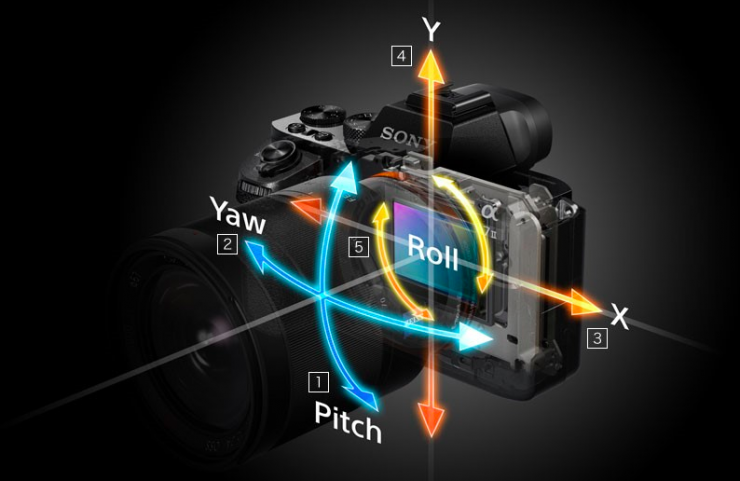
In recent years, through the help of Sony and Fuji cameras, In-Body Image Stabilization has become more and more common in cameras. Whereas image stabilization within the lens has a floating lens element helping to counteract the camera’s movement and shake, In-Body Image Stabilization has a floating sensor that helps neutralize any movement within the camera. The key advantage to this system is that if your camera has IBIS, all of the lenses you use with it will also have image stabilization.
Is In-Lens or In-Body Stabilization Better?
A common call we get here at Lensrentals.com is the cut to the chase “Which is better?”. But it’s not as simple as that, as both systems have advantages and disadvantages. For example, in-lens stabilization will generally perform better on longer focal lengths, because camera shake requires more compensation at the pivot point (camera) than it does within the lens. This is why many Sony telephotos still have in-lens stabilization, despite having IBIS on all of their mirrorless systems. So let’s look through some advantages of each system, to determine what works best for you.
Advantages to In-Lens Stabilization
- It’s far more effective in telephoto lenses. A subtle shake of the camera is pretty drastic when shooting at 500mm, and will naturally be better compensated within the lens rather than the camera body.
- Lens stabilization works better in low light conditions. Because the IS is working as an independent unit, you’ll have better results with in-lens stabilization while in low light conditions. In-Body Image Stabilization will often have trouble metering and focusing in lower light situations while activated.
- By in large, In-Lens Stabilization is more effective. While many camera companies developing IBIS will deny this, generally in-lens stabilization will provide better results. This is because the image stabilization is fine-tuned for each lens, and usually offers multiple IS modes depending on the situation. However, with systems like the Sony a7rIII and Sony a7III offering 5 stops of image stabilization, this argument is slowly fading away.
- Has no effect on your metering and autofocus. Unlike with IBIS, in-lens IS will have no negative effects to your autofocusing and metering while activated.
- By design, In-Lens Stabilization will offer better battery life. In-lens stabilization requires smaller motors to move the optics for camera shake, and is far less draining on the battery when compared to in-body image stabilization.
Advantages to In-Body Stabilization
- Generally, In-Body Image Stabilization (IBIS) is cheaper in the long run. While IBIS will usually be an added cost to the camera body purchase, it is a one time purchase and will usually result in lower lens prices, when compared to similar lenses with IS built in.
- In-Body Stabilization is universal – and works with all lenses. To further the point above, once you have IBIS, you should be able to use image stabilization with all the lenses in your kit.
- Unlike with most lenses with IS built in, IBIS operates in silence. If you’ve activated image stabilization on a lens, you’ve likely heard clicking and other noises from the lens while focusing. That is (usually at least), the image stabilization system making adjustments.
- IBIS offers cleaner bokeh when engaged. With IS turned on for in-lens systems, you’re asking the lens to make optical adjustments to counteract any movement, which can result in some weird bokeh. Because the optics are stationary with IBIS system, you will get a cleaner bokeh.
Misconceptions Regarding Image Stabilization
There are a few misconceptions with image stabilization systems that we need to answer often through tech support calls. So let’s go over a few of them here.
Can you use both in-lens stabilization and IBIS?
In short, yes. While it is dependent on the camera system you’re using (for example, Panasonic has a list of compatible lenses), but you should be able to use them together. With Sony systems, activating both systems will delegate 3-axis stabilization to the IBIS, and leave the pitch/yaw adjustments for the Optical Steady Shot (O.S.S) in-lens stabilization. Fuji systems, at least the Fujifilm X-H1, work in a similar fashion; delegating specific axis’ to different systems to achieve the standard 5-axis stabilization.
Should I turn off IS before demounting a lens?
As a general practice, yes. If you have Image Stabilization activated on a lens, you’ll want to turn it off, wait three seconds, and then unmount the lens. Not doing this can potentially put the IS system in what we call an ‘unparked’ position, which means the optics are still floating, which could cause damage if shaken and jarred.
Is there a theoretical limit to image stabilization?
Olympus seems to think the limit is 6.5 stops of image stabilization. In a recent interview, Setsuya Kataoka, part of the Imaging Product Development Division at Olympus, claimed that image stabilization’s theoretical limit is set at 6.5 stops of stabilization, due to rotation of the earth interfering with gyro sensors. I’ll let the comments below determine if that is a scientific fact, or just marketing mumbo jumbo.
Does image stabilization help with fast moving subjects?
No. Image stabilization is designed to control only the movements from camera shake. It won’t help stabilize any blur caused by moving subjects.
The Naming Schemes of Various Image Stabilization Systems
Likely because of patents, each brand has their own naming for their image stabilization, which is why most modern camera lenses have half a dozen letters slapped to the end of their official product name. So here is a quick reference guide for what each major brand calls their image stabilization system.
| Lens Brand | Image Stabilization Name |
| Canon | IS (Image Stabilization) |
| Nikon | VR (Vibration Reduction) |
| Sony | O.S.S. (Optical Steady Shot) |
| Panasonic | Mega O.I.S. (Mega Optical Image Stabilization) Power O.I.S. (Power Optical Image Stabilization) Dual I.S. (Dual Image Stabilization) |
| Sigma | OS (Optical Stabilizer) |
| Tamron | VC (Vibration Compensation) |
| FujiFilm | OIS (Optical Image Stabilization) |
| Olympus | IS (Image Stabilization) |
Hopefully, we were able to help with any questions you may have had regarding image stabilization, and if you have additional questions, feel free to chime in in the comments below or give us a call.
176 Comments
Jesse H ·
For the metering impact of IBIS, is this only a factor in SLR style cameras with separate AF and metering sensors? If metering and AF is off of the main sensor then it shouldn’t matter as much? Similarly only optical IS will stabilize the viewfinder in a SLR with optical view finder but in mirrorless either type should work.
Ilya Zakharevich ·
Thanks, Jesse,
before your remark this part of the page would not make any sense! Since nowadays IBIS is mostly for mirrorless, I did not even think about DSLR in the context of this section.
What is desperately needed is to add something like “for DSLR with their separate AF and auto-exposure modules”.
Jesse H ·
For the metering impact of IBIS, is this only a factor in SLR style cameras with separate AF and metering sensors? If metering and AF is off of the main sensor then it shouldn't matter as much? Similarly only optical IS will stabilize the viewfinder in a SLR with optical view finder but in mirrorless either type should work.
Ilya Zakharevich ·
Thanks, Jesse,
before your remark this part of the page would not make any sense! Since nowadays IBIS is mostly for mirrorless, I did not even think about DSLR in the context of this section.
What is desperately needed is to add something like “for DSLR with their separate AF and auto-exposure modules”.
cedyathome ·
Thanks for the explanations. I have a few questions:
– Older IS systems required you to shut them off when using a tripod. Is that still true of newer systems like the Sony one?
– Should IS or IBIS be turned off when using high shutter speeds (say 1/1000 or faster)?
I also assume that shooting with a camera mounted on a tripod will always best using IS or IBIS. Is that a true assumption?
Thank you.
Zach Sutton Photography ·
I’m not sure if it’s a requirement anymore, but if mounted to a tripod, there isn’t really much use for IS anyway, as you should have very little camera shake to begin with. The same reasoning would apply to the second question. If you’re shooting at very high shutter speeds, you’ll probably be best to have IS/IBIS off, to avoid any miscalculations within the system. Though IS systems are generally really accurate, they sometimes are not…so in these situations where you’re either mounted to a stationary object or shooting at fast speeds, I’d take IS out of the equation entirely to avoid any errors.
Thanks for reading!
Thom Hogan ·
Not exactly. A tripod or other support system often has high frequency vibrations (ringing) in it from various sources (wind, shutter slap, rough camera handling, insecure joints, etc.). Some IS systems attempt to isolate different types of movement and adjust accordingly.
However, there’s an upper end to both the detection and the actual response movement in all IS systems. What tends to happen when you’re using shutter speeds above the upper end ability of the system is that you get an aliasing type effect (which is what Pentax uses to advantage to do a user-selectable AA type filtration). It’s why I recommend turning VR off with shutter speeds above 1/500 on older Nikon lenses, 1/1000 on all. Edge acuity will be better at 1/2000 without VR active than with it active.
hywelphillips ·
In practical terms I have found that using IS with a telephoto lens on a tripod is still well worth doing if there’s much wind, especially if the wind is gusting. It seems to induce some vibration in the system which IS is good at taking out. My experience is primarily with an A7RII and 70-200 f/4 Sony lens – it noticeably improved the critical sharpness of the shots turning both body and lens IS on. In a calm studio on a heavy tripod, though, it really SHOULDN’T be necessary to turn IS on, and I know some photographers claim it degrades the images.
Personally I leave my IS on all the time, since I usually handhold indoors and shoot out in the mountains outdoors. I can’t say I’ve ever noticed a degradation which I’d attribute to IS. The only thing I definitely switch it off for is astrophotography.
cedyathome ·
Thanks for the explanations. I have a few questions:
- Older IS systems required you to shut them off when using a tripod. Is that still true of newer systems like the Sony one?
- Should IS or IBIS be turned off when using high shutter speeds (say 1/1000 or faster)?
I also assume that shooting with a camera mounted on a tripod will always best using IS or IBIS. Is that a true assumption?
Thank you.
Zach Sutton Photography ·
I'm not sure if it's a requirement anymore, but if mounted to a tripod, there isn't really much use for IS anyway, as you should have very little camera shake to begin with. The same reasoning would apply to the second question. If you're shooting at very high shutter speeds, you'll probably be best to have IS/IBIS off, to avoid any miscalculations within the system. Though IS systems are generally really accurate, they sometimes are not...so in these situations where you're either mounted to a stationary object or shooting at fast speeds, I'd take IS out of the equation entirely to avoid any errors.
Thanks for reading!
Thom Hogan ·
Not exactly. A tripod or other support system often has high frequency vibrations (ringing) in it from various sources (wind, shutter slap, rough camera handling, insecure joints, etc.). Some IS systems attempt to isolate different types of movement and adjust accordingly.
However, there's an upper end to both the detection and the actual response movement in all IS systems. What tends to happen when you're using shutter speeds above the upper end ability of the system is that you get an aliasing type effect (which is what Pentax uses to advantage to do a user-selectable AA type filtration). It's why I recommend turning VR off with shutter speeds above 1/500 on older Nikon lenses, 1/1000 on all. Edge acuity will be better at 1/2000 without VR active than with it active.
hywelphillips ·
In practical terms I have found that using IS with a telephoto lens on a tripod is still well worth doing if there's much wind, especially if the wind is gusting. It seems to induce some vibration in the system which IS is good at taking out. My experience is primarily with an A7RII and 70-200 f/4 Sony lens - it noticeably improved the critical sharpness of the shots turning both body and lens IS on. In a calm studio on a heavy tripod, though, it really SHOULDN'T be necessary to turn IS on, and I know some photographers claim it degrades the images.
Personally I leave my IS on all the time, since I usually handhold indoors and shoot out in the mountains outdoors. I can't say I've ever noticed a degradation which I'd attribute to IS. The only thing I definitely switch it off for is astrophotography.
DV ·
I’ve been using A-mount cameras with IBIS since the Maxxum 5D to now with the a99ii and this has never been a problem. I’ve used IBIS in the dark and it has never affected my metering, exposure, or focus.
Now, what WAS a problem with IBIS only systems is that in SLRs the viewfinder image was not stable, because obvious reasons. Having an unstable viewfinder can definitely hurt framing or the ability to keep your focus point over the image. With EVF systems, this is no longer the case: we now have stabilized viewfinders because the platens move during half-press. The Minolta A series digicams could also do this. The first round of Sony SLTs couldn’t, because the system was too inefficient (and on the a77ii could affect image quality because it wasn’t fast enough). The five-axis system in the a99ii (and in the a7 series cameras) corrected this problem with its far more efficient setup.
DV ·
I've been using A-mount cameras with IBIS since the Maxxum 5D to now with the a99ii and this has never been a problem. I've used IBIS in the dark and it has never affected my metering, exposure, or focus.
Now, what WAS a problem with IBIS only systems is that in SLRs the viewfinder image was not stable, because obvious reasons. Having an unstable viewfinder can definitely hurt framing or the ability to keep your focus point over the image. With EVF systems, this is no longer the case: we now have stabilized viewfinders because the platens move during half-press. The Minolta A series digicams could also do this. The first round of Sony SLTs couldn't, because the system was too inefficient (and on the a77ii could affect image quality because it wasn't fast enough). The five-axis system in the a99ii (and in the a7 series cameras) corrected this problem with its far more efficient setup.
Franck Mée ·
Hey Zach,
I’m sorry to be the grumpy one here, but I think your article misses a few points.
There is an important advantage to IBIS that you didn’t write about: it can be used for something else.
While OIS is limited to its core function, IBIS can provide “super-resolution” solutions (multi-shot/pixel shift resolution/high resolution/…), automatic horizon alignment, switchable anti-aliasing, minute framing adjustment if your tripod lacks micro-metric controls, sky following for night photography, and maybe other things I haven’t heard about.
And please stop saying IBIS is “usually an added cost” for the body: I haven’t seen an IBIS body being notably more expansive than a non-IBIS equivalent since the K100D vs K110D. 🙂
The Alpha 100 was cheaper than the EOS 40D, the K-1 was the same price as the D750 and cheaper than the D800 (depending on whether you want the 1/8000 s shutter and 36 Mpx for a “fair comparison”), the OM-D E-M10 was cheaper than the Alpha 6000 and the X-M1…
Les ·
IBIS can be associated with multi-shot, but the two aren’t necessarily linked. Sinar and others have offered multi-shot for over a decade, yet they never offered IBIS. Lots of IBIS cameras don’t offer multi-shot.
Also, cost and price aren’t the same. IBIS costs something to implement, but that cost isn’t necessarily reflected in selling price. The selling price is mostly determined by marketing. Back in the day, Nikon and Canon would both have full lines of APS SLR that differed only in small details, but the selling price went up in $100 increments.
Franck Mée ·
Well, I wrote “IBIS *can* provide”, so I did say they weren’t necessarily linked. And Zack was referring to an added cost when buying the body, so the production cost is irrelevant.
Thanks for playing though.
Les ·
Yes, you can have both features on the same body, but neither one requires (or “provides”) the other. The reason for that is multi-shot moves the sensor by one pixel (micrometers), while IBIS moves the sensor much more, so the implementation is very different. Case in point, multishot was around for nearly a decade before being offered on a camera that happened to also offer IBIS. And the opposite is also true. Correlation does not imply causation.
Franck Mée ·
Once again, that’s EXACTLY what I wrote. I don’t get why you answered me like I was wrong to say that IBIS can provide other functions.
DP ·
>>> Case in point
there is no case in point because reasons not to do multi-shot in 2004 when first IBIS camera appeared were not about moving sensor by a sensel, but rather because there was no reason to push for it… there are a lot of different IBIS implementations
DP ·
> IBIS can be associated with multi-shot, but the two aren’t necessarily linked.
better wording: multi-shot can always be implemented with IBIS, but it does not mean it will be…
Jan Steinman ·
You left out sensor cleaning! Olympus uses the IBIS mechanism to mechanically shake dust off the sensor, every time the power cycles.
I have never had to clean my OM-D E-M1.2 sensor, but camera blogs are full of Canikony users, complaining about having to clean their sensors.
Michael Clark ·
Most Canikon cameras made in the last decade or so use the filter stack in front of the sensor to shake off the dust of the front of the filter stack, which is where most dust is. Very little dust will make it past the filter stack.
My anecdotal contribution: I’ve never needed to clean the sensor on any of my APS-C Canon cameras, but have needed to clean the sensors on my FF cameras more than once. My theory is that the smaller height/width of the APS-C light box with the same depth as the larger FF light box allows more dust to reach the sensor stack.
This is borne out by reports of Sony FF mirrorless cameras, with their shorter registration distance and lack of a mirror blocking the light box during lens changes, having even greater need of manual sensor cleaning than FF DSLRs.
Franck Mée ·
Hey Zach,
I'm sorry to be the grumpy one here, but I think your article misses a few points.
There is an important advantage to IBIS that you didn't write about: it can be used for something else.
While OIS is limited to its core function, IBIS can provide "super-resolution" solutions (multi-shot/pixel shift resolution/high resolution/…), automatic horizon alignment, switchable anti-aliasing, minute framing adjustment if your tripod lacks micro-metric controls, sky following for night photography, and maybe other things I haven't heard about.
And please stop saying IBIS is "usually an added cost" for the body: I haven't seen an IBIS body being notably more expansive than a non-IBIS equivalent since the K100D vs K110D. :)
The Alpha 100 was cheaper than the EOS 40D, the K-1 was the same price as the D750 and cheaper than the D800 (depending on whether you want the 1/8000 s shutter and 36 Mpx for a "fair comparison"), the OM-D E-M10 was cheaper than the Alpha 6000 and the X-M1…
Les ·
IBIS can be associated with multi-shot, but the two aren't necessarily linked. Sinar and others have offered multi-shot for over a decade, yet they never offered IBIS. Lots of IBIS cameras don't offer multi-shot.
Also, cost and price aren't the same. IBIS costs something to implement, but that cost isn't necessarily reflected in selling price. The selling price is mostly determined by marketing. Back in the day, Nikon and Canon would both have full lines of APS SLR that differed only in small details, but the selling price went up in $100 increments.
Franck Mée ·
Well, I wrote "IBIS *can* provide", so I did say they weren't necessarily linked. And Zack was referring to an added cost when buying the body, so the production cost is irrelevant.
Thanks for playing though.
Les ·
Yes, you can have both features on the same body, but neither one requires (or "provides") the other. The reason for that is multi-shot moves the sensor by one pixel (micrometers), while IBIS moves the sensor much more, so the implementation is very different. Case in point, multishot was around for nearly a decade before being offered on a camera that happened to also offer IBIS. And the opposite is also true. Correlation does not imply causation.
Franck Mée ·
Once again, that's EXACTLY what I wrote. I don't get why you answered me like I was wrong to say that IBIS can provide other functions.
# WLM ·
>>> Case in point
there is no case in point because reasons not to do multi-shot in 2004 when first IBIS camera appeared were not about moving sensor by a sensel, but rather because there was no reason to push for it... there are a lot of different IBIS implementations
# WLM ·
> IBIS can be associated with multi-shot, but the two aren't necessarily linked.
better wording: multi-shot can always be implemented with IBIS, but it does not mean it will be...
Neven Falica ·
There are a few factual mistakes there – Minolta, Pentax and Olympus were using IBIS for years, Minolta started using it in 2003. in enthusiast compacts, every Pentax DSLR had IBIS since 2006. and Olympus started stuffing it in their DSLRs a year later. That’s three major companies missing on the list, all three using the system more than a decade ago – in my book, that’s not really “recent years” anymore.
Zach Sutton Photography ·
I’m not suggesting that Sony or Fuji invented IBIS, just that it has become far more prevalent in recent years thanks to their camera systems. Minolta left the photography space shortly after 2003, and both Pentax and Olympus have been pretty small fish in the camera space (at least until recently). It wasn’t until the Sony a7 in 2014, that IBIS was pushed into the mainstream…
Neven Falica ·
No, you haven’t suggested that, but you wrote an article about IBIS, and didn’t even mention one of the companies that pioneered the system more than a decade ago. That’s not insignificant omission. I’m aware both Pentax and Olympus were flying under the radar for most of the working pros until recently, but hey, that’s 12+ years, that’s the company that spearheaded it into existence even in the entry-level cameras, that’s the system used for in-camera shift feature – not something that could be missed by an article written on LensRentals.
Or maybe my standards are a bit too high. 🙂
No hard feelings, I’m just trying to fill in the missing information in otherwisely very informative article (Pentax calls it SR – Shake Reduction).
Daniel Morgan ·
Completely agree here Neven, I was about to write something similar.
Definitely kind of missed the mark on the development of in-body shake reduction.
You could at the very least update the article with the Pentax brand and what they call their IBIS system!
.. and I’ve never had my Pentax system have a problem metering or focusing while stabilization has been activated… I’m curious what brand that happens with? If that happens with Sony or one of the other major brands… all the more reason to perhaps mention Pentax in your listing!
The Pentax system can even be used for long exposures doing astrophotography, for pixel-shifting and taking multiple photos to get better color rendition when used on a tripod, for anti-alias filter simulation as-needed (thus eliminating the need for a physical AA filter/ can produce better detail than systems with an AA filter. ) Lots of things to consider.
oakie ·
Pentax doesn’t have issues with focus and metering because both functions happen off the sensor due to being an SLR. IBIS on a mirrorless, where the focusing and metering happen on the sensor itself, are subject to these issues while the sensor is moving around to compensate for shake. the reason for being is due to the pixels taking a contrast, phase or light reading for focus and metering can move out of the light it was originally subjected to as the sensor shifts.
Franck Mée ·
Alpha 7 II, 2015 actually. 😉
I think the Alpha 100 and the 3-500 series sold many, many more than the Alpha 7 II, as probably did the K10D. They were much more “mainstream” cameras, below (and sometimes far below) 1000 €.
The Alpha 7 series were “mainstream for a full-frame”, but not “mainstream” period, in my opinion.
DP ·
actually when Sony entered with the first dSLM + IBIS body Olympus already had more sales of dSLM + IBIS cameras… so while Sony contributed it was a gradual process, even now Sony does not sell a _magnitude_ more IBIS bodies than the m43 … what Sony did is it forced Nikon to finally accept that dSLM + IBIS are the real game… and Canon will be forced to follow now
Naomi ·
Start earning more money every week… It’s a valuable side job for anyone… Best part about it ,work from your home and start making 100-2000 bucks every week … Start now and have your first paycheck by the end of this week…> http://goodlove41.pw/rqEaqV
Brenda ·
The latest analysis demonstrates that more than 75% individuals are involved into online tasks. On line arena is becoming bigger and more beneficial and delivering a great number of work at home opportunities. Work at home internet jobs are trending and developing individual’s daily lives. Exactly why it is actually widely used? Mainly because it allows you to work from anywhere and any time. You get more time to devote with all your friends and can plan out trips for getaways. People are making pleasant income of $34000 in one week by utilizing the efficient and intelligent methods. Performing right work in a right path will always lead us in direction of success. You can begin to earn from the first day after you explore our site. >>>>> PLU.SH/njexd
David Bateman ·
Nope I think you come off as being extremely ignorant. Because of Olympus pushing hard with IBIS since the E510, others have noticed.
Fuji has one camera and has not introduced IBIS in any newer models.
T N Args ·
But Fuji? FUJI???? Who are generally criticised for their *lack of* stabilised bodies?
Alice ·
I generally earn about $6,000-$8,000 a month over the internet. It is actually adequate to easily replace my old jobs income, specially considering I just work about twenty hour each week at home.I lost my job after working for the same organization for a long time, I wanted trusted income, I was not researching for the “get rich quick” home programs you see online. Those are typical pyramid schemes or stuff where you have to sell to your friends and family members. I just needed a reliable method to earn a living for me and my family members. The best benefit of working on line is that I am always home with the little kids, I save a lot of money. Honestly,it is actually easier than you would think, all you need to do is fill out a simple form to receive front line access to the Home Profit System . I got the instructions kit and within a few weeks I was making over $4,000 on a monthly basis. The instructions are quite simple, you don’t have to be a computer whiz, but you should know how to use the net. If you can fill up forms and browse web-sites, you can do it very easily, You don’t even have to sell anything at all and no-one has to purchase anything. It’s as simple as being on Youtube.Here’s the right way to begin->->->-> http://shortaz.com/qR7H6
Emiko ·
I actually generate around $6,000-$8,000 every month online. It’s more than enough to comfortably replace my old jobs salary, especially considering I only work about 20 hrs every week at home.I lost my job after doing work for the same organization for a long time, I required trusted source of income, I was not interested in the “get rich quick” home programs as you can see all over the internet. Those are usually pyramid schemes or stuff where you have to sell to your friends and relatives. I just needed a reliable method to earn a living for me and my family members. The most interesting part of working on line is that I am always home with the kids, I save a lot of money. Honestly,it is easier than you would believe, all you need to do is fill out a simple form to obtain front line access to the Home Profit System . You don’t need to be a computer whiz, but you should be aware how to use the net. If you can fill forms and browse web sites, you can do it quite easily, You don’t even have to sell anything and nobody needs to purchase anything. It is as simple as being on Facebook.Here’s the right way to start out=> PLEASE SEE
Riley Escobar ·
Olympus has sold way more bodies with IBIS than Fuji. I wouldn’t even think of Fuji when thinking about that feature.
elkarrde ·
There are a few factual mistakes there - Minolta, Pentax and Olympus were using IBIS for years, Minolta started using it in 2003. in enthusiast compacts, every Pentax DSLR had IBIS since 2006. and Olympus started stuffing it in their DSLRs a year later. That's three major companies missing on the list, all three using the system more than a decade ago - in my book, that's not really "recent years" anymore.
Zach Sutton Photography ·
I'm not suggesting that Sony or Fuji invented IBIS, just that it has become far more prevalent in recent years thanks to their camera systems. Minolta left the photography space shortly after 2003, and both Pentax and Olympus have been pretty small fish in the camera space (at least until recently). It wasn't until the Sony a7 in 2014, that IBIS was pushed into the mainstream...
elkarrde ·
No, you haven't suggested that, but you wrote an article about IBIS, and didn't even mention one of the companies that pioneered the system more than a decade ago. That's not insignificant omission. I'm aware both Pentax and Olympus were flying under the radar for most of the working pros until recently, but hey, that's 12+ years, that's the company that spearheaded it into existence even in the entry-level cameras, that's the system used for in-camera shift feature - not something that could be missed by an article written on LensRentals.
Or maybe my standards and expectations are a bit too high. :)
No hard feelings, I'm just trying to fill in the missing information in otherwisely very informative article (Pentax calls it SR - Shake Reduction).
Daniel Morgan ·
Completely agree here Neven, I was about to write something similar.
Definitely kind of missed the mark on the development of in-body shake reduction.
You could at the very least update the article with the Pentax brand and what they call their IBIS system!
.. and I've never had my Pentax system have a problem metering or focusing while stabilization has been activated... I'm curious what brand that happens with? If that happens with Sony or one of the other major brands... all the more reason to perhaps mention Pentax in your listing!
The Pentax system can even be used for long exposures doing astrophotography, for pixel-shifting and taking multiple photos to get better color rendition when used on a tripod, for anti-alias filter simulation as-needed (thus eliminating the need for a physical AA filter/ can produce better detail than systems with an AA filter. ) Lots of things to consider.
oakie ·
Pentax doesn't have issues with focus and metering because both functions happen off the sensor due to being an SLR. IBIS on a mirrorless, where the focusing and metering happen on the sensor itself, were subject to these issues while the sensor is moving around to compensate for shake. the reason for being was due to the pixels taking a contrast, phase or light reading for focus and metering can move out of the light it was originally subjected to as the sensor shifts.
it's an old issue that has been resolved over time as both processors and IBIS units have gotten faster and more accurate, the advent of microlenses, and the increase in number of phase detect pixels and full sensor metering.
the bigger issue that's universal amongst IBIS is edges and corners going out of focus inconsistently with the lens, as the edges of the sensor plane can move in and out of focus from pitch and yaw adjustments. the same is true for OIS with a fixed sensor plane. however, having both IBIS and OIS can correct for this from a purely mechanical perspective, but i'm unsure if any manufacturers do this.
Franck Mée ·
Alpha 7 II, 2015 actually. ;)
I think the Alpha 100 and the 3-500 series sold many, many more than the Alpha 7 II, as probably did the K10D. They were much more "mainstream" cameras, below (and sometimes far below) 1000 €.
The Alpha 7 series were "mainstream for a full-frame", but not "mainstream" period, in my opinion.
# WLM ·
actually when Sony entered with the first dSLM + IBIS body Olympus already had more sales of dSLM + IBIS cameras... so while Sony contributed it was a gradual process, even now Sony does not sell a _magnitude_ more IBIS bodies than the m43 ... what Sony did is it forced Nikon to finally accept that dSLM + IBIS are the real game... and Canon will be forced to follow now
David Bateman ·
Nope I think you come off as being extremely ignorant. Because of Olympus pushing hard with IBIS since the E510, others have noticed.
Fuji has one camera and has not introduced IBIS in any newer models.
Riley Escobar ·
Olympus has sold way more bodies with IBIS than Fuji. I wouldn't even think of Fuji when thinking about that feature.
Ilya Zakharevich ·
Earth rotation? 1 day = 24×60×60 sec = 84,600 sec. With 100mm lens, the sensor moves (relative to the lens) about 100mm*2?/84,600 = 7?m/sec. So with 6½ steps (which is a 100mm lens handheld for 1sec, if I understand it correct), Earth’s rotation contributes a shift of ?1.5pixels.
I do not know what would be considered as an “acceptable” performance; I would think that in the context of shake, 1.5px would be considered negligible.
Moreover, even if one know the latitude, the local vertical, and the direction to north only approximately, one can still compensate this to a large extent…
Roger Cicala ·
I’m sitting here thinking “so they just need to add a tiny Foucault’s pendulum as an IS sensor to take care of that” and laughing myself silly. I truly need to get a life.
geekyrocketguy ·
I started having PTSD flashbacks to calculating the Coriolis effect in advanced mech physics classes…
After 1 minute of pondering, I /think/ this could be compensated for with a GPS (to know latitude) and compass (to know pointing).
A Foucault pendulum is a good option too (I’ll never say no to a Foucault pendulum!), but a few people might complain about the size. :-p
Ilya Zakharevich ·
@Cicala: Right. So the next generation of cameras would have a small dome rising above the middle of the camera. Wait…!
Ilya Zakharevich ·
Actually, you caught me up on this?—?for a few minutes I thought that this may work! What happens: Foucault’s pendulum-in-a-camera is not possible!
There are two principal components of Foucault’s pendulum: the intertially-stabilized platform (the pendulum) and the markings on the floor. The markings show us that the floor is rotating w.r.t. the intertially-stabilized platform.
A camera with IBIS already has an intertially-stabilized platform?—?and it is much better stabilized than pendulum (for example, the stabilization does not depend on latitude!). However, the camera has no clue about “markings on the floor”: it cannot find out that the room is rotating about it!
asad137 ·
Earth rotation in the context of astrophotography, so extremely long exposures — like 30 seconds or more.
geekyrocketguy ·
No, the rotation of the Earth causes a small and dynamic “force” which could potentially confuse the gyro sensors that control IS systems. This would be problematic regardless of the shutter speed.
Ilya Zakharevich ·
Wrong. There is no force associated to the Earth rotation. Local vertical may be different from what one could “naively” expect?—?this is all.
However, the stabilizer would try to make the optical axis to be immobile relative to the fixed stars. Because of this, it would rotate with the angular speed 15?/sec relative to the objects about you.
geekyrocketguy ·
I think there is some confusion? I agree with your original post.
I do astrophotography. I am certainly familiar with the Pentax star tracking system.
Re: forces associated with Earth’s rotation: look up the Coriolis effect. Yes, it is a “fictitious” force that only appears because we’re in a non-inertial reference frame, but it needs to be taken into account, and it likely is what the Olympus guy was referencing as setting the theoretical limit of IS.
Ilya Zakharevich ·
There is nothing “ficticious” about Coriolis force (unless you believe that Newtonian mechanics is the final answer) if you use certain coordinate systems?—?but nobody forces you to use these coordinate systems.?—?Moreover, working in these coordinate systems is very error-prone (which you just have shown above!)
Look at a camera in the coordinate system which does not rotate w.r.t. fixed stars. There is no Coriolis force. The room about the camera rotates; gyroscopic IBIS ensures that the camera behaves as if it does not rotate. And the camera has no clue that the room rotates about this!
DP ·
> And the camera has no clue that the room rotates about this!
it actually does as it can try to analyze the image readout from the sensor (may be not during the exposure time with current state of consumer sensors for dSLMs or for dSLRs with mirror up, but at least during the framing – using main sensor in dSLM or metering sensor in dSLR)… not that it solves the practical issue of stabilizing during the exposure, but in principle for sufficiently long exposure (close to a second) you can have a lot of readouts… once (if) sensor tech allows multiple sensels readouts during the actual exposure time then you can try to use that to acquire additional point of reference for stabilization.
PS: or information acquired during framing can be used to adjust IBIS operation during exposure
Ilya Zakharevich ·
Won’t help even if all the objects in a scene are completely fixed w.r.t. each other: you NEED 1sec exposure for a photo, how much would you need to detect a motion which is so slow?!
Yves Simon ·
IBIS has no clue that the Earth is ‘moving’ or ‘rotating’. Relativity 101.
asad137 ·
No, it’s for astrophotography:
http://www.ricoh-imaging.co.jp/english/photo-life/astro/
The effects you talk about are completely irrelevant at the timescales in question.
Ilya Zakharevich ·
The laws of physics do not know whether you are making a photo to publish in astrophotography magazine, or in Playboy. What IBIS knows about is the movement of camera in the coordinate system immobile w.r.t. the fixed stars. It can do nothing else since inertial navigation knows nothing about other coordinate systems
For either journal, with 100mm focal length, if the camera is stabilized w.r.t. the fixed stars, the image of ground objects would move about 7.5µm/sec on the sensor.
DP ·
except a camera can readout 30…240+ and more times image off the said sensor (or part of the frame) and can try (AI is a popular word) to assume that something within that image as being immobile and then try to adjust IBIS operation somewhat… gives additional reference…
Roger Cicala ·
“The laws of physics do not know whether you are making a photo to publish in astrophotography magazine, or in Playboy.” This has now become my favorite quote ever.
Steve Tschopp ·
GPS and a compass would give you correction for earths rotation. When I do electronic reduction for some source of systematic error 90% is fairly easy to achieve. This is between 3-4 stops. 6.5 stops is 99% correction for the error. At least in the stuff I build I never get to 99% error reduction, might be based on an optimistic limit set by experience. I would be curious to know how many “stops” of noise reduction the latest Bose headphones have.
Ilya Zakharevich ·
When in school, the log-scale exposure meter I designed for my darkroom would compensate the inverse current I? of a diode (to change I?(exp(V)-1) to I?exp(V)) up to 6–7eV. This was at room temperature (with steady-state heating system?—?not PCM-heating) on the timescale of about 30min–1hour.
So the achieved compensation depends on application (no surprise!). Remember that there is no feedback loop in image-stabilization, everything is done with forward-control (sp?) only. Having a precise enough model of the dynamical system of IBIS+sensor is really crucial.
BTW, I know that Konika-Minolta published the spectral curve of their IBIS (the level of compensation as a function of vibration frequency); it was around 10x in the range about 8–80Hz. I also know that Sony uses a non-linear system (to avoid bumps at the limit displacements). I have not seen any other numeric data for more contemporary stuff!
Jan Steinman ·
The latest Olympus offering (OM-D E-M1x) apparently beats the “Earth’s rotation” argument with additional sensors, including GPS and accelerometers. I think they now claim 7.5 stops with this camera.
Charles ·
Ahhhh… but aren’t you rotating with the earth at the same speed?
Ilya Zakharevich ·
Earth rotation? 1 day = 24×60×60 sec = 84,600 sec. With 100mm lens, the sensor moves (relative to the lens) about 100mm*2π/84,600 = 7μm/sec. So with 6½ steps (which is a 100mm lens handheld for 1sec, if I understand it correct), Earth’s rotation contributes a shift of ≈1.5pixels.
I do not know what would be considered as an “acceptable” performance; I would think that in the context of shake, 1.5px would be considered negligible.
Moreover, even if one know the latitude, the local vertical, and the direction to north only approximately, one can still compensate this to a large extent…
Roger Cicala ·
I'm sitting here thinking "so they just need to add a tiny Foucault's pendulum as an IS sensor to take care of that" and laughing myself silly. I truly need to get a life.
geekyrocketguy ·
I started having PTSD flashbacks to calculating the Coriolis effect in advanced mech physics classes...
After 1 minute of pondering, I /think/ this could be compensated for with a GPS (to know latitude) and compass (to know pointing).
A Foucault pendulum is a good option too (I'll never say no to a Foucault pendulum!), but a few people might complain about the size. :-p
Ilya Zakharevich ·
Actually, you caught me up on this — for a few minutes I thought that this may work! What happens: Foucault's pendulum-in-a-camera is not possible!
There are two principal components of Foucault's pendulum: the intertially-stabilized platform (the pendulum) and the markings on the floor. The markings show us that the floor is rotating w.r.t. the intertially-stabilized platform.
A camera with IBIS already has an intertially-stabilized platform — and it is much better stabilized than pendulum (for example, the stabilization does not depend on latitude!). However, the camera has no clue about “markings on the floor”: it cannot find out that the room is rotating about it!
asad137 ·
Earth rotation in the context of astrophotography, so extremely long exposures -- like 30 seconds or more.
geekyrocketguy ·
No, the rotation of the Earth causes a small and dynamic "force" which could potentially confuse the gyro sensors that control IS systems. This would be problematic regardless of the shutter speed.
Ilya Zakharevich ·
Wrong. There is no force associated to the Earth rotation. Local vertical may be different from what one could “naively” expect — this is all.
However, the stabilizer would try to make the optical axis to be immobile relative to the fixed stars. Because of this, it would rotate with the angular speed 15″/sec relative to the objects about you.
geekyrocketguy ·
I think there is some confusion? I agree with your original post.
I do astrophotography. I am certainly familiar with the Pentax star tracking system.
Re: forces associated with Earth's rotation: look up the Coriolis effect. Yes, it is a "fictitious" force that only appears because we're in a non-inertial reference frame, but it needs to be taken into account, and it likely is what the Olympus guy was referencing as setting the theoretical limit of IS.
Ilya Zakharevich ·
There is nothing “ficticious” about Coriolis force (unless you believe that Newtonian mechanics is the final answer) if you use certain coordinate systems — but nobody forces you to use these coordinate systems. — Moreover, working in these coordinate systems is very error-prone (which you just have shown above!)
Look at a camera in the coordinate system which does not rotate w.r.t. fixed stars. There is no Coriolis force. The room about the camera rotates; gyroscopic IBIS ensures that the camera behaves as if it does not rotate. And the camera has no clue that the room rotates about this!
# WLM ·
> And the camera has no clue that the room rotates about this!
it actually does as it can try to analyze the image readout from the sensor (may be not during the exposure time with current state of consumer sensors for dSLMs or for dSLRs with mirror up, but at least during the framing - using main sensor in dSLM or metering sensor in dSLR)... not that it solves the practical issue of stabilizing during the exposure, but in principle for sufficiently long exposure (close to a second) you can have a lot of readouts... once (if) sensor tech allows multiple sensels readouts during the actual exposure time then you can try to use that to acquire additional point of reference for stabilization.
PS: or information acquired during framing can be used to adjust IBIS operation during exposure
Yves Simon ·
IBIS has no clue that the Earth is 'moving' or 'rotating'. Relativity 101.
asad137 ·
No, it's for astrophotography:
http://www.ricoh-imaging.co...
The effects you talk about are completely irrelevant at the timescales in question.
Ilya Zakharevich ·
The laws of physics do not know whether you are making a photo to publish in astrophotography magazine, or in Playboy. What IBIS knows about is the movement of camera in the coordinate system immobile w.r.t. the fixed stars. It can do nothing else since inertial navigation knows nothing about other coordinate systems
For either journal, with 100mm focal length, if the camera is stabilized w.r.t. the fixed stars, the image of ground objects would move about 7.5µm/sec on the sensor.
# WLM ·
except a camera can readout 30...240+ and more times image off the said sensor (or part of the frame) within that same second and can try (AI is a popular word) to assume that something within that image as being immobile and then try to adjust IBIS operation somewhat... gives additional reference...
Roger Cicala ·
"The laws of physics do not know whether you are making a photo to publish in astrophotography magazine, or in Playboy." This has now become my favorite quote ever.
Steve Tschopp ·
GPS and a compass would give you correction for earths rotation. When I do electronic reduction for some source of systematic error 90% is fairly easy to achieve. This is between 3-4 stops. 6.5 stops is 99% correction for the error. At least in the stuff I build I never get to 99% error reduction, might be based on an optimistic limit set by experience. I would be curious to know how many "stops" of noise reduction the latest Bose headphones have.
Ilya Zakharevich ·
When in school, the log-scale exposure meter I designed for my darkroom would compensate the inverse current I₀ of a diode (to change I₀(exp(V)-1) to I₀exp(V)) up to 6–7eV. This was at room temperature (with steady-state heating system — not PCM-heating) on the timescale of about 30min–1hour.
So the achieved compensation depends on application (no surprise!). Remember that there is no feedback loop in image-stabilization, everything is done with forward-control (sp?) only. Having a precise enough model of the dynamical system of IBIS+sensor is really crucial.
BTW, I know that Konika-Minolta published the frequency response plot of their IBIS (the level of compensation as a function of vibration frequency); it was around 10x in the range about 8–80Hz. I also know that Sony uses a non-linear system (to avoid bumps at the limit displacements). I have not seen any other numeric data for more contemporary stuff!
Charles ·
Ahhhh... but aren't you rotating with the earth at the same speed?
bedo ·
“It’s far more effective in telephoto lenses.”
“By in large, In-Lens Stabilization is more effective. While many camera companies developing IBIS will deny this, generally in-lens stabilization will provide better results.”
Zach, do you have links to some relevant studies supporting these claims? Just curious as I only have anecdotal evidence with my own gear where Olympus IBIS outperforms anything else I have (IBIS or optical) by far.
Athanasius Kirchner ·
I’ve yet to see such a lofty claim tested and proven. It’s as you say – in my experience, newer IBIS systems outperform in-lens ones handily in a number of tests, especially for very slow exposures at wide angle.
Michael Clark ·
Well, in Zach’s defense, he was talking about telephoto lenses in that quote. It should be fairly obvious that the same degree of camera movement translates into a larger percentage of the frame with lenses that give a narrower angle of view. For an IBIS system to give the same amount of benefit for a 200mm lens, it would need to be able to move four times as far and four times as fast as that same IBIS unit needs with a 50mm lens. By the time one gets out past 300mm or so, existing IBIS systems tend to only give about one stop of benefit. Many telephoto lenses in the 400-800mm range with LBIS give four or more stops of benefit.
Jan Steinman ·
I think you’re making this up.
If so, then why am I able to shoot sharp moon shots with a 1000mm mirror lens at 1/60th?
My experience with Olympus IBIS is that it works just dandy with long lenses.
Michael Clark ·
I think you’re making that up.
See how that works?
Jan Steinman ·
EXIF data. See how that works? Didn’t think so.
Celestron C90, 1000mm ƒ/11, 1/60th, hand-held. (Well, I was leaning against a pickup truck.)
http://www.Bytesmiths.com/Personal/_A003935.jpg
But I don’t think you are convincible, and you’ll dream up some other reason why reality must not be so, so we’ll have to say good bye.
Michael Clark ·
That looks pretty blurry to me.
This one is a downsized (sorry, but my upstream bandwidth stinks out here in the sticks) of a fairly heavily cropped image from a crappy 7D classic + cheap Kenko 2X Teleplus Pro 300 DGX + EF 70-200mm f/2.8 L IS II. (“effective FL” of 640mm before the crop.)
Tripod mounted, mirror lockup, remote cable release at ISO 200, f/8, 1/125. IS turned off.
And yeah, if you look real close to the right you can see the major bands in Jupiter’s atmosphere.
Why in the world would anyone ever use IS and shoot handheld to take a photo of the moon?
https://uploads.disquscdn.com/images/2710156e1f9bf92bfde48ac084cf2c6bd286dda6445b9b60272f37a5ede43089.jpg
Athanasius Kirchner ·
Even when talking about superteles, what you claim isn’t borne out in practice. I have personally shot a Canon FDn 400mm f/4.5 on an Olympus E-M5, handheld, at 1/50 with good results – that’s 800mm equivalent, for 5 stops of stabilization.
But of course, that’s only my experience. Look at DPR’s testing for a more formal confirmation: https://www.dpreview.com/reviews/olympus-om-d-e-m1-mark-ii/5
Michael Clark ·
Back in the dark ages (a/k/a the film era), I could get 70% keepers at 2-3 stops below the 1/FL “rule of thumb” in certain shooting situations by using proper shooting technique and breathing methods learned at the rifle/pistol range. That was without any IS at all.
I’m sure you use similar techniques.
If I were still that young and in shape, I would only need another 2-3 stops from an IS system to get to 5 stops slower than the 1/FL RoT.
Just because one can get good shots at five stops below the 1/FL RoT does not mean IS is giving five stops of benefit. When one can shoot five stops slower than one can do it without the benefit of IS and get the same results while using the same techniques, only then is the IS providing five stops of benefit.
If an IBIS system can provide 5 stops of benefit at 400mm on a 2X crop body, then the same range of movement and speed by the sensor should be able to provide 8X that benefit at 50mm (because the same amount of pitch/yaw movement covers 8X as many pixels at 400mm as it does at 50mm). Yet no one is marketing a camera with 40 stop IS at 50mm are they?
Michael Clark ·
From the link you cited:
“At long focal lengths, with their narrow fields of view, a small hand movement creates a large displacement of the image: making hand shake very visible. We’ve tested the E-M1 II’s ability to combine sensor-shift and lens-shift IS. This allows more total correction movement than sensor-shift correction alone, which lets it correct for that large image displacement.”
and a little later in the same article:
“Combining in-body and in-lens stabilization – only available with the 12-100mm and 300mm F4 Pro lenses at this point – was slightly better than in-body alone, but not markedly so, at least in this particular test with the 12-100. With the 300mm F4 lens equipped, the advantage of dual IS was easily 6 stops compared to not using IS at all.”
bedo ·
"It’s far more effective in telephoto lenses."
"By in large, In-Lens Stabilization is more effective. While many camera companies developing IBIS will deny this, generally in-lens stabilization will provide better results."
Zach, do you have links to some relevant studies supporting these claims? Just curious as I only have anecdotal evidence with my own gear where Olympus IBIS outperforms anything else I have (IBIS or optical) by far.
Athanasius Kirchner ·
I've yet to see such a lofty claim tested and proven. It's as you say - in my experience, newer IBIS systems outperform in-lens ones handily in a number of tests, especially for very slow exposures at wide angle.
Michael Clark ·
Well, in Zach's defense, he was talking about telephoto lenses in that quote. It should be fairly obvious that the same degree of camera movement translates into a larger percentage of the frame with lenses that give a narrower angle of view. For an IBIS system to give the same amount of benefit for a 200mm lens, it would need to be able to move four times as far and four times as fast as that same IBIS unit needs with a 50mm lens. By the time one gets out past 300mm or so, existing IBIS systems tend to only give about one stop of benefit. Many telephoto lenses in the 400-800mm range with LBIS give four or more stops of benefit.
Athanasius Kirchner ·
Even when talking about superteles, what you claim isn’t borne out in practice. I have personally shot a Canon FDn 400mm f/4.5 on an Olympus E-M5, handheld, at 1/50 with good results - that’s 800mm equivalent, for 5 stops of stabilization.
But of course, that’s only my experience. Look at DPR’s testing for a more formal confirmation: https://www.dpreview.com/re...
Michael Clark ·
Back in the dark ages (a/k/a the film era), I could get 70% keepers at 2-3 stops below the 1/FL "rule of thumb" in certain shooting situations by using proper shooting technique and breathing methods learned at the rifle/pistol range. That was without any IS at all.
I'm sure you use similar techniques.
If I were still that young and in the shape I was then, I would only need another 2-3 stops from an IS system to get to 5 stops slower than the 1/FL RoT.
Just because one can get good shots at five stops below the 1/FL RoT does not mean IS is giving five stops of benefit. When one can shoot five stops slower than one can do it without the benefit of IS and repeatedly get the same results while using the same techniques, only then is the IS providing five stops of benefit.
If an IBIS system can provide 5 stops of benefit at 400mm on a 2X crop body, then the same range of movement and speed by the sensor should be able to provide 8X that benefit at 50mm (because the same amount of pitch/yaw movement covers 8X as many pixels at 400mm as it does at 50mm). A factor of 8 is three stops. Yet no one is marketing a camera with 8 stop IBIS at 50mm without the benefit of Dual IS (IBIS + LBIS) are they?
Michael Clark ·
From the link you cited:
"At long focal lengths, with their narrow fields of view, a small hand movement creates a large displacement of the image: making hand shake very visible. We've tested the E-M1 II's ability to combine sensor-shift and lens-shift IS. This allows more total correction movement than sensor-shift correction alone, which lets it correct for that large image displacement."
and a little later in the same article:
"Combining in-body and in-lens stabilization – only available with the 12-100mm and 300mm F4 Pro lenses at this point – was slightly better than in-body alone, but not markedly so, at least in this particular test with the 12-100. With the 300mm F4 lens equipped, the advantage of dual IS was easily 6 stops compared to not using IS at all."
This particular test used an actual focal length of 38mm on a 2X crop camera body. That's not the same thing as using a 300+ mm lens on a FF body.
And yes, one stop may be more than a bit conservative for the best IBIS systems in 2019. I'll concede that.
I'll also explicitly concede that IBIS can compensate for rotational movements that LBIS can not. I've not disputed that. But with any camera based IBIS system, the same range of motion and speed of the system will always be more effective at shorter focal lengths than longer focal lengths in proportion to the relative focal lengths when compensating for pitch and yaw camera movements.
asad137 ·
Minor nitpick: There aren’t 6 planes. There are 3 planes and 3 rotational axes. And really, there actually aren’t 3 planes. In the Sony graphic you use, the only planar correction is in the X-Y plane — there is no correction in the Y-Z or X-Z plane, which would shift the focus.
More accurate would be use Sony’s terminology of 5-axes, not planes (X, Y, pitch, yaw, roll).
asad137 ·
Minor nitpick: There aren't 6 planes. There are 3 planes and 3 rotational axes. And really, there actually aren't 3 planes. In the Sony graphic you use, the only planar correction is in the X-Y plane -- there is no correction in the Y-Z or X-Z plane, which would shift the focus.
More accurate would be use Sony's terminology of 5-axes, not planes (X, Y, pitch, yaw, roll).
Department S ·
Rather suprised at having to turn off in-lens and wait before dismounting – can’t imagine anyone ever does that (I don’t)?
Surely these systems would self-park when powered off? It would seem a design flaw to do otherwise!
Have you had many occurences of damage?
geekyrocketguy ·
I’ve heard of this for Sony lenses but never for other systems.
1) Does this apply to other brands?
2) Do you need to do this if the camera has already been powered off?
Thom Hogan ·
1. Yes.
2. You mean turn IS off if camera powered off? No. But note that cameras don’t immediately power off just because you turn the switch to off. If they’re still doing something, e.g. writing to a card, they’re not powered down.
Baconator ·
The camera should be turned off before unmounting an IS-equipped lens. I got my 70-200 II damaged by unmouting “hot”. Cost about $80 to repair via CPS.
Department S ·
Rather suprised at having to turn off in-lens and wait before dismounting - can't imagine anyone ever does that (I don't)?
Surely these systems would self-park when powered off? It would seem a design flaw to do otherwise!
Have you had many occurences of damage?
geekyrocketguy ·
I've heard of this for Sony lenses but never for other systems.
1) Does this apply to other brands?
2) Do you need to do this if the camera has already been powered off?
Thom Hogan ·
1. Yes.
2. You mean turn IS off if camera powered off? No. But note that cameras don't immediately power off just because you turn the switch to off. If they're still doing something, e.g. writing to a card, they're not powered down.
Baconator ·
The camera should be turned off before unmounting an IS-equipped lens. I got my 70-200 II damaged by unmouting "hot". Cost about $80 to repair via CPS.
geekyrocketguy ·
“Lens stabilization works better in low light conditions. Because the IS is working as an independent unit, you’ll have better results with in-lens stabilization while in low light conditions. In-Body Image Stabilization will often have trouble metering and focusing in lower light situations while activated.”
Can you explain this a bit more? I genuinely have no idea what you’re talking about. IS relies on gyro sensors, and those don’t care about light levels.
“IBIS offers cleaner bokeh when engaged.”
Although this is true, I think you’re missing a more important point. The lens is designed to have all elements co-aligned, so optical aberrations increase when the lens IS unit departs from its neutral position. This will affect the look of bokeh, yes, but it will also affect things such as corner sharpness. I’ve noticed a reduction in corner sharpness in tripod-mounted images with fast shutter speeds when I left lens IS on. Because of this, I’ve gotten in the habit of turning off my IS whenever I’m shooting with fast shutter speeds.
“Should I turn off IS before demounting a lens? As a general practice, yes.”
Does this apply to all systems, or only Sony? Should I still do this if the camera has already been powered off?
Thom Hogan ·
I’ll try to help here.
1. The on-sensor PD focus systems, for example, tend to be using every pixel in a row, and the “smallest” focus area used is actually a range of pixels (in a Nikon Z7, that’s about 240 pixels). When the IS is moving the sensor, those 240 pixels are looking at a different area. At some level, the camera has to figure out which of the 240 pixels its really going to use (or an average) for focus information, so shifting that zone all the time can have consequences. Indeed, it tends to have more consequence on vertical action, as that same Z7 only has 25 rows of 240 pixels for the smallest selectable focus point.
2. Basically yes. But IBIS can also shift vignetting to off-center visibility, as well. There’s no perfect answer here. And yes, I’ve been advocating that IS/VR/IBIS/OS/OIS/OSS be turned off unless needed for as long as we’ve had these abilities. Note that Pentax allows you to use IBIS to create an AA like aliasing effect. Guess what? At some shutter speed, all the IS systems do that ;~).
3. It applies to all systems that I know of, though the way the IS is powered sometimes can mitigate the issue. For instance, in Nikon’s lens VR, if the camera is inactive, the VR is off, so removing a lens in that situation is usually fine. However, if the camera is active, removing the lens with VR active can result in what we call the VR DTs: the lens literally shakes after being removed from the camera; nothing’s controlling that shake while the power dissipates, so there’s potential harm in the VR system hitting boundaries. Some Nikkor lenses are prone to VR issues over time, and I think this may be a cause of some of them.
Michael Clark ·
Roger has also mentioned in a few places that Canon’s IS needs to be “locked” by switching IS off while attached to an active powered on camera to reduce the risk of the IS unit “flopping around” and possibly suffering damage during transit.
geekyrocketguy ·
"Lens stabilization works better in low light conditions. Because the IS is working as an independent unit, you’ll have better results with in-lens stabilization while in low light conditions. In-Body Image Stabilization will often have trouble metering and focusing in lower light situations while activated."
Can you explain this a bit more? I genuinely have no idea what you're talking about. IS relies on gyro sensors, and those don't care about light levels.
"IBIS offers cleaner bokeh when engaged."
Although this is true, I think you're missing a more important point. The lens is designed to have all elements co-aligned, so optical aberrations increase when the lens IS unit departs from its neutral position. This will affect the look of bokeh, yes, but it will also affect things such as corner sharpness. I've noticed a reduction in corner sharpness in tripod-mounted images with fast shutter speeds when I left lens IS on. Because of this, I've gotten in the habit of turning off my IS whenever I'm shooting with fast shutter speeds.
"Should I turn off IS before demounting a lens? As a general practice, yes."
Does this apply to all systems, or only Sony? Should I still do this if the camera has already been powered off?
Another fairly substantial advantage of IBIS is that it weighs far less than in-lens IS. This helps reduce system size and weight.
Thom Hogan ·
I'll try to help here.
1. The on-sensor PD focus systems, for example, tend to be using every pixel in a row, and the "smallest" focus area used is actually a range of pixels (in a Nikon Z7, that's about 240 pixels). When the IS is moving the sensor, those 240 pixels are looking at a different area. At some level, the camera has to figure out which of the 240 pixels its really going to use (or an average) for focus information, so shifting that zone all the time can have consequences. Indeed, it tends to have more consequence on vertical action, as that same Z7 only has 25 rows of 240 pixels for the smallest selectable focus point.
2. Basically yes. But IBIS can also shift vignetting to off-center visibility, as well. There's no perfect answer here. And yes, I've been advocating that IS/VR/IBIS/OS/OIS/OSS be turned off unless needed for as long as we've had these abilities. Note that Pentax allows you to use IBIS to create an AA like aliasing effect. Guess what? At some shutter speed, all the IS systems do that ;~).
3. It applies to all systems that I know of, though the way the IS is powered sometimes can mitigate the issue. For instance, in Nikon's lens VR, if the camera is inactive, the VR is off, so removing a lens in that situation is usually fine. However, if the camera is active, removing the lens with VR active can result in what we call the VR DTs: the lens literally shakes after being removed from the camera; nothing's controlling that shake while the power dissipates, so there's potential harm in the VR system hitting boundaries. Some Nikkor lenses are prone to VR issues over time, and I think this may be a cause of some of them.
Michael Clark ·
Roger has also mentioned in a few places that Canon's IS needs to be "locked" by switching IS off while attached to an active powered on camera to reduce the risk of the IS unit "flopping around" and possibly suffering damage during transit.
geekyrocketguy ·
A question for Roger or someone else with a technical background: Has any manufacturer published (or has any individual calculated?) a frequency response plot of an IS system? This single plot captures all the relevant performance information for a IS system and would enable easy comparison between systems.
A frequency response plot has frequency on the X axis and damping (typically expressed in dB) on the Y axis. A perfect IS system would have infinite damping at all frequencies, but a realistic one probably damps low frequencies, has no impact at high frequencies (>100 Hz?), and has an overshoot frequency where the IS actually makes your photos blurrier due to the time lag between sensing and correction. See https://en.wikipedia.org/wiki/Frequency_response for more info.
Ilya Zakharevich ·
As I said above, KM did.
Wrong. Contemporary systems are non-linear.
Roger Cicala ·
My only answer is I don’t know. I did some research (looking up papers, not lab) just trying to get a feel for what type of motion a human holding a camera would have. It was very complex, and depended immensely both in frequency and direction on position of the camera (held up to the eye is really different than looking at the LCD for example); age of the photographer, presence of numerous minor disease states, medications and drugs, et.
The one thing I recall is they were almost all pretty low frequency, though, with several peaks around 3 and 6 per second, and I don’t think any really reached 30 / second from the human neuromuscular side of things. Of course, modes of transportation and stuff would be a lot different.
Ilya Zakharevich ·
There is an ISO testing procedure, but the last time I checked (5 years ago?) it was beyound a paywall. I think they were trying to emulate a hand-tremor…
Ilya Zakharevich ·
Without further evidence, I do not believe much in these 3Hz–6Hz numbers. KM’s response curve had efficiency decreasing approximately linearly below 8Hz (where it was about 8x), and the IBIS was still working quite well (about 2 stops, IIRC). Then, I interpreted this as the bulk of the shake being above 8Hz…
On the other hand, with relatively short exposures, 3Hz would give effect 10x smaller than 30Hz (given the same amplitude). So this depends strongly on the target range of exposure times too!
Roger Cicala ·
Good point Ilya. I was approaching it from the physiological point of view, the frequency of human tremors. 3 and 6 HZ are basal ganglion and cerebellar frequencies, there are different likely frequencies in flexar (say biceps) and extensor (triceps) muscles, etc. Whether any of them have the predominant effect, I have no clue.
Ricardo Rei ·
Hi Roger!
Hi to all!
Ok here goes to all science nerds…the article “Image sharpness” from mr. “Falk Lumo”:
http://www.falklumo.com/lumolabs/articles/sharpness/ImageSharpness.pdf
For me the article is complex. The text goes trough factors that play some role in image sharpness. One of the factors listed is shake (point 2.5) on page 26 a chart is presented depicting the power distribution of free-hand shake for a typical human photographer (the source is mentioned but i couldn’t find if it results come from some empirical test). So a spectrum from 0-30 Hz is expected, but higher frequency disturbances are likely to be less harmfull than the lower ones that are powerfull. For the article purpose the peak between 4-10 Hz is considered, a formula relating image blur to shake frequency is presented, so for simulation purpose a dominant frequency should be adopted or simulation must be run for each relevant harmonic. So in each axis, shake would be sensed as a spectrum of frequencies, but the system should filter for powerfull harmonic, and apply the right action in real time, in order to reduce the amplitude of the dominant frequency.
Another interesting question mentioned in point 2.5.1 is introducing the distance to subject into equantion. Translational shake (I think he refers to X or Y axis movement) can be neglected if the distance to subject >100 focal length (so if you have a 200 mm lens, translational shake can be neglected if the distance to subject is higher than 20 m). In this condition: “The same camera displacement then leads to only ?1% blur if translational when compared to rotational, e.g., a 5 px blur measure has less than 0.1 px translational error”.
As far as I know, when combining OIS+IBIS some manufacturers let Yaw+Pitch for the OIS and Roll+Y+X to IBIS. So I assume that Yaw and Pitch shake would be better corrected with OIS. OIS would correct 2/3 of the worst shake problems that arise when you shoot a large telephoto and your subject is far (the other 1/3 is roll and only IBIS could deal with it).
Kind regards
Ilya Zakharevich ·
I presume you mean 2.5.2.
The graph does not mark what is “Power” (is it related to the maximal displacement, or to the maximal speed?). Makes it not very practically useful…
Well, since at 0 the density is not 0, then probably it is “the displacement”. However, again, there are dB, and dB: did he take “square of the displacement” when calculating “power”?
The formula which follows the graph is pure BS. (It grows quadratically with t for a short time t of exposure. As if you press the shutter release only near the extremum of the displacement…)
Did not try to read any more…
Ricardo Rei ·
Hi Ilya,
The chart would be a spectrum of mechanical waves of maximum frequency of 30Hz. So the power would be related indeed to the displacement (amplitude of the wave, so amplitude of movement) x force (that induces that displacement), that’s energy not power. To get power you should divide by the time interval in wich the force is aplied. Using dB you divide a power P by some reference power Po (10 log(P/Po) so having a fixed time interval of force aplied in the test (equal in P and Po), power in dB will be related to displacement x force. Perhaps…
The article is complex to me, so just pick some hints to contribute regarding the shake frequency.
But there are standard methods by CIPA using representative frequencies of 0,1-0,5-1-5-10 Hz:
http://www.cipa.jp/image-stabilization/documents_e/VMVA_for_DC-X011_E.pdf#page=8
More on that google:
“image Stabilization Performance” site:http://www.cipa.jp/ filetype:pdf
Ricardo Rei ·
Hi Roger!
Hi to all!
Ok here goes to all science nerds...the article "Image sharpness" from mr. "Falk Lumo":
http://www.falklumo.com/lum...
For me the article is complex. The text goes trough factors that play some role in image sharpness. One of the factors listed is shake (point 2.5) on page 26 a chart is presented depicting the power distribution of free-hand shake for a typical human photographer (the source is mentioned but i couldn't find if it results come from some empirical test). So a spectrum from 0-30 Hz is expected, but higher frequency disturbances are likely to be less harmfull than the lower ones that are powerfull. For the article purpose the peak between 4-10 Hz is considered, a formula relating image blur to shake frequency is presented, so for simulation purpose a dominant frequency should be adopted or simulation must be run for each relevant harmonic. So in each axis, shake would be sensed as a spectrum of frequencies, but the system should filter for powerfull harmonic, and apply the right action in real time, in order to reduce the amplitude of the dominant frequency.
Another interesting question mentioned in point 2.5.1 is introducing the distance to subject into equantion. Translational shake (I think he refers to X or Y axis movement) can be neglected if the distance to subject >100 focal length (so if you have a 200 mm lens, translational shake can be neglected if the distance to subject is higher than 20 m). In this condition: "The same camera displacement then leads to only ≈1% blur if translational when compared to rotational, e.g., a 5 px blur measure has less than 0.1 px translational error".
As far as I know, when combining OIS+IBIS some manufacturers let Yaw+Pitch for the OIS and Roll+Y+X to IBIS. So I assume that Yaw and Pitch shake would be better corrected with OIS. OIS would correct 2/3 of the worst shake problems that arise when you shoot a large telephoto and your subject is far (the other 1/3 is roll and only IBIS could deal with it).
Kind regards
Ilya Zakharevich ·
I presume you mean 2.5.2.
The graph does not mark what is “Power” (is it related to the maximal displacement, or to the maximal speed?). Makes it not very practically useful…
Well, since at 0 the density is not 0, then probably it is “the displacement”. However, again, there are dB, and dB: did he take “square of the displacement” when calculating “power”?
The formula which follows the graph is pure BS. (It grows quadratically with t for a short time t of exposure. As if you press the shutter release only near the extremum of the displacement…)
Did not try to read any more…
geekyrocketguy ·
A question for Roger or someone else with a technical background: Has any manufacturer published (or has any individual calculated?) a frequency response plot of an IS system? This single plot captures all the relevant performance information for a IS system and would enable easy comparison between systems.
A frequency response plot has frequency on the X axis and damping (typically expressed in dB) on the Y axis. A perfect IS system would have infinite damping at all frequencies, but a realistic one probably damps low frequencies, has no impact at high frequencies (>100 Hz?), and has an overshoot frequency where the IS actually makes your photos blurrier due to the time lag between sensing and correction. See https://en.wikipedia.org/wi... for more info.
Ilya Zakharevich ·
As I said above, KM did.
Wrong. Contemporary systems are non-linear.
Roger Cicala ·
My only answer is I don't know. I did some research (looking up papers, not lab) just trying to get a feel for what type of motion a human holding a camera would have. It was very complex, and depended immensely both in frequency and direction on position of the camera (held up to the eye is really different than looking at the LCD for example); age of the photographer, presence of numerous minor disease states, medications and drugs, et.
The one thing I recall is they were almost all pretty low frequency, though, with several peaks around 3 and 6 per second, and I don't think any really reached 30 / second from the human neuromuscular side of things. Of course, modes of transportation and stuff would be a lot different.
I've always wondered, though, when the camera company says '4 stops of IS' - 4 stops of what, exactly? Human tremor? Bumpy road? Truck rumbling by? Earthquake?
Ilya Zakharevich ·
Without further evidence, I do not believe much in these 3Hz–6Hz numbers. KM’s response curve had efficiency decreasing approximately linearly below 8Hz (where it was about 8x), and the IBIS was still working quite well (about 2 stops, IIRC). Then, I interpreted this as the bulk of the shake being above 8Hz…
On the other hand, with relatively short exposures, 3Hz would give effect 10x smaller than 30Hz (given the same amplitude). So this depends strongly on the target range of exposure times too!
geekyrocketguy ·
I know this is a quite old discussion thread, but I encountered a partial answer to my question today, and thought several people might be interested.
The Center Column measured the IBIS performance of a Fuji X-H1 and reported that there was no deterioration in performance for frequencies below 15 Hz. So clearly the cutoff frequency is above this. See https://thecentercolumn.com....
Hopefully the anti-spam filter will let this comment through eventually.
Sggs ·
1 – I use to turn off is when shooting video on a tripoid, but a felow photographer tell me that when using long lenses (500mm or more), the is would reduce vibrations from the floor on tripoid as trucks, cars etc… passes near. My tests gave me mixed results. Have you some experience on that?
2 – shooting with a A7 R2 and a 24-70 f2.8 I have different resolution on the borders of the image, sometimes very good, some not, same focal length, 24 and f stop, f6.3, and speeds over 1/1000. Can this be caused by the is?
Thom Hogan ·
1. You’re getting into an area where the camera companies haven’t given us a lot of help. Nikon used to have a mode called Active on their VR lenses. What that did was look for and attempt to mitigate vibrations in the platform you were shooting from (true of a vibrating stadium platform or helicopter whether you’re shooting handheld or are mounted to the platform itself, though the latter case is worse).
2. Yes. I’d guess that if you looked closely you’d also see vignetting has shifted off center in those cases, too. On a perfectly centered and aligned lens with no element tilting, vignetting and edge astigmatisms are going to show up when the sensor shifts to one side. On an imperfectly aligned/tilted lens, things can be more dramatic. Nikon, for some reason, used to make a lot of their DSLRs/lenses with a slight below center alignment, which would have made it easy for IBIS to show edge of image circle issues. Of course, Nikon didn’t have IBIS then ;~). But they do now, and those slightly misaligned optics would show what your’e talking about when shifted one direction.
Sggs ·
Mr. Hogan, thanks for your answers, they are very helpfull. I lost my password of Disqs and could not reply before. Regards.
Sggs ·
1 - I use to turn off is when shooting video on a tripoid, but a felow photographer tell me that when using long lenses (500mm or more), the is would reduce vibrations from the floor on tripoid as trucks, cars etc... passes near. My tests gave me mixed results. Have you some experience on that?
2 - shooting with a A7 R2 and a 24-70 f2.8 I have different resolution on the borders of the image, sometimes very good, some not, same focal length, 24 and f stop, f6.3, and speeds over 1/1000. Can this be caused by the is?
Thom Hogan ·
1. You're getting into an area where the camera companies haven't given us a lot of help. Nikon used to have a mode called Active on their VR lenses. What that did was look for and attempt to mitigate vibrations in the platform you were shooting from (true of a vibrating stadium platform or helicopter whether you're shooting handheld or are mounted to the platform itself, though the latter case is worse).
2. Yes. I'd guess that if you looked closely you'd also see vignetting has shifted off center in those cases, too. On a perfectly centered and aligned lens with no element tilting, vignetting and edge astigmatisms are going to show up when the sensor shifts to one side. On an imperfectly aligned/tilted lens, things can be more dramatic. Nikon, for some reason, used to make a lot of their DSLRs/lenses with a slight below center alignment, which would have made it easy for IBIS to show edge of image circle issues. Of course, Nikon didn't have IBIS then ;~). But they do now, and those slightly misaligned optics would show what your'e talking about when shifted one direction.
DP ·
> Unlike with most lenses with IS built in, IBIS operates in silence.
dear, dear… IBIS in some implementations is not noiseless (Fuji X-H1 for example)… LensRentals really needs an technical editor to check articles before posting to prevent such lapses 🙂
Lillian ·
Earn more profit weekly… It’s fantastic part time job opportunity for anyone… The best part about it is that you can do this job from your couch at home and earn hundred up to two thousand dollars each week … Apply for the job now and receive your first check at the end of the week…> https://lxcesse.tumblr.com
# WLM ·
> Unlike with most lenses with IS built in, IBIS operates in silence.
dear, dear... IBIS in some implementations is not noiseless (Fuji X-H1 for example)... LensRentals really needs an technical editor to check articles before posting to prevent such lapses :-)
Wild Wild ·
Likely because of patients
Don’t ya mean *patents*?
Wild Wild ·
Don't ya mean *patents*?
Lester ·
image stabilization systems need to work on up to six different planes Ah, no. Strictly, a 3D coordinate system has three planes and three axes. IS works in five movement components: pitch, yaw, roll, left/right, and up/down. Not forward/backward.
“Rotational shake, or commonly referred to as pitch and yaw, control the horizontal and vertical rotational movements that can occur while handholding.” Sadly, there is no sense in which pitch or yaw “control” any movement.
“Below is a short diagram showing you how this works” I’m not sure what a “short” diagram is. Perhaps “simple”?
“In recent years, through the help of Sony and Fuji cameras, In-Body Image Stabilization has become more and more common” Sadly, completely misleading. Minolta, Pentax, and Olympus were there long before Sony or Fuji came along.
“This is why many Sony telephotos still have in-lens stabilization” Not just Sony!
“with systems like the Sony a7rIII and Sony a7III offering 5 stops of image stabilization” Not just Sony!
“Can you use both in-lens stabilization and IBIS? […]Panasonic […] Sony […] Fuji” Well, as I understand it, Olympus currently holds the world record for best stabilization, so might be worth mentioning here.
Zach, this piece comes across as a Sony fanboy post as well as being technically flawed. Not what I expect from Lensrentals. I’d suggest you seek the advice of an independent editor when posting “factual, informative” articles. Apart from that, keep writing!
Lester ·
image stabilization systems need to work on up to six different planes Ah, no. Strictly, a 3D coordinate system has three planes and three axes. IS works in five movement components: pitch, yaw, roll, left/right, and up/down. Not forward/backward.
"Rotational shake, or commonly referred to as pitch and yaw, control the horizontal and vertical rotational movements that can occur while handholding." Sadly, there is no sense in which pitch or yaw "control" any movement.
"Below is a short diagram showing you how this works" I'm not sure what a "short" diagram is. Perhaps "simple"?
"In recent years, through the help of Sony and Fuji cameras, In-Body Image Stabilization has become more and more common" Sadly, completely misleading. Minolta, Pentax, and Olympus were there long before Sony or Fuji came along.
"This is why many Sony telephotos still have in-lens stabilization" Not just Sony!
"with systems like the Sony a7rIII and Sony a7III offering 5 stops of image stabilization" Not just Sony!
"Can you use both in-lens stabilization and IBIS? [...]Panasonic [...] Sony [...] Fuji" Well, as I understand it, Olympus currently holds the world record for best stabilization, so might be worth mentioning here.
Zach, this piece comes across as a Sony fanboy post as well as being technically flawed. Not what I expect from Lensrentals. I'd suggest you seek the advice of an independent editor when posting "factual, informative" articles. Apart from that, keep writing!
zogzog ·
Is the advice to turn off a lens’s stabilizer before dismounting it relevant if you make it a habit to turn off the camera first? The camera should park the IS unit as a part of the shutdown process.
I always turn off the camera when switching lenses because I was taught that changing lenses while the camera is switched on is a bad idea, regardless of the stabilization issue, because an electrically active sensor attracts dust more easily. (Well, OK, I forget sometimes, but I feel really bad when I do so.)
zogzog ·
Is the advice to turn off a lens’s stabilizer before dismounting it relevant if you make it a habit to turn off the camera first? The camera should park the IS unit as a part of the shutdown process.
I always turn off the camera when switching lenses because I was taught that changing lenses while the camera is switched on is a bad idea, regardless of the stabilization issue, because an electrically active sensor attracts dust more easily. (Well, OK, I forget sometimes, but I feel really bad when I do so.)
Michael Clark ·
“While IBIS will usually be an added cost to the camera body purchase, it is a one time purchase and will usually result in lower lens prices, when compared to similar lenses with IS built in.”
So where are all of these cheaper lenses?
If one looks at prices from third party lens makers for versions that fit systems with IS and versions that fit systems with only IBIS, there’s usually very little to no price difference.
If one looks at comparable lenses in terms of focal length, maximum aperture, amounts of aberration correction, etc., very often the non-IS lenses in the IBIS system are more expensive than the comparable IS/VR lenses from Canon and Nikon.
Charles ·
Less expensive is a myth unless one is only speaking about camera bodies. Smaller and lighter (when it comes to lenses) is also a myth.
Jan Steinman ·
Yea, that must be why I can pack six lenses and an IBIS body in a bag that only held two DSLR lenses and a body.
Charles ·
Yeah, but now you are shooting Micro 4/3 and not full frame. Crappy.
Jan Steinman ·
Yea, tell me about it, with 80MP raw files, in-camera HDR, and ten-second hand-held shots. I’d have to give all that up to go to Fool Frame!
The biggest advantage of Fool Frame seems to be dimly-lit moving subjects. In that case, you can’t rely on IBIS to give you a lower ISO so you can match Fool Frame noise levels — which it does, handily, when you have several stops lower ISO for the same light, due to IBIS.
Charles ·
Yeah, yeah, yeah. Blah, Blah, Blah. If you are talking about a Lumix G9… It is just over 20mp, not 80 mp. The high resolution mode takes multiple images to build an 80mp file. Not the same as native 80mp. In fact, the G9 has that mode precisely because M4/3 isn’t quite up to the task. BTW: I also have in camera FF HDR. 10 second handheld shots? So what? I own an Olympus micro 4/3 camera. Believe me, not even in the same ballpark as FF. Gotta crop much? Then M4/3 is absolutely not the answer. Or should I say, “Micro Fool/3”. Clever, huh? Not.
Michael Clark ·
It was a rhetorical question. There are no “cheaper because they don’t have IS but have the same focal length, aperture, IQ, etc.” lenses.
Michael Clark ·
It was a rhetorical question. There are no "cheaper because they don't have IS but have the same focal length, aperture, IQ, etc." lenses.
Michael Clark ·
"While IBIS will usually be an added cost to the camera body purchase, it is a one time purchase and will usually result in lower lens prices, when compared to similar lenses with IS built in."
So where are all of these cheaper lenses?
If one looks at prices from third party lens makers for versions that fit systems with IS and versions that fit systems with only IBIS, there's usually very little to no price difference.
If one looks at comparable lenses in terms of focal length, maximum aperture, amounts of aberration correction, etc., very often the non-IS lenses in the IBIS system are more expensive than the comparable IS/VR lenses from Canon and Nikon.
Even with "legacy" lenses, there are now plenty of cheap older IS/VR lenses on the market. That might not have been the case when this tired old argument began almost two decades ago, but it is now. Since IBIS has become so widespread, the used prices of old legacy lenses from the pre-AF, pre-IS era have also risen dramatically, so they're not the bargains they once were, either.
cameraonrental ·
I am also maintaining one company regarding cameras. I’ve read your article.I found some interesting points.Those would be very helpful to the camera users.Thank you for providing this informative article.keep posting.
cameraonrental ·
I am also maintaining one company regarding cameras. I've read your article.I found some interesting points.Those would be very helpful to the camera users.Thank you for providing this informative article.keep posting.
Arlington Brian ·
@ZSuttonPhoto:disqus , thanks for the article it is quite helpful. I am surprised that for IBIS gyros are still used, I imagined (with no evidence) that at some point the sensor would just watch the image and follow it.
From reading the comments I see many people are more fastidious than I (turn off IS on a tripod, at higher shutter speeds etc.), I try not to turn off something that I may forget to turn back on later.
I was recently on a cruise and took a good few photos, I did some with IS and some without, and I didnt notice a huge difference. After reading your article I am surprised that the IS/IBIS didn’t freak out on me. Those gyros had to be going nuts as the boat moved in all 5-axis while myself and my subject had relatively stable footing.
I sort of want to go back and test low shutter speeds and see what happens. Logic tells me it should be IS/IBIS off, would love to know what other people have experienced.
Arlington Brian ·
@ZSuttonPhoto , thanks for the article it is quite helpful. I am surprised that for IBIS gyros are still used, I imagined (with no evidence) that at some point the sensor would just watch the image and follow it.
From reading the comments I see many people are more fastidious than I (turn off IS on a tripod, at higher shutter speeds etc.), I try not to turn off something that I may forget to turn back on later.
I was recently on a cruise and took a good few photos, I did some with IS and some without, and I didnt notice a huge difference. After reading your article I am surprised that the IS/IBIS didn't freak out on me. Those gyros had to be going nuts as the boat moved in all 5-axis while myself and my subject had relatively stable footing.
I sort of want to go back and test low shutter speeds and see what happens. Logic tells me it should be IS/IBIS off, would love to know what other people have experienced.
Charles ·
Yeah, yeah, yeah. Blah, Blah, Blah. If you are talking about a Lumix G9... It is just over 20mp, not 80 mp. The high resolution mode takes multiple images to build an 80mp file. Not the same as native 80mp. In fact, the G9 has that mode precisely because M4/3 isn't quite up to the task. BTW: I also have in camera FF HDR. 10 second handheld shots? So what? I own an Olympus micro 4/3 camera. Believe me, not even in the same ballpark as FF. Gotta crop much? Then M4/3 is absolutely not the answer. Or should I say, "Micro Fool/3". Clever, huh? Not.
Michael Clark ·
Most Canikon cameras made in the last decade or so use the filter stack in front of the sensor to shake off the dust of the front of the filter stack, which is where most dust is. Very little dust will make it past the filter stack.
My anecdotal contribution: I've never needed to clean the sensor on any of my APS-C Canon cameras, but have needed to clean the sensors on my FF cameras more than once. My theory is that the smaller height/width of the APS-C light box with the same depth as the larger FF light box allows more dust to reach the sensor stack.
This is borne out by reports of Sony FF mirrorless cameras, with their shorter registration distance and lack of a mirror blocking the light box during lens changes, having even greater need of manual sensor cleaning than FF DSLRs.
Michael Clark ·
I think you're making that up.
See how that works?
Michael Clark ·
That looks pretty blurry to me.
This one is a downsized (sorry, but my upstream bandwidth stinks out here in the sticks) of a fairly heavily cropped image from a crappy 7D classic + cheap Kenko 2X Teleplus Pro 300 DGX + EF 70-200mm f/2.8 L IS II. ("effective FL" of 640mm before the crop.)
Tripod mounted, mirror lockup, remote cable release at ISO 200, f/8, 1/125. IS turned off.
And yeah, if you look real close to the right you can see the major bands in Jupiter's atmosphere.
Why in the world would anyone ever use IS and shoot handheld to take a photo of the moon?
https://uploads.disquscdn.c...
Shelby Deeley ·
Would it be more advantageous to add a lens to a camera that already has in body stabilization? Or would it not make a difference?
Driek Berndsen ·
While playing with Tamron lenses without stabilisation on my Sony A7 iii, it looked like IBIS was not active while composing the shot in the finder or on the monitor. When I tested exposures (pictures) it was clear the IBIS was active anyway.
Before I had Canon EOS 20D and Canon lenses with IS active all the time.
Is this normal on Sony cameras?
Driek Berndsen ·
In a dpreview forum I read a post that said IBIS is only activated while half-pressing the shutter. And so it is!
Problem solved!
Driek Berndsen ·
While playing with Tamron lenses without stabilisation on my Sony A7 iii, it looked like IBIS was not active while composing the shot in the finder or on the monitor. When I tested exposures (pictures) it was clear the IBIS was active anyway.
Before I had Canon EOS 20D and Canon lenses with IS active all the time.
Is this normal on Sony cameras?
Driek Berndsen ·
In a dpreview forum I read a post that said IBIS is only activated while half-pressing the shutter. And so it is!
Problem solved!