
Roger Buys a Camera System: A 24-70mm System Comparison
Note: I’m going to bore people for a week or two while I decide on a new camera system for myself. To alert those who are going to be bored by posts about “Roger Buys a Camera System”; I’ll put that in the title for the rest of this series.
I don’t own an SLR – I go check one out for ‘testing’ when I need one. But I’ve moved out to the country and I want a camera at the house. I can’t really justify to management that I need to test a camera and some lenses for a year or two.
I know what I want: the Canon T4i‘s touch screen, the Canon 6D‘s Wi-Fi, and the Canon 5D Mk III‘s autofocus built around the Nikon D800E sensor, Nikon’s flash system, Pentax’s user interface (I’d take their sensor too, if I went crop frame), and be able to mount lenses from all manufacturers. But given a far-less-than-unlimited budget, I’ll be making some compromises, like everyone else. In order to make comparisons, I want to take a look at exactly how some systems differ.
Most of that doesn’t involve geek stuff like this, but geek stuff is what I know best so that’s where I’ll start. Resolution isn’t the end-all point for deciding on a camera system. It isn’t even the most important point in my decision about a camera system, and I’m a resolution nut. But it is a thing I want to know about.
A Resolution Comparison
One of the things I constantly harp on is that people should not compare Imatest or DxO results on two different cameras. You can’t look at the results of a lens on a crop sensor and a full-frame, for example. You can’t look at results of a lens test on a Canon 5D and make good predictions of how it will behave on a Canon 5D Mk III. We’ve even found lately that you can’t take the results on a Sony NEX-7 and extrapolate to a Sony NEX-6.
But there is one thing you can do fairly reasonably. You can compare two systems (camera and lens) to each other and determine the overall resolution of each system. I had some pretty self-centered reasons for doing just that. I, the ultimate camera system commitophobe, am going to have to buy, with my own money, a camera system. I hate when that happens.

One of the first compromise questions I had involves shooting with 24-70mm f/2.8 lenses; this is my most commonly used lens. The highest resolving 24-70mm f/2.8 lens is the Canon 24-70 f/2.8L II. The highest resolving camera is the Nikon D800E. Since I can’t mount the best lens to the best camera, I thought I’d look into how the two systems compare in final resolution.
I was fairly certain the D800E with a good Nikon lens is going to be better than the 5D Mk III with the great Canon lens. But I wasn’t sure by how much. The other nice thing about working at this focal length is we have a similar lens we can mount to either camera, the Tamron 24-70 f/2.8 VC, to get a little further comparison.
Let’s Look at Just the Lenses
Before we begin, I know there are some Fanboys somewhere who have stopped payment on their reality check and are stabbing pins in their Roger Effigy Doll because I said the Canon 24-70 II is the highest resolving f/2.8 lens. So let’s take the camera out of the equation and compare just the lenses on our Well’s Optical Bench. This means no camera mount, just evaluating the lens itself.
The following are MTF vs frequency plots for the center of the lenses in question – again, this is not Imatest data using camera images, this is purely assessment of the lenses (at infinity focus). The separation of the two graph lines shows the astigmatism of the lens. Almost all lenses have some; the Canon is truly unique in having so little. (These graphs courtesy of Aaron Closz who still gets nervous when I play with the optical bench. It’s nice and predictable, though. If I want him to run some tests all I have to do is sit down and say, “where’s that 70 micron reticle?” and here’s there like magic.)
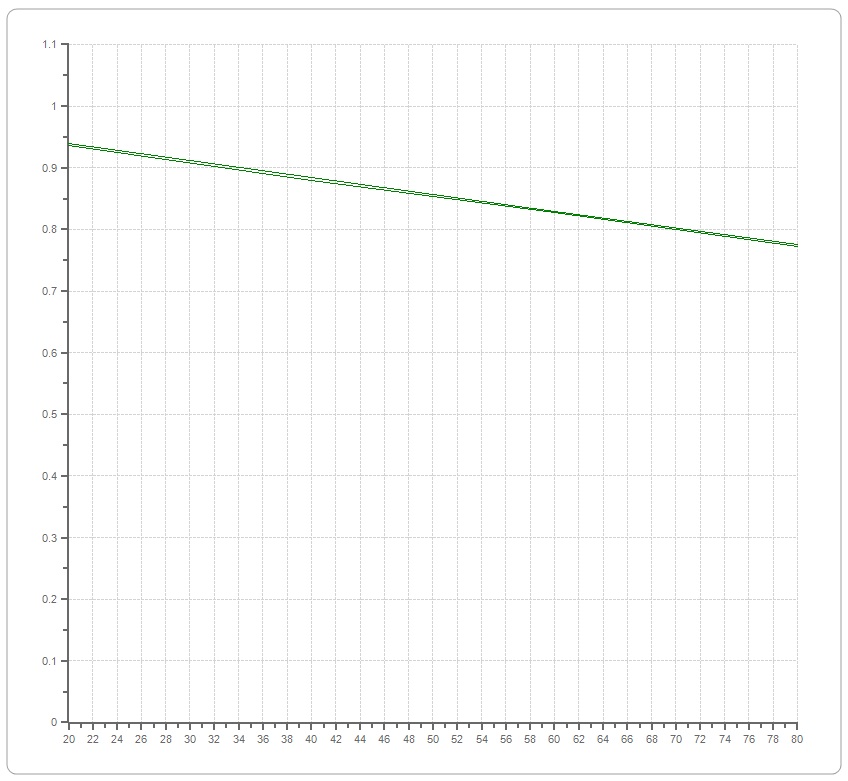
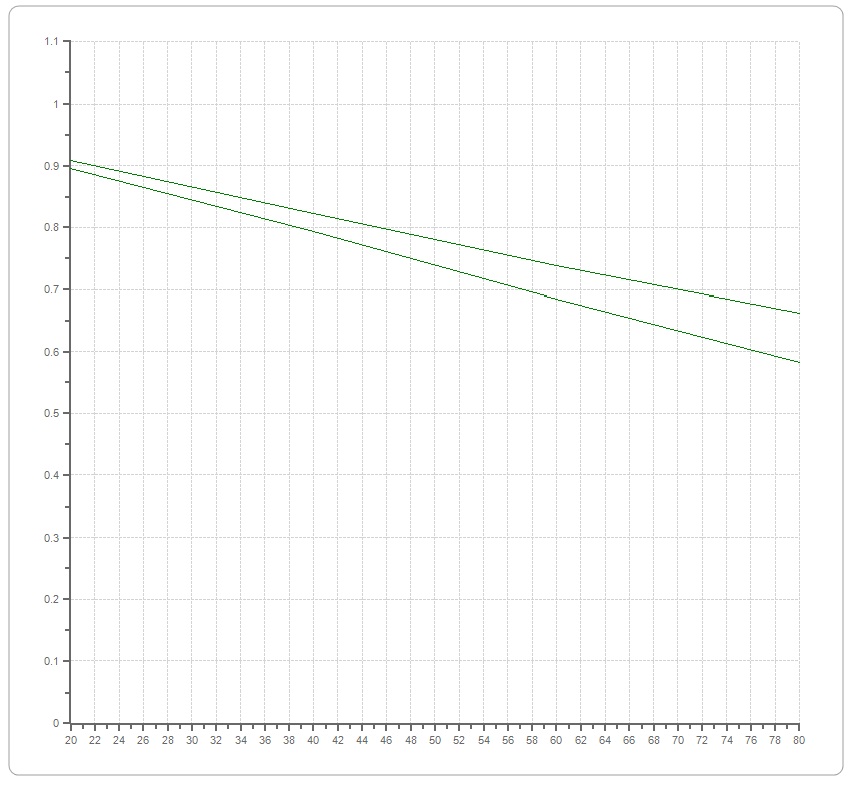
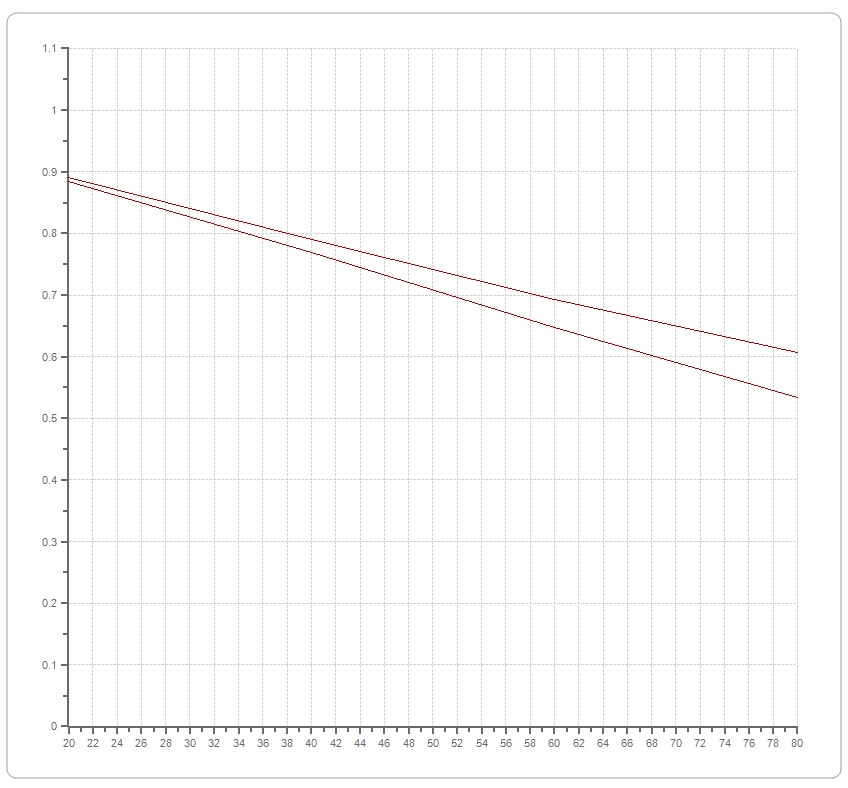
From direct comparisons we’ve known the Canon 24-70 II had a higher MTF 50 than the Tamron on Canon cameras, and that the Tamron was nearly as good as the Nikon on Nikon cameras. The optical bench shows a bit more differentiation between the Nikon and the Tamron than I expected, but otherwise clearly demonstrates what we already knew. I should mention we tested 2 copies of each, all of which had already been tested using Imatest and shown to be good copies.
System Testing
Now let’s add the camera systems into the mix, something Imatest is perfectly set up to do. We’re going to measure Imatest MTF in line pairs / image height, as always. Since the D800E has 4912 pixels of image height compared to the Canon 5D III’s 3840 pixels the Nikon should resolve somewhere around 1.2 to 1.3 X the Canon’s resolution if the lenses were equal. (Several other factors, including that the Nikon does not have an AA filter, lenses aren’t perfect, and the math is more complex than a simple ratio, make this a very rough estimate.)
Let’s start by comparing the Tamron 24-70 f/2.8 VC on the two different cameras. We shot two copies on two bodies and averaged the results (which, btw, were nearly identical) to show MTF 50 in the center, averaged across the entire lens, and averaged in the 4 corners at f/2.8 and f/4.
These tests are all done at 50mm. I just didn’t have time to set up at multiple focal lengths and 50mm is a strong area for all 3 lenses. I wanted to compare them at their best.



Tamron 24-70mm f/2.8 VC on Both Cameras
| Center MTF50 | Average MTF50 | Corner Avg. MTF50 | |
|---|---|---|---|
| Canon 5DIII f/2.8 | 810 | 665 | 350 |
| Nikon D800e f/2.8 | 1085 | 855 | 445 |
| Canon 5DIII f/4 | 940 | 710 | 445 |
| Nikon D800e f/4 | 1225 | 955 | 560 |
The MTF50 difference between the two cameras shooting the same lens is quite apparent. The difference is a bit greater in the center and a bit smaller in the corners but it is quite significant – as we knew it would be.
Canon 24-70mm f/2.8 II vs. Nikon 24-70mm f/2.8
Now let’s compare the Canon camera with the Canon 24-70 f/2.8 Mk II to the Nikon camera with the Nikon 24-70 f/2.8 AF-S. The better Canon lens should offset some of the Nikon camera’s superior resolution. That is exactly what happened.
| Center MTF50 | Average MTF50 | Avg. Corner MTF50 | |
|---|---|---|---|
| Canon @ f/2.8 | 1000 | 860 | 450 |
| Nikon @ f/2.8 | 1170 | 945 | 500 |
| Canon @ f/4 | 1060 | 910 | 505 |
| Nikon @ f/4 | 1240 | 1000 | 570 |
The higher resolution of the D800E makes the resolution of the Nikon system superior to the Canon system, although the difference isn’t as great as it was when we compared identical Tamron lenses. No real surprise here. Also not surprising, the Nikon lens is slightly better than the Tamron, although this is fairly close.
The real bottom line here is that there are no losers. The resolution numbers all of these combinations show are nothing short of amazing. For example, all three zooms are equal to, or slightly better than, the superb Zeiss 50mm f/2 Makro Planar at equal apertures on the same camera.
I’ll show the f/2.8 data as our usual graph with center resolution on the horizontal axis, average on thevertical, all in line pairs / image height. I think this shows fairly well the actual resolution difference between the cameras (compare the two Tamron results) and the degree to which a better lens closes the gap.
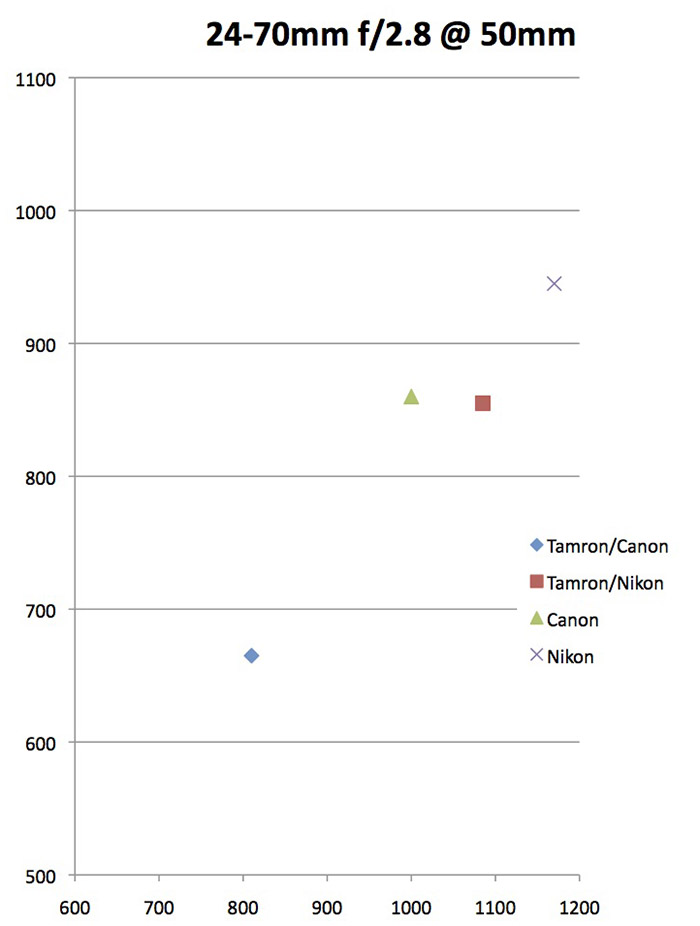
There’s one other aside that is probably worth mentioning; the test fairly well confirms common wisdom. If we run SQF numbers on these resolution differences, it suggests we’d need a print size of about 11 X 16 to detect this resolution difference. At that print size we should be able to tell the Tamron mounted to 5DIII (worst performer) from the Nikon 24-70 f/2.8 on D800E (best performer) pretty clearly. We might detect the difference between the Canon 24-70 Mk II on the 5DIII and the Nikon on the D800e. On a 16 X 20 print the Canon – Nikon difference would probably be clearly apparent.
So What Did I Learn Today?
Not too much. Like everyone else I already knew the D800E with a good lens was going to out-resolve the 5D III with a great lens, but that I’d need a reasonably large print to see the difference.
It also demonstrates another thing I mention a lot: the value of any third party lens varies according to what camera you shoot. The resolution difference between the Canon and Tamron 24-70 lenses is greater than that between the Nikon and Tamron. Right now, the price difference reflects that: the Nikon costs $600 more than the Tamron, the Canon $900.
But if you want to look at it another way, the Tamron on a D800E is about the resolution equal of a Canon Mk II on a 5DIII — a bit sharper in the center, not quite as sharp in the corners, but pretty even. The Tamron-Nikon combination (for a guy like me looking at shelling out some major bucks soon) is $1,000 cheaper than the Canon-Canon system.
Of course, all of those prices are going to settle a bit differently in a couple of months. This is just where they are right now. And resolution is just one factor that goes in to choosing a piece of kit.
As to my ongoing search for which camera system I’m buying into, this just answers one tiny question. I’ve got a lot more research to do. I expect you’ll be reading more about that soon.
Roger Cicala and Aaron Closz
Lensrentals.com
January, 2013
109 Comments
Patrick ·
Great analysis, thanks! I was wondering how the Canon and Nikon 24-70 f/2.8 compare.
Now if you could only test the 70-200mm f/2.8 . . .
Roger Cicala ·
Patrick,
I don’t think there’s as much difference between the 70-200 f2.8 lenses, so I expect the resolution difference would be larger in favor of the D800e. But I’ll double check.
David ·
So if you were going to put down several thousand $’s wouldn’t you be better of with the canon lens and hope canon releases a higher resolving camera in the future? you know, the old adage to invest in your lens’s? I would think the canon 24-7 f2.8 with canon 6d would be an interesting compromise?
Roger Cicala ·
David I totally agree with the adage. But I’m just beginning this decision making process. A resolution reality check was step 1.
I’m also cheap 🙂 I’m still considering both full-frame and crop-sensor cameras for my needs. I guess the process in my mind starts with “here’s the best”, now how close to the best can I get for how much less than that price. If I can get 90% of the best for 60% of the price, I’ll probably go that way. But I have no idea if that’s possible yet.
Also, I’ve learned being in this business for years. I don’t do hope.
Aaron ·
I’m guessing that the Imatest is done at ISO100. What would happen if you were to go up to the highest ISO? In poor (but still usable) lighting? And then resize both for 8×10 or 11×16 prints?
I know it’s a ton of work (I’ve got some vacation time…can I come up and play with your tools for a bit?), but while resolution and performance in good light is valuable, I think most of us shoot a bit higher than ISO100, and I’m regularly going up to 3200+, and often 6400+ for some of my shoots (live events).
I’ve used the Tamron 24-70 for once, and the 2.8 with VC was great, and I’m renting it again, but given how every single shoot is quite a bit different, it’d be hard to rent the Canon 24-70 v2 and do exact apple-to-apple comparison of resolution/quality, I’d love it if someone who has the tools and the itch to gather lots of data could do it. How about it? Pretty please?
Roger Cicala ·
Aaron,
We actually test at ISO 400. We thought that was close to real world, but once we crank up ISO we’re testing the cameras way more than the lens.
Lighting is also critical – the chart has to be lit with a maximum 1 lumen variation.
So I’m afraid we have to extrapolate Imatest results to more real world settings. But you’re welcome to come play with our toys if you like. You’d be just like us, though: grabbing a couple of hours of testing time before the backlog of rental lenses needing routine testing makes you go back to work :=)
Marty ·
Both the Nikon and Canon sensors out-resolve the lenses at the center so the Nikon pair has higher central resolution than the Canon. Assuming that the sensor resolution is constant from center to edge both sensors would appear to out-resolve the lenses at the corners (e.g. resolution on the Canon drops from 1000 to 450, and Nikon from 1170 to 500 so the lenses are the limiting component, than why does the Nikon pair still have higher resolution at the corners even though the Canon lens has a higher corner MTF?
Eric Lew ·
Roger – I just wanted to say I absolutely LOVE your blog. I the tests you run, the caveats you include – everything! Amazing work! What a contribution to the internet!!
Tim Glaser ·
I’m curious how the D800(E) vs 5dmkIII would compare using the new Sigma 35mm 1.4. I think if I was in the market to splash $$ around like that, that lens would probably be the first place for me to go.
Secondly, to address a comment above, where it was suggested to go with Canon because the 24-70mm lens is the best lens, there are 2 reasons I disagree with that:
1) Canon and Nikon both just released new bodies [it will be quite some time ‘hoping’ that Canon releases a better camera.]
2) Using that reasoning you could say that since Nikon glass is 6 years old or so now, there are more likely to bring out an update to that lens which will substantially improve it.
3) Obviously no camera system choice will be made on just one lens. For example someone planning on buying mostly used lenses will probably prefer Canon because there is always a better selection of used Canon glass. But someone else who wants the 14-24 f/2.8 Nikkor isn’t going to find much compelling at all about the Canon system. Same could be said for some one wanting the 50 1.4L, which is clearly better than the 50 1.4G.
Tim Glaser ·
*sigh*
3 reasons I disagree with that. I have trouble counting, and I don’t see an edit button.
Benny ·
All I see is that Tamron, Canon and Nikon 24-70 are all underutilized even on a 22 and 36mp sensors.
Gav ·
“On a 16 X 20 print the Canon – Nikon difference would probably be clearly apparent.”
Does anyone seriously believe this? There may be detectable differences there, but I doubt a human could do it.
Samuel ·
Roger, how significant are the differences in the resolution figures if the testing was done at ISO 100 instead of 400?
Frans van den Bergh ·
@Samuel: Changing ISO has less effect on Imatest scores than you might expect. The Slanted Edge algorithm used to measure resolution averages quite a few pixels (following lines parallel to the edge being tested) for each edge profile sample, i.e., there is significant high-frequency noise reduction built into the algorithm. Because of this, the MTF50 values do not respond to per-pixel noise in the same way a human observer would.
You are more likely to see an increase in the standard deviation of MTF50 values (over repeated images of the same location on test chart) with increasing ISO, rather than a clear trend in the mean MTF50 value (over repeated images of the same location on the test chart). In plain English: MTF50 values do not necessarily decrease with increasing ISO (up to a point); they just become more unreliable.
Samuel ·
Frans, thanks for the insight. This leads to a new question – how much less reliable are the MTF50 values at ISO 400 vs 100? How many sets of measurements should one make and average to reduce the error?
Samuel H ·
We’re all very lucky that you need to buy into a camera system, we stand to learn a lot here 🙂
So, next up, AF tests comparing Canon-Canon vs Nikon-Nikon vs Nikon-Tamron, right?
Roger Cicala ·
Samuel,
Next up, I think, is a bit of price comparison – what a full-frame SLR, crop sensor SLR, and mirrorless system is going to run to meet my needs, along with which systems just don’t have lenses or other aspects that do what i want. I’ve can do the lens selections and camera aspects from memory pretty much, but honestly I’ve lost touch with what a system is going to cost. Other than more than I want it to.
Then sort of screening out cameras for things like dynamic range, ISO performance, etc. – looking at what I stand to gain or loose with various systems and sensor sizes.
Hopefully after that I’ll have a couple of candidate systems in full-frame, crop-sensor, and mirrorless and some ideas about cost. Then I’ll start doing the things you suggest. And finally take a couple of finalists out shooting.
Samuel H ·
Oh, and if you’re considering crop cameras too, a fullframe vs APS-C comparison should be around the corner, right?
I ran my own tests and I’m pretty sure FF is going to end up sharper, even if you keep pixel count about the same, but I’ve had some people complain that my lenses are weird and the “you only use the sweet spot of the lens” argument is bigger than my “you’re magnifying all the issues” one (they point to slrgear results, which I guess are relative but they say they’re absolute).
http://www.similaar.com/foto/lenstestsff/lenstestsff.html
James Scholz ·
Roger,I love your tests and comments and look forward to each new entry.
Relative to how prints look I have a comment. I shoot architecture for a living and generally give the client a large print, normally 20×30, with the completion of each job. I have used the same Nikor 14-24 2.8 wide angle, and PC lenses with 3 full frame cameras over the years, the D3, D3x, and now D800e. I always shoot with sturdy tripod, mirrow lock up, cable release, etc. With out a doubt the clarity and dynamic range of the images has improved dramatically with each new system. Sensors make a big difference in large print appearance as your tests indicate.
Samuel H ·
Sounds great. Eager to read your thoughts along the journey!
Aaron ·
@Roger, Frans van den Bergh,
Thanks for the information, that’s good to know. So Imatest likely won’t be a real significant piece of information for how a system performs at the super-high ISO’s available these days. I’ll just have to figure out another way to see if I should stick with the Tamron 24-70, or hold out for the Canon 24-70. What a horrible choice to have to make 🙂
MFG ·
Hey Roger, you constantly mix up the D800 and the D800E in this article. And in the first paragraph you tell us that you CAN’T make these predictions(eg. Comparing two differnt cameras).
Did you forgot the “E”?
D800 and D800E is not the same camera; or is it?
Roger Cicala ·
Thank you – I’ve corrected it. The D800e was the Nikon camera in all tests. I have a tendency to think I can telepathically project what I mean without typing things properly.
n/a ·
I strongly suggest to reevaluate yours perception about things you can or can not live with out. I have to many friends who went mirrorless route and found they can not live with out optical viewfinder. I have to many friends who bought in all holy trinity and no matter how good these lenses are – they gather dust, because they are big pigs. Not so long a go, I was sure fx is not for me, I was in love with 18-200 versatility (28-300 not an option – to big) – and now am on d600 covered with 1.8g primes wondering why I waited for so long (gorgeous viewfinder, bright and razor sharp lenses, lightweight setup)…
You are in unique position to extensively test all possible combos you might like – do so / combat all perceptions 🙂
drgradus ·
Does the VC add any value to the kit for you? It’s easily over a stop, so the resolution increase from 2.8 to 4.0 wipes out any difference at 2.8, for most intents and purposes.
Bruce ·
Sony DSC-RX100? Fuji X100S?
Do your homework, by all means, and keep up the great posts, but then make life easy on yourself and pick something like one of the above! 😉
(The devil made me do it.)
Derrick ·
Can we get some Sony CZ 24-70 love up in here!!! Sony always gets over looked!
Roger Cicala ·
Derrick,
Momma said if I can’t say something nice . . . .
Just kidding. Actually it’s not a bad lens at all, but I don’t have a nice comparison point since I don’t have the Tamron in Alpha mount. From the optical bench I’d say it’s nearly as good as the Tamron, which is quite good. That doesn’t help factor in the Sony sensor, which is also superb so I wouldn’t be surprised if the Sony combo was at least as good as the Tamron-Canon. But I’ll try to get them done one of these days.
Roger
Tristan ·
Hi Roger
I love the articles you write for your blog always a great read.
This article has left me with a question though.
How does a D800 system compare to a D800e system?
or, I guess you could ask. How much resolution do you give up with the AA filter?
Hypothetically speaking.
Roger Cicala ·
Tristan, from some other testing we’ve done, it appears roughly a 10% difference.
Francois ·
I am always very supicious when comparisons in between MTF50 numbers are made.
A comparaison of different lenses on the same body, using the same RAW conversion is usually quite good.
When you compare two different bodies, it becomes very dangerous. First, you need to use the same RAW converter. I assume that you use Imatest that uses dcraw internally and does not sharpen the images at all. When you use that process and you compare a D800 and a D800E, you will see that the D800E comes ahead by 10%. But it seems the information in the D800 file is still there, and can be recovered by deconvolution. At the end of the day, what counts is what you can get from an image, not what it is when everything is at 0.
There is a huge difference in between the blur produced by a weak lens and the blur produced by an anti-aliasing filter. For the one introduced by the first one, there is no way to recover the information in post-processing. Although it might still be there, as nobody knows the point spread function of the lens, you are dead. The blur introduced by an anti-aliasing filter is very regular, and some sharpening algorithms almost recover it.
So MTF50 results for D800 and D800E are quite different, but the information contained in the files is almost the same. That’s one of the reason I sill have doubts about what this kind of experiment means.
Frans van den Bergh ·
@Samuel, Roger
I went ahead and measured MTF50 variability at various ISO settings using simulated D7000 images. I’ve written up the results here: http://mtfmapper.blogspot.com/2013/01/effects-of-iso-on-mtf50-measurements.html
Bottom line: given enough samples (repeated images of same chart), the mean MTF50 values are unaffected by ISO.
Roger Cicala ·
Frans, that is wonderful work. Very interesting to know.
Mark ·
Could you explain the resolution of lenses? Is this just a function of the quality of the build/glass, or is there more to it?
Roger Cicala ·
Mark, that would take a long time. I’d suggest, though, if you’re interested in that you take a quick look at the articles about Lens Geneology:
http://wordpress.lensrentals.com/2011/08/lens-geneology-part-1
http://wordpress.lensrentals.com/2011/09/lens-genealogy-part-2
It has a lot of information about the compromises made in various types of lenses.
AJ ·
Hi Roger,
A simple, concise and practical series of tests.
Lensrentals is my premier source of information on lenses.
Just wish you had the time to do more comparisons like this …
I appreciate the technical aspects of the lenses but it would be appreciated if there were some subjective comments as well on intangibles like ‘drawing style’ and bokeh – but I guess that’s a tall order by it’s very nature.
You had briefly commented on the Zeiss 50 mm being some-what ‘inferior’ to the zooms IRO MTF but that’s not the full IQ story I imagine.
Anyhow, the information you provide on your site, in addition to the evaluations/comparisons et al, is very much appreciated.
Warm regards.
Jeremy ·
“If I can get 90% of the best for 60% of the price, I’ll probably go that way. But I have no idea if that’s possible yet.”
This bang for the buck statement almost always leads to Pentax, currently the Pentax k-01 w/16-50/2.8 at 30% price. At this point the resolution across systems is the minor point of system selection, and other factors (e.g. ergonomics, reliability, portability) begin to dominate the process.
Otherwise based on resolution, system selection is solely based on which canikon system has the newest combo. Thanks for the analysis, interesting to see that these lenses were on par with the prime for resolution.
Mark ·
I mean who cares which one is marginally sharper? Do you want a 21mp file or a 36mp file? That’s the question you have to ask. Of course the D800E is sharper but so is my 8×10 camera. I’m not advising anyone looking at a 5D3 to consider a Deardorff becasue one might be sharper. It’s just different. I’m sure the D800e creates a great file but as a wedding photographer I’d never use one. What am I gonna do with all that data? Sharpness is such a meaningless metric.
Michael ·
The Tamron is listed as having VC. Is this a feature you would use in your decision making? I don’t have a steady hand so have always relied on VR/VC/OIS 😉
Roger Cicala ·
Michael,
It would be very much a feature for me, too, because I don’t have steady hands and then compound the problem with caffeine. Although I spend all day doing geek stuff like this, when choosing a camera things like ergonomics, reliability, vibration control, accessory selection are probably more important to me than absolute resolution. But I wanted to start my search with a bit of ‘see what’s out there and how much difference it makes’.
Ralf C. Kohlrausch ·
Hi Roger,
while you can’t put the Canon lens on the Nikon Camera, you can do it the other way round and adapt the Nikon lens to the Canon. That would rule out differences in sensor-technique and in-camera-processing. C’mon, you’re a geek, are you not?
Greets
Ralf C.
Timmi ·
OK, my first time here… I have no idea what MTF means. Perhaps a mention of what it is?
I tried saving you the trouble by doing a search… but I can’t figure out if you refer to the lense’s Manual Transmission Fluid, Make Trade Fair, Musculoskeletal Transplant Foundation, or what…
Roger Cicala ·
Hi Timmi,
You might try this: http://wordpress.lensrentals.com/2009/06/have-you-seen-my-acutance It’s a starting guide to what mtf (Modulation Transfer Function) is all about.
And I apologize – I should have put some links in for that and written it out the first time.
Roger
Bill ·
Can these results be extrapolated to those of us who shoot a smaller apertures? Landscape photography is often done at f/8-22 (though I’m still trying to find a lens that is sharp below f/11) due to depth of field needs.
Also how about shooting at significantly closer than infinity where in any real world image, the atmosphere will be the limiting factor? I have a view of 14,000 ft Long’s Peak from my porch and there is no resolution differentiation based on camera/lens resolution. For me, I care about the 1-3 meter range which is where I do 90% of my shooting with my Sigma 180 macro and Nikon 80-200 f/2.8D. At these distances, resolution differences are very obvious. My guess is that the Zeiss 50mm macro would quite noticeably outperform the lenses in this test at a 1 meter shooting distance.
Many thanks for a thought provoking article a great feedback as well.
Bill
Roger Cicala ·
Bill, to a limited degree, but at those apertures I think the difference in lenses would be minimized – how well the camera is going to perform with diffraction limited resolution will probably be more important. But I haven’t actually tested to see.
roger
Reinhard ·
I would like to see a best as best can comparison. A german magazine tested the D800E against the 40MP Hasselblad and said, that there is only a small difference. But only if you use the best lenses available, not the Nikon lenses…
The best result was by using the stellar 100 Macro from Zeiss. This lens is available for Canon and Nikon and if it´s really the best lens available today, this would be an interesting test. This also could be a good benchmark to compare different lenses on the same camera.
A direct comparison between Canon and Nikon lenses gives you an overview, the test with the best available lens gives you the maximum possible.
Kjeld Olesen ·
Hi
Great and interesting blog. You mention that you may venture into the comparison of a mirrorless system to one of the dSLR systems. Although not performed to the same scientific accuracy as your analysis here, you may find some inspiration in my test here http://www.acapixus.dk/photography/m43_v_Canon/
Here the 13 megapixel full frame camera performs well against the 16 megapixel MFT camera.
Rgds/Kjeld
Joseph ·
What confuses me slightly is, if it’s the body that is the limiting factor, why is it that stopping down sees such a drastic improvement? For example, in the case of the Canon, the sensor is what is limiting the numbers compared to the Nikon, however, when stopped down to F4 the number improves greatly for Canon, if the Lens’ was better from the start, why wasn’t it on more equal footing?
CarVac ·
@Ralf C. Kolrausch: For non unit-focusing lenses, adapter tolerances are irritating and he would have to try a whole bunch of adapters to find one that had the right thickness for that particular Nikon 24-70 on that particular 5D3.
brent ·
have you thought about testing the sony a99 and the zeiss 24-70 against the nikon 800e and canon 5dM3?
Alan ·
A few months ago AP magazine here in the UK ran a test of three 24-70 f2.8 lenses – Canon, Nikon and Zeiss (for Sony). Guess which won?
derek ·
thanks Roger , you are always the best.
after reading your test here,I just decided to go for the mount with the best 24-70f2.8 zoom or the best 85mmf1.2 or f1.4 prime(I think the Sony 85mmf1.4ZA is the best 85mm prime for SLR).
I guess it is Canon or Sony for me.
BTW, I am a Nikon shooter with a D600, a D800E and a D7000. But I have been debating selling my D800 and D7000 to get the A99v or the 5D3 since last Dec.
I have never been happy about my D800E and Nikon AFS85mmf1.4G, I’m quite fond of my new D600 for its small form factor and all around-ness , though.
I hate the ergonomics of the D800E(especially the grip), and unlike many many others , I consider my D800E as an experimental body(not very matured product).
I know many die-hard Nikon fans disagree but I really feel its lowlight AF sucks and its OVF really not as good as the OVF of the A900.
Plus, I much prefer the great EVF of the A99v ,with great focus peaking feature.
I guess my suggestion here is you might want to compare Sony vs Nikon vs Canon 85mm primes and 135mm primes.
I am quite sure as an EX-Sony shooter there is no better 135mm prime than the Sony 135mm f1.8ZA in any mount and the Sony 85mmf1.4ZA is quite amazing as well.
derek ·
and one more question:
what is you consider the sharpest 35mm prime in any FF DSLR mount?
the Sigma 35mmf1.4 or the Zeiss T*1.4/35mm ZF ZE or what?
thanks in advance.
Roger Cicala ·
Derek,
In testing the Sigma comes out ahead of the Zeiss, at least at f/1.4 a bit in resolution. But the lenses have a different look and I can certainly see why some would prefer the Zeiss. For me right now, looking at buying into an entire system, the price of the Sigma means I’ll probably be heading in that direction, whichever system I go with.
Roger
joh ·
Resolution tests such as these would have been more useful in the days when 12MP bodies were considered flagship cameras. You know, back when every little factor counted.
Clients don’t compare photos from different body/lens combos for resolution. Any of the above combos can easily produce files that will satisfy clients, even when printed to 16×24 (assuming good photographic technique and post processing). And by clients, I am referring to photographers’ clients, not (pixel-peeping) photographer-clients. 🙂
Regardless, thanks for the test. For me, noise performance and dynamic range are far more important factors in considering a camera. My resolution needs were met back in 2008, and I don’t think I’ll need more than ~20MP for years to come.
Roger Cicala ·
Joh, no disagreement at all. My own particular workflows often include a good bit of image manipulation in post, all of which (including sharpening) are going to reduce resolution (meaning actual resolution, not acutance) so I find at least 16 Mpix for my work and 20 can make a difference. Of course, that doesn’t stop me from lusting after 36 🙂
Eric ·
Hi Roger,
If a combination of the Canon 24-70 f/2.8 Mk II with a Nikon D800E was possible, where do you think it would land on that MTF50 graph?
Roger Cicala ·
Eric,
My rough guess is I’d have to expand the scale of the graph a bit. I may be off on this supposition but I’m thinking something like this: Canon on Canon outresolves Tamron on Canon by 200 Lp / ih in the center, roughly, 100 lp/ih in the corner. The Nikon on Nikon outresolves the Tamron on Nikon by about 100 lp/ih, so the Canon could be 100 lp/ih better. That’s a very simplistic thought, there’s a lot more to it than that. But it can never be, we can’t adapt a Canon lens to shoot on Nikon.
So the interesting question might be how much better with the Nikon Version 2 24-70 f/2.8 be?
KK ·
D600 vs. 6D in Low Light
Roger,
I absolutely love your analysis. Crisp, to the point, with a great level of precision. Love it. It also comes at a great time for me as I’m about to make a decision between those exact same three lenses and between the Nikon D600 and Canon 6D. I love both of those cameras. They are also newer than the 5D Mark III and the D800E, and a lot cheaper. I wish there was no AA filter in them. Perhaps the next generation of cheaper full frames…
I shoot a lot in low light (at parties and fashion shows mostly.) For that reason, I’m leaning towards the Tamron given its image stabilization. It’s also a great feature for video.
That leaves the question open between the 6D and the D600. (If I go D600, I’ll probably go with the Tamron lens. if I go 6D, I’ll consider the Canon Mark II lens for its optical supremacy, but am still leaning towards the Tamron for that image stabilization.) Any views on how their low light performance compares please? I’ve been reading conflicting views on that. Of course, this is a question to anybody who is reading this.
Thank guys!
KK
@Bruce: I do own the Sony RX100, and absolutely love it for its low light capabilities. It’s image quality is so superior to all other pocketable cameras I‘ve ever owned. Sadly, it still cannot be a substitute for a full frame camera. I wish it was. Who wants to carry a big camera around? It’s lens is also only really fast at the wide end and goes up to f4.9 (still pretty decent at that focal length.)
KK ·
D600 vs. 6D in Low Light
Roger,
I absolutely love your analysis. Crisp, to the point, with a great level of precision. Love it. It also comes at a great time for me as I’m about to make a decision between those exact same three lenses and between the Nikon D600 and Canon 6D. I love both of those cameras. They are also newer than the 5D Mark III and the D800E, and a lot cheaper. I wish there was no AA filter in them. Perhaps the next generation of cheaper full frames…
I shoot a lot in low light (at parties and fashion shows mostly.) For that reason, I’m leaning towards the Tamron given its image stabilization. It’s also a great feature for video.
That leaves the question open between the 6D and the D600. (If I go D600, I’ll probably go with the Tamron lens. if I go 6D, I’ll consider the Canon Mark II lens for its optical supremacy, but am still leaning towards the Tamron for that image stabilization.) Any views on how their low light performance compares please? I’ve been reading conflicting views on that. Of course, this is a question to anybody who is reading this.
Thank guys!
@Bruce: I do own the Sony RX100, and absolutely love it for its low light capabilities. It’s image quality is so superior to all other pocketable cameras I‘ve ever owned. Sadly, it still cannot be a substitute for a full frame camera. I wish it was. Who wants to carry a big camera around? It’s lens is also only really fast at the wide end and goes up to f4.9 (still pretty decent at that focal length.)
Tony Bologna ·
While i too like the Tamron, i can only trust it with VC off. There have been a lot of inconsistencies with my copy at “middle” shutter speeds. If i shoot at 1/125th or faster (usually something i avoid with all VR/VC lenses)it’s fine, and when i push it to the limits, say 1/10th at 70mm it’s great too. But if i shoot in between it’s a horrible mess. Have you noticed this issue?
fabio ·
As you state, sharpness only matters up to a certain point. Chromatic aberration is to me the most annoying issue with any lens, and it usually determines my purchase choice. Whenever you process images in any way, CA is the first thing that sticks out like a sore thumb.
I don’t buy Canon/Nikon because it is sharper than Tamron, but really because it usually has a lot less CA.
NormSchulttze ·
Roger
What is your idea of a “reasonably sized print”? Mine is 16×20.
Roger Cicala ·
Norman, 16 X 20 is where I live and breath given my usual display areas and subject matter. I occasionally will go to a 20 X 30 but that’s rare. My subject matters tend to be detailed, though, macros often, which make people want to look at them closely, so I probably want a bit more resolution than most people.
Trevor ·
Great article!
I have been debating something similar for a while and I am really, REALLY interested in following your blog as you work through this. You are so lucky to be able to these side-by-side comparisons and really find what you like when most of us simply get into a circle-jerk on DPReview or the like because we can’t get our hands on hardware.
So far I am happy with my Canon 7D but it’s low light performance has been tempting me to move up to a FF option. Problem is that I like this APS-C camera! My 30mm F1.4 Sigma acts like a cheap 50mm F1.4 on FF. My 50mm F1.8 acts like a cheap 85mm F1.8 on FF and my 17-55 F2.8 VC Tamron acts like a cheap 24-70 2.8 on FF. Then my 70-200 F4 L IS lets me reach out cheaply to a 320mm equivalent on FF.
The cost for me to buy FF, and a 50 F1.4 and a 85 F1.8 and a 24-70 2.8 IS and a 300mm F4 is WAY up there and I would loose my 8 FPS as well.
I know you have given up on hope but I am holding out (and hoping) for a 7D MkII.
All that aside. It really comes down to the images. I have never seen side by side image comparisons of “equivalent” lenses on the FF vs APS-C systems. Eg. A 30mm F1.4 on APS-C vs a 50mm F1.4 on FF, A 50 mm F1.4 on APS-C vs a 85 mm F1.4 on FF. I wonder if you ever thought about looking at that (hint, hint).
Anyways, I am looking forward to following this along with you.
Roger Cicala ·
Hi Trevor,
I’ve lately been shooting with an Olympus OM-D and fairly happy with it (even with 16 X 20 prints made with it) but it can’t quite fill my everyday needs. I shoot a lot with both of the Canon and Nikon cameras I’ve just tested. I’m going to look at cost to value ratio a lot with my decision, so I’ll be looking at a lot of APS-C cameras too.
Should be fun for a while!
Roger
ZiZi ·
OK, I see the advantage Nikon lens on D800E has @2.8. But am I interpreting this data correctly if I say that difference practically disappears @F4?
Peter ·
Would you consider comparing outside of Canon+Nikon? I’d be curious about e.g. the Sony-Zeiss and others.
Roger Cicala ·
Peter, I’m definitely looking outside Canon and Nikon and outside of full-frame.
Peter ·
Hi Trevor,
Your math is wrong. Converting to equivalent aperture (m-stop), your 30mm f/1.4 is m/2.2, so acts like an expensive 50mm f/2.2 on FF. Your 17-50mm is m/4.5, so acts like an expensive kit lens on FF. Your f/4 is m/6.4, so acts like — well, no one makes lenses that slow for FF that I know of.
Thomas ·
Peter, what “equivalent aperture” are you talking about? Your math is only correct when talking about DOF and nothing else. An f1.4 lens is an f1.4 lens, regardless of sensor size. Did handheld exposure meters have dials for f5.6@135, f5.6@6×6, f5.6@4×5″ and so on? Can’t remember ever having seen these and my remaining three meters definitely don’t have them…
Dave M ·
The differences between Canon and Nikon in terms of resolution, focus speed and accuracy, low light performance, frame rate, exposure accuracy, and whatnot are small. For me, those differences are too small to be the basis of making a choice. To me, price, reliability, durability, and ergonomics are the deciding factors. What does it feel like to hold and use the camera? Are the buttons and controls well placed? Are the menus easy to use?
Denny ·
Roger,
Do you think color rendering should be the number one factor to differentiate between camera systems?
Denny
Rick Knepper ·
Since I own the 5D2/24-70 II combo and the Nikon D800E/24-70G combo, I have a pretty good idea regarding performance so I skipped to your conclusion which kind of left me hanging. Here’s what I think for a guy in a similar position to your own sans the ability to pick any equipment he wants. Since all 3 lenses are relatively new and updates probably are very far in the future, buying the sharpest lens today and waiting for the Canon response to the D800E might be a good strategy.
Chuck Trotter ·
Your analysis raises a bigger question for me. With all the cameras and lens available to you, why are you looking at shelling out big bucks for a camera system? It is right there in the warehouse, ha ha.
Ivan Muller ·
Thanks Roger, as always, for a sane and logical discussion and test of the toys we so like to play with! We are spoiled for choice at the moment, but this article proves once again that lenses play a huge part in in overall image quality…that’s probably why the Leica’s do so well but its also nice to see that Canon is pulling out all the stops with their new lenses even though their new cameras are somewhat unexciting compared to the competition…so now we all wait to see what they can come up with to equal or beat the mighty D800.
Roman Boensch ·
Im working in Architecture and Landscape where resolution at the focus point is as important as resolution in the depth of field. When I compare the 24-70 Canon (the old one which was already exellent to me) on a 5d II with the 24-70 Nikon on the D800E (I tried 3 copies of the Nikon 24-70)I find that in the Nikon solution resolution decreases very quickly in the depth of the field. The Nikon solution has not at all the depth of field resolution at 24 as a 24 should have (everythig quite sharp from 3 meters to infinity at f8). The Canon 24-70 has this quality on the 5d II.
In adition the Nikons 24-70 that I tested had no reliable autofocus.
A lens that realy shines in terms of resolution, depth of fiel resolution and autofocus on the D800E ist the 14-24.
It would be extremely interesting to see your test with the test-chart located two meters or more in front and in the back of the focus plane.
Rene ·
Resolution of a lens is just a small part of it. There are many other factors like colour and types of distortion. There’re even things that cannot be measured but adds to give different types of “look”.
If all you care about is resolution then this is a good research but to decide on which system to buy it is far from enough.
Bob B. ·
GREAT info.
I am very happy with my 5DIII and my Canon 24-70 f.2.8L II.
I really don’t need the huge Nikon files and unless you are doing some ridiculously serious pixel peeping…my 16″x20″ prints look just fine!
Thanks for taking the time and presenting such precise organized information…really great!!!!!
Greg Thurtle ·
Great tests Roger – brilliant stuff.
Now about Nikon AF….. 🙂
cdubman ·
Roger – great article and site, thank you!
How do you think the Nikon D600 and Canon 5DMIII compare with these lenses? Since they are about the same resolution, would the Canon have an advantage/better performance?
Thanks in advance
Roger Cicala ·
Christian, the Canon 5DIII with the 24-70 II should out-resolve the Nikon 24-70 f/2.8 on a D600. Of course there’s a lot of other factors that may make you prefer the look of one lens over the other and the resolution difference isn’t going to be huge.
Maciek ·
The truth is – you CAN use Canon lens on Nikon body 😀 but not other way around. Wonder what results would it show?!!
Roger Cicala ·
MacLek = when I add an adapter I have another set of lens-mount interfaces and an increased chance of decentering or tilt – which probably wouldn’t be significant, but would put another variable into the comparison.
Lucas ·
Very good comparison. Those are all great lenses, although IMHO the Sony/Zeiss 24-70/2.8 is a bit superior. Looks like you really want either Canon or Nikon, but wouldn’t it be wothwhile to also try a Sony A99/Zeiss 24-70/2.8 combo for a change…? Even if it’s just to boldly challenge the status quo!
Klaus ·
Thanks for the great article at relevant time. I have been considering switching to a Nikon system, specifically the D800E, from my aging Canon 5DII. One of my biggest hesitations has been the belief that Nikon is lacking in the pro-grade f4 department. Almost all my work is done in the field, so weight and size take precedence over brightness and depth of field. I often photograph in remote areas where it’s possible to bring only one lens. The Nikon 24-70 f2.8 is a big, heavy lens. I had considered, contrary to your advice, getting a D800E paired with a 24-120 f4. After reading this and other of your resolution tests, I was able to get a rough extrapolation to compare a Nikon D800E with a 24-120 f4 to my current Canon 5DII with the new Canon 24-70 f2.8 II. It appears that the Nikon combination would be little improvement over simply upgrading my Canon lens. Your article was posted the same day I was going to buy the Nikon system. The long and short of it is that I pulled the plug on the Nikon idea for now. Thanks again for the posts. Very informative!
klw10 ·
Just curious… Why did you not compare those two with the Sony a99 and the Sony Zeiss 24-70? I would love to know where that combo stands in comparison to the other two. Thanks
Roger Cicala ·
klw,
My feeling was the Sony lens isn’t better than the Nikon or probably the Tamron, being a much older design (and from separate testing) and the Sony sensor doesn’t have the huge jump in Mpix that the Nikon does to pull the resolution up. But so many people have asked me to do so that I will, just to double check my assumptions.
Jamie ·
I would love to see how the Micro four thirds standard (like the Lumix GH3) stacks up against the competition.
Fernando ·
Very interesting. What about testing this at f/8? I always wondered if diffraction at this sensor resolution levels do make a difference at this aperture.
Cloud boy ·
When your own company has used hasselblads leicas and pentax medium format cams for unbelievably reasonable prices why would you even consider a dslr?
Carl ·
Great post Roger, as always!
I am writing most of this before I get to the conclusion of your post, so I don’t know which system you chose. I may be wrong, but I think you chose Nikon. (Ok you copped out and made no choice…hahaha, it’s nice to be you!)
Interesting that you conclude that all three lenses are sharper than the Zeiss Makro Planar. I guess Zeiss need to work harder to compete now! Maybe move production back to Germany?
For me, the camera “system” means the entire lens lineup, besides the camera bodies. Given that companies like yours are happy to rent me that $13,000 lens if I need it, I saw no reason to limit my own “system choice” to a FF camera and a 20-70 f/2.8 lens, although I see the logic of limiting yourself to this, only for the sake of a blog post. Unless of course, you’re scared of, or otherwise got tired of, using the big lenses for yourself? (Very Very Doubtful! You’re not scared of playing chess with them!)
So, taking the entire lens lineup into account, Canon wins that. It just does. Sorry Nikon fanbois.
Then there’s AF speed and low light performance. Canon’s 5D3 may very well win that in most cases (unless you never shoot above ISO 3200 or so). This is probably the strongest area of contention between the two. (I suppose if you mainly do flash photography of people or something, then you’re not worried about high ISO performance.)
Then there’s the price of the body. (To limit yourself to the cost of the body-lens combo is silly imo, because they can be bought and sold separately…and rented. I’m sure you receive an employee discount. Besides, you can afford more than you are hinting at in this post anyway…get real Roger!)
Originally, the 5D3 was very much over-priced at $3400 or more. Now the price is more even. However, I think if what you are mostly wanting to do is travel and family photography (by limiting this “choice” to the 24-70), I’m sure I’m not alone in thinking the non “E” version of the D800 would be the better choice. You don’t seem like a guy that likes to do a lot of editing in post, but I could be wrong. Again, for this blog post you’re obviously trying to wring out as much resolution from each competing system as you can…so you went with the “E”. Since there’s no “E” version from Canon, it is therefore intentionally handicapped by you. Why, I wonder?
Given your previous “favorite” FF camera was the Nikon D700 (or so you claim in your mini-review “take” sections)…I believe you probably prefer the Nikon system, along with its ergonomics. I frankly don’t understand that, myself…because you don’t look like a guy with very long, skinny “alien” fingers. 😀
Roger Cicala ·
Carl,
Well, great minds sort of think alike 🙂
I am looking at a system that will let me do 80-90% of what I need to do, knowing I can “rent” other things when I need. So I won’t be getting a supertelephoto prime, although I’ll use one several times a year, for example. I really haven’t gotten too far along the process, but the first ‘start selecting’ article should be out tomorrow. I definitely haven’t decided on a brand yet.
Carl ·
Haha, glad to hear that! Ok…just still don’t see how people can use Nikon’s grip. I know I’m very used to Canon’s…but I felt almost no difference going from my older XXD body, to the 1 series I rented from you last fall. Wheras, trying the D800 out in the store…wow it felt like an opposite minded person designed it or something. The control on the rear is so small, as well…felt like I’d have to stick my fingers in a pencil sharpener to make them small enough to fiddle with it. The shutter release, feels like it’s sticking out farther than the front lens element! I wear a size 10 glove, so my hands aren’t bigger than average…and I know they’re not as long as some people have, but still.
Also, as you know…you get much larger files with the D800, so that means you need a really fast computer and that much more storage space, if you do wind up editing a lot of them. If I had to rent any of the Nikons, I would want the D3s, because I absolutely love shooting fast wildlife in very low light.
I sure wish I could go to the barn and take out a supertelephoto to play with several times a year like you…rather than once or twice. I’ll get there eventually!
I must say, the older 400 f/2.8 is calling my name, since you reduced its price after the new one came out. But then, so are a couple of others…including that new Sigma 120-300 with the new fluorite elements…No doubt everybody will slam it as worthless, but I want to try one anyway! If Sigma painted it metallic white, everybody would change their mind 😀
Nicolas ·
Roger,
you own the hood of knowledge, and have enough gear to make tests that are statistically significant.
I experience (and have read about -see link below) the fact that the Tamron 24-70 VC drains battery life even if the (Canon) camera is off. On my side, I lost 10% in less than one hour.
Apparently, it’s the VC: switched off on the lens, the issue disappears.
Did you observe this? Otherwise, well, that’s an info before you choose your 24-70 system 😉
Nicolas
For reference: http://photography-on-the.net/forum/showthread.php?t=1216945&page=2
Roger Cicala ·
Nicolas,
We’ve had several renters report it. I’m not certain if it’s some defective lenses, certain Canon cameras, or something that is a design defect.
Roger
Nicolas ·
Roger,
I wrote Tamron (Europe), and will perform some tests on my side. And I’ll post a feedback here.
In the meanwhile, thanks for your feedback: seems that there is a trend..
Kr,
Nico
Blunt ·
@Maciek has it the wrong way around – you can put Nikon lenses on Canon bodies, but not the other way around.
This is because the Canon mount-to-sensor distance (I think the technical term is registration distance) is lower than the Nikon – thus you can put an adapter between a Canon body and a Nikon lens to get place the Nikon lens at the right distance from the sensor. To achieve the same thing with a Canon lens and Nikon body would require an adapter with a negative thickness 🙂
Spy Black ·
I don’t know if anyone mentioned this, (I didn’t read down the entire listed of replies) but in everyday use the Tamron has one asset the Nikon nor Canon has, and that is image stabilization. When roaming about out in the real world and light levels drop, that becomes a very great advantage for the Tamron user. So I think the combo of D800E with the Tamron gives you the best overall real-world performance.
Peter ·
The only site I came across this millenium that uses optical bench MTF data! Kudos.
One more interesting observation comes from comparing the systems’performance of Nikon vs Canon vertical resolution. Total 4912 nikon pixels vs 3840 Canon pixels on the sensor. Canon gets 1060 lp/ph at f4. That is 2120lines/3840=55% of the theoretical Nyquist limit (maximum theoretical resolution of the system with perfect lens etc). Nikon does 2480/4912=50%. So half of the potential resolution is lost to lens , AA filter, algorithms etc. Canon being slightly more efficient.
I have tested Olympus E5 with Zuiko 14-35 /f2 glass. That camera has a 12 Mpixel 4/3 sensor with 3000 pixels vertically. It registered 1300lp/ph or 2600lines/3000=87% of the nyquist limit. 1300 line pairs is more than either the Canon or the 36mpix Nikon with their flagship 24-70 lenses. Th e4/3 sensor is smaller than APS-C and since then Olympus OM-D came out with the 16 mpix sensor which is better in all aspects.
matrox vietnam ·
I take pleasure in, cause I discovered exactly what I was looking for. You have ended my 4 day lengthy hunt! God Bless you man. Have a great day. Bye
Ruaal ·
Hi Roger,
I have a Canon 50D and was looking to buy a Canon 24-70 f2.8L USM lense for wedding photography.
Have you ever compared this lense with a Tamron and/or Sigma of similar specs on a 50D and if you have, what are your recommendations also considering the price difference?
Your help with this will be greatly appreciated.
Roger Cicala ·
Ruaal,
On the 50D I’d probably prefer the Tamron. It’s equally sharp with the 24-70 Mk I and IS is useful to have sometimes. The Sigma is not as sharp as the other two.
That being said, on a 50D I’d really prefer the 17-55 f/2.8 IS unless I thought an upgrade to full-frame was in my future, or I just really needed to get to 24mm. I use the wider end a lot, 24 just isn’t that wide on a 50D, but also like the cost savings. That’s just me though.
Roger
Marcia Salazar ·
I always thought that DSLR cameras are the best types of cameras out there but when I saw what the Fuji X-E1 can do, I immediately fell in love with it. I realized that there are more good cameras out there if only you know how to look but it also depends of your preference.
K ·
Nikon D600 + Nikkor 24-70 f2.8 and Nikkor 70-200 f2.8 VR II vs. Canon 6D + Canon 24-70 f2.8 II and Canon 70-200 f2.8 IS II
Roger,
I’d like to kindly ask for your views on a decision very similar to the one you’ve made recently. I’d like to decide between the Nikon D600 and the Canon 6D, and two-three lenses (initially) for each.
The question is, what gives one better image quality: a higher quality sensor with great lenses (Nikon D600 + Nikkor 24-70 f2.8 and Nikkor 70-200 f2.8 VR II) or a somewhat lower quality sensor with somewhat better lenses (Canon 6D + Canon 24-70 f2.8 II + Canon 70-200 f2.8 IS II.) In other words, what makes the bigger difference here, the Canon’s better lenses or the Nikon’s better sensor?
The photography I do:
I shoot people / portraits at parties in low light and shoot catwalk fashion shows (also often in poor light, sometimes in good light.) You could call my photography “fashion” and “wedding” photography.
Also, at parties, I often hand my camera to friends to get my own shots. These friends often cannot hold a shot even at 1/30s with IS turned on. I also frequently need to do heavy cropping on these images (the ceiling in particular, while my feet are chopped off…) A higher resolution image to start with helps.
Sensors:
Advantage Nikon here: 24 Mpx v.s 20 Mpx and a Dynamic Range that is 2 EVs broader.
Lenses I’m planning to (initially) buy if I go Canon:
• Canon 24-70 f2.8 II – better than the Nikon equivalent. (Seems significantly better than the Tamron 24-70 f2.8, so I’m not as tempted by the Tamron’s IS and lower price if I go Canon.)
• Canon 70-200 f2.8 IS II – better than the Nikon equivalent. (Seems significantly better than the Tamron 70-200 f2.8, so I’m not as tempted by Tamron’s lower price if I go Canon.)
• Canon 85 f1.2 II – a Nikon equivalent simply doesn’t exist. (I’m debating whether I really need this lens / how practical it actually is. If it cost $400, I would not be debating it, I would just buy it. But at $2,000, I’m debating it, and may go for a cheaper portrait lens eventually. The existence of it as an option is nice.)
Lenses I’m planning to (initially) buy if I go Nikon:
• Nikkor 24-70 f2.8 or Tamron 24-70 f2.8 (Image Stabilized) – there difference in optical quality seems small, and Tamron’s IS would help me (my friends holding my camera while photographing me) in low light at parties.
• Nikkor 70-200 f2.8 VR II or Tamron’s latest 70-200 f2.8 SP Di VC USD – the difference in optical quality seems small, and the Tamron is cheaper, so I’m tempted by the Tamron.
• Nikkor 85 f1.4G or Nikkor 85 f1.8G – both great lenses, but not quite as cool as the Canon 85 f1.2 II
Future proofing / long-term system considerations:
• It seems Canon may be years (?) behind Nikon/Sony in sensor technology in the following two respects:
o DR: the dynamic range of the Nikons is 2 EVs better.
o AA filter: Nikon also seems to be one or two years ahead in terms of eliminating AA filters. (Is this right?)
• The D600 already has AF in Live View while shooting video. The 6D doesn’t have that.
• IS/VR in the 24-70 f2.8: there is a chance that the updated version of the Nikkor 24-70 f2.8 (perhaps coming out later this year, perhaps not coming out for a couple more years) will have IS/VR built in following Tamron’s lead. Canon’s 24-70 f2.8 Mk II just came out last year without IS. That lens will probably not be updated for many years.
Thank you for all your thoughts!
Kristian
Roger Cicala ·
Kristian,
The answer for resolution is better sensor and lesser lenses give better IQ than better lenses and inferior sensor. But for that difference to show you’d be talking D800 and Nikon lenses versus 6D and Canon lenses. With the D600 as the camera, the advantage, although slight, would be to the Canon camera and lenses. However, the resolution difference is slight enough that for purchasing decisions I’d call it even and look at other things.
Roger
Nicolas ·
To whoever passes along in this old forum post: I can confirm that the battery drain issue on the EOS6D comes from the lens, and that Tamron (kindly) fixes the issues rapidly.
I had the issue here in Europe, it went back & forth to Tamron and it’s now history.
I had promised to come here and post feedback, so…
Nicolas ·
let’s be precise: “the lens” is the new Tamron 24-70 VC
Catalin ·
I just want to see some Nikon D600 (D3X) numbers here for a better point of view between camera&lens. Is it better a D600 than a 5DMkIII with Tamron 24-70?
Thanks for sharing your hard work!