
Roger Buys a Camera System: So What’s This Going to Cost?
In my last post I made a preliminary list of systems I was going to consider. Some people are a little surprised I’m considering crop sensor cameras. I’m surprised that they’re surprised. I’ve shot with a micro 4/3 system for months and it certainly met 80% of my needs, so an APS-C based camera may be just fine. Or I may decide that I need to have a full-frame camera. I’ve generally shot full frame for the last several years.
But did I mention this is coming out of my own pocket? And that I’m kind of cheap? It’s been several years since I’ve actually priced systems but the last time I checked APS-C was a lot cheaper. I want to look at just how many of my hard earned it requires to join the Big Boy Full-Frame Camera Owner’s Club. I may just hang out with the kids.
I also want an idea, before I start comparing systems, about the cost difference between the different systems. I know exactly what the cameras sell for, but that doesn’t necessarily reflect the cost of buying into a system. (Oh, and for those of you who think I have these numbers floating around in my head, I haven’t done Lensrentals’ purchasing for almost two years. I’m way out of the loop.)
My Olympus OM-D System’s Cost
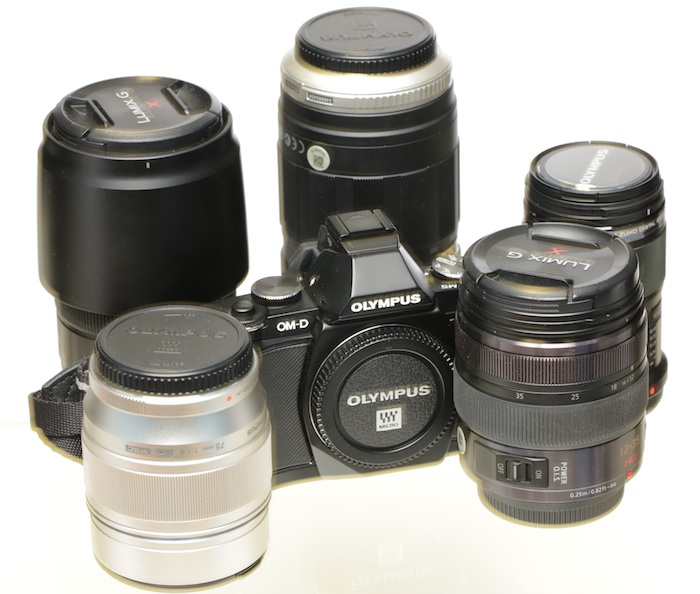
I’ve most recently been shooting with an Olympus OM-D system that I bought over several months. Purchasing piecemeal tends to confuse me about what I’ve actually invested in the system, so I tallied up my total costs.
| Component | Cost |
|---|---|
| Olympus OM-D E-M5 | $1,049 |
| Olympus HLD-6 Grip | $249 |
| Panasonic 35-100mm f/2.8 OIS | $1,498 |
| Panasonic 12-35mm f/2.8 OIS | $1,144 |
| Panasonic 7-14mm f/4 | $949 |
| Olympus 75mm f/1.8 | $949 |
| Olympus 60mm f/2.8 Macro | $499 |
| Panasonic 100-300mm f/4-5.6 OIS | $499 |
| TOTAL | $6,836 |
I have to admit I was a bit taken aback. Nearly $7,000 in my micro 4/3 system. I’m glad I took the time to tally this up. I truly hadn’t realized how much I had invested in it.
This probably surprised me more than anything I had looked at so far. It may well serve as a good example for those who are thinking of changing systems – it’s an expensive proposition (By the way – whoever recently bought a nice Olympus 75mm f/1.8 from Lensrentals, you got a great deal. That was my personal lens).
I know what you’re thinking, but no, my wife would rather shove bamboo shoots under her fingernails than read my blog, so my secret is safe with you. Nothing like hiding in plain sight. The best part is if it ever does come to her attention, I’ll be able to say, “But, honey, I even wrote about it!! What do you mean you had no idea??” Once again I serve as a role model for husbands everywhere.
This is probably as good a place as any to mention why I’m leaving the Olympus behind. It’s been a good camera system for me. One of the major reasons for getting it, though, was my desire for a small system. To maximize the image quality I ended up with the very best lenses, most of which aren’t that tiny. I’ve recently picked up a Sony RX-100 and that quickly became a go-everywhere, truly pocketable camera for when I’m just shooting snapshots for online jpgs. If anyone wants a blog post about the best point-and-shoot camera, here it is: get the RX-100.
In the end, my shooting style and demand for the best lenses made it a bit less portable than I’d hoped for, the RX-100 eased my need for a small camera system, and I found that I was shooting SLRs more and the Olympus less. When I moved out to the country the Micro 4/3 telephoto weakness became more irritating to me and pushed me over the edge.
Full Frame Costs
Just to get a rough idea, I’m going to price the body and these lenses: 24-70 f/2.8, 70-200 f/2.8, 100 or 150mm Macro, wide-angle f/2.8 zoom, and the best quality telezoom. I also want a moderately wide-angle, wide-aperture prime lens. I’d probably go with the Sigma 35mm f/1.4 lens for any of the three full-frame bodies so my actual cost will be $899 more than the table shows. Finally, I want a shoe-mount flash. I’ll use the middle grade flash because that’s what I use in real life.
No comparison like this is going to be perfectly fair, and when I finally decide on a system I’ll make some changes, but this should give me a rough idea about system cost. Obviously these are February 2013 prices. If you stumble on this article in 6 months they’ll probably be quite different. Of course, these are current list prices, too, and if you shop carefully you could certainly save a couple of hundred bucks.
| Nikon | Nikon | Canon | Canon | Sony | Sony |
|---|---|---|---|---|---|
| Nikon D800E | $3,097 | Canon 5D Mk III | $3,149 | Sony A99 | $2,798 |
| Nikon 24-70mm f/2.8 AF-S | $1,887 | Canon 24-70mm f/2.8L II | $2,199 | Sony-Zeiss 24-70mm f/2.8 | $1,898 |
| Nikon 70-200mm f/2.8 VR II | $2,397 | Canon 70-200mm f/2.8L IS II | $2,299 | Sony 70-200mm f/2.8 G | $1,998 |
| Nikon 14-24mm f/2.8 AF-S | $1,997 | Canon 16-35mm f/2.8L II | $1,489 | Sony-Zeiss 16-35mm f/2.8 | $1,898 |
| Nikon 105mm f/2.8 Micro | $899 | Canon 100mm f/2.8L IS Macro | $899 | Sigma 150mm f/2.8 Macro | $1,099 |
| Sigma 50-500mm f/4.5-6.3 | $1,509 | Canon 100-400mm f/4.5-5.6L IS | $1,489 | Sony 70-400mm f/4-5.6 G | $1,898 |
| Nikon SB-700 | $327 | Canon 430EX II | $279 | Sony HVL-F43AM | $348 |
| TOTAL | $12,113 | $11,803 | $11,937 |
Two notes on the table above: I substituted the Sigma 50-500mm OS for the Nikon system because it’s both a better lens optically and a bit less expensive than the Nikon 80-400. I substituted the Sigma 150mm f/2.8 OS for the Sony 100mm f/2.8 macro, which I consider a weak lens. That added $300 to the Sony system.
So what did I learn? That I’m not going to choose my full-frame system on price point, obviously. Whichever full-frame system I choose will run just under $13,000 (including the 35mm prime). I can probably save enough with careful shopping to make it $12,000. But there’s not going to be a significant price savings with one system over the other.
One other point — people are going to ask why I don’t substitute the Canon 6D or Nikon D600 and save nearly $1,000. Well, $2,000 versus $3,000 for a camera seems like a big difference, but $13,000 versus $12,000 has me in ‘might as well get the best’ mode. Still, I may well consider doing that later, although I’d be more likely to substitute the Canon 6D than the Nikon D600.
This point was one I explored a bit in the first article in this group. For the Nikon, at least, the increased resolution of the D800 may actually let me save a bit of money on lenses. For example, the D800 and Tamron 24-70 f/2.8 VC will certainly out-resolve the D600 with the Nikon 24-70 f/2.8. I’m not saying I’d do that, but that $600 difference alone could largely offset the difference in camera costs.
The difference in resolution between the two Canon cameras is smaller. With that system the trade off would be better AF versus cooler features (I have a man-crush on the 6D’s WiFi setup). I’m more likely to make that switch if I go with Canon, but at the moment I’m leaning towards the 5D Mk III.
Crop Sensor Costs
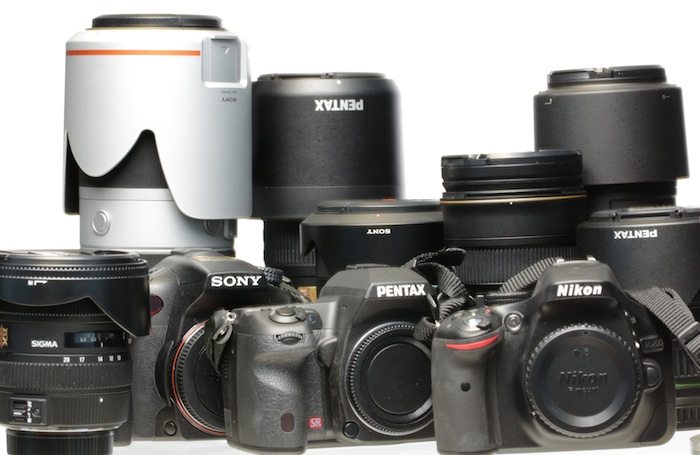
OK, so how much will I save with if I go with an APS-C camera? I did the same exercise with my three APS-C camera choices. There’s a more variation here but I’ll try to keep the systems roughly equivalent. I want to point out, though, that these lens lists are just for comparison purposes. As I get into each system more I’ll certainly make some lens changes.
| Nikon | Nikon | Pentax | Pentax | Sony | Sony |
|---|---|---|---|---|---|
| Nikon D5200 | $897 | Pentax K-5 IIs | $1,197 | Sony A77 | $1,098 |
| Nikon 24-70mm f/2.8 AF-S | $1,887 | Pentax 16-50mm f/2.8 | $1,497 | Sony-Zeiss 24-70mm f/2.8 | $1,898 |
| Nikon 70-200mm f/2.8 VR II | $2,397 | Pentax 50-135mm f/2.8 | $1,597 | Sony 70-200mm f/2.8 G | $1,988 |
| Sigma 10-20mm f/3.5 | $599 | Sigma 10-20mm f/3.5 | $599 | Sigma 10-20mm f/3.5 | $599 |
| Nikon 105mm f/2.8 Micro | $899 | Pentax 100mm f/2.8 Macro | $847 | Sigma 105mm f/2.8 Macro | $769 |
| Nikon 300mm f/4 | $1,379 | Pentax 300mm f/4 | $1,397 | Sigma 50-500mm f/4.5-6.3 OS | $1,509 |
| Nikon SB-700 | $327 | Pentax AF-360 FGZ | $239 | Sony HVL-F43AM | $348 |
| TOTAL | $8,385 | TOTAL | $7,373 | TOTAL | $8,209 |
A couple of points need explaining for this comparison. First, I’m listing the Sigma 10-20mm f/3.5 lens for all 3 systems because it’s a very good lens, gets me as wide as I want to be, and lists at a reasonable price. I might consider any of the many other ultra-wide choices for a specific system, but for now I’ll take f/3.5.
Second, I put the Nikon and Sony 24-70 f/2.8 lenses as my standard zoom rather than their APS-C equivalents. I’ve shot enough with the Nikon 17-55mm f/2.8 DX and Sony 16-50mm f/2.8 to know I prefer the full-frame lenses in their place and would pay the difference. The Tamron 24-70 f/2.8 VC might be an alternative. In theory a crop-sensor lens will provide a better value since it is designed and manufactured with a smaller image circle. My experience is that they almost always cost less, but are not always the better value.
It’s probably not quite fair to put the Pentax 50-135mm f/2.8 against the Sony and Nikon 70-200 f/2.8 lenses either, but that’s the option I have for an f/2.8 telezoom. There is a long gap in my Pentax system between that 135 and the 300mm f/4 lens I have for a telephoto. If I put the 200 f/2.8 in that gap, I add $1,100 to the Pentax system cost. I considered the Pentax 60-250mm f/4 as an alternative but I’d prefer f/2.8 and the 60-250mm didn’t quite have the image quality of some of the other lenses — good, not great.
This brings me to a point I want to reemphasize; an area where I probably think differently than most of you. The lesser camera needs the better lens. This is the opposite of what most people actually buy.
I consider that a higher camera resolution makes every lens resolve better. (I wasn’t sure how much, which is why I did the 24-70 f/2.8 system comparison earlier.) But it’s something I had already discovered when I moved from full-frame SLRs to the Olympus OM-D. I was happy with the images only when I had a very good lens on the OM-D.
At any rate, if I decide on any of the 3 APS-C systems, I’ll be getting some different lenses than the ones listed in the tables above. This was just to provide me with a rough idea about system cost.
The takeaway message is that if I go crop-sensor, given the lenses I prefer, the cost will be about 2/3 of what a full-frame will cost me. To be honest, I had expected a bit bigger differential.
What’s Next?
I was surprised at how much I’d spent on my micro 4/3 system. Then I was surprised to find how much I would spend for a new full-frame system. Finally, I was surprised to find going with an APS-C system wasn’t going to save me quite as much as I’d hoped. There were no good surprises today. In fact, I spent a few minutes thinking that my cell phone takes pretty nice pictures. Maybe I need a new hobby.
I’m already well involved in the next steps. I’ve already spent a couple of weeks shooting first with the Pentax K-5 IIs system, because I was the least familiar with that system and needed time to check out the lenses that were available to me. And some lenses that were not available to me. (For those of you wondering why the Pentax 300mm f/4 lens suddenly showed up for rent, well, that was because my Pentax evaluation required it for research purposes. If you haven’t tried it, do. It’s quite excellent.)
While I’m familiar with Sony lenses I haven’t shot nearly as much with the A99 and A77 as I have previous Alpha cameras, so I’m wallowing in those currently.
I’ll let you know what I think in a week or so.
Addendum: I might as well let me secret out now: one of the reasons I began this series of posts was that I knew I’d get some really good input from readers. If you haven’t read the comments from the previous post, I suggest them highly. There are some really good thoughts, several of which are already influencing my thinking, with absolutely no strident fanboy posts.
Roger Cicala
Lensrentals.com
February, 2013
109 Comments
Duane Pandorf ·
After I saw the total cost for your OMD system I don’t feel so guilty now since upgrading to a Leica M-E and a couple lenses. A fast 50 as in pre-ASPH Lux, the latest 90mm Elmarit and will add a 28mm Elmarit at the wide end. All this for around 10k. I don’t shoot fast moving stuff and I don’t shoot in the dark either. You need quality light for great photos.
I can fit all of that plus my accessories in a small bag and it weighs around 5 pounds.
Christoph Breitkopf ·
Your requirement in the previous article, namely “Accurate Live View or contrast-based focus assist”, seems to suggest that you use manual focus quite often. The large selection of used (and mostly quite inexpensive) MF lenses for Nikon and Pentax is heaven for the lens geek, so I wonder if this might be an additional criterion for you, or if AF is a must-have for all lenses.
Fazal Majid ·
You also have to factor in system viability. Sony is the weakest player, is bleeding red ink and could decide to stop investing in DSLRs to focus on NEX.
I’m sticking with Canon for now despite their embarrassing lag in sensors due to the excellence of the 24-70mm f/2.8L II. I have a 5DIII but if I were buying now, I would also consider the 6D for the GPS and WiFi with minimal loss in AF speed.
Nikon would be a no-brainier due to IQ, but their quality control has been questionable of late and they are lagging on lenses.
Jeremy ·
Excellent series (really enjoy number comparisons vs generalities) and a bit humbling if we all take inventory of our current “investments.” Any comment on how IS/VR/SR implementation or weather resistance will play into your decision, or is that another post?
Roger Cicala ·
Jeremy, IS/VR will play a big part. I have a bit more tremor than most, at least I do after my daily caffeine ration kicks in. I find 1/focal length for me often needs some VR. I really have to be (depending on lots of factors, of course) closer to 1 / 1.5 focal lengths to get sharp images. So it’s a big help.
Weather sealing not so much. I don’t trust it anyway and usually use a Roger’s Rain Cover (plastic bags and rubber bands) in anything this side of fog.
ginsbu ·
Another interesting post.
My feeling is that once you’re committing to the FF f/2.8 zooms for Nikon or Sony, the FF body makes sense. If you’re considering supplementing a FF system with a crop body, bear in mind that IQ-wise, the D800 cropped (or in crop mode) is going to be pretty close. Maybe consider that for more reach with a FF Nikon kit.
For APS-C, then, I tend to think Pentax is the stronger choice. (I considered Pentax before getting an OM-D.) I would consider the Tamron 17-50/2.8 (the good old non-VC version) and Sigma 70-200/2.8 for a Pentax kit: good IQ and saves a little over the Pentax lenses. Unfortunately though, Pentax has raised their lens prices quite a lot, so they offer less value than they used to.
That said, I don’t know how much you’ll find APS-C gets you over an OM-D. For your telephoto needs, have you tried any of the 4/3 or other telephotos on an adapter?
Good luck with your choice and I look forward to reading the rest of the series (and the comments!).
sam townsend ·
Just a quick note on the pentax gear, the lens is the 16-50/f2.8, it’s not 16-55. My most used lens, with some 30,000 pics taken with it since I got it right after it was released.
I also have the 50-135/f2.8 and the da*300/f4. Both fantastic quality.
Other than those lenses, I use the DA15/f4 limited, and an old FA35/f2 heavily.
Jim Harris ·
You are really heavily redundant at the long end. I recommend the Canon full frame set-up. But drop the 100-400, and instead pick up the 2X III extender for the 70-200. Cheaper and more practical, plus you get the better IS of the 70-200. Buy the 6D as well — nothing wrong with a nice back-up or secondary use body. Don’t deny yourself the fun aspect. Plus Canon has the best 24-70 lens, and that is going to be your most useful, and will last into the next generation of high MP bodies that are sure to come from Canon. The Canon 100L is an awesome lens and has terrific IS, and I’m sure you like to do quite a bit of hand held shooting. Best of luck deciding! 🙂 Jim
Ben ·
Something to consider is the used market. Take a look at the Memphis craigslist Photo/Video section and you will see a lot of good Canon lenses for reasonable prices.
http://memphis.craigslist.org/search/pho?zoomToPosting=&altView=&query=canon&srchType=A&minAsk=&maxAsk=
Jim Harris ·
PS — the 5D III has better AF, LV and color than the D800. Just saying! 😉
MSA ·
Camera ergonomics should also play a role. I haven’t seen much discussion on usability, user interface and general camera software quality.
Roger Cicala ·
MSA – that’s what the final decision is about, of course. But I figured I didn’t need to try out 50+ cameras so first a list of potential candidates.
James Scholz ·
Roger,
Thanks again for your interesting series.
I am getting Social Security and have photographed for many years. I have lugged 8×10 film cameras to mountain tops and camped for as long as 5 days in remote wilderness spots waiting for the perfect weather conditions for a shot. I have never regretted spending good money on what I considered the best equipment for the job, but have regretted in the film days going with smaller formats when I could have shot larger. I have regretted being too lazy to use a tripod with my 35mm camera when months later I realized the image was a prize and it could have been better. I have regretted taking short cuts, and most anything that stood in the way of my producing the best images I could, but I can not remember ever looking back and feeling bad about purchasing a really good photographic tool and wishing I had gone with a cheaper but lesser item.
When I read the obituaries and see more and more people my age it is clear to me that making the best images I can is more important then saving a relatively small amount of money on equipment. I now shoot mostly digital and am really happy with the biggest sharpest sensors and the brightest lenses and very solid panning equipment. When the shot comes up short I just look in the mirror rather then blame the tools.
Martin ·
Interesting posts Roger. Like you I have found the wifi on the Canon 6D to be a killer utility as I can see what I am taking even when the tripod is so low that I can’t see the LV comfortably. IQ is extremely good too. However, I have tried getting birds in flight with the 6D and it is a hit and miss affair. This may be technique, or it may be using an EF 1.4x III extender on my 70-200/4, which will certainly slow down the AF or it may be that the 6D’s not up to it in that demanding field. So I am thinking about the 7D for improving the AF hit rate as well as extending reach. Then I noticed you have no Canon crop camera in your APS-C alternatives. Now gicen the great lenses this seems a big omission unless you really don’t like the 7D or 60D. Or is it that you are wauthibg for the 7D II in the expectation that its AF featuring will be up there with the 5D III?
Roger Cicala ·
Martin,
It is a big ommission, and 6 months from now, assuming a new Canon crop camera, I’d probably be different. But the 60D and 7D, in my opinion, are too long in the tooth and the newer APS-Cs from everyone else have really opened a gap. I had originally planned on the 60D in my thoughts (the 7D and I just can’t seem to agree on what supposed to be in focus – I think it doesn’t like me). But after looking at the specs a bit I really thought the Pentax was a more interesting camera to explore, and I was certain I wouldn’t go 60D if I went crop sensor.
All of that being said, one of the really good suggestions in the last post’s comments was that if I go full-frame, a crop-sensor second body is probably less expensive than another lens and probably more functional. I’m really thinking about that point. If I end up with a Canon system, though, it will be the next generation crop body. But again, I think this has more to do with the fact that Canon is overdue for a refresh and the timing of these posts.
Milan ·
Looking at the cost of getting that extra 10-20% from what you get with what you have now, it doesn’t look like you’re so cost conscious…
I mean, if the biggest issue with m4/3 right now is the 400mm weak spot, by just buying a Canon 200mm f2.8 (some $750 and 1.6 lb) and an adapter you’ll solve mostly the problem for now (yes, with slow AF or just MF, so it depends on the kind of things you shoot at that FL). If with less than 1/10th of the investment, you’ll get 90% of your needs, that sounds like a good deal.
Or maybe not, just wondering…
Bob ·
Great writeup. The reason that there wasn’t a big difference between the cost of full frame and crop sensor systems is because you were using full frame lenses, silly! 🙂
You can actually get the FF vs. Crop differential down to about 50% if you get crop-frame f/2.8 zooms from Nikon and Canon, and/or the equivalent lenses from Sigma, Tamron or Tokina.
For example, Sigma makes a very good stabilized 17-50 and 50-150 f/2.8, and Tokina makes very good (although not stabilized) 11-16, 16-50, and 50-135.
Wolfgang Lonien ·
Well my list would be smaller – for most of what I do, I’d be perfectly happy with something like a 28, 50, and 85/90/105mm prime (the latter being a macro would be an additional plus).
Micro Four Thirds would give me all of that; APS-C wouldn’t (well yes, you could mount a 20mm full frame prime and make it a 30 or 32mm, but hmmm). Regular Four Thirds wouldn’t – they have awesome zooms, but no short primes. That leaves full frame.
Lately I calculated: an E-M5, the grip (I think you need it with this camera), and the PanaLeica 25mm. Good stuff, but together that would almost be around 2000€ where I live. Then I realized that a D600 or a 6D with one of their nifty fifties (1.8 would surely be fine) isn’t that much more (if anything at all)…
That of course leaves the question of missing IBIS in those full framers (except the Sony).
Great series; I’m very much looking forward to all of those thoughts and experiences of yours. Thanks for sharing them.
Mike ·
Can we get some love for used gear?
My current rig:
Canon 5D ($600 used, including a crappy kit lens and 16 gig CF card)
Canon 28mm f/1.8 ($350 used)
Canon 50mm f/1.4 ($300 new)
Canon 100mm macro ($350 used)
That’s $1600. And I’m thinking about picking up a used 70-200mm f/4 IS or 100-400mm for about $900-1000.
Also, I can actually now sell these lenses for as much if not more than what I paid, so it actually ends up costing me nothing to own them.
Adam ·
Wonderful comparison though it’s difficult to compare the platforms strictly on cost. One reader opined that he never regretted a larger frame camera and in many instances that is true. But if the alternative is no camera a 4/3’rds or even p&s is better. And while cost is an imperative, one has to factor in all of the other intangibles. Lugging a bunch of heavy gear cross country/continent is sometimes a non-starter. As I have gotten older, hauling my 1d series cameras around with big glass is neither practical or desirable. In the end, it’s all about tradeoffs; IQ vs. Size vs. Cost.
Eric ·
If it were anybody else and they were interested in super-telephotos I’d send them to Canon, hands down(and I’m a Nikon guy). There’s a huge gap between the 80-400 and what, the 500 f4? Yes, the 300 f4 but no VR. Seeing as you can grab one of those 5/600s on your way out of the office, D800.
John ·
Its tough Roger, for us poor souls out here, to see you in the candy land store of camera stuff having to make these hard decisions. My two cents, OK, one cent:
Canon 6d 2k
24-70 II 2.2k
70-200 II 2.3k
ZE15 3k
2xII .5k
Total $11247 This does not include any “founder’s discount” you may get from connections you still have. And if you need a longer lens, why there’s this really good rental house not far from you. As someone else mentioned get the best glass now as you wont regret it later.
Jim ·
Great article, as always, although i didn’t want to be reminded how much I’ve spent on my OMD system. Was your Olympus 75mm f/1.8 sold during the Black Friday sale last November? If so, then I have your lens! It’s brilliant, BTW, although gets limited use right now – I’m enjoying the 60mm macro too much!
Martin ·
Thanks, Roger. We think alike. I am tempted by the 7D because it’s quite cheap now but ars loga vita brevis, etc, I think the 7DII is likely to be the maiden’s prayer. Just wish they’d get on with it!
Martin ·
Oh and considering your 24-70 post, and the improved marriage between new lenses and new bodies, it might be that the solution will be a 7DII plus 100-400 II. May not be this year, though, and vita brevis!
Uwe Steinmueller ·
>I consider that a higher camera resolution makes every lens resolve better. (I wasn’t sure how much, which is why I did the 24-70 f/2.8 system comparison earlier.)
In absolute resolution terms yes but often not at the pixel level.
Roger Cicala ·
Totally true, Uwe, and a point I should have made more clear. I was speaking in the ‘image resolution’ term.
Matthijs ·
Why not…
…choose slower zooms?
…choose more primes?
…consider the quality and price of all the lenses you’ll buy eventually if you’re brutally honest?
…weigh lens quality more than sensor quality?
This might greatly impact your ultimate price, quality and choice.
I might be way off but I think your comparison is not what you’ll end up with. (See your recent OM investments.)
Hope this helps.
Nick ·
Hi Roger,
You should also consider the Tokina 11-16mm F/2.8 for your APS-C cameras.
Duncan ·
How about:
Sell the Panasonic 35-100 and 100-300 since they’re too big to carry easily and not good enough in absolute performance (especially since at those lengths there’s a good chance it’s action photography where m43 is still weak anyway).
Then buy some of the smaller m43 primes: Olympus 12, Panasonic 20, Olympus 45. You’ve then got a setup small enough to fit in a man bag and will produce pretty good results for groups and short portraits for when you want more than then RX100, but don’t want the full SLR kit bag. Should be roughly cost neutral compared to the zooms you sell.
Then get a crop camera of your choice with a 70-200 and a macro. 70-200 will give you 100-300ish for action, and the macro just to get the higher resolution on the big body.
This is roughly where I’ve ended up after a great deal of equipment churn. OMD with primes up to 90mm (well 150mm as of last week) equivalent where the better static focussing helps with portraits and I’m more likely to carry it places.
Separately I have a 7D with 70-200/4 and 400/5.6 for wildlife/aircraft/etc. where the AF tracking matters. The times the 7D gets used is more likely to be a “photography occassion” where I don’t mind carrying the equipment, as opposed to be an event with optional photography like a family get together where a full size SLR feels like too much.
NancyP ·
If you do a lot of macro (or anything else) on tripod, the swivel LCD screen is handy. I have the Canon 60D for that reason.
Uwe Steinmueller ·
>Totally true, Uwe, and a point I should have made more clear. I was speaking in the ‘image resolution’ term.
I know. But you also know that once you use the D800 you want it all 🙂 . Your selected lenses would do fine.
I do some aerial photography and here the GH3 + 35-100mm did quite well. In absolute resolution the D800 + 24-120mm of course wins.
Please check here:
http://www.outbackphoto.net/news/2013/2/6/re-processing-older-aerial-shots-with-dop-optimalsharp-v3.html
For aerials the processing (sharpening) is a core issue.
Uwe Steinmueller ·
By the way would be interesting to see how a single image could measure up with different sharpening?
Roger Cicala ·
Uwe, I would like that very much!! Link us up, please!
Roger
conjure ·
The main benefit of the pentax system are the limited lenses and the in camera shake reduction system.
I analysed the situations where I take photos and which setup would be the best.
My optiomal result (which matches nearly my actual gear) would be:
2 Bodys: K-5II(s) + K-01
3 Zooms: Sigma 8-16mm, Pentax 16-50mm, Pentax 60-250mm (because of the great bokeh)
3 Primes: 31mm f1.8, 77mm f1.8, 100mm macro (compare the size/wight to other macros)
1 flash
1 tripod
The situations are:
1.) Exploring the nature:
K-5II + 8-16mm, 16-50mm, 60-250mm, 100mm macro
2.) Night stroll:
K-5II + 31mm + 77mm
3.) Hiking with the family, no time to change lenses:
K-01 + 16-50mm and K-5II + 60-250mm
4.) Studio shooting:
K-5II + 31mm, 77mm, 16-50mm, 60-250mm
5.) City walk with friends, no time to change lenses:
K-01 + 8-16mm and K-5II + 16-50mm
6.) Small low light party setup:
K01 + 31mm + 77mm
OK, it is slightly more than 7000$
Samuel H ·
How about a budget D800 system, using the great sensor to save on lenses, and leaving out the 70-200? (since you’re already going for the 50-500 and a 105mm f/2.8 micro)
D800E: $3100
Tamron 24-70 f/2.8 VC: $1300
Samyang 14mm f/2.8: $420
Nikon 105mm f/2.8 Micro: $900
Sigma 50-500mm f/4.5-6.3: $1,509
Nikon SB-700: $327
That adds up to $7.5K (plus the sigma 35mm), and I would expect this to perform a lot better than the small sensor systems.
You can change the Samyang 14mm for something else if you absolutely need AF. Maybe the Tokina 16-28mm f/2.8, or even the 11-16mm f/2.8 (it works as a pretty decent 16mm f/2.8 prime when mounted on full frame).
BTW I’d also cheap out on the crop sensor systems, going for the Tamron 17-50 f/2.8 non-VC.
Uwe Steinmueller ·
>Uwe, I would like that very much!! Link us up, please!
Drop me an email.
Samuel H ·
I read in the comments that you want stabilization… Add the Tamron 70-200 f/2.8 VC and you’re at $9K. That’s above crop-sensor system price, but not by much.
Tim Glaser ·
The D800E + 14-24mm f/2.8 gives such a huge advantage in the ultrawide category over the other full frame systems, that if that is an important lens for you, then I think that would be much the one I would go with.
Now that the kinks seem to have been worked out on the D800’s, I don’t see how you can go with the 5DmkIII.
You must have seen the FM article on how much shadow detail can be recovered from the D800, right?
Clement ·
Based on roger’s review of it, I rented the Tamron 24-70 2.8 VC for Canon 5dmk3. I was quite happy with that combo.
Question, are you going to buy your lenses new?
Roger Cicala ·
Clement, it depends on what I get and what’s available. I’ll buy used from Lensrentals if we have what I want for sale. Otherwise probably new.
Dean Swartz ·
Great series of blogs. You direct, non-sugarcoated comments add to your credibility. I used the D800e with a 70-200 f2.8 VRII and 300mm f2.8 VRII coupled to teleconverters up to the TC-20E III on a recent trip to Brazil to photograph jaguars. I made a decision to “go light” foregoing 200-400 and 500mm lenses as a trade-off for ease of use in a small and often rocking boat. I have to say that the images (even with the 1.4, 1.7, and 2.0 TCs) were some of the best I’ve ever taken. (I used to travel with a D3S and D3X, 200-400, and 500.) I strongly urge all to consider “going light” as I have. With the massive megapixels of the D800e and the high ISO capabilities (I comfortably shot at ISOs of 6,400), it’s a great and flexible system. Of course, for fast action, out comes the D4 (not so light)! And, to really go light, strap a 24mm 1.4G, but be careful not to trip over your smile!
A ·
I guess your desire for a tilt-shift lens might ultimately determine whether or not you go APS-C over full frame. Or indeed which brand you choose.
If you want a native ultra-wide (near 17mm) with tilt, it has to be full frame, and currently it has to be Canon.
You may also find the price advantage for APS-C narrows even further if you buy the full frame camera and the 24mm TS, rather than the 17mm TS and a crop body. There’s a couple of hundred USD right there.
I guess the Pentax and Sony are still just in the game with the Schneider Super-Angulon 28mm and the T-mount, but I wonder whether the T-mount adds an extra layer of “might be out of tolerance” to the picture…
Derek ·
Roger, don’t forget the “little things”. For instance, I just switched from a 7D to a D600 and in the process I lost IS/VR for my main lens (17-55 f/2.8 IS to Nikon 24-70).
Like you, I have “somewhat unstable” hands and can’t generally use 1/focal length… So I was worried about losing IS. However, it turns out that the D600 is _way_ better in this regard because:
1. It has the abiliity to set different focal length multipliers for shutter speed! I have mine set at 2x
2. MUCH lower noise means that faster shutter speeds (from #1) actually equate to much better looking photos.
3. Insaneley more configurable Auto ISO modes means that I can set a minimum shutter speed (and ISO ranges) (to satisfy my hands or the action) AND still shoot in aperture priorty with Auto ISO on.
It might not seem like much, but it’s these small things that really differentiate systems these days…
Chris Lavis-Jones ·
Hi Roger, if you are thinking about FF and a crop camera then consider that the D800 when used in DX mode is still 16mp which is still within your criteria. It’s your second crop body built in and for no extra cost. Plus you get the AF covering almost all the frame when used in DX mode.
I also shoot close ups, flowers in my case, 100% viewfinder was a big deal for me as I was fed up with stuff creeping into the edges of my frame. I bought a D3 second hand in the end, as I don’t need the res. the image library that take my stock require everything downsized to 8mp. My other work is mostly for websites or greeting cards so no issue there. D800 was on my short list too but for what I do I couldn’t justify the extra outlay (including computer and storage).
Although I too am also puzzled at the idea of getting rid of the OMD instead just adding a 200mm with an adapter.
What ever you deside we will watch and read with interest.
Thom Hogan ·
Things are even a little more tricky than they at first glance look. I’ll just give you one thing that would worry me about your Nikon crop sensor choice (D5200), for example: no AF Fine Tune. You’re pairing the camera with some very good lenses, but I’d worry whether or not I’d be getting the absolute best out of the system. There are similar small problems with all the other choices, too.
This is why I insist that people prioritize the things that are important to them: a full 1,2,3… ranking of everything on their list. If AF accuracy is near the top of the list, the D5200 isn’t the right camera (I’m picking on Nikon here because I know it best, obviously).
Almost any choice someone makes will end up in compromises. Recently I gave up my Nikon crop sensor system for m4/3 (I also have an FX system, so I have a little more flexibility than others). It really ended up that the compromises I made with Nikon DX were worse than the compromises I made with m4/3. But the only way I could figure that out was by prioritizing my needs and wants and doing a careful assessment of who fell where.
derek ·
Actually Sony 100macro is quite good and it may well be better than the Nikon AFS105f2.8VR Micro but it is not as sharp as the Canon 100LIS.
Wow, serious Nikon charge 1.9k for the 14-24f2.8 in US?
it costs me only about 1.6k here.
Chris Jankowski ·
Roger,
Lenses are always a moving target, but it is worth pointing out that both of the Sony telephoto zooms you specified: 70-200 f2.8 G and 70-400 f4-5.6 are apparently due for replacement this year. It is hoped that the replacements will remove the deficiencies of the existing ones – softness at f2.8 for the 70-200 and the speed of the SSM for the 70-400. Hopefully, the garish silvery finish of the 70-400 lens will also change.
Joe Kashi ·
I’d second the suggestion of the non-VC Tamron 17-50mm zoom on the K-5 series. I’ve used one for a few years and it’s quite good. Usually selling for under $450, it’s also quite a good deal.
Uwe Steinmueller ·
Macro and AF-S. I think the Canon 100mm has very fast AF-S compared to Nikon. Why macro and AF-S? If you shoot macro handheld your body moves and if you shoot poppies in light wind you need it even more so. The micro AF of the Canon 100mm Macro is really something.
J.L. Williams ·
Interesting series (although I agree with Thom about strict priority-setting; it really does simplify your universe of choices drastically.)
A pleasant surprise to me as a Micro 4/3 user is that your comparison is making M4/3 look like a much better value than I would have guessed. A knock one often hears about M4/3 is that it is pricey compared to what you could get in traditional DSLR formats. But considering that your erstwhile M4/3 system was made up mostly of top-of-the-line gear, it prices out very well.
Of course if something doesn’t do what you need it to do (as in your case) then it doesn’t matter how good a value it is — but since I’m finding that M4/3 DOES do almost everything I need it to do, I’m glad to know I’m not getting hosed on pricing as badly as I would have thought.
robert cook ·
Roger , you said you need a new hobby !! You have one , you Love it and your Great at it !! So consider your phone , and the best Bridge camera, like the 2.8 always. 28 ish to 600ish Pany , light and easy to carry handy set up !! That way you have a BACK UP and versatility always. But if you start to carry all that GARBAGGGGGE around, on your lists ,, what can I say ,, but less is more. How about the 28 to 300 Nikon zoom on the Nikon D 800 E and I think your life would be mellower !!!!! The Canons cameras have focus issues that , FORCED me to switch to Nikon . And THERE IS NOT A BETTER SENSOR TODAY than the Sony sensor in the Nikon D800 E,, (35format). Now,, one other thing you should really wait for.. The NEW coming Sony 70 400 lens.. WHAT A RANGE !! What versatility !! That one lens and one other and your DONE !!! But you do need a back up body ,, the Sony A 78 is rumored. Thank you for all your reviews.
Tim Cooper ·
You can add a crop body to the full-frame kit essentially for free by switching out the full-frame ultrawide for a crop ultrawide.
I wouldn’t do this because I love the 17L and lust after that 14-24G, but if you don’t need a high-end landscape lens it’s probably a good idea.
Mathias ·
I already wondered in the last post, why you picked the Nikon 5200 over the 7000 while prefering the Sony A77 to the A57 and choosing the bigger Pentax model as well. That appears a bit inconsistent, to me.
nandadevieast ·
Roger,
Are you a guy who can’t spend too many months with a camera…
Come on, tell us the truth…:)
Peter ·
Nikon: d52k is craptastic. 7k
Sony: remap focus zoom to be convenient, and spend a while with a fast prime. play with evf for review in different lighting. Use af/mf instead of depress shutter halfway for focus. Play with low-light, with that stabilized f/1.4.
Marko Solic ·
First of all, great series of posts, I enjoy reading each one. 🙂
Secondly, why is the resolution of the D800(e) so important to you?
I understand the advantage that it gives you with the lenses, but I don’t undetstand what is the practical application of all that?
If one camera+lens combination has a number of 985 on your chart (whatever it means 😀 ), and another has 805 – how will that affect your photographs in real life?
If you’ll be printing huge landscapes or if you are doing high-end fasion photography I will certainly understand, but to be honest, will you be doing any of those things?
The real test should be your photos the way you will use them, without 100% magnification or charts – are you even capable of telling the difference between let’s say 5D III, A99, and D800E with their 24-70mm lenses?
Roger Cicala ·
Marko,
I’m focusing on 16 X 20 prints, although I do print larger. And that’s the question I want to answer – will it make a difference in my work. I know it does on test charts, but I don’t print those very often 🙂 So that’s why the comparison.
Peter ·
One more tip on Sony: use Oxus zoom, and just lean back or forward slightly to microadjust. Hyper accurate way to fine tune manual focus. Very helpful at f/1.4.
Stephen ·
What do you find weak about the Sony 100/2.8 Macro?
Roger Cicala ·
Stephen, it’s a good lens but has a more CA and a bit less resolution than the the newer designed macros. If I was locked into Alpha I’d shoot the Sigma 150 instead.
Luis ·
Roger, you killed my crush on micro 4/3. Thank you.
Loses to P&S going portable and cheap, and is as expensive and cumbersome as APS-C catching up with IQ.
The open question in your APS-C configurations is how much are you giving up for 66% of the price. I miss too a “good but no great” APS-C lenses configuration for some 33% of the cost.
Samuel H ·
Reading the comments from the previous post, two bodies instead of a >300mm lens makes a lot of sense.
D800E: $3100
D5200: $900
Samyang 14mm f/2.8: $420
Tamron 24-70 f/2.8 VC: $1300
Tamron 70-200 f/2.8 VC: $1500
Nikon 105mm f/2.8 Micro: $900
Nikon SB-700: $327
That adds up to $8500, and has all your bases covered, including a 300mm equivalent with VC.
Samuel H ·
… which begs the question: what’s sharper, D800 with sigma 50-500, or D5200 with Tamron 70-200 VC?
Rob ·
I thought it might be interesting to look at the weight of the various systems….
OMD system 2535g
Nikon 5200 crop system 6105g
Nikon 800E FF system 7519g
That is the primary reason that my OMD system is unlikely to be upgraded. Still if you are buying photographic equipment by weight, it sure does look expensive!
Lester ·
Just to offer one solution to the M4/3 telephoto “problem” — I run the Zuiko 50-200 (100-400 equiv) f2.8-3.5 on my OM-D E-M5 through an MMF-3 adaptor. Focus is slow (not good for action shots), but IQ is superb…
Scott Gant ·
Roger, I have to ask, what is it that you’re looking for that the m4/3 system just isn’t giving you? Is it just for the ultra long focal lengths you’re looking for?
Have you ever looked at a picture that someone else took and go “oh, I can see he didn’t use a FF camera with that”? Can you even tell just by looking what camera/lens/format was used? I personally can’t. Now, getting to how YOU take pictures, again, what is it that you’re not getting from your system that you wish you could get?
Also, why do you have to buy an entire new system? Why not just keep your m4/3 system now, and just buy a single camera and single lens that you’re not getting from the m4/3? You know, you want a 400mm lens, so get one and use it on a D800…but then you also have your Olympus for other things. Why the “all the same system” mindset? Just curious.
I don’t use an m4/3 system btw, but I see it everyday with people saying “I’m dumping my FF DSLR for m4/3, and I’ve never been happier”. Even some pros are going mirrorless with the m4/3 systems, which is why I was curious to see why you’re moving away from it and going back to DSLR-land. I’m still chugging along with a 5D MkII.
Roger Cicala ·
Scott, the ‘over the edge’ for me was the telephoto end. When I first got into the OM-D I was doing far less than I am now. But once I moved out to the country, with a pond behind my house, hardly a day goes by that I don’t want to take a shot of the deer, coyote, and birds that I can see from the back porch. There are workarounds, obviously, but not with wildlife-speed autofocus.
As to the prints, I have a number of 16 X 20 OM-D prints hanging in the house and at the office. But, as I’ll mention in the next article, there definitely is a difference for many subjects that I can see.
Randy Schwartz ·
Aside from cost, another question to answer is how much do you want to carry? In general, quality equals weight (that includes bodies and lenses). To me, much of the appeal of Canon’s 6D is its size and weight. If you want (need?) the benefits of FF, there’s no way to get away with low weight. Bottom line: That’s why we enthusiasts have many cameras and lenses (or rent them), some days you want to go light, other days you want to feel your inner pro and take out the heavy artillery. I assume the new system you will be purchasing will be your heavy artillery. Good luck to you and your back! lol.
JonR ·
Your two “system” articles are excellent, but I think that you are premature in abandoning your m43 system for either athe heavier and more expensive APS-C or FF systems scoring high on the DxO charts. Below, I provide some thoughts as to why it is advisable to wait for the hybrid focusing m43/43 camera that Olympus is proving to produce this year.
I too have been going through this process having decided to adopt a lighter (weight) system (D300 & FX/DX lenses) due to my advancing age and emersion in nature photography requiring fast telephoto lenses. For about two years, I have been shooting with a lot of m43 (EM-5 & GH2 bodies & many lenses), Four Thirds Oly Pro telephoto zooms and my Nikon DX/FX gear (plus the Sony RX100 and the Nikon N1 V1 for special purposes).
My assessment is similar to yours re the OM-D EM-5: it’s a great camera that meets my needs for macro, landscape, architectural, street and even multi-flash photography using the Pani 7-14mm f/4, 12-35mm f/2.8 & 45mm f/2.8 macro lenses plus the OLY 14-150mm walk around lens. The less than stellar performance of the m43 system comes in the telephoto range especially with consistent AF-C of moving birds in low contrast light. The Pani 100-300mm is a decent lens for nature telephoto work but the not nearly the optic quality of the OLY 90-250mm f/2.8 or the more compact OLY 50-200mm f/2.8-3.5 zooms even when the latter are combined with a 1.4x TC. These two lenses are surpurb but were designed to focus optimally with phase detect sensors. On the EM-5 they will focus under 3 seconds in AF-1 + M but not near instantly and continuously as they should.
Olympus is very aware that they have mostly orphaned their excellent Four Thirds lenses and have repeatedly announced their commitment to solve this issue with a new “pro” m43/43 camera body in 2013. It should have a mirrorless hybrid sensor – I hope – similar to the design used by the little Nikon N1. This little CX sensor has 77 (?) phase shift detect sensors buried in the same plane as the more abundant contrast focus sensors. (The N1 V1 with the TF1 adapter focuses my 200-400 F/4 instantly while producing an equivalent 10MP image @ F/4 and 549-1024mm!)
Clearly, there is proven technology for Olympus to build a new m43/43 camera with an excellent sensor with a hybrid focus systems. (Note that the new Nikon D5200 has both focusing systems but no micro adjustment capability to correct for front/back focus issues.) Therefor, it seem advisable to wait for the new Olympus body before abandoning ones excellent m43 or Four Thirds gear and investing in more expensive an heavier APS-C or FF systems.
Randy Schwartz ·
Going a little deeper into what determines one’s purchase might include the “fun” factor and resale value. Certainly, for most of us, our camera equipment is very much our toys. As you mentioned, having Wi-Fi is a lot of fun (and we’re only in the early stages here). I think Canon did a very smart thing adding that to the 6D- I’m sure we’ll see more of that in future cameras from all makes. That leads me to resale value. Like you think you’ll be keeping the body(ies) for more than a year or two? (Let’s not forget why you do this for a living!) Lenses have much more staying power than bodies, but even there we do get bored with using the same lenses over and over. There’s little doubt in my mind that Nikon and Canon will maintain better resale value, if for no other reason then there being more enthusiasts out there married to those brands. I believe Canon has the edge here based their service record and Nikon being a much smaller company (but I do expect Nikon will be purchased by a bigger company when that time comes).
Justin ·
Another consideration is to ditch the heavy zooms. For the D800e (as an example), mount a 24-120 and pick up a few primes. The trinity of 28, 50, 85 f1.8s are spectacular.
Add the Bigma you mentioned and you are done. Or add one more zoom, either the 16-35 f/4 or the 14-24 f/2.8.
Jos MARTENS ·
My system proposal : two bodies ( to avoid changing lenses, especially interesting in dusty areas ), one APS-C to give you maximum zoom, one full frame to give you maximum wide angle. Lenses : I owe a Sigma 120-300 2.8 IS/VR,very good sharpness but heavy, and a 24-70. Add a 100 mm makro and eventually an ultrawide, fixed or zoom. Add a shoe-mounted flash, not necessarily a top of the range model. Do not forget : a camera bag/rucksack that packs it all with space for extra batteries, memory cards, and Ipad/Iphone( your go light camera)/portable PC for back-up and review. Oh yes maybe also the chargers and for survival a few power bars and bottle of water. Now check : can and will you carry this weight and does it suit your wallet? I leave it to you to pick the lenses and calculate the prices
Stephen Froehlich ·
Roger, you mention that the CA of the Sony-branded macro is too big for you, but I’m assuming you shoot RAW and correct the CA (plus don’t the Sony bodies do this internally). You’ve already posted a great analysis of the tradeoff between mathematical un-distortion and resolution, but I would think that mathematical lateral CA correction would have far fewer side effects. I’d love to see you undertake that analysis at some point as I am in the habit of ignoring lateral CA performance in my decision-making these days, relying on DxO to do it instead.
I will also note that you’re asking a camera system to do just about everything well … a very demanding task. Its amazing that you can find so many choices that are up to the challenge, especially for less than the price of a car … or a bassoon.
I would also join Roger in noting that ownership of an RX100 has radically shifted how we use our DSLRs (A Canon T1i and XSi in our case.)
i.e. they almost never get used with the standard kit lens anymore. Instead I only break out the DSLRs when we need something (aperture, reach, UWA, true macro) that the RX100 can’t do. (Then there is the fact that the RX100 can sync flash at 1/2000s …)
Karl ·
Roger, thank you for this great series of articles. I’m quite surprised you didn’t put weather sealing in to your considerations. It would make all the difference to me. But then I’m not sure about the sealing of your listed lenses. The D5200 is certainly missing it and that’s why I’d chose the D7k over it if I had to choose between the two.
Also I’d take a second body just to have another focal length handy. Especially at the low prices of the older ones but then this resolved anytime in the future if really needed.
David ·
I really like this article. What I am perplexed by is that you claim you are lacking in the tele-photo end with your OMD. But you have a 600mm f5.6 with the Panny 100-300mm lens. For you full frame systems your maxed out at 400mm with Canon and 500mm in Nikon with the sigma, which I don’t think is that great a lens. When Panasonic releases the 150mm lens this year or next, then you have the fast tele you were missing. I would just buy the Panasonic lens when it come out and be done. For other tele lenes just get the Tamron 300mm f2.8 adaptall or the Nikon AIS 400mm and you really have telephoto.
Maybe my comment is hitting that I don’t know exactly what the OMD is not giving you. Or maybe you think the other side will give you something better, but a $12000 reality check might just tell you no its not different, just heavier and more expensive.
Roger Cicala ·
David,
6 months ago that wasn’t too important to me but when I moved into the country every day became a 400mm photo op as various animals came by to water in the pond behind my house. When I took an SLR and 400mm lens home I could get more detail than I could with the xx-300 lenses m4/3 lenses even zoomed out to 600mm equivalent. One solution would be to wait for a better m4/3 lens, but Spring starts here in a couple of weeks and as I said in the first post, I want a system now, and have found ‘waiting for what’s coming’ is fun, but not practical.
Another solution would be to buy an SLR with a dedicated lens and just keep that at the house. The cost of things makes that a true consideration, but I also want to explore my options a lot more fully.
Joe ·
Where’s that Olympus 300/2.8 43rds lens when you need it (haven’t seen it on the site in 1-2 years).
A good idea would be to setup a tripod with a super tele and body on a gimbal head and just leave it at the door. Clean memory card and a charged battery (if not doing a plugin setup). Always ready for a grab and shoot. Of course, this would be in addition to your walk about kit, which will have an added cost of home improvements.
Gary ·
If you go with the Sony A99 then I’d get the HVL-60M rather than the 43. Sony changed the shoe, with the 43 you have to use an adapter, the 60 is the new version so no messing around.
Jerry ·
If you go with f/4 zooms and the Canon 6D, you can get a complete full-frame system for $6205! I was surprised (in a good way) when I added it up: 6D kit with 24-105L, $2699; 17-40L, $839; 100L Macro $899; 100-400L, $1489, and the 430EX II flash, $279. The slower zooms are equivalent to the f/2.8 zooms on crop (or at least, within a half-stop to a stop, past 100 mm). The complete telephoto zoom range is covered, so the 70-200 is redundant. This saves a lens in your bag, and the kit is much lighter than the equivalent crop system. Yet you get full-frame resolution, and get the best performance out of your primes.
Zachery ·
Funny, I went through a similar exercise recently. Though I don’t have the mass amount of gear at my disposable to try and test things out, I have switched systems like 6 times now (yeah, don’t mention the cost of that) and am finally settled on a D800. I decided not to go with the D800E because of this article, primarily the nature of the moiré and the ultimate conclusion that the D800E is sharper but statistically it’s a sub pixel difference: http://www.falklumo.com/lumolabs/articles/D800AA/D800AAFilter.html
But the reason I went with the D800 over the D600 was partly the resolution but also partly the resolution :). I had already seen with other lenses how I can get a better result downsampling a D800 image to 24mp than a 24mp camera will get, and that’s backed up with the 24-70 comparison article. But I also wanted to simplify my occasional telephoto shooting desires and I decided after a lot of thought that 15mp is okay, for my needs at telephoto distances and I can live with making smaller prints out of those shots. But in practice, I may only need to crop to 18, 20mp. I have the option, though, with the D800 to even go down as far as 10mp with a decent lens and still do a 12×18 print on a rough paper. So while I can take some cheaper lenses and get better images out of them, I can also take some more expensive lenses and get more utility out of them.
Beyond that, I lived with the D800 for months and I found it extremely enjoyable to work with, despite the huge file sizes and 10s LR render times. I chose the D800 over any Canon offering because I can personally see the image quality difference, but also the science backs it up with a massive, over two stops improvement in DR. Remember a stop is DOUBLE… it’s a big deal, but also a significant color sensitivity increase and each bit of that is double as well (commonly misunderstood). The combination of high resolution, high color sensitivity and high DR means the results just coalesce into something very next-generation looking to me compared to what comes out of the Canons.
The only thing that kept me reevaluating this was that in a longer term plan, I will buy a 24mm perspective correction lens. I know the Nikkor is regarded as not as great as the Canon. However, some of the photographers I respect the most are using the D800 + 24mm PC-E and their results are fine art quality and very good. Perhaps it’s a little extra supply of post-processing sauce, but, it doesn’t matter. At the end of the day, the images I want to make with this combo can be made, even if it’s not the very best possible resolving 24mm PC-E.
Those were my primary reasons behind going with the D800. I had no existing lenses in any FF system to consider or anything otherwise dragging me in. I was wide open to the Canon option as they have a few lenses I find interesting. But ultimately I felt that I could *do more* with the D800 thanks to its resolution and DR.
Ultimately my core kit will be: D800, Tokina 16-28/2.8, Nikkor 24/3.5 PC-E, Sigma 35/1.4, Nikkor 85/1.8G, Nikkor 70-200/4, Nikkor 80-400 replacement (rumored for this year, fingers crossed). I may also add a few little things here and there, such as a Rokinon 8mm fisheye for crop mode, but that’s the actual plan. Excluding the PC-E and eventual 80-400, that prices out to be about $6350, add the PC-E to take it to 8350, and I don’t know what the 80-400 will cost but it will still be well under $12000-$13000. Of course, that is because of my differing shooting preference, as I don’t really care for normal zooms, though if I did I would get the Nikkor 28-70 most likely, and also I don’t require a fast 70-200, I only use that lens for landscapes.
JN ·
When I bought my 1st DSLR it was the Canon 10D. At the time it got nice reviews. But I do remember that what swayed me (all other things being about equal) and what was/is still important to me is form. I just prefer the Canon DSLR body style/shape, simpler, neater I feel than some others. In the same way I couldn’t wait to get the X100, because its just such an attractive camera.
So of course price, functionality, lens etc etc are really important, but you have to LIKE it too! This works for me. Best of luck with your final choice. I really enjoy your articles Roger, do keep it up.
Mike Dougherty ·
One of the advantages of digital is that you can mix & match more than with film. For example, my current cropped frame digital setup covers a lot of range: (I don’t change lenses in the field.)
D7000 with Sigma 8-16 $900 + $700 = $1,600
D7000 with Sigma 17-70 OS micro $900 + $400 = $1,300
Sony A57 with 70-400 $600 + $2200 = $2,800
Total cost is $5,700 and everything fits in a Think Tank bag that fits in the overhead bin of a CRJ.
I’ve seldom found a situation that I can’t shoot.
Rory ·
Hi Roger – love your blog!
I think you should build your system around the lenses you want now and anticipate buying in the future and then go with whatever body works with the lenses. Bodies are always improving, so if Nikon is a tad better now, Canon will be top dog in a year or so, but not so much for the lenses. The crux of th issue, as I see it, is that you have been bitten by the wildlife long lens bug. Unfortunately, there is no cheap cure for this affliction. Like tripods, everyone looks for a cheap solution and finally ended up buying the same equipment as the big dogs. I have lost count of the number of people I know that have bought a sigma or tamron tele that end up with one of the Canon or Nikon super teles. They simply are the best. I shoot Nikon and have both the D800E and D4 plus a 600VR. The D800 is great, but does not acquire focus as fast as the D4. However, I think the Canon tele lens selection is better and they are lighter. Make sure you get a lens with image stabilization.
So, if you really want a 400+mm lens you are really limited to Nikon or Canon, and the Canon options are better. You can save a little money by buying a pre-owned last generation lens. I would suggest you consider a 500/4.
Just my two cents.
Rory
Fred ·
Really enjoying this series, Roger. Many thanks.
Just a side note, due to Pentax’s somewhat odd pricing policy, websites aren’t allowed to quote their best pricing in print. My understanding is that B&H (as one example) will quote you considerably lower prices on the phone.
At that point Pentax starts to become a value proposition in addition to its water-resistant, compact/light weight, built in stabilisation and ergonomic qualities.
Lots of other food for thought in the comments. Thanks for suggesting readers take the time to go through them.
Tony Bologna ·
The most interesting point to me is the one left unsaid. The lack of Nikon D7000/D300s or Canon 60D/7D as choices proves just how dire the current prosumer to professional DX market is. I hope this changes soon.
Jeff Stulin ·
In the range of 12mm-75mm (24mm – 150mm ff equiv) I find, that if I am willing to live with primes, that my OMD M4/3 system offers spectacular quality & usability, while remaining extremely small and light. The OMD’s built in stability is very effective.
If I want great zooms, or if I want to go beyond 75mm (150mm ff eqiv), or if I want to photograph action, then another choice may be better.
Because of the size and weight within the 12mm-75mm range my OMD is far better than anything I have ever owned, since I am much more likely to have it with me.
Brad ·
Remember that the D800 will also give you a aps-c crop factor of 15Mp. How often do you actually need 400mm at 36mp? Is 15mp close enough to 16Mp so that you can modify your lens list and stop at say, 300mm instead of needing to have something to cover 400 as well?
That opens you up to a sigma 120-300/2.8OS and then you would not need the 70-200 and 50-500, saving you an extra $800 as well as reducing the weight of the bag you need to carry around.
August ·
Hi Roger,
I’m enjoying your journey. But I’m wondering why you haven’t included any Zeiss lenses in your potential lens cache,
especially knowing your great enthusiasm for them? Like the Sony-Zeiss 135 or the Zeiss 100 macro for either Canon or Nikon?
Best of luck,
August
Steven Runyan ·
let me break this down in to a series of decisions:
– you regularly want to be able to print a variety of subjects 16×20 (17×25) and larger at a professional level of quality – then FF
– low light is important – then FF
– high quality wide angle (>35mm) is important – then FF
– landscape and architectural is very high Priority – D800e (resolution)
– moving subjects are important – 5D3 (autofocus, frame rate)
– macro is a priority – 5D3 (liveview)
– hassle free warranty and prompt, reasonably priced repair – Canon
– won’t have to change systems for at least 5 years – Nikon or Canon
poor economic decisions:
– an APSC system with APSC lenses which will all have to be replaced when (not if) you buy a FF body
– an APSC system with no upgrade path to FF (e.g. Pentax)
a gamble:
– Sony – the company isn’t profitable, the camera division isn’t profitable, management is under serious pressure. There is a potential problem for Nikon and others Sony decides high resolution sensors aren’t a good business.
Mark Davidson ·
I go through a similar exercise a couple of times a year as I go into “camera rut” season. What keeps me in my Canon gear is the 17TS-E. It is a unique money making lens for my architecture photography. The delightful and well regarded Nikkor 14-24 almost makes me jump but the purity of proper correction at capture stills my hand.
The other thing that keeps me from switching is that, as a pro, I have a need for fast , reliable and responsive service from my repair source. I have never used Nikon service but my colleagues who do curse them roundly.
As for the lower DR of the 5DmkIII, I do what I did in the transparency days…. I fill with flash or reflectors.
jds ·
If the long end is the only thing that bothers you with your om-d, I’d go with a dedicated body+long lens. That’s unless you haven’t found weaknesses with your 4/3 system at short focal lengths, you hinted in a comment that you may add to that in a future post)
Like you I have a pond and do lots of wildlife photography, and I can tell you that I’ve been lusting for a while for a 4/3 to do everything but wildlife photography. Who wants a huge 10kg+ bag when you can do the same at a third of the weight and size? (In a few worse case scenarios I’ve missed good pictures, just because I “didn’t feel like bringing the whole enchilada with me” …)
With respect to tele-lenses, one thing I’ve learned over the years is that you can never have a focal length that’s too long: You can always move back, but getting closer is another story … At 500mm and above Nikon and Canon are the only game, at $7k and up … (With the possible exception of the Sigma 500mm f4.5). The Sigma zooms never worked for me, but a D800 at 36mp could change that. One option is to use a crop sensor with a 400mm, at 640mm effective that’s a lot of telelens for the buck. In fact it would be interesting to compare an image from d800 or 5dmk2-3 with 400mm cropped to match the same area as obtained with a aps-c, say d7000 or 7d …
jds ·
Correction: The d800 is of course a full frame … Not sure what I had in mind when I wrote that last sentence …
Esa Tuunanen ·
“– low light is important – then FF”
Not so fast, Steven.
Advantage isn’t automatic for every situation.
Bigger format has better light gathering ability only when allowing shallower DOF. When stopped down for same DOF different formats all have same light gathering ability.
Esa Tuunanen ·
Weakness of mirrorless 4/3 is definitely long focal length shooting with native narrow FOV teles being few, slow on aperture and not of high quality.
But then again current bodies lack focus system for full utilizing of such lenses so that’s probably reason why Olympus or Panasonic haven’t been interested in making native lenses to fill that gap.
Here’s some about both of these problems:
http://www.pekkapotka.com/journal/2012/7/17/wildlife-with-e-m5.html
With moving target/continous focus solved mirrorless 4/3 would have it’s own point, like amplified live view image when OVF goes uselessly dark and manageable size&weight 180-500mm FOV f/2.8 lens fit for working with teleconverters.
It’s actually interesting question if Sony will eventually remove SLT mirror from Alpha bodies when on sensor PDAF improves.
They probably wanted to simplify mechanical design of body and offer seamless integration of live view but noticed that they needed to keep separate PDAF sensor for retaining focus performance.
Trent Grasse ·
I honestly think 70-200 2.8 with a teleconverter would cover your needs for a long lens very adequately
ken ·
For Steve Runyan:
“an APSC system with no upgrade path to FF (e.g. Pentax)”
They and Tokina have confirmed this actually. They were waiting for costs to come down enough to make FF more of a mass market item instead of 5% of Canikon’s sales 😉
Look for it in 2014 with the usual great Pentax ergonomics…
You pretty much can’t go wrong w/ any of the DSLRs nowadays IMHO…compared w/ any of the old film gear, the new sensors w/ ISO gazillion support are pretty amazing…
For 4/3rds and HDSLR video, I’d also short list the Panasonic GH2…more resolution than the 5DmkIII and D800 and video quality comparable to the C300.
Stefan ·
So, cost. Total cost? You come from 16 MP and go to 20+ MP. You may want to use a new and quick computer and more storage. At 36 MP, you definitely want to. There goes another grand. Sturdier support or new set of filters, anyone? The Lee filters for the 14-24 are great but cost.
What about this altenative set:
D800E or 5DIII
24-120 or 24-105, F4
Sigma 120-200, F2.8 plus TC(s)
Sigma 35, F1.4
Macro around 105 mm
2nd best flash in the vendor lineup plus gels
This should set you back 8-9 grands w/o filters, spares etc.
To substitute for wide angle, go tripod + l-bracket + PTGUI or the like.
And you have much less to carry, out in the countryside.
Btw, is your monitor calibrated? Might want a new one? 😉
Sounds like a plan? Eager to learn what you’ll have chosen.
Matthew Saville ·
Roger, one weakness that very few people mention about the Nikon VS Canon situation:
1.) Nikon has no mRAW or sRAW mode. So if you enjoy shooting RAW and you get a D800, for example, you’re “stuck” at 36 megapixels if you want full-frame results, which can generate ~40-50 MB files and that adds up quickly.
2.) Canon, bless their heart, has mRAW and sRAW which is fabulous for toying around or shooting high volume types of things such as overnight time lapses, or action sports where “reach” isn’t important, …or weddings.
3.) Unfortunately, bless their heart, Canon’s mRAW mode introduces horrible color shifting in shadows, especially on the mk3. So if you like to push your dynamic range then you can kiss that option goodbye.
4.) So, we come full circle back to Nikon. (At least personally, I do) …How to get that file size down? Well, we’re in luck; Nikon has both a 12-bit RAW option, and a “Lossy” RAW compression option. This can knock your file size down below 1MB per 1MP! So for example, fully compressed 36 MP RAW files from a D800 would be about the same file size as the 14-bit lossless compressed 22 MP files from the 5D mk3.
Now, before any die-hard pixel peepers jump down my throat over such sacrilege as RAW compression, do yourself a favor and test it out before you crucify me. Or google some tests. The difference is negligible in 99% of shooting environments. I have a very easy rule of thumb: I only bump my Nikons into 14-bit lossless RAW if I am shooting landscapes, and even then it’s gotta be a pretty dang epic scene. And even then, I can’t really tell a difference in the files.
Anyways, Maybe for your shooting volume this is a non-issue. You gotta be shooting thousands of images per week for this to be a critical problem. I shoot for a wedding studio that has enough volume such that shooting 36 MP un-compressed RAW would cost $10-15K extra per year, LOL.
Articles testing these issues are being published on my website, of course.
Take care,
=Matt=
butch ·
im a sony guy and have been looking at the A57 and used A77 as options for my upgrade. i really wish tamron or sony woudl bring back the 400 f4.5
i have the 16-80 and tamron 70-200 2.8. i have been on the lookout for an older minolta 400mm but with the launch of the 500 the prices have gone way up. as for a macro the new tamton 90 usd might be ok or in the same price range the 180macro. your sure right about the spring making you zoom hungry and macro for that matter (all i have for true macro is the 30macro )
lisandra ·
Cost isnt so surprising if you ask me, its right where it should be in fact. If you look at it ff goes for about twice as much as your m4/3s kit, and thats ignoring the fact you used 6 lenses for m4/3s and 5 for everyone else. And for aps c? Well if you add something that gets you to 150 equivalent at f1.8 (I wouldnt know what, but figure it aint cheap) that puts apsc in about 1.5 times the cost of m4/3s. Coincidence? I think not!
Patricia Dulaney ·
Thanks for your insights and information. I love Photography and i have my own DSLR camera too but, in times that i want to try new effects on pictures, i just rent on some lenses for me not to keep on buying and just used it for like twice or a week. I just saved my money to what lens i really needed and use often.
Nicholas Cole ·
This is a really cool series. It’s no mystery why your APS-C options aren’t saving you the money you’d expected though. You’re still looking at FF options for the most expensive part of the system. For example, switching to the Sony 16-50 alone would save you close to $1200.
As you said though, lesser camera -> better lenses 🙂
Here’s a question though. You’ve said previously that if you’re going to use something 2-3 times a year, you’ll rent it. Are there any lenses in your hypothetical kit that you don’t see yourself using more than three times a year?
Roger Cicala ·
Nicholas,
The lenses in my kit I’ll probably use several times a month, but things like a tilt shift and supertelephoto I only use a few times a year.
George Pappas ·
Roger,
wonderful series. Love your thinking/writing as always.
What struck me about this system comparison is how well the major camera makers have done their marketing homework. They clearly know their customer segments very well and are looking at comparable price/system/switching costs very carefully. The do this as a hedge against losing customers during the inevitable, specific, highs and lows that occur in their product lines during this massive innovation wave called digital photography.
Your case in point is Canon; while the 5D3’s sensor may not be the equal of the Nikon D800, the camera’s other features plus lens selection were part of Canon’s calculus while they get their next generation of sensors on the market. The fact that the FF system costs are functionally equivalent shows the homework that these companies have done….
Excellent series. Thanks again.
andrew ·
I appreciate that I am very late to the game, so may not get a response but I wonder whether you’d comment on the following comparison.
Nikon SB-700 Speedlight (Standard) £229.00
Nikon D600 Body Only (Standard) £1,450.00
Sigma 70-200mm f/2.8 EX DG OS HSM – Nikon fit (Standard) £899.00
Sigma 85mm F1.4 EX DG HSM (Nikon AF) (Standard) £669.00
Tamron SP 24-70mm f/2.8 Di VC USD (Nikon Fit) (Standard) £846.99
£4,093.99
Nikon AF-S NIKKOR 24-70mm f/2.8G ED (Standard) £1,239.00
Nikon AF-S NIKKOR 70-200mm f/2.8G ED VR II (standard) £1,605.00
Nikon AF-S NIKKOR 85mm f/1.4G (Standard) £1,189.00
Nikon SB-700 Speedlight (Standard) £229.00
Nikon D600 Body Only (Standard) £1,450.00
£5,712.00
I’m in a not dissimilar position to that which you found yourself in. I’ve read your articles and I wonder with the kit listed, whether you are getting 90% of the performance for 70% of the money with the third party lenses listed.
The Sigma 85 prime has had excellent reviews, as has the Tamron 24-70 and the 70-200. So I suppose my question is do you think that you are getting >90% of the technical performance and if so, why would you not have chosen to do something like this?
thanks
Andrew
Roger Cicala ·
Hi Andrew,
I like most of your choices, but the Sigma 70-200 is definitely not 90% of the Nikon. I’d prefer the Tamron 70-200 if you want to go 3rd party route there.
Roger
Nils Karlson ·
I always wonder…where do people get all this money to buy such expensive gear?
Maybe I am on the wrong job, haha!
But well, I shoot a professional system as well – a Pentax 645nII medium format camera with my three favorite lenses (35/75/120, which will give approximately the same width as 21/45/75 in the 35mm world).
I only paid 900€ for the whole system (and a few spare parts as well as the small odd bits) on ebay.
Well, I do not have a scanner (yet), so I can’t show the world my pictures, but I am ok with this.
To me, this way is more useful than drooling over a camera I will never ever be able to afford (hey, if anyone wants to give me a D3s as a gift, I’d be glad to use it for action pictures of my cats and dogs), but I prefer the solid Pentax 645nII and its magnificent lenses over a cheap and crummy cropped DSLR with a little peephole (which some folks call ‘finder’…because it is so small, you can’t find anything).
And the moral of the story? See above 😉
Thanks for sharing your thoughts on buying a camera system!
Richard ·
Wow! All systems are expensive!
Interesting comments on the lenses. I wonder if the need for good lenses on the OMD comes from that fact that the lens has to produce a really very sharp image in a smaller space, as in viewing and printing you’re going to enlarge that final image a lot more. The MTF charts for Olympus I’ve seen tend to use 20 and 60 lines/mm not 10 and 30 as they’re making an image half the size!
I had that Sigma lens! I only sold it for about £100! Should have researched.
I’ve bought older kit, and hopefully saved. So my OMD-EM5 cost about £600 with the 45 f/1.8 and the 40-150 f/5.6. The 45 has come down in price to about £170 now. The 40-150 is respectable enough though not as sharp seems on offer at half RRP for £140. I don’t use the kit zoom, but do use the others, meaning the EM5 body wasn’t that expensive at all.
The grip was second hand for about £100 for both parts. A waste of £100 at the moment, but worth keeping in case I want the second battery or external power.
£300 for the 17 f/1.8
£120 for a cheap flash.
So £1120 or $1750, but nowhere near as many lenses as you. The 12-40 PRO is £730 at the moment, but I think I’d be looking second hand now at around £500 for this, similar for the 75 f/1.8. Wow this can be an expensive hobby!
Still, it does give quite reasonable pictures though I have to be precise with it to get the results.