
Roger Buys a Camera System: Screening for Candidates
As I mentioned in my last post, I have more time for photography now than I have for the last several years so I’m buying a personal camera system. While I can ‘borrow’ stuff from Lensrentals for a specific shoot I can’t just take a system and keep it at my house permanently.
My rule of thumb has always been if I need something 2 or 3 times a year, I’ll rent it, but if I need it more frequently than that I should buy it. Over the last few months I’ve found myself shooting with something different than my current system (Olympus OM-D E-M5 based) at least once or twice a month. It seemed time to investigate my options.
The purpose of this post is NOT to convince you that my choices are right for you. What I need and want in a system isn’t going to be what you need and want. The process I use to reach the decision may be interesting to some of you – I certainly get a half dozen emails a week asking how to choose a system. For most of you, though, who already are locked into a system, these couple of articles will not be very interesting. I apologize and we’ll return to our regularly scheduled blogging in a week or so.
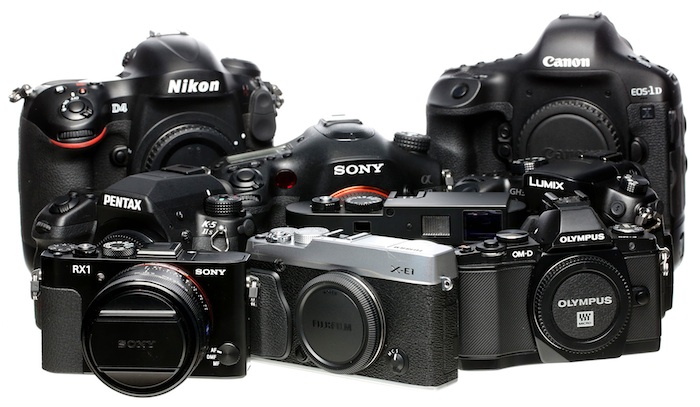
Meet the Purchaser
As I wrote once upon a time in The Rashomon Effect, every one of us is going to have slightly different priorities and therefore make slightly different decisions. To make this useful to you, I’ll have to let you know a bit about me so that you can note where your priorities are different. If your photographic priorities and opportunities are far different from mine, my thoughts about selection will be of zero benefit to you. If what you need is somewhat similar to me, you might find my thoughts to be of some benefit.
I’m looking for serious hobbyist level equipment that will handle most of my needs. I’ll ‘rent’ for specific needs every so often.
I shoot occasionally with everything – that’s my job after all. That being said, I’m most experienced with Canon, Nikon, and Micro 4/3. But I think I’m fairly brand agnostic. I don’t think there’s any clearly best system, at least not right now — some have better cameras, others certain great lenses, and some have better service.
My photography skill level is moderate to good, definitely nowhere near great (If it was great I’d shooting bikini models on Ferrari’s nickel or on the sidelines at the Superbowl instead of writing this).
If I was a better photographer I could probably get by with lesser equipment. Since I am what I am, things that let me rescue borderline images, like image stabilization, extra megapixels, and a strong dynamic range may be more important to me than to you.
I have a good budget, but price is very important to me. I’m cheap. Plus within 6 months my wife will ‘mention’ whatever I spend on this system in comparison to a new piece of furniture or some home improvement. I’ll pay the man for something that’s clearly better, but if I can get 90% of the benefit for 60% of the price, I’ll head that way every time (A concept that my wife doesn’t quite understand).
I’m also a reliability and customer service fanatic, and I expect to be treated like the good customer I am. I consider reliability and service at the top of my list when I buy a car, and a camera system can be a ‘near car’ expense. I realize very few of you are going to let that influence your decisions like I do, so I should definitely mention that.
Finally, I want to take pictures now, so I’m not going to worry about what may come out in 6 or 12 months. It’s never what I expect it to be, anyway.
So What Am I Looking For?
The most important part of my search process will come last. By that I mean that using the camera, looking at images, seeing how the camera handles and focuses, etc. are going to be the final word in my decision.
But, at my last count, there are 50 odd cameras I might consider. I’m not going to shoot with all of them for a week. First, I’ll list out what I want, then do some screening research and come up with a list of systems that appear to meet my needs. Then I’ll rank and test out what’s on the list.
I should mention I’m a sucker for the cool features (the Canon 6D‘s wifi being my most current infatuation). I know myself well enough to realize I need to start logical before the bells and whistles make me loose my train of logical thought. I’ll also look around the edges of my list because sometimes I don’t realize I want something until I see it.
Nearly Absolute Requirements
I have a few requirements for my new system. (Focal lengths I use below are full-frame equivalent.)
Lenses
- A reasonably lightweight 400mm telephoto lens (zoom or prime)
- A high-quality macro lens (I prefer 100mm but am flexible)
- A high-quality 24-70 f/2.8 (I might consider f/4 with stabilization)
- A standard to slightly wide focal length, wide-aperture prime lens
- A wide-angle to ultra wide-angle lens (20mm acceptable, 14mm preferred)
Camera
- At least 16 megapixels resolution
- A viewfinder (optical preferred, good EVF acceptable)
- Shoe-mount flash
- Excellent ISO 800 performance
- Accurate Live View or contrast-based focus assist
- 3 frames per second minimum in RAW
- Microfocus adjustment
I won’t say the above are completely non-negotiable, but there would have to be a reasonable alternative for each of these requirements. But I’m not completely ruling out any system at this point.
One note about my megapixel requirement: I know people get wonderful 60 inch prints from their 12 megapixel cameras. I’ve got a wonderful 60-inch print from my 1 pixel camera. I call it “Snow Bank in Fog”. Print quality depends on a lot of things including how good the initial shot was in-camera, what the subject matter is, viewing distance, and more.
I wouldn’t hesitate to make a big portrait print from a 12 megapixel camera. But my macro images, heavily post-processed and often viewed from a foot or two away, really need at least 16 megapixels for a 20 inch print, especially if I’ve done a lot of post-process manipulation. I’ll accept that a more skillful photographer may never need over 16 megapixels so we can avoid a 50-comment argument about it. But this is my camera and I would like more freedom to crop for composition, post-process more heavily if I desire, or makeup for a slightly missed shot.
Things I Would Like
Lenses
- A tilt-shift
- A true supertelephoto (300 f/2.8 minimum, 500 f/4)
- A selection of reasonably-priced, high-quality prime lenses
- Good 70-200 image stabilized zoom
Camera
- At least 20 megapixels
- Excellent dynamic range
- Excellent ISO 1600, adequate ISO 3200 performance
- 5 frames per second in RAW
- Excellent single shot AF performance (realizing this is somewhat lens-dependent within each system)
Preliminary Camera Screening
I could eliminate some systems that clearly aren’t going to meet my wants now but I’d like to do a little more research first. I might find something that warrants further investigation.
I mentioned earlier that I can make most of the prints I want to from 16 megapixels, but sometimes feel I’m right on the edge there for what I print. Plus more pixels might let me crop a bit more aggressively if my composing is a bit off. I knew it would also make up, to some degree for a lens that doesn’t resolve quite as well, which I confirmed in my last article.
There are sensor factors other than pixel count that are going to make some difference to me, too. I’m not going to test those factors because DxOMark has already done that work better than I could. DxOMark is not The Word; nothing that tests a single sample can ever be The Word. But it provides excellent sensor data (please don’t twist this remark to claim I said something about their lens reviews; I’m talking sensor data) very nicely presented and easily used.
The Overall Sensor Score is a very blunt tool; I don’t find much benefit in compressing umpteen data points into a single number. However, I do find the three specific scores for high ISO performance, color depth, and dynamic range quite useful. I should mention I’m not looking for which camera has the absolute top score; I’ll leave that for Fanboys. I use it to compare cameras, find a range I think is excellent and good, and later compare those cameras for other factors.
Let’s start with the simplest benchmark, high ISO performance. The graph (color boxes are mine) simply shows the highest ISO setting at which each camera kept a 30dB signal to noise ratio, 9EV dynamic range, and 18-bit color depth. If you don’t care what that stuff all is, then simplify it by saying the ISO at which the camera was still giving really good images right out of the camera.
One of the nice things about the DxO graphs is they show the cameras by year of release so it let’s me know that the Nikon D3s (green arrow at the top of the page) has as high ISO performance that’s as good as the newer cameras to it’s right. This is a great tool to find 2 or 3-year-old camera that might fill your needs at a bargain price on the used market.
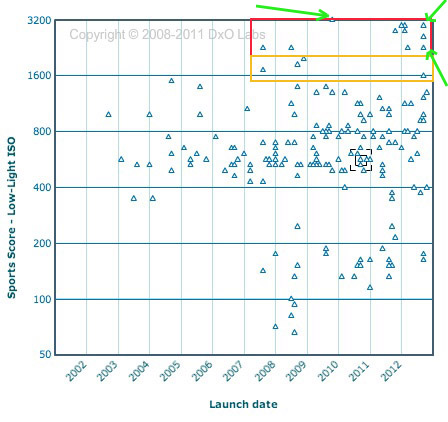
Again, I’m not looking for the very best camera. Real-world factors are going to make splitting hairs between the Nikon D600 (green arrow in the top corner) and the Canon 6D (green arrow along the right edge) a pretty silly thing to do. Rather I roughly thought everything in the red box is really, really good, the ones in the yellow box were certainly going to be acceptable to me, and those close to the yellow box would probably be just fine.
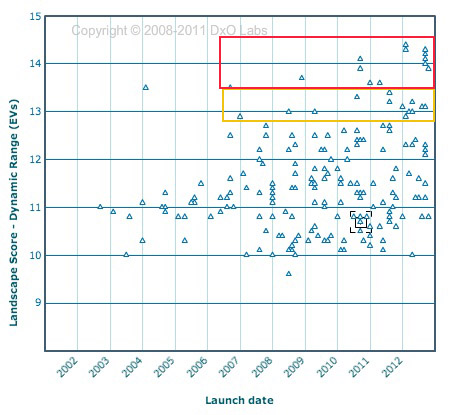
I repeated the exercise with the DxO Dynamic Range Score – (the DxO DR scores are measured at baseline ISO and I don’t always shoot there, but it’s still a worthwhile thing to look at). One EV equals about a stop of light. My red box for this graph shows cameras within 1 stop of the best (the Nikon D800) and my yellow box within about 1.5 stops of the best.
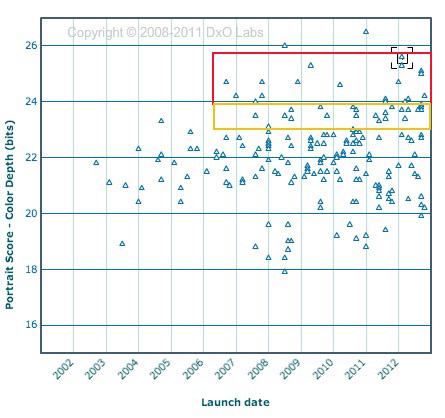
Color depth is a bit less important to me than to many people; I tend to postprocess in LAB space and false colorize regularly. But it’s worth checking the same way since DxO makes it easy to do. The cameras above the red line, BTW, and a few inside the red box, are Medium Format cameras that I’m not considering.
When the dust had settled, there were 7 cameras that rated in my ‘best’ boxes in all 3 categories. There were 5 more cameras that rated best in dynamic range and color depth, ‘good’ in ISO performance, and several more that were at least in my ‘good’ boxes in every category and a couple that were ‘best’ or ‘good’ in two areas, but barely missed ‘good’ in Dynamic Range. I did eliminate those that had less than 16 megapixels and the medium format cameras from my list.
| All Red (Best) | All Yellow (Good) | Near Miss (DR too low) |
|---|---|---|
| Nikon D800 | Nikon D3x | Canon 5D Mk III |
| Nikon D800e | Nikon D7000 | Canon 6D |
| Nikon D600 | Nikon D3200 | Canon 5D Mk II |
| Nikon D4 | Nikon D5100 | Sony A900 |
| Nikon D5200 | Pentax KII | |
| Sony RX1 | Pentax K-5 IIs | |
| Sony A99 | Pentax K-30 | |
| Pentax K-01 | ||
| Sony A77 | ||
| Sony A57 | ||
| Sony NEX-7 | ||
| Sony NEX-6 | ||
| Sony NEX-5R |
I looked at this list a bit and noticed a couple of things that were reassuring. First, the Olympus OM-D just barely missed the list, being just under my ‘good’ box in all the categories. I know that camera well. It fills many of my needs, although I will occasionally bump against its limitations. The list, then, contains cameras that should fulfill my needs, at least in theory.
Since I had decided the OM-D didn’t quite meet all my needs, I didn’t put it on the list. (Don’t get me wrong, I love the camera and have used it extensively for months. It just isn’t meeting enough of my needs now.) I should also note the Fuji X-Pro was not tested by DxO so it’s not here for that reason. But again, it doesn’t have the lenses that meet my absolute requirements list, so I won’t consider it further.
The table surprised me in several ways. First, was the dominance by Nikon cameras. I knew the D800/600/D4 cameras were highest on DxO’s rankings. I was a bit taken aback by how many Nikon APS-C cameras made this list and that no Canon APS-C cameras were even close. The current Canon crop sensor cameras are all older models due for replacement, but the gap still surprised me. Having shot with them, I know they meet my needs fairly well so perhaps my selection criteria was a bit tighter than it should have been. I certainly am not ruling them out just based on some numbers.
I wasn’t surprised by how well the Sony bodies did. After all, Sony’s sensor technology and patents are leading the pack right now. I was a bit surprised at how well the Pentax sensors rated. Again, I knew they were good, but perhaps didn’t realize just how good they were. While I wouldn’t rule out any camera just based on this list, the Pentax showing makes me very interested in looking at them a bit more thoroughly.
Narrowing Down a Little
I’m not ready to make a final list yet, but think it’s time to focus down a little and do some further comparisons.
Going back to my absolute needs the NEX system doesn’t really fill them. NEX doesn’t give me the telephoto I want at the quality I desire, nor the standard range zoom. Sure, I could rig up some things on adapters and make something that works, but I’ve got too many other options to consider that a prime choice.
I’ve been using the Olympus OM-D as my ‘home camera’ for a while and on paper it meets all my requirements except the 400mm lens one. This is going to set some Fanboys off, I know, but having shot extensively with the Olympus 75-300 and Panasonic 100-300, neither makes it for me. I’m sure someone has used that combination to shoot a mountain lion for the cover of National Geographic. Unfortunately, the image quality I’m getting with either can’t compete with good telephoto zooms on an SLR. I’m going to use the OM-D system as my baseline comparison. I expect my new system to meet my needs better than it does.
Obviously I’ll want to evaluate the Nikon systems. I’ve demonstrated to myself (if no one else) that the resolution of the D800 bodies can let me use a slightly less capable lens and still get marvelous results. The performance of the Nikon crop-sensor bodies on my little DxO search makes those worth further investigation, too. I’ve historically shot full-frame, but spending the last 6 months with an m4/3 system has shown me I could probably do most of my photography just fine with an APS-C sensor camera and rent a big boy when needed.
I love Canon’s lens selection, so I’m definitely going to consider a Canon system. While I know from experience the Canon crop-sensor cameras are capable, the numbers I’m looking at make me wonder if there’s much to attract me with the Canon 7D or 60D. I certainly am going to look at the 5D Mk III or 6D, though. They’re definitely competitive.
The Sony system definitely requires more investigation, too, and I’m interested in evaluating their improved AF system, which I’ve used only a few times. The surprise to me, at this point, is how well Pentax does by the numbers. I’ve shot with their cameras and been impressed by several features and the ergonomics, of course, but I haven’t really considered it as an entire system. I will now.
I don’t need a 10-frames-per-second pro body for what I shoot, the Canon 1D IV and 1Dx, and Nikon D4 and D3x aren’t on my list. I may revisit things and decide to look at some other cameras later, but for right now this is what I think I’ll consider further:
Full Frame:
- Nikon D800e
- Canon 5D Mk III (I like the 6D’s built in Wi-Fi but prefer the III’s better AF – I reserve the right to change my mind)
- Sony A99
APS-C Frame
I’m not certain the camera I choose will be one of these, but they’re certainly the front runners at this point.
In the next article I’ll look a bit at system (rather than camera) costs before I start actually evaluating things further.
Roger Cicala
Lensrentals.com
February, 2012
68 Comments
Mark Olwick ·
Loving this series, Roger!
Bernard Ortiz ·
Hi Roger – quick correction up there – “EV” does not stand for “Electron Volt”, though it could in another context. It’s “Exposure Value” in this context.
Like many, I went through something like this, and decided that an in-focus shot with lesser DR was better than an OOF one… so I ended up with the 5DIII, because I sometimes shoot indoor events with dogs (like dog shows, agility, and so on). I also shoot a lot of “daughter” events in horrid lighting (why must all the birthday parties be held at indoor bounce-houses?), so while a 5DIII may be overkill for most of what I shoot, it has the capabilities when I need it, which is more often than 2-3 times a year.
KyleSTL ·
Roger, I love your logical decision-making process. It has a very stark contrast to the emotional (read: fanboy) decisions that are typically made online publicly and defended vehemently in the same space.
Chris Hoffmann ·
Thanks for taking us through your thought process Roger!
Stephen Froehlich ·
A little more clarification on EV vs. eV:
Exposure Value is really just the technical term for a “stop”. As an EV is a factor of 2, it is also very closely related to a single bit or 3 dB.
http://en.wikipedia.org/wiki/Exposure_value
http://en.wikipedia.org/wiki/Electronvolt
Electrons (the fundamental measure of current) are used in academic sensor measurements like Sensorgen does for the read noise that goes in to the DxO dynamic range and SNR measurements. However, eV’s are a measurement of energy (a tiny fraction of a Joule), not current. If the sensor operated at exactly 1V, the electron read noise could also be measured in eVs’s but of course sensors operate at a different voltage, likely 5V or 3.3V, but I don’t actually know that value.
http://www.sensorgen.info/
Stephen Froehlich ·
It should be noted as well that Pentax is using Sony sensors just like Nikon and Sony are.
derek ·
now I have one D800, one D800e and one D600 but I am considering selling my D800 and d800e to go back to sony a mount, I just simply prefer in-body IS and the EVF(I know you prefer the OVF).
and I think Sony’s lens lineup is better than that of Nikon at least for me. I loved Sony SAL85f1.4ZA, 24f2ZA and 70-400GSSM.
I know many guys say Sony does not have enough lenses but how many lenses do you really need? I think Alpha system offers quite good lneses.
But Iknow if you need a 400f2.8, but Sony has the best 24-70/2.8(stabilized) and lighter and optically quite good 28-75f2.8(also stabilized) and excellent 135f1.8ZA.
I think you may want to really check Sony A system out a bit seriously, I suggest you to try the A99v with the 135mmf1.8ZA, which is the best SLR lens I have ever used in my life and I think you will be quite impressed with it. Finally, despite of the lower DXO score of the A99v than that of the D800,the A99v has at least 14ev of DR at ISO100 and it is really good, even slightly better at pixel level than the D800E.
Roger Cicala ·
Derek, I’ve shot the 135 f/1.8. It awed me. Sony will be getting serious consideration from me. It’s a really different system, though, and I’ll need to spend more time actually using it. I’m more used to Canon and Nikon so I won’t need to do much hand’s on with them. Sony and Pentax I have less experience with and I’ll need to spend more time with both before deciding.
Thomas Alicoate ·
The DxO results always seemed confusing to me. Is it possible to manipulate a camera’s raw data to improve your results? I can’t figure it out with just one system, but someone with access to a lot of gear might be able to at least make a couple tests under controlled lighting and determine if Sony sensor DR dominance is really based on the hardware. I was always curious why cameras from Nikon and Sony that used the same sensor didn’t have the exact same DxO result. I shoot Canon, which people will probably have found obvious by now. I’m not trying to be a fanboy, I’m just trying to figure out if Nikon is really better, or can I get real close to the same DR in post. If you have looked at this in the past and can verify their results, I would love to hear about it.
Roger Cicala ·
Thomas, someone more knowledgable than I will probably be able to answer your question. I just want to make clear I consider this a screening tool. It may not be completely accurate (I can’t say) but I think it’s a reasonable starting place. I doubt it’s accurate enough to split hairs with.
More importantly, I know from my own experience that, for example, a half stop of extra dynamic range might be nice to have but in reality a host of real-world factors (not the least of which will be my skill or lack thereof) is going to be more important.
But that extra half-stop is going to be something I consider along with cost, lens selection, image quality, AF capability, ergonomics, customer service, etc.
ginsbu ·
Interesting to see how you think this through. It’s great that there are so many fine cameras to choose from at a variety of price points even if that makes choosing hard! I’m looking forward to the rest of the series.
Two questions I don’t think you answered: In what ways is the OM-D not meeting your needs? Explaining that would help your readers better understand what you’re looking for. Also, are you planning on keeping the OM-D alongside your new system or replacing it? I think m4/3 and FF systems can complement each other very nicely and would give you the flexibility to play to the strengths of each.
Finally, I’m surprised that you didn’t include the D600 on your FF list. I would have thought the value proposition with that body would keep it in the running at this stage.
Roger Cicala ·
ginsbu,
I go into that a bit in the next post about the Olympus – and it remains what I will measure others against as in what do I get for this additional money that I don’t have now.
It was basically 3 things, though: 1) Getting an RX100 reduced the pressure I felt for a small go-anywhere interchangeable lens system; 2) I really want a 400mm (FF equivalent) high-quality lens and I didn’t find it in m4/3 (that’ll set some fanboys off, but there it is), and 3) 16 mpix was just enough for me, but that pushed me a bit to use the very best lenses, which made the system larger physically and more expensive.
All of that being said, it might well be that it’s where I stay.
I’ll certainly consider the D600 from a price point (and the 6D from a coolness point) but as I’ll discuss in the next post, if I’m shelling out $12k for a full-frame system, saving $1,000 to go with the D600, while not insignificant, is not a driving factor, either.
The way my mind works, though, is I’ll probably narrow down to a couple of these 6 cameras, then go back and look at alternatives within that system and fine-tune again, then compare to anything I’ve left out one last time.
ginsbu ·
Thanks for the reply, Roger. All sensible points. It’s too bad m4/3 doesn’t yet have longer primes or faster tele-zooms. I’m looking forward to the next post.
Karl ·
@Thomas, I reads somewhere that the process that the lithographic Canon is using on their sensors (0.5 microns) is one or two generations behind Sony (0.18 microns). This affects the geometry and pixel size of their sensors (I am not a chip designer so I do not know how).
I still think their are other benefits to running a Canon system over Nikon or Sony but I think the Sony sensors are demonstrably more advanced.
Carl ·
Roger, your budget has grown beyond just a body and a 24-70…great minds think alike again…hahaha. I still think your heart is somehow with Nikon. It’s a shame Canon are behind with their sensor development…but then, if they were at parity, given their market success…Nikon would have to either merge or be bought by a larger company. That might happen anyway, but not soon I suppose.
I really don’t see you choosing a system outside of Nikon or Canon…
There’s been some interesting debate about sensors over at CR lately…
Roger Cicala ·
We shall see. I can’t say my heart is particularly anywhere. I started with Canon, way back in the Rebel days. I think they have the best lenses. Nikon has the best sensors and the worst service. I don’t know enough about the other bodies to say a lot, but I’m learning more about them every day.
Brian T ·
I had a Sony A900 and bought an A65 to try out the EVF on the basis that, if I couldn’t get used to it, I wouldn’t lose too much money and would know to start looking around for an OVF model in due course. Fortunately I did and now have the A99 too which I find excellent. One trick you may have heard of with the viewfinder (it is an acquired taste) is to set it to show the camera settings and if you shoot in RAW which I assume you do, you will actually see the JPEG that the camera is set for. Setting this to Portrait and -3 contrast will help the soot and whitewash effect considerably, aided by the very wide latitude of the sensor which is very reluctant to clog up shadows or burn out highlights.
Best of luck with your search.
Feng Chun ·
Hi Roger,
If you don’t shoot base ISO, you may need to see the detail measurement graph on the DR ratings. Canon sensor has a flatter decrease on EV values compare to the Nikon ones when ISO increases. Consider 6D and D800E, at ISO 400 D800E already have 1.5 stop loss (to ISO 100) while 6D almost keep the same number as ISO 100. and at ISO 800 the two camera DR values are fairly close while after 1600 Canon take the leads.
Roger Cicala ·
Feng Chun,
Very pertinent point and one I should have made in the article. I probably should graph out ISO 400 and 800 performance for DR since that range is probably 75% of my shooting.
Thanks!
Kai ·
@Karl: 0.5um is actually three generations behind 0.18um. IC technology steps are approx 0.7x (ie sqrt(1/2), area drops to half). The steps were 500nm -> 350nm -> 250nm -> 180nm (followed by 130nm, 90nm, 65nm, 40/45nm, 32/28nm, 20nm). The 20-28nm range for the most advanced/expensive processes usually only used for hugely complex digital graphics processors, dedicated memory chips (SRAM, DRAM, flash), and processors (CPUs).
Analogue circuitry (including photon-gathering diodes) generally does not benefit from the IC technology scaling and stays almost the same size, regardless of IC technology geometry.
So changing from 0.5um (500nm) to 0.18um will not get a better sensor cell in itself, but if the new process has some photon-gather improvements this may result in a big jump. Also, there are some 2nd order effects like (minimum) spacing, lower power consumption (so less self-heating) and better ADC techniques etc that can help.
Carl ·
Roger, one thing is certain: I am confident that you are the right person with the right venue to be posting this blog. It’s good to see someone trying to be as objective as possible…with the resources, connections, and test equipment to back it up.
I especially don’t like reviewers who are just trying to post a review before someone else…not to mention those that get overly simplistic and lack depth.
Feng Chun…I agree. Nice to see it being pointed out.
Kai…interesting points…please go to canonrumors’ forum and tell them all about it. I keep seeing “this process” and “that process”…I knew there was more to it than that!
Nqina Dlamini ·
This should be the GO-TO article for all those “Which Camera should I buy” threads. Thank Roger.
fiatlux ·
Interesting thought process.
Would you consider combining an APS-C and a FF camera?
In this case, finding a good “400mm equivalent” would be a lot easier.
Roger Cicala ·
Fiatlux,
That’s an interesting thought. I hadn’t been planning on it (I would certainly if I was shooting professionally), but the next article, which looks at system costs, makes a second body seem more reasonable, particularly if I choose a full-frame, adding roughly $1,000 for an APS-C backup camera is something to consider.
John ·
Hi Roger, Not sure how much repair/after sales service is going to influence your final decision but I’d almost bet money Nikon won’t be at the top of your list when you finally decide on which system to get. But I’ve been wrong before as I’m sure I will be again. lol
John
Pete Johnson ·
Hi Roger, I am curious what kind of macro do you like to shoot? I have been shooting bugs the last couple of years. I live in central Arkansas, same climate as you, and find it a bug lovers (I don’t really “love” bugs, I just find them fascinating) paradise. If you are moving to the country “opportunities” await!
Roger Cicala ·
Pete,
Mine are a bit different (although I do love shooting some spiders). A lot of my macros are close ups of electronic circuitry and things like that. They make marvelous abstract prints. I love watching people look at them and try to figure out what they are.
http://m5.i.pbase.com/g4/13/527413/2/144492195.YmUWe9ki.jpg
http://m8.i.pbase.com/g4/13/527413/2/144464058.Ski9YjCl.jpg
http://m3.i.pbase.com/g4/13/527413/2/144475753.FYrSSgfc.jpg
Randy Schwartz ·
When you consider the relatively minor cost of an APS-C second body, it’s a no-brainer to have one (not to mention the advantage of having two mounted lenses when out shooting). I’d be very surprised if you don’t find two bodies as the most practical solution. And Feng Chun certainly puts the “sensor wars” in perspective: most of us amateurs are better off using a little more ISO to get the shot sharp than worrying about squeezing out a little more dynamic range with low ISO…hence, Canon sensors are not “inferior” for us.
But who cares about the outcome, it’s the journey Roger will take us on which we all enjoy!
mark ·
Why are no medium format cameras included? I’m not very familiar with the lens options, so I imagine this could be a reason to exclude them right from the get go.
Roger Cicala ·
Mark,
I considered MF a bit, but the size and need for telephoto, along with cost pretty much eliminated it. I also really want to be able to shoot several frames per second.
Json ·
Hi Roger. I’m planning to buy into a DSLR system too and your absolute requirements are very close to my. You refer to the DXO dynamic range measurements in your graph. From the EV data I saw that you use the Print values, which are calculated for a resized 8MP picture. You find the real sensor values under the Screen tab. For
the D800E the difference is 1.1EV. I found it not obvious to find this vaules and if you go for a 36MP body you won’t scale down to 8MP most times. I was confused the 1st time when I recognized the DR differences between the Canon and Nikon/Sony sensors and take a deep thought if this is has a big impact in my buying decision. For the money I have to spend (same amount you calculate) I won’t to get the best system I can get. My conclusion about DR is, that 13EV’s is nice to have. It’s single shot HDR. For me this is not critical, because I have no output device that can handle it. A top notch monitor can handle 10EV, most handle only 8EV. It looks for me if a car runs 160mp/h or 190mp/h. Both is sufficient in most cases.
For my decision the lens portfolio, lens quality and other add-ons are more important. How good is the camera system supported by 3rd party suppliers and from WEB communities (e.g. Magic Lantern)? You have still addressed all the other criteria, so no further to add.
Good luck with your decision, it will not be an easy one. Even if money is not a limited resource you have to make compromises.
Ben ·
Are you going to mentally get past the Nikon service Roger? Not sure I’d trade the DR for the service, infact I didn’t. Bought a 5D3 with 50L, sent them straight to canon for tuning, CPS 3 day warranty service and they came back this morning. Did I mention they were grey market and canon didn’t say a thing? Makes up for a lot for this pro photographer.
Roger Cicala ·
Ben,
I honestly don’t know yet. It’s a negative, no question. But it’s just one thing to consider. Now, if I was a full-time working pro it would probably be a very high priority for me. That’s why I’ve seen several corporate photography companies leave Nikon – the cost of ownership is too much higher. On the other hand, I’ve seen some full-time individual pros that have switched to Nikon for the camera’s features. These tend to be individual pros rather than corporate pros.
As a non-pro hobbyist it’s still something I’ll consider, but I don’t have a formula for how much. I do know that if I go Nikon system I’ll have more third-party lenses than if I go Canon because if things are close I’ll avoid Nikon’s service costs and turnaround times. (Tamron and Sigma have much better service but Tokina doesn’t. Rokibowyang has basically no service at all, but at those prices I consider the lenses disposables.)
Pete Johnson ·
Regarding your image links Roger, the first one is easy. It’s obviously the bridge of a 34 string, twin neck guitar, although I’m not sure of the manufacturer.
Clement ·
Canon 5D Mk III is amazing. Plus the EF mount is very flexible for adapters.
Mike ·
Why not get a Canon FD 200mm F2.8 with an m4/3 adapter. Bingo, 400mm f2.8! Personally I use the old FD 135mm f2.0 all the time on my GH-2, and it works as a splendid 270mm equivalent at f2.0. On your OM-D it would even be stabilized.
Tony ·
Roger, you’re reminding me of the way I make major purchase decisions. I end up narrowing the list to “oranges” and “bananas”. Make that really good oranges and really good bananas. But at some point it’s going to be more important to have a round fruit than a yellow one. Or vice versa. The playing fields just don’t overlap completely.
Very nice macro work. You’d catch me staring at them because I do know what they are, and I’m marveling at the art of their designs. Somebody had some real fun with that routing. Especially that triangular island that has no engineering reason to exist. It’s Art Deco in copper. What’s it from?
Roger Cicala ·
Tony, I believe that one is a Sony NEX, probably NEX 5. I imagine some young engineers that get an exciting job like “go lay out the flexes” put some of their artistic energy into them. But they’re like Easter Eggs in old programs to me, I love finding them.
I totally agree about oranges and apples. And I think that my overall summary is going to be “these 2 oranges, this apple, and this banana are all ‘best value in class’. Now which one would taste best to me today?
Rich ·
Interesting articles.. I find myself at a similar place evaluating cameras; but, having a smaller budget I will have to draw larger boxes… Your requirement about service struck me because that is very high in my evaluation…. I have a hypothetical ranking based on limited experience, a lot of Internet discussion and gleaned from blogs and magazines… So I would be very interested if you would elaborated on the service question and how you view these companies in a future article or maybe provide a link if you’ve already done this earlier. (The reputation Nikon is establishing with their current service is distorting my selection process.)
Roger Cicala ·
Rich,
Part of my experience you can see in our last annual repair data article: http://wordpress.lensrentals.com/2012/09/lensrentals-repair-data-january-july-2012
Compared to other industries, camera companies have generally not been great. Right now I find Tamron (3 day repair guarantee is awesome) and Canon (3-6 day turnaround) are really good, and Sigma (nicely set up customer service online is quite good). Zeiss is very reasonable, too, and often will offer a refurbished lens instead of waiting for repair. Sony, Fuji and Olympus all are OK. Tokina and Nikon are pretty horrid, with looooonnnng repair times and Nikon the most expensive for repairs on average. Voigtlander’s are very difficult to have repaired at all.
Please note this is for the U. S. only (other geographic areas are quite different) and the last 18 months or so. If we turned the clock back 4 or 5 years, Nikon was tops and Sigma and Tamron the pits. (Which is why I don’t pay much attention when I hear “Nikon has given me great service for 20 years”.)
I know you can find a Fanboy on every corner who will tell you about their wonderful repair experience with Nikon or their horrid one with Tamron or Canon. I’m looking at 3,800 repairs in the last year, though, and averaging out the experience.
Martin ·
Really very interesting blog entry, I agree. But what’ s all the words and time for – I know for 99% that Roger will go for Canon 5D mark III. Im really so sure about it. You will see that I’m right in the end :-).
Gordon Lewis ·
I find it curious that your analysis would rely so much on DxO data, especially since you have easy access to any of the camera systems you’re considering and you are exceptionally capable of running your own tests. Why do you place so much faith in DxO data rather than your own first-hand experience? I’m not judging or hating, just wondering…
Roger Cicala ·
Gordon, I’m simply using a handy tool to do some screening. I’ll be testing cameras and lenses on my own for quite a while (in fact I’ve already been at it two weeks). But that tool is a very nice way to get an overview. In fact, without it I probably would have ignored the Pentax system entirely.
Blunt ·
I think there’s a slip in the table. Shouldn’t that entry for Pentax K II be for the Pentax K5 II?
Roger Cicala ·
Blunt, that is correct. K5 IIs actually.
Aaron ·
I’m a bit confused Roger, you say “…the Canon 1D IV and 1Dx, and Nikon D4 and D3x aren’t on my list.”, but in the table above you have the D4 listed, but no Canon 1D. Is this a typo/mistake that it got left in the table?
Roger Cicala ·
Aaron,
I think you’re referring to the screening table where I was looking at highly rated cameras. There are several on that list that I decided not to pursue. The D4 made all the DxO cutoffs, like the RX1, but neither are cameras I’m thinking about.
lisandra ·
Well roger, I hardly post but am an avid fan of yours. Heres what I can tell you: I went through your same process not more than a year ago, and I ended uo with a 1dmk4. My fellow m4/3s shooters would kill me if they knew. At any rate very long story short I spent 2 months getting over the slightly miss focuses (and my editor calling me an obsesive paranoid), I also spent about half a year complaining on the sheer size of the 70-200 f2.8 II (which frankly isnt that big) and lastly I spent just about the whole year crqnky cause I couldn’t fit all the lenses I wanted to fit in my shoulder bag. A shameful year later I have a 1dmk4 sitting on a shelf but bring myself to sell it, and went back with a gh3, an omd, and all the lenses I initially though werent cutting it. Im also very broke after the affair.
The grass is greener right?
armis ·
Damn. I was really hoping the X-E1 would make the preliminary cut, I’m really really curious about it and would have loved some of your thoughts.
Roger Cicala ·
Armis, it won’t cover my telephoto needs I’m afraid. Nice camera overall, though.
nandadevieast ·
Roger,
M43/Olympus OM-D system will soon have
fast telephotos from Panasonic and Olympus.
Also, Oly has updated the 75-300 that they had…
Going by the criterion you have, the camera you will eventually choose will have to be pretty much
an allrounder.
Roger Cicala ·
I don’t think the 75-300 optical formula has changed with the new version. As I mentioned, though, I’m buying now. I’ve wasted months and months before, waiting for what’s coming out that ends up not being what I’d hoped.
Lynn ·
Intrigued you’d get the Nikon D5200 over the Nikon D7000. I know it fits your criteria better, but for myself… the facts that the D5200 has no internal focus motor, and won’t meter for older manual focus lenses, would both be dealbreakers. If I have an autofocus lens, I want to be able to autofocus, and not be limited to focusing manually. And if I want to play around with an old manual focus lens, I want my body to meter.
Still hoping that Nikon comes out with a replacement for the D300s someday, because I’ll probably always want a crop sensor body, but I can’t see its being the D5200 over the D7000.
Enjoying this series A LOT! And I’ll keep the “cost” one away from my spouse…
Aaron ·
Huh, so the 1DX/1D4 didn’t make the cut for the table, but the 5D3 did? I’m really surprised! Even though you aren’t considering them, I would have expected the 1DX especially to make it onto the table.
Daniel ·
Nice blog series. Clear thinking applied to a practical decision. And humor–what a prized commodity in the product review field.
Hope you will consider a segment on Tilt-Shift lenses, as I have shelved my 4X5 (50 lbs. and slow) but miss the ability to control focus while keeping fairly large aperture settings. A good 24mm Tilt-Shift lens would bring back some of that view camera capability I miss in the 4X5. For your macro shots a 90mm tilt might surprise you by providing a change in relative size in images of parts of your circuit boards — creating an illusion of receding horizon lines all well focused. In the Tilt-Shift area, Canon lenses would seem to have the lead, both for lens quality as well as flexibility of the mount to rotate the tilt and shift functions.
On a separate issue, I hope you address practical issues of hand-holding a camera, and ergonomics of controls. As I age I find hand-holding a camera to be less steady, and intricate menus are hard to remember. Both affect the outcome of images taken in the field. Image shake is well addressed in tests, but ease-of-use ergonomics are not well addressed. For instance, Zeiss and older Nikon lenses offer aperture rings where my left hand “expects” to find an f-stop adjustment. So a small vote toward older Nikon lenses and Zeiss/Sony. However, none of the VR enabled G series Nikons have an aperture ring. And on the issue of obscure menu settings, the D800/D800e lacks the ability to store and recall custom settings unless I save them on an SD/CF card.
Best regards and looking forward to more blog entries.
Daniel
RohithT ·
Great stuff as usual, Roger.
I went through a similar exercise last year. I had an E-P1 and a good collection of lenses (Panasonic 20mm, Olympus 45, Olympus 9-18, and Olympus 14-150). The easy choice would have been just to get the E-M5 and be done with it.
I wanted to take the opportunity to reevaluate my needs, though, and see if another system would better satisfy my needs and better serve my growth as a photographer. I only considered full frame systems because I didn’t see APS-C systems offering any significant advantage over a Micro Four Thirds system, except when it came to telephoto options.
In the end, the full frame options at the time (a used 5D Mk2, used D700, were the only financially feasible options for me since the 6D and D600 hadn’t been announced) also didn’t offer enough of an upgrade to make up for the additional gear cost, the lack of an EVF (I prefer EVF’s to OVF’s) and the multiples in weight/size (smaller/lighter camera gear can often mean the difference between doing all carry-on baggage on a trip and checking luggage). I ended up with the easy choice after all: I got the E-M5 and am quite happy with it.
That being said, had telephoto been a more significant part of my photography or had the 6D or D600 been available when I was making my evaluation, I might have swung the other way.
It’s surprising that an Olympus-supported camera system has such poor telephoto options, since the Four Thirds system had so many great telephoto lenses. I hope Olympus, Panasonic, Sigma, and/or Tokina come out with something great in the next few months; it’s the only significant hole left, now that the 12-35 and 35-100 F2.8 twins have been released. A 50-150 constant f/3.5 or f/4 would be killer (and hopefully well under $1,000).
sbiessel ·
Thanks for the informative posts. I had a similar quandary a while back. I had been shooting with a Canon 5DII and Pentax K5. I wanted the DR of the Pentax K5 in a full frame sensor, so ended up going with a D800. Happy with the decision, though I find the D800 to be less comfortable than either camera. The ergonomics on the K5 are fantastic, and I know I’ll be kicking myself when they finally release a full frame. Though their lens selection has left me pretty frustrated at times. There’s no perfect camera, unfortunately.
JonR ·
Your two “system” articles are excellent! I too have been going through this process having decided to adopt a lighter (weight) system (D300 & FX/DX lenses) due to my advancing age and emersion in nature photography requiring fast telephoto lenses. For about two years, I have been shooting with a lot of m43 (EM-5 & GH2 bodies & many lenses), Four Thirds Oly Pro telephoto zooms and my Nikon DX/FX gear (plus the Sony RX100 and the Nikon N1 V1 for special purposes).
My assessment is similar to yours re the OM-D EM-5: it’s a great camera that meets my needs for macro, landscape, architectural, street and even multi-flash photography using the Pani 7-14mm f/4, 12-35mm f/2.8 & 45mm f/2.8 macro lenses plus the OLY 14-150mm walk around lens. The less than stellar performance of the m43 system comes in the telephoto range especially with consistent AF-C of moving birds in low contrast light. The Pani 100-300mm is a decent lens for nature telephoto work but the not nearly the optic quality of the OLY 90-250mm f/2.8 or the more compact OLY 50-200mm f/2.8-3.5 zooms even when the latter are combined with a 1.4x TC. These two lenses are surpurb but were designed to focus optimally with phase detect sensors. On the EM-5 they will focus under 3 seconds in AF-1 + M but not near instantly and continuously as they should.
Olympus is very aware that they have mostly orphaned their excellent Four Thirds lenses and have repeatedly announced their commitment to solve this issue with a new “pro” m43/43 camera body in 2013. It should have a mirrorless hybrid sensor – I hope – similar to the design used by the little Nikon N1. This little CX sensor has 77 (?) phase shift detect sensors buried in the same plane as the more abundant contrast focus sensors. (The N1 V1 with the TF1 adapter focuses my 200-400 F/4 instantly while producing an equivalent 10MP image @ F/4 and 549-1024mm!)
Clearly, there is proven technology for Olympus to build a new m43/43 camera with an excellent sensor with a hybrid focus systems. (Note that the new Nikon D5200 has both focusing systems but no micro adjustment capability to correct for front/back focus issues.) Therefor, it seem advisable to wait for the new Olympus body before abandoning ones excellent m43 or Four Thirds gear and investing in more expensive an heavier APS-C or FF systems.
Heidfirst ·
As already mentioned it’s not surprising about Pentax sensor performance as they use Sony sensors (as do a lot of the Nikons).
Where they may fall down for your needs is in availability of long (400mm & above) lenses & possibly in AF.
Justin ·
I commented similarly on the other post (just fyi)
Another consideration is to ditch the heavy zooms. For the D800e (as an example), mount a 24-120 f/4 and pick up a few primes. The trinity of 28, 50, 85 f1.8s are spectacular.
Add the Bigma you mentioned and you are done. Or if you are in need of a truly ultra-wide field of view, add one more zoom, either the 16-35 f/4 or the 14-24 f/2.8.
D800e – 3000
24-120 f/4 – 1300
28 1.8 – 700
50 1.8 – 220
85 1.8 – 500
Bigma – 1020
= $8900
Pretty reasonable for (arguably, barely) the best 35mm provides.
Max ·
I like the idea of using a camera that crops like the NEX7 for telephoto shots and using a full frame for wide angles. I am also willing to stitch some panoramas but in reality the Zeiss 21mm 2.8 does well on my NEX7 and will be ‘expansive’ on a full frame. I bought the Sigma 19 and 30 after reading Roger’s enthusiasm for the 30 but a little testing makes it a no brainer to use the Zeiss when it really counts.
http://www.flickr.com/photos/zeissgeist/8454684962/in/photostream/lightbox/
The Zeiss c/y 21mm 2,8 @ 4.0
http://www.flickr.com/photos/zeissgeist/8448403473/in/photostream/lightbox/
The Sigma 19mm 2,8 @ 4.0
http://www.flickr.com/photos/zeissgeist/8449487600/in/photostream/lightbox/
(Yes I know the bottom right ROI is dodgy but in the Sigma’s favor – even still…. )
Andrew Herd ·
First, many thanks for writing such an outstanding blog – I learn every time I read it. Curiously, I have gone through much the same kind of evaluation, and shoot at work with Canon gear and at home with M43. The latter has its shortcomings, such as a lack of long telephoto primes, and no focus tracking capability worth mentioning, but it does have a huge advantage that you haven’t gone into here, unless I have missed it, Roger.
M43 kit is so incredibly light and compact that I am temperamentally inclined to cut it some slack for its drawbacks. When a 150mm F4 gets released (hey, why are they all competing in the sub 30mm segment?), my calculations say I will be able to put it in a coat pocket. Now you try doing that with a 600mm 35 mm lens and see what size of pocket you need! I gain the impression that no-one at Olympus expected the E-M5 to do as well as it did and that its success in dragging the company out of a financial hole has changed some things. It surely has changed my perceptions about what kind of lens system I personally want – given a camera is basically a bucket into which you pour light through a lens, I am beginning to think that maybe a small, really efficient bucket ticks a lot of boxes.
Ed ·
Roger,
You’ll regret getting a camera without autofocus fine-tune, which Nikon omitted from their D5200.
Matthew Saville ·
Roger, allow me to spoil you on one small issue that has “ruined” me as far as amateur / advanced amateur bodies is concerned.
On all semi-pro and pro Nikon bodies, and on a few of the newest Canon bodies, there is a button customization that I absolutely cannot live without. 1-click 100% zooming during image playback. Canon is still working out the bugs on this one, but the 5D mk3 and 6D have at least a “Quick zoom” button now. You customize the playback initial zoom to be “actual size”, and then on the 5D mk3 you program the “SET” button to do zooming. Now, instantly after clicking a photo, you can go BAM right to 100%. Even if you shot with an off-center subject, as long as you managed to get a focus point over that subject and lock focus, the camera goes right to that point. Same on the Nikons, with the center button customization. I like Nikon’s implementation a little bit more because Nikon allows you to scroll from image to image without first hitting the playback button, whereas Canon still seems convinced that you should have to hit “play” before being able to review more than one image. At least the newer Canons are worlds better than the previous generations such as the 5D mk2, where it would drive me mad to be able to see the image on the back of the camera right away, but not be able to zoom or scroll to other images without first clicking “playback, zoom, zoom, zoom, zoom, scroll, scroll, scroll, scroll…”
It sounds like nothing, but once you get spoiled then it becomes oh-so-annoying when you’re in any situation that even remotely resembles action, and you need to confirm 100% focus.
All this to say that, unfortunately, the D5200 and D7000, as well as the D600, lack this feature. In my opinion this is a huge error on Nikon’s part. This is why, at my current situation and hobby, (adventure landscape / night time lapse photography) …my top pick camera is absolutely the Canon 6D. That is not to say that I wouldn’t take a D600 into the wilderness any day, especially if dynamic range was important. Heck a D5200 would deliver gorgeous image quality too, and it’d be so dang light I’d probably be skipping up the wilderness trails. I’d just have to make do without that zooming function.
For general and heavy-duty work, on the other hand, I cannot live without the zooming feature and I would absolutely not consider my system complete unless I owned a camera with such a feature.
Take care,
=Matt=
Harry P. Lux ·
great article and serious thoughts – Thank you Roger!
I do practical lens tests for more then 25 years now – for me, lenses are always first choice – and second I look for a camera – a camera that pleases my hand, my photography style and is fast and durable.
I loved the Olympus E-System (except for the AF and High ISO) , I liked even the Pen-Series, but the OM-D was a big disappointment – the zooms lenses (collecting dust inside) and the body are looking old and used after a few weeks of consistent shooting – not professional at all. The primes are other quality and stay dust free.
I always liked the Panasonic G2, GH2 and now the GH3 better and even the Nex 6 I would favorite.
But there is no one camera for all and everything what counts for me, are lenses, so I kept my Eos 5D3 and lenses like 2,8/300mm; 2,8/400 mm with extenders
IF one goes to 400 mm – there is only Canon – 2,8/300 mm & 1,4x – 4,0/400 mm; 5,6/400 mm or even 2,8/400 mm or 5,6/100-400 mm –
it’s no Nikon, no Sony, no Pentax, no Sigma out there at 400 mm at the same quality, speed, lightweight and durability.
I had the fantastic 2,8/300 mm and the 2,8/90-250 mm from Olympus – but AF is weak and finally ISO 1000 is not fast enough for animals and sports, nor for children.
I had Nikon D3x with 2,8/70-200 mm and 4,0/200-400 mm – not bad, but for me, not good enough and to much is missing, like 5,6/80-400 mm AFS VR; 4,0/300 mm AF-S VR; 4,0/400 mm AF-S VR; 2,0/135 mm AF-S VR and better, lighter 2,8/70-200 mm VR; 2,8/300 mm VR; 2,8/400 mm VR; 4,0/500 mm VR; 4,0/600 mm VR – so Nikon is no option for tele – not for me – and when I see crazy price of the heavy 5,6/800 mm – no thanks.
Pentax has a few really great lenses, like the 4,0/300 mm – but mostly primes and the AF is unpredictable.
So if I had to pick one camera, it would be Eos 5D3 (today!)
but if I could pick too – the second would be the Lumix GH3
and third my IPhone 5 or Lumix LX7
and I use them all for different situations and with different lenses
I take a GH3 with 7-14 mm & 12-35 mm for a holiday
and I take a Eos 5D3 with 2,8/400 mm for telephoto
maybe some day, there will be an EOS M with viewfinder, fast AF and fine, small lenses … someday when I wake up…
Patricia Dulaney ·
It is really good to think first before buying anything. If you need it always, then better yet buy it. If you don’t need it frequently you can just rent and use your money for other stuffs that you’ll be more needing.
Alec Kinnear ·
You really should try more Fuji gear, Roger, it’s great. I’m originally a happy Canon shooter, was a not very happy Sony shooter (love the 150g NEX 5T but dislike my A6300) and have recently acquired and tested some Fuji bodies and lenses. Both images and workflow are a pleasure. DXO by effectively blackballing Fuji is doing their visitors and photography in general a disservice.
Alec Kinnear ·
You really should try more Fuji gear, Roger, it's great. I'm originally a happy Canon shooter, was a not very happy Sony shooter (love the 150g NEX 5T but dislike my A6300) and have recently acquired and tested some Fuji bodies and lenses. Both images and workflow are a pleasure. DXO by effectively blackballing Fuji is doing their visitors and photography in general a disservice.