

Joey recently wrote an article about his new crush, the Nikon 105mm f/1.4 E lens, and has been in the lab about every other day since then, asking me if I’ve run the MTFs yet. “You’re going to be blown away,” he says. And every other day I tell him, “I don’t get blown away very often.”
So finally Friday we had time to run the bench tests, and, well, I’m blown away. From an MTF standpoint, this is the sharpest f/1.4 lens Nikon has made. It may be the sharpest f/1.4 lens, period.
Let me get the usual disclaimer out of the way first, so that someone online can not read it and then talk about how my review is incomplete. This is not a lens review. There are 762 different places you can read a lens review, and this isn’t one of them. There is one place you can see the MTF results for ten copies of the lens, and you’re here. What follows is the MTF test results for ten copies of the lens, not a lens review.
Optical Bench MTF Results
I’m going to start by just putting the MTF results for the Nikon 105mm f/1.4 ED lens up her all by itself because truly it’s a thing of beauty. Everyone look for a minute. A quiet, “Ooooohhhh-ahhhhh” would be appreciated.
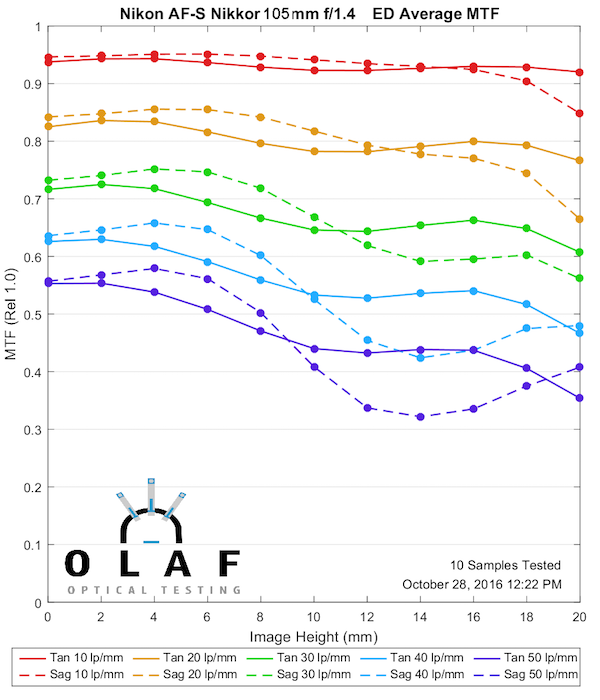
The center resolution is excellent for a f/1.4 lens, which surprised me a bit because most newer Nikon lenses have been willing to give up a little center resolution to maintain good resolution all the way to the edges. Like most newer Nikon lenses, this one does indeed keep superior resolution all the way out to the edge.
This is a spectacular performance, especially for a lens type which hasn’t been available previously in any major mount. It also makes it a bit difficult to give you comparisons since there aren’t any other 105mm f/1.4 lenses for me to put up against it. So we’ll start by comparing it to some 85mm f/1.4 lenses. This isn’t quite as much of a stretch as the numbers suggest since the Nikon actually is 101mm at infinity, not 105mm.
Compared to 85mm f/1.4 Lenses
The Nikon 85mm f/1.4 G lens is an excellent example of what we’ve been seeing from Nikon primes the last 4 or 5 years: not quite as sharp as it’s competitors, but very smooth and even from center to edge. The 105mm f/1.4 keeps that smooth even look, but is far sharper.
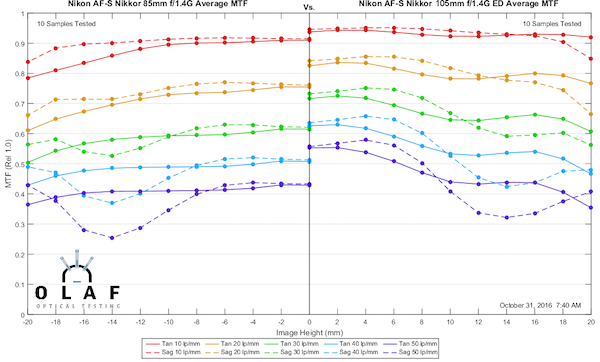
The Zeiss 85mm f/1.4 Otus is arguably the sharpest 85mm wide-aperture lens available. It is, indeed a little sharper than the Nikon 105mm f/1.4, at least in the center of the frame. Away from center it’s still a tiny bit sharper. But at double the price of the Nikon, it probably should be. So for everyone complaining about the price compared to other Nikon primes, well, consider the price compared to an Otus. It seems more reasonable that way.
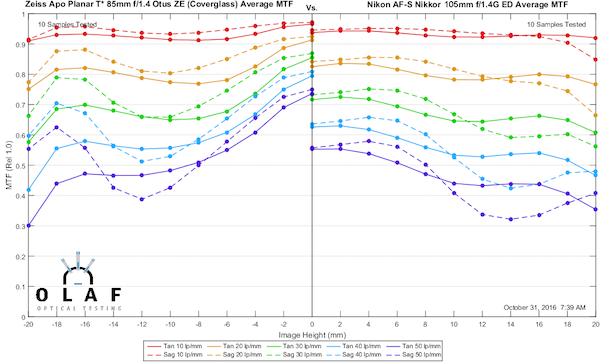
Compared to 100mm f/2.8 Lenses
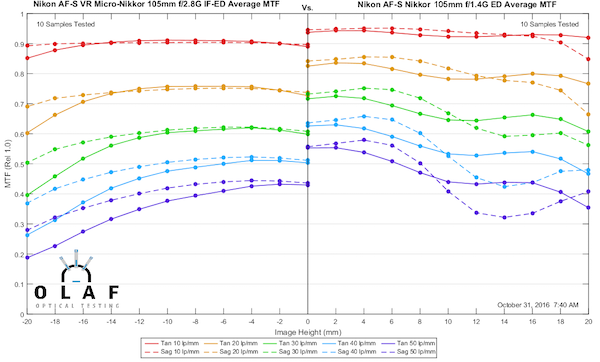
Two full stops of aperture difference make this a very unfair comparison. You would expect a lens at f/2.8 to be far better than a lens at f/1.4. But hey, life isn’t fair, and I’m looking for any reasonable comparison here. The focal lengths are about the same, so I’m going with it.
The Nikon 105 f/2.8 AF-S VR Micro is a far older lens design and is sharper at macro distances than at infinity. I was still surprised that the 105mm f/1.4 ED is flat out sharper at f/1.4 than the 105 Micro Nikkor is at f/2.8. That’s really impressive.
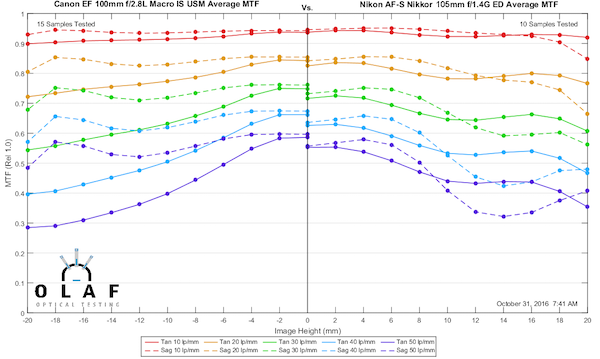
Nikon shooters always seem to think I make a comparison to make their lenses look bad, so I reached down and got the Canon 100mm f/2.8L IS Macro lens out for this comparison, because, well at f/2.8 and as one of Canon’s better lenses, this comparison should keep the Nikon fanboys certain I hate their brand, right? Wrong. Even at f/1.4, the Nikon lens is nearly as sharp as the Canon at f/2.8. That’s just ridiculous.
One Last Comparison
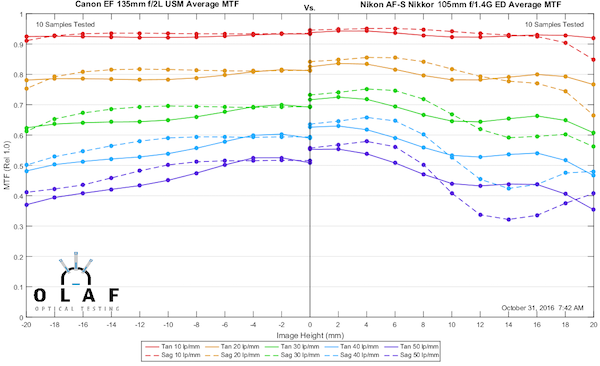
OK, I’ve said for a long time one of my favorite focal lengths for portraits, etc. was 135mm. The Sony 135mm f/1.8 would make a spectacular comparison, but I don’t have data on it. I do, however, have data on one of my all-time favorite lenses, the Canon 135mm f/2.0 L. Again, despite giving up a stop of aperture, the Nikon 105 is a bit better at f/1.4 than the Canon is at f/2.0 in the center, perhaps a tiny bit behind in the outer half of the image. But that’s giving up a full stop of aperture sharpness.
Sample Variation
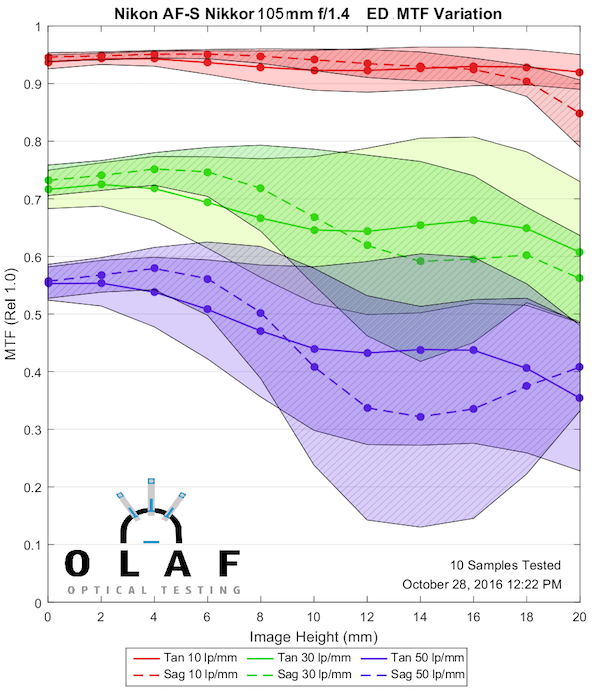
Sample variation with wide-aperture lenses can be a weak point. The 105mm f/1.4 wasn’t bad by any means, although you can see that off-axis there is some variation indicating there are some copies with a bit of field tilt, but overall sharpness variation is good.
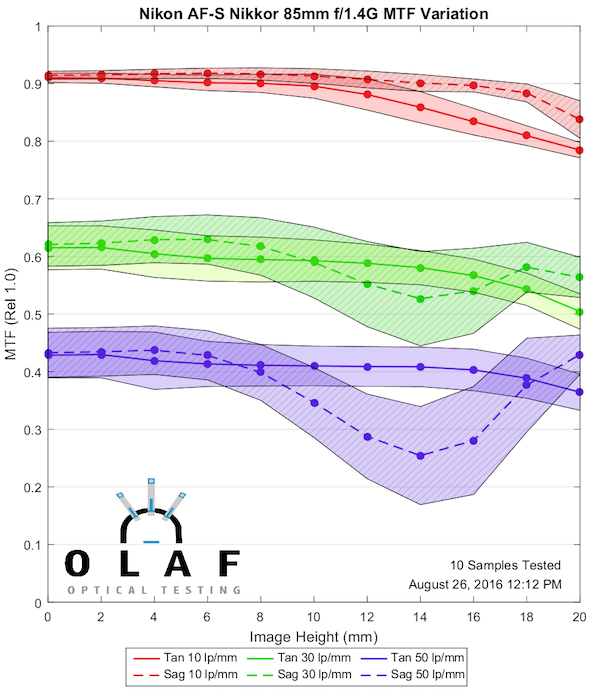
For comparison, here is the variation graph for the Nikon 85mm f/1.4 which has small copy-to-copy variation. The 105 is as low in the center, meaning overall sharpness doesn’t vary much, but wider off-axis, meaning there are some slight decenters or field tilts in our sample population, but none that were clearly bad.
Summary
The optical bench confirms very nicely what the early reviews have said: this is an exceptionally sharp lens edge-to-edge. Optically, it’s probably the best thing Nikon has put out in several years; it’s a genuinely world-class optic. It’s not inexpensive, but it is less expensive than a lot of other lenses that have optical quality like this.
Roger Cicala and Aaron Closz
Lensrentals.com
November, 2016
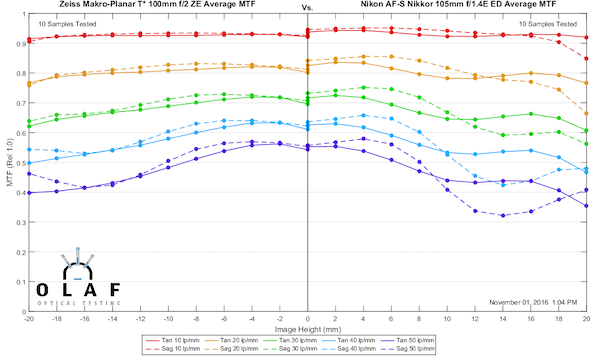
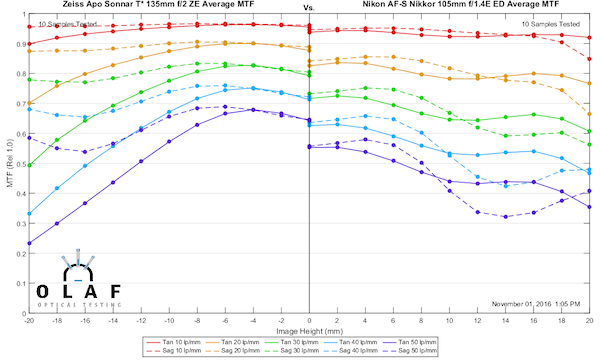
Addendum: OK, I had a moment of weakness and bowed to the requests for a couple of further comparisons. No more, though, OK? I really have to, like, do work and stuff to support this hobby of mine. Remember, again, the Nikon is spotting these other two lenses a full stop of aperture. In theory, it should be much better at f/2.0.
Also, for those who want stop-down tests. No. I’m sorry, but really, I’ve got stuff I need to do. Olaf is getting busier and actually has like revenue generating activities, and stop-downs are another full day of testing. There’s just not time.
Nikon 105mm f1.4 v Zeiss 100mm f/2 Makro-Planar
Nikon 105mm f1.4 v Zeiss 135mm f/2 APO Sonnar
64 Comments
Fazal Majid ·
I’d say the rather high sample variation is consistent with the lens being made in Nikon’s second-tier Chinese factories, not in Japan.
DaveHenson ·
It is not about where it is made but about the quality control procedures. If Nikon have not set the proper controls in place, blame Nikon not the factory.
The sample variation is probably due to the complexity of making a high-quality f1.4 camera as evidenced by Roger’s comment “Sample variation with wide-aperture lenses can be a weak point.”
If you know the issues surrounding camera manufacture better than Roger I would be interested.
Echo ·
Case in point: iPhone.
China builds great gear if your QC game is on point.
Gearsau ·
Exactly. 50 years ago, people used to laugh at Japanese quality. Not any more though. Many Japanese companies have transplants in China and Thailand. I know because, I used to do a lot of application work there ( engineering). The Japanese still have people there, to ensure quality control is maintained.
decentrist ·
In 1966 no one was laughing at Japanese quality. They had quality manufacturing in the optical realm long before that. The Germans have people at their Puebla Mexico VW plant, and they still manage an inferior product relative to German manufacturing. China is second tier quality at best.
decentrist ·
Anyone can look at the output…no experience required.
DaveHenson ·
I’m not sure what your point is.
Adam Sanford ·
There is no EF 100mm f/2.8 IS II. I believe you meant the EF 100mm f/2.8L IS.
Roger Cicala ·
You are correct. And in a minute the article will be too 🙂
Thank you!
Jim A. ·
Sharp eyed Canon fans are never far when they hear someone praising a Nikon lens… 🙂
Roger Cicala ·
Jim A. wins “best comment of the day” award. LMAO
Abhijeeth Aarey ·
Hi Roger, thanks for the data ! For completeness, could we also please look at an MTF comparison to the Zeiss 100 MP if possible ? That would be nice, no ?! 🙂
Thom (whose findings I respect) also posted his review of this lens. He mentions a dip in performance in the corners when stopping down from f1.4 to f2.0 and f4 . Apparently recovers by f5.6. Would be nice to look at the data (if possible) to see if this is consistent across copies and also to understand “how much”- may be helpful to understand this lens better.
Thanks!
Roger Cicala ·
OK, I’ll post it as an addendum to the article in a minute. And I’ll throw in the Zeiss 135mm f/2 also. But the guys requesting Tamron comparisons, well, since nobody ever rents them, we don’t stock enough to test them. Sorry.
Albert ·
Fair enough. Is it on my to-buy list since as much as the forthcoming Sigma 85 ART sounds good, it is not in my budget. Plus I plain love the Tamron 35. I am very curious about the Samyang 135 f/2 though, but want to try it before plunking down $500 on a manual focus lens, and soon discovering it has become a $500 paperweight.
Roger Cicala ·
Albert, I don’t have an opinion on the image quality of the Samyang, although from what I hear it is excellent. My only advice would be if you buy one, and are in the US, go with Rokinon’s brand. They have repair capabilities, Samyang and Bower really don’t. And they will break.
Andre Yew ·
Hey, who are you calling nobody?! I even bought my rental copy! 🙂
It’s too bad not more people have discovered how good the Tamron 85 is.
Roger Cicala ·
Andre, I meant, “only a few special people”. I did review the shorter Tamron f/1.8s and they were excellent. But we never got enough 85s.
Abhijeeth Aarey ·
Thanks Roger ! The 100MP is my personal “reference” lens, so this is useful info. Perfmance like this at a full aperture advantage , especially 40lp/mm and above, and with AF (!) really puts this lens performance in perspective. 135 Zeiss comparison is a bonus !
Cheers :)!
Carleton Foxx ·
No one rent them because you don’t test them.
Albert ·
Looks absolutely spectacular. Nice to see Nikon finally doing credit to its name and rep once again.
Two other lenses that have been compared to Zeiss equivalents I’d love to see put under the Olaf are the Tamron 85 f/1.8 VC (http://www.cameralabs.com/reviews/Tamron_SP_85mm_f1-8_Di_VC_USD/sharpness.shtml) and the Samyang 135 f/2 (http://www.lenstip.com/442.4-Lens_review-Samyang_135_mm_f_2.0_ED_UMC_Image_resolution.html and CameraLabs say the same).
Echo ·
Posts like these may not directly generate revenue, but it’s convinced me (a Canon guy) to rent a Nikon D610 body and this lens. I’m usually a 5D/135mm guy.
Thanks for the effort in these comparisons Roger. They’ve helped me make many a rental and purchase decision. I’m just waiting for the inevitable 24-105 II MTF testing now!
alvareo ·
The sensor in the D610 is better than the 5D up to the mk III, ISO 12800 on the 5D and ISO 25600 on the D610 have equivalent amounts of noise, plus you can pull more details out of the shadows on the D610 without gaining a whole lot of noise with it.
Abhijeeth Aarey ·
Wanted to echo this comment 🙂 !
May not directly contribute to revenue, but articles, data and comparisons like these go a long way in me sticking to renting exclusively from LR ( 6 years and counting !)
Unrest ·
Nice. Thanks, Roger.
James ·
I know we’re talking about f1.4 vs f2 but the Zeiss MP 100 looks rather good.
John Koerner ·
Of course the Zeiss is good. But it’s not a true macro, it’s not as sharp at f/2 as the Nikon is at f/1.4, and the Zeiss doesn’t have AF either. The Nikon 105 is better in every conceivable way, for a few hundred more.
James ·
I think that’s overstating it a bit. it depends a lot on what you shoot. The zeiss mp is the only zeiss stills lens to have come from their cinema optical line of design. It has a lot going for it in terms of color, rendering, and build.
John Koerner ·
How am I overstating? The Zeiss is not as sharp, not as fast, has no AF, and its bokeh/rendering isn’t as good, either.
James ·
Because the lens is a tool and not a set of measurements. To say the Nikon is “better in every conceivable way” is what I meant by overstating it. It’s a question of use cases.
John Koerner ·
I understand, James.
However, you need to understand that “the set of measurements” defines the lens’ abilities. Denial of this isn’t rebuttal, it is only denial.
It is a non-statement for you to say the obvious: “Because the lens is a tool.” Yes, James, lenses are tools. And (regardless of genre) some tools are better than others at what they’re designed to do.
As an example, a miter-saw and a hand-saw are both tools, designed to cut wood. Yet one cuts virtually all forms of wood better, faster, and with more precision than the other. While there might be 1 or 2 applications where a hand-saw would do comparable work, or might even be preferable, the fact remains that in *most* cases a power saw is going to be used … and will save an incredible amount of time/effort for the user, usually doing the better and more precise job as well.
Back to lenses:
By the same token, the Zeiss macro lens isn’t even 1:1, it;s 1:2. It may have a certain few applications where it’s comparable, even preferable, but for *most* applications, the new Nikon 105 will do anything the Zeiss will do … better, faster, more accurately, and with greater sharpness to boot. That’s what the measurements say, and that is the reality of AF vs. MF.
Again, denial isn’t rebuttal, it’s only denial.
James ·
Look, I agree with you. I simply stated the zeiss lens on that mtf looks rather good (especially at the edges I observe). The Nikon may be the best thing since sliced bread – I haven’t used it myself so I don’t really have an opinion of it yet. I don’t tend to form opinions based simply on measurements.
Cesjr86 ·
Also with the MTF data being as close as it is I don’t think you will see an actually difference in real life scenarios when it comes to f1.4 vs f2 between the 2 lens. Now, of course it is a 100 vs a 105 and the 105 is a whole stop faster so you will in other ways.
PitDog MMA ·
I understand, James.
However, you need to understand that "the set of measurements" defines the lens' abilities. Denial of this isn't rebuttal, it is only denial.
It is a non-statement for you to say the obvious: "Because the lens is a tool." Yes, James, lenses are tools. And (regardless of genre) some tools are better than others at what they're designed to do.
As an example, a miter-saw and a hand-saw are both tools, designed to cut wood. Yet one cuts virtually all forms of wood better, faster, and with more precision than the other. While there might be 1 or 2 applications where a hand-saw would do comparable work, or might even be preferable, the fact remains that in *most* cases a power saw is going to be used ... and will save an incredible amount of time/effort for the user, usually doing the better and more precise job as well.
Back to lenses:
By the same token, the Zeiss macro lens isn't even 1:1, it;s 1:2. It may have a certain few applications where it's comparable, even preferable, but for *most* applications, the new Nikon 105 will do anything the Zeiss will do ... better, faster, more accurately, and with greater sharpness to boot. That's what the measurements say, and that is the reality of AF vs. MF.
Again, denial isn't rebuttal, it's only denial.
RLThomas ·
Geez Louise, Roger! All this talk about working and revenue generating activities… You’d think Lensrentals.com was a business! Seriously though, I must say your reviews, er, I mean MTF test results, do induce me to rent (and then buy) some of the better glass you come across. My dream is that someday manufacturers will see the light and provide ACTUAL MTF curves based on multiple copies and copy variation data like you do. Until then, I will wait to see what you have to say before rushing out to get the latest gear because when Roger and Olaf say it’s great – I believe it.
Roger Cicala ·
Thank you! While Lensrentals does just fine, OLAF, which is entirely funded by yours truly, bleeds money like you can’t imagine. Just trying to slow the hemorrhage 🙂
DrJon ·
Which makes it time to say thank you very much for all you this great effort are putting out to the community, I’m pretty sure everyone really appreciates it (even with the odd fan-boy moment).
bokesan ·
I wonder what the Nikon’s weaknesses are. E.g. the Zeiss MP 100 looks spectacular, too, but many people are put off by it’s LoCA. So far I’ve only read about slower AF than some reviewers would have liked. If nothing else comes up, I’ll be _really_ impressed.
John Koerner ·
The weakness of ALL Zeiss is that they’re MF. If you need to get a quick, crisp, perfect shot … in a fleeting moment … the Zeiss lenses fail. The Nikon will give you BETTER results *with* blazing-fast AF so you make sure you nail it, in time. What’s not to like?
Marc P. ·
What’s the problem with MF Zeiss lenses? If you can’t handle it, you’re not the typical MF lenses shooter, period. No offence. 😉 For sure, AF is better for example at Night Photography, but i like my MF lenses.
John Koerner ·
Marc, you can’t even spell the word ‘offence’ (no offense 😉
As an extreme macro shooter, who uses a vintage all-manual Voigtlander 125mm macro lens, with 630° of focus throw, I assure you I can “handle” MF lenses as well or better than you think you can. Most often, when I have the time, I prefer MF over AF, which is why virtually all of my lenses are MF (I only own 2 AF lenses). So I enjoy my MF lenses as you do. However, for wildlife, and many times quick moments of portraiture, AF is simply preferable to MF, because you can nail a fleeting moment in a split-second, rather than trying to nail it manually. I think the appeal of this lens is that it rivals the best Zeiss MF lenses *and* gives you very fast AF. If you mostly shoot situations where you don’t need AF, then stick with manual. But it’s nice to have Zeiss-like quality with blazing-fast AF to boot.
Marc P. ·
John, nothing against you, but i dislike ppl into general with self-adulation behaviour…everybody does know the difference between a MF and AF lens…anyway, i don’t shoot fleeting moments, or people, or sports, or action…just static objects, nature, landscape, a bit architecture, and other things i do like and love…besides this, i do shoot myself since 87, and i do think it’s long enough…just as a hobby and for keeping track of my memories. 🙂 nothing bad meant.
And even this lens is really *very* good, i’d stick with a true zeiss lens, because the type of rendering style & micro contrast is slightly different, also the 3D Pop, not with every Zeiss lens, but most of them. 🙂
Good Light !
John Koerner ·
Are you saying ‘you’ don’t suffer from self-adulation, Marc? Might want to re-read your own comments 😉
I use the Voigtlander 125mm macro because it is made by Cosina (the same company that makes the Zeiss Makro and Milvus ;), only Cosina made their Voigtlander superior to the Zeiss Makro (true 1:1, as opposed to 1:2, with true color correction) … so much so that Zeiss demanded Cosina stop making their own macro lens, if they want to continue manufacturing for Zeiss … might want to look into it … especially if you like the 3D pop 😉
http://www.thenaturephotographer.club/JohnKoerner/653/1783/medium
http://www.thenaturephotographer.club/entry.php?16
PitDog MMA ·
Are you saying 'you' don't suffer from self-adulation, Marc? Might want to re-read your own comments ;)
I use the Voigtlander 125mm macro because it is made by Cosina (the same company that makes the Zeiss Makro and Milvus ;), only Cosina made their Voigtlander superior to the Zeiss Makro (true 1:1, as opposed to 1:2, with true color correction) ... so much so that Zeiss demanded Cosina stop making their own macro lens, if they want to continue manufacturing for Zeiss ... might want to look into it ... especially if you like the 3D pop ;)
http://www.thenaturephotogr...
http://www.thenaturephotogr...
PitDog MMA ·
Marc, you can't even spell the word 'offence' (no offense ;)
As an extreme macro shooter, who uses a vintage all-manual Voigtlander 125mm macro lens, with 630° of focus throw, I assure you I can "handle" MF lenses as well or better than you think you can. Most often, when I have the time, I prefer MF over AF, which is why virtually all of my lenses are MF (I only own 2 AF lenses). So I enjoy my MF lenses as you do. However, for wildlife, and many times quick moments of portraiture, AF is simply preferable to MF, because you can nail a fleeting moment in a split-second, rather than trying to nail it manually. I think the appeal of this lens is that it rivals the best Zeiss MF lenses *and* gives you very fast AF. If you mostly shoot situations where you don't need AF, then stick with manual. But it's nice to have Zeiss-like quality with blazing-fast AF to boot.
Søren Stærke ·
Why didn’t you test the NIkon 105 at aperture f/2 and f/2.8 to get a direct comparison with the other lenses at that aperture? It would give a much better understanding of the difference of a full stop or two, when it comes to MTF results.
Roger Cicala ·
Because time.
Richard Haw ·
Thom has his review up. he said that this lens drops in performance around f/2-f/4. just go read it for yourself. his commentaries mirror the ones made in this benchmark.
Richard Haw ·
which is saying a lot.
Richard Haw ·
http://www.dslrbodies.com/lenses/nikon-lens-reviews/nikkor-prime-lens-reviews/nikon-105mm-f14e-af-s-ed.html
sorry, forgot the link.
chrisgull ·
Whoa.
Ed Bambrick ·
There is a kind of relief that occurs when one sees the latest and greatest is not exactly as good as the tired old dogs they’ve had for several years. Such as the 135mm Apo or the Otus 85mm. For what I use them for, and how I use them, there are none better.
John Koerner ·
How do you figure “not as good?”
The Zeiss is slower on every level (no AF, f/2 not f/1.4).
DrJon ·
If you’re ever at a loose end I see you stock the Laowa 105mm… 🙂
(Their MTF graph on your page for the lens look very interesting. Plus there’s two aperture rings to play with…)
Falk Lumo ·
Thanks.
However, the one and only comparison will be against the forthcoming Sigma 85/1.4 Art.
Falk Lumo ·
Maybe, I should clarify: According to some lab tests, the Sigma 85/1.4A clearly outperforms the Otus 85/1.4 and may be the sharpest lens ever made. At much lower cost than the Nikon 105/1.4. Of course, the Nikon may still be a superior choice but it should be compared against the 85/1.4A.
Max Manzan ·
The new Sigma 85mm Art is a superb lens. However, if some lab tests certifiy that it “clearly outperforms” the Otus 1,4/85mm, I’d very much question the reliability of those labs.
Falk Lumo ·
Hi Max,
meanwhile, DxOlab tested all, the Sigma 85/1.4A, Zeiss 85/1.4Otus and Nikon 105/1.4E.
-> https://www.dxomark.com/Lenses/Compare/Side-by-side/Sigma-85mm-F14-DG-HSM-A-Nikon-on-Nikon-D800E-versus-Nikon-AF-S-NIKKOR-105mm-F14E-ED-on-Nikon-D800E-versus-Zeiss-Carl-Zeiss-Apo-Planar-T-Star-Otus-85mm-F14-ZF2-Nikon-on-Nikon-D800E__1777_814_1727_814_1384_814
At F1.4, the Art is the clear winner, followed by the Zeiss, then Nikon where the Zeiss is relatively stronger towards the edges (vs. Nikon). Note that the DxO Accutance charts deemphasize differences at the top compared to an MTF sensor test chart or an optical bench test.
At F2.8, all three lenses become the same in the inner 40%. Beyond, the Sigma and Zeiss both beat the Nikon.
This is considering pure resolution. I hear the Nikon 105/1.4E has a nicer bokeh and better contrast. Also, One should mention that the Nikon 105/1.4E has a focal length of 95mm only at infinity!
Max Manzan ·
Thank you Falk,
“DxOlab tested all, the Sigma 85/1.4A, Zeiss 85/1.4Otus and Nikon 105/1.4E. ”
my point exactly.
Best
Jim Kasson ·
Darn you, Roger. You just cost me two G’s.
Christian Nilsson ·
Well here is one more review of the Nikon 105mm f/1.4 with MTF measurement made in an optical bench. Scroll down too see the MTF charts. Also MTF comparisons with Zeiss Otus 85mm f/1.4, the old Nikon 105mm f/2 DC and a couple of other portrait lenses. Nikon has done a good job but the Otus beats it when it comes to sharpness at close focus distances. http://www.objektivtest.se/tester/nikon-af-s-105-mm-f14-e-ed-test-bokeh-mastare/
stevelink ·
Excellent article as usual, Roger! But I wonder how this lens stacks up against the Fujinon XF90mm f/2…As a product and landscape photographer using several other brands over 35+ years, I can state that this Fujinon XF90 is hte sharpest lens I’ve ever had the pleasure of using! It makes me really anticipate the upcoming Fujinon XF80mm f/2.8 Macro! Now, if that one’s even sharper than the XF90, especially at macro distances, it will be freaking Awesome indeed! Thank you sir.
Nick Korn ·
Congrats to Nikon for their new product. However, it’s still behind the Sigma 85mm f/1.4 Art in term of sharpness per DXO Mark sharpness results; Nikon 105mm f/1.4 @ 33 pMP vs Sigma 85mm f/1.4 Art @ 36 pMp tested on the D810. Keep in mind that the D850 is the new standard for Nikon at 46 MP. If you do the math, the best Nikon lens (105mm f/1.4E) is still 13 MP away from resolving the entire D850 sensor.
Just to be fair to Nikon, Canon isn’t doing so well in resolving their 50 MP sensor either, because most of Canon’s lenses can only resolve about 33 pMP per DXO mark sharpness results. Their 300mm f/2.8 L II is the only outstanding one resolving 45 pMP per DXo Mark.
The only maker of lenses that could resolve their highest sensor would be Sony, because it has quite a few lenses that can resolve about 40 pMP on their a7rII’s 42 MP sensor.
Sure, some would argue the DXO mark numbers don’t mean a thing…truth because a 12 MP camera can still produce fantastic images, but you are paying lots of money and wasting the full potential of the 46/50 MP sensor if your lenses cannot deliver…
bokesan ·
Roger, was this test done with or without extra glass in the path? I’m asking because the Nikkor only has 66.1mm exit pupil distance according to the EXIF data, so it should be quiet strongly affected by this. (Looking at Brians graphs from this post: https://www.lensrentals.com/blog/2014/06/sensor-stack-thickness-when-does-it-matter/).
Yitzchal Levy ·
The Zeiss 135mm f/2 APO Sonnar curves look VERY impressive!