

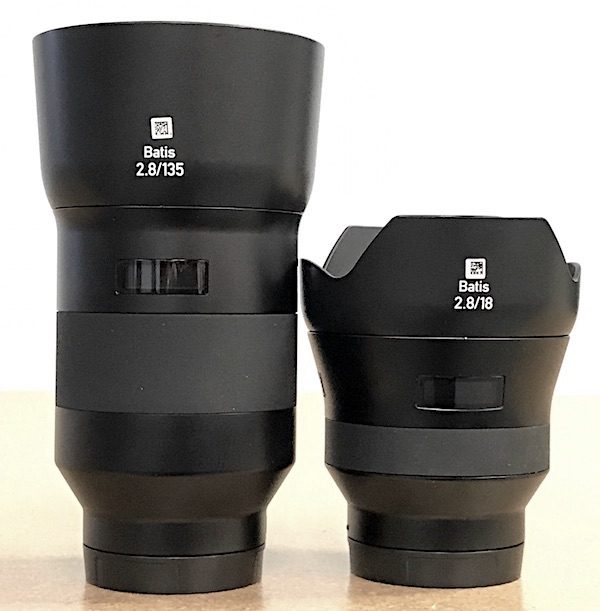
I’ve been slow to test the Batis lenses for several reasons. We can never get enough copies when they’re first released and by the time we do have enough copies I’ve got six other things to do. That said, I did give an overview of the Batis 25mm and 85mm a while back and even did a teardown of the 25mm of.
But I haven’t gotten around to testing either of the Batis at the extreme focal lengths: the Batis 18mm f/2.8 and the Batis 135mm f/2.8. That’s a shame really because the Batis are generally excellent lenses, reasonably small to carry around, and, by FE mount standards not ridiculously high in price. So I finally got around to testing both of them and thought I’d just combine things into a single post.
MTF Curves
Batis 18mm f/2.8
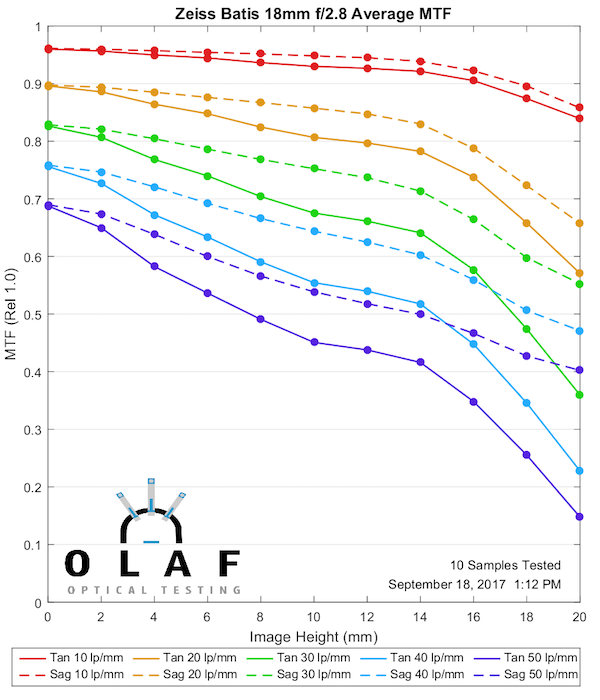
We’ll start with the 18mm, which I was quite interested in testing. It gets a ton of positive comments, and Zeiss generally does a spectacular job with their wide-angle lenses. The MTF curves confirm just that. It has excellent resolution, not just in the center, but well out toward the edges. There’s little separation between the tangential and sagittal curves, indicating low astigmatism and lateral color.
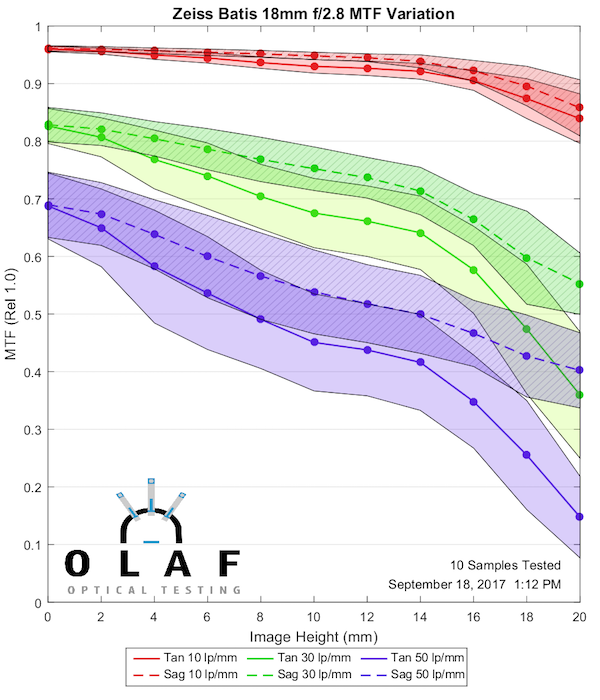
The 10-copy variation curves are also very good for a wide angle lens. This is a nice, tight pattern.
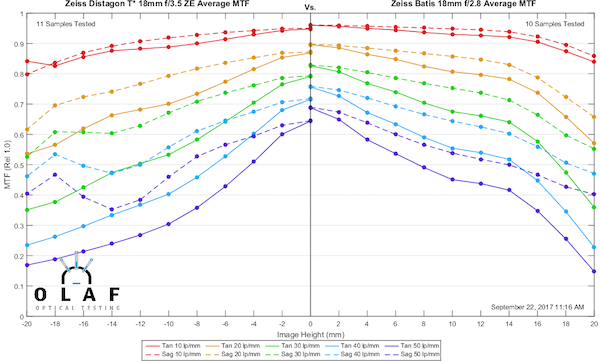
Of course, it helps to show some comparisons to other lenses. Let’s start with comparing it to the Zeiss 18mm f/3.5 Distagon T*. The Distagon has an advantage in being tested at f/3.5 compared to the Batis at f/2.8. But the Batis still smokes it.
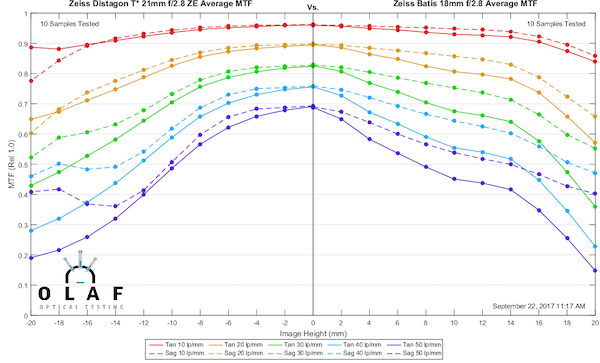
Let’s make things a little tougher. The Zeiss 21mm f/2.8 Distagon has been THE wide angle lens for comparison since way before I’ve been testing. While they’re even in the center, the 21mm Distagon is a little better off-axis.
Batis 135mm f/2.8
The 135mm focal length now has a huge number of excellent lenses, which makes me happy. I love that focal length. The Batis 135mm f/2.8 is certainly one of them.
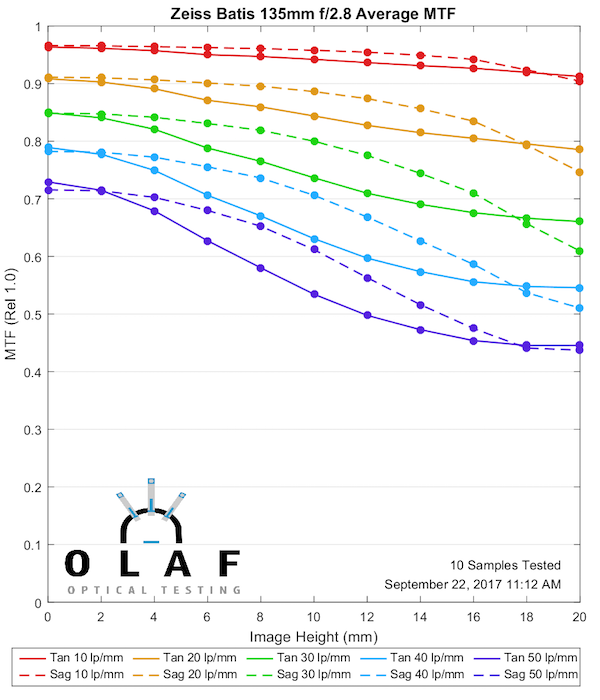
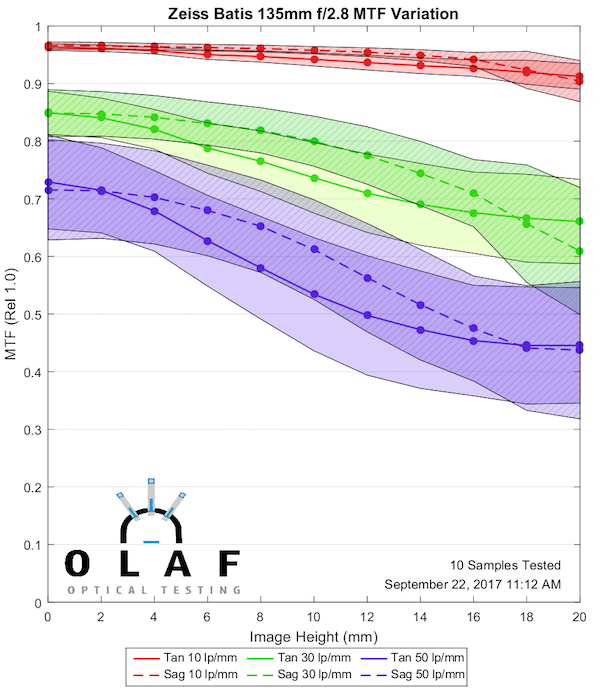
The variance is also good, although we expect that with a 135mm lens.
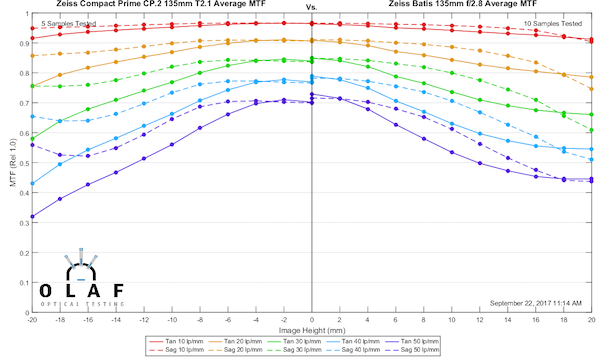
We’ll start comparisons by staying in-brand, with the Zeiss 135mm T2.1 CP.2 lens. They’re virtually identical. Well, as far as optical testing. They’re pretty easy to tell apart if you have them in your hands.
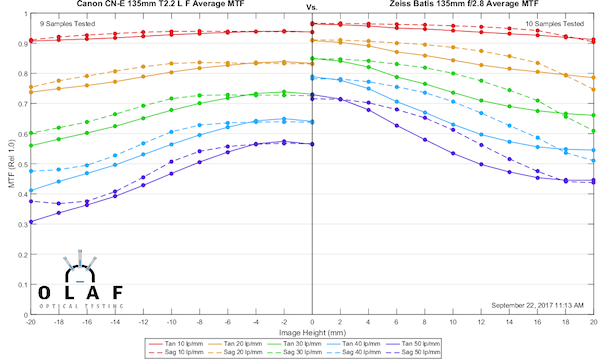
The next comparison is with my ex-favorite lens, the Canon 135mm f/2. Remember, the Canon is being tested at f/2, so it is expected not to be quite as sharp as the f/2.8 lens. But OK, the Batis is certainly at least stop worth of better. This is pretty impressive.
The Full Batis Line
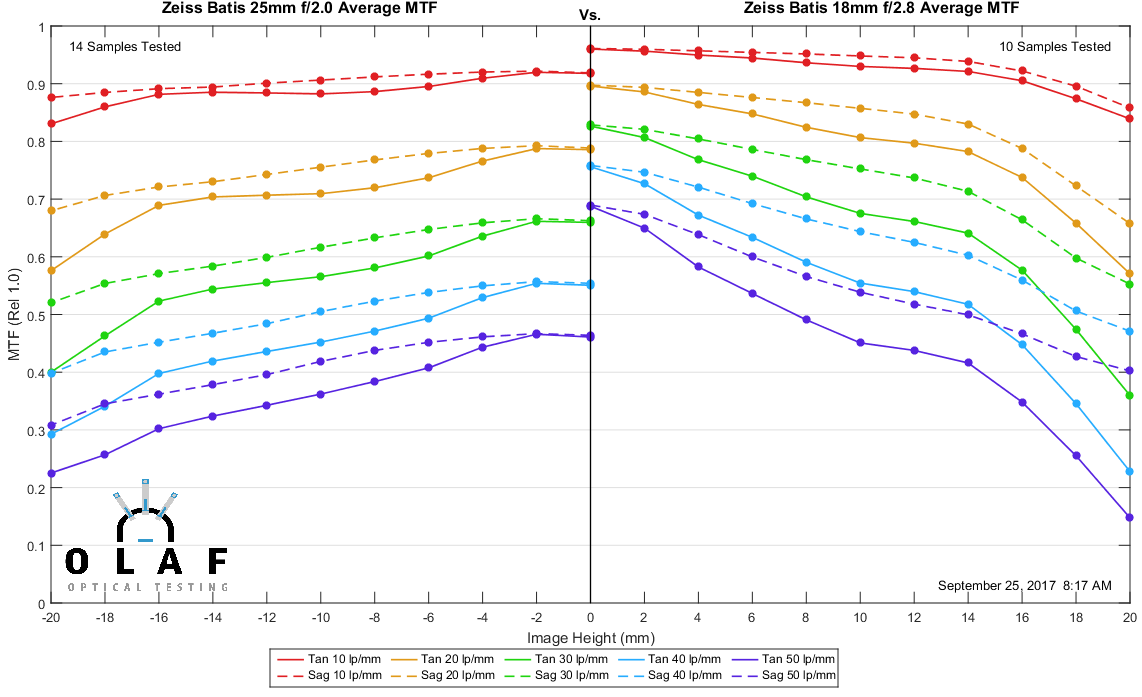
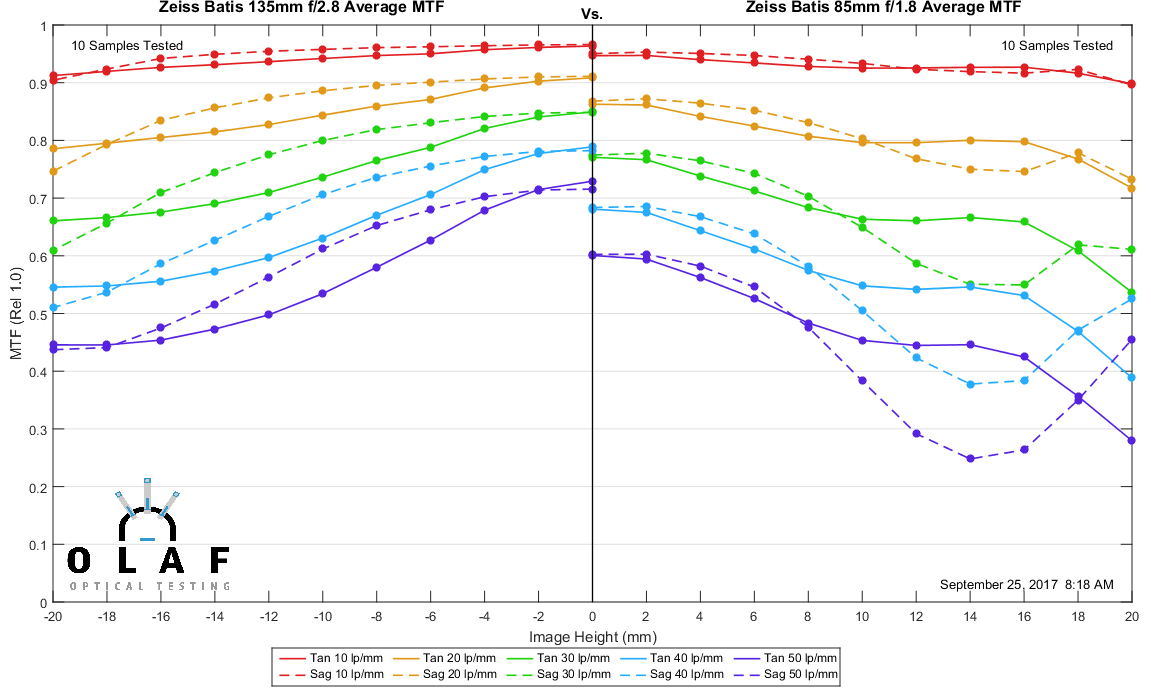
I doubt anyone is choosing which Batis lens they are going to purchase on the basis of MTF charts. I’m using our comparison graphs to put all 4 of them together without taking up a lot of space, though, so that they’re in one place. Remember the two middle-range lenses are tested at a wider aperture than the 18mm and 135mm.
Roger Cicala
Lensrentals.com
September, 2017
What is best in life, Roger?
To crush the marketing departments. See them driven before you. And to hear the lamentations of their sales reps.
55 Comments
SpecialMan ·
Some of the other Batis lenses were designed by Tamron, according to internet lore; have we taken one of these Batisi apart to look for family resemblances? And, if this is true that they have such humble origins, what does it mean from a global perspective? Should we cut out the middleman and buy Tamrons?
Roger Cicala ·
I don’t know first-hand (if I did I couldn’t comment at all because of nondisclosures) but the rumors I hear are that Tamron is doing a lot of lens design and some manufacturing for lenses wearing other badges and not just Zeiss. We did take apart a Batis 25mm (I linked in the article) but optical design wouldn’t show in the teardown. Optomechanical design might.
SpecialMan ·
Thanks. Fascinating—I foresee a future when we become brand-agnostic and start buying lenses because we’re fans of the designer. For instance, the Batis 25 was supposedly designed by Takahiko Saka—maybe he’s the Helen Turley of optics????
Athanasius Kirchner ·
You raise an excellent point – most lens designers, despite their enormous contributions to the field of photography, are almost anonymous. Yet they’re responsible for many compromises and specific ‘looks’ – I’d certainly love to know more about the humans behind optics.
Brandon Dube ·
The history of great lens designers at various companies is pretty well known – -buy “A History of the Photographic Lens,” it covers things up to at least the 1960s-1970s pretty well in terms of whos-whos.
Their fingerprints are most visible when you look at field curvature/astigmatism — designers tend to have fairly clear tastes w.r.t. that.
Athanasius Kirchner ·
Thanks, that’s a good tip.
Someone ·
Nikon exposes a little bit of that in their “Nikkor Thousand One Nights” series of articles.
http://imaging.nikon.com/history/story/
Athanasius Kirchner ·
They’re too convoluted for my taste – the translation is somehow “off”, and in the end I get distracted by the curious use of English made in the articles. They’re not terrible or anything, but obviously translated by a Japanese native who understands English, rather than the other way around (I consume unhealthy amounts of Japanese media translated for Western audiences, which is how I ‘know’ this).
Astro Landscapes ·
Pentax users have been ahead of you by years on this one! Their forums are packed with discussions about who designed which optic.
Les ·
People confuse production design and optical design. If it’s made in a Tamron factory, then Tamron had a hand in the production design. They may also have designed the optics, but that’s not a given.
Another issue is that lenses are built to a cost. Back in the 1990s, Sigma was telling journalists that they could build lenses that are just as good as Zeiss/Leica (and they may have built some R zooms for Leica), but then they would need to charge just as much money for them. The market wasn’t ready for that back then, but it is now.
In other words, Tamron could sell a lens like this under their own brand, but it wouldn’t be significantly cheaper.
Roger Cicala ·
Les, I think that’s exactly it and in these days there are so many patents and subassemblies that I think there are few “100% brands”. Leica (as in real Leica, not Leica-xxx), Sigma, and Canon probably are. But when we disassemble things we often see that electronics, AF assemblies, and some other things all seem to be made in the same place, they’re extremely similar no matter the badge on the outside.
Whether a lens is designed in house and then outsourced for parts, or the AF assembly and optomechanicals contracted from one of the half-dozen huge optical foundries whose names no one has heard of, or the design bought from another company and made in house, it’s all much grayer than people want to think.
Mike ·
Sigma made the 28-70 for Leica, possibly others, Minolta made several for Leica. Tamron made some excellent optics, I have a lot of their 80’s zooms and a 180.
Messier77 ·
Roger, thanks for doing this test. Any chance you could put up comparisons to the Sony 16-35 f/2.6 GM and 12-24 f/4 (I know you wont have them at the same focal lengths, but it’s at least worth a look)?
Samuel H ·
I went to the 16-35 and 12-24 articles, unless Roger says otherwise (I know methodology has changed at times, but I don’t keep track of when and how), I think you can just compare the graphs.
Messier77 ·
Just easier to see them side to side. That’s all.
Roger Cicala ·
No methodology changes for stuff out in 2017, but that’s a good point.
Roger Cicala ·
https://uploads.disquscdn.com/images/2bc5676838fbee8aa1c6c56435e89cd762252f1ce3a7f41ba4222b8e27d4208e.png
Messier77 ·
Thanks! The 16-35mm GM is extremely impressive by comparison, especially considering that’s at 2mm wider.
Roger Cicala ·
At the wide end, yes, it’s one of the best wide-zooms around at 16mm. It isn’t nearly as nice at the longer end. On the other hand, the Batis doesn’t zoom at all.
yaley ·
So you’re telling me the GM zoom is as good as the Zeiss prime?
Max Manzan ·
“While they’re even in the center, the 21mm Distagon is a little better off-axis.”
hm, that’s not really what I see in the comparative diagram. I see a slightly better performance off-axis over most of the field for the Batis 18mm, except in the extreme corners, where the difference is tiny.
Samuel H ·
I came here to say exactly that.
And also that I see a Batis 18mm in my future…
Roger Cicala ·
I’m giving a lot of emphasis, in a wide angle, to the lower sag-tan separation of the 21mm when I say better. You’re correct about absolute numbers, but lower astigmatism is a big deal to me. YMMV of course, we all are looking for different aspects. But I think we have to call both ‘amazingly good’ and I probably split hairs a bit too much with that comment.
Claudia Muster ·
It would be interesting if you could sometime elaborate in a short article what lens astigmatism means for real photography.
Brandon Dube ·
there’s something kind of sort of like that in the works
Roger Cicala ·
It’s not that short :-). Oh, wait, you’re talking about the next article.
Claudia Muster ·
🙂 In the meantime, I’ve found your enlightening article from 2010 about aberrations. I’m looking forward to your next article.
Claudia Muster ·
In the meantime, I’ve found your very enlightening article from 2010 about aberrations. It kind of answers my question. (Although I don’t doubt that theres still much more about it.)
TinusVerdino ·
Also looks impressive against the Rokinon/Samyang 135 and the Sigma 135 1.8 excuse me for Photoshopping:
https://uploads.disquscdn.com/images/5521a86524f718c361899c72ee2f2cc23c7728ccd0b6aba4d52f5fa533defa6c.jpg
https://uploads.disquscdn.com/images/c76b5c1916fbfbe6c37258ab952ff702baf273fd472acd691a1981fd319d6d24.jpg
Roger Cicala ·
Photoshop away!! Well done.
Adrian ·
Not if you compare it with the Sigma 135 at 2.8 :
https://www.lensrentals.com/blog/media/2017/04/stopdown.jpg
Of course, that was only one copy (an average one as Roger says), and there is more to a lens than MTF (for me bokeh fringing is also very important)
Samuel H ·
I’m hoping Sigma will start making FE lenses soon, and they will be new designs tanking tha advantage of the shorter focal flange distance. But, in the meantime…
Your old imatest results said adapters were a bad idea, but lots of users were perfectly happy with them. Maybe because their standards are not THAT high, even with all the pixel peeping everybody seems to love nowadays, or maybe because the test was somehow unfair to adapters, which I doubt, but well, it may have happened, after all you’ve changed your methodology a lot since those days, and that means it wasn’t perfect. Did you ever revisit this issue with the new methodology?
I’m asking because this Batis 135mm looks great but the Sigma 135mm is almost as good… at f/1.8 instead of f/2.8! And yes, it’s huge and twice as heavy, but it’s actually cheaper than the Batis.
Roger Cicala ·
I said adapters were a bad idea for testing. At the time, several reviewers were doing Imatest on one camera using adapters for different lenses and claiming that made the tests equal. Adapters will detectably alter Imatest numbers. But that doesn’t mean they’re a problem for photography most of the time; they aren’t.
Samuel H ·
Great to hear. My guess is that they always cause some tilt, which you could see on the field curvature graphs.
Still hoping Sigma will bring out FE lenses before Sony brings out the a7x I’ve been waiting for… (I’m shooting video, none of their options is good enough to justify the upgrade from an a6500).
Roger Cicala ·
Exactly. And if you’re shooting a 2-D test chart that tilt ends up making readings lower than they should be in some areas.
Jonathan ·
Roger, the graph name for the Canon lens is wrong. 🙂
Lee ·
Any particular reason you used the 135 CP.2 and 135 CN-E instead of the vanilla versions? Seems random since the Batis isn’t really a cine
Roger Cicala ·
Not really. Those two are optically identical to their photo counterparts. Just grabbed them probably because they showed up first in the drop down menus.
Ilya Zakharevich ·
Duplication at end of 1st paragraph: “did a teardown of the 25mm of the 25mm”.
Roger Cicala ·
Thank you, Ilya. Fixed that.
SpecialMan ·
Hmmmm… so.
If I shot using best technique, would a client be able to see that the acutance and resolution from these lenses is superior to their Canon or Nikon cousins?
Or are we talking swings and roundabouts as usual?
Roger Cicala ·
Depends on what you were shooting, what print size and resolution, etc. Would they? I have no idea. Could they? Sure.
obican ·
Roger Cicala (from Lensrentals) did compare Zeiss Batis for So… OMG LOOK AT WHAT THAT BATIS 2/135 DID TO THAT POOR CANON!?!?!
Seriously, that Canon 135L is already an excellent lens and I was expecting the Batis to be quite a good lens too but I wasn’t exactly ready for this.
Wait, I’ll scroll up and have another look.
…
Oh god…
Roger Cicala ·
Remember, the Canon is spotting a full stop of aperture. It would be much closer if it was at f/2.8.
obican ·
Yeah I remember that but still, that’s pretty impressive. Still, sleeping on that information for a night and considering the price difference, I’d still be absolutely happy with the 135L on a Sony body.
DrJon ·
Okay, impossible-ish question given your time constraints – you say ” The Zeiss 21mm f/2.8 Distagon has been THE wide angle lens for comparison” but I’m thinking maybe the Sigma 20mm f1.4 will be better by the time you hit f2.8, and have AF. (I tested one of the Sigmas once and the lack of purple fringing wide-open was insane.) Would you like to prove your assertion (and co-incidentally select my purchase…)???
vasile ·
thanks for the batis18. now i’m more confuse regarding what to buy 🙂
OTOH, “To crush the marketing departments…” – tell that to apple…
VPR ·
Thank you, Roger Cicala and Lens Rentals.
I recently bought the Batis 135mm f/2.8 (“on sale”), in part because of what your MTF analysis revealed about what this beast can do.
More generally, this particular review showed, once again, why your blog carries weight with so many. Your commitment to transparency and rigour, not to mention the lively style that you and your colleagues bring to your blog, make this a “must read” site.
Thank you. Live long and prosper!
A Canuck ·
Thank you, Roger Cicala and Lens Rentals.
I recently bought the Batis 135mm f/2.8 ("on sale"), in part because of what your MTF analysis revealed about what this beast can do.
More generally, this particular review showed, once again, why your blog carries weight with so many. Your commitment to transparency and rigour, not to mention the lively style that you and your colleagues bring to your blog, make this a "must read" site.
Thank you. Live long and prosper!
PS: Thus far the Batis 135 has been lovely to use... and some of the photos it has helped me to take are actually not bad! I hope I will learn how to use it to maximum effect.
j.a. ·
Impressive results undoubtedly. Zeiss lenses are well know for their micro contrast. Is this something that can be measured?
PaloAltoMark ·
Hi Roger. Is a lens’ ability to render things dimensionally (the so called “Zeiss pop”) measurable using MTF charts? Would performance at +40 line pairs per millimeter be the way to do the evaluation? Thanks in advance for your perspective.
Roger Cicala ·
PaloAlto and j. a. the problem is trying to define nonscientific terms (Zeiss pop, micro-contrast) scientifically. Actually, micro contrast has a scientific definition put out by Zeiss many years ago and it is, indeed, lens performance at high frequencies; 40 and 50 lp/mm. However, that is NOT how it’s used (abused perhaps) on the forums and discussion boards where it generally means ‘something I can see that’s not measurable’.
As used today, those terms mean whatever the user wants them to mean, and whatever the other user wants them to mean, which are often not the same thing at all.
PaloAltoMark ·
Fair enough regarding the imprecision of “lens pop”. But thanks for confirming the connection between micro contrast and MTF scores at 40 lpm.
davidmedinaphotography ·
I would be lying if I could say I understand the charts. I do not what I al looking at. But I am trying to decide between the Sony 135mm f1.8 and the batis 135mm f2.8. I have used the Sony and I liked it but one of the main reasons I switched to Sony was the Zeiss partnership with Sony. I do have the batis 85mm and love it. I haven’t felt the need to get the GM 85mm. But I am torn between the Sony 135mm and the Batiz 135mm. I just don’t want to regret getting the Batis. I wold love to hear your thoughts between this two lenses. (I have the same divided heart with the GM 24mm and the Batis 25mm).
Roger Cicala ·
I think the Batis is excellent, smaller, and cheaper. The Sony is amazing, but i can’t quantitate for you if it’s worth the size and price. I know a lot of very content Batis 135 shooters, though, and can recommend it.