
MTF Testing the Canon 85mm f/1.4 L IS
The King is Not Dead
The Canon 85mm f/1.2 II lens, the king of creamy bokeh, is basically a 40-year old optical design first released in 1976 (in FD mount) and released as an EF mount lens after some slight optical modification in 1989. The “II” version, released in 2006, was an electrical/mechanical change only, the optics remained the same. That’s an amazing run for a photography lens. It was designed in the early 1970’s and is still used frequently today.
But even those of us who love the lens (and I’m one of them) admit it has shortcomings and isn’t a great ‘everyday’ 85mm prime. Autofocus is slow enough to limit its use in many situations. Even stopped down, it’s not a sharp lens by today’s standards. It’s a rather heavy lens (as we say, there’s not much air in there). And because of its design (the internal optics and mechanics are a single part), most repairs are breathtakingly expensive ($1,100 is the norm for anything other than a front or rear element scratch).
So Long Live the New … . Prince or Something.
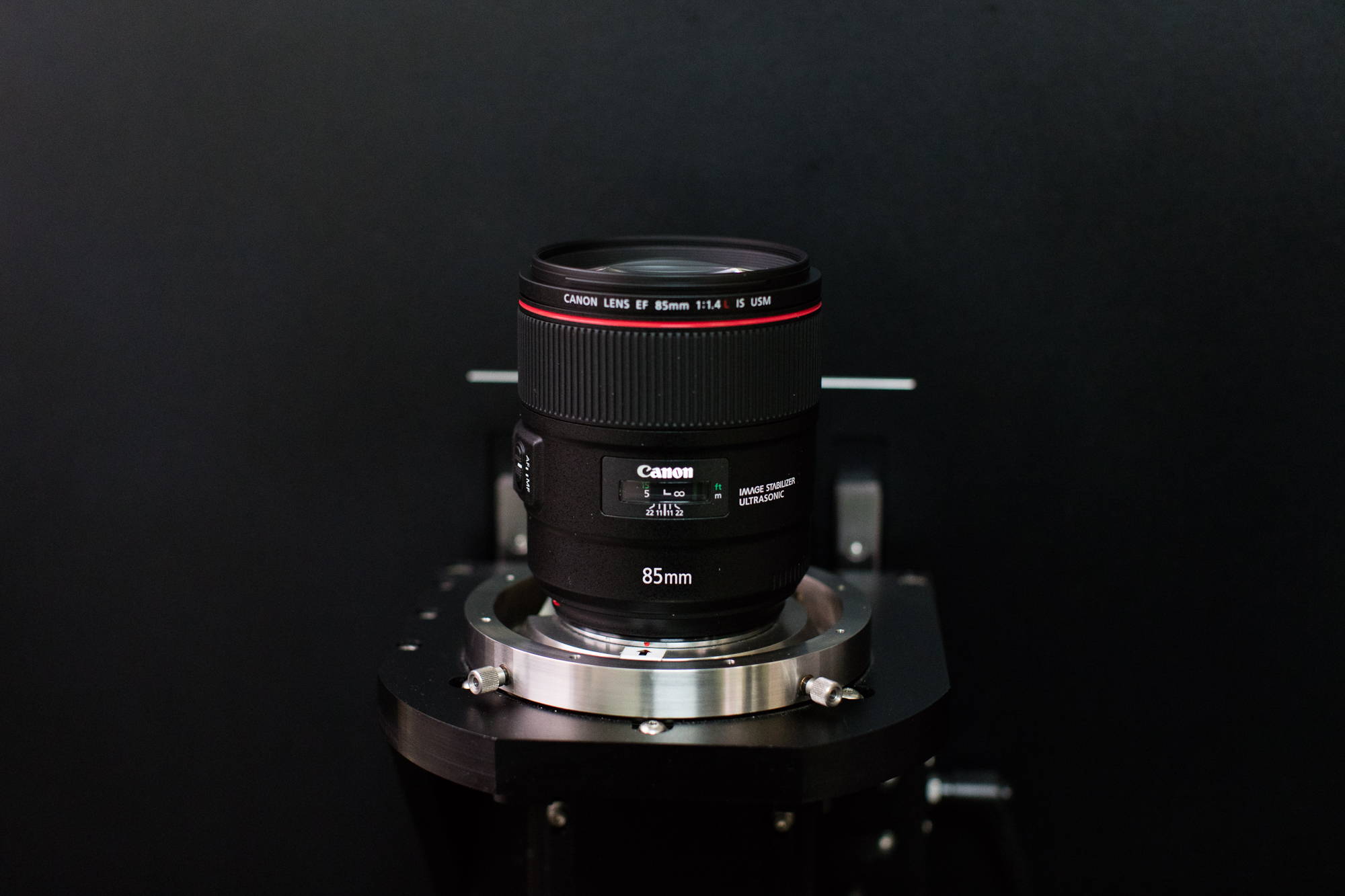
So we have, many of us, waited not-all-that-damn patiently for Canon to release a modern, fast-focusing 85mm L lens. Many wanted an updated f/1.2. Others just wanted the sharpest 85mm lens on the planet. At least a significant minority wanted it to have Image Stabilization. And they wanted it to be about the same size as the Canon 85mm f1.8.
Canon has heard our pleas and has answered some of them with the Canon 85mm f/1.4 L IS USM lens. It’s slightly lighter than the f/1.2, and 0.4 pounds lighter than the Sigma 85mm f/1.4 Art. It has an easy-on-the-pocket 77mm front diameter, compared to 86mm for the Sigma. And it’s price, while not cheap by any means, is fairly reasonable at $1,600. That’s about the same as the Nikon 85mm f/1.4G AF-S, $500 more than the Sigma 85mm f/1.4 Art, but a few hundred less than the Canon 85mm f/1.2L II or the Sony FE 85mm f/1.4 GM.
I usually tell you what I’m going to tell you first, so you don’t have to read the whole article if you don’t want to. In the case of this lens, I wish I was one of those click-bait headline review sites that gave each lens a number grade. Depending on how I valued the various categories of assessment I could just as easily say ‘this lens rated 89.534; our highest score ever‘ or ‘this lens rated 56.497 and is a huge disappointment‘. I suspect you’ll find that kind of extreme commentary on various internet sites.
So what do I really think? The Canon 85mm f/1.4 L IS is going to disappoint the Fanboys wanting bragging rights for the absolute best resolution in an 85mm lens. But after all the dust settles, it’s going to be an immensely popular lens because it’s very good optically and just superbly usable.
It may not give you the creamiest or sharpest image possible, but it will get reasonably high marks for both. It nails autofocus quickly and easily and the IS works superbly well. Basically, if you have enough light to see it, you’ll be able to photograph it. It’s reasonably sized and easy to handle.
If you shoot 85mm with wide aperture primes frequently and outside the studio, and want a high ‘keeper rate’, you’ll want this lens. If 85mm is a specialty lens for you, then you might prefer a different lens that emphasizes that special feature you’re looking for.
So, What About the Optics
MTF
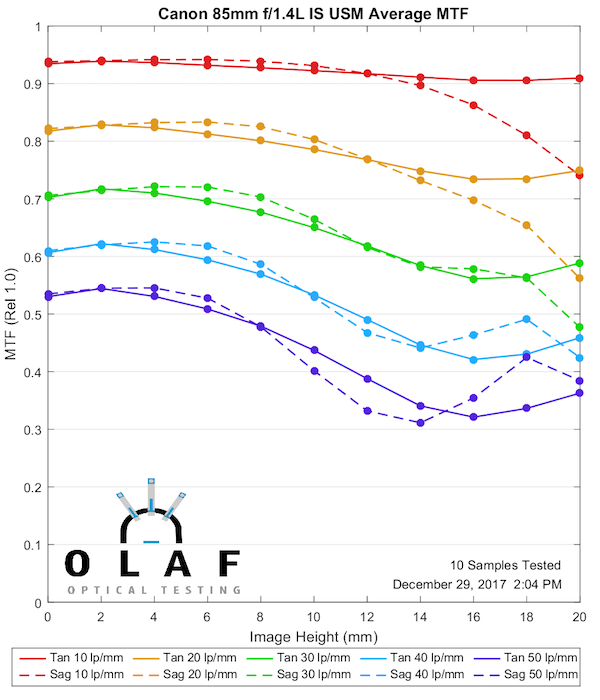
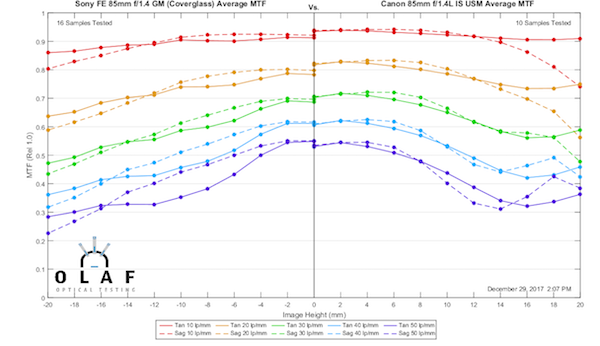
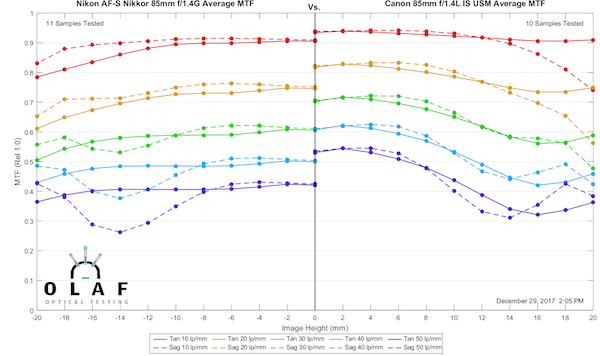
We did our usual 4-rotation MTF (Modulation Transfer Function) tests on ten copies of the lens. The MTF was good, but not outstandingly good at f/1.4. It maintains excellent sharpness away from the center, but shows some astigmatism-like separation of the sagittal and tangential lines in the outer 1/4 of the image.
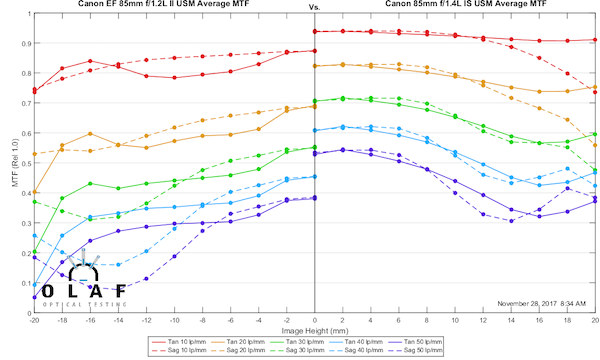
This is a huge MTF improvement over the Canon 85mm f/1.2L II lens. (The f/1.2 doesn’t get all that much better at f/1.4, BTW, especially away from the center. But more on that later.)
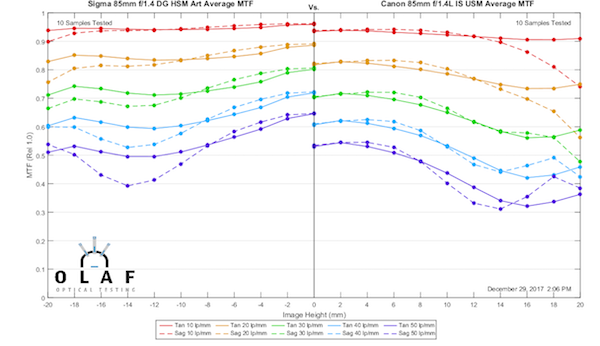
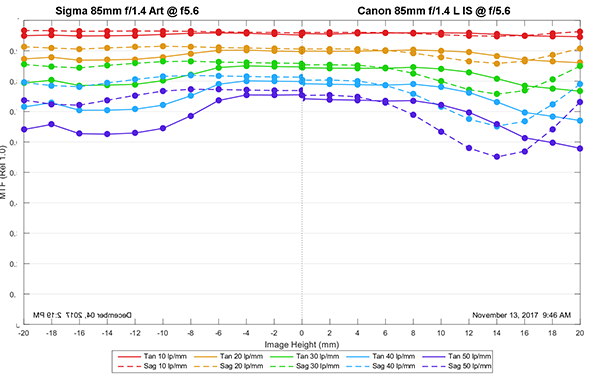
The new Canon is not as good as the current resolution champion Sigma 85mm f/1.4 Art lens, either in center or off-center resolution.
But the Canon is quite good. It more than holds its own in comparison with the Sony FE 85mm f/1.4 GM or Nikon 85mm f/1.4 G lenses, both of which are considered excellent.
Compared to Sony FE 85mm f/1.4 GM
Compared to Nikon 85mm f/1.4 G AF-S
The 85mm f/1.8 Options
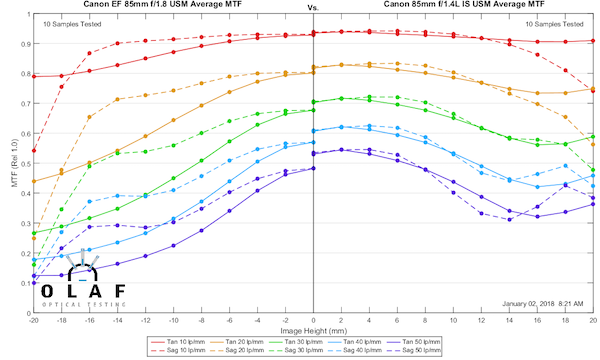
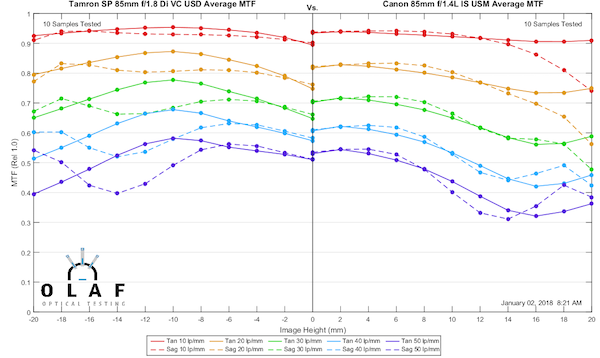
People always ask for these, although I have no idea why. If you don’t need a f/1.4 aperture why are you considering spending way more money on a f/1.4 lens? But the graphs below compare the Canon f/1.4L IS at f/1.4 to the f/1.8 lenses.
Compared to Canon 85mm f/1.8
The 85 f/1.8 is decent in the center, but outside the middle 1/3 of the image, things aren’t close.
Compared to Tamron 85mm f/1.8 many letters VC
The Tamron VC, which is a very nice lens, is about the same at f/1.8 as the Canon is at f/1.4. And OK, I do admit I understand why this comparison; a low-light shooter might be choosing for image stabilization over everything else. But again, if you don’t need f/1.4 … . .
A More In-Depth Look
Field Curvature (MTF v Field v Focus)
The field curvature plots tell us a lot about the lens. In the upper left corner is the ‘average’ field and you’ll notice it’s pretty flat, so you can keep everything in focus from one side to the other. But if you look at the separate sagittal and tangential fields (lower two plots) you’ll notice they are both slightly curved; the sagittal in a shallow ‘M’ shape, the tangential in an even more shallow ‘W’.
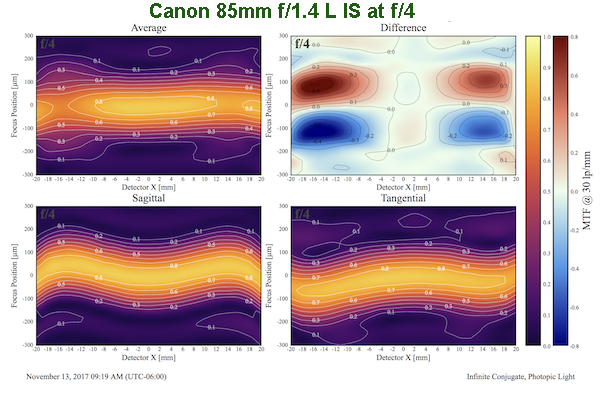
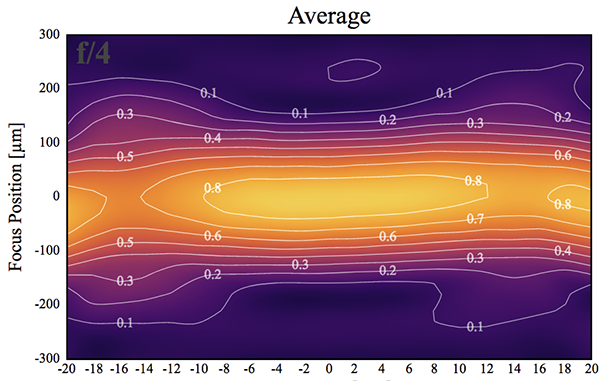
If you look back at the purple areas in the ‘average’ graph, now you notice that it’s slightly dumbbell-shaped. That’s because off-axis the difference between the ‘M’ and ‘W’ is an area of astigmatism that won’t go away. You can try as you like, but you’re not going to get rid of the astigmatism in that area.
The ‘difference’ graph in the upper right shows you two significant areas where astigmatism is fairly noticeable (the red and blue patches). Bokeh in these areas is going to be a little misshapen or busy. Notice they are just barely out of focus (the “0” on the Y-axis). Further out of focus everything gets blurry and smooth. So the takeaway is to make sure your out-of-focus highlights are well out of focus, not just barely out of focus. OK, the real takeaway is the bokeh-masters online will enjoy hours of arguing about whether the bokeh is great or awful. It will depend on the shot.
As an aside, if you wonder about the new color scheme for the field curvature graphs, it’s supposed to be just as visible to color-blind persons as those with full-color vision, so we thought we’d switch over to it. OK, you’re right, mostly I think it looks cooler.
BIF and BAF
For those of you who liked the experimental stuff we are doing with best individual focus MTF (BIF) and best average focus MTF (BAF), well, this lens makes those unnecessary. The very flat average field (see image below) means when you focus in the center (or anywhere else) everything at that distance is already in focus. So the best individual focus MTF is about the same as the standard MTF.
Because of the off-axis astigmatism, best average focus point doesn’t make much difference either. The best sagittal focus (orange line) bulges forward, while the best tangential focus position (green line) heads the opposite way. The best average focus is right in the middle, again about the same as best center focus.
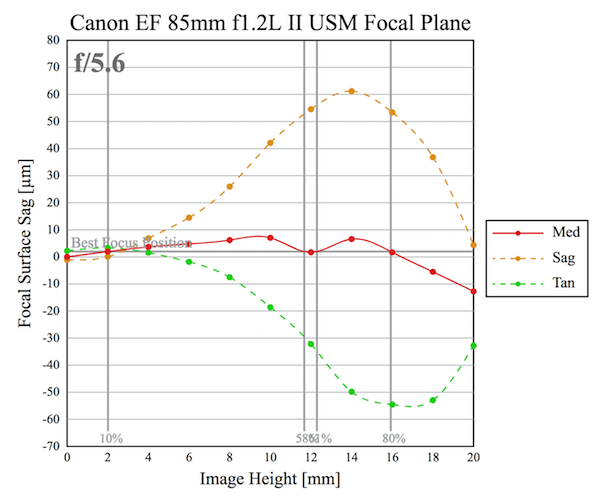
So our fancy program is useless, but that’s a good thing; it makes shooting in the field easy. Best center focus is best individual focus is best overall focus. Not many lenses are designed that way.
As to performance, you have near-center sharpness to about 6mm from center (1/3 of the way to the edge). For the middle 1/3 of the image, sharpness remains excellent although it does drop off slightly at higher frequencies (fine detail). In the outer 1/3, there is going to be some astigmatism and it won’t change no matter how you adjust focus.
The sum total of all of this is that the Canon 85mm f/1.4 L IS is very easy to use accurately. You don’t have to worry about field curvature at all and wherever you focus you’ll get good sharpness across the field. Whether this contributes to the very accurate autofocus many people have observed with using this lens, I don’t know, but it can’t hurt.
Stop Down Tests
We’re going to start showing stop-down MTFs on all lenses going forward. These aren’t done on all 10 lenses, we just pick an average copy and run stop-down MTFs on that one, so you may notice some minor irregularities that our averaged MTFs don’t show.
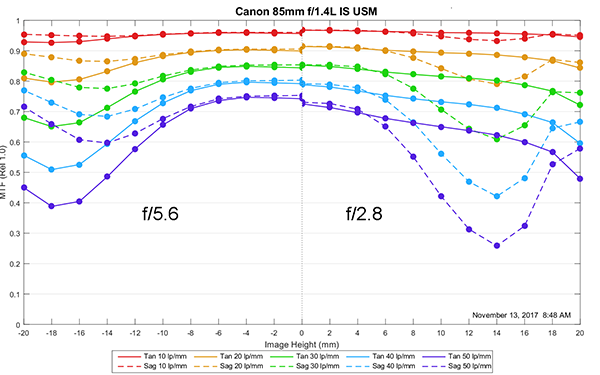
First let’s compare the two Canon 85mm L lenses at f/2.8, which is where the f/1.2 (on the left) starts to get sharp. The new lens, as you would expect, is still sharper both on and off axis.
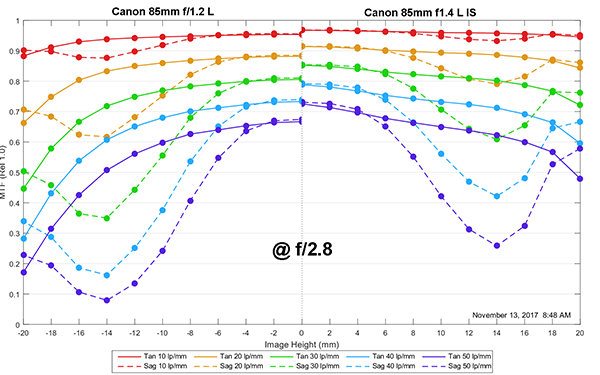
Next, we’ll stop the 85mm f/1.4 L IS lens down to f/5.6 and compare it to f/2.8. As an aside, you may notice I flipped focus from tangential to sagittal on this one, trying to do a couple of experiments at once, but it illustrates what I mentioned above about astigmatism. The takeaway message is that by f/2.8 this lens is near maximum sharpness and maintains it at least to f/5.6.
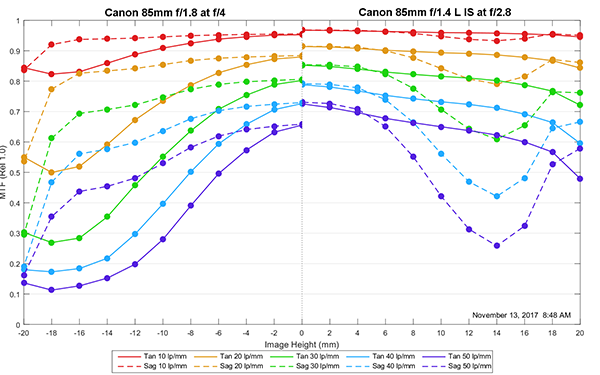
One more comparison for the “all lenses are equal stopped down” crowd. Here is the Canon 85mm f/1.8 at f/4, its sharpest aperture, compared to the Canon 85mm f/1.4 L IS at f/2.8. Even at a wider aperture, the L is much better both on and off axis.
Variance
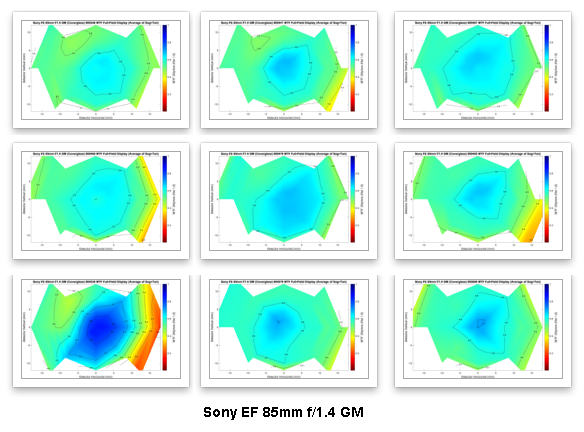
The Canon 85mm f/1.4 L IS is a very consistent lens, both in center sharpness and side-to-side variation. The comparison graphs below shows the Canon (top left), Sigma (top right), Nikon (bottom left), and Sony GM (bottom right) 85mm lenses. The Canon has the least variation overall.
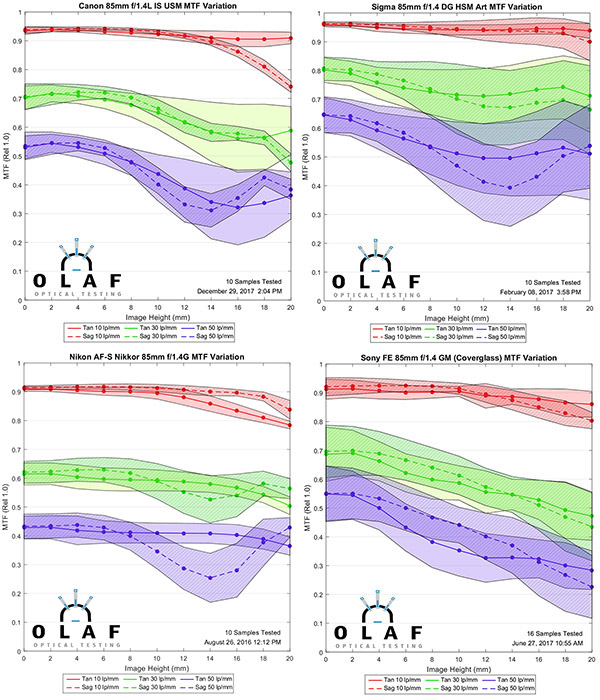
While we still don’t feel our variance number is the end-all measurement, it’s the best thing we have right now. For what it’s worth, we consider good primes to have variance numbers of 40 or less.
LENS | VARIANCE |
|---|---|
| Zeiss Milvus 85mm f1.4 | 29 |
| Canon 85mm f1.4 L IS | 31 |
| Zeiss Otus 85mm f/1.4 | 32 |
| Sigma 85mm f1.4 Art | 40 |
| Nikon 85mm f/1.4G AF-S | 35 |
| Tamron 85mm f/1.8 VC | 47 |
| Sony FE 85mm f/1.4 GM | 61 |
| Canon 85mm f1.8 | 65 |
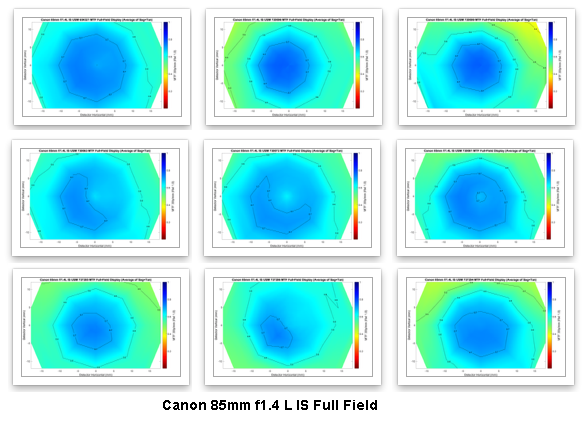
To give you a bit more intuitive look at how much of a difference that is, we’ll compare full-frame display resolution thumbnails of 9 copies of the Canon 85mm f/1.4 IS with 9 copies of the Sony FE 85mm f/1.4 GM. This is a really consistent performance from the Canon.
So What Did We Learn Today?
This is a lens where the designer has focused on being very good in as many situations as possible rather than obtaining the highest possible MTF. It’s apparently designed for the person who uses 85mm in a lot of different situations; especially in low light situations.
It’s very sharp, the field is designed to get good focus no matter where you focus, and all reports indicate that the focusing is quick and accurate. If you take a ton of shots, your keeper rate is going to be exceptionally high. And if you shoot in poor lighting with an 85mm it will be amazing compared to almost anything else available in Canon mount.
As I said earlier, if you have a specialty use for an 85mm prime, you may want something else. The Sigma Art and Zeiss Otus have slightly higher resolution. The Tamron 85mm f/1.8 VC is a good choice if you primarily want image stabilization and don’t need f/1.4. The Canon f/1.2 still is a unique optic with a look that’s quite different.
This lens does everything well and one thing (low light) exceptionally well. It’s the decathlete of 85mm lenses.
Roger Cicala and Aaron Closz
Lensrentals.com
January 2018 (hey look, y’all, I got the year right and it’s not even March yet!!)
Addendum: I’ve been asked twice if the Sigma is still sharper than the Canon at f/5.6 and the answer is insignificantly, if at all. They’re almost identical at f/5.6.
Addendum II: There is a really good article Canon put out about the background of designing this lens HERE. Be sure to read Part II.
103 Comments
Brian F Leighty ·
Great article as always Roger. Looking at TDP it looked like the Sigma was a little sharper and your results confirm it. I’m glad I bought my Sigma last spring. I agree that a lot of people will like this lens for it’s all around and if the price were the same and I was to choose now I’d choose the Canon but with the price difference and slight optical edge it’s a much tougher choice.
Adam Sanford ·
I’d go with the L for sure here. I’d take AF reliability/consistency + IS over a very small sharpness delta every single time.
With the 50s, it’s a tougher call, as the sharpness delta between the L and the Art is night and day and the 50L plane of focus is nutty beast. But here at 85 (and also at 35), I’d pay the money for the Canon just for first party AF you can hang your hat on.
Uncle Rog: AF hit rate database! Please please please.
Brian F Leighty ·
Yeah I’d agree with you if I had issues with focus but I don’t. Don’t have any with my 35 art either. Never tried on the mark iii though tried on mark ii and mark iv and both 6ds with no issue though
Brian F Leighty ·
Great article as always Roger. Looking at TDP it looked like the Sigma was a little sharper and your results confirm it. I'm glad I bought my Sigma last spring. I agree that a lot of people will like this lens for it's all around and if the price were the same and I was to choose now I'd choose the Canon but with the price difference and slight optical edge it's a much tougher choice.
Adam Sanford ·
I'd go with the L for sure here. I'd take AF reliability/consistency + IS over a very small sharpness delta every single time.
With the 50s, it's a tougher call, as the sharpness delta between the L and the Art is night and day and the 50L plane of focus is nutty beast. But here at 85 (and also at 35), I'd pay the money for the Canon just for first party AF you can hang your hat on.
Uncle Rog: AF hit rate database! Please please please.
Mike Aubrey ·
Nice. This is a helpful.
I’ve always used Marco Cavina’s MTF data comparing the Zeiss 85/1.2 with the FD & EF versions, but, of course, this is more detailed in every way and involves multiple copies.
https://translate.googleusercontent.com/translate_c?act=url&depth=1&hl=en&ie=UTF8&prev=_t&rurl=translate.google.com&sl=auto&sp=nmt4&tl=en&u=http://www.marcocavina.com/articoli_fotografici/TEST_85mm_f_1,2/00_pag.htm&usg=ALkJrhi4ETIDWM_5-0RMq_pI6U3qWMcknQ
Mike Aubrey ·
Nice. This is a helpful.
I've always used Marco Cavina's MTF data for the 85Ls, comparing the Zeiss 85/1.2 with the FD & EF versions, but, of course, this is more detailed in every way and involves multiple copies.
https://translate.googleuse...
geekyrocketguy ·
Thank you for this review!
The bottom left plot in the “variance” section says it is for the Nikon 24mm f/1.4. Is this a typo in the title, or was the wrong plot included?
Roger Cicala ·
Geeky, absolutely wrong plot. I pushed the right button this time and corrected that and the attached table. Thank you.
Roger Cicala ·
Geeky, I absolutely pushed the wrong button on that plot – thank you. I’ve corrected it and the accompanying table.
Mahmoud Darwish ·
Another typo “One more comparison for the “all lenses are equal stopped down” crowd.
Here is the Canon 85mm f/1.8 at f/4, its sharpest aperture, compared to
the Canon 85mm f/4 L IS at f/2.8.” f/4 instead of f/1.4
Roger Cicala ·
Thank you! Crowd source proofreading > > editor. 🙂
Mahmoud Darwish ·
And thanks for the reviews, I really enjoy reading them
geekyrocketguy ·
Thank you for this review!
The bottom left plot in the "variance" section says it is for the Nikon 24mm f/1.4. Is this a typo in the title, or was the wrong plot included?
Roger Cicala ·
Geeky, I absolutely pushed the wrong button on that plot - thank you. I've corrected it and the accompanying table.
Mahmoud Darwish ·
Another typo "One more comparison for the “all lenses are equal stopped down” crowd.
Here is the Canon 85mm f/1.8 at f/4, its sharpest aperture, compared to
the Canon 85mm f/4 L IS at f/2.8." f/4 instead of f/1.4
Roger Cicala ·
Thank you! Crowd source proofreading > > editor. :-)
Adam Sanford ·
Just rented the 85 f/1.4L IS from LR actually (it’s in transit back to Tennessee as we speak). Used it on my 5D3 over the holiday.
Pros: Wonderfully sharp + internal focusing + it’s no longer FBW like the 85 f/1.2L II + **the AF. is. simply. impeccable.** Prior large aperture rentals from LR of the Sigma 35 Art and Canon 50L — despite careful dock/AFMA work and militant technique — had woeful wide open AF hit rates due to inconsistent not-AFMA/dock-correctable whiffing on my 5D3. This 85, however, was fire and forget good. Absolutely stellar.
Con: Mirror box clips the bokeh balls in some cirumstances, i.e. I believe the mirror box is smaller than the wide open iris of the lens, so the mirror box serves as a *lovely* bokeh template/spoiler to turn your bokeh balls into D shapes. Doesn’t always happen — I’ll post two samples in a sec.
Adam Sanford ·
Close bokeh (say 15 feet, not MFD or anything) — note the clipped D-shaped bokeh. (This happens with the 85 f/1.2L II for the same reason, I believe.) https://uploads.disquscdn.com/images/daf5eaf8badb4532f7847deb602b9b658a5a076cde8544b7701e3b8eb78e4eb2.jpg
Miros?aw St?pi?ski ·
Adam, you ruined half of my life by showing this. ? Once you see it, it cannot be unseen, I keep noticing it everywhere.
Adam Sanford ·
Many have said this to me: “It cannot be unseen” once it is found.
That said, that 85 f/1.2L II has it as well and that never stopped it from reeling some magical stuff over it’s time of service.
Ramon ·
It’s par for the course with these lenses, but it’s a nice problem to have!
I notice it in everyone of my images when it shows up, and then I choose to ignore it.
kirkmoon ·
I played around with this a bit over the holidays and the above comments are in line with what I discovered. The mirror box cutoff is rather annoying when it occurs and once you are aware of it it is hard to NOT see it, but it only occurs as described above. I could reduce or eliminate it by either increasing the distance between the subject and the point light sources behind the subject OR by stopping down a bit. The phenomenon is pretty much gone at f2.8.
Adam Sanford ·
Which makes perfect sense. Stopping down will reduce the iris diameter to being smaller than the mirror box.
…but that’s not why you buy a large aperture prime. But it’s not a showstopper to me, nor is it to the hordes of portaiture / wedding / event / fashion folks who shoot with the f/1.2L II.
kirkmoon ·
Totally agree. Just wanted to point out to those who might think this is a big deal that it only arises in a relatively specific situation (point light sources relatively close to the subject) and, if desired, can be easily eliminated at the cost of stopping down a bit. As a result, it may not be the best lens in the world for photographing people standing in front of Christmas trees in the living room, but the bokeh in all other respects seems beautiful to me. This is a super all around fast lens. I am very happy with it.
I have looked to see if this occurs with the 85mm Sigma 1.4 Art and from what I can tell (from looking at images on the web) it does, but is significantly less obvious (fewer instances, less obvious clipping when present.) I haven’t seen any clipping of bokeh balls on images from the Otus 85 but haven’t seen lots of images made with this lens. I assume this means that the wide open iris diameters of these two lenses are smaller than on the Canon.
Re whether it is truly the mirror box clipping or not, it sure makes sense that it is. If you note where the artifact occurs, it is only seen in bokeh balls situated near the edges of the long side of the image frame and is invariably located on the edges of the balls towards the center of the image frame (exactly as seen in your image above). I tried mightily to generate this clipping on balls located near the edges along the short axis of the image frame without success. There aren’t any other structures along the light path that are candidates. Back of the lens is a large, round glass lens with no mask.
Adam Sanford ·
Which makes perfect sense. Stopping down will reduce the iris diameter to being smaller than the mirror box.
...but that's not why you buy a large aperture prime. But it's not a showstopper to me, nor is it to the hordes of portaiture / wedding / event / fashion folks who shoot with the f/1.2L II.
kirkmoon ·
Totally agree. Just wanted to point out to those who might think this is a big deal that it only arises in a relatively specific situation (point light sources relatively close to the subject) and, if desired, can be easily eliminated at the cost of stopping down a bit. As a result, it may not be the best lens in the world for photographing people standing in front of Christmas trees in the living room, but the bokeh in all other respects seems beautiful to me. This is a super all around fast lens. I am very happy with it.
I have looked to see if this occurs with the 85mm Sigma 1.4 Art and from what I can tell (from looking at images on the web) it does, but is significantly less obvious (fewer instances, less obvious clipping when present.) I haven't seen any clipping of bokeh balls on images from the Otus 85 but haven't seen lots of images made with this lens. I assume this means that the wide open iris diameters of these two lenses are smaller than on the Canon.
Re whether it is truly the mirror box clipping or not, it sure makes sense that it is. If you note where the artifact occurs, it is only seen in bokeh balls situated near the edges of the long side of the image frame and is invariably located on the edges of the balls towards the center of the image frame (exactly as seen in your image above). I tried mightily to generate this clipping on balls located near the edges along the short axis of the image frame without success. There aren't any other structures along the light path that are candidates. Back of the lens is a large, round glass lens with no mask.
JosephAndrews ·
NIce find (and explanation), Adam.
I presume the D-shaped bokeh disappears with the same lens attached to a mirrorless camera?!
Adam Sanford ·
What we don’t know definitively is if it’s truly the mirror box or not — that’s just the read the bright folks at CanonRumors gave me. If it is, adapting this on mirrorless likely will not demonstrate this behavior (barring some nutty adaptor design that leaves hardware inside the wide open iris diameter).
So we need someone with an A7/A9 rig to adapt this new lens and report back.
Adam Sanford ·
And it’s not my find. The good folks at CR pointed it out to me when the first f/1.4L IS samples dropped, like it was a known thing with the f/1.2L II that the new lens could not eliminate.
Adam Sanford ·
Far bokeh (say 30+ feet, not infinity or anything) — almost no clipping occurs. Nearly all are full bokeh balls. https://uploads.disquscdn.com/images/77d95088e59dbd62c53798a86a57d5373eacf088fe7e95452332e555ec0c3436.jpg
Adam Sanford ·
Lots of examples of this with the 85 f/1.2L II as I said, see here from a recent PP article — it’s kind of hard not to see once you see it.
https://petapixel.com/2017/12/01/shooting-portraits-christmas-lights-ordinary-bedroom/
Oleg ·
“the AF. is. simply. impeccable” that’s really awesome. I like my 85Art, but I can’t say the same about it LOL.
UniversalCreations ·
I tested a few sampels of both the 85L f/1.4 IS and Sigma 85Art on the 5D4 and 1DX2 and the Sigma was faster in low light and more consistent at shorter distance. All 3 Canons had problems with head shots to focus consistent on an eye with the 1DX2. A costumer came with this problem, so I began testing. With good light and larger focus distance, the Canon is slightly faster than the Sigma 85Art (not as fast as the Sigma 135Art) and as consistent.
Adam Sanford ·
Just rented the 85 f/1.4L IS from LR actually (it's in transit back to Tennessee as we speak). Used it on my 5D3 over the holiday.
Pros: IS + Wonderfully sharp + internal focusing + it's no longer FBW like the 85 f/1.2L II + **the AF. is. simply. impeccable.** Prior large aperture rentals from LR of the Sigma 35 Art and Canon 50L -- despite careful dock/AFMA work and militant technique -- had woeful wide open AF hit rates due to inconsistent not-AFMA/dock-correctable whiffing on my 5D3. This 85, however, was fire and forget good. Absolutely stellar.
Con: Mirror box clips the bokeh balls in some circumstances, i.e. I believe the mirror box is smaller than the wide open iris of the lens, so the mirror box serves as a *lovely* bokeh template/spoiler to turn your bokeh balls into D shapes. Doesn't always happen -- I'll post two samples in a sec. Also, the IS is quiet in use, but the startup / stop of IS has a discernible click to it as it uses (apparently) some IS module tech from a large superwhite tele prime.
Those are two picky cons that shouldn't take away from what a fine instrument this is. Get this lens, it's great.
Adam Sanford ·
Close-ish bokeh (say 15 feet, not MFD or anything) -- note the clipped D-shaped bokeh. (This happens with the 85 f/1.2L II for the same reason, I believe.) https://uploads.disquscdn.c...
Mireaux ·
Adam, you ruined half of my life by showing this. 😂 Once you see it, it cannot be unseen, I keep noticing it everywhere.
Adam Sanford ·
Many have said this to me: "It cannot be unseen" once it is found.
That said, that 85 f/1.2L II has it as well and that never stopped it from reeling in some magical stuff over its time of service.
Ramon ·
It's par for the course with these lenses, but it's a nice problem to have!
I notice it in everyone of my images when it shows up, and then I choose to ignore it.
JosephAndrews ·
NIce find (and explanation), Adam.
I presume the D-shaped bokeh disappears with the same lens attached to a mirrorless camera?!
Adam Sanford ·
What we don't know definitively is if it's truly the mirror box or not -- that's just the read the bright folks at CanonRumors gave me. If it is, adapting this on mirrorless likely will not demonstrate this behavior (barring some nutty adaptor design that leaves hardware inside the wide open iris diameter).
So we need someone with an A7/A9 rig to adapt this new lens and report back.
Adam Sanford ·
And it's not my find. The good folks at CR pointed it out to me when the first f/1.4L IS samples dropped, like it was a known thing with the f/1.2L II that the new lens could not eliminate.
Adam Sanford ·
Far bokeh (say 30+ feet, not infinity or anything) -- almost no clipping occurs. Nearly all are full bokeh balls. https://uploads.disquscdn.c...
Adam Sanford ·
Lots of examples of this with the 85 f/1.2L II as I said, see here from a recent PP article -- it's kind of hard not to see once you see it.
https://petapixel.com/2017/...
Adam Sanford ·
Uncle Rog, there’s a perception out there that IS can affect sharpness. Anything to that? Any difference in performance with the IS on vs. off?
Roger Cicala ·
That’s a complex subject. The stabilizer is an optical element and I’m told in lens design it sometimes is a trade off between IS and absolute sharpness. Given a lens with IS you are moving that optical element so it’s theoretically possible that some images are less sharp away from center just because of the random ‘where the IS happens to be’ factor. Whether it happens, or how frequently, I can’t say other than ‘obviously not often’.
Adam Sanford ·
Is there any way to perform your test method with the IS both on and off and compare the output?
Roger Cicala ·
We have to test with it off and locked. Otherwise without power it jiggles when the machine moves ruining the test.
geekyrocketguy ·
I was discussing this just yesterday. I’ve definitely noticed that my corners occasionally lose a bit of sharpness when using IS, so I tend to leave my IS off most of the time.
Adam Sanford ·
Uncle Rog, there's a perception out there that IS can affect sharpness. Anything to that? Any difference in performance with the IS on vs. off?
Roger Cicala ·
That's a complex subject. The stabilizer is an optical element and I'm told in lens design it sometimes is a trade off between IS and absolute sharpness. Given a lens with IS you are moving that optical element so it's theoretically possible that some images are less sharp away from center just because of the random 'where the IS happens to be' factor. Whether it happens, or how frequently, I can't say other than 'obviously not often'.
geekyrocketguy ·
I was discussing this just yesterday. I've definitely noticed that my corners occasionally lose a bit of sharpness when using IS, so I tend to leave my IS off most of the time.
Max Manzan ·
Exceptionally informative article, thank you very much!
Now you only need to systematically perform close-range MTF measurements also on non-macro lenses, and than you’ll have the perfect lens test! ?
Roger Cicala ·
Unfortunately our choices are infinity or macro distances. That’s all we can test.
Max Manzan ·
Ok, I see.
On a more serious note, I notice that your MTF curves for the Canon 1,4/85mm IS at f/5.6 look different in the two graphs “Canon IS f/2.8 vs Canon IS f/5.6” and “Canon IS f/5.6 vs Sigma Art f/5.6”. Is that the same copy of the Canon IS which was focused a bit differently?
Roger Cicala ·
Max, two different copies. I made the vs Sigma graph later by request.
Max Manzan ·
Exceptionally informative article, thank you very much!
Now you only need to systematically perform close-range MTF measurements also on non-macro lenses, and than you'll have the perfect lens test! 😃
Roger Cicala ·
Unfortunately our choices are infinity or macro distances. That's all we can test.
Max Manzan ·
Ok, I see.
On a more serious note, I notice that your MTF curves for the Canon 1,4/85mm IS at f/5.6 look different in the two graphs "Canon IS f/2.8 vs Canon IS f/5.6" and "Canon IS f/5.6 vs Sigma Art f/5.6". Is that the same copy of the Canon IS which was focused a bit differently?
HenWin ·
I have not finished the article, but one question popped into my head in the first couple of paragraphs: does MTF still mean “Mean time to failure”? Please explain what it means if that’s not it. It would be helpful if you would not use abbreviations without explaining them.
geekyrocketguy ·
Modulation transfer function: https://en.wikipedia.org/wiki/Optical_transfer_function
HenWin ·
Thanks…I had no idea.
Roger Cicala ·
You are correct, but this is the 43rd Modulation Transfer Function article we’ve done so I thought everyone who came here would know. Still, it’s the right thing to do so I’ve added it.
HenWin ·
I think the way to approach it would be to have, perhaps a link to the terms you use in your articles instead of having to write a bunch of definitions within each article. It would be like structured programming (am I dating myself??? 🙂 )… the definitions would always be available, and accessible all the time.
Roger Cicala ·
A good point and I’ll try to dig up some of the early links to our “What is MTF” articles. Actually, now that I think of it, probably they should be rewritten.
HenWin ·
I have not finished the article, but one question popped into my head in the first couple of paragraphs: does MTF still mean "Mean time to failure"? Please explain what it means if that's not it. It would be helpful if you would not use abbreviations without explaining them.
geekyrocketguy ·
Modulation transfer function: https://en.wikipedia.org/wi...
HenWin ·
Thanks...I had no idea.
Roger Cicala ·
You are correct, but this is the 43rd Modulation Transfer Function article we've done so I thought everyone who came here would know. Still, it's the right thing to do so I've added it.
HenWin ·
I think the way to approach it would be to have, perhaps a link to the terms you use in your articles instead of having to write a bunch of definitions within each article. It would be like structured programming (am I dating myself??? :-) )... the definitions would always be available, and accessible all the time.
Roger Cicala ·
A good point and I'll try to dig up some of the early links to our "What is MTF" articles. Actually, now that I think of it, probably they should be rewritten.
mclaren777 ·
Thank you so much for doing such a thorough test.
Bob B. ·
So much great info. I feel so informed & I still love my 85mm f/1.2L II, even on my 5DIV. I know it focuses slow, I know it’s heavy and now I know also super expensive to repair. …but I am not giving it up…I just Love the rendering a bokeh etc. If I need super sharp and fast focus I will just have to go to my 50mm or 135mm Arts or my 24-70mm L or my 80-200mm L. The 85mm f/1.2L II is at this point a specialty lens, I guess…and, I kind of like that!
Bob B. ·
So much great info. I feel so informed & I still love my 85mm f/1.2L II, even on my 5DIV. I know it focuses slow, I know it’s heavy and now I know also super expensive to repair. ...but I am not giving it up...I just Love the rendering a bokeh etc. If I need super sharp and fast focus I will just have to go to my 50mm or 135mm Arts or my 24-70mm L or my 80-200mm L. The 85mm f/1.2L II is at this point a specialty lens, I guess...and, I kind of like that!
myname stillmyname ·
Roger
Thanks for your hard work, this is certainly one of the “top draw” reviews on the net, cracking work, always love the multiple copies angle.
Do you plan to do a teardown review?. would love to see how this compares to the 35LII
rgds
Derek
myname stillmyname ·
Roger
Thanks for your hard work, this is certainly one of the "top draw" reviews on the net, cracking work, always love the multiple copies angle.
Do you plan to do a teardown review?. would love to see how this compares to the 35LII
rgds
Derek
Tom Koetting ·
After 6 weddings, I can firmly say I LOVE THIS LENS. Going to eBay are our old 85L, Canon 85 1.8, and our Tamron. This is the Goldielocks 85 — thanks to LR for the great rentals.
Caerolle ·
“The Tamron 85mm f/1.8 VC is a good choice if you primarily want image stabilization and don’t need f/1.4.”
As someone who has to watch how much she spends on photography, I can think of another reason for considering the Tamron, if you can live with 1.8 instead of 1.4: Without looking it up, I am going to guess the Tamron is like half the price of the Canon. And the optical performance looks very good, and it is probably lighter and smaller too, on top of that. That said, money being no consideration, I would get the Canon 1.4 and the 1.2 both, and a 5D MkIV for the 1.2, and a 5Ds for the 1.4. 😉
Caerolle ·
"The Tamron 85mm f/1.8 VC is a good choice if you primarily want image stabilization and don’t need f/1.4."
As someone who has to watch how much she spends on photography, I can think of another reason for considering the Tamron, if you can live with 1.8 instead of 1.4: Without looking it up, I am going to guess the Tamron is like half the price of the Canon. And the optical performance looks very good, and it is probably lighter and smaller too, on top of that. That said, money being no consideration, I would get the Canon 1.4 and the 1.2 both, and a 5D MkIV for the 1.2, and a 5Ds for the 1.4. ;)
Edward Lai ·
Roger (or anyone else who can help), I’ve seen the Tamron 85mm scoring well (whether on your test or other site’s resolution chart) but when pixel peeping real life images (from more than one source) there seems to be some spherochromtism like veiling haze (think classic zeiss lenses like the 50/85mm planar wide open) which decreases the perception of acuity. Can you shed some light on this matter?
Brandon Dube ·
Do you have an image? I can usually read the aberrations from a picture.
Edward Lai ·
mattgranger.(deletethistext)com/portraitlens here he includes full sized raws and JPEGs for you and just focus on the Tamron 85. There is the otus and nikkor 85 1.4 to compare cause the lashes and texture on the face isn’t as clear as I’d like. The reason i attached links are 1. It is meaningless embedding JPEGs which are compressed and whoknowswhatdisquswilldotothem. and 2. I’m on my phone while the huge files are in my laptop which I currently don’t have access . Thanks in advance.
Brandon Dube ·
The tamron sample in the first .zip file is misfocused — the best focus is in the hair to the left, not on the eyes or eyelashes. In the second, the best focus is on the hair directly above her left eye (right eye in photo).
Neither images shows anyway spherochromatism, or chromatic aberrations at all. It looks more like the VC is on at a high shutter speed, which for most implementations of optical image stabilization makes the image softer.
As a word of caution – be careful with reviewing jpgs online. Everyone sharpens differently which can skew how you judge things heavily.
Carleton Foxx ·
“VC is on at….makes the image softer.”
What???!!#?!?? You can’t drop a bomb like that and just go on about your business.
At what shutter speed do stabilized lenses start to degrade image quality?
Brandon Dube ·
Well, if you (or someone else) wants to fund Olaf $50k for a Hexapod to do dynamics testing with a camera, we can find out.
The IS unit is putting in intentional motion blur to counter the motion blur from you put in with your body. The imperfection in its measurement and delay in the action of that motion cause some residual blur. At high shutter speeds, that blur is greater than the blur from just you and the images are softer.
Try taking some pictures of a newspaper or something at, say, 1/50s and then 1/1000s with IS.
ocube ·
Not sure of the science but I was taught to always switch the IS of a len off if not using it, especially when shooting stills.
Edward Lai ·
mattgranger.(deletethistext)com/portraitlens here he includes full sized raws and JPEGs for you and just focus on the Tamron 85. There is the otus and nikkor 85 1.4 to compare cause the lashes and texture on the face isn't as clear as I'd like. The reason i attached links are 1. It is meaningless embedding JPEGs which are compressed and whoknowswhatdisquswilldotothem. and 2. I'm on my phone while the huge files are in my laptop which I currently don't have access . Thanks in advance.
Brandon Dube ·
The tamron sample in the first .zip file is misfocused -- the best focus is in the hair to the left, not on the eyes or eyelashes. In the second, the best focus is on the hair directly above her left eye (right eye in photo).
Neither images shows anyway spherochromatism, or chromatic aberrations at all. It looks more like the VC is on at a high shutter speed, which for most implementations of optical image stabilization makes the image softer.
As a word of caution - be careful with reviewing jpgs online. Everyone sharpens differently which can skew how you judge things heavily.
Carleton Foxx ·
"VC is on at....makes the image softer."
What???!!#?!?? You can't drop a bomb like that and just go on about your business.
At what shutter speed do stabilized lenses start to degrade image quality?
Brandon Dube ·
Well, if you (or someone else) wants to fund Olaf $50k for a Hexapod to do dynamics testing with a camera, we can find out.
The IS unit is putting in intentional motion blur to counter the motion blur from you put in with your body. The imperfection in its measurement and delay in the action of that motion cause some residual blur. At high shutter speeds, that blur is greater than the blur from just you and the images are softer.
Try taking some pictures of a newspaper or something at, say, 1/50s and then 1/1000s with IS.
Edward Lai ·
Roger (or anyone else who can help), I've seen the Tamron 85mm scoring well (whether on your test or other site's resolution chart) but when pixel peeping real life images (from more than one source) there seems to be some spherochromtism like veiling haze (think classic zeiss lenses like the 50/85mm planar wide open) which decreases the perception of acuity. Can you shed some light on this matter?
Hunter45 ·
Roger, I don’t understand the chart (?) labelled “Canon EF 85mm f1.2L II USM Focal Plane”. How does that help a review of the new f1.4L model?
Roger Cicala ·
Sorry, that’s a mislabel that I didn’t catch. The computer didn’t have the 85 f1.4 L IS in it’s lens list so I changed titles on the other graphs and missed this one.
45Hunter ·
Roger, I don't understand the chart (?) labelled "Canon EF 85mm f1.2L II USM Focal Plane". How does that help a review of the new f1.4L model?
Roger Cicala ·
Sorry, that's a mislabel that I didn't catch. The computer didn't have the 85 f1.4 L IS in it's lens list so I changed titles on the other graphs and missed this one.
Triumph675 ·
Went to my local camera shop and brought in my Canon 5D Mark III along with my Sigma 85 1.4 ART and played around with the new Canon 5D Mark IV and the Canon 85 1.4 IS and between both cameras and lenses it was really hard to tell the difference between the two when putting them into Lightroom and looking at them. I actually found the IS to throw my eye off when looking through the camera but I did find that most of my shots were actually slightly sharper because of the IS at 1.4-1.8
The Canon 85 1.4 IS I found to produce more contrast in the photo then my Sigma 85 did. I also had backfocus issues on multiple shots with the Canon 85 and Mark IV which I thought was really interesting. My Canon 5D MII and Sigma 85 1.4 ART required MAJOR calibration from a professional shop.
The weight difference is what I am more sold on that anything right now. I love my Sigma now that it focuses correctly but its very heavy and that weight can be all that it takes to miss a shot at 1.4-1.8
I’ve also had nothing but problems with my 85 and 35 from Sigma but both have been repaired and work perfectly now. All of my Canon glass has been flawless.
Triumph675 ·
Went to my local camera shop and brought in my Canon 5D Mark III along with my Sigma 85 1.4 ART and played around with the new Canon 5D Mark IV and the Canon 85 1.4 IS and between both cameras and lenses it was really hard to tell the difference between the two when putting them into Lightroom and looking at them. I actually found the IS to throw my eye off when looking through the camera but I did find that most of my shots were actually slightly sharper because of the IS at 1.4-1.8
The Canon 85 1.4 IS I found to produce more contrast in the photo then my Sigma 85 did. I also had backfocus issues on multiple shots with the Canon 85 and Mark IV which I thought was really interesting. My Canon 5D MII and Sigma 85 1.4 ART required MAJOR calibration from a professional shop.
The weight difference is what I am more sold on that anything right now. I love my Sigma now that it focuses correctly but its very heavy and that weight can be all that it takes to miss a shot at 1.4-1.8
I've also had nothing but problems with my 85 and 35 from Sigma but both have been repaired and work perfectly now. All of my Canon glass has been flawless.
Carleton Foxx ·
Roger….to answer your question “If you don’t need a f/1.4 aperture why are you considering spending way more money on a f/1.4 lens?”
What I’ve been led to believe is that f/1.4 lenses are sort of a prestige product for lens makers and consequently they are better built and sharper to justify their higher prices. On a practical level, two stops down from f/1.4 is still wider than two stops down from f/1.8 or f/2.
But I’m probably just a victim of marketing and should trade in all my other lenses for a set of Nikon’s f/1.8s.
Carleton Foxx ·
Roger....to answer your question “If you don’t need a f/1.4 aperture why are you considering spending way more money on a f/1.4 lens?”
What I've been led to believe is that f/1.4 lenses are sort of a prestige product for lens makers and consequently they are better built and sharper to justify their higher prices. On a practical level, two stops down from f/1.4 is still wider than two stops down from f/1.8 or f/2.
And your stopped-down head-to-head between the two Canon 85s tends to lend credence to this belief.
Beaverman33 ·
For those of you who are interested in some more thoughts / info on the new(ish) Canon EF 85mm f/1.4L IS USM lens . . . I’ve written a fairly detailed review, mainly comparing it to the much cheaper Canon EF 85mm f/1.8 USM. Obviously I don’t have the test equipment that Roger and crew use but I thought it would be useful to share my thoughts . . .
https://simonbrettellphotography.co.uk/canon-ef-85mm-f-1-4l-is-usm-lens-review/
PhotoSimon ·
For those of you who are interested in some more thoughts / info on the new(ish) Canon EF 85mm f/1.4L IS USM lens . . . I've written a fairly detailed review, mainly comparing it to the much cheaper Canon EF 85mm f/1.8 USM. Obviously I don't have the test equipment that Roger and crew use but I thought it would be useful to share my thoughts . . .
https://simonbrettellphotog...
manas vatsal ·
Nice article…i really love the headshots of 85mm lens. I have written an article on this king of prime lens. Hope you and your readers will find it interesting.
http://photoxperience.in/85mm-lens-review/
Andreas Martin ·
I owe Roger and all of the lensrentals team a big thank you for all these in-depth-tests. Could you do an explanaition of the MTF charts? What do the x and y axis actually mean? Thank you