

We just finished testing a couple of 35mm prime lenses and came away quite impressed. But it took a little longer to finish testing the one everyone had been asking about; the Sigma 35mm f/1.2 DG Art lens. I declared the Tamron 35mm f/1.4 SP the sharpest 35mm lens we had tested just a week ago, so we were all curious if that title would hold up after the Sigma was tested.
So curious, in fact, that I broke the MTF Testing Rule I Always Refuse to Break. I actually tested the Sigma at both f/1.2 AND at f/1.4. Why did I finally break the rule? Cause I wanted to. Will I break it again, if you ask nicely, have a really good reason, and are on a Holy Quest? Nope.
Let’s take a second to do a quick comparison of the Sigma f1.2 with other 35mm wide-aperture prime lenses (including some for other mounts, because a lot of people are shooting other mount lenses on Sony cameras).
| Lens | Price | Weight (g) | Length (mm) |
|---|---|---|---|
| Sigma 35mm f1.2 Art | $1,499 | 1090 | 136 |
| Tamron 35mm f1.4 SP | $899 | 815 | 105 |
| Sony FE 35mm f1.8 | $748 | 281 | 73 |
| Canon 35mm f1.4L II | $1,699 | 760 | 105 |
| Sigma 35mm f1.4 Art | $699 | 665 | 94 |
Obviously, if the widest aperture isn’t that important, the Sony FE 35mm f1.8 provides a much smaller lens with great image quality at a cheaper price. A lot of you may not realize the Sigma 35mm f1.4 Art is the least expensive option, yet still provides superb resolution. The Tamron 35mm f1.4 SP was recently declared (by me) to be the resolution champion at this focal length and is an awesome bargain at its price.
The Sigma 35mm f/1.2, though, gives you f/1.2, and some of us, at least, lust after f/1.2. You pay a price for f/1.2, both in dollars and in lens size. The question really is, as we say in the South, so what all comes with that? Because we all know a lot of f/1.2 lenses are ‘wide-aperture, hold the sharpness’.
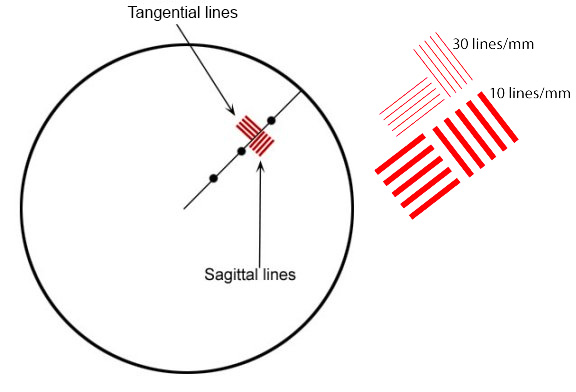
A Quick How to on Reading MTF ChartsIf you’re new here, you’ll see we have a scientific methodology to our approach, and use MTF charts to measure lens resolution and sharpness. All of our MTF charts test ten of the same lenses, and then we average out the results. MTF (or (or Modulation Transfer Function) Charts measure the optical potential of a lens by plotting the contrast and resolution of the lens from the center to the outer corners of the frame. An MTF chart has two axis, the y-axis (vertical) and the x-axis (horizontal). The y-axis (vertical) measures how accurately the lens reproduces the object (sharpness), where 1.0 would be the theoretical “perfect lens.” The x-axis (horizontal) measures the distance from the center of a lens to the edges (measured in millimeters where 0mm represents the center, and 20mm represents the corner point). Generally, a lens has the greatest theoretical sharpness in the center, with the sharpness being reduced in the corners. Tangential & Sagittal LinesThe graph then plots two sets of five different ranges. These sets are broken down into Tangential lines (solid lines on our graphs) and Sagittal (dotted lines on our graphs). Sagittal lines are a pattern where the lines are oriented parallel to a line through the center of the image. Tangential (or Meridonial) lines are tested where the lines are aligned perpendicular to a line through the center of the image.
From there, the Sagittal and Tangential tests are done in 5 sets, started at 10 lines per millimeter (lp/mm), all the way up to 50 lines per millimeter (lp/mm). To put this in layman’s terms, the higher lp/mm measure how well the lens resolves fine detail. So, higher MTF is better than lower, and less separation of the sagittal and tangential lines are better than a lot of separation. Please keep in mind this is a simple introduction to MTF charts, for a more scientific explanation, feel free to read this article. |
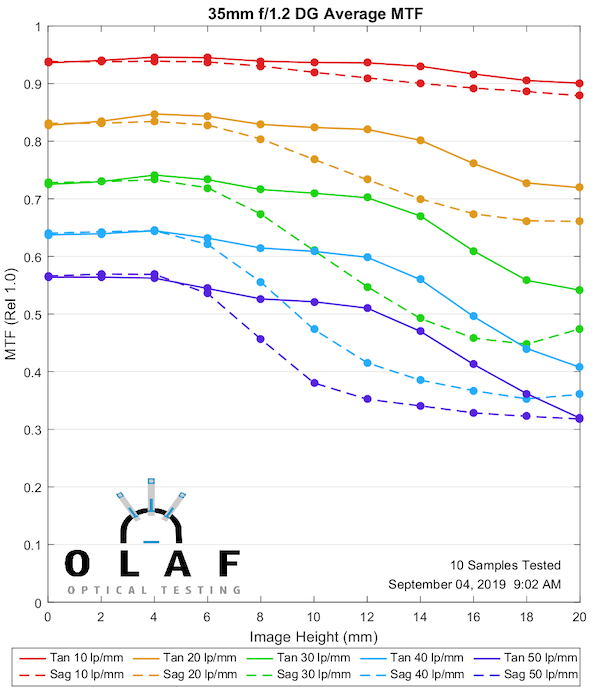
MTF Results
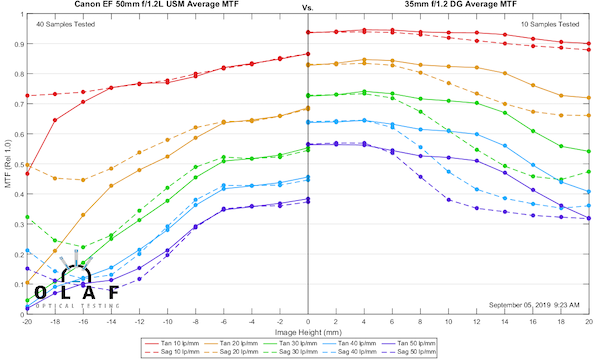
For an f/1.2 lens, the MTF chart is really, really good. Center resolution is excellent. Away from center resolution is well maintained, although, there is some sagittal and tangential separation, which indicates either a bit of astigmatism or lateral color. This is expected in very wide-aperture lenses, though, and it isn’t severe.
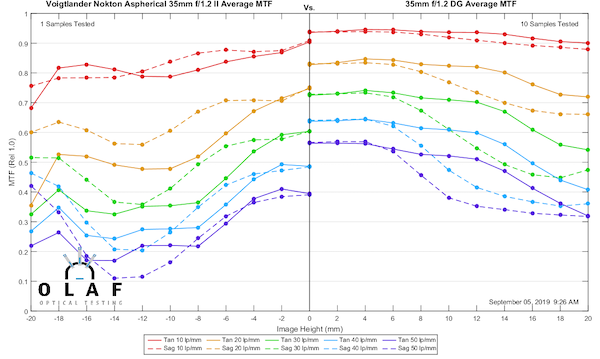
Since we’re all used to looking at f/1.4 MTF charts, it’s worth pulling up some other f/1.2 comparisons to show just how sharp this is for an f/1.2 lens. The only other 35mm f1.2 I have data for is the Voigtlander Nokton 35mm f1.2 Mk II. The Voigtlander is an older, smaller, less expensive, manual focus lens so we didn’t expect it to keep up with the Sigma; and it doesn’t.
The classic old Canon 50mm f/1.2L is an f/1.2 lens and while it’s obviously not a 35mm focal length, it’s still worth a comparison. It was never considered a sharp lens, even back in the old days, though. (And before you ask, no I can’t test the RF 50mm f/1.2 yet, so I don’t have that logical comparison available.)
The sharpest ultra-wide aperture lens that I had tested (before now) at f/1.2 was the Leica Noctilux-M 75mm f/1.25 ASPH. Despite the Leica’s $12,000 price tag, the Sigma is indeed sharper. I was honestly a little surprised at this.
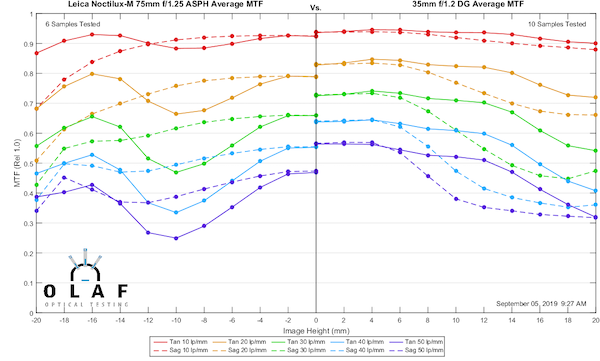
So I think we’ve settled the question as to whether the Sigma is the sharpest f/1.2 that we’ve tested. (From computer-generated MTF charts I do think the Canon RF 50mm f/1.2 will test sharper, but, as I said, I can’t test it yet.)
I Know What You’re Thinking
So, it’s a really amazing sharp lens at f/1.2. Those of you who really need f/1.2 are already off ordering it somewhere. But a lot of people are thinking, well, I’d like me some f/1.2, but I really want to know how it compares to the 35mm f/1.4 lenses. I know it should sharpen up a bit at f/1.4, but how much? So, for this one and only test, because 1) I wanted to know, too; and 2) I had a rare day where the optical bench and I both had nothing else to do; I ran 5 of the Sigma 35mm f/1.2 lenses at f/1.4.
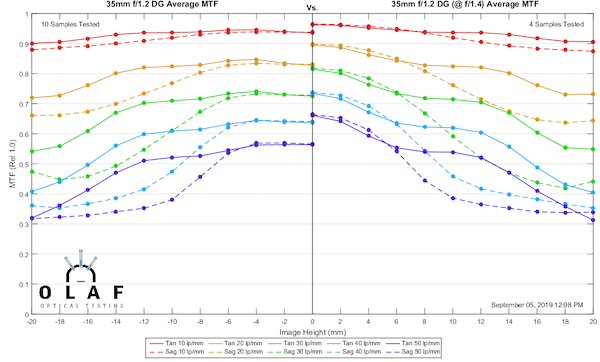
Just slightly stopped down to f/1.4 we have a significant improvement in resolution in the center of the image, but not much change in the outer half. (For those of you who think ‘stopping down improves things everywhere’; no it doesn’t. It’s specific to each lens and depends on which aberrations the lens has. Some lenses sharpen up all over, some in the corners first, some in the center.)
I used those f/1.4 results to do a couple of comparisons to other 35mm f1.4 lenses. We’ll compare it first to the Sigma 35mm f/1.4 Art, which is an excellent 35mm.
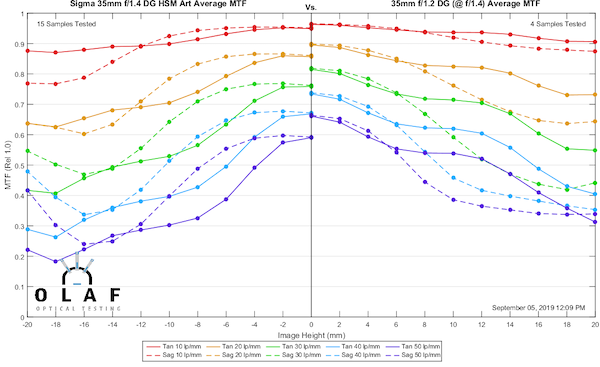
The Sigma 35mm f1.2 DG Art is clearly a bit better than the original f/1.4 Art. It is a newer, larger, and more expensive lens. But, I honestly thought the f/1.2 lens would be less sharp than the f/1.4 before doing this test. Because historically f/1.2 lenses have been.
So now the question becomes, is it as good as the Tamron 35mm f1.4 SP, the lens that just 10 days ago I declared the sharpest 35mm we’ve ever tested?
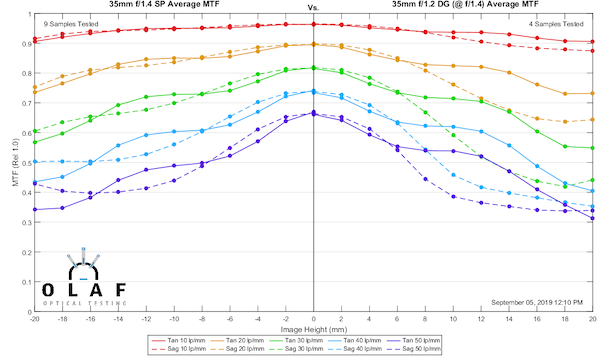
Well, it’s a dead heat in the center. Away from center, if I split a few hairs, the Tamron is a little sharper and it clearly has less sagittal-tangential separation. So the Tamron retains its title of sharpest lens in the Welterweight division.
This is where you ask me ‘could we see that difference in a photo’? Nah. The two lenses would render differently, perhaps have a slightly different color cast you might notice, etc. But even in a large print with a magnifying glass, you couldn’t say one is clearly sharper than the other.
Conclusion
We showed one important thing here. If you want to shoot a 35mm f/1.2 on a Sony camera, the Sigma is a superb solution. Unlike most ‘ultra-wide’ aperture primes, you don’t pay any sharpness penalty to use this lens. That is truly unusual, f/1.2 lenses are expected to be less sharp at the same aperture than f/1.4 lenses.
It’s actually a bit better than ‘as good as’. The Tamron 35mm f1.4 SP is a tiny bit of hair-splitting, pixel-peeping sharper. But the Sigma 35mm f/1.2 is only available for FE and L mount cameras, and the Tamron isn’t available in FE mount (although I’m sure some people will be shooting in with an adapter on FE cameras).
As always, I’m only testing optical resolution. But assuming the AF speed and accuracy, the bokeh, rendering, and other important aspects of the lens please you, this is the sharpest 35mm wide-aperture lens you can natively mount to your Sony camera, and it’s a wider aperture than any of the others, too.
If you don’t care about f/1.2, then the Tamron on an adapter (if you’re an adapter person) is awesome, smaller, and less expensive. The Sony FE 35mm f1.8 will probably be the most popular of this recently tested group; it’s small, native, and reasonably (but not cheaply) priced. The Sony FE 35mm f/1.4 ZA is also a lens that exists, although I can’t imagine anyone is considering buying one.
Roger Cicala and Aaron Closz
Lensrentals.com
September, 2019
67 Comments
Astro Landscapes ·
At first I was like, “it’s a good thing I published my Tamron review already, because I just called it the best 35mm EVER for astro-landscape panoramic stitching with its amazing corners, and now here comes a likely better lens…”
…Then I saw the MTF graph and I was like, “NO WAY OMG!!!”
😛
Roger Cicala ·
Well, I said no difference, but astro photography will see it if anything does. “Optical bench – a testing method that is nearly as picky as astrophotography, but has the advantage of numerical results.”
After I test, I go find some astro pictures to decide “so was that off-axis difference noticeable?”
geekyrocketguy ·
I’m going to start citing this quote when I give astrophoto lectures.
Astro Landscapes ·
With megapixels these days, it’s always noticeable… 🙁
Getting the best results out of any given lens when shooting the night sky is definitely the biggest challenge/frustration I’ve ever faced. No matter how sharp a lens is proven to be “on paper”, it can all fall apart if you miss focus by a fraction of a millimeter, (especially on modern AF lenses with abysmal focus throw) or if you heavily abuse your lens for a few months or a year, and something gets even slightly out of alignment. GeekyRocketGuy and I have seen many of our Brokinon lenses pass away in the prime of their youth from such a common ailment. 😛
Even on my test images from the A7R3 and the 24 1.4 GM, I have some examples of f/1.4 perfectly nailing focus on stars through the entire image or plane of focus, …and a few images which inexplicably have a soft right edge despite being tack-sharp in the center, or even being stopped-down to f/2.8…
And nowadays, there’s even more variables that could be the culprit. Did the IBIS lock the sensor at a slightly skewed angle when turning it off, causing a tilt-shift look to those few images? Or did I simply miss focus?
I’ve resigned myself to starting my manual focus workflow somewhere between the rule-of-thirds points and the extreme corners, trying to nail focus there, and then checking the dead-center and the other corners. Because no matter how perfect you think you’ve nailed it in the dead center, there still seems to be some small %% difference in the depth of field (yes, even at f/1.4 and focusing on stars) between dead-center and the corners, so you just can’t be sure unless you actually check.
I hope Tamron is working on more f/1.4 primes, whether for DSLR mounts or mirrorless mounts; they seem to be onto something good. Or maybe 35mm is just that much easier to do well than 24mm or 35mm, as we found with the Sigma 20, 24, and 35 1.4 Arts. I guess we’ll find out.
Then, there’s the “fact” that Sony’s FE mount is the narrowest diameter of the big three, so if we really want to see something impressive, we should all wait until Nikon puts out their (alleged/leaked) 35mm f/1.2 for that gaping maw of a mount they have now…
Oh, and if LR needs an astro-focused review of any of these lenses, I’d be happy to communicate with Zach S. or anyone about that. 😀
Larry Templeton ·
Just a quick question from a non-astro shooter… If you mount your camera to a “star tracker” (or whatever those motion mounts are called) aren’t you then able to shoot at f/8–if you want—since you can decrease your shutter speed without worrying about motion blur?
geekyrocketguy ·
Yes, you could, however the landscape will blur a lot during the tracked shot. Matthew (Astro-Landscapes) and I tend to try to do everything in a single shot. It’s a bit of a reaction against the compositing/fakery/just-drop-a-milky-way-in that is all the rage these days in landscape photography. We try to keep everything real.
Astro Landscapes ·
Yes, and especially if you plan to photograph the sky only, and at telephoto focal lengths, a good tracking mount is a must-have.
However, for nightscape photography, where the starry sky is just a sky above a landscape of course, tracking is an annoying addition of extra gear, shooting time, and post-production. And it’s basically impossible if you’re shooting timelapse, which I enjoy a lot.
Either way, generally speaking an astro shooter who is shooting tracked will still only stop down a “mere” 2-3 stops, or to f/4 or so, because f/8 is definitely overkill on most lenses. Optimally, an f/1.4 prime stopped down to f/2.8 or f/4 is the best middle ground.
Larry Templeton ·
I respect the “get it correctly in-camera” ethos that your partner and you seem to respect. But (and this is just layman curiosity) is shooting and exposing for the landscape separately from the sky while on a star tracker really in contradiction with the desire to shoot something faithfully? (Of course, dropping in the Milky Way on a shot in which it didn’t appear is completely ridiculous—but this doesn’t seem like that at all.)
Astro Landscapes ·
Yes, unfortunately, because dynamic range suffers severely at ISOs like 6400 or 12800, or even 3200 or 1600 on many cameras. The foreground, or the earth, will be utterly trash in the shadows, which definitely compromises the "faithfulness" when capturing a scene.
For an example of how terrible (useless, really) the foreground detail can become in some astro-landscape photos, (though this is not an example of tracking, where a lower ISO could be used) ...see the end of this video here: https://youtu.be/HX--H5GSZO...
Jim Abels ·
To print large images and have low noise has forced me into stacking the sky separately from the ground. I often stack the sky in 15-20 shots averaging the noise of 10-12,800 ISO. It gives sharp stars but adds much more difficulty to editing the photo. For the ground images, I stack for noise and this has really changed things for me. But at this point, I can’t say I got in camera because that’s not possible without lots of noise or stars trailing. It has forced me to learn how to blend better in photoshop. Are you using Starry Landscape Stacker or Sequator?
Astro Landscapes ·
Yes, using SLS for now, but I work on both Mac and PC so I’ll probably get around to testing Sequator sooner or later. From what I’ve seen it messes up a bit more often though.
If you’re stacking at ISO 12800, though, you should probably look into getting a tracker so that you can kick that ISO way down and get cleaner shots to begin with.
Paolo Bubu ·
Star trackers are great on paper, but I found out that in the real world people are abusing em creating fake looking photos or “impossible standards” often taking a picture in one location and pasting the sky from another, that’s super lame considering one of the coolest thing of the night sky is that it’s basically a giant clock and that it’s great when one is able to combine that aspect with the foreground.
Mark Harris ·
not again with that BS mount size crap that Canikon tried to push in desperation when people were less than impressed with their lackluster products
PJ Smith ·
The thing that stands out to me though, is the Tamron is designed for Nikon and Canon FF DSLR’s, which makes the Tamron that much more impressive. It’s obviously optical engineering wise easier to design a lens like the Sigma 35mm f1.2 since it’s for mirrorless (therefor a larger mount and much shorter flange distance.) Is it then surprising that the Sigma is almost as good? No, it’s actually more surprising that the Tamron still bests it by a slight margin.
Astro Landscapes ·
I definitely can’t wait to see what Tamron does for full-frame mirrorless f/1.4 (or faster) primes!
Mark Harris ·
Looks to me like the Sigma is sharper mid way through the frame then the Tamron wins near the edges.
In any case, super happy with the 1.2 and its surely smoother bokeh than the Tamron.
One thing to consider is that adapters can affect IQ specially from wider lenses if not perfectly built:
www.youtube.com/watch?v=75X...
Not to mention, AF performance may vary as well so while more expensive and bigger, the 1.2, native focus and no concerns about adapter build quality all make the Sigma a better choice in my book.
Thanks for your awesome work!
David Kudell ·
Another great Sigma lens. Alas, the focus by wire system kills it for me, since I need to use it for video.
JordanCS13 ·
Grab the f/1.4 version then….even the native FE mount version still has the mechanical coupled focus ring.
Trey Mortensen ·
Curious as to why you can’t test the 50 1.2 RF yet, since it’s been out for a while now. Is it due to so many copies being out on loan, so you don’t have enough for a test sample? Is it something to do with the fact that it’s so complicated (referencing your build tear down)? Is it something to do with Canon in general? I suspect it’s something similar to my first question, but would love to hear why!
Mike Aubrey ·
They need a mount for it on the machine before they can test it.
Sean Tomlinson ·
No Mike, the truth is that Roger is in the pay of Sonikon to keep Canon down as part of an international plot by the Illuminati to prevent the world from seeing the brilliance of their lenses.
Mike Aubrey ·
“The Sony FE 35mm f/1.4 ZA is also a lens that exits.”
Typo or Freudian slip? 😉
Roger Cicala ·
Both?
George De Castro Day ·
I’ve owned a 35/1.4 ZA for a couple of years, and use it all that time. One thing about it that drives me nuts is the aperture click/smooth switch (whatever the technical term for it is). It slips from one position to the other far too easily. I have been happy with it, shooting with 7RIIs and 7RIIIs, although the bulk is sometimes a drag. I’m wondering what your take on it is, given the above comment, and how you feel it compares to the Tampon? I’ve had some dread of OEM lenses, in terms of AF response and build quality, but, at the price, the Tampon seems hard to pass up, when the next round of upgrades hits. Thoughts?
Roger Cicala ·
I’m not a big fan of the ZA because they almost always have a soft corner, but a lot of people love it. From an image quality standpoint, any of these new lenses should be a step up. However, I don’t do any tests of AF capabilities or speed, bokeh, flare, etc. and those are all really important.
George De Castro Day ·
Maybe this is the answer? Looks like the Tamron and Sigma kick the Zeiss 35/1.4 ZA's booty pretty far: https://www.lensrentals.com...
Andreas Werle ·
Oh Roger, you did MTF of a Leica M-Mount Lens! 🙂
Phillip Reeve ·
More of that please! Would love to see more Voigtlander MTFs especially from their (APO) E-mount lenses
Astro Landscapes ·
It would likely only prove that there is no free lunch when it comes to corner sharpness and the “mirrorless weight savings” myth. If you want a lens as relatively compact as most Voigts, you’re gonna get trash in the corners, no matter the flange distance or mount diameter.
Phillip Reeve ·
Well their APOs aren’t exactly compact and very high performance. The only other Voigtlander which is a top performer in regards to sharpness in it’s class would be the 1.4/21. When we speak about the others performance is certainly not exactly class leading in regard to sharpness.
Astro Landscapes ·
Oh, that 21 1.4, Ben Horne just switched to it from his Loxia 21 2.8, I heard about it but I didn’t know if it was any good in the corners for astro work. I had kind of just written off Voigtlander as one of the “it has lots of character!” lens companies that cinematographers and Instagrammers like.
I’ll have to see if Ben can at least do some 4K timelapse of the night sky at f/1.4 on his next trip…
Roger Cicala ·
We rarely stock 10 copies of them, so it’s not often I run them.
NRKStudio ·
Any chance to seat the real king of MTF, the Zeiss 35/1.4 ZM?
On a side note, the Leica 75/1.25 stopped down to f2 is sharper than the Leica 50/2 APO at f2 according to Leica’s MTF. Such is a wonder.
Carl Eberhart ·
Well done as always Roger ! Next please do a comparison of approx. 20mm lenses…I suggest the Tokina Firins (manual and auto), the Art, and the new (?) 21mm Voigtlander f/1.4. You can throw in the Nikkor and Zeiss if you like.
In the astro groups people are always trying to find the “best”, that has the least coma (you can do a coma test besides your MTF, it won’t kill ya 🙂 ). The Sigma haters will always find fault with it but I think it may still be the best overall at 20mm.
DrJon ·
Oooh, Coma tests pretty please…
Paolo Bubu ·
Tokina Firin will likely murder everything under 1000$, that lens is fantastic for the price.
Athanasius Kirchner ·
Well, the ZA 35mm f/1.4 has a market in my country (Chile). Sony is already the most affordable brand here, and the Zony has the smallest price tag among all the modern 35mm f/1.4 lenses (when and if they are available, to begin with). On rebate, the Canon EF comes a little bit under the Zony’s price… but then Sony also do discounts here, and then their offering is unbeatable.
AndyNZ ·
Great work Roger…. appreciated.
Samuel H ·
WOW, Sigma is doing lots of AWESOME stuff lately.
Is there any chance we’ll see the MTF tests from their APS-C lenses? (I’m very happy with my 16mm f/1.4 and 56mm f/1.4, I’d like to know how much resolution I’m missing out by not moving to full frame)
Andrew Hansen ·
Do you plan on testing the Leica 35 SL apo? Or any of the sl lenses?
Roger Cicala ·
If and when we get an electronic mount made for them on the optical bench.
Photo Dad ·
How was the copy variation on the Sigma 35 1.2?
Roger Cicala ·
Very consistent lens.
BoredErica ·
Same for Sigma 40mm 1.4?
Roger Cicala ·
Yes, all the new SIgmas were very tight. There’s variation, of course, but on the Canon-L range. And I know first-hand Sigma’s doing the best ‘end of assembly line’ testing of anyone right now.
Andreas Werle ·
Sorry for nitpicking, Roger.
You said: “I ran 5 of the Sigma 35mm f/1.2 lenses at f/1.4.”, but the chart reads 4 samples.
Greetings Andy
Roger Cicala ·
Andy I ran 5; that may have been a chart composed after the fourth. I’ll put the 5th graph up when I get back in town but they’re virtually identical.
Pox ·
Impressive. I hope Sigma does a 50mm 1.2 and a 85mm 1.2.
Joshua Richardson ·
A Sigma 85/1.2 may dislocate your lens mount. 😀
Don Farra ·
Roger, thank you once again for an excellent analysis report. I have a question. As a Sony user will an MC-11 adapter with the Tamron lens change the test measurements significantly in your opinion? Thank you.
Roger Cicala ·
Don I do not think so; the Sony filter stack is similar to what the Tamron was designed for.
Don Farra ·
Thank you
decentrist ·
bigger,heavier,sharper…..at what point does this become comedy?
Paolo Bubu ·
Apart from the higer frequencies (which arguably are less important than the lower ones) the Sigma has more astigmatism than the Tamron, is heavier, bigger and mor expansive.
To me the Tamron is the winner of the two without doubts, that lens is a jewel!
Mark Harris ·
Higher resolutions are VERY important, plus the Sigma has WAY smoother bokeh..so to me is easily the winner. I dont get a 1.4/1.2 to do landscapes..for that I could get a smaller slower lens or a zoom.
Sergey G. ·
Hi Roger, I’m sorry to highjack this 35/1.2 tread, but I don’t see another opportunity to contact you directly. I’ve been enjoying your posts mixed with solid test data and very humorous remarks.
There is very new and quite unusual lens in play – the Tamron 35-150mm F/2.8-4 Di VC OSD (Model A043) zoom, which is claimed to be very sharp and generally great. I’m a birder and usually shoot Sigma 500/4 (for 2 years, previously shot Sigma 500/4.5 for 6 years) and Nikkor 500/5.6PF (more like my retirement lens to be eventually). Currently I’m giving up my previous brand (Pentax) 5 bodies and almost 2 dozens lenses, switching completely to Nikon (D500 and D850). So, the initial choice looked quite obvious: 14(12)-24; 24-70, and 70-200. And based mostly on your test results I almost opted out for the Sigma 14-24/2.8, Tamron 24-70/2.8, and Nikkor 70-200/2.8E. I know that you are not a fan of longish zooms. Me too. However, with 35-150 initial f/2.8, and f/4 starting somewhere from FL 70mm, this lens might be a game changer, requiring mostly something like 15(16)-30(35)mm (Tamron, Tokina Opera, etc.) to be paired with for every day casual use and probably outperforming your “f/5.6 best choice recommendation” – the Sigma 24-105/4.
I just learned that LensRentals now has new Tamron 35-150 in house. Are you planning to test it and compare with closest competitors? I’m pretty sure, many of your readers will greatly appreciate such work.
Thank you in advance,
Greyser
Roger Cicala ·
Greyser, it has been my habit to not test anything greater than a 3X zoom, and to not test variable aperture zooms. I may (may) get that done because it does interest me, but it will be more about ‘oh, I have a week with nothing else to do’ than anything else.
Sergey G. ·
Hi Roger, I really appreciate your reply. I have to confess that I’ve learned about your 3X zoom testing rule before I asked for this (sorry). But… There are some unique examples of greater zooms to be better than lower “x” lenses. Let’s take for example phenomenon of 50-500 “Bigma”. It went through many iterations and every time it was considered better/sharper than Sigma’s 150-500 and 170-500 zooms. 10x vs. 3x. I’ve never had one, preferring long fast primes, however, it is a well known fact among birders. And Sigma did it again with recently released 60-600mm which (according to MTF data what I’ve seen) is sharper then 150-600mm Sport.
This 35-150/2.8-4 seems to be unique in many ways, challenging most of traditional paradigms. Probably Tamron is paving its own path in highly competitive market. Let’s say almost flawless 15-30/2.8 + 35-150/2.8-4, which is f/2.8 lens at 35-70mm. It is relatively same sized as Tamron 24-70, but lighter a bit and has another 75-150/3.5-4 advantage. What a treat! Or a couple of smaller fast primes on wider end and this… plus 200/4 or 300/4 prime. Quite interesting concepts might be. All available so far info is very contoversial. Some said that the output is on a softer side, while others were truely amazed by 35-150 sharpness along the whole FL range. I guess yours very objective scientific testing of multiple copies may fill the voids perfectly well.
I very respect your time, but you seem to be very curious man with a hunger for new and unusual things. And it might be real fun! Just trying to convince you to reveal an ultimate truth 🙂
Thank you agin and hope for the best,
Respectfully,
Greyser
Roger Cicala ·
Greyser, I tested 3 copies of the Tamron 35-150mm. It’s a good 5X zoom, meaning sure not as good as a 3X zoom, but for what it is, it’s good but not special. No paradigms were shifted in the making of the 35-150.
Sergey G. ·
Roger, thank you very much for the test. So, it is more of convenient “portrait zoom” as Tamron specified it, than all around lens for every day use.
How it stands out against, let’s say, Sigma 24-105 or Nikon 24-120? I understand that you just poked into it and did not have enough time to compare them. I just curios about your impressions in general: similar, inferior/superior.
Thank you again,
Greyser
Roger Cicala ·
Greyser, I’d say it’s not quite as sharp as those two, but close enough that sample variation would largely mask the differences. With 5X zooms there’s going to be a significant amount of variation not just between the lenses, but within one lens at various focal lengths. I’d probably go with whether I preferred the Tamron zoom range to the others.
Sergey G. ·
Thanks a lot. I’m trying to build UWA-WA lens coverage around beautiful Sigma 24-35/2. Probably I should go with couple faster primes. For now in transferring to Nikon process I own two 500mm primes and Nikkor 70-200/2.8. And I need to feel the gaps, but want to do it smartly 🙂
Vladimir Gorbunov ·
Dear Roger, could you please clarify, do I understand you correctly that variable aperture lenses tend to be of inconsistent optical quality, and therefore there’s little interest in testing them?
BTW, you tested 24-105s, as far as I remember. 🙂
Mark Harris ·
For me Sigma just created the perfect 35mm 1.2 for environmental portraits. Just stunning resolution, AF performance and bokeh.
Thomas ·
I have a question concerning the AF motor of this lens. I received my copy yesterday. It is a great and optically flawless lens, focus works great on my A7r4, although Sony GMasters still have an edge, as expected. However, I can hear some pronounced ticking noise in AF-C, when pressing the shutter button half way down for continuos focussing on my A7r4. It works as expected, so it is probably not technically defective. I have the same noise on all my Sony GMasters, but it is much less pronounced and I can only hear it, when putting my ear onto the lens. On the Sigma 35/1.2, I can clearly hear this noise when 50cm away from the camera with my ears. It is also audible in video recordings, when using the internal camera mic. If this is “normal”, I can perfectly live with it. I only want to rule out any technical issues as long as I still have possibility to return the lens to the dealer. The problem is, that most sources claim, the lens would be noiseless (which is impossible anyway) and in my reality, it is a totally different thing. I admit, that I am a little bit sensitive, but I do not understand, how anybody could say, it is noiseless. I talked to several people: while a minority would confirm this phenomenon, the majority does not subjectively experience any specific “noise”, as it seems. Does anybody else have this “noise” ? I suppose it is much more pronounced due to the stepping motor (while Sony uses a linear motor for smoother movements), which would explain, that it is also audible in MF, when turning the focus ring step by step.
MarkJ ·
Roger, you wrote :
“Just slightly stopped down to f/1.4 we have a significant improvement in resolution in the center of the image, but not much change in the outer half”
The reason for this is that in a fast lens like this, the off-axis pupil beyond half field is significantly vignetted by lens apertures and mounting diameters. Your half-stop of stopping down will only aftect the near-axial pupil size – it won’t touch the available pupil further off-axis. Hence there will be no change in the aberrations or MTF. Go down another stop or two, however, it will have quite a significant effect.
Mark ( lens designer )
Mike Aubrey ·
Are the Voigtlander 35mm f/1.2 results done with or without Sony’s cover glass?