

ADDENDUM: I should have mentioned in the text, all testing was done at 73°F (22.75C) ambient temperature.
Lots and lots of people are talking about Canon R5 heat cut-offs. The discussions range from technical discussions about heat generation, cooling methods, and firmware protocols to strident conspiracy theories.
I only know a little bit about heat:
- Electronics give off heat when they’re working.
- Heat fries chicken, which is good, and fries electronics, which is bad.
- You can get rid of heat by conduction (flowing through nearby materials), convection (circulating through gas or fluids), and radiation (which mostly occurs at high temperatures). We know from the teardown that the R5 is tightly sealed, so we have to figure that convection doesn’t play much of a role.
As a repair and QA oriented person, I hate bricking cameras. So I’m less interested in coaxing the camera into working hotter (see point 2) and more interested in how the heat gets out. When we did the teardown of the Canon R5, we saw some metal heat sink/transfer plates that would conduct heat away from specific chips, but once the heat sinks get hot, then what happens? That’s what I was interested in.
This is not rocket science; there are people far more qualified than me talking about chip operating temperatures, the thermal flow of various substances, firmware cool-down cycles, and stuff like that. (There are also people far less qualified than me talking about those things.) I have nothing to add to either of those discussions, and I don’t intend to get into a fracas about it.
This is just some fundamental stuff about how heat leaves the camera—because to my simple mind, getting the heat out of the camera is the end-all, be-all. Tweak heat flow as much as you like inside, and maybe you’ll gain a few minutes of this or that. But eventually, the heat has to get outside, or the camera needs to shut down. I do need to point out that the heat flow with the back off has nothing in common with the heat flow with the back on, so I’m doing this with fully assembled cameras.
First Step
We got a Canon R5 running V1.0 firmware, slapped a CFx card in, put it in 8K mode, and ran it to temperature cut-off, using some industrial thermometers to see where heat left the camera.
With the lens on, and the camera sitting on a table, all covers closed and LCD folded against the camera back but not on we ran it for 18 minutes before getting a temp warning. The hottest part of the camera was the back behind the LCD door (43°C / 109°F), followed by the rear body around the command/set dials and the area of the grip where you rest your thumb (40°C / 104°F). The bottom plate around the tripod socket reached 38°C / 100°F.
The top, front, and sides didn’t warm up much at all; most of the camera was around 30°C.
We redid things with the LCD moved to the open position, away from the camera. This time that area on the back of the camera was a bit cooler, 39.5°C / 103°F, but nothing else changed much. So a few takeaways: First, leaving the LCD open lets the camera radiate heat a bit better, which is pretty logical, but not better enough to prolong recording time. (We did use the same CFx card for both runs.)
Next, we waited until the camera cooled enough to record again and restarted. The only interesting part of this was the second shut down occurred at a degree or two lower external temps than the first. Is this because of the delay in getting residual heat out of the insides? The inside should be hotter than the outside, because thermodynamics, but I couldn’t measure how significant that difference was.
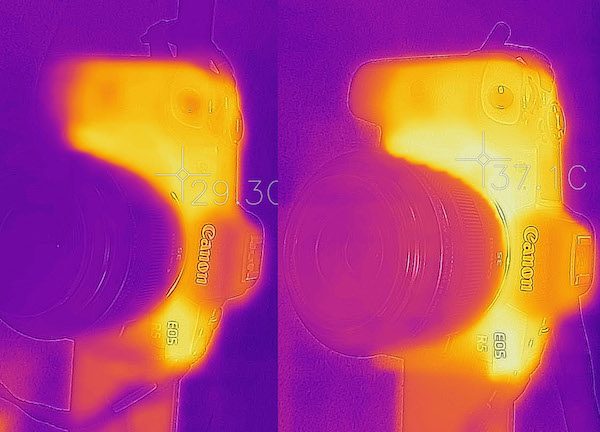
At this point, we decided that the thermometers we were using were reading from a 1cm² area, which was kind of a blunt tool. So I got a little FLIR IR camera, spent some time checking it’s readings against both of the thermometers we used, and decided it was just as accurate and gave us a lot more information. Plus, cool pictures that are more fun to look at than rows of tables.
The Chassis and Shell
The chassis and shell of most cameras have been developed for years to be strong and light (most manufacturers use similar material). I’ve never thought they conducted heat well, but I didn’t know for sure.
So we took a shell off to test this a bit. Just simple stuff; I used a narrow-gauge heat gun to heat the shell and see what happened.
First, we heated the inside of the shell with rubber intact and tested the temperature on the other side. We found that the shell is indeed not a great heat conductor. Heating the inside up to 180° F / 82°C the outside got up to 160° F, but with several seconds delay. With the rubber grip applied the difference was, as you would expect, a bit longer, and the outside reached about 150°.
Then we heated one corner of the shell looked to see how far the heat spread. We knew heat crossed the 2mm thickness of the shell slowly, so I figured it wouldn’t conduct heat to other parts of the shell very well. For once, I figured right.
We had to go back to our industrial thermometers for readings here; the spectrum was more than our little camera could handle. But I’ve got that bottom corner heated up to 180° F, the rest of the shell isn’t very hot at all.
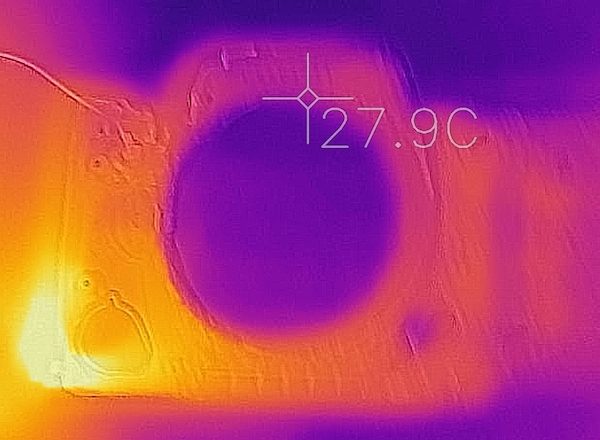
I kept the corner hot for a few minutes, and we did get some local spread, but I’m not sure if some of that was leakage from my heat gun. It’s very clear, though, that the shell material doesn’t spread heat especially well. If this was aluminum or copper, the whole shell would have heated up. Obviously, it does pass heat out of the camera to some degree, but it sure doesn’t act as a heat sink or anything.
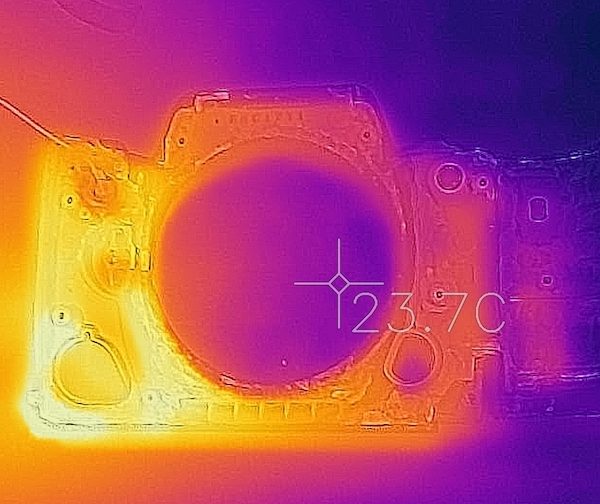
One other point of interest, the shell held heat pretty well. Even exposed to air, it was over 10 minutes before it cooled down to room temperature. This kind of poses the question that if heat isn’t getting out of the shell very well, then how does the heat get out?
Looking at the Heat
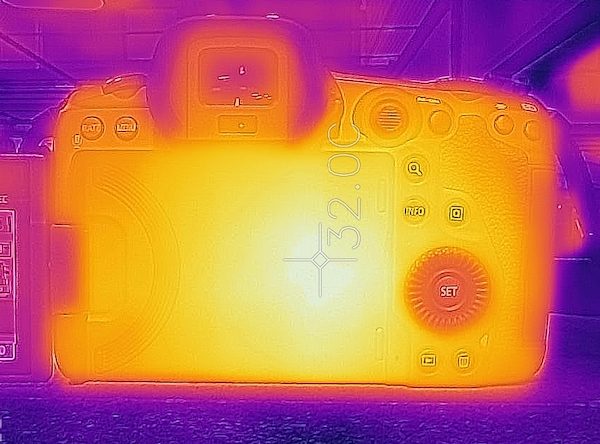
We got another Canon R5 with firmware v1.0, put a CFx card in, opened up the LCD, and started recording 8k again. Within a few minutes, we found our warm spot on the back of the camera.
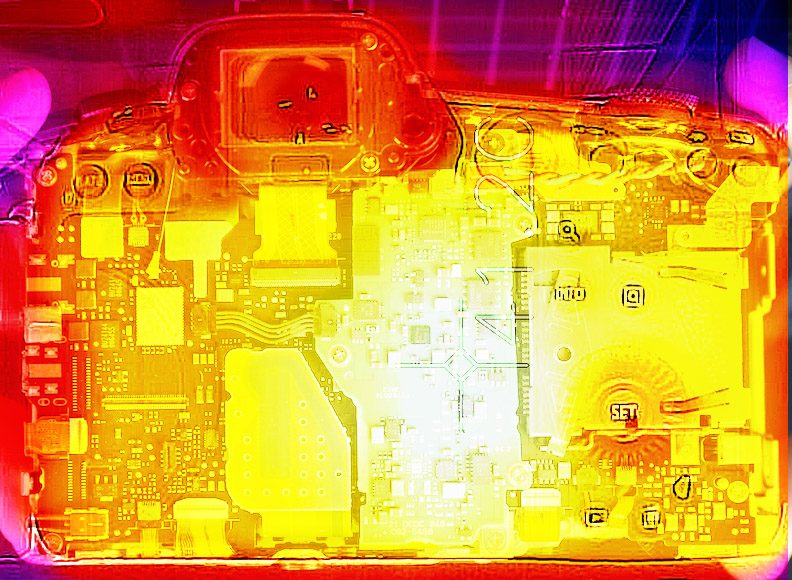
I overlaid an image from our teardown on the thermal image to show what’s right below there. Duh, the area over the processor and SDRAM cards.
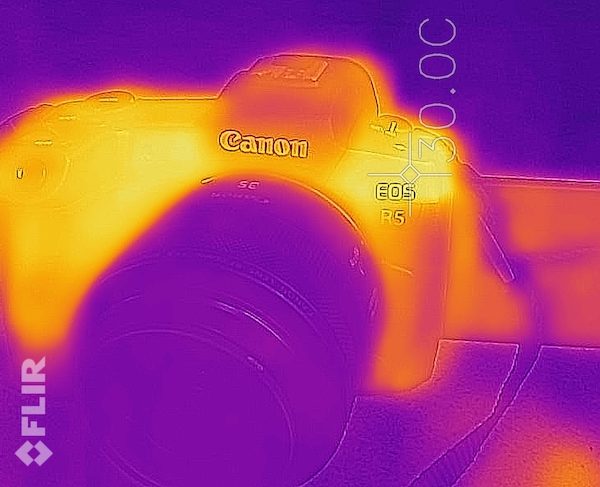
There was a little warmth on the front.
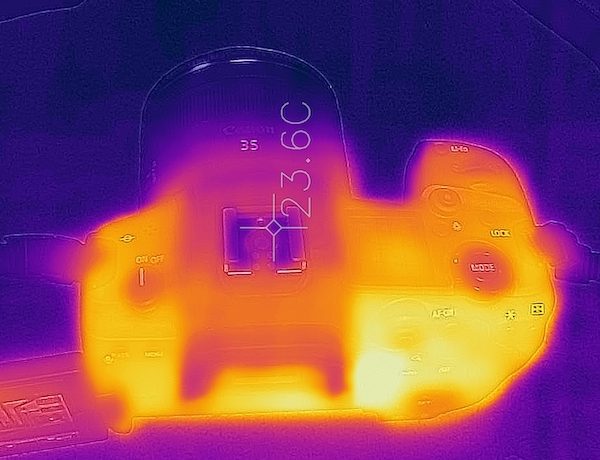
The top remained relatively cool. I had wondered, with the camera sitting on its base, if there might be some ‘heat rising in air’ effect. But then, as the teardown showed, there’s not a lot of air in there. We seem to be seeing a ‘viewfinder blocks heat transfer’ effect.
The bottom of the camera got a bit warmer, so it seems like the heat sink that’s connected to the metal tripod plate is sending some heat that way.
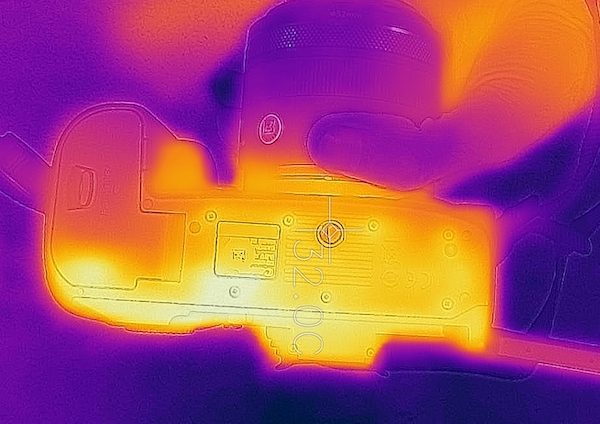
After a while, the warm fuzzies started giving way to the screaming heaties. Here are some pics showing how the camera was lighting up as we approached thermal cut-off, at 20 minutes.
The bottom is my favorite in this group. Notice how every screw that goes into the metal tripod plate is lighting up. The lens mount ring is pretty hot, too, with a temp of 38°C. The tripod socket seems to actually be a bit cooler than the rest of the bottom plate. I’m not sure why, perhaps a different metal, a gasket where it connects to the tripod plate, or possibly because it sits in a little air pocket inside the camera.
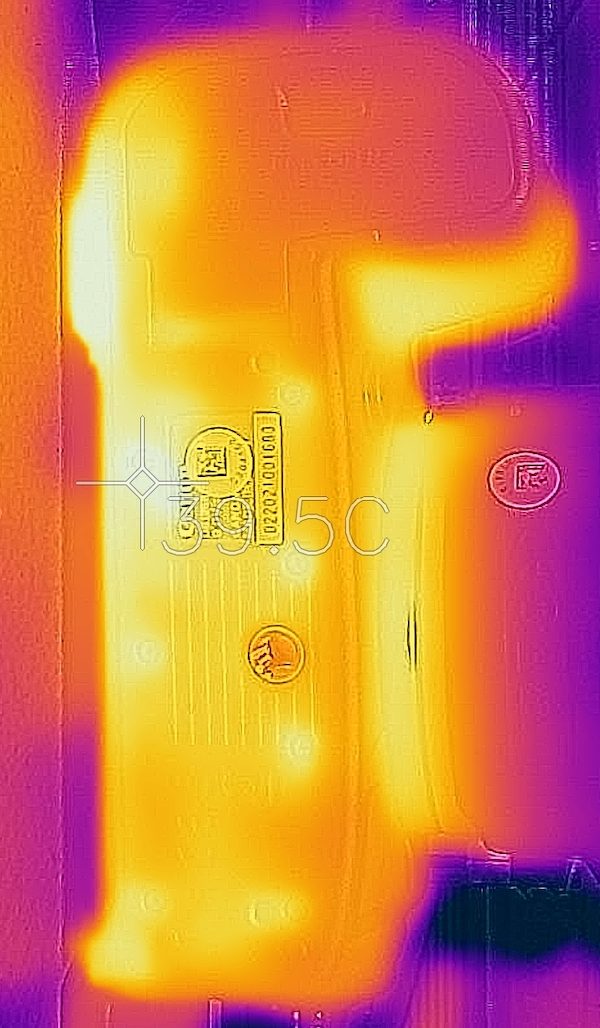
The top assembly still isn’t very hot in general, but both of the metal camera-strap lugs are spewing heat.
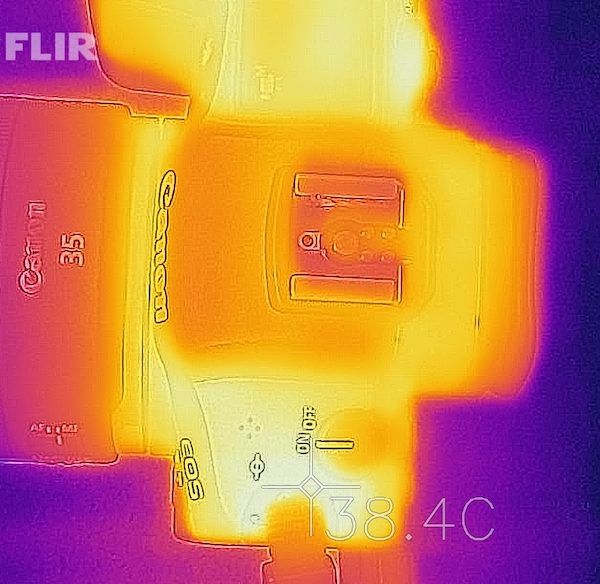
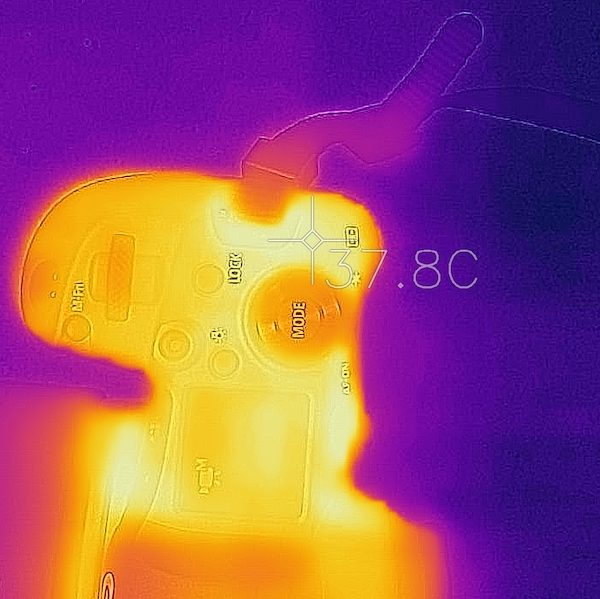
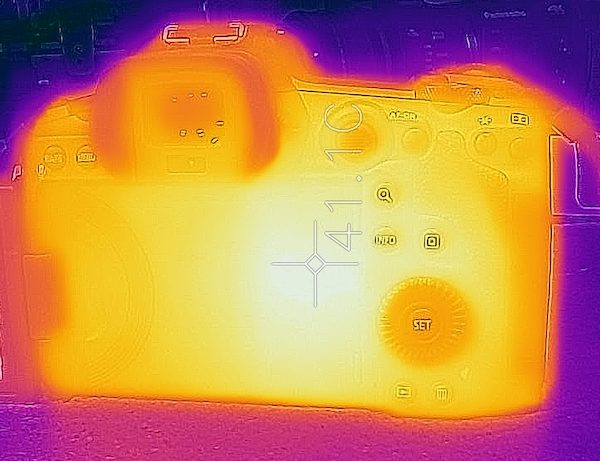
The hot spot at the back peaks out at 42°C and the entire back warms up to some degree.
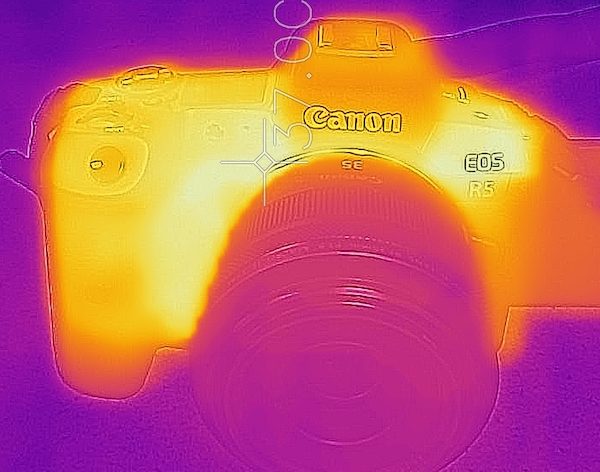
We have some significant heat radiating from the front, too, particularly around the lens mount area and in the corner above the card doors.
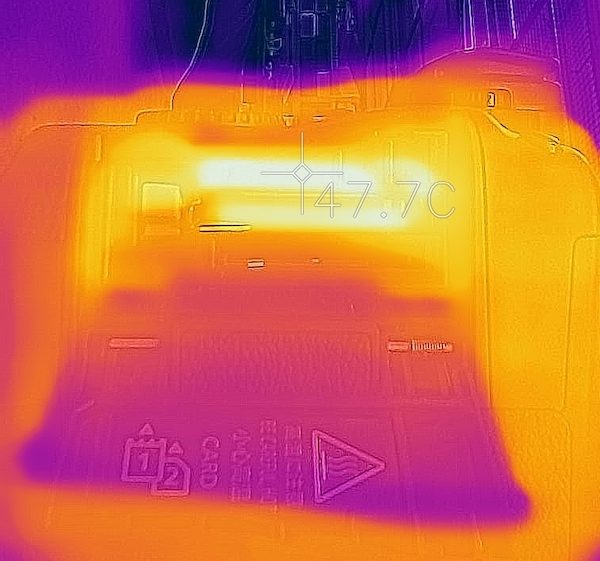
The hottest spot in the camera, though, was clearly the CFx slot. After the card was ejected it was about 48°C.
After Firmware Upgrade
We got a longer run after upgrading to V1.1, getting 25 minutes before cut off, but at the expense of slightly higher temps. (Full disclosure: I didn’t tell Joey to use the same CFx card in every run, so that may have changed.)
Not surprisingly, the longer run times came with slightly higher temperatures. Only a half degree hotter at the back.
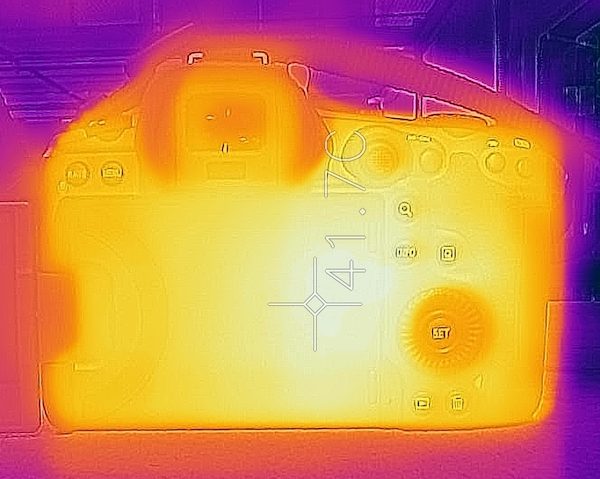
And at the bottom.
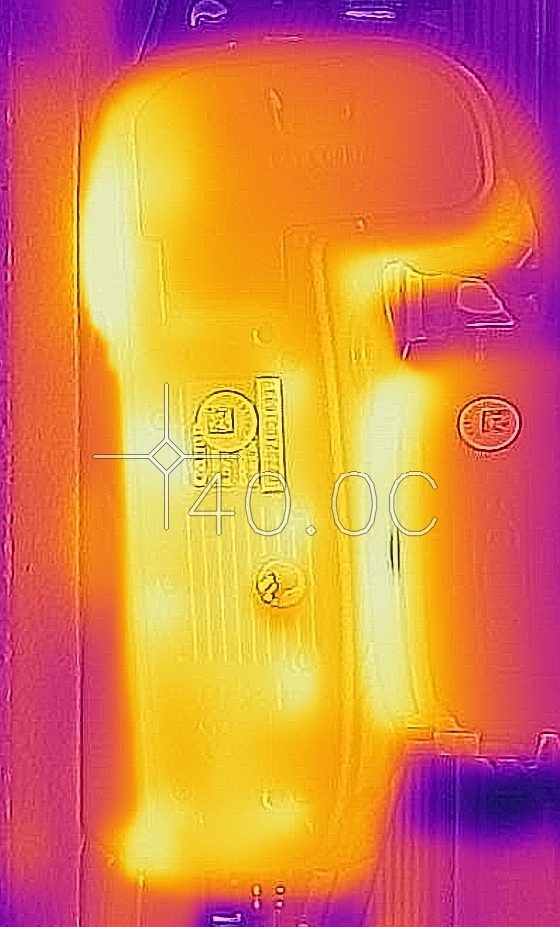
The card slot is quite a bit hotter, though.
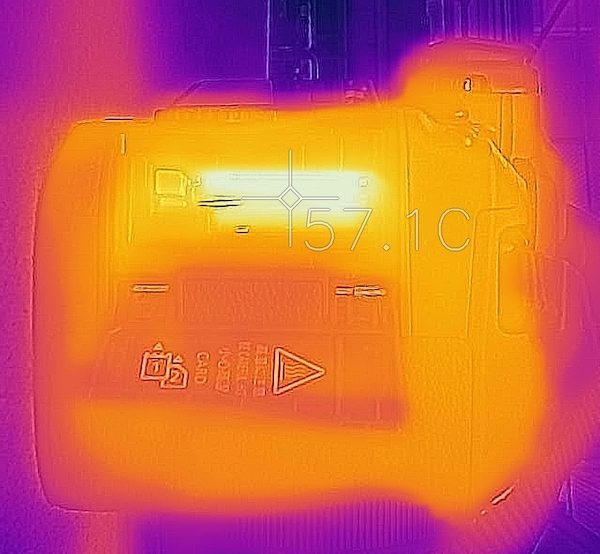
Of course, the card was hot, but I figured someone was going to ask, so here. It reads cooler than the slot, but it took a couple of seconds to get it out and get the image, so I’m not sure if it actually was.
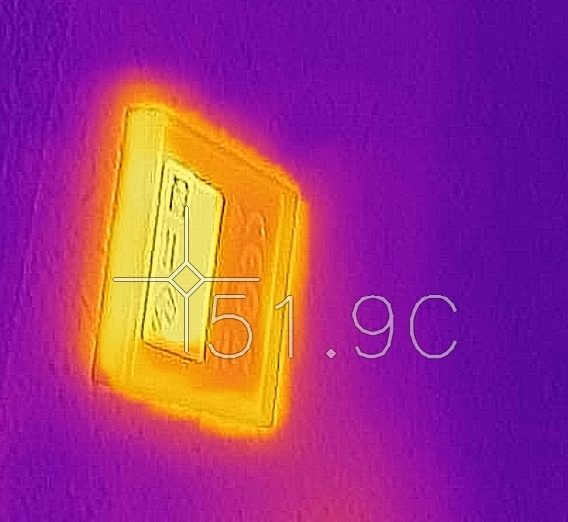
This made me curious about how hot the I/O ports were. The port covers had remained closed during recording. The ones on the mainboard were quite hot; those on the sub-board not hot at all.
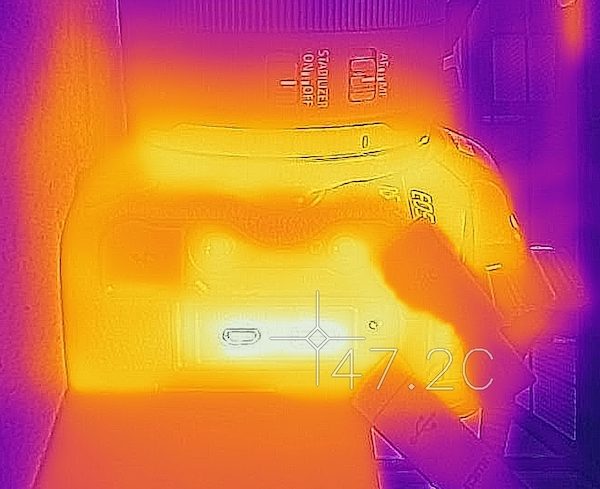
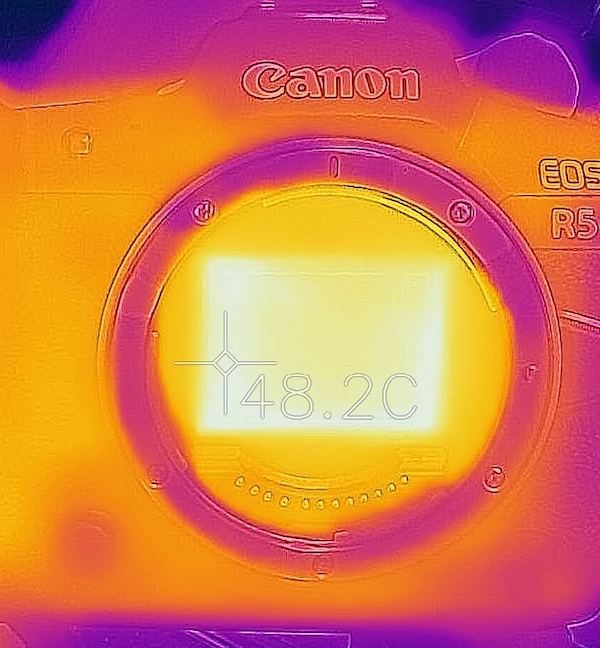
The sensor radiated quite a bit of heat, too. It wasn’t as hot as the card slot, but has a bigger surface area. It may also be that the metal in the IBIS unit is hot and that’s leaking out through the sensor area.
A friend, who wants no part of the inevitable arguments a Canon R5 heat post causes these days and will therefore remain nameless, was kind enough to read the internal temperature from a raw file taken when we were doing these other measurements. The EXIF recorded internal temperature was 63°C (I originally typoed this as 61C, it has since been corrected), which is hotter than even the CFx card slot.
I don’t know which temperature sensor the EXIF reads or where it is located. But somewhere inside the camera is hotter than the CFx card, and way hotter than the outside of the camera. There has to be a gradient, of course, for heat to flow. Still, this seems to indicate heat isn’t flowing easily.
So What Did We Learn Today?
Odds and ends mostly. The answer to the question “how does heat leave the camera” is basically not very well, and mostly via the metal parts. ‘Mostly’ as in the temperature is higher there, so I assume the heat flows easiest to those metal parts. I don’t have the math to figure out the actual caloric transfer, and the ‘not metal’ parts have a bigger surface area, so it may be that most of the calories may exit through the shell. The camera is hotter deep inside (the temperature sensor) than at the hottest exit points.
I am NOT a chip guy, but according to their faq, the Toshiba voltage converting chips have a suggested maximum operating temp of 60°C before they dramatically lose efficiency, and less efficiency means generating more heat. The CFx card slot was at 57°C and the internal temperature sensor at 61° C when things shut down. That could be a coincidence but may suggest Canon doesn’t think getting the inside much over 60° C is a good idea. I don’t know, but I’m a conservative guy by nature, so my personal decision is I’d prefer not to get the inside much hotter than that.
I’m not going to comment on how to improve heat transfer deep inside the camera; other people seem to be working on that. But the camera is a lot hotter inside than it is outside when it shuts down. If it doesn’t get heat out very well, it certainly can’t be expected to cool down quickly after it turns off from overheating. Cooling the outside of the camera should help a bit, but it’s not going to be very efficient.
Leaving the LCD opened away from the camera back, opening up the HDMI port cover, and saving to SD cards when possible (not an answer for 8K video, I get that) may all help get heat out of the camera while you’re using it. Still, I doubt it’s enough to make a significant difference in recording time. Removing the rubber grips might help a bit, too, but probably not a lot; the shell isn’t a great heat conductor.
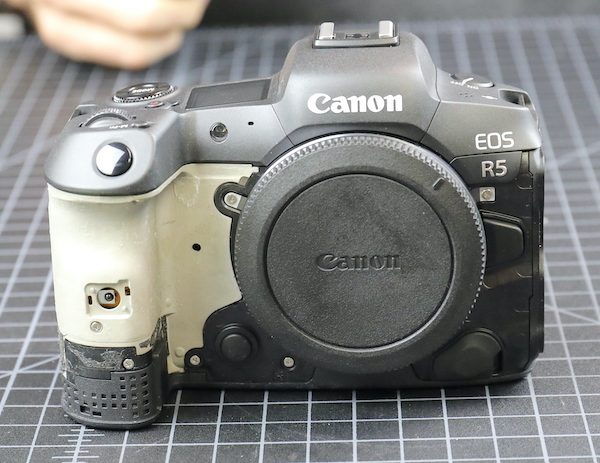
It seems likely that taking off the lens and opening the shutter, opening the card doors, and removing the CFx card will speed cool down. (I think several people have already discussed that online). But that’s all I can think of that might help a stock camera stay cool, and none of those are impressive thoughts.
Some people intend to do more aggressive things to extend recording time. It would certainly be possible, with some minor modifications, to connect the metal heat sink plates to the outside world. You might do so by just exposing the bottom tripod plate and attaching a sink to that. Of course you lose weather sealing, but it would be simple to try. I don’t know enough about the effectiveness of thermal transfer to say, but you could run thermal tape under all the bottom screws and bring it out through the bottom plastic cover and attach it to a heat sink. If that’s effective, adding some more paths to the two other heat plates in the camera might be even better.
You could also ventilate the camera to outside air fairly easily. There’s a large area in the body’s back plate that could be opened up; there’s no electronics under it. There are some smaller areas on the front plate where this could be done, too. It would be a fairly simple matter to take all the weather sealing out and make some leaking places for air to circulate. I honestly doubt some air circulation is going to have much of a cooling effect, but again, I don’t have this kind of maths. I bet some of the commenters will, though.
There’s also the issue that the camera is hotter deep inside. I suspect that when some third party does good work to improve heat transfer (where there is demand, an entrepreneur will fulfill it), that work will have to include some modifications of the internal heat flow. That won’t of itself be enough; you’ll still have to get the heat outside of the camera to accomplish much.
These kinds of things would make for a bigger, bulkier camera with no weather sealing—sort of a redneck 8K video camera.
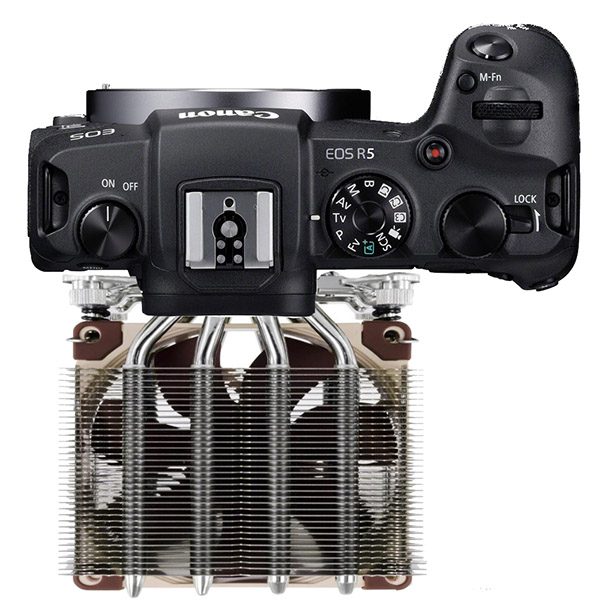
Given the low price of the R5 compared to a dedicated video camera with these specs, I expect someone will probably do it. Not me, I’m out of the entrepreneur thing, and a lot of experimenting (AKA camera sacrifice) would need to be done to figure out the most efficient methods.
I just can’t imagine tossing a fan on it and / or making a few holes is going to be effective. Someone will Kickstarter the idea, of course, but that doesn’t mean it’s going to work. Someone is raising a bunch of money on Kickstarter and then not delivering a working product. Who would have thought that could happen.
And Now, We Shall Have the Speculations!
Speculation is not knowledge. Robert M. Price
For a long, long time, the engineers making photo cameras have been worried about better weather sealing and materials that are strong and lightweight. They have not been particularly worried about getting heat out of cameras.
A big camera has many different development teams, each doing its own thing when it designs a camera. Let’s guess that the team doing electronic and video capabilities managed to cram all this super video goodness onto chips. Surely the marketing team LOVED the idea.
Some other team probably said, ‘it’s gonna be hot in there’ and got told, ‘put in some heat sinks and transfers and do the best you can.’ That was done, we’ve seen it. Perhaps it could have been done better, but there was a lot of new stuff going into this camera, which probably meant a lot of compromises had to be made, and deadlines had to be met. (Actually, deadlines were missed, they always are, and the pressure mounted.) In the end, I bet that everyone agreed 15-20 minutes of 8k video was better than 0 minutes, and well, deadlines!
The body design team has been working towards the goal of light, strong, weather-resistant for about 15 years. A new casing material, openings to allow air (and therefore water) to flow through the camera, external heat sinks, that stuff wasn’t going to happen. Not only would you need to find new material, but you’d also need a new plant to make the parts and a redesigned assembly line, too. And nobody was going to hold up the release for another year while they redesigned things.
Is Canon going to “fix this” as people keep saying? I doubt that’s possible, and I really doubt Canon thinks it needs fixing. I believe they consider it primarily a photography camera that can shoot some video. There may be another tweak or two, but I speculate that operating temps have to be kept at some level, and that cool down is always going to be slow.
A firmware hack or update isn’t going to make the camera cool better; it’s going to allow it to work hotter. I think that probably isn’t a good idea, but I could be wrong. I’m wrong a lot. (Do you know what I do when I’m wrong? I say, “It looks like I was wrong about that.” Some of you all should try that. You’ll be surprised to find it’s not painful.)
Other people are certain this is a purposeful firmware crippling, and a hack will fix it. That will mean the camera can really operate at higher temperatures. It might be they are right. Things may work fine in there at 70°C or even 75°C (167° F).
Will the Canon R5ii someday have better heat management? It’s possible that Canon won’t give a damn since they consider this a photo camera with video capabilities, and it’s not a priority. I suspect, though, that Canon engineers are like me; they don’t like the idea of unescaped heat in a camera and will improve the heat flow on general principles. But that’s someday, and I’m living in today.
Joey Miller, Aaron Closz, and Roger Cicala
Lensrentals.com
This 11th day of the 9th year of 2020
A Note for Leaving Comments: We have polite discussions and disagreements here, backed by logic, facts, and, when possible, science. If you want to scream your viewpoints or make personal attacks on others, there are plenty of forums where that is the main method of communication; please take those comments there.
Another note for those about to suggest more tests: You can buy a nice little phone mounted IR camera for just a few hundred dollars. You should get one and do those tests. I’m like a squirrel, I have a short attention span and get bored easily. I’m over this heat stuff.
211 Comments
ausidog ·
As an engineer, my manager had a lot of old engineering adages. Here’s one that fits: “There comes a time in every project where you have to shoot the engineer and build the damn thing.”
Olandese Volante ·
Hearing from people who’ve spent some time with the R5 hands-on, the IBIS in actual use falls a bit short of expectations. However, I expect future firmware updates might bring some improvements.
That said, the R5 appears to be an excellent piece of kit. Wish I could afford one (and the glass to match) – but hey, one can dream…
Patrick Chase ·
Interesting. I have an R5, and the IBIS beats the living daylights out of my A7R3 for both photos and video. It measures a bit better than my GH5 for “handholding improvement” in photos, and video stabilization is similar to the Panasonic.
I’m hopeful that the A7S3’s cropped “active” IS mode (with its 10% crop to offset the coverage constraints from FE’s small mount ring) will enable it to provide more aggressive stabilization similar to the other makers. I have one of those on order too as a “mostly video” body.
Eric Calabros ·
With so easily satisfied customers, they don’t need to try hard.
JB ·
I come from the software world and once had a CEO says something strikingly similar. It was some version of the old adage “Real developers ship.” While I don’t always like it I know it often is true. At some point you ship what you’ve got because you have to ship something.
Patrick Chase ·
The version I heard was that “the manager’s job is to tell the engineers when they’re done”.
Ph?m Anh ·
Hi Roger, it’s nice to see a Lensrental’s article about this topic. It certainly clear a lot of doubt. Could I confirm two things with you?
1. The “industrial thermometer” is a contact type? I guess so since it use 1 cm2 surface to measure.
2. From your measurements, is the EXIF temp a good indicator for internal temp? And it does have relation with the outside temp which we measure?
Question No.1 is because a thermoengineer in FredMirand said the IR emissity of an object might affect the measured value to be different than actual value. A contact theometer is needed to confirm for an IR one.
Question No.2 is because if we could use the EXIF temp as an indicator for internal temp then we could reset the overheating timer manually when we know the internal is cool enough.
Roger Cicala ·
I used both an IR and contact to get standards. The IR was adjustable for emissity and I confirmed we had it right with the contact one. Then both agreed with the IR camera (somewhat to my surprise because of what you mentioned).
I don’t have any knowledge about the EXIF temp indicator other than it’s in EXIF. I’m told, but don’t know for sure that there are 3 temp sensors inside. I don’t know where they are located, or what they report to EXIF; whether it shows the hottest, the average, or just one of them.
Someone has suggested disassembling, leaving several heat probes inside, and reassembling but that’s more work than I’m willing to do, plus I don’t have that kind of equipment.
Ph?m Anh ·
Thank you Roger, that’s nice.
Phạm Anh ·
Hi Roger, it's nice to see a Lensrental's article about this topic. It certainly clear a lot of doubt. Could I confirm two things with you?
1. The "industrial thermometer" is a contact type? I guess so since it use 1 cm2 surface to measure.
2. From your measurements, is the EXIF temp a good indicator for internal temp? And it does have relation with the outside temp which we measure?
Question No.1 is because a thermoengineer in FredMirand said the IR emissity of an object might affect the measured value to be different than actual value. A contact theometer is needed to confirm for an IR one.
Question No.2 is because if we could use the EXIF temp as an indicator for internal temp then we could reset the overheating timer manually when we know the internal is cool enough.
Chik Sum ·
As a computer and camera geek for a decade and more, I agree that it’s a compromise, and that’s exactly I think that MILC won’t be the final answer like the iphone taking over point and shoot cameras… camera bodies going even lighter just sacrifices weight balance with lens, shrinking lenses and you loose IQ or aperture.
While heat generates a lot more when taking 8K video which is just similar to keeping a car engine in redline or a computer CPU full load, which generates this shutting down heat issue, using the sensor as the VF all the time likely degrades the lifespan of cameras more (good for canon and other makers, as you are forced to upgrade every 5-6 years rather than 15-16). As consumers spending some USD 3500+ per 5 year don’t sounds like a good idea
Mr. Low Notes ·
“upgrade every 5-6 years rather than 15-16)” Seriously???
Are You using a Canon 20D or a Nikon D100 in 2020?
J.M. Stearns ·
As a matter of fact, I am a 20D user. I’ve gotten my money’s worth of of this camera, and with a decent lens still takes better photos than my iPhone XS.
Olandese Volante ·
I still shoot with a 50D, but I do run into its limitations in low light. 50/1.8 and 85/1.8 save the day, or rather, night.
I also still have my 400D, and while it isn’t much use in low light, it does take postcard-perfect pics in daylight.
Mr. Low Notes ·
Your comment validates my comment and point.
Mr. Low Notes ·
I figured you might still be using a Moto Razer too. 😉
I still have and occasionally use my 60D but sold my older gear long ago. Yeah, what smartphones can do camera wise is amazing.
Bolton Peck ·
The Moto Razer was a better telephone, as in used for vocal communication. But then again, so was my old analog Motorola brick.
Also the Razer has a respectable Ms. Pac Man port 😀
Mr. Low Notes ·
I still have my Razer stored away and totally agree! I liked my Blackberry Tour a lot too. I miss the keyboard.
Mr. Low Notes ·
I figured you might still be using a Moto Razer too. ;-)
I still have and occasionally use my 60D but sold my older gear long ago. Yeah, what smartphones can do camera wise is amazing.
U R NOT ME ·
Loving my Nikon D100. You sound like a snob.
Mr. Low Notes ·
LMFAO!!! I even upvoted your comment!!
It was a great camera in it’s day. My brother had one. Then a D200…. You know is snobs! LOL!! 😉
Mr. Low Notes ·
LMFAO!!! I even upvoted your comment!!
It was a great camera in it's day. My brother had one. Then a D200.... You know us snobs! LOL!! ;-)
davev8 ·
err yes …well a 5D mki …it still takes nicer looking photos than just about anything including my M5
Mr. Low Notes ·
That’s 5D Classic!! 😉
Mr. Low Notes ·
That's 5D Classic!! ;-)
Micha? Sierzchu?a ·
1Ds mark III, good enough for 2020?
Mr. Low Notes ·
After doing a little research on it for a fair answer I would say no. Not knocking the camera but it’s obsolete compared to the last 2 versions of a 1D series.
Micha? Sierzchu?a ·
1Ds is not the same purpose camera as 1D is. And as 1D has evolved to 1Dx, that 1Ds evolved to 5Ds(R). Simply can’t compare s to x.
Michael Clark ·
Not really for its primary designed purpose: shooting sports and action at the cutting edge of current technology.
It’s one thing to say a consumer grade general purpose camera is still good for taking general purpose photos (i.e. posed portraits in bright light, whether outdoors or by providing enough controlled lighting to accommodate the technical capabilities of the camera) when expectations of what that type of photo should look like haven’t changed that much over that time span. It’s quite another to say a highly specialized camera is still good for shooting sports and action under not so great lighting when expectations of what is possible in that scenario have been grossly inflated over the same time period.
Micha? Sierzchu?a ·
Afaik Canon “S” is about a resolution boost, so that’s a studio workhorse. So 1Ds series was not meant bo be a fast sport cameras. 1Ds3 was the last 1D with S, now it is continued as a 5Ds and 5DsR. Soon we should expect new eosR with an S line, probably EOS R5s which should double the R5 resoluion trading the speed for it.
Micha? Sierzchu?a ·
1Ds3 isn’t a sports camera. It’s a studio camera. S-line was made for resolution, not performance. 1Ds3 was the last 1D for studio work, it was replaced with 5Ds(R) and now we expect the EOS R5s with around 90MP (~300MP in pixel shift).
Michael Clark ·
Canon replaced both the 1D mkIV and the 1Ds mkIII in 2012 with the 1D X. They were quite vocal that they considered the 18MP 1D X to be good enough to do most of what the 1Ds mkIII was being used to do. When the 50MP 5Ds came out in 2015, it’s in an entirely different category than the 21.1MP 1Ds mkIII. Heck, even the 22.3MP 5D mkIII introduced the same year the 1Ds line was merged into the 1D line in the 1D X outresolves your 1Ds mkIII.
Micha? Sierzchu?a ·
I think that 1Dx wasn’t a merge of 1Ds and 1D, it was just a continuation of the 1D line, but they didn’t want to use V in the number to not make any confusion with the 5D line. And 1Ds was replaced by 5Ds. I do studio photos, I own 1Ds3 and 5DsR, both are very limited in the ISO, 1600 and 6400, which makes 1Ds3 unusable at night, and 5DsR produces quite a lot noise at 6400, because of how small the pixels are. Those cameras are studio focused. And you’re right, for a general purpose, they will fail at some situations, but IMO 1Ds3 and it’s current price of +/- $600 it’s a nice daylight camera, that one can experience a feel of the top line from the canon brand. Otherwise, taking into account the cost, I would say that 6D+50/1.8stm still have the lead at the general purpose photography, it isn’t the fastest body on the world, but central point can focus in darkness and IQ is excellent, even at high ISO settings. And I’ve seen them going for $400 in perfect condition recently.
Michael Clark ·
You’re free to think whatever you want, but that’s not what Canon and its representatives explicitly stated at the time they introduced the 1D X.
“TOKYO, October 18, 2011—Canon Inc. and Canon Marketing Japan Inc. today announced the introduction in Japan of the new EOS-1D X digital single-lens reflex (SLR) camera offering a high level of performance to satisfy the demands of professionals in such fields as sports photography, photojournalism and studio photography.”
“To date, Canon has developed its top-of-the-line digital SLR cameras through the 1Ds series, which delivers exceptionally high image quality, and the 1D series, which achieves superlative high-speed performance. Integrating the strengths of these two series, Canon’s new professional flagship model, the EOS-1D X, brings together the highest levels of image quality and speed performance.”
Michael Clark ·
Think whatever you want, but Canon explicitly stated in marketing materials, interviews with Canon officials, and white papers that the 1D X was the merging of the 1D and 1Ds lines. As stated above, at the same time Canon released the 18 MP 1D X in 2012 they also introduced the 22.3MP 5D Mark III.
Michael Clark ·
OK. So it is a 1Ds Mark III instead of a 1D Mark III.
Now, to answer your question again:
Not really for its primary designed purpose as a high resolution studio and landscape camera.
The 21MP 1Ds Mark III, along with the faster handling 16MP 1D Mark IV, was replaced by the 18MP 1D X in 2012. The 1D X managed to increase handling speed over the 1D Mark IV while also keeping close to the resolution of the 1Ds Mark III. That was also the same year Canon introduced the 22MP 5D Mark III, which offered both higher resolution and faster handling speed than the 1Ds Mark III at a significantly lower price.
Today Canon’s highest resolution body is the 50MP 5Ds/5Ds R.
It’s one thing to say a consumer grade general purpose camera is still good for taking general purpose photos (i.e. posed portraits in bright light, whether outdoors or by providing enough controlled lighting to accommodate the technical capabilities of the camera) when expectations of what that type of photo should look like haven’t changed that much over that time span. It’s quite another to say a highly specialized camera is still good for shooting high resolution portraits, product photography, and other things in the studio – as well as high resolution landscapes – when expectations of what is possible in that scenario have been grossly inflated over the same time period.
So yeah, as a high resolution studio and landscape camera the 1Ds Mark III is no longer competitive in the 2021 marketplace.
Michael Clark ·
OK, then it’s hopelessly outdated not only in 2020 by the R5, but in 2012 by the 5D Mark III, 2016 by the 5D Mark IV, 2014 by the 5Ds & 5Ds R, to name just a few, all of which have higher resolution than the 1Ds Mark III.
Chik Sum ·
similar, I am using a 5D III in 2012, and also the original 5D as active when I need 2 bodies, it still goes strong and I will keep them longer, point is the desire to upgrade and rely on for years where I can pass it to my wife or friends to start photography vs something really breaks and unrepairable in less than half the time
Mr. Low Notes ·
Nothing wrong with using older gear if it works for you but my point was that no way a camera made in 2004-05 can really compete with a camera made in the past few years. I’m sure there are many that will disagree with me, as some already have, but I’m not trying to be turd about it. Just realistic. 15-16 years for a film camera is one thing but not for digital. Especially in the early and mid 2000s versus anything in the past 6 years. Back then there was a new model with more MPs and other improvements introduced every 18 months. Then it slowed down to every 3 to 4 years. Then picked back up when Sony started seeing success with their full frame mirrorless and they were coming out with newer models every 2 years or so. For some people that wasn’t fast enough and for those nothing is never enough. Just visit DPReview.
As for me I’m not that far off from your point of view. My upgrade time span is 5 to 7 years and that will probably increase over time because the technology has matured so much compared to 2000-2010. Camera wise I have a 60D, 70D, EOS M, 6D and EOS R. The 60D doesn’t get much use anymore but the rest do. Like you I passed the older gear to my wife. I have no plans to upgrade anything for quite awhile but probably will before 15 years. 😉
ausidog ·
In the film days, you weren’t stuck with only one type or even brand of film. It would be analogous to buying your camera body, and then buying boxes and boxes of film cartridges of varying ISO and only using those for the next 5 to 10 years. Sure, you could have done such a thing. But why?
Mr. Low Notes ·
Nothing wrong with using older gear if it works for you but my point was that no way a camera made in 2004-05 can really compete with a camera made in the past few years. I'm sure there are many that will disagree with me, as some already have, but I'm not trying to be turd about it. Just realistic. 15-16 years for a film camera is one thing but not for digital. Especially in the early and mid 2000s versus anything in the past 6 years. Back then there was a new model with more MPs and other improvements introduced every 18 months. Then it slowed down to every 3 to 4 years. Then picked back up when Sony started seeing success with their full frame mirrorless and they were coming out with newer models every 2 years or so. For some people that wasn't fast enough and for those nothing is never enough. Just visit DPReview.
As for me I'm not that far off from your point of view. My upgrade time span is 5 to 7 years and that will probably increase over time because the technology has matured so much compared to 2000-2010. Camera wise I have a 60D, 70D, EOS M, 6D and EOS R. The 60D doesn't get much use anymore but the rest do. Like you I passed the older gear to my wife. I have no plans to upgrade anything for quite awhile but probably will before 15 years. ;-)
Robert M ·
The camera industry is on an Olympic upgrade schedule.
They rely on professionals upgrading every 4 years.
Mr. Low Notes ·
” Olympic upgrade schedule”
That’s a good one and probably about right. And for some that’s not even fast enough. Can’t please everyone.
Mr. Low Notes ·
" Olympic upgrade schedule"
That's a good one and probably about right. And for some that's not even fast enough. Can't please everyone.
Robert M ·
Cinema cameras are getting smaller and more affordable. I think the days of hybrid mirrorless cameras are numbered. R5 is a top photo camera with great video crammed into it in a limited fashion. A7S III is a great video camera with the photography specs of a $200 camera that can still overheat at 60 and 120 FPS. If there is truly a market for hybrid mirrorless cameras then they cost more than comparable cinema cameras. Like the 1DX III does as a hybrid DSLR.
YS ·
As a computer and camera geek for a decade and more, I agree that it's a compromise, and that's exactly I think that MILC won't be the final answer like the iphone taking over point and shoot cameras... camera bodies going even lighter just sacrifices weight balance with lens, shrinking lenses and you loose IQ or aperture.
While heat generates a lot more when taking 8K video which is just similar to keeping a car engine in redline or a computer CPU full load, which generates this shutting down heat issue, using the sensor as the VF all the time likely degrades the lifespan of cameras more (good for canon and other makers, as you are forced to upgrade every 5-6 years rather than 15-16). As consumers spending some USD 3500+ per 5 year don't sounds like a good idea
Mr. Low Notes ·
"upgrade every 5-6 years rather than 15-16)" Seriously???
Are You using a Canon 20D or a Nikon D100 in 2020?
rbruns ·
Yes, I am over the heat stuff also and using the camera within its limitations. IMHO, one would have to be willing to sacrifice the camera if attempting to bypass the Canon safetys with a hack. Maybe a follow-on camera will have fewer limitations, but maybe not as newer electronics are again pushed to their thermal limits. Thanks for your thoughtful testing.
Robert M ·
I people make more money off their cameras pulling off these tricks then sacrificing the cameras would be worth it for them. There have been no reports of anyone frying their cameras, but we have no idea what the results of bypassing the heat limits are overtime. Only time will tell. There is no other 8K handheld camera with IBIS and things can be done with the R5 that other 8K cameras would not be able to do.
Charles Simonds ·
It would be interesting (to me at least) to know what thermal tricks Canon uses in their dedicated video cameras. I would expect the video cameras have been up against thermal limits for several generations. For example does
Canon use heat pipes to remove heat from selected components in the video cameras.
Roger Cicala ·
I haven’t noticed heat pipes, but they have sinks, fans, and open ductwork.
Brandon Dube ·
Power consumption of a image sensor is usually between 2 and 8 watts, which must be dissipated through its package or actively cooled.
Something like a phantom sensor is much higher — some break 50W, if you can believe it.
asad137 ·
Not sure about Canon, but Linustechtips hacked together a water-cooled RED 8K camera. From the factory, it uses heat pipes coupled to finned heatsinks with forced air cooling.
David ·
Canon’s video cameras don’t have IBIS so thermal conduction from the sensor would be easier for them… not to mention the completely different form factor and vent/fan to have convection cooling. IBIS is wonderful except for heat transfer. The upcoming EOS C70 announcement on 24-September will be interesting to see a new form factor
Brandon Dube ·
On the viewfinder, I wouldn’t be so sure. Lots of visible light glasses are very opaque in mid and long wave IR, the spectral range where the FLIR camera is looking. “thermal” IR is a longer wavelength that we don’t really have any public data on the transmissivity of glass for. Visible glasses are also all pretty universally terrible thermal conductors.
The same applies to the camera lens, although the plastic and metal that are wrapped around the glass should transfer heat fine. Maybe the cold you see in the FLIR there is real.
When you look directly at the sensor, I don’t know whether the FLIR is getting spoofed or not, either. The hot mirror on the sensor is really reflective, but only in NIR — the heat from behind you might be part of the reading, not just the emissivity of the sensor. If the FLIR is sensitive in NIR, then it’s being spoofed. A smart thermal engineer could estimate what amount of ambient radiation is going to be hitting it and how far off accurate it might be. I am not that smart thermal engineer.
asad137 ·
At the longer end (into the THz/submm range) there are some data in the astronomical instrumentation literature, but almost certainly not for the huge variety of optical glasses that are commonly used in the visible/NIR. Tydex has some data on their website for things like Si, fused silica, quartz, and sapphire.
Except the crystalline ones, like crystalline quarts and sapphire. But even quartz goes opaque at around 3µm and only starts getting transparent again at around 40µm, Sapphire goes opaque around 5µm and opens up longwards of 100µm
I’m not sure there is any material out there that has reasonable transmission from the visible all the way into the tens-of-microns wavelength range.
Brandon Dube ·
Glass is an amorphous solid, not a crystal. Crystallization is a failure mode in glass production. When I say thermal conductors, I’m talking about the coefficient of thermal conductivity, not transmissivity.
Tnos Hosten ·
some people refer to quartz (aka fused silica) as a glass… yet it is a crystal 😛
Brandon Dube ·
Nope, fused silica glass is amorphous, non-crystaline. Allow me to quote you the data sheet for the best fused silica in the world, https://www.corning.com/med...
"Glass codes 7979, 7980, and 8655 are high purity non-crystalline silica glasses with excellent optical qualities."
emphasis of course mine.
Brandon Dube ·
Nope, fused silica glass is amorphous, non-crystaline. Allow me to quote you the data sheet for the best fused silica in the world, Corning C 7980 or 8655. Search “Corning C 7980 datasheet”, first result.
“Glass codes 7979, 7980, and 8655 are high purity non-crystalline silica glasses with excellent optical qualities.”
Tnos Hosten ·
you’re right… stupid translation error in my brain and many do make this mistake. but quartz is crystalline (‘m not a native english speaker).
At least “fused quartz” delivers most of the sought after optical properties of quartz.
Brandon Dube ·
When someone says they made a lens out of “Fused Silica” nine out of ten times it’s corning C7980. The remaining one it’s Ohara high purity synthetic fused silica which is, you guessed it, not a crystal.
If you want to talk about (not glass, not something people make optics out of) I kindly request you take that to the appropriate forum, but it isn’t this one. There are some crystaline materials used to make optics, but the only ones relevant to visible light are CaF2 and sapphire. And ain’t nobody making anything but windows out of sapphire. And ain’t nobody putting those on DSLR/MILC camera lenses.
Tnos Hosten ·
I have plenty of true quartz optics (yes, lenses and obviously mirrors etc) of much more renowned optics companies than canon. Not just windows, but yes, not for consumer lenses. As you said, wrong forum. 😉
Brandon Dube ·
I don’t think you do, because no optics material supplier (Corning, Schott, Ohara, Hoya, …) makes crystal quartz. And there really isn’t anyone else that does chemistry of the required purity. C7980 has impurities in parts per billion.
What is this renowned optics company? How good are the optics? Twentieth wave? Two hundredth wave? Thousandth wave? Do you know how good the elements in a consumer Canon lens are?
Andreas Werle ·
Heraeus for instance makes “Quartzglass”.
But all this glass is “Synthetic fused silica”. They also produce some glass made of “natural quartz”, namely one called infrasil 301 and infrasil 302. If you read the knowledge base of Heraeus Conamic about Quartzglass you will find that none of this is crystal quartz. It is “quartz glass” which is made by melting crystaline grains.
Google for “Heraeus Fused Silica Knowledge Base”
Greetings Andy
asad137 ·
Ok, fair point, but they are commonly referred to as “glass” because they are transparent in the visible and are not polymers. Would you agree that crystalline quartz and sapphire are considered “visible glass” for the purposes of optics usage (i.e. things that transmit in the visible wavelength range)?
uh…I know, and so was I. Sapphire and quartz have thermal conductivities about an order of magnitude larger than amorphous glasses (and sapphire fibers are sometimes even used to make electrically insulating thermal links at cryogenic temperatures).
My point about the transmissivity was that even the optical materials that are relatively good thermal conductors don’t transmit in the MWIR.
Brandon Dube ·
No, no optical engineer I’ve ever spoken to would call Sapphire, CaF2, any of the crystaline IR materials, or anything that isn’t glass, glass.
The closest you’ll get is “glassy ceramics” for things like clearceram/zerodur.
asad137 ·
Note that I said “commonly referred to”, not “commonly referred to by optical engineers”. Just because they might be technically wrong doesn’t mean they won’t say it.
Brandon Dube ·
So we agree there are no crystalline glasses, we shouldn’t use the term, and that we only propagate misinformation by doing so? Others in this thread said FS is a crystal, when it very unambiguously is not. This is the sort of thing it’s in our best interest to avoid.
Tnos Hosten ·
there's a bunch of optical materials transparent across parts of the near to mid-IR spectrum, check these out and go to figure 4:
https://www.edmundoptics.co...
By the way, N-BK7 is your ordinary (optical) glass. UV fused silica is quartz (transmission better at the UV and N-IR end).
As you can see, ordinary salt is great ... but like some other materials there, it must be protected from water ;-)
ftirguy ·
KBr fits the bill if you don’t mind the concerns with moisture.
asad137 ·
Sure enough! Also very appropriate username…
Tnos Hosten ·
well, I’m an optics & laser physicist so maybe I can ease your doubts.
I have no reason to believe that the thermal camera (was the model named?) gives a result here with a significant error. It doesn’t matter if the cover glass is partly reflective in the spectrum , it’s emissivity is very likely close to 1 in the relevant spectrum (somwhere between 5 and 14µm typically) and we can be almost certain that the thermal coupling to the silicon chip is good meaning there neither is need for it to be transparent in order to see through nor does it have to be a good thermal conductor, the temperature is going to be VERY similar to that of the chip since recording minutes of video will lead to an almost static temperature distribution. Also the radiative and convection cooling of the glass to the half space in front of it is negligible to the solid state heat bridge (direct contact) with the silicon chip behind. I really wouldn’t worry too much about it.
Any reflection off the surface is negligible as long as the spectrum is no hotter than the glass itself, I doubt they took these images in an oven 😉
Brandon Dube ·
I’m an optical engineer at NASA and I just sent some cameras to mars.
And I haven’t worked all these years in precision measurement to accept “probably negligible.” The last time “probably negligible” was used on a project I worked on, it resulted in building fourteen paper weight telescopes that went from 8 nm RMS WFE to 2 um RMS WFE overnight during bond cure because “Silicon carbide is really stiff, and the bending from epoxy cure is probably negligible.”
Either measure, or do not speculate blindly.
Tnos Hosten ·
no need to be offended, also no need to compare CVs, but sure, why not. My group just finished a multi million euro (not dollars) project on optical in-situ temperature measurements from ambient to 1400°C… So I also (!) know exactly what I’m talking about. Maybe we just suffer from a healthy dose of scepticism, which surely is part of our job, no 😉
Why not be good scientists and quickly verifiy:
I just did a quick experiment using two different pyrometers, 8-14µm, b) 2-3µm. with ordinary glass and quartz, took 3 minutes and was confirmed via TC.
1st test:
Measure clear sky… obviously much colder than ground. Then measure the sky through glass/quartz whatever –> measures actual temperature of that material, not sky. I saw no apparent offset.
2nd test:
pour hot water in range 50°C in a) drinking glass b) flask for chemistry (yes, I also got that as quartz). First the outer layer of the vessel measures incorrectly (too low if cooler at first) at 1-2mm wall thickness. After roughly 10s equalized. Exchange water for cooler one
I checked with a TC, the optical measurements were +-1-2 °C.
Brandon Dube ·
Thanks for the laugh — splitting the difference between euros and US denomination on millions of (unit of currency) is a sure sign of trying to inflate things.
Percy was $2.7B, if you’re trying to do that comparison.
Tnos Hosten ·
LOL… I was jokingly telling you I’m from europe… not bragging about a temporal relative devaluation of the dollar… typing text surely is hard on jokes.
Brandon Dube ·
From your comments, it is extremely clear you are not involved in EUV lithography.
Tnos Hosten ·
if you say so, but I personally designed the entire machine … just like you alone just claimed to have recently sent cameras to mars … PERSONALLY!
omg, loosen up! I designed several components of the IR pump laser…. one piece of a piece of a machine that had thousands of PhDs working on it over the better part of two decades.
Let’s get back on track:
I am openly waiting for valid counter arguments regarding the imho good enough accuracy of the thermal images of the sensor as seen above. Obviously especially metal shiny and anodized parts will ready incorrectly due to huge variation in emissivity, but the sensor including it’s cover”glass” likely has only few degrees C of error and that was the key question you stated. Seriously, I’m interested in hearing why you think this might be significantly off… what would you call significant here?
Brandon Dube ·
Thanks, I appreciate you twisting my words.
barmalini ·
ASML collega?
Patrick Chase ·
After all of this posturing I just want to know: Whose is bigger?
Brandon Dube ·
That really wasn’t the point of my comment, it was more tongue in cheek. My top-level comment gave some points backed by basic science or optics. Someone responded with a comment to the tone of “you are wrong, I’m an optical engineer.” Except I’m also an optical engineer and can do without the argument to authority. I like facts, not someone who tells me they’re right with no substance behind it.
Patrick Chase ·
The entire argument was pointless. If the cover glass is spoofing the FLIR such that it underestimates the true temperature of the sensor (which is admittedly possible as you argued), where would that heat go? How would it change the conclusions of the article?
Brandon Dube ·
Over, not under.
Tnos Hosten ·
How could a reflective surface (emissivity << 1) with temperature x spoof a pyrometer with typical emissivity setting of 0.95 to overestimate the temperature?
Honest question, haven't seen that happening. Granted, he didn't state the emissivity setting.
Verochka Tzimmermann ·
> I just sent some cameras to mars.
those cameras (where you were a part of design team) were sent to mars by some other people… no ?
Brandon Dube ·
The lenses were designed by someone else, and the team that delivered them is a few dozen people. They were focused by an algorithm I developed. I think that justifies usage of the word “I.” That is not the same as “I alone.”
Jam005 ·
But what the FLIR does tell one in conjunction with an IR themometer pointed directly inside of the camera, is that is gets extremely hot. And one can not determine the internal camera body temperature by using their hands holding the camera.
Brandon Dube ·
A FLIR camera is very similar to an IR thermometer in its operating principle.
obican ·
Should’ve used dummy CF and SD cards to store all the heat and eject them when they get too hot, replace them with chilled ones. You get to use your extra card slots, you cool the camera down without compromising weather sealing and most importantly, Canon would get to sell a lot of accessories.
Cdave ·
Or a Peltier cooler on an external power pack, shaped like an SD card
Tarjei Jensen ·
You can make a fin that fits into the slot. Make it out of aluminium, copper, silver, etc.
Just remember that it should not short circuit the connector in the slot.
Andreas Werle ·
Thanks for that, Roger and Aaron (and Joey).
Will you again break open a R5 and do the heat stuff investigation on a “naked” camera? 🙂
Greetings Andy
Roger Cicala ·
Andy, I really have lost interest. I kind of saw this as a ‘here’s the preliminary things, there’s no magic bullet’ as a starting point for people who are more interested. The obvious next step is someone doing just that, followed by putting thermal probes in, closing the camera back up and looking at that. Way to much work for me, I’m lazy and poorly motivated.
Jim A. ·
This statement – “I’m wrong a lot. (Do you know what I do when I’m wrong? I say, “It looks like I was wrong about that.” Some of you all should try that. You’ll be surprised to find it’s not painful.)” is some solid advice. No pretense, just facts. It’s what makes these blogs better than any others I’m aware of. Your basic rule is a good one to live by. Thanks for doing what I was curious enough to consider doing with my own R5. I have two of the Seek Thermal cameras that fit my cell phone and thought, “I could just run it and watch what happens.” Now I don’t have to do that. I am curious about how much of the heat gets contributed by the CMOS sensor, but I read Brandon Dube’s comment below and realize I won’t likely get an accurate reading off it with my IR thermometer. Plus, at this point, it’s just navel gazing, I’m not hoping to turn my R5 into a Red Cinema cam. As usual, you’re sharing great info that interests us a lot, even if we’re not going to do anything with the info. Always learn, it’s something I keep trying to do.
Brandon Dube ·
I wouldn’t use “not likely.” It depends how sensitive to NIR your camera is, and how how whatever can “see” the sensor is. If your IR camera is insensitive to NIR, and MWIR and LWIR ones generally are, then the hot mirror is not so relevant.
Jim A. ·
The spec sheet lists,”7.5 to 14 microns” as the spectral sensitivity, so I guess that’s mid IR…You guys are going to make me do this, aren’t you? I will give it a look this weekend, I work too much during the week to dig deep enough in a lazy evening after work that begins at 8:30pm.
Brandon Dube ·
Approximately: 6xx to 850 nm = NIR, 850 to 1500 = SWIR, 1500 to 5000 = MWIR, 5000+ = LWIR.
“LWIR” is usually more like 9-12 though. 7.5 to 14 is very much a LWIR camera, it’s probably an uncooled microbolometer.
Jim A. ·
That’s exactly what it is. Chalcogenide lens, vanadium oxide uncooled microbolometer, 206×156 array, 12um pixel pitch. It’s not a high dollar item, but it is surprisingly interesting to look around with. It’s weird to be able to see where someone’s hand was on the counter AFTER they’ve moved it away…
Roger Cicala ·
Somebody’s gotta do the heavy lifting. I’m too old for that. 🙂
Roger Cicala ·
Somebody’s going to be interested enough to put some little thermal probes in there and look at that stuff, but it’s not going to be me. 🙂
Learning is why I do this blog. I learn more with every post — not so much the stuff I learned while writing it, but the comments from knowledgeable people who share their knowledge freely. I am a crowd-sourced blogger; most of what I know I got from others.
Athanasius Kirchner ·
Thanks for all the testing and detailed analysis. It’s a great data set.
The large discrepancy between the CFE slot (which has been denounced by some as the root of all evil) and the temperature registered in the EXIF is suspicious. So far, it appears that the temperature sensors inside the R5 aren’t very accurate. But at least it’s clear that the body shell is poor at transferring heat to the outside, and will definitely be the main roadblock in getting better performance out of the R5.
It’s also clear that I dodged a bullet by not waiting for the R6. With its polycarbonate body shell, it’s obvious that that one will suffer even worse from thermal issues.
Ciaran ·
I would assume the temperature reading in the EXIF is accurate. However, we don’t know where exactly that temperature is measured. It is probably an on-die temperature, which are often much higher than the temperatures that can be observed externally.
Athanasius Kirchner ·
Could be. But if it has three sensors, it seems unlikely that all three would detect so much additional temperature, unless they were located on both RAM chips and the Digic X.
Adam Wilt ·
Re. “This 11th day of the 9th year of 2020”, yes, it feels like the 9th year of 2020, but really, it’s just the 9th month. I think.
Cdave ·
Whoosh!
Roger Cicala ·
Month, year, who can tell anymore? 🙂
Siegfried ·
I was, uhm, less correct than I would like to have been
(c) Aug 22, 2012
Roger Cicala ·
LMAO!!!! Thank you, that made my day. 🙂
Roger Cicala ·
You made me spit my Coke!!! I had to go look that article up. I was 62.5% correct. 🙂
Michael Clark ·
I’ve stolen that line more than once since reading it all those years ago.
Patrick Giranthon ·
Talking about video, I found absolute opposite ideas about sensor wearing. So at this point, I still dont know if using a sensor at 60° during a long period of time (25min sessions during years) is something harmful or not. I read many opinions, not many facts, and no studies at all… Any ideas about that??
Roger Cicala ·
I just know a little bit about chip operating temperature and such, so I’m probably going Dunning-Kreuger giving any response at all. But I think at 60° you’re seeing increased noise but I don’t think causing long term damage. Someone more kowledgeable please jump in here.
Olandese Volante ·
There’s a rule of thumb in electronics that says component lifetime, i.e. the length of the “bottom” part of the “bathtub curve”, halves with every 10°C increase in temperature. Of course the allowable operating temperature range must be taken into account, if you go past the max. temp. limit, all bets are off.
I have no idea what a CMOS image sensor’s max temp limit might be, but silicon chips generally hold up well up to 75°C. The smaller a chip’s structures are, the more critical the temp limit gets because of increased leakage currents. At some point these leakage currents start contributing significant power dissipation, and this may then lead to a condition known as “thermal runaway” which is usually followed by utter destruction.
Ciaran ·
Most chips are designed to work at temperatures well in excess of 60C. The chips I design are rated to work at 125C ambient continuously for 20 years, which means the die temperatures can reach 150C. Even low spec commercial chips are usually rated to 70C ambient. I don’t design sensors, but I don’t think there is anything unique to sensors that would cause a reliability problem at the temperatures you observed.
Brandon Dube ·
The bonds of the focal plane into its package can become embrittled by rapid thermal cycling. Brittle + shake it around with ibis probably isn’t a great combination.
Wayne R Crauder ·
Seeing the sensor gets that hot (maybe) does this affect the image quality comparing the last minute to the first minute? Probably would not show up downsized, but just curious about 8K quality.
Roger Cicala ·
It should, and probably does. But I’m not sure if that heat is all from the sensor, or maybe leaking around the edges from the metal arms in the IBIS? Or as Brandon Dube mentioned below, maybe not an accurate IR reading.
ProfHankD ·
Well, I wouldn’t recommend it, but semiconductor parts generally can operate up to at least about 120C. Of course, I’m talking about max internal temp of the die; temp at the chip package surface is usually much lower than max temp on the die. There might well already be a spot on the die that’s at 120C with the readings you got. There’s also the old rule of thumb that semiconductor part life halves with every 5F temp increase….
It looks like they’d have to do something really aggressive to cool within this package, but the fact that there seems to be a primary heat source (rather than many) helps. I don’t think your redneck cooler image is really too far off; you’d probably need either a thermoelectric (Peltier) cooler or a liquid or phase-change loop to move the heat out… but probably to a “cooling grip” rather than a fan and heat sink stuck on the back. There’s a really cheap and easy redneck solution in simply sticking a little sealed ice pack onto the back of the camera (duct tape + baggie)… the camera internals would probably stay hot enough to avoid condensation forming in the camera. Of course, I’d never do that; I’d 3D print a holder and clip-in ice pack. 😉
Roger Cicala ·
Hank you have me thinking about years ago when I did a PhotoGeek contest. We should do a home-made cool down contest.
ProfHankD ·
Ok; game on! At a total build cost of about $3, here’s my entry:
https://uploads.disquscdn.com/images/0c6704617532abc7c2da9842918e60f812af41ac25088b844a21c0ca78897e05.png
Each 3×4 ice cube sheet gets cut into 6 2-cube inserts, so $1.99 buys a dozen reusable inserts. The 3D-printed holder screws into the tripod mount and fits within the indentation made for the LCD. I don’t have an EOS R5 to try it with, so dimensions are measured off camerasize and posted photos of the R5 body.
Micha? Sierzchu?a ·
Ice pack solution was already tested, someone already was testing the camera in freezing conditions as well. It changes few % only. As author has wrote, the R5 body isn’t a good heatsink, so applying any cool stuff to it doesn’t matter.
ProfHankD ·
Honestly, I’d only expect about 10-20% max from any purely external cooling solution. The ice is a joke. The phase-change heat pipe isn’t…. Then again, I really just don’t care. I use mostly old lenses, and for that Nikon Z and Sony E are winners because of their mounts… and I already have Sonys (and Minolta AF lenses). 😉
ProfHankD ·
Honestly, I’d only expect about 10-20% max from any purely external cooling solution. The ice is a joke. The phase-change heat pipe isn’t…. Then again, I really just don’t care. I use mostly old lenses, and for that Nikon Z and Sony E are winners because of their mounts… and I already have Sonys (and Minolta AF lenses). 😉
ProfHankD ·
Honestly, I'd only expect about 10-20% max from any purely external cooling solution. The ice is a joke -- although I'll post my design from below on Thingiverse if people want it. The phase-change heat pipe isn't a joke. Then again, I really just don't care. I use mostly old lenses, and for that Nikon Z and Sony E are winners because of their mounts... and I already have Sonys (and Minolta AF lenses). ;-)
Tarjei Jensen ·
My prediction is that we end up with liquid heat removal.
A Peltier element needs too much power I’m told.
If I had an R5 and was desperate for cooling, I would put it in plastic bags (note plural) and either immerse it in a bucket of water or hide it in a freezer.
We know that the freezer reduces cooldown time since it has been tested by Cameralabs.
I would of course also use any sleep mode available. And also auto shutoff.
PeterParker ·
I’m interested in knowing if the R6 has the same type of heat dissipation issue, and whether or not it shares the same type of “updated” sealing. One without the other would be an interesting circle to try to square.
Thanks, as always, for these posts Joey/Aaron/Roger!
Trey Mortensen ·
https://media3.giphy.com/media/kf9dfB18XB6JGM8J7s/giphy.gif
Nick ·
Finally someone takes some internal measurements of the R5 and talks about them with some sense instead of looking at a weather-sealed, no fan, compact design, 8K camera that reaches internal temps in the range of 140-150 degrees Fahrenheit and says “Why does it say it’s overheating?”.
Tarjei Jensen ·
You forgot about the cripplehammer.
I do believe that Canon is selective about which features it adds to the cameras. Judging by the current heat issue, one major reason for limitations could have been excessive heat. Not always, but at times.
Talking about cripplehammers now after it has been verified that putting the camera in a freezer reduces the recovery time can lead one to doubts about some people’s mental capacity. Or conclude that the rumours about Sony’s business practices might be true.
Robert M ·
It seems that there are people who do not get that Camera Conspiracies is satirical comedy.
Nick ·
It’s amazing how you could read the article above and then waltz in with that cripplehammer BS. Go back to EOSHD if you wanna speculate, they’re proving things here.
Zak McKracken ·
»it has been verified that putting the camera in a freezer reduces the recovery time«
You don’t say! Putting things in freezers cools them down? That changes everything!
Robert M ·
A lot of us expected the R5 to overheat in 8K and 4K 120 FPS when we saw how small it was and that it was weather sealed. It was really the fact that it overheated in 4K HQ and that the R6 overheated in 4K 30 that surprised people. What set people off was the long recovery times. With firmware 1.1.1 R6 can record over an hour now. If the recovery time is more palatable then a lot more people will be happy. 4K 60 FPS is still only 1/2 hour. That makes R6 unusable for some folks without an external recorder. On the other hand, an R6 plus an external recorder is still cheaper than A7S III.
Kufat ·
Now that you have a FLIR camera, you can figure out which parts of your house are drafty or poorly insulated!
More seriously, it might be time for heat management to become a primary design goal rather than an afterthought. I don’t think we’ll see anything as dramatic as the giant HSF in your photo, but using the case as a more effective heatsink (and having it make contact with the hottest chips’ packages, with appropriate thermal grease) might be realistic.
Olandese Volante ·
Current tendency is the other way round: lower dissipation. There’s a lot of engineering effort going into making circuitry more energy efficient, because it brings the most benefits. Longer operating time on a given battery, lower thermal wear, smaller and lighter devices, more comfortable handholding.
That said, any piece of gear that’s at the bleeding edge in terms of performance tends to carry a dissipation penalty.
Kufat ·
Yeah, no question that decreased TDP is ideal. I don’t see a realistic need for more than 8K video, so hopefully the next generation will be doing approximately the same work with more advanced silicon.
Olandese Volante ·
Well, I didn’t see realistic a need for 8k video, at least not in a handheld general purpose camera body. Yet apparently some people seem to think it’s so essential that they can’t stop bitching about it 😉
Originaru ·
Roger, i have commented on your forums, always admired your work and your responsibility.
I feel that you have sent a message to “someone” with this text and maybe too soon, i think sooner or later the truth will come out favoring the “conspiracy theorists” this time, yes its possible that a hardware hack would still be needed, but maybe it was a intentional move by Canon that could easily be “corrected” for the launch.
The camera should behave based on the temps not based on timers, maybe it was a shortcut to save battery, so internal sensor only updates in a very long cycle, but this seems a little bit too much for a professional camera…
Mel Gross ·
I don’t know how well it will work, long term, but there is reporting from at least a couple of You Tuber camera users that say that without the Express card in, and using external recording, there doesn’t seem to be a time limitation. How accurate that is, I don’t know. But possibly, along with your notations as to how hot that card and connector gets, it is true. It’s an interesting thing, and an easy one to test. I don’t have the camera yet, so I can’t.
David ·
4K60 was externally recorded successfully by a number of youtubers for substantial (define that how you will) periods
https://www.youtube.com/res...
I have a R5 but don't have an external recorder to test myself.
The CFx card/slot is a major heat generator so it makes sense (heat and dollars) to record externally.
Canon has promised new firmware
https://www.canon-europe.co...
That will have lower bit rates (compressed) for 8k raw ie similar to cinema light. This "should" mean external 8K recording would the be possible via the HDMI port. We are assuming that the HDMI port is 2.0 (unsure of a or b) as 2.1 would handle 8K raw. Canon's advanced user guide doesn't specify. Note that there are no (or very few) certified HDMI 2.1 cables available at this time so that is a reasonable assumption
Ideally, this will mean longer record times... but frankly this is academic to me as I am not interested in 2 hour 8K recording times. 4k120 short clips and maybe 8k raw clips (for 30 fps burst) with no concerns for overheating will be all I would want for the foreseeable future... that and PC hardware that provide H265 support
Kit. ·
“This 11th day of the 9th year of 2020”: I’m not 100% sure, but I think there something might be wrong here.
Andre Yew ·
Roger, very interesting post as usual, and thanks for putting some numbers out there that other people can then compare to the behavior of their own cameras. The FLIR iPhone add-on is a great thing to have around too, and as someone else mentions, it’s great for tracking down leaks around the house too.
So I know you’re bored with heat stuff, but as a control, how about doing the same kinds of tests with something like the Panasonic S1H, which seems to have pretty robust heat management, maybe the S1 too since they have somewhat similar bodies, and maybe one of the overheating Sonys? Someone might say that all cameras get to 61C internally and it’s only greedy Canon that shuts you down with a timer, but I also realize it’s not your job to shoot down every tinfoil hat conspiracy theory with extra work. Anyway, just some food for thought … Thanks as always for the interesting data!
Mako ·
With the R5 that Canon lent me, I was able to do about 1.5 hours of mixed real life street shooting with it before it shut down. It got uncomfortably warm during this time. I should have paid more attention to battery life during this time. I got into a 2nd battery. One could correlate temperature with how much stored battery energy went through the body in a certain amount of time. If one wasn’t interested in, at least water proofing, I wonder where the best places to drill some holes would be? 🙂
Mako ·
Low light performance was very good, and low light AF was superb with the 50 and 85 1.2 lenses. 6, https://uploads.disquscdn.com/images/d3c92adc739a5802659eeed1b58cc7f5f7b021c82f8c2368afaa744ef9725651.jpg 6,400 iso jpeg SOOC.
Mako ·
The "funny" cooling hardware photo is actually pretty much how the vaunted Arriflex Alexa cools itself. That camera has received almost all of the Oscar nominations and wins, for Cinematography. In case you didn't know it, those cameras, use an APS sized sensor of 7.5 megs. And you know how large those images get projected! https://www.arri.com/resour...
Mako ·
The “funny” cooling hardware photo is actually pretty much how the vaunted Arriflex Alexa cools itself. That camera has received almost all of the Oscar nominations and wins, for Cinematography. In case you didn’t know it, those cameras, use an APS sized sensor of 7.5 megs. And you know how large those images get projected! https://uploads.disquscdn.com/images/2396776d4a1e98b9cacb0f9f0dbeca196f340e724fbb3c5f12a70ac4ee7b38f9.jpg
Tarjei Jensen ·
Is that the camera which can only be used 3 minutes at a time?
davev8 ·
so am i correct that the Body is not made out of magnesium alloy????
Roger Cicala ·
To the best of my knowledge it IS magnesium alloy, like all the other cameras. But I’ve done no analysis.
???? ?????????? ·
I’m sorry, what do you mean by “not metal” parts? Can you confirm that most of the R5 body is made of polycarbonate and / or fiberglass? Because it’s just the opposite to what Canon says. I have another guess: magnesium as a very lightweight metal with very low density (2/3 density of aluminum, 1/2 of titanium, 1/4 of steel and 1/5 of copper) is mush worse in heat transfer compared to steel or brass elements.
Roger Cicala ·
The body seems made of the same substance the other R (and most cameras) are these days. I’m told it’s a magnesium alloy and it is as you describe, very light and low density, more rigid than most polycarbonates with a ‘foamy’ surface. It does not transfer heat well.
???? ?????????? ·
Thank you for the answer, Roger! I guess it would have been dissipating better, had they made a larger copper heat sinks right next to the body… There’s another mystery in EOS R5 for me though: we do now know that R5 has internal temperature sensors (and even writes that measurements in RAW meta data), and we do know that it heats. But how is that possible that resetting power (battery door hack) lets the camera to record for another 20 minutes, and another 20 minutes, and another..? Looks like a critical firmware bug, but I do not now, that sounds too critical to ignore temperature sensor to me. I’m confused. For some time I thought that R5 does’t have any temperature measurements if it works like that.
Tarjei Jensen ·
Judging from what canon has said, it appears that reading the temperature might be a costly operation for some reason.
They use a timer to schedule sampling the temperature. And they probably thought that they did not need to read the temperature until 5 minutes after power on. Which was a mistake.
There is a lot of people with less than stellar understanding about electronics and heat. Hence the cripplehammer.
They don’t understand that the talk about the cripplehammer reveals a lot about themselves.
Олег Ивановский ·
I'm sorry, what do you mean by "not metal" parts? Can you confirm that most of the R5 body is made of polycarbonate and / or fiberglass? Because it's just the opposite to what Canon says. I have another guess: magnesium as a very lightweight metal with very low density (2/3 density of aluminum, 1/2 of titanium, 1/4 of steel and 1/5 of copper) is mush worse in heat transfer compared to steel or brass details of camera body.
Jalan Lee ·
Thanks Roger! Heat loss is proportional to the temperature difference. So as the camera body gets warmer the heat loss gets higher. If we assume Canon is very very conservative (duh!) they might set the maximum temp much lower than really necessary. Letting the chip run 10 degrees hotter could have a big impact on the run time. For example, letting the temp go to 70C versus 60C increases the theoretical heat loss by about 40%. I run my computer CPU at 90C all the time…
Barbu Mateescu ·
Back in „the day” (whichever that was), I was really worried that my 3GHz Prescott went to 78°C, with a pretty massive Thermalright cooler and an 120mm fan.
What can you possibly do to a current CPU, to get it to 90?°C?!?
Scott ·
I’m no camera engineer, but I do know that heat is tough on just about anything(glues, plastics, electronics) over time. So I suspect Canon might improve this a wee bit more, but like Roger’s conclusion’s imply, I don’t see how a weather sealed, relatively insulated box(I mean if I wanted to keep the heat inside, I’d seal it up like it is), is ever going to defeat the heat buildup if it can’t get transferred away. I’m a bit surprised at how hot things are inside though, 63 Celcius? That has to be murder on longevity, and I’m assuming these tests weren’t done under a noon hour sun. Someone needs to run some cooling pipes inside there and bring the heat out to a radiator outside. Maybe hotshoe mountable! lol
Tnos Hosten ·
Thanks Roger for this very interesting article.
Seing the results I am quite torn between believing the rant telling us that Canon crippled the R5/R6 with a mere timer. There still is a timer, but the camera internals also do become VERY hot.
With this design, as Rogers states, there is simply no obvious choice of how to conduct the heat away.
Even though the primary heat source seems to be the CPU and memory area, I still think that the IBIS must impair the thermal coupling of the sensor.
My hypothesis: Canon is limiting video record times in order to ensure image quality!!!
A nice test: Looking at the dark noise of the sensors with a long time exposure and comparing this to the mirrorless competition (Nikon Z5,6,7, Sony A7 series and even EOS R) I measured like 10 times the dark current/noise in the RAW files provided on some forum, which were taken after the sensor had gotten hot (just record some higher end video mode until it overheats).
Now that tells me, Canon does hold back on record time for no reason. My guess is, they wanted to ensure that photos could always be taken (which I agree with). This means, they’ll have to keep the sensor temperature low enough so that image quality will not totally fall apart.
Physics dictates, the noise floor will rise exponentially with higher sensor temperature, sadly making this camera a very bad choice for astro-photographers.
I don’t have the camera yet, maye somebody can provide dark frames of different exposure after applying some tricks to overcome the overheating. I wouldn’t be surprised if the noise becomes overly visible even at shorter exposures, for low signal especially (darker areas). The camera otherwise has superb ISO-invariance or whatever you’d want to call it.
Roger Cicala ·
Thank you, Tnos. Very interesting thoughts that make good sense! That’s something that needs to be looked at.
Zak McKracken ·
Simple test that might be useful in that context:
Record video of some test scene until the camera turns off, then analyze the (change in) noise characteristics of the footage as the camera heats up. Depending on availability of S-log, C-log, HDR modes and such, it might be difficult to compare between cameras that way, but that could be solved by stopping the video, taking a raw picture, then continuing (albeit at the cost of a human spending time to do it…) It’d be interesting in how far heat is affecting camera output, and if there are differences between manufacturers/models/firmware versions in this area.
I’m sure you guys don’t have anything else to do anyway, right?
Zak McKracken ·
»sadly making this camera a very bad choice for astro-photographers.«
I’m not so sure about this. Meaning: it may be correct but we can’t tell. It seems like the sensor on the R5 is heating up to some extend while shooting 8k, but how bad is it when shooting pictures of the night sky? Other cameras with limits on their video record time, or which don’t even offer 8K may be heating their sensors just as much in that scenario, or possibly more.
Tnos Hosten ·
well… here’s some noise diagrams comparing the noise of the EOS R vs the R5. 10 minute dark exposures, ISO 100. In camera long exposure noise reduction off. This depicts the pixel value noise of the RAW files.
This compares the noise of the R with the R5 first image taken with both cameras.
https://uploads.disquscdn.com/images/9f476dced68758573f91b5ee310c5821068dccb31cb4379c1d8ada180500381e.png
This shows the R (hottest temperature after several long-time exposure images) vs. the R5 after 1,2,3,4,shots and after recording a 15 minute video (EXIF temperature then at 54°C!!!).
https://uploads.disquscdn.com/images/26224a5bc1b0655de0728beb26ee51b424265f91694a65292fb2d622d2d6e56a.png
Now, that was firmware 1.0 on the R5, we had not done the comparison after that.
Jeff Sellenrick ·
Just spitballing here, but I would guess that Canon could substitute the bottom panel with machined aluminum or some other highly conductive metal on the R5II and make that the place where all the heat sinks make contact. Maybe include some heat sink style fins on the bottom. This could work in tandem with a special grip with fans designed to cool it down. Seems a little extreme, but with another 3-4 years in chip advancement maybe they could achieve unlimited 8k.
Tnos Hosten ·
there is nothing worth calling a heatsink inside of this camera. They could have fitted a heatpipe or something to get the heat to the magnesium frame better if they added a few millimeters in size. Since I found the 5D series more comfortable in size anyways, I wouldn’t have minded a slightly larger but not overheating body at all :-/
CanonNews ·
Hey Roger! Thanks for the update. We did a summation of what we felt was going on with Canon’s decisions back a month ago, and you’ve added one in here that actually gives a TON of reasons for keeping the heat at or below 60C which is the voltage converters. Depending on the temperature to efficiency curve it’s all together possible that if there’s no place for excess heat to go, that it won’t take much for the camera to go into thermal runaway, depending on how much heat those voltage converters generate.
Roger Cicala ·
Thank you. The thermal runaway thing was a new concept to me, but after reading about it, that seems like a really bad thing.
Lee Hester ·
I’m curious how the heat compares to the heat generated when it continuously shoots 4k, which doesn’t face these limitations.
Roger Cicala ·
Me too! Someone should check that. Someone else. 🙂
Foma Akvinat ·
Am I understanding correctly that a bigger body, like Canon 1DC, would be able to record for longer times and would have faster recovery?
Roger Cicala ·
Theoretically, although there’s lots of variables.
Andreas Werle ·
Interesting Interview with Katsuyuki Nagai-san from Canon-Europe:
“This is where we come to the first of the two governing factors that affect the cameras when it comes to overheating. Holding a very warm object for an extended period has the potential to result in what is known as low temperature burns. Secondary is to protect the internal components of the camera from the overheating. We limit how hot the external body of the camera can get to protect users, which is one of the causes of overheat shutdown. Some heat management must also be applied to ensure the camera continues to operate.”
The Interview was mad by Johnnie Behiri on CineD
Robert M ·
Yep, that looks like they are concerned with liability from the camera operator more than they are concerned with the life of the camera. If we circumvent the heat limits then they would not be responsible. They basically even warned against it. If the camera gets to hot to hold then people could just use a cage and a handle instead of holding it directly.
ausidog ·
Perhaps an easily accessible jumper with some stenciled lettering that says “definitely do not bridge this jumper to enable higher temperatures”. Checkmate, lawyers.
Kenneth_Almquist ·
If the first factor is the primary constraint, that might explain why Canon didn’t try to improve the flow of heat to the surface of the camera. Improving the flow would decrease the maximum recording time before the surface temperatures got too high (although it would improve recovery time). It may also explain why the initial version of the firmware seems to have relied mainly on timeouts rather than temperature readings. The camera has temperature sensors, but they presumably measure internal temperatures rather than the surface temperatures that Canon is trying to control.
Zak McKracken ·
Simple physics say that if you increase heat conductivity, you achieve the same heat transfer at lower temperature differences. (Or more heat transfer at the same temperature differences). So above a certain conductivity, it should be possible to dump all the required heat without burning anyone.
This might, however, not be achievable based on the R5’s surface area, with the case material it’s made of.
In addition, (again, based on theory, not the particular design restrictions of the R5), you only need to keep surface temperature below (44°C limit for “slow” burns, acc. to wikipedia) in places where the user touches the camera for an extended time. So as long as the grip, the lens and the buttons on the back stay below critical, you could still dump more heat through all other surfaces.
This means it’s definitely possible to design a camera the size and shape of the R5 which handles heat noticeably better — though it doesn’t mean, of course, that it would have been realistic for Canon (or any other company in their place) to do much better than they have with the R5.
I wouldn’t be surprised to see them returning to metal cases with their next higher-spec models.
rich ·
I think you should be getting a comparison of how hot Sony (A7Siii) is letting their cameras run at. Otherwise it is just pure speculation to say if 50-60 degrees is too hot for a camera and its sensor.
Roger Cicala ·
I should do all kinds of things; ask my wife, she’ll tell you. But I’m all over doing heat. 🙂
Robert M ·
The internals are different, so it is not safe to assume that the cameras can operate at the same temperatures. The R5 heat limit algorithm seems far more protective than other cameras. It is possible that other cameras are wrong, but we have gotten use to it. People are going to work around the limits. Which ideas are good and which are bad will come in time.
Rchard ·
For me it would be interesting if you could do the same tests with an Olympus E-M1X. I know it can’t film in 8k but it would be interesting to see how their heat pipe work when filming Cinema 4k.
Roger Cicala ·
Not me. I’m all done with heat. I agree somebody should, though.
Søren Stærke ·
The reason why the CFx in the slot reads a higher temperature is due to cavity effect. Basically deep holes emit higher temperatures due to being a better black body than a flat surface – because it has more surface area.
Since the card slot is a narrow spaced deep hole, the temperature seems higher in there.
Per Kristoffersson ·
as far as dealing with the heat buildup inside the camera, I think I saw something a short while back about a Canon patent for an EF-RF adapter with a fan in it. Such a thing could help I guess and maybe someone will hack one of the cheaper RF- -to-whatever adapters to try that concept. If long recording times and 8K is that important, it would definitely be worth hacking up a cheap M42 adapter (or design and 3D print one though getting those threads usable might be troublesome) to test the concept.
Grummbeer Bauer ·
*Roger throws in “fracas” to make it clear to his editor that his writing is not casual* 😉
Great writing, an informative and fun read as always, THX Roger.
Roger Cicala ·
I’m going to start including fracas in every post. I really like that word. But the best part, the very best part, is that ‘fracas’ is an acronym for a system developed by the US Navy:
Failure Reporting, Analysis, and Corrective Actions System
It is my goal to be a FRACAS
B. Woolley ·
Just logged in to say thanks to you guys, Joey, Aaron and Roger!
You confirmed what I was already thinking. The compact, weather sealed body, full of all that fancy electronic stuff, warms up as a brick. As there are only three ways to remove the heat from hot components; conduction, transport (convection, too crowded, and if possible internal only due to weather sealing, so what is left redistributes), and radiation (internally everything is almost in the end the same temperature so no luck there either), only conduction remains internally. Together with the heat capacity of the various components to accumulate and store the heat, in the end you will have a hot brick in your hands (not too hot as your hands and the electronics will not like it).
When my R5 arrives I will point my FLIR One Pro camera at it (used it for my house) and have a look what the battery grip does to the heat coming from the bottom plate; will it take in and store extra heat or not? Thinking of it… can take the same pictures of my R. The FLIR also has the possibility to show the average temperature of a region (and the spot measurements shown above). Will do some math one day… :- ) (I don’t do much video anyway).
Will Lovitt ·
I just love this stuff.
Herman ·
Apparently Canon has a patent for a fan that attaches like a lens adapter, which would suck heat away from that hot sensor.
For me, and my hybrid workflow the R5 works excellently. It works with my R, and with the C100/C200 cinema cameras I use at work. A coworker (who also shoots Sony) bought this camera on the preorder the same day I got it about 6 weeks ago. He shots way more video than I do (mostly video shoots), and he is over the moon about the incredible video this camera produces. He is very happy with his, as I am with mine.
It’s all about what fits your workflow, and how great you want your video files to be.
Bing Bing Pow ·
So, the fake news that this was a limit to protect the cinema line is now debunked. The R5 does in fact overheat. Canon was telling the truth, and no one should buy this camera.
Sicofante ·
Overheating and heating are not the same. This article doesn’t prove overheating at all.
Bing Bing Pow ·
Right. This article is fake.
Sicofante ·
Sigh…
The article is showing what the temperatures are were they can be measured. If the camera overheats or not can’t be determined by that (and the article makes no attempt at doing it), since the firmware stops the camera from recording when the manufacturer deems it adequate.
We do know the camera does not overheat because a good number of experiments, effectively circumventing the decisions made by the firmware, show it can record much longer than what the manufacturer decided.
Again: every electronics heats when working. Overheating means it stops working by cause of that heating. This is not the case and the article makes no attempt at proving otherwise.
Stefanie Daniella ·
i would never want to use any camera with any option to “override” overheating warning limiters/restricters allowing excess heat which destroys the quality of image data being churned out from a now too hot noisier image sensor = compromising recorded video footage, not just spoil the hardware, or harm the operator, or waste energy, expended less efficiently.
exceptions only exist where such compromising excess heat can be dissipated effectively via “improvised external” means notwithstanding.
james goh ·
It’s very difficult to design proper hear dissipation if one of the major heat source is the writing to the card. They have no control of the cards,unless they make their own or have on board memory like mobile phones
Vu Bui ·
What a fantastic post (and test), Roger. I have one of those FLIR cameras but haven’t run into issues with either my R5 or R6 so I haven’t been inclined to do such rigorous testing, though I truly appreciate that you have.
The only testing I’ve done was a full run on each indoors (with original firmware) where it performed as Canon stated, then an outdoor test in 15°C cloudy weather after 1.1.1, where they both ran for 90 minutes without warnings or overheating (R5 in 4K HQ 24P to CFx, R6 in 4K 24P). That’s more than enough for my use, and living in Sweden I’ll see more temps below 20 than above.
Not THAT Ross Cameron ·
Satire alert:
As an unbiased Nikon owner, I decree that the R5 shall henceforth be known as The Hades (as in “hotter than…).
This talk of electro-wizardry causing the heat is clearly misguided at best. The only logical explanation is the the IBIS is so class-leading it has somehow opened a cross-dimensional portal into said realm and is letting the heat bleed into ours.
Canon should be congratulated for the thermal shutdown capabilities – it is obvious that they take climate change seriously and don’t want their products to be a contributor.
Satire alert off.
Hopefully, with the above comment, we have now jumped the shark on this matter and whole thing can be laid to rest. Wishful thinking?
Dennis L. ·
Or – if it is primarily a photo camera the fix is easy. Stop trying to make a super duper video camera out of it. Go back to 2K. If you can’t shoot anything because the camera is overheating – it is definitely a problem.
Kai Harrekilde-Petersen ·
With the amount of heat going to the tripod mount, I was surprised to find that you DIDN’T try to mount a big-ass metal block (painted black) to the mount. Or at least mount it to an aluminum ball-head and tripod. Should siphon away some heat and dissipate across the nice large surface.
Dean Cho ·
Looking forward to seeing in the future how many R5 cameras fail due to the high internal temps damaging the electronics. Also looking forward to seeing how the high internal temperatures affect image quality, such as increased noise.
Zak McKracken ·
Based on the pictures with the newer firmware, showing that the case gets a little hotter but the card slot heats up lots more, I wonder if the firmware update might not merely increase the temperature limit but also reduce power consumption (this heat production) on some of the components (but not the storage system).
Monic ·
May I ask a question related to all mirror-less cameras? Given that the sensor is always downloading data to the optical viewfinder, it appears it will be hotter than a DSLR sensor that is off most of the time except when taking a photo or when live view is active. So the question is, since the mirror-less sensor is hotter, is the noise floor for mirror-less cameras always going to be higher than for a DSLR camera? Or more simply – is the noise performance of a DSLR better than a comparable mirror-less camera?
Roger Cicala ·
That makes sense, but I don’t know if anyone’s really looked at it.
DrJon ·
BTW Interesting quote from Canon:
https://www.cined.com/canon...
"Holding a very warm object for an extended period has the potential to result in what is known as low temperature burns. Secondary is to protect the internal components of the camera from the overheating. We limit how hot the external body of the camera can get to protect users, which is one of the causes of overheat shutdown. Some heat management must also be applied to ensure the camera continues to operate.
Recording time is controlled by monitoring the temperature inside the camera body and the last usage status information (operating time). With the new firmware we improved the temperature detection system and updated the video recording time control algorithm. The combination of these two points enables the system to increase recording time by taking into consideration things like external cooling during filming.
Also, the movie recording time displayed when powering the camera off/on quickly between recording consecutive short videos (at room temperature) has been improved."
Grant McWilliams ·
It would be interesting to take the cards out and record externally which seems to work forever without overheating and then do these temperature readings again. Why does it overheat only when we have cards in the camera? Does the extra airspace solve the problem or is it because the circuitry for reading cards is active if they’re in even if they’re not being used?
Carleton Foxx ·
Stick it in a dorm refrigerator with a hole for the lens to peek out of. If that doesn’t work, medium-size chest freezer.
Markus ·
The most interesting thing with the Canon R 5 camera overheats and the canon is like water typing in its mouth, and they showed the C 70 camera … this one shoots 4 fps / 60 or 50 fps. but already has cooling. And the camera … which shoots 8 k / 30 … no cooling was built for it. ???
AK83 ·
Hey LR guys.
I read the article a couple of times and saw no mention of the battery/battery compartment temps.
I’d guess(no engineer here tho!) that the most obvious worry for R5 owners would be the temperature of a lithium based battery. They get hotter, they get more dangerous. I have no interest in the article(other than pure info .. I’m a Nikon person). Canon would surely have tested for this with their batteries, and it’s very common for folks to skip OEM batteries and use aftermarket branded ones. So the battery temp question would then double up in terms of potential danger .. this would have to be a camera body that an owner would be best advised to avoid aftermarket batteries .. for sure.
I dunno! .. just guessing .. any actual info on battery temps?
Petteri Pavas ·
The easiest way to cool it – assuming the weather sealing is up to it – would be with water. That may be difficult inside, but outside it should be feasible.
Chris ·
I am pretty sure, you already know this video...if not.. have fun watching
https://www.youtube.com/wat...
Ron ·
I must admit I don’t have a degree in thermal dynamics, but I have one in engineering. However, one does not need either: just a modicum of logic and common sense to see what you have eloquently expressed.
There is a direct conflict in design between making a camera body compact and environmentally sealed, with a high-performance sensor and processor inside, as opposed to using that camera to operate it as a video camera on high-resolution for extended periods where the heat will build up and have not much place to go…
Users have moaned about the video performance of DSLRs, and now MILCs, but IMHO the fault of manufacturers is not so much in the engineers who design of their camera bodies, but with their marketing people in clearly expressing that those same bodies are stills cameras, designed primarily for photographers and not specifically designed for videographers. I spent a lot of time trying to rein in the temptation to over promise and then under-deliver. It is much better the other way around…
The EOS R5c is out there now and that should take some of the heat (pun intended) off the R5. It would seem that they have done this to placate those determined to go cheap and use this camera type for extended video instead of using one of the many dedicated video cameras available.
I do appreciate the flexibility and economy of having one body to do both, but it IS primarily a stills camera – and an excellent one at that.
Thanks again for you excellent articles and no-nonsense approach.
Ron