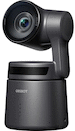
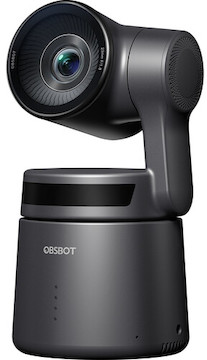
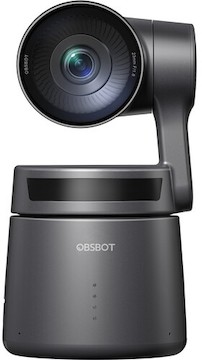
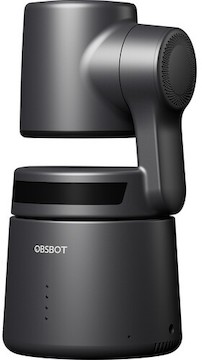
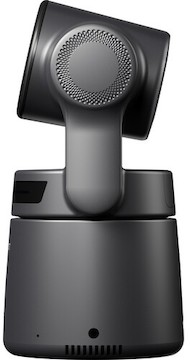
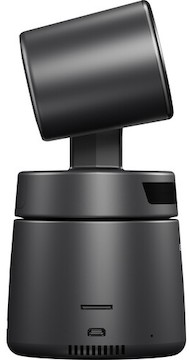
The OBSBOT Tail Air is a 4K PTZ camera with support for Sony’s VISCA protocol. For an upgraded version with rotation and more ports, see the OBSBOT Tail 2 PTZR. Key features include:
Pint-sized PTZ camera with AI for subject tracking and gesture control
8x optical lenses w/ equivalent focal length of 23mm, max f/1.8, and 4x digital zoom
8.4MP 1/1.8" CMOS sensor with 3856 × 2176 effective resolution for up to 4K@30, 1080p60
Micro HDMI, 3.5mm TRS AUX with Mic and Line IN support, USB-C host connections
PTZ Perfection. The OBSBOT Tail Air AI-Powered PTZ Streaming Camera provides you with crisp, 4K imaging to seamlessly capture every move during your presentation or meeting. This PTZ camera sports a 1/1.8" CMOS sensor with a 3856 × 2176 resolution and an eight element lens with a f/1.8 aperture, guaranteeing clean and crisp imaging for however you need to use it. Additionally, it offers a controllable panning range of ±150 degrees and a tilt of -65 degrees to 32 degrees.
AI Tracking and Multiview. Human Tracking can be activated on the Tail Air to automatically follow the subject around the room or landscape and keep them in frame, enabling a completely hands-free experience. The tracking feature works great even if the subject is a distance away, the lighting is low, or if the subject is on the move. If you activate the AI Director Grids feature, the camera will automatically crop and divide the captured video into different grids to switch between.
Control Methods. After you get the settings set up on this camera and you’re ready to record, you can start/stop recording, lock/unlock the AI target, or zoom in/out with intuitive Gesture Control 2.0. The Tail Air also supports the VISCA protocol. If you’re more comfortable with a handheld controller, you can totally grab the separately available Smart Remote for Tail Air with your rental.
Power, Memory, Ports. The Tail Air is powered by an internal lithium-ion battery that provides you with 154 minutes of operation at 1080p30 on a full charge. It takes about 90 minutes to charge via the USB-C port, which can be quite a long time for some folks. We suggest keeping it plugged into the power source as much as possible. To record and save your footage, there is a microSDXC slot that will accept cards up to 512GB. As for furthering connection options, you’ll have access to a 3.5mm TRS port for an audio accessory, a USB-C port for data transmission and power, and an HDMI port that outputs up to 4K30 and 1080p60 to supervise your footage.