Lenses and Optics
Finally, Some m4/3 MTF Testing: 25mm Prime Lens Comparison

This blog is a little different. It’s geekier than most, of course. Also, I don’t use it to make income, and that makes it a bit scattered. A mainstream blog has to cover all the hot topics. I get to cover what I’m interested in at the moment. More importantly, I don’t have to cover everything, so you rarely see me writing about stuff I don’t understand.
Another benefit is I get to watch with great amusement as various Fanboys speculate on why I don’t write about their favorite product. The actual reason is usually that the company hasn’t released lenses that interest me (Nikon in 2017, for example) or I don’t have mounts to test them (Fuji and Pentax).
Micro 4/3 is a bit different. I can test most of them (the m4/3 mount we have can’t handle linear electromagnetic focusing lenses, but can handle all the others) but it requires taking time to set up the machine differently. Since most of our contract testing is for full-frame lenses, that makes it a little inconvenient to do m4/3, and because I’m old and grumpy, I tend to avoid inconvenience.
But now it’s the holidays, we don’t have any contract testing lined up, so I am going to test some of the more interesting m4/3 lenses. So now you m4/3 shooters are getting equal opportunity to read too-long articles full of charts and graphs just like everyone else. Like they say, “be careful what you ask for, you might get it.”
As we start looking at these, I want to emphasize a couple of things, because many m4/3 users will be new to this blog. First, we’re testing the lenses with no camera involved; all we’re evaluating is the optics. My interest is in the lenses, and the lenses only. Making lenses for a smaller imaging circle has some distinct theoretical advantages. Whether the lensmakers use those advantages for good and make better lenses, or for evil to cut corners and raise margins, well, that interests me quite a bit.
When you take a picture, you’re using the system (the camera and lens each add their limitations). Despite what many self-described experts say, it is very, very rare that just the lens or just the camera limit the output of the system. In practical terms, unless you have a really horrid lens, or a 4 megapixel camera, both camera and lens contribute to the final output. (If you have both a horrid lens and a 4 megapixel camera then you don’t need to be reading this.)
One other point: with m4/3 lenses you can’t make broad generalizations about the name on the outside, because that doesn’t necessarily reflect who made the components on the inside. So if the Olympus 25mm f/1.2 is pretty awesome (it is), for example, don’t take that to mean all Olympus lenses are pretty awesome (they aren’t). The name on the outside means “We paid the people who designed the lens, made the different components, and assembled it. Some of them actually work for us, some don’t, and the ones who did this lens didn’t necessarily do that other lens.”
Let’s Meet Today’s Players
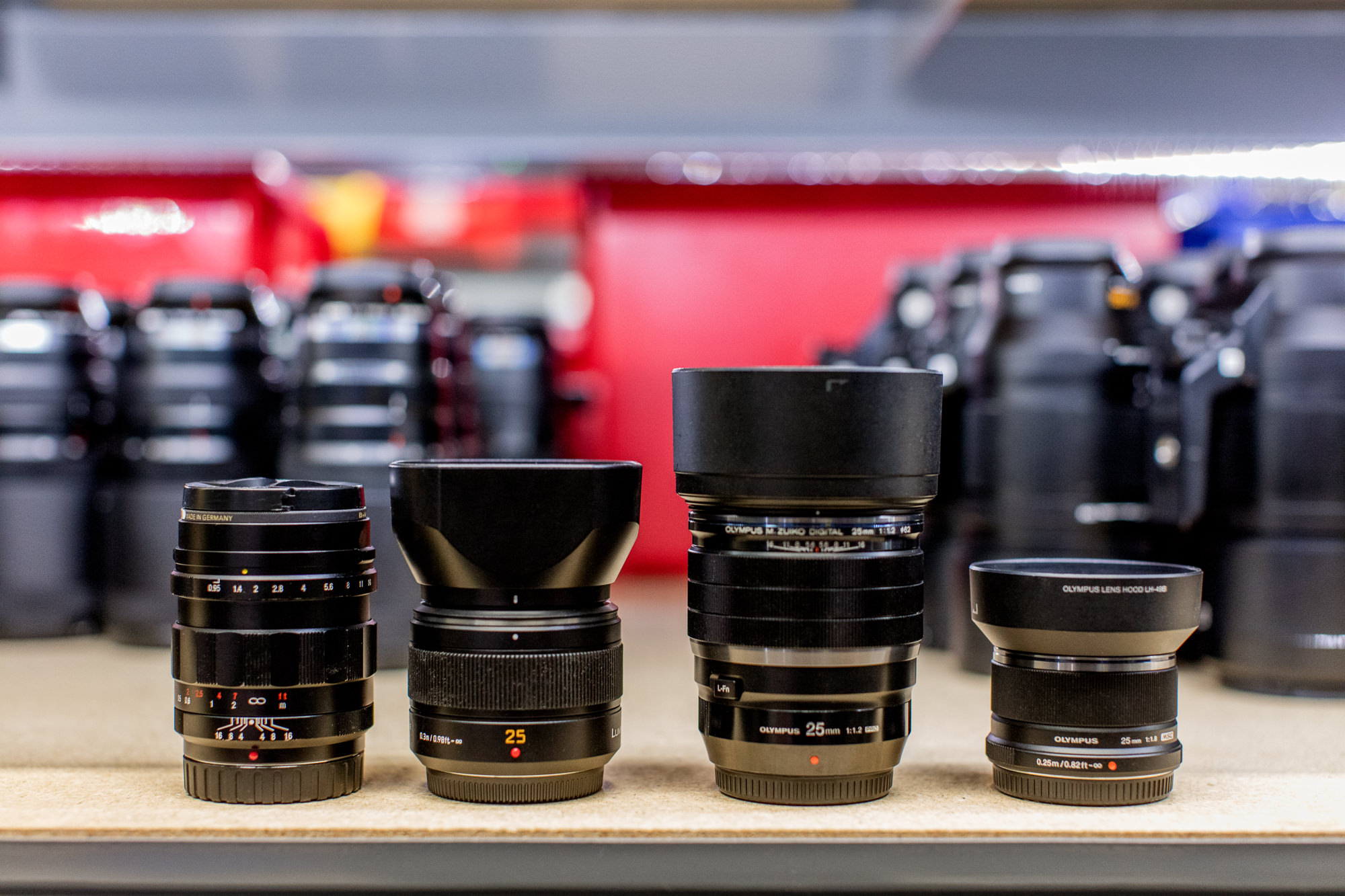
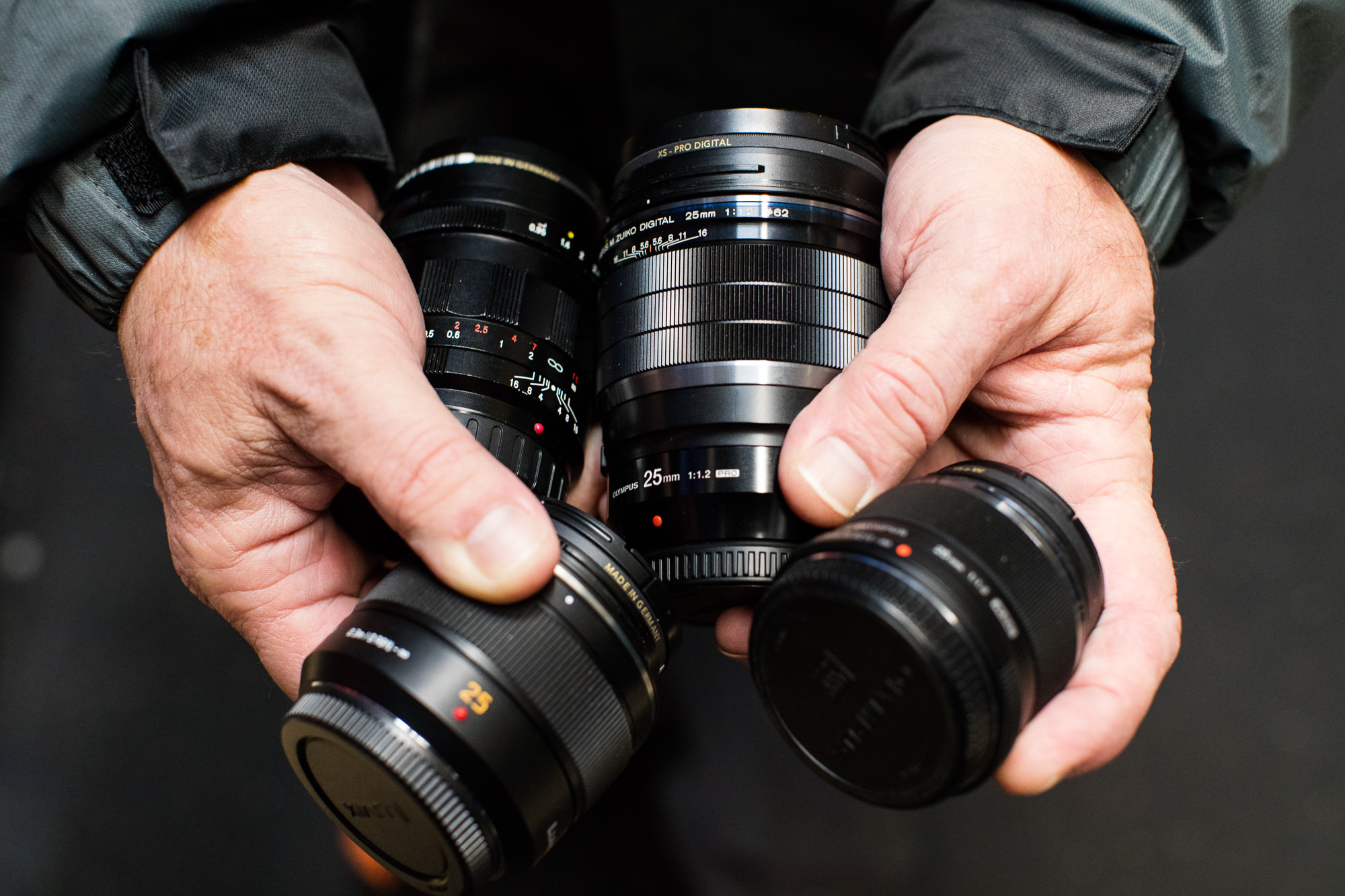
We have several lenses that meet the criteria of being 25mm primes and being testable on our machine.
- Olympus 25mm f/1.2 ED Pro
- Olympus Digital 25mm f/1.8
- Panasonic Leica DG Summilux 25mm f/1.4 ASPH
- Voigtlander 25mm f/0.95 Nokton Type II
Notably missing from this list is the Panasonic 25mm f/1.7, because, as its Fanboys will probably tell you shortly, everyone knows it’s far better than all the others, and I wanted to keep that a secret. Or because it has an electromagnetic focusing motor and we can’t test it on the optical bench. Take whichever theory best suites your degree of paranoia.
I’ll also mention that while we usually test 10 copies of each lens, but when we get into m4/3 mounts, ten copies can be hard to come by. For that reason we’ve only tested five copies of the Voigtlander, that’s all we had in stock.
The Olympus 25mm f/1.2 ED Pro
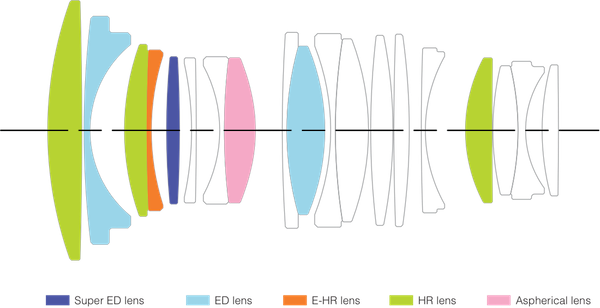
We start with this lens because it’s considered an excellent new design that has been very popular. It’s by far the most expensive of this group at about $1,200. It contains multiple low dispersion and high refraction, as well as a single aspheric element. On the other hand, 19 elements make this a very complex lens, which made us wonder what copy-to-copy variation would be like.
Courtesy Olympus.com
Olympus Digital 25mm f/1.8
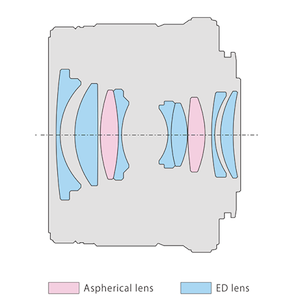
The other extreme is the little Olympus Digital 25mm. At $249 it’s the bargain lens of the bunch and it’s also the smallest. It doesn’t have as wide an aperture. It has two aspheric elements, but at this price range, we expect those are molded. So, we started with low expectations, but at this price, just a decent showing would make this a lens worth considering.
Olympus. com
Panasonic Leica DG Summilux 25mm f/1.4 ASPH
At $600 this lens has a reasonable price, it’s not very large physically, has an f/1.4 aperture, and despite what I consider the stupidest hood design in all of photography history, has a fairly rabid following who love it. It has two aspheric elements and the simplest design of all the lenses we tested. Plus, it says Leica and Summilux on the front, and we all know what that means — they paid Leica to put ‘Leica’ and ‘Summilux’ on the front. In case I wasn’t clear, I went into this test a little cynical about this lens. It’s an older design, and I expected the newer design of the Olympus might have passed it by.
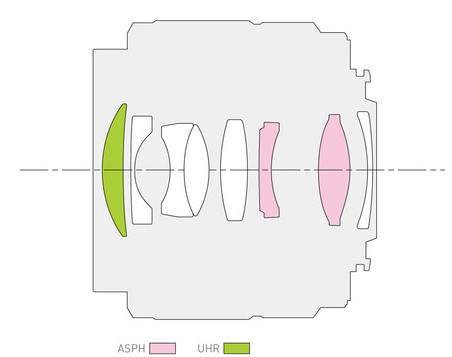
Panasonic.com
Voigtlander 25mm f/0.95 Nokton Type II
I maintain complete impartiality when it comes to lenses. Except I despise all things Voigtlander. Not because their lenses are bad, but because customer service is nonexistent and repairs nearly impossible to obtain, at least in the U. S. But at f/0.95 and a reasonable (for that kind of aperture) price tag of $800, this lens has to be considered for those who are willing to focus manually. Plus it has an all-metal construction which provides two advantages. First, it weighs a lot more. Second, you can describe it as ‘built like a tank’, which, of course, means ‘I don’t know anything about lens construction, but this one sure is heavy.’
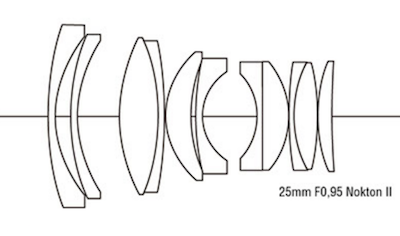
Courtesy Voigtlander
OPTICAL TESTS
MTF Results
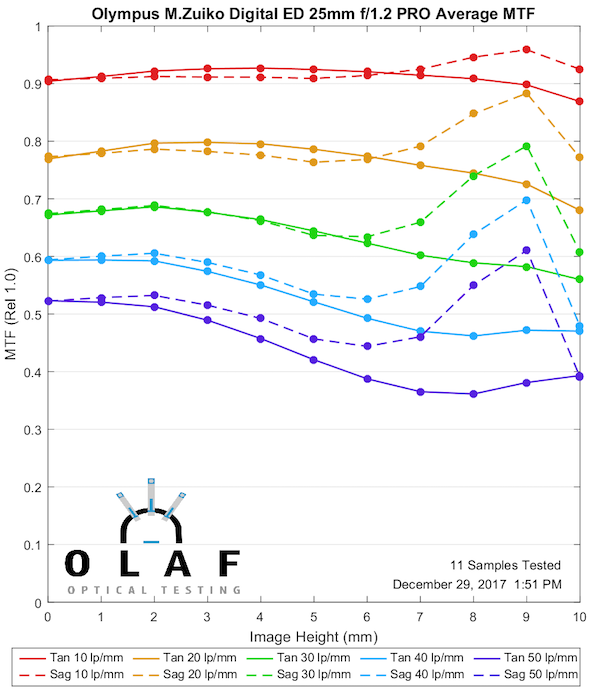
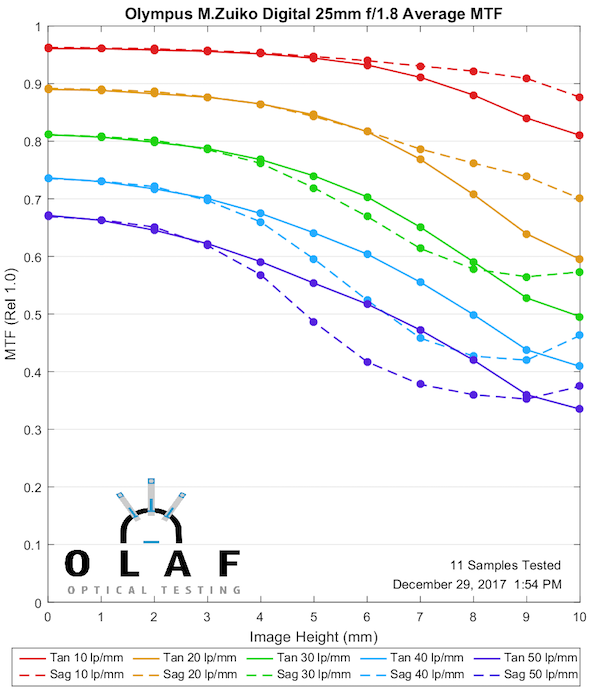
These results are all taken at widest aperture, so it’s not a direct comparison optically; a smaller aperture gives a better MTF. They’ll all improve stopped down a bit (more on that later). These MTFs are the average of 10 samples for all except the Voigtlander, which is the average of 5 samples.
Olympus 25mm f/1.2 ED Pro
This is actually very good for an f/1.2 lens, much better than the Canon 50mm f/1.2, for example. It maintains excellent sharpness in the center half of the image. It’s still quite sharp, although with some astigmatism, out to the edge.
Olaf Optical Testing, 2018
Olympus Digital 25mm f/1.8
Here’s my first surprise of this testing batch. The little Olympus is really quite good. It falls off and has some astigmatism in the outer 1/3 of the image a bit, but not badly.
Olaf Optical Testing, 2018
Panasonic Leica DG Summilux 25mm f/1.4 ASPH
The Panasonic was a bit disappointing. Even though it’s tested at a smaller aperture than the Olympus Pro, it doesn’t resolve nearly as well in the center. This is especially true of the higher frequencies (green, blue, and purple lines) which are critical for fine detail resolution on cameras with smaller pixels. It does maintain good resolution out to the edge of the frame, though.

Olaf Optical Testing, 2018
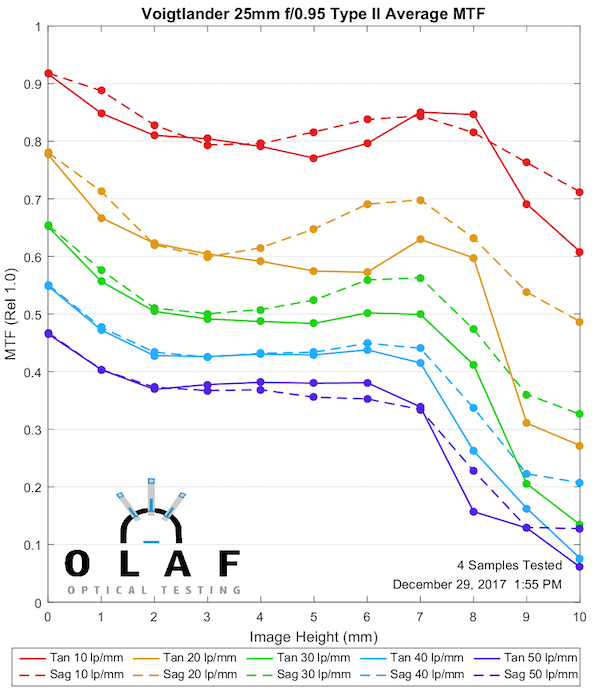
Voigtlander 25mm f/0.95 Nokton Type II
This one was also better than I expected. It resolves decently in the center and falls off at the edges. But at f/0.95 that’s unavoidable. I was impressed that it could do this well. Lenses with apertures this wide are rarely this good. Right in the center, it resolves as well at f/0.95 as the Panasonic does at f/1.4.
Olaf Optical Testing, 2018
Stop-Down Tests
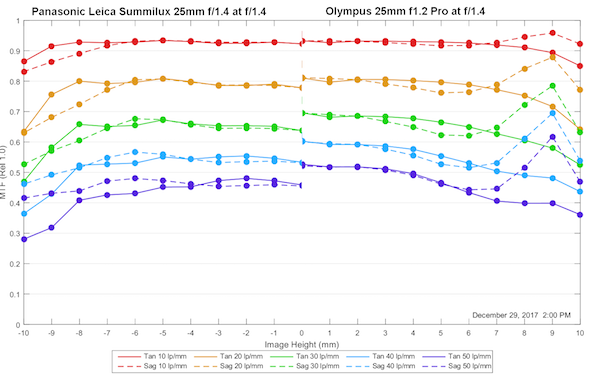
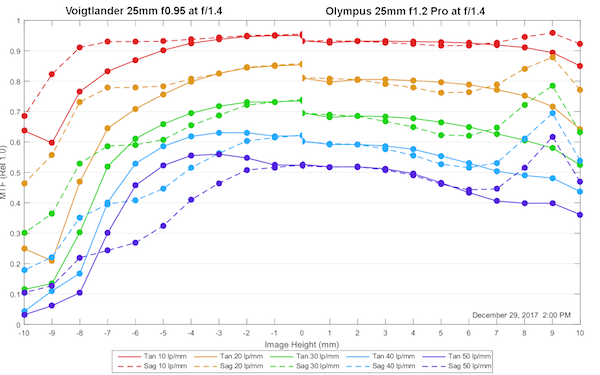
We picked an average copy of the Voigtlander and Olympus 25mm f/1.2 to retest at f/1.4, to get a little more even comparison. (And used an average copy of the Panasonic for comparison, so we weren’t comparing single lenses to a group of lenses.)
Panasonic – Olympus
The Olympus was clearly better at higher frequencies (blue and purple lines). If you’re shooting with (or looking at a test done on) a 12-megapixel camera, the high frequencies are less important.
Olaf Optical Testing, 2018
Voigtlander-Olympus
The Voigtlander surprises me yet again. It can match, perhaps slightly exceed, the Olympus in the center 1/2 of the image, although it can’t (like all ultra-wide aperture lens designs) keep up in the outer 1/3 of the image.
Olaf Optical Testing, 2014
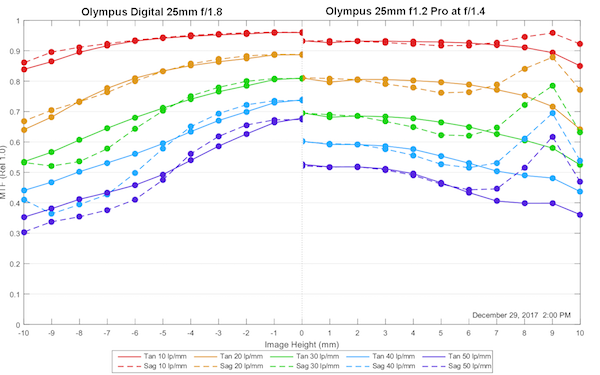
Olympus 25mm f1.8 and Olympus 25mm f/1.2 Pro at f/1.4
I didn’t test the Pro at f/1.8. To be honest, I didn’t think there would be enough competition that I’d be interested. So I’ll have to compare the Pro at f/1.4 to the Digital f/1.8 at f/1.8. Not really fair, since the Pro would do better at f/1.8. On the other hand, you can buy 4 of the little Digital f/1.8 for the price of one Pro, so . . . . .
Olaf Optical Testing, 2018
It’s kind of shocking to me that the Digital f/1.8 is significantly sharper in the center. Things even up away from the center, but still, that’s impressive. Really. Impressive. Good job little-inexpensive-lens.
Comparisons at f/2.8
Because sometimes people stop down.
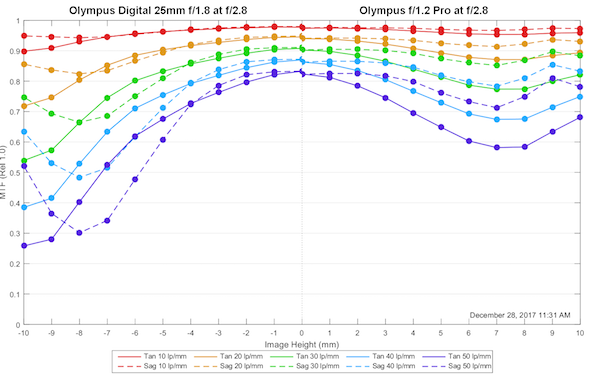
Olympus vs. Olympus
At f/2.8 the Pro is definitely superior in the outer 1/3 of the image, but the baby Olympus still impresses me with its performance at f/2.8.
Olaf Optical Testing, 2018
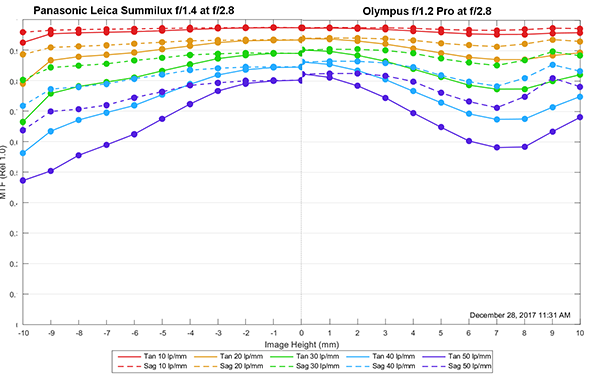
Panasonic Leica vs. Olympus Pro
At f/2.8 there’s not a lot of difference between the two. The Olympus is a bit better at the edges of the image, but it’s a small difference.
Olaf Optical Testing, 2018
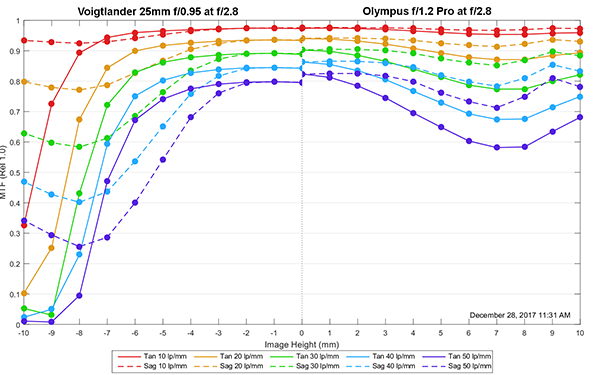
Voigtlander vs. Olympus Pro
Not surprisingly, the Olympus is now a tiny better than the Voigt in the center, and far better in the outer half of the image.
Olaf Optical Testing, 2018
Field Curvature (MTF vs. Field vs. Focus)
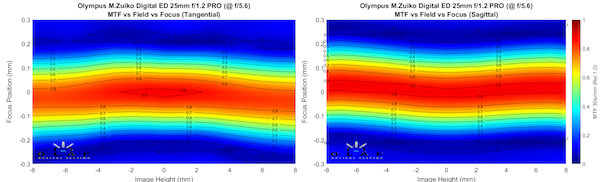
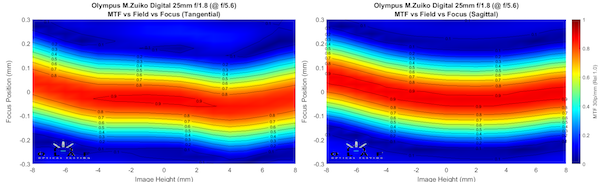
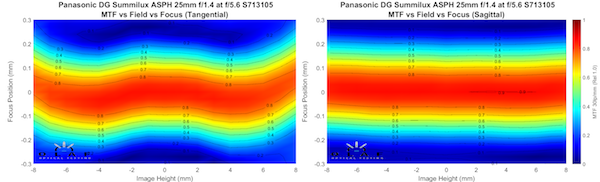
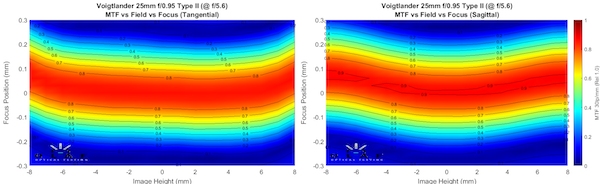
For those of you who don’t read our technical articles very often, the field curvature may be the most useful thing we give you. This is NOT distortion; rather it’s how the plane of best focus curves. The tangential and sagittal fields often curve differently; when they do you know, there will be astigmatism in those areas.
There’s other information you can get from field curvatures and if you’re interested here are some background articles: Fun with Fields of Focus 1, Fun with Fields of Focus II, Field Curvature and Stopping Down. I should mention these are done at f/5.6 because that gives a nice, clear picture of the field. Stopping down (or opening up) doesn’t change the curvature significantly. Keep in mind that when you’re shooting at a wider aperture, the field is much narrower.
We haven’t done these on many m4/3 lenses, so I had no idea what to expect. Because there’s less side-to-side distance to cover, it seemed likely that the field curvature would be less apparent.
Olympus 25mm f/1.2 ED Pro
There’s a gentle curve with this lens, but note that the sagittal field (right side) curves differently than the tangential field (left side). This means that while the overall field is flat, there is going to be some astigmatism off-center. The MTF graphs above reflect that.
Olaf Optical Testing, 2018
Olympus Digital 25mm f/1.8
Here we see a more dramatic curve, but more of a tendency to be in the same direction. At wide apertures, though, the edges of the image are not going to be in focus at the same point that the center is. With this one, the field will truly curve. This also explains that the MTF curves above drop off at the edges, not because the lens is weaker, but because the field is curving away.
Olaf Optical Testing, 2018
Panasonic Leica DG Summilux 25mm f/1.4 ASPH
Here we have two very different curves. The sagittal is almost perfectly flat; the tangential is in a W shape. This lens will have some mid-field astigmatism that will clear up near the edges, but will be pretty flat otherwise.
Olaf Optical Testing, 2018
Voigtlander 25mm f/0.95 Nokton Type II
Here’s yet another surprise to me. I really expected the ultra-wide aperture lens would have severe field curvature, but it’s not too bad. There will be edge astigmatism (where the U-shaped tangential curve continues up, while the M-shaped sagittal curve turns down). There will be a slightly curved overall field.
Olaf Optical Testing, 2018
Copy-to-Copy Variation
Micro 4/3 lenses, in general, have a lot of sample variation. Why this is I can’t say. What I can say is it’s not the fabled “QA check” that people imagine happens. Optical tolerance is done during the design of the lens and the assembly line, not by running a test at the end of manufacturing. Micro 4/3 lenses, as a rule, don’t have any compensating adjustable elements, so what you get at the end of the assembly line is what you get unless something is broken inside.
With these lenses, I wasn’t sure what to expect. The Olympus Pro is a complex lens; complexity and wide aperture tend to create a lot of variation. The Panasonic Leica and Olympus Digital f/1.8 are much simpler designs.
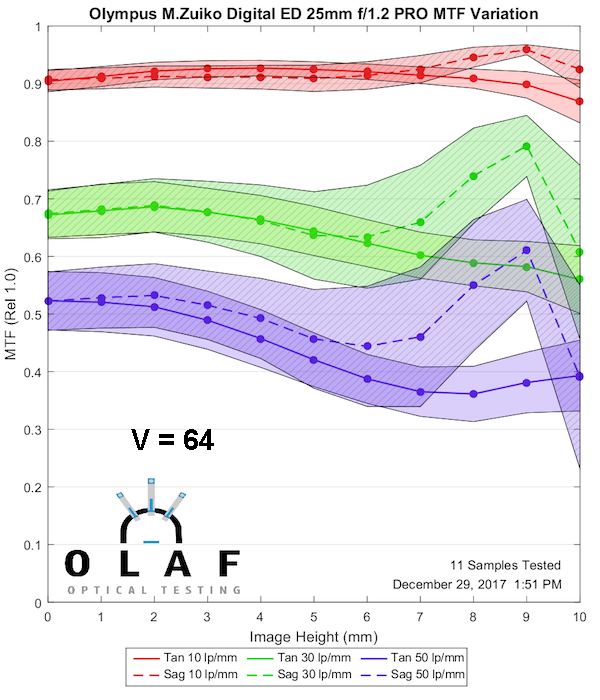
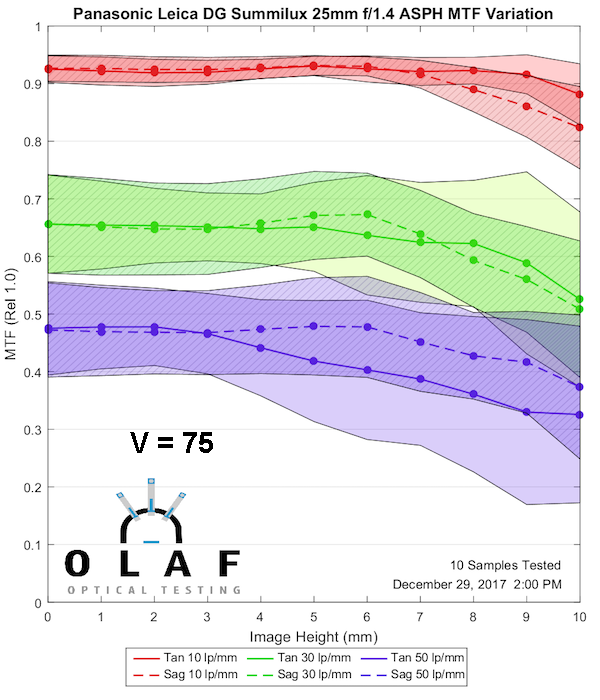
I’ve added the Variance Number to these graphs, although I want to point out that a number is a blunt tool; it’s not nearly as useful as looking at the graphs. As a rule, we consider prime lenses to be acceptable if the Variance number is less than 40, and random crap shoots if it’s over 80. So here are the graphs and variance numbers for the three lenses we could run them on. (We don’t consider five copies enough to comment on variance, so we skipped the Voigtlander in this part of the post.)
Olympus 25mm f/1.2 Pro
It looks better than the variance number suggests, but there’s some significant variation particularly in overall sharpness (notice how even in the center, there’s a fairly thick area).
Olaf Optical Testing, 2018
Olympus 25mm Digital f/1.8
The variance number says it’s quite good, but the widening as you go away from center shows that there’s likely to be some difference in one side or the other on a given copy. The current variance number doesn’t take this into account as much as I would like it to.

Olaf Optical Testing, 2018
Panasonic Leica Summilux f/1.4
Any way you look at it, there’s a lot of copy-to-copy variation, more in overall sharpness. This is getting close to the point where your copy and Bob’s copy are probably noticeably different.
Olaf Optical Testing, 2018
So What Did We Learn Today?
Well, there are several good choices if you’re interested in a 25mm prime lens for your m4/3 camera. There’s not a bad choice in the bunch; I think most people would be happy with whichever one they have.
If you absolutely need an f/1.4 or wider aperture lens, the Olympus 25mm f/1.2 Pro is probably the best overall lens, although it comes at a hefty price. If you want the widest aperture possible and are willing to manually focus and realize you probably can’t get it repaired, the Voigtlander Nokton Type II is much better optically than I had expected.
The Pansonic Leica Summilux is a good lens, and at 2/3 the price of the Olympus Pro is a reasonable choice for a lot of people. It’s certainly not better, and the copy-to-copy variation makes me hesitant to recommend it very highly. On the other hand, as I said to start with, I’m a little cynical about that lens so maybe that’s affecting my judgment. It’s still a good lens at a reasonable price.
Me personally, though, I love a bargain, and in this case, I’d be willing to give up some aperture to get it. The little Olympus 25mm f/1.8 isn’t as wide an aperture as the others. Even stopped down, it’s not quite as sharp at the edges as either the Olympus Pro or the Panasonic Leica. But at that price and that small size, it’s a great bargain and a really good lens. This one surprised me in a very positive way.
Roger Cicala and Aaron Closz
Lensrentals.com
January, 2018
Note: It’s been a while since we did an m4/ test. For those of you m4/3 Fanboys and Detractors who are so vocal in some forums, this isn’t those forums. We welcome informed discussion and opinions. We do not allow snide, or ugly personal comments to other posters. I’m not a poster; you can be snide and ugly to me if you like.

Author: Roger Cicala
I’m Roger and I am the founder of Lensrentals.com. Hailed as one of the optic nerds here, I enjoy shooting collimated light through 30X microscope objectives in my spare time. When I do take real pictures I like using something different: a Medium format, or Pentax K1, or a Sony RX1R.
-
Pak T
-
KG
-
Roger Cicala
-
KG
-
Roger Cicala
-
Kachadurian
-
Roger Cicala
-
DrJon
-
Samuel H
-
mohammad mehrzad
-
Brandon Dube
-
David Cockey
-
hjwulff
-
hjwulff
-
Roger Cicala
-
Andre Yew
-
Brandon Dube
-
Andre Yew
-
Brandon Dube
-
Andre Yew
-
Brandon Dube
-
SpecialMan
-
Claudia Muster
-
Cary Talbot
-
Brandon Dube
-
Andre Yew
-
Roger Cicala
-
Franck Mée
-
Brandon Dube
-
Andre Yew
